EP0121913A2 - Apparat und Verfahren zum Eingeben von Notenblattdaten in eine Notenblattdruckeinrichtung - Google Patents
Apparat und Verfahren zum Eingeben von Notenblattdaten in eine Notenblattdruckeinrichtung Download PDFInfo
- Publication number
- EP0121913A2 EP0121913A2 EP84103816A EP84103816A EP0121913A2 EP 0121913 A2 EP0121913 A2 EP 0121913A2 EP 84103816 A EP84103816 A EP 84103816A EP 84103816 A EP84103816 A EP 84103816A EP 0121913 A2 EP0121913 A2 EP 0121913A2
- Authority
- EP
- European Patent Office
- Prior art keywords
- data
- musical
- accordance
- tone
- entropy
- Prior art date
- Legal status (The legal status is an assumption and is not a legal conclusion. Google has not performed a legal analysis and makes no representation as to the accuracy of the status listed.)
- Granted
Links
Images










Classifications
-
- B—PERFORMING OPERATIONS; TRANSPORTING
- B41—PRINTING; LINING MACHINES; TYPEWRITERS; STAMPS
- B41B—MACHINES OR ACCESSORIES FOR MAKING, SETTING, OR DISTRIBUTING TYPE; TYPE; PHOTOGRAPHIC OR PHOTOELECTRIC COMPOSING DEVICES
- B41B27/00—Control, indicating, or safety devices or systems for composing machines of various kinds or types
-
- B—PERFORMING OPERATIONS; TRANSPORTING
- B41—PRINTING; LINING MACHINES; TYPEWRITERS; STAMPS
- B41M—PRINTING, DUPLICATING, MARKING, OR COPYING PROCESSES; COLOUR PRINTING
- B41M3/00—Printing processes to produce particular kinds of printed work, e.g. patterns
- B41M3/04—Music
Definitions
- the present invention relates to an apparatus and method for inputting musical sheet data into a musical-sheet-printing system so as to perform printing of music in accordance with the input musical sheet data.
- note data among musical sheet data are very important.
- Various types of methods have been proposed to enter and process musical note data.
- a typical example of note data input apparatus is disclosed in EPC Provisional Publication No. 53393.
- the note data is entered together with pitch data and duration data at a function keyboard.
- the corresponding "accidental" function key is depressed to enter the note data with the corresponding accidental.
- the pitch and duration data of the note must be entered at the keyboard, which hinders smooth data entry. For example, when a chord such as a triad or the like is played, the respective notes making up the chord must be entered independently.
- a musical sheet to be printed is generally handwritten. If the musical sheet data are entered as if an operator is playing the piano, pitch data entry can be performed at high speed.
- a method for entering the pitch data at a piano-keyboard input unit is disclosed in British Patent No. 1,337,201. According to this method, musical note data can be smoothly entered with function keys irrespective of chord data entry and single note data entry. An accidental can be easily entered by depressing a corresponding black key of the keyboard.
- this prior art has the following problem. There are two ways notating accidentals on a musical sheet. In particular,.any semitone must specify which accidental (sharp or flat) is added thereto. For this reason, smooth keyboard playing (i.e., smooth data input) is interrupted, and data input errors tend to occur.
- an object of the present invention to provide an apparatus for inputting musical sheet data into a musical-sheet-printing system, wherein current tonality is automatically determined without requiring depression of a "#" or "b” key even if an accidental is required, and a method of entering musical sheet data.
- entropy data of notes included in a predetermined number of note data to be processed is determined, and the corresponding accidental data is determined in accordance with the entropy data.
- the newer the note data musical data
- the better for determining the tonality and naturally the older the musical data, the lower its contribution to the tonality determination.
- the present invention permits the number of new note data to be set at a given value and employs expire rate conception.
- a tone and its accidental can be automatically determined. Therefore, high-speed, accurate data entry can be performed.
- an apparatus for inputting musical sheet data into a musical sheet-printing system comprising:
- Figs. lA and lB are schematic block diagrams showing a musical-sheet-printing system to which a musical-sheet data-input apparatus and method, according to the present invention, are applied.
- a piano keyboard 1 is connected to a microprocessor 5 through a data bus 3.
- the keyboard 1 comprises 26 white keys and 18 black keys.
- a coded musical signal is generated by depressing one of the white or black keys.
- Figs. 2A and 2 B show the relationship between treble.and bass notes and the corresponding keys.
- Figs. 3A to 3D show the relationships between a note with a natural and the corresponding key, between a note with a flat and the corresponding key, between a triad and the corresponding keys, and between a treble note and the corresponding key, respectively. These musical data can be easily entered in a one-touch manner unlike the conventional musical data entry.
- a read-only memory (to be referred to as a ROM hereafter) 7 and a random access memory (to be referred to as a RAM hereinafter) 9 are connected to the microprocessor 5 through the data bus 3.
- the microprocessor 5 comprises, for example, a microprocessor Model 9900 available from Texas Intruments Inc., U.S.A.
- the ROM 7 stores a control program for controlling a function keyboard 11 and a display unit 13, which will be described in detail later, a communication program for causing the musical sheet-printing system to communicate with a host computer 19, and a program for calculating the entropy of a note included in a predetermined number of note data to be processed.
- the function keyboard 11 and the display unit 13 are connected to the microprocessor 5 through an I/O port 15.
- the function keyboard 11 has various keys for entering musical data, as shown in Fig. 4. Table 1 shows a relationship between the function keys and their functions.
- the function keyboard 11 further comprises alphanumeric keys which are omitted for illustrative convenience.
- Input data from the function keyboard 11 is displayed at the display unit 13.
- the microprocessor 5 (to be referred to as a CPU hereafter) is connected to the host computer 19 through an I/O port 17. Edited musical data is transferred from the CPU 5 to the host computer 19.
- the host computer 19 is connected through a data bus 21 to a memory 23, a digitizer 25, a graphic printer 27, and a laser type setter 29.
- the host computer 19 comprises, for example, a computer VAX 780 available from Digital Equipment Corp., U.S.A.
- the edited musical data transferred from the CPU 5 is printed out at the graphic printer 27.
- Input error correction and expression term and mark entry are performed by the digitizer 25 by referring to a hard copy.
- the musical data, including the expression terms and marks after input data correction, are supplied to the laser type setter 29, thereby forming a block copy.
- the data entered at the piano keyboard 1 and the function keyboard 11 are stored in the RAM 9.
- the chromatic scale is obtained by dividing one octave into 12 portions. Each tone is called a chromatic tone. Seven tones are extracted from these chromatic tones in accordance with the following tone intervals: ,
- the above scale is called a diatonic scale. Since the chromatic scale consists of 12 tones, all the tones of the diatonic scale can be shifted to any of the 12 different positions of the chromatic scale. Tone shifting represents tonality. Therefore, a repertoire of 12 tones can be extracted from the main repertoire of tones (chromatic tones). This tonality is determined in accordance with the first key of a given scale. In the system of the present invention, a major key is not distinguished from a minor key.
- tonality is only used to determine the corresponding accidental.
- a given scale can be applied as a major or minor scale, so the major scale need not be distinguished from the minor scale.
- Table 2 shows tonal relationships and their numeric values.
- Table 3 shows the tonality of the diatonic scale derived from the chromatic scale.
- Table 4 is used for determining accidentals on the basis of the tonality given in Table 3.
- the relationship between a composer and audience is given as follows.
- the audience must spontaneously select a suitable one of the scales when the composer uses a modulation and an accidental in a plurality of scales.
- the audience can determine that a melody corresponds to tones of one of the 12 types of scales (i.e., he can determine which scale provides a maximum number of occurrences of music data).
- the audience can select a tonic relationship which has a maximum entropy.
- the composer corresponds to the operator and the audience corresponds to the computer.
- the computer detects which scale is suitable for the currently played melody (i.e., which tones have the maximum number of occurrences in the input tone data).
- the computer detects which scale has the maximum tonality entropy. Therefore, the computer determines that the input tone actually entered by the operator corresponds to the corresponding tone (scale/tonality) of the scale with the tonality having the maximum tonality entropy.
- the maximum entropies of the scales are obtained as shown in Table 5.
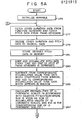
- the current tonal determination will be described with reference to Figs. 5A to 5D and Fig. 6.
- the number of note data to be processed is 12, as indicated in a block 327 in Fig. 6. Every time the piano keyboard 1 is operated, the window is shifted by one note data. Therefore, the oldest note data is excluded from the window and the newly input note data is fetched therein.
- step 275 in Fig. 5A a variable corresponding to the number of note data included in the block 327 is initialized.
- the CPU 5 fetches coded duration data supplied from the function keyboard 11 and the coded pitch data supplied from the piano keyboard 1.
- step 279 the CPU 5 decodes the duration and pitch data to digital musical data. The decoded data are stored in the memory 9 in step 281. The CPU 5 then performs the operation of step 283. In step 283, every time any one of the keys at the piano keyboard 1 is depressed, the note data is classified and counted.
- step 285 the CPU 5 decrements a counter by the number of pitch data disappearing from the window and increments the counter by the number of pitch data appearing in the window.
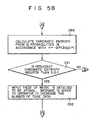
- step 291 the CPU 5 checks whether or not the resultant chromatic scale entropy is greater than 3.0. If NO in step 291, the CPU 5 performs the operation of step 295.
- step 295 the CPU 5 causes 12 different scale counters to count the seven diatonic tone data, as shown in Table 7. Table 7 actually shows 13 scale counters. However, the contents of the scale counters in Gb major/Eb minor (-6) and in F # major/D minor (+6) can be considered to be substantially equal. Therefore, the use of 12 different scale counters are sufficient to count the data.
- step 297 the CPU 5 divides the respective counts by a total count so as to obtain seven probabilities.
- step 301 the C P U 5 performs the operation of -P x log 2 P for each probability.
- step 303 the entropies of the respective products are calculated in accordance with the equation Pilog 2 p i.
- step 305 the CPU 5 calculates the entropies of each of the 12 different scales. However, when the 12-scale entropies have not been calculated, the flow returns to step 297. The CPU 5 repeats the sequence between steps 297 and 303. However, when the 12-scale entropies have been calculated, the CPU 5 advances to step 307.
- the CPU 5 selects the maximum entropy among the 12 entropies and one of the numeric values -6 to +6 representing tonality in step 307.
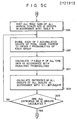
- the CPU 5 then advances to step 309.
- the CPU 5 determines an accidental and a tone, with reference to Table 4, using as parameters a tonality value (one of -6 to +6) and a chromatic tone pitch (one of 1 to 12).
- the CPU 5 transfers the tone data to the display unit 13, so that the tone data is displayed thereon.
- step 313 the CPU 5 stores tonality data and pitch data in the memory.
- the CPU 5 checks whether or not the currently input note data is the last note. If YES in step 315, the CPU 5 performs the operation of step 317 wherein all the stored data are transferred to the host computer 19.
- step 315 the CPU 5 returns to step 277.
- the CPU 5 repeates the operations of steps 277 to 315.
- step 291 the input data are determined as atonal tone data in step 293.
- the CPU 5 insctructs to narrow the window.
- the CPU 5 also guides for tonality input.
- a middle value is calculated in accordance with the tonality entropy distribution. As shown in Fig. 7, the middle value is used to select tonality input.
- the tonality input suitable for a given piece of music cannot be determined. There are two reasons for this. First, a given measure is atonal or substantially atonal, as previously described. Second, only a few tones among seven tones are used at the beginning of measures. In general, when only a few tones are used and have a weak relationship with respect to tonality, tonality determination is performed with low reliability. For example, when the tones C, F, and G are present, tonality values -4, -3, -2, -1, and 0 can be attributed to a melody consisting of the tones C, F, and G. In this case, these tones are common in keys given by tonality values -4, - 3, -2, -1, and 0.
- the number of input note data is preset, these notes are classified, and entropies of the respective notes are accumulated.
- entropy calculation is not limited to this method.
- An expire rate may be preset as a weighting coefficient. In this case, the predetermined expire rate is multiplied by the respective input data so as to calculate the corresponding entropy.
- the expire rate is defined as dx/dy when the weighting coefficient is plotted along the axis of ordinate and time is plotted along the axis of abscissa.
- the expire rate is multiplied by the number of times the previously entered note data occurs. In this manner, the significance of the previously entered note data can be lessened.
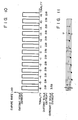
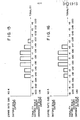
- the resultant entropy distribution is shown in Fig. 10. In this case, the expire rate is given to be 1.00.
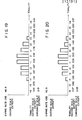
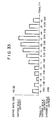
- the resultant entropy distribution is shown in Fig. 12. As apparent from Fig. 12, the diatonic-scale-entropy distribution has a peak for the tonality value "0". In this case, the expire rate is given to be 1.00.
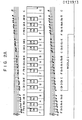
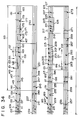
- musical sheet data such as notes 153, 221, 267, and 269 which are to have an accidental added can be entered without performing any special operations.
Landscapes
- Engineering & Computer Science (AREA)
- Multimedia (AREA)
- Auxiliary Devices For Music (AREA)
- Printing Methods (AREA)
- Preparing Plates And Mask In Photomechanical Process (AREA)
Applications Claiming Priority (2)
| Application Number | Priority Date | Filing Date | Title |
|---|---|---|---|
| JP61603/83 | 1983-04-08 | ||
| JP58061603A JPS59187886A (ja) | 1983-04-08 | 1983-04-08 | 楽譜印刷システムにおける楽譜デ−タの入力装置および方法 |
Publications (3)
| Publication Number | Publication Date |
|---|---|
| EP0121913A2 true EP0121913A2 (de) | 1984-10-17 |
| EP0121913A3 EP0121913A3 (en) | 1986-10-01 |
| EP0121913B1 EP0121913B1 (de) | 1988-09-14 |
Family
ID=13175903
Family Applications (1)
| Application Number | Title | Priority Date | Filing Date |
|---|---|---|---|
| EP84103816A Expired EP0121913B1 (de) | 1983-04-08 | 1984-04-06 | Apparat und Verfahren zum Eingeben von Notenblattdaten in eine Notenblattdruckeinrichtung |
Country Status (4)
| Country | Link |
|---|---|
| US (1) | US4603386A (de) |
| EP (1) | EP0121913B1 (de) |
| JP (1) | JPS59187886A (de) |
| DE (1) | DE3474007D1 (de) |
Families Citing this family (16)
| Publication number | Priority date | Publication date | Assignee | Title |
|---|---|---|---|---|
| JPS61171342A (ja) * | 1985-01-24 | 1986-08-02 | Toppan Printing Co Ltd | 楽譜デ−タ入力装置 |
| JPH085246B2 (ja) * | 1987-11-06 | 1996-01-24 | 凸版印刷株式会社 | 楽譜版下作成装置 |
| WO1989001651A1 (en) * | 1987-08-18 | 1989-02-23 | Toppan Printing Co., Ltd. | Musical score drawer |
| JPH01131566A (ja) * | 1987-11-17 | 1989-05-24 | Toppan Printing Co Ltd | 楽譜版下作成装置 |
| JPH01130971A (ja) * | 1987-11-18 | 1989-05-23 | Toppan Printing Co Ltd | 楽譜版下作成装置 |
| US5038658A (en) * | 1988-02-29 | 1991-08-13 | Nec Home Electronics Ltd. | Method for automatically transcribing music and apparatus therefore |
| JP2832988B2 (ja) * | 1989-03-07 | 1998-12-09 | ヤマハ株式会社 | データ検索システム |
| US6411289B1 (en) * | 1996-08-07 | 2002-06-25 | Franklin B. Zimmerman | Music visualization system utilizing three dimensional graphical representations of musical characteristics |
| FR2775630B1 (fr) * | 1998-03-05 | 2000-06-30 | Informusique Sa | Systeme d'edition de documents, tels que partitions musicales |
| US7532943B2 (en) * | 2001-08-21 | 2009-05-12 | Microsoft Corporation | System and methods for providing automatic classification of media entities according to sonic properties |
| US7065416B2 (en) * | 2001-08-29 | 2006-06-20 | Microsoft Corporation | System and methods for providing automatic classification of media entities according to melodic movement properties |
| US7035873B2 (en) * | 2001-08-20 | 2006-04-25 | Microsoft Corporation | System and methods for providing adaptive media property classification |
| US7589727B2 (en) * | 2005-01-18 | 2009-09-15 | Haeker Eric P | Method and apparatus for generating visual images based on musical compositions |
| JP4737212B2 (ja) * | 2008-03-07 | 2011-07-27 | 日本電気株式会社 | メロディ作成装置、方法、プログラム、及び、携帯端末装置 |
| US8884148B2 (en) * | 2011-06-28 | 2014-11-11 | Randy Gurule | Systems and methods for transforming character strings and musical input |
| US10657935B2 (en) * | 2017-12-18 | 2020-05-19 | Debra Diane Lewis | Magnum opus method, program, and app |
Family Cites Families (10)
| Publication number | Priority date | Publication date | Assignee | Title |
|---|---|---|---|---|
| US3331271A (en) * | 1964-06-15 | 1967-07-18 | Glenn Helen Gregg | Musical notation |
| US3698277A (en) * | 1967-05-23 | 1972-10-17 | Donald P Barra | Analog system of music notation |
| FR2100961B1 (de) * | 1970-07-29 | 1973-06-29 | Consiliul National Pentru | |
| US3700785A (en) * | 1971-07-02 | 1972-10-24 | Verna M Leonard | Means for simplified rewriting of music |
| US4104949A (en) * | 1976-03-08 | 1978-08-08 | Timmy Clark | Apparatus and method for transcribing musical notations |
| IT7869805A0 (it) * | 1977-12-09 | 1978-12-07 | Capper Styles Whole Tone Co | Notazione musicale |
| US4215343A (en) * | 1979-02-16 | 1980-07-29 | Hitachi, Ltd. | Digital pattern display system |
| EP0053393B1 (de) * | 1980-12-03 | 1985-05-22 | Dai Nippon Insatsu Kabushiki Kaisha | Vorrichtung zum Drucken von Musiknoten |
| JPS5845979A (ja) * | 1981-09-14 | 1983-03-17 | Nippon Gakki Seizo Kk | 楽譜プリント装置 |
| JPS58211486A (ja) * | 1982-06-04 | 1983-12-08 | Nippon Gakki Seizo Kk | 楽譜プリント装置 |
-
1983
- 1983-04-08 JP JP58061603A patent/JPS59187886A/ja active Granted
-
1984
- 1984-04-06 US US06/597,687 patent/US4603386A/en not_active Expired - Lifetime
- 1984-04-06 EP EP84103816A patent/EP0121913B1/de not_active Expired
- 1984-04-06 DE DE8484103816T patent/DE3474007D1/de not_active Expired
Also Published As
| Publication number | Publication date |
|---|---|
| US4603386A (en) | 1986-07-29 |
| DE3474007D1 (en) | 1988-10-20 |
| EP0121913B1 (de) | 1988-09-14 |
| EP0121913A3 (en) | 1986-10-01 |
| JPS59187886A (ja) | 1984-10-25 |
| JPH023978B2 (de) | 1990-01-25 |
Similar Documents
| Publication | Publication Date | Title |
|---|---|---|
| EP0121913B1 (de) | Apparat und Verfahren zum Eingeben von Notenblattdaten in eine Notenblattdruckeinrichtung | |
| US4646609A (en) | Data input apparatus | |
| US6791021B2 (en) | Automatic chord progression correction apparatus and automatic composition apparatus | |
| US5525749A (en) | Music composition and music arrangement generation apparatus | |
| US5756918A (en) | Musical information analyzing apparatus | |
| CN110390859B (zh) | 一种基于MusicXML乐谱到盲文的转换方法及系统 | |
| US5852252A (en) | Chord progression input/modification device | |
| Smith | Editing and printing music by computer | |
| US5063820A (en) | Electronic musical instrument which automatically adjusts a performance depending on the type of player | |
| US7166792B2 (en) | Storage medium containing musical score displaying data, musical score display apparatus and musical score displaying program | |
| US4498363A (en) | Just intonation electronic keyboard instrument | |
| US5418325A (en) | Automatic musical arrangement apparatus generating harmonic tones | |
| Byrd | A system for music printing by computer | |
| JP2705334B2 (ja) | 自動伴奏装置 | |
| US5459281A (en) | Electronic musical instrument having a chord detecting function | |
| US6031171A (en) | Performance data analyzer | |
| EP0379577B1 (de) | Zeichengerät für partituren | |
| EP0053393B1 (de) | Vorrichtung zum Drucken von Musiknoten | |
| JPH05249974A (ja) | 調検出装置 | |
| EP0317583A1 (de) | Rechnergesteuertes schreibsystem für notenschrift | |
| US5283388A (en) | Auto-play musical instrument with an octave shifter for editing phrase tones | |
| JP2555673B2 (ja) | 楽譜版下作成装置 | |
| US5119713A (en) | Electronic musical instrument having a portamento function utilizing whole and half transformations | |
| JP3018357B2 (ja) | 電子楽器 | |
| GB2212318A (en) | Apparatus for production of a musical score |
Legal Events
| Date | Code | Title | Description |
|---|---|---|---|
| PUAI | Public reference made under article 153(3) epc to a published international application that has entered the european phase |
Free format text: ORIGINAL CODE: 0009012 |
|
| AK | Designated contracting states |
Designated state(s): DE FR GB |
|
| PUAL | Search report despatched |
Free format text: ORIGINAL CODE: 0009013 |
|
| AK | Designated contracting states |
Kind code of ref document: A3 Designated state(s): DE FR GB |
|
| 17P | Request for examination filed |
Effective date: 19861020 |
|
| 17Q | First examination report despatched |
Effective date: 19880202 |
|
| GRAA | (expected) grant |
Free format text: ORIGINAL CODE: 0009210 |
|
| AK | Designated contracting states |
Kind code of ref document: B1 Designated state(s): DE FR GB |
|
| REF | Corresponds to: |
Ref document number: 3474007 Country of ref document: DE Date of ref document: 19881020 |
|
| ET | Fr: translation filed | ||
| PLBE | No opposition filed within time limit |
Free format text: ORIGINAL CODE: 0009261 |
|
| STAA | Information on the status of an ep patent application or granted ep patent |
Free format text: STATUS: NO OPPOSITION FILED WITHIN TIME LIMIT |
|
| 26N | No opposition filed | ||
| PGFP | Annual fee paid to national office [announced via postgrant information from national office to epo] |
Ref country code: FR Payment date: 19990409 Year of fee payment: 16 |
|
| PGFP | Annual fee paid to national office [announced via postgrant information from national office to epo] |
Ref country code: DE Payment date: 20000403 Year of fee payment: 17 |
|
| PGFP | Annual fee paid to national office [announced via postgrant information from national office to epo] |
Ref country code: GB Payment date: 20000405 Year of fee payment: 17 |
|
| PG25 | Lapsed in a contracting state [announced via postgrant information from national office to epo] |
Ref country code: FR Free format text: LAPSE BECAUSE OF NON-PAYMENT OF DUE FEES Effective date: 20001229 |
|
| REG | Reference to a national code |
Ref country code: FR Ref legal event code: ST |
|
| PG25 | Lapsed in a contracting state [announced via postgrant information from national office to epo] |
Ref country code: GB Free format text: LAPSE BECAUSE OF NON-PAYMENT OF DUE FEES Effective date: 20010406 |
|
| GBPC | Gb: european patent ceased through non-payment of renewal fee |
Effective date: 20010406 |
|
| PG25 | Lapsed in a contracting state [announced via postgrant information from national office to epo] |
Ref country code: DE Free format text: LAPSE BECAUSE OF NON-PAYMENT OF DUE FEES Effective date: 20020201 |