EP0122653A1 - Verfahren und Einrichtung zum Sortieren von Gegenständen nach ihrer äusseren Erscheinung, insbesondere für eine Farbsortierung von Gegenständen - Google Patents
Verfahren und Einrichtung zum Sortieren von Gegenständen nach ihrer äusseren Erscheinung, insbesondere für eine Farbsortierung von Gegenständen Download PDFInfo
- Publication number
- EP0122653A1 EP0122653A1 EP84200396A EP84200396A EP0122653A1 EP 0122653 A1 EP0122653 A1 EP 0122653A1 EP 84200396 A EP84200396 A EP 84200396A EP 84200396 A EP84200396 A EP 84200396A EP 0122653 A1 EP0122653 A1 EP 0122653A1
- Authority
- EP
- European Patent Office
- Prior art keywords
- sorting
- video
- digital
- series
- matrix
- Prior art date
- Legal status (The legal status is an assumption and is not a legal conclusion. Google has not performed a legal analysis and makes no representation as to the accuracy of the status listed.)
- Withdrawn
Links
- 238000000034 method Methods 0.000 title claims abstract description 25
- 239000011159 matrix material Substances 0.000 claims abstract description 27
- 238000012360 testing method Methods 0.000 claims abstract description 25
- 238000004364 calculation method Methods 0.000 claims abstract description 22
- 230000015654 memory Effects 0.000 claims description 35
- 238000006243 chemical reaction Methods 0.000 claims description 26
- 238000004458 analytical method Methods 0.000 claims description 23
- 238000012545 processing Methods 0.000 claims description 14
- 230000006870 function Effects 0.000 claims description 12
- 230000005540 biological transmission Effects 0.000 claims description 7
- 230000003936 working memory Effects 0.000 claims description 7
- 238000005070 sampling Methods 0.000 claims description 4
- 238000001514 detection method Methods 0.000 claims description 2
- 241000220225 Malus Species 0.000 description 7
- 235000013399 edible fruits Nutrition 0.000 description 7
- 230000006978 adaptation Effects 0.000 description 5
- 235000021016 apples Nutrition 0.000 description 5
- 238000004891 communication Methods 0.000 description 5
- 238000010200 validation analysis Methods 0.000 description 4
- 238000010586 diagram Methods 0.000 description 3
- 230000005855 radiation Effects 0.000 description 3
- 241000863032 Trieres Species 0.000 description 2
- 230000008901 benefit Effects 0.000 description 2
- 230000007547 defect Effects 0.000 description 2
- 239000000284 extract Substances 0.000 description 2
- 238000000429 assembly Methods 0.000 description 1
- 230000000712 assembly Effects 0.000 description 1
- 238000012550 audit Methods 0.000 description 1
- 230000008033 biological extinction Effects 0.000 description 1
- 238000012217 deletion Methods 0.000 description 1
- 230000037430 deletion Effects 0.000 description 1
- 230000008030 elimination Effects 0.000 description 1
- 238000003379 elimination reaction Methods 0.000 description 1
- 238000002474 experimental method Methods 0.000 description 1
- 235000012055 fruits and vegetables Nutrition 0.000 description 1
- JEIPFZHSYJVQDO-UHFFFAOYSA-N iron(III) oxide Inorganic materials O=[Fe]O[Fe]=O JEIPFZHSYJVQDO-UHFFFAOYSA-N 0.000 description 1
- 238000005259 measurement Methods 0.000 description 1
- 238000010606 normalization Methods 0.000 description 1
- 238000012546 transfer Methods 0.000 description 1
Images

Classifications
-
- B—PERFORMING OPERATIONS; TRANSPORTING
- B07—SEPARATING SOLIDS FROM SOLIDS; SORTING
- B07C—POSTAL SORTING; SORTING INDIVIDUAL ARTICLES, OR BULK MATERIAL FIT TO BE SORTED PIECE-MEAL, e.g. BY PICKING
- B07C5/00—Sorting according to a characteristic or feature of the articles or material being sorted, e.g. by control effected by devices which detect or measure such characteristic or feature; Sorting by manually actuated devices, e.g. switches
- B07C5/34—Sorting according to other particular properties
- B07C5/342—Sorting according to other particular properties according to optical properties, e.g. colour
- B07C5/3422—Sorting according to other particular properties according to optical properties, e.g. colour using video scanning devices, e.g. TV-cameras
Definitions
- the invention relates to a method of sorting objects according to parameters relating to their external appearance; it extends to a device for implementing said method.
- the invention can in particular be applied.
- Numerous devices which aim to achieve colorimetric sorting of objects.
- the majority of these devices performs the sorting by emitting a given signal or radiation towards the object, by capturing said signal or radiation after reflection on the object or passage through it and by carrying out an analog measurement of this latter signal. or radiation to deduce certain characteristics of the object.
- the analysis "on the fly" of the analog video signal to define the characteristics of the object allows only to perform sorting based on a small number of simple parameters. It should be noted that the need to project a pattern on each object involves a relatively complex device and limits its application to objects of sufficient area, whose disparities in shape are not too great.
- the present invention proposes to overcome the defects of existing systems.
- An objective of the invention is in particular to provide a system capable of carrying out an extremely fine sorting of objects, making it possible in particular to differentiate objects having local heterogeneities of surfaces such as local irregularity, punctual spot, local differences in color. , etc ..., even if the average parametric values of these objects do not allow them to be distinguished.
- Another objective of the invention is to provide a system benefiting from a great flexibility of adaptation in order to make it usable for different applications or the nature of the sorting to be carried out and its parameters can be very different.
- Another objective is to provide a simple structure system capable of allowing very high sorting rates.
- video image is meant, in the broad sense, not only a standard television image, but also any image represented by an electrical signal generated by a two-dimensional electronic scanning of the object (scanning with X-rays, r or infrared, image supplied by a charge transfer circuit "CCD”, etc ).
- the invention is therefore essentially characterized by the combination of the following three points: use of a video image of each object, which is converted into a digital matrix; memorization in real time of this matrix which remains available for the duration of the treatment; processing in two successive calculation stages functions of the sorting to be carried out, a first stage during which are stored, in the form of intermediate calculation results, the information from the matrix useful for carrying out the sorting considered, a second stage where the sorting decision.
- each object is available before the treatment and throughout its duration, so that the process of the in vention allows to take into account all the appearance characteristics of the object whatever they are, whether they affect the object as a whole or on the contrary that they are limited to an area of it.
- the two stages of processing are programmable according to each application and make it possible, as a function of the latter, firstly, to retain, in contracted forms, the information useful for the planned sorting, then to carry out the decision-making tests on these information or information derived from it.
- Video images can be generated in black and white by standard video cameras at low cost; digital conversion then consists in assigning to the points of the image codes with several bits representative of the gray levels of these points among a number of predetermined levels between white and black.
- the video images can be generated in color, the conversion being carried out, in an identical manner to that mentioned above, for each chromatic component (three in number in a normalized color video signal).
- the objects to be sorted are caused to scroll along at least one sorting line and two video images of each object seen from different angles are generated by means of two cameras arranged facing each other.
- each sorting line the two images of the same object being converted, stored and processed with a time offset so as to successively deliver two series of digital information corresponding to said object, series of information on which the tests of the sorting to be done.
- the invention makes it possible in particular to carry out a sorting of objects according to colorimetric parameters.
- each matrix of digital codes can then consist in calculating the weight of each gray level by counting the number of digital codes corresponding to the various gray levels, with a view to delivering words in number equal to the number of gray levels ⁇ programmed, the tests carried out on this series of words consisting in calculating statistical quantities characteristic of said series, such as mean, standard deviation, variance ... and in comparing them with thresholds to deliver the exploitable classification signals.
- the number of gray levels taken into account is programmed according to the finesse of analysis required by the sorting, in particular: 8 levels (three-bit words), 16 levels (four-bit words) or, in the event of very sorting sophisticated, 64 levels (six-bit words). For example, using 16 gray levels, experiments have shown that it is possible to sort apples according to international colorimetric standards, with an error rate of less than 5% and at rates higher than 5 fruits per second. by sorting line.
- Such processing makes it possible, with relatively light computing means, to use all the useful information of the two video images without introducing distortions due to possible overlapping areas.
- Each calculation unit can advantageously be constituted by a microprocessor.
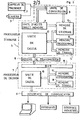
- the sorting device shown by way of example in the figures comprises several sorting lines T 1 , T 2 , T 3 ..., along which the objects to be sorted are brought to pass by suitable drive means ( Figure 1 ).
- the objects consist of apples which are placed on conveyor belts, such as 1; each mat may consist of rollers (not shown) which rotate the apples on themselves during their movement.
- each sorting line is equipped with a presence sensor 2 adapted to detect the presence of apples and generate a presence signal when an apple is running at its level.
- This sensor 2 is of any type known per se (photo-sensor, electromagnetic sensor, etc.).
- two black and white video cameras 3 and 4 are arranged opposite each sorting line and offset with respect to each other along the direction of travel of the belts, so as to provide an image of two faces of each apple (this one having turned on itself during its journey between the cameras).
- These standard type cameras each supply an analysis processor 5 with an analog video signal; on presence signal command from sensor 2 (after intro duction of a delay corresponding to the offset of the camera considered and of the sensor 2), the video signal is captured, converted in the form of a matrix of digital codes, then processed to deliver a series of digital information, function of sorting and representative of the parametric values of the object.
- the information series from the various analysis processors are delivered, through asynchronous transmission means 6, to a decision processor-7, adapted to perform sorting tests on said series.
- the two sets of information, representative of the same object and coming from the two cameras 3 and 4 of the same sorting line, are converted, stored and processed with a determined time offset, in the two corresponding analysis processors, then delivered successively to the decision processor 7.
- the latter delivers exploitable classification information which is routed through a communication interface 8, to an operating device (display means, printer, industrial interface for controlling a mechanical referral system ).
- FIG. 2 is a block diagram showing the general structure of an analysis processor 5 and of the decision processor 7.
- the analysis processor 5 comprises a conversion unit 9 which receives the video signal from the camera 3 and the presence signal from the detection sensor 2; in the presence of a fruit, this unit 9 captures the video signal and assigns to the points of the image multi-bit codes representative of the gray levels of these points among a number of predetermined levels between white and black, thus delivering a matrix of digital codes representative of said image.
- the conversion unit is adapted, as will be seen below, to select certain lines distributed among all the lines of the frame (for example 1 line out of 2) and, for each selected line, a certain number of points (for example 100 points per line). This reduces the storage and calculation means of the analysis processor without, in practice, detracting from the finesse of the sorting to be carried out.
- the analysis processor also comprises a storage memory 10 capable of memorizing a matrix of digital codes on command of a direct memory access unit 11, a calculation unit 12 composed of a microprocessor, a program memory 13 and a working memory 14 associated with the microprocessor.
- the program memory 13 contains the program of the logical operations to be carried out by the microprocessor 12, logical operations which are a function of the sorting to be carried out and which make it possible, from the digital matrix contained in the storage memory 10, to develop a series d 'much smaller information.
- the program written in the memory 13 is easily adaptable to each application without modifying the structure of the device.
- each series of information coming from the microprocessor 12 represents the weight of each gray level and comprises 16 words of 16 bits each, which are delivered through the transmission means 6 to the decision processor 7.
- each digital code matrix by the microprocessor 12 is carried out in real time during the period of time separating the end of storage in memory 10 and the capture of a new image in the conversion unit. ; the digital code matrix is kept in memory 10 for this entire period of time.
- the microprocessor is of the "TEXAS TMS 9995" type, the processing lasts approximately 100 milliseconds, which is perfectly compatible with obtaining high sorting rates.
- the decision processor 7 receives the successive series of information from the analysis processors, which are distributed via a bus 15 to a calculation unit 16 constituted as previously by a microprocessor; this is associated with a program memory 17 containing the calculations and tests to be performed and with a working memory 18.
- the program contained in the memory 17 is adapted to the sorting envisaged.
- a calculation is first performed by the microprocessor 16 to provide statistical quantities which represent, in contracted form, each series of information (mean, standard deviation, variance, etc.) and are a function of sorting. to achieve ; it is these statistical quantities which are then compared with thresholds to deliver to the communication interface 8 an exploitable classification signal.
- two sets of information are delivered by each object to the bus 15; these series are temporally offset by a determined period of time and this characteristic is used by the bus to match the series of information relating to the same object, in order to enable the microprocessor 16 to carry out the appropriate calculations.
- the statistical quantities mentioned above will be calculated, on the one hand, for each of the 2 sets of information, on the other hand, for the set formed by the union of these sets and the tests will be performed on these three sets of statistical quantities (in particular tests of minimum distance with respect to reference points in a space with 3 n dimensions / where n is the number of statistical quantities taken into account).
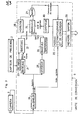
- FIG. 3 shows by way of example the block diagram of an embodiment of the conversion unit 9.
- a calibrator 19 the video component and the synchronization signals are separated from the video signal coming from the camera.
- the calibrated video component is sent to a sampling and conversion module 20, which is suitable for temporally cutting said video component and for assigning to each sample a digital code representative of the amplitude of the signal. This code is generated by comparison with a plurality of amplitude thresholds (8, 16 or 64) representative of gray levels.
- the synchronization signals from the calibrator 19 are processed to control the start-up and coding stopped by module 20.
- a monostable flip-flop 21 extracts the signals from the start of the frame and delivers them to another flip-flop 22 which receives the signal from the presence sensor 2 after passing through a delay circuit 23.
- This flip-flop 22 delivers a validation signal when it is in the presence, at the same time, of a frame start signal and of a signal representative of the presence of a fruit.
- This validation signal is delivered to the validation input of another flip-flop 24 which receives the signals for the start of selected lines.
- These signals are generated from the synchronization signal by means of a divider 25 which extracts certain line start signals and suppresses the others.
- this divider can be provided to extract a line start signal out of 2, so that only the corresponding lines will then be taken into account.
- the flip-flop 24 receives the line start signals from the timed flip-flop 26, the validation signals from the flip-flop 22 and, on another input, conversion stop signals when the desired number of points has been coded for a given line. This flip-flop 24 delivers signals to a NAND gate 27 which authorize the coding of the lines selected from the start of a frame.
- the gate 27 simultaneously receives the signals from a clock 28 (which moreover synchronizes the various components of the device) and delivers conversion control signals to the module 20.
- the module performs the sampling of the calibrated video signal of the line considered and the coding of the samples. It delivers the digital codes to a buffer memory 29 which stores them temporarily before they are stored in the storage memory 10 of the analysis processor.
- the module 20 is connected to a counter 30, which it increments at each coded point.
- This counter is programmed to provide a conversion stop signal to the flip-flop 24 when a certain number of points distributed on the line have been coded (one can for example take into account 100 points on each selected line).
- the conversion unit described above by way of example makes it possible to select certain lines from the set in the video component and to count and code a determined number of points on each line.
- This selection will in practice depend on the complexity and the finesse of the sorting to be carried out; it makes it possible to lighten the means of the device (storage means, calculation means) and to achieve higher processing speeds.
Landscapes
- Engineering & Computer Science (AREA)
- Multimedia (AREA)
- Sorting Of Articles (AREA)
- Closed-Circuit Television Systems (AREA)
Applications Claiming Priority (2)
| Application Number | Priority Date | Filing Date | Title |
|---|---|---|---|
| FR8305555A FR2543457B1 (fr) | 1983-03-29 | 1983-03-29 | Procede et dispositif pour le triage d'objets en fonction de leur aspect externe, en particulier pour un tirage colorimetrique d'objets |
| FR8305555 | 1983-03-29 |
Publications (1)
| Publication Number | Publication Date |
|---|---|
| EP0122653A1 true EP0122653A1 (de) | 1984-10-24 |
Family
ID=9287537
Family Applications (1)
| Application Number | Title | Priority Date | Filing Date |
|---|---|---|---|
| EP84200396A Withdrawn EP0122653A1 (de) | 1983-03-29 | 1984-03-20 | Verfahren und Einrichtung zum Sortieren von Gegenständen nach ihrer äusseren Erscheinung, insbesondere für eine Farbsortierung von Gegenständen |
Country Status (3)
| Country | Link |
|---|---|
| EP (1) | EP0122653A1 (de) |
| ES (1) | ES531003A0 (de) |
| FR (1) | FR2543457B1 (de) |
Cited By (6)
| Publication number | Priority date | Publication date | Assignee | Title |
|---|---|---|---|---|
| EP0342354A3 (de) * | 1988-04-15 | 1992-01-08 | Tecnostral S.A. Industria E Tecnologia | Vorrichtung zur Sortierung nach Farbe |
| US5085325A (en) * | 1988-03-08 | 1992-02-04 | Simco/Ramic Corporation | Color sorting system and method |
| EP0459342A3 (en) * | 1990-05-28 | 1992-05-06 | Seichter Gmbh | Sorting device |
| FR2732464A1 (fr) * | 1995-03-30 | 1996-10-04 | Alcatel Cable | Procede et dispositif de verification de la conformite d'un element isolant donne avec un element isolant de reference |
| ES2123422A1 (es) * | 1996-07-03 | 1999-01-01 | Amaducci Romana | Procedimiento y dispositivo para clasificacion cromatica de productos. |
| FR3025120A1 (fr) * | 2014-09-02 | 2016-03-04 | Fachaux Et Fils Ets | Calibreuse amelioree pour fruits et/ou legumes |
Citations (4)
| Publication number | Priority date | Publication date | Assignee | Title |
|---|---|---|---|---|
| DE2318849A1 (de) * | 1973-04-13 | 1974-10-17 | Remy Ernst Dr | Verfahren zur optischen auslese oder zum optischen pruefen von objekten, wie z.b. behaeltern od.dgl |
| GB1401854A (en) * | 1972-08-02 | 1975-07-30 | Takeda Chemical Industries Ltd | Inspection of ampoules |
| US4122951A (en) * | 1977-02-28 | 1978-10-31 | Alaminos Jose I L | Machine for the automatic detection of blemishes in olives and other fruits |
| EP0058028A2 (de) * | 1981-01-29 | 1982-08-18 | Lockwood Graders (U.K.) Limited | Verfahren und Vorrichtung zur Erkennung bestimmter Bereiche von Bildern und Verfahren und Vorrichtung zum Sortieren von Gegenständen und zum Erkennen von Fehlerstellen |
-
1983
- 1983-03-29 FR FR8305555A patent/FR2543457B1/fr not_active Expired
-
1984
- 1984-03-20 EP EP84200396A patent/EP0122653A1/de not_active Withdrawn
- 1984-03-27 ES ES531003A patent/ES531003A0/es active Granted
Patent Citations (4)
| Publication number | Priority date | Publication date | Assignee | Title |
|---|---|---|---|---|
| GB1401854A (en) * | 1972-08-02 | 1975-07-30 | Takeda Chemical Industries Ltd | Inspection of ampoules |
| DE2318849A1 (de) * | 1973-04-13 | 1974-10-17 | Remy Ernst Dr | Verfahren zur optischen auslese oder zum optischen pruefen von objekten, wie z.b. behaeltern od.dgl |
| US4122951A (en) * | 1977-02-28 | 1978-10-31 | Alaminos Jose I L | Machine for the automatic detection of blemishes in olives and other fruits |
| EP0058028A2 (de) * | 1981-01-29 | 1982-08-18 | Lockwood Graders (U.K.) Limited | Verfahren und Vorrichtung zur Erkennung bestimmter Bereiche von Bildern und Verfahren und Vorrichtung zum Sortieren von Gegenständen und zum Erkennen von Fehlerstellen |
Cited By (8)
| Publication number | Priority date | Publication date | Assignee | Title |
|---|---|---|---|---|
| US5085325A (en) * | 1988-03-08 | 1992-02-04 | Simco/Ramic Corporation | Color sorting system and method |
| EP0342354A3 (de) * | 1988-04-15 | 1992-01-08 | Tecnostral S.A. Industria E Tecnologia | Vorrichtung zur Sortierung nach Farbe |
| EP0459342A3 (en) * | 1990-05-28 | 1992-05-06 | Seichter Gmbh | Sorting device |
| FR2732464A1 (fr) * | 1995-03-30 | 1996-10-04 | Alcatel Cable | Procede et dispositif de verification de la conformite d'un element isolant donne avec un element isolant de reference |
| EP0740148A1 (de) * | 1995-03-30 | 1996-10-30 | Alcatel Cable | Verfahren und Vorrichtung zur Überprüfung eines isolierenden Elementes |
| US5650620A (en) * | 1995-03-30 | 1997-07-22 | Alcatel Cable | Method and device for verifying that a given insulative element conforms to a reference insulative element |
| ES2123422A1 (es) * | 1996-07-03 | 1999-01-01 | Amaducci Romana | Procedimiento y dispositivo para clasificacion cromatica de productos. |
| FR3025120A1 (fr) * | 2014-09-02 | 2016-03-04 | Fachaux Et Fils Ets | Calibreuse amelioree pour fruits et/ou legumes |
Also Published As
| Publication number | Publication date |
|---|---|
| ES8501259A1 (es) | 1984-12-01 |
| FR2543457A1 (fr) | 1984-10-05 |
| FR2543457B1 (fr) | 1985-07-19 |
| ES531003A0 (es) | 1984-12-01 |
Similar Documents
| Publication | Publication Date | Title |
|---|---|---|
| EP0098763B1 (de) | Verfahren und Einrichtungen der visuellen Telekommunikation, insbesondere für die Verwendung durch Schwerhörige | |
| US2803406A (en) | Apparatus for counting objects | |
| FR2674340A1 (fr) | Procede pour detecter et classifier des particularites dans des images sonar. | |
| FR2656684A1 (fr) | Systeme d'inspection des munitions des armes portatives. | |
| FR2674339A1 (fr) | Procede et appareil pour detecter des cibles dans des images sonar. | |
| FR2510757A1 (fr) | Procede et appareil pour la detection de defauts dans un objet | |
| FR2486342A1 (fr) | Systeme et procede d'inspection video | |
| FR2485198A1 (fr) | Procede et dispositif de mesure du volume d'une particule | |
| JPH04166751A (ja) | びんの欠陥検査方法 | |
| FR2614711A1 (fr) | Procede et dispositif d'exploitation du signal d'ecran d'un ecran tactile | |
| EP0266241A1 (de) | Verfahren zur Umwandlung eines originalen Videobildes mit vielen Graupegeln in ein binäres Bild | |
| FR2651885A1 (fr) | Systeme et procede utilisant de l'energie rayonnee penetrante pour la detection automatique d'armes et d'explosifs dans des bagages notamment. | |
| EP0095541A1 (de) | Verfahren und Vorrichtung zur automatischen Kontrolle von Behältern durch Transparenzvergleich | |
| EP0142439A2 (de) | Verfahren zur Kompression einer Folge digitaler Informationen und Vorrichtung dafür | |
| EP0018861B1 (de) | Verfahren und Vorrichtung zur numerischen Erfassung von Videosignalen die von einem blattförmigen Produkt gewonnen wurden | |
| FR2667180A1 (fr) | Systeme de manutention a resolution elevee permettant de determiner l'orientation d'un article par inspection geometrique et de reorienter ou rejeter l'article a l'aide du signal d'un microprocesseur. | |
| FR2597636A1 (fr) | Procede de reconnaissance automatique d'objets susceptibles de se chevaucher | |
| EP0122653A1 (de) | Verfahren und Einrichtung zum Sortieren von Gegenständen nach ihrer äusseren Erscheinung, insbesondere für eine Farbsortierung von Gegenständen | |
| US3829614A (en) | Automatic video contrast tracker | |
| CA2401422A1 (fr) | Procede et dispositif de perception automatique | |
| FR2584513A1 (fr) | Reconnaissance de forme dans des signaux bidimensionnels | |
| HU224946B1 (en) | System for checking containers by a field programmable gate array logic | |
| EP0332553A1 (de) | Verfahren zur Wiederzuordnung der Wahl eines Unterabtastungsverfahrens nach dem Kriterium einer Datenraten-Reduktion einer Folge von Hilfsdaten, die zur Rekonstruktion eines unterabgetasteten, elektronischen Bildes dienen | |
| EP0249607A1 (de) | Verfahren und vorrichtung zum komprimieren von digitalen bildern mittels einer konditionellen kodierung ohne informationsverlust | |
| EP0123573B1 (de) | Verfahren zum adaptiven Kodieren und Dekodieren eines Fernsehbildes und Vorrichtung zur Durchführung dieses Verfahrens |
Legal Events
| Date | Code | Title | Description |
|---|---|---|---|
| PUAI | Public reference made under article 153(3) epc to a published international application that has entered the european phase |
Free format text: ORIGINAL CODE: 0009012 |
|
| AK | Designated contracting states |
Designated state(s): DE IT NL |
|
| 17P | Request for examination filed |
Effective date: 19841227 |
|
| 17Q | First examination report despatched |
Effective date: 19870108 |
|
| STAA | Information on the status of an ep patent application or granted ep patent |
Free format text: STATUS: THE APPLICATION IS DEEMED TO BE WITHDRAWN |
|
| 18D | Application deemed to be withdrawn |
Effective date: 19870519 |
|
| RIN1 | Information on inventor provided before grant (corrected) |
Inventor name: BRUEL, ANDRE Inventor name: KREY, CHARLIE Inventor name: AYACHE, ALAIN Inventor name: BIGUET, GEORGES |