EP0123451A2 - Verfahren zum Spinnen von Kohlenstoffasern aus Pech - Google Patents
Verfahren zum Spinnen von Kohlenstoffasern aus Pech Download PDFInfo
- Publication number
- EP0123451A2 EP0123451A2 EP84302049A EP84302049A EP0123451A2 EP 0123451 A2 EP0123451 A2 EP 0123451A2 EP 84302049 A EP84302049 A EP 84302049A EP 84302049 A EP84302049 A EP 84302049A EP 0123451 A2 EP0123451 A2 EP 0123451A2
- Authority
- EP
- European Patent Office
- Prior art keywords
- fiber
- spinning
- pitch
- viscosity
- feed material
- Prior art date
- Legal status (The legal status is an assumption and is not a legal conclusion. Google has not performed a legal analysis and makes no representation as to the accuracy of the status listed.)
- Ceased
Links
Images



Classifications
-
- D—TEXTILES; PAPER
- D01—NATURAL OR MAN-MADE THREADS OR FIBRES; SPINNING
- D01F—CHEMICAL FEATURES IN THE MANUFACTURE OF ARTIFICIAL FILAMENTS, THREADS, FIBRES, BRISTLES OR RIBBONS; APPARATUS SPECIALLY ADAPTED FOR THE MANUFACTURE OF CARBON FILAMENTS
- D01F9/00—Artificial filaments or the like of other substances; Manufacture thereof; Apparatus specially adapted for the manufacture of carbon filaments
- D01F9/08—Artificial filaments or the like of other substances; Manufacture thereof; Apparatus specially adapted for the manufacture of carbon filaments of inorganic material
- D01F9/12—Carbon filaments; Apparatus specially adapted for the manufacture thereof
- D01F9/14—Carbon filaments; Apparatus specially adapted for the manufacture thereof by decomposition of organic filaments
-
- D—TEXTILES; PAPER
- D01—NATURAL OR MAN-MADE THREADS OR FIBRES; SPINNING
- D01D—MECHANICAL METHODS OR APPARATUS IN THE MANUFACTURE OF ARTIFICIAL FILAMENTS, THREADS, FIBRES, BRISTLES OR RIBBONS
- D01D5/00—Formation of filaments, threads, or the like
- D01D5/08—Melt spinning methods
-
- D—TEXTILES; PAPER
- D01—NATURAL OR MAN-MADE THREADS OR FIBRES; SPINNING
- D01F—CHEMICAL FEATURES IN THE MANUFACTURE OF ARTIFICIAL FILAMENTS, THREADS, FIBRES, BRISTLES OR RIBBONS; APPARATUS SPECIALLY ADAPTED FOR THE MANUFACTURE OF CARBON FILAMENTS
- D01F9/00—Artificial filaments or the like of other substances; Manufacture thereof; Apparatus specially adapted for the manufacture of carbon filaments
-
- D—TEXTILES; PAPER
- D01—NATURAL OR MAN-MADE THREADS OR FIBRES; SPINNING
- D01F—CHEMICAL FEATURES IN THE MANUFACTURE OF ARTIFICIAL FILAMENTS, THREADS, FIBRES, BRISTLES OR RIBBONS; APPARATUS SPECIALLY ADAPTED FOR THE MANUFACTURE OF CARBON FILAMENTS
- D01F9/00—Artificial filaments or the like of other substances; Manufacture thereof; Apparatus specially adapted for the manufacture of carbon filaments
- D01F9/08—Artificial filaments or the like of other substances; Manufacture thereof; Apparatus specially adapted for the manufacture of carbon filaments of inorganic material
- D01F9/12—Carbon filaments; Apparatus specially adapted for the manufacture thereof
- D01F9/14—Carbon filaments; Apparatus specially adapted for the manufacture thereof by decomposition of organic filaments
- D01F9/145—Carbon filaments; Apparatus specially adapted for the manufacture thereof by decomposition of organic filaments from pitch or distillation residues
-
- D—TEXTILES; PAPER
- D01—NATURAL OR MAN-MADE THREADS OR FIBRES; SPINNING
- D01F—CHEMICAL FEATURES IN THE MANUFACTURE OF ARTIFICIAL FILAMENTS, THREADS, FIBRES, BRISTLES OR RIBBONS; APPARATUS SPECIALLY ADAPTED FOR THE MANUFACTURE OF CARBON FILAMENTS
- D01F9/00—Artificial filaments or the like of other substances; Manufacture thereof; Apparatus specially adapted for the manufacture of carbon filaments
- D01F9/08—Artificial filaments or the like of other substances; Manufacture thereof; Apparatus specially adapted for the manufacture of carbon filaments of inorganic material
- D01F9/12—Carbon filaments; Apparatus specially adapted for the manufacture thereof
- D01F9/14—Carbon filaments; Apparatus specially adapted for the manufacture thereof by decomposition of organic filaments
- D01F9/32—Apparatus therefor
- D01F9/322—Apparatus therefor for manufacturing filaments from pitch
Definitions
- the invention relates to the manufacture of continuous pitch-based carbon fibers and more particularly to an improved spinning technique for providing a continuous pitch-based carbon fiber having superior mechanical properties.
- the present invention is concerned with the latter approach for achieving high strength fibers. While it is realized that it is important to process a pitch precursor to obtain the proper chemistries, the present invention emphasizes the need to focus upon obtaining a precursor having the optimum rheological characteristics required to achieve optimum spinning conditions.
- spun fibers having a random cross-section produce carbon fibers with greater mechanical properties and strengths than the previous radially textured fibers. These fibers do not exhibit the tendency to split along the fiber axis as the previous radially textured fibers.
- the present invention is based upon a mathematical model, which was developed to study the structural changes in the fiber as it is being spun. It was theorized that if one could understand the forces shaping the domains, textures and fibrils during spinning, one would be able to make a better determination of the necessary spinning parameters and rheology needed to effect a strong fiber.
- the mathematical model was followed by a series of tests designed to affirm or deny the results of the study.
- a radial texture may form at a particular viscosity of the precursor, wherein the alignment of the fibrils along the longitudinal axis is nearly parallel.
- the orientation of the mesophase fibrils and the subsequent orientation of the graphite crystallites resulting therefrom after carbonization should not be parallel or so near parallel, that the fiber becomes susceptible to cracking from internal defects.
- parallel aligned carbon crystallites are more subject to damage from internal defects. These defects are always present in every precursor, and they cannot be eliminated. Therefore, a parallel or near parallel alignment, according to theory should result in a more flaw-sensitive fiber and hence, should be avoided.
- a third zone is achieved at still higher viscosities wherein the texture becomes random and the alignment of the crystallites become more skewed.
- a final or fourth zone features a radially textured fiber having crystallites with a highly skewed alignment producing undulating ribbons.
- the best precursors are ones that will have a cross-section with an ordered (typically radial) texture and crystallites having a highly skewed alignment with respect to the longitudinal axis such that undulating ribbons are formed in the final fiber product.
- the vortices in the "carrot" may not form, or may be so weak, that a random texture will form, i.e. the vorticity does not shape the orientation of the fibers. This condition corresponds to zone one, as mentioned above.
- zone one and four there is a zone on either end of the viscosity spectrum (zones one and four), which is not influenced by loss of vorticity at the spin reversal. Hence, this zone will provide a preferred fiber texture. At the high viscosity end (zone four), the skewed alignment is such that undulating ribbons in the fiber will result.
- the present invention seeks to increase rather than decrease the viscosity of the precursor in order to obtain an optimum rheological condition.
- the present invention teaches an opposite proposition, i.e. decreasing the spinning temperature and increasing the viscosity of the pitch material.
- decreasing the spinning temperature and increasing the viscosity of the pitch material By controlling these spinning parameters, it is possible to influence the shear and vorticities in the spinning thread, thus resulting in a continuous fiber that is substantially free of randomized textures and which has undulating ribbons of graphite crystallites with respect to the fiber axis.
- a spinning pitch has a "spin reversal" in the carrot portion of the thread as the pitch necks down into a fiber after leaving the spinnerette.
- This "spin reversal" during drawdown of the pitch creates a reversed shear and/or vorticity in the spinning material that influences the texturing of the fiber. This reversal causes a disruption of the texture such that the material tends to become randomized.
- the magnitude, direction and rate at which shear and vorticity takes place in the spinning fiber can now be controlled, so that a fiber can be consistently produced with an ordered texture, skewed alignment and consequently with optimized mechanical properties.
- continuous fibers can be produced having oriented textures, such as onion-skin, radial or a hybrid of onion-skin and radial and further having graphite crystallites arranged in undulating ribbons along the fiber axis.
- An object of the invention pertains to the fabrication of high strength, continuous, pitchbased, carbon fibers.
- a fiber with superior mechanical properties can be produced by controlling the magnitude and/or the rate of change of shear at the spinning reversal, and the vorticity before and after the reversal point. This is so, because the vorticity in the spinning thread influences the texture of the fiber by providing a "maintaining" force. Thus, if the rate or magnitude of the shear and vorticity can be controlled, a high strength fiber can be achieved.
- the shear and vorticity in the carrot can be controlled during spinning by controlling at least one of the following spinning parameters, such as: (a) the viscosity of the pre-spun pitch; (b) the temperature of the spinning pitch; (c) the throughput of the spinning pitch; (d) the slope of viscosity versus temperature of the pitch; and (e) the size and shape of the spinnerette capillaries.
- spinning parameters such as: (a) the viscosity of the pre-spun pitch; (b) the temperature of the spinning pitch; (c) the throughput of the spinning pitch; (d) the slope of viscosity versus temperature of the pitch; and (e) the size and shape of the spinnerette capillaries.
- the control of these parameters will result in the production of a continuous, pitch-based carbon fiber having a substantially ordered orientation or uniform pattern of graphite crystallites.
- the fiber will be substantially free of randomly oriented molecules and will have undulating ribbons throughout its longitudinal axis.
- the ordering of the crystallites will also consequently result in a fiber having a substantially ordered or uniform texture over a substantial portion of its cross-section.
- the ordered texture can take several forms, such as: onion-skin, radial or a hybrid of onion-skin and radial.
- the carbon fibers fabricated in accordance with this invention will have ultimate tensile strengths of at least 325 Ksi at a young's modulus of at least approximately 30 million psi.
- the pitch precursor yielding such high strength fibers should have a minimum viscosity of at least 2300 poises at spin reversal.
- a fiber thread 10 is shown as it is being spun and drawn down from a capillary 11 of a -spinnerette 12.
- the thread 10 initially forms a carrot 13 as it initially comes from the spinnerette 12, and then necks down into a long fiber strand 14.
- the reversal in shear and vorticity can cause a temporary dislocation in the material, such that the texture and mechanical properties of the fiber can be severely effected if the viscosity is too low.
- V R The fluid velocity labelled V R result from the counterbored shape of the spinerette capillary 12, and act inwardly along the radial axis "R" to influence the structuring of the fibrils of the carrot to form a radial pattern.
- the reversal in spin can change the pattern developed in the upper portion of the carrot 13 over certain ranges of viscosity of the pitch.
- Figure 2a shows a schematic perspective view of a typical fiber 10a.
- the cross-section 18 of the fiber lOa depicts a "random" texture for the fibrils 19 of the material, i.e. these fibrils 19 are arranged throughout the fiber 10a in a disordered array.
- This type of texture is typical of prior art fibers.
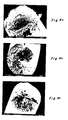
- An examination of spun pitch-based carbon fibers under a scanning electron microscope readily reveals that a wide variety of textures can exist within the cross-section of the fibers.
- the phrase "texture” of the fiber as defined herein, shall mean "the arrangement of the fibrils 19 across the cross-section of the thread of the fiber".
- the stacking of fibrils 19 across the fiber diameter can take on a variety of patterns.
- the "radial” texture 20 is characterized by the basal plane radiating out from the center of the fiber like the spokes of a wheel, as shown in the fiber 10b of Figure 2b.
- the "onion-skin” texture 21 has the basal plane “wrapping around" the center of the fiber like a scroll, as shown in the fiber 10c of Figure 2c.
- the "random" texture 18 of Figure 2a is characterized by the basal plane buckling and meandering across the fiber diameter in a random fashion.
- Still another texture which may be created within the fiber is the "hybrid”, such as that shown in fiber 10d of Figure 2d.
- a “hybrid” texture will exhibit a radial core 20 with increasingly disordered regions near the outer surfaces of the fiber. This usually gives the fiber the appearance of having a “collar” around the outside. Occasionally, this collar takes on a distinct "onion-skin!' texture 21 in regions where the folded basal planes become aligned parallel to the outer surface of the fiber.
- the final texture of the carbon fiber is developed during the spinning process.
- the orientation of the liquid crystals (fibrils) in the pitch is determined by the fluid velocity gradients and stress field encountered by the pitch as it is flowing through the spinnerette capillary, and as it is being drawn down to its final diameter.
- SP 479 and SP 480 were obtained by the following process:
- the capillary diameter is measured in microns.
- fiber strengths tended to increase with: (1) a decrease in the spin temperature; and (2) increase in throughput (increase in flow rate and capillary diameter).
- a third zone of randomly textured fibers is obtained from precursors having carrot viscosities in the range of approximately 1,932 to 2,317 poises.
- a fourth zone featuring radially textured fibers was derived from a pitch precursor having carrot viscosities approximately above 2,317 poises at spin temperature.
- the type of alignment of the graphite crystallites along the longitudinal axis of the fiber is believed to be the factor which most explains the difference between the average tensile strengths of the different zones.
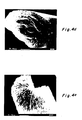
- the radially textured fiber of zone 2 features graphite crystallites which form parallel threads 25 with the axis z-z of the fiber 10', as shown in Figure 5a.
- the radially textured fiber of zone 4 features graphite crystallites that form threads 27 that are skewed with respect to the fiber axis z-z of fiber 10", shown in Figure 45b. These skewed threads 27 take the form of undulating ribbons.
- the invention has discovered that parameters such as spin viscosity and spinning temperature can control the shear and vorticity effecting the texture and alignment of the graphite crystallites in a spun fiber.
- the invention has also discovered that the texture and alignment characteristics are directly related to the ultimate mechanical properties of the fiber.
Landscapes
- Engineering & Computer Science (AREA)
- Textile Engineering (AREA)
- Chemical & Material Sciences (AREA)
- Chemical Kinetics & Catalysis (AREA)
- General Chemical & Material Sciences (AREA)
- Manufacturing & Machinery (AREA)
- Mechanical Engineering (AREA)
- Inorganic Fibers (AREA)
- Spinning Methods And Devices For Manufacturing Artificial Fibers (AREA)
Applications Claiming Priority (2)
| Application Number | Priority Date | Filing Date | Title |
|---|---|---|---|
| US06/479,415 US4504454A (en) | 1983-03-28 | 1983-03-28 | Process of spinning pitch-based carbon fibers |
| US479415 | 1983-03-28 |
Publications (2)
| Publication Number | Publication Date |
|---|---|
| EP0123451A2 true EP0123451A2 (de) | 1984-10-31 |
| EP0123451A3 EP0123451A3 (de) | 1985-05-02 |
Family
ID=23903912
Family Applications (1)
| Application Number | Title | Priority Date | Filing Date |
|---|---|---|---|
| EP84302049A Ceased EP0123451A3 (de) | 1983-03-28 | 1984-03-27 | Verfahren zum Spinnen von Kohlenstoffasern aus Pech |
Country Status (5)
| Country | Link |
|---|---|
| US (1) | US4504454A (de) |
| EP (1) | EP0123451A3 (de) |
| JP (1) | JPS602712A (de) |
| AU (1) | AU2621084A (de) |
| CA (1) | CA1220914A (de) |
Cited By (2)
| Publication number | Priority date | Publication date | Assignee | Title |
|---|---|---|---|---|
| US4576811A (en) * | 1983-11-03 | 1986-03-18 | E. I. Du Pont De Nemours And Company | Process for adjusting the fiber structure of mesophase pitch fibers |
| EP0577408A3 (de) * | 1992-06-30 | 1994-02-16 | Tonen Corp |
Families Citing this family (18)
| Publication number | Priority date | Publication date | Assignee | Title |
|---|---|---|---|---|
| JPS59163422A (ja) * | 1983-03-09 | 1984-09-14 | Kashima Sekiyu Kk | 石油系メソフエ−ズの紡糸法 |
| US4913889A (en) * | 1983-03-09 | 1990-04-03 | Kashima Oil Company | High strength high modulus carbon fibers |
| JPS60259609A (ja) * | 1984-06-01 | 1985-12-21 | Nippon Oil Co Ltd | 紡糸用ノズル |
| JPH0637725B2 (ja) * | 1985-01-19 | 1994-05-18 | 工業技術院長 | 炭素繊維の製法 |
| US4775589A (en) * | 1985-07-02 | 1988-10-04 | Nippon Steel Cporporation | Coaltar pitch based carbon fiber having high Young's modulus |
| US5149517A (en) * | 1986-01-21 | 1992-09-22 | Clemson University | High strength, melt spun carbon fibers and method for producing same |
| CA1321863C (en) * | 1986-06-06 | 1993-09-07 | Howard G. Tennent | Carbon fibrils, method for producing the same, and compositions containing same |
| US4816202A (en) * | 1986-10-09 | 1989-03-28 | Idemitsu Kosan Co., Ltd. | Method of melt spinning pitch |
| US4861653A (en) * | 1987-09-02 | 1989-08-29 | E. I. Du Pont De Nemours And Company | Pitch carbon fibers and batts |
| US4915926A (en) * | 1988-02-22 | 1990-04-10 | E. I. Dupont De Nemours And Company | Balanced ultra-high modulus and high tensile strength carbon fibers |
| JPH0791698B2 (ja) * | 1988-06-10 | 1995-10-04 | 帝人株式会社 | ピッチ糸炭素繊維の製造法 |
| DE68923268T2 (de) * | 1988-08-12 | 1995-11-16 | Ube Industries | Karbidfasern mit hoher festigkeit und hohem elastizitätsmodulus und polymerzusammensetzung dafür. |
| EP0421944A3 (en) * | 1989-08-31 | 1992-06-17 | Tanaka Kikinzoku Kogyo K.K. | Composite carbon fibre and process for preparing same |
| US5407614A (en) * | 1989-11-17 | 1995-04-18 | Petoca Ltd. | Process of making pitch-based carbon fibers |
| US5591335A (en) * | 1995-05-02 | 1997-01-07 | Memtec America Corporation | Filter cartridges having nonwoven melt blown filtration media with integral co-located support and filtration |
| MX9709134A (es) * | 1995-06-07 | 1998-03-31 | Conoco Inc | Hilado de fibras de carbono de peces solvatadas. |
| US6764628B2 (en) * | 2002-03-04 | 2004-07-20 | Honeywell International Inc. | Composite material comprising oriented carbon nanotubes in a carbon matrix and process for preparing same |
| TWI631077B (zh) | 2016-09-06 | 2018-08-01 | 財團法人工業技術研究院 | 複合石墨結構、其製造方法及其複合電極結構 |
Family Cites Families (7)
| Publication number | Priority date | Publication date | Assignee | Title |
|---|---|---|---|---|
| FR2049158B1 (de) * | 1969-06-05 | 1973-08-10 | Kureha Chemical Ind Co Ltd | |
| US3991170A (en) * | 1973-04-27 | 1976-11-09 | Union Carbide Corporation | Process for producing orientation in mesophase pitch by rotational motion relative to a magnetic field and carbonization of the oriented mesophase |
| US4331620A (en) * | 1980-02-25 | 1982-05-25 | Exxon Research & Engineering Co. | Process for producing carbon fibers from heat treated pitch |
| JPS5788016A (en) * | 1980-11-19 | 1982-06-01 | Toa Nenryo Kogyo Kk | Optically anisotropic carbonaceous pitch for carbon material, its manufacture, and manufacture of carbonaceous pitch fiber and carbon fiber |
| US4376747A (en) * | 1980-12-11 | 1983-03-15 | Union Carbide Corporation | Process for controlling the cross-sectional structure of mesophase pitch derived fibers |
| US4351816A (en) * | 1980-12-17 | 1982-09-28 | Union Carbide Corporation | Method for producing a mesophase pitch derived carbon yarn and fiber |
| JPS57154416A (en) * | 1981-03-12 | 1982-09-24 | Kureha Chem Ind Co Ltd | Preparation of carbon fiber having random mosaic cross-sectional structure |
-
1983
- 1983-03-28 US US06/479,415 patent/US4504454A/en not_active Expired - Lifetime
-
1984
- 1984-03-20 CA CA000449977A patent/CA1220914A/en not_active Expired
- 1984-03-27 EP EP84302049A patent/EP0123451A3/de not_active Ceased
- 1984-03-27 AU AU26210/84A patent/AU2621084A/en not_active Abandoned
- 1984-03-28 JP JP59060488A patent/JPS602712A/ja active Pending
Cited By (3)
| Publication number | Priority date | Publication date | Assignee | Title |
|---|---|---|---|---|
| US4576811A (en) * | 1983-11-03 | 1986-03-18 | E. I. Du Pont De Nemours And Company | Process for adjusting the fiber structure of mesophase pitch fibers |
| EP0577408A3 (de) * | 1992-06-30 | 1994-02-16 | Tonen Corp | |
| US5395607A (en) * | 1992-06-30 | 1995-03-07 | Tonen Corporation | High compressive strength pitch based carbon fiber |
Also Published As
| Publication number | Publication date |
|---|---|
| CA1220914A (en) | 1987-04-28 |
| EP0123451A3 (de) | 1985-05-02 |
| AU2621084A (en) | 1984-10-04 |
| JPS602712A (ja) | 1985-01-09 |
| US4504454A (en) | 1985-03-12 |
Similar Documents
| Publication | Publication Date | Title |
|---|---|---|
| US4504454A (en) | Process of spinning pitch-based carbon fibers | |
| Edie et al. | Melt-spun non-circular carbon fibers | |
| EP0166388B1 (de) | Verfahren zur Herstellung von Kohlenstoffasern des Pechtyps | |
| US4746470A (en) | Process for the preparation of carbon fibers having structure reflected in cross sectional view thereof as random mosaic | |
| US5536486A (en) | Carbon fibers and non-woven fabrics | |
| JPS59168127A (ja) | 炭素繊維の製造方法 | |
| US5766523A (en) | Blow spinning die and process for spinning carbon fibers from solvated pitches | |
| JPH02216222A (ja) | 高強度高モジュラスピッチ系炭素繊維 | |
| JPS61113827A (ja) | 高性能ピツチ系炭素繊維の製造方法 | |
| US5047292A (en) | Pitch-based carbon fiber and process for preparation thereof | |
| CA1227005A (en) | Process for producing carbon fibers | |
| EP0336144B1 (de) | Kohlenstoffasern und Verfahren zu deren Herstellung | |
| JPH0561367B2 (de) | ||
| US5547363A (en) | Nozzle for spinning pitch-based carbon fibers | |
| JPS61108725A (ja) | 新規構造を有するピツチ系炭素繊維の製造法 | |
| EP0387829B1 (de) | Kohlenstoffasern und nichtgewebte Textilmaterialien | |
| US4859381A (en) | Process for preparing pitch-type carbon fibers | |
| JPS62177222A (ja) | ピツチ系炭素繊維の製造方法 | |
| JPS60104524A (ja) | 炭素繊維の製造方法 | |
| JP4601875B2 (ja) | 炭素繊維の製造方法 | |
| JP2837299B2 (ja) | ピッチ系極細炭素繊維の製造方法 | |
| JPS616316A (ja) | 黒鉛繊維 | |
| JPS62170527A (ja) | ピツチ系炭素繊維の製造方法 | |
| JPH02242917A (ja) | メソフェーズピッチ系炭素繊維の製造方法 | |
| US20020163107A1 (en) | Using counter-bore and capillary geometry to control mesophase pitch-based carbon fiber filament micro and macro structure |
Legal Events
| Date | Code | Title | Description |
|---|---|---|---|
| PUAI | Public reference made under article 153(3) epc to a published international application that has entered the european phase |
Free format text: ORIGINAL CODE: 0009012 |
|
| AK | Designated contracting states |
Designated state(s): BE DE FR GB IT NL |
|
| PUAL | Search report despatched |
Free format text: ORIGINAL CODE: 0009013 |
|
| AK | Designated contracting states |
Designated state(s): BE DE FR GB IT NL |
|
| RAP1 | Party data changed (applicant data changed or rights of an application transferred) |
Owner name: E.I. DU PONT DE NEMOURS AND COMPANY |
|
| 17P | Request for examination filed |
Effective date: 19851009 |
|
| 17Q | First examination report despatched |
Effective date: 19860527 |
|
| STAA | Information on the status of an ep patent application or granted ep patent |
Free format text: STATUS: THE APPLICATION HAS BEEN REFUSED |
|
| 18R | Application refused |
Effective date: 19871127 |
|
| RIN1 | Information on inventor provided before grant (corrected) |
Inventor name: RIGGS, DENNIS MICHAEL |