EP0128285A1 - Verfahren zur Herstellung von Polyalkylpiperidylaminen - Google Patents
Verfahren zur Herstellung von Polyalkylpiperidylaminen Download PDFInfo
- Publication number
- EP0128285A1 EP0128285A1 EP84103702A EP84103702A EP0128285A1 EP 0128285 A1 EP0128285 A1 EP 0128285A1 EP 84103702 A EP84103702 A EP 84103702A EP 84103702 A EP84103702 A EP 84103702A EP 0128285 A1 EP0128285 A1 EP 0128285A1
- Authority
- EP
- European Patent Office
- Prior art keywords
- formula
- alkylated
- aminopiperidine
- reaction
- polyalkylpiperidylamines
- Prior art date
- Legal status (The legal status is an assumption and is not a legal conclusion. Google has not performed a legal analysis and makes no representation as to the accuracy of the status listed.)
- Granted
Links
- 238000000034 method Methods 0.000 title claims abstract description 20
- 238000002360 preparation method Methods 0.000 title claims abstract description 5
- 150000001412 amines Chemical class 0.000 title description 2
- BCIIMDOZSUCSEN-UHFFFAOYSA-N piperidin-4-amine Chemical class NC1CCNCC1 BCIIMDOZSUCSEN-UHFFFAOYSA-N 0.000 claims abstract description 7
- LFQSCWFLJHTTHZ-UHFFFAOYSA-N Ethanol Chemical compound CCO LFQSCWFLJHTTHZ-UHFFFAOYSA-N 0.000 claims abstract 4
- 238000006243 chemical reaction Methods 0.000 claims description 13
- XXMIOPMDWAUFGU-UHFFFAOYSA-N hexane-1,6-diol Chemical compound OCCCCCCO XXMIOPMDWAUFGU-UHFFFAOYSA-N 0.000 claims description 9
- FTVFPPFZRRKJIH-UHFFFAOYSA-N 2,2,6,6-tetramethylpiperidin-4-amine Chemical compound CC1(C)CC(N)CC(C)(C)N1 FTVFPPFZRRKJIH-UHFFFAOYSA-N 0.000 claims description 7
- UFHFLCQGNIYNRP-UHFFFAOYSA-N Hydrogen Chemical compound [H][H] UFHFLCQGNIYNRP-UHFFFAOYSA-N 0.000 claims description 4
- 229910052739 hydrogen Inorganic materials 0.000 claims description 4
- 239000001257 hydrogen Substances 0.000 claims description 4
- 239000000203 mixture Substances 0.000 claims description 4
- 241000711825 Viral hemorrhagic septicemia virus Species 0.000 claims description 3
- JGDFBJMWFLXCLJ-UHFFFAOYSA-N copper chromite Chemical compound [Cu]=O.[Cu]=O.O=[Cr]O[Cr]=O JGDFBJMWFLXCLJ-UHFFFAOYSA-N 0.000 claims description 3
- 125000000217 alkyl group Chemical group 0.000 claims 2
- 125000000113 cyclohexyl group Chemical group [H]C1([H])C([H])([H])C([H])([H])C([H])(*)C([H])([H])C1([H])[H] 0.000 claims 1
- 125000002496 methyl group Chemical group [H]C([H])([H])* 0.000 claims 1
- 238000005932 reductive alkylation reaction Methods 0.000 abstract description 2
- 239000003054 catalyst Substances 0.000 description 6
- 150000001875 compounds Chemical class 0.000 description 6
- UKJARPDLRWBRAX-UHFFFAOYSA-N n,n'-bis(2,2,6,6-tetramethylpiperidin-4-yl)hexane-1,6-diamine Chemical compound C1C(C)(C)NC(C)(C)CC1NCCCCCCNC1CC(C)(C)NC(C)(C)C1 UKJARPDLRWBRAX-UHFFFAOYSA-N 0.000 description 6
- 238000006268 reductive amination reaction Methods 0.000 description 6
- IOCLFIGHHOKNTE-UHFFFAOYSA-N 2,2,6,6-tetramethyl-n-(2,2,6,6-tetramethylpiperidin-4-yl)piperidin-4-amine Chemical compound C1C(C)(C)NC(C)(C)CC1NC1CC(C)(C)NC(C)(C)C1 IOCLFIGHHOKNTE-UHFFFAOYSA-N 0.000 description 5
- BASFCYQUMIYNBI-UHFFFAOYSA-N platinum Chemical compound [Pt] BASFCYQUMIYNBI-UHFFFAOYSA-N 0.000 description 5
- ZOSKCNWQMFJHOM-UHFFFAOYSA-N 1-(2,2,6,6-tetramethylpiperidin-4-yl)azepane Chemical compound C1C(C)(C)NC(C)(C)CC1N1CCCCCC1 ZOSKCNWQMFJHOM-UHFFFAOYSA-N 0.000 description 4
- ZVVYHZVCDWEHAA-UHFFFAOYSA-N 6-[(2,2,6,6-tetramethylpiperidin-4-yl)amino]hexan-1-ol Chemical compound CC1(C)CC(NCCCCCCO)CC(C)(C)N1 ZVVYHZVCDWEHAA-UHFFFAOYSA-N 0.000 description 3
- LYCAIKOWRPUZTN-UHFFFAOYSA-N Ethylene glycol Chemical compound OCCO LYCAIKOWRPUZTN-UHFFFAOYSA-N 0.000 description 3
- OKKJLVBELUTLKV-UHFFFAOYSA-N Methanol Chemical compound OC OKKJLVBELUTLKV-UHFFFAOYSA-N 0.000 description 3
- 150000004985 diamines Chemical class 0.000 description 3
- MTHSVFCYNBDYFN-UHFFFAOYSA-N diethylene glycol Chemical compound OCCOCCO MTHSVFCYNBDYFN-UHFFFAOYSA-N 0.000 description 3
- 125000003386 piperidinyl group Chemical group 0.000 description 3
- XLYOFNOQVPJJNP-UHFFFAOYSA-N water Substances O XLYOFNOQVPJJNP-UHFFFAOYSA-N 0.000 description 3
- RKMGAJGJIURJSJ-UHFFFAOYSA-N 2,2,6,6-Tetramethylpiperidine Substances CC1(C)CCCC(C)(C)N1 RKMGAJGJIURJSJ-UHFFFAOYSA-N 0.000 description 2
- RTIXZMFNQBFMAL-UHFFFAOYSA-N 6-(piperidin-4-ylamino)hexan-1-ol Chemical compound OCCCCCCNC1CCNCC1 RTIXZMFNQBFMAL-UHFFFAOYSA-N 0.000 description 2
- OKTJSMMVPCPJKN-UHFFFAOYSA-N Carbon Chemical compound [C] OKTJSMMVPCPJKN-UHFFFAOYSA-N 0.000 description 2
- PXHVJJICTQNCMI-UHFFFAOYSA-N Nickel Chemical compound [Ni] PXHVJJICTQNCMI-UHFFFAOYSA-N 0.000 description 2
- 239000003513 alkali Substances 0.000 description 2
- 230000029936 alkylation Effects 0.000 description 2
- 238000005804 alkylation reaction Methods 0.000 description 2
- QVQLCTNNEUAWMS-UHFFFAOYSA-N barium oxide Chemical compound [Ba]=O QVQLCTNNEUAWMS-UHFFFAOYSA-N 0.000 description 2
- 230000015572 biosynthetic process Effects 0.000 description 2
- HQABUPZFAYXKJW-UHFFFAOYSA-N butan-1-amine Chemical compound CCCCN HQABUPZFAYXKJW-UHFFFAOYSA-N 0.000 description 2
- WERYXYBDKMZEQL-UHFFFAOYSA-N butane-1,4-diol Chemical compound OCCCCO WERYXYBDKMZEQL-UHFFFAOYSA-N 0.000 description 2
- 229910052799 carbon Inorganic materials 0.000 description 2
- GHLKSLMMWAKNBM-UHFFFAOYSA-N dodecane-1,12-diol Chemical compound OCCCCCCCCCCCCO GHLKSLMMWAKNBM-UHFFFAOYSA-N 0.000 description 2
- NAQMVNRVTILPCV-UHFFFAOYSA-N hexane-1,6-diamine Chemical compound NCCCCCCN NAQMVNRVTILPCV-UHFFFAOYSA-N 0.000 description 2
- 229910052697 platinum Inorganic materials 0.000 description 2
- 239000011541 reaction mixture Substances 0.000 description 2
- 238000012360 testing method Methods 0.000 description 2
- DNIAPMSPPWPWGF-VKHMYHEASA-N (+)-propylene glycol Chemical compound C[C@H](O)CO DNIAPMSPPWPWGF-VKHMYHEASA-N 0.000 description 1
- YPFDHNVEDLHUCE-UHFFFAOYSA-N 1,3-propanediol Substances OCCCO YPFDHNVEDLHUCE-UHFFFAOYSA-N 0.000 description 1
- XQHOKEIFXKDEPH-UHFFFAOYSA-N 1-ethoxy-3-(2-hydroxyethoxy)propan-2-ol Chemical compound CCOCC(O)COCCO XQHOKEIFXKDEPH-UHFFFAOYSA-N 0.000 description 1
- GZZLQUBMUXEOBE-UHFFFAOYSA-N 2,2,4-trimethylhexane-1,6-diol Chemical compound OCCC(C)CC(C)(C)CO GZZLQUBMUXEOBE-UHFFFAOYSA-N 0.000 description 1
- XACKQJURAZIUES-UHFFFAOYSA-N 2,4,4-trimethylhexane-1,6-diol Chemical compound OCC(C)CC(C)(C)CCO XACKQJURAZIUES-UHFFFAOYSA-N 0.000 description 1
- CQCGYXKWJGZZDN-UHFFFAOYSA-N CC(C)(C1)N(C)C(C)(C)CC1[NH-] Chemical compound CC(C)(C1)N(C)C(C)(C)CC1[NH-] CQCGYXKWJGZZDN-UHFFFAOYSA-N 0.000 description 1
- 0 C[*-]C1CC(C)(C)N(*)C(C)(C)C1 Chemical compound C[*-]C1CC(C)(C)N(*)C(C)(C)C1 0.000 description 1
- 101100322245 Caenorhabditis elegans des-2 gene Proteins 0.000 description 1
- 239000007868 Raney catalyst Substances 0.000 description 1
- 229910000564 Raney nickel Inorganic materials 0.000 description 1
- NPXOKRUENSOPAO-UHFFFAOYSA-N Raney nickel Chemical compound [Al].[Ni] NPXOKRUENSOPAO-UHFFFAOYSA-N 0.000 description 1
- 238000009825 accumulation Methods 0.000 description 1
- 150000001298 alcohols Chemical class 0.000 description 1
- 125000005263 alkylenediamine group Chemical group 0.000 description 1
- 238000010533 azeotropic distillation Methods 0.000 description 1
- ZSIQJIWKELUFRJ-UHFFFAOYSA-N azepane Chemical compound C1CCCNCC1 ZSIQJIWKELUFRJ-UHFFFAOYSA-N 0.000 description 1
- 230000001588 bifunctional effect Effects 0.000 description 1
- 238000009835 boiling Methods 0.000 description 1
- 239000007795 chemical reaction product Substances 0.000 description 1
- PMMYEEVYMWASQN-IMJSIDKUSA-N cis-4-Hydroxy-L-proline Chemical compound O[C@@H]1CN[C@H](C(O)=O)C1 PMMYEEVYMWASQN-IMJSIDKUSA-N 0.000 description 1
- 229910017052 cobalt Inorganic materials 0.000 description 1
- 239000010941 cobalt Substances 0.000 description 1
- GUTLYIVDDKVIGB-UHFFFAOYSA-N cobalt atom Chemical compound [Co] GUTLYIVDDKVIGB-UHFFFAOYSA-N 0.000 description 1
- 238000009833 condensation Methods 0.000 description 1
- 230000005494 condensation Effects 0.000 description 1
- 238000010924 continuous production Methods 0.000 description 1
- ZBCBWPMODOFKDW-UHFFFAOYSA-N diethanolamine Chemical compound OCCNCCO ZBCBWPMODOFKDW-UHFFFAOYSA-N 0.000 description 1
- 239000000539 dimer Substances 0.000 description 1
- 150000002009 diols Chemical class 0.000 description 1
- 238000004821 distillation Methods 0.000 description 1
- 230000000694 effects Effects 0.000 description 1
- 125000003700 epoxy group Chemical group 0.000 description 1
- IBVAYMHQEZMDIM-UHFFFAOYSA-N ethane-1,2-diamine;piperazine Chemical compound NCCN.C1CNCCN1 IBVAYMHQEZMDIM-UHFFFAOYSA-N 0.000 description 1
- 238000004817 gas chromatography Methods 0.000 description 1
- 229910052736 halogen Inorganic materials 0.000 description 1
- 150000002367 halogens Chemical class 0.000 description 1
- 239000012433 hydrogen halide Substances 0.000 description 1
- 229910000039 hydrogen halide Inorganic materials 0.000 description 1
- 238000005984 hydrogenation reaction Methods 0.000 description 1
- 239000000543 intermediate Substances 0.000 description 1
- 238000004519 manufacturing process Methods 0.000 description 1
- 229910052759 nickel Inorganic materials 0.000 description 1
- LWMPFIOTEAXAGV-UHFFFAOYSA-N piperidin-1-amine Chemical class NN1CCCCC1 LWMPFIOTEAXAGV-UHFFFAOYSA-N 0.000 description 1
- 239000004597 plastic additive Substances 0.000 description 1
- 229920000166 polytrimethylene carbonate Polymers 0.000 description 1
- 239000010970 precious metal Substances 0.000 description 1
- 239000000047 product Substances 0.000 description 1
- 238000004064 recycling Methods 0.000 description 1
- 230000002829 reductive effect Effects 0.000 description 1
- 150000003839 salts Chemical class 0.000 description 1
- 238000007086 side reaction Methods 0.000 description 1
- 238000003786 synthesis reaction Methods 0.000 description 1
- ZIBGPFATKBEMQZ-UHFFFAOYSA-N triethylene glycol Chemical compound OCCOCCOCCO ZIBGPFATKBEMQZ-UHFFFAOYSA-N 0.000 description 1
Classifications
-
- C—CHEMISTRY; METALLURGY
- C07—ORGANIC CHEMISTRY
- C07D—HETEROCYCLIC COMPOUNDS
- C07D211/00—Heterocyclic compounds containing hydrogenated pyridine rings, not condensed with other rings
- C07D211/04—Heterocyclic compounds containing hydrogenated pyridine rings, not condensed with other rings with only hydrogen or carbon atoms directly attached to the ring nitrogen atom
- C07D211/06—Heterocyclic compounds containing hydrogenated pyridine rings, not condensed with other rings with only hydrogen or carbon atoms directly attached to the ring nitrogen atom having no double bonds between ring members or between ring members and non-ring members
- C07D211/36—Heterocyclic compounds containing hydrogenated pyridine rings, not condensed with other rings with only hydrogen or carbon atoms directly attached to the ring nitrogen atom having no double bonds between ring members or between ring members and non-ring members with hetero atoms or with carbon atoms having three bonds to hetero atoms with at the most one bond to halogen, e.g. ester or nitrile radicals, directly attached to ring carbon atoms
- C07D211/56—Nitrogen atoms
- C07D211/58—Nitrogen atoms attached in position 4
Definitions
- This invention relates to a process for the preparation of polyalkylpiperidylamines of the formula I. with the meanings given in claim 1.
- Polyalkylpiperidylamines are valuable intermediates, especially for the synthesis of plastic additives.
- a process is known from GB-PS 834 290, according to which 2, 2, 6, 6-tetramethylpiperidone-4 in the presence of a platinum / activated carbon catalyst and in the presence of hydrogen with dialkylaminoalkylamines to give the 2, 2 substituted in the 4-position , 6, 6-tetramethylpiperidine is implemented.
- DE-OS 23 49 962 describes the reductive amination of 1-benzyl-2, 2, 6, 6-tetramethylpiperidone-4 with butylamine in methanol over a platinum catalyst.
- DE-OS 26 11 208 is the reductive amination of 2, 2, 6, 6-tetraalkylpiperidone-4 with alkylenediamines on Pt contacts and the reaction of the dimeric polyalkylpiperidylamines obtained with bifunctional compounds which contain halogen and / or epoxy groups, to polymeric polyalkylpiperidylamines.
- DE-OS 26 21 870 describes the reductive amination of 2, 2, 6, 6-tetramethylpiperidone-4 in the presence of a Raney nickel catalyst.
- DE-OS 30 07 996 describes the reductive amination of 2,2,6,6-tetramethylpiperidone-4 with mono- and diamines over cobalt and nickel catalysts.
- water of reaction formed during the condensation be removed by azeotropic distillation before the hydrogenation begins.
- the disadvantage of the first three processes is the use of expensive precious metal catalysts, which cannot be regenerated without loss.
- Raney catalysts such as those used in the fourth process, are basically intended for batch operation. Reuse is cumbersome, use in continuous processes requires considerable effort.
- a fundamentally different way of producing polyalkylpiperidylamines is to react 4-amino-polyalkylpiperidines with dihalogen compounds in the presence of alkali compounds to neutralize the hydrogen halide released (cf. DE-OS 26 11 208). Even if high yields of polyalkylpiperidylamines are achieved with this procedure, the use of alkali compounds and the accumulation of considerable amounts of salts represent a considerable disadvantage. Because of the high water solubility of the polyalkylpiperidylamines, considerable losses of the reaction products occur when they are separated from the reaction mixture .
- the aim of the present process was to develop an improved process for the preparation of dimeric polyalkylpiperidylamines, using 4-aminopiperidines of the formula II going out.
- the process according to the invention proceeds according to the following reaction scheme: Depending on the molar ratio in which the reaction takes place, different mixtures of the compounds I and III are obtained. By recycling III, the reaction can be controlled so that only I is formed.
- the 4-aminopolyalkylpiperidines (II) are preferably used in excess, based on the diol component.
- the reaction temperatures are 120 to 250 ° C, in particular 160 to 220 ° C, preferably 180 to 200 ° C.
- Suitable catalysts are copper chromite contacts, which are preferably activated by adding barium oxide.
- the contact load is 0.1 to 3 VHSV, based on the feed mixture. VHSV values of 0.2 to 1, in particular 0.2 to 0.5, are particularly advantageous.
- the required hydrogen pressure is between 1 and 300 bar, the pressure range from 3 to 30 bar is preferred.
- 4-Amino-2, 2, 6, 6-tetramethylpiperidine is particularly preferred as 4-aminopolyalkylpiperidine.
- Suitable dialcohol components are e.g. B. ethylene glycol, diethylene glycol, triethylene glycol, 1,3-propanediol, 3,7-dioxa-1,5-nonanediol, diethanolamine, bis-hydroxyyethylmethylamine, 1,4-butanediol, 1,6-hexanediol, 1,12-dodecanediol, 2, 2, 4-trimethyl-1,6-hexanediol, 2, 4, 4-trimethyl-1, 6-hexanediol, 1, 4-cyclohexanediol, 4, 4'-dihydroxycyelohexylmethane, N, N '-Bis-2- hydroxyethylpiperazine. 1, 6-Hexanediol is preferred.
Landscapes
- Chemical & Material Sciences (AREA)
- Organic Chemistry (AREA)
- Hydrogenated Pyridines (AREA)
- Peptides Or Proteins (AREA)
- Pharmaceuticals Containing Other Organic And Inorganic Compounds (AREA)
Abstract
Description
- Gegenstand dieser Erfindung ist ein Verfahren zur Herstellung von Polyalkylpiperidylaminen der Formel I

- Diese Verbindungen sollen nach der Zahl der Piperidineinheiten, die sie enthalten, als "dimere" bezeichnet werden und dadurch von den Piperidylaminen, die nur eine Piperidineinheit enthalten (monomer) oder mehr als vier Piperidineinheiten enthalten (polymer) unterschieden werden.
- Polyalkylpiperidylamine stellen wertvolle Zwischenprodukte, insbesondere für die Synthese von Kunststoffadditiven, dar.
- Die Herstellung von Polyalkylpiperidylaminen durch reduktive Aminierung von Polyalkylpiperidonen-4 ist Stand der Technik.
- So ist aus der GB-PS 834 290 ein Verfahren bekannt, wonach 2, 2, 6, 6-Tetramethylpiperidon-4 in Gegenwart eines Platin/Aktivkohle-Katalysators und in Anwesenheit von Wasserstoff mit Dialkylaminoalkylaminen zu den in 4-Stellung substituiertem 2, 2, 6, 6-Tetramethylpiperidin umgesetzt wird.
- In der DE-OS 23 49 962 wird die reduktive Aminierung von 1-Benzyl-2, 2, 6, 6-tetramethylpiperidon-4 mit Butylamin in Methanol an einem Platinkatalysator beschrieben.
- Gegenstand der DE-OS 26 11 208 ist die reduktive Aminierung von 2, 2, 6, 6-Tetraalkylpiperidon-4 mit Alkylendiaminen an Pt-Kontakten und die Umsetzung der erhaltenen dimeren Polyalkylpiperidylamine mit bifunktionellen Verbindungen, die Halogen- und/oder Epoxygruppen enthalten, zu polymeren Polyalkylpiperidylaminen.
- In der DE-OS 26 21 870 wird die reduktive Aminierung von 2, 2, 6, 6-Tetramethylpiperidon-4 in Gegenwart eines Raney-Nickel-Katalysators beschrieben.
- Schließlich beschreibt die DE-OS 30 07 996 die reduktive Aminierung von 2,2,6,6-Tetramethylpiperidon-4 mit Mono- und Diaminen an Cobalt- und Nickelkatalysatoren. In dieser Schrift wird empfohlen, das bei der Kondensation gebildete Reaktionswasser vor Beginn der Hydrierung durch azeotrope Destillation zu entfernen.
- Nachteilig an den drei erstgenannten Verfahren ist die Verwendung teurer Edelmetallkatalysatoren, die nicht verlustfrei regeneriert werden können.
- Raney-Katalysatoren, wie sie im vierten Verfahren eingesetzt werden, sind grundsätzlich für den Chargenbetrieb bestimmt. Eine Wiederverwendung ist umständlich, der Einsatz in kontinuierlichen Verfahren erfordert einen erheblichen Aufwand.
- Wie das letztgenannte Verfahren aufzeigt, ist es bei der reduktiven Aminierung von 2, 2, 6, 6-Tetramethylpiperidon-4 von Vorteil, wenn das Reaktionswasser möglichst rasch aus dem Reaktionsgemisch entfernt wird. Der Grund hierfür liegt in der leichten Hydrolysierbarkeit des 2, 2, 6, 6-Tetramethylpiperidon-4, insbesondere bei höheren Temperaturen, die naturgemäß zu Ausbeuteverlusten führen muß.
- Eine grundsätzlich andere Möglichkeit der Herstellung von Polyalkylpiperidylaminen besteht in der Umsetzung von 4-Amino-polyalkylpiperidinen mit Dihalogenverbindungen in Gegenwart von Alkaliverbindungen zur Neutralisation des freiwerdenden Halogenwasserstoffs (vgl. DE-OS 26 11 208). Wenn auch bei dieser Arbeitsweise hohe Ausbeuten an Polyalkylpiperidylaminen erzielt werden, so stellt doch der Einsatz von Alkaliverbindungen und der Anfall von erheblichen Mengen an Salzen einen erheblichen Nachteil dar. Aufgrund der hohen Wasserlöslichkeit der Polyalkylpiperidylamine treten erhebliche Verluste der Reaktionsprodukte bei der Abtrennung aus dem Reaktionsgemisch auf.
- Eigene Versuche, die dimeren Polyalkylpiperidylamine durch hydrierende Alkylierung von Diaminen mit in 4-Stellung hydroxylierten Polyalkylpiperidinen herzustellen, lieferten völlig unbefridigende Ergebnisse. Unter den Reaktionsbedingungen kommt es nämlich zu Reaktionen der Diamine untereinander und miteinander. Beispielsweise erhielt man beim Einsatz von Ethylendiamin Piperazin und beim Einsatz von Hexamethylendiamin Azacycloheptan.
- Daher erschien es aussichtslos, mit dem Verfahren der hydrierenden Alkylierung von Aminen (vgl. Houben-Weyl, Band XI/1, Seite 126 ff.) einen Durchbruch zu erzielen.
- Ziel des vorliegenden Verfahrens war es, ein verbessertes Verfahren zur Herstellung dimerer Polyalkylpiperidylamine zu entwickeln, wobei man von 4-Aminopiperidinen der Formel II

- Es wurde jetzt überraschend gefunden, daß man durch reduktive Alkylierung von alkylierten 4-Aminopiperidinen mit difunktionellen Alkoholen die gewünschten dimeren Polyalkylpiperidylamine erhält (siehe Ansprüche).
- Das erfindungsgemäße Verfahren verläuft nach folgendem Reaktionsschema:


- Als Nebenreaktion wird die Umsetzung
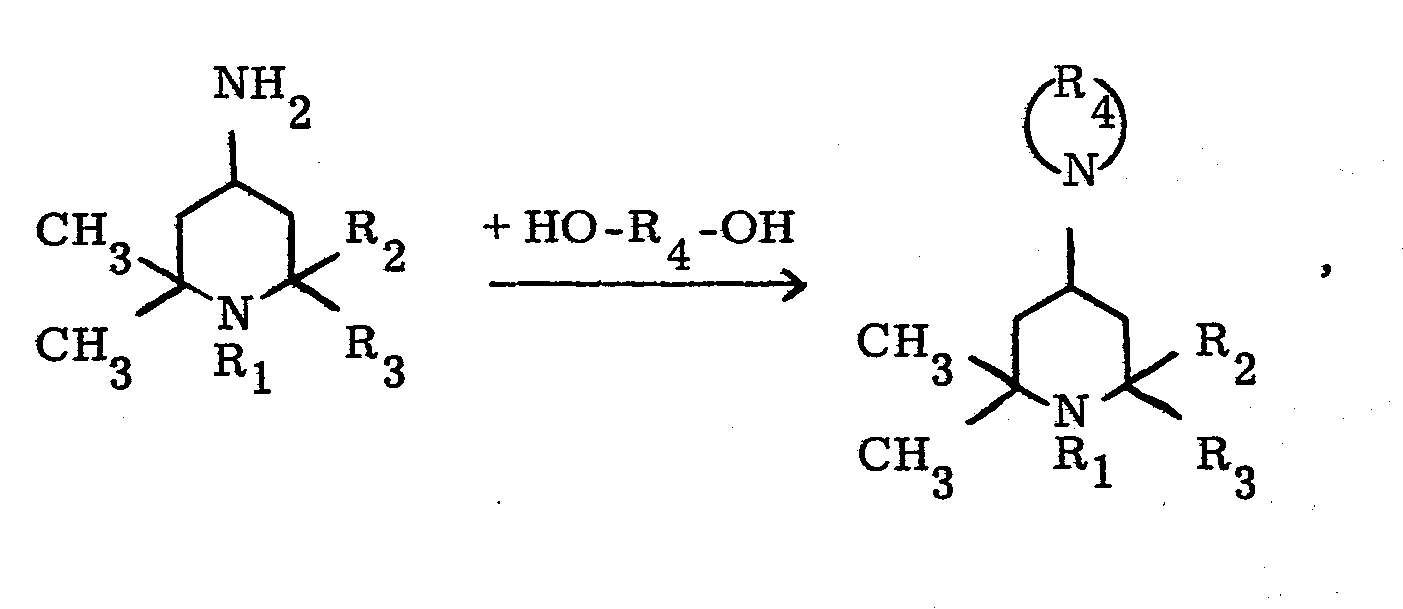

- Die 4-Aminopolyalkylpiperidine (II) werden vorzugsweise im Überschuß, bezogen auf die Diol-Komponente, eingesetzt.
- Die Reaktionstemperaturen betragen 120 bis 250 °C, insbesondere 160 bis 220°C, vorzugsweise 180 bis 200°C. Geeignete Katalysatoren sind Kupferchromit-Kontakte, die vorzugsweise durch Bariumoxid-Zusatz aktiviert sind. Die Kontaktbelastung, bei bevorzugt kontinuierlicher Arbeitsweise im Rieselverfahren, beträgt 0, 1 bis 3 VHSV, bezogen auf das Einsatzgemisch. Besonders vorteilhaft sind VHSV-Werte von 0, 2 bis 1, insbesondere 0, 2 bis 0, 5.
- Der erforderliche Wasserstoffdruck liegt zwischen 1 und 300 bar, bevorzugt wird der Druckbereich von 3 bis 30 bar.
- Als 4-Aminopolyalkylpiperidin wird 4-Amino-2, 2, 6, 6-tetramethylpiperidin besonders bevorzugt.
- Geeignete Dialkohol-Komponenten sind z. B. Ethylenglykol, Diethylenglykol, Triethylenglykol, 1,3-Propandiol, 3,7-Dioxa-1, 5-nonandiol, Diethanolamin, Bis-hydroxyyethylmethylamin, 1,4-Butandiol, 1, 6-Hexandiol, 1,12-Dodecandiol, 2, 2, 4-Trimethyl-1,6-hexandiol, 2, 4, 4-Trimethyl-1, 6-hexandiol, 1, 4-Cyclohexandiol, 4, 4' -Dihydroxycyelohexylmethan, N, N' -Bis-2-hydroxyethylpiperazin. Bevorzugt ist 1, 6-Hexandiol.
- N, N' -Bis-(2, 2, 6, 6-tetramethyl-4-piperidyl)-hexamethylendiamin
- In einem 1 1-Schachtofen, der mit 500 ml reduziertem Kupferchromit-Kontakt (Harshaw Cu 1107 der Fa. Harshaw, DE-5632 Wermelskirchen) gefüllt ist, werden bei 180 C und 30 bar Wasserstoff stündlich 250 ml eines Gemisches aus 4-Amino-2, 2, 6; 6-tetramethylpiperidin und 1, 6-Hexandiol im Molverhältnis 4 : 1 umgesetzt.
- Nach GC-Analyse enthält das Austrittsprodukt nach einer Versuchsdauer von 10 Tagen
- 73,1 % 4-Amino-2, 2, 6, 6-tetramethylpiperidin
- 9, 8 % 1, 6 -Hexandiol
- 1,0 % 4-Hexamethylenimino-2, 2, 6, 6-tetramethylpiperidin
- 0, 55 % Bis-(2, 2, 6, 6-tetramethyl-4-piperidyl)-amin
- 6,5 % 4-(6-Hydroxyhexylamino)-piperidin
- 9, 0 % N, N' -Bis-(2, 2, 6, 6-tetramethyl-4-piperidyl)-hexamethylendiamin.
- Dies entspricht einem Umsatz an 4-Amino-2, 2, 6, 6-tetramethylpiperidin von 14, 4 % und einem 1, 6-Hexandiol-Umsatz von 38, 7 % sowie, unter Berücksichtigung der Rückführbarkeit von 4-Amino-2, 2, 6, 6-tetramethylpiperidin, 1, 6-Hexandiol und 4-(6-Hydroxylhexylamino)-2, 2, 6, 6-tetramethylpiperidin, einer Ausbeute an N, N' -Bis-(2, 2, 6, 6-tetramethyl-4-piperidyl)-hexamethylendiamin von 89, 9 %, bezogen auf 4-Amino-2, 2, 6, 6-tetramethylpiperidin, und von 92,0%, bezogen auf 1, 6-Hexandiol.
- Durch destillative Aufarbeitung wurden isoliert:
- 4-Hexamethylenimino-2, 2, 6, 6-tetramethylpiperidin Kp10 150 °C, n25 D = 1, 4870
- Bis-(2, 2, 6, 6-tetramethyl-4-piperidyl)-amin Kp14 = 180 °C, Fp. = 74 - 77 °C
- 4-(6-Hydroxyhexylamino)-2, 2, 6, 6-tetramethylpiperidin Kp27 = 195 °C, Fp. = 80 - 81 °C
- N, N' -Bis-(2, 2, 6, 6-tetramethyl-4-piperidyl)-hexamethylendiamin Rp28 = 253 °C, Fp. = 60,5 - 61,5°C
- Die Druckwerte der Siedepunkte wurden in Torr angegeben.
- Nach 60tätiger Versuchdauer wurde kein Aktivitätsabfall des Katalysators beobachtet.
Claims (7)


dadurch gekennzeichnet,
daß man ein alkyliertes 4-Aminopiperidin der Formel II

dadurch gekennzeichnet,
daß man die Umsetzung bei einem Wasserstoffdruck von 1 bis 300 bar, vorzugsweise 3 bis 30 bar, in Gegenwart eines Kupferchromitkatalysators durchführt.
dadurch gekennzeichnet,
daß man das alkylierte 4-Aminopiperidin mit dem Dialkohol im Molverhältnis von 10 : 1, vorzugsweise 4 : 1, bis 2 : 1 umsetzt.
dadurch gekennzeichnet,
daß man die Umsetzung bei einer Temperatur von 120 bis 250 C, vorzugsweise 180 bis 200 °C, durchführt.
dadurch gekennzeichnet,
daß die VHSV des Einsatzgemisches aus alkyliertem 4-Aminopiperidin und difunktionellem Alkohol 0, 1 bis 3, vorzugsweise 0, 2 bis 0, 5, beträgt.
dadurch gekennzeichnet,
daß man als alkyliertes 4-Aminopiperidin 4-Amino-2, 2, 6, 6 -tetramethylpiperidin einsetzt.
dadurch gekennzeichnet,
daß man als difunktionellen Alkohol 1,6-Hexandiol verwendet.
Priority Applications (1)
| Application Number | Priority Date | Filing Date | Title |
|---|---|---|---|
| AT84103702T ATE28633T1 (de) | 1983-06-13 | 1984-04-04 | Verfahren zur herstellung von polyalkylpiperidylaminen. |
Applications Claiming Priority (2)
| Application Number | Priority Date | Filing Date | Title |
|---|---|---|---|
| DE3321332 | 1983-06-13 | ||
| DE3321332A DE3321332A1 (de) | 1983-06-13 | 1983-06-13 | Verfahren zur herstellung von polyalkylpiperidylaminen |
Publications (2)
| Publication Number | Publication Date |
|---|---|
| EP0128285A1 true EP0128285A1 (de) | 1984-12-19 |
| EP0128285B1 EP0128285B1 (de) | 1987-07-29 |
Family
ID=6201381
Family Applications (1)
| Application Number | Title | Priority Date | Filing Date |
|---|---|---|---|
| EP84103702A Expired EP0128285B1 (de) | 1983-06-13 | 1984-04-04 | Verfahren zur Herstellung von Polyalkylpiperidylaminen |
Country Status (7)
| Country | Link |
|---|---|
| US (1) | US4526971A (de) |
| EP (1) | EP0128285B1 (de) |
| JP (1) | JPS608264A (de) |
| AT (1) | ATE28633T1 (de) |
| CA (1) | CA1217771A (de) |
| DE (2) | DE3321332A1 (de) |
| ES (1) | ES533318A0 (de) |
Cited By (1)
| Publication number | Priority date | Publication date | Assignee | Title |
|---|---|---|---|---|
| EP0838455A1 (de) * | 1996-10-28 | 1998-04-29 | Basf Aktiengesellschaft | Verfahren zur Herstellung von Bis-(2,2,6,6-tetramethyl-4-piperidyl)-amin |
Families Citing this family (6)
| Publication number | Priority date | Publication date | Assignee | Title |
|---|---|---|---|---|
| IT1160181B (it) * | 1983-01-19 | 1987-03-04 | Montedison Spa | Derivati della 4-metil-piperidina alchil-sostituita e loro impiego come stabilizzanti |
| DE3528124A1 (de) * | 1985-08-06 | 1987-02-12 | Huels Chemische Werke Ag | Verfahren zur entfernung von n-butyraldehyd aus gasstroemen |
| IT1216560B (it) * | 1988-04-07 | 1990-03-08 | Ciba Geigy Spa | Procedimento per la preparazione di bis(2,2,6,6_tetrametil_4_piperidil)ammina. |
| JP2903739B2 (ja) * | 1990-06-29 | 1999-06-14 | 住友化学工業株式会社 | N,n′−ビス(2,2,6,6−テトラメチル−4−ピペリジル)アルカンジアミンの製造法 |
| DE102004023640A1 (de) * | 2004-05-10 | 2005-12-08 | Degussa Ag | Verfahren zur Herstellung von 4-substituierten 2,2,6,6-Tetramethyl-piperidin-N-oxy- und 2,2,6,6-Tetramethyl-piperidin-N-hydroxy-verbindungen |
| DE102006010347A1 (de) * | 2006-03-03 | 2007-09-06 | Degussa Gmbh | Polymerisationsinhibitor zur Stabilisierung von olefinisch ungesättigten Monomeren |
Citations (4)
| Publication number | Priority date | Publication date | Assignee | Title |
|---|---|---|---|---|
| GB834290A (en) * | 1957-02-13 | 1960-05-04 | Ici Ltd | Substituted piperidines |
| EP0033663A1 (de) * | 1980-02-04 | 1981-08-12 | Carstab Corporation | 2,2,6,6-Tetramethyl-4-piperidyl-substituierte Heteroringverbindungen, Verfahren zu ihrer Herstellung und sie enthaltende Polymere |
| DE3007996A1 (de) * | 1980-03-01 | 1981-09-17 | Hoechst Ag, 6000 Frankfurt | Verfahren zur herstellung von polyalkylpiperidylaminen |
| EP0061785A1 (de) * | 1979-01-15 | 1982-10-06 | Ciba-Geigy Ag | Verwendung von Polyalkylpiperid-polyaminen als Epoxydharzhärter |
Family Cites Families (1)
| Publication number | Priority date | Publication date | Assignee | Title |
|---|---|---|---|---|
| JPS5892660A (ja) * | 1981-11-27 | 1983-06-02 | Adeka Argus Chem Co Ltd | ピペリジルアミン化合物 |
-
1983
- 1983-06-13 DE DE3321332A patent/DE3321332A1/de not_active Withdrawn
-
1984
- 1984-03-30 US US06/595,555 patent/US4526971A/en not_active Expired - Fee Related
- 1984-04-04 DE DE8484103702T patent/DE3465081D1/de not_active Expired
- 1984-04-04 EP EP84103702A patent/EP0128285B1/de not_active Expired
- 1984-04-04 AT AT84103702T patent/ATE28633T1/de not_active IP Right Cessation
- 1984-06-11 JP JP59118378A patent/JPS608264A/ja active Pending
- 1984-06-12 CA CA000456404A patent/CA1217771A/en not_active Expired
- 1984-06-12 ES ES533318A patent/ES533318A0/es active Granted
Patent Citations (4)
| Publication number | Priority date | Publication date | Assignee | Title |
|---|---|---|---|---|
| GB834290A (en) * | 1957-02-13 | 1960-05-04 | Ici Ltd | Substituted piperidines |
| EP0061785A1 (de) * | 1979-01-15 | 1982-10-06 | Ciba-Geigy Ag | Verwendung von Polyalkylpiperid-polyaminen als Epoxydharzhärter |
| EP0033663A1 (de) * | 1980-02-04 | 1981-08-12 | Carstab Corporation | 2,2,6,6-Tetramethyl-4-piperidyl-substituierte Heteroringverbindungen, Verfahren zu ihrer Herstellung und sie enthaltende Polymere |
| DE3007996A1 (de) * | 1980-03-01 | 1981-09-17 | Hoechst Ag, 6000 Frankfurt | Verfahren zur herstellung von polyalkylpiperidylaminen |
Cited By (1)
| Publication number | Priority date | Publication date | Assignee | Title |
|---|---|---|---|---|
| EP0838455A1 (de) * | 1996-10-28 | 1998-04-29 | Basf Aktiengesellschaft | Verfahren zur Herstellung von Bis-(2,2,6,6-tetramethyl-4-piperidyl)-amin |
Also Published As
| Publication number | Publication date |
|---|---|
| EP0128285B1 (de) | 1987-07-29 |
| ES8503653A1 (es) | 1985-03-01 |
| JPS608264A (ja) | 1985-01-17 |
| DE3465081D1 (en) | 1987-09-03 |
| ATE28633T1 (de) | 1987-08-15 |
| CA1217771A (en) | 1987-02-10 |
| DE3321332A1 (de) | 1984-12-13 |
| US4526971A (en) | 1985-07-02 |
| ES533318A0 (es) | 1985-03-01 |
Similar Documents
| Publication | Publication Date | Title |
|---|---|---|
| DE2907869C2 (de) | ||
| EP0128285B1 (de) | Verfahren zur Herstellung von Polyalkylpiperidylaminen | |
| DE1518067A1 (de) | Verfahren zur Herstellung von alpha-Alkyl-omega-amino-alkannitrilen | |
| EP0297295A1 (de) | Verfahren zur Herstellung von Methylaminen | |
| DE1227447B (de) | Verfahren zur Herstellung von Phenylisopropylaminen | |
| EP0001274B1 (de) | Verfahren zur Herstellung von Serinol | |
| DE69220708T2 (de) | Verfahren zur Herstellung von 2,2,6,6,-Tetramethyl-4-Amino-Piperidilen | |
| DE69636943T2 (de) | Verfahren zur Herstellung von Etherverbindungen | |
| DE102008040045A1 (de) | Verfahren zur Herstellung von 4-Amino-2,2,6,6-tetramethylpiperidin | |
| DE3007996A1 (de) | Verfahren zur herstellung von polyalkylpiperidylaminen | |
| EP0535518B1 (de) | Verfahren zur Herstellung von 2-Aminomethylpiperidin | |
| DE1240874B (de) | Verfahren zur Herstellung von Bis-[2-hydroxy-3-(alpha, alpha-dimethylbenzyl)-5-methylphenyl]-methan | |
| EP0435072A2 (de) | Verfahren zur Herstellung von N,N-Dimethylaminen | |
| EP0044968B1 (de) | Verfahren zur Herstellung von N-Alkylpiperidinen und N-Alkylpyrrolidinen | |
| EP0181618B1 (de) | Verfahren zur Herstellung von Substituierten Piperidinen | |
| EP0070424B1 (de) | Verfahren zur Herstellung von N,N'-disubstituierten 3-Aminopropanamiden | |
| EP2085385B1 (de) | Verfahren zur Herstellung von 4-Amino-2,2,6,6-tetramethylpiperidin | |
| DE2531060B2 (de) | ||
| EP0906280B1 (de) | Sterisch gehindertes 4-amino-piperidin mit geringem dimergehalt, seine herstellung und verwendung | |
| DE1037464B (de) | Verfahren zur Herstellung unsymmetrischer Dialkylhydrazine durch katalytische Reduktion von Dialkylnitrosaminen | |
| DE3544510A1 (de) | Verfahren zur herstellung aliphatischer tertiaerer amine | |
| DE2655794A1 (de) | Verfahren zur herstellung von aethylencyanhydrin | |
| EP0893430B1 (de) | Verfahren zur Herstellung von Alkylaminen | |
| EP0074537A1 (de) | N,N,N'-Trimethyl-N'-2-hydroxyethyl-propylendiamin, Verfahren zu seiner Herstellung, Polyurethane, die 0,01 bis 5 Gew.-% N,N,N'-Trimethyl-N'-2-hydroxyethylpropylendiamin enthalten, und seine Verwendung als Katalysator | |
| EP0838456B1 (de) | Verfahren zur Herstellung von 4-Amino-2,2,6,6-tetramethylpiperidin (TAD) über das Zwischenprodukt 2,2,6,6-Tetramethyl-4-[(2,2,6,6-tetramethyl-4-piperidyliden)amino]-piperidin |
Legal Events
| Date | Code | Title | Description |
|---|---|---|---|
| PUAI | Public reference made under article 153(3) epc to a published international application that has entered the european phase |
Free format text: ORIGINAL CODE: 0009012 |
|
| AK | Designated contracting states |
Designated state(s): AT BE CH DE FR GB IT LI LU NL SE |
|
| 17P | Request for examination filed |
Effective date: 19841117 |
|
| RAP1 | Party data changed (applicant data changed or rights of an application transferred) |
Owner name: HUELS AKTIENGESELLSCHAFT |
|
| 17Q | First examination report despatched |
Effective date: 19860430 |
|
| GRAA | (expected) grant |
Free format text: ORIGINAL CODE: 0009210 |
|
| AK | Designated contracting states |
Kind code of ref document: B1 Designated state(s): AT BE CH DE FR GB IT LI LU NL SE |
|
| REF | Corresponds to: |
Ref document number: 28633 Country of ref document: AT Date of ref document: 19870815 Kind code of ref document: T |
|
| REF | Corresponds to: |
Ref document number: 3465081 Country of ref document: DE Date of ref document: 19870903 |
|
| ET | Fr: translation filed | ||
| ITF | It: translation for a ep patent filed | ||
| PG25 | Lapsed in a contracting state [announced via postgrant information from national office to epo] |
Ref country code: AT Effective date: 19880404 |
|
| PG25 | Lapsed in a contracting state [announced via postgrant information from national office to epo] |
Ref country code: SE Effective date: 19880405 |
|
| PG25 | Lapsed in a contracting state [announced via postgrant information from national office to epo] |
Ref country code: LU Free format text: LAPSE BECAUSE OF NON-PAYMENT OF DUE FEES Effective date: 19880430 Ref country code: LI Effective date: 19880430 Ref country code: CH Effective date: 19880430 |
|
| PLBE | No opposition filed within time limit |
Free format text: ORIGINAL CODE: 0009261 |
|
| STAA | Information on the status of an ep patent application or granted ep patent |
Free format text: STATUS: NO OPPOSITION FILED WITHIN TIME LIMIT |
|
| 26N | No opposition filed | ||
| BERE | Be: lapsed |
Owner name: HULS A.G. Effective date: 19880430 |
|
| PG25 | Lapsed in a contracting state [announced via postgrant information from national office to epo] |
Ref country code: NL Effective date: 19881101 |
|
| PG25 | Lapsed in a contracting state [announced via postgrant information from national office to epo] |
Ref country code: GB Effective date: 19881123 |
|
| NLV4 | Nl: lapsed or anulled due to non-payment of the annual fee | ||
| GBPC | Gb: european patent ceased through non-payment of renewal fee | ||
| PG25 | Lapsed in a contracting state [announced via postgrant information from national office to epo] |
Ref country code: FR Free format text: LAPSE BECAUSE OF NON-PAYMENT OF DUE FEES Effective date: 19881229 |
|
| REG | Reference to a national code |
Ref country code: CH Ref legal event code: PL |
|
| PG25 | Lapsed in a contracting state [announced via postgrant information from national office to epo] |
Ref country code: DE Effective date: 19890103 |
|
| REG | Reference to a national code |
Ref country code: FR Ref legal event code: ST |
|
| PG25 | Lapsed in a contracting state [announced via postgrant information from national office to epo] |
Ref country code: BE Effective date: 19890430 |
|
| EUG | Se: european patent has lapsed |
Ref document number: 84103702.1 Effective date: 19890726 |