EP0128886B1 - Matière de séparation à base d'orosomucoide ou de dérivés ou de fragments analogues, sa préparation et son utilisation - Google Patents
Matière de séparation à base d'orosomucoide ou de dérivés ou de fragments analogues, sa préparation et son utilisation Download PDFInfo
- Publication number
- EP0128886B1 EP0128886B1 EP84850169A EP84850169A EP0128886B1 EP 0128886 B1 EP0128886 B1 EP 0128886B1 EP 84850169 A EP84850169 A EP 84850169A EP 84850169 A EP84850169 A EP 84850169A EP 0128886 B1 EP0128886 B1 EP 0128886B1
- Authority
- EP
- European Patent Office
- Prior art keywords
- orosomucoid
- solid phase
- separation
- oxidized
- enantiomers
- Prior art date
- Legal status (The legal status is an assumption and is not a legal conclusion. Google has not performed a legal analysis and makes no representation as to the accuracy of the status listed.)
- Expired
Links
- 102000012404 Orosomucoid Human genes 0.000 title claims description 32
- 108010061952 Orosomucoid Proteins 0.000 title claims description 32
- 238000000034 method Methods 0.000 title claims description 27
- 239000000463 material Substances 0.000 title claims description 13
- 239000012634 fragment Substances 0.000 title claims description 11
- 238000000926 separation method Methods 0.000 title description 22
- 239000007790 solid phase Substances 0.000 claims description 31
- HBAQYPYDRFILMT-UHFFFAOYSA-N 8-[3-(1-cyclopropylpyrazol-4-yl)-1H-pyrazolo[4,3-d]pyrimidin-5-yl]-3-methyl-3,8-diazabicyclo[3.2.1]octan-2-one Chemical class C1(CC1)N1N=CC(=C1)C1=NNC2=C1N=C(N=C2)N1C2C(N(CC1CC2)C)=O HBAQYPYDRFILMT-UHFFFAOYSA-N 0.000 claims description 26
- PEDCQBHIVMGVHV-UHFFFAOYSA-N Glycerine Chemical compound OCC(O)CO PEDCQBHIVMGVHV-UHFFFAOYSA-N 0.000 claims description 18
- 239000000126 substance Substances 0.000 claims description 15
- VYPSYNLAJGMNEJ-UHFFFAOYSA-N Silicium dioxide Chemical compound O=[Si]=O VYPSYNLAJGMNEJ-UHFFFAOYSA-N 0.000 claims description 7
- 238000001179 sorption measurement Methods 0.000 claims description 7
- 238000013375 chromatographic separation Methods 0.000 claims description 6
- 238000006243 chemical reaction Methods 0.000 claims description 4
- 125000003172 aldehyde group Chemical group 0.000 claims description 3
- 125000003277 amino group Chemical group 0.000 claims description 3
- 238000004132 cross linking Methods 0.000 claims description 3
- 239000007800 oxidant agent Substances 0.000 claims description 3
- 239000002262 Schiff base Substances 0.000 claims description 2
- 239000003638 chemical reducing agent Substances 0.000 claims description 2
- 150000004753 Schiff bases Chemical class 0.000 claims 1
- 238000002523 gelfiltration Methods 0.000 claims 1
- 239000012071 phase Substances 0.000 description 20
- KFZMGEQAYNKOFK-UHFFFAOYSA-N Isopropanol Chemical compound CC(C)O KFZMGEQAYNKOFK-UHFFFAOYSA-N 0.000 description 18
- 102000004169 proteins and genes Human genes 0.000 description 15
- 108090000623 proteins and genes Proteins 0.000 description 15
- 229940079593 drug Drugs 0.000 description 9
- 239000003814 drug Substances 0.000 description 9
- 229940088679 drug related substance Drugs 0.000 description 8
- CPELXLSAUQHCOX-UHFFFAOYSA-M Bromide Chemical compound [Br-] CPELXLSAUQHCOX-UHFFFAOYSA-M 0.000 description 6
- 239000000872 buffer Substances 0.000 description 6
- 150000001720 carbohydrates Chemical class 0.000 description 5
- 239000007788 liquid Substances 0.000 description 5
- KHIWWQKSHDUIBK-UHFFFAOYSA-M periodate Chemical class [O-]I(=O)(=O)=O KHIWWQKSHDUIBK-UHFFFAOYSA-M 0.000 description 5
- 239000011541 reaction mixture Substances 0.000 description 5
- UVTNFZQICZKOEM-UHFFFAOYSA-N disopyramide Chemical compound C=1C=CC=NC=1C(C(N)=O)(CCN(C(C)C)C(C)C)C1=CC=CC=C1 UVTNFZQICZKOEM-UHFFFAOYSA-N 0.000 description 4
- 229960001066 disopyramide Drugs 0.000 description 4
- 230000001225 therapeutic effect Effects 0.000 description 4
- ZIBPVLWIYWXNMK-UHFFFAOYSA-N 1'-[3-(diethylamino)propyl]spiro[2,3-dihydro-1h-naphthalene-4,3'-pyrrolidine]-2',5'-dione Chemical compound O=C1N(CCCN(CC)CC)C(=O)CC11C2=CC=CC=C2CCC1 ZIBPVLWIYWXNMK-UHFFFAOYSA-N 0.000 description 3
- 239000008351 acetate buffer Substances 0.000 description 3
- 230000008901 benefit Effects 0.000 description 3
- 239000008139 complexing agent Substances 0.000 description 3
- 230000000694 effects Effects 0.000 description 3
- 239000011859 microparticle Substances 0.000 description 3
- 230000003287 optical effect Effects 0.000 description 3
- 239000008363 phosphate buffer Substances 0.000 description 3
- 239000000377 silicon dioxide Substances 0.000 description 3
- XLYOFNOQVPJJNP-UHFFFAOYSA-N water Substances O XLYOFNOQVPJJNP-UHFFFAOYSA-N 0.000 description 3
- LEBVLXFERQHONN-UHFFFAOYSA-N 1-butyl-N-(2,6-dimethylphenyl)piperidine-2-carboxamide Chemical compound CCCCN1CCCCC1C(=O)NC1=C(C)C=CC=C1C LEBVLXFERQHONN-UHFFFAOYSA-N 0.000 description 2
- BTBUEUYNUDRHOZ-UHFFFAOYSA-N Borate Chemical compound [O-]B([O-])[O-] BTBUEUYNUDRHOZ-UHFFFAOYSA-N 0.000 description 2
- 239000002253 acid Substances 0.000 description 2
- 230000002378 acidificating effect Effects 0.000 description 2
- 230000001476 alcoholic effect Effects 0.000 description 2
- 150000001412 amines Chemical class 0.000 description 2
- 150000001413 amino acids Chemical class 0.000 description 2
- SQVRNKJHWKZAKO-UHFFFAOYSA-N beta-N-Acetyl-D-neuraminic acid Natural products CC(=O)NC1C(O)CC(O)(C(O)=O)OC1C(O)C(O)CO SQVRNKJHWKZAKO-UHFFFAOYSA-N 0.000 description 2
- 229960003150 bupivacaine Drugs 0.000 description 2
- 239000012069 chiral reagent Substances 0.000 description 2
- 150000001875 compounds Chemical class 0.000 description 2
- 150000002118 epoxides Chemical group 0.000 description 2
- 125000002887 hydroxy group Chemical group [H]O* 0.000 description 2
- 230000014759 maintenance of location Effects 0.000 description 2
- 238000004519 manufacturing process Methods 0.000 description 2
- INWLQCZOYSRPNW-UHFFFAOYSA-N mepivacaine Chemical compound CN1CCCCC1C(=O)NC1=C(C)C=CC=C1C INWLQCZOYSRPNW-UHFFFAOYSA-N 0.000 description 2
- 229960002409 mepivacaine Drugs 0.000 description 2
- 239000000203 mixture Substances 0.000 description 2
- 230000003647 oxidation Effects 0.000 description 2
- 238000007254 oxidation reaction Methods 0.000 description 2
- 238000002360 preparation method Methods 0.000 description 2
- -1 primary amino groups Schiff bases Chemical class 0.000 description 2
- 108090000765 processed proteins & peptides Proteins 0.000 description 2
- 150000003856 quaternary ammonium compounds Chemical class 0.000 description 2
- SQVRNKJHWKZAKO-OQPLDHBCSA-N sialic acid Chemical compound CC(=O)N[C@@H]1[C@@H](O)C[C@@](O)(C(O)=O)OC1[C@H](O)[C@H](O)CO SQVRNKJHWKZAKO-OQPLDHBCSA-N 0.000 description 2
- 239000012279 sodium borohydride Substances 0.000 description 2
- 229910000033 sodium borohydride Inorganic materials 0.000 description 2
- 239000000243 solution Substances 0.000 description 2
- 150000003512 tertiary amines Chemical class 0.000 description 2
- INWLQCZOYSRPNW-CYBMUJFWSA-N (2r)-n-(2,6-dimethylphenyl)-1-methylpiperidine-2-carboxamide Chemical compound CN1CCCC[C@@H]1C(=O)NC1=C(C)C=CC=C1C INWLQCZOYSRPNW-CYBMUJFWSA-N 0.000 description 1
- INWLQCZOYSRPNW-ZDUSSCGKSA-N (2s)-n-(2,6-dimethylphenyl)-1-methylpiperidine-2-carboxamide Chemical compound CN1CCCC[C@H]1C(=O)NC1=C(C)C=CC=C1C INWLQCZOYSRPNW-ZDUSSCGKSA-N 0.000 description 1
- UVOIBTBFPOZKGP-CQSZACIVSA-N 1-[10-[(2r)-2-(dimethylamino)propyl]phenothiazin-2-yl]propan-1-one Chemical compound C1=CC=C2N(C[C@@H](C)N(C)C)C3=CC(C(=O)CC)=CC=C3SC2=C1 UVOIBTBFPOZKGP-CQSZACIVSA-N 0.000 description 1
- LFQSCWFLJHTTHZ-UHFFFAOYSA-N Ethanol Chemical compound CCO LFQSCWFLJHTTHZ-UHFFFAOYSA-N 0.000 description 1
- 230000005526 G1 to G0 transition Effects 0.000 description 1
- 102000003886 Glycoproteins Human genes 0.000 description 1
- 108090000288 Glycoproteins Proteins 0.000 description 1
- UFHFLCQGNIYNRP-UHFFFAOYSA-N Hydrogen Chemical compound [H][H] UFHFLCQGNIYNRP-UHFFFAOYSA-N 0.000 description 1
- 108010058683 Immobilized Proteins Proteins 0.000 description 1
- DUDKAZCAISNGQN-UHFFFAOYSA-N Oxyphencyclimine Chemical compound CN1CCCN=C1COC(=O)C(O)(C=1C=CC=CC=1)C1CCCCC1 DUDKAZCAISNGQN-UHFFFAOYSA-N 0.000 description 1
- 229920005654 Sephadex Polymers 0.000 description 1
- 229910000831 Steel Inorganic materials 0.000 description 1
- 150000007513 acids Chemical class 0.000 description 1
- 239000008186 active pharmaceutical agent Substances 0.000 description 1
- 150000001408 amides Chemical class 0.000 description 1
- 238000013459 approach Methods 0.000 description 1
- 238000010923 batch production Methods 0.000 description 1
- 230000015572 biosynthetic process Effects 0.000 description 1
- 239000008280 blood Substances 0.000 description 1
- 210000004369 blood Anatomy 0.000 description 1
- 210000001124 body fluid Anatomy 0.000 description 1
- 239000010839 body fluid Substances 0.000 description 1
- 125000004432 carbon atom Chemical group C* 0.000 description 1
- 230000008859 change Effects 0.000 description 1
- 238000012512 characterization method Methods 0.000 description 1
- 239000007795 chemical reaction product Substances 0.000 description 1
- 239000003795 chemical substances by application Substances 0.000 description 1
- 238000004440 column chromatography Methods 0.000 description 1
- 230000008878 coupling Effects 0.000 description 1
- 238000010168 coupling process Methods 0.000 description 1
- 238000005859 coupling reaction Methods 0.000 description 1
- LEBVLXFERQHONN-MRXNPFEDSA-N dextrobupivacaine Chemical compound CCCCN1CCCC[C@@H]1C(=O)NC1=C(C)C=CC=C1C LEBVLXFERQHONN-MRXNPFEDSA-N 0.000 description 1
- 150000002148 esters Chemical class 0.000 description 1
- 238000000605 extraction Methods 0.000 description 1
- 125000002485 formyl group Chemical class [H]C(*)=O 0.000 description 1
- 230000003100 immobilizing effect Effects 0.000 description 1
- 150000002605 large molecules Chemical group 0.000 description 1
- LEBVLXFERQHONN-INIZCTEOSA-N levobupivacaine Chemical compound CCCCN1CCCC[C@H]1C(=O)NC1=C(C)C=CC=C1C LEBVLXFERQHONN-INIZCTEOSA-N 0.000 description 1
- 238000004811 liquid chromatography Methods 0.000 description 1
- 229920002521 macromolecule Polymers 0.000 description 1
- UQKAOOAFEFCDGT-UHFFFAOYSA-N n,n-dimethyloctan-1-amine Chemical compound CCCCCCCCN(C)C UQKAOOAFEFCDGT-UHFFFAOYSA-N 0.000 description 1
- 229960002369 oxyphencyclimine Drugs 0.000 description 1
- 238000010979 pH adjustment Methods 0.000 description 1
- 230000000144 pharmacologic effect Effects 0.000 description 1
- 239000011148 porous material Substances 0.000 description 1
- 230000008569 process Effects 0.000 description 1
- 229960005036 propiomazine Drugs 0.000 description 1
- 239000012460 protein solution Substances 0.000 description 1
- 150000003839 salts Chemical class 0.000 description 1
- 150000003384 small molecules Chemical class 0.000 description 1
- 239000010959 steel Substances 0.000 description 1
- 239000000725 suspension Substances 0.000 description 1
- 238000003786 synthesis reaction Methods 0.000 description 1
- 238000002560 therapeutic procedure Methods 0.000 description 1
- 210000002700 urine Anatomy 0.000 description 1
Images



Classifications
-
- C—CHEMISTRY; METALLURGY
- C07—ORGANIC CHEMISTRY
- C07B—GENERAL METHODS OF ORGANIC CHEMISTRY; APPARATUS THEREFOR
- C07B57/00—Separation of optically-active compounds
-
- B—PERFORMING OPERATIONS; TRANSPORTING
- B01—PHYSICAL OR CHEMICAL PROCESSES OR APPARATUS IN GENERAL
- B01D—SEPARATION
- B01D15/00—Separating processes involving the treatment of liquids with solid sorbents; Apparatus therefor
- B01D15/08—Selective adsorption, e.g. chromatography
- B01D15/26—Selective adsorption, e.g. chromatography characterised by the separation mechanism
- B01D15/38—Selective adsorption, e.g. chromatography characterised by the separation mechanism involving specific interaction not covered by one or more of groups B01D15/265 and B01D15/30 - B01D15/36, e.g. affinity, ligand exchange or chiral chromatography
- B01D15/3804—Affinity chromatography
- B01D15/3809—Affinity chromatography of the antigen-antibody type, e.g. protein A, G or L chromatography
-
- B—PERFORMING OPERATIONS; TRANSPORTING
- B01—PHYSICAL OR CHEMICAL PROCESSES OR APPARATUS IN GENERAL
- B01D—SEPARATION
- B01D15/00—Separating processes involving the treatment of liquids with solid sorbents; Apparatus therefor
- B01D15/08—Selective adsorption, e.g. chromatography
- B01D15/26—Selective adsorption, e.g. chromatography characterised by the separation mechanism
- B01D15/38—Selective adsorption, e.g. chromatography characterised by the separation mechanism involving specific interaction not covered by one or more of groups B01D15/265 and B01D15/30 - B01D15/36, e.g. affinity, ligand exchange or chiral chromatography
- B01D15/3833—Chiral chromatography
-
- B—PERFORMING OPERATIONS; TRANSPORTING
- B01—PHYSICAL OR CHEMICAL PROCESSES OR APPARATUS IN GENERAL
- B01J—CHEMICAL OR PHYSICAL PROCESSES, e.g. CATALYSIS OR COLLOID CHEMISTRY; THEIR RELEVANT APPARATUS
- B01J20/00—Solid sorbent compositions or filter aid compositions; Sorbents for chromatography; Processes for preparing, regenerating or reactivating thereof
- B01J20/30—Processes for preparing, regenerating, or reactivating
- B01J20/32—Impregnating or coating ; Solid sorbent compositions obtained from processes involving impregnating or coating
- B01J20/3202—Impregnating or coating ; Solid sorbent compositions obtained from processes involving impregnating or coating characterised by the carrier, support or substrate used for impregnation or coating
- B01J20/3204—Inorganic carriers, supports or substrates
-
- B—PERFORMING OPERATIONS; TRANSPORTING
- B01—PHYSICAL OR CHEMICAL PROCESSES OR APPARATUS IN GENERAL
- B01J—CHEMICAL OR PHYSICAL PROCESSES, e.g. CATALYSIS OR COLLOID CHEMISTRY; THEIR RELEVANT APPARATUS
- B01J20/00—Solid sorbent compositions or filter aid compositions; Sorbents for chromatography; Processes for preparing, regenerating or reactivating thereof
- B01J20/30—Processes for preparing, regenerating, or reactivating
- B01J20/32—Impregnating or coating ; Solid sorbent compositions obtained from processes involving impregnating or coating
- B01J20/3214—Impregnating or coating ; Solid sorbent compositions obtained from processes involving impregnating or coating characterised by the method for obtaining this coating or impregnating
- B01J20/3217—Resulting in a chemical bond between the coating or impregnating layer and the carrier, support or substrate, e.g. a covalent bond
- B01J20/3219—Resulting in a chemical bond between the coating or impregnating layer and the carrier, support or substrate, e.g. a covalent bond involving a particular spacer or linking group, e.g. for attaching an active group
-
- B—PERFORMING OPERATIONS; TRANSPORTING
- B01—PHYSICAL OR CHEMICAL PROCESSES OR APPARATUS IN GENERAL
- B01J—CHEMICAL OR PHYSICAL PROCESSES, e.g. CATALYSIS OR COLLOID CHEMISTRY; THEIR RELEVANT APPARATUS
- B01J20/00—Solid sorbent compositions or filter aid compositions; Sorbents for chromatography; Processes for preparing, regenerating or reactivating thereof
- B01J20/30—Processes for preparing, regenerating, or reactivating
- B01J20/32—Impregnating or coating ; Solid sorbent compositions obtained from processes involving impregnating or coating
- B01J20/3231—Impregnating or coating ; Solid sorbent compositions obtained from processes involving impregnating or coating characterised by the coating or impregnating layer
- B01J20/3242—Layers with a functional group, e.g. an affinity material, a ligand, a reactant or a complexing group
- B01J20/3268—Macromolecular compounds
- B01J20/3272—Polymers obtained by reactions otherwise than involving only carbon to carbon unsaturated bonds
- B01J20/3274—Proteins, nucleic acids, polysaccharides, antibodies or antigens
-
- B—PERFORMING OPERATIONS; TRANSPORTING
- B01—PHYSICAL OR CHEMICAL PROCESSES OR APPARATUS IN GENERAL
- B01J—CHEMICAL OR PHYSICAL PROCESSES, e.g. CATALYSIS OR COLLOID CHEMISTRY; THEIR RELEVANT APPARATUS
- B01J20/00—Solid sorbent compositions or filter aid compositions; Sorbents for chromatography; Processes for preparing, regenerating or reactivating thereof
- B01J20/30—Processes for preparing, regenerating, or reactivating
- B01J20/32—Impregnating or coating ; Solid sorbent compositions obtained from processes involving impregnating or coating
- B01J20/3231—Impregnating or coating ; Solid sorbent compositions obtained from processes involving impregnating or coating characterised by the coating or impregnating layer
- B01J20/3242—Layers with a functional group, e.g. an affinity material, a ligand, a reactant or a complexing group
- B01J20/3268—Macromolecular compounds
- B01J20/328—Polymers on the carrier being further modified
- B01J20/3282—Crosslinked polymers
Definitions
- the present invention relates to a chromatog- raphicseparation material, characterized in that it comprises a particulate solid phase on which orosomucoid, a derivative of orosomucoid or a fragment of orosomucoid is immobilized, methods of producing the separation material and use thereof.
- Chiral stationary phases have also been used for the separation of enantiomers. Such phases have been produced by immobilization of a chiral compound on to a solid phase. However, the majority of these phases exhibits an important limitation as concerns the usability for different types of chemical substances. For many of the phases it is, moreover, supposed that test substances are present in some form of derivatives in order to be able to use the method. This means that the preparatiive use of such methods are limited.
- Enantiomers of preferentially amino acids have also been separated by addition of a chiral complexing agent to the mobile phase in a liquid chromatographic separation system.
- a chiral complexing agent to the mobile phase in a liquid chromatographic separation system.
- the addition of the complexing agent to the mobile phase makes the method unsuitable to use for preparative purposes.
- the method is unfavourable from an economical point of view in view of the large amounts of the chiral complexing agent that are used.
- the object of the present invention is to eliminate the disadvantages of the prior techniques and instead provide a technique for direct separation of enantiomers which technique can be applied to different types of substances (amines, acids and non protolytic compounds) without any preceding preparation of derivatives.
- the orosomucoid comprises a peptide chain and a carbohydrate portion.
- the molecule comprises five carbohydrate parts.
- the carbohydrate portion constitutes 45% of the mass of the molecule.
- the terminal sugar in the carbohydrate chain comprises i.a. sialic acid which comprises alcoholic hydroxyl groups as well as an acidic function.
- the orosomucoid is bound to a solid phase, e.g. silica microparticles by covalent coupling.
- the solid phase is first reacted with 3-glycidoxypropyltrimetoxysilane containing reactive epoxide groups.
- the epoxide activated solid phase is then reacted with the orosomucoid in a buffer of pH 8.5.
- the solid phase with the orosomucoid immobilized thereon is then packed in a column known per se, through which a mobile phase is pumped by means of a pump, e.g. a high pressure pump.
- the alcoholic hydroxyl groups of the orosomucoid are oxidized to aldehyde groups by means of an oxidizing agent, e.g. metaperiodate salts.
- an oxidizing agent e.g. metaperiodate salts.
- the molar ratio between the oxidized agent and the protein is 120.
- the metaperiodate salt excess is removed by addition of glycerol.
- the reaction mixture is gel- filtrated to remove the glycerol excess as well as reaction products of glycerol and the mataperiod- ate salt.
- the oxidized orosomucoid can then e.g. be adsorbed on a solid phase, e.g. positively charged porous silica microparticles.
- a solid phase e.g. positively charged porous silica microparticles.
- the adsorption is carried out at such a pH that the sialic acid and other acidic functions of the protein molecule are charged and attracted by the positive charges of the solid phase.
- the pH of the reaction mixture is then raised. This will have two consequences, namely that amino groups in the peptide chain are transferred into uncharged form and that a cross-linking reaction is initiated at the same time between these amino groups and the aldehyde groups of the carbohydrate portion of adjacent molecules.
- the molecules are linked together into large, continuous chains which leads to that these large protein aggregates are anchored in the pores of the solid phase.
- the immobilizing technique described has the great advantage compared with other techniques that it enables immobilization of a 5-10 times higher amount of protein per gram solid phase compared to the above first embodiment of the method according to the invention where the protein is covalently bonded to the solid phase.
- the high amount of protein leads to that large amounts of a racemic substance with low molecular weight can be resolved on a column containing a large amount of protein on the solid phase.
- the solid phase with the orosomucoid immobilized thereon is then packed in a known steel column through which a mobile phase is pumped by means of a pump, most often a high pressure pump.
- racemic drugs can be mentioned as examples: disopyramide, mepensolate bromide, mepivacaine, bupivacaine, propiomazine, and oxyphencyclimine and others.
- Fig. 1 shows a chromatogram of the separation of the enantiomers of the antiarythmic drug disopyramide.
- the separation was carried out on a column with a length of 100 mm and a diameter of 3.0 mm packed with a chiral solid phase produced according to the second method described above.
- the column is eluted with phosphate buffer, pH 7.23 containing 8% (v/v) 2-propanol having a liquid flow of 0.5 ml/min.
- Figs. 2 and 3 show chromatograms of the separation of the enantiomers of the drug substances mepensolate bromide and RAC 109.
- the separation column used in Figs. 2 and 3 is identical with the one used in Fig. 1.
- the column is eluted with phosphate buffer, pH 7.15 containing 2% 2-propanol and 0.98 mM dimethylocty- lamine, and phosphate buffer, pH 7.20, containing 8% 2-propanol.
- the advantage of the material according to the invention is its wide use, i.e. that the material according to the invention exhibits enantioselectivity for substances having very different properties (amines, amides and esters).
- the reason for this seems to be that the orosomucoid has many chiral sites, since it is a large molecule, a molecular weight of about 40,000, which is advantageous in comparison with chiral phases based on immobilisation of enantiomers of small molecules.
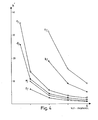
- the separation column with the material according to the invention is suitably eluted with water based mobile phases of different pH. It has proved to be advantageous to work within a pH range of 6-8 which is in agreement with the physiological pH of blood where pH is about 7.4. It has been possible to control retention times, capacity factors and separation selectivity by either a simple pH adjustment of mobile phase or addition of low concentrations of alcohol to the mobile phase in the manner shown more in detail in Figs. 4 and 5.
- Fig. 4 it is shown how the capacity factor k', proportional to the retention time for enantiomers of different drug substances varies with the amount of 2-propanol of the mobile phase wherein the curve a relates to (S)-bupivacaine, curve b relates to (R)-bupivacaine, curve c relates to (S)-mepivacaine, curve d relates to (R)-mepivacaine, curve e relates to mepensolate bromide II and curve f relates to mepensolate bromide I, where I and II are used to denote the enantiomers in those cases where pure enantiomers are not available.
- I denotes the enantiomer which is eluted first, i.e. the one that exhibits the lowest capacity factor
- II denotes the enantiomer that is eluted last in the chromatogram, i.e. the enantiomer with the highest capacity factor.
- Fig. 5 shows the separation factor a as a function of the pH of the mobile phase for a number of substances wherein curve a relates to disopyramide, curve b relates to RAC 109, curve c relates to bupivacaine, curve d relates to mepensolate bromide and curve e relates to mepivacaine.
- the separation factor a is hereby defined as the capacity factor for the enantiomer with the highest capacity factor divided with the capacity factor for the enantiomer with the lowest capacity factor.
- the orosomucoid derivatives or fragments thereof are immobilized on a solid phase, e.g. silica microparticles, by covalent binding.
- a solid phase e.g. silica microparticles
- the solid phase is packed in a column, applied to thin layer plates or used in a suspension for batch- separation of enantiomers.
- the column alternatively the thin layer plates are eluted with e.g. a water phase of given pH.
- the orosomucoid, derivatives or fragments thereof are dissolved in a buffer of known pH.
- the solution is adsorbed on a solid phase which is packed in a column, applied to thin layer plates or used in solution.
- a racemic test substance is distributed between the protein treated solid phase and a liquid mixture.
- the orosomucoid, derivatives or fragments thereof are dissolved in a buffer of known pH.
- a racemic substance is distributed between the water-based protein solution and at least one other liquid so that a liquid-based multi-phase system is formed, between which a racemic substance can be distributed.
- the method can be used in a batch process or carried out as a continuous extraction.
- the orosomucoid is dissolved in a cold, +4°C, acetate buffer of pH 5.
- the metaperiodate salt, 120 mole metaperiodate/mole protein, and the protein is reacted for 1 h at +4°C protected from light.
- glycerol, 18-20 mole glycerol/mole metaperiodate is added to the reaction mixture and reacted for ten minutes at room temperature.
- the reaction mixture is gelfiltered on a column packed with Sephadex@ G-25 (fine), equilibrated with a 0.01 M acetate buffer, pH 5.
- the reaction mixture is applied on the column which is, then, eluted with 0.01 M acetate buffer, pH 5.
- Oxidized protein is collected and adsorbed at pH 5 on a carrier having a surface containing positive groups at the above stated pH.
- the positive groups can be a quaternary ammonium compound or a tertiary amine.
- the adsorption can be carried out in batch.
- oxidized protein can be pumped through a column containing a solid phase with positive charges.
- the solid phase is suspended in a 0.1 M borate buffer pH 8.5 and reduced with a surplus of sodiumborohydride at room temperature for 1 h.
- the solid phase is washed with buffer pH 7 until the development of hydrogen gas has ceased.
- the orosomucoid is adsorbed at pH 5 on a carrier with a surface containing positive groups at the above stated pH.
- the positive groups can be a quaternary ammonium compound or a tertiary amine.
- the adsorption can be carried out in batch.
- the protein can be pumped through a column containing a solid phase with positive charges.
Landscapes
- Chemical & Material Sciences (AREA)
- Analytical Chemistry (AREA)
- Chemical Kinetics & Catalysis (AREA)
- Organic Chemistry (AREA)
- Molecular Biology (AREA)
- Health & Medical Sciences (AREA)
- Life Sciences & Earth Sciences (AREA)
- Immunology (AREA)
- Biochemistry (AREA)
- General Health & Medical Sciences (AREA)
- Inorganic Chemistry (AREA)
- Organic Low-Molecular-Weight Compounds And Preparation Thereof (AREA)
- Treatment Of Liquids With Adsorbents In General (AREA)
- Solid-Sorbent Or Filter-Aiding Compositions (AREA)
Claims (8)
Applications Claiming Priority (4)
| Application Number | Priority Date | Filing Date | Title |
|---|---|---|---|
| SE8303221 | 1983-06-08 | ||
| SE8303221A SE445649B (sv) | 1983-06-08 | 1983-06-08 | Anvendning av en fast berare med immobiliserad orosomucoid for separation, forfarande for framstellning av separationsmaterial, separationsanordning samt separationsmaterial |
| SE8307023 | 1983-12-19 | ||
| SE8307023A SE8307023L (sv) | 1983-06-08 | 1983-12-19 | Anordning for separation, foretredesvis av optiska isomerer, jemte forfarande for immobilisering av orosomucoid pa en berare och anvendning av denna for separation, foretredesvis av optiska isomerer |
Publications (3)
| Publication Number | Publication Date |
|---|---|
| EP0128886A2 EP0128886A2 (fr) | 1984-12-19 |
| EP0128886A3 EP0128886A3 (en) | 1985-08-14 |
| EP0128886B1 true EP0128886B1 (fr) | 1987-11-19 |
Family
ID=26658503
Family Applications (1)
| Application Number | Title | Priority Date | Filing Date |
|---|---|---|---|
| EP84850169A Expired EP0128886B1 (fr) | 1983-06-08 | 1984-06-04 | Matière de séparation à base d'orosomucoide ou de dérivés ou de fragments analogues, sa préparation et son utilisation |
Country Status (4)
| Country | Link |
|---|---|
| US (1) | US4612121A (fr) |
| EP (1) | EP0128886B1 (fr) |
| DE (1) | DE3467511D1 (fr) |
| SE (2) | SE445649B (fr) |
Families Citing this family (22)
| Publication number | Priority date | Publication date | Assignee | Title |
|---|---|---|---|---|
| JPH0713030B2 (ja) * | 1986-04-02 | 1995-02-15 | エーザイ株式会社 | 光学異性体用分離剤 |
| FR2597605B1 (fr) * | 1986-04-16 | 1989-06-23 | Merieux Inst | Nouveau materiau pour chromatographie d'affinite et son application a la separation et a la purification des antigenes proteiques des bacteries du genre bordetella |
| US5133866A (en) * | 1988-03-24 | 1992-07-28 | Terrapin Technologies, Inc. | Method to identify analyte-bending ligands |
| US4963263A (en) * | 1988-03-24 | 1990-10-16 | Terrapin Technologies, Inc. | Method of identity analyte-binding peptides |
| US5241052A (en) * | 1988-03-04 | 1993-08-31 | New England Deaconess Hospital Corporation | Carcinoma orosomucoid-related antigen, a monoclonal antibody thereto, and their uses |
| US5204450A (en) * | 1988-03-04 | 1993-04-20 | New England Deaconess Hospital Corporation | Carcinoma orosomucoid-related antigen, a monoclonal antibody thereto, and their uses |
| US4914021A (en) * | 1988-03-04 | 1990-04-03 | New England Deaconess Hospital Corporation | Carcinoma orosomucoid-related antigen, a monoclonal antibody thereto, and their uses |
| SE465514B (sv) * | 1990-02-19 | 1991-09-23 | Curt Pettersson | Foerfarande och anvaendning av ett separationsmedium vid separation av enantiomerer |
| CA2061519C (fr) * | 1991-02-20 | 2004-05-18 | Naoki Asakawa | Matieres de remplissage combinant des proteines a un support par un espaceur |
| US5354461A (en) * | 1991-02-20 | 1994-10-11 | Eisai Co., Ltd. | Packings combining protein to a support via a spacer |
| US5670629A (en) * | 1994-11-01 | 1997-09-23 | Shinwa Chemical Industries, Ltd. | Ovoglycoprotein and agents for chromatographic separation containing same |
| US7786141B2 (en) * | 2004-08-19 | 2010-08-31 | Vertex Pharmaceuticals Incorporated | Dihydrospiroindene modulators of muscarinic receptors |
| US7879834B2 (en) | 2004-08-19 | 2011-02-01 | Vertex Pharmaceuticals Incorporated | Spiroindoline modulators of muscarinic receptors |
| JP2008521825A (ja) * | 2004-11-29 | 2008-06-26 | バーテックス ファーマシューティカルズ インコーポレイテッド | ムスカリン受容体のモジュレーター |
| CA2634456A1 (fr) | 2005-12-22 | 2007-07-05 | Vertex Pharmaceuticals Incorporated | Modulateurs de recepteurs muscariniques |
| RU2008137583A (ru) * | 2006-02-22 | 2010-03-27 | Вертекс Фармасьютикалз Инкорпорейшн (Us) | Спиропиперидины в качестве модуляторов мускариновых рецепторов |
| US8003660B2 (en) | 2006-02-22 | 2011-08-23 | Vertex Pharmaceuticals Incorporated | Modulators of muscarinic receptors |
| US7858790B2 (en) | 2006-06-29 | 2010-12-28 | Vertex Pharmaceuticals Incorporated | Modulators of muscarinic receptors |
| CN101553231A (zh) | 2006-08-15 | 2009-10-07 | 弗特克斯药品有限公司 | 毒蕈碱受体调节剂 |
| US7786107B2 (en) * | 2006-08-18 | 2010-08-31 | Vertex Pharmaceuticals Incorporated | Modulators of muscarinic receptors |
| JP2010540640A (ja) * | 2007-10-03 | 2010-12-24 | バーテックス ファーマシューティカルズ インコーポレイテッド | ムスカリン作用性レセプターのモジュレーター |
| US20160368873A1 (en) * | 2014-02-17 | 2016-12-22 | Ltt Bio-Pharma Co., Ltd. | Optically Active Form of Mepenzolate, and Ameliorating Agent for Chronic Obstructive Pulmonary Disease Which Contains Same as Active Ingredient |
Family Cites Families (5)
| Publication number | Priority date | Publication date | Assignee | Title |
|---|---|---|---|---|
| US4312727A (en) * | 1979-03-23 | 1982-01-26 | The Cleveland Clinic Foundation | Glyoxal agarose and zonal immobilization of proteins therewith |
| US4416784A (en) * | 1980-01-28 | 1983-11-22 | Kureha Kagaku Kogyo Kabushiki Kaisha | Filling composition for use in liquid chromatography |
| US4464165A (en) * | 1980-11-24 | 1984-08-07 | American Hoechst Corporation | Material and method for removing immunoglobulins from whole blood |
| GB2097280B (en) * | 1981-04-27 | 1984-11-07 | Public Helath Lab Service Boar | High pressure liquid affinity chromatography |
| DE3143726C2 (de) * | 1981-11-04 | 1987-02-05 | Degussa Ag, 6000 Frankfurt | Optisch aktive Prolin-Derivate, Verfahren zu ihrer Herstellung und ihre Verwendung |
-
1983
- 1983-06-08 SE SE8303221A patent/SE445649B/sv not_active IP Right Cessation
- 1983-12-19 SE SE8307023A patent/SE8307023L/ not_active Application Discontinuation
-
1984
- 1984-05-23 US US06/613,177 patent/US4612121A/en not_active Expired - Lifetime
- 1984-06-04 EP EP84850169A patent/EP0128886B1/fr not_active Expired
- 1984-06-04 DE DE8484850169T patent/DE3467511D1/de not_active Expired
Also Published As
| Publication number | Publication date |
|---|---|
| US4612121A (en) | 1986-09-16 |
| DE3467511D1 (en) | 1987-12-23 |
| SE445649B (sv) | 1986-07-07 |
| SE8303221L (sv) | 1984-12-09 |
| SE8303221D0 (sv) | 1983-06-08 |
| EP0128886A3 (en) | 1985-08-14 |
| SE8307023L (sv) | 1984-12-09 |
| EP0128886A2 (fr) | 1984-12-19 |
| SE8307023D0 (sv) | 1983-12-19 |
Similar Documents
| Publication | Publication Date | Title |
|---|---|---|
| US4612121A (en) | Separation material, methods of producing a separation material and use of orosomucoid, functional analogs thereto or derivatives or fragments thereof for separation purposes | |
| EP0240013B1 (fr) | Agent de séparation pour isomères optiques, son procédé de préparation et son utilisation | |
| US4245005A (en) | Pellicular coated support and method | |
| US4322310A (en) | Chiral supports for resolution of racemates | |
| Hermansson | Direct liquid chromatographic resolution of racemic drugs using α1-acid glycoprotein as the chiral stationary phase | |
| US5277813A (en) | Shielded stationary phases | |
| EP1817109B1 (fr) | Matériau de séparation à base d'échangeur d'anions de mode mixte | |
| JP3808500B2 (ja) | 分離剤としての大環状抗生物質 | |
| Haginaka et al. | . beta.-Cyclodextrin-bonded silica for direct injection analysis of drug enantiomers in serum by liquid chromatography | |
| Mohammad et al. | Chiral‐recognition chromatography of β‐blockers on continuous polymer beds with immobilized cellulase as enantioselective protein | |
| KR101060896B1 (ko) | 금속 킬레이트 친화성 리간드의 형성 방법 | |
| US5135649A (en) | Column packing material with both hydrophobic and hydrophilic groups and process for production thereof | |
| Hermansson | Direct liquid chromatographic resolution of racemic drugs by means of α1-acid glycoprotein as the chiral complexing agent in the mobile phase | |
| KR100973749B1 (ko) | 의사이동상식 크로마토그래피를 이용하여 광학 이성체를 분리하는 방법 | |
| JP3377516B2 (ja) | 蛋白質と炭素鎖が結合した担体 | |
| JPH0774797B2 (ja) | 液体クロマトグラフィー用充てん剤並びにその製造方法及び使用方法 | |
| JP3148032B2 (ja) | 多糖の置換芳香族カルバメート誘導体および分離剤 | |
| JPS6041619A (ja) | 分離用物質およびその製造方法 | |
| JP3206111B2 (ja) | 液体クロマトグラフィー用充填剤 | |
| Haginaka et al. | Preparation and characterization of mixed functional phase silica materials using phenyl-, butyl-or octylchlorosilane as a silylating agent | |
| EP1455920B1 (fr) | Procede de separation | |
| Zief et al. | Solid phase extraction for sample preparation | |
| JP2002022721A (ja) | 液体クロマトグラフィー用親水性ods充填剤の製造方法 | |
| Haginaka et al. | β-cyclodextrin/diol phase silica materials for direct injection analysis of drug enantiomers in serum by liquid chromatography | |
| Schuster et al. | Chiral separation of pheniramine‐like 3‐phenyl‐3‐heteroarylpropylamines by CE and HPLC methods |
Legal Events
| Date | Code | Title | Description |
|---|---|---|---|
| PUAI | Public reference made under article 153(3) epc to a published international application that has entered the european phase |
Free format text: ORIGINAL CODE: 0009012 |
|
| AK | Designated contracting states |
Designated state(s): DE FR GB SE |
|
| PUAL | Search report despatched |
Free format text: ORIGINAL CODE: 0009013 |
|
| AK | Designated contracting states |
Designated state(s): DE FR GB SE |
|
| 17P | Request for examination filed |
Effective date: 19850902 |
|
| 17Q | First examination report despatched |
Effective date: 19860620 |
|
| GRAA | (expected) grant |
Free format text: ORIGINAL CODE: 0009210 |
|
| AK | Designated contracting states |
Kind code of ref document: B1 Designated state(s): DE FR GB SE |
|
| REF | Corresponds to: |
Ref document number: 3467511 Country of ref document: DE Date of ref document: 19871223 |
|
| ET | Fr: translation filed | ||
| PLBE | No opposition filed within time limit |
Free format text: ORIGINAL CODE: 0009261 |
|
| STAA | Information on the status of an ep patent application or granted ep patent |
Free format text: STATUS: NO OPPOSITION FILED WITHIN TIME LIMIT |
|
| 26N | No opposition filed | ||
| EAL | Se: european patent in force in sweden |
Ref document number: 84850169.8 |
|
| REG | Reference to a national code |
Ref country code: GB Ref legal event code: IF02 |
|
| PGFP | Annual fee paid to national office [announced via postgrant information from national office to epo] |
Ref country code: FR Payment date: 20030319 Year of fee payment: 20 |
|
| PGFP | Annual fee paid to national office [announced via postgrant information from national office to epo] |
Ref country code: GB Payment date: 20030415 Year of fee payment: 20 |
|
| PGFP | Annual fee paid to national office [announced via postgrant information from national office to epo] |
Ref country code: SE Payment date: 20030625 Year of fee payment: 20 |
|
| PGFP | Annual fee paid to national office [announced via postgrant information from national office to epo] |
Ref country code: DE Payment date: 20030829 Year of fee payment: 20 |
|
| PG25 | Lapsed in a contracting state [announced via postgrant information from national office to epo] |
Ref country code: GB Free format text: LAPSE BECAUSE OF EXPIRATION OF PROTECTION Effective date: 20040603 |
|
| REG | Reference to a national code |
Ref country code: GB Ref legal event code: PE20 |
|
| EUG | Se: european patent has lapsed |