EP0129362A2 - Diode à barrière Schottky à anneau de garde - Google Patents
Diode à barrière Schottky à anneau de garde Download PDFInfo
- Publication number
- EP0129362A2 EP0129362A2 EP84303749A EP84303749A EP0129362A2 EP 0129362 A2 EP0129362 A2 EP 0129362A2 EP 84303749 A EP84303749 A EP 84303749A EP 84303749 A EP84303749 A EP 84303749A EP 0129362 A2 EP0129362 A2 EP 0129362A2
- Authority
- EP
- European Patent Office
- Prior art keywords
- guard ring
- schottky barrier
- barrier layer
- layer
- voltage
- Prior art date
- Legal status (The legal status is an assumption and is not a legal conclusion. Google has not performed a legal analysis and makes no representation as to the accuracy of the status listed.)
- Granted
Links
- 230000004888 barrier function Effects 0.000 title claims abstract description 53
- 239000002184 metal Substances 0.000 claims abstract description 16
- 229910052751 metal Inorganic materials 0.000 claims abstract description 16
- 239000000758 substrate Substances 0.000 claims abstract description 16
- 230000015556 catabolic process Effects 0.000 claims abstract description 9
- 239000004065 semiconductor Substances 0.000 claims abstract description 8
- 229910021420 polycrystalline silicon Inorganic materials 0.000 claims description 8
- 229920005591 polysilicon Polymers 0.000 claims description 8
- 238000011084 recovery Methods 0.000 abstract description 11
- VYPSYNLAJGMNEJ-UHFFFAOYSA-N Silicium dioxide Chemical compound O=[Si]=O VYPSYNLAJGMNEJ-UHFFFAOYSA-N 0.000 description 11
- 229910052814 silicon oxide Inorganic materials 0.000 description 11
- BASFCYQUMIYNBI-UHFFFAOYSA-N platinum Chemical compound [Pt] BASFCYQUMIYNBI-UHFFFAOYSA-N 0.000 description 7
- 239000000969 carrier Substances 0.000 description 6
- 230000005684 electric field Effects 0.000 description 4
- 238000005229 chemical vapour deposition Methods 0.000 description 3
- 238000004519 manufacturing process Methods 0.000 description 3
- 229910052697 platinum Inorganic materials 0.000 description 3
- 229910021332 silicide Inorganic materials 0.000 description 3
- FVBUAEGBCNSCDD-UHFFFAOYSA-N silicide(4-) Chemical compound [Si-4] FVBUAEGBCNSCDD-UHFFFAOYSA-N 0.000 description 3
- ZOXJGFHDIHLPTG-UHFFFAOYSA-N Boron Chemical compound [B] ZOXJGFHDIHLPTG-UHFFFAOYSA-N 0.000 description 2
- PXHVJJICTQNCMI-UHFFFAOYSA-N Nickel Chemical compound [Ni] PXHVJJICTQNCMI-UHFFFAOYSA-N 0.000 description 2
- 229910052796 boron Inorganic materials 0.000 description 2
- MYMOFIZGZYHOMD-UHFFFAOYSA-N Dioxygen Chemical compound O=O MYMOFIZGZYHOMD-UHFFFAOYSA-N 0.000 description 1
- XUIMIQQOPSSXEZ-UHFFFAOYSA-N Silicon Chemical compound [Si] XUIMIQQOPSSXEZ-UHFFFAOYSA-N 0.000 description 1
- 239000004411 aluminium Substances 0.000 description 1
- 229910052782 aluminium Inorganic materials 0.000 description 1
- XAGFODPZIPBFFR-UHFFFAOYSA-N aluminium Chemical compound [Al] XAGFODPZIPBFFR-UHFFFAOYSA-N 0.000 description 1
- 230000015572 biosynthetic process Effects 0.000 description 1
- 238000000151 deposition Methods 0.000 description 1
- 229910001882 dioxygen Inorganic materials 0.000 description 1
- 238000005516 engineering process Methods 0.000 description 1
- 239000007789 gas Substances 0.000 description 1
- 230000004941 influx Effects 0.000 description 1
- 150000002500 ions Chemical class 0.000 description 1
- 239000000463 material Substances 0.000 description 1
- 238000000034 method Methods 0.000 description 1
- 238000012986 modification Methods 0.000 description 1
- 230000004048 modification Effects 0.000 description 1
- 229910052759 nickel Inorganic materials 0.000 description 1
- 239000008188 pellet Substances 0.000 description 1
- 238000001259 photo etching Methods 0.000 description 1
- 239000000376 reactant Substances 0.000 description 1
- 229910052710 silicon Inorganic materials 0.000 description 1
- 239000010703 silicon Substances 0.000 description 1
- 238000005245 sintering Methods 0.000 description 1
Images


Classifications
-
- H—ELECTRICITY
- H10—SEMICONDUCTOR DEVICES; ELECTRIC SOLID-STATE DEVICES NOT OTHERWISE PROVIDED FOR
- H10D—INORGANIC ELECTRIC SEMICONDUCTOR DEVICES
- H10D62/00—Semiconductor bodies, or regions thereof, of devices having potential barriers
- H10D62/10—Shapes, relative sizes or dispositions of the regions of the semiconductor bodies; Shapes of the semiconductor bodies
- H10D62/102—Constructional design considerations for preventing surface leakage or controlling electric field concentration
- H10D62/103—Constructional design considerations for preventing surface leakage or controlling electric field concentration for increasing or controlling the breakdown voltage of reverse-biased devices
- H10D62/105—Constructional design considerations for preventing surface leakage or controlling electric field concentration for increasing or controlling the breakdown voltage of reverse-biased devices by having particular doping profiles, shapes or arrangements of PN junctions; by having supplementary regions, e.g. junction termination extension [JTE]
- H10D62/106—Constructional design considerations for preventing surface leakage or controlling electric field concentration for increasing or controlling the breakdown voltage of reverse-biased devices by having particular doping profiles, shapes or arrangements of PN junctions; by having supplementary regions, e.g. junction termination extension [JTE] having supplementary regions doped oppositely to or in rectifying contact with regions of the semiconductor bodies, e.g. guard rings with PN or Schottky junctions
-
- H—ELECTRICITY
- H10—SEMICONDUCTOR DEVICES; ELECTRIC SOLID-STATE DEVICES NOT OTHERWISE PROVIDED FOR
- H10D—INORGANIC ELECTRIC SEMICONDUCTOR DEVICES
- H10D8/00—Diodes
- H10D8/60—Schottky-barrier diodes
Definitions
- This invention relates to a Schottky barrier diode (hereafter referred to as an SBD) and, in particular, to an SBD with a guard ring that has a comparatively high withstand voltage.
- SBD Schottky barrier diode
- SBDs have a low forward voltage drop and use majority carriers so the reverse recovery time is short. These characteristics make the SBD widely applicable as high-speed rectifying elements in power switching applications. Also, as SBDs are formed of a junction of a metal layer and a metal silicide layer on the surface of a semiconductor, an electrical field is formed around the ends of the metal and silicide layers. In order to increase the withstand voltage, an SBD is provided with a guard ring 2, as is shown in Fig. 1. An N - epitaxial layer 4 is formed on an N + semiconductor substrate 3 and on top of this, a Schottky barrier metal layer 1 is formed.
- the guard ring 2 is formed, which is a region with a conductivity opposite to that of the epitaxial layer 4 is formed.
- An opening is formed in an insulating film 5, which is also formed on the upper surface of the epitaxial layer 4, and a metal electrode 6 is formed on top of the Schottky barrier layer 1.
- a electrode 7 is formed on the underside of the N + semiconductor substrate 3, on the other hand. In this kind of SBD, the electrical field concentration around the Schottky barrier metal layer 1 is reduced inside the guard ring 2.
- the withstand voltage was in the 40 to 50 volt range so, for example, when used in power rectifying applications where the signal frequency is under 500 KHz, no particular problems occurred.
- the SBD shown in Fig. 1 has a withstand voltage of 40 V and a reverse recovery time of about 50 ns. If the specific resistance of the N - layer 4 is increased to give this particular SBD a withstand voltage of 200 V, the reverse recovery time would become 300 ns.
- the purpose of the invention is to provide a Schottky barrier diode with a short reverse recovery time and a high withstand voltage.
- the guard ring in the surface region of the semiconductor substrate is isolated from the Schottky barrier layer by an insulating film which has a hole. This hole is covered by a resistance layer through which the guard ring and barrier layer are electrically connected.
- the width of the substrate region between the guard ring and the Schottky barrier layer is smaller than the sum of the width of the depletion layers on the guard ring side and the barrier side when the lower voltage of either the guard ring breakdown voltage or the barrier breakdown voltage is applied.
- the guard ring and barrier layer are electrically connected by a high-resistance layer, a voltage drop occurs in this high-resistance layer at the time of conduction. Accordingly, even if the specific resistance of the N - epitaxial layer is to raise the withstand voltage of the device, the forward voltage in the guard ring can be kept low so there is virtually no flow of minority carriers into the high-resistance layer and the reverse recovery time is short.
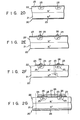
- a wafer 20 is shown with an N - epitaxial layer 22 of a specific resistance of about 5 ⁇ cm grown to a depth of about 20 ⁇ m on an N + silicon substrate 21.
- the wafer 20 is oxidized to form a 2 ⁇ m thick silicon oxide film 23 over the entire surface.
- Fig. 2C shows openings 24 formed in a specified position of the film 23 using a photoetching process.
- boron is diffused into the N - epitaxial layer 22 through the openings 24.
- the wafer 20 is oxidized once more to re-form the silicon oxide film 23 over the entire surface of the substrate.
- the region into which boron has been diffused becomes the P guard ring 25, which has a thickness of about 5 ⁇ m.
- Fig. 2E shows the formation of openings in that part of the silicon oxide film 23 which is over the P + guard ring 25, and the exposure of the layer 22.
- a polysilicon high-resistance layer 26 of 10 6 to 10 ⁇ cm is grown in the exposed area by CVD (chemical vapour deposition).
- a polysilicon layer having such a high resistance can be formed by using a CVD reactant gas to which oxygen gas is added to a concentration of less than 10%.
- the silicon oxide film 23 is removed from the inner side of the guard ring 25 such that the silicon oxide film 23 is left with a specified width around the inner periphery of the guard ring 25.
- the semiconductor substrate is then exposed.
- a barrier metal such as platinum is formed on the exposed surface between the inner sides of the guard ring 25 by a vapour deposition method.
- a Schottky barrier layer 27 of Pt silicide is formed.
- the Schottky barrier layer 27 and the guard ring 25 are isolated from each other.
- the width L of the region between the edge of the barrier layer 27 and the guard ring 25 is easy to manufacture with today's technology and, taking into consideration the yield rate, 5 to 8 ⁇ m is satisfactory.
- a metal electrode 28 of nickel or aluminium, etc. is shown formed on the lower surface of the wafer 20 and the upper surfaces of the barrier layer 27, the silicon oxide film 23, and the polysilicon 26. This wafer is cut along the chain line to produce an individual SBD pellet.
- the silicon oxide film 23 is formed on the substrate surface between the edges of the guard ring 25, the barrier layer 27 and the polysilicon 26, and a high-resistance layer is formed on the guard ring 25 to electrically connect the barrier layer 27 and the guard ring 25.
- the forward voltage drop V F occurring at the barrier surface at rated use is, with platinum as the barrier metal, approximately 0.75 V. Also, by using platinum it is possible to increase the forward voltage and decrease the reverse current.
- the Schottky barrier surface is 2 mm X 2 mm
- a direct resistance of about 2.5 K g will be formed on the guard ring, and when the forward voltage drop of the device is 0.75 V, the voltage in the guard ring will not be over 0.6 V.
- the SBD of this invention is able to suppress the forward bias of the guard ring 25 so that even if the specific resistance of N - epitaxial layer 22 is raised to increase the reverse withstand voltage, there is virtually no flow of minority carriers into polysilicon layer 2 6 , and the reverse recovery time is in the 50 ns order.
- the depletion layer between the guard ring 25 and the end of the barrier layer 27 gradually lengthens, as is shown in Figs. 3A to 3C. While the reverse voltage is still small, the depletion layer 31 at the end of barrier layer 27 and the depletion layer 32 of the guard ring 25 are quite far apart, as shown in Fig. 3A, so a field concentration is produced at the end of the barrier layer. In this case, however, because the applied voltage is low, breakdown does not occur. As the applied voltage increases, the depletion layers 31 and 32 come into contact, as is shown in Fig. 3B, and as the voltage increases further, they join together, as shown in Fig.
- the breakdown withstand voltage of the SBD is determined by the breakdown withstand voltage of the guard ring 25.
- the width L of the substrate region between the guard ring 25 and the barrier layer 27 is, theoretically, set such that it is lower than the sum of the width W 2 of the depletion layer 32 on the guard ring 25 side and the width W I of depletion layer 31 on the barrier layer end side "L ⁇ W 1 + W 2 '' when the lower breakdown voltage of either the guard ring or the barrier layer is applied.
- the characteristics of the SBD of this embodiment are a large withstand voltage of 200 V and a short reverse recovery time of less than 50 ns.
- a metal electrode 28 extends from over the silicon oxide film 23 on the region on the outside of the guard ring 25 to cover the barrier layer 27.
- the silicon oxide film 23 has a field plate structure, the substrate area directly underneath the metal electrode 28 is little affected by the positive ions in the film 23. Accordingly, compared with a device in which the metal electrode 28 extends from the barrier layer 27 to the polysilicon layer 26, this structure has an increased withstand voltage.
- the polysilicon layer 26 is not limited to the above and may be any material that has a resistance sufficient to suppress the forward bias value of the guard ring 25.
Landscapes
- Electrodes Of Semiconductors (AREA)
Applications Claiming Priority (2)
| Application Number | Priority Date | Filing Date | Title |
|---|---|---|---|
| JP58108126A JPS59232467A (ja) | 1983-06-16 | 1983-06-16 | ガ−ドリング付きシヨツトキ−バリヤ−ダイオ−ド |
| JP108126/83 | 1983-06-16 |
Publications (3)
| Publication Number | Publication Date |
|---|---|
| EP0129362A2 true EP0129362A2 (fr) | 1984-12-27 |
| EP0129362A3 EP0129362A3 (en) | 1985-07-03 |
| EP0129362B1 EP0129362B1 (fr) | 1987-09-09 |
Family
ID=14476592
Family Applications (1)
| Application Number | Title | Priority Date | Filing Date |
|---|---|---|---|
| EP84303749A Expired EP0129362B1 (fr) | 1983-06-16 | 1984-06-04 | Diode à barrière Schottky à anneau de garde |
Country Status (3)
| Country | Link |
|---|---|
| US (1) | US4607270A (fr) |
| EP (1) | EP0129362B1 (fr) |
| JP (1) | JPS59232467A (fr) |
Cited By (4)
| Publication number | Priority date | Publication date | Assignee | Title |
|---|---|---|---|---|
| FR2594596A1 (fr) * | 1986-02-18 | 1987-08-21 | Thomson Csf | Structure semiconductrice associant un ou plusieurs transistors de puissance et leur logique de commande et de protection |
| EP0803913A1 (fr) * | 1996-04-25 | 1997-10-29 | Siemens Aktiengesellschaft | Dispositif de diode Schottky et procédé de fabrication |
| FR2755794A1 (fr) * | 1996-10-15 | 1998-05-15 | Int Rectifier Corp | Diode schottky de puissance pour haute tension, ayant un metal de barriere fait d'aluminium et ecarte du premier anneau diffuse |
| FR2785091A1 (fr) * | 1998-09-01 | 2000-04-28 | Int Rectifier Corp | Diode de schottky |
Families Citing this family (23)
| Publication number | Priority date | Publication date | Assignee | Title |
|---|---|---|---|---|
| JPH0618276B2 (ja) * | 1988-11-11 | 1994-03-09 | サンケン電気株式会社 | 半導体装置 |
| US5418185A (en) * | 1993-01-21 | 1995-05-23 | Texas Instruments Incorporated | Method of making schottky diode with guard ring |
| US6066884A (en) * | 1999-03-19 | 2000-05-23 | Lucent Technologies Inc. | Schottky diode guard ring structures |
| DE10015884A1 (de) * | 2000-03-30 | 2001-10-11 | Philips Corp Intellectual Pty | Schottky-Diode |
| US6399413B1 (en) * | 2000-04-18 | 2002-06-04 | Agere Systems Guardian Corp. | Self aligned gated Schottky diode guard ring structures |
| US6690037B1 (en) | 2000-08-31 | 2004-02-10 | Agere Systems Inc. | Field plated Schottky diode |
| US6573128B1 (en) | 2000-11-28 | 2003-06-03 | Cree, Inc. | Epitaxial edge termination for silicon carbide Schottky devices and methods of fabricating silicon carbide devices incorporating same |
| US6498108B2 (en) | 2001-02-12 | 2002-12-24 | Fairchild Semiconductor Corporation | Method for removing surface contamination on semiconductor substrates |
| US7078296B2 (en) | 2002-01-16 | 2006-07-18 | Fairchild Semiconductor Corporation | Self-aligned trench MOSFETs and methods for making the same |
| JP2004134589A (ja) * | 2002-10-10 | 2004-04-30 | Sanyo Electric Co Ltd | 半導体装置 |
| US9515135B2 (en) * | 2003-01-15 | 2016-12-06 | Cree, Inc. | Edge termination structures for silicon carbide devices |
| US7026650B2 (en) * | 2003-01-15 | 2006-04-11 | Cree, Inc. | Multiple floating guard ring edge termination for silicon carbide devices |
| WO2005119793A2 (fr) * | 2004-05-28 | 2005-12-15 | Caracal, Inc. | Diodes schottky en carbure de silicium |
| US20060092592A1 (en) * | 2004-10-14 | 2006-05-04 | Taiwan Semiconductor Manufacturing Co. | ESD protection circuit with adjusted trigger voltage |
| US8901699B2 (en) | 2005-05-11 | 2014-12-02 | Cree, Inc. | Silicon carbide junction barrier Schottky diodes with suppressed minority carrier injection |
| US20080036048A1 (en) * | 2006-08-10 | 2008-02-14 | Vishay General Semiconductor Llc | Semiconductor junction device having reduced leakage current and method of forming same |
| KR20090127035A (ko) * | 2007-03-26 | 2009-12-09 | 스미토모덴키고교가부시키가이샤 | 쇼트키 배리어 다이오드 및 그 제조 방법 |
| US7672101B2 (en) * | 2007-09-10 | 2010-03-02 | Taiwan Semiconductor Manufacturing Co., Ltd. | ESD protection circuit and method |
| TW201015718A (en) * | 2008-10-03 | 2010-04-16 | Sanyo Electric Co | Semiconductor device and method for manufacturing the same |
| US8519478B2 (en) | 2011-02-02 | 2013-08-27 | International Business Machines Corporation | Schottky barrier diode, a method of forming the diode and a design structure for the diode |
| US8937319B2 (en) * | 2011-03-07 | 2015-01-20 | Shindengen Electric Manufacturing Co., Ltd. | Schottky barrier diode |
| CN103094358A (zh) * | 2011-11-01 | 2013-05-08 | 比亚迪股份有限公司 | 一种肖特基二极管及其制造方法 |
| DE112020006511T5 (de) * | 2020-01-14 | 2022-11-17 | Mitsubishi Electric Corporation | Schottky-Barrierendiode |
Family Cites Families (10)
| Publication number | Priority date | Publication date | Assignee | Title |
|---|---|---|---|---|
| DE1960465A1 (de) * | 1969-12-02 | 1971-06-09 | Licentia Gmbh | Halbleiteranordnung |
| DE1960455A1 (de) * | 1969-12-02 | 1971-06-09 | Korfmann Gmbh Maschf | Antriebsaggregat |
| US3694719A (en) * | 1970-11-27 | 1972-09-26 | Rca Corp | Schottky barrier diode |
| US4157563A (en) * | 1971-07-02 | 1979-06-05 | U.S. Philips Corporation | Semiconductor device |
| US3890698A (en) * | 1971-11-01 | 1975-06-24 | Motorola Inc | Field shaping layer for high voltage semiconductors |
| RO60829A2 (fr) * | 1973-12-05 | 1976-08-15 | ||
| JPS55103763A (en) * | 1979-01-31 | 1980-08-08 | Nec Home Electronics Ltd | Semiconductor device |
| FR2460040A1 (fr) * | 1979-06-22 | 1981-01-16 | Thomson Csf | Procede pour realiser une diode schottky a tenue en tension amelioree |
| JPS5949713B2 (ja) * | 1979-12-25 | 1984-12-04 | 日本電信電話株式会社 | シヨツトキバリヤダイオ−ド |
| DE3219598A1 (de) * | 1982-05-25 | 1983-12-01 | Siemens AG, 1000 Berlin und 8000 München | Schottky-leistungsdiode |
-
1983
- 1983-06-16 JP JP58108126A patent/JPS59232467A/ja active Granted
-
1984
- 1984-06-04 EP EP84303749A patent/EP0129362B1/fr not_active Expired
- 1984-06-08 US US06/618,952 patent/US4607270A/en not_active Expired - Lifetime
Cited By (8)
| Publication number | Priority date | Publication date | Assignee | Title |
|---|---|---|---|---|
| FR2594596A1 (fr) * | 1986-02-18 | 1987-08-21 | Thomson Csf | Structure semiconductrice associant un ou plusieurs transistors de puissance et leur logique de commande et de protection |
| EP0236200A1 (fr) * | 1986-02-18 | 1987-09-09 | Thomson-Csf | Structure semiconductrice associant un ou plusieurs transistors de puissance, et leur logique de commande et de protection |
| EP0803913A1 (fr) * | 1996-04-25 | 1997-10-29 | Siemens Aktiengesellschaft | Dispositif de diode Schottky et procédé de fabrication |
| US5907179A (en) * | 1996-04-25 | 1999-05-25 | Siemens Aktiengesellschaft | Schottky diode assembly and production method |
| US6191015B1 (en) | 1996-04-25 | 2001-02-20 | Siemens Aktiengesellschaft | Method for producing a Schottky diode assembly formed on a semiconductor substrate |
| FR2755794A1 (fr) * | 1996-10-15 | 1998-05-15 | Int Rectifier Corp | Diode schottky de puissance pour haute tension, ayant un metal de barriere fait d'aluminium et ecarte du premier anneau diffuse |
| US5859465A (en) * | 1996-10-15 | 1999-01-12 | International Rectifier Corporation | High voltage power schottky with aluminum barrier metal spaced from first diffused ring |
| FR2785091A1 (fr) * | 1998-09-01 | 2000-04-28 | Int Rectifier Corp | Diode de schottky |
Also Published As
| Publication number | Publication date |
|---|---|
| US4607270A (en) | 1986-08-19 |
| JPS59232467A (ja) | 1984-12-27 |
| EP0129362B1 (fr) | 1987-09-09 |
| EP0129362A3 (en) | 1985-07-03 |
| JPH0216591B2 (fr) | 1990-04-17 |
Similar Documents
| Publication | Publication Date | Title |
|---|---|---|
| US4607270A (en) | Schottky barrier diode with guard ring | |
| US5021840A (en) | Schottky or PN diode with composite sidewall | |
| US7187054B2 (en) | Diode and method for manufacturing the same | |
| US6404033B1 (en) | Schottky diode having increased active surface area with improved reverse bias characteristics and method of fabrication | |
| US6426541B2 (en) | Schottky diode having increased forward current with improved reverse bias characteristics and method of fabrication | |
| CA1175953A (fr) | Structure planar pour dispositifs a semiconducteur haute tension avec espacements dans une couche de verre recouvrant des regions a champ eleve | |
| US4638551A (en) | Schottky barrier device and method of manufacture | |
| JP3417013B2 (ja) | 絶縁ゲート型バイポーラトランジスタ | |
| EP0345435B1 (fr) | Dispositif semi-conducteur à haute tension de claquage et procédé pour sa fabrication | |
| JP2689047B2 (ja) | 絶縁ゲート型バイポーラトランジスタとその製造方法 | |
| US9577044B2 (en) | Semiconductor device with first and second electrodes forming schottky junction with silicon carbide semiconductor layer and method of manufacturing the same | |
| US4375717A (en) | Process for producing a field-effect transistor | |
| EP0646964A1 (fr) | Verrouillage actif, en structure intégrée pour la protection de dispostifs de puissance contre des surtensions, et procédé de fabrication associé | |
| JPH0752770B2 (ja) | 導電変調型mosfet | |
| US5089427A (en) | Semiconductor device and method | |
| EP0274190A2 (fr) | Jonction P-N ayant une tension d'avalanche augmentée | |
| CN110581180A (zh) | 半导体器件及其制造方法 | |
| EP0107773B1 (fr) | Thyristor bloquable | |
| JP3067034B2 (ja) | ショットキーバリア半導体装置 | |
| GB2097188A (en) | Field effect semiconductor device | |
| JP2005079233A (ja) | ショットキーダイオードとその製造方法 | |
| JPH0620125B2 (ja) | 半導体装置 | |
| JPH0464458B2 (fr) | ||
| JPH06177404A (ja) | 半導体ダイオード | |
| CN119008677A (zh) | 碳化硅基集成半导体器件及其制备方法 |
Legal Events
| Date | Code | Title | Description |
|---|---|---|---|
| PUAI | Public reference made under article 153(3) epc to a published international application that has entered the european phase |
Free format text: ORIGINAL CODE: 0009012 |
|
| 17P | Request for examination filed |
Effective date: 19840611 |
|
| AK | Designated contracting states |
Designated state(s): FR GB NL |
|
| PUAL | Search report despatched |
Free format text: ORIGINAL CODE: 0009013 |
|
| AK | Designated contracting states |
Designated state(s): FR GB NL |
|
| 17Q | First examination report despatched |
Effective date: 19860502 |
|
| GRAA | (expected) grant |
Free format text: ORIGINAL CODE: 0009210 |
|
| AK | Designated contracting states |
Kind code of ref document: B1 Designated state(s): FR GB NL |
|
| ET | Fr: translation filed | ||
| PLBE | No opposition filed within time limit |
Free format text: ORIGINAL CODE: 0009261 |
|
| STAA | Information on the status of an ep patent application or granted ep patent |
Free format text: STATUS: NO OPPOSITION FILED WITHIN TIME LIMIT |
|
| 26N | No opposition filed | ||
| PGFP | Annual fee paid to national office [announced via postgrant information from national office to epo] |
Ref country code: GB Payment date: 19970527 Year of fee payment: 14 |
|
| PGFP | Annual fee paid to national office [announced via postgrant information from national office to epo] |
Ref country code: FR Payment date: 19970610 Year of fee payment: 14 |
|
| PGFP | Annual fee paid to national office [announced via postgrant information from national office to epo] |
Ref country code: NL Payment date: 19970630 Year of fee payment: 14 |
|
| PG25 | Lapsed in a contracting state [announced via postgrant information from national office to epo] |
Ref country code: GB Free format text: LAPSE BECAUSE OF NON-PAYMENT OF DUE FEES Effective date: 19980604 |
|
| PG25 | Lapsed in a contracting state [announced via postgrant information from national office to epo] |
Ref country code: NL Free format text: LAPSE BECAUSE OF NON-PAYMENT OF DUE FEES Effective date: 19990101 |
|
| GBPC | Gb: european patent ceased through non-payment of renewal fee |
Effective date: 19980604 |
|
| PG25 | Lapsed in a contracting state [announced via postgrant information from national office to epo] |
Ref country code: FR Free format text: LAPSE BECAUSE OF NON-PAYMENT OF DUE FEES Effective date: 19990226 |
|
| NLV4 | Nl: lapsed or anulled due to non-payment of the annual fee |
Effective date: 19990101 |
|
| REG | Reference to a national code |
Ref country code: FR Ref legal event code: ST |