EP0129879B1 - [1] Benzepino(3,4-b)pyridin-Derivate - Google Patents
[1] Benzepino(3,4-b)pyridin-Derivate Download PDFInfo
- Publication number
- EP0129879B1 EP0129879B1 EP84107193A EP84107193A EP0129879B1 EP 0129879 B1 EP0129879 B1 EP 0129879B1 EP 84107193 A EP84107193 A EP 84107193A EP 84107193 A EP84107193 A EP 84107193A EP 0129879 B1 EP0129879 B1 EP 0129879B1
- Authority
- EP
- European Patent Office
- Prior art keywords
- group
- pyridine
- benzoxepino
- dihydro
- derivative
- Prior art date
- Legal status (The legal status is an assumption and is not a legal conclusion. Google has not performed a legal analysis and makes no representation as to the accuracy of the status listed.)
- Expired
Links
- 0 C**C(C(CCC(*)(CC1)*2CCCC2)C1*C1)C2C1*(C)NCCC2 Chemical compound C**C(C(CCC(*)(CC1)*2CCCC2)C1*C1)C2C1*(C)NCCC2 0.000 description 17
- JAPMJSVZDUYFKL-UHFFFAOYSA-N C1C2C1CCC2 Chemical compound C1C2C1CCC2 JAPMJSVZDUYFKL-UHFFFAOYSA-N 0.000 description 1
- XDTMQSROBMDMFD-UHFFFAOYSA-N C1CCCCC1 Chemical compound C1CCCCC1 XDTMQSROBMDMFD-UHFFFAOYSA-N 0.000 description 1
Classifications
-
- C—CHEMISTRY; METALLURGY
- C07—ORGANIC CHEMISTRY
- C07D—HETEROCYCLIC COMPOUNDS
- C07D491/00—Heterocyclic compounds containing in the condensed ring system both one or more rings having oxygen atoms as the only ring hetero atoms and one or more rings having nitrogen atoms as the only ring hetero atoms, not provided for by groups C07D451/00 - C07D459/00, C07D463/00, C07D477/00 or C07D489/00
- C07D491/02—Heterocyclic compounds containing in the condensed ring system both one or more rings having oxygen atoms as the only ring hetero atoms and one or more rings having nitrogen atoms as the only ring hetero atoms, not provided for by groups C07D451/00 - C07D459/00, C07D463/00, C07D477/00 or C07D489/00 in which the condensed system contains two hetero rings
- C07D491/04—Ortho-condensed systems
-
- C—CHEMISTRY; METALLURGY
- C07—ORGANIC CHEMISTRY
- C07D—HETEROCYCLIC COMPOUNDS
- C07D495/00—Heterocyclic compounds containing in the condensed system at least one hetero ring having sulfur atoms as the only ring hetero atoms
- C07D495/02—Heterocyclic compounds containing in the condensed system at least one hetero ring having sulfur atoms as the only ring hetero atoms in which the condensed system contains two hetero rings
- C07D495/04—Ortho-condensed systems
Definitions
- the present invention relates to a novel [1] benzepino [3,4-b]pyridine derivative, the pharmaceutically acceptable acid addition salts thereof and a pharmaceutical composition containing, as the active ingredient, a novel [1]benzepino[3,4-b]pyridine derivative.
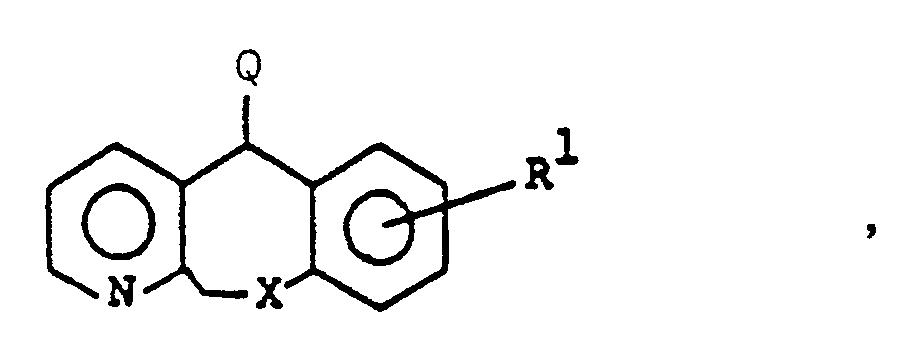
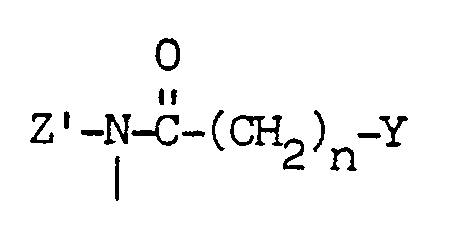
- the present invention pertains to a novel [1] benzepino[3,4-b]pyridine derivative. represented by the formula (I): wherein R 1 represents a hydrogen atom, a C 1-5 alkyl group, a halogenated C 1-3 alkyl group, a C, - 5 alkoxy group or a halogen atom; R 2 represents wherein Y represents an amino group which may be mono- or di-substituted by a C 1 - 5 alkyl group; a heterocyclic group which may be substituted by a C 1-5 alkyl group or by a halogen atom, the heterocyclic group being a piperazine group, a piperidine group, a morpholine group, a pyrrolidine group, a pyridine group, a quinuclidine group, an imidazole group, an indole group, a quinoline group or a pyrrolizidine group; z represents a hydrogen atom,
- the present invention pertains to a pharmaceutical composition
- a pharmaceutical composition comprising a pharmaceutical carrier and, as an active ingredient, an effective amount of a novel [1] benzepino[3,4-b]pyridine derivative represented by the formula (I).
- the alkyl group for R 1 , Z and Z' include an alkyl group having 1 - 5 carbon atoms, such as a methyl group, an ethyl group, a propyl group, a butyl group and a pentyl group;
- the halogenated alkyl group for R' includes a halogenated alkyl group having 1 - 3 carbon atoms, such as a trifluoromethyl group, a trichloromethyl group and a tribromomethyl group;
- the alkoxy group for R' includes an alkoxy group having 1 - 5 carbon atoms, such as a methoxy group, an ethoxy group, a propoxy group, a butoxy group and a pentyloxy group;
- the halogen atom for R' includes a fluorine atom, a chlorine atom, a bromine atom and an iodine atom
- the pharmaceutically acceptable acid addition salts of the present compound are inorganic acid salts such as hydrochlorides, hydrobromides, phosphates, sulfates, etc. and organic acid salts such as acetates, maleate, fumarates, tartrates, citrates, oxalates and benzoates.
- the present compound is prepared from compound II represented by the formula (II): wherein R' and X have the same meanings as defined above, by utilizing well-known organic synthetic methods as described below.
- R', R 2 and X have the same meanings as defined above; and Q represents a halogen atom.
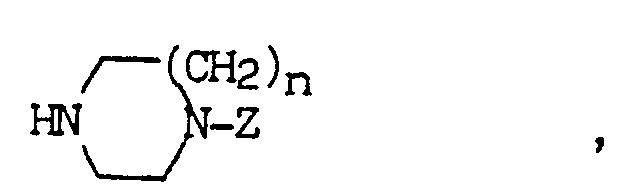
- Compound II is reduced into compound III, which is reacted with a halogenating agent to give compound IV or acid addition salt thereof. It is then reacted with an amine [ Z"-NH-(CH 2 ) m -Y(compound V) or (compound VI), wherein Y, Z, m and n have the same meanings as defined above; and Z" represents a hydrogen atom or an alkyl group having 1 to 5 carbon atoms ] to obtain compound I.
- Compound III is prepared by reducing compound II usually with a metal hydride complex, such as lithium aluminum hydride and sodium borohydride.
- a metal hydride complex such as lithium aluminum hydride and sodium borohydride.
- compound II is dissolved or suspended in an anhydrous solvent such as diethyl ether, diisopropyl ether, tetrahydrofuran and ethylene glycol dimethyl ether. Then, 0.3 to 2.0 equivalents, based on compound II, of lithium aluminum hydride is added thereto, and the mixture is stirred at an appropriate temperature from 0 C to the boiling point of the solvent used for 30 minutes to 3 hours to complete the reduction.
- anhydrous solvent such as diethyl ether, diisopropyl ether, tetrahydrofuran and ethylene glycol dimethyl ether.
- compound II is dissolved or suspended in a solvent such as water, methanol, ethanol, isopropanol, ethylene glycol dimethyl ether, dimethylformamide and dimethylsulfoxide. Then, 0.3 to 1.0 equivalent, based on compound II, of sodium borohydride is added thereto, and the mixture is stirred at an appropriate temperature from 0 to 60 °C for one to 8 hours to complete the reduction.
- a solvent such as water, methanol, ethanol, isopropanol, ethylene glycol dimethyl ether, dimethylformamide and dimethylsulfoxide.
- Compound III thus obtained is easily converted to compound IV or acid addition salt thereof by reaction with a halogenating agent such as thionyl halides and phosphorus halides.
- a halogenating agent such as thionyl halides and phosphorus halides.
- thionyl halide thionyl chloride or thionyl bromide is used.
- Compound III is reacted with excess thionyl halide, in the presence or absence of a solvent such as benzene, toluene, xylene, dichloromethane, chloroform, carbon tetrachloride, dimethylformamide and diethyl ether, at an appropriate temperature from 0 to 70 C for one to 5 hours in the presence of a tertiary amine, if necessary, such as pyridine, quinoline, dimethylaniline, triethylamine and diisopropylethylamine, to give compound IV or acid addition salt thereof.
- a solvent such as benzene, toluene, xylene, dichloromethane, chloroform, carbon tetrachloride, dimethylformamide and diethyl ether
- phosphorus halides include phosphorus trichloride, phosphorus pentachloride, phosphorus tribromide, phosphorus pentabromide, phosphorus oxychloride and phosphorus oxybromide. These compounds may be reacted with compound III under similar conditions as in the case of thionyl halides, affording compound IV or acid addition salt thereof.
- hydrogen halides are used for halogenation of compound III to form compound IV or acid addition salt thereof.
- Compound I is prepared by reaction of compound IV or acid addition salt thereof with compound V or compound VI.
- the reaction is carried out at an appropriate temperature from -10 to 120°C for 30 minutes to 3 hours using 2 to 10 equivalents of compound V or VI, based on compound IV or acid addition salt thereof, and using an inert solvent, if necessary, such as dichloromethane, chloroform, carbon tetrachloride, benzene, toluene, xylene, diethyl ether, diisopropyl ether, tetrahydrofuran, dioxane, hexane, cyclohexane, acetonitrile, carbon disulfide, ethyl acetate and dimethylformamide.
- an inert solvent if necessary, such as dichloromethane, chloroform, carbon tetrachloride, benzene, toluene, xylene, diethyl ether, diisopropyl ether,
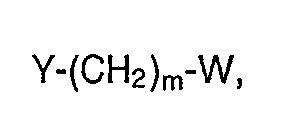
- Compound IV or acid addition salt thereof, obtained in Process A, is subjected to reaction with ammonia or an amine [ Z"-NH 2 (compound VIII), wherein Z" has the same meaning as defined above ] to form compound VII, which is then reacted with compound IX of formula Y-(CH 2 ) m- W wherein Y and m have the same meanings as defined above; and W represents a halogen atom such as chlorine atom, bromine atom and iodine atom or a sulfonyloxy group such as methylsulfonyloxy group, phenylsulfonyloxy group and p-toluenesulfonyloxy group, or acid addition salt thereof, to give compound 1-1 of this invention.
- a halogen atom such as chlorine atom, bromine atom and iodine atom
- a sulfonyloxy group such as methylsulfonyloxy group, phenylsul
- Compound VII is prepared by reaction of compound IV or acid addition salt thereof with an excess amount of compound VIII in the presence or absence of an inert solvent such as benzene, toluene, xylene, dichloromethane, chloroform, carbon tetrachloride, dimethylformamide, diethyl ether, tetrahydrofuran, dioxane, acetonitrile and ethyl acetate, at an appropriate temperature from -78 to 50 C for 30 minutes to 3 hours.
- an inert solvent such as benzene, toluene, xylene, dichloromethane, chloroform, carbon tetrachloride, dimethylformamide, diethyl ether, tetrahydrofuran, dioxane, acetonitrile and ethyl acetate
- R 1 , X, Y and m have the same meanings as defined above.
- Compound I-2 of this invention is prepared by condensation of compound II with compound X to afford compound XI, followed by reduction.
- compound II is subjected to reaction with 5 to 10 equivalents based on compound II, of compound X in a solvent such as dichloromethane, chloroform, carbon tetrachloride, benzene, toluene, xylene, carbon disulfide and dimethylformamide, at an appropriate temperature from 0 to 120° C for 6 to 48 hours in the presence of 0.5 to 1.0 equivalent, based on compound II of a Lewis acid such as titanium tetrachloride and tin tetrachloride, to give compound XI.
- a solvent such as dichloromethane, chloroform, carbon tetrachloride, benzene, toluene, xylene, carbon disulfide and dimethylformamide
- This product is then reduced by using a method commonly employed for reduction of imines to amines, for example, reduction with a metal hydride complex such as lithium aluminum hydride, sodium borohydride and sodium borocyanohydride, or by catalytic hydrogenation, whereby compound 1-2 is obtained.
- a metal hydride complex such as lithium aluminum hydride, sodium borohydride and sodium borocyanohydride, or by catalytic hydrogenation, whereby compound 1-2 is obtained.
- R 1 , X, Y and m have the same meanings as defined above; and R 3 represents an acyl group having 1 to 5 carbon atoms.
- acyl group having 1 to 5 carbon atoms for R 3 examples include formyl, acetyl, propionyl, butyryl, valeryl, fluoroacetyl, difluoroacetyl, trifluoroacetyl, chloroacetyl, dichloroacetyl, trichloroacetyl, bromoacetyl, dibromoacetyl, tribromoacetyl groups, etc.
- Compound 1-3 of this invention is prepared by acylating compound 1-2, obtained by Processes A through C, by a method usually used for acylation of amino groups, for example, by using carbonyl halides, carboxylic anhydrides or active esters.
- R 1 , R 2 and X have the same meanings as defined above, and R 4 represents an alkyl group, a phenyl group or a substituted phenyl group.
- Examples of the substituted phenyl group includes p-tolyl group.
- Compound I of this invention is prepared by reaction of compound III, obtained in Process A, with a sulfonylating agent to afford compound XII or acid addition salt thereof, followed by reaction with an amine (compound V or VI).
- Compound I-2 is prepared by condensation of compound VII', compound VII (wherein Z" is a hydrogen atom) obtained in Process B, with compound XIII to afford compound XIV, followed by reduction.
- R 1 , R 2 , X, Y and Q have same meanings as defined above; and l is 1 or 2.
- Compound IV or acid addition salt thereof, obtained in Process A, is reacted with ammonia or an amine [ R 2- NH 2 (compound XVII), wherein R 2 has the same meaning as defined above ] to form compound XV, followed by reaction with a halogenated acyl halide [ Q-CO(CH2) l -Q(compound XVIII), wherein Q and l have the same meanings as defined above ] or with a halogenated acid anhydride ⁇ [Q-(CH2) l -CO] 2 O (compound XIX), wherein Q and t have the same meanings as defined above to give compound XVI or acid addition salt thereof.
- Compound 1-4 of this invention is prepared by reaction of compound XVI or acid addition salt thereof thus obtained with compound XX (Y-H, wherein Y has the same meaning as defined above).
- Process G is described in more detail below.
- Compound IV or acid addition salt thereof is subjected to reaction with excess ammonia or a compound XVII, in the presence or absence of an inert solvent, such as benzene, toluene, xylene, dichloromethane, chloroform, carbon tetrachloride, dimethylformamide, diethyl ether, tetrahydrofuran, dioxane, acetonitrile and ethyl acetate, at an appropriate temperature from -78 to 50 C for 30 minutes to 3 hours, whereby compound XV is obtained.
- an inert solvent such as benzene, toluene, xylene, dichloromethane, chloroform, carbon tetrachloride, dimethylformamide, diethyl ether, tetrahydrofuran, dioxane, acetonitrile and ethyl acetate
- compound XV is reacted with 1 to 1.5 equivalents of compound XVIII in an inert solvent such as benzene, toluene, xylene, dichloromethane, chloroform, carbon tetrachloride, dimethylformamide, diethyl ether, tetrahydrofuran and dioxane in the presence of a base, if necessary, such as pyridine, triethylamine and diisopropylethylamine, at an appropriate temperature from -20 to 50 C for 30 minutes to 2 hours, whereby compound XVI or acid addition salt thereof is obtained.
- an inert solvent such as benzene, toluene, xylene, dichloromethane, chloroform, carbon tetrachloride, dimethylformamide, diethyl ether, tetrahydrofuran and dioxane
- a base if necessary, such as pyridine, triethylamine and diisopropyle
- compound VI is prepared by adding 1 to 2 equivalents of compound XVIII to a mixture of compound XV, an organic solvent such as benzene, toluene, xylene and diethyl ether, and an aqueous solution of a base such as sodium hydroxide, potassium hydroxide, sodium carbonate and potassium carbonate, at an appropriate temperature from -20 to 50°C.
- an organic solvent such as benzene, toluene, xylene and diethyl ether
- a base such as sodium hydroxide, potassium hydroxide, sodium carbonate and potassium carbonate
- Compound 1-4 is prepared by reaction of compound XVI or acid addition salt thereof with compound XX.
- the reaction is carried out at an appropriate temperature from room temperature to 120° C for 2 to 8 hours, using 2 to 5 equivalents of compound XX, based on compound XVI or acid addition salt thereof, and using an inert solvent, if necessary, such as benzene, toluene, xylene, dichloromethane, chloroform, carbon tetrachloride, dimethylformamide, diethyl ether, tetrahydrofuran, dioxane, acetonitrile, hexane, and ethyl acetate, in the presence of an iodide, if necessary, such as potassium and sodium iodides.
- an inert solvent if necessary, such as benzene, toluene, xylene, dichloromethane, chloroform, carbon tetrachloride, dimethylformamide, diethy
- R 1 , R 2 , X and Q have the same meanings as defined above.
- Compound I-5 of this invention is prepared by reaction of compound IV or acid addition salt thereof, obtained in Process A, with compound XXI.
- Compound IV or acid addition salt thereof is subjected to reaction with 1 to 3 equivalents of compound XXI in the presence of a base such as sodium carbonate, sodium bicarbonate, potassium carbonate, potassium bicarbonate, pyridine, dimethylamine, triethylamine and diisopropylamine, using an inert solvent, if necessary, such as dichloromethane, chloroform, carbon tetrachloride, benzene, tolulene, xylene, diethyl ether, diisopropyl ether, tetrahydrofuran, dioxane, hexane, acetonitrile, dimethylformamide and ethyl acetate, at an appropriate temperature from -10 to 100°C for 30 minutes to 3 hours, whereby compound 1-5 is obtained.
- a base such as sodium carbonate, sodium bicarbonate, potassium carbonate, potassium bicarbonate, pyridine, dimethylamine, triethylamine and diisopropyl
- R 1 , R 2 , Z" and X have the same meanings as defined above; and Z"' represents an alkyl group having 1 to 5 carbon atoms.
- Compound 1-6 of this invention is prepared by reaction of compound XV with compound XXII.
- R', R 2 and X have the same meanings as defined above; and R 5 and R 6 represent hydrogen atom or an alkyl group having 1 to 5 carbon atoms.
- Test methods for acute toxicity and antiulcer activity of the present compounds are described below. Test for acute toxicity
- mice Groups of 5 male dd-strain mice weighing 19 to 21 g were used.
- the present compounds were administered either orally (0.3 mg/g) or intraperitoneally (0.1 mg/g).
- the MLD minimum lethal dose
- the rats were immobilized in the stress cage devised by Takagi et al. [Jap. J. Pharmacol., 18, 9 (1968)].
- the cage was then immersed vertically in a water bath at 23 ⁇ 1 ° C for 7 hours to the height of xiphoid process.
- Each rat was then killed with carbon dioxide gas and its stomach was removed. The lengths of the lesions developed on the glandular stomach were summed to give a lesion index for each rat.
- test compounds were dissolved in saline or dissolved or suspended in saline with a suitable amount of polyethylene glycol-400 added or not added.
- the ulcer- inhibiton rate of each compound was calculated from the following formula by comparing the lesion index of the test group with that of the control group [administered with only the solvent (saline with polyethylene glycol-400 added or not added)]. Results for typical examples of the present compounds are given in Table 4.
- the present compounds have excellent antiulcer activity, and therefore are useful as an antiulcer agent.
- compositions of the present invention are prepared by uniformly mixing an effective amount of present compounds as the active ingredient, in free form or as an acid addition salt, with a pharmaceutically acceptable carrier.
- the carrier may take various forms depending on the pharmaceutical form suitable for administration. It is preferable that the pharmaceutical composition is in single administration form suitable for administration orally or by injection.
- any useful pharmaceutical carrier may be used.
- oral liquid preparations such as suspensions and syrups can be prepared using water, sugar (e.g. sucrose, sorbitol and fructose), glycols (e.g. polyethyleneglycol and propyleneglycol), oils (e.g. sesame oil, olive oil and soybean oil), antisepics (e.g. an alkyl parahydroxybenzoate), flavours (e.g. strawberry flavour and peppermint) and the like.
- Powders, pills, capsules and tablets can be prepared using excipients (e.g. lactose, glucose, sucrose and mannitol), disintegrators (e.g.
- starch and sodium alginate starch and sodium alginate
- lubricants e.g. magnesium stearate and talc
- binders e.g. polyvinyl alcohol, hydroxypropylcellulose and gelatin
- surfactants e.g. sucrose fatty acid ester
- plasticizers e.g. glycerin
- Tablets and capsules are the most useful single oral administration forms because of the ease of administration. To make tablets and capsules solid pharmaceutical carriers are used.
- An injection solution can be prepared using a carrier consisting of salt solution, glucose solution and a mixture of salt and glucose solution.
- the amount of the active ingredient can be varied over a rather wide range, 10 - 50 mg person (about 60 kg)/day in one dose or several divided doses is generally considered to be effective.
- This product was dissolved in 10 ml of dichloromethane.
- the resultant solution was added dropwise to a solution of 4.2 g of N,N-diethylethylenediamine in 20 ml of dichloromethane and the mixture was stirred at room temperature for 3 hours. Then, 20 ml of water and 20 ml of dichloromethane were added thereto and the mixture was shaken. The separated aqueous layer was removed, and the dichloromethane layer was dried and concentrated under reduced pressure.
- hydrochloride of 5-chloro-5,11-dihydro[1]benzoxepino[3,4-b]pyridine prepared from 4.3 g of 5-hydroxy-5,11-dihydro[1]benzoxepino[3,4-b]pyridine in a similar manner to that in Example 1 was dissolved in 50 ml of dichloromethane. The mixture solution was added dropwise to a 200 ml solution of ammonia in dichloromethane under ice cooling, and the mixture was stirred at room temperature for 2 hours. After completion of the reaction, 50 ml of water was added thereto and the mixture was shaken.
- 5-chloro-5,11-dihydro[l]benzoxepino[3,4-b]pyridine hydrochloride obtained from 1.7 g of 5,11-dihydro-5-hydroxy-[1]benzoxepino[3,4-b]pyridine in a similar manner to that in Example 27, was dissolved in 15 ml of dichloromethane. The resultant solution was added dropwise to a solution of 1.4 g 1,3-dimethylurea and 2.5 g of triethylamine in 35 ml of dichloromethane. The mixture was stirred at room temperature for 2 hours and concentrated under reduced pressure.
- a tablet comprising the following components is prepared in a conventional manner.
- a powder comprising the following components is prepared in a conventional manner.
- a powder comprising the following components is prepared in a conventional manner.
- a syrup comprising the following components is prepared in a conventional manner.
Landscapes
- Chemical & Material Sciences (AREA)
- Organic Chemistry (AREA)
- Pharmaceuticals Containing Other Organic And Inorganic Compounds (AREA)
Claims (26)










Priority Applications (1)
| Application Number | Priority Date | Filing Date | Title |
|---|---|---|---|
| AT84107193T ATE67205T1 (de) | 1983-06-24 | 1984-06-22 | (1> benzepino(3,4-b)pyridin-derivate. |
Applications Claiming Priority (6)
| Application Number | Priority Date | Filing Date | Title |
|---|---|---|---|
| JP113831/83 | 1983-06-24 | ||
| JP58113831A JPS606690A (ja) | 1983-06-24 | 1983-06-24 | 新規な〔1〕ベンズエピノ〔3,4−b〕ピリジン誘導体 |
| JP186129/83 | 1983-10-05 | ||
| JP58186129A JPS6078985A (ja) | 1983-10-05 | 1983-10-05 | 新規な〔1〕ベンズエピノ〔3,4−b〕ピリジン誘導体 |
| JP58196976A JPS6089419A (ja) | 1983-10-21 | 1983-10-21 | 新規な〔1〕ベンズエピノ〔3,4−b〕ピリジン誘導体を有効成分とする抗潰瘍剤 |
| JP196976/83 | 1983-10-21 |
Publications (3)
| Publication Number | Publication Date |
|---|---|
| EP0129879A2 EP0129879A2 (de) | 1985-01-02 |
| EP0129879A3 EP0129879A3 (en) | 1988-01-07 |
| EP0129879B1 true EP0129879B1 (de) | 1991-09-11 |
Family
ID=27312598
Family Applications (1)
| Application Number | Title | Priority Date | Filing Date |
|---|---|---|---|
| EP84107193A Expired EP0129879B1 (de) | 1983-06-24 | 1984-06-22 | [1] Benzepino(3,4-b)pyridin-Derivate |
Country Status (4)
| Country | Link |
|---|---|
| US (1) | US4547496A (de) |
| EP (1) | EP0129879B1 (de) |
| CA (1) | CA1237428A (de) |
| DE (1) | DE3485040D1 (de) |
Families Citing this family (10)
| Publication number | Priority date | Publication date | Assignee | Title |
|---|---|---|---|---|
| US5547943A (en) * | 1986-04-30 | 1996-08-20 | Chugai Seiyaku Kabushiki Kaisha | Sucralfate preparation |
| US6323206B1 (en) | 1996-07-12 | 2001-11-27 | Millennium Pharmaceuticals, Inc. | Chemokine receptor antagonists and methods of use therefor |
| US6613905B1 (en) | 1998-01-21 | 2003-09-02 | Millennium Pharmaceuticals, Inc. | Chemokine receptor antagonists and methods of use therefor |
| US6509346B2 (en) | 1998-01-21 | 2003-01-21 | Millennium Pharmaceuticals, Inc. | Chemokine receptor antagonists and methods of use therefor |
| WO1999037619A1 (en) | 1998-01-21 | 1999-07-29 | Millennium Pharmaceuticals, Inc. | Chemokine receptor antagonists and methods of use therefor |
| ATE309249T1 (de) | 1998-01-21 | 2005-11-15 | Millennium Pharm Inc | Chemokin rezeptor antagonisten und verwndung |
| US7271176B2 (en) * | 1998-09-04 | 2007-09-18 | Millennium Pharmaceuticals, Inc. | Chemokine receptor antagonists and methods of use thereof |
| US6503926B2 (en) | 1998-09-04 | 2003-01-07 | Millennium Pharmaceuticals, Inc. | Chemokine receptor antagonists and methods of use therefor |
| US7541365B2 (en) | 2001-11-21 | 2009-06-02 | Millennium Pharmaceuticals, Inc. | Chemokine receptor antagonists and methods of use therefor |
| TWI291467B (en) | 2002-11-13 | 2007-12-21 | Millennium Pharm Inc | CCR1 antagonists and methods of use therefor |
-
1984
- 1984-06-21 CA CA000457146A patent/CA1237428A/en not_active Expired
- 1984-06-21 US US06/623,084 patent/US4547496A/en not_active Expired - Fee Related
- 1984-06-22 DE DE8484107193T patent/DE3485040D1/de not_active Expired - Lifetime
- 1984-06-22 EP EP84107193A patent/EP0129879B1/de not_active Expired
Also Published As
| Publication number | Publication date |
|---|---|
| EP0129879A2 (de) | 1985-01-02 |
| EP0129879A3 (en) | 1988-01-07 |
| US4547496A (en) | 1985-10-15 |
| DE3485040D1 (de) | 1991-10-17 |
| CA1237428A (en) | 1988-05-31 |
Similar Documents
| Publication | Publication Date | Title |
|---|---|---|
| KR910002583B1 (ko) | 피페라진 유도체 또는 이의 염, 이의 제조방법 및 활성 성분으로서 이를 함유하는 약제학적 조성물 | |
| EP0511610B1 (de) | Benzisothiazol- und Benzisoxazol-3-carboxamide, Verfahren zu deren Herstellung und ihre Anwendung als antipsychotische Arzneimittel | |
| US5001130A (en) | Psychotropic heterobicycloalkylpiperazine derivatives | |
| US6897211B2 (en) | Thienodibenzoazulene compounds as tumor necrosis factor inhibitors | |
| US4673680A (en) | α2 -adrenergic receptor antagonists as modifiers of gastrointestinal motility | |
| US4547496A (en) | Antiulcer [1] benzepino[3,4-b]pyridine and compositions | |
| EP0038564B1 (de) | Dibenz(b,e)oxepin-Derivate und diese enthaltende pharmazeutische Präparate | |
| PT94070A (pt) | Processo para a preparacao de derivados de piperazina | |
| IL93760A (en) | History of N-3] 3-Ariyl) Hydroxyamino (methylphenyl [-3-) pyridyl (- H1, H3-pyrrolo] C-1,2 [thiazole-7-carboxamide, their preparation and pharmaceutical preparations containing them | |
| CA1154763A (en) | In 5-position substituted 5,10-dihydro-11h- dibenzo[b,e][1,4] diazepine-11-ones, processes for their preparation, and pharmaceutical compositions containing these compounds | |
| US4335122A (en) | Dihydro-dibenzoxepines-thiepines and -morphanthridones, compositions and use | |
| CA2060965A1 (en) | Piperidine derivatives | |
| US4476133A (en) | Triazolo-4,1-benzoxazepines having CNS activity | |
| US4703051A (en) | 4,7-dihydrothieno[2,3-B]pyridine derivatives useful in the treatment of cardiovascular diseases | |
| EP1081136A1 (de) | Optisch aktive tetrahydrobenzindol-derivate | |
| CS207619B2 (en) | Method of making the new derivatives of 5,11-dihydro-6h-pyrido 2,3-b 1,4 benzodiazepin-6-on | |
| Hino et al. | Agents Acting on the Central Nervous System.: Synthesis of 3-Phenyl-2-piperazinyl-1-benzazocines, 3-Substituted-2-piperazinyl-1-benzazepines and Related Compounds | |
| EP0270692A1 (de) | Antiarrhythmisches mittel | |
| EP0090275B1 (de) | Isoxazole (5,4-b) Pyridine | |
| US4929616A (en) | Novel basic-substituted 5-halo-thienoisothiazol-3(2H)-one 1,1-dioxides, a process for the preparation thereof, and pharmaceutical preparations containing these compounds | |
| US5547961A (en) | Method of treatment of intestinal diseases | |
| EP0657443A1 (de) | Optisch aktive carboxamidderivate | |
| JPS6089419A (ja) | 新規な〔1〕ベンズエピノ〔3,4−b〕ピリジン誘導体を有効成分とする抗潰瘍剤 | |
| US4269774A (en) | Thiazolo[5,4-d][2]benzazepines | |
| US5336679A (en) | Tetrahydroimidazopyridine derivatives and salts thereof |
Legal Events
| Date | Code | Title | Description |
|---|---|---|---|
| PUAI | Public reference made under article 153(3) epc to a published international application that has entered the european phase |
Free format text: ORIGINAL CODE: 0009012 |
|
| AK | Designated contracting states |
Designated state(s): AT BE CH DE FR GB IT LI LU NL SE |
|
| PUAL | Search report despatched |
Free format text: ORIGINAL CODE: 0009013 |
|
| AK | Designated contracting states |
Kind code of ref document: A3 Designated state(s): AT BE CH DE FR GB IT LI LU NL SE |
|
| 17P | Request for examination filed |
Effective date: 19880211 |
|
| 17Q | First examination report despatched |
Effective date: 19890410 |
|
| GRAA | (expected) grant |
Free format text: ORIGINAL CODE: 0009210 |
|
| AK | Designated contracting states |
Kind code of ref document: B1 Designated state(s): AT BE CH DE FR GB IT LI LU NL SE |
|
| REF | Corresponds to: |
Ref document number: 67205 Country of ref document: AT Date of ref document: 19910915 Kind code of ref document: T |
|
| ET | Fr: translation filed | ||
| ITF | It: translation for a ep patent filed | ||
| REF | Corresponds to: |
Ref document number: 3485040 Country of ref document: DE Date of ref document: 19911017 |
|
| PLBE | No opposition filed within time limit |
Free format text: ORIGINAL CODE: 0009261 |
|
| STAA | Information on the status of an ep patent application or granted ep patent |
Free format text: STATUS: NO OPPOSITION FILED WITHIN TIME LIMIT |
|
| 26N | No opposition filed | ||
| EPTA | Lu: last paid annual fee | ||
| EAL | Se: european patent in force in sweden |
Ref document number: 84107193.9 |
|
| PGFP | Annual fee paid to national office [announced via postgrant information from national office to epo] |
Ref country code: NL Payment date: 19950523 Year of fee payment: 12 |
|
| PGFP | Annual fee paid to national office [announced via postgrant information from national office to epo] |
Ref country code: AT Payment date: 19950526 Year of fee payment: 12 |
|
| PGFP | Annual fee paid to national office [announced via postgrant information from national office to epo] |
Ref country code: FR Payment date: 19950614 Year of fee payment: 12 |
|
| PGFP | Annual fee paid to national office [announced via postgrant information from national office to epo] |
Ref country code: GB Payment date: 19950616 Year of fee payment: 12 |
|
| PGFP | Annual fee paid to national office [announced via postgrant information from national office to epo] |
Ref country code: CH Payment date: 19950619 Year of fee payment: 12 |
|
| PGFP | Annual fee paid to national office [announced via postgrant information from national office to epo] |
Ref country code: SE Payment date: 19950621 Year of fee payment: 12 |
|
| PGFP | Annual fee paid to national office [announced via postgrant information from national office to epo] |
Ref country code: DE Payment date: 19950624 Year of fee payment: 12 |
|
| PGFP | Annual fee paid to national office [announced via postgrant information from national office to epo] |
Ref country code: LU Payment date: 19950701 Year of fee payment: 12 |
|
| PGFP | Annual fee paid to national office [announced via postgrant information from national office to epo] |
Ref country code: BE Payment date: 19950712 Year of fee payment: 12 |
|
| PG25 | Lapsed in a contracting state [announced via postgrant information from national office to epo] |
Ref country code: LU Free format text: LAPSE BECAUSE OF NON-PAYMENT OF DUE FEES Effective date: 19960622 Ref country code: GB Effective date: 19960622 Ref country code: AT Effective date: 19960622 |
|
| PG25 | Lapsed in a contracting state [announced via postgrant information from national office to epo] |
Ref country code: SE Effective date: 19960623 |
|
| PG25 | Lapsed in a contracting state [announced via postgrant information from national office to epo] |
Ref country code: LI Effective date: 19960630 Ref country code: CH Effective date: 19960630 Ref country code: BE Effective date: 19960630 |
|
| BERE | Be: lapsed |
Owner name: KYOWA HAKKO KOGYO CO. LTD Effective date: 19960630 |
|
| PG25 | Lapsed in a contracting state [announced via postgrant information from national office to epo] |
Ref country code: NL Effective date: 19970101 |
|
| GBPC | Gb: european patent ceased through non-payment of renewal fee |
Effective date: 19960622 |
|
| REG | Reference to a national code |
Ref country code: CH Ref legal event code: PL |
|
| PG25 | Lapsed in a contracting state [announced via postgrant information from national office to epo] |
Ref country code: FR Effective date: 19970228 |
|
| PG25 | Lapsed in a contracting state [announced via postgrant information from national office to epo] |
Ref country code: DE Effective date: 19970301 |
|
| EUG | Se: european patent has lapsed |
Ref document number: 84107193.9 |
|
| NLV4 | Nl: lapsed or anulled due to non-payment of the annual fee |
Effective date: 19970101 |
|
| REG | Reference to a national code |
Ref country code: FR Ref legal event code: ST |