EP0130849B1 - Procédé de production d'une suspension eau-charbon à haute concentration - Google Patents
Procédé de production d'une suspension eau-charbon à haute concentration Download PDFInfo
- Publication number
- EP0130849B1 EP0130849B1 EP84304602A EP84304602A EP0130849B1 EP 0130849 B1 EP0130849 B1 EP 0130849B1 EP 84304602 A EP84304602 A EP 84304602A EP 84304602 A EP84304602 A EP 84304602A EP 0130849 B1 EP0130849 B1 EP 0130849B1
- Authority
- EP
- European Patent Office
- Prior art keywords
- coal
- slurry
- water
- hgi
- process according
- Prior art date
- Legal status (The legal status is an assumption and is not a legal conclusion. Google has not performed a legal analysis and makes no representation as to the accuracy of the status listed.)
- Expired
Links
Images


Classifications
-
- C—CHEMISTRY; METALLURGY
- C10—PETROLEUM, GAS OR COKE INDUSTRIES; TECHNICAL GASES CONTAINING CARBON MONOXIDE; FUELS; LUBRICANTS; PEAT
- C10L—FUELS NOT OTHERWISE PROVIDED FOR; NATURAL GAS; SYNTHETIC NATURAL GAS OBTAINED BY PROCESSES NOT COVERED BY SUBCLASSES C10G OR C10K; LIQUIFIED PETROLEUM GAS; USE OF ADDITIVES TO FUELS OR FIRES; FIRE-LIGHTERS
- C10L1/00—Liquid carbonaceous fuels
- C10L1/32—Liquid carbonaceous fuels consisting of coal-oil suspensions or aqueous emulsions or oil emulsions
- C10L1/326—Coal-water suspensions
Definitions
- This invention relates to a process for producing a high concentration coal-water slurry. More particularly it relates to a process for producing a coal-water slurry at a reduced cost of production.
- coal has begun to be used in even increasing amounts to replace petroleum.
- coal in the form of a solid fuel is difficult to handle and also the proportion of its transport cost relative to its total cost is great.
- development of techniques of converting coal into slurry to make it possible to handle coal in the form of fluid has been energetically carried out.
- CWM Coal and Water Mixture
- coal in order to produce a CWM slurry having a high coal concentration, a low viscosity and a good stability, it is said to be preferable to grind coal so as to give a particle size distribution such that the packing fraction of the coal may be made as high as possible.
- One such process for grinding coal is a high concentration wet grinding process wherein coal is ground in a high concentration of 60-80 % by weight. (Throughout the following description, percentages are by weight unless specified otherwise).
- the viscosity of slurry also becomes high, which inevitably results in the problem that grinding efficiency is reduced and an increase in the power consumed in the mill.
- the amount of surfactant is usually about 1 % of the weight of coal used, and this raises the cost of production of the CWM.
- AU-A-91028/82 discloses a process for producing high-concentration coal-water slurry by pulverizing coal, which comprises first coarsely crushing the coal, thereafter subjecting the coarsely crushed coal thus obtained to a pulverizing process, together with water and a slurry dispersant, according to necessity, in a wet-type pulverising machine, and feeding back one portion of the finely pulverized coal slurry thus obtained into the inlet of said wet-type pulverizing machine.
- WO 81/01152 discloses a pipeline pumpable coal-water slurry having a novel combination of coal particles and carrier water is prepared by a method wherein the particle sizes and their distribution are controlled in accordance with a particle size distribution formula which is especially beneficial for providing a novel coal compact with a minimum amount of void space between particles and a maximum amount of particle surface area with an advantageous amount of colloidal sized particles present.
- coal-water slurry 1000 mPas (cP), or less, at 60 rpm with 75 wt % coal, dry basis, make the coal-water slurry especially advantageous for transport by pipeline over long distances.
- the coal-water slurry can be provided at a high coal content so that the slurry can be burned directly without need for dewatering at its destination.
- WO 83/00501 discloses a thixotropic, yield-pseudoplastic coal-water slurry containing at least 65 weight percent of solid material and having a Brookfield viscosity which does not exceed 4000 mPas (centipoise) under certain specified test conditions. Also described are processes for preparing said slurry as well as a process for pumping said slurry.
- WO 83/04046 discloses a process for producing a slurry of a pulverized carbonaceous material having a predetermined particle size distribution with a certain average particle size and a certain maximum particle size.
- the process which includes a comminuting phase comprising at least two milling stages and combining the milled material with a carrier liquid to provide the slurry is characterized by the following steps: (a) that the carbonaceous material is milled in a first milling stage; (b) that the milled product from stage (a) is divided into coarse material having a particle size which at least is larger than the average particle size of the predetermined particle size distribution and into fine material having a particle size smaller than that of the coarse material; (c) that the coarse material from stage (b) is milled in at least one further milling stage to produce at least one further portion of fine material, the average particle size of which is smaller than the average particle size of the final slurry; and (d) that the slurry is produced of the combined portions of fine.
- EP-A-0117742 discloses that coarse coal particles are pulverized to at least 70% passing through a standard 200 mesh screen in the presence of water in an amount to form aqueous coal slurries having a coal concentration from 60 to 80% by weight.
- the pulverization is carried out also in the presence of polyether type polyoxyalkylene adducts having a high molecular weight with polyols having at least three active hydrogen atoms, phenol/aldehyde condensates or polyalkyleneimines, or derivatives of these adducts.
- the present invention provides a process for producing a coal-water slurry by feeding coal to a wet mill and grinding it therein, characterized in that the coal fed to the wet mill is two or more different kinds of coal having different coal grindabilities as measured by the Hardgrove index, (HGI), the HGI value of the coal having the lower grindability being 60 or less and that of the coal having the higher grindability being larger by 8 or more than that of the coal having the lower grindability.
- HGI Hardgrove index
- the amounts of coal and water are adjusted so as to give a coal concentration in the slurry of 60 to 80 % by weight.
- the coal-feed to the wet-mill is divided in a multi-stage manner.
- the phrase "the coal feed is divided in a multi-stage manner" means that a portion of the coal feed is ground, and then at least a further portion of the coal feed is added thereto so that as the coal is ground, the coal concentration of the slurry increases.
- the grinding is carried out in a single mill-or in a succession of mills.
- coal may be fed in a multi-stage manner into one mill or coal may be fed into each of two or more connected mills to substantially effect a multi-stage feed.
- F ao represents the mesh opening size (pm) of a sieve through which 80% of raw material coal passes
- P 80 represents the mesh opening size (pm) of a sieve through which 80 % of ground material passes.
- Fig. 3 shows the system of a wet grinding apparatus of two-stage coal feed type wherein one mill suitable for carrying out the present invention is employed.
- coal stored in a bunker 1 is fed to a ball mill 3 through a feeder 2 and ground in the presence of water and an additive fed through a feed pipe 4.
- the coal concentration at that time is varied depending on the kind of coal, but it is generally in the range of 40 to 70 %, preferably 50 to 65 %.
- the resulting coal-containing slurry obtained by the above grinding is then mixed with coal fed from another bunker 1A through a feeder 2A so as to give a definite coal concentration (generally 60 to 80 %), followed by further grinding.
- the slurry After being ground to a definite particle size, the slurry is discharged from the exit of the mill 3 and stored in a slurry-adjusting tank 5, and if desired, sent to a combustion furnace, etc. by way of a pump 6.
- the coal fed through the feeder 2 may be in advance mixed with water and the additive, and the coal fed through the feeder 2A may be fed in either or both of the vicinity of the inlet of the mill and the vicinity of its exit.
- Fig. 4 shows the system of an apparatus illustrating another embodiment of the present invention.
- This apparatus is different from that of Fig. 3 in that in addition to the mill 3, a mill 3B provided with a bunker 1 B, a feeder 2B and a slurry-adjusting vessel 5B is connected to the mill 3 by the medium of a pump to obtain a substantially two-stage coal feed structure.
- this apparatus it is also possible to attain the effectiveness of the multi-stage grinding as in the case of Fig. 3.
- a wet mill such as wet ball mill is suitable for the coal grinding, but the present invention is not always limited thereto, and it is possible to carry out the multi-stage grinding in combination of the wet mill with a rough grinding machine, a dry mill or the like to raise the mixing effect.
- a mixture of two or more different kinds of coal is ground each having a different Hardgrove index (HGI), the HGI value of the coal having the lower grindability being 60 or less and that having the higher grindability being larger by 8 or more than the HGI value of the coal having the lower grindability.
- the Hardgrove index (HGI) gives an indication of the ease of grinding (grindability) of the coal as discussed in Japanese Industrial Standard (JIS)-M8801. Further, in order to obtain the coal-water slurry of the present invention, it is desirable to adjust the amount of water added so as to give an ultimate coal concentration in the slurry, of 60 to 80% by weight.
- Fig. 5 shows a view illustrating the system of an apparatus showing an embodiment of the production process for the coal-water slurry of the present invention wherein a mixture of two different kinds of coal is used.
- Coal A21 and coal B22 are respectively roughly ground in rough grinding machines 231, 232 after passing through conveyors 321, 322, bunkers 211, 212 and metering feeders 221, 222.
- coal is sent to one or a plurality of mills 14 through conduits 11, 12, and at the same time an addition liquid containing an additive such as a surfactant and water is added from an addition liquid tank 13 through a feed pipe 31.
- an addition liquid containing an additive such as a surfactant and water
- the mixing of coal having different grindabilities includes, beside the above process of mixing in the mill 14, (1) a process of mixing at a coal depot, (2) a process of mixing in a coal bunker, (3) a process of mixing in a metering feeder, (4) a process of mixing in a rough grinding machine, (5) a process of mixing after preparation of slurries, etc.
- an additional particulate material such as a different kind of coal having a maximum particle size of 100 pm, or a clay substance or an inorganic salt or oxide in an amount of 5 to 50 % by weight, preferably 20 ⁇ 10 % by weight, based on the solids content in the slurry.
- These particles function as a solid lubricant in the coal-water slurry to notably promote the viscosity reduction of coal slurry.
- coal particles having a maximum particle size of 100 pm pulverized coal produced during the process of coal mining or coal preparing (usually, coal recovered as sludge coal) is preferable.
- This carbon-containing material is composed mostly of ultrafine particles of 100 ⁇ m or less, and since it generally contains 10 to 50 % of clay, it is preferable as a modifier for the viscosity characteristics.
- Preferred clay substances for use as additional particulate material are kaolin and clay, and preferred inorganic salts and oxides are calcium carbonate, silicate, silica and alumina. Addition of calcium salts such as calcium carbonate has a merit of desulfurization at the time of combustion in addition to the viscosity improvement.
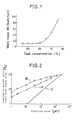
- the slurry viscosity in the former case of two-stage feed process was 1,500 mPas (cP), which was lower than 1,800 mPas (cP) in the latter case of one-stage feed process.
- coal was first milled in a coal concentration of 65 %, followed by adding coal till the concentration reached 75 %.
- the work index Wi in the case where milling was carried out till P $o 105 ⁇ m was attained, was 58 (Kwh/ton) in the case of one-stage feed, whereas it was 49 (Kwh/ton) in the case of two-stage feed, that is, a lower value.
- the slurry viscosities at that time were 2,200 mPas (cP) and 1,950 mPas (cP), respectively, that is, a reduction effectiveness of the slurry viscosity was also observed in the case of two-stage feed process.
- a slurry was produced according to the two-stage feed process in the same manner as in Example 1 except that the amount of the surfactant added was 0.5 % based on the weight of coal.
- the slurry viscosity at that time was 1,800 mPas (cP). Namely, in spite of reduction in the amount of a surfactant added, the resulting slurry had the same viscosity as that in the case where 0.7 % of a surfactant was added in the one-stage feed process of Example 1.
- the resulting work index Wi reached as high a value as 58 (Kwh/ton).
- a slurry was produced in the same manner as in Example 1 according to the two-stage feed process except that coal C alone was first ground in a coal concentration of 54 %, followed by adding coal B.
- the resulting work index Wi was as low a value as 45 (Kwh/ton).
- a two-stage feed process was carried out in the same manner as above except that the order of feed of coal B and coal C was changed.
- the resulting work index Wi was 50 (Kwh/ton) which was somewhat higher than the above value.
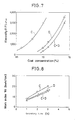
- coal-water slurries Three kinds of coal-water slurries were produced: a coal-water slurry obtained by grinding 2 kg of coal C (HGI: 49) ground to 7 mesh or less with 0.857 kg of water in a small type ball mill, a coal-water slurry obtained by grinding 2 kg of coal D (HGI: 90) with 0.857 kg of water in the same ball mill as above and a coal-water slurry obtained by grinding 1 kg of coal C and 1 kg of coal D with 0.857 kg of water.
- coal C HGI: 49
- coal E HGI: 59
- 0.857 kg of water were ground in a small type ball mill in the same manner as in Example 5 to produce a coal-water slurry.
- 1 kg of coal C (HGI: 49), coal F (HGI: 55) and 0.857 kg of water were ground in the same ball mill to produce a coal-water slurry.
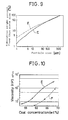
- Fig. 9 shows a particle size distribution (E) in the case of Wambo coal alone and a particle size distribution (F) after addition of Akahira sludge coal. It is seen that when Akahira sludge coal is added, the proportion of fine particles increases to give a particle size distribution having a broader width. Further, the viscosity characteristics of (E) and (F) are shown in Fig. 10. It is seen that when fine particles are added, the viscosity is notably reduced in the same coal concentration in the case of (F).
- Wambo coal E obtained in the same manner as in Example 9 was added 20 g of kaolin (A1 2 0 3 30 %, Si0 2 60 %, -300 mesh), 20 g of precipitated calcium carbonate (300 mesh pass: 99 %) or 50 g of pulverized Miike coal (-300 mesh), each as fine particles, respectively. Further, water was added so as to give solids concentration of 70 %. The viscosities of the resulting coal-water slurries were measured. The results are shown in Table 4.
Landscapes
- Chemical & Material Sciences (AREA)
- Oil, Petroleum & Natural Gas (AREA)
- Engineering & Computer Science (AREA)
- Chemical Kinetics & Catalysis (AREA)
- General Chemical & Material Sciences (AREA)
- Organic Chemistry (AREA)
- Liquid Carbonaceous Fuels (AREA)
- Crushing And Grinding (AREA)
- Solid Fuels And Fuel-Associated Substances (AREA)
Claims (8)
Applications Claiming Priority (4)
| Application Number | Priority Date | Filing Date | Title |
|---|---|---|---|
| JP121043/83 | 1983-07-05 | ||
| JP12104583A JPS6013890A (ja) | 1983-07-05 | 1983-07-05 | 低粘度化高濃度石炭−水スラリの製造方法 |
| JP121045/83 | 1983-07-05 | ||
| JP58121043A JPS6013888A (ja) | 1983-05-06 | 1983-07-05 | 高濃度石炭−水スラリ製造法 |
Publications (2)
| Publication Number | Publication Date |
|---|---|
| EP0130849A1 EP0130849A1 (fr) | 1985-01-09 |
| EP0130849B1 true EP0130849B1 (fr) | 1987-04-29 |
Family
ID=26458508
Family Applications (1)
| Application Number | Title | Priority Date | Filing Date |
|---|---|---|---|
| EP84304602A Expired EP0130849B1 (fr) | 1983-07-05 | 1984-07-05 | Procédé de production d'une suspension eau-charbon à haute concentration |
Country Status (5)
| Country | Link |
|---|---|
| US (1) | US4747548A (fr) |
| EP (1) | EP0130849B1 (fr) |
| AU (1) | AU568660B2 (fr) |
| CA (1) | CA1255905A (fr) |
| DE (1) | DE3463394D1 (fr) |
Families Citing this family (7)
| Publication number | Priority date | Publication date | Assignee | Title |
|---|---|---|---|---|
| JPS59204688A (ja) * | 1983-05-06 | 1984-11-20 | Babcock Hitachi Kk | 高濃度石炭−水スラリの製造方法 |
| ATE60349T1 (de) * | 1985-11-12 | 1991-02-15 | Carbogel Ab | Kohle-wasser-suspensionzusammensetzung, die auf geringwertige kohlenstoffhaltige feststoffe basiert. |
| US6221148B1 (en) | 1999-11-30 | 2001-04-24 | Engelhard Corporation | Manufacture of improved metakaolin by grinding and use in cement-based composites and alkali-activated systems |
| CN104897470B (zh) * | 2015-06-03 | 2017-07-11 | 辽宁科技大学 | 一种矿石的静压功指数的测定方法 |
| CN107987905A (zh) * | 2017-12-11 | 2018-05-04 | 南京大学 | 一种干湿联合磨矿制备高浓度配煤水煤浆的方法 |
| CN114100782A (zh) * | 2021-11-29 | 2022-03-01 | 北京丰润铭科贸有限责任公司 | 一种纺锤形深度煤粉研磨及发电装置 |
| CN114891544A (zh) * | 2022-04-29 | 2022-08-12 | 天津博诺环保技术有限公司 | 一种污泥两级改性制备污泥水煤浆处理方法 |
Citations (4)
| Publication number | Priority date | Publication date | Assignee | Title |
|---|---|---|---|---|
| WO1981001152A1 (fr) * | 1979-10-26 | 1981-04-30 | Univ Alfred Res | Boue charbon-eau et sa methode de preparation |
| WO1983000501A1 (fr) * | 1981-07-31 | 1983-02-17 | Univ Alfred Res | Boue de charbon-eau |
| WO1983004046A1 (fr) * | 1982-05-07 | 1983-11-24 | Ab Carbogel | Procede de production d'une boue d'un materiau carbone pulverise |
| EP0117742A2 (fr) * | 1983-02-25 | 1984-09-05 | Dai-Ichi Kogyo Seiyaku Co., Ltd. | Préparation d'une suspension aqueuse de charbons à haute teneur en charbons |
Family Cites Families (8)
| Publication number | Priority date | Publication date | Assignee | Title |
|---|---|---|---|---|
| US2381351A (en) * | 1942-04-23 | 1945-08-07 | Hardinge Co Inc | Method and means of feeding material to grinding mills |
| US2430085A (en) * | 1943-07-09 | 1947-11-04 | Pittsburgh Midway Coal Mining | Process of preparing coal for use in colloidal fuels |
| US2824701A (en) * | 1952-11-21 | 1958-02-25 | Smidth & Co As F L | Method of and apparatus for multiple stage wet grinding |
| GB804017A (en) * | 1956-09-03 | 1958-11-05 | Simon Handling Eng Ltd | Improvements in ball mills for pulverising coal and other materials |
| GB1553634A (en) * | 1977-01-17 | 1979-09-26 | Shell Int Research | Process for the preparation and pipeline transportation of a slurry of coal particles in water |
| US4265407A (en) * | 1979-07-13 | 1981-05-05 | Texaco Inc. | Method of producing a coal-water slurry of predetermined consistency |
| ZA816150B (en) * | 1980-10-17 | 1982-09-29 | Atlantic Res Corp | Process for making fuel slurries of coal in water and product thereof |
| AU545527B2 (en) * | 1981-12-03 | 1985-07-18 | Electric Power Development Co. Ltd. | Production of high concentration of coal |
-
1984
- 1984-07-05 EP EP84304602A patent/EP0130849B1/fr not_active Expired
- 1984-07-05 DE DE8484304602T patent/DE3463394D1/de not_active Expired
- 1984-07-05 CA CA000458233A patent/CA1255905A/fr not_active Expired
- 1984-07-05 AU AU30297/84A patent/AU568660B2/en not_active Ceased
-
1986
- 1986-11-17 US US06/931,878 patent/US4747548A/en not_active Expired - Lifetime
Patent Citations (4)
| Publication number | Priority date | Publication date | Assignee | Title |
|---|---|---|---|---|
| WO1981001152A1 (fr) * | 1979-10-26 | 1981-04-30 | Univ Alfred Res | Boue charbon-eau et sa methode de preparation |
| WO1983000501A1 (fr) * | 1981-07-31 | 1983-02-17 | Univ Alfred Res | Boue de charbon-eau |
| WO1983004046A1 (fr) * | 1982-05-07 | 1983-11-24 | Ab Carbogel | Procede de production d'une boue d'un materiau carbone pulverise |
| EP0117742A2 (fr) * | 1983-02-25 | 1984-09-05 | Dai-Ichi Kogyo Seiyaku Co., Ltd. | Préparation d'une suspension aqueuse de charbons à haute teneur en charbons |
Also Published As
| Publication number | Publication date |
|---|---|
| US4747548A (en) | 1988-05-31 |
| AU3029784A (en) | 1985-01-10 |
| EP0130849A1 (fr) | 1985-01-09 |
| DE3463394D1 (en) | 1987-06-04 |
| CA1255905A (fr) | 1989-06-20 |
| AU568660B2 (en) | 1988-01-07 |
Similar Documents
| Publication | Publication Date | Title |
|---|---|---|
| EP0037832B1 (fr) | Boue charbon-eau et sa methode de preparation | |
| US4045092A (en) | Fuel composition and method of manufacture | |
| US4887383A (en) | Process for producing a slurry of a pulverized carbonaceous material | |
| CA1189701A (fr) | Methode de production de bouillies denses d'eau et de charbon | |
| JPH0257840B2 (fr) | ||
| EP0130849A1 (fr) | Procédé de production d'une suspension eau-charbon à haute concentration | |
| EP0188869B1 (fr) | Procédé pour la préparation d'une boue de charbon et d'eau | |
| JPH0315957B2 (fr) | ||
| KR100743646B1 (ko) | 석탄과 오일을 혼합한 혼합 액상연료 제조장치, 이를 이용한 혼합 액상연료 제조방법 및 이에 의하여 제조된 혼합 액상연료 | |
| US4624680A (en) | Coal-water slurry and method for its preparation | |
| JP2625240B2 (ja) | 石炭・水スラリの製造方法 | |
| AU540302B2 (en) | Coal-water slurry and method for its preparation | |
| JPH0315958B2 (fr) | ||
| JPS59157184A (ja) | 石炭―水スラリーの製造装置 | |
| JPH0637627B2 (ja) | 石炭スラリ−の調製方法 | |
| JPH0315959B2 (fr) | ||
| JPH06108069A (ja) | 石炭・水混合物とその製造方法 | |
| JPH0446995A (ja) | 石炭・水スラリの製造方法 | |
| JPH0762364A (ja) | 固体燃料−水スラリ及びその製造方法 | |
| JPS60199098A (ja) | 石炭スラリ−の製造方法 | |
| JPS63196688A (ja) | 固体燃料・水スラリ−の製造方法 | |
| JPH0347316B2 (fr) | ||
| JPH0415277B2 (fr) | ||
| JPH06307625A (ja) | 加圧流動床ボイラ燃焼炉への石炭供給方法 | |
| JPS6195094A (ja) | 石炭水スラリの製造方法 |
Legal Events
| Date | Code | Title | Description |
|---|---|---|---|
| PUAI | Public reference made under article 153(3) epc to a published international application that has entered the european phase |
Free format text: ORIGINAL CODE: 0009012 |
|
| AK | Designated contracting states |
Designated state(s): AT BE CH DE FR GB IT LI LU NL SE |
|
| RBV | Designated contracting states (corrected) |
Designated state(s): BE DE FR GB IT NL SE |
|
| 17P | Request for examination filed |
Effective date: 19850320 |
|
| GRAA | (expected) grant |
Free format text: ORIGINAL CODE: 0009210 |
|
| AK | Designated contracting states |
Kind code of ref document: B1 Designated state(s): BE DE FR GB IT NL SE |
|
| ITF | It: translation for a ep patent filed | ||
| REF | Corresponds to: |
Ref document number: 3463394 Country of ref document: DE Date of ref document: 19870604 |
|
| ET | Fr: translation filed | ||
| PLBE | No opposition filed within time limit |
Free format text: ORIGINAL CODE: 0009261 |
|
| STAA | Information on the status of an ep patent application or granted ep patent |
Free format text: STATUS: NO OPPOSITION FILED WITHIN TIME LIMIT |
|
| 26N | No opposition filed | ||
| ITTA | It: last paid annual fee | ||
| EAL | Se: european patent in force in sweden |
Ref document number: 84304602.0 |
|
| PGFP | Annual fee paid to national office [announced via postgrant information from national office to epo] |
Ref country code: BE Payment date: 19950712 Year of fee payment: 12 |
|
| PGFP | Annual fee paid to national office [announced via postgrant information from national office to epo] |
Ref country code: FR Payment date: 19950724 Year of fee payment: 12 |
|
| PGFP | Annual fee paid to national office [announced via postgrant information from national office to epo] |
Ref country code: NL Payment date: 19950728 Year of fee payment: 12 |
|
| PG25 | Lapsed in a contracting state [announced via postgrant information from national office to epo] |
Ref country code: BE Effective date: 19960731 |
|
| BERE | Be: lapsed |
Owner name: BABCOCK-HITACHI K.K. Effective date: 19960731 |
|
| PG25 | Lapsed in a contracting state [announced via postgrant information from national office to epo] |
Ref country code: NL Effective date: 19970201 |
|
| PG25 | Lapsed in a contracting state [announced via postgrant information from national office to epo] |
Ref country code: FR Effective date: 19970328 |
|
| NLV4 | Nl: lapsed or anulled due to non-payment of the annual fee |
Effective date: 19970201 |
|
| REG | Reference to a national code |
Ref country code: FR Ref legal event code: ST |
|
| PGFP | Annual fee paid to national office [announced via postgrant information from national office to epo] |
Ref country code: GB Payment date: 20010702 Year of fee payment: 18 |
|
| PGFP | Annual fee paid to national office [announced via postgrant information from national office to epo] |
Ref country code: SE Payment date: 20010709 Year of fee payment: 18 |
|
| PGFP | Annual fee paid to national office [announced via postgrant information from national office to epo] |
Ref country code: DE Payment date: 20010825 Year of fee payment: 18 |
|
| REG | Reference to a national code |
Ref country code: GB Ref legal event code: IF02 |
|
| PG25 | Lapsed in a contracting state [announced via postgrant information from national office to epo] |
Ref country code: GB Free format text: LAPSE BECAUSE OF NON-PAYMENT OF DUE FEES Effective date: 20020705 |
|
| PG25 | Lapsed in a contracting state [announced via postgrant information from national office to epo] |
Ref country code: SE Free format text: LAPSE BECAUSE OF NON-PAYMENT OF DUE FEES Effective date: 20020706 |
|
| PG25 | Lapsed in a contracting state [announced via postgrant information from national office to epo] |
Ref country code: DE Free format text: LAPSE BECAUSE OF NON-PAYMENT OF DUE FEES Effective date: 20030201 |
|
| GBPC | Gb: european patent ceased through non-payment of renewal fee |
Effective date: 20020705 |
|
| EUG | Se: european patent has lapsed |