EP0131932B1 - Procédé pour la distillation de dichloro-1,2 éthane - Google Patents
Procédé pour la distillation de dichloro-1,2 éthane Download PDFInfo
- Publication number
- EP0131932B1 EP0131932B1 EP84108243A EP84108243A EP0131932B1 EP 0131932 B1 EP0131932 B1 EP 0131932B1 EP 84108243 A EP84108243 A EP 84108243A EP 84108243 A EP84108243 A EP 84108243A EP 0131932 B1 EP0131932 B1 EP 0131932B1
- Authority
- EP
- European Patent Office
- Prior art keywords
- column
- boiling
- edc
- gas
- pressure
- Prior art date
- Legal status (The legal status is an assumption and is not a legal conclusion. Google has not performed a legal analysis and makes no representation as to the accuracy of the status listed.)
- Expired
Links
Images

Classifications
-
- C—CHEMISTRY; METALLURGY
- C07—ORGANIC CHEMISTRY
- C07C—ACYCLIC OR CARBOCYCLIC COMPOUNDS
- C07C17/00—Preparation of halogenated hydrocarbons
- C07C17/38—Separation; Purification; Stabilisation; Use of additives
-
- C—CHEMISTRY; METALLURGY
- C07—ORGANIC CHEMISTRY
- C07C—ACYCLIC OR CARBOCYCLIC COMPOUNDS
- C07C17/00—Preparation of halogenated hydrocarbons
- C07C17/38—Separation; Purification; Stabilisation; Use of additives
- C07C17/383—Separation; Purification; Stabilisation; Use of additives by distillation
-
- Y—GENERAL TAGGING OF NEW TECHNOLOGICAL DEVELOPMENTS; GENERAL TAGGING OF CROSS-SECTIONAL TECHNOLOGIES SPANNING OVER SEVERAL SECTIONS OF THE IPC; TECHNICAL SUBJECTS COVERED BY FORMER USPC CROSS-REFERENCE ART COLLECTIONS [XRACs] AND DIGESTS
- Y02—TECHNOLOGIES OR APPLICATIONS FOR MITIGATION OR ADAPTATION AGAINST CLIMATE CHANGE
- Y02P—CLIMATE CHANGE MITIGATION TECHNOLOGIES IN THE PRODUCTION OR PROCESSING OF GOODS
- Y02P20/00—Technologies relating to chemical industry
- Y02P20/10—Process efficiency
-
- Y—GENERAL TAGGING OF NEW TECHNOLOGICAL DEVELOPMENTS; GENERAL TAGGING OF CROSS-SECTIONAL TECHNOLOGIES SPANNING OVER SEVERAL SECTIONS OF THE IPC; TECHNICAL SUBJECTS COVERED BY FORMER USPC CROSS-REFERENCE ART COLLECTIONS [XRACs] AND DIGESTS
- Y02—TECHNOLOGIES OR APPLICATIONS FOR MITIGATION OR ADAPTATION AGAINST CLIMATE CHANGE
- Y02P—CLIMATE CHANGE MITIGATION TECHNOLOGIES IN THE PRODUCTION OR PROCESSING OF GOODS
- Y02P20/00—Technologies relating to chemical industry
- Y02P20/50—Improvements relating to the production of bulk chemicals
Definitions
- the present invention relates to a method for distillation of 1,2-dichloroethane (hereunder abbreviated as EDC). More particularly, the invention relates to a method for EDC distribution which includes a heat recovery step for making effective use of the thermal energy of an EDC gas being recovered from the top of a high-boiling column in which EDC containing high-boiling substances is distilled.
- EDC 1,2-dichloroethane
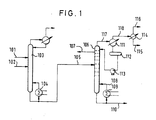
- a flowsheet for the conventional method of EDC distillation is shown in Figure 1.
- Crude EDC containing low-boiling and high-boiling substances is supplied from a dehydrator column and a vinyl chloride column into a low-boiling column 103 through pipes 101 and 102, respectively, for distillation separation of the low-boiling substances.
- the bottoms from column 103 containing the high-boiling substances are fed to a high-boiling column 106 through a pipe 105.
- the thermal energy required in the column 103 is supplied from a reboiler 104.
- the distillate from column 106 is fed to an EDC cracking furnace (not shown) through a pipe 107.
- the bottoms from 106 are reheated in a reboiler 109 while they are circulating through a pipe 108, and after the reheating, the bottoms ascend through the column 106 and pass through another cycle of distillation.
- EDC bottoms containing from 5 to 20 mol% of high boiling substances such as 1,1,2-trichloroethane and 1,1,2,2-tetrachloroethane are fed into an EDC recovery column through a pipe 110.
- the greater part of the EDC gas discharged from the top of the column 106 and which has a pressure of less than 0.5 kg/cm 2 G is cooled in a condenser 111 and separated from the uncondensed gas in a gas-liquid separator 112.
- the condensate is withdrawn from the separator 112 with a pump 113 and refluxed to the top of the column 106.
- the EDC gas which has not condensed in 111 and which contains trace amounts of hydrogen chloride and water is cooled in a vent condenser 114, and the condensate is withdrawn through a pipe 115 and the still uncondensed gas is withdrawn through a pipe 116.
- the method described above is deficient, e.g., in that a large amount of thermal energy is lost, especially in the condenser 111.
- no effective method is known for recovering and making further use of the thermal energy loss occurring in a condenser connected to the top of an EDC distilling column.
- the present inventors have conducted extensive studies on the conditions for heat recovery from EDC gas to be recovered from the high-boiling column, and have finally accomplished the present invention.
- the invention provides a method for distillation of EDC containing high-boiling substances in a high-boiling column, comprising distilling the EDC in said high-boiling column at an overhead pressure higher than one atmosphere (absolute), introducing the EDC gas recovered from the top of said column into a compressor, increasing the pressure and temperature of said gas to levels higher than the overhead pressure and temperature by from 0.5 kg/cm 2 or more and from 7°C or more, respectively, and recovering the heat from said gas.
- 103 is a low-boiling column
- 104 is a reboiler for low-boiling column
- 106 is a high-boiling column
- 109 is a reboiler for high-boiling column
- 111 is a condenser
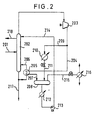
- 202 is a high-boiling column
- 203 is a turbo compresor
- 205 is a thermosiphon reboiler
- 208 is a gas-liquid separator
- 210 is a condenser
- 212 is a heat exchanger
- 303 is a low-boiling column
- 305 is a high-boiling column
- 307 is a turbo compressor
- 309 is a thermosiphon reboiler associated with the low-boiling column
- 312 is a gas-liquid separator
- 314 is a thermosiphon reboiler Associated with the high-
- the operating pressure at the top of the high-boiling column is at least one atmosphere (absolute), and preferably between one atmosphere (absolute) and 1.5 kg/cm 2 G (gauge pressure). If a pressure higher than 1.5 kg/cm 2 G is selected and the column is operated at elevated temperatures, thermal decomposition of the high-boiling substances in the EDC is promoted, and problems may occur in the EDC refining step.
- the pressure and temperature of the EDC gas introduced into the compressor are elevated there by respective degrees of from 0.5 to 7 kg/cm 2 and from 7 to 80°C. If greater degrees of elevation are selected, not only are the energy and investment cost for the compressor increased, but also thermal decomposition of the compressed EDC gas is accelerated, thus increasing the chances of problems occurring during the EDC refining step. If the degrees of pressure and temperature increase are less than from 0.5 to 7 kg/cm 2 and from 7 to 80°C, the recovered heat energy finds only limited applications of use and the initial cost of the heat exchanger for heat recovery is increased.
- At least 85% of the heat value of the thermal energy loss that has occurred in the overhead condenser connected to the high-boiling column can be recovered, requiring energy equivalent to only about from 5 to 20% of that thermal loss.
- the recovery heat source is recycled to reboiler condensers associated, e.g., with the high-boiling and low-boiling columns, and the thermal energy of that source is recovered in such reboiler condensers for subsequent use.
- the present invention provides a method of distillation for EDC containing high-boiling substances by a sequence including a step of distilling the high-boiling substances and a step of recovering heat from the gas recovered from the top of the high-boiling column, wherein said high-boiling column is operated at an overhead pressure of at least 0.5 kg/cm 2 G, and the heat recovered is used as a heat source for reboilers associated with at least two columns selected -from the high-boiling column, low-boiling column, dehydrator column, EDC recovery column and a vinyl chloride column.
- the pressure atthetop of the high-boiling column is at least 0.5 kg/cm 2 G, and more preferably the range of from 0.5 to 1.5 kg/ cm 2 G is selected in order to prevent the thermal decomposition of EDC or the high-boiling substances in the EDC.
- the EDC gas introduced into the compressor is preferably compressed to an extent of at least 0.5 kg/cm 2 , and more preferably the range of from 0.5 to 2.0 kg/cm 2 is selected in order to save the energy necessary for pressure boosting and to avoid an increase in the initial cost of the compressor.
- an amount of energy accounting for about 8% of the thermal energy loss occurring in the overhead condenser associated with the high-boiling column is sufficient for recovering the total heat value of that loss and using it as a heat source for reboilers associated with the distillation columns in a vinyl monomer plant including a high-boiling column.
- the energy required for operating the compressor in this preferred embodiment of the method of the present invention as illustrated in Figure 3 is about one half the energy required when the heat recovery system shown in the flowsheet of Figure 2 is applied to the iiigh-boiling column.
- the preferred embodiment has the further advantage that it greatly reduces the initial cost of the compressor.
- EDC condenses at a relatively high temperature in the exterior of the shell of a reboiler, and therefore, by recovering the thermal energy involved in the change from the condensation temperature to the temperature at the top of the high-boiling column, a more thermally advantageous process can be realized.
- the condensed EDC may be heat-exchanged with hot water fed to a steam generator intended for removing the heat of reaction from an oxychlorination zone, and by so doing, more steam can be produced in said generator.
- the present invention provides an industrially very advantageous method for operation of a vinyl chloride monomer plant in that it greatly reduces the required energy consumption and initial cost while ensuring ease in the normal operation of that plant.
- the bottoms from the column 103 were fed for distillation into a high-boiling column 106 (overhead pressure: 0.05 kg/cm 2 G) with 51 sieve trays through a pipe 105 while steam (10.3 tons/hr) was fed into a reboiler 109 having a heat transfer area of 600 m 2 .
- EDC gas (85°C, 73.4 tons/hr) leaving the top of the column 106 was fed into a condenser 111 through a pipe 117, and 72.8 tons/hr of the EDC gas feed was condensed and refluxed to the top of the column 106 with a pump 113.
- the heat of condensation of the EDC gas was 5.64 x 10 6 kcal/hr.
- the uncondensed EDC gas (0.6 ton/hr) containing trace levels of hydrogen chloride and water was fed into a vent condenser 114 through a pipe 118, and after cooling, the condensate was withdrawn out of the system through a pipe 115, whereas the uncondensed gas was discharged through a pipe 116.
- the bottoms (95°C, 3.8 tons/hr) from the column 106 containing 5 mol% of the fiigh-boiling substances were supplied into an EDC recovery column (not shown) through a pipe 110.
- the refined EDC (85°C) withdrawn as liquid from the top of the column 106 through pipe 107 contained 0.5 mol% of low-boiling substances and 0.01 mol% of high-boiling substances.
- 10.3 tons of steam was supplied to the column 106 per hour.
- Crude EDC having the same composition, temperature and flow rate as those of the bottoms extracted from the low-boiling column in Comparative Example was supplied through a pipe 201 to a high-boiling column 202 having the same construction as used in Comparative Example (the stage of distillation at which the crude EDC was supplied was also the same as in Comparative Example), and distillation was performed at an overhead pressure of 0.05 kg/cm 2 G.
- EDc gas (85°C, 73.4 tons/hr) leaving the top of the column 202 was introduced into a turbo compressor 203 wherein the pressure and temperature of said gas were increased to 1.41 kg/ cm Z G and 131°C.
- a portion (71.3 tons/hr) of the thus-treated EDC gas was supplied to the exterior of the shell of a thermosiphon reboiler 205 (heat transfer area: 1,000 m 2 ) through a pipe 204.
- the supplied EDC gas was subjected to heat exchange at a rate of 5.55 x 10 6 kcal/hr with the bottoms (95°C) coming from column 202 through a pipe 206.
- the resulting condensate was sent to a gas-liquid separator 208 through a pipe 207.
- excess thermal energy was removed by cooling the gas in a condenser 210.
- 1.5 tons of EDC was supplied hourly to the condenser 210 through pipe 209, condensed there and supplied to the gas-liquid separator 208 through pipe 211.
- the EDC gas (0.6 ton/hr) containing trace levels of hydrogen chloride and water leaving uncondensed from the separator 208 was fed to a condenser 216 throgh a pipe 215, and, after cooling, the condensate and uncondensed gas were separately discharged from the condenser.
- the liquid EDC (113.5°C) held in the separator 208 was cooled to 85°C in a heat exchanger 212 and subsequently refluxed to the top of the column 202 by a pump 213 through a pipe 214.
- the bottoms having the same composition and temperature as those of the bottoms obtained in Comparative Example left the column 202 and were supplied to an EDC recovery column through a pipe 217 at a rate of 3.8 tons/hr.
- a liquid refined EDC (85°C) was withdrawn from the column 202 through a pipe 218 (the stage of distillation at which said EDC was withdrawn was the same as in column 106 used in Comparative Example); said refined EDC contained 0.5 mol% of low-boiling substances and 0.01 mol% of high boiling substances.
- Crude EDC (45.2 tons/hr) having the same composition, temperature and flow rate as those used in Comparative Example was fed into a low-boiling column 303 through pipes 301 and 302.
- the column 303 had the same construction as that of the column 103 and was operated under the same distillation conditions.
- the bottoms from the column 303 were fed into a high-boiling column 305 through a pipe 304.
- the column 305 had the same construction as that of the column 106 and was operated at an overhead pressure of 1.0 kg/cm 2 G.
- the overhead EDC gas (106°C, 73.4 tons/hr) was fed into a turbo compressor 307 through a pipe 306 and compressed to 2.1 kg/cm 2 G and 130°C.
- the turbo compressor 307 was motor driven at ca 3,600 rpm.
- thermosiphon reboiler 309 A portion (42.4 tons/hr) of the compressed EDC gas was supplied to the exterior of the shell of a thermosiphon reboiler 309 through a pipe 308.
- the reboiler 309 was associated with the low-boiling column 303 and had a heat transfer area of 370 m 2 .
- the compressed EDC gas was heat-exchanged with the bottoms (95°C) from the column 303 that circulated through a pipe 310 and the interior of the shell of the reboiler.
- the EDC gas condensed at 123°C and the condensate was fed to a gas-liquid separator 312 through a pipe 311.
- the heat value involved in the heat exchange in the reboiler 309 was 3.14 x 10 6 kcal/hr and this was equivalent to 5.9 tons/hr of the steam that was necessary for performing distillation in the low-boiling column 103 in Comparative Example.
- the remaining part of the compressed EDC gas (31.0 tons/hr) was supplied to the exterior of the shell of a thermosiphon reboiler 314 through a pipe 313.
- This reboiler was associated with the high-boiling column 305 and had a heat transfer area of 1,000 m 2 .
- the compressed EDC gas was heat-exchanged with the bottoms (115°C) from the column 305 that circulated through a pipe 315 and the interior of the shell of the reboiler.
- the EDC gas condensed at 123°C and the condensate was fed into a gas-liquid separator 317 through a pipe 316.
- the heat value involved in the heat exchange in the reboiler 314 was 2.29 x 10 6 kcal/hr and this was equivalent to 4.4 tons/hr of steam.
- a reboiler 318 having a heat transfer area of 300 m 2 was fed with 6.5 tons of steam per hour, which was equivalent to a heat value of 3.4 x 10 6 kcal/hr.
- EDC gas containing trace levels of hydrogen chloride and water was discharged from each of the separators 312 and 317 through a pipe 319 at a rate of 0.3 ton/hr.
- Liquid EDC (123°C) held in separator 312 (317) was cooled to 106°C in a heat exchanger 320 (321) and refluxed to the top of the high-boiling column 305 through a pipe 324 by a pump 322 (323).
- Purified liquid EDC (40.5 tons/hr, 106°C) obtained from the 48th stage of distillation as counted from the bottom of the column 305 contained 0.5 mol% of low-boiling substances and 0.01 mol% of high-boiling substances and was supplied to an EDC cracking furnace through a pipe 326.
- the power requirement of the compressor 307 was 500 kWh.
- the quantity of the heat required for the EDC cracking furnace and EDC recovery column could be reduced by an amount of 3.1 x 10 5 kcal/hr, which was equal to 0.6 ton/hr of steam.
Landscapes
- Chemical & Material Sciences (AREA)
- Organic Chemistry (AREA)
- Organic Low-Molecular-Weight Compounds And Preparation Thereof (AREA)
- Vaporization, Distillation, Condensation, Sublimation, And Cold Traps (AREA)
Claims (6)
Applications Claiming Priority (4)
| Application Number | Priority Date | Filing Date | Title |
|---|---|---|---|
| JP58126246A JPS6019731A (ja) | 1983-07-13 | 1983-07-13 | 1,2−ジクロルエタンの蒸留法 |
| JP126246/83 | 1983-07-13 | ||
| JP58127828A JPS6019732A (ja) | 1983-07-15 | 1983-07-15 | 1,2−ジクロルエタンの蒸留法 |
| JP127828/83 | 1983-07-15 |
Publications (2)
| Publication Number | Publication Date |
|---|---|
| EP0131932A1 EP0131932A1 (fr) | 1985-01-23 |
| EP0131932B1 true EP0131932B1 (fr) | 1986-10-22 |
Family
ID=26462463
Family Applications (1)
| Application Number | Title | Priority Date | Filing Date |
|---|---|---|---|
| EP84108243A Expired EP0131932B1 (fr) | 1983-07-13 | 1984-07-13 | Procédé pour la distillation de dichloro-1,2 éthane |
Country Status (2)
| Country | Link |
|---|---|
| EP (1) | EP0131932B1 (fr) |
| DE (1) | DE3461028D1 (fr) |
Families Citing this family (7)
| Publication number | Priority date | Publication date | Assignee | Title |
|---|---|---|---|---|
| DE3519161A1 (de) * | 1985-05-29 | 1986-12-04 | Hoechst Ag, 6230 Frankfurt | Verfahren zur reinigung von 1,2-dichlorethan |
| US4587370A (en) * | 1985-06-05 | 1986-05-06 | Uop Inc. | Aromatic hydrocarbon alkylation process product recovery method |
| ATE267788T1 (de) * | 1999-09-22 | 2004-06-15 | Uhde Gmbh | Verfahren zur wärmenutzung bei der herstellung von 1,2-dichlorethan |
| DE19953762C2 (de) * | 1999-11-09 | 2003-07-10 | Uhde Gmbh | Verfahren zur Nutzung der bei der 1,2-Dichlorethan-Herstellung im Direktchlorierungsreaktor anfallenden Wärme |
| ES2748391T3 (es) * | 2011-12-08 | 2020-03-16 | Thyssenkrupp Ind Solutions Ag | Procedimiento para la recuperación de calor en instalaciones de monómero de cloruro de vinilo o en el ensamblaje de instalaciones de cloruro de vinilo/poli(cloruro de vinilo) y dispositivo adecuado para ello |
| CN107501039B (zh) * | 2017-07-28 | 2020-03-10 | 石河子天域新实化工有限公司 | 一种氯乙烯高沸塔排污与回收的控制方法 |
| CN117679773A (zh) * | 2023-12-13 | 2024-03-12 | 上海齐耀膨胀机有限公司 | 一种分离提纯系统及方法 |
Family Cites Families (1)
| Publication number | Priority date | Publication date | Assignee | Title |
|---|---|---|---|---|
| JPS5940369B2 (ja) * | 1980-03-26 | 1984-09-29 | 鐘淵化学工業株式会社 | 1.2ジクロルエタンの精製法 |
-
1984
- 1984-07-13 DE DE8484108243T patent/DE3461028D1/de not_active Expired
- 1984-07-13 EP EP84108243A patent/EP0131932B1/fr not_active Expired
Also Published As
| Publication number | Publication date |
|---|---|
| DE3461028D1 (en) | 1986-11-27 |
| EP0131932A1 (fr) | 1985-01-23 |
Similar Documents
| Publication | Publication Date | Title |
|---|---|---|
| Hanika et al. | Butylacetate via reactive distillation—modelling and experiment | |
| EP0053517B1 (fr) | Méthode pour la récupération et l'utilisation de la chaleur perdue | |
| US4317926A (en) | Process for preparing and recovering acrylic acid | |
| US4788357A (en) | Vinyl chloride production | |
| US3968178A (en) | Chlorination of hydrocarbons | |
| CN86108265A (zh) | 由苯乙烷生产苯乙烯的改进脱氢工艺—包括低温热回收以及苯乙烷—水蒸汽进料的改进 | |
| GB2110678A (en) | Process for separating ethylene oxide from aqueous solutions | |
| US4278505A (en) | Process of recovering an n-hexane product which is free from aromatic compounds | |
| US2519451A (en) | Ammonia distillation | |
| EP0180995B1 (fr) | Procédé pour le retraitement du produit de pyrolyse de la scission de 1,2-dichloroéthane avec récupération de chaleur | |
| US4747914A (en) | Process for the purification of 1,2-dichloroethane | |
| EP0131932A1 (fr) | Procédé pour la distillation de dichloro-1,2 éthane | |
| EP0187030A2 (fr) | Procédé de fractionnement d'un mélange à plusieurs composants | |
| US4966657A (en) | Process for separating ethylene oxide from aldehyde impurities by distillation | |
| EP0559227A2 (fr) | Procédé de préparation d'acroleine | |
| US3824283A (en) | Urea synthesis process | |
| US4484983A (en) | Distillation and vapor treatment process | |
| US4324932A (en) | Process for the manufacture of vinyl chloride by the thermal cracking of 1,2-dichloroethane | |
| US4484984A (en) | Distillation with condensation process | |
| JP2003155264A (ja) | アルキルアリールカーボネートの製造方法 | |
| US4411676A (en) | Fractional distillation of C2 /C3 hydrocarbons at optimum pressures | |
| JPH0819014B2 (ja) | 二塩化エタンの製造方法 | |
| NO822994L (no) | Fremgangsmaate til fremstilling av vinylklorid. | |
| JP3128809B2 (ja) | 蒸留操作に於ける熱回収方法 | |
| US6716977B1 (en) | Method for making caprolactam from impure ACN wherein ammonia and water are removed from crude caprolactam in a simple separation step and then THA is removed from the resulting caprolactam melt |
Legal Events
| Date | Code | Title | Description |
|---|---|---|---|
| PUAI | Public reference made under article 153(3) epc to a published international application that has entered the european phase |
Free format text: ORIGINAL CODE: 0009012 |
|
| AK | Designated contracting states |
Designated state(s): DE NL SE |
|
| 17P | Request for examination filed |
Effective date: 19850322 |
|
| GRAA | (expected) grant |
Free format text: ORIGINAL CODE: 0009210 |
|
| AK | Designated contracting states |
Kind code of ref document: B1 Designated state(s): DE NL SE |
|
| REF | Corresponds to: |
Ref document number: 3461028 Country of ref document: DE Date of ref document: 19861127 |
|
| PLBI | Opposition filed |
Free format text: ORIGINAL CODE: 0009260 |
|
| PGFP | Annual fee paid to national office [announced via postgrant information from national office to epo] |
Ref country code: NL Payment date: 19870731 Year of fee payment: 4 |
|
| 26 | Opposition filed |
Opponent name: HUELS AKTIENGESELLSCHAFT Effective date: 19870619 |
|
| NLR1 | Nl: opposition has been filed with the epo |
Opponent name: HUELS AKTIENGESELLSCHAFT |
|
| RDAG | Patent revoked |
Free format text: ORIGINAL CODE: 0009271 |
|
| STAA | Information on the status of an ep patent application or granted ep patent |
Free format text: STATUS: PATENT REVOKED |
|
| 27W | Patent revoked |
Effective date: 19880919 |
|
| NLR2 | Nl: decision of opposition | ||
| EUG | Se: european patent has lapsed |
Ref document number: 84108243.1 |