EP0132506A2 - Azeotropische Fraktionierung von Fetten - Google Patents
Azeotropische Fraktionierung von Fetten Download PDFInfo
- Publication number
- EP0132506A2 EP0132506A2 EP84104155A EP84104155A EP0132506A2 EP 0132506 A2 EP0132506 A2 EP 0132506A2 EP 84104155 A EP84104155 A EP 84104155A EP 84104155 A EP84104155 A EP 84104155A EP 0132506 A2 EP0132506 A2 EP 0132506A2
- Authority
- EP
- European Patent Office
- Prior art keywords
- fat
- solvent
- oil
- fraction
- precipitate
- Prior art date
- Legal status (The legal status is an assumption and is not a legal conclusion. Google has not performed a legal analysis and makes no representation as to the accuracy of the status listed.)
- Ceased
Links
Images





Classifications
-
- A—HUMAN NECESSITIES
- A23—FOODS OR FOODSTUFFS; TREATMENT THEREOF, NOT COVERED BY OTHER CLASSES
- A23G—COCOA; COCOA PRODUCTS, e.g. CHOCOLATE; SUBSTITUTES FOR COCOA OR COCOA PRODUCTS; CONFECTIONERY; CHEWING GUM; ICE-CREAM; PREPARATION THEREOF
- A23G3/00—Sweetmeats; Confectionery; Marzipan; Coated or filled products
- A23G3/34—Sweetmeats, confectionery or marzipan; Processes for the preparation thereof
- A23G3/36—Sweetmeats, confectionery or marzipan; Processes for the preparation thereof characterised by the composition containing organic or inorganic compounds
- A23G3/40—Sweetmeats, confectionery or marzipan; Processes for the preparation thereof characterised by the composition containing organic or inorganic compounds characterised by the fats used
-
- C—CHEMISTRY; METALLURGY
- C11—ANIMAL OR VEGETABLE OILS, FATS, FATTY SUBSTANCES OR WAXES; FATTY ACIDS THEREFROM; DETERGENTS; CANDLES
- C11B—PRODUCING, e.g. BY PRESSING RAW MATERIALS OR BY EXTRACTION FROM WASTE MATERIALS, REFINING OR PRESERVING FATS, FATTY SUBSTANCES, e.g. LANOLIN, FATTY OILS OR WAXES; ESSENTIAL OILS; PERFUMES
- C11B7/00—Separation of mixtures of fats or fatty oils into their constituents, e.g. saturated oils from unsaturated oils
- C11B7/0008—Separation of mixtures of fats or fatty oils into their constituents, e.g. saturated oils from unsaturated oils by differences of solubilities, e.g. by extraction, by separation from a solution by means of anti-solvents
- C11B7/0041—Separation of mixtures of fats or fatty oils into their constituents, e.g. saturated oils from unsaturated oils by differences of solubilities, e.g. by extraction, by separation from a solution by means of anti-solvents in mixtures of individualized solvents (water is not taken into account)
Definitions
- This invention relates to an improved process for the solvent fractionation of fats to produce fractions with unique properties suitable for use as speciality fats.
- the fractionation process may be a simple one-step crystallization process, (Process 1), which yields only a high melting fraction and an oil or it may be a more elaborate scheme with two crystallization steps to produce three.fractions, a high melting fraction, an intermediate or middle melting fraction and an oil (Process 2).
- a major objective of Process 2 is to develop a fractionation process in which the intermediate fraction has physical properties similar to those of cocoa butter.
- Cocoa butter is a very important ingredient in chocolate and as such is one of the most expensive food fats in the world today. It is most unusual among naturally occurring fats in that it has a unique narrow melting range. It is a hard and brittle solid below 25°C, it softens slightly above this temperature and melts sharply and completely at 35-37°C, corresponding to the temperature of the human body. Because of the relative scarcity of natural cocoa butter, there have been proposed many processes for producing confectionery fats with cocoa butter-like properties from fats such as palm oil or tallow. These processes for the most part have depended on single solvents or on ordinary mixtures of solvents as the solvent phase.
- the present invention provides a process for the solvent fractionation of fats into at least 2 fractions including a first high melting glyceride fraction and a second fraction that is an oil at temperatures above 10°C, the process comprising the steps of :
- Process 1 For convenience this process, producing 2 fractions, will be hereinafter designated as Process 1.
- the procedure outlined above is modified by carrying out steps (b) and (d) above at.slightly higher temperatures and interposing a second crystallization step.
- this variant of the process comprises :
- steps -(a) and (a') are effected at temperatures of about 55 to 60°C to ensure complete dissolution of the fat.
- the processes of the invention may be applied to fats from animal, vegetable or marine sources, both natural and modified as by catalytic hydrogenation, molecular rearrangement, or both. They are advantageously used for the fractionation of the fats listed in Table 1, especially those marked with an asterisk.
- Process 2 may be used to produce confectionery fats, the Process 1 is useful for the winterization of oils.
- Preferred solvents are the binary azeotropic solvent mixtures shown together with their boiling points (B.P.) in Table 2.
- the percentages are by weight.
- Binary azeotropic solvent mixtures present several advantages not usually found in other solvent systems. Thus, the volumes required are smaller than for single solvents and crystallization temperatures may be higher. As both polar and non-polar solvents are present, greater specificity in the crystallization process has been observed and being azeotropes, the composition of recovered solvent is the same as that of the original. The choice of solvents is such that the fractionation processes can be applied to fats whose natural fatty acid content is as low as 5 % and as high as 80 %.
- the processes of this invention may be carried out either as a batch or a continuous process but for the purpose of simplification only the batch process will be described in the examples.
- the solvent used in the process may be any of the solvent mixtures listed in Table 1.
- the solvent will be chosen having regard to the fat being fractionated, and especially its fatty acid composition.
- solvents having polar characteristics are especially preferred for the fractionation of many fats because they have superior solubilising properties for unsaturated fractions.
- the three fractions obtainable by the processes of the invention high melting stearine, semi-soft confectionery fat and oil will be designated, respectively, as P-1, P-2 and F-1 or F-2 (depending on the process).
- DSC Differential Scanning Calorimetry
- the major product in the fractionation of palm oil by Process 1 is the liquid oil fraction F-1, a clear, pumpable oil is suitable for lubricant oils, particularly "cutting oils", core oils in the metal coating industry, textile oils, tanning oils, plasticizers, and as a diesel oil extender or replacer.
- the high melt fraction P-1 may be used as a source of high molecular weight fatty acids.
- These same fractions have also many food uses, such as the use of the high melt fraction P-1 as the stiffening fat in shortenings, as a solid phase in vegetable based margarines and the use of the oil fraction F-1 as a frying or salad oil.
- the fractions P-1, P-2 and F-2 are examples of the type of products obtainable by fractionating fats according to Process 2.
- 1-99 % of the semi-solid fat fraction P-2 may be combined with 1-99 % of cocoa butter to form a confectionery fat.
- a confectionery fat having a higher melting point than cocoa butter can be produced by a blend from 5-25 % of the high melting fraction P-1, and from 75-95 % of the fraction P-2.
- 1-99 % of the last produced confectionery fat can be blended with 1-99 % of cocoa butter to form another confectionery fat of higher melting range.
- the liquid oil fraction, F-2 can be used to produce a cooking or frying oil by mixing with 1-99 % of for example olive oil, soy bean oil, corn oil, palm oil, safflower oil, sunflower oil, rape seed oil or peanut oil.
- each of the fractions P-1, P-2 and F-2 from Process 2 has widely differing physical properties, they may be used as base materials for a wide variety of cosmetic or pharmaceutical products.
- the fractions obtainable by Process 2 may be subjected to chemical or enzymatic hydrolysis to provide a source of fatty acids of low and high molecular weight, depending on the fat originally used.
- the solution is transferred to a crystallizer equipped with a stirrer and cooling coils. At first, the solution is stirred rapidly at 150 RPM to effect rapid heat transfer, but as the temperature of the solution drops, stirring is gradually decreased to 75 RPM and at the first sign of crystals, the stirring is reduced to 35 RPM.
- the cooling medium in the coils is maintained at no more than a 5°C differential between the cooling medium and the crystallizer except for the final crystallization temperature when the differential is only 2°C.
- the solution temperature is thus lowered gradually over a period of one hour to 12°C. Crystallization starts at about 28°C and becomes heavy at 18°C. When the temperature reaches 12°C, the mixture of solvent and crystals is held for an additional 15 minutes. During this period stirring is discontinued and the fat crystals settle rapidly to the bottom of the cryes tallizer. Most of the clear supernatant liquid is removed by syphoning using a light vacuum, and the remaining filtrate and precipitate are filtered also under slight vacuum. The filter cake is transferred to a wash vessel and about 300 ml of fresh solvent are added with stirring. The resultant slurry is immediately filtered using slight vacuum.
- the precipitate fraction P-1, and the combined filtrates are individually treated, first in an evaporator and then a deodorizer.
- the yield of liquid oil, F-1, is 880 g.
- the yield of high melt stearine, P-1, is 120 g.
- Table 3 lists the yields of stearine and oil, P-1 and F-1, and the fatty acid percentage composition of the original palm oil and the palm oil fractions.
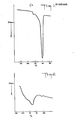
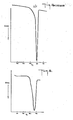
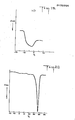
- the DSC thermal curve of the stearine fraction F-1, Figure 1 indicates that this fraction melts at about 60°C;
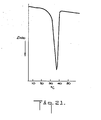
- Figure 2 indicates that the oil fraction F-1 is liquid above 6°C.
- the solution is transferred to a crystallizer equipped with a stirrer and cooling coils.
- the solution is stirred rapidly to effect good heat transfer.
- stirring is also gradually decreased from 150 RPM to 75 RPM.
- the cooling medium in the coils is maintained at no more than a 5°C differential between the cooling medium and the crystallizer temperature except for the final temperature of 18°C when the differential is only 2°C.
- the solution temperature is thus gradually lowered from about 40°C to 18°C over a period of about one hour. Crystallization begins at about 28°C and becomes heavy at 22°C. When the temperature reaches 18°C, stirring is discontinued and the mixture allowed to crystallize during an additional 15 minutes. During this time the fat crystals settle rapidly to the bottom of the crystallizer. Most of the clear supernatant solution is removed by syphoning with slight vacuum and the remaining precipitate and filtrate mixture is then filtered again using slight vacuum. The filter cake is transferred to a wash vessel and 300 ml of fresh solvent previously cooled to 16°C are added with stirring. The resultant slurry is immediately filtered as before.
- the precipitate (high melting stearine) fraction, P-1 is treated first in an evaporator and then a deodorizer.
- the yield of fraction P-1 is 81.g.
- the filtrates are combined and returned to the crystallizer.
- the stirring rate is adjusted to 150 RPM and the temperature of the crystallizer gradually lowered over a period of one hour to 6°C with the stirring rate being lowered over this period to 35RPM. Crystallization begins at about 12-14°C and becomes heavy at 10°C. When the temperature reaches 6°C stirring is stopped and the solvent-crystal mixture allowed to crystallize during an additional 15 minutes. During this period most of the crystals settle to the bottom of the crystallizer. The clear supernatant solvent layer is removed under vacuum as before.
- the filter cake is transferred to a wash vessel and about 300 ml of fresh solvent previously cooled to about 4°C added with stirring.
- the resultant slurry is immediately filtered using slight vacuum.
- the collected precipitate (fraction P-2) and the combined filtrates are treated individually first in an evaporator and then in a deodorizer.
- the yield of mid-melting confectionery fat fraction P-2 is 254 g and the yield of the liquid oil, fraction F-2 is 665 g.
- Table 5 lists the yields of fractions P-1, P-2 and F-2, and the fatty acid compositions of the original palm oil and of the fractions.
- the DSC thermal profile curve of fraction P-1 indicates that this fraction melts at 60°C
- the DSC thermal profile, Figure 8, of fraction P-1 indicates that it melts at about 57°C
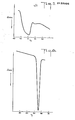
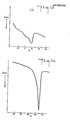
- that in Figure 9 of the confectionery fat fraction indicates a melting point of about 38°C
- the DSC thermal profile of the oil fraction F-2 ( Figure 10) shows that it is totally liquid at temperatures above 10°C.
Landscapes
- Chemical & Material Sciences (AREA)
- Engineering & Computer Science (AREA)
- Life Sciences & Earth Sciences (AREA)
- Analytical Chemistry (AREA)
- Food Science & Technology (AREA)
- Polymers & Plastics (AREA)
- Inorganic Chemistry (AREA)
- Chemical Kinetics & Catalysis (AREA)
- Oil, Petroleum & Natural Gas (AREA)
- Wood Science & Technology (AREA)
- Organic Chemistry (AREA)
- Fats And Perfumes (AREA)
- Edible Oils And Fats (AREA)
Applications Claiming Priority (2)
| Application Number | Priority Date | Filing Date | Title |
|---|---|---|---|
| US517508 | 1983-07-26 | ||
| US06/517,508 US4601857A (en) | 1983-07-26 | 1983-07-26 | Process for fat fractionation with azeotropic solvents |
Publications (2)
| Publication Number | Publication Date |
|---|---|
| EP0132506A2 true EP0132506A2 (de) | 1985-02-13 |
| EP0132506A3 EP0132506A3 (de) | 1985-03-13 |
Family
ID=24060104
Family Applications (1)
| Application Number | Title | Priority Date | Filing Date |
|---|---|---|---|
| EP84104155A Ceased EP0132506A3 (de) | 1983-07-26 | 1984-04-12 | Azeotropische Fraktionierung von Fetten |
Country Status (11)
| Country | Link |
|---|---|
| US (1) | US4601857A (de) |
| EP (1) | EP0132506A3 (de) |
| JP (1) | JPS60123597A (de) |
| AU (1) | AU560642B2 (de) |
| DK (1) | DK299284A (de) |
| GB (1) | GB2143840B (de) |
| IE (1) | IE57794B1 (de) |
| IN (1) | IN161535B (de) |
| MY (3) | MY102856A (de) |
| SG (1) | SG35787G (de) |
| ZA (1) | ZA844729B (de) |
Cited By (10)
| Publication number | Priority date | Publication date | Assignee | Title |
|---|---|---|---|---|
| EP0189669A1 (de) * | 1984-12-21 | 1986-08-06 | The Procter & Gamble Company | Lösungsmittelfraktionierungsverfahren zur Gewinnung von Fett für Süsswaren, fähig zum thermischen Konditionieren, aus Palmöl |
| CH666160A5 (fr) * | 1985-07-05 | 1988-07-15 | Nestle Sa | Procede de traitement du beurre de cacao. |
| EP0424997A3 (en) * | 1989-10-27 | 1992-05-13 | Unilever Nv | Cacao butter fractions |
| EP0556995A1 (de) * | 1992-02-21 | 1993-08-25 | Castrol Limited | Schmiermittel |
| EP0594319A1 (de) * | 1992-10-17 | 1994-04-27 | Castrol Limited | Schmiermittel |
| EP0594320A1 (de) * | 1992-10-17 | 1994-04-27 | Castrol Limited | Industrielle Öle |
| US5401867A (en) * | 1991-10-04 | 1995-03-28 | Krupp Maschinentechnik Gesellschaft Mit Beschrankter Haftung | Fractionation of a mixture of substances |
| EP0803196A1 (de) * | 1996-04-24 | 1997-10-29 | Fuji Oil Company, Limited | Hartbutterzusatzzusammensetzung und Verfahren zur Herstellung einer Hartbutterzusammensetzung |
| WO2002008369A1 (en) * | 2000-07-20 | 2002-01-31 | The United States Of America, As Represented By The Secretary Of Agriculture | Solvent fractionation of chicken fat |
| EP0669151B1 (de) * | 1994-02-24 | 2003-03-26 | Matsushita Electric Industrial Co., Ltd. | Verfahren zur Extraktion organischer Substanz, in diesem Verfahren zu verwendendes Lösungsmittel und Verfahren zur Messung des Gehaltes an organischer Substanz |
Families Citing this family (5)
| Publication number | Priority date | Publication date | Assignee | Title |
|---|---|---|---|---|
| US4880658A (en) * | 1983-07-26 | 1989-11-14 | Nestec S.A. | Obtaining a fat fraction with azeotropic solvents |
| US4839191A (en) * | 1983-07-26 | 1989-06-13 | Nestec S.A. | Fat fractions and mixtures thereof |
| GB8924288D0 (en) * | 1989-10-27 | 1989-12-13 | Unilever Plc | Confectionery fats |
| ES2049078T3 (es) * | 1990-04-05 | 1994-04-01 | Unilever Nv | Mezclas de grasas para composiciones de chocolate. |
| FR2885900B1 (fr) * | 2005-05-20 | 2009-02-13 | Omya Development Ag | Matieres minerales contenant du carbonate a emission en gaz carbonique combustible fossile reduite lors de leurs decompositions ainsi que leur procede de synthese et leurs utilisations. |
Family Cites Families (18)
| Publication number | Priority date | Publication date | Assignee | Title |
|---|---|---|---|---|
| US2645652A (en) * | 1950-10-13 | 1953-07-14 | Standard Oil Co | Fractionation of oleiferous materials |
| US2684378A (en) * | 1951-02-13 | 1954-07-20 | Us Agriculture | Process for fractionating glyceridic mixtures obtained as hydrocarbon solutions |
| US2740799A (en) * | 1951-06-11 | 1956-04-03 | Swift & Co | Solvent treatment |
| US2758125A (en) * | 1953-11-18 | 1956-08-07 | Malmstrom Chem Corp | Fractionation of lanolin oil |
| GB921033A (de) * | 1958-09-13 | 1963-03-13 | Asahidenka Kogyo Kabushiki Kaisha | |
| US3025314A (en) * | 1960-08-08 | 1962-03-13 | William H King | Recovery of oil from acetone-hexanewater mixed solvent extracts of raw cottonseed meats |
| US3173935A (en) * | 1961-04-14 | 1965-03-16 | Chemetron Corp | Separation of fatty mixtures |
| US3632616A (en) * | 1968-04-24 | 1972-01-04 | Richard Kassabian | Apparatus and process for the selective fractionation of fatty materials into useful fractions thereof |
| US4104290A (en) * | 1975-02-07 | 1978-08-01 | H.L.S. Ltd., Industrial Engineering Company | Process for separating oils and fats into liquid and solid fractions |
| US4167519A (en) * | 1975-03-07 | 1979-09-11 | University Of Science Of Malaysia | Olein-stearin separation |
| US4018806A (en) * | 1975-10-06 | 1977-04-19 | The Procter & Gamble Company | Process for recovering symmetrical diglycerides from glyceride mixtures |
| JPS6017000B2 (ja) * | 1976-06-11 | 1985-04-30 | 鐘淵化学工業株式会社 | 油脂の溶剤分別結晶法 |
| US4103039A (en) * | 1976-08-18 | 1978-07-25 | Fuji Oil Company, Limited | Method for producing improved shea fat |
| JPS60395B2 (ja) * | 1976-12-28 | 1985-01-08 | 不二製油株式会社 | パーム油の分別法 |
| US4127597A (en) * | 1977-04-14 | 1978-11-28 | The United States Of America As Represented By The Secretary Of Agriculture | Continuous fractionation of tallow and production of a cocoa butter-like plastic fat |
| GB2013705B (en) * | 1978-01-24 | 1982-09-02 | Biocell Srl | Process for the solvent fractionation of animal or vegetable fats in general |
| JPS56115399A (en) * | 1980-02-14 | 1981-09-10 | Asahi Denka Kogyo Kk | Quality improvement of sarseed oil |
| JPS5840396A (ja) * | 1981-09-04 | 1983-03-09 | 味の素株式会社 | 油脂の抽出法 |
-
1983
- 1983-07-26 US US06/517,508 patent/US4601857A/en not_active Expired - Fee Related
-
1984
- 1984-04-12 EP EP84104155A patent/EP0132506A3/de not_active Ceased
- 1984-06-18 IE IE1518/84A patent/IE57794B1/en not_active IP Right Cessation
- 1984-06-19 DK DK299284A patent/DK299284A/da not_active Application Discontinuation
- 1984-06-19 GB GB08415625A patent/GB2143840B/en not_active Expired
- 1984-06-21 AU AU29738/84A patent/AU560642B2/en not_active Ceased
- 1984-06-21 ZA ZA844729A patent/ZA844729B/xx unknown
- 1984-07-13 IN IN509/MAS/84A patent/IN161535B/en unknown
- 1984-07-26 JP JP59156451A patent/JPS60123597A/ja active Pending
-
1987
- 1987-04-22 SG SG357/87A patent/SG35787G/en unknown
- 1987-05-11 MY MYPI87000628A patent/MY102856A/en unknown
-
1992
- 1992-04-13 MY MYPI92000631A patent/MY106569A/en unknown
- 1992-04-13 MY MYPI92000630A patent/MY106570A/en unknown
Cited By (11)
| Publication number | Priority date | Publication date | Assignee | Title |
|---|---|---|---|---|
| EP0189669A1 (de) * | 1984-12-21 | 1986-08-06 | The Procter & Gamble Company | Lösungsmittelfraktionierungsverfahren zur Gewinnung von Fett für Süsswaren, fähig zum thermischen Konditionieren, aus Palmöl |
| CH666160A5 (fr) * | 1985-07-05 | 1988-07-15 | Nestle Sa | Procede de traitement du beurre de cacao. |
| EP0424997A3 (en) * | 1989-10-27 | 1992-05-13 | Unilever Nv | Cacao butter fractions |
| US5401867A (en) * | 1991-10-04 | 1995-03-28 | Krupp Maschinentechnik Gesellschaft Mit Beschrankter Haftung | Fractionation of a mixture of substances |
| EP0556995A1 (de) * | 1992-02-21 | 1993-08-25 | Castrol Limited | Schmiermittel |
| EP0594319A1 (de) * | 1992-10-17 | 1994-04-27 | Castrol Limited | Schmiermittel |
| EP0594320A1 (de) * | 1992-10-17 | 1994-04-27 | Castrol Limited | Industrielle Öle |
| EP0669151B1 (de) * | 1994-02-24 | 2003-03-26 | Matsushita Electric Industrial Co., Ltd. | Verfahren zur Extraktion organischer Substanz, in diesem Verfahren zu verwendendes Lösungsmittel und Verfahren zur Messung des Gehaltes an organischer Substanz |
| EP0803196A1 (de) * | 1996-04-24 | 1997-10-29 | Fuji Oil Company, Limited | Hartbutterzusatzzusammensetzung und Verfahren zur Herstellung einer Hartbutterzusammensetzung |
| US5879736A (en) * | 1996-04-24 | 1999-03-09 | Fuji Oil Company, Ltd. | Process of making a hard butter composition |
| WO2002008369A1 (en) * | 2000-07-20 | 2002-01-31 | The United States Of America, As Represented By The Secretary Of Agriculture | Solvent fractionation of chicken fat |
Also Published As
| Publication number | Publication date |
|---|---|
| DK299284D0 (da) | 1984-06-19 |
| GB2143840B (en) | 1987-01-21 |
| AU560642B2 (en) | 1987-04-09 |
| IE841518L (en) | 1985-01-26 |
| MY106570A (en) | 1995-06-30 |
| DK299284A (da) | 1985-01-27 |
| GB2143840A (en) | 1985-02-20 |
| EP0132506A3 (de) | 1985-03-13 |
| ZA844729B (en) | 1985-02-27 |
| MY102856A (en) | 1993-03-31 |
| AU2973884A (en) | 1985-01-31 |
| MY106569A (en) | 1995-06-30 |
| IE57794B1 (en) | 1993-04-07 |
| GB8415625D0 (en) | 1984-07-25 |
| JPS60123597A (ja) | 1985-07-02 |
| SG35787G (en) | 1988-09-23 |
| US4601857A (en) | 1986-07-22 |
| IN161535B (de) | 1987-12-19 |
Similar Documents
| Publication | Publication Date | Title |
|---|---|---|
| US4601857A (en) | Process for fat fractionation with azeotropic solvents | |
| DK2399977T3 (en) | The fractionation method for 1,3-disaturated-2-unsaturated triglyceride | |
| EP0081881B1 (de) | Verfahren zur Lösungsmittel fraktionierung von Palmöl stearinen und die mittels dieses Verfahrens erhaltenen Produkte | |
| EP0074146B1 (de) | Lösungsmittelfraktionierung von gehärtetem Butterfett | |
| US4219584A (en) | Hard butter composition | |
| JPS62210949A (ja) | カカオバタ−代用組成物 | |
| JP2600010B2 (ja) | 向流乾式分別結晶化 | |
| US4104288A (en) | Method for producing hard butter fraction from shea fat | |
| JPH11243855A (ja) | 油中水型乳化油脂組成物 | |
| US4839191A (en) | Fat fractions and mixtures thereof | |
| US4880658A (en) | Obtaining a fat fraction with azeotropic solvents | |
| DK161771B (da) | Fremgangsmaade til oploesningsfraktionering af fedtstoffer | |
| JPH0811799B2 (ja) | カカオバタ−代用脂の製造方法 | |
| JP3502158B2 (ja) | カカオ脂の分別方法及び該方法によって得られる分別脂を含有するチョコレート | |
| US3944585A (en) | Multi-step crystallization and blending process for making physiochemically designed fat compositions from tallow | |
| US4006264A (en) | Preparation of confectioners' fats | |
| JPH07135901A (ja) | 製菓用油脂組成物の製造方法 | |
| JPH0427813B2 (de) | ||
| JPH06181686A (ja) | 油脂の分別用乳化剤及び油脂の分別方法 | |
| EP0035298B1 (de) | Verfahren zur Lösungsmittelfraktionierung von Olivenöl-Stearin und verwandte Produkte | |
| Paulicka | Specialty fats | |
| JP2000109879A (ja) | カカオ脂の分別方法 | |
| JPS6121993B2 (de) | ||
| US3804867A (en) | Process for production of a peanut oil composition by hydrogenation and winterization | |
| JP4397116B2 (ja) | カカオ脂オレインフラクション |
Legal Events
| Date | Code | Title | Description |
|---|---|---|---|
| PUAI | Public reference made under article 153(3) epc to a published international application that has entered the european phase |
Free format text: ORIGINAL CODE: 0009012 |
|
| PUAL | Search report despatched |
Free format text: ORIGINAL CODE: 0009013 |
|
| 17P | Request for examination filed |
Effective date: 19840412 |
|
| AK | Designated contracting states |
Designated state(s): BE CH DE FR IT LI LU NL SE |
|
| AK | Designated contracting states |
Designated state(s): BE CH DE FR IT LI LU NL SE |
|
| 17Q | First examination report despatched |
Effective date: 19860416 |
|
| R17C | First examination report despatched (corrected) |
Effective date: 19860731 |
|
| STAA | Information on the status of an ep patent application or granted ep patent |
Free format text: STATUS: THE APPLICATION HAS BEEN REFUSED |
|
| 18R | Application refused |
Effective date: 19870207 |
|
| RIN1 | Information on inventor provided before grant (corrected) |
Inventor name: LONGHI, SERGIO Inventor name: LUDDY, FRANCIS EUGENE |