EP0133164B1 - Copolymerisierbare Verbindungen - Google Patents
Copolymerisierbare Verbindungen Download PDFInfo
- Publication number
- EP0133164B1 EP0133164B1 EP84810357A EP84810357A EP0133164B1 EP 0133164 B1 EP0133164 B1 EP 0133164B1 EP 84810357 A EP84810357 A EP 84810357A EP 84810357 A EP84810357 A EP 84810357A EP 0133164 B1 EP0133164 B1 EP 0133164B1
- Authority
- EP
- European Patent Office
- Prior art keywords
- tert
- butyl
- bis
- hydrogen
- methyl
- Prior art date
- Legal status (The legal status is an assumption and is not a legal conclusion. Google has not performed a legal analysis and makes no representation as to the accuracy of the status listed.)
- Expired
Links
Classifications
-
- C—CHEMISTRY; METALLURGY
- C07—ORGANIC CHEMISTRY
- C07D—HETEROCYCLIC COMPOUNDS
- C07D249/00—Heterocyclic compounds containing five-membered rings having three nitrogen atoms as the only ring hetero atoms
- C07D249/16—Heterocyclic compounds containing five-membered rings having three nitrogen atoms as the only ring hetero atoms condensed with carbocyclic rings or ring systems
- C07D249/18—Benzotriazoles
- C07D249/20—Benzotriazoles with aryl radicals directly attached in position 2
-
- C—CHEMISTRY; METALLURGY
- C08—ORGANIC MACROMOLECULAR COMPOUNDS; THEIR PREPARATION OR CHEMICAL WORKING-UP; COMPOSITIONS BASED THEREON
- C08F—MACROMOLECULAR COMPOUNDS OBTAINED BY REACTIONS ONLY INVOLVING CARBON-TO-CARBON UNSATURATED BONDS
- C08F20/00—Homopolymers and copolymers of compounds having one or more unsaturated aliphatic radicals, each having only one carbon-to-carbon double bond, and only one being terminated by only one carboxyl radical or a salt, anhydride, ester, amide, imide or nitrile thereof
- C08F20/02—Monocarboxylic acids having less than ten carbon atoms, Derivatives thereof
- C08F20/10—Esters
- C08F20/34—Esters containing nitrogen, e.g. N,N-dimethylaminoethyl (meth)acrylate
- C08F20/36—Esters containing nitrogen, e.g. N,N-dimethylaminoethyl (meth)acrylate containing oxygen in addition to the carboxy oxygen, e.g. 2-N-morpholinoethyl (meth)acrylate or 2-isocyanatoethyl (meth)acrylate
-
- C—CHEMISTRY; METALLURGY
- C08—ORGANIC MACROMOLECULAR COMPOUNDS; THEIR PREPARATION OR CHEMICAL WORKING-UP; COMPOSITIONS BASED THEREON
- C08F—MACROMOLECULAR COMPOUNDS OBTAINED BY REACTIONS ONLY INVOLVING CARBON-TO-CARBON UNSATURATED BONDS
- C08F20/00—Homopolymers and copolymers of compounds having one or more unsaturated aliphatic radicals, each having only one carbon-to-carbon double bond, and only one being terminated by only one carboxyl radical or a salt, anhydride, ester, amide, imide or nitrile thereof
- C08F20/02—Monocarboxylic acids having less than ten carbon atoms, Derivatives thereof
- C08F20/52—Amides or imides
- C08F20/54—Amides, e.g. N,N-dimethylacrylamide or N-isopropylacrylamide
- C08F20/60—Amides, e.g. N,N-dimethylacrylamide or N-isopropylacrylamide containing nitrogen in addition to the carbonamido nitrogen
-
- C—CHEMISTRY; METALLURGY
- C08—ORGANIC MACROMOLECULAR COMPOUNDS; THEIR PREPARATION OR CHEMICAL WORKING-UP; COMPOSITIONS BASED THEREON
- C08K—Use of inorganic or non-macromolecular organic substances as compounding ingredients
- C08K5/00—Use of organic ingredients
- C08K5/16—Nitrogen-containing compounds
- C08K5/34—Heterocyclic compounds having nitrogen in the ring
- C08K5/3467—Heterocyclic compounds having nitrogen in the ring having more than two nitrogen atoms in the ring
- C08K5/3472—Five-membered rings
- C08K5/3475—Five-membered rings condensed with carbocyclic rings
Definitions
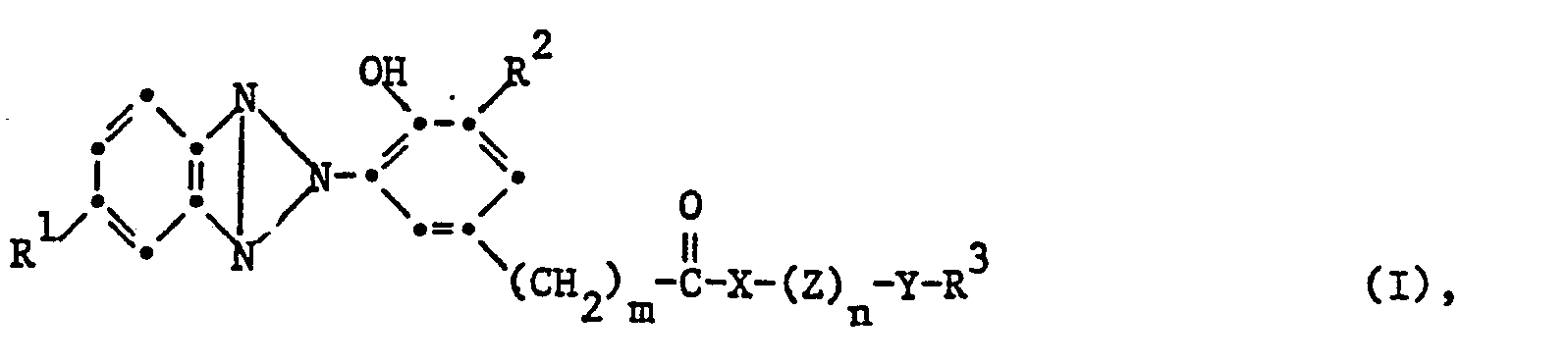
- the present invention relates to novel copolymerizable 2- (2'-hydroxyphenyl) benzotriazoles, their use for protecting polymers against light-induced degradation, and the polymers equipped therewith.
- the compounds according to the invention do not have these disadvantages or have them to a lesser extent and also have the advantage of high fastness to migration and the possibility of using high concentrations of UV absorber in thin layers, such as protective lacquers. It is important that the remaining properties of the polymer to be protected do not change or change only insignificantly.
- DE-B-1 217 383 discloses 2- (2-hydroxyphenyl) benzotriazoles which, like the compounds according to the invention, have one in the 5-position of the phenyl ring (See definitions below).
- the compounds known from this DE-B do not have any substituents containing polymerizable double bonds and, in contrast to the compounds according to the invention, cannot therefore be polymerized into substrates to be protected.
- X means an anion such as Cl e , -HS04e or (BF 4 ) e.
- the reaction is preferably carried out catalytically using hydrogen or, for. B. zinc dust used as a reducing agent.
- the ester (R 9 ) is saponified by the alkaline medium, it can easily be restored after acidification by boiling in a lower alkyl alcohol such as methanol.
- the product obtained in this way is an intermediate product, e.g. B. to be implemented with compounds of the formula HX- (Z) n -YH.
- This is a conventional transesterification, which leads to compounds of the formula leads.
- the latter can be esterified in a known manner with chloropropionic acid chloride to give the compounds of the formula I.
- the various process steps are known to the person skilled in the art and are described in detail in EP-A-57 160.
- the 2- (2'-hydroxyphenyl) benzotriazole compounds which can be used according to the invention can make up between 0.01 and 20% of the polymerizable mixture. If the resulting copolymer is processed directly into articles with a thickness of more than 0.1 mm, contents of 0.05 to 2% with respect to the total weight are preferred, for polymers which are used as very thin coatings (so-called coatings) and for polymers the polymers which are to be incorporated conventionally as stock concentrates, contents of 2-20% are preferred. In this case, the colorless benzotriazole compounds are particularly valuable, since otherwise such strong yellow colorations are easily obtained at such high concentrations.
- the homopolymerizable of the monomers mentioned can be copolymerized together with the benzotriazole monomers according to the invention or can be reacted with further monomers to form ter and quater polymers.
- the molecular weight of the polymers obtained is of minor importance insofar as the minimum limit values necessary to achieve the usual and necessary mechanical and electrical properties are exceeded. Depending on the polymer, it should be between 5000 and several million.
- the copolymerization of the ethylenically unsaturated compounds with the 2- (2'-hydroxyphenyl) benzotriazole compounds which contain at least one copolymerizable ethylenically unsaturated group is carried out in a conventional manner. It is triggered, for example, by means of free radicals, such as those that occur when heating benzoyl peroxide, ⁇ , ⁇ '-azodiisobutyronitrile and tert-butyl peroxide, or in redox systems, such as mixtures of salts of persulfuric acid and sulfurous acid, or by exposure to high-energy radiation. In some cases, ionic polymerizations also succeed; however, these are difficult to carry out because of the highly polar nature of the monomeric 2- (2'-hydroxyphenyl) benzotriazole compounds.
- the polymers according to the invention are processed in the usual way, for example by spraying, pressing, calendering and casting.
- the polymers can also be reacted further in a homologous manner, for example polyvinyl esters can be saponified to form polyvinyl alcohols.
- copolymers according to the invention are used in the same way as corresponding, conventionally produced polymers. Additional applications arise for copolymers according to the invention thanks to their light stability and their UV absorption capacity, be it as construction material, coating material or as UV filter in the packaging industry.
- additives can also be added together with the stabilizers according to the invention, for example antioxidants, other UV absorbers, metal carboxylates, lubricants, antistatic agents, flame retardants, pigments, fillers or reinforcing materials.
- cross-linking aids such as. B. triallyl cyanurate, diallyl terephthalate, triallyl trimethithate, ethylene glycol diacrylate or trimethylalpropane trimethacrylate.
- N- (2-hydroxyethyl) -3- (2H-benzotriazol-2-yl) -4-hydroxy-5-tert-butyl-benzenepropamidamide is used and the procedure described in Example 1 is followed, N- (2-acrylyloxyethyl) is obtained ) -3- (2H-Benzotriazol-2-yl) -4-hydroxy-5-tert.butyl-benzenepropanamide as a white crystallate. Mp 80-83 ° C.
- N- (2-hydroxyethyl) -3- (5-chloro-2H-benzotriazol-2-yl) -4-hydroxy-5-tert.butyl-benzenepropanamide is used, N- (2- Acrlyloxyethyl) -3- (5-chloro-2H-benzotriazol-2-yl) -4-hydroxy-5-tert.butyl-benzenepropanamide as white crystals. M.p. 106-108 ° C.
- N- (3-hydroxypropyl) -3- (2H-benzotriazol-2-yl) -4-hydroxy-5-tert.butyl-benzenepropamide is used and the procedure is analogous to that described in Example 1, N- (3- Acrylyloxypropyl) -3- (2H-benzotriazol-2-yl) -4-hydroxy-5-tert.butyl-benzenepropanamide as a white crystallizate, which is recrystallized from acetonitrile. Mp 87-89 ° C.
- Formulation 82 parts of a polyester acrylate (Ebecryl 584 from UCB) 15 parts of dicyclopentenyloxyethyl acrylate (Rohm + Haas) 3 parts of a flow aid (Byk 300) 1.5 parts of additive are homogenized in a disolver for 5 minutes. The UV absorbers are added and mixed again in a disolver at 45-50 ° C. for 5 minutes.
- the samples are checked for gloss retention and crack formation every 100 hours.
Landscapes
- Chemical & Material Sciences (AREA)
- Organic Chemistry (AREA)
- Health & Medical Sciences (AREA)
- Chemical Kinetics & Catalysis (AREA)
- Medicinal Chemistry (AREA)
- Polymers & Plastics (AREA)
- Organic Low-Molecular-Weight Compounds And Preparation Thereof (AREA)
- Addition Polymer Or Copolymer, Post-Treatments, Or Chemical Modifications (AREA)
- Compositions Of Macromolecular Compounds (AREA)
Description
- Die vorliegende Erfindung betrifft neue copolymerisierbare 2-(2'-Hydroxyphenyl)-benztriazole, deren Verwendung zum Schützen von Polymerisaten gegen lichtinduzierten Abbau, sowie die damit ausgerüsteten Polymeren.
- Es ist bekannt, ethylenisch ungesättigte Derivate von Benztriazolen polymerisierbaren Monomeren zuzugeben und diese dann zu einem gegen UV-Licht geschützten Copolymeren reagieren zu lassen. Solche einbaubaren Stabilisatoren sind z. B. in der US-A-3 399 173 beschrieben. Bekannte copolymerisierbare Additive sind jedoch zuwenig im Co-monomeren löslich, was zur Störung der Copolymerisation führt, oder sie sind z.T. nur schwer zugänglich. Ausserdem werden in der EP-A-57 160 Benztriazol-UV-Absorber beschrieben, welche sich u.a. für Lacksysteme, wie Automobillacke eignen. Die erfindungsgemässen Verbindungen besitzen diese Nachteile nicht oder in geringerem Ausmass und besitzen darüber hinaus den Vorteil hoher Migrationsechtheit und der Möglichkeit, hohe Konzentrationen an UV-Absorber in dünnen Schichten, wie Schutzlacken, einzusetzen. Dabei ist es wichtig, dass sich die übrigen Eigenschaften des zu schützenden Polymers nicht oder nur unwesentlich ändern.
- Aus der DE-B-1 217 383 sind 2-(2-Hydroxyphenyl)-benztriazole bekannt, die wie die erfindungsgemässen Verbindungen in 5-Stellung des Phenylringes einen

- Die vorliegende Erfindung betrifft Verbindungen der Formel

- X -O- oder -N(R4)- bedeutet, und
- Y -0- oder -N(R5)- ist, und
- Z C2-C12 Alkylen, durch ein bis drei -N(R4)-Gruppen und/oder Sauerstoff-Atome unterbrochenes C4-C12 Alkylen, durch eine Hydroxygruppe substituiertes C3-C12 Alkylen, Butenylen, Butinylen, Cyclohexylen oder Phenylen bedeutet, und
- m eine Zahl 0, 1 oder 2 ist, und
- n 1, und falls X und Y -N(R4)- bzw. -N(R5) sind, auch 0 bedeutet, und
- R1 Wasserstoff, Chlor, C,-C4 Alkyl oder C1-C4 Alkoxy ist, und
- R2 Wasserstoff oder C1-C8 Alkyl bedeutet, und
- R3 eine Gruppe -C(0)-C(R6) = C(H)R7 ist, oder, falls Y -N(R5)- ist, zusammen mit R5 eine Gruppe -C(O)-CH = CH-C(O)- bildet, wobei R6 Wasserstoff oder Methyl ist, und R7 Wasserstoff, Methyl oder -C(O)-X-R8 bedeutet, wobei R8 Wasserstoff, C1-C12 Alkyl oder eine Gruppe der Formel bedeutet

- X und Y können unabhängig voneinander -0- oder -N(R4)- bzw. -N(R5)-sein. Hervorzuheben sind Verbindungen, in welchen eines von X und Y -0- ist, und insbesondere solche, in welchen sowohl X wie auch Y -0- ist.
- Z ist als C2-C12 Alkylen geradkettig oder verzweigt. Dabei handelt es sich z. B. um Ethylen, Propylen, Tetramethylen, Hexamethylen, Octamethylen, Dodecamethylen, 1,1-Ethyliden, 2,2-Propyliden, 2-Methylpentamethylen oder 2-Ethylhexamethylen. Bevorzugt sind C2-C6 Alkylengruppen.
- Bedeutet Z C4-C12 Alkylen, welches durch Sauerstoff unterbrochen ist, so handelt es sich z. B. um -CH2-CH2-O-CH2-CH2-, -CH2-CH2-0-CH2-CH2-CH2, CH2-CH2-O-CH2-CH2-O-CH2-CH2, -CH2-CH2-O-CH2-CH2-O-CH2-CH2-O-CH2-CH2- und Alkylen, das durch Gruppen -N(R4)- unterbrochen ist, bedeutet beispielsweise -CH2-CH2-NH-CH2-CH2-CH2-CH2-, -CH2-CH2-CH2-NH(CH2)8- oder -CH2-CH2-CH2-N(CH3)-CH2-CH(C2H5)(CH2)4-.
- Z als durch eine Hydroxygruppe substituiertes C3-C12-Alkylen ist 2-Hydroxytetramethylen, 2-Hydroxyhexamethylen und insbesondere 2-Hydroxypropylen.
- Z ist als Cyclohexylen z. B. Cyclohexylen-1,4 und insbesondere Cyclohexylen-1,2.
- Z ist als Phenylen z. B. Phenylen-1,3 oder Phenylen-1,4.
- m kann 0, 1 oder 2 sein. Bevorzugt ist m 2.
- n ist bevorzugt 1, kann aber auch 0 sein, falls sowohl X als auch Y über Stickstoff gebunden sind.
- Rl als CI-C4 Alkyl ist beispielsweise Methyl, Ethyl, n-Propyl, Isopropyl, n-Butyl, sec. Butyl oder tert. Butyl.
- Bedeutet R1 Cl-C4 Alkoxy, so handelt es sich z. B. um Methoxy, Ethoxy, n-Propoxy, Isopropoxy, n-Butoxy oder tert. Butoxy.
- Bevorzugte Bedeutung von R1 ist Wasserstoff oder Chlor.
- R2 als C1-C8 Alkyl ist beispielsweise Methyl, Ethyl, n-Propyl, Isopropyl, n-Butyl, sec. Butyl, tert. Butyl, n-Pentyl, tert. Amyl, n-Hexyl, n-Heptyl, n-Octyl, 2-Ethylhexyl oder 1,1,3,3-Tetramethylbutyl. Bevorzugt ist tert. Butyl.
- R4, R5 und R8 als C1-C12 Alkyl können die gleiche oben für R2 angegebene Bedeutung haben und zusätzlich geradkettiges oder verzweigtes Nonyl, Decyl, Undecyl oder Dodecyl sein.
- Sind R4 und R5 durch Sauerstoff-Atome unterbrochenes Alkyl, so sind dieselben Beispiele, wie oben für Z beschrieben, zu nennen.
- Beispiele für R4 und R5 als Aralkyl sind Benzyl, a-Methylbenzyl, 1-Phenylethyl, a,a-Dimethylbenzyl, oder 1-Phenylpropyl.
- Falls Z Ethylen ist, können R4 und R5 zusammen ebenfalls Ethylen bilden, was einer Überbrückung über einen Piperazinrest gleichkommt.
- ist Y eine Gruppe -N(R5)-, so kann R3 und R5 zusammen eine Gruppe -C(O)-CH=CH-C(O)- bilden was eine Substitution des Rests
- Die bevorzugte Bedeutung von R3 ist allerdings -C(O)-C(R6)=C(H)R7.
- R6 und R7 sind bevorzugt Methyl und insbesondere Wasserstoff.
- Besonders bevorzugt sind Verbindungen der Formel I, worin X -O- oder -N(R4)- und Y -0- oder -N(R5)-bedeutet, Z C2-C6 Alkylen, 2-Hydroxypropylen oder Cyclohexylen ist, m 2 und n 1 bedeutet, und R1 Wasserstoff oder Chlor ist, und R2 Wasserstoff oder C1-C8 Alkyl bedeutet und R3 eine Gruppe -C(O)-C(R6)=C(H)R7 ist, wobei R6 und R7 unabhängig voneinander Wasserstoff oder Methyl sind, und R3, falls Y -N(R5)- ist, zusammen mit R5 eine Gruppe -C(O)-CH=CH-C(O)- bildet, und R4 und R5 unabhängig voneinander Wasserstoff oder Cl-C4 Alkyl sind.
- Beispiele für Verbindungen der Formel sind solche, die der Formel II entsprechen:


- Die Herstellung der Verbindungen der Formel I erfolgt auf an sich bekannte Weise. So wird z. B. ein gegebenenfalls substituiertes o-Nitroanilin diazotiert und mit einer Verbindung der Formel III


- X bedeutet dabei ein Anion wie Cle, -HS04e oder (BF4)e. Aus dem z. B. wie oben beschrieben hergestellten Produkt wird durch reduzierende Triazolierung unter alkalischen Bedingungen das entsprechende Benztriazol-Derivat hergestellt.

- Bei der reduktiven Triazolierung erfolgt die Reaktion vorzugsweise katalytisch durch Wasserstoff oder es wird z. B. Zinkstaub als Reduktionsmittel eingesetzt. Durch das alkalische Milieu wird zwar der Ester (R9) verseift, er kann jedoch nach dem Ansäuern leicht durch Kochen in einem Niederalkylalkohol, wie Methanol wieder hergestellt werden.
- Das so gewonnene Produkt ist Zwischenprodukt, um z. B. mit Verbindungen der Formel HX-(Z)n-YH umgesetzt zu werden. Dabei handelt es sich um eine übliche Umesterung, welche zu Verbindungen der Formel

- Die erfindungsgemäss verwendbaren 2-(2'-Hydroxyphenyl)-benztriazolverbindungen können zwischen 0,01 bis 20 % der polymerisierbaren Mischung ausmachen. Wird das entstehende Copolymer direkt zu Artikeln mit Dicken über 0,1 mm verarbeitet, so sind Gehalte von 0,05 bis 2 % bezüglich des Gesamtgewichtes bevorzugt, bei Polymeren, die als sehr dünne Überzüge (sogenannte coatings) verwendet werden, sowie bei Polymeren, die als Stammkonzentrate konventionell hergestellten Polymeren einverleibt werden sollen, sind Gehalte von 2 - 20 % bevorzugt. In diesem Falle sind die farblosen Benztriazolverbindungen besonders wertvoll, da sich bei solch hohen Konzentrationen sonst leicht starke Gelbfärbungen ergeben.
- Als Beispiele für ethylenisch ungesättigte Verbindungen, die für die Herstellung der erfindungsgemässen Copolymeren in Frage kommen, seien folgende genannt:
- 1. monosubstituierte Ethylene, das heisst Vinylverbindungen, wie Vinylhalogenide, zum Beispiel Vinylfluorid oder Vinylchlorid; Vinylester organischer Carbonsäuren, zum Beispiel Vinylacetat, Vinylstearat oder Vinylbenzoat; Vinylether, zum Beispiel Vinylisopropylether oder Vinylphenylether; Vinylketone, beispielsweise Vinylmethylketon oder Vinylcyclohexylketon; N-Vinyl-Verbindungen, zum Beispiel Vinylpyrrolidon, Vinylcarbazol oder Vinylisocyanat; S-Vinylverbindungen, wie Vinylmethylthioether, Vinylmethylsulfon oder Vinylsulfonsäure; vinylsubstituierte homocyclisch- oder heterocyclisch-aromatische Verbindungen, wie Styrol, Vinyltoluol, 1-Vinylnaphthalin oder 2-Vinylpyridin; Acrylverbidungen, beispielsweise Acrylsäure, Acrylnitril, Acrylsäurephenylester, Acrylsäureethylester, Acrylsäureamid oder Acrylsäurebutylamid; Allylverbindungen, wie Ester und Ether des Allylalkohols, zum Beispiel Allylbenzoat oder Phenylallylether; Derivate des Allylamins, wie Essigsäureallylamid, Allylharnstoff oder N-Allyl-2,4,6-triamino-1,3,5-triazin oder C-Allylverbindungen wie Allylbenzol;
- 2. 1,1-disubstituierte Ethylene, das heisst Vinylidenverbindungen, beispielsweise Vinylidenchlorid, Vinylidencyanid, Methacrylnitril, Methacrylsäuremethylester, a-Chloracrylsäureethylester, a-Methylstyrol, Isobutylen oder Isopropenylacetat;
- 3. 1,2-disubstituierte Ethylene, wie Vinylencarbonat, Maleinsäureanhydrid, Maleinsäureimid, Fumarsäureethylester, Maleinsäuredinitril, Acenaphthylen oder S,S-dioxobenzthiophen;
- 4. Di- und Polyene, besonders konjugierte Polyene, wie Butadien, Isopren, Chloropren, Sorbinsäure, Sorbinsäuremethylester, oder Verbindungen mit mehreren isolierten Doppelbindungen, wie Divinylbenzol, Acrylsäureallylester, Phthalsäurediallylester, Glukosetriallylether oder N,N',N"-Triallyl-2,4,6-triamino-1,3,5-triazin.
- Die homopolymerisierbaren der genannten Monomeren können zusammen mit den erfindungsgemässen Benztriazolmonomeren copolymerisiert oder aber mit weiteren Monomeren zu Ter- und Quaterpolymeren umgesetzt werden. Das Molekulargewicht der erhaltenen Polymere ist, sofern die zur Erreichung der üblichen und notwendigen mechanischen und elektrischen Eigenschaften nötigen minimalen Grenzwerte überschritten werden, von geringer Bedeutung. Je nach Polymeren soll es zwischen 5000 und mehreren Millionen liegen.
- Die Copolymerisation der ethylenisch ungesättigten Verbindungen mit den 2-(2'-Hydroxyphenyl)-benztriazolverbindungen, welche mindestens eine copolymerisierbare ethylenisch ungesättigte Gruppe enthalten, erfolgt auf übliche Weise. Sie wird zum Beispiel mittels freier Radikale ausgelöst, wie sie beispielsweise beim Erwärmen von Benzoylperoxyd, α,α'-Azodiisobutyronitril und tert.-Butylperoxyd oder in Redoxsystemen, wie Mischungen von Salzen der Perschwefelsäure und der schwefligen Säure oder durch Einwirkung energiereicher Strahlungen entstehen. In manchen Fällen gelingen auch ionische Polymerisationen; doch sind diese wegen des stark polaren Charakters der monomeren 2-(2'-Hydroxyphenyl)-benztriazolverbindungen schwierig durchzuführen.
- Die Verarbeitung der erfindungsgemässen Polymeren erfolgt auf üblichem Weg, zum Beispiel durch Verspritzen, Pressen, Kalandrieren und Giessen. Die Polymeren können auch noch polymerhomolog weiter umgesetzt werden, zum Beispiel können Polyvinylester unter Bildung von Polyvinylalkoholen verseift werden.
- Die anfänglichen physikalischen Eigenschaften der neuen Additionspolymeren sind (mit Ausnahme der UV-Absorption) denjenigen der konventionell, das heisst in Abwesenheit von einpolymerisierbaren 2-(2'-Hydroxyphenyl)-benztriazolverbindungen hergestellten Polymeren sehr ähnlich. Die Verarbeitung kann daher im allgemeinen in beiden Fällen auf die gleiche Art und Weise erfolgen. Bei der Alterung unter Lichteinfluss zeigen erfindungsgemässe Additionspolymere jedoch eine wesentlich geringere Veränderung der ursprünglichen physikalischen Eigenschaften und sind auch viel weniger den sonst üblichen Verfärbungen unterworfen.
- Im allgemeinen finden erfindungsgemässe Copolymere gleiche Anwendung wie entsprechende, konventionell hergestellte Polymere. Zusätzliche Anwendungen ergeben sich für erfindungsgemässe Copolymere dank ihrer Lichtstabilität und ihrem UV-Absorptionsvermögen, sei es als Konstruktionsmaterial, Beschichtungsmaterial oder als UV-Filter in der Verpackungsindustrie.
- Zusammen mit den erfindungsgemässen Stabilisatoren können auch andere Additive zugegeben werden, beispielsweise Antioxidantien, andere UV-Absorber, Metallcarboxylate, Gleitmittel, Antistatika, Flammschutzmittel, Pigmente, Füll- oder Verstärkungsstoffe. Ausserdem kann man Vernetzungshilfsmittel zusetzen, wie z. B. Triallylcyanurat, Diallylterephthalat, Triallyltrimethithat, Ethylenglykol-diacrylat oder Trimethylalpropan-trimethacrylat.
- Untenstehend sind Beispiele weiterer Zusätze, mit welchen die erfindungsgemässen Benztriazole eingesetzt werden können, aufgeführt:
- 1. Antioxidantien
- 1.1. Alkylierte Monophenole
- 2,6-Di-tert.butyl-4-methylphenol
- 2-Tert.butyl-4,6-dimethylphenol
- 2,6-Di-tert.butyl-4-ethylphenol
- 2,6-Di-tert.butyl-4-n-butylphenol
- 2,6-Di-tert.butyl-4-i-butylphenoi
- 2,6-Di-cyclopentyl-4-methylphenol
- 2-(a-Methylcyclohexyl)-4,6-dimethylphenol
- 2,6-Di-octadecyl-4-methylphenol
- 2,4,6-Tri-cyclohexylphenol
- 2.6-Di-tert.butyl-4-methoxymethylphenol
- 1.2. Alkylierte Hydrochinone
- 2.6-Di-tert.butyl-4-methoxyphenol
- 2,5-Di-tert.butyl-hydrochinon
- 2,5-Di-tert.amyl-hydrochinon
- 2,6-Diphenyl-4-octadecyloxyphenol
- 1.3. Hydroxylierte Thiodiphenylether
- 2,2'-Thio-bis-(6-tert.butyl-4-methylphenol)
- 2,2'-Thio-bis-(4-octylphenol)
- 4,4'-Thio-bis-(6-tert.butyl-3-methylphenol)
- 4,4'-Thio-bis-(6-tert.butyl-2-methylphenol)
- 1.4. Alkyliden-Bisphenole
- 2,2'-Methylen-bis-(6-tert.butyl-4-methylphenol)
- 2,2'-Methylen-bis-(6-tert.butyl-4-ethylphenol)
- 2,2'-Methylen-bis-(4-methyl-6-(α-methylcyclohexyl)-phenol]
- 2,2'-Methylen-bis-(4-methyl-6-cyclohexylphenol)
- 2,2'-Methylen-bis-(6-nonyl-4-methylphenol)
- 2,2'-Methylen-bis-(4,6-di-tert.butylphenol)
- 2,2'-Ethyliden-bis-(4,6-di-tert.butylphenol)
- 2,2'-Ethyliden-bis-(6-tert.butyl-4-isobutylphenol)
- 2,2'-Methylen-bis-[6-(a-methylbenzyl)-4-nonylphenol]
- 2,2'-Methlyen-bis-[6-(a,a-dimethylbenzyl)-4-nonylphenol]
- 4,4'-Methylen-bis-(2,6-di-tert.butylphenol)
- 4,4'-Methylen-bis-(6-tert.butyl-2-methylphenol)
- 1,1-Bis-(5-tert.butyl-4-hydroxy-2-methylphenyl)-butan
- 2,6-Di-(3-tert.butyl-5-methyl-2-hydroxybenzyl)-4-methylphenol
- 1,1,3-Tris-(5-tert.butyl-4-hydroxy-2-methylphenyl)-buta
- 1,1-Bis-(5-tert.butyl-4-hydroxy-2-methylphenyl)-3-n-dodecylmercaptobutan
- Ethylenglycol-bis-[3,3-bis-(3'-tert.butyl-4'-hydroxyphenyl)-butyrat]
- Di-(3-tert.butyl-4-hydroxy-5-methylphenyl)-dicyclopentadien
- Di-[2-(3'-tert.butyl-2'-hydroxy-5'-methyl-benzyl)-6-tert.butyl-4-methyl-phenyl]-terephthalat.
- 1.5 Benzylverbindungen
- 1,3,5-Tri-(3,5-di-tert.butyl-4-hydroxybenzyl)-2,4,6-trimethylbenzol
- Di-(3,5-di-tert.butyl-4-hydroxybenzyl)-sulfid
- 3,5-di-tert.butyl-4-hydroxybenzyl-mercaptoessigsäure-isooctylester
- Bis-(4-tert.butyl-3-hydroxy-2,6-dimethylbenzyl)dithiol-terephthalat
- 1,3,5-Tris-(3,5-di-tert.butyl-4-hydroxybenzyl)-isocyanurat
- 1,3,5-Tris-(4-tert.butyl-3-hydroxy-2,6-dimethylbenzyl)-isocyanurat
- 3,5-Di-tert.butyl-4-hydroxybenzyl-phosphonsäure-dioctadecylester
- 3,5-Di-tert.butyl-4-hydroxybenzyl-phosphonsäure-monoethylester, Calcium-salz.
- 1.6. Acylaminophenole
- 4-Hydroxy-laurinsäureanilid
- 4-Hydroxy-stearinsäureanilid
- 2,4-Bis-octylmercapto-6-(3,5-di-tert.butyl-4-hydroxyanilino)-s-triazin
- N-(3,5-di-tert.butyl-4-hydroxyphenyl)-carbaminsäureoctylester.
- 1.7. Ester der β-(3,5-Di-tert.butyl-4-hydroxyphenyl)-propionsäure mit ein- oder mehrwertiaen Alkoholen, wie z. B. mit

- 1.8. Ester der β(5-tert.butyl-4-hydroxy-3-methylphenyl)-propionsäure mit ein- oder mehrwertigen Alkoholen, wie z. B. mit

- 1.9. Amide der β-(3,5-Di-tert.butyl-4-hydroxyphenyl)-propionsäure, wie z. B.
- N,N'-Di-(3,5-di-tert.butyl-4-hydroxyphenylpropionyl)-hexamethylendiamin
- N,N'-Di-(3,5-di-tert.butyl-4-hydroxyphenylpropionyl)-trimethylendiamin
- N,N'-Di-(3,5-di-tert.butyl-4-hydroxyphenylpropionyl)-hydrazin
- 2. UV-Absorber und Lichtschutzmittel
- 2.1. 2-(2'-Hydroxyphenyl)-benztriazole, wie z. B. das 5'-Methyl-, 3',5'-Di-tert.butyl-, 5'-Tert.butyl-, 5'-(1,1,3,3-Tetramethyl-butyl)-, 5-Chlor-3',5'-di-tert.butyl-, 5-Chlor-3'-tert.butyl-5'-methyl-, 3'-sec.Butyl-5'-tert.butyl, 4'-Octoxy-, 3',5'-Di-tert.amyl-, 3',5'-Bis-(a,a-dimethylbenzyl)-Derivat.
- 2.2. 2-Hydyroxybenzophenone, wie z. B. das 4-Hydroxy-, 4-Methoxy-, 4-Octoxy-, 4-Decyloxy-, 4-Dodecyloxy-, 4-Benzyloxy-, 4,2',4'-Trihydroxy-, 2'-Hydroxy-4,4'-dimethoxy-Derivat.
- 2.3. Ester von gegebenenfalls substituierten Benzoesäuren, wie z. B. 4-Tert.butyl-phenylsalicylat, Phenylsalicylat, Octylphenylsalicylat, Dibenzoylresorcin, Bis-(4-tert.butylbenzoyl)-resorcin, Benzoylresorcin, 3,5-Di-tert.butyl-4-hydroxybenzoesäure-2,4-di-tert.butylphenylester, 3,5-Di-tert.butyl-4-hydroxybenzoesäure hexadecylester.
- 2.4. Acrylate, wie z. B. a-Cyan-ß,ß-diphenylacrylsäure-ethylester bzw. -isooctylester, a-Carbomethoxyzimtsäuremethylester, a-Cyano-ß-methyl-p-methoxy-zimtsäuremethylester bzw. -butylester, a-Carbomethoxyp-methoxy-zimtsäure-methylester, N-(ß-Carbomethoxy-ß-cyanovinyl)-2-methyl-indolin.
- 2.5. Nickelverbindungen, wie z. B. Nickelkomplexe des 2,2'-Thio-bis-[4-(1,1,3,3-tetramethylbutyl)-phenols], wie der 1 : 1- oder der 1 : 2-Komplex, gegebenenfalls mit zusätzlichen Liganden wie n-Butylamin, Triethanolamin oder N-Cyclohexyl-diethanolamin, Nickeldibutyldithiocarbamat, Nickelsalze von 4-Hydroxy-3,5-di- tert.butylbenzylphosphonsäure-monoalkylestern wie vom Methyl- oder Ethylester, Nickelkomplexe von Ketoximen wie von 2-Hydroxy-4-methyl-phenyl-undecylketonoxim, Nickelkomplexe des 1-Phenyl-4-lauroyl-5-hydroxy-pyrazols, gegebenenfalls mit zusätzlichen Liganden.
- 2.6. Sterisch gehinderte Amine, wie z. B. Bis-(2,2,6,6-tetramethylpiperidyl)-sebacat Bis-(1,2,2,6,6-pentamethylpiperidyl)-sebacat n-Butyl-3,5-di-tert.butyl-4-hydroxybenzyl-malonsäure-bis(1,2 2,6,6-pentamethylpiperidyl)-ester, Kondensationsprodukt aus 1-Hydroxyethyl-2,2,6,6-Tetramethyl-4-hydroxypiperidin und Bernsteinsäure, Kondensationsprodukt aus N,N'-(2,2,6,6-Tetramethylpiperidyl)-hexamethylendiamin und 4-tert.octylamino-2,6-dichlor-1,3,5-s-triazin, Tris-(2,2,6,6-tetramethylpiperidyl)-nitrilotriacetat, Tetrakis-(2,2,6,6-tetramethyl-4-piperidyl)-1,2,3,4-butantetracarbonsäure, 1,1'-(1,2-ethandiylj-bis-(3,3,5,5-tetramethyl-piperazinon).
- 2.7. Oxalsäurediamide, wie z. B. 4,4'-Di-octyloxy-oxanilid, 2,2'-Di-octyloxy-5,5'-di-tert.butyl-oxanilid, 2,2'-Di- dodecyloxy-5,5'-di-tert.butyl-oxanilid, 2-Ethoxy-2'-ethyl-oxanilid, N,N'-Bis-(3-dimethylaminopropyl)-oxalamid, 2-Ethoxy-5-tert.butyl-2'-ethyl-oxanilid und dessen Gemisch mit 2-Ethoxy-2'-ethyl-5,4'-di-tert.butyl-oxanilid, Gemische von ortho- und para-Methoxy- sowie von o- und p-Ethoxy-di-substituierte oxaniliden.
- 3. Metalldesaktivatoren, wie z. B. N,N'-Diphenyloxalsäurediamid, N-Salicylal-N'-salicyloylhydrazin, N,N'-Bis- salicyloylhydrazin, N,N'-Bis-(3,5-di-tert.butyl-4-hydroxyphenylpropionyl)-hydrazin, 3-Salicyloylamino-1,2,4-triazol, Bis-benzyliden-oxalsäuredihydrazid.
- 4. Phosphite und Phosphonite, wie z. B. Triphenylphosphit, Diphenylalkylphosphite, Phenyldialkylphosphite, Tri-(nonylphenyl)-phosphit, Trilaurylphosphit, Trioctadecylphosphit, Distearyl-pentaerythritdiphosphit, Tris-(2,4-di-tert.butylphenyl)-phosphit, Diisodecylpentaerythrit-diphosphit, Di-(2,4-di-tert.butylphenyl)-pentaerythritdiphosphit, Tristearyl-sorbit-triphosphit, Tetrakis-(2,4-di-tert.butylphenyl)-4,4'-biphenylen- diphosphonit.
- 5. Peroxidzerstörende Verbindungen, wie z. B. Ester der ß-Thio-dipropionsäure, beispielsweise der Lauryl-, Stearyl-, Myristyl- oder Tridecylester, Mercaptobenzimidazol, das Zinksalz des 2-Mercaptobenzimidazols, Zinkdibutyl-dithiocarbamat, Dioctadecyldisulfid, Pentaerythrit-tetrakis-(ß-dodecylmercapto)-propionat.
- 6. Polyamidstabilisatoren, wie z. B. Kupfersalze in Kombination mit Jodiden und/oder Phosphorverbindungen und Salze des zweiwertigen Mangans.
- 7. Basische Co-Stabilisatoren, wie z. B. Melamin, Polyvinylpyrrolidon, Dicyandiamid, Triallylcyanurat, HarnstoffDerivate, Hydrazin-Derivate, Amine, Polyamide, Polyurethane, Alkali- und Erdalkalisalze höherer Fettsäuren, beispielsweise Ca-Stearat, Zn-Stearat, Mg-Stearat, Na-Ricinoleat, K-Palmitat, Antimonbrenzcatechinat oder Zinnbrenzcatechinat.
- 8. Nukleierungsmittel, wie z. B. 4-tert.Butylbenzoesäure, Adipinsäure, Diphenylessigsäure.
- 9. füllstoffe und Verstärkungsmittel, wie z. B. Calciumcarbonat, Silikate, Glasfasern, Asbest, Talk, Kaolin, Glimmer, Bariumsulfat, Metalloxide und -hydroxide, Russ, Graphit.
- 10. Sonstige Zusätze, wie z. B. Weichmacher, Gleitmittel, Emulgetoren, Pigmente, optische Aufheller, Flammschutzmittel, Antistatika, Treibmittel.
- Die folgenden Beispiele erläutern die vorliegende Erfindung näher.
- In 100 ml Methylenchlorid werden bei 0 - 5°C 43,7 g (0,1 Mol) 3-(2H-Benzotriazol-2-yl)-4-hydroxy-5-tert.butyl- benzolpropansäure-(2-hydroxy) cyclohexylester und 13,3 g (0,105 Mol) Chlorpropionsäurechlorid gelöst. Bei dieser Temperatur lässt man langsam 21,1 g (0,21 Mol) Triethylamin zutropfen. Es bildet sich sofort ein Niederschlag von Triethylaminhydrochlorid. Nach dem Zutropfen lässt man ca. 30 Min. kalt ausrühren und danach die Temperatur auf 20 - 25°C ansteigen. Bei dieser Temperatur lässt man noch ca. 6 Std. ausrühren. Danach filtriert nan die Lösung und wäscht sie mit verdünnter Natriumcarbonatlösung. Die organische Phase wird eingedampft und das bräunliche Harz aus Hexan auskristallisiert. Man erhält 34,4 g (70,1 %) 3-(2H-Benzotriazol-2-yl)-4-hydroxy-5-tert.butyl-benzolpropansäure-(2-acrylyloxy)-cyclohexylester als weisses Kristallisat. Smp. 82 - 84° C.
- Verwendet man 3-(5-chlor-2H-benzotriazol-2-yl)-4-hydroxy-5-tert.butyl-benzolpropansäure-(2-hydroxy)-cyclohexylester und verfährt im übrigen genau gleich, wie in Beispiel 1 beschrieben, so erhält man 3-(5-Chlor-2H-benzotriazol-2-yl)-4-hydroxy-5-tert.butylbenzolpropansäure-(Z-acrylyloxy)-cyclohexylester als weisses Kristallisat. Smp. 109 110°C.
- Verwendet man N-(2-Hydroxyethyl)-3-(2H-benzotriazol-2-yl)-4-hydroxy-5-tert.butyl-benzolpropanamid und verfährt wie in Beispiel 1 beschrieben, so erhält man N-(2-Acrylyloxyethyl)-3-(2H-benzotriazol-2-yl)-4-hydroxy-5-tert.butyl-benzolpropanamid als wiesses Kristallat. Smp. 80 - 83° C.
- Verwendet man N-(2-Hydroxyethyl)-3-(5-chlor-2H-benzotriazol-2-yl)-4-hydroxy-5-tert.butyl- benzolpropanamid, so erhält man bei wiederum gleichem Verfahren N-(2-Acrlyloxyethyl)-3-(5-chlor-2H-benzotriazol-2-yl)-4-hydroxy-5-tert.butyl-benzolpropanamid als weisses Kristallisat. Smp. 106 - 108°C.
- Verwendet man N-(3-Hydroxypropyl)-3-(2H-benzotriazol-2-yl)-4-hydroxy-5-tert.butyl-benzolpropanamid und verfährt analog wie in Beispiel 1 beschrieben, so erhält man N-(3-Acrylyloxypropyl)-3-(2H-benzotriazol-2-yl)-4-hydroxy-5-tert.butyl-benzolpropanamid als weisses Kristallisato, das aus Acetonitril umkristallisiert wird. Smp. 87 - 89° C.
- Verwendet man 3-(2H-Benzotriazol-2-yl)-4-hydroxy-5-tert.butyl-benzolpropansäure-(2-hydroxy)-propylester und verfährt genau gleich wie in Beispiel 1 beschrieben so erhält man 3-(2H-Benzotriazol-2-yl)-4-hydroxy-5-tert.butyl-benzolpropansäure-(2-acrylyloxy)-propylester als harzförmiges Produkt.

- Verwendet man 3-(2H-Benzotriazol-2-yl)-4-hydroxy-5-tert.butylbenzolpropansäure-(2-hydroxy)-butylester und verfährt genau gleich wie in Beispiel 1 beschrieben, so erhält man 3-(2H-Benzotriazol-2-yl)-4-hydroxy-5-tert.butylbenzolpropansäure-(2-acrylyloxy)-butylester als harzförmiges Produkt.

- Verwendet man 3-(2H-Benzotriazol-2-yl)-4-hydroxy-5-tert.butyl-benzolpropansäure-(2-hydroxy-2-phenyl)-äthylester und verfährt im übrigen genau gleich, wie in Beispiel 1 beschrieben, so erhält man 3-(2H-Benzotriazol-2-yl)-4-hydroxy-5-tert.butylbenzolpropansäure-(2-acrylyl-2-phenyl)-äthylester, als weisses Kristallisat, das aus Ligroin umkristallisierbar ist. Smp. 89 - 91°C.
- Verwendet man 3-(2H-Benzotriazol-2-yl)-4-hydroxy-5-tert.butyl-benzolpropansäure-(2-hydroxy-3-phenoxy)-propylester und verfährt im übrigen genau gleich, wie in Beispiel 1 beschrieben, so erhält man 3-(2H-Benzotriazol-2-yl)-4-hydroxy-5-tert.butyl-benzolpropansäure-(2-acrylyl-3-phenoxy)-propylester.
- In 300 ml Toluol werden 38.2 g N-(2-Hydroxyethyl)-3-(2H-benzotriazol-2-yl)-4-hydroxy-5-tert.butyl- benzolpropanamid mit 21.6 g Maleinsäuredimethylester gelöst. Man erhitzt die Lösung auf Rückfluss und gibt 1.24 g Dibutylzinnoxid als Katalysator hinzu. Darauf wird während 5 Stunden ein Gemisch Methanol/Toluol abdestilliert und dabei reines Toluol laufend durch den Tropftrichter wieder hinzugegeben. Mit der Zeit fällt ein beiger Niederschlag aus. Nach 5 Stunden Reaktionszeit filtriert man von diesem Niederschlag ab und dampft das orangefarbene Filtrat ein. Man erhält ein bräunliches Öl, das über Kieselgel mit CH2CI2/-Essigsäureethylester = 9 : 1 chronatographiert wird. Die Produktefraktionen werden vereinigt und eingedampft. Der Rückstand wird aus Hexan und wenig Toluol umkristallisiert. Man erhält 26.3 g N-(2-(4-Methoxy-1,4-dioxo-cis-but-2-en-1-yloxy)-ethyl)-3-(2H-benzotriazol-2-yl)-4-hydroxy-5-tert.butyl-benzol- propanamid als weisses Kristallisat mit Smp. 72 - 75°C.
- Formulierung:
82 Teile eines Polyesteracrylates (Ebecryl 584 Fa. UCB)
15 Teile Dicyclopentenyloxyäthylacrylat (Rohm + Haas)
3 Teile eines Verlaufshilfsmittel (Byk 300)
1,5 Teile Additiv
werden während 5 Minuten in einem Disolver homogenisiert. Die UV-Absorber werden zugegeben und nochmals während 5 Minuten im Disolver bei 45 - 50° C gemischt. - Auf ein vorgrundiertes und mit silbermetallic Lack überzogenes AI-Blech, werden elektromotorisch mit einer Spiralrakel die Klarlacke so aufgezogen, dass Trockenfilme von 40 ± 3 µm erzielt erzielt werden. Diese werden anschliessend in einer Elektronenbestrahlungs-Laboranlage mit 6 M rad ausgehärtet. Die so gehärteten Filme werden anschliessend in einem OUV-Belichtungsgerät mit folgendem Zyklus belichtet:
- 4h UV Licht bei 60° C
- 4h ohne Belichtung bei 50° C usw.
- Alle 100h werden die Proben auf Glanzerhaltung und Rissbildung überprüft.
-


Claims (9)

Applications Claiming Priority (2)
| Application Number | Priority Date | Filing Date | Title |
|---|---|---|---|
| CH4087/83 | 1983-07-26 | ||
| CH408783 | 1983-07-26 |
Publications (3)
| Publication Number | Publication Date |
|---|---|
| EP0133164A2 EP0133164A2 (de) | 1985-02-13 |
| EP0133164A3 EP0133164A3 (en) | 1986-06-25 |
| EP0133164B1 true EP0133164B1 (de) | 1988-12-14 |
Family
ID=4269581
Family Applications (1)
| Application Number | Title | Priority Date | Filing Date |
|---|---|---|---|
| EP84810357A Expired EP0133164B1 (de) | 1983-07-26 | 1984-07-20 | Copolymerisierbare Verbindungen |
Country Status (4)
| Country | Link |
|---|---|
| US (2) | US4785063A (de) |
| EP (1) | EP0133164B1 (de) |
| JP (1) | JPS6051181A (de) |
| DE (1) | DE3475617D1 (de) |
Families Citing this family (52)
| Publication number | Priority date | Publication date | Assignee | Title |
|---|---|---|---|---|
| EP0057160B1 (de) * | 1981-01-23 | 1985-06-19 | Ciba-Geigy Ag | 2-(2-Hydroxyphenyl)-benztriazole, ihre Verwendung als UV-Absorber und ihre Herstellung |
| EP0133164B1 (de) * | 1983-07-26 | 1988-12-14 | Ciba-Geigy Ag | Copolymerisierbare Verbindungen |
| US4926190A (en) * | 1987-02-18 | 1990-05-15 | Ciba-Geigy Corporation | Ink jet recording process using certain benzotriazole derivatives as light stabilizers |
| JPH0788471B2 (ja) * | 1987-02-20 | 1995-09-27 | 旭電化工業株式会社 | 熱硬化性合成樹脂塗料用安定剤 |
| JP2683007B2 (ja) * | 1987-03-03 | 1997-11-26 | アイオーラブ・コーポレーシヨン | ベンゾトリアゾール化合物、その共重合体および紫外線吸収用組成物 |
| US4981914A (en) * | 1987-08-12 | 1991-01-01 | Atochem North America, Inc. | Polymer bound UV stabilizers |
| US4863999A (en) * | 1987-08-12 | 1989-09-05 | Pennwalt Corporation | Multipurpose polymer bound stabilizers |
| US5206378A (en) * | 1987-08-12 | 1993-04-27 | Elf Atochem North America, Inc. | Hydrazido functionalized 2-(2-hydroxyphenyl)-2h-benzotriazoles |
| US4868246A (en) * | 1987-08-12 | 1989-09-19 | Pennwalt Corporation | Polymer bound UV stabilizers |
| US4857595A (en) * | 1987-08-12 | 1989-08-15 | Pennwalt Corporation | Polymer bound hindered amine light stabilizers |
| US4980420A (en) * | 1987-08-12 | 1990-12-25 | Atochem North America, Inc. | Benzotriazole and oxanilide UV absorber hydrazides |
| US5096974A (en) * | 1987-08-12 | 1992-03-17 | Atochem North America, Inc. | Process for preparing multipurpose polymer bound stabilizers and polymer bound stabilizer produced thereby |
| US4857596A (en) * | 1987-08-12 | 1989-08-15 | Pennwalt Corporation | Polymer bound antioxidant stabilizers |
| US4975489A (en) * | 1987-08-12 | 1990-12-04 | Atochem North America, Inc. | Process for preparing polymer bound hindered amine light stabilizers |
| US4981917A (en) * | 1987-08-12 | 1991-01-01 | Atochem North America, Inc. | Process for preparing polymer bound antioxidant stabilizers |
| US5233047A (en) * | 1987-08-12 | 1993-08-03 | Elf Atochem North America, Inc. | Benzotriazole UV absorber hydrazides |
| US5096977A (en) * | 1987-08-12 | 1992-03-17 | Atochem North America, Inc. | Process for preparing polymer bound UV stabilizers |
| US4874803A (en) * | 1987-09-21 | 1989-10-17 | Pennwalt Corporation | Dianhydride coupled polymer stabilizers |
| EP0323408B1 (de) * | 1987-12-28 | 1994-04-06 | Ciba-Geigy Ag | Neue 2-(2-Hydroxyphenyl)-benztriazol-derivate |
| US5272219A (en) * | 1988-08-18 | 1993-12-21 | Elf Atochem North America, Inc. | Process for preparing amino or hydrazino peroxides, derivatives and their uses |
| US4956416A (en) * | 1988-08-18 | 1990-09-11 | Atochem North America, Inc. | Amino or hydrazino peroxides, derivatives and their uses |
| US4975494A (en) * | 1988-11-23 | 1990-12-04 | Atochem Of North America, Inc. | Polymer bound light stabilizer coating resins |
| US4927891A (en) * | 1988-11-23 | 1990-05-22 | Pennwalt Corporation | Polymer bound light stabilizer coating resins |
| US5187289A (en) * | 1989-01-31 | 1993-02-16 | Chemipro Kasei Kaisha, Ltd. | Method of preparing 2-phenyl benzotriazoles |
| EP0409840A4 (en) * | 1989-02-13 | 1991-09-04 | Atochem North America, Inc. | Benzotriazole and oxanilide uv absorber hydrazides |
| US5298033A (en) * | 1989-03-14 | 1994-03-29 | Ciba-Geigy Corporation | Ultraviolet absorbing lenses and methods of manufacturing thereof |
| GB2230784B (en) * | 1989-03-21 | 1992-11-18 | Ciba Geigy Ag | Process for modifying acrylate copolymers |
| EP0424316A3 (en) * | 1989-10-19 | 1991-09-25 | Ciba-Geigy Ag | Purification of 2-aryl-2h-benzotriazoles |
| EP0441746B1 (de) * | 1990-02-06 | 1995-06-21 | Ciba-Geigy Ag | Lichtstabilisierte Bindemittel für Lacke |
| US5198498A (en) * | 1990-02-06 | 1993-03-30 | Ciba-Geigy Corporation | Light-stabilized binders for coating compositions |
| US5467217A (en) * | 1991-11-01 | 1995-11-14 | Research Frontiers Incorporated | Light valve suspensions and films containing UV absorbers and light valves containing the same |
| US5384235A (en) * | 1992-07-01 | 1995-01-24 | Eastman Kodak Company | Photographic elements incorporating polymeric ultraviolet absorbers |
| JP3486909B2 (ja) * | 1992-09-09 | 2004-01-13 | 東レ株式会社 | コンタクトレンズおよび眼内レンズ |
| AU681658B2 (en) * | 1993-04-22 | 1997-09-04 | Novartis Ag | UV-absorbing benzotriazoles having a styrene group |
| US5455152A (en) * | 1994-09-27 | 1995-10-03 | Eastman Kodak Company | Benzotriazole based UV absorbing monomers and photographic elements containing polymers formed from them |
| US5610000A (en) * | 1995-05-31 | 1997-03-11 | Eastman Kodak Company | 2'-hydroxyphenyl benzotriazole based UV absorbing polymers and photographic elements containing them |
| US5994431A (en) * | 1996-05-03 | 1999-11-30 | 3M Innovative Properties Company | Amide functional ultraviolet light absorbers for polyolefins |
| US5981076A (en) * | 1996-12-09 | 1999-11-09 | 3M Innovative Properties Company | UV protected syndiotactic polystyrene overlay films |
| US6008302A (en) * | 1997-04-29 | 1999-12-28 | 3M Innovative Properties Company | Polyolefin bound ultraviolet light absorbers |
| US6244707B1 (en) | 1998-07-21 | 2001-06-12 | Wesley Jessen Corporation | UV blocking lenses and material containing benzotriazoles and benzophenones |
| US6194330B1 (en) | 1998-07-31 | 2001-02-27 | Milliken & Company | Polymer latex for ultraviolet absorbtion on fabric |
| ATE262005T1 (de) * | 1998-12-23 | 2004-04-15 | Ciba Sc Holding Ag | Polymerstabilisatoren mit einem niedrigpolydispersat |
| DE60020631T2 (de) * | 1999-03-29 | 2005-11-03 | Nippon Mitsubishi Oil Corp. | Beschichtungszusammensetzung auf Wasserbasis |
| JP3187388B2 (ja) * | 1999-06-04 | 2001-07-11 | 株式会社日本触媒 | 塗料用組成物 |
| US6251173B1 (en) | 1999-10-29 | 2001-06-26 | Lexmark International, Inc. | Ink compositions containing ultraviolet absorbers |
| BR0015619A (pt) * | 1999-11-16 | 2002-07-16 | Ciba Sc Holding Ag | Uso de absorventes de uv de benzotriazol |
| AU2003297108B2 (en) * | 2003-01-09 | 2008-01-10 | Alcon, Inc. | Dual function UV-absorbers for ophthalmic lens materials |
| US7381762B2 (en) * | 2004-08-20 | 2008-06-03 | Milliken & Company | Ultraviolet light (UV) absorbing compounds and compositions containing UV absorbing compounds |
| US20070092830A1 (en) * | 2005-10-24 | 2007-04-26 | Bausch & Lomb Incorporated | Polymeric radiation-absorbing materials and ophthalmic devices comprising same |
| EP2065362A1 (de) | 2007-11-29 | 2009-06-03 | Agfa Graphics N.V. | Herstellungsverfahren für copolymerisierbare Fotoinitiatoren |
| BR112015022854A2 (pt) | 2013-03-14 | 2017-07-18 | Alkermes Pharma Ireland Ltd | pró-farmacos de fumaratos e uso do mesmo no tratamento de várias doenças |
| US8669281B1 (en) | 2013-03-14 | 2014-03-11 | Alkermes Pharma Ireland Limited | Prodrugs of fumarates and their use in treating various diseases |
Family Cites Families (8)
| Publication number | Priority date | Publication date | Assignee | Title |
|---|---|---|---|---|
| US943009A (en) * | 1908-08-01 | 1909-12-14 | John H Dorman | Tapping and drilling tool. |
| CH494060A (de) * | 1961-06-16 | 1970-07-31 | Geigy Ag J R | Verwendung von 2-(2'-Hydrophenyl)-benztriazolverbindungen als Lichtschutzmittel |
| UST943009I4 (de) | 1974-09-13 | 1976-02-03 | ||
| EP0031302A3 (de) * | 1979-12-21 | 1981-07-22 | Ciba-Geigy Ag | Benzotriazol UV-Absorber, Verfahren zu ihrer Herstellung und stabilisierte Mischungen |
| EP0057160B1 (de) * | 1981-01-23 | 1985-06-19 | Ciba-Geigy Ag | 2-(2-Hydroxyphenyl)-benztriazole, ihre Verwendung als UV-Absorber und ihre Herstellung |
| US4528311A (en) * | 1983-07-11 | 1985-07-09 | Iolab Corporation | Ultraviolet absorbing polymers comprising 2-hydroxy-5-acrylyloxyphenyl-2H-benzotriazoles |
| EP0133164B1 (de) * | 1983-07-26 | 1988-12-14 | Ciba-Geigy Ag | Copolymerisierbare Verbindungen |
| DE3439483A1 (de) * | 1984-10-27 | 1986-05-07 | Röhm GmbH, 6100 Darmstadt | Radikalisch polymerisierbarer uv-absorber, verfahren zu seiner herstellung und seine polymere |
-
1984
- 1984-07-20 EP EP84810357A patent/EP0133164B1/de not_active Expired
- 1984-07-20 DE DE8484810357T patent/DE3475617D1/de not_active Expired
- 1984-07-26 JP JP59156464A patent/JPS6051181A/ja active Granted
-
1986
- 1986-07-18 US US06/886,934 patent/US4785063A/en not_active Expired - Lifetime
-
1988
- 1988-07-13 US US07/218,188 patent/US4892915A/en not_active Expired - Lifetime
Also Published As
| Publication number | Publication date |
|---|---|
| US4785063A (en) | 1988-11-15 |
| US4892915A (en) | 1990-01-09 |
| EP0133164A3 (en) | 1986-06-25 |
| JPS6051181A (ja) | 1985-03-22 |
| EP0133164A2 (de) | 1985-02-13 |
| DE3475617D1 (en) | 1989-01-19 |
| JPH0533222B2 (de) | 1993-05-19 |
Similar Documents
| Publication | Publication Date | Title |
|---|---|---|
| EP0133164B1 (de) | Copolymerisierbare Verbindungen | |
| EP0323408B1 (de) | Neue 2-(2-Hydroxyphenyl)-benztriazol-derivate | |
| EP0119160B1 (de) | N-substituierte (4-Hydroxyphenylthiomethyl)-amine oder -ureide | |
| EP0415887B1 (de) | 3-Phenylbenzofuran-2-one | |
| EP0214102B1 (de) | 5-Aralkylsubstituierte 2H-Benztriazole und stabilisierte Zusammensetzungen | |
| US4513109A (en) | Phenols and use thereof as stabilizers | |
| EP0145658B1 (de) | Amide von Hydroxyphenylalkylthio-alkancarbonsäuren | |
| EP0130945A2 (de) | N-Piperidyl-lactame als Lichtschutzmittel | |
| EP0153907B1 (de) | Verbindungen enthaltend Piperidinreste und ihre Verwendung zum Stabilisieren von synthetischen Polymeren | |
| EP0344114B1 (de) | Ungesättigte Derivate von 2,2,6,6-Tetramethylpiperidin | |
| EP0214935B1 (de) | Sterisch gehinderte Siliciumesterstabilisatoren | |
| EP0110830B1 (de) | Neue benzylierte Phenole | |
| EP0155474B1 (de) | Bis-,Tris-, Tetrakis-und Pentakis-(substituiertes hydroxy-phenylthio)-alkane und-cycloalkane und sie enthaltende Stoffzusammensetzungen | |
| DE3809628A1 (de) | Sich von 2,2,6,6-tetramethylpiperidin ableitende triazin-verbindungen | |
| EP0219459B1 (de) | Substituierte p-Hydroxyphenylverbindungen | |
| EP0158598B1 (de) | Neue Piperidinverbindungen | |
| EP0240463B1 (de) | Substituierte Aminoxypropionamide | |
| EP0119961A1 (de) | Oligoester mit Polyalkylpiperidingruppen | |
| EP0113318B1 (de) | Neue (4-Hydroxyphenylthio)-imid Stabilisatoren | |
| EP0134194B1 (de) | S-(4-Hydroxyphenyl)-thioester | |
| DE3639381A1 (de) | Substituierte benzylhydroxylamine und deren verwendung als stabilisatoren fuer organisches material | |
| EP0140362B1 (de) | Alkylierte S-(2-Hydroxyphenylthio)-carbonsäureester | |
| EP0137395B1 (de) | Neue 4-(Hydroxyphenylthio)-benzoate | |
| DE3227283C2 (de) | ||
| DE3541234A1 (de) | Substituierte (4-hydroxyphenylthioalkyl)-derivate |
Legal Events
| Date | Code | Title | Description |
|---|---|---|---|
| PUAI | Public reference made under article 153(3) epc to a published international application that has entered the european phase |
Free format text: ORIGINAL CODE: 0009012 |
|
| 17P | Request for examination filed |
Effective date: 19840723 |
|
| AK | Designated contracting states |
Designated state(s): DE FR GB IT NL |
|
| PUAL | Search report despatched |
Free format text: ORIGINAL CODE: 0009013 |
|
| AK | Designated contracting states |
Kind code of ref document: A3 Designated state(s): DE FR GB IT NL |
|
| 17Q | First examination report despatched |
Effective date: 19880119 |
|
| GRAA | (expected) grant |
Free format text: ORIGINAL CODE: 0009210 |
|
| AK | Designated contracting states |
Kind code of ref document: B1 Designated state(s): DE FR GB IT NL |
|
| REF | Corresponds to: |
Ref document number: 3475617 Country of ref document: DE Date of ref document: 19890119 |
|
| ITF | It: translation for a ep patent filed | ||
| GBT | Gb: translation of ep patent filed (gb section 77(6)(a)/1977) | ||
| ET | Fr: translation filed | ||
| PLBE | No opposition filed within time limit |
Free format text: ORIGINAL CODE: 0009261 |
|
| STAA | Information on the status of an ep patent application or granted ep patent |
Free format text: STATUS: NO OPPOSITION FILED WITHIN TIME LIMIT |
|
| 26N | No opposition filed | ||
| ITTA | It: last paid annual fee | ||
| NLS | Nl: assignments of ep-patents |
Owner name: CIBA SC HOLDING AG |
|
| REG | Reference to a national code |
Ref country code: GB Ref legal event code: 732E |
|
| NLT1 | Nl: modifications of names registered in virtue of documents presented to the patent office pursuant to art. 16 a, paragraph 1 |
Owner name: CIBA SPECIALTY CHEMICALS HOLDING INC. |
|
| REG | Reference to a national code |
Ref country code: FR Ref legal event code: TP |
|
| PGFP | Annual fee paid to national office [announced via postgrant information from national office to epo] |
Ref country code: FR Payment date: 20010531 Year of fee payment: 18 |
|
| PGFP | Annual fee paid to national office [announced via postgrant information from national office to epo] |
Ref country code: DE Payment date: 20010608 Year of fee payment: 18 |
|
| PGFP | Annual fee paid to national office [announced via postgrant information from national office to epo] |
Ref country code: NL Payment date: 20010618 Year of fee payment: 18 |
|
| PGFP | Annual fee paid to national office [announced via postgrant information from national office to epo] |
Ref country code: GB Payment date: 20010629 Year of fee payment: 18 |
|
| REG | Reference to a national code |
Ref country code: GB Ref legal event code: IF02 |
|
| PG25 | Lapsed in a contracting state [announced via postgrant information from national office to epo] |
Ref country code: GB Free format text: LAPSE BECAUSE OF NON-PAYMENT OF DUE FEES Effective date: 20020720 |
|
| PG25 | Lapsed in a contracting state [announced via postgrant information from national office to epo] |
Ref country code: NL Free format text: LAPSE BECAUSE OF NON-PAYMENT OF DUE FEES Effective date: 20030201 Ref country code: DE Free format text: LAPSE BECAUSE OF NON-PAYMENT OF DUE FEES Effective date: 20030201 |
|
| GBPC | Gb: european patent ceased through non-payment of renewal fee |
Effective date: 20020720 |
|
| PG25 | Lapsed in a contracting state [announced via postgrant information from national office to epo] |
Ref country code: FR Free format text: LAPSE BECAUSE OF NON-PAYMENT OF DUE FEES Effective date: 20030331 |
|
| NLV4 | Nl: lapsed or anulled due to non-payment of the annual fee |
Effective date: 20030201 |
|
| REG | Reference to a national code |
Ref country code: FR Ref legal event code: ST |