EP0135150A2 - Neue Polyimide und ein Verfahren zu ihrer Herstellung - Google Patents
Neue Polyimide und ein Verfahren zu ihrer Herstellung Download PDFInfo
- Publication number
- EP0135150A2 EP0135150A2 EP84109742A EP84109742A EP0135150A2 EP 0135150 A2 EP0135150 A2 EP 0135150A2 EP 84109742 A EP84109742 A EP 84109742A EP 84109742 A EP84109742 A EP 84109742A EP 0135150 A2 EP0135150 A2 EP 0135150A2
- Authority
- EP
- European Patent Office
- Prior art keywords
- polymers
- formula
- bis
- structural units
- weight
- Prior art date
- Legal status (The legal status is an assumption and is not a legal conclusion. Google has not performed a legal analysis and makes no representation as to the accuracy of the status listed.)
- Granted
Links
- 238000000034 method Methods 0.000 title claims description 10
- 238000002360 preparation method Methods 0.000 title claims description 7
- 239000004642 Polyimide Substances 0.000 title description 5
- 229920001721 polyimide Polymers 0.000 title description 5
- 229920000642 polymer Polymers 0.000 claims abstract description 64
- 229910052736 halogen Inorganic materials 0.000 claims abstract description 7
- 150000002367 halogens Chemical class 0.000 claims abstract description 7
- -1 CH 3 Chemical group 0.000 claims description 25
- 238000000465 moulding Methods 0.000 claims description 6
- 125000003118 aryl group Chemical group 0.000 claims description 5
- 229910052739 hydrogen Inorganic materials 0.000 claims description 5
- 238000004519 manufacturing process Methods 0.000 claims description 5
- 238000000576 coating method Methods 0.000 claims description 4
- 125000000217 alkyl group Chemical group 0.000 claims description 3
- MZSOOJRVRGVBHN-UHFFFAOYSA-N buta-1,3-dienyl penta-2,4-dienoate Chemical class C(=CC=C)OC(=O)C=CC=C MZSOOJRVRGVBHN-UHFFFAOYSA-N 0.000 claims description 3
- 229910052799 carbon Inorganic materials 0.000 claims description 3
- 150000003949 imides Chemical class 0.000 claims description 3
- 125000001997 phenyl group Chemical group [H]C1=C([H])C([H])=C(*)C([H])=C1[H] 0.000 claims description 3
- 238000006555 catalytic reaction Methods 0.000 claims description 2
- 125000003545 alkoxy group Chemical group 0.000 claims 1
- 125000006273 (C1-C3) alkyl group Chemical group 0.000 abstract description 4
- 125000000041 C6-C10 aryl group Chemical group 0.000 abstract description 4
- 125000006274 (C1-C3)alkoxy group Chemical group 0.000 abstract description 2
- ZMXDDKWLCZADIW-UHFFFAOYSA-N N,N-Dimethylformamide Chemical compound CN(C)C=O ZMXDDKWLCZADIW-UHFFFAOYSA-N 0.000 description 19
- 239000003054 catalyst Substances 0.000 description 15
- SECXISVLQFMRJM-UHFFFAOYSA-N N-Methylpyrrolidone Chemical compound CN1CCCC1=O SECXISVLQFMRJM-UHFFFAOYSA-N 0.000 description 13
- 238000006243 chemical reaction Methods 0.000 description 12
- 238000005984 hydrogenation reaction Methods 0.000 description 11
- 150000003254 radicals Chemical class 0.000 description 11
- IISBACLAFKSPIT-UHFFFAOYSA-N bisphenol A Chemical compound C=1C=C(O)C=CC=1C(C)(C)C1=CC=C(O)C=C1 IISBACLAFKSPIT-UHFFFAOYSA-N 0.000 description 10
- 239000002904 solvent Substances 0.000 description 10
- 239000000243 solution Substances 0.000 description 9
- 125000004432 carbon atom Chemical group C* 0.000 description 8
- 238000006356 dehydrogenation reaction Methods 0.000 description 8
- 239000002253 acid Substances 0.000 description 7
- 150000001408 amides Chemical class 0.000 description 6
- 150000004985 diamines Chemical class 0.000 description 6
- 229920000515 polycarbonate Polymers 0.000 description 6
- 239000004334 sorbic acid Substances 0.000 description 6
- 229940075582 sorbic acid Drugs 0.000 description 6
- JOXIMZWYDAKGHI-UHFFFAOYSA-N toluene-4-sulfonic acid Chemical compound CC1=CC=C(S(O)(=O)=O)C=C1 JOXIMZWYDAKGHI-UHFFFAOYSA-N 0.000 description 6
- RYHBNJHYFVUHQT-UHFFFAOYSA-N 1,4-Dioxane Chemical compound C1COCCO1 RYHBNJHYFVUHQT-UHFFFAOYSA-N 0.000 description 5
- RTZKZFJDLAIYFH-UHFFFAOYSA-N Diethyl ether Chemical compound CCOCC RTZKZFJDLAIYFH-UHFFFAOYSA-N 0.000 description 5
- PPBRXRYQALVLMV-UHFFFAOYSA-N Styrene Chemical compound C=CC1=CC=CC=C1 PPBRXRYQALVLMV-UHFFFAOYSA-N 0.000 description 5
- 239000000460 chlorine Substances 0.000 description 5
- 239000000203 mixture Substances 0.000 description 5
- 239000004417 polycarbonate Substances 0.000 description 5
- 229920000728 polyester Polymers 0.000 description 5
- XQUPVDVFXZDTLT-UHFFFAOYSA-N 1-[4-[[4-(2,5-dioxopyrrol-1-yl)phenyl]methyl]phenyl]pyrrole-2,5-dione Chemical compound O=C1C=CC(=O)N1C(C=C1)=CC=C1CC1=CC=C(N2C(C=CC2=O)=O)C=C1 XQUPVDVFXZDTLT-UHFFFAOYSA-N 0.000 description 4
- ISWSIDIOOBJBQZ-UHFFFAOYSA-N Phenol Chemical compound OC1=CC=CC=C1 ISWSIDIOOBJBQZ-UHFFFAOYSA-N 0.000 description 4
- 125000002947 alkylene group Chemical group 0.000 description 4
- 229940106691 bisphenol a Drugs 0.000 description 4
- 229910052801 chlorine Inorganic materials 0.000 description 4
- MVPPADPHJFYWMZ-UHFFFAOYSA-N chlorobenzene Chemical compound ClC1=CC=CC=C1 MVPPADPHJFYWMZ-UHFFFAOYSA-N 0.000 description 4
- 150000001875 compounds Chemical class 0.000 description 4
- 150000002170 ethers Chemical class 0.000 description 4
- LYCAIKOWRPUZTN-UHFFFAOYSA-N ethylene glycol Natural products OCCO LYCAIKOWRPUZTN-UHFFFAOYSA-N 0.000 description 4
- NAQMVNRVTILPCV-UHFFFAOYSA-N hexane-1,6-diamine Chemical compound NCCCCCCN NAQMVNRVTILPCV-UHFFFAOYSA-N 0.000 description 4
- 239000000463 material Substances 0.000 description 4
- 125000002496 methyl group Chemical group [H]C([H])([H])* 0.000 description 4
- 239000000178 monomer Substances 0.000 description 4
- YBRVSVVVWCFQMG-UHFFFAOYSA-N 4,4'-diaminodiphenylmethane Chemical compound C1=CC(N)=CC=C1CC1=CC=C(N)C=C1 YBRVSVVVWCFQMG-UHFFFAOYSA-N 0.000 description 3
- NLHHRLWOUZZQLW-UHFFFAOYSA-N Acrylonitrile Chemical compound C=CC#N NLHHRLWOUZZQLW-UHFFFAOYSA-N 0.000 description 3
- UHOVQNZJYSORNB-UHFFFAOYSA-N Benzene Chemical compound C1=CC=CC=C1 UHOVQNZJYSORNB-UHFFFAOYSA-N 0.000 description 3
- KAKZBPTYRLMSJV-UHFFFAOYSA-N Butadiene Chemical compound C=CC=C KAKZBPTYRLMSJV-UHFFFAOYSA-N 0.000 description 3
- YMWUJEATGCHHMB-UHFFFAOYSA-N Dichloromethane Chemical compound ClCCl YMWUJEATGCHHMB-UHFFFAOYSA-N 0.000 description 3
- 239000004952 Polyamide Substances 0.000 description 3
- 239000004721 Polyphenylene oxide Substances 0.000 description 3
- 239000004793 Polystyrene Substances 0.000 description 3
- YXFVVABEGXRONW-UHFFFAOYSA-N Toluene Chemical compound CC1=CC=CC=C1 YXFVVABEGXRONW-UHFFFAOYSA-N 0.000 description 3
- 150000007513 acids Chemical class 0.000 description 3
- 229920000402 bisphenol A polycarbonate polymer Polymers 0.000 description 3
- 125000000596 cyclohexenyl group Chemical group C1(=CCCCC1)* 0.000 description 3
- 150000002009 diols Chemical class 0.000 description 3
- 229930195733 hydrocarbon Natural products 0.000 description 3
- 150000002430 hydrocarbons Chemical class 0.000 description 3
- 239000001257 hydrogen Substances 0.000 description 3
- 239000003495 polar organic solvent Substances 0.000 description 3
- 229920002647 polyamide Polymers 0.000 description 3
- 229920000570 polyether Polymers 0.000 description 3
- 239000000047 product Substances 0.000 description 3
- 230000035484 reaction time Effects 0.000 description 3
- 235000010199 sorbic acid Nutrition 0.000 description 3
- 239000007858 starting material Substances 0.000 description 3
- QAOWNCQODCNURD-UHFFFAOYSA-N sulfuric acid Substances OS(O)(=O)=O QAOWNCQODCNURD-UHFFFAOYSA-N 0.000 description 3
- XJKSTNDFUHDPQJ-UHFFFAOYSA-N 1,4-diphenylbenzene Chemical compound C1=CC=CC=C1C1=CC=C(C=2C=CC=CC=2)C=C1 XJKSTNDFUHDPQJ-UHFFFAOYSA-N 0.000 description 2
- QTWJRLJHJPIABL-UHFFFAOYSA-N 2-methylphenol;3-methylphenol;4-methylphenol Chemical compound CC1=CC=C(O)C=C1.CC1=CC=CC(O)=C1.CC1=CC=CC=C1O QTWJRLJHJPIABL-UHFFFAOYSA-N 0.000 description 2
- CSCPPACGZOOCGX-UHFFFAOYSA-N Acetone Chemical compound CC(C)=O CSCPPACGZOOCGX-UHFFFAOYSA-N 0.000 description 2
- IJGRMHOSHXDMSA-UHFFFAOYSA-N Atomic nitrogen Chemical compound N#N IJGRMHOSHXDMSA-UHFFFAOYSA-N 0.000 description 2
- NLZUEZXRPGMBCV-UHFFFAOYSA-N Butylhydroxytoluene Chemical compound CC1=CC(C(C)(C)C)=C(O)C(C(C)(C)C)=C1 NLZUEZXRPGMBCV-UHFFFAOYSA-N 0.000 description 2
- HEDRZPFGACZZDS-UHFFFAOYSA-N Chloroform Chemical compound ClC(Cl)Cl HEDRZPFGACZZDS-UHFFFAOYSA-N 0.000 description 2
- 238000006117 Diels-Alder cycloaddition reaction Methods 0.000 description 2
- LFQSCWFLJHTTHZ-UHFFFAOYSA-N Ethanol Chemical compound CCO LFQSCWFLJHTTHZ-UHFFFAOYSA-N 0.000 description 2
- UFHFLCQGNIYNRP-UHFFFAOYSA-N Hydrogen Chemical compound [H][H] UFHFLCQGNIYNRP-UHFFFAOYSA-N 0.000 description 2
- QIGBRXMKCJKVMJ-UHFFFAOYSA-N Hydroquinone Chemical compound OC1=CC=C(O)C=C1 QIGBRXMKCJKVMJ-UHFFFAOYSA-N 0.000 description 2
- KFZMGEQAYNKOFK-UHFFFAOYSA-N Isopropanol Chemical compound CC(C)O KFZMGEQAYNKOFK-UHFFFAOYSA-N 0.000 description 2
- KKEYFWRCBNTPAC-UHFFFAOYSA-N Terephthalic acid Chemical compound OC(=O)C1=CC=C(C(O)=O)C=C1 KKEYFWRCBNTPAC-UHFFFAOYSA-N 0.000 description 2
- 238000010521 absorption reaction Methods 0.000 description 2
- 230000002378 acidificating effect Effects 0.000 description 2
- 239000003963 antioxidant agent Substances 0.000 description 2
- 238000009835 boiling Methods 0.000 description 2
- 229910052794 bromium Inorganic materials 0.000 description 2
- 229920001577 copolymer Polymers 0.000 description 2
- 229930003836 cresol Natural products 0.000 description 2
- HGCIXCUEYOPUTN-UHFFFAOYSA-N cyclohexene Chemical compound C1CCC=CC1 HGCIXCUEYOPUTN-UHFFFAOYSA-N 0.000 description 2
- 239000006185 dispersion Substances 0.000 description 2
- 150000002148 esters Chemical class 0.000 description 2
- BEFDCLMNVWHSGT-UHFFFAOYSA-N ethenylcyclopentane Chemical compound C=CC1CCCC1 BEFDCLMNVWHSGT-UHFFFAOYSA-N 0.000 description 2
- 229910052731 fluorine Inorganic materials 0.000 description 2
- RRAMGCGOFNQTLD-UHFFFAOYSA-N hexamethylene diisocyanate Chemical compound O=C=NCCCCCCN=C=O RRAMGCGOFNQTLD-UHFFFAOYSA-N 0.000 description 2
- 150000002431 hydrogen Chemical class 0.000 description 2
- QQVIHTHCMHWDBS-UHFFFAOYSA-N isophthalic acid Chemical compound OC(=O)C1=CC=CC(C(O)=O)=C1 QQVIHTHCMHWDBS-UHFFFAOYSA-N 0.000 description 2
- FPYJFEHAWHCUMM-UHFFFAOYSA-N maleic anhydride Chemical compound O=C1OC(=O)C=C1 FPYJFEHAWHCUMM-UHFFFAOYSA-N 0.000 description 2
- LQNUZADURLCDLV-UHFFFAOYSA-N nitrobenzene Chemical compound [O-][N+](=O)C1=CC=CC=C1 LQNUZADURLCDLV-UHFFFAOYSA-N 0.000 description 2
- 229910052757 nitrogen Inorganic materials 0.000 description 2
- 239000003921 oil Substances 0.000 description 2
- 239000002530 phenolic antioxidant Substances 0.000 description 2
- 229920002492 poly(sulfone) Polymers 0.000 description 2
- 229920002857 polybutadiene Polymers 0.000 description 2
- 229920001707 polybutylene terephthalate Polymers 0.000 description 2
- 229920000573 polyethylene Polymers 0.000 description 2
- 229920002635 polyurethane Polymers 0.000 description 2
- 239000004814 polyurethane Substances 0.000 description 2
- WSWCOQWTEOXDQX-MQQKCMAXSA-N sorbic acid group Chemical class C(\C=C\C=C\C)(=O)O WSWCOQWTEOXDQX-MQQKCMAXSA-N 0.000 description 2
- 229910052717 sulfur Inorganic materials 0.000 description 2
- XZUSXWMBZDIECA-UHFFFAOYSA-N 1-chloro-4-(3-methylbutyl)benzene Chemical compound CC(C)CCC1=CC=C(Cl)C=C1 XZUSXWMBZDIECA-UHFFFAOYSA-N 0.000 description 1
- BQTPKSBXMONSJI-UHFFFAOYSA-N 1-cyclohexylpyrrole-2,5-dione Chemical compound O=C1C=CC(=O)N1C1CCCCC1 BQTPKSBXMONSJI-UHFFFAOYSA-N 0.000 description 1
- HIDBROSJWZYGSZ-UHFFFAOYSA-N 1-phenylpyrrole-2,5-dione Chemical group O=C1C=CC(=O)N1C1=CC=CC=C1 HIDBROSJWZYGSZ-UHFFFAOYSA-N 0.000 description 1
- BJELTSYBAHKXRW-UHFFFAOYSA-N 2,4,6-triallyloxy-1,3,5-triazine Chemical compound C=CCOC1=NC(OCC=C)=NC(OCC=C)=N1 BJELTSYBAHKXRW-UHFFFAOYSA-N 0.000 description 1
- 150000003923 2,5-pyrrolediones Chemical class 0.000 description 1
- DKCPKDPYUFEZCP-UHFFFAOYSA-N 2,6-di-tert-butylphenol Chemical class CC(C)(C)C1=CC=CC(C(C)(C)C)=C1O DKCPKDPYUFEZCP-UHFFFAOYSA-N 0.000 description 1
- PXBFMLJZNCDSMP-UHFFFAOYSA-N 2-Aminobenzamide Chemical class NC(=O)C1=CC=CC=C1N PXBFMLJZNCDSMP-UHFFFAOYSA-N 0.000 description 1
- UPMLOUAZCHDJJD-UHFFFAOYSA-N 4,4'-Diphenylmethane Diisocyanate Chemical compound C1=CC(N=C=O)=CC=C1CC1=CC=C(N=C=O)C=C1 UPMLOUAZCHDJJD-UHFFFAOYSA-N 0.000 description 1
- NIXOWILDQLNWCW-UHFFFAOYSA-M Acrylate Chemical compound [O-]C(=O)C=C NIXOWILDQLNWCW-UHFFFAOYSA-M 0.000 description 1
- 239000005711 Benzoic acid Substances 0.000 description 1
- 239000004342 Benzoyl peroxide Substances 0.000 description 1
- OMPJBNCRMGITSC-UHFFFAOYSA-N Benzoylperoxide Chemical compound C=1C=CC=CC=1C(=O)OOC(=O)C1=CC=CC=C1 OMPJBNCRMGITSC-UHFFFAOYSA-N 0.000 description 1
- WKBOTKDWSSQWDR-UHFFFAOYSA-N Bromine atom Chemical compound [Br] WKBOTKDWSSQWDR-UHFFFAOYSA-N 0.000 description 1
- YWRPOAQPPVKDPA-TXNGQMQOSA-N C(\C=C\C=C\C)(=O)N.C(\C=C\C=C\C)(=O)N Chemical class C(\C=C\C=C\C)(=O)N.C(\C=C\C=C\C)(=O)N YWRPOAQPPVKDPA-TXNGQMQOSA-N 0.000 description 1
- ZAMOUSCENKQFHK-UHFFFAOYSA-N Chlorine atom Chemical compound [Cl] ZAMOUSCENKQFHK-UHFFFAOYSA-N 0.000 description 1
- 238000005698 Diels-Alder reaction Methods 0.000 description 1
- 239000004606 Fillers/Extenders Substances 0.000 description 1
- ZHNUHDYFZUAESO-UHFFFAOYSA-N Formamide Chemical class NC=O ZHNUHDYFZUAESO-UHFFFAOYSA-N 0.000 description 1
- 239000005057 Hexamethylene diisocyanate Substances 0.000 description 1
- 239000002841 Lewis acid Substances 0.000 description 1
- FXHOOIRPVKKKFG-UHFFFAOYSA-N N,N-Dimethylacetamide Chemical compound CN(C)C(C)=O FXHOOIRPVKKKFG-UHFFFAOYSA-N 0.000 description 1
- 239000006057 Non-nutritive feed additive Substances 0.000 description 1
- 229920002292 Nylon 6 Polymers 0.000 description 1
- 229930182556 Polyacetal Natural products 0.000 description 1
- 239000005062 Polybutadiene Substances 0.000 description 1
- 239000004698 Polyethylene Substances 0.000 description 1
- 239000004734 Polyphenylene sulfide Substances 0.000 description 1
- 239000007868 Raney catalyst Substances 0.000 description 1
- BUGBHKTXTAQXES-UHFFFAOYSA-N Selenium Chemical compound [Se] BUGBHKTXTAQXES-UHFFFAOYSA-N 0.000 description 1
- NINIDFKCEFEMDL-UHFFFAOYSA-N Sulfur Chemical compound [S] NINIDFKCEFEMDL-UHFFFAOYSA-N 0.000 description 1
- UCKMPCXJQFINFW-UHFFFAOYSA-N Sulphide Chemical compound [S-2] UCKMPCXJQFINFW-UHFFFAOYSA-N 0.000 description 1
- 150000001298 alcohols Chemical class 0.000 description 1
- 150000001299 aldehydes Chemical class 0.000 description 1
- 125000001931 aliphatic group Chemical group 0.000 description 1
- 229910052784 alkaline earth metal Inorganic materials 0.000 description 1
- 150000001342 alkaline earth metals Chemical class 0.000 description 1
- 125000003277 amino group Chemical group 0.000 description 1
- 125000000732 arylene group Chemical group 0.000 description 1
- 235000019400 benzoyl peroxide Nutrition 0.000 description 1
- GDTBXPJZTBHREO-UHFFFAOYSA-N bromine Substances BrBr GDTBXPJZTBHREO-UHFFFAOYSA-N 0.000 description 1
- CODNYICXDISAEA-UHFFFAOYSA-N bromine monochloride Chemical compound BrCl CODNYICXDISAEA-UHFFFAOYSA-N 0.000 description 1
- 150000003857 carboxamides Chemical class 0.000 description 1
- 150000001735 carboxylic acids Chemical class 0.000 description 1
- 230000003197 catalytic effect Effects 0.000 description 1
- 238000009903 catalytic hydrogenation reaction Methods 0.000 description 1
- 239000007795 chemical reaction product Substances 0.000 description 1
- 239000003638 chemical reducing agent Substances 0.000 description 1
- 239000003795 chemical substances by application Substances 0.000 description 1
- 239000003245 coal Substances 0.000 description 1
- 239000011248 coating agent Substances 0.000 description 1
- 238000001816 cooling Methods 0.000 description 1
- 238000005260 corrosion Methods 0.000 description 1
- 230000007797 corrosion Effects 0.000 description 1
- 125000000113 cyclohexyl group Chemical group [H]C1([H])C([H])([H])C([H])([H])C([H])(*)C([H])([H])C1([H])[H] 0.000 description 1
- 239000012024 dehydrating agents Substances 0.000 description 1
- 230000018044 dehydration Effects 0.000 description 1
- 238000006297 dehydration reaction Methods 0.000 description 1
- 239000003599 detergent Substances 0.000 description 1
- 150000001993 dienes Chemical class 0.000 description 1
- 238000010790 dilution Methods 0.000 description 1
- 239000012895 dilution Substances 0.000 description 1
- 238000005538 encapsulation Methods 0.000 description 1
- 238000005516 engineering process Methods 0.000 description 1
- 238000001704 evaporation Methods 0.000 description 1
- 230000008020 evaporation Effects 0.000 description 1
- 238000001125 extrusion Methods 0.000 description 1
- 239000004744 fabric Substances 0.000 description 1
- 230000002349 favourable effect Effects 0.000 description 1
- 239000002657 fibrous material Substances 0.000 description 1
- 239000000945 filler Substances 0.000 description 1
- 238000001914 filtration Methods 0.000 description 1
- 239000011888 foil Substances 0.000 description 1
- 239000011521 glass Substances 0.000 description 1
- 150000005171 halobenzenes Chemical class 0.000 description 1
- 125000005843 halogen group Chemical group 0.000 description 1
- 125000005842 heteroatom Chemical group 0.000 description 1
- 125000000623 heterocyclic group Chemical group 0.000 description 1
- 229920001519 homopolymer Polymers 0.000 description 1
- 125000002887 hydroxy group Chemical group [H]O* 0.000 description 1
- WGCNASOHLSPBMP-UHFFFAOYSA-N hydroxyacetaldehyde Natural products OCC=O WGCNASOHLSPBMP-UHFFFAOYSA-N 0.000 description 1
- 239000003112 inhibitor Substances 0.000 description 1
- 238000001746 injection moulding Methods 0.000 description 1
- 239000001023 inorganic pigment Substances 0.000 description 1
- 239000003049 inorganic solvent Substances 0.000 description 1
- 229910001867 inorganic solvent Inorganic materials 0.000 description 1
- 239000003456 ion exchange resin Substances 0.000 description 1
- 229920003303 ion-exchange polymer Polymers 0.000 description 1
- 150000002576 ketones Chemical class 0.000 description 1
- 150000007517 lewis acids Chemical class 0.000 description 1
- 239000007788 liquid Substances 0.000 description 1
- 239000007791 liquid phase Substances 0.000 description 1
- 239000000314 lubricant Substances 0.000 description 1
- 239000000155 melt Substances 0.000 description 1
- 229910052751 metal Inorganic materials 0.000 description 1
- 239000002184 metal Substances 0.000 description 1
- 150000002762 monocarboxylic acid derivatives Chemical class 0.000 description 1
- 239000012299 nitrogen atmosphere Substances 0.000 description 1
- 229910000510 noble metal Inorganic materials 0.000 description 1
- 239000012860 organic pigment Substances 0.000 description 1
- 229910052763 palladium Inorganic materials 0.000 description 1
- 125000000843 phenylene group Chemical group C1(=C(C=CC=C1)*)* 0.000 description 1
- AQSJGOWTSHOLKH-UHFFFAOYSA-N phosphite(3-) Chemical class [O-]P([O-])[O-] AQSJGOWTSHOLKH-UHFFFAOYSA-N 0.000 description 1
- 150000003012 phosphoric acid amides Chemical class 0.000 description 1
- 125000005543 phthalimide group Chemical class 0.000 description 1
- 229920003023 plastic Polymers 0.000 description 1
- 239000004033 plastic Substances 0.000 description 1
- 229910052697 platinum Inorganic materials 0.000 description 1
- 229920003192 poly(bis maleimide) Polymers 0.000 description 1
- 229920001610 polycaprolactone Polymers 0.000 description 1
- 229920006393 polyether sulfone Polymers 0.000 description 1
- 229920000139 polyethylene terephthalate Polymers 0.000 description 1
- 229920006254 polymer film Polymers 0.000 description 1
- 229920000098 polyolefin Polymers 0.000 description 1
- 229920006324 polyoxymethylene Polymers 0.000 description 1
- 229920006380 polyphenylene oxide Polymers 0.000 description 1
- 229920000069 polyphenylene sulfide Polymers 0.000 description 1
- 229920002223 polystyrene Polymers 0.000 description 1
- 229920001021 polysulfide Polymers 0.000 description 1
- 239000005077 polysulfide Substances 0.000 description 1
- 150000008117 polysulfides Polymers 0.000 description 1
- 238000001556 precipitation Methods 0.000 description 1
- 238000003825 pressing Methods 0.000 description 1
- 125000002924 primary amino group Chemical group [H]N([H])* 0.000 description 1
- 150000004053 quinones Chemical class 0.000 description 1
- 239000000376 reactant Substances 0.000 description 1
- 239000011541 reaction mixture Substances 0.000 description 1
- 230000001105 regulatory effect Effects 0.000 description 1
- 150000003839 salts Chemical class 0.000 description 1
- 229920006395 saturated elastomer Polymers 0.000 description 1
- 229910052711 selenium Inorganic materials 0.000 description 1
- 239000011669 selenium Substances 0.000 description 1
- 238000003756 stirring Methods 0.000 description 1
- 125000001424 substituent group Chemical group 0.000 description 1
- 239000000758 substrate Substances 0.000 description 1
- 150000003457 sulfones Chemical class 0.000 description 1
- 239000011593 sulfur Substances 0.000 description 1
- 150000003467 sulfuric acid derivatives Chemical class 0.000 description 1
- 238000010189 synthetic method Methods 0.000 description 1
- 125000006158 tetracarboxylic acid group Chemical group 0.000 description 1
- 229920001169 thermoplastic Polymers 0.000 description 1
- 239000004416 thermosoftening plastic Substances 0.000 description 1
- 150000007970 thio esters Chemical class 0.000 description 1
- 150000003568 thioethers Chemical class 0.000 description 1
- YNJBWRMUSHSURL-UHFFFAOYSA-N trichloroacetic acid Chemical compound OC(=O)C(Cl)(Cl)Cl YNJBWRMUSHSURL-UHFFFAOYSA-N 0.000 description 1
- HVLLSGMXQDNUAL-UHFFFAOYSA-N triphenyl phosphite Chemical class C=1C=CC=CC=1OP(OC=1C=CC=CC=1)OC1=CC=CC=C1 HVLLSGMXQDNUAL-UHFFFAOYSA-N 0.000 description 1
- 125000000391 vinyl group Chemical group [H]C([*])=C([H])[H] 0.000 description 1
- XLYOFNOQVPJJNP-UHFFFAOYSA-N water Substances O XLYOFNOQVPJJNP-UHFFFAOYSA-N 0.000 description 1
- 239000002023 wood Substances 0.000 description 1
Classifications
-
- C—CHEMISTRY; METALLURGY
- C08—ORGANIC MACROMOLECULAR COMPOUNDS; THEIR PREPARATION OR CHEMICAL WORKING-UP; COMPOSITIONS BASED THEREON
- C08G—MACROMOLECULAR COMPOUNDS OBTAINED OTHERWISE THAN BY REACTIONS ONLY INVOLVING UNSATURATED CARBON-TO-CARBON BONDS
- C08G73/00—Macromolecular compounds obtained by reactions forming a linkage containing nitrogen with or without oxygen or carbon in the main chain of the macromolecule, not provided for in groups C08G12/00 - C08G71/00
- C08G73/06—Polycondensates having nitrogen-containing heterocyclic rings in the main chain of the macromolecule
- C08G73/10—Polyimides; Polyester-imides; Polyamide-imides; Polyamide acids or similar polyimide precursors
- C08G73/12—Unsaturated polyimide precursors
-
- C—CHEMISTRY; METALLURGY
- C08—ORGANIC MACROMOLECULAR COMPOUNDS; THEIR PREPARATION OR CHEMICAL WORKING-UP; COMPOSITIONS BASED THEREON
- C08F—MACROMOLECULAR COMPOUNDS OBTAINED BY REACTIONS ONLY INVOLVING CARBON-TO-CARBON UNSATURATED BONDS
- C08F222/00—Copolymers of compounds having one or more unsaturated aliphatic radicals, each having only one carbon-to-carbon double bond, and at least one being terminated by a carboxyl radical and containing at least one other carboxyl radical in the molecule; Salts, anhydrides, esters, amides, imides, or nitriles thereof
- C08F222/36—Amides or imides
- C08F222/40—Imides, e.g. cyclic imides
- C08F222/404—Imides, e.g. cyclic imides substituted imides comprising oxygen other than the carboxy oxygen
Definitions
- the invention relates to new polyimides and a process for their preparation. They can be processed into molded articles or molding compounds.
- Diels-Alder cycloaddition is a common synthetic method in low-molecular chemistry.
- poly-Diels-Alder cycloaddition makes it difficult to produce polymers.
- Such reactions with bis-maleimides as dienophiles have so far only produced a few special, high-temperature-resistant polymers (eg Advances Chem. Ser. 91 (1969), pp. 628-642, Vysokomol. Soed. 12 (19870), Series B, No. 4, p. 277, J. Polym. Sci. A-1, Polymer Chemistry 10 (1972), No. 2, p. 319).
- such polymers are either insoluble or cannot be processed themoplastic.
- the starting materials are difficult to manufacture and therefore cannot be used for large-scale use.
- polyimides polycondensates of tetracarboxylic half-esters
- BE-PS 654 850 have different properties than polyimides from a poly-Diels-Alder reaction.
- polycyclides with special bis-butadienyl monocarboxylic acid derivatives can be prepared by polycycloaddition of bismaleimides with special properties. Depending on the content of built-in imide structures, they have different technological properties. These polyimides can be selectively hydrogenated or dehydrogenated, whereby their properties can be modified.
- suitable organic radicals R and R are saturated or unsaturated alkylene radicals having 2 to 30 C atoms, preferably 2 to 20 C atoms, aromatic radicals having 6 to 60 C atoms, preferably 6 to 18 C atoms, where these residues in the chain can be interrupted one or more times by heteroatoms such as N, S, 0, P.
- R preferably represents an alkylene radical with 2 to 20 C atoms, polyolefin radical with a molecular weight of 500 to 3000, or arylene radical with 6 to 18 C atoms. Furthermore, the radicals R and R 2 are preferably different.
- Oligomeric or polymeric radicals R may, for example, residues of a polyester, polyether, polysulfone, polycarbonate, polyurethane, polyacetal, polyamide, polysulfide, a C o- or homopolymer of an olefinically unsaturated, free-radical polymerizable monomers, in particular of a monomer such as acrylonitrile, styrene, conjugated diene, (Meth) acrylate, 1-olefin.
- Residues R which are derived from polycarbonates, polyesters or polyamides are particularly preferred.
- the polymers of the invention are essentially linear in the main chain and have molecular weights greater than 1000, preferably greater than 5000 to 50,000. If the radicals R and R themselves are of higher molecular weight, The polymers according to the invention can assume molecular weights of more than 200,000. The polymers according to the invention have different solubilities in different solvents. Polymers with good solubility in polar organic or inorganic solvents are preferred.
- solvents examples include: amides such as dimethylformamide, sulfones such as N-methylpyrrolidone, (halogen) hydrocarbons such as chlorobenzene, chloroform, methylene chloride, alcohols such as cresol, phenol, acids such as concentrated sulfuric acid, ethers such as dioxane, ketones such as acetone etc.
- Preferred polymeric sorbic acid ester derivatives are polycarbonate or polyester sorbinates e.g. (2,2-bis (4-hydroxyphenyl) propane) polycarbonate, (bisphenol A polycarbonate), sorbinates of polyesters on bisphenol A and iso- and / or terephthalic acid, polyterephthalic acid ethylene glycol ester sorbinates, polybutylene terephthalate sorbinates.
- polycarbonate or polyester sorbinates e.g. (2,2-bis (4-hydroxyphenyl) propane) polycarbonate, (bisphenol A polycarbonate), sorbinates of polyesters on bisphenol A and iso- and / or terephthalic acid, polyterephthalic acid ethylene glycol ester sorbinates, polybutylene terephthalate sorbinates.
- components (II) and (III) are reacted in a customary manner in equimolar proportions.
- the molecular weight of the polyaddition polymers can be influenced.
- the end groups and the molecular weight of the polymers can be influenced in particular by adding small amounts of monofunctional maleimides or butydienylcarboxylic acid derivatives. In this case, preference is given to using N-phenyl- or N-cyclohexylmaleimide or sorbic acid or sorbic acid esters or amides.
- the polyaddition is preferably catalyzed.
- Preferred catalysts are protonic acids (for example HCl, H 2 S0 4 , aromatic sulfonic acids, carboxylic acids), acidic ion exchange resins, compounds which act as Lewis acids under the reaction conditions, for example ZnCl 2 , AlCl 3 , Ti alcoholates, FeCl - etc.
- the catalysts are preferably used in amounts of about 10 ppm to 2% by weight, based on the reactants.
- the process according to the invention can be carried out in the melt, in solution or in dispersion.
- the reaction in solution or in a combination process from bulk / solution polyaddition or from bulk / dispersion polyaddition is preferred.
- Preferred solvents are polar organic solvents, in particular ethers such as dioxane and high-boiling polyethers, amides such as dimethylformamide, dimethylacetamide and phosphoric acid amides and N-methylpyrrolidone, aromatics such as halobenzenes, or aliphatic, high-boiling hydrocarbons.
- ethers such as dioxane and high-boiling polyethers
- amides such as dimethylformamide, dimethylacetamide and phosphoric acid amides and N-methylpyrrolidone
- aromatics such as halobenzenes
- aliphatic, high-boiling hydrocarbons aliphatic, high-boiling hydrocarbons.
- the process according to the invention is carried out at temperatures of 50-300 ° C., preferably at 60 to 200 ° C.
- the quality of the polymers depends on the chosen reaction conditions, for example on the reaction temperature. In certain cases, for example when using a catalyst, it can be advantageous to carry out the reaction at a relatively low temperature. Furthermore, the Addition of conventional antioxidants and inhibitors (e.g. hydroquinone, 2,6-di-tert-butylphenols, triphenylphosphites, etc.), optionally in combination with customary reducing agents (e.g. phosphites, thioethers, aldehydes) to the reaction mixture, have a favorable effect on the quality of the polymer to be prepared.
- conventional antioxidants and inhibitors e.g. hydroquinone, 2,6-di-tert-butylphenols, triphenylphosphites, etc.
- customary reducing agents e.g. phosphites, thioethers, aldehydes
- the polymers of the formula (I) according to the invention contain structural units which are derived from cyclohexene. These structural units can be hydrogenated to saturated cyclohexane structures by suitable measures. They can also be dehydrated by other measures, so that aromatic benzene structures arise.
- the polymers with built-in structural units (IV) or (V) are prepared from polymers with built-in structural units (I) by hydrogenation of the double bond of the cyclohexene structure or by dehydrogenation of the cyclohexene structure.
- the hydrogenation or dehydrogenation reactions of the polymers of structural unit (I) according to the invention proceed almost completely. These reactions can also be carried out partially.
- structural units (I) are then present in the polymers in addition to structural units (IV) or (VI).
- Known hydrogenation processes can be used for the hydrogenation according to the invention, in particular catalytic hydrogenations in the presence of, for example, black catalysts, Adams catalysts, Raney catalysts, supported catalysts and oxide or sulfide catalysts.
- Supported catalysts are preferably those which can be easily separated off, for example Pd or Pt catalysts on support materials such as coal, Si0 2 , A1203, and sulfates of alkaline earth metals.
- Such catalysts are preferably used in the smallest possible amount, based on the product to be hydrogenated, in particular in amounts of less than 10% by weight.
- the hydrogenation is preferably carried out in solution, preferably in an acidic medium.
- Polar organic solvents in which the polymer dissolves are suitable as solvents, for example ethers such as dioxane, acids, liquid carboxamides.
- the hydrogenation is preferably carried out in the solvent in which the preparation of the polymer of the formula (I) was carried out. In special cases, the hydrogenation can be carried out without a solvent.
- the hydrogenation is preferably carried out at a temperature of 50-200 ° C.
- the hydrogen pressure is generally about 1 to 200 bar.
- this can be controlled by the amount of hydrogen, pressure or temperature.
- the dehydrogenation of the polymers according to the invention with structural units (I) can also be carried out according to known Ver driving done.
- the dehydrogenation is preferably carried out in the liquid phase in the presence of catalysts, in particular noble metal catalysts.
- catalysts in particular noble metal catalysts.
- solvents which may be mentioned are: hydrocarbons such as benzene, toluene, cresol, phenol, amides such as formic acid amides, ethers such as diethyl ether.
- the dehydrogenation can also be carried out using dehydrogenation agents such as sulfur, selenium, quinones, nitrobenzene and Fe salts.
- dehydrogenation agents such as sulfur, selenium, quinones, nitrobenzene and Fe salts.
- These or other known catalysts can be used in catalytic amounts, in stoichiometric amounts based on the molecular residues to be dehydrogenated or in excess.
- the dehydrogenation takes place at temperatures from 100 to about 350 ° C.
- a different degree of dehydration can be achieved, i.e. not all cyclohexene structures are dehydrated to aromatic benzene structures.
- the polymers according to the invention are suitable in various ways for the production of various moldings with interesting combinations of properties in terms of application technology.
- the polymers of the invention can be made from solution or melt to materials with high heat resistance and good stress corrosion resistance. They can be used in particular in the thermoplastic or coating sector.
- Coatings made from the polymers according to the invention with olefinic double bonds can be reacted, for example, under free radical conditions, optionally with the use of olefinically unsaturated vinyl monomers to form crosslinked, hardened materials. These can be used to seal substrate surfaces such as wood, metal, glass, plastic, etc.
- Hydrogenation or dehydrogenation of the polycycloaddition polymers can increase the processing and temperature resistance of the polymers in special cases.
- polymers according to the invention are based on polymeric bis-butadienylcarboxylic acid derivatives and / or polymeric bis-maleimides, block-like copolymers can be obtained. This also enables the properties of the polymers according to the invention, e.g. Elasticity, hardness, strength and module behavior can be modified.
- the polymers according to the invention are suitable for the production of coatings, foils, encapsulation materials, seals, threads, plates, molding compositions which can be processed by pressing, extrusion, injection molding.
- which he Polymers according to the invention are preferably processed in combination with antioxidants, processing aids (for example lubricants, extender oils), inorganic or organic pigments, inert fillers (in particular with fiber materials) to give moldings.
Landscapes
- Chemical & Material Sciences (AREA)
- Health & Medical Sciences (AREA)
- Chemical Kinetics & Catalysis (AREA)
- Medicinal Chemistry (AREA)
- Polymers & Plastics (AREA)
- Organic Chemistry (AREA)
- Macromolecular Compounds Obtained By Forming Nitrogen-Containing Linkages In General (AREA)
Abstract
Description
- Die Erfindung betrifft neue Polyimide und ein Verfahren zu ihrer Herstellung. Sie können zu Formkörpern oder Formmassen weiterverarbeitet werden.
- Die Diels-Alder-Cycloaddition ist in der niedermolekularen Chemie eine übliche Synthesemethode. Im Gegensatz dazu lassen sich durch Poly-Diels-Alder-Cycloaddition nur schwierig Polymere herstellen. Durch solche Umsetzungen mit Bis-maleinimiden als Dienophile wurden bisher nur einige spezielle, hochtemperaturbeständige Polymerisate hergestellt (z.B. Advances Chem. Ser. 91 (1969), S. 628-642, Vysokomol. Soed. 12 (19870), Serie B, Nr. 4, S. 277, J. Polym. Sci. A-1, Polymer Chemistry 10 (1972), Nr. 2, S. 319). Jedoch sind solche Polymere entweder unlöslich oder themoplastisch nicht verarbeitbar. Weiterhin sind die Ausgangsmaterialien schwierig herzustellen und daher für eine großtechnische Nutzung nicht verwendbar.
- Technisch verwendbare Polyimide, Polykondensate von Tetracarbonsäurehalbestern, sind aus der BE-PS 654 850 bekannt. Diese haben andere Eigenschaften als Polyimide aus einer Poly-Diels-Alder-Umsetzung.
- Es wurde nun gefunden, daß man durch Polycycloaddition von Bismaleinimiden mit speziellen Bis-Butadienylmonocarbonsäurederivaten Polyimide mit besonderen Eingenschaften herstellen kann. Je nach Gehalt an eingebauten Imidstrukturen weisen sie unterschiedliche technologische Eigenschaften auf. Diese Polyimide lassen sich selektiv hydrieren oder dehydrieren, wodurch ihre Eigenschaften modifiziert werden können.
- Gegenstand der Erfindung sind somit zu Formkörpern verarbeitbare Polymere mit eingebauten Struktureinheiten der Formel (I):
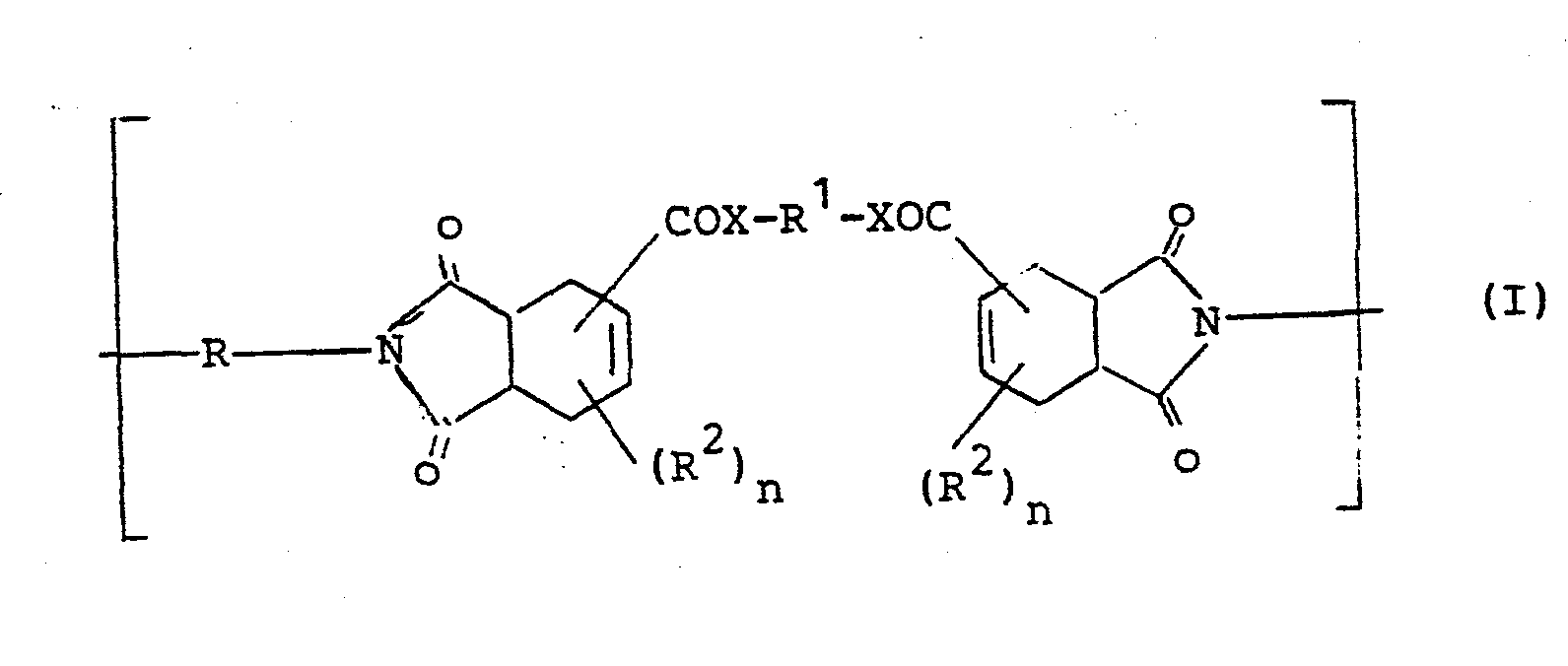
- X für -O-, -S-, -NY-, vorzugweise -O- oder -NY- steht,
- Y H, C1-3-Alkyl, C6-10 Aryl, vorzugsweise H, CH3, Phenyl,
- n eine ganze Zahl von 0 bis 3, vorzugsweise 0 und 1 und R2 H, C1-3-Alkyl, C6-10 Aryl, Halogen, C1-3-Alkoxy, vorzugsweise CH3-, CH30-Phenyl, Cl und Br,
- R und R1 für einen bivalenten organischen, niedermolekularen, oligomeren oder polymeren Rest stehen.
- Als organische Reste R und R können beispielsweise gesättigte oder ungesättigte Alkylenreste mit 2 bis 30 C-Atomen, vorzugsweise 2 bis 20 C-Atomen, aromatische Reste mit 6 bis 60 C-Atomen, vorzugsweise 6 bis 18 C-Atomen in Betracht kommen, wobei diese Reste in der Kette durch Heteroatome wie N, S, 0, P ein- oder mehrfach unterbrochen sein können.
- R steht vorzugsweise für einen Alkylenrest mit 2 bis 20 C-Atomen, Polyolefinrest mit einem Molekulargewicht von 500 bis 3000, oder Arylenrest mit 6 bis 18 C-Atomen. Weiterhin sind die Reste R und R2 vorzugsweise unterschiedlich.
- Oligomere oder polymere Reste R können z.B. Reste eines Polyesters, Polyethers, Polysulfons, Polycarbonats, Polyurethans, Polyacetals, Polyamids, Polysulfids, eines Co- oder Homopolymerisats eines olefinisch ungesättigten, radikalischen polymerisierbaren Monomeren, insbesondere eines Monomeren wie Acrylnitril, Styrols, konjugierten Diens, (Meth)-acrylats, 1-Olefins sein. Besonders bevorzugt sind Reste R die sich von Polycarbonaten, Polyestern oder Polyamiden ableiten.
- Beispielsweise seien folgende oligomeren oder polymeren Reste R genannt:
- Reste von Polybutylen- oder Polyethylenterephthalaten, von Polyphenylenoxiden, von Polytetramethylenoxiden, von aromatischen Polysulfonen oder Polyethersulfonen, von Bisphenol-A-polycarbonat, von Polyurethanen aus Polyester- oder Polyetherdiolen und Hexamethylendiisocyanat oder aromatischen Diisocyanaten, von Polymethylenoxid, von Polyphenylensulfiden, von Poly-p-Aminobenzoesäureamiden, von Polyamiden aus 1,6-Hexamethylendiamin und C2-12-Alkylen-dicarbonsäuren, von Polycaprolactonen oder Polycaprolactamen, sowie Reste von Polyethylen, von Polystyrolen, von Polybutadien, die partiell hydriert sein können, oder von Copolymeren aus Butadien mit Acrylnitril oder Styrol.
- Bevorzugte niedermolekulare Reste R entsprechen den Formeln (VI), (VII) oder (VIII),

- R 3 und R 4 für Wasserstoff, einen Alkylrest mit 1 bis 3 C-Atomen, Halogen wie F, Cl bedeutet,
- n für eine ganze Zahl von 1 bis 8 steht, wobei für den Fall, daß n für eine Zahl von 2 bis 8 steht, die Reste R3 und R4 an benachbarten C-Atomen auch für eine zusätzliche einfache Bindung stehen können und
- m für die Zahl 0, 1, 2 oder 3 steht,

- R 3, R 4 und n die bei Formel (VI) angegebene Bedeutung besitzen
- Z für -O-, -S-, -COO-, -CONH-, -SO-, -SO2-, vorzugsweise -O-, -S- und -COO- steht und
- X für die Zahl 0, 1 oder 2 steht.
- Beispielsweise seien folgende niedermolekulare Reste R 1 genannt:
- Ethylen-, 1,3-Propylen-, 1,6-Hexamethylen-, Phenylen-, p-Biphenylen-, Diethylenether-, Ditetramethylenether-, 4,4'-Diphenylpropan(2,2)-, 4,4'-Diphenylmethan-, -ether-, -thioether-, -sulfon-, -sulfoxid-, -phosphensäureester-, die gegebenenfalls an den Aromaten mit 1 oder 2 Methyl-oder Halogengruppen (z.B. Chlor, Brom) substituiert sein können, 1,4-Diethylenbenzol-, 1,4-Diphenylbenzol-, 4,4'-Benzoesäurephenylester-, 4,4'-Benzoesäurephenylamid-Reste, oder Reste, die sich von heterocyclischen Gruppen ableiten, wie z.B. Reste von Phthalsäureimiden.
- Die erfindungsgemäßen Polymeren sind in der Hauptkette im wesentlichen linear aufgebaut und besitzen Molekulargewichte größer 1000, bevorzugt größer 5000 bis 50000. Falls die Reste R und R selbst höhermolekular sind, können die erfindungsgemäßen Polymeren Molekulargewichte von mehr als 200000 annehmen. Die erfindungsgemäßen Polymeren besitzen unterschiedliche Löslichkeiten in verschiedenen Lösungsmitteln. Bevorzugt sind Polymere mit guter Löslichkeit in polaren organischen oder anorganischen Lösungsmitteln. Solche Lösungsmittel sind z.B.: Amide wie Dimethylformamid, Sulfone wie N-Methylpyrrolidon, (Halogen) Kohlenwasserstoffe wie Chlorbenzol, Chloroform, Methylenchlorid, Alkohole wie Kresol, Phenol, Säuren wie konzentrierte Schwefelsäure, Ether wie Dioxan, Ketone wie Aceton etc..
- Ein weiterer Gegenstand der Erfindung ist ein Verfahren zur Herstellung der Polymeren der Formel (I), dadurch gekennzeichnet, daß Bis-Maleinimide der Formel (II)

- R die bei Formel (I) angegebene Bedeutung hat,
- R 1, R 2 und X die bei Formel (I) angegebene Bedeutung hat,
- Bevorzugte Verbindungen (II) sind Umsetzungsprodukte aus Aminoverbindungen mit zwei NH2-Gruppen und Maleinsäureanhydrid. Zur Umsetzung mit Maleinsäureanhydrid werden vorzugsweise folgende Diamine eingesetzt:
- NH2-(C 2-8-Alkylen)-NH2
- NH2-(C 6-18-Arylen)-NH2
- NH2-C6H4-(C 1-8-Alkylen)-C6H4-NH2
- NH2-(C 1-4-Alkylen)-C6H4-(C 1-4-Alkylen)-NH2,
- Bevorzugte polymere Sorbinsäureesterderivate sind Polycarbonat- oder Polyester-sorbinate z.B. (2,2-Bis-(4-hydroxyphenyl)-propan)polycarbonat-, (Bisphenol-A-polycarbonat-), Sorbinate von Polyestern an Bisphenol A und Iso- und/oder Terephthalsäure, Polyterephthalsäureethylenglykolester-sorbinate, Polybutylenterephthalatsorbinate.
- Zur Herstellung der erfindungsgemäßen Polymeren werden die Komponenten (II) und (III) in üblicher Weise in äquimolaren Mengenverhältnissen umgesetzt. Durch Einsetzen mit einem Überschuß einer der Komponenten kann u.a. das Molekulargewicht der Polyadditionspolymeren beeinflußt werden. Die Endgruppen sowie das Molekulargewicht der Polymeren kann insbesondere durch Zusatz geringer Mengen monofunktioneller Maleinimide bzw. Butydienylcarbonsäurederivate beeinflußt werden. Vorzugsweise werden in diesem Falle N-Phenyl- oder N-Cyclohexylmaleinimid oder Sorbinsäure oder Sorbinsäureester oder -amide eingesetzt.
- Während man bei dem Einsatz von niedermolekularen Ausgangskomponenten zur Herstellung der erfindungsgemäßen Polymeren durchweg nahezu äquimolar arbeitet und das Molekulargewicht durch die oben genannten Maßnahmen beispielsweise regeln kann, kann es vorteilhaft sein, beim Einsatz hochmolekularer Ausgangsstoffe der Struktur (II) und (III) eine der Komponenten im Überschuß einzusetzen. Dieser Überschuß hängt ab vom Molekulargewicht und der molekularen Einheitlichkeit der polymeren Ausgangsverbindungen. Normalerweise ist aber als oberste Grenze des Verfahrens ein Arbeiten mit molaren Verhältnissen der Ausgangskomponente von (II) : (III) = 1 : 2 bis 2 : 1 zu nennen.
- Die Polyaddition wird bevorzugt katalysiert. Bevorzugte Katalysatoren sind Protonensäuren (z.B. HCl, H2S04, aromatische Sulfonsäuren, Carbonsäuren), saure Ionenaustauscherharze, Verbindungen die unter den Umsetzungsbedingungen als Lewissäuren wirken, z.B. ZnCl2, AlCl3, Ti-Alkoholate, FeCl- usw. Die Katalysatoren werden vorzugsweise in Mengen von etwa 10 ppm bis 2 Gew.-%, bezogen auf die Reaktanten, eingesetzt.
- Das erfindungsgemäße Verfahren kann in der Schmelze, in Lösung oder in Dispersion durchgeführt werden. Bevorzugt ist die Umsetzung in Lösung oder in einem Kombinationsverfahren aus Masse/Lösungspolyaddition oder aus Masse/Dispersionspolyaddition.
- Bevorzugte Lösungsmittel sind polare organische Lösungsmittel, insbesondere Ether wie Dioxan und hochsiedende Polyether, Amide wie Dimethylformamid, Dimethylacetamid und Phosphorsäureamide und N-Methylpyrrolidon, Aromaten wie Halogenbenzole, oder aliphatische, hochsiedende Kohlenwasserstoffe.
- Das erfindungsgemäße Verfahren wird bei Temperaturen von 50 - 300°C durchgeführt, vorzugsweise bei 60 bis 200°C.
- Um hohe Monomerumsätze zu erreichen, kann es vorteilhaft sein, die Polyaddition bei Temperaturen von unter 100°C zu beginnen und im Laufe der Reaktion auf Temperaturen von 100 - 200°C zu steigern.
- Die Qualität der Polymeren hängt von den gewählten Umsetzungsbeindungen, z.B. von der Umsetzungstemperatur ab. In bestimmten Fällen, z.B. bei Verwendung eines Katalysators kann es vorteilhaft sein, bei relativ niedriger Temperatur die Umsetzung auszuführen. Weiterhin kann der Zusatz üblicher Antioxidantien und Inhibitoren (z.B. Hydrochinon, 2,6-Di-tert-butylphenole, Triphenylphosphite, etc.), gegebenenfalls in Kombination mit üblichen Reduktionsmitteln (z.B. Phosphite, Thioether, Aldehyde) zur Umsetzungsmischung, die Qualität des herzustellenden Polymeren günstig beeinflußen.
- Die erfindungsgemäßen Polymeren der Formel (I) enthalten Struktureinheiten, die sich vom Cyclohexen ableiten. Diese Struktureneinheiten können durch geeignete Maßnahmen zu gesättigten Cyclohexanstrukturen hydriert werden. Sie können auch durch andere Maßnahmen dehydriert werden, so daß aromatische Benzolstrukturen entstehen.
- Die Polymeren mit hydrierten Struktureinheiten können durch die Formel (IV) wiedergegeben werden 4
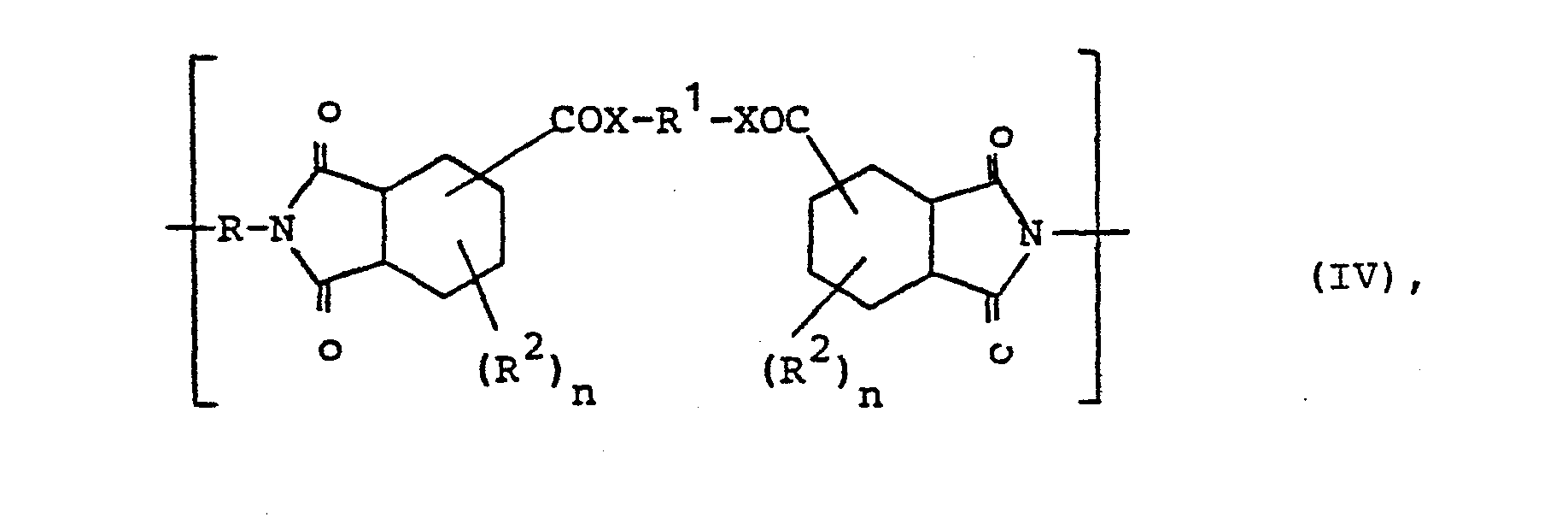
- R, R1, R2,-X und n die bei Formel (I) angegebene Bedeutung haben.
- Die Polymeren mit dehydrierten, aromatischen Benzolstrukturen können durch die Formel (V) wiedergegeben werden.

- R, R 1, R2, X und n die bei Formel (I) angegebene Bedeutung haben.
- Die Polymeren mit eingebauten Struktureinheiten (IV) oder (V) werden aus Polymeren mit eingebauten Struktureinheiten (I) durch Hydrierung der Doppelbindung der Cyclohexenstruktur oder durch Dehydrierung der Cyclohexenstruktur hergestellt. Die Hydrierungs- oder Dehydrierungsreaktionen der erfindungsgemäßen Polymeren der Struktureinheit (I) verlaufen nahezu vollständig. Diese Reaktionen können auch partiell ausgeführt werden. In diesem Falle liegen dann in den Polymeren Struktureinheiten (I) neben Struktureinheiten (IV) bzw. (VI) vor.
- Zur erfindungsgemäßen Hydrierung können bekannte Hydrierungsverfahren herangezogen werden, insbesondere katalytische Hydrierungen in Anwesenheit beispielsweise von Schwarz-Katalysatoren, Adams-Katalysatoren, Raney-Katalysatoren, Trägerkatalysatoren sowie Oxid- bzw. Sulfidkatalysatoren. Trägerkatalysatoren sind vorzugsweise solche die sich leicht abtrennen lassen, z.B. Pd- oder Pt-Katalysatoren auf Trägermaterialien wie Kohle, Si02, A1203, sowie Sulfate von Erdalkalimetallen. Vorzugsweise werden solche Katalysatoren in möglichst geringer Menge, bezogen auf das zu hydrierende Produkt eingesetzt, in besonderen in Mengen kleiner 10 Gew.-%.
- Vorzugsweise wird die Hydrierung in Lösung durchgeführt, vorzugsweise im sauren Medium. Als Lösungsmittel kommen polare organische Lösungsmittel, in denen sich das Polymer löst, in Frage, zum Beispiel Ether wie Dioxan, Säuren, flüssige Carbonsäureamide. Vorzugsweise wird die Hydrierung in dem Lösungsmittel durchgeführt in dem die Herstellung des Polymeren der Formel (I) durchgeführt wurde. In besonderen Fällen kann die Hydrierung ohne Lösungsmittel durchgeführt werden.
- Die Hydrierung wird vorzugsweise bei einer Temperatur von 50-200°C durchgeführt. Der Wasserstoffdruck beträgt im allgemeinen etwa 1 bis 200 bar.
- Will man an den Polymeren eine partielle Hydrierung der olefinischen Doppelbindungen erreichen, so kann dies durch die Wasserstoffmenge, Druck oder Temperatur gesteuert werden.
- Die Dehydrierung der erfindungsgemäßen Polymeren mit Struktureinheiten (I) kann ebenfalls nach bekannten Verfahren erfolgen. Vorzugsweise erfolgt die Dehydrierung in flüssiger Phase in Gegenwart von Katalysatoren, insbesondere Edelmetallkatalysatoren. Als Lösungsmittel sind beispielsweise zu nennen: Kohlenwasserstoffe wie Benzol, Toluol, Kresol, Phenol, Amide wie Ameisensäureamide, Ether wie Diethylether.
- Die Dehydrierung kann auch mit Dehydrierunsmitteln wie Schwefel, Selen, Chinonen, Nitrobenzol, Fe-Salzen durchgeführt werden. Diese oder weitere bekannte Katalysatoren können in katalytischen Mengen, in stöchiometrischen Mengen bezogen auf die zu dehydrierenden Molekülreste oder im Uberschuß eingesetzt werden.
- Die Dehydrierung findet bei Temperaturen von 100 bis etwa 350°C statt. Durch Auswahl des geeigneten Dehydrierungsmittels oder Katalysators, Variation der Temperatur, Reaktionszeit, kann ein unterschiedlicher Dehydrierungsgrad erreicht werden, d.h. es werden nicht unbedingt alle Cyclohexenstrukturen zu aromatischen Benzolstrukturen dehydriert.
- Die erfindungsgemäßen Polymeren eignen sich in vielfältiger Weise zur Herstellung verschiedener Formkörper mit interessanten anwendungstechnischen Eigenschaftskombinationen.
- Die erfindungsgemäßen Polymeren lassen sich aus Lösung oder Schmelze zur Materialien hoher Wärmeformbeständigkeit und guter Spannungsrißkorrosionsbeständigkeit verarbeiten. Sie können insbesondere auf dem Thermoplast- oder Beschichtungssektor Verwendung finden.
- Beschichtungen aus den erfindungsgemäßen Polymeren mit olefinischen Doppelbindungen können beispielsweise unter radikalischen Bedingungen, gegebenenfalls unter Mitverwendung von olefinisch ungesättigten Vinylmonomeren zu vernetzten, gehärteten Materialien umgesetzt werden. Diese können zum Versiegeln von Substratoberflächen wie Holz, Metall, Glas, Kunststoff usw. Verwendung finden.
- Neben hoher Temperaturbeständigkeit weisen solche Produkte gute Beständigkeiten gegen aggressive Medien auf.
- Hydrierung oder Dehydrierung der Polycycloadditionspolymeren kann in speziellen Fällen die Verarbeitungs- und Temperaturbeständigkeit der Polymeren erhöhen.
- Geht man zur Herstellung der erfindungsgemäßen Polymeren von polymeren Bis- Butadienylcarbonsäurederivaten und/oder poymeren Bis-Maleinimiden aus, können blockartig aufgebaute Copolymere erhalten werden. Auch dadurch können die Eigenschaften der erfindungsgemäßen Polymeren, z.B. Elastizität, Härte, Festigkeiten und Modulverhalten, modifiziert werden.
- Die erfindungsgemäßen Polymeren eignen sich zur Herstellung von Beschichtungen, Folien, Einkapselungsmaterialien, Dichtungen, Fäden, Platten, Formmassen, die durch Pressen, Extrusion, Spritzguß verarbeitbar sein können. Die erfindungsgemäßen Polymeren werden vorzugsweise in Kombination mit Antioxidantien, Verarbeitungshilfsmitteln (z.B. Gleitmittel, Extenderöle), anorganischen oder organischen Pigmenten, inerten Füllstoffen (insb. mit Fasermaterialien) zu Formkörpern verarbeitet.
-
- a) 16,64 Gew.-Teile Bis-Sorbinsäureester des Bisphenol A, 14,32 Gew.-Teile Bis-Maleinimid des p,p'-Diamino- diphenylmethans, 0,1 Gew.-Teile p-Toluolsulfonsäure, 0,3 Gew.-Teile phenolisches Antioxidanz (Ionol KB R) und 0,1 Gew.-Teile Dilauryldithiodipropinat (Irganox PS 800 " ) werden in 50 Gew.-Teile N-Methylpyrrolidon eingebracht. Unter Rühren und N2-Athmosphäre läßt man 3,5 Stunden bei 80°C reagieren. Dann heizt man auf 90°C auf und führt die Polyaddition 3 Stunden bei dieser Temperatur fest. Anschließend werden 10 Gew.-Teile N-Methylpyrrolidon eingespeist und nochmals 1 Stunde bei 95°C gerührt. Dabei hat sich eine hochviskose Lösung gebildet. Nach Abkühlen und Verdünnen mit weiterem Lösungsmittel wird das Polymer mittels Isopropanol ausgefällt, gewaschen und getrocknet. Das Polymer besitzt einen Staudingerindex bei 25°C, in N-Methylpyrrolidon = NMP) von 0,55 dö/g. Das Polymer löst sich in N-Methylpyrrolidon, Phenol, Schwefelsäure und Dimethylformamid. Aus einer Lösung des Polymeren lassen sich Filme herstellen. Der Stickstoffgehalt des Polymeren beträgt 3,5 Gew.-%. IR (KBr) Absorptionsbanden bei 1760, 1710, 1510, 1380, 1100, 1170 cm-1.
- b) Beispiel a) wird wiederholt. Anstatt p-Toluolsulfonsäure werden 0,05 Gew.-Teile Trichloressigsäure eingesetzt. Das gebildete Polymer besitzt einen Staudingerindex von 0,60 dl/g (bei 25°C in NMP).
- c) Beispiel a) wird ohne Säurezusatz wiederholt. Das gebildete Polymer weist nach gleicher Reaktionszeit einen Staudingerindex von 0,26 dl/g auf.
- d) 28 Gew.-Teile Bis-Maleinsäureimid des 1,6-Hexamethylendiamins, 32 Gew.-Teile Bis-Sorbinsäureester des Bisphenols-A, 0,09 Gew.-Teile p-Toluolsulfonsäure und 0,4 Gew.-Teile Ionol KB(R) werden in 100 Gew.-Teilen Dimethylformamid gelöst. Bei 100°C wird 4 h gerührt. Anschließend steigert man die Reaktionstemperatur für eine Stunde auf 130°C. Das gebildete Polymer besitzt einen Staudingerindex von 0,61 dl/g, (bei 25°C, in NMP).
- e) 13,9 Gew.-Teile eines Bisphenol-A-polycarbonates mit terminalen Bisphenol-A-sorbinsäureesterendgruppen und einem Staudingerindex von 0,403 dl/g (in CH2C12 bei 25°C), 0,63 Gew.-Teile eines Bis-Maleinsäureimids des p,p'-Diaminodiphenylmethans und 0,3 Gew.-Teile phenolisches Antioxidanz werden in 70 Gew.-Teilen Chlorbenzol bei 130°C gelöst. Nach 12 Stunden Reaktionszeit bei 130°C wird das gebildete Polycarbonatimid durch Verdampfen des Lösungsmittels isoliert. Das Polymer besitzt einen Staudingerindex von 0,59 dl/g (in CH2C12 bei 25°C).
- f) 100 Gew.-Teile einer 15 Gew.%igen Lösung des Polymeren aus Beispiel a) in N-Methylpyrrolidon werden mit 0,4 Gew.-Teilen Benzoylperoxid und 1,5 Gew.-Teilen Triallylcyanurat versetzt. Aus der Lösung wird bei Temperaturen von 50°C ein Film hergestellt, der eine Stunde lang bei 130°C getempert wird. Dieser Film ist unlöslich in gebräuchlichen Lösungsmitteln und ist unempfindlich gegen gebräuch- liche Kraftfahrstoffe, Reinigungsmittel und öle.
- g) 10 Gew.-Teile des Polymeren aus Beispiel c) werden in 100 Gew.-Teilen Dioxan gelöst. In Gegenwart von 1 Gew.-Teil Pt02 und H2 wird in einem Autoklaven bei 55°C hydriert. Die Hydrierung ist beendet, wenn die IR-Absorption des Polymeren zwischen 1600 und 1700 cm-1 nicht weiter abnimmt. Nach Abfiltration des Katalysators und Ausfällung mit einem Ethanol/Wasser-Gemisch wird das partiell hydrierte Polymer aus Beispiel c) erhalten.
- h) 90 Gew.-Teile eines Bis-Sorbinsäureesters eines Polytetramethylenglycols mit einem durchschnittlichen Molekulargewicht von 800 und 14 Gew.-Teile Bis-Maleinimid aus p,p'-Diaminodiphenylmethan werden analog Vorschrift a) umgesetzt. Es wird ein Polymer guter Flexibilität erhalten, das einen Staudingerindex (gemessen in DMF bei 23°C) von [η] = 0,67 dl/g besitzt. (DMF = Dimethylformamid)
bedeutet und

gegebenenfalls unter Katalyse, mit einem Bis-Butadienylcarbonsäurederivat der Formel (III)

unter Polyaddition zu den erfindungsmäßen Polymeren umgesetzt werden.
wobei die Phenylenreste -C6H4- gegebenenfalls mit bis zu 2 CH3-Gruppen substituiert sein können.
Bevorzugte Verbindungen (III) sind Bis-Butadienylmonocarbonsäureester, -amide, -thioester, besonders bevorzugt -ester oder -amide wie die Bis-Sorbinsäureamide der oben beschriebenen Diamine oder die Bis-Sorbinsäureester von Diolen bzw. OH-enthaltenden Polymeren oder von Diaminen bzw. NH2-enthaltenden Polymeren, vorzugsweise die Bis-Sorbinsäureester von Polymeren, Polyadditionprodukten oder Polykondensaten mit endständigen OH-Gruppen oder AminoGruppen. Zur Umsetzung mit Sorbinsäure werden folgende Diole oder Diamine vorzugsweise verwendet:


Claims (7)


gegebenenfalls unter Katalyse, mit einem Bis-Butadienylcarbonsäurederivat der Formel (III)

unter Polyaddition zu den erfindungsgemäßen Polymeren umgesetzt werden.


Applications Claiming Priority (2)
| Application Number | Priority Date | Filing Date | Title |
|---|---|---|---|
| DE19833330768 DE3330768A1 (de) | 1983-08-26 | 1983-08-26 | Neue polyimide und ein verfahren zu ihrer herstellung |
| DE3330768 | 1983-08-26 |
Publications (3)
| Publication Number | Publication Date |
|---|---|
| EP0135150A2 true EP0135150A2 (de) | 1985-03-27 |
| EP0135150A3 EP0135150A3 (en) | 1988-09-07 |
| EP0135150B1 EP0135150B1 (de) | 1990-08-08 |
Family
ID=6207471
Family Applications (1)
| Application Number | Title | Priority Date | Filing Date |
|---|---|---|---|
| EP84109742A Expired - Lifetime EP0135150B1 (de) | 1983-08-26 | 1984-08-16 | Neue Polyimide und ein Verfahren zu ihrer Herstellung |
Country Status (2)
| Country | Link |
|---|---|
| EP (1) | EP0135150B1 (de) |
| DE (2) | DE3330768A1 (de) |
Cited By (3)
| Publication number | Priority date | Publication date | Assignee | Title |
|---|---|---|---|---|
| WO1991001307A3 (en) * | 1989-07-25 | 1991-04-04 | Henkel Research Corp | N-cyanoimides and process for their preparation and uses thereof |
| WO2008094741A1 (en) | 2007-02-02 | 2008-08-07 | Exxonmobil Chemical Patents Inc. | Improved properties of peroxide-cured elastomer compositions |
| WO2025043635A1 (en) * | 2023-08-31 | 2025-03-06 | Blue Cube Ip Llc | Maleimide polymer for electrical laminates |
Family Cites Families (1)
| Publication number | Priority date | Publication date | Assignee | Title |
|---|---|---|---|---|
| US3440215A (en) * | 1965-03-17 | 1969-04-22 | Gen Electric | Aromatic polyimides |
-
1983
- 1983-08-26 DE DE19833330768 patent/DE3330768A1/de not_active Withdrawn
-
1984
- 1984-08-16 EP EP84109742A patent/EP0135150B1/de not_active Expired - Lifetime
- 1984-08-16 DE DE8484109742T patent/DE3482923D1/de not_active Expired - Lifetime
Cited By (3)
| Publication number | Priority date | Publication date | Assignee | Title |
|---|---|---|---|---|
| WO1991001307A3 (en) * | 1989-07-25 | 1991-04-04 | Henkel Research Corp | N-cyanoimides and process for their preparation and uses thereof |
| WO2008094741A1 (en) | 2007-02-02 | 2008-08-07 | Exxonmobil Chemical Patents Inc. | Improved properties of peroxide-cured elastomer compositions |
| WO2025043635A1 (en) * | 2023-08-31 | 2025-03-06 | Blue Cube Ip Llc | Maleimide polymer for electrical laminates |
Also Published As
| Publication number | Publication date |
|---|---|
| DE3330768A1 (de) | 1985-03-14 |
| DE3482923D1 (de) | 1990-09-13 |
| EP0135150B1 (de) | 1990-08-08 |
| EP0135150A3 (en) | 1988-09-07 |
Similar Documents
| Publication | Publication Date | Title |
|---|---|---|
| DE68904396T2 (de) | Alpha, alpha', alpha''-tris(4-cyanatophenyl)-1,3,5-tri-isopropylbenzole und harze davon. | |
| DE2446383C2 (de) | Von Phenylindandiaminen und -dianhydriden abgeleitete lösliche Polyimide | |
| DE2760336C2 (de) | ||
| DE69026297T2 (de) | Polyamid-Polyimid- und Polybenzoxazol-Polyimid-Polymere | |
| CH648572A5 (de) | Imidoligomere mit je einer endstaendigen acetylengruppe. | |
| DE2425164A1 (de) | Verfahren zur kettenverlaengerung von polyimiden | |
| EP0193721A2 (de) | Polyimide und Verfahren zu ihrer Herstellung | |
| DE2601577A1 (de) | Von phenylindan-diaminen sich ableitende, loesliche polyamid-imide | |
| DE69932532T2 (de) | Synthese von phenolischen monomeren mit imid- oder diimid-einheiten und daraus hergestellte hitzebeständige carbonat-polymere | |
| DE2018525B2 (de) | Verfahren zur Herstellung von Imidgruppen enthaltenden Präkondensaten | |
| DE2263190A1 (de) | Loesliche polyimide aus aromatischen dianhydriden und 2,4-diaminodiphenylaminen und 2,4-diaminodiphenylsulfiden | |
| DE1770146C3 (de) | Verfahren zur Herstellung von PoIy-(arylen-triketoimidazolidinen) | |
| DE4440409C2 (de) | Verfahren zur Herstellung von Polyamidimid-Harzen mit hohem Molekulargewicht | |
| DE3685597T2 (de) | Bis(hydroxyphthalimid), verfahren zu seiner herstellung und seine anwendung zur herstellung von polyesterimid. | |
| CH654844A5 (de) | Verfahren zur herstellung von polyamidverbindungen. | |
| DE2257996A1 (de) | Loesliche polyimide | |
| EP0135150B1 (de) | Neue Polyimide und ein Verfahren zu ihrer Herstellung | |
| EP0245815A2 (de) | Neue lösliche und/oder schmelzbare Polyimide und Polyamidimide | |
| DE2005587B2 (de) | Aromatische Polyimide mit Karbüiolkettenverknüpfung sowie deren Anwendung | |
| DE2331245A1 (de) | Polyarylenester, verfahren zu ihrer herstellung, ihre verwendung als klebstoffe und diese verbindungen enthaltende klebemassen | |
| DE2038275C3 (de) | Polyimide aus 2,6-Diamino-s-triazinen und Dianhydriden | |
| CH630650A5 (de) | Verfahren zur herstellung von nicht oder schwach gefaerbten, thermoplastischen xylol-formaldehyd-polymeren. | |
| DE4224248C2 (de) | Nadimid-terminierte Polyarylate und gehärtete Polyarylatharze | |
| DE4108587A1 (de) | Polyaetherimidimide und verfahren zu deren herstellung | |
| DE19514415C2 (de) | Farbloses oder gering gefärbtes Polyimid und Verfahren zur Herstellung eines Polyimides durch Umsetzung eines Dianhydrides mit einem Diisocyanat |
Legal Events
| Date | Code | Title | Description |
|---|---|---|---|
| PUAI | Public reference made under article 153(3) epc to a published international application that has entered the european phase |
Free format text: ORIGINAL CODE: 0009012 |
|
| 17P | Request for examination filed |
Effective date: 19840816 |
|
| AK | Designated contracting states |
Designated state(s): DE FR GB IT NL |
|
| PUAL | Search report despatched |
Free format text: ORIGINAL CODE: 0009013 |
|
| AK | Designated contracting states |
Kind code of ref document: A3 Designated state(s): DE FR GB IT NL |
|
| 17Q | First examination report despatched |
Effective date: 19890914 |
|
| GRAA | (expected) grant |
Free format text: ORIGINAL CODE: 0009210 |
|
| AK | Designated contracting states |
Kind code of ref document: B1 Designated state(s): DE FR GB IT NL |
|
| ITF | It: translation for a ep patent filed | ||
| ET | Fr: translation filed | ||
| REF | Corresponds to: |
Ref document number: 3482923 Country of ref document: DE Date of ref document: 19900913 |
|
| GBT | Gb: translation of ep patent filed (gb section 77(6)(a)/1977) | ||
| PLBE | No opposition filed within time limit |
Free format text: ORIGINAL CODE: 0009261 |
|
| STAA | Information on the status of an ep patent application or granted ep patent |
Free format text: STATUS: NO OPPOSITION FILED WITHIN TIME LIMIT |
|
| PGFP | Annual fee paid to national office [announced via postgrant information from national office to epo] |
Ref country code: DE Payment date: 19910724 Year of fee payment: 8 |
|
| PGFP | Annual fee paid to national office [announced via postgrant information from national office to epo] |
Ref country code: FR Payment date: 19910730 Year of fee payment: 8 |
|
| 26N | No opposition filed | ||
| PGFP | Annual fee paid to national office [announced via postgrant information from national office to epo] |
Ref country code: GB Payment date: 19910805 Year of fee payment: 8 |
|
| ITTA | It: last paid annual fee | ||
| PGFP | Annual fee paid to national office [announced via postgrant information from national office to epo] |
Ref country code: NL Payment date: 19910831 Year of fee payment: 8 |
|
| PG25 | Lapsed in a contracting state [announced via postgrant information from national office to epo] |
Ref country code: GB Effective date: 19920816 |
|
| PG25 | Lapsed in a contracting state [announced via postgrant information from national office to epo] |
Ref country code: NL Effective date: 19930301 |
|
| GBPC | Gb: european patent ceased through non-payment of renewal fee |
Effective date: 19920816 |
|
| NLV4 | Nl: lapsed or anulled due to non-payment of the annual fee | ||
| PG25 | Lapsed in a contracting state [announced via postgrant information from national office to epo] |
Ref country code: FR Effective date: 19930430 |
|
| PG25 | Lapsed in a contracting state [announced via postgrant information from national office to epo] |
Ref country code: DE Effective date: 19930501 |
|
| REG | Reference to a national code |
Ref country code: FR Ref legal event code: ST |