EP0135183A2 - Verfahren zur Herstellung von Carbonsäureamidgruppen enthaltenden Verbindungen, insbesondere von Peptiden - Google Patents
Verfahren zur Herstellung von Carbonsäureamidgruppen enthaltenden Verbindungen, insbesondere von Peptiden Download PDFInfo
- Publication number
- EP0135183A2 EP0135183A2 EP84110679A EP84110679A EP0135183A2 EP 0135183 A2 EP0135183 A2 EP 0135183A2 EP 84110679 A EP84110679 A EP 84110679A EP 84110679 A EP84110679 A EP 84110679A EP 0135183 A2 EP0135183 A2 EP 0135183A2
- Authority
- EP
- European Patent Office
- Prior art keywords
- reaction
- preparation
- peptides
- compounds
- bases
- Prior art date
- Legal status (The legal status is an assumption and is not a legal conclusion. Google has not performed a legal analysis and makes no representation as to the accuracy of the status listed.)
- Granted
Links
Images

Classifications
-
- C—CHEMISTRY; METALLURGY
- C07—ORGANIC CHEMISTRY
- C07K—PEPTIDES
- C07K5/00—Peptides containing up to four amino acids in a fully defined sequence; Derivatives thereof
- C07K5/04—Peptides containing up to four amino acids in a fully defined sequence; Derivatives thereof containing only normal peptide links
- C07K5/08—Tripeptides
- C07K5/0802—Tripeptides with the first amino acid being neutral
- C07K5/0804—Tripeptides with the first amino acid being neutral and aliphatic
- C07K5/0806—Tripeptides with the first amino acid being neutral and aliphatic the side chain containing 0 or 1 carbon atoms, i.e. Gly, Ala
-
- C—CHEMISTRY; METALLURGY
- C07—ORGANIC CHEMISTRY
- C07K—PEPTIDES
- C07K1/00—General methods for the preparation of peptides, i.e. processes for the organic chemical preparation of peptides or proteins of any length
- C07K1/06—General methods for the preparation of peptides, i.e. processes for the organic chemical preparation of peptides or proteins of any length using protecting groups or activating agents
- C07K1/08—General methods for the preparation of peptides, i.e. processes for the organic chemical preparation of peptides or proteins of any length using protecting groups or activating agents using activating agents
- C07K1/082—General methods for the preparation of peptides, i.e. processes for the organic chemical preparation of peptides or proteins of any length using protecting groups or activating agents using activating agents containing phosphorus
Definitions
- EP-A1-56618 discloses a process for the preparation of carboxamides in which compounds containing carboxyl groups are reacted with compounds which contain a free amino group in the presence of dialkylphosphinic anhydrides.
- the dialkylphosphinic acid released in the reaction is bound by an excess of an organic base or a basic buffer initially added to the reaction mixture.
- the present method represents a new way of optimizing the conditions mentioned for an economical synthesis of peptides and amides.
- compounds containing carboxamide groups in particular oligopeptides
- the new process is characterized ekennzeich- g net that keeping the hydrogen ion concentration of the reaction mixture by metered addition of a base during the reaction within a defined range.
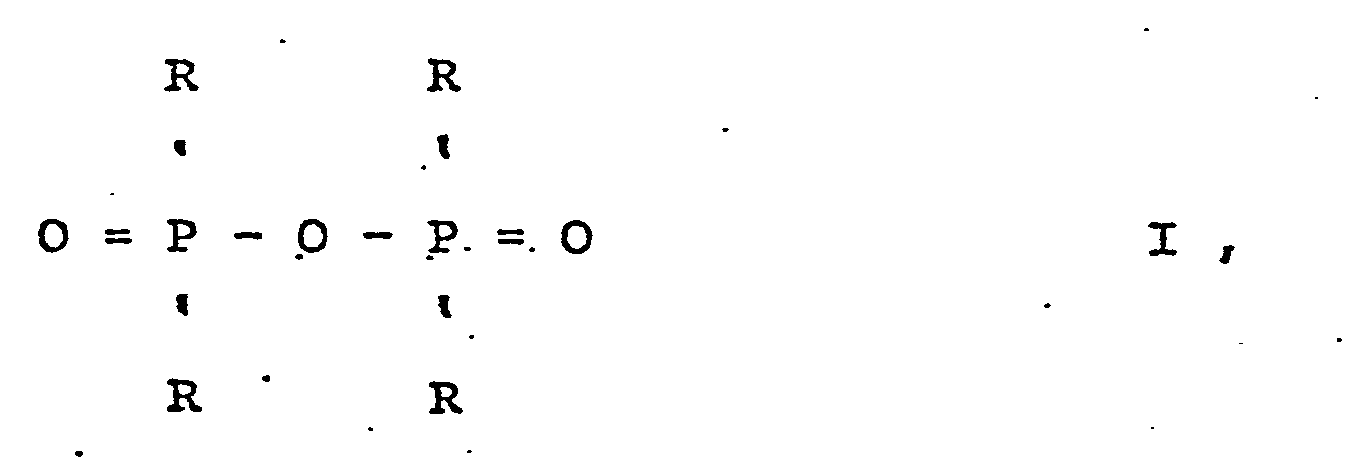
- Anhydrides of dialkylphosphinic acids are taken to mean compounds of the formula I. in which R means alkyl.
- the substituents R shown in the formula can be the same or different.
- Anhydrides in which both P atoms are substituted equally are preferred.
- Anhydrides of the formula I in which R is in each case a lower alkyl, preferably one having 1 to 4 carbon atoms, are particularly suitable for the purposes of the invention.
- dialkylphosphinic anhydrides used according to the invention are colorless liquids. They are stable at room temperature and can be distilled without decomposition at reduced pressure. They are easily soluble in most non-aqueous solvents, especially in lipid solvents such as chloroform or methylene chloride, but also in polar solvents such as DMF and DMA.
- anhydrides of dialkylphosphinic acids are Wise called: Methylethylphosphinic anhydride, Methol-ProPYlphosphinic anhydride, Ricohyl-butylpüosphinic anhydride, Diethylphosphinic anhydride, Di-n-propylphosphinic anhydride, Di-n-butylphosphinic anhydride.
- dialkylphosphinic anhydrides can be prepared in a manner known per se, e.g. by reacting the dialkylphosphinic acid chlorides with dialkylphosphinic acid alkyl esters at 150-160 ° C. (Houben-Weyl, Methods of Organic Chemistry, G. Thieme Verl., Stuttgart 1963, BD. XII, p. 266 ff). Methods in which dialkylphosphinic acids, their salts or esters are reacted with phosgene are particularly preferred (DBP 2 129 583, DOS 2 225 545).
- the inventive method is preferably in gemischtisseßrigen, mono- or 2-g en Phasi systems within a narrow pH range, preferably at approximately constant pH performed.
- the pH value of the reaction mixtures can be 5-10, advantageously it should be neutral to weakly acidic; values between 5.0 and 7.0 are particularly preferred. However, syntheses in the weakly alkaline range are also possible.
- the pH is preferably checked by metered addition of concentrated aqueous solutions of the alkali metal hydroxides, but organic bases such as N-ethylmorpholine, triethylamine or trialkylamines with up to 6 C atoms can also be used.
- the starting materials used are, on the one hand, an amino acid or a peptide with a blocked carboxyl group and, on the other hand, an amino acid or a peptide with a blocked amino group.
- esters of straight-chain or branched ali are particularly suitable phatic alcohols diethanol, ethanol, tert.
- Butanol Esters araliphatic alcohols such as benzyl alcohol or D iphenylmethylcarbinol can be used.
- Mixtures of water and a water-miscible organic solvent such as e.g. Dioxane, tetrahydrofuran, dimethylformamide or dimethylacetamide can be used.
- a water-miscible organic solvent such as e.g. Dioxane, tetrahydrofuran, dimethylformamide or dimethylacetamide.
- the use of such systems is particularly advantageous when linking predominantly water-soluble peptides.
- reaction usually takes place sufficiently quickly at room temperature. Slight heating does no harm. Higher temperatures, for example above 30 ° C, are not recommended, particularly in the case of peptide synthesis, because of the risk of racemization.
- a reaction temperature between 0 and 30 ° C. is preferred, in particular between 5 and 25 ° C.
- the process according to the invention allows for the first time to follow the course of the reaction based on the consumption of the base used at an approximately constant pH.
- the reaction is preferably carried out in a self-writing pH state, expediently with thorough mixing of the mixed aqueous system containing the reaction partners carboxyl component, amine component and dialkylphosphinic anhydride.
- the representation of the base consumption as a function of time provided by the writer shows a curve which runs asymptotically towards the end of the reaction (cf. the curve reproduction in the figure).
- the method according to the invention thus offers the possibility of recognizing the end point of the synthesis reaction in a simple manner.
- alkali metal salts formed in the course of the reaction when using alkali metal hydroxides as bases in this variant of the process according to the invention are, in contrast to the salts formed when some organic tertiary bases are used, when the reaction product is isolated by extraction from an alkaline solution with a water solution miscible lipoid phase easier to separate due to their greater hydrophilicity. Furthermore, contamination of the Li p id p hase by extracted tertiary base is avoided in this procedure.
- the method according to the invention is simple to carry out and delivers peptides in high optical purity and yield. It is also economical and environmentally friendly.
- the dialkylphosphinic anhydrides are low molecular weight, easy to maintain and clean, and show a high proportion of reactive groups per unit weight and good lipophilicity.
- the dialkylphosphinic anhydrides and the associated dialkylphosphinic acids are lipid-soluble. This enables water-soluble peptide derivatives to be worked up in a first precipitation step using suitable lipoid solvents.
- the dialkylphosphinic acid obtained from the dialkylphosphinic anhydride in the course of the peptide synthesis can be recovered from the residual solutions of the synthesis reaction.
- the dialkylphosphinic acids can be recovered from a larger amount of aqueous synthesis mother liquors by extraction with solvents such as chloroform and isobutanol and subsequent workup by distillation. It is of particular technical interest that the dialkylphosphinic acids can be distilled in vacuo without decomposition.
- the reprocessed dialkylphosphinic acids obtained in this way can then easily be converted into the corresponding dialkylphosphinic anhydrides by the method of DOS 2 225 545.
- the organic base can be replaced by alkali metal hydroxide solutions, which is the reprocessing described above the dialkylphosphinic acids significantly simplified after synthesis.
- the extraction step can be omitted.
- the dialkylphosphinic acid can then be distilled off directly from the evaporated synthetic mother liquor or, in a two-phase procedure, is recovered from the aqueous phase by acidification and extraction after the lipoid phase has been separated off.
- the inorganic neutral salts then remain in the aqueous phase.
Landscapes
- Chemical & Material Sciences (AREA)
- Organic Chemistry (AREA)
- Molecular Biology (AREA)
- Proteomics, Peptides & Aminoacids (AREA)
- Biophysics (AREA)
- General Health & Medical Sciences (AREA)
- Genetics & Genomics (AREA)
- Medicinal Chemistry (AREA)
- Health & Medical Sciences (AREA)
- Biochemistry (AREA)
- Life Sciences & Earth Sciences (AREA)
- Analytical Chemistry (AREA)
- Peptides Or Proteins (AREA)
- Organic Low-Molecular-Weight Compounds And Preparation Thereof (AREA)
- Acyclic And Carbocyclic Compounds In Medicinal Compositions (AREA)
- Medicines That Contain Protein Lipid Enzymes And Other Medicines (AREA)
Abstract
Description
- Zur Herstellung von Carbonsäureamid- und Peptidbindungen ist eine große Anzahl von Verfahren bekannt (siehe z.B. Houben-Weyl, Methoden der organischen Chemie, Bd. XV, Teil II, S. 1 -364. Ferner Angew. Chemie 92, 129 (1980)) Alle diese Verfahren zielen mit unterschiedlichem Erfolg 'darauf, die für die Synthese von Peptiden notwendigen Kriterien der Racemisierungsfreiheit, der einfachen und schonenden Durchführbarkeit bei hohen Ausbeuten und mit leicht zugänglichen Ausgangsmaterialien sicherzustellen.
- Aus der EP-A1-56618 ist ein Verfahren zur Herstellung von Carbonsäureamiden bekannt, bei welchem man Carboxylgruppen enthaltende Verbindunaen.mit Verbindungen, die eine freie Aminogruppe enthaJten, in Gegenwart von Dialkvlphosphinsäureanhydriden umsetzt. Die bei der Reaktion freigesetzte Dialkylphosphinsäure wird durch einen anfangs der Reaktionsmischung zugesetzten Überschuß einer organischen Base oder eines basischen Puffers gebunden.
- Das vorliegende Verfahren stellt einen neuen Weg dar, die genannten Bedingungen für eine wirtschaftliche Synthese von Peptiden und Amiden zu optimieren.
- Es wurde gefunden, daß man Carbonsäureamidgruppen enthaltende Verbindungen, insbesondere Oligopeptide, unter mildsn Bedingungen in guter Ausbeute herstellen kann, indem man Verbindungen, die eine freie Aminogruppe enthalten, insbesondere Aminocarbonsäurederivate oder Peptide, deren Carboxylgruppe geschützt ist, in Gegenwart des Anhydrids einer Diaikylphosphinsäure mit Verbindungen umsetzt, die eine freie Carboxylgruppe enthalten, insbescndere Aminocarbonsäuren oder Peptide, deren Amincgruppe acyliert ist. Das neue Verfahren ist dadurch gekennzeich- net, daß man die Wasserstoffionenkonzentration der Reaktionsmischung durch Zudosierung einer Base während der Reaktion innerhalb eines definierten Bereiches hält.
- Die zum Schutz der funktionellen Gruppen eingeführten Reste können im Falle der Synthese von Peptiden anschließend in üblicher Weise abgespalten werden.
- Unter Anhydriden der Dialkylphosphinsäuren werden Verbindungen der Formel I verstanden
- Besonders geeignet im Sinne der Erfindung sind Anhydride der Formel I, in denen R jeweils ein niederes Alkyl ist, vorzugsweise ein solches mit 1 bis 4 C-Atomen.
- Die erfindungsgemäß verwendeten Dialkylphosphinsäureanhydride sind farblose Flüssigkeiten. Sie sind bei Raumtemperatur stabil und lassen sich bei vermindertem Druck unzersetzt destillieren. In den meisten nicht wäßrigen Lösungsmitteln, insbesondere in Lipidlösungsmitteln wie Chloroform oder Methylenchlorid, aber auch in polaren Lösungsmitteln wie DMF und DMA sind sie leicht löslich.
- Als Anhydride der Dialkylphosphinsäuren seien beispielsweise genannt: Methyläthylphosphinsaureanhydrid, Methol-ProPYlphosphinsäureanhydrid,Miethyl-butylpüosphinsäure- anhydrid, Diäthylphosphinsäureanhydrid, Di-n-propylphosphinsäureanhydrid, Di-n-butylphosphinsäureanhydrid.
- Die Herstellung der Dialkylphosphinsäureanhydride kann in an sich bekannter Weise erfolgen, z.B. durch Umsetzung der Dialkylphosphinsüurechloride mit Dialkylphosphinsäurealkylestern bei 150 - 160°C(Houben-Weyl, Methoden der Organischen Chemie, G. Thieme Verl., Stuttgart 1963, BD. XII, S. 266 ff). Besonders bevorzugt sind Verfahren, bei denen Dialkylphosphinsäuren, deren Salze oder Ester mit Phosgen umgesetzt werden (DBP 2 129 583, DOS 2 225 545).
- Das erfindungsgemäße Verfahren wird vorzugsweise in gemischtwäßrigen, ein- oder 2-phasigen Systemen innerhalb eines engen pH-Bereiches,bevorzugt bei annähernd konstantem pH-Wert,durchgeführt. Der pH-Wert der Reaktionsaemische kann bei 5-10, zweckmäßigerweise soll er im Neutralen bis schwach Sauren lieaen; insbesondere bevorzugt werden Werte zwischen 5,0 und 7,0. Jedoch sind auch Synthesen im schwach alkalischen Bereich möglich. Die Kontrolle des pH-Wertes erfolgt vorzuasweise durch dosierte Zugabe von konzentrierten wäßrigen Lösungen der Alkalimetallhydroxyde, es können jedoch auch organische Basen wie N-Ethylmorpholin, Triethylamin oder Trialkylamine mit bis zu 6 C-Atomen verwendet werden.
- Zur Herstellung von Oligopeptiden nach dem erfinäungsgemäßen Verfahren verwendet man als Ausgangsmaterialien einerseits eine Aminosäure oder ein Peptid mit einer blockierten Carboxylgruppe und andererseits eine Aminosäure oder ein Peptid mit einer blockierten Aminogruppe.
- Für den Schutz der Carboxylgruppen können alle in der Peptidsynthese üblichen Schutzgruppen verwendet werden. Insbesondere eignen sich Ester geraäkettiger oder verzweigter aliphatischer AlKohole wle Diethanol, Äthanol, tert. Butanol Auch Ester araliphatischer Alkohole wie Benzylalkohol oder Diphenylmethylcarbinol können Verwendung finden.
- Zum Schutz der Aminogruppen können ebenfalls alle in der Peptidsynthese üblichen Schutzgruppen dienen. Als besonders geeignet seien beispielsweise der Carbobenzoxyrest und der Carbo-tert.-butyloxyrest genannt.
- Als Lösungsmittel können alle in der Peptidsynthese üblichen wasserfreien, inerten Lösungsmittel, z.B. Methylenchlorid, Chloroform, Dimethylformamid, Dimethylacetamid, Dioxan oder Tetrahydrofuran Verwendung finden.
- Als Lösungsmittel können bei der einphasigen, gemischtwäßrigen Durchführung der Reaktion Gemische aus Wasser und einem mit Wasser mischbaren organischen Lösungsmittel, wie z.B. Dioxan, Tetrahydrofuran, Dimethylformamid oder Dimethylacetamid verwendet werden. Die Verwendung solcher Systeme ist insbesondere bei der Verknüpfung von überwiegend wasserlöslichen Peptiden von Vorteil.
- Zur zweiphasigen, gemischtwäßrigen Durchführung der Reaktion können Systeme wie z.B. Essigsäureethylester, Essigsäureisopropylester, Essigsäure-n-butylester, Methylenchlorid, Glykoldimethvlether, 3-Methyl-tetrahydrofuran und Chloroform, jeweils in heterogener Mischung mit Wasser, verwendet werden.
- Die Reaktion läuft in der Regel bei Raumtemperatur hinreichend schnell ab. Leichtes Erwärmen schadet nicht. Höhere Temperaturen, etwa oberhalb 30°C, sind, insbesondere bei der Peptidsynthese, wegen der Racemisierungsgefahr nicht zu empfehlen. Bevorzugt ist eine Reaktionstemperatur zwischen O und 30°C, insbesondere eine solche zwischen 5 und 25°C.
- Das erfindungsgemäße Verfahren erlaubt es erstmalia, den Verlauf der Umsetzung anhand des Verbrauchs der eingesetzten Base bei annähernd konstantem pH-Wert zu verfolgen. Dazu wird die Reaktion vorzugsweise in einem selbstschreibenden pH-Staten zweckmäßigerweise unter kräftiger Durchmischung des die Reaktionspartner Carboxylkomponente, Aminkomponente und Dialkylphosphinsäureanhydrid enthaltenden gemischtwäßrigen Systems durchgeführt. Die vom Schreiber gelieferte Darstellung des Basenverbrauches in Abhängigkeit von der Zeit zeigt eine Kurve, die gegen Ende der Reaktion asymptotisch verläuft (vergl. die Kurvenreproduktion in der Fig.).
- Das erfindungsgemäße Verfahren bietet also die Möglichkeit, den Endpunkt der Synthesereaktion auf einfache Weise zu erkennen.
- Es sei angemerkt, daß die nach der beschriebenen Methode in diesen gemischtwäBrigen Systemen gemessenen "scheinbaren" pH-Werte von den echten pH-Werten dieser Systeme abweichen können.
- Verwendet man in bekannter Weise Pufferlösungen zum Abfangen der Dialkylphosphinsäure, so treten zwangsweise aus anorganischen Salzen zusammengesetzte Salzüberschüsse in den Mutterlaugen der Ansätze auf. Sie erschweren bei der technischen Durchführung des Verfahrens die Rückge-winnung der aus dem Kondensationsmittel entstandenen Dialkylphosphinsäure, und können zu Abwasserproblemen Anlaß geben.
- Die bei der Verwendung von Alkalihydroxyden als Basen bei dieser Variante des erfindungsgemäßen Verfahren im Verlauf der Reaktion gebildeten Alkalisalze sind im Gegensatz zu den bei der Verwendung mancher organischer tertiärer Basen entstehenden Salze bei einer Isolierung des Reaktionsproduktes durch Extraktion aus alkalischer Lösung mit einer mit Wasser nur beschränkt mischbaren Lipoidphase infolge ihrer größeren Hydrophilitat leichter abzutrennen. Ferner wird bei dieser Verfahrensweise eine Verunreinigung der Lipidphase durch extrahierte tertiäre Base vermieden.
- Das erfindungsgemäße Verfahren ist einfach durchzuführen und liefert Peptide in hoher optischer Reinheit und Ausbeute. Außerdem ist es sparsam und umweltfreundlich.
- Die Dialkylphosphinsäureanhydride sind niedrigmolekular, leicht zu erhalten und zu'reinigen und zeigen einen hohen Anteil an reaktiven Gruppen pro Gewichtseinheit sowie eine gute Lipophilität. Die Dialkylphosphinsäureanhydride und die zugehörigen Dialkylphosphinsäuren sind lipidlöslich. Das ermöglicht eine Aufarbeitung wasserlöslicher Peptidderivate über einen ersten Fällungsschritt mit geeigneten Lipoidlösungsmitteln.
- Die aus dem Dialkylphosphinsäureanhydrid im Verlauf der Peptidsynthese erhaltene Dialkylphosphinsäure kann aus den Restlösungen der Synthesereaktion wiedergewonnen werden. Eine Wiedergewinnung der Dialkylphosphinsäuren aus einer größeren Menge von wässrigen Synthesemutterlaugen ist durch Extraktion mit Lösungsmitteln wie Chloroform und Isobutanol und anschließender destillativer Aufarbeitung möglich. Dabei ist es von besonderem technischen Interesse, daß die Dialkylphosphinsäuren im Vakuum ohne Zersetzung destillierbar sind. Die so gewonnenen wiederaufgearbeitetenDialkylphosphinsäuren können sodann leicht nach dem Verfahren der DOS 2 225 545 in die entsprechenden Dialkylphosphinsäureanhydride übergeführt werden.
- Bei der beschriebenen gemischtwäßrigen Arbeitsweise kann die organische Base durch AlkalihydroxydlÖsungen ersetzt werden, was die oben beschriebene Wiederaufarbeitung der Dialkylphosphinsäuren nach der Synthese wesentlich vereinfacht. In diesem Fall kann auf den Extraktionsschritt verzichtet werden. Die Dialkylphosphinsäure kann dann nach Freisetzung direkt aus der abgedampften Synthesemutterlauge abdestilliert werden, oder wird bei zweiphasiger Arbeitsweise nach dem Abtrennen der Lipoidphase durch Ansäuern und Extraktion aus der wäßrigen Phase zurückgewonnen. In der wäßrigen Phase verbleiben dann die anorganischen Neutralsalze.
- Zu der Lösung von 10,5 g (0,05 Mol) Carbobenzoxyglyzin in 120 ml Essigsäureethylester gibt man unter Rühren bei -5°C 7,0 g (0,05 Mol) H-Gly-OCH3·HCl. Zu der entstandenen Suspension tropft man 20 g Methylethylphosphinsäureanhydrid. Bei einer Temperatur von 0° bis +10°C stellt man dann den pH-Wert der Reaktionsmischung mit Hilfe eines Autotitrators durch Zutropfen von 4n NaOH auf 7,0, und hält den durch hochtouriges Rühren gut durchgemischten Ansatz bei diesem pH, bis der an den Autotitrator angeschlossene Schreiber einen asymptotischen Verlauf der Natronlauge-Verbrauchskurve gegen die Zeitachse zeigt. Das ist nach etwa 60 Minuten der Fall. Man trennt nun die Essigesterphase ab, extrahiert sie mit zweimal 50 ml gesättigter Natriumbicarbonatlösung, trocknet mit Natriumsulfat, und erhält nach Abdampfen des Lösungsmittels im Vakuum bei Raumtemperatur 12,25 g (84 % d. Th.) Z-Dipeptidester mit einem Schmelzpunkt von 81°C.
- Man löst 3,0 g (0,01 Mol) Z-Phe-OH und 1,0 g (0,0 1 Mol, 1,2 ml) Cyclohexylamin in einem Gemisch aus 20 ml Tetrahvdrofuran und 5 ml Wasser. Nach Abkühlen des Reaktionsgemisches auf -5°C setzt man unter Rühren 4 a Methvlethylphosphinsäureanhydrid zu, stellt den pH der Reaktionslösung mit 4n NaOH auf 6,0 und hält es durch dosierte Natronlaugezugabe wie in Beispiel 1 beschrieben, während der gesamten Umsetzunaszeit konstant. Nach 60 Minuten ist die Reaktion, wie aus dem Alkalihvdroxydverbrauch ersichtlich, praktisch beendet. Man engt die Reaktionslösung im Vakuum bei Raumtemperatur ein, nimmt mit Essigester auf, und wäscht die Essigesterlösung mit 5 %iger Kaliumbisulfatlösung, gesättigter Natriumbicarbonatlösung und Wasser, trocknet über Natriumsulfat und erhält nach Abdampfen des Lösungsmittels im Vakuum bei Raumtemperatur und nach Trocknen des Produktes im Vakuum über P2O5 3,0 g Endprodukt vom Fp 167°C, [α]D = - 3,0° (c=1, DMF)
- Man löst 3,35 g (0,01 Mol) Z-Trp-OH in 20 ml Essigsäureisopropylester, gibt 1,25 g (0,01 Mol) H-Gly-OCH3 zu, kühlt die gut gerührte Suspension auf -5°C und gibt bei dieser Temperatur unter gleichzeitiger Einstellung des pH-Wertes auf 5,7 durch dosierte Zugabe von 4n NaÖH am Autotitrator wie in Beispiel 1 beschrieben, 4,0 ml Methylethylphosphinsäureanhydrid zu. Die Reaktion wird unter guter Durchmischung der Phasen innerhalb von 60 Minuten zu Ende geführt. Die abgetrennte Essigesterphase wird wie in Beispiel 2 beschrieben, aufgearbeitet. Ausbeute: 3,53 g (86 % d. Th.) [α]D-13,5° (c=0,1 Eisessig)
- Zu der Lösung von 2,26 g (0,005 Mol) Z-Phe-Arg-OH in - 25 ml Essigsäureisopropylester gibt man 1,55 g (0,005 Mol) H-Trp-Gly-OCH3 · HCl und kühlt die gut gerührte Suspension
- Die Lösung von 642 mg Z-Gly-Leu-OH und 449 mg H-Arg-OMe. HCl in 3 ml Dimethylacetamid und 0,5 ml Wasser versetzt man mit 1,3 ml Methylethylphosphinsäureanhydrid und hält den pH-Wert während der nun ablaufenden Reaktion mit einer Mischung aus N-Ethylmorpholin und Wasser (1:1, Vol/Vol) bei 7,2 durch einen pH-Staten. Nach 40 Minuten ist lt.
- Schreiber-Aufzeichnung die Reaktion beendet. Die Aufarbeitung erfolgt wie im Beispiel 2 beschrieben, jedoch ohne die dort angeführte Extraktion der Essigesterphase mit 5 % Kaliumbisulfatlösung.
- Ausbeute:700 mg (71 % d.Th.) [α]D = -24,4° (c=1, CH3OH) auf -5°C. Dann tropft man 2 ml Methylethylphosphinsäüreanhydrid unter Konstanthalten des pH-Wertes bei pH 5,2 mit 4n NaOH wie im Beispiel 1 beschrieben, zu. Nach 15 Minuten läßt man die Temperatur des Reaktionsgemisches auf Raumtemperatur kommen. Nach 70 Minuten ist die Umsetzung praktisch vollständig. wie die Aufzeichnung des NaOH-Verbrauches gegen die Reaktionszeit zeigt. Man trennt nun die Essigesterphase ab, wäscht sie mit Wasser und gesättigter Natriumbicarbonatlösung und isoliert das Reaktionsprodukt aus der getrockneten Lösung durch Abdampfen i. V. bei Raumtemperatur und Digerieren des Rückstandes mit abs. Diethylether.
- Ausbeute nach Umkristallisieren aus Ethanol/Ether : 3,0 g [α]D= -25,7°(c=0,1, DMF). (84,5 % d. Th.)
- Man löst 1,91 g (0,005 Mol) Z-Lys(Boc)-OH in 25 ml mit Wasser gesättigtem Butylacetat, gibt 1,65 g (0,005 Mol) H-Val-Tyr-OCH3 · HCl zu, kühlt die gut gerührte Reaktionsmischung auf -5°C, und bringt dann den pH-Wert der schnell gerührten Mischung mit 4n NaOH wie im Beispiel 1 beschrieben, auf 7,0, und hält es während der ganzen Reaktionsdauer (70 Minuten) auf diesem Wert. Die Temperatur hält man während der ersten 10 Minuten der Reaktionszeit auf -5°C bis O°C, dann läßt man auf Raumtemperatur erwärmen. Die Aufarbeitung der das Endprodukt enthaltenden Butylacetatphase erfolgt wie im Beispiel 2 angegeben.
- Ausbeute nach Umkristallisation aus Ethanol/Ether:3,0 g (91 % d. Th.) [α]D=-25° (c=1, Ethanol).
Claims (8)
dadurch gekennzeichnet, daß man die Wasserstoffionenkonzentration der Reaktionsmischung durch Zudosierung einer Base während der Reaktion innerhalb eines definierten Bereiches hält und nach beendeter Reaktion gegebenenfalls zum Schutz anderer funktioneller Gruppen eingeführte Reste abspaltet.
Priority Applications (1)
| Application Number | Priority Date | Filing Date | Title |
|---|---|---|---|
| AT84110679T ATE33251T1 (de) | 1983-09-16 | 1984-09-07 | Verfahren zur herstellung von carbonsaeureamidgruppen enthaltenden verbindungen, insbesondere von peptiden. |
Applications Claiming Priority (2)
| Application Number | Priority Date | Filing Date | Title |
|---|---|---|---|
| DE19833333456 DE3333456A1 (de) | 1983-09-16 | 1983-09-16 | Verfahren zur herstellung von carbonsaeureamidgruppen enthaltenden verbindungen, insbesondere von peptiden |
| DE3333456 | 1983-09-16 |
Publications (3)
| Publication Number | Publication Date |
|---|---|
| EP0135183A2 true EP0135183A2 (de) | 1985-03-27 |
| EP0135183A3 EP0135183A3 (en) | 1986-03-05 |
| EP0135183B1 EP0135183B1 (de) | 1988-03-30 |
Family
ID=6209237
Family Applications (1)
| Application Number | Title | Priority Date | Filing Date |
|---|---|---|---|
| EP84110679A Expired EP0135183B1 (de) | 1983-09-16 | 1984-09-07 | Verfahren zur Herstellung von Carbonsäureamidgruppen enthaltenden Verbindungen, insbesondere von Peptiden |
Country Status (13)
| Country | Link |
|---|---|
| EP (1) | EP0135183B1 (de) |
| JP (1) | JPS6084249A (de) |
| AT (1) | ATE33251T1 (de) |
| AU (1) | AU570724B2 (de) |
| CA (1) | CA1285698C (de) |
| DE (2) | DE3333456A1 (de) |
| DK (1) | DK160041C (de) |
| ES (1) | ES8505939A1 (de) |
| GR (1) | GR80370B (de) |
| HU (1) | HU189936B (de) |
| IE (1) | IE58082B1 (de) |
| IL (1) | IL72943A (de) |
| PT (1) | PT79195B (de) |
Families Citing this family (2)
| Publication number | Priority date | Publication date | Assignee | Title |
|---|---|---|---|---|
| DE3333455A1 (de) * | 1983-09-16 | 1985-04-11 | Hoechst Ag, 6230 Frankfurt | Verfahren zur herstellung n-alkylierter dipeptide und deren estern |
| DE3333454A1 (de) * | 1983-09-16 | 1985-04-11 | Hoechst Ag, 6230 Frankfurt | Verfahren zur herstellung von n-alkylierten dipeptiden und deren estern |
Family Cites Families (4)
| Publication number | Priority date | Publication date | Assignee | Title |
|---|---|---|---|---|
| DE2901843A1 (de) * | 1979-01-18 | 1980-07-31 | Hoechst Ag | Verfahren zur herstellung von carbonsaeureamiden und peptiden |
| DE3101427A1 (de) * | 1981-01-17 | 1982-09-02 | Hoechst Ag, 6000 Frankfurt | "verfahren zur herstellung von carbonsaeureamidgruppen enthaltenden verbindungen, insbesondere von peptiden" |
| DE3333455A1 (de) * | 1983-09-16 | 1985-04-11 | Hoechst Ag, 6230 Frankfurt | Verfahren zur herstellung n-alkylierter dipeptide und deren estern |
| DE3333454A1 (de) * | 1983-09-16 | 1985-04-11 | Hoechst Ag, 6230 Frankfurt | Verfahren zur herstellung von n-alkylierten dipeptiden und deren estern |
-
1983
- 1983-09-16 DE DE19833333456 patent/DE3333456A1/de not_active Withdrawn
-
1984
- 1984-09-07 DE DE8484110679T patent/DE3470162D1/de not_active Expired
- 1984-09-07 EP EP84110679A patent/EP0135183B1/de not_active Expired
- 1984-09-07 AT AT84110679T patent/ATE33251T1/de not_active IP Right Cessation
- 1984-09-10 HU HU843418A patent/HU189936B/hu unknown
- 1984-09-13 PT PT79195A patent/PT79195B/de active IP Right Revival
- 1984-09-13 CA CA000463073A patent/CA1285698C/en not_active Expired - Lifetime
- 1984-09-14 IL IL72943A patent/IL72943A/xx not_active IP Right Cessation
- 1984-09-14 AU AU33073/84A patent/AU570724B2/en not_active Expired
- 1984-09-14 ES ES535919A patent/ES8505939A1/es not_active Expired
- 1984-09-14 DK DK440184A patent/DK160041C/da not_active IP Right Cessation
- 1984-09-14 IE IE235284A patent/IE58082B1/en not_active IP Right Cessation
- 1984-09-14 JP JP59191870A patent/JPS6084249A/ja active Granted
- 1984-09-14 GR GR80370A patent/GR80370B/el unknown
Also Published As
| Publication number | Publication date |
|---|---|
| CA1285698C (en) | 1991-07-02 |
| AU3307384A (en) | 1985-03-21 |
| IE58082B1 (en) | 1993-06-30 |
| IL72943A (en) | 1988-07-31 |
| PT79195B (de) | 1986-09-10 |
| AU570724B2 (en) | 1988-03-24 |
| ES535919A0 (es) | 1985-06-16 |
| DE3333456A1 (de) | 1985-04-11 |
| ES8505939A1 (es) | 1985-06-16 |
| DK160041B (da) | 1991-01-21 |
| EP0135183A3 (en) | 1986-03-05 |
| PT79195A (de) | 1984-10-01 |
| DK440184A (da) | 1985-03-17 |
| IE842352L (en) | 1985-03-16 |
| DE3470162D1 (en) | 1988-05-05 |
| GR80370B (en) | 1985-01-11 |
| HU189936B (en) | 1986-08-28 |
| DK160041C (da) | 1991-06-10 |
| ATE33251T1 (de) | 1988-04-15 |
| JPS6084249A (ja) | 1985-05-13 |
| HUT36083A (en) | 1985-08-28 |
| EP0135183B1 (de) | 1988-03-30 |
| IL72943A0 (en) | 1984-12-31 |
| DK440184D0 (da) | 1984-09-14 |
| JPH0417177B2 (de) | 1992-03-25 |
Similar Documents
| Publication | Publication Date | Title |
|---|---|---|
| DE1795763C3 (de) | Verfahren zur Herstellung von Vincaleukoblastin- und Leurocristinderivaten | |
| EP0033392B1 (de) | Verfahren zur Acylierung von Aminocarbonsäuren | |
| DE2901843A1 (de) | Verfahren zur herstellung von carbonsaeureamiden und peptiden | |
| DE1518048C3 (de) | Verfahren zur Herstellung von Peptiden mit einem oder mehreren Hydroxy-aminosäureresten | |
| EP0135183B1 (de) | Verfahren zur Herstellung von Carbonsäureamidgruppen enthaltenden Verbindungen, insbesondere von Peptiden | |
| EP0056618B1 (de) | Verfahren zur Herstellung von Carbonsäureamidgruppen enthaltenden Verbindungen, insbesondere von Peptiden | |
| EP0048345A1 (de) | Verfahren zur Herstellung eines alpha-L-Aspartyl-L-Phenylalanin-Alkyl-Esters | |
| DE2944086A1 (de) | Peptidderivate | |
| EP1129107B1 (de) | Verfahren zur herstellung von l-prolyl-l-m-sarcolysyl-l-p-fluorphenylalanin und von derivaten davon | |
| DE2725732C2 (de) | Bestatin-Analoga, Verfahren zu ihrer Herstellung und diese Verbindungen enthaltende pharmazeutische Präparate | |
| DE3421303A1 (de) | Salze aus 3-hydroxy-4-oxo-3,4-dihydro-1,2,3-benzotriazin und amino-verbindungen | |
| DE68904868T2 (de) | S-difluoromethylhomocysteine, verfahren zu ihrer herstellung und insektizide zusammensetzungen. | |
| DE2902015A1 (de) | Verfahren zur herstellung des decapeptids ceruletid | |
| DE69711112T2 (de) | Sulfonat von Glutathion-Monoester | |
| CH508662A (de) | Verfahren zur Herstellung von Thallium- bzw. Organothalliumsalzen von N-Carboxy-bzw. N-Thiocarboxypeptiden | |
| DE878259C (de) | Verfahren zur Herstellung eines penicillinhaltigen Produktes | |
| DE1065424B (de) | Verfahren zur Herstellung von Pepfiden | |
| DE2253924A1 (de) | Verfahren zur t-butylierung von hydroxy- oder thiolsubstituierten aminosaeuren | |
| DE948158C (de) | Verfahren zur Herstellung von Zink-Komplexsalzen von Tripeptiden | |
| DE2425912C3 (de) | S-Hydroxyacylaminomethyl-S-acylamino-2,4,6-trijod-benzoesäuren und deren Salze, Verfahren zur Herstellung dieser Verbindungen u. diese Verbindungen enthaltende Röntgenkontrastmittel | |
| DE2022032A1 (de) | Verfahren zur Herstellung von Peptiden | |
| DE1518059B1 (de) | Verfahren zur Herstellung von Derivaten von l-Lysin | |
| DE1126399B (de) | Verfahren zur Herstellung cytostatisch wirkender Derivate des p-[Bis-(2-chloraethyl)-amino]-phenylalanins | |
| DE1033670B (de) | Verfahren zur Herstellung von ª†-Glutamylpeptiden | |
| CH363350A (de) | Verfahren zur Herstellung von Polyamiden |
Legal Events
| Date | Code | Title | Description |
|---|---|---|---|
| PUAI | Public reference made under article 153(3) epc to a published international application that has entered the european phase |
Free format text: ORIGINAL CODE: 0009012 |
|
| AK | Designated contracting states |
Designated state(s): AT BE CH DE FR GB IT LI LU NL SE |
|
| PUAL | Search report despatched |
Free format text: ORIGINAL CODE: 0009013 |
|
| AK | Designated contracting states |
Kind code of ref document: A3 Designated state(s): AT BE CH DE FR GB IT LI LU NL SE |
|
| 17P | Request for examination filed |
Effective date: 19860709 |
|
| 17Q | First examination report despatched |
Effective date: 19861217 |
|
| GRAA | (expected) grant |
Free format text: ORIGINAL CODE: 0009210 |
|
| AK | Designated contracting states |
Kind code of ref document: B1 Designated state(s): AT BE CH DE FR GB IT LI LU NL SE |
|
| REF | Corresponds to: |
Ref document number: 33251 Country of ref document: AT Date of ref document: 19880415 Kind code of ref document: T |
|
| ITF | It: translation for a ep patent filed | ||
| REF | Corresponds to: |
Ref document number: 3470162 Country of ref document: DE Date of ref document: 19880505 |
|
| ET | Fr: translation filed | ||
| GBT | Gb: translation of ep patent filed (gb section 77(6)(a)/1977) | ||
| PLBE | No opposition filed within time limit |
Free format text: ORIGINAL CODE: 0009261 |
|
| STAA | Information on the status of an ep patent application or granted ep patent |
Free format text: STATUS: NO OPPOSITION FILED WITHIN TIME LIMIT |
|
| 26N | No opposition filed | ||
| ITTA | It: last paid annual fee | ||
| EPTA | Lu: last paid annual fee | ||
| EAL | Se: european patent in force in sweden |
Ref document number: 84110679.2 |
|
| REG | Reference to a national code |
Ref country code: CH Ref legal event code: PUE Owner name: HOECHST AKTIENGESELLSCHAFT TRANSFER- AVENTIS PHARM |
|
| REG | Reference to a national code |
Ref country code: GB Ref legal event code: IF02 |
|
| NLS | Nl: assignments of ep-patents |
Owner name: AVENTIS PHARMA DEUTSCHLAND GMBH |
|
| REG | Reference to a national code |
Ref country code: FR Ref legal event code: TP |
|
| REG | Reference to a national code |
Ref country code: GB Ref legal event code: 732E |
|
| PGFP | Annual fee paid to national office [announced via postgrant information from national office to epo] |
Ref country code: DE Payment date: 20030801 Year of fee payment: 20 |
|
| PGFP | Annual fee paid to national office [announced via postgrant information from national office to epo] |
Ref country code: AT Payment date: 20030804 Year of fee payment: 20 |
|
| PGFP | Annual fee paid to national office [announced via postgrant information from national office to epo] |
Ref country code: NL Payment date: 20030805 Year of fee payment: 20 |
|
| PGFP | Annual fee paid to national office [announced via postgrant information from national office to epo] |
Ref country code: SE Payment date: 20030806 Year of fee payment: 20 Ref country code: GB Payment date: 20030806 Year of fee payment: 20 Ref country code: FR Payment date: 20030806 Year of fee payment: 20 Ref country code: CH Payment date: 20030806 Year of fee payment: 20 |
|
| PGFP | Annual fee paid to national office [announced via postgrant information from national office to epo] |
Ref country code: LU Payment date: 20030813 Year of fee payment: 20 |
|
| PGFP | Annual fee paid to national office [announced via postgrant information from national office to epo] |
Ref country code: BE Payment date: 20030818 Year of fee payment: 20 |
|
| PG25 | Lapsed in a contracting state [announced via postgrant information from national office to epo] |
Ref country code: LI Free format text: LAPSE BECAUSE OF EXPIRATION OF PROTECTION Effective date: 20040906 Ref country code: GB Free format text: LAPSE BECAUSE OF EXPIRATION OF PROTECTION Effective date: 20040906 Ref country code: CH Free format text: LAPSE BECAUSE OF EXPIRATION OF PROTECTION Effective date: 20040906 |
|
| PG25 | Lapsed in a contracting state [announced via postgrant information from national office to epo] |
Ref country code: NL Free format text: LAPSE BECAUSE OF EXPIRATION OF PROTECTION Effective date: 20040907 Ref country code: LU Free format text: LAPSE BECAUSE OF EXPIRATION OF PROTECTION Effective date: 20040907 Ref country code: AT Free format text: LAPSE BECAUSE OF EXPIRATION OF PROTECTION Effective date: 20040907 |
|
| REG | Reference to a national code |
Ref country code: GB Ref legal event code: PE20 |
|
| BE20 | Be: patent expired |
Owner name: *AVENTIS PHARMA DEUTSCHLAND G.M.B.H. Effective date: 20040907 |
|
| REG | Reference to a national code |
Ref country code: CH Ref legal event code: PL |
|
| NLV7 | Nl: ceased due to reaching the maximum lifetime of a patent |
Effective date: 20040907 |
|
| EUG | Se: european patent has lapsed |