EP0136210A1 - Ligands phosphorés chiraux, leur procédé de fabrication et leur application à catalyse de réactions de synthèse énantiosélective - Google Patents
Ligands phosphorés chiraux, leur procédé de fabrication et leur application à catalyse de réactions de synthèse énantiosélective Download PDFInfo
- Publication number
- EP0136210A1 EP0136210A1 EP84401621A EP84401621A EP0136210A1 EP 0136210 A1 EP0136210 A1 EP 0136210A1 EP 84401621 A EP84401621 A EP 84401621A EP 84401621 A EP84401621 A EP 84401621A EP 0136210 A1 EP0136210 A1 EP 0136210A1
- Authority
- EP
- European Patent Office
- Prior art keywords
- chosen
- formula
- reaction
- application according
- ligand
- Prior art date
- Legal status (The legal status is an assumption and is not a legal conclusion. Google has not performed a legal analysis and makes no representation as to the accuracy of the status listed.)
- Granted
Links
- 239000003446 ligand Substances 0.000 title claims abstract description 84
- OAICVXFJPJFONN-UHFFFAOYSA-N Phosphorus Chemical compound [P] OAICVXFJPJFONN-UHFFFAOYSA-N 0.000 title claims abstract description 23
- 229910052698 phosphorus Inorganic materials 0.000 title claims abstract description 18
- 239000011574 phosphorus Substances 0.000 title claims abstract description 18
- 238000003786 synthesis reaction Methods 0.000 title claims description 19
- 238000000034 method Methods 0.000 title claims description 12
- 238000006555 catalytic reaction Methods 0.000 title description 3
- 238000002360 preparation method Methods 0.000 title 1
- 239000004215 Carbon black (E152) Substances 0.000 claims abstract description 18
- 229930195733 hydrocarbon Natural products 0.000 claims abstract description 18
- 125000003118 aryl group Chemical group 0.000 claims abstract description 4
- 125000000217 alkyl group Chemical group 0.000 claims abstract 3
- -1 amine radical Chemical class 0.000 claims description 48
- LFQSCWFLJHTTHZ-UHFFFAOYSA-N Ethanol Chemical compound CCO LFQSCWFLJHTTHZ-UHFFFAOYSA-N 0.000 claims description 33
- 238000006243 chemical reaction Methods 0.000 claims description 28
- RTZKZFJDLAIYFH-UHFFFAOYSA-N Diethyl ether Chemical compound CCOCC RTZKZFJDLAIYFH-UHFFFAOYSA-N 0.000 claims description 16
- 239000002253 acid Substances 0.000 claims description 15
- 229910052751 metal Inorganic materials 0.000 claims description 14
- 239000002184 metal Substances 0.000 claims description 14
- 150000001414 amino alcohols Chemical class 0.000 claims description 12
- 230000015572 biosynthetic process Effects 0.000 claims description 11
- 125000004435 hydrogen atom Chemical group [H]* 0.000 claims description 9
- 150000002894 organic compounds Chemical class 0.000 claims description 9
- 150000002466 imines Chemical class 0.000 claims description 8
- SJYNFBVQFBRSIB-UHFFFAOYSA-N norbornadiene Chemical compound C1=CC2C=CC1C2 SJYNFBVQFBRSIB-UHFFFAOYSA-N 0.000 claims description 8
- 229910052723 transition metal Inorganic materials 0.000 claims description 8
- 150000003624 transition metals Chemical class 0.000 claims description 8
- VGGSQFUCUMXWEO-UHFFFAOYSA-N Ethene Chemical compound C=C VGGSQFUCUMXWEO-UHFFFAOYSA-N 0.000 claims description 7
- KZSNJWFQEVHDMF-BYPYZUCNSA-N L-valine Chemical compound CC(C)[C@H](N)C(O)=O KZSNJWFQEVHDMF-BYPYZUCNSA-N 0.000 claims description 7
- KZSNJWFQEVHDMF-UHFFFAOYSA-N Valine Natural products CC(C)C(N)C(O)=O KZSNJWFQEVHDMF-UHFFFAOYSA-N 0.000 claims description 7
- 150000001993 dienes Chemical class 0.000 claims description 7
- 238000007037 hydroformylation reaction Methods 0.000 claims description 7
- 239000004474 valine Substances 0.000 claims description 7
- 239000005977 Ethylene Substances 0.000 claims description 6
- 235000001014 amino acid Nutrition 0.000 claims description 6
- 229940024606 amino acid Drugs 0.000 claims description 6
- 150000001413 amino acids Chemical class 0.000 claims description 6
- 239000003795 chemical substances by application Substances 0.000 claims description 6
- 150000001875 compounds Chemical class 0.000 claims description 6
- 125000005843 halogen group Chemical group 0.000 claims description 6
- 150000003254 radicals Chemical class 0.000 claims description 6
- 150000003839 salts Chemical class 0.000 claims description 6
- 239000002904 solvent Substances 0.000 claims description 6
- HVVNJUAVDAZWCB-YFKPBYRVSA-N [(2s)-pyrrolidin-2-yl]methanol Chemical compound OC[C@@H]1CCCN1 HVVNJUAVDAZWCB-YFKPBYRVSA-N 0.000 claims description 5
- 150000001412 amines Chemical group 0.000 claims description 5
- 125000004429 atom Chemical group 0.000 claims description 5
- 239000000470 constituent Substances 0.000 claims description 5
- 150000002148 esters Chemical class 0.000 claims description 5
- 238000006459 hydrosilylation reaction Methods 0.000 claims description 5
- 238000004519 manufacturing process Methods 0.000 claims description 5
- DHMQDGOQFOQNFH-UHFFFAOYSA-N Glycine Chemical compound NCC(O)=O DHMQDGOQFOQNFH-UHFFFAOYSA-N 0.000 claims description 4
- ROHFNLRQFUQHCH-YFKPBYRVSA-N L-leucine Chemical compound CC(C)C[C@H](N)C(O)=O ROHFNLRQFUQHCH-YFKPBYRVSA-N 0.000 claims description 4
- QIVBCDIJIAJPQS-VIFPVBQESA-N L-tryptophane Chemical compound C1=CC=C2C(C[C@H](N)C(O)=O)=CNC2=C1 QIVBCDIJIAJPQS-VIFPVBQESA-N 0.000 claims description 4
- ROHFNLRQFUQHCH-UHFFFAOYSA-N Leucine Natural products CC(C)CC(N)C(O)=O ROHFNLRQFUQHCH-UHFFFAOYSA-N 0.000 claims description 4
- QIVBCDIJIAJPQS-UHFFFAOYSA-N Tryptophan Natural products C1=CC=C2C(CC(N)C(O)=O)=CNC2=C1 QIVBCDIJIAJPQS-UHFFFAOYSA-N 0.000 claims description 4
- YRKCREAYFQTBPV-UHFFFAOYSA-N acetylacetone Chemical compound CC(=O)CC(C)=O YRKCREAYFQTBPV-UHFFFAOYSA-N 0.000 claims description 4
- 150000001408 amides Chemical class 0.000 claims description 4
- 150000001450 anions Chemical class 0.000 claims description 4
- 238000006074 cyclodimerization reaction Methods 0.000 claims description 4
- 150000002430 hydrocarbons Chemical class 0.000 claims description 4
- 238000005984 hydrogenation reaction Methods 0.000 claims description 4
- 150000002576 ketones Chemical class 0.000 claims description 4
- 239000000758 substrate Substances 0.000 claims description 4
- 150000003573 thiols Chemical class 0.000 claims description 4
- RRKODOZNUZCUBN-CCAGOZQPSA-N (1z,3z)-cycloocta-1,3-diene Chemical compound C1CC\C=C/C=C\C1 RRKODOZNUZCUBN-CCAGOZQPSA-N 0.000 claims description 3
- DCXYFEDJOCDNAF-UHFFFAOYSA-N Asparagine Natural products OC(=O)C(N)CC(N)=O DCXYFEDJOCDNAF-UHFFFAOYSA-N 0.000 claims description 3
- QNAYBMKLOCPYGJ-REOHCLBHSA-N L-alanine Chemical compound C[C@H](N)C(O)=O QNAYBMKLOCPYGJ-REOHCLBHSA-N 0.000 claims description 3
- DCXYFEDJOCDNAF-REOHCLBHSA-N L-asparagine Chemical compound OC(=O)[C@@H](N)CC(N)=O DCXYFEDJOCDNAF-REOHCLBHSA-N 0.000 claims description 3
- 235000004279 alanine Nutrition 0.000 claims description 3
- 235000009582 asparagine Nutrition 0.000 claims description 3
- 229960001230 asparagine Drugs 0.000 claims description 3
- 238000006471 dimerization reaction Methods 0.000 claims description 3
- 229910052736 halogen Inorganic materials 0.000 claims description 3
- 239000011261 inert gas Substances 0.000 claims description 3
- 125000001449 isopropyl group Chemical group [H]C([H])([H])C([H])(*)C([H])([H])[H] 0.000 claims description 3
- 125000002496 methyl group Chemical group [H]C([H])([H])* 0.000 claims description 3
- 230000000737 periodic effect Effects 0.000 claims description 3
- MTCFGRXMJLQNBG-REOHCLBHSA-N (2S)-2-Amino-3-hydroxypropansäure Chemical compound OC[C@H](N)C(O)=O MTCFGRXMJLQNBG-REOHCLBHSA-N 0.000 claims description 2
- 125000003143 4-hydroxybenzyl group Chemical group [H]C([*])([H])C1=C([H])C([H])=C(O[H])C([H])=C1[H] 0.000 claims description 2
- 239000004475 Arginine Substances 0.000 claims description 2
- UGFAIRIUMAVXCW-UHFFFAOYSA-N Carbon monoxide Chemical compound [O+]#[C-] UGFAIRIUMAVXCW-UHFFFAOYSA-N 0.000 claims description 2
- 239000004471 Glycine Substances 0.000 claims description 2
- PMMYEEVYMWASQN-DMTCNVIQSA-N Hydroxyproline Chemical compound O[C@H]1CN[C@H](C(O)=O)C1 PMMYEEVYMWASQN-DMTCNVIQSA-N 0.000 claims description 2
- XUJNEKJLAYXESH-REOHCLBHSA-N L-Cysteine Chemical compound SC[C@H](N)C(O)=O XUJNEKJLAYXESH-REOHCLBHSA-N 0.000 claims description 2
- ZGUNAGUHMKGQNY-ZETCQYMHSA-N L-alpha-phenylglycine zwitterion Chemical compound OC(=O)[C@@H](N)C1=CC=CC=C1 ZGUNAGUHMKGQNY-ZETCQYMHSA-N 0.000 claims description 2
- ODKSFYDXXFIFQN-BYPYZUCNSA-P L-argininium(2+) Chemical compound NC(=[NH2+])NCCC[C@H]([NH3+])C(O)=O ODKSFYDXXFIFQN-BYPYZUCNSA-P 0.000 claims description 2
- CKLJMWTZIZZHCS-REOHCLBHSA-N L-aspartic acid Chemical compound OC(=O)[C@@H](N)CC(O)=O CKLJMWTZIZZHCS-REOHCLBHSA-N 0.000 claims description 2
- LEVWYRKDKASIDU-IMJSIDKUSA-N L-cystine Chemical compound [O-]C(=O)[C@@H]([NH3+])CSSC[C@H]([NH3+])C([O-])=O LEVWYRKDKASIDU-IMJSIDKUSA-N 0.000 claims description 2
- ZDXPYRJPNDTMRX-VKHMYHEASA-N L-glutamine Chemical compound OC(=O)[C@@H](N)CCC(N)=O ZDXPYRJPNDTMRX-VKHMYHEASA-N 0.000 claims description 2
- HNDVDQJCIGZPNO-YFKPBYRVSA-N L-histidine Chemical compound OC(=O)[C@@H](N)CC1=CN=CN1 HNDVDQJCIGZPNO-YFKPBYRVSA-N 0.000 claims description 2
- AGPKZVBTJJNPAG-WHFBIAKZSA-N L-isoleucine Chemical compound CC[C@H](C)[C@H](N)C(O)=O AGPKZVBTJJNPAG-WHFBIAKZSA-N 0.000 claims description 2
- KDXKERNSBIXSRK-YFKPBYRVSA-N L-lysine Chemical compound NCCCC[C@H](N)C(O)=O KDXKERNSBIXSRK-YFKPBYRVSA-N 0.000 claims description 2
- FFEARJCKVFRZRR-BYPYZUCNSA-N L-methionine Chemical compound CSCC[C@H](N)C(O)=O FFEARJCKVFRZRR-BYPYZUCNSA-N 0.000 claims description 2
- COLNVLDHVKWLRT-QMMMGPOBSA-N L-phenylalanine Chemical compound OC(=O)[C@@H](N)CC1=CC=CC=C1 COLNVLDHVKWLRT-QMMMGPOBSA-N 0.000 claims description 2
- OUYCCCASQSFEME-QMMMGPOBSA-N L-tyrosine Chemical compound OC(=O)[C@@H](N)CC1=CC=C(O)C=C1 OUYCCCASQSFEME-QMMMGPOBSA-N 0.000 claims description 2
- KDXKERNSBIXSRK-UHFFFAOYSA-N Lysine Natural products NCCCCC(N)C(O)=O KDXKERNSBIXSRK-UHFFFAOYSA-N 0.000 claims description 2
- 239000004472 Lysine Substances 0.000 claims description 2
- HQXZAYQRNWRLNJ-UHFFFAOYSA-N NP.OP Chemical compound NP.OP HQXZAYQRNWRLNJ-UHFFFAOYSA-N 0.000 claims description 2
- MTCFGRXMJLQNBG-UHFFFAOYSA-N Serine Natural products OCC(N)C(O)=O MTCFGRXMJLQNBG-UHFFFAOYSA-N 0.000 claims description 2
- 125000002777 acetyl group Chemical group [H]C([H])([H])C(*)=O 0.000 claims description 2
- 239000012190 activator Substances 0.000 claims description 2
- AZDRQVAHHNSJOQ-UHFFFAOYSA-N alumane Chemical class [AlH3] AZDRQVAHHNSJOQ-UHFFFAOYSA-N 0.000 claims description 2
- ODKSFYDXXFIFQN-UHFFFAOYSA-N arginine Natural products OC(=O)C(N)CCCNC(N)=N ODKSFYDXXFIFQN-UHFFFAOYSA-N 0.000 claims description 2
- 235000003704 aspartic acid Nutrition 0.000 claims description 2
- 239000012298 atmosphere Substances 0.000 claims description 2
- OQFSQFPPLPISGP-UHFFFAOYSA-N beta-carboxyaspartic acid Natural products OC(=O)C(N)C(C(O)=O)C(O)=O OQFSQFPPLPISGP-UHFFFAOYSA-N 0.000 claims description 2
- 125000004432 carbon atom Chemical group C* 0.000 claims description 2
- 229910002091 carbon monoxide Inorganic materials 0.000 claims description 2
- 235000018417 cysteine Nutrition 0.000 claims description 2
- XUJNEKJLAYXESH-UHFFFAOYSA-N cysteine Natural products SCC(N)C(O)=O XUJNEKJLAYXESH-UHFFFAOYSA-N 0.000 claims description 2
- 229960003067 cystine Drugs 0.000 claims description 2
- PMMYEEVYMWASQN-UHFFFAOYSA-N dl-hydroxyproline Natural products OC1C[NH2+]C(C([O-])=O)C1 PMMYEEVYMWASQN-UHFFFAOYSA-N 0.000 claims description 2
- 230000005611 electricity Effects 0.000 claims description 2
- ZDXPYRJPNDTMRX-UHFFFAOYSA-N glutamine Natural products OC(=O)C(N)CCC(N)=O ZDXPYRJPNDTMRX-UHFFFAOYSA-N 0.000 claims description 2
- 235000004554 glutamine Nutrition 0.000 claims description 2
- 150000002367 halogens Chemical class 0.000 claims description 2
- HNDVDQJCIGZPNO-UHFFFAOYSA-N histidine Natural products OC(=O)C(N)CC1=CN=CN1 HNDVDQJCIGZPNO-UHFFFAOYSA-N 0.000 claims description 2
- 229960002591 hydroxyproline Drugs 0.000 claims description 2
- 239000000543 intermediate Substances 0.000 claims description 2
- 125000000959 isobutyl group Chemical group [H]C([H])([H])C([H])(C([H])([H])[H])C([H])([H])* 0.000 claims description 2
- AGPKZVBTJJNPAG-UHFFFAOYSA-N isoleucine Natural products CCC(C)C(N)C(O)=O AGPKZVBTJJNPAG-UHFFFAOYSA-N 0.000 claims description 2
- 229960000310 isoleucine Drugs 0.000 claims description 2
- 125000001972 isopentyl group Chemical group [H]C([H])([H])C([H])(C([H])([H])[H])C([H])([H])C([H])([H])* 0.000 claims description 2
- 229930182817 methionine Natural products 0.000 claims description 2
- 235000006109 methionine Nutrition 0.000 claims description 2
- WCYWZMWISLQXQU-UHFFFAOYSA-N methyl Chemical compound [CH3] WCYWZMWISLQXQU-UHFFFAOYSA-N 0.000 claims description 2
- VLTRZXGMWDSKGL-UHFFFAOYSA-M perchlorate Inorganic materials [O-]Cl(=O)(=O)=O VLTRZXGMWDSKGL-UHFFFAOYSA-M 0.000 claims description 2
- COLNVLDHVKWLRT-UHFFFAOYSA-N phenylalanine Natural products OC(=O)C(N)CC1=CC=CC=C1 COLNVLDHVKWLRT-UHFFFAOYSA-N 0.000 claims description 2
- 229910052709 silver Inorganic materials 0.000 claims description 2
- 239000004332 silver Substances 0.000 claims description 2
- 150000003512 tertiary amines Chemical class 0.000 claims description 2
- FGMPLJWBKKVCDB-UHFFFAOYSA-N trans-L-hydroxy-proline Natural products ON1CCCC1C(O)=O FGMPLJWBKKVCDB-UHFFFAOYSA-N 0.000 claims description 2
- OUYCCCASQSFEME-UHFFFAOYSA-N tyrosine Natural products OC(=O)C(N)CC1=CC=C(O)C=C1 OUYCCCASQSFEME-UHFFFAOYSA-N 0.000 claims description 2
- 125000001797 benzyl group Chemical group [H]C1=C([H])C([H])=C(C([H])=C1[H])C([H])([H])* 0.000 claims 1
- 238000005868 electrolysis reaction Methods 0.000 claims 1
- 125000002883 imidazolyl group Chemical group 0.000 claims 1
- 150000003475 thallium Chemical class 0.000 claims 1
- UHOVQNZJYSORNB-UHFFFAOYSA-N Benzene Chemical compound C1=CC=CC=C1 UHOVQNZJYSORNB-UHFFFAOYSA-N 0.000 description 54
- IJGRMHOSHXDMSA-UHFFFAOYSA-N Atomic nitrogen Chemical compound N#N IJGRMHOSHXDMSA-UHFFFAOYSA-N 0.000 description 22
- 239000000126 substance Substances 0.000 description 14
- KWGRBVOPPLSCSI-WPRPVWTQSA-N (-)-ephedrine Chemical compound CN[C@@H](C)[C@H](O)C1=CC=CC=C1 KWGRBVOPPLSCSI-WPRPVWTQSA-N 0.000 description 12
- 229910052757 nitrogen Inorganic materials 0.000 description 11
- 239000000243 solution Substances 0.000 description 11
- 230000003287 optical effect Effects 0.000 description 10
- 239000010948 rhodium Substances 0.000 description 10
- YXFVVABEGXRONW-UHFFFAOYSA-N Toluene Chemical compound CC1=CC=CC=C1 YXFVVABEGXRONW-UHFFFAOYSA-N 0.000 description 9
- ZMANZCXQSJIPKH-UHFFFAOYSA-N Triethylamine Chemical compound CCN(CC)CC ZMANZCXQSJIPKH-UHFFFAOYSA-N 0.000 description 9
- UFHFLCQGNIYNRP-UHFFFAOYSA-N Hydrogen Chemical compound [H][H] UFHFLCQGNIYNRP-UHFFFAOYSA-N 0.000 description 7
- 239000003054 catalyst Substances 0.000 description 7
- 229910052739 hydrogen Inorganic materials 0.000 description 7
- 239000001257 hydrogen Substances 0.000 description 7
- XLYOFNOQVPJJNP-UHFFFAOYSA-N water Substances O XLYOFNOQVPJJNP-UHFFFAOYSA-N 0.000 description 7
- OKKJLVBELUTLKV-UHFFFAOYSA-N Methanol Chemical compound OC OKKJLVBELUTLKV-UHFFFAOYSA-N 0.000 description 6
- KWGRBVOPPLSCSI-UHFFFAOYSA-N d-ephedrine Natural products CNC(C)C(O)C1=CC=CC=C1 KWGRBVOPPLSCSI-UHFFFAOYSA-N 0.000 description 6
- 229960002179 ephedrine Drugs 0.000 description 6
- ULGZDMOVFRHVEP-RWJQBGPGSA-N Erythromycin Chemical compound O([C@@H]1[C@@H](C)C(=O)O[C@@H]([C@@]([C@H](O)[C@@H](C)C(=O)[C@H](C)C[C@@](C)(O)[C@H](O[C@H]2[C@@H]([C@H](C[C@@H](C)O2)N(C)C)O)[C@H]1C)(C)O)CC)[C@H]1C[C@@](C)(OC)[C@@H](O)[C@H](C)O1 ULGZDMOVFRHVEP-RWJQBGPGSA-N 0.000 description 5
- 239000002244 precipitate Substances 0.000 description 5
- XEEYBQQBJWHFJM-UHFFFAOYSA-N Iron Chemical compound [Fe] XEEYBQQBJWHFJM-UHFFFAOYSA-N 0.000 description 4
- IMNFDUFMRHMDMM-UHFFFAOYSA-N N-Heptane Chemical compound CCCCCCC IMNFDUFMRHMDMM-UHFFFAOYSA-N 0.000 description 4
- PPBRXRYQALVLMV-UHFFFAOYSA-N Styrene Chemical compound C=CC1=CC=CC=C1 PPBRXRYQALVLMV-UHFFFAOYSA-N 0.000 description 4
- WYURNTSHIVDZCO-UHFFFAOYSA-N Tetrahydrofuran Chemical compound C1CCOC1 WYURNTSHIVDZCO-UHFFFAOYSA-N 0.000 description 4
- 238000000655 nuclear magnetic resonance spectrum Methods 0.000 description 4
- BASFCYQUMIYNBI-UHFFFAOYSA-N platinum Chemical compound [Pt] BASFCYQUMIYNBI-UHFFFAOYSA-N 0.000 description 4
- 239000000047 product Substances 0.000 description 4
- 238000001308 synthesis method Methods 0.000 description 4
- UFDFFEMHDKXMBG-UHFFFAOYSA-N 2-acetamidoprop-2-enoic acid Chemical compound CC(=O)NC(=C)C(O)=O UFDFFEMHDKXMBG-UHFFFAOYSA-N 0.000 description 3
- BBDKZWKEPDTENS-UHFFFAOYSA-N 4-Vinylcyclohexene Chemical compound C=CC1CCC=CC1 BBDKZWKEPDTENS-UHFFFAOYSA-N 0.000 description 3
- CSCPPACGZOOCGX-UHFFFAOYSA-N Acetone Chemical compound CC(C)=O CSCPPACGZOOCGX-UHFFFAOYSA-N 0.000 description 3
- KTHDTJVBEPMMGL-VKHMYHEASA-N N-acetyl-L-alanine Chemical compound OC(=O)[C@H](C)NC(C)=O KTHDTJVBEPMMGL-VKHMYHEASA-N 0.000 description 3
- PXHVJJICTQNCMI-UHFFFAOYSA-N Nickel Chemical compound [Ni] PXHVJJICTQNCMI-UHFFFAOYSA-N 0.000 description 3
- RWRDLPDLKQPQOW-UHFFFAOYSA-N Pyrrolidine Chemical compound C1CCNC1 RWRDLPDLKQPQOW-UHFFFAOYSA-N 0.000 description 3
- CIUQDSCDWFSTQR-UHFFFAOYSA-N [C]1=CC=CC=C1 Chemical compound [C]1=CC=CC=C1 CIUQDSCDWFSTQR-UHFFFAOYSA-N 0.000 description 3
- 238000009876 asymmetric hydrogenation reaction Methods 0.000 description 3
- XGRJZXREYAXTGV-UHFFFAOYSA-N chlorodiphenylphosphine Chemical compound C=1C=CC=CC=1P(Cl)C1=CC=CC=C1 XGRJZXREYAXTGV-UHFFFAOYSA-N 0.000 description 3
- BHEPBYXIRTUNPN-UHFFFAOYSA-N hydridophosphorus(.) (triplet) Chemical compound [PH] BHEPBYXIRTUNPN-UHFFFAOYSA-N 0.000 description 3
- 239000007788 liquid Substances 0.000 description 3
- 239000000203 mixture Substances 0.000 description 3
- 239000012299 nitrogen atmosphere Substances 0.000 description 3
- 229910052703 rhodium Inorganic materials 0.000 description 3
- MHOVAHRLVXNVSD-UHFFFAOYSA-N rhodium atom Chemical compound [Rh] MHOVAHRLVXNVSD-UHFFFAOYSA-N 0.000 description 3
- 238000003756 stirring Methods 0.000 description 3
- 229960004799 tryptophan Drugs 0.000 description 3
- GDMRVYIFGPMUCG-SNVBAGLBSA-N (2r)-2-azaniumyl-3-(6-methyl-1h-indol-3-yl)propanoate Chemical compound CC1=CC=C2C(C[C@@H](N)C(O)=O)=CNC2=C1 GDMRVYIFGPMUCG-SNVBAGLBSA-N 0.000 description 2
- 239000004912 1,5-cyclooctadiene Substances 0.000 description 2
- WAPNOHKVXSQRPX-UHFFFAOYSA-N 1-phenylethanol Chemical compound CC(O)C1=CC=CC=C1 WAPNOHKVXSQRPX-UHFFFAOYSA-N 0.000 description 2
- YGCZTXZTJXYWCO-UHFFFAOYSA-N 3-phenylpropanal Chemical compound O=CCCC1=CC=CC=C1 YGCZTXZTJXYWCO-UHFFFAOYSA-N 0.000 description 2
- KWOLFJPFCHCOCG-UHFFFAOYSA-N Acetophenone Chemical compound CC(=O)C1=CC=CC=C1 KWOLFJPFCHCOCG-UHFFFAOYSA-N 0.000 description 2
- 108010011485 Aspartame Proteins 0.000 description 2
- 0 C*C(C)(*)N(C)*(C)C Chemical compound C*C(C)(*)N(C)*(C)C 0.000 description 2
- OKTJSMMVPCPJKN-OUBTZVSYSA-N Carbon-13 Chemical compound [13C] OKTJSMMVPCPJKN-OUBTZVSYSA-N 0.000 description 2
- ROSDSFDQCJNGOL-UHFFFAOYSA-N Dimethylamine Chemical compound CNC ROSDSFDQCJNGOL-UHFFFAOYSA-N 0.000 description 2
- OTMSDBZUPAUEDD-UHFFFAOYSA-N Ethane Chemical compound CC OTMSDBZUPAUEDD-UHFFFAOYSA-N 0.000 description 2
- WHUUTDBJXJRKMK-UHFFFAOYSA-N Glutamic acid Natural products OC(=O)C(N)CCC(O)=O WHUUTDBJXJRKMK-UHFFFAOYSA-N 0.000 description 2
- VEXZGXHMUGYJMC-UHFFFAOYSA-N Hydrochloric acid Chemical compound Cl VEXZGXHMUGYJMC-UHFFFAOYSA-N 0.000 description 2
- KDLHZDBZIXYQEI-UHFFFAOYSA-N Palladium Chemical compound [Pd] KDLHZDBZIXYQEI-UHFFFAOYSA-N 0.000 description 2
- NBIIXXVUZAFLBC-UHFFFAOYSA-N Phosphoric acid Chemical compound OP(O)(O)=O NBIIXXVUZAFLBC-UHFFFAOYSA-N 0.000 description 2
- VYPSYNLAJGMNEJ-UHFFFAOYSA-N Silicium dioxide Chemical compound O=[Si]=O VYPSYNLAJGMNEJ-UHFFFAOYSA-N 0.000 description 2
- CDBYLPFSWZWCQE-UHFFFAOYSA-L Sodium Carbonate Chemical compound [Na+].[Na+].[O-]C([O-])=O CDBYLPFSWZWCQE-UHFFFAOYSA-L 0.000 description 2
- 241000897276 Termes Species 0.000 description 2
- AYFVYJQAPQTCCC-UHFFFAOYSA-N Threonine Natural products CC(O)C(N)C(O)=O AYFVYJQAPQTCCC-UHFFFAOYSA-N 0.000 description 2
- 150000001298 alcohols Chemical class 0.000 description 2
- 150000001299 aldehydes Chemical class 0.000 description 2
- 150000001336 alkenes Chemical class 0.000 description 2
- 239000007864 aqueous solution Substances 0.000 description 2
- IAOZJIPTCAWIRG-QWRGUYRKSA-N aspartame Chemical compound OC(=O)C[C@H](N)C(=O)N[C@H](C(=O)OC)CC1=CC=CC=C1 IAOZJIPTCAWIRG-QWRGUYRKSA-N 0.000 description 2
- 239000000605 aspartame Substances 0.000 description 2
- 235000010357 aspartame Nutrition 0.000 description 2
- 229960003438 aspartame Drugs 0.000 description 2
- 238000010533 azeotropic distillation Methods 0.000 description 2
- 150000004696 coordination complex Chemical class 0.000 description 2
- 239000013078 crystal Substances 0.000 description 2
- MGNZXYYWBUKAII-UHFFFAOYSA-N cyclohexa-1,3-diene Chemical compound C1CC=CC=C1 MGNZXYYWBUKAII-UHFFFAOYSA-N 0.000 description 2
- 230000032050 esterification Effects 0.000 description 2
- 238000005886 esterification reaction Methods 0.000 description 2
- 238000001704 evaporation Methods 0.000 description 2
- 230000008020 evaporation Effects 0.000 description 2
- 235000013922 glutamic acid Nutrition 0.000 description 2
- 239000004220 glutamic acid Substances 0.000 description 2
- 229910052742 iron Inorganic materials 0.000 description 2
- 229910052759 nickel Inorganic materials 0.000 description 2
- 229910052697 platinum Inorganic materials 0.000 description 2
- RUOJZAUFBMNUDX-UHFFFAOYSA-N propylene carbonate Chemical compound CC1COC(=O)O1 RUOJZAUFBMNUDX-UHFFFAOYSA-N 0.000 description 2
- 239000011541 reaction mixture Substances 0.000 description 2
- YLQBMQCUIZJEEH-UHFFFAOYSA-N tetrahydrofuran Natural products C=1C=COC=1 YLQBMQCUIZJEEH-UHFFFAOYSA-N 0.000 description 2
- CZDYPVPMEAXLPK-UHFFFAOYSA-N tetramethylsilane Chemical compound C[Si](C)(C)C CZDYPVPMEAXLPK-UHFFFAOYSA-N 0.000 description 2
- ILWRPSCZWQJDMK-UHFFFAOYSA-N triethylazanium;chloride Chemical compound Cl.CCN(CC)CC ILWRPSCZWQJDMK-UHFFFAOYSA-N 0.000 description 2
- VYXHVRARDIDEHS-QGTKBVGQSA-N (1z,5z)-cycloocta-1,5-diene Chemical compound C\1C\C=C/CC\C=C/1 VYXHVRARDIDEHS-QGTKBVGQSA-N 0.000 description 1
- JRTIUDXYIUKIIE-KZUMESAESA-N (1z,5z)-cycloocta-1,5-diene;nickel Chemical compound [Ni].C\1C\C=C/CC\C=C/1.C\1C\C=C/CC\C=C/1 JRTIUDXYIUKIIE-KZUMESAESA-N 0.000 description 1
- ZPEZUAAEBBHXBT-WCCKRBBISA-N (2s)-2-amino-3-methylbutanoic acid;2-amino-3-methylbutanoic acid Chemical compound CC(C)C(N)C(O)=O.CC(C)[C@H](N)C(O)=O ZPEZUAAEBBHXBT-WCCKRBBISA-N 0.000 description 1
- YYTUUFMWKBIPEY-QMMMGPOBSA-N (3S)-3-ethenylcyclohexene Chemical compound C=C[C@@H]1CCCC=C1 YYTUUFMWKBIPEY-QMMMGPOBSA-N 0.000 description 1
- POILWHVDKZOXJZ-ARJAWSKDSA-M (z)-4-oxopent-2-en-2-olate Chemical compound C\C([O-])=C\C(C)=O POILWHVDKZOXJZ-ARJAWSKDSA-M 0.000 description 1
- VYXHVRARDIDEHS-UHFFFAOYSA-N 1,5-cyclooctadiene Chemical class C1CC=CCCC=C1 VYXHVRARDIDEHS-UHFFFAOYSA-N 0.000 description 1
- AEKHFLDILSDXBL-UHFFFAOYSA-N 1-(methylamino)propan-2-ol Chemical compound CNCC(C)O AEKHFLDILSDXBL-UHFFFAOYSA-N 0.000 description 1
- ULIMZYAYESNNIP-UHFFFAOYSA-N 2-(methylamino)-2-phenylethanol Chemical compound CNC(CO)C1=CC=CC=C1 ULIMZYAYESNNIP-UHFFFAOYSA-N 0.000 description 1
- XODAOBAZOQSFDS-UHFFFAOYSA-N 2-acetamido-3-phenylprop-2-enoic acid Chemical compound CC(=O)NC(C(O)=O)=CC1=CC=CC=C1 XODAOBAZOQSFDS-UHFFFAOYSA-N 0.000 description 1
- IQVAERDLDAZARL-UHFFFAOYSA-N 2-phenylpropanal Chemical compound O=CC(C)C1=CC=CC=C1 IQVAERDLDAZARL-UHFFFAOYSA-N 0.000 description 1
- RBWNDBNSJFCLBZ-UHFFFAOYSA-N 7-methyl-5,6,7,8-tetrahydro-3h-[1]benzothiolo[2,3-d]pyrimidine-4-thione Chemical compound N1=CNC(=S)C2=C1SC1=C2CCC(C)C1 RBWNDBNSJFCLBZ-UHFFFAOYSA-N 0.000 description 1
- FYPVRHDXFWNYTG-UHFFFAOYSA-N C=1C=CC2=CC=CC=C2C=1[SiH2]C1=CC=CC=C1 Chemical compound C=1C=CC2=CC=CC=C2C=1[SiH2]C1=CC=CC=C1 FYPVRHDXFWNYTG-UHFFFAOYSA-N 0.000 description 1
- BESYPDVTNNKJNE-FVGYRXGTSA-N CCC(O)=O.C1=CC=C2C(C[C@H](N)C(O)=O)=CNC2=C1 Chemical compound CCC(O)=O.C1=CC=C2C(C[C@H](N)C(O)=O)=CNC2=C1 BESYPDVTNNKJNE-FVGYRXGTSA-N 0.000 description 1
- 229910020366 ClO 4 Inorganic materials 0.000 description 1
- WTDRDQBEARUVNC-LURJTMIESA-N L-DOPA Chemical compound OC(=O)[C@@H](N)CC1=CC=C(O)C(O)=C1 WTDRDQBEARUVNC-LURJTMIESA-N 0.000 description 1
- WTDRDQBEARUVNC-UHFFFAOYSA-N L-Dopa Natural products OC(=O)C(N)CC1=CC=C(O)C(O)=C1 WTDRDQBEARUVNC-UHFFFAOYSA-N 0.000 description 1
- WHUUTDBJXJRKMK-VKHMYHEASA-N L-glutamic acid Chemical compound OC(=O)[C@@H](N)CCC(O)=O WHUUTDBJXJRKMK-VKHMYHEASA-N 0.000 description 1
- AYFVYJQAPQTCCC-GBXIJSLDSA-N L-threonine Chemical compound C[C@@H](O)[C@H](N)C(O)=O AYFVYJQAPQTCCC-GBXIJSLDSA-N 0.000 description 1
- 229910010082 LiAlH Inorganic materials 0.000 description 1
- 238000005481 NMR spectroscopy Methods 0.000 description 1
- DWWGPRRNNAWIPN-UHFFFAOYSA-N PO.NPN Chemical compound PO.NPN DWWGPRRNNAWIPN-UHFFFAOYSA-N 0.000 description 1
- 208000018737 Parkinson disease Diseases 0.000 description 1
- KJTLSVCANCCWHF-UHFFFAOYSA-N Ruthenium Chemical compound [Ru] KJTLSVCANCCWHF-UHFFFAOYSA-N 0.000 description 1
- 229910021607 Silver chloride Inorganic materials 0.000 description 1
- 239000004473 Threonine Substances 0.000 description 1
- 239000006035 Tryptophane Substances 0.000 description 1
- KJNSHVJSFPXZRZ-UHFFFAOYSA-N acetylcarbamic acid Chemical class CC(=O)NC(O)=O KJNSHVJSFPXZRZ-UHFFFAOYSA-N 0.000 description 1
- MKUXAQIIEYXACX-UHFFFAOYSA-N aciclovir Chemical compound N1C(N)=NC(=O)C2=C1N(COCCO)C=N2 MKUXAQIIEYXACX-UHFFFAOYSA-N 0.000 description 1
- 150000007513 acids Chemical class 0.000 description 1
- 239000004480 active ingredient Substances 0.000 description 1
- 239000013543 active substance Substances 0.000 description 1
- XPNGNIFUDRPBFJ-UHFFFAOYSA-N alpha-methylbenzylalcohol Natural products CC1=CC=CC=C1CO XPNGNIFUDRPBFJ-UHFFFAOYSA-N 0.000 description 1
- 229910000147 aluminium phosphate Inorganic materials 0.000 description 1
- 238000004458 analytical method Methods 0.000 description 1
- 239000010425 asbestos Substances 0.000 description 1
- 230000005587 bubbling Effects 0.000 description 1
- 239000006227 byproduct Substances 0.000 description 1
- 125000002091 cationic group Chemical group 0.000 description 1
- AKJFBIZAEPTXIL-UHFFFAOYSA-N chloro(dicyclohexyl)phosphane Chemical compound C1CCCCC1P(Cl)C1CCCCC1 AKJFBIZAEPTXIL-UHFFFAOYSA-N 0.000 description 1
- HGCIXCUEYOPUTN-UHFFFAOYSA-N cis-cyclohexene Natural products C1CCC=CC1 HGCIXCUEYOPUTN-UHFFFAOYSA-N 0.000 description 1
- 229910017052 cobalt Inorganic materials 0.000 description 1
- 239000010941 cobalt Substances 0.000 description 1
- GUTLYIVDDKVIGB-UHFFFAOYSA-N cobalt atom Chemical compound [Co] GUTLYIVDDKVIGB-UHFFFAOYSA-N 0.000 description 1
- 230000000536 complexating effect Effects 0.000 description 1
- 125000000753 cycloalkyl group Chemical group 0.000 description 1
- 125000000113 cyclohexyl group Chemical group [H]C1([H])C([H])([H])C([H])([H])C([H])(*)C([H])([H])C1([H])[H] 0.000 description 1
- YNLAOSYQHBDIKW-UHFFFAOYSA-M diethylaluminium chloride Chemical compound CC[Al](Cl)CC YNLAOSYQHBDIKW-UHFFFAOYSA-M 0.000 description 1
- ZOMNIUBKTOKEHS-UHFFFAOYSA-L dimercury dichloride Chemical class Cl[Hg][Hg]Cl ZOMNIUBKTOKEHS-UHFFFAOYSA-L 0.000 description 1
- GPAYUJZHTULNBE-UHFFFAOYSA-N diphenylphosphine Chemical compound C=1C=CC=CC=1PC1=CC=CC=C1 GPAYUJZHTULNBE-UHFFFAOYSA-N 0.000 description 1
- VDCSGNNYCFPWFK-UHFFFAOYSA-N diphenylsilane Chemical compound C=1C=CC=CC=1[SiH2]C1=CC=CC=C1 VDCSGNNYCFPWFK-UHFFFAOYSA-N 0.000 description 1
- 238000006073 displacement reaction Methods 0.000 description 1
- 238000004821 distillation Methods 0.000 description 1
- 239000012153 distilled water Substances 0.000 description 1
- 238000001035 drying Methods 0.000 description 1
- 230000000694 effects Effects 0.000 description 1
- 230000008030 elimination Effects 0.000 description 1
- 238000003379 elimination reaction Methods 0.000 description 1
- 125000001495 ethyl group Chemical group [H]C([H])([H])C([H])([H])* 0.000 description 1
- 239000000706 filtrate Substances 0.000 description 1
- 238000001914 filtration Methods 0.000 description 1
- 238000007306 functionalization reaction Methods 0.000 description 1
- 238000004817 gas chromatography Methods 0.000 description 1
- 210000004907 gland Anatomy 0.000 description 1
- 239000011521 glass Substances 0.000 description 1
- 230000007062 hydrolysis Effects 0.000 description 1
- 238000006460 hydrolysis reaction Methods 0.000 description 1
- 229910052741 iridium Inorganic materials 0.000 description 1
- GKOZUEZYRPOHIO-UHFFFAOYSA-N iridium atom Chemical compound [Ir] GKOZUEZYRPOHIO-UHFFFAOYSA-N 0.000 description 1
- LVHBHZANLOWSRM-UHFFFAOYSA-N itaconic acid Chemical class OC(=O)CC(=C)C(O)=O LVHBHZANLOWSRM-UHFFFAOYSA-N 0.000 description 1
- 229960004502 levodopa Drugs 0.000 description 1
- 239000012280 lithium aluminium hydride Substances 0.000 description 1
- 238000005259 measurement Methods 0.000 description 1
- 150000002739 metals Chemical class 0.000 description 1
- 150000004702 methyl esters Chemical class 0.000 description 1
- 125000000250 methylamino group Chemical group [H]N(*)C([H])([H])[H] 0.000 description 1
- BYALTDFXTDMKJC-UHFFFAOYSA-N n-methyl-n-phenylphosphanylmethanamine Chemical compound CN(C)PC1=CC=CC=C1 BYALTDFXTDMKJC-UHFFFAOYSA-N 0.000 description 1
- 235000013615 non-nutritive sweetener Nutrition 0.000 description 1
- 239000012074 organic phase Substances 0.000 description 1
- 150000001282 organosilanes Chemical class 0.000 description 1
- 229910052763 palladium Inorganic materials 0.000 description 1
- VLTRZXGMWDSKGL-UHFFFAOYSA-N perchloric acid Chemical compound OCl(=O)(=O)=O VLTRZXGMWDSKGL-UHFFFAOYSA-N 0.000 description 1
- 239000003208 petroleum Substances 0.000 description 1
- 239000012071 phase Substances 0.000 description 1
- ZORAAXQLJQXLOD-UHFFFAOYSA-N phosphonamidous acid Chemical class NPO ZORAAXQLJQXLOD-UHFFFAOYSA-N 0.000 description 1
- FBVVGPMIPAZFAW-WCCKRBBISA-N pyrrolidine-2-carboxylic acid;(2s)-pyrrolidine-2-carboxylic acid Chemical compound OC(=O)C1CCCN1.OC(=O)[C@@H]1CCCN1 FBVVGPMIPAZFAW-WCCKRBBISA-N 0.000 description 1
- 238000001953 recrystallisation Methods 0.000 description 1
- 229910052895 riebeckite Inorganic materials 0.000 description 1
- 229910052707 ruthenium Inorganic materials 0.000 description 1
- 238000000926 separation method Methods 0.000 description 1
- 239000000377 silicon dioxide Substances 0.000 description 1
- HKZLPVFGJNLROG-UHFFFAOYSA-M silver monochloride Chemical compound [Cl-].[Ag+] HKZLPVFGJNLROG-UHFFFAOYSA-M 0.000 description 1
- 229910000029 sodium carbonate Inorganic materials 0.000 description 1
- 239000000725 suspension Substances 0.000 description 1
- 125000000999 tert-butyl group Chemical group [H]C([H])([H])C(*)(C([H])([H])[H])C([H])([H])[H] 0.000 description 1
- 229910052716 thallium Inorganic materials 0.000 description 1
- BKVIYDNLLOSFOA-UHFFFAOYSA-N thallium Chemical compound [Tl] BKVIYDNLLOSFOA-UHFFFAOYSA-N 0.000 description 1
- 230000007704 transition Effects 0.000 description 1
- 238000005406 washing Methods 0.000 description 1
Classifications
-
- C—CHEMISTRY; METALLURGY
- C07—ORGANIC CHEMISTRY
- C07F—ACYCLIC, CARBOCYCLIC OR HETEROCYCLIC COMPOUNDS CONTAINING ELEMENTS OTHER THAN CARBON, HYDROGEN, HALOGEN, OXYGEN, NITROGEN, SULFUR, SELENIUM OR TELLURIUM
- C07F15/00—Compounds containing elements of Groups 8, 9, 10 or 18 of the Periodic Table
- C07F15/0006—Compounds containing elements of Groups 8, 9, 10 or 18 of the Periodic Table compounds of the platinum group
- C07F15/0073—Rhodium compounds
-
- C—CHEMISTRY; METALLURGY
- C07—ORGANIC CHEMISTRY
- C07C—ACYCLIC OR CARBOCYCLIC COMPOUNDS
- C07C2/00—Preparation of hydrocarbons from hydrocarbons containing a smaller number of carbon atoms
- C07C2/02—Preparation of hydrocarbons from hydrocarbons containing a smaller number of carbon atoms by addition between unsaturated hydrocarbons
- C07C2/42—Preparation of hydrocarbons from hydrocarbons containing a smaller number of carbon atoms by addition between unsaturated hydrocarbons homo- or co-oligomerisation with ring formation, not being a Diels-Alder conversion
- C07C2/44—Preparation of hydrocarbons from hydrocarbons containing a smaller number of carbon atoms by addition between unsaturated hydrocarbons homo- or co-oligomerisation with ring formation, not being a Diels-Alder conversion of conjugated dienes only
- C07C2/46—Catalytic processes
- C07C2/465—Catalytic processes with hydrides or organic compounds
-
- C—CHEMISTRY; METALLURGY
- C07—ORGANIC CHEMISTRY
- C07C—ACYCLIC OR CARBOCYCLIC COMPOUNDS
- C07C2/00—Preparation of hydrocarbons from hydrocarbons containing a smaller number of carbon atoms
- C07C2/02—Preparation of hydrocarbons from hydrocarbons containing a smaller number of carbon atoms by addition between unsaturated hydrocarbons
- C07C2/50—Diels-Alder conversion
- C07C2/52—Catalytic processes
-
- C—CHEMISTRY; METALLURGY
- C07—ORGANIC CHEMISTRY
- C07C—ACYCLIC OR CARBOCYCLIC COMPOUNDS
- C07C45/00—Preparation of compounds having >C = O groups bound only to carbon or hydrogen atoms; Preparation of chelates of such compounds
- C07C45/49—Preparation of compounds having >C = O groups bound only to carbon or hydrogen atoms; Preparation of chelates of such compounds by reaction with carbon monoxide
- C07C45/50—Preparation of compounds having >C = O groups bound only to carbon or hydrogen atoms; Preparation of chelates of such compounds by reaction with carbon monoxide by oxo-reactions
- C07C45/505—Asymmetric hydroformylation
-
- C—CHEMISTRY; METALLURGY
- C07—ORGANIC CHEMISTRY
- C07F—ACYCLIC, CARBOCYCLIC OR HETEROCYCLIC COMPOUNDS CONTAINING ELEMENTS OTHER THAN CARBON, HYDROGEN, HALOGEN, OXYGEN, NITROGEN, SULFUR, SELENIUM OR TELLURIUM
- C07F7/00—Compounds containing elements of Groups 4 or 14 of the Periodic Table
- C07F7/02—Silicon compounds
- C07F7/08—Compounds having one or more C—Si linkages
- C07F7/18—Compounds having one or more C—Si linkages as well as one or more C—O—Si linkages
- C07F7/1804—Compounds having Si-O-C linkages
- C07F7/1872—Preparation; Treatments not provided for in C07F7/20
- C07F7/188—Preparation; Treatments not provided for in C07F7/20 by reactions involving the formation of Si-O linkages
-
- C—CHEMISTRY; METALLURGY
- C07—ORGANIC CHEMISTRY
- C07F—ACYCLIC, CARBOCYCLIC OR HETEROCYCLIC COMPOUNDS CONTAINING ELEMENTS OTHER THAN CARBON, HYDROGEN, HALOGEN, OXYGEN, NITROGEN, SULFUR, SELENIUM OR TELLURIUM
- C07F9/00—Compounds containing elements of Groups 5 or 15 of the Periodic Table
- C07F9/02—Phosphorus compounds
- C07F9/28—Phosphorus compounds with one or more P—C bonds
- C07F9/46—Phosphinous acids [R2POH], [R2P(= O)H]: Thiophosphinous acids including[R2PSH]; [R2P(=S)H]; Aminophosphines [R2PNH2]; Derivatives thereof
-
- C—CHEMISTRY; METALLURGY
- C07—ORGANIC CHEMISTRY
- C07F—ACYCLIC, CARBOCYCLIC OR HETEROCYCLIC COMPOUNDS CONTAINING ELEMENTS OTHER THAN CARBON, HYDROGEN, HALOGEN, OXYGEN, NITROGEN, SULFUR, SELENIUM OR TELLURIUM
- C07F9/00—Compounds containing elements of Groups 5 or 15 of the Periodic Table
- C07F9/02—Phosphorus compounds
- C07F9/547—Heterocyclic compounds, e.g. containing phosphorus as a ring hetero atom
- C07F9/553—Heterocyclic compounds, e.g. containing phosphorus as a ring hetero atom having one nitrogen atom as the only ring hetero atom
- C07F9/572—Five-membered rings
-
- C—CHEMISTRY; METALLURGY
- C07—ORGANIC CHEMISTRY
- C07C—ACYCLIC OR CARBOCYCLIC COMPOUNDS
- C07C2531/00—Catalysts comprising hydrides, coordination complexes or organic compounds
- C07C2531/16—Catalysts comprising hydrides, coordination complexes or organic compounds containing coordination complexes
- C07C2531/22—Organic complexes
-
- C—CHEMISTRY; METALLURGY
- C07—ORGANIC CHEMISTRY
- C07C—ACYCLIC OR CARBOCYCLIC COMPOUNDS
- C07C2601/00—Systems containing only non-condensed rings
- C07C2601/12—Systems containing only non-condensed rings with a six-membered ring
- C07C2601/16—Systems containing only non-condensed rings with a six-membered ring the ring being unsaturated
Definitions
- the present invention relates to a family of new chiral phosphorus ligands, a process for their production and new transition metal complexes comprising said ligands, useful as catalysts in reactions of enantioselective synthesis of organic compounds.
- the object of the present invention consists of chiral phosphorus ligands which can be produced according to a simple and inexpensive process, capable of entering into the constitution of transition metal complexes useful as catalysts in various reactions of enantioselective synthesis of organic compounds.
- radical R examples are in particular methyl, ethyl, isopropyl, tert-butyl, cyclohexyl and phenyl radicals.
- the most frequent example of a hydrocarbon radical R 1 or R 2 is the methyl radical.
- radicals R 3 or R 4 are in particular methyl, isopropyl, isobutyl, isoamyl, n-hydroxyethyl, iso-hydroxyethyl, n-aminobutyl, 4-methyleneimidazolyl, Nn-propylguanidyl, ethanoyl, acetamidoyl, n-propionamidoyl radicals benzyl, p-hydroxybenzyl, 3-methylene indolyl, methanethioyl, etc.
- a second object of the present invention is a process for manufacturing the new chiral phosphorous ligands described above.
- the method according to the invention consists in reacting in an hydrocarbon solvent, at a temperature between -50 ° C and 80 ° C and under an inert gas atmosphere an optically active amino alcohol of general formula with at least one compound of formula P (R) 2 Y in which Y is chosen from halogen atoms and amine radicals, said compound being in a molar ratio, relative to the amino alcohol, greater than or equal to the number of groups P (R) 2 to be introduced into the chiral molecule.
- hydrocarbon solvent within the meaning of the present invention is meant, for example, benzene, toluene, etc.
- Y is an amine radical.
- Y is a halogen atom.
- tertiary amine such as, for example, triethylamine
- the chiral amino alcohols of formula (V) are most often either commercial or easily accessible products by reduction of natural amino acids (or their formylated methyl esters).
- R 3 or R 4 of the amino alcohol of formula (V) carries a function, this can be introduced by a well known functionalization reaction, for example the ester function will be introduced by esterification of the function corresponding acic (case of carbalcoxyhydroxyprolines).
- prolinol hydroxyproline, ephedrines and aminoacool
- N-methylated derivatives of the following natural amino acids glycine, phenylglycine, phenylalanine, leucine, serine, threonine, histidine, lysine, arginine, isoleucine, valine, alanine, tyrosine, tryptophan, methionine, cysteine, glutamine, asparagine, aspartic acid, glutamic acid, cystine, etc.
- the present invention also relates to particular applications of ligands of the family of "aminophosphine-phosphinites" of formula: in which R, R 1 , R3, R 4 , R 5 and R 6 have the same meaning as above. Some of the ligands of this family have not been described in the prior art mentioned above.
- the chiral phosphorous ligands according to the invention can be identified in particular using their proton, carbon 13 and phosphorus 31 nuclear magnetic resonance spectra, as well as their specific rotary power.
- Table I summarizes the identification data for certain aminophosphine-phosphinites, in which R is the phenyl radical, depending on the amino alcohol or the amino acid from which they are derived.
- Table II summarizes the identification data for certain aminophosphinites, in which R is the phenyl radical, depending on the amino alcohol or the amino acid from which they are derived.
- Table III summarizes the identification data for certain aminophosphinediphosphinites and, as regards the ligand derived from tryptophan, from a diaminophosphine-phosphinite in which R is the phenyl radical. 25
- [ ⁇ ] D denotes the specific rotary power at 25 ° C expressed in degrees for the line 0 and ⁇ denotes the chemical displacement expressed in ppm relative to phosphoric acid (case of phosphorus 31) or tetramethylsilane (case proton and carbon 13).
- the notations (m), (dd), (d) and (s) respectively designate a multiplet, a double doublet, a doublet and a singlet.
- a third object of the present invention relates to the application of the new chiral phosphorus ligands described above to reactions of enantioselective synthesis of organic compounds.
- This application consists in reacting at least one organic compound having no center of asymmetry with (A) on the one hand at least one metal complex of transition of formula MZq in which M is a metal from group VIII of the Periodic Table, q is the degree of coordination of the metal M and Z is an atom or a molecule capable of complexing the metal M and (B) on the other hand minus a chiral phosphorus ligand L described above.
- said reaction can be carried out in the presence of (C) at least one agent capable of capturing at least one ligand Z of the constituent (A).
- This agent (C) can be either an acid having an anion A- poorly coordinating and sterically hindered or a metal salt of such an acid, or an amount of electricity brought into play by electrolyes with imposed cathodic potential.
- anion A- poorly coordinating and sterically hindered is meant in particular the perchlorate, tetrafluoro- and tetraphenylborate, hexafluorophosphate anions.
- the metallic salts which can be used are mainly those of silver and thallium.
- said enantioselective synthesis reaction can be carried out, if necessary, in the presence of (D) at least one activator chosen from aluminum derivatives of formula AlR n X 3-n , in which 0 n n n 3, X is a halogen atom and R is an alkyl radical having from 1 to 12 carbon atoms.
- the constituents (A) and (B) are generally in a molar ratio (B) / (A) of between 1 and 10.
- the constituents (A) and (D) are generally in a molar ratio (D) / (A) between 0.1 and 10.
- the constituent (A) and the agent (C) are generally in a molar ratio (C) / (A) less than or equal to q, when (C) is an acid or salt.
- the degree of coordination q can commonly be between 2 and 6 inclusive depending on the metal and / or the ligands used.
- a fourth object of the present invention relates, as new products used as intermediates in the application described above, complexes of transition metals chosen from on the one hand those of formula MZq -r L r , and on the other hand those of formulas (MZq -r L r ) + A-, formulas in which M ,. Z, A and q have the same meanings as above, L denotes the chiral phosphorus ligand and r is equal to 1 or 2.
- These complexes are formed, in the context of said application, by reaction between the complex of formula MZq of on the one hand and the ligand L on the other hand, where appropriate in the presence of at least one acid or salt having an A- anion.
- transition metal complexes can be identified in particular using their nuclear magnetic resonance spectrum of phosphorus 31.
- Table IV summarizes the identification data for certain complexes of formula (Rh (Norbornadiene) (L] + CL0 4 - depending on the nature of the ligand L.
- Recrystallization carried out in benzene eliminates a by-product identified as methylamino bis (diphenylphosphine): analysis by nuclear magnetic resonance of the proton indeed reveals chemical shifts chimiques at 7.6 and 3.5 ppm compared to with tetramethylsilane. 0.8 mole of ligand No. 1 is then obtained (see Table I), of chemical purity evaluated at 95%.
- S (+) prolinol can be easily obtained by reduction of 2-pyrrolidine carboxylic acid (proline) by means of the double lithium aluminum hydride LiAlH 4 in suspension in tetrahydrofuran.
- the other amino alcohols are prepared from the corresponding natural amino acids by monoformylation of the amine function, esterification of the acid function, then reduction by LiAlHc.
- Example 8 To 0.1 millimole of the complex of Example 8 are successively added 10 cm 3 of anhydrous benzene and 40 cm 3 of freshly distilled propylene carbonate. The solution is produced under nitrogen and is introduced under inert gas into a 320 cm 3 electrochemical autoclave equipped with three electrodes: a platinum electrode (cathode), an iron electrode (anode) and a reference electrode allowing a liquid junction between inside the autoclave and outside atmospheric pressure. This last electrode is constituted by a tube pierced in its center into which a wick of asbestos is introduced.
- This one soaks up the liquid solvent and a cable gland system makes it possible to compress the wick and to counteract the internal pressure, while allowing the passage of a slight flow of liquid to effect the junction with a saturated calomel electrode located outside the autoclave.
- This three-electrode assembly is necessary to carry out a reduction to an imposed cathode potential, using a potentiostat. Then added 4.5 g of freshly distilled styrene. The reactor is then charged with a CO / H 2 mixture (1/1) at the temperature of 25 ° C under 10 atmospheres.
- Gas chromatography makes it possible to determine a conversion rate of 45 mol% of styrene into a mixture consisting of 93% 2-phenyl propanal and 7% 3-phenyl propanal.
- the benzene is removed from the reaction mixture by evaporation under vacuum, then rectification of the products is carried out under vacuum.
- a solution of aldehydes in propylene carbonate is thus obtained, rid of the presence of the metal complex, on which the measurement of the rotary power is directly carried out: the optical yield is 25% in aldehyde of configuration S.
- Example 11 The operations described in Example 11 are repeated, replacing ligand No. 3 with ligand No. 4.
- Example 13 The operations described in Example 13 are repeated, replacing ligand No. 3 with ligand No. 8 and ⁇ -naphthyl phenylsilane with diphenylsilane.
- 1-phenyl ethanol is also obtained with a chemical yield of 96% and an optical yield of 26%.
- Example 19 The operations described in Example 19 are repeated, replacing acetamidoacrylic acid with acetamidocinnamic acid.
- the (S) N-acetylphenylalamine is then recovered with an optical yield of 82%.
Landscapes
- Chemical & Material Sciences (AREA)
- Organic Chemistry (AREA)
- Chemical Kinetics & Catalysis (AREA)
- Health & Medical Sciences (AREA)
- Life Sciences & Earth Sciences (AREA)
- Biochemistry (AREA)
- General Health & Medical Sciences (AREA)
- Molecular Biology (AREA)
- Organic Low-Molecular-Weight Compounds And Preparation Thereof (AREA)
- Low-Molecular Organic Synthesis Reactions Using Catalysts (AREA)
- Catalysts (AREA)
Abstract
Description
- La présente invention concerne une famille de nouveaux ligands phosphorés chiraux, un procédé pour leur fabrication et de nouveaux complexes de métaux de transition comportant lesdits ligands, utiles comme catalyseurs dans des réactions de synthèse énantiosélective de composés organiques.
- L'intérêt industriel de la synthèse de substances optiquement actives catalysée par des complexes de métaux de transition contenant des ligands chiraux est bien connu. De telles réactions catalytiques en vue de la création d'au moins un centre d'asymétrie dans une molécule organique présentent toutefois une grande difficulté et ne sont maîtrisées industriellement que dans des cas très particuliers. Ainsi il est connu (brevets américains n° 4 005 127, 4 142 992 et 4 220 590) de préparer la (dihydroxy-3,4 phényl)-3 alanine (L'-DOPA) par hydrogénation de l'acide méthoxy-3, acétoxy-4 acétamidocinnamique au moyen d'un catalyseur homogène à base de rhodium coordiné par un ligand phosphoré, suivie d'hydrolyse. Toutefois la synthèse de ce ligand nécessite une série de cinq étapes parmi lesquelles une séparation de diastéréoisomères qui augmente de manière conséquente le prix de revient global de l'opération (B.D. VINEYRARD, W.S. KNOWLES et M.J. SABACKY, Journal of Molecular Catalysis, 19 ( 1983) p. 161). On rappelle que la L-DOPA est utilisée comme principe actif pour le traitement de la maladie de Parkinson. E. CESAROTTI, A. CHIESA et G. D'ALFONSO ont décrit dans Tetrahedron Letters, vol. 23, n° 29 (1982), pages 2995-6, l'hydrogénation assymétrique, à 20°C et sous pression atmosphérique, des acides α-N-acétaminoacrylique, «-N-acétaminocinnamique et itaconique en présence d'un complexe cationique de formule Rh(COD)L C104 dans laquelle COD désigne le cyclooctadiène et L désigne le ligand N-(diphénylphosphino)-2-diphénylphosphinoxyméthyl pyrrolidine.
- Le but de la présente invention consiste en des ligands phosphorés chiraux qui puissent être fabriqués selon un procédé simple et peu onéreux, capables d'entrer dans la constitution de complexes de métaux de transition utiles comme catalyseurs dans différentes réactions de synthèse énantiosélective de composés organiques.
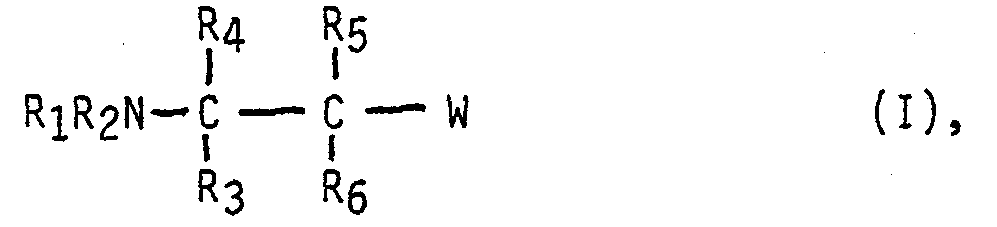
- Un premier objet de la présente invention est une famille de nouveaux ligands phosphorés chiraux, comprenant au moins un radical amine et au moins un radical dihydrocarbylphosphinoxy de formule W = OP(R)2 dans laquelle R est un radical hydrocarboné choisi parmi les radicaux alkyles, aryles et cycloalkyles, caractérisés en ce qu'ils sont choisis parmi :
- - ceux de formule
- - ceux de formule

- - ceux de formule

- - ceux de formule

- - R1 et R2 sont choisis parmi l'atome hydrogène et les radicaux hydrocarbonés,
- - R3 et R4, nécessairement différents l'un de l'autre, sont choisis parmi l'atome d'hydrogène et les radicaux hydrocarbonés éventuellement porteurs d'au moins une fonction choisie parmi les fonctions alcool, thiol, thiother, amine, imine, acide, ester, amide et ether, et
- - R5 et R6 sont choisis parmi l'atome d'hydrogène et les radicaux hydrocarbonés éventuellement fonctionnalisés.
- La famille des ligands selon l'invention se décompose donc en trois sous-familles selon le nombre de radicaux dihydrocarbylphosphine présents et selon leur place dans la molécule :
- 1) la sous-famille des chélates essentiellement monodentés de formule (I) que nous désignerons par la suite par le terme "aminophosphinites".
- 2) la sous-famille des chélates essentiellement bidentés de formule (II) que nous désignerons par la suite par le terme "aminodiphosphinites".
- 3) la sous-famille des chélates essentiellement tridentés comprend d'une part les "aminophosphinediphosphinites" de formule (III) et d'autre part les "diaminophosphine-phosphinites" de formule (IV).
- Des exemples de radical R sont notamment les radicaux méthyle, éthyle, isopropyle, tertiobutyle, cyclohexyle et phényle. L'exemple le plus fréquent de radical hydrocarboné R1 ou R2 est le radical méthyle.
- Des exemples de radicaux R3 ou R4 sont notamment les radicaux méthyle, isopropyle, isobutyle, isoamyle, n-hydroxyéthyle, iso-hydroxyéthyle, n-aminobutyle, méthylène-4 imidazolyle, N-n-propylguanidyle, éthanoyle, acétamidoyle, n-propionamidoyle, benzyle, p-hydroxybenzyle, méthylène-3 indolyle, méthanethioyle, etc.
- Un second objet de la présente invention est un procédé de fabrication des nouveaux ligands phosphorés chiraux décrits ci-dessus. Le procédé selon l'invention consiste à faire réagir dans un solvant hydrocarboné, à une température comprise entre -50°C et 80°C et sous atmosphère de gaz inerte un aminoalcool optiquement actif de formule générale

- Par solvant hydrocarboné au sens de la présente invention on entend par exemple le benzène, le toluène, etc.
- Pour la synthèse des ligands de formules (I) et (II), on préfère utiliser un composé dans lequel Y est un radical amine. Pour la synthèse des ligands de formules (III) et (IV), on préfère utiliser un composé dans lequel Y est un atome d'halogène. Pour faciliter l'élimination de l'hydrure d'halogène formé par la réaction, on peut alors avantageusement conduire celle-ci en présence d'un excès d'amine tertiaire, telle que par exemple la triéthylamine, qui précipitera sous forme d'halogènohydrate. Le ligand phosphoré chiral est isolé successivement par filtration du précipité suivie d'évaporation du solvant hydrocarboné sous vide. Il se présente généralement sous forme d'une huile visqueuse. Les aminoalcools chiraux de formule (V) sont le plus souvent des produits soit commerciaux soit facilement accessibles par réduction d'aminoacides naturels (ou de leurs esters méthyliques formylés). Lorsque le radical R3 ou R4 de l'aminoalcool de formule (V) est porteur d'une fonction, celle-ci peut être introduite par une réaction de fonctionnalisation bien connue, par exempt la fonction ester sera introduite par estérification de la fonction acic correspondante (cas des carbalcoxyhydroxyprolines). A titre d'exemples peut citer le prolinol, l'hydroxyproline, les éphédrines et les aminoacool; N-méthylés dérivés des aminoacides naturels suivants : glycine, phénylglycine, phénylalanine, leucine, sérine, thréonine, histidine, lysine, arginine, isoleucine, valine, alanine, tyrosine, tryptophane, méthionine, cystéine, glutamine, asparagine, acide aspartique, acide glutamique, cystine, etc.
- La présente invention concerne aussi des applications particulières de ligands de la famille des "aminophosphine-phosphinites" de formule :

- Les ligands phosphorés chiraux selon l'invention peuvent être identifiés notamment à l'aide de leurs spectres de résonance magnétique nucléaire du proton, du carbone 13 et du phosphore 31, ainsi que de leur pouvoir rotatoire spécifique. Le tableau I ci-après résume les données d'identification de certains aminophosphine-phosphinites, dans lesquels R est le radical phényle, selon l'aminoalcool ou l'aminoacide dont ils sont issus.
- Le tableau II ci-après résume les données d'identification de certains aminophosphinites, dans lesquels R est le radical phényle, selon l'aminoalcool ou l'aminoacide dont ils sont issus.
- Le tableau III ci-après résume les données d'identification de certains aminophosphinediphosphinites et, en ce qui concerne le ligand issu du tryptophane, d'un diaminophosphine-phosphinite dans lesquels R est le radical phényle. 25
- Dans ces tableaux [α] D désigne le pouvoir rotatoire spécifique à 25°C exprimé en degrés pour la raie 0 et δ désigne le déplacement chimique exprimé en ppm par rapport à l'acide phosphorique (cas du phosphore 31) ou au tétraméthylsilane (cas du proton et du carbone 13). Les notations (m), (dd), (d) et (s) désignent respectivement un multiplet, un double doublet, un doublet et un singulet.
- Un troisième objet de la présente invention concerne l'application des nouveaux ligands phosphorés chiraux décrits précédemment à des réactions de synthèse énantiosélective de composés organiques. Cette application consiste à faire réagir au moins un composé organique ne possédant pas de centre d'asymétrie avec (A) d'une part au moins un complexe de métal de


- D'autre part ladite réaction de synthèse énantiosélective peut être effectuée, le cas échéant, en présence de (D) au moins un activateur choisi parmi les dérivés aluminiques de formule AlRnX3-n, dans laquelle 0≤ n ≤3, X est un atome d'halogène et R est un radical alkyle ayant de 1 à 12 atomes de carbone. Les constituants (A) et (B) sont généralement dans un rapport molaire (B)/(A) compris entre 1 et 10. Les constituants (A) et (D) sont généralement dans un rapport molaire (D)/(A) compris entre 0,1 et 10. Le constituant (A) et l'agent (C) sont généralement dans un rapport molaire (C)/(A) inférieur ou égal à q, lorsque (C) est un acide ou sel.
- Parmi les métaux M couramment utilisables on peut citer le fer, le nickel, le cobalt, le rhodium, le ruthénium, l'iridium, le palladium, le platine. Parmi les atomes ou molécules Z couramment utilisables on peut citer le monoxyde de carbone, les halogènes, l'éthylène, le norbornadiène, le cyclooctadiène, l'acétylacétone. Enfin le degré de coordination q peut être couramment compris entre 2 et 6 inclusivement selon le métal et/ou les ligands utilisés.
- Tout composé organique ne possédant pas de centre d'asymétrie peut être soumis à une réaction de synthèse énantiosélective selon l'invention. Il en va ainsi de certaines oléfines, de certaines cétones, de certains diènes, éventuellement fonctionnalisés. Des exemples de réactions selon l'invention sont les réactions bien connues suivantes :
- - hydrogénation et hydroformylation de substrats organiques insaturés tels que les oléfines éventuellement fonctionnalisées en (X de la double liaison, en particulier les déhydroaminoacides ou leurs dérivés N-acétylés tels que les acides acétamidocarboxyliques ; les réactions d'hydrogénation sont généralement effectuées à une température comprise entre 0 et 200°C et sous une pression comprise entre 1 et 200 bars ; les réactions d'hydroformylation sont généralement effectuées à une température comprise entre 15 et 300°C et sous une pression comprise entre 1 et 350 bars ; ces réactions peuvent être appliquées industriellement notamment à la synthèse d'édulcorants non nutritifs comme l'aspartame et le (R)6-méthyl- tryptophane.
- - réduction de cétones et d'imines prochirales par des organosilanes, en particulier des monohydrosilanes et, de préférence, des dihydrosilanes (réaction d'hydrosilylation).
- - cyclodimérisation et dimérisation des diènes conjugués, et codimérisation de l'éthylène et d'un diène conjugué ; ces réactions sont généralement effectuées à une température comprise entre -30 et +100°C et sous une pression inférieure à 100 bars.
- Un quatrième objet de la présente invention concerne, à titre de produits nouveaux utilisés comme intermédiaires dans l'application décrite précédemment, des complexes de métaux de transition choisis parmi d'une part ceux de formule MZq-rLr, et d'autre part ceux de formules (MZq-rLr)+A-, formules dans lesquelles M,. Z, A et q ont les mêmes significations que précédemment, L désigne le ligand phosphoré chiral et r est égal à 1 ou 2. Ces complexes se forment, dans le cadre de ladite application, par réaction entre le complexe de formule MZq d'une part et le ligand L d'autre part, le cas échéant en présence d'au moins un acide ou sel possédant un anion A-.
- Ces complexes de métaux de transition peuvent être identifiés notamment à l'aide de leur spectre de résonance magnétique nucléaire du phosphore 31. Le tableau IV ci-après résume les données d'identification de certains complexes de formule (Rh (Norbornadiène) (L]+ CL04- selon la nature du ligand L.

- Les exemples suivants sont donnés à titre illustratif et non limitatif de la présente invention.
- On fait réagir dans le benzène sec, à une température de +5°C et sous atmosphère d'azote, 2 moles de chlorodiphénylphosphine avec 1 mole d'éphédrine (méthylamino-2 phényl-1 propanol-1) érythro (+) (rendue anhydre par distillation azéotropique de l'eau par le benzène) en présence d'un excès de triéthylamine. On filtre le précipité de chlorhydrate de triéthylammonium qui se forme, puis on évapore le benzène sous vide. Une recristallisation effectuée dans le benzène permet d'éliminer un sous-produit identifié comme la méthylamino bis (diphénylphosphine) : l'analyse par résonance magnétique nucléaire du proton révèle en effet des déplacement chimiques δ à 7,6 et 3,5 ppm par rapport au tétraméthylsilane. On obtient alors 0,8 mole du ligand n° 1 (voir tableau I), de pureté chimique évaluée à 95 %.
- On répète la méthode de synthèse décrite à l'exemple 1 en remplaçant l'éphédrine érythro (+) respectivement par :
- - l'éphédrine thréo (-) en vue d'obtenir le ligand n° 2.
- - le S (+) prolinol en vue d'obtenir le ligand n° 5.
- - le R (-) méthylphénylglycinol en vue d'obtenir le ligand n° 6
- - le N-méthyl amino-2 propanol en vue d'otenir le ligand n° 7.
- - l'alcool N-méthylé dérivé de l'acide α-aminoisovalerique (valine) en vue d'obtenir le ligand n° 8.
- - l'alcool N-méthylé dérivé de l'acide amino-2 méthyl-4 n-valérique (leucine) en vue d'obtenir le ligand n° 9.
- - le N-méthyl amino-2 phényl-3 propanol en vue d'obtenir le ligand n° 10.
- - le carbéthoxyhydroxyprolinol en vue d'obtenir le ligand n° 3.
- On obtient ces ligands avec un rendement identique ou similaire à celui de l'exemple 1.
- Pour mémoire, on rappelle que le S (+) prolinol peut être aisément obtenu par réduction de l'acide pyrrolidine-2 carboxylique (proline) au moyen de l'hydrure double de lithium et aluminium LiAlH4 en suspension dans le tétrahydrofuranne. De même les autres aminoalcools sont préparés à partir des aminoacides naturels correspondants par monoformylation de la fonction amine, estérification de la fonction acide, puis réduction par LiAIHç.
- On répète la méthode de synthèse décrite à l'exemple 1 en remplaçant d'une part l'éphédrine érythro (+) par le S (+) proiinol et d'autre part la chlorodiphénylphosphine par la chlorodicyclohexylphosphine. On obtient alors, avec le même rendement, le ligand n° 4 (voir tableau I)
- On fait réagir dans le benzène sec sous atmosphère d'azote 1 mole de diméthylaminophénylphosphine avec 1 mole d'éphédrine érythro (+) (rendue anhydre par distillation azéotropique de l'eau par le benzène). Après dégagement de la diméthylamine, on évapore le benzène sous vide et l'on récupère 0,8 mole du ligand n° 11 (voir tableau II) de pureté chimique évaluée à 90 %.
- On répète la méthode de synthèse décrite à l'exemple 4 en remplaçant l'éphédrine érythro (+) successivement par :
- - l'alcool N-méthylé dérivé de l'acide O( -aminoisovalérique (valine) pour obtenir le ligand n° 12 (voir tableau II).
- - l'alcool N-diméthylé dérivé de la valine pour obtenir le (S)(oxydiphényl- phosphino)-1-(N-diméthylamino)-2-isopropyl-2 éthane identifié comme suit :

- On obtient ces ligands avec un rendement identique ou similaire à celui de l'exemple 4.
- On fait réagir dans le benzène sec sous atmosphère d'azote 3 moles de chlorodiphénylphosphine avec 1 mole de l'alcool N-méthylé dérivé de l'acide glutamique en présence d'un excès de triéthylamine. On filtre le précipité de chlorhydrate de triéthylammonium qui se forme, puis on évapore le benzène sous vide. On obtient alors 0,8 mole du ligand n° 15 (voir tableau III) de pureté chimique évaluée à 85 %.
- On répète la méthode de synthèse décrite à l'exemple 6 en utilisant comme aminoalcools les alcools N-méthylés dérivés de :
- - l'acide aminosuccinique (asparagine) pour obtenir le ligand n° 16.
- - l'acide amino-2 hydroxy-3 butyrique (thréonine) pour obtenir le ligand n° 17.
- - l'acide amino-2 (3-indolyl)-3 propionique (tryptophane) pour obtenir le ligand n° 18.
- On obtient ces ligands avec un rendement identique ou similaire à celui de l'exemple 6.
- On fait réagir, dans le benzène sec et à une température de 20°C, 1 mole du ligand n° 1 (ci-après désigné L) et 0,5 mole de dichlorotétra- carbonyldirhodium. On évapore le solvant puis, après lavage par un ether de pétrole et séchage sous vide, on récupère 0,8 mole d'un complexe de formule RhCl(CO)L. Ce complexe est identifié par son spectre de résonance magnétique nucléaire du phosphore 31, qui révèle des déplacement chimiques à 90,1 ppm(dd), 99,7 ppm(dd), 111,6 ppm(dd) et 128,7 ppm(dd).
- A 0,1 millimole du complexe de l'exemple 8 sont ajoutés successivement 10 cm3 de benzène anhydre et 40 cm3 de carbonate de propyléne fraichement distillé. La solution est réalisée sous azote et est introduite sous gaz inerte dans un autoclave électrochimique de 320 cm3 équipe de trois électrodes : une électrode de platine (cathode), une électrode de fer (anode) et une électrode de référence permettant une jonction liquide entre l'intérieur de l'autoclave et la pression atmosphérique extérieure. Cette dernière électrode est constituée par un tube percé en son centre dans lequel on introduit une mèche d'amiante. Celle ci s'imbibe du liquide solvant et un système de presse-étoupe permet de comprimer la mèche et de contrecarrer la pression intérieure, tout en permettant le passage d'un léger débit de liquide pour effectuer la jonction avec une électrode au calomel saturé située à l'extérieur de l'autoclave. Ce montage à trois électrodes est nécessaire pour effectuer une réduction à potentiel cathodique imposé, à l'aide d'un potentiostat. On ajoute ensuite 4,5 g de styrène fraichement distillé. Le réacteur est alors chargé d'un mélange CO/H2 (1/1) à la température de 25°C sous 10 atmosphères. On électrolyse la solution au potentiel cathodique de réduction de -0,9 volts, jusqu'à ce que l'intensité du courant devienne inférieure à 5 % de sa valeur maximale, ce qui correspond à environ 1 Faraday par atome gramme de rhodium (temps de réduction = environ 4 heures). La chromatographie en phase gazeuse permet de déterminer un taux de conversion de 45 % molaire du styrène en un mélange constitué de 93 % de phényl-2 propanal et de 7 % de phényl-3 propanal. Le benzène est éliminé du mélange réactionnel par évaporation sous vide, puis on effectue une rectification sous vide des produits. On obtient ainsi une solution d'aldéhydes dans le carbonate de propylène, débarassée de la présence du complexe métallique, sur laquelle on effectue directement la mesure du pouvoir rotatoire : le rendement optique est de 25 % en aldéhyde de configuration S.
- Dans un tube en verre on introduit successivement 687 mg (2,5 millimole) de bis(cyclooctadiène-1,5) nickel puis 947,5 mg (2,5 millimole) du ligand n° 9.
- On solubilise ces produits dans 2 g d'heptane et environ 15 cm3 de toluène, de manière à obtenir une concentration en catalyseur de 0,1 mole par litre après addition de 6,75 g (0,13 mole) de butadiène-1,3 par bullage dans la solution maintenue à 0°C. Le mélange réactionnel est ensuite maintenu sous agitation à la température de 40°C pendant 24 heures. La pression réactionnelle atteint environ 5 bars. En fin de réaction le catalysat est filtré sur silice pour éliminer le catalyseur et la solution limpide obtenue est distillée sur colonne pour séparer le vinyl-4 cyclohexène de son isomère cyclooctadiène-1,5, libéré à partir du catalyseur initial et formé au cours de la réaction. On obtient en effet, avec un rendement chimique de 85 %, un mélange constitué essentiellement de 40 % de cyclooctadiène-1,5 et 52 % de vinyl-4 cyclohexène. Le vinyl-4 cyclohexène est obtenu avec une pureté optique de 25 %.
- Dans un tube de Schlenk et sous azote on dissout 0,1 millimole de complexe de Cramer Rh2C12(C2H4)4 dans 8 cm3 d'éthanol à 95 %, on ajoute à l'aide d'un tube de transfert une solution de 0,2 millimole du ligand n° 3 dans 12 cm3 d'éthanol à 95 % et on agite pendant 15 minutes sous azote à 20°C. Le complexe ainsi obtenu, de formule RhLC1, est transféré sous hydrogène dans un réacteur préalablement purgé, contenant 0,01 mole d'acide acétamidoacrylique dissous dans 40 cm3 d'éthanol à 95 %. On introduit de l'hydrogène dans le réacteur et la réaction, effectuée à 20°C sous pression atmosphérique, est suivie par lecture du- volume d'hydrogène absorbé. Après 1 heure de réaction, l'éthanol est évaporé, le résidu est repris à l'eau chaude puis on filtre pour séparer le complexe insoluble. L'eau est évaporée et on récupère alors, avec un rendement chimique de 98 % , la N-acétylalanine. Son pouvoir rotatoire spécifique, mesuré sur une solution aqueuse de concentration 2 g/100 cm3, [α]25 n= + 48,9°, correspond à un rendement optique de 73,5 %.
- On répète les opérations décrites à l'exemple 11 en remplaçant le ligand n° 3 par le ligand n° 4. On récupère avec le même rendement chimique la N-acétylalanine dont le pouvoir rotatoire spécifique [α]25 = + 48,5° correspond à un rendement optique de 73 %. D
- Dans un tube de Schlenk et sous azote, on dissout 0,2 millimole de complexe de Cramer Rh2Cl2(C2H4)4 dans 10 cm3 de benzène, on ajoute à l'aide d'un tube de transfert une solution de 0,4 millimole du ligand de n° 3 dans 10 cm3 de benzène et on agite pendant 15 minutes sous azote à 20°C. Le complexe ainsi obtenu, de forme RhLCI, est transféré sous azote dans un réacteur préalablement purgé, contenant 2,34 cm3 d'acétophénone (0,02 mole), 4,1 cm3 d'0(-naphtyl phénylsilane (0,02 mole) et 30 cm3 de benzène. La réaction est poursuivie, à 20°C et sous pression atmosphérique, pendant 4 heures. Le benzène est ensuite évaporé sous vide. Le résidu est dissous dans 60 ml d'acétone contenant 12 ml d'une solution aqueuse d'acide chlorhydrique 10 % et on agite pendant 2 heures. On extrait la phase organique à l'éther, on neutralise par une solution de carbonate de sodium 5 %, puis par de l'eau distillée. La phase éthérée est ensuite séchée sur MgS04, filtrée et évaporée sous vide. Après distillation on récupère, avec un rendement chimique de 96 %, le phényl-1 éthanol. Son pouvoir rotatoire spécifique [α]25 D = - 22,4° correspond à un rendement optique de 42,6 %.
- On répète les opérations décrites à l'exemple 13 en remplaçant le ligand n° 3 par le ligand n° 8 et l' α-naphtyl phénylsilane par le diphénylsilane. On obtient également le phényl-1 éthanol avec un rendement chimique de 96 % et un rendement optique de 26 %.
- Dans un autoclave de 300 cm3 préalablement purgé à l'azote on introduit successivement 110 mg (0,4 millimole) de bis(cyclooctadiène-1,5 nickel, 33 cm3 de toluène anhydre, 2 g d'heptane, 220 mg (0,4 millimole) du ligand n° 17, 0,2 g (1,6 millimole) de chlorure de diéthylaluminium, puis 4 g (0,05 mole) de cyclohexadiène-1,3. L'autoclave est alors fermé puis chargé en éthylène jusqu'à atteindre une quantité équimolaire à celle du diène. La réaction est alors poursuivie sous agitation, à -30°C et sous une pression de 6 bars, pendant 15 minutes. Après rectification on obtient, avec un rendement chimique de 80 %, du (S)vinyl-3 cyclohexène pur à 97 % et possédant un pouvoir rotatoire spécifique [α]25 = 245°, soit un rendement optique de 92,3 %. D
-
- a) Première méthode A 0,85 millimole de complexe Rh(Norbornadiène)(Acétylacétonate) et à 1 millimole de ligand L dissous dans 3 cm3 de tétrahydrofuranne on ajoute, sous azote et à 20°C, une solution de 120 mg d'acide perchlorique 70 % dans 2 cm3 de tétahydro- furanne. Dès que la couleur de la solution devient orange, des cristaux apparaissent. Le phénomène s'amplifie par addition d'éther éthylique. On filtre sous azote, on lave au méthanol puis à l'éthanol et on sèche sous vide. On récupère ainsi le complexe ionique [(Rh(Norbornadiène)L] +C104 avec un rendement supérieur à 80 %.
- b) Deuxième méthode A 1 millimole de complexe Rh2(Norbornadiène)2C12 dissous dans 50 cm3 de méthanol contenant 1 millimole de ligand L on ajoute, sous azote et à 20°C, 1,1 millimole de perchlorate d'argent. Après 15 minutes d'agitation, on filtre le précipité de chlorure d'argent. Le filtrat est évaporé, lavé au benzène sous azote, puis à l'éther éthylique puis séché sous vide. Les cristaux du complexe ionique [Rh(Norbornadiène)L] +ClO4 - sont ainsi récupérés avec un rendement supérieur à 80 %.
- Le spectre de résonance magnétique nucléaire du phosphore 31 pour différents complexes ainsi préparés permet leur identification selon la nature du ligand L (voir tableau IV).
- 0,1 millimole d'un complexe ionique préparé conformément à l'exemple 24, dissous dans 10 cm3 d'éthanol à 95 %, est transféré sous hydrogène dans un réacteur préalablement purgé contenant 0,01 mole d'acide acétamidoacrylique dissous dans 40 cm3 d'éthanol à 95 %. On introduit de l'hydrogène dans le réacteur et la réaction, effectuée à 20°C sous pression atmosphérique, est suivie par lecture du volume d'hydrogène absorbé. Après 1 heure de réaction, l'éthanol est évaporé, le résidu est repris à l'eau chaude puis on filtre pour séparer le complexe insoluble. L'eau est évaporée et on récupère alors, avec un rendement chimique de 98 %, la N-acétylalanine. Son pouvoir rotatoire spécifique [α]25 D , mesuré sur une solution aqueuse de concentration 2 g/100 cm3, correspond au rendement optique R.0 indiqué dans le tableau V ci-après en fonction de la nature du ligand L.

- On répète les opérations décrites aux exemples 17 à 19 en utilisant de l'hydrogène de haute pureté et en remplaçant l'éthanol à 95 % par de l'éthanol pur, L étant le ligand n° 3. On récupère alors, avec le même rendement chimique, la N-acétylalamine dont le pouvoir rotatoire spécifique[α]25 D = + 56,6 % correspond à un rendement optique de 85 %.
- On répète les opérations décrites à l'exemple 19 en remplaçant l'acide acétamidoacrylique par l'acide acétamidocinnamique. On récupère alors la (S)N-acétylphénylalamine avec un rendement optique de 82 %.
Claims (26)


Applications Claiming Priority (3)
| Application Number | Priority Date | Filing Date | Title |
|---|---|---|---|
| FR8312953 | 1983-08-05 | ||
| FR8312953A FR2550201B1 (fr) | 1983-08-05 | 1983-08-05 | Ligands phosphores chiraux, leur procede de fabrication a partir d'aminoacides naturels et leur application a la catalyse de reactions de synthese enantioselective |
| CA000460551A CA1244451A (fr) | 1983-08-05 | 1984-08-08 | Ligands phosphores chiraux, leur procede de fabrication a partir d'aminoacides naturels et leur application a la catalyse de reactions de synthese enantioselective |
Publications (2)
| Publication Number | Publication Date |
|---|---|
| EP0136210A1 true EP0136210A1 (fr) | 1985-04-03 |
| EP0136210B1 EP0136210B1 (fr) | 1989-08-16 |
Family
ID=39226991
Family Applications (1)
| Application Number | Title | Priority Date | Filing Date |
|---|---|---|---|
| EP84401621A Expired EP0136210B1 (fr) | 1983-08-05 | 1984-08-03 | Ligands phosphorés chiraux, leur procédé de fabrication et leur application à catalyse de réactions de synthèse énantiosélective |
Country Status (7)
| Country | Link |
|---|---|
| US (3) | US4877908A (fr) |
| EP (1) | EP0136210B1 (fr) |
| JP (3) | JPS6089492A (fr) |
| AT (1) | ATE45581T1 (fr) |
| CA (1) | CA1244451A (fr) |
| DE (1) | DE3479424D1 (fr) |
| FR (1) | FR2550201B1 (fr) |
Cited By (3)
| Publication number | Priority date | Publication date | Assignee | Title |
|---|---|---|---|---|
| FR2600330A1 (fr) * | 1986-06-23 | 1987-12-24 | Charbonnages Ste Chimique | Procede d'hydrogenation asymetrique de composes carbonyles et composes obtenus |
| FR2603286A1 (fr) * | 1986-08-27 | 1988-03-04 | Elf Aquitaine | Procede de preparation de derives de l'acide phosphineux et produit intermediaire utilise a cet effet |
| WO2003018192A3 (fr) * | 2001-08-24 | 2003-11-13 | Basf Ag | Procede de preparation de 2-propylheptanol |
Families Citing this family (18)
| Publication number | Priority date | Publication date | Assignee | Title |
|---|---|---|---|---|
| FR2550201B1 (fr) * | 1983-08-05 | 1986-02-28 | Charbonnages Ste Chimique | Ligands phosphores chiraux, leur procede de fabrication a partir d'aminoacides naturels et leur application a la catalyse de reactions de synthese enantioselective |
| FR2576593A1 (fr) * | 1985-01-30 | 1986-08-01 | Charbonnages Ste Chimique | Procede de fabrication de la l-phenylalanine |
| FR2578754B1 (fr) * | 1985-03-13 | 1987-05-15 | Charbonnages Ste Chimique | Systeme catalytique electrochimique, son procede de preparation et son application a la fabrication d'aldehydes |
| DE3728592A1 (de) * | 1987-02-03 | 1989-03-09 | Bayerische Motoren Werke Ag | Radaufhaengung |
| FR2629367B1 (fr) * | 1988-03-30 | 1990-11-23 | Norsolor Sa | Systeme catalytique, son procede de preparation et son application a la fabrication d'aldehydes |
| FR2658515A1 (fr) * | 1990-02-19 | 1991-08-23 | Norsolor Sa | Nouveaux aminophosphine-phosphinites, leur procede de fabrication et leur application a des reactions enantioselectives. |
| US5360938A (en) * | 1991-08-21 | 1994-11-01 | Union Carbide Chemicals & Plastics Technology Corporation | Asymmetric syntheses |
| US5475146A (en) * | 1993-09-02 | 1995-12-12 | E. I. Du Pont De Nemours And Company | Enantioselective hydroformylation |
| US5481006A (en) * | 1994-01-11 | 1996-01-02 | E. I. Du Pont De Nemours And Company | Selective asymmetric hydrogenation of dehydroamino acid derivatives using rhodium and iridium diphosphinite carbohydrate catalyst compositions |
| SK281759B6 (sk) * | 1994-02-02 | 2001-07-10 | Novartis Ag | Spôsob hydrogenácie imínov |
| JPH0973965A (ja) * | 1995-09-04 | 1997-03-18 | Sumitomo Electric Ind Ltd | ケーブルリール |
| US5654455A (en) * | 1995-12-21 | 1997-08-05 | Ciba-Geigy Corporation | Tris-phosphite ligands and their use in transitioin metal catalyzed processes |
| US6307087B1 (en) * | 1998-07-10 | 2001-10-23 | Massachusetts Institute Of Technology | Ligands for metals and improved metal-catalyzed processes based thereon |
| US6395916B1 (en) | 1998-07-10 | 2002-05-28 | Massachusetts Institute Of Technology | Ligands for metals and improved metal-catalyzed processes based thereon |
| US6759551B1 (en) * | 2000-11-03 | 2004-07-06 | Bayer Cropscience S.A. | Chiral (s- or r-methylphenylglycine) amino acid crystal and method for preparing same |
| JP4913962B2 (ja) * | 2001-08-30 | 2012-04-11 | マナック株式会社 | フェニルエチニルフタル酸無水物誘導体の製造方法 |
| US20230042680A1 (en) * | 2021-08-06 | 2023-02-09 | Heraeus Deutschland GmbH & Co. KG | Process for the manufacture of halogenobis(alkene)rhodium(i) dimers or halogenobis(alkene)iridium(i) dimers |
| CN114487169B (zh) * | 2022-01-05 | 2024-01-16 | 宁波大学 | 一种手性氨基酸的检测方法 |
Family Cites Families (2)
| Publication number | Priority date | Publication date | Assignee | Title |
|---|---|---|---|---|
| US4331818A (en) * | 1980-03-19 | 1982-05-25 | The Procter & Gamble Company | Chiral phospine ligand |
| FR2550201B1 (fr) * | 1983-08-05 | 1986-02-28 | Charbonnages Ste Chimique | Ligands phosphores chiraux, leur procede de fabrication a partir d'aminoacides naturels et leur application a la catalyse de reactions de synthese enantioselective |
-
1983
- 1983-08-05 FR FR8312953A patent/FR2550201B1/fr not_active Expired
-
1984
- 1984-08-03 AT AT84401621T patent/ATE45581T1/de active
- 1984-08-03 DE DE8484401621T patent/DE3479424D1/de not_active Expired
- 1984-08-03 EP EP84401621A patent/EP0136210B1/fr not_active Expired
- 1984-08-06 JP JP59164737A patent/JPS6089492A/ja active Granted
- 1984-08-08 CA CA000460551A patent/CA1244451A/fr not_active Expired
-
1987
- 1987-10-13 US US07/107,919 patent/US4877908A/en not_active Expired - Fee Related
-
1989
- 1989-10-11 US US07/398,539 patent/US5099077A/en not_active Expired - Fee Related
-
1991
- 1991-11-28 JP JP3339712A patent/JPH0592983A/ja not_active Withdrawn
- 1991-12-23 US US07/811,673 patent/US5210202A/en not_active Expired - Fee Related
-
1992
- 1992-09-01 JP JP4257477A patent/JPH0692981A/ja active Pending
Non-Patent Citations (3)
| Title |
|---|
| CHEMICAL ABSTRACTS, vol. 100, no. 23, 4 juin 1984, page 512, no. 191019d, Columbus, Ohio, USA; M. PETIT et al.: "Preparation of chiral aminophosphine-phosphinites. Applications to asymmetric homogeneous catalysis" & NOUV. J. CHIM. 1983, 7(10), 593-596 * |
| CHEMISTRY LETTERS, no. 12, décembre 1981, pages 1691-1694, The Chemical Society of Japan, Tokyo, JP; K. OSAKADA et al.: "New chiral aminophosphines prepared from L-ornithine and catalytic asymmetric hydrogenation using their rhodium(I) complexes" * |
| TETRAHEDRON LETTERS, vol. 23, no. 29, 1982, pages 2995-2996, Pergamon Press Ltd., GB; E. CESAROTTI et al.: "Asymmetric hydrogenation by chiral aminophosphine-phosphinite rhodium complexes" * |
Cited By (7)
| Publication number | Priority date | Publication date | Assignee | Title |
|---|---|---|---|---|
| FR2600330A1 (fr) * | 1986-06-23 | 1987-12-24 | Charbonnages Ste Chimique | Procede d'hydrogenation asymetrique de composes carbonyles et composes obtenus |
| WO1987007889A1 (fr) * | 1986-06-23 | 1987-12-30 | Societe Chimique Des Charbonnages S.A. | Procede d'hydrogenation asymetrique de composes carbonyles et composes obtenus |
| EP0253700A1 (fr) * | 1986-06-23 | 1988-01-20 | Elf Atochem S.A. | Procédé d'hydrogénation asymétrique de composés carbonylés et composés obtenus |
| US5128488A (en) * | 1986-06-23 | 1992-07-07 | Societe Chimique Des Charbonnages S.A. | Process for the asymmetric hydrogenation of carbonyl compounds obtained |
| FR2603286A1 (fr) * | 1986-08-27 | 1988-03-04 | Elf Aquitaine | Procede de preparation de derives de l'acide phosphineux et produit intermediaire utilise a cet effet |
| EP0262009A1 (fr) * | 1986-08-27 | 1988-03-30 | Societe Nationale Elf Aquitaine | Procédé de préparation de dérives de l'acide phosphineux et produit intermédiaire utilisé à cet effet |
| WO2003018192A3 (fr) * | 2001-08-24 | 2003-11-13 | Basf Ag | Procede de preparation de 2-propylheptanol |
Also Published As
| Publication number | Publication date |
|---|---|
| ATE45581T1 (de) | 1989-09-15 |
| JPH0592983A (ja) | 1993-04-16 |
| EP0136210B1 (fr) | 1989-08-16 |
| FR2550201B1 (fr) | 1986-02-28 |
| JPS6089492A (ja) | 1985-05-20 |
| US5210202A (en) | 1993-05-11 |
| US5099077A (en) | 1992-03-24 |
| FR2550201A1 (fr) | 1985-02-08 |
| CA1244451A (fr) | 1988-11-08 |
| JPH0692981A (ja) | 1994-04-05 |
| JPH054395B2 (fr) | 1993-01-19 |
| DE3479424D1 (en) | 1989-09-21 |
| US4877908A (en) | 1989-10-31 |
Similar Documents
| Publication | Publication Date | Title |
|---|---|---|
| EP0136210B1 (fr) | Ligands phosphorés chiraux, leur procédé de fabrication et leur application à catalyse de réactions de synthèse énantiosélective | |
| CA1117981A (fr) | Procede de preparation de citronellal optiquement actif | |
| EP0748326B1 (fr) | Diphosphines optiquement actives, leur preparation par dedoublement du melange racemique | |
| WO1994001390A1 (fr) | Procede d'hydrogenation enantioselectif du groupe carbonyl, utilisant des complexes de ruthenium avec biphosphine ligands | |
| EP1185488A1 (fr) | Sulfonylamides et carboxamides et leur application en catalyse asymetrique | |
| EP0912467B1 (fr) | Procede d'hydrogenation asymetrique d'un compose cetonique et derive | |
| EP0443923B1 (fr) | Nouveaux aminophosphine-phosphinites, leur procédé et leur application à des réactions énantiosélectives | |
| EP0564568A1 (fr) | Procede d'hydrogenation de composes organiques ethyleniquement insatures et catalyseurs au ruthenium pour sa realisation. | |
| EP0253700B1 (fr) | Procédé d'hydrogénation asymétrique de composés carbonylés et composés obtenus | |
| WO2001009077A1 (fr) | Derives chiraux n-substitues de la norephedrine, leur preparation et leur utilisation pour la synthese de composes fonctionnalises optiquement actifs par transfert d'hydrogene | |
| EP0210210B1 (fr) | Procede de fabrication de la l-phenylalanine | |
| EP0968220A1 (fr) | Diphosphines de 6,6'-bis-(1-phosphanorbornadiene) | |
| EP0927152B1 (fr) | Procede de preparation de benzylalcools alpha-substitues optiquement actifs | |
| FR2849036A1 (fr) | Diphosphines chirales, leur preparation et leurs utilisations comme ligands dans la synthese de complexes destines a la catalyse asymetrique | |
| FR2816947A1 (fr) | Complexes metalliques asymetriques a base d'un metal de transition utiles pour la reduction enantioselective de derives cetoniques par transfert d'hydrure | |
| EP1245551B1 (fr) | 1,2-bis(methyl(1,1,3,3-tetramethylbutyl)-phosphino)ethane, son procede de preparation, complexes de metaux de transition le contenant en tant que ligand et leurs utilisations | |
| FR2849037A1 (fr) | Diphosphines chirales, leur preparation et leurs utilisations coome ligands dans la synthese de complexes destines a la catalyse asymetrique | |
| FR2800371A1 (fr) | Nouveaux composes de type diamine mono- ou poly- fluore, sulfonyle ou carbonyle, leur procede de preparation et leur application en catalyse asymetrique | |
| FR2734823A1 (fr) | Nouveaux complexes metalliques optiquement actifs et leur utilisation en catalyse asymetrique | |
| FR2795070A1 (fr) | Nouveaux composes de type diamine mono- ou poly- fluore, sulfonyle ou carbonyle, leur procede de preparation et leur application en catalyse asymetrique |
Legal Events
| Date | Code | Title | Description |
|---|---|---|---|
| PUAI | Public reference made under article 153(3) epc to a published international application that has entered the european phase |
Free format text: ORIGINAL CODE: 0009012 |
|
| AK | Designated contracting states |
Designated state(s): AT BE CH DE FR GB IT LI LU NL SE |
|
| 17P | Request for examination filed |
Effective date: 19850417 |
|
| 17Q | First examination report despatched |
Effective date: 19860811 |
|
| RAP1 | Party data changed (applicant data changed or rights of an application transferred) |
Owner name: NORSOLOR S.A. |
|
| ITF | It: translation for a ep patent filed | ||
| GRAA | (expected) grant |
Free format text: ORIGINAL CODE: 0009210 |
|
| AK | Designated contracting states |
Kind code of ref document: B1 Designated state(s): AT BE CH DE FR GB IT LI LU NL SE |
|
| REF | Corresponds to: |
Ref document number: 45581 Country of ref document: AT Date of ref document: 19890915 Kind code of ref document: T |
|
| REF | Corresponds to: |
Ref document number: 3479424 Country of ref document: DE Date of ref document: 19890921 |
|
| GBT | Gb: translation of ep patent filed (gb section 77(6)(a)/1977) | ||
| PLBE | No opposition filed within time limit |
Free format text: ORIGINAL CODE: 0009261 |
|
| STAA | Information on the status of an ep patent application or granted ep patent |
Free format text: STATUS: NO OPPOSITION FILED WITHIN TIME LIMIT |
|
| 26N | No opposition filed | ||
| ITTA | It: last paid annual fee | ||
| GBPC | Gb: european patent ceased through non-payment of renewal fee |
Effective date: 19930803 |
|
| EPTA | Lu: last paid annual fee | ||
| EAL | Se: european patent in force in sweden |
Ref document number: 84401621.2 |
|
| REG | Reference to a national code |
Ref country code: GB Ref legal event code: 728C |
|
| REG | Reference to a national code |
Ref country code: GB Ref legal event code: 732E |
|
| REG | Reference to a national code |
Ref country code: GB Ref legal event code: 728Y |
|
| PGFP | Annual fee paid to national office [announced via postgrant information from national office to epo] |
Ref country code: GB Payment date: 19960726 Year of fee payment: 13 |
|
| PGFP | Annual fee paid to national office [announced via postgrant information from national office to epo] |
Ref country code: FR Payment date: 19960809 Year of fee payment: 13 |
|
| PGFP | Annual fee paid to national office [announced via postgrant information from national office to epo] |
Ref country code: DE Payment date: 19960812 Year of fee payment: 13 |
|
| PGFP | Annual fee paid to national office [announced via postgrant information from national office to epo] |
Ref country code: AT Payment date: 19960813 Year of fee payment: 13 |
|
| PGFP | Annual fee paid to national office [announced via postgrant information from national office to epo] |
Ref country code: SE Payment date: 19960815 Year of fee payment: 13 |
|
| PGFP | Annual fee paid to national office [announced via postgrant information from national office to epo] |
Ref country code: CH Payment date: 19960821 Year of fee payment: 13 |
|
| PGFP | Annual fee paid to national office [announced via postgrant information from national office to epo] |
Ref country code: NL Payment date: 19960828 Year of fee payment: 13 |
|
| PGFP | Annual fee paid to national office [announced via postgrant information from national office to epo] |
Ref country code: LU Payment date: 19960901 Year of fee payment: 13 |
|
| PGFP | Annual fee paid to national office [announced via postgrant information from national office to epo] |
Ref country code: BE Payment date: 19961003 Year of fee payment: 13 |
|
| PG25 | Lapsed in a contracting state [announced via postgrant information from national office to epo] |
Ref country code: LU Free format text: LAPSE BECAUSE OF NON-PAYMENT OF DUE FEES Effective date: 19970803 Ref country code: GB Free format text: LAPSE BECAUSE OF NON-PAYMENT OF DUE FEES Effective date: 19970803 Ref country code: AT Free format text: LAPSE BECAUSE OF NON-PAYMENT OF DUE FEES Effective date: 19970803 |
|
| PG25 | Lapsed in a contracting state [announced via postgrant information from national office to epo] |
Ref country code: SE Free format text: LAPSE BECAUSE OF NON-PAYMENT OF DUE FEES Effective date: 19970804 |
|
| PG25 | Lapsed in a contracting state [announced via postgrant information from national office to epo] |
Ref country code: LI Free format text: LAPSE BECAUSE OF NON-PAYMENT OF DUE FEES Effective date: 19970831 Ref country code: CH Free format text: LAPSE BECAUSE OF NON-PAYMENT OF DUE FEES Effective date: 19970831 Ref country code: BE Free format text: LAPSE BECAUSE OF NON-PAYMENT OF DUE FEES Effective date: 19970831 |
|
| BERE | Be: lapsed |
Owner name: S.A. NORSOLOR Effective date: 19970831 |
|
| PG25 | Lapsed in a contracting state [announced via postgrant information from national office to epo] |
Ref country code: NL Free format text: LAPSE BECAUSE OF NON-PAYMENT OF DUE FEES Effective date: 19980301 |
|
| GBPC | Gb: european patent ceased through non-payment of renewal fee |
Effective date: 19970803 |
|
| REG | Reference to a national code |
Ref country code: CH Ref legal event code: PL |
|
| PG25 | Lapsed in a contracting state [announced via postgrant information from national office to epo] |
Ref country code: FR Free format text: LAPSE BECAUSE OF NON-PAYMENT OF DUE FEES Effective date: 19980430 |
|
| PG25 | Lapsed in a contracting state [announced via postgrant information from national office to epo] |
Ref country code: DE Free format text: LAPSE BECAUSE OF NON-PAYMENT OF DUE FEES Effective date: 19980501 |
|
| EUG | Se: european patent has lapsed |
Ref document number: 84401621.2 |
|
| NLV4 | Nl: lapsed or anulled due to non-payment of the annual fee |
Effective date: 19980301 |
|
| REG | Reference to a national code |
Ref country code: FR Ref legal event code: ST |