EP0140540B1 - Photochromische Verbindungen und ihre Verwendung in photoreaktiven Linsen - Google Patents
Photochromische Verbindungen und ihre Verwendung in photoreaktiven Linsen Download PDFInfo
- Publication number
- EP0140540B1 EP0140540B1 EP84306030A EP84306030A EP0140540B1 EP 0140540 B1 EP0140540 B1 EP 0140540B1 EP 84306030 A EP84306030 A EP 84306030A EP 84306030 A EP84306030 A EP 84306030A EP 0140540 B1 EP0140540 B1 EP 0140540B1
- Authority
- EP
- European Patent Office
- Prior art keywords
- compound
- group
- heliochromic
- lens
- aryl
- Prior art date
- Legal status (The legal status is an assumption and is not a legal conclusion. Google has not performed a legal analysis and makes no representation as to the accuracy of the status listed.)
- Expired - Lifetime
Links
- 150000001875 compounds Chemical class 0.000 title claims abstract description 89
- DCBMHXCACVDWJZ-UHFFFAOYSA-N adamantylidene Chemical group C1C(C2)CC3[C]C1CC2C3 DCBMHXCACVDWJZ-UHFFFAOYSA-N 0.000 claims abstract description 17
- 125000003118 aryl group Chemical group 0.000 claims abstract description 15
- 125000000623 heterocyclic group Chemical group 0.000 claims abstract description 13
- 229910052739 hydrogen Inorganic materials 0.000 claims abstract description 13
- 239000001257 hydrogen Substances 0.000 claims abstract description 13
- 125000000217 alkyl group Chemical group 0.000 claims abstract description 12
- 125000003710 aryl alkyl group Chemical group 0.000 claims abstract description 8
- QVGXLLKOCUKJST-UHFFFAOYSA-N atomic oxygen Chemical group [O] QVGXLLKOCUKJST-UHFFFAOYSA-N 0.000 claims abstract description 8
- 229910052760 oxygen Inorganic materials 0.000 claims abstract description 8
- 239000001301 oxygen Substances 0.000 claims abstract description 8
- 238000006243 chemical reaction Methods 0.000 claims description 20
- 238000010438 heat treatment Methods 0.000 claims description 19
- 239000000203 mixture Substances 0.000 claims description 18
- 239000002904 solvent Substances 0.000 claims description 14
- -1 3,5-dimethoxyphenyl group Chemical group 0.000 claims description 12
- 238000000034 method Methods 0.000 claims description 10
- 125000001997 phenyl group Chemical group [H]C1=C([H])C([H])=C(*)C([H])=C1[H] 0.000 claims description 8
- 239000000463 material Substances 0.000 claims description 7
- 125000001544 thienyl group Chemical group 0.000 claims description 7
- 230000008707 rearrangement Effects 0.000 claims description 6
- NINIDFKCEFEMDL-UHFFFAOYSA-N Sulfur Chemical compound [S] NINIDFKCEFEMDL-UHFFFAOYSA-N 0.000 claims description 5
- 125000002541 furyl group Chemical group 0.000 claims description 5
- 230000000638 stimulation Effects 0.000 claims description 5
- 125000002941 2-furyl group Chemical group O1C([*])=C([H])C([H])=C1[H] 0.000 claims description 4
- 125000003682 3-furyl group Chemical group O1C([H])=C([*])C([H])=C1[H] 0.000 claims description 4
- 239000005864 Sulphur Substances 0.000 claims description 4
- 125000000175 2-thienyl group Chemical group S1C([*])=C([H])C([H])=C1[H] 0.000 claims description 3
- 125000001541 3-thienyl group Chemical group S1C([H])=C([*])C([H])=C1[H] 0.000 claims description 3
- 230000005855 radiation Effects 0.000 claims description 3
- CERQOIWHTDAKMF-UHFFFAOYSA-M Methacrylate Chemical compound CC(=C)C([O-])=O CERQOIWHTDAKMF-UHFFFAOYSA-M 0.000 claims description 2
- 230000015572 biosynthetic process Effects 0.000 claims description 2
- 125000000449 nitro group Chemical group [O-][N+](*)=O 0.000 claims description 2
- 229920000515 polycarbonate Polymers 0.000 claims description 2
- 239000004417 polycarbonate Substances 0.000 claims description 2
- 125000004435 hydrogen atom Chemical group [H]* 0.000 claims 4
- 125000002373 5 membered heterocyclic group Chemical group 0.000 claims 2
- NIXOWILDQLNWCW-UHFFFAOYSA-M Acrylate Chemical compound [O-]C(=O)C=C NIXOWILDQLNWCW-UHFFFAOYSA-M 0.000 claims 1
- 239000002841 Lewis acid Substances 0.000 claims 1
- 125000005843 halogen group Chemical group 0.000 claims 1
- 150000007517 lewis acids Chemical class 0.000 claims 1
- 239000004033 plastic Substances 0.000 abstract description 26
- 229920003023 plastic Polymers 0.000 abstract description 26
- 230000008859 change Effects 0.000 abstract description 6
- 238000004519 manufacturing process Methods 0.000 abstract description 5
- 230000002441 reversible effect Effects 0.000 abstract description 5
- 150000002431 hydrogen Chemical group 0.000 abstract description 4
- YXFVVABEGXRONW-UHFFFAOYSA-N Toluene Chemical compound CC1=CC=CC=C1 YXFVVABEGXRONW-UHFFFAOYSA-N 0.000 description 78
- WFDIJRYMOXRFFG-UHFFFAOYSA-N Acetic anhydride Chemical compound CC(=O)OC(C)=O WFDIJRYMOXRFFG-UHFFFAOYSA-N 0.000 description 21
- LFQSCWFLJHTTHZ-UHFFFAOYSA-N Ethanol Chemical compound CCO LFQSCWFLJHTTHZ-UHFFFAOYSA-N 0.000 description 18
- 239000002243 precursor Substances 0.000 description 16
- 238000010626 work up procedure Methods 0.000 description 14
- RTZKZFJDLAIYFH-UHFFFAOYSA-N Diethyl ether Chemical compound CCOCC RTZKZFJDLAIYFH-UHFFFAOYSA-N 0.000 description 13
- KWYUFKZDYYNOTN-UHFFFAOYSA-M Potassium hydroxide Chemical compound [OH-].[K+] KWYUFKZDYYNOTN-UHFFFAOYSA-M 0.000 description 13
- 150000002576 ketones Chemical class 0.000 description 13
- CLXKDEZNTHPJDN-UHFFFAOYSA-N C1=CC=C2SC([Li])=CC2=C1 Chemical compound C1=CC=C2SC([Li])=CC2=C1 CLXKDEZNTHPJDN-UHFFFAOYSA-N 0.000 description 12
- DKGAVHZHDRPRBM-UHFFFAOYSA-N Tert-Butanol Chemical compound CC(C)(C)O DKGAVHZHDRPRBM-UHFFFAOYSA-N 0.000 description 12
- KEAYESYHFKHZAL-UHFFFAOYSA-N Sodium Chemical compound [Na] KEAYESYHFKHZAL-UHFFFAOYSA-N 0.000 description 11
- 239000003795 chemical substances by application Substances 0.000 description 11
- 239000012312 sodium hydride Substances 0.000 description 11
- 229910000104 sodium hydride Inorganic materials 0.000 description 11
- RFFLAFLAYFXFSW-UHFFFAOYSA-N 1,2-dichlorobenzene Chemical compound ClC1=CC=CC=C1Cl RFFLAFLAYFXFSW-UHFFFAOYSA-N 0.000 description 10
- 125000004177 diethyl group Chemical group [H]C([H])([H])C([H])([H])* 0.000 description 10
- DTUQWGWMVIHBKE-UHFFFAOYSA-N phenylacetaldehyde Chemical compound O=CCC1=CC=CC=C1 DTUQWGWMVIHBKE-UHFFFAOYSA-N 0.000 description 10
- CSCPPACGZOOCGX-UHFFFAOYSA-N Acetone Chemical compound CC(C)=O CSCPPACGZOOCGX-UHFFFAOYSA-N 0.000 description 9
- OKKJLVBELUTLKV-UHFFFAOYSA-N Methanol Chemical compound OC OKKJLVBELUTLKV-UHFFFAOYSA-N 0.000 description 9
- 239000000243 solution Substances 0.000 description 9
- NGNBDVOYPDDBFK-UHFFFAOYSA-N 2-[2,4-di(pentan-2-yl)phenoxy]acetyl chloride Chemical compound CCCC(C)C1=CC=C(OCC(Cl)=O)C(C(C)CCC)=C1 NGNBDVOYPDDBFK-UHFFFAOYSA-N 0.000 description 8
- QGZKDVFQNNGYKY-UHFFFAOYSA-N Ammonia Chemical compound N QGZKDVFQNNGYKY-UHFFFAOYSA-N 0.000 description 8
- HEDRZPFGACZZDS-UHFFFAOYSA-N Chloroform Chemical compound ClC(Cl)Cl HEDRZPFGACZZDS-UHFFFAOYSA-N 0.000 description 8
- VEXZGXHMUGYJMC-UHFFFAOYSA-N Hydrochloric acid Chemical compound Cl VEXZGXHMUGYJMC-UHFFFAOYSA-N 0.000 description 8
- 230000007062 hydrolysis Effects 0.000 description 8
- 238000006460 hydrolysis reaction Methods 0.000 description 8
- PNMRZCVRLXEPCC-UHFFFAOYSA-N 1-(5-phenylthiophen-3-yl)ethanone Chemical compound CC(=O)C1=CSC(C=2C=CC=CC=2)=C1 PNMRZCVRLXEPCC-UHFFFAOYSA-N 0.000 description 7
- JHQVCQDWGSXTFE-UHFFFAOYSA-N 2-(2-prop-2-enoxycarbonyloxyethoxy)ethyl prop-2-enyl carbonate Chemical compound C=CCOC(=O)OCCOCCOC(=O)OCC=C JHQVCQDWGSXTFE-UHFFFAOYSA-N 0.000 description 7
- 239000013078 crystal Substances 0.000 description 7
- 238000002360 preparation method Methods 0.000 description 7
- WQDUMFSSJAZKTM-UHFFFAOYSA-N Sodium methoxide Chemical compound [Na+].[O-]C WQDUMFSSJAZKTM-UHFFFAOYSA-N 0.000 description 6
- 150000002148 esters Chemical class 0.000 description 6
- 150000003949 imides Chemical class 0.000 description 6
- 239000003208 petroleum Substances 0.000 description 6
- LPNYRYFBWFDTMA-UHFFFAOYSA-N potassium tert-butoxide Chemical compound [K+].CC(C)(C)[O-] LPNYRYFBWFDTMA-UHFFFAOYSA-N 0.000 description 6
- CXWXQJXEFPUFDZ-UHFFFAOYSA-N tetralin Chemical compound C1=CC=C2CCCCC2=C1 CXWXQJXEFPUFDZ-UHFFFAOYSA-N 0.000 description 6
- 0 C*C(C1C(C)=O)C(CCICCCC2)=C2C(*)C1C(C)=O Chemical compound C*C(C1C(C)=O)C(CCICCCC2)=C2C(*)C1C(C)=O 0.000 description 5
- 238000009835 boiling Methods 0.000 description 5
- 238000002425 crystallisation Methods 0.000 description 5
- 125000000118 dimethyl group Chemical group [H]C([H])([H])* 0.000 description 5
- 230000020477 pH reduction Effects 0.000 description 5
- YNAVUWVOSKDBBP-UHFFFAOYSA-N Morpholine Chemical compound C1COCCN1 YNAVUWVOSKDBBP-UHFFFAOYSA-N 0.000 description 4
- VYPSYNLAJGMNEJ-UHFFFAOYSA-N Silicium dioxide Chemical compound O=[Si]=O VYPSYNLAJGMNEJ-UHFFFAOYSA-N 0.000 description 4
- 229910021529 ammonia Inorganic materials 0.000 description 4
- 238000004587 chromatography analysis Methods 0.000 description 4
- 125000004122 cyclic group Chemical group 0.000 description 4
- 238000011835 investigation Methods 0.000 description 4
- 125000002496 methyl group Chemical group [H]C([H])([H])* 0.000 description 4
- 229940100595 phenylacetaldehyde Drugs 0.000 description 4
- 239000000741 silica gel Substances 0.000 description 4
- 229910002027 silica gel Inorganic materials 0.000 description 4
- 239000007858 starting material Substances 0.000 description 4
- 125000001424 substituent group Chemical group 0.000 description 4
- FCEHBMOGCRZNNI-UHFFFAOYSA-N 1-benzothiophene Chemical compound C1=CC=C2SC=CC2=C1 FCEHBMOGCRZNNI-UHFFFAOYSA-N 0.000 description 3
- MEKOFIRRDATTAG-UHFFFAOYSA-N 2,2,5,8-tetramethyl-3,4-dihydrochromen-6-ol Chemical class C1CC(C)(C)OC2=C1C(C)=C(O)C=C2C MEKOFIRRDATTAG-UHFFFAOYSA-N 0.000 description 3
- YXHKONLOYHBTNS-UHFFFAOYSA-N Diazomethane Chemical compound C=[N+]=[N-] YXHKONLOYHBTNS-UHFFFAOYSA-N 0.000 description 3
- YMWUJEATGCHHMB-UHFFFAOYSA-N Dichloromethane Chemical compound ClCCl YMWUJEATGCHHMB-UHFFFAOYSA-N 0.000 description 3
- YTPLMLYBLZKORZ-UHFFFAOYSA-N Thiophene Chemical compound C=1C=CSC=1 YTPLMLYBLZKORZ-UHFFFAOYSA-N 0.000 description 3
- WETWJCDKMRHUPV-UHFFFAOYSA-N acetyl chloride Chemical compound CC(Cl)=O WETWJCDKMRHUPV-UHFFFAOYSA-N 0.000 description 3
- 239000012346 acetyl chloride Substances 0.000 description 3
- 238000004061 bleaching Methods 0.000 description 3
- 238000005266 casting Methods 0.000 description 3
- 238000004040 coloring Methods 0.000 description 3
- 239000003480 eluent Substances 0.000 description 3
- 238000011065 in-situ storage Methods 0.000 description 3
- 239000000155 melt Substances 0.000 description 3
- 230000003287 optical effect Effects 0.000 description 3
- 125000003762 3,4-dimethoxyphenyl group Chemical group [H]C1=C([H])C(OC([H])([H])[H])=C(OC([H])([H])[H])C([H])=C1* 0.000 description 2
- IKHGUXGNUITLKF-UHFFFAOYSA-N Acetaldehyde Chemical class CC=O IKHGUXGNUITLKF-UHFFFAOYSA-N 0.000 description 2
- LHXDLQBQYFFVNW-UHFFFAOYSA-N Fenchone Chemical compound C1CC2(C)C(=O)C(C)(C)C1C2 LHXDLQBQYFFVNW-UHFFFAOYSA-N 0.000 description 2
- UFHFLCQGNIYNRP-UHFFFAOYSA-N Hydrogen Chemical compound [H][H] UFHFLCQGNIYNRP-UHFFFAOYSA-N 0.000 description 2
- CSNNHWWHGAXBCP-UHFFFAOYSA-L Magnesium sulfate Chemical compound [Mg+2].[O-][S+2]([O-])([O-])[O-] CSNNHWWHGAXBCP-UHFFFAOYSA-L 0.000 description 2
- VVQNEPGJFQJSBK-UHFFFAOYSA-N Methyl methacrylate Chemical compound COC(=O)C(C)=C VVQNEPGJFQJSBK-UHFFFAOYSA-N 0.000 description 2
- MZRVEZGGRBJDDB-UHFFFAOYSA-N N-Butyllithium Chemical compound [Li]CCCC MZRVEZGGRBJDDB-UHFFFAOYSA-N 0.000 description 2
- 238000006600 Stobbe condensation reaction Methods 0.000 description 2
- 239000002253 acid Substances 0.000 description 2
- 230000008901 benefit Effects 0.000 description 2
- 125000001246 bromo group Chemical group Br* 0.000 description 2
- 229910052799 carbon Inorganic materials 0.000 description 2
- 239000011248 coating agent Substances 0.000 description 2
- 238000000576 coating method Methods 0.000 description 2
- 238000009792 diffusion process Methods 0.000 description 2
- 239000006185 dispersion Substances 0.000 description 2
- ZIUSEGSNTOUIPT-UHFFFAOYSA-N ethyl 2-cyanoacetate Chemical compound CCOC(=O)CC#N ZIUSEGSNTOUIPT-UHFFFAOYSA-N 0.000 description 2
- 125000001495 ethyl group Chemical group [H]C([H])([H])C([H])([H])* 0.000 description 2
- 238000001640 fractional crystallisation Methods 0.000 description 2
- 239000011521 glass Substances 0.000 description 2
- 229910052736 halogen Inorganic materials 0.000 description 2
- 150000002367 halogens Chemical class 0.000 description 2
- 150000004702 methyl esters Chemical class 0.000 description 2
- 238000000465 moulding Methods 0.000 description 2
- XAEFZNCEHLXOMS-UHFFFAOYSA-M potassium benzoate Chemical compound [K+].[O-]C(=O)C1=CC=CC=C1 XAEFZNCEHLXOMS-UHFFFAOYSA-M 0.000 description 2
- 239000000047 product Substances 0.000 description 2
- 125000001436 propyl group Chemical group [H]C([*])([H])C([H])([H])C([H])([H])[H] 0.000 description 2
- 238000006798 ring closing metathesis reaction Methods 0.000 description 2
- 238000007142 ring opening reaction Methods 0.000 description 2
- 239000012047 saturated solution Substances 0.000 description 2
- JDVPQXZIJDEHAN-UHFFFAOYSA-N succinamic acid Chemical compound NC(=O)CCC(O)=O JDVPQXZIJDEHAN-UHFFFAOYSA-N 0.000 description 2
- LHXDLQBQYFFVNW-XCBNKYQSSA-N (+)-Fenchone Natural products C1C[C@]2(C)C(=O)C(C)(C)[C@H]1C2 LHXDLQBQYFFVNW-XCBNKYQSSA-N 0.000 description 1
- KYVBFEMQEUXVQB-UHFFFAOYSA-N (4-methoxyphenyl)-thiophen-2-ylmethanone Chemical compound C1=CC(OC)=CC=C1C(=O)C1=CC=CS1 KYVBFEMQEUXVQB-UHFFFAOYSA-N 0.000 description 1
- DSSYKIVIOFKYAU-XCBNKYQSSA-N (R)-camphor Chemical compound C1C[C@@]2(C)C(=O)C[C@@H]1C2(C)C DSSYKIVIOFKYAU-XCBNKYQSSA-N 0.000 description 1
- SGSGCQGCVKWRNM-UHFFFAOYSA-N 1-(1-benzothiophen-2-yl)ethanone Chemical compound C1=CC=C2SC(C(=O)C)=CC2=C1 SGSGCQGCVKWRNM-UHFFFAOYSA-N 0.000 description 1
- ZTTZKDDWXHQKSY-UHFFFAOYSA-N 1-(1-benzothiophen-3-yl)ethanone Chemical compound C1=CC=C2C(C(=O)C)=CSC2=C1 ZTTZKDDWXHQKSY-UHFFFAOYSA-N 0.000 description 1
- GCCKHXWBNPBUOD-UHFFFAOYSA-N 1-(furan-3-yl)ethanone Chemical compound CC(=O)C=1C=COC=1 GCCKHXWBNPBUOD-UHFFFAOYSA-N 0.000 description 1
- SUHOOHWTIVUMSZ-UHFFFAOYSA-N 1-[5-(3,4-dimethoxyphenyl)thiophen-3-yl]ethanone Chemical compound C1=C(OC)C(OC)=CC=C1C1=CC(C(C)=O)=CS1 SUHOOHWTIVUMSZ-UHFFFAOYSA-N 0.000 description 1
- DZRJNLPOTUVETG-UHFFFAOYSA-N 1-benzofuran-2-yl(phenyl)methanone Chemical compound C=1C2=CC=CC=C2OC=1C(=O)C1=CC=CC=C1 DZRJNLPOTUVETG-UHFFFAOYSA-N 0.000 description 1
- LTMRRSWNXVJMBA-UHFFFAOYSA-L 2,2-diethylpropanedioate Chemical compound CCC(CC)(C([O-])=O)C([O-])=O LTMRRSWNXVJMBA-UHFFFAOYSA-L 0.000 description 1
- RIVVYJWUHXMGSK-UHFFFAOYSA-N 2-(3,4-dimethoxyphenyl)acetaldehyde Chemical compound COC1=CC=C(CC=O)C=C1OC RIVVYJWUHXMGSK-UHFFFAOYSA-N 0.000 description 1
- FALRKNHUBBKYCC-UHFFFAOYSA-N 2-(chloromethyl)pyridine-3-carbonitrile Chemical compound ClCC1=NC=CC=C1C#N FALRKNHUBBKYCC-UHFFFAOYSA-N 0.000 description 1
- RNIDWJDZNNVFDY-UHFFFAOYSA-N 3-Acetylthiophene Chemical compound CC(=O)C=1C=CSC=1 RNIDWJDZNNVFDY-UHFFFAOYSA-N 0.000 description 1
- RFCIKBBITCFWMT-UHFFFAOYSA-N 7,7a-dihydro-1-benzothiophene Chemical compound C1C=CC=C2C=CSC12 RFCIKBBITCFWMT-UHFFFAOYSA-N 0.000 description 1
- 239000004342 Benzoyl peroxide Substances 0.000 description 1
- OMPJBNCRMGITSC-UHFFFAOYSA-N Benzoylperoxide Chemical compound C=1C=CC=CC=1C(=O)OOC(=O)C1=CC=CC=C1 OMPJBNCRMGITSC-UHFFFAOYSA-N 0.000 description 1
- 241000723346 Cinnamomum camphora Species 0.000 description 1
- RYGMFSIKBFXOCR-UHFFFAOYSA-N Copper Chemical compound [Cu] RYGMFSIKBFXOCR-UHFFFAOYSA-N 0.000 description 1
- YZCKVEUIGOORGS-OUBTZVSYSA-N Deuterium Chemical compound [2H] YZCKVEUIGOORGS-OUBTZVSYSA-N 0.000 description 1
- DKMROQRQHGEIOW-UHFFFAOYSA-N Diethyl succinate Chemical compound CCOC(=O)CCC(=O)OCC DKMROQRQHGEIOW-UHFFFAOYSA-N 0.000 description 1
- MUXOBHXGJLMRAB-UHFFFAOYSA-N Dimethyl succinate Chemical compound COC(=O)CCC(=O)OC MUXOBHXGJLMRAB-UHFFFAOYSA-N 0.000 description 1
- DGAQECJNVWCQMB-PUAWFVPOSA-M Ilexoside XXIX Chemical compound C[C@@H]1CC[C@@]2(CC[C@@]3(C(=CC[C@H]4[C@]3(CC[C@@H]5[C@@]4(CC[C@@H](C5(C)C)OS(=O)(=O)[O-])C)C)[C@@H]2[C@]1(C)O)C)C(=O)O[C@H]6[C@@H]([C@H]([C@@H]([C@H](O6)CO)O)O)O.[Na+] DGAQECJNVWCQMB-PUAWFVPOSA-M 0.000 description 1
- FXHOOIRPVKKKFG-UHFFFAOYSA-N N,N-Dimethylacetamide Chemical compound CN(C)C(C)=O FXHOOIRPVKKKFG-UHFFFAOYSA-N 0.000 description 1
- GRYLNZFGIOXLOG-UHFFFAOYSA-N Nitric acid Chemical compound O[N+]([O-])=O GRYLNZFGIOXLOG-UHFFFAOYSA-N 0.000 description 1
- 229940123973 Oxygen scavenger Drugs 0.000 description 1
- 206010034972 Photosensitivity reaction Diseases 0.000 description 1
- BQCADISMDOOEFD-UHFFFAOYSA-N Silver Chemical compound [Ag] BQCADISMDOOEFD-UHFFFAOYSA-N 0.000 description 1
- 238000000862 absorption spectrum Methods 0.000 description 1
- 125000002015 acyclic group Chemical group 0.000 description 1
- IYKFYARMMIESOX-SPJNRGJMSA-N adamantanone Chemical compound C([C@H](C1)C2)[C@H]3C[C@@H]1C(=O)[C@@H]2C3 IYKFYARMMIESOX-SPJNRGJMSA-N 0.000 description 1
- 150000001299 aldehydes Chemical class 0.000 description 1
- 125000003545 alkoxy group Chemical group 0.000 description 1
- 125000005250 alkyl acrylate group Chemical group 0.000 description 1
- 150000001408 amides Chemical class 0.000 description 1
- 150000008064 anhydrides Chemical class 0.000 description 1
- 230000003466 anti-cipated effect Effects 0.000 description 1
- 150000004982 aromatic amines Chemical class 0.000 description 1
- 235000019400 benzoyl peroxide Nutrition 0.000 description 1
- 230000005540 biological transmission Effects 0.000 description 1
- GDTBXPJZTBHREO-UHFFFAOYSA-N bromine Substances BrBr GDTBXPJZTBHREO-UHFFFAOYSA-N 0.000 description 1
- 229910052794 bromium Inorganic materials 0.000 description 1
- 125000000484 butyl group Chemical group [H]C([*])([H])C([H])([H])C([H])([H])C([H])([H])[H] 0.000 description 1
- 229930008380 camphor Natural products 0.000 description 1
- 229960000846 camphor Drugs 0.000 description 1
- 125000004432 carbon atom Chemical group C* 0.000 description 1
- 230000015556 catabolic process Effects 0.000 description 1
- 239000003054 catalyst Substances 0.000 description 1
- 125000001309 chloro group Chemical group Cl* 0.000 description 1
- 238000009833 condensation Methods 0.000 description 1
- 230000005494 condensation Effects 0.000 description 1
- 229910052802 copper Inorganic materials 0.000 description 1
- 239000010949 copper Substances 0.000 description 1
- 230000009615 deamination Effects 0.000 description 1
- 238000006481 deamination reaction Methods 0.000 description 1
- 230000007423 decrease Effects 0.000 description 1
- 238000006731 degradation reaction Methods 0.000 description 1
- 229910052805 deuterium Inorganic materials 0.000 description 1
- 239000012954 diazonium Substances 0.000 description 1
- 150000001989 diazonium salts Chemical class 0.000 description 1
- 150000005690 diesters Chemical class 0.000 description 1
- ZBCBWPMODOFKDW-UHFFFAOYSA-N diethanolamine Chemical compound OCCNCCO ZBCBWPMODOFKDW-UHFFFAOYSA-N 0.000 description 1
- MFJUJDJVNXTBBF-UHFFFAOYSA-N diethyl propanedioate;magnesium Chemical compound [Mg].CCOC(=O)CC(=O)OCC MFJUJDJVNXTBBF-UHFFFAOYSA-N 0.000 description 1
- 238000004044 disperse dyeing Methods 0.000 description 1
- 239000000975 dye Substances 0.000 description 1
- 230000000694 effects Effects 0.000 description 1
- 125000006575 electron-withdrawing group Chemical group 0.000 description 1
- 238000005538 encapsulation Methods 0.000 description 1
- 230000032050 esterification Effects 0.000 description 1
- 238000005886 esterification reaction Methods 0.000 description 1
- 239000012259 ether extract Substances 0.000 description 1
- 125000000219 ethylidene group Chemical group [H]C(=[*])C([H])([H])[H] 0.000 description 1
- 239000000284 extract Substances 0.000 description 1
- 229930006735 fenchone Natural products 0.000 description 1
- 239000012467 final product Substances 0.000 description 1
- NBVXSUQYWXRMNV-UHFFFAOYSA-N fluoromethane Chemical compound FC NBVXSUQYWXRMNV-UHFFFAOYSA-N 0.000 description 1
- SEIJUEFSMOQNKS-UHFFFAOYSA-N furan-3-yl(phenyl)methanone Chemical compound C=1C=CC=CC=1C(=O)C=1C=COC=1 SEIJUEFSMOQNKS-UHFFFAOYSA-N 0.000 description 1
- 125000005842 heteroatom Chemical group 0.000 description 1
- 229930195733 hydrocarbon Natural products 0.000 description 1
- 150000002430 hydrocarbons Chemical class 0.000 description 1
- 125000002887 hydroxy group Chemical group [H]O* 0.000 description 1
- 238000010348 incorporation Methods 0.000 description 1
- 238000006317 isomerization reaction Methods 0.000 description 1
- 239000007788 liquid Substances 0.000 description 1
- 159000000003 magnesium salts Chemical class 0.000 description 1
- 229910052943 magnesium sulfate Inorganic materials 0.000 description 1
- 235000019341 magnesium sulphate Nutrition 0.000 description 1
- 230000007246 mechanism Effects 0.000 description 1
- 238000002844 melting Methods 0.000 description 1
- 230000008018 melting Effects 0.000 description 1
- 238000005065 mining Methods 0.000 description 1
- 239000000178 monomer Substances 0.000 description 1
- 238000010137 moulding (plastic) Methods 0.000 description 1
- 229910017604 nitric acid Inorganic materials 0.000 description 1
- 239000003921 oil Substances 0.000 description 1
- 230000003647 oxidation Effects 0.000 description 1
- 238000007254 oxidation reaction Methods 0.000 description 1
- 230000001590 oxidative effect Effects 0.000 description 1
- 150000002978 peroxides Chemical class 0.000 description 1
- DWYFUJJWTRPARQ-UHFFFAOYSA-N phenyl(thiophen-2-yl)methanone Chemical compound C=1C=CC=CC=1C(=O)C1=CC=CS1 DWYFUJJWTRPARQ-UHFFFAOYSA-N 0.000 description 1
- CMOJGEQZTCYQET-UHFFFAOYSA-N phenyl(thiophen-3-yl)methanone Chemical compound C=1C=CC=CC=1C(=O)C=1C=CSC=1 CMOJGEQZTCYQET-UHFFFAOYSA-N 0.000 description 1
- MBLYFBGSSFQRLA-UHFFFAOYSA-N phenyl-(5-phenylthiophen-3-yl)methanone Chemical compound C=1C=CC=CC=1C(=O)C(C=1)=CSC=1C1=CC=CC=C1 MBLYFBGSSFQRLA-UHFFFAOYSA-N 0.000 description 1
- 230000036211 photosensitivity Effects 0.000 description 1
- 229920000642 polymer Polymers 0.000 description 1
- 230000008569 process Effects 0.000 description 1
- 238000000746 purification Methods 0.000 description 1
- 238000006862 quantum yield reaction Methods 0.000 description 1
- 238000001953 recrystallisation Methods 0.000 description 1
- 230000009467 reduction Effects 0.000 description 1
- 230000004044 response Effects 0.000 description 1
- 230000000717 retained effect Effects 0.000 description 1
- 150000003839 salts Chemical class 0.000 description 1
- 229920002545 silicone oil Chemical class 0.000 description 1
- 229910052709 silver Inorganic materials 0.000 description 1
- 239000004332 silver Substances 0.000 description 1
- 229910052708 sodium Inorganic materials 0.000 description 1
- 239000011734 sodium Substances 0.000 description 1
- 239000006104 solid solution Substances 0.000 description 1
- 238000004611 spectroscopical analysis Methods 0.000 description 1
- 229940014800 succinic anhydride Drugs 0.000 description 1
- 239000004753 textile Substances 0.000 description 1
- 150000003577 thiophenes Chemical class 0.000 description 1
- JOXIMZWYDAKGHI-UHFFFAOYSA-N toluene-4-sulfonic acid Chemical compound CC1=CC=C(S(O)(=O)=O)C=C1 JOXIMZWYDAKGHI-UHFFFAOYSA-N 0.000 description 1
Images







Classifications
-
- C—CHEMISTRY; METALLURGY
- C07—ORGANIC CHEMISTRY
- C07D—HETEROCYCLIC COMPOUNDS
- C07D307/00—Heterocyclic compounds containing five-membered rings having one oxygen atom as the only ring hetero atom
- C07D307/02—Heterocyclic compounds containing five-membered rings having one oxygen atom as the only ring hetero atom not condensed with other rings
-
- G—PHYSICS
- G02—OPTICS
- G02B—OPTICAL ELEMENTS, SYSTEMS OR APPARATUS
- G02B3/00—Simple or compound lenses
-
- C—CHEMISTRY; METALLURGY
- C07—ORGANIC CHEMISTRY
- C07D—HETEROCYCLIC COMPOUNDS
- C07D307/00—Heterocyclic compounds containing five-membered rings having one oxygen atom as the only ring hetero atom
- C07D307/02—Heterocyclic compounds containing five-membered rings having one oxygen atom as the only ring hetero atom not condensed with other rings
- C07D307/34—Heterocyclic compounds containing five-membered rings having one oxygen atom as the only ring hetero atom not condensed with other rings having two or three double bonds between ring members or between ring members and non-ring members
- C07D307/38—Heterocyclic compounds containing five-membered rings having one oxygen atom as the only ring hetero atom not condensed with other rings having two or three double bonds between ring members or between ring members and non-ring members with substituted hydrocarbon radicals attached to ring carbon atoms
- C07D307/54—Radicals substituted by carbon atoms having three bonds to hetero atoms with at the most one bond to halogen, e.g. ester or nitrile radicals
-
- C—CHEMISTRY; METALLURGY
- C07—ORGANIC CHEMISTRY
- C07D—HETEROCYCLIC COMPOUNDS
- C07D307/00—Heterocyclic compounds containing five-membered rings having one oxygen atom as the only ring hetero atom
- C07D307/77—Heterocyclic compounds containing five-membered rings having one oxygen atom as the only ring hetero atom ortho- or peri-condensed with carbocyclic rings or ring systems
- C07D307/78—Benzo [b] furans; Hydrogenated benzo [b] furans
- C07D307/79—Benzo [b] furans; Hydrogenated benzo [b] furans with only hydrogen atoms, hydrocarbon or substituted hydrocarbon radicals, directly attached to carbon atoms of the hetero ring
-
- C—CHEMISTRY; METALLURGY
- C07—ORGANIC CHEMISTRY
- C07D—HETEROCYCLIC COMPOUNDS
- C07D333/00—Heterocyclic compounds containing five-membered rings having one sulfur atom as the only ring hetero atom
- C07D333/02—Heterocyclic compounds containing five-membered rings having one sulfur atom as the only ring hetero atom not condensed with other rings
- C07D333/04—Heterocyclic compounds containing five-membered rings having one sulfur atom as the only ring hetero atom not condensed with other rings not substituted on the ring sulphur atom
- C07D333/06—Heterocyclic compounds containing five-membered rings having one sulfur atom as the only ring hetero atom not condensed with other rings not substituted on the ring sulphur atom with only hydrogen atoms, hydrocarbon or substituted hydrocarbon radicals, directly attached to the ring carbon atoms
- C07D333/22—Radicals substituted by doubly bound hetero atoms, or by two hetero atoms other than halogen singly bound to the same carbon atom
-
- C—CHEMISTRY; METALLURGY
- C07—ORGANIC CHEMISTRY
- C07D—HETEROCYCLIC COMPOUNDS
- C07D333/00—Heterocyclic compounds containing five-membered rings having one sulfur atom as the only ring hetero atom
- C07D333/02—Heterocyclic compounds containing five-membered rings having one sulfur atom as the only ring hetero atom not condensed with other rings
- C07D333/04—Heterocyclic compounds containing five-membered rings having one sulfur atom as the only ring hetero atom not condensed with other rings not substituted on the ring sulphur atom
- C07D333/06—Heterocyclic compounds containing five-membered rings having one sulfur atom as the only ring hetero atom not condensed with other rings not substituted on the ring sulphur atom with only hydrogen atoms, hydrocarbon or substituted hydrocarbon radicals, directly attached to the ring carbon atoms
- C07D333/24—Radicals substituted by carbon atoms having three bonds to hetero atoms with at the most one bond to halogen, e.g. ester or nitrile radicals
-
- C—CHEMISTRY; METALLURGY
- C07—ORGANIC CHEMISTRY
- C07D—HETEROCYCLIC COMPOUNDS
- C07D333/00—Heterocyclic compounds containing five-membered rings having one sulfur atom as the only ring hetero atom
- C07D333/02—Heterocyclic compounds containing five-membered rings having one sulfur atom as the only ring hetero atom not condensed with other rings
- C07D333/04—Heterocyclic compounds containing five-membered rings having one sulfur atom as the only ring hetero atom not condensed with other rings not substituted on the ring sulphur atom
- C07D333/26—Heterocyclic compounds containing five-membered rings having one sulfur atom as the only ring hetero atom not condensed with other rings not substituted on the ring sulphur atom with hetero atoms or with carbon atoms having three bonds to hetero atoms with at the most one bond to halogen, e.g. ester or nitrile radicals, directly attached to ring carbon atoms
- C07D333/38—Carbon atoms having three bonds to hetero atoms with at the most one bond to halogen, e.g. ester or nitrile radicals
-
- C—CHEMISTRY; METALLURGY
- C07—ORGANIC CHEMISTRY
- C07D—HETEROCYCLIC COMPOUNDS
- C07D333/00—Heterocyclic compounds containing five-membered rings having one sulfur atom as the only ring hetero atom
- C07D333/50—Heterocyclic compounds containing five-membered rings having one sulfur atom as the only ring hetero atom condensed with carbocyclic rings or ring systems
- C07D333/52—Benzo[b]thiophenes; Hydrogenated benzo[b]thiophenes
- C07D333/54—Benzo[b]thiophenes; Hydrogenated benzo[b]thiophenes with only hydrogen atoms, hydrocarbon or substituted hydrocarbon radicals, directly attached to carbon atoms of the hetero ring
- C07D333/56—Radicals substituted by oxygen atoms
-
- C—CHEMISTRY; METALLURGY
- C07—ORGANIC CHEMISTRY
- C07D—HETEROCYCLIC COMPOUNDS
- C07D333/00—Heterocyclic compounds containing five-membered rings having one sulfur atom as the only ring hetero atom
- C07D333/50—Heterocyclic compounds containing five-membered rings having one sulfur atom as the only ring hetero atom condensed with carbocyclic rings or ring systems
- C07D333/52—Benzo[b]thiophenes; Hydrogenated benzo[b]thiophenes
- C07D333/54—Benzo[b]thiophenes; Hydrogenated benzo[b]thiophenes with only hydrogen atoms, hydrocarbon or substituted hydrocarbon radicals, directly attached to carbon atoms of the hetero ring
- C07D333/60—Radicals substituted by carbon atoms having three bonds to hetero atoms with at the most one bond to halogen, e.g. ester or nitrile radicals
-
- C—CHEMISTRY; METALLURGY
- C07—ORGANIC CHEMISTRY
- C07D—HETEROCYCLIC COMPOUNDS
- C07D409/00—Heterocyclic compounds containing two or more hetero rings, at least one ring having sulfur atoms as the only ring hetero atoms
- C07D409/02—Heterocyclic compounds containing two or more hetero rings, at least one ring having sulfur atoms as the only ring hetero atoms containing two hetero rings
- C07D409/06—Heterocyclic compounds containing two or more hetero rings, at least one ring having sulfur atoms as the only ring hetero atoms containing two hetero rings linked by a carbon chain containing only aliphatic carbon atoms
-
- C—CHEMISTRY; METALLURGY
- C07—ORGANIC CHEMISTRY
- C07D—HETEROCYCLIC COMPOUNDS
- C07D493/00—Heterocyclic compounds containing oxygen atoms as the only ring hetero atoms in the condensed system
- C07D493/02—Heterocyclic compounds containing oxygen atoms as the only ring hetero atoms in the condensed system in which the condensed system contains two hetero rings
- C07D493/10—Spiro-condensed systems
-
- C—CHEMISTRY; METALLURGY
- C07—ORGANIC CHEMISTRY
- C07D—HETEROCYCLIC COMPOUNDS
- C07D495/00—Heterocyclic compounds containing in the condensed system at least one hetero ring having sulfur atoms as the only ring hetero atoms
- C07D495/02—Heterocyclic compounds containing in the condensed system at least one hetero ring having sulfur atoms as the only ring hetero atoms in which the condensed system contains two hetero rings
- C07D495/10—Spiro-condensed systems
-
- G—PHYSICS
- G03—PHOTOGRAPHY; CINEMATOGRAPHY; ANALOGOUS TECHNIQUES USING WAVES OTHER THAN OPTICAL WAVES; ELECTROGRAPHY; HOLOGRAPHY
- G03C—PHOTOSENSITIVE MATERIALS FOR PHOTOGRAPHIC PURPOSES; PHOTOGRAPHIC PROCESSES, e.g. CINE, X-RAY, COLOUR, STEREO-PHOTOGRAPHIC PROCESSES; AUXILIARY PROCESSES IN PHOTOGRAPHY
- G03C1/00—Photosensitive materials
- G03C1/72—Photosensitive compositions not covered by the groups G03C1/005 - G03C1/705
- G03C1/73—Photosensitive compositions not covered by the groups G03C1/005 - G03C1/705 containing organic compounds
Definitions
- This invention relates to photochromic compounds and is particularly concerned with compounds having the ability to undergo a change to a coloured or more strongly coloured form in strong sunlight and revert to their original form on removal or reduction of the U.V. component of sunlight, e.g. in diffuse daylight conditions.
- U.K. Patent Specification No. 2,002,752 discloses a series of photochromic compounds having a high degree of photosensitivity so that they colour in U.V. light and reverse rapidly in white light. Such compounds are not suitable sunglasses or related applications because of this tendency to revert to the colourless form in white light. As a consequence, they show little or no colouring in unfiltered sunlight.
- a new class of photochromic compounds has been discovered which possess the combination of properties necessary for photoreactive lenses, namely (a) a high quantum efficiency for colouring in the near ultra-violet (b) a low quantum yield for bleaching with visible white light and (c) fast thermal fade at ambient temperatures, but not so rapid that the combination of white light bleaching and thermal fade prevent colouring by the ultraviolet component of strong sunlight.
- these properties are desirably retained in the conventional rigid plastics used for ophthalmic and piano lenses.
- heliochromic is introduced to describe the behaviour of these novel compounds and will be used for this purpose in the remainder of this specification.
- Examples of possible substituents in the adamantylidene group are halogen and hydroxy.
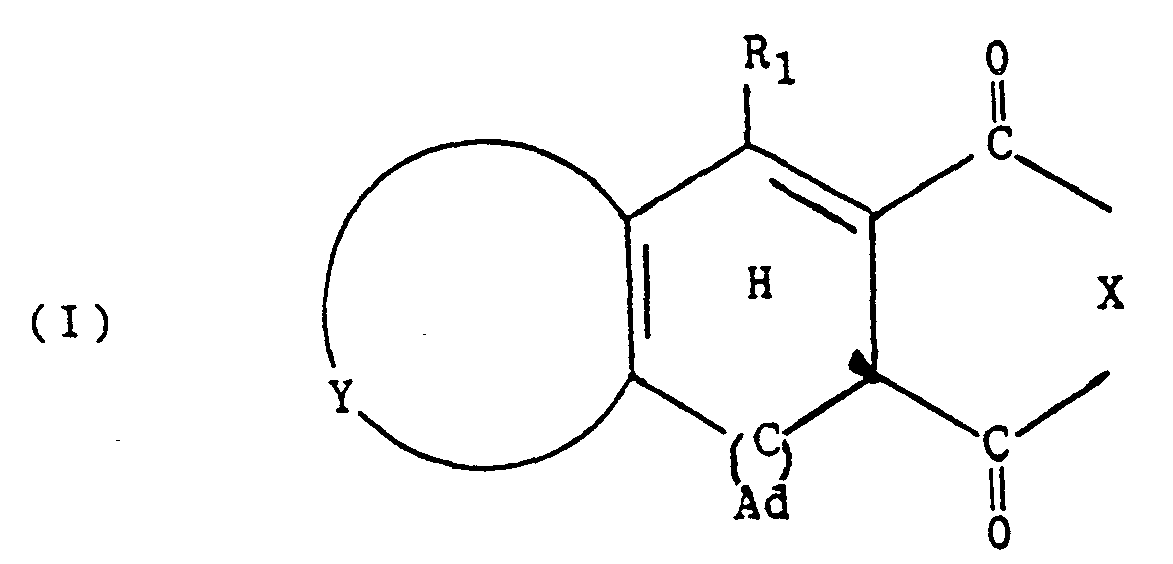
- Preferred classes of heliochromic compounds falling within formula (I) are those in which the group represented by the formula (II): is a resonance stabilised heterocyclic group, containing an oxygen or sulphur heteroatom e.g. furyl or thienyl.
- Such heterocyclic groups may be benzannelated and substituted in positions other than where the group is linked to the six-membered group in formula (I), especially the a-position.
- Suitable substituents are deuterium, lower alkyl, e.g. methyl, ethyl, propyl, aryl (e.g. phenyl), nitro, and halogen, (e.g. chloro or bromo) groups.
- aromatic or heterocyclic groups represented by the above formula (II) are groups derived from 2,5-, 2,4- or 3,5-dimethoxyphenyl; 2- or 3-furyl; or 2- or 3-thienyl groups, which may be substituted or benzannelated by cyclisation onto that group with a subsequent hydrogen shift.
- the group represented by R 1 in the above formula (I) is preferably other than hydrogen e.g. substituted with a tower ajkyt, i.e. methyl, ethyl, propyl or butyl (especially methyl) or phenyl.
- Preferred groups represented by R 2 are methyl and phenyl.
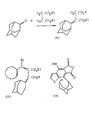
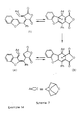
- the adamantylidene group possesses a rigid strain free cage structure. Its structure is shown in the accompanying formula drawings. For convenience, the informal shorthand form, Ad - C is used in this specification to designate the adamantylidene group as indicated at the foot of sheets 3 to 10 of the formula drawings. It is believed that the adamantylidene group plays a vital part in the generation of the heliochromic properties of this invention, because this bulky, stable group weakens the single bond of the six-membered ring of which it forms part, facilitating electrocyclic ring opening on irradiation with ultra- violet light.
- the adamantylidene group need not be attached to the group where this represents a heterocylic group, via the carbon atom adjacent to the heteroatom.
- the adamantylidene group need not be attached to the thienyl group via the 2-position but could equally be attached via the 3-position as shown in structural formula (9A).
- the preparation of the fulgides from which the heliochromes are obtained is conveniently carried out using a dialkyl adamantylidenesuccinate (preferably the diethyl ester) as the starting material.
- a dialkyl adamantylidenesuccinate preferably the diethyl ester
- the preparation of this ester is described in U.K. Patent Specification No. 2,051,813 and can be obtained in over 80% yield and more than 98% purity.
- a condensing agent such as sodium hydride (as 50% dispersion in oil) or potassium t-butoxide (in t-butanot)
- the adamantylidene diester is condensed with the appropriate aldehyde or ketone wherein R 1 has the same significance as in formula (I) above, in the presence of a condensing agent, as before, followed by hydrolysis of the resulting half ester (structure 12) to the diacids, e.g. with 10% ethanolic potassium hydroxide solution.
- the E-diacid is obtained in admixture with the Z-isomer, by hydrolysis, e.g. with 10% ethanolic potassium hydroxide solution.
- the diacids are cyclised with an appropriate agent, e.g. acetic anhydride or acetyl chloride to form the corresponding fulgides.
- the heliochromic rearrangement product is obtained by heating the fulgides or fulgimides or by a combination of heating and irradiation with U.V. light or by Lewis acid-catalysed cyclisation, e.g using SnCI 4 .
- a combination of U.V. irradiation and heating has the advantage that a lower temperature can be employed and under such milder conditions a better yield can be anticipated.
- the rearrangement is effected by heating alone, a temperature of about 180°C is required.
- irradiation with U.V. light is effective to promote rearrangement at temperatures as low as about 25°C.
- the mixture of diacids can be separated (e.g. via the sparingly soluble potassium salt of the E-diacid) but this is generally unnecessary since the Z-fulgide is converted into E-fulgide on heating. Accordingly the mixture can be heated to form the heliochromic compound.
- this may be synthesised by a Gewald type reaction in which an acetaldehyde derivative is condensed with sulphur and ethyl cyanoacetate, preferably in the presence of morpholine and a solvent such as ethanol.
- the product of this reaction is an amino ester of a thiophen derivative. If the acetaldehyde derivative has an aryl substituent, this will be present as a substituent in the thiophene ring.
- the thiophene derivative is converted to the corresponding acid chloride by deamination and hydrolysis.
- the resultant acid chloride is reacted with a salt (e.g.
- Example 18 illustrates the preparation of 4-acetyl-2-phenylthiophene (6) starting from phenylacetaldehyde (1).
- Derivatives of compound (6) in which the phenyl group is substituted, e.g. with alkoxy or alkyl, are readily obtained by selection of an appropriate substituted phenyl acetaldehyde starting compound (1).
- 4 acetyl-2-phenylthiophene, and related compounds in which the phenyl group is substituted are novel compounds.
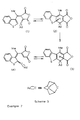
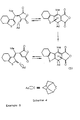
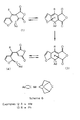
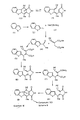
- reaction schemes 1 to 11 The following Examples are given to illustrate the preparation of heliochromic compounds in accordance with the invention. Reaction schemes showing the formation of the heliochromic compounds from their respective fulgide precursor are given in the accompanying sheets 1 to 13, inclusive, identified as reaction schemes 1 to 11. In all cases where it is stated that compounds were irradiated with "white” light, an intense white light source, containing a U.V. component, was used.
- 2-Phenyl-4-acetylthiophen (8 g) was condensed with either diethyl or dimethyl adamantylidenesuccinate (18 g) in toluene (100 cm 3 ), using sodium hydride (6 g) as condensing agent, and gave, after work up and hydrolysis with a slight excess of 10% ethanolic potassium hydroxide solution, the E-diacid as the potassium salt.
- the diacid obtained by acidification with hydrochloric acid, was cyclised with acetyl chloride (50 cm 3 ) and gave the fulgide of structure (1) as yellow crystals (4.7 g).
- fulgide (1) On heating the fulgide (1) at 180°C in o-dichlorobenzene, it rearranged to the heliochromic compound (3), which was isolated in 50-60% yield from unreacted fulgide (1), its Z isomer and thianaphthene (13, Sheet 2) by recrystallisation from o-dichlorobenzene.
- Heliochromic compound (3) behaved similarly to the compound of .Example 1 when irradiated with white light except that the coloured form (4) was purple.
- fulgide (1) in toluene at 110°G rearranged quantitatively to the heliochromic compound (3), or alternatively, on heating the fulgide (2 g) at 180°C in o-dichlorobenzene for hour, it rearranged to the heliochromic compound in near quantitative yield.
- Heliochromic compound (3) reversibly produced a maroon coloured form on irradiation with white light.
- 3-Benzoylthiophen (5 g) was condensed with diethyl adamantylidenesuccinate (8 g) using potassium t-butoxide (3 g) in t-butanol (100 cm 3 ) as condensing agent. The mixture was boiled (1 h), t-butanol was distilled off under reduced pressure and the residue was acidified with hydrochloric acid and extracted with ether. Solvent was removed from the ether extract and the residual half-esters (formula 1A) was hydrolysed with 10% ethanolic potassium hydroxide. The diacids, obtained on acidification, were cyclised with acetic anhydride and gave a mixture of E and Z-fulgides.
- the mixed fulgides were converted into the heliochromic compound (3) as described in Example 5, purified by crystallisation from chloroform and petroleum (b.p. 60-80°C).
- the coloured form (4) of the heliochromic compound was blue.
- fulgide (1) in toluene at 110°C gave the heliochromic compound (3) which was purified by chromatography on silica gel using toluene and petroleum (1:1 mixture) as eluent.
- Compound (3) was reversibly converted to a red compound (4) on exposure to white light.
- Routes to the corresponding heliochromic imides include rearrangement of the corresponding fulgimides by heating in solvent in an analogous manner to the corresponding fulgides.
- the heliochromic anhydride could be converted to its corresponding imide by reaction with ammonia or an aliphatic or aromatic amine (see as illustrated in Example 15).
- Ketone (4) was condensed with dimethyl adamantylidenesuccinate in the presence of sodium hydride in toluene.
- the resulting half-ester was hydrolysed with ethanolic potassium hydroxide and acidified with hydrochloric acid to yield diacid (5), which was cyclised to E-fulgide (6), using acetic anhydride.
- the resulting fulgimide (3) was photochromic, showing a colourless to red colour change on irradiation at 366 nm, reversed by white light.
- fulgimide (3) On irradiation at 366 nm in CDCI 3 for 3 days, fulgimide (3) is converted into heliochromic compound (5). In sunlight, compound (5) undergoes a colourless to orange colour change to compound (6) and thermally fades to the colourless forms.
- Phenylacetaldehyde (1) (30 g) was reacted with sulphur (6 g) and ethyl cyanoacetate (19 g) in the presence of morpholine (17.5 g) and ethanol (50 ccs) to give the crystalline amino ester (2) (11.6 g).
- the amino ester (2) was converted to the diazonium salt and reduced by boiling in ethanol containing finely divided copper to give the pure ester (3). Hydrolysis of the ester with aqueous ethanolic KOH followed by acidification with 5M HCI, gave the acid (4) in approximately 70% yield. The acid was converted to the corresponding acid chloride (5) by reaction with SOCI 2 .
- the acid chloride (5) was reacted with magnesium diethyl malonate to yield the compound (5A) as an intermediate and the ketone (6) as the final product.
- the resulting ketone can be converted to the corresponding heliochrome as described in Example 1.
- heliochromic compounds described herein are solvatochromic i.e. their absorption spectra depends upon the solvent.
- the nature of the colour change can be varied by selecting the plastics material forming the lenses or the coating thereon.
- the heliochromic compounds of this invention can be added to a polymerisation mixture from which plastics lenses are intended to be produced.
- a polymerisation mixture from which plastics lenses are intended to be produced.
- methyl methacrylate (53 cm) containing the heliochrome of formula 9 (Sheet 1) (0.15 g) and benzoyl peroxide (0.15 g) was polymerised by heating at 100°C for 30 minutes.
- the resulting polymer was found to be heliochromic, which indicates that the heliochromes are partially resistant to peroxide-induced degradation.
- the most commonly used material for plastic lenses is diethylene glycol bis (allyl carbonate) usually known as CR-39 (CR-39 is a trade mark of P.P.G. Ltd.).
- the heliochromic compound may be mixed or combined into the CR-39 catalysed liquid monomer, degassed and poured into glass moulds and cured, e.g. as described in U.S. Patent No. 2,542,286, the disclosure of which is incorporated herein by reference for further details of the procedure for moulding or casting plastic lenses.
- heliochromic plastics articles A variety of techniques are available for preparing heliochromic plastics articles in accordance with the teaching of this invention.
- the heliochromic compounds need not be incorporated directly into or coated onto the plastics articles, but can be employed in the form of fulgide or fulgimide precursors and converted in situ, during or after the incorporation or coating step, into the corresponding heliochromic compound, e.g. by heating at U.V. irradiation. Conversion in situ provides an advantageous route to the manufacture of heliochromic plastics articles, such as photoreactive lenses.
- an effective amount of precursor is incorporated into a plastics article, such as a lens by contacting in substantially oxygen-free conditions at least one surface of the lens with a melt or solution of the fulgide or fulgimide, which is the precursor of the desired heliochromic compound.
- the treatment is effected at elevated temperature, e.g. about 180°C, in order to increase the rate of diffusion of the fulgide or fulgimide into the plastics article.
- the fulgides and fulgimides undergo conversion to the corresponding heliochromic compound, it is believed that the fulgide or fulgimide diffuses preferentially into the plastics article. Possibly this is because the heliochromic compounds tend to have higher melting points than their precursors. In any event, crystals of heliochromic compound are observable in the precursor melts used to treat the preformed plastics articles.
- precursors may be employed in the form of melts and are generally quite stable in molten condition at a temperature of about 180°C for a few hours, precursor can also be imbibed into the plastics articles from a solution.
- Solvents employed should, of course, be inert and are preferably high boiling, e.g. boiling at temperatures above 200°C so that the imbibation from a solution can be carried out at elevated temperature in order to increase the rate of diffusion.
- solvents advantage may be taken of a technique employed in disperse dyeing of textiles or fibres where a solvent is selected which possesses a lesser affinity for the solute (in this case the precursor rather than a dyestuff) than does the material to be treated (in this case the plastics article).
- the precursor is effectively partitioned between solution in the solvent and solid solution in the plastic and thus diffuses into the plastics article.
- solvents such as fluorinated hydrocarbons or silicone oils are suitable from this viewpoint when imbibing the precursor into CR39 plastics articles.
- a saturated solution of the precursor in the selected solvent is used, which would not normally exceed a concentration of a few per cent of the precursor.
- the surface of a cured CR-39 plastics lens was treated with the molten precursor by laying its convex surface (whose curvature roughly corresponded with the concavity of the depression) in the depression in the hot plate. In this way the surface of the lens was maintained in contact with the molten precursor for 2 hours.
- the lens was exposed to radiation from an AM 2 lamp at 25°C and was found to be heliochromic, darkening to 5.5% transmission.
- the time required to fade to half the initial optical density was 32 seconds.
- the fatigue life (T1/2) was 2000 minutes. T1/2 is the time taken for the induced optical density to decay to half its initial value when exposed continuously to Air Mass 2 radiation.
- a saturated solution was prepared of the same fulgide as used in Example 20 in the fluorocarbon solvent sold by Minnesota Mining and Manufacturing Company (3M) under the trade name FC 70.
- This solvent had a'boiling point of 217°C.
- the resulting solution was heated to 180°C and a 2 mm thick coplanar CR39 lens was immersed in the solution for one hour while maintaining the temperature at 180°C. After removal from the solvent, the lens was found to be heliochromic and darkened to an induced optical density of 0.7 when irradiated with an AM 2 lamp. Thermal reverse was very rapid at ambient temperature when removing the white light irradiation.
Landscapes
- Chemical & Material Sciences (AREA)
- Organic Chemistry (AREA)
- Physics & Mathematics (AREA)
- General Physics & Mathematics (AREA)
- Engineering & Computer Science (AREA)
- Materials Engineering (AREA)
- Optics & Photonics (AREA)
- Eyeglasses (AREA)
- Non-Silver Salt Photosensitive Materials And Non-Silver Salt Photography (AREA)
- Electrochromic Elements, Electrophoresis, Or Variable Reflection Or Absorption Elements (AREA)
- Heterocyclic Carbon Compounds Containing A Hetero Ring Having Oxygen Or Sulfur (AREA)
- Nitrogen And Oxygen Or Sulfur-Condensed Heterocyclic Ring Systems (AREA)
- Organic Low-Molecular-Weight Compounds And Preparation Thereof (AREA)
- Optical Filters (AREA)
- Addition Polymer Or Copolymer, Post-Treatments, Or Chemical Modifications (AREA)
- Indole Compounds (AREA)
- Nitrogen Condensed Heterocyclic Rings (AREA)
Claims (12)




Priority Applications (1)
| Application Number | Priority Date | Filing Date | Title |
|---|---|---|---|
| AT84306030T ATE52511T1 (de) | 1983-09-07 | 1984-09-03 | Photochromische verbindungen und ihre verwendung in photoreaktiven linsen. |
Applications Claiming Priority (2)
| Application Number | Priority Date | Filing Date | Title |
|---|---|---|---|
| US53016183A | 1983-09-07 | 1983-09-07 | |
| US530161 | 1983-09-07 |
Publications (3)
| Publication Number | Publication Date |
|---|---|
| EP0140540A2 EP0140540A2 (de) | 1985-05-08 |
| EP0140540A3 EP0140540A3 (en) | 1986-04-02 |
| EP0140540B1 true EP0140540B1 (de) | 1990-05-09 |
Family
ID=24112661
Family Applications (1)
| Application Number | Title | Priority Date | Filing Date |
|---|---|---|---|
| EP84306030A Expired - Lifetime EP0140540B1 (de) | 1983-09-07 | 1984-09-03 | Photochromische Verbindungen und ihre Verwendung in photoreaktiven Linsen |
Country Status (10)
| Country | Link |
|---|---|
| EP (1) | EP0140540B1 (de) |
| JP (1) | JPS60155179A (de) |
| KR (1) | KR850002328A (de) |
| AT (1) | ATE52511T1 (de) |
| AU (1) | AU565366B2 (de) |
| BR (1) | BR8404401A (de) |
| DE (1) | DE3482181D1 (de) |
| GB (1) | GB2146327B (de) |
| SG (1) | SG34087G (de) |
| ZA (1) | ZA846867B (de) |
Families Citing this family (17)
| Publication number | Priority date | Publication date | Assignee | Title |
|---|---|---|---|---|
| EP0239376A3 (de) * | 1986-03-27 | 1988-05-11 | Gec-Marconi Limited | Photolithographie mit erhöhtem Kontrast |
| GB8613420D0 (en) * | 1986-06-03 | 1986-07-09 | Plessey Co Plc | Photochromic gamma butyrolactones |
| GB8611837D0 (en) * | 1986-05-15 | 1986-06-25 | Plessey Co Plc | Photochromic spiropyran compounds |
| GB8614680D0 (en) * | 1986-06-17 | 1986-07-23 | Plessey Co Plc | Photoreactive lenses |
| JPH0629947B2 (ja) * | 1986-07-16 | 1994-04-20 | 正浩 入江 | 光学記録材料 |
| JPH0745502B2 (ja) * | 1987-11-10 | 1995-05-17 | 株式会社トクヤマ | 新規化合物及びそれを含む組成物 |
| US5130058A (en) * | 1988-07-01 | 1992-07-14 | Tokuyama Soda Kabushiki Kaisha | Photochromic compound, process for production thereof, use thereof and composition containing said photochromic compound |
| JPH0291076A (ja) * | 1988-09-28 | 1990-03-30 | Tokuyama Soda Co Ltd | フォトクロミック性化合物及びその製造方法 |
| US5169861A (en) * | 1989-03-09 | 1992-12-08 | Tanabe Seiyaku Co., Ltd. | Benzothiophene compounds |
| JPH0676412B2 (ja) * | 1989-03-09 | 1994-09-28 | 田辺製薬株式会社 | ビフェニル誘導体、その製法及びその合成中間体 |
| EP0401958B1 (de) * | 1989-06-05 | 1995-01-11 | Tokuyama Corporation | Fotochromische Verbindung, deren Zusammensetzung und Verwendung |
| JP3244288B2 (ja) * | 1990-07-23 | 2002-01-07 | 昭和電工株式会社 | 近赤外光消色型記録材料 |
| JP3138117B2 (ja) * | 1993-06-11 | 2001-02-26 | 株式会社トクヤマ | 新規化合物 |
| GB9309992D0 (en) * | 1993-05-14 | 1993-06-30 | Heller Harry G | Tribochromic compounds and their applications |
| AU5341098A (en) * | 1996-12-27 | 1998-07-31 | Tokuyama Corporation | Fulgimide compounds, use of them, and compositions containing the same |
| US6863843B2 (en) | 2000-12-21 | 2005-03-08 | Vision-Ease Lens, Inc. | Naphthopyran compounds, photoresponsive compositions and lenses |
| JP2009046393A (ja) * | 2006-03-09 | 2009-03-05 | Yokohama National Univ | フォトクロミック化合物 |
Family Cites Families (6)
| Publication number | Priority date | Publication date | Assignee | Title |
|---|---|---|---|---|
| GB1442628A (en) * | 1973-09-01 | 1976-07-14 | Heller H G | Photochromic compounds |
| GB1464603A (en) * | 1974-07-31 | 1977-02-16 | Heller H | Substituted organic photochromic compounds and processes for their preparation |
| IT1079147B (it) * | 1976-08-31 | 1985-05-08 | Heller George H | Composti fotocromici e processo di loro preparazione |
| NL7714607A (nl) * | 1977-05-31 | 1978-12-04 | Plessey Co Ltd | Fotochrome verbindingen en werkwijze voor het bereiden daarvan alsmede registreer- of weer- gaveinrichting voor fotochrome beelden en werk- wijze voor het vormen van een tijdelijk beeld. |
| US4220708A (en) * | 1977-07-22 | 1980-09-02 | Heller Harold G | Photochromic compounds |
| GB1600615A (en) * | 1977-10-28 | 1981-10-21 | Plessey Co Ltd | Photochromic compounds |
-
1984
- 1984-09-03 KR KR1019840005392A patent/KR850002328A/ko not_active Withdrawn
- 1984-09-03 ZA ZA846867A patent/ZA846867B/xx unknown
- 1984-09-03 JP JP59184352A patent/JPS60155179A/ja active Pending
- 1984-09-03 DE DE8484306030T patent/DE3482181D1/de not_active Expired - Lifetime
- 1984-09-03 BR BR8404401A patent/BR8404401A/pt unknown
- 1984-09-03 AU AU32662/84A patent/AU565366B2/en not_active Expired - Fee Related
- 1984-09-03 AT AT84306030T patent/ATE52511T1/de not_active IP Right Cessation
- 1984-09-03 EP EP84306030A patent/EP0140540B1/de not_active Expired - Lifetime
- 1984-09-03 GB GB08422200A patent/GB2146327B/en not_active Expired
-
1987
- 1987-04-11 SG SG340/87A patent/SG34087G/en unknown
Also Published As
| Publication number | Publication date |
|---|---|
| ZA846867B (en) | 1985-04-24 |
| GB2146327B (en) | 1986-11-26 |
| JPS60155179A (ja) | 1985-08-15 |
| SG34087G (en) | 1988-03-04 |
| BR8404401A (pt) | 1985-07-30 |
| GB2146327A (en) | 1985-04-17 |
| EP0140540A3 (en) | 1986-04-02 |
| ATE52511T1 (de) | 1990-05-15 |
| DE3482181D1 (de) | 1990-06-13 |
| KR850002328A (ko) | 1985-05-10 |
| EP0140540A2 (de) | 1985-05-08 |
| GB8422200D0 (en) | 1984-10-10 |
| AU565366B2 (en) | 1987-09-10 |
| AU3266284A (en) | 1985-05-30 |
Similar Documents
| Publication | Publication Date | Title |
|---|---|---|
| US4685783A (en) | Polychromic tetracyclo-spiro-adamatylidene derivatives, and polychromic lens incorporating said compounds | |
| EP0140540A2 (de) | Photochromische Verbindungen und ihre Verwendung in photoreaktiven Linsen | |
| EP0351112B1 (de) | Photochromische Verbindung, Verfahren zu ihrer Herstellung, ihre Verwendung und diese enthaltende photochromische Zubereitung | |
| JP4157245B2 (ja) | クロメン化合物 | |
| JP4256985B2 (ja) | クロメン化合物 | |
| GB2190379A (en) | Photochromic spiropyran compounds | |
| JP3801386B2 (ja) | クロメン化合物 | |
| JP2000256347A (ja) | クロメン化合物 | |
| EP1446406A2 (de) | Photochromic naphthopyrans für ophthalmische artikel | |
| JP2001011066A (ja) | クロメン化合物 | |
| JP2000344761A (ja) | クロメン化合物 | |
| JPH11286484A (ja) | クロメン化合物 | |
| KR20020027342A (ko) | C7-c8이 어닐링된 방향족 헤테로사이클을 갖는 벤조피란화합물, 이들의 조성물 및 이들이 포함된 (공)중합체매트릭스 | |
| JP2002518494A (ja) | 光互変性ナフトピラン | |
| JPH072824A (ja) | 新規化合物 | |
| JP2003502274A (ja) | C6−c7においてアネル化されたナフトピラン、それらの調製並びにそれらを含有する組成物および(コ)ポリマーマトリクス | |
| EP0696582B1 (de) | Polycyclische Spirophthalimid-Derivate, Verfahren zu ihrer Herstellung und ihre Verwendung als Fulgimide | |
| JP2856818B2 (ja) | スピロオキサジン化合物及びその製造方法 | |
| JP2000026469A (ja) | スピロオキサジン化合物 | |
| JP3165760B2 (ja) | 新規化合物 | |
| JPH07285931A (ja) | 新規化合物 | |
| JP3248768B2 (ja) | スピロピラン化合物及びフォトクロミック材 | |
| JP2774830B2 (ja) | スピロオキサジン化合物及びその製造方法 | |
| JP2723390B2 (ja) | フォトクロミック組成物 | |
| JPH06345772A (ja) | 新規化合物 |
Legal Events
| Date | Code | Title | Description |
|---|---|---|---|
| PUAI | Public reference made under article 153(3) epc to a published international application that has entered the european phase |
Free format text: ORIGINAL CODE: 0009012 |
|
| AK | Designated contracting states |
Designated state(s): AT BE CH DE FR GB IT LI LU NL SE |
|
| PUAL | Search report despatched |
Free format text: ORIGINAL CODE: 0009013 |
|
| AK | Designated contracting states |
Kind code of ref document: A3 Designated state(s): AT BE CH DE FR GB IT LI LU NL SE |
|
| 17P | Request for examination filed |
Effective date: 19860306 |
|
| RBV | Designated contracting states (corrected) |
Designated state(s): AT BE CH DE FR IT LI LU NL SE |
|
| 17Q | First examination report despatched |
Effective date: 19870601 |
|
| ITF | It: translation for a ep patent filed | ||
| GRAA | (expected) grant |
Free format text: ORIGINAL CODE: 0009210 |
|
| AK | Designated contracting states |
Kind code of ref document: B1 Designated state(s): AT BE CH DE FR IT LI LU NL SE |
|
| REF | Corresponds to: |
Ref document number: 52511 Country of ref document: AT Date of ref document: 19900515 Kind code of ref document: T |
|
| ET | Fr: translation filed | ||
| REF | Corresponds to: |
Ref document number: 3482181 Country of ref document: DE Date of ref document: 19900613 |
|
| PGFP | Annual fee paid to national office [announced via postgrant information from national office to epo] |
Ref country code: BE Payment date: 19900621 Year of fee payment: 7 |
|
| PGFP | Annual fee paid to national office [announced via postgrant information from national office to epo] |
Ref country code: LU Payment date: 19900704 Year of fee payment: 7 |
|
| PGFP | Annual fee paid to national office [announced via postgrant information from national office to epo] |
Ref country code: AT Payment date: 19900913 Year of fee payment: 7 |
|
| PGFP | Annual fee paid to national office [announced via postgrant information from national office to epo] |
Ref country code: CH Payment date: 19900920 Year of fee payment: 7 |
|
| PGFP | Annual fee paid to national office [announced via postgrant information from national office to epo] |
Ref country code: SE Payment date: 19900921 Year of fee payment: 7 |
|
| PG25 | Lapsed in a contracting state [announced via postgrant information from national office to epo] |
Ref country code: LU Free format text: LAPSE BECAUSE OF NON-PAYMENT OF DUE FEES Effective date: 19900930 |
|
| PLBE | No opposition filed within time limit |
Free format text: ORIGINAL CODE: 0009261 |
|
| STAA | Information on the status of an ep patent application or granted ep patent |
Free format text: STATUS: NO OPPOSITION FILED WITHIN TIME LIMIT |
|
| 26N | No opposition filed | ||
| ITPR | It: changes in ownership of a european patent |
Owner name: TRASFORMAZIONE SOCIETARIA;THE PLESSEY COMPANY LIMI |
|
| REG | Reference to a national code |
Ref country code: CH Ref legal event code: PUE Owner name: GEC-MARCONI LIMITED |
|
| PG25 | Lapsed in a contracting state [announced via postgrant information from national office to epo] |
Ref country code: AT Effective date: 19910903 |
|
| PG25 | Lapsed in a contracting state [announced via postgrant information from national office to epo] |
Ref country code: SE Effective date: 19910904 |
|
| ITTA | It: last paid annual fee | ||
| PG25 | Lapsed in a contracting state [announced via postgrant information from national office to epo] |
Ref country code: LI Effective date: 19910930 Ref country code: CH Effective date: 19910930 Ref country code: BE Effective date: 19910930 |
|
| REG | Reference to a national code |
Ref country code: FR Ref legal event code: TP |
|
| BERE | Be: lapsed |
Owner name: GEC-MARCONI LTD Effective date: 19910930 |
|
| REG | Reference to a national code |
Ref country code: CH Ref legal event code: PL |
|
| PGFP | Annual fee paid to national office [announced via postgrant information from national office to epo] |
Ref country code: FR Payment date: 19920909 Year of fee payment: 9 |
|
| PGFP | Annual fee paid to national office [announced via postgrant information from national office to epo] |
Ref country code: DE Payment date: 19920923 Year of fee payment: 9 |
|
| PGFP | Annual fee paid to national office [announced via postgrant information from national office to epo] |
Ref country code: NL Payment date: 19920930 Year of fee payment: 9 |
|
| NLS | Nl: assignments of ep-patents |
Owner name: GEC-MARCONI LIMITED TE STANMORE, GROOT-BRITTANNIE. |
|
| PG25 | Lapsed in a contracting state [announced via postgrant information from national office to epo] |
Ref country code: NL Effective date: 19940401 |
|
| NLV4 | Nl: lapsed or anulled due to non-payment of the annual fee | ||
| PG25 | Lapsed in a contracting state [announced via postgrant information from national office to epo] |
Ref country code: FR Free format text: LAPSE BECAUSE OF NON-PAYMENT OF DUE FEES Effective date: 19940531 |
|
| PG25 | Lapsed in a contracting state [announced via postgrant information from national office to epo] |
Ref country code: DE Effective date: 19940601 |
|
| REG | Reference to a national code |
Ref country code: FR Ref legal event code: ST |
|
| EUG | Se: european patent has lapsed |
Ref document number: 84306030.2 Effective date: 19920408 |