EP0143020B1 - Catalyseurs à base de sulfures de métaux du groupe VIII et du groupe VIB, leur fabrication et leur utilisation dans les réactions d'hydrotraitement des coupes d'hydrocarbures contenant du soufre - Google Patents
Catalyseurs à base de sulfures de métaux du groupe VIII et du groupe VIB, leur fabrication et leur utilisation dans les réactions d'hydrotraitement des coupes d'hydrocarbures contenant du soufre Download PDFInfo
- Publication number
- EP0143020B1 EP0143020B1 EP84401869A EP84401869A EP0143020B1 EP 0143020 B1 EP0143020 B1 EP 0143020B1 EP 84401869 A EP84401869 A EP 84401869A EP 84401869 A EP84401869 A EP 84401869A EP 0143020 B1 EP0143020 B1 EP 0143020B1
- Authority
- EP
- European Patent Office
- Prior art keywords
- metal
- group
- catalyst
- group viii
- disulfide
- Prior art date
- Legal status (The legal status is an assumption and is not a legal conclusion. Google has not performed a legal analysis and makes no representation as to the accuracy of the status listed.)
- Expired
Links
- 239000003054 catalyst Substances 0.000 title claims description 135
- 229910052751 metal Inorganic materials 0.000 title claims description 87
- 239000002184 metal Substances 0.000 title claims description 87
- 150000002739 metals Chemical class 0.000 title claims description 17
- 229910052717 sulfur Inorganic materials 0.000 title claims description 14
- NINIDFKCEFEMDL-UHFFFAOYSA-N Sulfur Chemical compound [S] NINIDFKCEFEMDL-UHFFFAOYSA-N 0.000 title claims description 13
- 239000011593 sulfur Substances 0.000 title claims description 13
- 238000002360 preparation method Methods 0.000 title description 17
- 150000003568 thioethers Chemical class 0.000 title 1
- 238000000034 method Methods 0.000 claims description 48
- 239000000243 solution Substances 0.000 claims description 41
- PXHVJJICTQNCMI-UHFFFAOYSA-N Nickel Chemical compound [Ni] PXHVJJICTQNCMI-UHFFFAOYSA-N 0.000 claims description 40
- 125000004429 atom Chemical group 0.000 claims description 25
- BWGNESOTFCXPMA-UHFFFAOYSA-N Dihydrogen disulfide Chemical compound SS BWGNESOTFCXPMA-UHFFFAOYSA-N 0.000 claims description 24
- IJGRMHOSHXDMSA-UHFFFAOYSA-N Atomic nitrogen Chemical compound N#N IJGRMHOSHXDMSA-UHFFFAOYSA-N 0.000 claims description 21
- 229910052759 nickel Inorganic materials 0.000 claims description 20
- 238000010586 diagram Methods 0.000 claims description 19
- 239000002244 precipitate Substances 0.000 claims description 18
- ZOKXTWBITQBERF-UHFFFAOYSA-N Molybdenum Chemical compound [Mo] ZOKXTWBITQBERF-UHFFFAOYSA-N 0.000 claims description 17
- 229910052750 molybdenum Inorganic materials 0.000 claims description 17
- 239000011733 molybdenum Substances 0.000 claims description 17
- 238000006243 chemical reaction Methods 0.000 claims description 14
- UYJXRRSPUVSSMN-UHFFFAOYSA-P ammonium sulfide Chemical compound [NH4+].[NH4+].[S-2] UYJXRRSPUVSSMN-UHFFFAOYSA-P 0.000 claims description 11
- 239000007864 aqueous solution Substances 0.000 claims description 11
- 150000004763 sulfides Chemical class 0.000 claims description 11
- 229910052757 nitrogen Inorganic materials 0.000 claims description 10
- 239000010941 cobalt Substances 0.000 claims description 9
- 229910017052 cobalt Inorganic materials 0.000 claims description 9
- GUTLYIVDDKVIGB-UHFFFAOYSA-N cobalt atom Chemical compound [Co] GUTLYIVDDKVIGB-UHFFFAOYSA-N 0.000 claims description 9
- 229910052976 metal sulfide Inorganic materials 0.000 claims description 9
- UCKMPCXJQFINFW-UHFFFAOYSA-N Sulphide Chemical compound [S-2] UCKMPCXJQFINFW-UHFFFAOYSA-N 0.000 claims description 8
- CWQXQMHSOZUFJS-UHFFFAOYSA-N molybdenum disulfide Chemical compound S=[Mo]=S CWQXQMHSOZUFJS-UHFFFAOYSA-N 0.000 claims description 8
- 150000003839 salts Chemical class 0.000 claims description 8
- RYGMFSIKBFXOCR-UHFFFAOYSA-N Copper Chemical compound [Cu] RYGMFSIKBFXOCR-UHFFFAOYSA-N 0.000 claims description 6
- 150000003863 ammonium salts Chemical class 0.000 claims description 6
- 238000001354 calcination Methods 0.000 claims description 6
- 238000001035 drying Methods 0.000 claims description 6
- 229910052961 molybdenite Inorganic materials 0.000 claims description 6
- NIFIFKQPDTWWGU-UHFFFAOYSA-N pyrite Chemical compound [Fe+2].[S-][S-] NIFIFKQPDTWWGU-UHFFFAOYSA-N 0.000 claims description 6
- 229910052683 pyrite Inorganic materials 0.000 claims description 6
- 239000011028 pyrite Substances 0.000 claims description 6
- 125000004434 sulfur atom Chemical group 0.000 claims description 6
- 239000003795 chemical substances by application Substances 0.000 claims description 5
- 229910052802 copper Inorganic materials 0.000 claims description 5
- 239000010949 copper Substances 0.000 claims description 5
- 229930195733 hydrocarbon Natural products 0.000 claims description 5
- 150000002430 hydrocarbons Chemical class 0.000 claims description 5
- 229920000447 polyanionic polymer Polymers 0.000 claims description 5
- 230000001105 regulatory effect Effects 0.000 claims description 5
- XEEYBQQBJWHFJM-UHFFFAOYSA-N Iron Chemical compound [Fe] XEEYBQQBJWHFJM-UHFFFAOYSA-N 0.000 claims description 4
- 239000011230 binding agent Substances 0.000 claims description 4
- 239000003361 porogen Substances 0.000 claims description 4
- 238000000926 separation method Methods 0.000 claims description 4
- 238000007493 shaping process Methods 0.000 claims description 4
- 239000004215 Carbon black (E152) Substances 0.000 claims description 3
- 238000000634 powder X-ray diffraction Methods 0.000 claims description 3
- 239000000376 reactant Substances 0.000 claims description 3
- WFKWXMTUELFFGS-UHFFFAOYSA-N tungsten Chemical compound [W] WFKWXMTUELFFGS-UHFFFAOYSA-N 0.000 claims description 3
- 229910052721 tungsten Inorganic materials 0.000 claims description 3
- 239000010937 tungsten Substances 0.000 claims description 3
- 229910002651 NO3 Inorganic materials 0.000 claims description 2
- 229910052742 iron Inorganic materials 0.000 claims description 2
- NHNBFGGVMKEFGY-UHFFFAOYSA-N nitrate group Chemical group [N+](=O)([O-])[O-] NHNBFGGVMKEFGY-UHFFFAOYSA-N 0.000 claims description 2
- 150000001768 cations Chemical class 0.000 claims 1
- 230000001747 exhibiting effect Effects 0.000 claims 1
- 238000004519 manufacturing process Methods 0.000 claims 1
- 238000001228 spectrum Methods 0.000 claims 1
- XLYOFNOQVPJJNP-UHFFFAOYSA-N water Substances O XLYOFNOQVPJJNP-UHFFFAOYSA-N 0.000 description 35
- XKRFYHLGVUSROY-UHFFFAOYSA-N Argon Chemical compound [Ar] XKRFYHLGVUSROY-UHFFFAOYSA-N 0.000 description 26
- 239000012153 distilled water Substances 0.000 description 22
- QGAVSDVURUSLQK-UHFFFAOYSA-N ammonium heptamolybdate Chemical compound N.N.N.N.N.N.O.O.O.O.O.O.O.O.O.O.O.O.O.O.O.O.O.O.O.O.O.O.O.O.[Mo].[Mo].[Mo].[Mo].[Mo].[Mo].[Mo] QGAVSDVURUSLQK-UHFFFAOYSA-N 0.000 description 13
- 229910052786 argon Inorganic materials 0.000 description 13
- 230000000694 effects Effects 0.000 description 13
- 239000000203 mixture Substances 0.000 description 13
- 239000003153 chemical reaction reagent Substances 0.000 description 11
- 239000001257 hydrogen Substances 0.000 description 11
- 229910052739 hydrogen Inorganic materials 0.000 description 11
- 235000001508 sulfur Nutrition 0.000 description 11
- UFHFLCQGNIYNRP-UHFFFAOYSA-N Hydrogen Chemical compound [H][H] UFHFLCQGNIYNRP-UHFFFAOYSA-N 0.000 description 10
- YXFVVABEGXRONW-UHFFFAOYSA-N Toluene Chemical compound CC1=CC=CC=C1 YXFVVABEGXRONW-UHFFFAOYSA-N 0.000 description 9
- 239000011261 inert gas Substances 0.000 description 9
- VYPSYNLAJGMNEJ-UHFFFAOYSA-N Silicium dioxide Chemical compound O=[Si]=O VYPSYNLAJGMNEJ-UHFFFAOYSA-N 0.000 description 8
- 230000003197 catalytic effect Effects 0.000 description 8
- 238000000975 co-precipitation Methods 0.000 description 8
- AOPCKOPZYFFEDA-UHFFFAOYSA-N nickel(2+);dinitrate;hexahydrate Chemical compound O.O.O.O.O.O.[Ni+2].[O-][N+]([O-])=O.[O-][N+]([O-])=O AOPCKOPZYFFEDA-UHFFFAOYSA-N 0.000 description 8
- 239000002283 diesel fuel Substances 0.000 description 7
- PNEYBMLMFCGWSK-UHFFFAOYSA-N aluminium oxide Inorganic materials [O-2].[O-2].[O-2].[Al+3].[Al+3] PNEYBMLMFCGWSK-UHFFFAOYSA-N 0.000 description 6
- 239000007789 gas Substances 0.000 description 6
- QGZKDVFQNNGYKY-UHFFFAOYSA-O Ammonium Chemical compound [NH4+] QGZKDVFQNNGYKY-UHFFFAOYSA-O 0.000 description 5
- 238000007792 addition Methods 0.000 description 5
- 239000012295 chemical reaction liquid Substances 0.000 description 5
- 238000005984 hydrogenation reaction Methods 0.000 description 5
- KBJMLQFLOWQJNF-UHFFFAOYSA-N nickel(ii) nitrate Chemical compound [Ni+2].[O-][N+]([O-])=O.[O-][N+]([O-])=O KBJMLQFLOWQJNF-UHFFFAOYSA-N 0.000 description 5
- 238000003756 stirring Methods 0.000 description 5
- WWNBZGLDODTKEM-UHFFFAOYSA-N sulfanylidenenickel Chemical compound [Ni]=S WWNBZGLDODTKEM-UHFFFAOYSA-N 0.000 description 5
- CIWBSHSKHKDKBQ-JLAZNSOCSA-N Ascorbic acid Chemical compound OC[C@H](O)[C@H]1OC(=O)C(O)=C1O CIWBSHSKHKDKBQ-JLAZNSOCSA-N 0.000 description 4
- 235000014698 Brassica juncea var multisecta Nutrition 0.000 description 4
- 241000251184 Rajiformes Species 0.000 description 4
- 238000002441 X-ray diffraction Methods 0.000 description 4
- ZGSDJMADBJCNPN-UHFFFAOYSA-N [S-][NH3+] Chemical compound [S-][NH3+] ZGSDJMADBJCNPN-UHFFFAOYSA-N 0.000 description 4
- IYYZUPMFVPLQIF-UHFFFAOYSA-N dibenzothiophene Chemical compound C1=CC=C2C3=CC=CC=C3SC2=C1 IYYZUPMFVPLQIF-UHFFFAOYSA-N 0.000 description 4
- QXYJCZRRLLQGCR-UHFFFAOYSA-N dioxomolybdenum Chemical compound O=[Mo]=O QXYJCZRRLLQGCR-UHFFFAOYSA-N 0.000 description 4
- 239000007788 liquid Substances 0.000 description 4
- 229910052953 millerite Inorganic materials 0.000 description 4
- 239000000047 product Substances 0.000 description 4
- 230000005855 radiation Effects 0.000 description 4
- 238000004064 recycling Methods 0.000 description 4
- 239000000126 substance Substances 0.000 description 4
- 238000011144 upstream manufacturing Methods 0.000 description 4
- XDTMQSROBMDMFD-UHFFFAOYSA-N Cyclohexane Chemical compound C1CCCCC1 XDTMQSROBMDMFD-UHFFFAOYSA-N 0.000 description 3
- GRYLNZFGIOXLOG-UHFFFAOYSA-N Nitric acid Chemical compound O[N+]([O-])=O GRYLNZFGIOXLOG-UHFFFAOYSA-N 0.000 description 3
- HEMHJVSKTPXQMS-UHFFFAOYSA-M Sodium hydroxide Chemical compound [OH-].[Na+] HEMHJVSKTPXQMS-UHFFFAOYSA-M 0.000 description 3
- 150000001875 compounds Chemical class 0.000 description 3
- 238000001125 extrusion Methods 0.000 description 3
- 239000011521 glass Substances 0.000 description 3
- 239000012535 impurity Substances 0.000 description 3
- 229910017604 nitric acid Inorganic materials 0.000 description 3
- 230000002572 peristaltic effect Effects 0.000 description 3
- 239000000843 powder Substances 0.000 description 3
- 238000001556 precipitation Methods 0.000 description 3
- 238000007670 refining Methods 0.000 description 3
- 239000012266 salt solution Substances 0.000 description 3
- 239000000377 silicon dioxide Substances 0.000 description 3
- ITRNXVSDJBHYNJ-UHFFFAOYSA-N tungsten disulfide Chemical compound S=[W]=S ITRNXVSDJBHYNJ-UHFFFAOYSA-N 0.000 description 3
- WKBOTKDWSSQWDR-UHFFFAOYSA-N Bromine atom Chemical compound [Br] WKBOTKDWSSQWDR-UHFFFAOYSA-N 0.000 description 2
- CURLTUGMZLYLDI-UHFFFAOYSA-N Carbon dioxide Chemical compound O=C=O CURLTUGMZLYLDI-UHFFFAOYSA-N 0.000 description 2
- RWSOTUBLDIXVET-UHFFFAOYSA-N Dihydrogen sulfide Chemical compound S RWSOTUBLDIXVET-UHFFFAOYSA-N 0.000 description 2
- MYMOFIZGZYHOMD-UHFFFAOYSA-N Dioxygen Chemical compound O=O MYMOFIZGZYHOMD-UHFFFAOYSA-N 0.000 description 2
- IFTRQJLVEBNKJK-UHFFFAOYSA-N Ethylcyclopentane Chemical compound CCC1CCCC1 IFTRQJLVEBNKJK-UHFFFAOYSA-N 0.000 description 2
- OAICVXFJPJFONN-UHFFFAOYSA-N Phosphorus Chemical compound [P] OAICVXFJPJFONN-UHFFFAOYSA-N 0.000 description 2
- 239000004809 Teflon Substances 0.000 description 2
- 229920006362 Teflon® Polymers 0.000 description 2
- 241001080024 Telles Species 0.000 description 2
- YTPLMLYBLZKORZ-UHFFFAOYSA-N Thiophene Chemical compound C=1C=CSC=1 YTPLMLYBLZKORZ-UHFFFAOYSA-N 0.000 description 2
- XLOMVQKBTHCTTD-UHFFFAOYSA-N Zinc monoxide Chemical compound [Zn]=O XLOMVQKBTHCTTD-UHFFFAOYSA-N 0.000 description 2
- 239000002253 acid Substances 0.000 description 2
- 238000004458 analytical method Methods 0.000 description 2
- 150000001450 anions Chemical class 0.000 description 2
- GDTBXPJZTBHREO-UHFFFAOYSA-N bromine Substances BrBr GDTBXPJZTBHREO-UHFFFAOYSA-N 0.000 description 2
- 229910052794 bromium Inorganic materials 0.000 description 2
- 238000004517 catalytic hydrocracking Methods 0.000 description 2
- 238000006555 catalytic reaction Methods 0.000 description 2
- 238000005119 centrifugation Methods 0.000 description 2
- QGUAJWGNOXCYJF-UHFFFAOYSA-N cobalt dinitrate hexahydrate Chemical compound O.O.O.O.O.O.[Co+2].[O-][N+]([O-])=O.[O-][N+]([O-])=O QGUAJWGNOXCYJF-UHFFFAOYSA-N 0.000 description 2
- 230000001143 conditioned effect Effects 0.000 description 2
- 230000001276 controlling effect Effects 0.000 description 2
- 238000002447 crystallographic data Methods 0.000 description 2
- 238000006477 desulfuration reaction Methods 0.000 description 2
- 230000023556 desulfurization Effects 0.000 description 2
- 238000001704 evaporation Methods 0.000 description 2
- 230000008020 evaporation Effects 0.000 description 2
- 238000007327 hydrogenolysis reaction Methods 0.000 description 2
- UAEPNZWRGJTJPN-UHFFFAOYSA-N methylcyclohexane Chemical compound CC1CCCCC1 UAEPNZWRGJTJPN-UHFFFAOYSA-N 0.000 description 2
- GDOPTJXRTPNYNR-UHFFFAOYSA-N methylcyclopentane Chemical compound CC1CCCC1 GDOPTJXRTPNYNR-UHFFFAOYSA-N 0.000 description 2
- JKQOBWVOAYFWKG-UHFFFAOYSA-N molybdenum trioxide Chemical compound O=[Mo](=O)=O JKQOBWVOAYFWKG-UHFFFAOYSA-N 0.000 description 2
- 229910052698 phosphorus Inorganic materials 0.000 description 2
- 239000011574 phosphorus Substances 0.000 description 2
- 238000010926 purge Methods 0.000 description 2
- 239000012429 reaction media Substances 0.000 description 2
- 239000007787 solid Substances 0.000 description 2
- 230000006641 stabilisation Effects 0.000 description 2
- 238000011105 stabilization Methods 0.000 description 2
- 238000005987 sulfurization reaction Methods 0.000 description 2
- QWHNJUXXYKPLQM-UHFFFAOYSA-N 1,1-dimethylcyclopentane Chemical class CC1(C)CCCC1 QWHNJUXXYKPLQM-UHFFFAOYSA-N 0.000 description 1
- ZAMOUSCENKQFHK-UHFFFAOYSA-N Chlorine atom Chemical compound [Cl] ZAMOUSCENKQFHK-UHFFFAOYSA-N 0.000 description 1
- 229920002449 FKM Polymers 0.000 description 1
- MBMLMWLHJBBADN-UHFFFAOYSA-N Ferrous sulfide Chemical compound [Fe]=S MBMLMWLHJBBADN-UHFFFAOYSA-N 0.000 description 1
- 241001415961 Gaviidae Species 0.000 description 1
- 101000837626 Homo sapiens Thyroid hormone receptor alpha Proteins 0.000 description 1
- 102100028702 Thyroid hormone receptor alpha Human genes 0.000 description 1
- -1 VIB metals Chemical class 0.000 description 1
- 240000008042 Zea mays Species 0.000 description 1
- XUKVMZJGMBEQDE-UHFFFAOYSA-N [Co](=S)=S Chemical compound [Co](=S)=S XUKVMZJGMBEQDE-UHFFFAOYSA-N 0.000 description 1
- QZYDAIMOJUSSFT-UHFFFAOYSA-N [Co].[Ni].[Mo] Chemical compound [Co].[Ni].[Mo] QZYDAIMOJUSSFT-UHFFFAOYSA-N 0.000 description 1
- 230000001133 acceleration Effects 0.000 description 1
- 230000002378 acidificating effect Effects 0.000 description 1
- 150000001336 alkenes Chemical class 0.000 description 1
- 230000003042 antagnostic effect Effects 0.000 description 1
- 239000011260 aqueous acid Substances 0.000 description 1
- QVGXLLKOCUKJST-UHFFFAOYSA-N atomic oxygen Chemical compound [O] QVGXLLKOCUKJST-UHFFFAOYSA-N 0.000 description 1
- 239000000440 bentonite Substances 0.000 description 1
- 229910000278 bentonite Inorganic materials 0.000 description 1
- SVPXDRXYRYOSEX-UHFFFAOYSA-N bentoquatam Chemical compound O.O=[Si]=O.O=[Al]O[Al]=O SVPXDRXYRYOSEX-UHFFFAOYSA-N 0.000 description 1
- 230000015572 biosynthetic process Effects 0.000 description 1
- NFMAZVUSKIJEIH-UHFFFAOYSA-N bis(sulfanylidene)iron Chemical compound S=[Fe]=S NFMAZVUSKIJEIH-UHFFFAOYSA-N 0.000 description 1
- 239000001569 carbon dioxide Substances 0.000 description 1
- 229910002092 carbon dioxide Inorganic materials 0.000 description 1
- 239000011203 carbon fibre reinforced carbon Substances 0.000 description 1
- 239000000460 chlorine Substances 0.000 description 1
- 229910052801 chlorine Inorganic materials 0.000 description 1
- 239000004927 clay Substances 0.000 description 1
- 238000004581 coalescence Methods 0.000 description 1
- UFMZWBIQTDUYBN-UHFFFAOYSA-N cobalt dinitrate Chemical compound [Co+2].[O-][N+]([O-])=O.[O-][N+]([O-])=O UFMZWBIQTDUYBN-UHFFFAOYSA-N 0.000 description 1
- WHDPTDWLEKQKKX-UHFFFAOYSA-N cobalt molybdenum Chemical compound [Co].[Co].[Mo] WHDPTDWLEKQKKX-UHFFFAOYSA-N 0.000 description 1
- 229910001981 cobalt nitrate Inorganic materials 0.000 description 1
- 238000004939 coking Methods 0.000 description 1
- 238000002485 combustion reaction Methods 0.000 description 1
- 230000003111 delayed effect Effects 0.000 description 1
- ZKKLPDLKUGTPME-UHFFFAOYSA-N diazanium;bis(sulfanylidene)molybdenum;sulfanide Chemical class [NH4+].[NH4+].[SH-].[SH-].S=[Mo]=S ZKKLPDLKUGTPME-UHFFFAOYSA-N 0.000 description 1
- 229910001882 dioxygen Inorganic materials 0.000 description 1
- 238000004821 distillation Methods 0.000 description 1
- 229920001971 elastomer Polymers 0.000 description 1
- 239000000806 elastomer Substances 0.000 description 1
- 238000001493 electron microscopy Methods 0.000 description 1
- 230000007717 exclusion Effects 0.000 description 1
- 238000001914 filtration Methods 0.000 description 1
- 239000000446 fuel Substances 0.000 description 1
- 238000005469 granulation Methods 0.000 description 1
- 230000003179 granulation Effects 0.000 description 1
- 238000010438 heat treatment Methods 0.000 description 1
- 239000001307 helium Substances 0.000 description 1
- 229910052734 helium Inorganic materials 0.000 description 1
- SWQJXJOGLNCZEY-UHFFFAOYSA-N helium atom Chemical compound [He] SWQJXJOGLNCZEY-UHFFFAOYSA-N 0.000 description 1
- 238000003837 high-temperature calcination Methods 0.000 description 1
- 150000002431 hydrogen Chemical class 0.000 description 1
- 229910000037 hydrogen sulfide Inorganic materials 0.000 description 1
- 238000011065 in-situ storage Methods 0.000 description 1
- 229910052500 inorganic mineral Inorganic materials 0.000 description 1
- 229910000339 iron disulfide Inorganic materials 0.000 description 1
- 238000006317 isomerization reaction Methods 0.000 description 1
- 238000003760 magnetic stirring Methods 0.000 description 1
- GYNNXHKOJHMOHS-UHFFFAOYSA-N methyl-cycloheptane Natural products CC1CCCCCC1 GYNNXHKOJHMOHS-UHFFFAOYSA-N 0.000 description 1
- 239000011707 mineral Substances 0.000 description 1
- 235000010755 mineral Nutrition 0.000 description 1
- 150000002751 molybdenum Chemical class 0.000 description 1
- 229910052982 molybdenum disulfide Inorganic materials 0.000 description 1
- DDTIGTPWGISMKL-UHFFFAOYSA-N molybdenum nickel Chemical compound [Ni].[Mo] DDTIGTPWGISMKL-UHFFFAOYSA-N 0.000 description 1
- 239000004570 mortar (masonry) Substances 0.000 description 1
- 239000012452 mother liquor Substances 0.000 description 1
- LAIZPRYFQUWUBN-UHFFFAOYSA-L nickel chloride hexahydrate Chemical compound O.O.O.O.O.O.[Cl-].[Cl-].[Ni+2] LAIZPRYFQUWUBN-UHFFFAOYSA-L 0.000 description 1
- RRIWRJBSCGCBID-UHFFFAOYSA-L nickel sulfate hexahydrate Chemical compound O.O.O.O.O.O.[Ni+2].[O-]S([O-])(=O)=O RRIWRJBSCGCBID-UHFFFAOYSA-L 0.000 description 1
- 229940116202 nickel sulfate hexahydrate Drugs 0.000 description 1
- MOWMLACGTDMJRV-UHFFFAOYSA-N nickel tungsten Chemical compound [Ni].[W] MOWMLACGTDMJRV-UHFFFAOYSA-N 0.000 description 1
- 229910000008 nickel(II) carbonate Inorganic materials 0.000 description 1
- ZULUUIKRFGGGTL-UHFFFAOYSA-L nickel(ii) carbonate Chemical compound [Ni+2].[O-]C([O-])=O ZULUUIKRFGGGTL-UHFFFAOYSA-L 0.000 description 1
- 230000001590 oxidative effect Effects 0.000 description 1
- 239000001301 oxygen Substances 0.000 description 1
- 229910052760 oxygen Inorganic materials 0.000 description 1
- 238000001139 pH measurement Methods 0.000 description 1
- 239000002245 particle Substances 0.000 description 1
- 238000005453 pelletization Methods 0.000 description 1
- 230000000737 periodic effect Effects 0.000 description 1
- 239000003208 petroleum Substances 0.000 description 1
- DHRLEVQXOMLTIM-UHFFFAOYSA-N phosphoric acid;trioxomolybdenum Chemical compound O=[Mo](=O)=O.O=[Mo](=O)=O.O=[Mo](=O)=O.O=[Mo](=O)=O.O=[Mo](=O)=O.O=[Mo](=O)=O.O=[Mo](=O)=O.O=[Mo](=O)=O.O=[Mo](=O)=O.O=[Mo](=O)=O.O=[Mo](=O)=O.O=[Mo](=O)=O.OP(O)(O)=O DHRLEVQXOMLTIM-UHFFFAOYSA-N 0.000 description 1
- CYQAYERJWZKYML-UHFFFAOYSA-N phosphorus pentasulfide Chemical compound S1P(S2)(=S)SP3(=S)SP1(=S)SP2(=S)S3 CYQAYERJWZKYML-UHFFFAOYSA-N 0.000 description 1
- 238000000053 physical method Methods 0.000 description 1
- 229920001021 polysulfide Polymers 0.000 description 1
- 239000005077 polysulfide Substances 0.000 description 1
- 150000008117 polysulfides Polymers 0.000 description 1
- 239000002243 precursor Substances 0.000 description 1
- 239000010453 quartz Substances 0.000 description 1
- 239000012088 reference solution Substances 0.000 description 1
- 230000029219 regulation of pH Effects 0.000 description 1
- 239000011949 solid catalyst Substances 0.000 description 1
- 239000011343 solid material Substances 0.000 description 1
- 150000003463 sulfur Chemical class 0.000 description 1
- 150000003464 sulfur compounds Chemical class 0.000 description 1
- 150000003467 sulfuric acid derivatives Chemical class 0.000 description 1
- 238000010408 sweeping Methods 0.000 description 1
- 238000003786 synthesis reaction Methods 0.000 description 1
- 238000005979 thermal decomposition reaction Methods 0.000 description 1
- 229930192474 thiophene Natural products 0.000 description 1
- YMZATHYBBBKECM-UHFFFAOYSA-N tris(sulfanylidene)tungsten Chemical compound S=[W](=S)=S YMZATHYBBBKECM-UHFFFAOYSA-N 0.000 description 1
- CMPGARWFYBADJI-UHFFFAOYSA-L tungstic acid Chemical compound O[W](O)(=O)=O CMPGARWFYBADJI-UHFFFAOYSA-L 0.000 description 1
- 238000005406 washing Methods 0.000 description 1
- 239000011787 zinc oxide Substances 0.000 description 1
Images



Classifications
-
- B—PERFORMING OPERATIONS; TRANSPORTING
- B01—PHYSICAL OR CHEMICAL PROCESSES OR APPARATUS IN GENERAL
- B01J—CHEMICAL OR PHYSICAL PROCESSES, e.g. CATALYSIS OR COLLOID CHEMISTRY; THEIR RELEVANT APPARATUS
- B01J29/00—Catalysts comprising molecular sieves
- B01J29/04—Catalysts comprising molecular sieves having base-exchange properties, e.g. crystalline zeolites
-
- B—PERFORMING OPERATIONS; TRANSPORTING
- B01—PHYSICAL OR CHEMICAL PROCESSES OR APPARATUS IN GENERAL
- B01J—CHEMICAL OR PHYSICAL PROCESSES, e.g. CATALYSIS OR COLLOID CHEMISTRY; THEIR RELEVANT APPARATUS
- B01J27/00—Catalysts comprising the elements or compounds of halogens, sulfur, selenium, tellurium, phosphorus or nitrogen; Catalysts comprising carbon compounds
- B01J27/02—Sulfur, selenium or tellurium; Compounds thereof
- B01J27/04—Sulfides
- B01J27/047—Sulfides with chromium, molybdenum, tungsten or polonium
- B01J27/049—Sulfides with chromium, molybdenum, tungsten or polonium with iron group metals or platinum group metals
-
- C—CHEMISTRY; METALLURGY
- C10—PETROLEUM, GAS OR COKE INDUSTRIES; TECHNICAL GASES CONTAINING CARBON MONOXIDE; FUELS; LUBRICANTS; PEAT
- C10G—CRACKING HYDROCARBON OILS; PRODUCTION OF LIQUID HYDROCARBON MIXTURES, e.g. BY DESTRUCTIVE HYDROGENATION, OLIGOMERISATION, POLYMERISATION; RECOVERY OF HYDROCARBON OILS FROM OIL-SHALE, OIL-SAND, OR GASES; REFINING MIXTURES MAINLY CONSISTING OF HYDROCARBONS; REFORMING OF NAPHTHA; MINERAL WAXES
- C10G45/00—Refining of hydrocarbon oils using hydrogen or hydrogen-generating compounds
- C10G45/02—Refining of hydrocarbon oils using hydrogen or hydrogen-generating compounds to eliminate hetero atoms without changing the skeleton of the hydrocarbon involved and without cracking into lower boiling hydrocarbons; Hydrofinishing
- C10G45/04—Refining of hydrocarbon oils using hydrogen or hydrogen-generating compounds to eliminate hetero atoms without changing the skeleton of the hydrocarbon involved and without cracking into lower boiling hydrocarbons; Hydrofinishing characterised by the catalyst used
- C10G45/06—Refining of hydrocarbon oils using hydrogen or hydrogen-generating compounds to eliminate hetero atoms without changing the skeleton of the hydrocarbon involved and without cracking into lower boiling hydrocarbons; Hydrofinishing characterised by the catalyst used containing nickel or cobalt metal, or compounds thereof
- C10G45/08—Refining of hydrocarbon oils using hydrogen or hydrogen-generating compounds to eliminate hetero atoms without changing the skeleton of the hydrocarbon involved and without cracking into lower boiling hydrocarbons; Hydrofinishing characterised by the catalyst used containing nickel or cobalt metal, or compounds thereof in combination with chromium, molybdenum, or tungsten metals, or compounds thereof
-
- B—PERFORMING OPERATIONS; TRANSPORTING
- B01—PHYSICAL OR CHEMICAL PROCESSES OR APPARATUS IN GENERAL
- B01J—CHEMICAL OR PHYSICAL PROCESSES, e.g. CATALYSIS OR COLLOID CHEMISTRY; THEIR RELEVANT APPARATUS
- B01J37/00—Processes, in general, for preparing catalysts; Processes, in general, for activation of catalysts
- B01J37/02—Impregnation, coating or precipitation
- B01J37/03—Precipitation; Co-precipitation
Definitions
- Supported hydrorefining catalysts are most commonly sold in the "oxide" form, that is to say after having undergone a high temperature calcination in the presence of air, so that the active metals are chemically bound to it. oxygen.
- the refining with hydrogen of hydrocarbon cuts containing sulfur impurities achieves in particular hydrodesulfurization by hydrogen, with hydrogen sulfide as product. Consequently, the forms stable in the presence of the reaction atmosphere under the operating conditions of the active metals contained in the catalysts in operation are sulphides.
- catalyst 3076 from the company IG Maschinen, described in the CIOS report, volume XXXII-107, pages 115 to 124, published in 1945.
- This catalyst combines nickel monosulfide NiS with tungsten disulfide WS 2 in the report molar 2: 1.
- the sulfides are obtained by treatment between 420 and 460 ° C with a H 2 + H 2 S mixture of the nickel carbonate + tungstic acid mixture.
- US Patent 2,394,739 teaches a method of preparing a compound hydrogenation catalyst, also of a mixture of nickel monosulfide and tungsten disulfide, according to which an aqueous solution of nickel nitrate is added to an ammoniacal solution of ammonium thiotungstate and excess ammonium sulfide.
- An acidic nickel nitrate solution can also be added to the thiotungstate solution. In all cases, the precipitate is reduced under hydrogen after drying.
- PRATT et al. studied a series of sulfur-containing nickel and molybdenum catalysts prepared by them (Journal of Catalysis, vol 66, pages 82 to 92, 1980). Their method of preparation involves continuous coprecipitation from aqueous solutions of nickel nitrate and ammonium heptamolybdate, in the absence of sulfur. The precipitate, dried and calcined in air for 4 hours at 400 ° C., leads to a very divided mixture of the oxides of nickel and molybdenum. After sulfurization in situ with 20% volume of H 2 S in H 2 for 4 hours at 400 ° C, these mixtures were tested in catalytic activity of hydrogenolysis of thiophene. After tests, the catalysts were characterized.
- One of the most active catalysts corresponding to the atomic ratio (nickel / nickel + molybdenum) equal to 0.73, had a specific surface of approximately 50 m 2 / g, an overall stoichiometry of one sulfur atom per metallic atom approximately and the presence of MoS 2 , NiS 2 and NiS was detected by X-ray diffraction in this catalyst.
- US Pat. No. 4,303,634 describes the preparation of an unsupported molybdenum disulfide catalyst by thermal decomposition under an inert atmosphere of the ammonium salt of molybdenum sulfide obtained by reaction between molybdenum trioxide and ammonium sulfide.
- US Patent 4,243,554 describes an analogous method for obtaining an analogous catalyst, starting from an ammonium thiomolybdate salt of well defined composition. These patents therefore describe methods for preparing molybdenum catalysts only.
- the operation is carried out in air and the whole is kept at temperature with stirring until all the water has evaporated.
- the precipitate obtained, precursor of the final catalyst is then brought under a flow of 2 to 6% volume of H 2 S in H 2 between 320 and 400 ° C for 4 hours, for a final sulfurization, then cooled under nitrogen and conditioned under argon.
- the catalysts prepared by the HSP method characterized by Candia et al. by X-ray diffraction, were found to consist of a single homogeneous phase analogous to molybdenite.
- a variant of the "HSP"method was described by Breysse et al.
- the proportions of the reagents used during step (2) are advantageously such that the ratio of the number of group VIII metal atoms to the total number of metal atoms is from 0.35 to 0.95, preferably from 0.50 to 0.85 and the ratio of the number of sulfur atoms to the total number of metal atoms is from 1.2 to 2.1, preferably close to 2, for example from 1.70 to 2, 05.
- a preferred class of catalysts which can be obtained in particular according to the method described above consists of catalysts comprising the combination of at least one sulfide of a metal from group VIB with at least one sulfide of a metal of group VIII, these sulphides having a stoichiometry of 1.2 to 2.2 sulfur atoms per metal atom, and preferably a stoichiometry close to 2, for example from 1.70 to 2.05, a ratio of the number of group VIII metal atoms in the total number of metal atoms from 0.35 to 0.95, and the crystallographic structure of molybdenite for group VIB metal sulphide (s) and that of pyrite for metal sulphide (s) metal of group VIII, the said association having a powder diffraction pattern of X-ray radiation at the wavelength of the K al p ha line of copper comprising at least the two main lines and preferably the four main lines characteristic of or group metal disulphides VIB, the apex of the line noted
- These catalysts can be shaped as such or associated, mechanically for example, with a clay binder, with a porogen, or with a refractory oxide such as for example alumina, silica or a silica-alumina.
- the invention also relates to the use of these catalysts in the various reactions of the operations of refining with hydrogen of the cuts of hydrocarbons containing inter alia sulfur impurities: hydrodesulfurization, hydrodenitrogenation, hydrodemetallization, hydrogenations, hydrodecyclization, hydrocracking.
- the group VIII metal is more particularly nickel, cobalt or iron, and the group VIB metal is more particularly molybdenum or tungsten.
- the nickel-molybdenum couple, or the cobalt-molybdenum couple, or the nickel-tungsten couple, or even the cobalt-nickel-molybdenum combination, are advantageously used. We prefer associations involving nickel.
- the sulfurizing agent may more particularly be ammonium sulfide, or alternatively an aqueous-soluble ammonium or hydrogen polysulfide. It is most often ammonium sulfide.
- a sealed reaction vessel is prepared containing deaerated distilled water with magnetic stirring, it is purged by a stream of inert gas to remove free molecular oxygen, and the stream is then maintained.
- purge gas which must saturate the reaction liquid and the gaseous overhead of the enclosure.
- the inert gas can be, with the exclusion of pure oxygen or diluted by another gas, any other gas and for example nitrogen, carbon dioxide or a rare gas such as for example helium or argon .
- Argon is preferably used.
- the enclosure is equipped with a combined double junction glass electrode allowing the pH of the reaction liquid to be continuously measured to the nearest 0.01 units.
- the medium is maintained at a temperature of 0 to 50 ° C, and preferably at room temperature.
- the reactants are made to arrive separately in the enclosure, in the form of an aqueous solution containing at least 15% by weight of ammonium sulfide, of an aqueous solution of an ammonium salt of a polyanion of the group VIB metal, and an aqueous solution of the divalent anion of the group VIII metal anion.
- the volume flow rates of the reagent solutions are kept constant and substantially equal to each other.
- the concentrations of the solutions of the metals of groups VIB and VIII are adjusted so that the ratio of the atomic flow rate of the group or metals of group VIII to the total atomic flow rate of the metals introduced into the enclosure is equal to the atomic ratio of the metals of group VIII to the sum of metals desired for the final catalyst to be prepared.
- the pH is maintained at a reference value as mentioned above, to within plus or minus 0.5 units, for example by separate controlled additions of aqueous acid solutions nitric or phosphoric and ammonium sulfide. This can be done manually or automatically.
- the reaction liquid becomes black due to the precipitation of finely divided metal sulfides.
- the precipitate can be separated from the mother liquors by filtration or centrifugation, either during the introduction of the reagents, or when the latter is finished. However, preferably, the separation will be carried out during the addition of the reactants, by continuous centrifugation of the reaction liquid and by recycling the mother liquors in the reaction vessel. The centrifugal acceleration is then fixed between 5400 and 19600 M. S - 2 , preferably between 5800 and 9800 M. S - 2
- the precipitate collected at the end of step (b) of separation is preferably shaped, by any process known to those skilled in the art, such as extrusion, pelletizing, granulation, coalescence in drops.
- extrusion is used.
- alumina, silica or silica-alumina gel a binder known to a person skilled in the art, such as bentonite, porogens, or any other substance capable of to give the finished catalyst specific mechanical and / or textural properties.
- the incorporated substance and the precipitate are co-mixed until a homogeneous paste is obtained, which is subjected to shaping by the most suitable method.
- the incorporated substance can represent from 5 to 95%, preferably from 20 to 60%, by weight of the finished catalyst.
- the wet catalyst is introduced into an oven swept by a stream of inert gas, preferably the same one that was used in the coprecipitation step.
- the specific inert gas flow rate is fixed between 100 and 10,000 liters per liter of precipitate and per hour (TPN).
- the catalyst is subjected in the oven to a drying step under inert gas at a temperature of between 100 and 150 ° C. until the relative humidity of the sweeping gas in the hot zone of the oven becomes less than 5%.
- the oven temperature is then increased to a value between 300 and 600 ° C, preferably 390 to 450 ° C, for 1 to 6 hours, preferably 2 to 5 hours.
- This calcination under inert gas constitutes the final stage of preparation of the catalyst, which is then, preferably, brought to ambient temperature under inert gas and packaged in a sealed container under inert gas.
- the catalyst thus prepared can be transferred to the catalytic use reactor without taking any special precautions, but preferably the transfer takes place away from atmospheric air.
- the catalysts obtained by the method described above are active for all the possible reactions between hydrogen and a mixture of hydrocarbons containing sulfur compounds, and in particular the hydrogenation, hydrodesulfurization, hydrodenitrogenation reactions, hydrodemetallization, hydrodecyclization, hydrogenolysis and hydrocracking.
- a tight reaction vessel comprising a glass balloon with a spherical bottom of 5 liters, provided with a cover with 5 passages with teflon-coated O-ring, and engaged in a combined magnetic stirrer balloon heater of ELECTROTHERMAL type ROTAMANTLE.
- the enclosure is connected to an argon supply circuit (argon U from the company Air Liquide) and to a vent evacuation circuit fitted with a bubbler, a guard flask and a washing bottle containing an aqueous solution of technical sodium hydroxide.
- the cover of the flask is provided with 5 glass capillary tubes with blunt end for separate dropwise introduction of reagent solutions.
- One of the tips is connected to a tank of aqueous nickel nitrate solution with 6 molecules of water (RP NORMA-PUR from PROLABO), another to a tank of aqueous solution of ammonium heptamolybdate with 4 molecules of water (RP NORMAPUR from PROLABO), and a third to a tank of aqueous ammonium sulphide solution at approximately 20% by weight (RECTAPUR from PROLABO).
- the supply circuits for these solutions are made of flexible pipes and include a common peristaltic pump with three parallel heads of the MASTERFLEX brand. This arrangement makes it possible to introduce the three solutions into the reaction vessel simultaneously and rigorously at the same volume flow rate.
- the fourth and fifth tips are connected respectively to a concentrated nitric acid tank (RP NORMAPUR from PROLABO) and to a bypass upstream of the MASTERFLEX pump on the ammonium sulfide solution circuit, via pipes flexible in VITON engaged in the stators of peristaltic pumps with stepping motor type MPRE from the company TACUSSEL.
- the reaction chamber is also fitted with an INGOLD type 465 double-junction combined pH measurement electrode, connected to a regulating pH meter URECTRON 6 TACUSSEL, controlling the speed of rotation of the MPRE pumps.
- the assembly constituted by the electrode, the URECTRON 6, and the MPRE pumps controlling the introduction into the enclosure of controlled quantities of antagonistic reagents respectively acid and basic which are nitric acid and ammonium sulphide makes it possible to maintain the pH of the reaction medium at the desired value.
- the withdrawal tube is connected by a translucent elastomer tube to the upstream side of a MASTERFLEX peristaltic pump supplying upstream an automatic SORVALL SS-3 centrifuge equipped with a SORVALL SZENT-GYORGYI and BLUM continuous centrifuge rotor.
- the downstream outlet of the centrifuge is connected to the recycling tube.
- the reservoirs provided for this purpose are filled with a solution of 75.95 g of nickel nitrate hexahydrate in 280 cm 3 of distilled water, with a solution of 19.76 g of ammonium heptamolybdate with 4 molecules d water in 280 cm 3 of distilled water, 300 cm 3 of ammonium sulphide solution and 200 cm 3 of concentrated nitric acid.
- the INGOLD electrode is calibrated using reference solutions of well determined pH. 1400 cm 3 of aerated distilled water is introduced into the reaction flask, the sealed enclosure is closed and it is purged for 30 minutes with a stream of argon at a flow rate of 30 liters / hour. Then this flow is reduced to around 5 liters / hour.
- the pH regulation system is activated by setting the setpoint to 5, to the nearest 0.5 units.
- the centrifuge is put into action, gradually increasing its speed of rotation until it reaches the value of approximately 14,000 revolutions per minute. It is then possible to start the withdrawal pump supplying the centrifuge, at a moderate flow rate, until the distilled water withdrawn and circulating in the centrifuge returns to the flask. We await the establishment of a permanent and constant withdrawal and recycling rate and the stabilization of the pH at its set value.
- the pump for introducing the reagents is put into action, setting its flow rate at approximately 100 cm 3 / hour, and the introduction of the reagents is continued until all of the metal salts have been used up. 200 cm 3 of distilled water are then added to each of the tanks of metal salt solutions and the circuits are rinsed until the distilled water is used up. The introduction of the reagents is stopped at this time.
- the reaction medium changes to dark brown then to opaque black, which indicates that the co-precipitation is effective.
- the opacity of the upstream withdrawal circuit is monitored.
- the coprecipitation phase is complete.
- the wet precipitate is extracted from the centrifuge and placed in a quartz boat, which is introduced into a horizontal tube furnace.
- the laboratory tube of the tube furnace is purged by a stream of argon which will be maintained in the following stages of drying and calcination.
- the oven temperature is brought to 110 ° C and maintained at this value for two hours.
- the oven temperature is brought to 400 ° C and maintained at this value for two hours.
- the oven is allowed to cool under a stream of argon, then the laboratory tube is isolated under argon.
- the laboratory tube is opened in a glove box previously purged with argon and filled with argon, and the calcined catalyst is ground in agate mortar, then packaged in an airtight bottle in this glove box.
- the procedure is the same but using a solution of 89.25 g of nickel nitrate hexahydrate in 250 cm 3 of distilled water and a solution of 13.54 g of ammonium heptamolybdate with 4 molecules of water in the same amount of distilled water to obtain approximately 40 g of catalyst C according to the invention.
- Table 3 brings together the elementary analyzes carried out on catalysts A to F and M and N, by the X fluorescence technique for nickel and molybdenum, and by combustion for sulfur. It shows that the ratio of the number of sulfur atoms to the total number of metal atoms is between 1.4 and 2.2 for all the preparations according to the invention. Table 3 also collects the values of the specific surfaces measured on these catalysts by nitrogen sorptometry using a SORPTOMATIC device from the company CARLO ERBA.
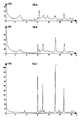
- Figures 1 to 7 collect the X-ray diffraction diagrams obtained for catalysts A to F, using the radiation emitted by a copper anticathode tube and filtered at the wavelength of the line K aj p ha of this metal (0.15405 nanometers) on a PHILIPS model PW1050 goniometer fitted with a rear monochromator.
- the signal was recorded by a counting chain fed by the detector; sample and detector advance step by step.
- a counting time of 5 seconds per step was chosen, the step being fixed at 2.5 hundredths of a theta degree of BRAGG.
- This method is for example described in "Physical Methods of the Study of Minerals and Solid Materials" by JP EBERHART, pages 195 and following, in the editions DOIN, Paris, 1976.
- the abscissa scale is graduated in BRAGG angles, and the ordinates are in arbitrary units of intensity of diffracted radiation.
- the diagrams of 3 catalysts D, F, B, A, M, and N are shown on the same scale in FIGS. 1 to 4 and 10 and 11 respectively.
- FIGS. 5 to 7 respectively the diagrams of catalysts A, C and E on the same scale, different from the previous one. It can be seen in these figures that only the catalysts A, C, M and N have a diffraction diagram corresponding to the particular definition of the catalysts of the invention.
- the hydrodesulfurization test makes it possible to measure the rate V of hydrodesulfurization of dibenzothiophene expressed in moles transformed per second and per gram of catalyst.
- Table 6 collates the results of the hydrorefining and hydrodesulfurization tests. It clearly highlights the superior hydrorefining activities of the catalysts of the invention A, C, M and N compared with the catalysts of the prior art HR 306 and HR 346 on the one hand, and compared on the other hand with catalysts such as D, E, and F, which have neither a composition nor a diffraction diagram corresponding to the definitions of the catalysts of the invention.
- Catalyst B prepared according to the method of the invention but whose diffraction diagram does not correspond to that of the preferred catalysts of the invention is less effective in hydrorefining than catalysts A, C, M, and N. It is however more active in hydrorefining than the catalysts of the prior art.
- the catalysts A, C, M and N of the invention are equivalent, or even slightly more active than the catalysts of the prior art.
- Catalysts D to F which have neither a composition nor a diffraction diagram corresponding to the definitions of the invention are significantly less active.
- catalysts G, HI, J, and K are prepared as indicated in example 1, but by regulating the coprecipitation pH 4.5 for G, 8 for H, 4 for I, 9 for J, and without regulating the pH for K.
- catalysts G to K in the catalytic hydrorefining and hydrodesulfurization tests are also indicated in Table 6, and they can be compared with those obtained for catalyst A according to the invention for the preparation of which the pH was regulated. at the value 5. It can be seen that the preparation method as claimed only leads to catalysts having good activity when the pH is maintained at a value of between 4.5 and 8 during the co-precipitation. Maintaining the pH within the limits defined for the preparation method according to the invention is particularly important in order to obtain catalysts for hydrodesulfurization activity greater than or comparable to that of the catalysts of the prior art.
- Catalyst L is prepared by proceeding as for catalyst A of Example 1, but carrying out the co-precipitation in the presence of air.
- the X-ray diffraction diagram of the catalyst L is also given in FIG. 9 (where it can be compared to the diagram corresponding to the catalyst A reproduced on the same scale: FIG. 8) and the characteristics of this diagram are indicated in the table. 4.
- This catalyst is rich in molybdenum dioxide since the height of the main line of this compound is greater than 10 times that of the line (002) of molybdenite.
- the activities of catalyst L measured in the hydrorefining tests and hydrodesulfurization are shown in Table 6. They are very low compared to those obtained for catalyst A.
- Catalysts A1 to A8 are prepared by proceeding as indicated in Example 1 for catalyst A, but using solutions of metal salts described in Table 7. Their activities in the hydrorefining and hydrodesulfurization tests are compared to that catalyst A and HR 306 and 346 catalysts according to the prior art in Table 8.
- This example shows that catalysts prepared according to the method of the invention based on different combinations of at least one cobalt, iron sulfide, and / or nickel, with at least one molybdenum and / or tungsten sulfide also show progress compared to the supported catalysts of the prior art with regard to the activity in hydrorefining.
- the catalyst A2 combining nickel and cobalt with molybdenum is the most active.
- the catalysts A9, A10, A11 and A12 are prepared as in Example 1 for catalyst A, but starting with nickel sulfate hexahydrate and nickel chloride hexahydrate respectively, instead of nickel nitrate hexahydrate, dimolybdate of ammonium and ammonium salt of phosphomolybdic acid instead of ammonium heptamolybdate.
- the amounts of salt are determined so as to bring into play each time the same number of atoms of nickel and molybdenum as for the preparation of catalyst A.
- the finished catalysts have the same ratio of the number of atoms of nickel to the number total of metallic atoms as catalyst A, but A9 contains sulfur bound as sulphates, A10 contains chlorine and A12 contains phosphorus.
- Catalysts A9 to A12 are evaluated in the hydrorefining and hydrodesulfurization catalytic tests and compared to catalyst A and to the HR 306 and HR 346 catalysts of the prior art. The results obtained are presented in Table 8.
- the catalysts A9 and A10 are slightly less active than A, that A11 is equivalent to it and that A12 has a higher activity.
- Catalysts A9 to A12 are however all more active in hydrorefining than the catalysts of the prior art, and comparable to superior in hydrodesulfurization.
- a solution of 76 g of cobalt nitrate hexahydrate in 300 cm 3 of distilled water is prepared and a solution of 19.8 g of ammonium heptamolybdate containing 4 molecules of water in 300 cm 3 of distilled water.
- the two solutions are brought to 70 ° C., then mixed.
- the mixture is slowly introduced into a flask with vigorous stirring containing 500 cm 3 of ammonium sulfide in aqueous solution at 20% by weight, maintained at 70 ° C. When the introduction is complete, the flask is kept under stirring at 70 ° C. until the liquid has completely evaporated.
- the dry product is collected, heated from ambient to 400 ° C in 250 min, maintained at 400 ° C for 4 hours, then cooled to ambient, all under a stream of H 2 containing 3 % by volume of H 2 S. At the end of this resulfurization, the solid is swept by a stream of nitrogen, then of argon, then conditioned under argon. About 40 g of catalyst A13 are thus collected, prepared according to the original "HSP" method described by Topsoe et al. (already mentioned) to prepare mixed sulfides of cobalt and molybdenum.
- Catalysts A13 and A14 are subjected to hydrorefining and hydrodesulfurization tests. The results obtained have been reported in Table 8 and can be compared with those obtained for the catalyst A1 prepared by the method according to the invention. Catalysts A1, A13 and A14 have the same elemental composition. The catalysts A1 and A13 have comparable hydrodesulfurization activities, but A1 is much more active in hydrorefining. Catalyst A14 was the least active in both tests.
- catalyst A prepared as in Example 1, including an extrusion step to obtain cylindrical particles with a diameter of 0.8 mm and an average length of 5 mm, which are then introduced away from atmospheric air in the tubular reactor of a pilot unit of the CATATEST type, marketed by the company GEOMECANIQUE.
- Such an apparatus is known for carrying out catalytic hydrorefining tests of real petroleum fractions, on a small scale, but under industrial and continuous operating conditions.
- the CATATEST is pressurized to 6 MPa under pure hydrogen.
- the hydrogen flow rate is fixed at 100 l / h (TPN), and the temperature of the heating shells is increased at the rate of approximately 10 ° C. per minute.
- TPN 100 l / h
- the unit is supplied with a charge of medium diesel oil, previously withdrawn from the liquid effluent distillation column of a delayed coking unit.
- This diesel has an initial point of 160 ° C and an end point of 350 ° C, a sulfur content of about 0.5% by weight, and a nitrogen content of about 0.05% by weight.
- the diesel flow rate at the CATATEST inlet is fixed at 500 ml / h, the flow rate of hydrogen supplied at 200 l / h. and the temperature of the reactor is increased at a rate of 10 ° C / min up to 360 ° C, a temperature which is subsequently maintained uniform throughout the reactor.
- the hydrotreated diesel produced during the first 24 hours of stabilization is eliminated, then the accumulated liquid recipes are taken every two hours, treated with finely divided zinc oxide to remove the dissolved hydrogen sulphide and analyzed.
- the residual sulfur content is 0.20% by weight
- the bromine index is less than 1
- catalyst A according to the invention therefore makes it possible to achieve the most difficult of the specifications required for the use of this diesel oil by reducing the volume of catalyst required by a factor of 4, without changing the operating conditions.
Landscapes
- Chemical & Material Sciences (AREA)
- Engineering & Computer Science (AREA)
- Chemical Kinetics & Catalysis (AREA)
- Organic Chemistry (AREA)
- Oil, Petroleum & Natural Gas (AREA)
- Materials Engineering (AREA)
- General Chemical & Material Sciences (AREA)
- Crystallography & Structural Chemistry (AREA)
- Catalysts (AREA)
- Production Of Liquid Hydrocarbon Mixture For Refining Petroleum (AREA)
Applications Claiming Priority (2)
| Application Number | Priority Date | Filing Date | Title |
|---|---|---|---|
| FR8316944 | 1983-10-25 | ||
| FR8316944A FR2553680B1 (fr) | 1983-10-25 | 1983-10-25 | Catalyseurs a base de sulfures de metaux du groupe viii et du groupe vib, pour les reactions d'hydrotraitement des coupes d'hydrocarbures contenant du soufre |
Publications (2)
| Publication Number | Publication Date |
|---|---|
| EP0143020A1 EP0143020A1 (fr) | 1985-05-29 |
| EP0143020B1 true EP0143020B1 (fr) | 1987-03-18 |
Family
ID=9293469
Family Applications (1)
| Application Number | Title | Priority Date | Filing Date |
|---|---|---|---|
| EP84401869A Expired EP0143020B1 (fr) | 1983-10-25 | 1984-09-21 | Catalyseurs à base de sulfures de métaux du groupe VIII et du groupe VIB, leur fabrication et leur utilisation dans les réactions d'hydrotraitement des coupes d'hydrocarbures contenant du soufre |
Country Status (7)
| Country | Link |
|---|---|
| US (1) | US4596785A (da) |
| EP (1) | EP0143020B1 (da) |
| JP (1) | JPS6094140A (da) |
| CA (1) | CA1232895A (da) |
| DE (1) | DE3462658D1 (da) |
| DK (1) | DK164263C (da) |
| FR (1) | FR2553680B1 (da) |
Families Citing this family (51)
| Publication number | Priority date | Publication date | Assignee | Title |
|---|---|---|---|---|
| EP0215989A1 (en) * | 1985-08-06 | 1987-04-01 | Exxon Research And Engineering Company | Amorphous, iron promoted mo and w sulfide hydroprocessing catalysts and uses thereof |
| US4687647A (en) * | 1987-01-08 | 1987-08-18 | Lloyd Berg | Conversion of molybdenite to molybdenum dioxide using petroleum or coal tar pitches |
| US4729980A (en) * | 1987-04-27 | 1988-03-08 | Intevep, S.A. | Catalyst for the simultaneous hydrodemetallization and hydroconversion of heavy hydrocarbon feedstocks and process for preparing the catalyst |
| US5349109A (en) * | 1991-06-04 | 1994-09-20 | The Board Of Regents Of The University Of Oklahoma | Molybdenum-catalyzed amination of olefins |
| US7513989B1 (en) | 1997-07-15 | 2009-04-07 | Exxonmobil Research And Engineering Company | Hydrocracking process using bulk group VIII/Group VIB catalysts |
| US6783663B1 (en) | 1997-07-15 | 2004-08-31 | Exxonmobil Research And Engineering Company | Hydrotreating using bulk multimetallic catalysts |
| US6635599B1 (en) * | 1997-07-15 | 2003-10-21 | Exxonmobil Research & Engineering Company | Mixed metal catalyst, its preparation by co-precipitation, and its use |
| US6582590B1 (en) | 1997-07-15 | 2003-06-24 | Exxonmobil Research And Engineering Company | Multistage hydroprocessing using bulk multimetallic catalyst |
| US6929738B1 (en) | 1997-07-15 | 2005-08-16 | Exxonmobil Research And Engineering Company | Two stage process for hydrodesulfurizing distillates using bulk multimetallic catalyst |
| US7232515B1 (en) | 1997-07-15 | 2007-06-19 | Exxonmobil Research And Engineering Company | Hydrofining process using bulk group VIII/Group VIB catalysts |
| US6162350A (en) * | 1997-07-15 | 2000-12-19 | Exxon Research And Engineering Company | Hydroprocessing using bulk Group VIII/Group VIB catalysts (HEN-9901) |
| US6712955B1 (en) | 1997-07-15 | 2004-03-30 | Exxonmobil Research And Engineering Company | Slurry hydroprocessing using bulk multimetallic catalysts |
| US7229548B2 (en) * | 1997-07-15 | 2007-06-12 | Exxonmobil Research And Engineering Company | Process for upgrading naphtha |
| US7288182B1 (en) | 1997-07-15 | 2007-10-30 | Exxonmobil Research And Engineering Company | Hydroprocessing using bulk Group VIII/Group VIB catalysts |
| US6534437B2 (en) | 1999-01-15 | 2003-03-18 | Akzo Nobel N.V. | Process for preparing a mixed metal catalyst composition |
| KR100637577B1 (ko) * | 1999-01-15 | 2006-10-20 | 알베마를 네덜란드 비.브이. | 혼합 금속 촉매, 공침에 의한 이의 제조 방법 및 이의 용도 |
| RU2279313C2 (ru) | 2000-07-12 | 2006-07-10 | Альбемарл Недерландс Б.В. | Смешанный металлический катализатор, содержащий горючее связующее |
| DE60134140D1 (de) * | 2000-07-12 | 2008-07-03 | Albemarle Netherlands Bv | Verfahren zur herstellung eines ein additiv enthaltenden mischmetallkatalysators |
| US7691257B2 (en) * | 2004-04-22 | 2010-04-06 | Exxonmobil Research And Engineering Company | Process to manufacture low sulfur diesel fuels |
| US20050236304A1 (en) * | 2004-04-22 | 2005-10-27 | Soled Stuart L | Process to manufacture lube oil products |
| US7780845B2 (en) * | 2004-04-22 | 2010-08-24 | Exxonmobil Research And Engineering Company | Process to manufacture low sulfur distillates |
| US7776205B2 (en) * | 2004-04-22 | 2010-08-17 | Exxonmobil Research And Engineering Company | Process to upgrade hydrocarbonaceous feedstreams |
| US7648941B2 (en) * | 2004-09-22 | 2010-01-19 | Exxonmobil Research And Engineering Company | Bulk bimetallic catalysts, method of making bulk bimetallic catalysts and hydroprocessing using bulk bimetallic catalysts |
| KR101281134B1 (ko) * | 2005-04-21 | 2013-07-02 | 리서치 인스티튜트 오브 페트롤리움 프로세싱 시노펙 | 수소첨가 촉매 및 그의 응용 |
| US8062508B2 (en) * | 2005-10-26 | 2011-11-22 | Exxonmobil Research And Engineering Company | Hydroprocessing using bulk bimetallic catalysts |
| WO2007059621A1 (en) * | 2005-11-23 | 2007-05-31 | Pedro Pereira-Almao | Ultradispersed catalyst compositions and methods of preparation |
| JP5010409B2 (ja) * | 2007-09-14 | 2012-08-29 | トヨタ自動車株式会社 | 硫化物の単結晶微粉末、及びその製造方法 |
| US20090023965A1 (en) | 2008-05-01 | 2009-01-22 | Intevep, S.A. | Dispersed metal sulfide-based catalysts |
| IT1398288B1 (it) | 2009-09-30 | 2013-02-22 | Eni Spa | Ossidi misti di metalli di transizione, catalizzatori di idrotrattamento da essi ottenuti, e processo di preparazione comprendente procedimenti sol-gel |
| CA2781893C (en) | 2009-12-08 | 2016-10-04 | Exxonmobil Research And Engineering Company | Hydroprocessing of high nitrogen feed using bulk catalyst |
| US9168506B2 (en) * | 2010-01-21 | 2015-10-27 | Intevep, S.A. | Additive for hydroconversion process and method for making and using same |
| CA2785580A1 (en) * | 2010-01-21 | 2011-07-28 | Shell Internationale Research Maatschappij B.V. | Process for treating a hydrocarbon-containing feed |
| SG181796A1 (en) * | 2010-01-21 | 2012-07-30 | Shell Int Research | Process for treating a hydrocarbon-containing feed |
| US8940268B2 (en) * | 2010-01-21 | 2015-01-27 | Shell Oil Company | Process for producing a thiometallate or a selenometallate material |
| EP2526166A2 (en) | 2010-01-21 | 2012-11-28 | Shell Oil Company | Hydrocarbon composition |
| WO2011091208A2 (en) * | 2010-01-21 | 2011-07-28 | Shell Oil Company | Process for treating a hydrocarbon-containing feed |
| WO2011091199A1 (en) * | 2010-01-21 | 2011-07-28 | Shell Oil Company | Process for producing a thiometallate or a selenometallate material |
| WO2011091200A2 (en) * | 2010-01-21 | 2011-07-28 | Shell Oil Company | Hydrocarbon composition |
| EP2526062B1 (en) * | 2010-01-21 | 2020-03-18 | Shell Oil Company | Process for producing a copper thiometallate or a selenometallate material |
| SG181825A1 (en) * | 2010-01-21 | 2012-07-30 | Shell Int Research | Process for treating a hydrocarbon-containing feed |
| EP2526167A2 (en) * | 2010-01-21 | 2012-11-28 | Shell Oil Company | Hydrocarbon composition |
| EP2526173A2 (en) | 2010-01-21 | 2012-11-28 | Shell Oil Company | Process for cracking a hydrocarbon-containing feed |
| EP2526172A2 (en) * | 2010-01-21 | 2012-11-28 | Shell Oil Company | Process for cracking a hydrocarbon-containing feed |
| CA2784208C (en) * | 2010-01-21 | 2018-06-26 | Shell Internationale Research Maatschappij B.V. | Nano-tetrathiometallate or nano-tetraselenometallate material |
| WO2011091221A2 (en) * | 2010-01-21 | 2011-07-28 | Shell Oil Company | Manganese tetrathiotungstate material |
| GB2478332A (en) | 2010-03-04 | 2011-09-07 | Grimley Smith Associates | Method of metals recovery from refinery residues |
| WO2012078837A2 (en) | 2010-12-10 | 2012-06-14 | Shell Oil Company | Process for treating a hydrocarbon-containing feed |
| US8858784B2 (en) | 2010-12-10 | 2014-10-14 | Shell Oil Company | Process for treating a hydrocarbon-containing feed |
| WO2012078836A1 (en) | 2010-12-10 | 2012-06-14 | Shell Oil Company | Hydrocracking of a heavy hydrocarbon feedstock using a copper molybdenum sulfided catalyst |
| ITMI20110510A1 (it) | 2011-03-30 | 2012-10-01 | Eni Spa | Ossidi misti di metalli di transizione, catalizzatori di idrotrattamento da essi ottenuti, e processo di preparazione |
| IT201700037970A1 (it) | 2017-04-06 | 2018-10-06 | Eni Spa | Idrotrattamento di cariche da fonti rinnovabili con catalizzatori ad elevato contenuto di fase attiva |
Family Cites Families (8)
| Publication number | Priority date | Publication date | Assignee | Title |
|---|---|---|---|---|
| FR830135A (fr) * | 1937-02-12 | 1938-07-21 | Int Hydrogenation Patents Co | Procédé pour le traitement thermique de matières carbonées et catalyseurs propres à cet usage |
| US2394739A (en) * | 1942-03-16 | 1946-02-12 | Shell Dev | Dehydrogenation of hydrocarbons |
| US2595772A (en) * | 1949-12-08 | 1952-05-06 | Standard Oil Dev Co | Method of preparing catalysts |
| US3017368A (en) * | 1959-03-13 | 1962-01-16 | Gulf Research Development Co | Process for preparation of a catalyst |
| FR1482144A (fr) * | 1966-04-12 | 1967-05-26 | Exxon Research Engineering Co | Perfectionnement aux catalyseurs d'hydroraffinage |
| NL6806576A (da) * | 1967-05-16 | 1968-11-18 | ||
| BE755422A (fr) * | 1969-09-08 | 1971-03-01 | Inst Francais Du Petrole | Fabrication de catalyseurs du type molybdate de fer utilisablesnotamment pour l'oxydation catalytique des alcools en |
| US4243554A (en) * | 1979-06-11 | 1981-01-06 | Union Carbide Corporation | Molybdenum disulfide catalyst and the preparation thereof |
-
1983
- 1983-10-25 FR FR8316944A patent/FR2553680B1/fr not_active Expired
-
1984
- 1984-09-17 CA CA000463422A patent/CA1232895A/fr not_active Expired
- 1984-09-21 JP JP59199344A patent/JPS6094140A/ja active Granted
- 1984-09-21 EP EP84401869A patent/EP0143020B1/fr not_active Expired
- 1984-09-21 DK DK452284A patent/DK164263C/da not_active IP Right Cessation
- 1984-09-21 DE DE8484401869T patent/DE3462658D1/de not_active Expired
- 1984-09-24 US US06/653,643 patent/US4596785A/en not_active Expired - Lifetime
Also Published As
| Publication number | Publication date |
|---|---|
| DK164263C (da) | 1992-10-26 |
| JPH0475059B2 (da) | 1992-11-27 |
| US4596785A (en) | 1986-06-24 |
| EP0143020A1 (fr) | 1985-05-29 |
| CA1232895A (fr) | 1988-02-16 |
| FR2553680A1 (fr) | 1985-04-26 |
| DK452284A (da) | 1985-04-26 |
| FR2553680B1 (fr) | 1987-09-18 |
| JPS6094140A (ja) | 1985-05-27 |
| DK164263B (da) | 1992-06-01 |
| DK452284D0 (da) | 1984-09-21 |
| DE3462658D1 (en) | 1987-04-23 |
Similar Documents
| Publication | Publication Date | Title |
|---|---|---|
| CA1232895A (fr) | Catalyseurs a base de sulfures de metaux du groupe viii et du groupe vib, leur fabrication et leur utilisation dans les reactions d'hydrotraitement des coupes d'hydrocarbures contenant du soufre | |
| EP0133031B1 (en) | Bulk and supported, self-promoted molybdenum and tungsten sulfide catalysts formed from bis(tetrathiometallate) precursors and their preparation and use for hydrotreating | |
| EP0313480B1 (fr) | Procédé de production de carbure de silicium à grande surface spécifique et application à des réactions catalytiques à temperature élevée | |
| EP0958054B1 (fr) | Procede pour la presulfuration de catalyseurs | |
| FR2469954A1 (fr) | Catalyseur pour l'hydrotraitement d'huiles hydrocarbonees lourdes, procede pour sa preparation et procede d'hydrotraitement d'huiles hydrocarbonees lourdes l'utilisant | |
| FR2843050A1 (fr) | Catalyseur a base de metaux du groupe vi et du groupe viii presents au moins en partie sous la forme d'heteropolyanions dans le precurseur oxyde | |
| EP0329499A1 (fr) | Procédé de présulfuration de catalyseur de traitement d'hydrocarbures | |
| FR2556235A1 (fr) | Procede de fabrication d'un catalyseur a base d'alumine | |
| JPS6099342A (ja) | ビス(テトラチオメタレ−ト)前駆体から形成される嵩高で担体を有する自己促進型の硫化モリブデン及び硫化タングステン触媒、その調製法及び水素化処理への使用 | |
| JPS61245846A (ja) | 無定形の鉄で助触媒されるMo及びW硫化物水素化処理触媒及びその使用法 | |
| EP2799132A1 (fr) | Procédé de préparation d'un catalyseur à base de tungstène utilisable en hydrotraitement ou en hydrocraquage | |
| FR2923837A1 (fr) | Procede de desulfuration en deux etapes d'essences olefiniques comprenant de l'arsenic. | |
| Khani et al. | Study of MoO3-γAl2O3 catalysts behavior in selective catalytic reduction of SO2 toxic gas to sulfur with CH4 | |
| US20070284289A1 (en) | Process to prepare mixed molded carbide and nitrite material and its application as a catalyst in hydrotreatment processes | |
| FR2556363A1 (fr) | Procede d'hydrotraitement d'hydrocarbures | |
| CA2521867C (fr) | Procede d'impregnation de catalyseurs d'hydrotraitement par un orthophtalate et procede de sulfuration le mettant en oeuvre | |
| RU2473387C1 (ru) | Способ получения массивного катализатора гидропереработки тяжелых нефтяных фракций | |
| EA030219B1 (ru) | Получение смешанных спиртов из синтетического газа | |
| WO2021013528A1 (fr) | Procédé de production d'une essence a basse teneur en soufre et en mercaptans | |
| FR2546175A1 (fr) | Procede de production d'un catalyseur d'hydrodemetallation de bruts lourds et de residus | |
| EP4251714A1 (fr) | Procede d'hydrodesulfuration mettant en oeuvre un catalyseur comprenant un support d'alumine flash | |
| FR2614311A1 (fr) | Catalyseur d'hydrometallisation et d'hydroconversion de charges d'alimentation d'hydrocarbure lourd et procede de preparation de celui-ci. | |
| WO2021013526A1 (fr) | Procédé de production d'une essence a basse teneur en soufre et en mercaptans | |
| EP4004157A1 (fr) | Procédé de production d'une essence a basse teneur en soufre et en mercaptans | |
| WO2023117533A1 (fr) | Procede de traitement d'une essence contenant des composes soufres comprenant une etape de dilution |
Legal Events
| Date | Code | Title | Description |
|---|---|---|---|
| PUAI | Public reference made under article 153(3) epc to a published international application that has entered the european phase |
Free format text: ORIGINAL CODE: 0009012 |
|
| AK | Designated contracting states |
Designated state(s): BE DE GB IT NL |
|
| 17P | Request for examination filed |
Effective date: 19850627 |
|
| 17Q | First examination report despatched |
Effective date: 19860530 |
|
| ITF | It: translation for a ep patent filed | ||
| GRAA | (expected) grant |
Free format text: ORIGINAL CODE: 0009210 |
|
| AK | Designated contracting states |
Kind code of ref document: B1 Designated state(s): BE DE GB IT NL |
|
| REF | Corresponds to: |
Ref document number: 3462658 Country of ref document: DE Date of ref document: 19870423 |
|
| PLBE | No opposition filed within time limit |
Free format text: ORIGINAL CODE: 0009261 |
|
| STAA | Information on the status of an ep patent application or granted ep patent |
Free format text: STATUS: NO OPPOSITION FILED WITHIN TIME LIMIT |
|
| 26N | No opposition filed | ||
| ITTA | It: last paid annual fee | ||
| PGFP | Annual fee paid to national office [announced via postgrant information from national office to epo] |
Ref country code: BE Payment date: 20010924 Year of fee payment: 18 |
|
| REG | Reference to a national code |
Ref country code: GB Ref legal event code: IF02 |
|
| PG25 | Lapsed in a contracting state [announced via postgrant information from national office to epo] |
Ref country code: BE Free format text: LAPSE BECAUSE OF NON-PAYMENT OF DUE FEES Effective date: 20020930 |
|
| BERE | Be: lapsed |
Owner name: *INSTITUT FRANCAIS DU PETROLE Effective date: 20020930 |
|
| PGFP | Annual fee paid to national office [announced via postgrant information from national office to epo] |
Ref country code: GB Payment date: 20030818 Year of fee payment: 20 |
|
| PGFP | Annual fee paid to national office [announced via postgrant information from national office to epo] |
Ref country code: NL Payment date: 20030930 Year of fee payment: 20 |
|
| PGFP | Annual fee paid to national office [announced via postgrant information from national office to epo] |
Ref country code: DE Payment date: 20031002 Year of fee payment: 20 |
|
| PG25 | Lapsed in a contracting state [announced via postgrant information from national office to epo] |
Ref country code: GB Free format text: LAPSE BECAUSE OF EXPIRATION OF PROTECTION Effective date: 20040920 |
|
| PG25 | Lapsed in a contracting state [announced via postgrant information from national office to epo] |
Ref country code: NL Free format text: LAPSE BECAUSE OF EXPIRATION OF PROTECTION Effective date: 20040921 |
|
| REG | Reference to a national code |
Ref country code: GB Ref legal event code: PE20 |
|
| NLV7 | Nl: ceased due to reaching the maximum lifetime of a patent |
Effective date: 20040921 |