EP0143175B2 - Formaldehydfreie wässrige Kunststoffdispersionen auf Basis eines vernetzbaren Polymerisats, Verfahren zu ihrer Herstellung und ihre Verwendung - Google Patents
Formaldehydfreie wässrige Kunststoffdispersionen auf Basis eines vernetzbaren Polymerisats, Verfahren zu ihrer Herstellung und ihre Verwendung Download PDFInfo
- Publication number
- EP0143175B2 EP0143175B2 EP84109152A EP84109152A EP0143175B2 EP 0143175 B2 EP0143175 B2 EP 0143175B2 EP 84109152 A EP84109152 A EP 84109152A EP 84109152 A EP84109152 A EP 84109152A EP 0143175 B2 EP0143175 B2 EP 0143175B2
- Authority
- EP
- European Patent Office
- Prior art keywords
- dispersions
- crosslinkable polymer
- formula
- methylolamide
- formaldehyde
- Prior art date
- Legal status (The legal status is an assumption and is not a legal conclusion. Google has not performed a legal analysis and makes no representation as to the accuracy of the status listed.)
- Expired - Lifetime
Links
- 239000006185 dispersion Substances 0.000 title claims abstract description 58
- 238000000034 method Methods 0.000 title claims abstract description 13
- 238000002360 preparation method Methods 0.000 title claims abstract description 5
- WSFSSNUMVMOOMR-NJFSPNSNSA-N methanone Chemical compound O=[14CH2] WSFSSNUMVMOOMR-NJFSPNSNSA-N 0.000 title description 6
- 229920000642 polymer Polymers 0.000 claims abstract description 33
- 229920003023 plastic Polymers 0.000 claims abstract description 27
- 239000004033 plastic Substances 0.000 claims abstract description 27
- 150000001875 compounds Chemical class 0.000 claims abstract description 17
- XMYQHJDBLRZMLW-UHFFFAOYSA-N methanolamine Chemical compound NCO XMYQHJDBLRZMLW-UHFFFAOYSA-N 0.000 claims abstract description 15
- 239000000178 monomer Substances 0.000 claims abstract description 11
- 230000008569 process Effects 0.000 claims abstract description 5
- 125000004178 (C1-C4) alkyl group Chemical group 0.000 claims abstract description 4
- QVGXLLKOCUKJST-UHFFFAOYSA-N atomic oxygen Chemical compound [O] QVGXLLKOCUKJST-UHFFFAOYSA-N 0.000 claims abstract description 4
- 229910052760 oxygen Inorganic materials 0.000 claims abstract description 4
- 239000001301 oxygen Substances 0.000 claims abstract description 4
- 239000004745 nonwoven fabric Substances 0.000 claims description 15
- 238000004132 cross linking Methods 0.000 claims description 12
- 238000000576 coating method Methods 0.000 claims description 7
- CNCOEDDPFOAUMB-UHFFFAOYSA-N N-Methylolacrylamide Chemical group OCNC(=O)C=C CNCOEDDPFOAUMB-UHFFFAOYSA-N 0.000 claims description 6
- PPBRXRYQALVLMV-UHFFFAOYSA-N Styrene Chemical compound C=CC1=CC=CC=C1 PPBRXRYQALVLMV-UHFFFAOYSA-N 0.000 claims description 6
- 239000002253 acid Substances 0.000 claims description 6
- 150000007524 organic acids Chemical class 0.000 claims description 6
- SMZOUWXMTYCWNB-UHFFFAOYSA-N 2-(2-methoxy-5-methylphenyl)ethanamine Chemical compound COC1=CC=C(C)C=C1CCN SMZOUWXMTYCWNB-UHFFFAOYSA-N 0.000 claims description 5
- NIXOWILDQLNWCW-UHFFFAOYSA-N 2-Propenoic acid Natural products OC(=O)C=C NIXOWILDQLNWCW-UHFFFAOYSA-N 0.000 claims description 5
- -1 maleic acid diesters Chemical class 0.000 claims description 5
- 239000000203 mixture Substances 0.000 claims description 5
- HRPVXLWXLXDGHG-UHFFFAOYSA-N Acrylamide Chemical compound NC(=O)C=C HRPVXLWXLXDGHG-UHFFFAOYSA-N 0.000 claims description 4
- CERQOIWHTDAKMF-UHFFFAOYSA-N Methacrylic acid Chemical compound CC(=C)C(O)=O CERQOIWHTDAKMF-UHFFFAOYSA-N 0.000 claims description 4
- 239000000123 paper Substances 0.000 claims description 4
- 239000007787 solid Substances 0.000 claims description 4
- 239000012209 synthetic fiber Substances 0.000 claims description 4
- VGGSQFUCUMXWEO-UHFFFAOYSA-N Ethene Chemical compound C=C VGGSQFUCUMXWEO-UHFFFAOYSA-N 0.000 claims description 3
- 239000005977 Ethylene Substances 0.000 claims description 3
- OFOBLEOULBTSOW-UHFFFAOYSA-N Propanedioic acid Natural products OC(=O)CC(O)=O OFOBLEOULBTSOW-UHFFFAOYSA-N 0.000 claims description 3
- XTXRWKRVRITETP-UHFFFAOYSA-N Vinyl acetate Chemical compound CC(=O)OC=C XTXRWKRVRITETP-UHFFFAOYSA-N 0.000 claims description 3
- BZHJMEDXRYGGRV-UHFFFAOYSA-N Vinyl chloride Chemical compound ClC=C BZHJMEDXRYGGRV-UHFFFAOYSA-N 0.000 claims description 3
- 150000007513 acids Chemical class 0.000 claims description 3
- 125000005396 acrylic acid ester group Chemical group 0.000 claims description 3
- 229920001577 copolymer Polymers 0.000 claims description 3
- UIWXSTHGICQLQT-UHFFFAOYSA-N ethenyl propanoate Chemical compound CCC(=O)OC=C UIWXSTHGICQLQT-UHFFFAOYSA-N 0.000 claims description 3
- 239000011976 maleic acid Substances 0.000 claims description 3
- 239000000463 material Substances 0.000 claims description 3
- 239000002557 mineral fiber Substances 0.000 claims description 3
- 235000005985 organic acids Nutrition 0.000 claims description 3
- VZCYOOQTPOCHFL-UHFFFAOYSA-N trans-butenedioic acid Natural products OC(=O)C=CC(O)=O VZCYOOQTPOCHFL-UHFFFAOYSA-N 0.000 claims description 3
- 229920001567 vinyl ester resin Polymers 0.000 claims description 3
- NLHHRLWOUZZQLW-UHFFFAOYSA-N Acrylonitrile Chemical compound C=CC#N NLHHRLWOUZZQLW-UHFFFAOYSA-N 0.000 claims description 2
- 230000001476 alcoholic effect Effects 0.000 claims description 2
- 150000001735 carboxylic acids Chemical class 0.000 claims description 2
- 239000011248 coating agent Substances 0.000 claims description 2
- 239000004744 fabric Substances 0.000 claims description 2
- 230000036541 health Effects 0.000 claims description 2
- 238000005470 impregnation Methods 0.000 claims description 2
- FQPSGWSUVKBHSU-UHFFFAOYSA-N methacrylamide Chemical compound CC(=C)C(N)=O FQPSGWSUVKBHSU-UHFFFAOYSA-N 0.000 claims description 2
- KCTMTGOHHMRJHZ-UHFFFAOYSA-N n-(2-methylpropoxymethyl)prop-2-enamide Chemical group CC(C)COCNC(=O)C=C KCTMTGOHHMRJHZ-UHFFFAOYSA-N 0.000 claims description 2
- 229920002994 synthetic fiber Polymers 0.000 claims description 2
- 229920001897 terpolymer Polymers 0.000 claims description 2
- 125000000391 vinyl group Chemical group [H]C([*])=C([H])[H] 0.000 claims description 2
- 238000005728 strengthening Methods 0.000 claims 3
- 238000004026 adhesive bonding Methods 0.000 claims 2
- VZCYOOQTPOCHFL-UPHRSURJSA-N maleic acid Chemical compound OC(=O)\C=C/C(O)=O VZCYOOQTPOCHFL-UPHRSURJSA-N 0.000 claims 1
- 239000002759 woven fabric Substances 0.000 claims 1
- WSFSSNUMVMOOMR-UHFFFAOYSA-N Formaldehyde Chemical compound O=C WSFSSNUMVMOOMR-UHFFFAOYSA-N 0.000 description 42
- YAMHXTCMCPHKLN-UHFFFAOYSA-N imidazolidin-2-one Chemical compound O=C1NCCN1 YAMHXTCMCPHKLN-UHFFFAOYSA-N 0.000 description 11
- OKKJLVBELUTLKV-UHFFFAOYSA-N Methanol Chemical group OC OKKJLVBELUTLKV-UHFFFAOYSA-N 0.000 description 7
- XSQUKJJJFZCRTK-UHFFFAOYSA-N Urea Chemical compound NC(N)=O XSQUKJJJFZCRTK-UHFFFAOYSA-N 0.000 description 5
- 238000004519 manufacturing process Methods 0.000 description 5
- 238000003860 storage Methods 0.000 description 5
- XLYOFNOQVPJJNP-UHFFFAOYSA-N water Substances O XLYOFNOQVPJJNP-UHFFFAOYSA-N 0.000 description 5
- OISVCGZHLKNMSJ-UHFFFAOYSA-N 2,6-dimethylpyridine Chemical compound CC1=CC=CC(C)=N1 OISVCGZHLKNMSJ-UHFFFAOYSA-N 0.000 description 4
- LFQSCWFLJHTTHZ-UHFFFAOYSA-N Ethanol Chemical compound CCO LFQSCWFLJHTTHZ-UHFFFAOYSA-N 0.000 description 4
- 229920006254 polymer film Polymers 0.000 description 4
- 239000000654 additive Substances 0.000 description 3
- 239000011230 binding agent Substances 0.000 description 3
- 238000001514 detection method Methods 0.000 description 3
- 230000009257 reactivity Effects 0.000 description 3
- 239000002904 solvent Substances 0.000 description 3
- QGZKDVFQNNGYKY-UHFFFAOYSA-N Ammonia Chemical compound N QGZKDVFQNNGYKY-UHFFFAOYSA-N 0.000 description 2
- 239000004971 Cross linker Substances 0.000 description 2
- 229920000877 Melamine resin Polymers 0.000 description 2
- LRHPLDYGYMQRHN-UHFFFAOYSA-N N-Butanol Chemical compound CCCCO LRHPLDYGYMQRHN-UHFFFAOYSA-N 0.000 description 2
- YRKCREAYFQTBPV-UHFFFAOYSA-N acetylacetone Chemical compound CC(=O)CC(C)=O YRKCREAYFQTBPV-UHFFFAOYSA-N 0.000 description 2
- 230000002378 acidificating effect Effects 0.000 description 2
- 239000008346 aqueous phase Substances 0.000 description 2
- 239000004202 carbamide Substances 0.000 description 2
- 238000006243 chemical reaction Methods 0.000 description 2
- 238000004140 cleaning Methods 0.000 description 2
- HPYNZHMRTTWQTB-UHFFFAOYSA-N dimethylpyridine Natural products CC1=CC=CN=C1C HPYNZHMRTTWQTB-UHFFFAOYSA-N 0.000 description 2
- 239000004815 dispersion polymer Substances 0.000 description 2
- 238000011156 evaluation Methods 0.000 description 2
- 239000000835 fiber Substances 0.000 description 2
- 238000011065 in-situ storage Methods 0.000 description 2
- 229920005989 resin Polymers 0.000 description 2
- 239000011347 resin Substances 0.000 description 2
- 238000007711 solidification Methods 0.000 description 2
- 230000008023 solidification Effects 0.000 description 2
- UMGDCJDMYOKAJW-UHFFFAOYSA-N thiourea Chemical compound NC(N)=S UMGDCJDMYOKAJW-UHFFFAOYSA-N 0.000 description 2
- 150000003672 ureas Chemical class 0.000 description 2
- 239000002023 wood Substances 0.000 description 2
- IAXXETNIOYFMLW-UHFFFAOYSA-N (4,7,7-trimethyl-3-bicyclo[2.2.1]heptanyl) 2-methylprop-2-enoate Chemical compound C1CC2(C)C(OC(=O)C(=C)C)CC1C2(C)C IAXXETNIOYFMLW-UHFFFAOYSA-N 0.000 description 1
- BJEPYKJPYRNKOW-REOHCLBHSA-N (S)-malic acid Chemical compound OC(=O)[C@@H](O)CC(O)=O BJEPYKJPYRNKOW-REOHCLBHSA-N 0.000 description 1
- NQPJDJVGBDHCAD-UHFFFAOYSA-N 1,3-diazinan-2-one Chemical compound OC1=NCCCN1 NQPJDJVGBDHCAD-UHFFFAOYSA-N 0.000 description 1
- SLZAMKNXRDJWLA-UHFFFAOYSA-N 1-(5-acetyl-2,6-dimethyl-1,4-dihydropyridin-3-yl)ethanone Chemical compound CC(=O)C1=C(C)NC(C)=C(C(C)=O)C1 SLZAMKNXRDJWLA-UHFFFAOYSA-N 0.000 description 1
- ZYVYEJXMYBUCMN-UHFFFAOYSA-N 1-methoxy-2-methylpropane Chemical compound COCC(C)C ZYVYEJXMYBUCMN-UHFFFAOYSA-N 0.000 description 1
- JJLGDPNMAWKKAU-UHFFFAOYSA-N 2-methylprop-2-enamide;prop-2-enoic acid Chemical compound OC(=O)C=C.CC(=C)C(N)=O JJLGDPNMAWKKAU-UHFFFAOYSA-N 0.000 description 1
- NNTWKXKLHMTGBU-UHFFFAOYSA-N 4,5-dihydroxyimidazolidin-2-one Chemical compound OC1NC(=O)NC1O NNTWKXKLHMTGBU-UHFFFAOYSA-N 0.000 description 1
- ZMGMDXCADSRNCX-UHFFFAOYSA-N 5,6-dihydroxy-1,3-diazepan-2-one Chemical class OC1CNC(=O)NCC1O ZMGMDXCADSRNCX-UHFFFAOYSA-N 0.000 description 1
- 0 C*(CC(*)N1)C(*)*IC1=O Chemical compound C*(CC(*)N1)C(*)*IC1=O 0.000 description 1
- 239000004640 Melamine resin Substances 0.000 description 1
- 229920001807 Urea-formaldehyde Polymers 0.000 description 1
- 239000003377 acid catalyst Substances 0.000 description 1
- 230000004913 activation Effects 0.000 description 1
- 230000000996 additive effect Effects 0.000 description 1
- 230000002411 adverse Effects 0.000 description 1
- 229920000180 alkyd Polymers 0.000 description 1
- 125000000217 alkyl group Chemical group 0.000 description 1
- BJEPYKJPYRNKOW-UHFFFAOYSA-N alpha-hydroxysuccinic acid Natural products OC(=O)C(O)CC(O)=O BJEPYKJPYRNKOW-UHFFFAOYSA-N 0.000 description 1
- 125000003368 amide group Chemical group 0.000 description 1
- 229910021529 ammonia Inorganic materials 0.000 description 1
- 150000008378 aryl ethers Chemical class 0.000 description 1
- 230000008901 benefit Effects 0.000 description 1
- 238000009435 building construction Methods 0.000 description 1
- 125000004432 carbon atom Chemical group C* 0.000 description 1
- 150000001732 carboxylic acid derivatives Chemical group 0.000 description 1
- 239000003054 catalyst Substances 0.000 description 1
- 239000003795 chemical substances by application Substances 0.000 description 1
- 238000003776 cleavage reaction Methods 0.000 description 1
- 238000004891 communication Methods 0.000 description 1
- 239000000470 constituent Substances 0.000 description 1
- 229920006037 cross link polymer Polymers 0.000 description 1
- 239000003431 cross linking reagent Substances 0.000 description 1
- 239000012153 distilled water Substances 0.000 description 1
- 230000008020 evaporation Effects 0.000 description 1
- 238000001704 evaporation Methods 0.000 description 1
- 239000011888 foil Substances 0.000 description 1
- 239000008187 granular material Substances 0.000 description 1
- 238000010438 heat treatment Methods 0.000 description 1
- 230000000622 irritating effect Effects 0.000 description 1
- 239000004922 lacquer Substances 0.000 description 1
- 239000001630 malic acid Substances 0.000 description 1
- 235000011090 malic acid Nutrition 0.000 description 1
- JDSHMPZPIAZGSV-UHFFFAOYSA-N melamine Chemical compound NC1=NC(N)=NC(N)=N1 JDSHMPZPIAZGSV-UHFFFAOYSA-N 0.000 description 1
- 239000003607 modifier Substances 0.000 description 1
- 238000000465 moulding Methods 0.000 description 1
- 210000004400 mucous membrane Anatomy 0.000 description 1
- BBDXEDDPHHVEPB-UHFFFAOYSA-N n-[hydroxy(2-methylpropoxy)methyl]prop-2-enamide Chemical compound CC(C)COC(O)NC(=O)C=C BBDXEDDPHHVEPB-UHFFFAOYSA-N 0.000 description 1
- 230000006855 networking Effects 0.000 description 1
- 238000005580 one pot reaction Methods 0.000 description 1
- 239000003973 paint Substances 0.000 description 1
- 239000012071 phase Substances 0.000 description 1
- 239000000843 powder Substances 0.000 description 1
- 230000000717 retained effect Effects 0.000 description 1
- 150000003839 salts Chemical class 0.000 description 1
- 230000007017 scission Effects 0.000 description 1
- 230000035945 sensitivity Effects 0.000 description 1
- 238000001228 spectrum Methods 0.000 description 1
- 239000000758 substrate Substances 0.000 description 1
- 229920003002 synthetic resin Polymers 0.000 description 1
- 239000000057 synthetic resin Substances 0.000 description 1
- 230000002110 toxicologic effect Effects 0.000 description 1
- 231100000027 toxicology Toxicity 0.000 description 1
- 238000009736 wetting Methods 0.000 description 1
Classifications
-
- D—TEXTILES; PAPER
- D21—PAPER-MAKING; PRODUCTION OF CELLULOSE
- D21H—PULP COMPOSITIONS; PREPARATION THEREOF NOT COVERED BY SUBCLASSES D21C OR D21D; IMPREGNATING OR COATING OF PAPER; TREATMENT OF FINISHED PAPER NOT COVERED BY CLASS B31 OR SUBCLASS D21G; PAPER NOT OTHERWISE PROVIDED FOR
- D21H17/00—Non-fibrous material added to the pulp, characterised by its constitution; Paper-impregnating material characterised by its constitution
- D21H17/20—Macromolecular organic compounds
- D21H17/33—Synthetic macromolecular compounds
- D21H17/34—Synthetic macromolecular compounds obtained by reactions only involving carbon-to-carbon unsaturated bonds
- D21H17/38—Synthetic macromolecular compounds obtained by reactions only involving carbon-to-carbon unsaturated bonds containing crosslinkable groups
- D21H17/39—Synthetic macromolecular compounds obtained by reactions only involving carbon-to-carbon unsaturated bonds containing crosslinkable groups forming ether crosslinkages, e.g. alkylol groups
-
- C—CHEMISTRY; METALLURGY
- C04—CEMENTS; CONCRETE; ARTIFICIAL STONE; CERAMICS; REFRACTORIES
- C04B—LIME, MAGNESIA; SLAG; CEMENTS; COMPOSITIONS THEREOF, e.g. MORTARS, CONCRETE OR LIKE BUILDING MATERIALS; ARTIFICIAL STONE; CERAMICS; REFRACTORIES; TREATMENT OF NATURAL STONE
- C04B26/00—Compositions of mortars, concrete or artificial stone, containing only organic binders, e.g. polymer or resin concrete
- C04B26/02—Macromolecular compounds
- C04B26/04—Macromolecular compounds obtained by reactions only involving carbon-to-carbon unsaturated bonds
-
- C—CHEMISTRY; METALLURGY
- C08—ORGANIC MACROMOLECULAR COMPOUNDS; THEIR PREPARATION OR CHEMICAL WORKING-UP; COMPOSITIONS BASED THEREON
- C08F—MACROMOLECULAR COMPOUNDS OBTAINED BY REACTIONS ONLY INVOLVING CARBON-TO-CARBON UNSATURATED BONDS
- C08F6/00—Post-polymerisation treatments
- C08F6/006—Removal of residual monomers by chemical reaction, e.g. scavenging
-
- C—CHEMISTRY; METALLURGY
- C08—ORGANIC MACROMOLECULAR COMPOUNDS; THEIR PREPARATION OR CHEMICAL WORKING-UP; COMPOSITIONS BASED THEREON
- C08K—Use of inorganic or non-macromolecular organic substances as compounding ingredients
- C08K5/00—Use of organic ingredients
- C08K5/16—Nitrogen-containing compounds
- C08K5/34—Heterocyclic compounds having nitrogen in the ring
- C08K5/3442—Heterocyclic compounds having nitrogen in the ring having two nitrogen atoms in the ring
- C08K5/3445—Five-membered rings
-
- D—TEXTILES; PAPER
- D06—TREATMENT OF TEXTILES OR THE LIKE; LAUNDERING; FLEXIBLE MATERIALS NOT OTHERWISE PROVIDED FOR
- D06M—TREATMENT, NOT PROVIDED FOR ELSEWHERE IN CLASS D06, OF FIBRES, THREADS, YARNS, FABRICS, FEATHERS OR FIBROUS GOODS MADE FROM SUCH MATERIALS
- D06M15/00—Treating fibres, threads, yarns, fabrics, or fibrous goods made from such materials, with macromolecular compounds; Such treatment combined with mechanical treatment
- D06M15/19—Treating fibres, threads, yarns, fabrics, or fibrous goods made from such materials, with macromolecular compounds; Such treatment combined with mechanical treatment with synthetic macromolecular compounds
- D06M15/37—Macromolecular compounds obtained otherwise than by reactions only involving carbon-to-carbon unsaturated bonds
- D06M15/39—Aldehyde resins; Ketone resins; Polyacetals
- D06M15/423—Amino-aldehyde resins
-
- D—TEXTILES; PAPER
- D06—TREATMENT OF TEXTILES OR THE LIKE; LAUNDERING; FLEXIBLE MATERIALS NOT OTHERWISE PROVIDED FOR
- D06M—TREATMENT, NOT PROVIDED FOR ELSEWHERE IN CLASS D06, OF FIBRES, THREADS, YARNS, FABRICS, FEATHERS OR FIBROUS GOODS MADE FROM SUCH MATERIALS
- D06M17/00—Producing multi-layer textile fabrics
- D06M17/04—Producing multi-layer textile fabrics by applying synthetic resins as adhesives
Definitions
- the invention relates to storage-stable aqueous plastic dispersions based on a crosslinkable polymer composed of ethylenically unsaturated monomers and containing N-methylolamide and / or N-methyloletheramide groups, which contain a cyclic urea compound, preferably ethylene urea, as formaldehyde acceptor, which may or may not be present in the dispersion binds virtually completely by cleaving formaldehyde, so that the dispersions without impairing the crosslinkability and also the polymer films produced therefrom are largely free of formaldehyde and thus physiologically harmless.
- the invention further relates to a process for the preparation of said formaldehyde-free dispersions and their use.
- plastic dispersions are particularly important as binders to increase the mechanical strength and to improve the handle, both when using natural and synthetic fibers.
- non-wovens as a disposable article in the sanitary, hygiene and household sectors, with good wetting properties after fiber treatment with finishing agents, a high level of wet resistance is required.
- plastic dispersions with crosslinking groups The required mechanical properties as well as the resistance to cleaning can be achieved particularly cheaply by using plastic dispersions with crosslinking groups.
- the networking of plastic dispersions. optionally advantageous in the presence of catalysts, e.g. Acids or salts lead to a three-dimensional molecular enlargement of the polymer components, which means greater resistance of the products to mechanical stress and greater insensitivity when treated with water and solvents.
- the plastic dispersions in question are predominantly polymers based on vinyl acetate, vinyl propionate, acrylic acid esters, ethylene, styrene, branched aliphatic carboxylic acid vinyl esters (preferably with carboxylic acid residues of 4-18 carbon atoms), vinyl chloride, acrylamide, acrylic acid, Acrylonitrile.
- Methacrylic acid, methacrylamide and similar ethylenically unsaturated monomers, preferably copolymeric combinations of the monomers mentioned with those comonomers which contain groups capable of crosslinking reactions are used to build up the desired polymer properties.
- Components which primarily contain methylol groups are suitable as crosslinkers.
- Polymer portions with basic molecular units of N-methylol derivatives of unsaturated organic acid amides such as e.g. N-methylolacrylamide (NMAA) and / or their alkyl or aryl ether, such as e.g.
- NMAA N-methylolacrylamide
- alkyl or aryl ether such as e.g.
- N- (iso-butoxy-methylol) acrylamide (IBMA) crosslinking agents of this type, however, have the property, if they contain free methylol groups in situ or are formed by cleavage from their derivatives in an aqueous acidic medium, to a small extent to remove formaldehyde, where a balance occurs which is very much on the side of the methylol group incorporated in the polymer.
- the crosslinking of the dispersion polymer via the methylol groups takes place during and after evaporation of the water in a temperature range from 80 to 250 ° C., preferably 120 to 180 ° C., and depends from the duration of the temperature influence and the substrate temperature to be achieved.
- the polymer film after crosslinking is practically free of formaldehyde.
- the above-mentioned crosslinker components containing methylol groups have the particular advantage that they lead to the desired improvements in the mechanical properties of films and coatings and to their solvent resistance in the crosslinked polymers, without losing the property character of the crosslinking product due to the macromolecular structure of the polymer goes.
- the properties of nonwovens finished with such crosslinked dispersion polymers e.g. soft / hard grip, wettability, deformability, sealability, etc. only marginally affected.
- a disadvantage is the proportion of free formaldehyde which is formed, even if only in a very small amount, due to the establishment of the equilibrium in the aqueous phase, which, because of its smell and the irritating effect on the eyes and mucous membranes, can be perceived in very low concentrations and thus in the production of all types of nonwovens must be observed in particular for toxicological reasons.
- binder systems for the production of nonwovens for the sanitary and hygiene sector in sub-sectors of the application that only formaldehyde-free plastic dispersion systems may be used.
- the aim of the present invention was therefore to construct a plastic dispersion system which has the known basic properties which are characteristic of binding nonwovens and has a good crosslinking character, but which has the proportion of free formaldehyde due to the methylol groups incorporated in the polymer due to the establishment of equilibrium in the aqueous phase binds to a reactive component in situ or during filming in statu nascendi.
- the mixture is said to be stable, storable and, like standard synthetic resin dispersions, to be processable by the various methods of nonwoven bonding.
- the reactivity with regard to crosslinking and formaldehyde binding in the storage and storage solutions customary for plastic dispersions Processing conditions are retained.
- crosslinkable aqueous plastic dispersions are usually added to reactive components such as urea, thiourea, melamine and others for their compatibility and reactivity
- reactive components such as urea, thiourea, melamine and others for their compatibility and reactivity
- the entire system must be added immediately before processing and, in addition, is ruled out in many cases due to the non-fulfillment of the complex range of requirements for nonwoven binders.
- these additives For use in plastic dispersions, which are used for binding nonwovens for hygiene and sanitary purposes, these additives, like the polymer, must meet the physiological requirements and should also be soluble or dispersible in water.
- aqueous plastic dispersions with contents of N-methylol groups and also the polymer films obtained therefrom can be obtained largely formaldehyde-free if the dispersions are given urea derivatives, in particular cyclic urea compounds, preferably ethylene urea (- imidazolidin-2-one) ) adds.
- urea derivatives in particular cyclic urea compounds, preferably ethylene urea (- imidazolidin-2-one)
- Formaldehyde is bound by converting the urea compounds added according to the invention into their N- or N'-methylol compounds, the reaction equilibrium in the aqueous-acidic phase being virtually entirely on the side of the N- or N'-methylol compound.
- ethylene urea can be used as an additive in the curing of acid-curing alkyd resin-urea resin combinations to reduce the emission of formaldehyde that occurs.
- the ethylene urea is added immediately before the lacquer is processed, preferably at the same time as the acid catalyst, and thus represents a so-called two-pot system in a non-aqueous, organic solution.
- the acid-curing plasticized urea / formaldehyde resin component is used for the production of mono- or two-component paints for the industrial surface finishing of wood and wood-based materials use a commercially available 60% by weight resin solution in ethanol / butanol.
- the dispersions preferably contain organic acids and / or organic acid donors and the pH of the dispersions is preferably in the acidic range, in particular at pH 1.5 to 6.
- the solids content of the dispersions is in particular 30 to 55% by weight.
- the content of compounds of the formula I must be at least equivalent to the amount of formaldehyde to be bound. It is preferably 0.15 to 6% by weight, in particular 0.3 to 3% by weight, based on the dispersion.
- a particularly preferred compound of formula I is the imidazolidin-2-one known as ethylene urea.
- crosslinkable plastic dispersions whose polymer content is the usual basic molecular units of ethylenically unsaturated monomers from the group consisting of vinyl acetate, vinyl propionate, acrylic acid esters, malic acid monoesters, maleic acid diesters, styrene, ethylene, vinyl esters, long-chain linear or branched carboxylic acids, vinyl chloride, acrylamide, acrylamide, acrylic acid, methacrylic acid, acrylic acid, acrylic acid, methacrylic acid, acrylic acid Methacrylamide, its possible combinations to copolymers or terpolymers and conventional basic molecular units with crosslinkable N-methylolamide and / or N-methylolether amide groups.
- the content of basic molecular units with the crosslinkable N-methylolamide and / or N-methyloletheramide groups in the polymer component of the dispersions is not critical and can assume all the values customary for crosslinkable plastic dispersions. However, it is preferably 0.2 to 6% by weight, in particular 1.5 to 4% by weight, based on the polymer.
- a basic molecular unit with an N-methylolamide group capable of crosslinking is that of the N-methylolacrylamide and / or the methyl isobutyl ether of the N-methylolacrylamide.
- Another object of the invention is a process for the preparation of the above-described formaldehyde-free aqueous plastic dispersions based on a crosslinkable polymer from ethylenically unsaturated monomers containing N-methylolamide and / or N-methyloletheramide groups, which is characterized in that it is prepared in a conventional manner aqueous, crosslinkable polymer dispersions containing N-methylolamide and / or N-methyloletheramide groups mixed with a compound of the formula I.
- the compounds of the formula I are preferably added to the dispersions as alcoholic solutions. 20 to 50% by weight, in particular 30% by weight, solutions of compounds of the formula I in ethanol are particularly preferably used. Surprisingly, the compounds of the formula I can be completely eliminated work into the above-mentioned crosslinkable aqueous polymer dispersions without any problems.
- the resulting mixtures according to the invention are stable over many months under conventional storage conditions at room temperature, even in the presence of conventional organic acids or acid donors.
- the basic properties of the dispersions namely the ability of their polymer constituents to crosslink and their reactivity to formaldehyde, even if the latter are present or subsequently formed in the lowest concentrations, remain fully obsolete.
- the polymer films or coatings produced using the amounts of ethylene urea according to the invention have a somewhat higher hydrophilicity compared to the films or coatings produced without the addition of ethylene urea, e.g. Surprisingly, the dry and in particular the wet tear strengths of films and coatings which have been produced from dispersions according to the invention are not adversely affected.
- Table 2 shows the wet tensile strengths of a special paper equipped with a crosslinkable polymer dispersion as a function of additives to ethylene urea, the values after heat treatment at 150 ° C. being of particular importance, since at 100 ° C. the activation energy for complete crosslinking of polymers containing methylol groups is often still present is not available to the extent necessary.
- crosslinkable aqueous polymer dispersions according to the invention can be used for the physiologically harmless bonding, impregnation, solidification and coating of materials of all kinds, such as flat solid bodies, foils, granules, powders, fibers, threads, fabrics, nonwovens, paper. They are preferably used for the physiologically harmless solidification of non-wovens made of natural, synthetic or mineral fibers or threads and their mixtures for the technical area and for the sectors of sanitary, household and hygiene nonwovens, also of paper.
Landscapes
- Chemical & Material Sciences (AREA)
- Chemical Kinetics & Catalysis (AREA)
- Engineering & Computer Science (AREA)
- Organic Chemistry (AREA)
- Ceramic Engineering (AREA)
- Textile Engineering (AREA)
- Health & Medical Sciences (AREA)
- Medicinal Chemistry (AREA)
- Polymers & Plastics (AREA)
- Materials Engineering (AREA)
- Structural Engineering (AREA)
- General Chemical & Material Sciences (AREA)
- Compositions Of Macromolecular Compounds (AREA)
- Phenolic Resins Or Amino Resins (AREA)
- Addition Polymer Or Copolymer, Post-Treatments, Or Chemical Modifications (AREA)
- Treatments For Attaching Organic Compounds To Fibrous Goods (AREA)
- Paper (AREA)
- Adhesives Or Adhesive Processes (AREA)
- Solid-Sorbent Or Filter-Aiding Compositions (AREA)
- Processes Of Treating Macromolecular Substances (AREA)
- Graft Or Block Polymers (AREA)
- Compounds Of Unknown Constitution (AREA)
- Manufacture Of Macromolecular Shaped Articles (AREA)
- Organic Low-Molecular-Weight Compounds And Preparation Thereof (AREA)
- Paints Or Removers (AREA)
Description
- Die Erfindung betrifft lagerungsstabile wäßrige Kunststoffdispersionen auf Basis eines vernetzbaren Polymerisats aus ethylenisch undesättigten Monomeren mit einem Gehalt an N-Methylolamid- und/oder N-Methyloletheramidgruppen, die eine cyclische Harnstoffverbindung, vorzugsweise Ethylenharnstoff, als Formaldehydacceptor enthalten, welcher in der Dispersion gegebenenfalls vorhandenen oder sich durch Abspaltung bildenden Formaldehyd praktisch vollständig bindet, so daß die Dispersionen ohne Beeinträchtigung der Vernetzbarkeit sowie auch die daraus hergestellten Polymerisatfilme weitgehend formaldehydfrei und damit physiologisch unbedenklich sind. Die Erfindung betrifft ferner ein Verfahren zur Herstellung der genannten formaldehydfreien Dispersionen sowie deren Verwendung.
- Bei der Herstellung von Vliesstoffen für Einweg- bzw. Wegwerfartikel wie auch für Dauerartikel kommt, unabhängig vom Herstellungsverfahren, sowohl beim Einsatz natürlicher als auch synthetischer Fasern den Kunststoff-Dispersionen als Binder zur Erhöhung der mechanischen Beanspruchbarkeit und duch zur Verbesserung des Griffs besondere Bedeutung zu.
- So wird für non wovens als Wegwerfartikel im Sanitär-, Hygiene- und Haushaltsbereich bei ausreichend guten Benetzungseigenschaften nach der Faserbehandlung mit ausrüstenden Mitteln eine hohe Naßreifestigkeit gefordert.
- Es stehen weiterhin z.B. für die Bereiche Bekleidung, Haushalt, Hochbau und Automobilbau neben den Festigkeitseigenschaften der Vliesstoffe deren Reinigungsbeständigkeit gegenüber Wasser und Lösungsmitteln im Vordergrund.
- Die geforderten mechanischen Eigenschaften wie auch die Reinigungsbeständigkeit können besonders günstig durch die Anwendung von Kunststoff-Dispersionen mit vernetzenden Gruppen realisiert werden. Die Vernetzung der Kunststoff-Dispersionen. gegebenenfalls vorteilhaft in Gegenwart von Katalysatoren, wie z.B. Säuren oder Salzen, führt zu einer dreidimensionalen Molekülvergrößerung bei den Polymerisatbestandteilen,was größere Widerstandsfähigkeit der Produkte gegenüber mechanischer Belastung und höhere Unempfindlichkeit bei der Behandlung mit Wasser und Lösungsmitteln bedeutet.
- Bei den hierfür infrage kommenden Kunststoff-Dispersionen handelt es sich vorwiegend um Polymerisate auf der Basis von Vinylacetat, vinylpropionat, Acrylsäureestern, Ethylen, Styrol, verzweigten aliphatischen Carbonsäurevinylestern (vorzugsweise mit Carbonsäureresten von 4-18 C-Atomen), Vinylchlorid, Acrylamid, Acrylsäure, Acrylnitril. Methacrylsäure, Methacrylamid und ähnlichen ethylenisch ungesättigten Monomeren, wobei zum Aufbau der gewünschten Polymerisateigenschaften vorzugsweise copolymere Kombinationen der angeführten Monomeren mit solchen Comonomeren, die zu Vernetzungsreaktionen befähigte Gruppen enthalten, Verwendung finden.
- Als Vernetzer kommen vorwiegend methylolgruppenhaltige Komponenten infrage. Besonders geeignet sind dabei Polymerisatanteile mit Grundmoleküleinheiten aus N-Methylolderivaten ungesättigter organischer Säureamide, wie z.B. N-Methylolacrylamid (NMAA) und/oder deren Alkyl- oder Arylether, wie z.B. N-(iso-Butoxy-methylol)-acrylamid (IBMA), Vernetzer dieser Art haben jedoch die Eigenschaft, sofern sie in situ freie Methylolgruppen enthalten oder solche durch Spaltung aus ihren Derivaten in wäßrig saurem Medium gebildet werden, in geringem Umfang Formaldehyd abzuspalten, wobei sich ein Guleichgewicht einstellt, das sehr stark auf der Seite der im Polymerisat eingebauten Methylolgruppe liegt Die Vernetzung des Dispersionspolymerisates über die Methylolgruppen erfolgt während und nach Verdunstung des Wassers in einem Temperaturbereich von 80 bis 250°C, vorzugsweise 120 bis 180 C, und hängt ab von der Dauer der Temperatureinwirkung und der zu erzielenden Substrattemperatur. Der Polymerisatfilm nach der Vernetzung ist ebenso wie die Ausgangsdispersion praktisch frei von Formaldehyd. Die genannten methylolgruppenhaltigen Vernetzerkomponenten haben vor allem den Vorteil, daß sie bei den vernetzten Polymerisaten zu den gewünschten Verbesserungen bezüglich der mechanischen Eigenschaften von Filmen und Beschichtungen sowie zu deren Lösungsmittelbestandigkeit führen, ohne daß dadurch der durch den makromolekularen Aufbau des Polymerisats bedingte Eigenschaftscharakter bei dem Vernetzungsprodukt verloren geht. So werden die Eigenschaften von mit solchermaßen vernetzten Dispersionspolymerisaten ausgerüsteten Vliesstoffen, wie z.B. weicher/harter Griff, Benetzungsfähigkeit, Verformbarkeit, Siegelfähigkeit usw. nur unerheblich beeinflußt. Von Nachteil ist jedoch der durch die Einstellung des Gleichgewichts in wäßriger Phase sich, wenn auch nur in sehr geringer Menge, bildende Anteil an freiem Formaldehyd, der wegen seines Geruchs und der Reizwirkung auf Augen und Schleimhäute schon in sehr geringer Konzentration wahrgenommen werden kann und somit bei der Herstellung von Vliesstoffen aller Art u.a. insbesondere aus toxikologischen Gründen beachtet werden muß. Darüber hinaus besteht für die Verwendung von Bindemittelsystemen zur Herstellung von Vliesstoffen für den Sanitär- und Hygienebereich in Teilsektoren der Anwendung die Auflage, daß nur formaldehydfreie Kunststoff-Dispersionssysteme verwendet werden dürfen.
- Ziel der vorliegenden Erfindung war es somit, ein Kunststoff-Dispersionssystem aufzubauen, das die bekannten für die Bindung von non wovens charakteristischen Basiseigenschaften mit gutem vernetzenden Charakter besitzt, aber den durch die im Polymerisat eingebauten Methylolgruppen durch Gleichgewichtseinstellung in wäßriger Phase bedingten Anteil an freiem Formaldehyd in situ bzw. bei Verfilmung in statu nascendi an eine reaktionsfähige Komponente bindet. Die Mischung soll Stabil, lagerungsfähig und wie Standardkunstharz-Dispersionen nach den verschiedenen Verfahren der Vliesstoffverfestigung verarbeitbar sein. Darüber hinaus soll die Reaktivität bezüglich der Vernetzung sowie der Formaldehydbindung bei den für Kunststoff-Dispersionen üblichen Lagerungs- und Verarbeitungsbedingungen erhalten bleiben.
- Zur Reduzierung des Gehaltes an freiem Formaldehyd werden bei der Ausrüstung von Vliesstoffen für den technischen wie auch für den Hygienebereich den vernetzbaren wäßrigen Kunststoffdispersionen bei deren Anwendung üblicherweise bereits reaktionsfähige Komponenten wie Harnstoff, Thioharnstoff, Melamin und andere zugesetzt Aus Gründen der Verträglichkeit und Reaktivität werden diese Zusatzstoffe dem Gesamtsystem aber ürst unmittelbar vor der Verarbeitung zuzugeben und scheiden darüber hinaus in vielen Fällen wegen Nichterfüllung des komplexen Anforderungsspektrums für Vliesbinder aus.
- Für den Einsatz in Kunststoff-Dispersionen, die für die Bindung von Vliesstoffen für den Hygiene- und Sanitärbereich eingesetzt werden, müssen diese Zusatzstoffe ebenso wie das Polymerisat den gestellten physiologischen Anforderungen entsprechen und sollten außerdem in Wasser löslich oder dispergierbar sein.
- Es wurde nun überraschenderweise gefunden, daß wäßrige Kunststoffdispersionen mit Gehalten an N-Methylol-Gruppen sowie auch die daraus gewonnenen Polymerisatfilme weitgehend formaldehydfrei erhalten werden können, wenn man den Dispersionen Harnstoffderivate, insbesondere cyclische Harnstoffverbindungen, vorzugsweise Ethylenharnstoff (- Imida-zolidin-2-on) zusetzt. Die Bindung von Formaldehyd erfolgt durch die Überführung der erfindungsgemäß zugesetzen Harnstoffverbindungen in deren N- bzw. N'-Methylolverbindungen, wobei das Reaktionsgleichgewicht In wäßrig-saurer Phase praktisch vollständig auf der Seite der N- bzw. N'-Methylolverbindung liegt.
- Aus der Europäischen Patentanmeldungsschrift Nr. 0 O43 036/A1 war bereits bekannt, daß Ethylenharnstoff als Zusatz bei der Härtung von säurehärtenden Alkydharz-Harnstoffharz-Kombinationen zur Verringerung der auftretenden Emission von Formaldehyd verwendet werden kann. Die Zugabe des Ethylenhamstoffs erfolgt dabei aber unmittelbar vor der Verarbeitung des Lackes, vorzugsweise gleichzeitig mit dem Säurekatalysator, und stellt somit ein sogenanntes Zwei-Topfsystem in nichtwäßriger, organischer Lösung dar. Als säurehärtende plastifizierte Harnstoff/Formaldehydharz-Komponente wird dabei zur Herstellung von Ein- oder Zweikomponentenlacken für die industrielle Oberflächenveredlung von Holz und Holzwerkstoffen eine handelsübliche 60 gew.-%ige Harzlösung in Ethanol/Butanol verwendet.
- Gegenstand der vorliegenden Erfindung sind nun formaldehydfreie waßrige Kunststoffdispersionen auf Basis eines vernetzbaren Polymerisats aus ethylenisch ungesättigten Monomeren mit einem Gehalt an N-Methylolamid- und/oder N-Methyloletheramidgruppën, dadurch gekennzeichnet, daß die Dispersionen eine Verbindung der Formel I,

X = Sauerstoff, -CH₂-, -CH(R)- oder -N(R)-, wobei R für (C₁-C₄)-Alkyl oder (C₁-C₄)-Alkylol steht, und
R¹, R - H oder OH bedeutet,
enthalten,
daß sie übliche Säuren und/oder Säurespender enthalten und ihr Feststoffgehalt 15 bis 65 Gew.-%, bezogen auf die wäßrige Dispersion, beträgt, daß das vernetzbare Polymerisat übliche Grundmoleküleinheiten mit zur Vernetzung fähigen N-Methylolamid- und/oder N-Methyloletheramidgruppen enthält und daß das vernetzbare Polymerisat N-Methylolacrylamideinheiten und/oder N-(Isobutoxymethyl)acrylamidein-heiten als zur Vernetzung fähige Komponente enthält. - Die Dispersionen enthalten vorzugsweise organische Säuren und/oder organische Säurespenderund der pH-Wert der Dispersionen liegt vorzugsweise im sauren Bereich, insbesondere bei pH 1,5 bis 6. Der Feststoffgehalt der Dispersionen insbesondere bei 30 bis 55 Gew.-%.
- Der Gehalt an Verbindungen der Formel I muß mindestens der zu bindenden Formaldehydmenge äquivalent sein. Vorzugsweise beträgt er 0,15 bis 6 Gew.-%, insbesondere 0,3 bis 3 Gew.-%, bezogen auf die Dispersion.
- Eine besonders bevorzugte Verbindung der Formel I ist das als Ethylenharnstoff bekannte Imidazolidin-2-on.
- Weitere Verbindungen der Formel I sind z.B. Dihydroxyethylenharnstoff, Propylenhamstoff, Triazinone, Urone.
- Bevorzugt sind ferner solche vernetzbaren Kunststoffdispersionen, deren Polymerisatanteil übliche Grundmoleküleinheiten von ethylenisch ungesättigten Monomeren aus der Gruppe Vinylacetat, Vinylpropionat, Acrylsäureester, Maieinsäuremonoester, Maleinsäurediester, Styrol, Ethylen, Vinylester langkettiger linearer oder verzweigter Carbonsäuren, Vinylchlorid, Acrylamid, Acrylsäure, Acrylnitril, Methacrylsäure, Methacrylamid, deren mögliche Kombinationen zu Copolymerisaten oder Terpolymerisaten sowie übliche Grundmoleküleinheiten mit zur Vernetzung fähigen N-Methylolamidund/oder N-Methyloletheramidgruppen enthält.
- Der Gehalt an Grundmoleküleinheiten mit den zur Vernetzung fähigen N-Methylolamid- und/oder N-Methyloletheramidgruppen in dem Polymerisatanteil der Dispersionen ist nicht kritisch und kann alle bei vernetzbaren Kunststoffdispersionen üblichen Werte annehmen. Vorzugsweise beträgt er jedoch 0,2 bis 6 Gew.-%, insbesondere 1,5 bis 4 Gew.-%, bezogen auf das Polymerisat.
- Eine Grundmoleküleinheit mit einer zur Vernetzung fähigen N-Methylolamidgruppe ist diejenige des N-Methylolacrylamids und/oder der Methylolisobutylether des N-Methylolacrylamids.
- Weiterer Gegenstand der Erfindung ist ein Verfahren zur Herstellung der vorstehend beschriebenen formaldehydfreien wäßrigen Kunststoffdispersionen auf Basis eines vernetzbaren Polymerisats aus ethylenisch ungesättigten Monomeren mit einem Gehalt an N-Methylolamid- und/oder N-Methyloletheramidgruppen, das dadurch gekennzeichnet ist, daß man in üblicher Weise hergestellte wäßrige, vernetzbare und N-Methylolamid- und/oder N-Methyloletheramidgruppen enthaltende Polymerisatdispersionen mit einer Verbindung der Formel I vermischt.
- Die Verbindungen der Formel I werden den Dispersionen bevorzugt als alkoholische Lösungen zugesetzt Besonders bevorzugt werden 20 bis 50 gew.-%ige, insbesondere 30 gew.-%ige Lösungen von Verbindungen der Formel I in Ethanol verwendet Überraschenderweise lassen sich die Verbindungen der Formel I völlig problemlos in die obengenannten vernetzbaren wäßrigen Polymerisatdispersionen einarbeiten. Die resultierenden erfindungsgemäßen Mischungen sind unter üblichen Lagerungsbedingungen bei Raumtemperatur über viele Monate stabil, auch in Gegenwart von üblichen organischen Säuren oder Säurespendern. Auch die Grundeigenschaften der Dispersionen, nämlich die Vernetzungsfähigkeit ihrer Polymerisatbestandteile und die Reaktivität gegenüber Formaldehyd, selbst bei Vorliegen oder nachträglicher Bildung des letzteren in geringsten Konzentrationen, bleiben dabei voll ernalten. Die Erhaltung dieses Eigenschaftsspektrums ist eine Grundvoraussetzung für die Verwendbarkeit der Verbindungen der Formel I als Modifizierungsmittel in vernetzbaren Kunststoffdispersionen zur Behandlung beispielsweise von non wovens. Besonders vorteilhafte Ergebnisse können durch den Zusatz von Ethylenharnstoff erhalten werden. So können z.B. durch den erfindungsgernäßen en Zusatz von Ethylenharnstoff der Gehalt an freiem Formaldehyd in N-Methylolgruppen enthaltenden vernetzbaren wäßrigen Kunststoffdispersionen bis an die Nachweisgrenze der üblichen Bestimmungsmethoden für Formaldehyd reduziert und auch während ggf. nachfolgenden Lagerungszeiten auf diesem reduzierten Niveau gehalten werden. Gleiches gilt für die aus den genannten erfindungsgemäßen Dispersionen hergestellten Filme und Beschichtungen vor und nach deren Temperaturbehandlung, wodurch eine praktisch formaldehydfreie Ausrüstung von Vliesstoffen jeglicher Art durch die Anwendung eines wäßrigen Ein-Topfsystems ermöglicht wird.
- Obwohl die unter Mitverwendung erfindungsgemäßer Mengen von Ethylenharnstoff hergestellten Polymerisat-Filme bzw. Beschichtungen eine etwas höhere Hydrophilie vergleichsweise zu den ohne Ethylenharnstoffzusatz hergestellten Filmen oder Beschichtungen aufweisen, werden z.B. die Trocken- und insbesondere die Naßreißfestigkeiten von Filmen und Beschichtungen, die aus erfindungsgemäßen Dispersionen hergestellt wurden, überraschenderweise nicht negativ beeinflußt.
- Zum Nachweis von Formaldehyd gibt es eine Reihe von Bestimmungsmethoden, deren Ergebnisse in ihrer absoluten Bewertung im allgemeinen nicht zueinander in Beziehung gesetzt werden können. Als z.Zt. aussagefähigste Nachweismethode für freien Formaldehyd in wäßrigen Dispersionen kann die Lutidin-Methode" angesehen werden. Nach dieser Methode wird der Formaldehyd mit Acetylaceton in Gegenwart von Ammoniak zu 3,5-Diacetyl-1,4-dihydrolutidin umgesetzt. Die intensität der dabei auftretenden gelben Färbung wird im Spektralphotometer gemessen. Die Methode zeichnet sich durch hohe Empfindlichkeit und geringe Störanfälligkeit aus.
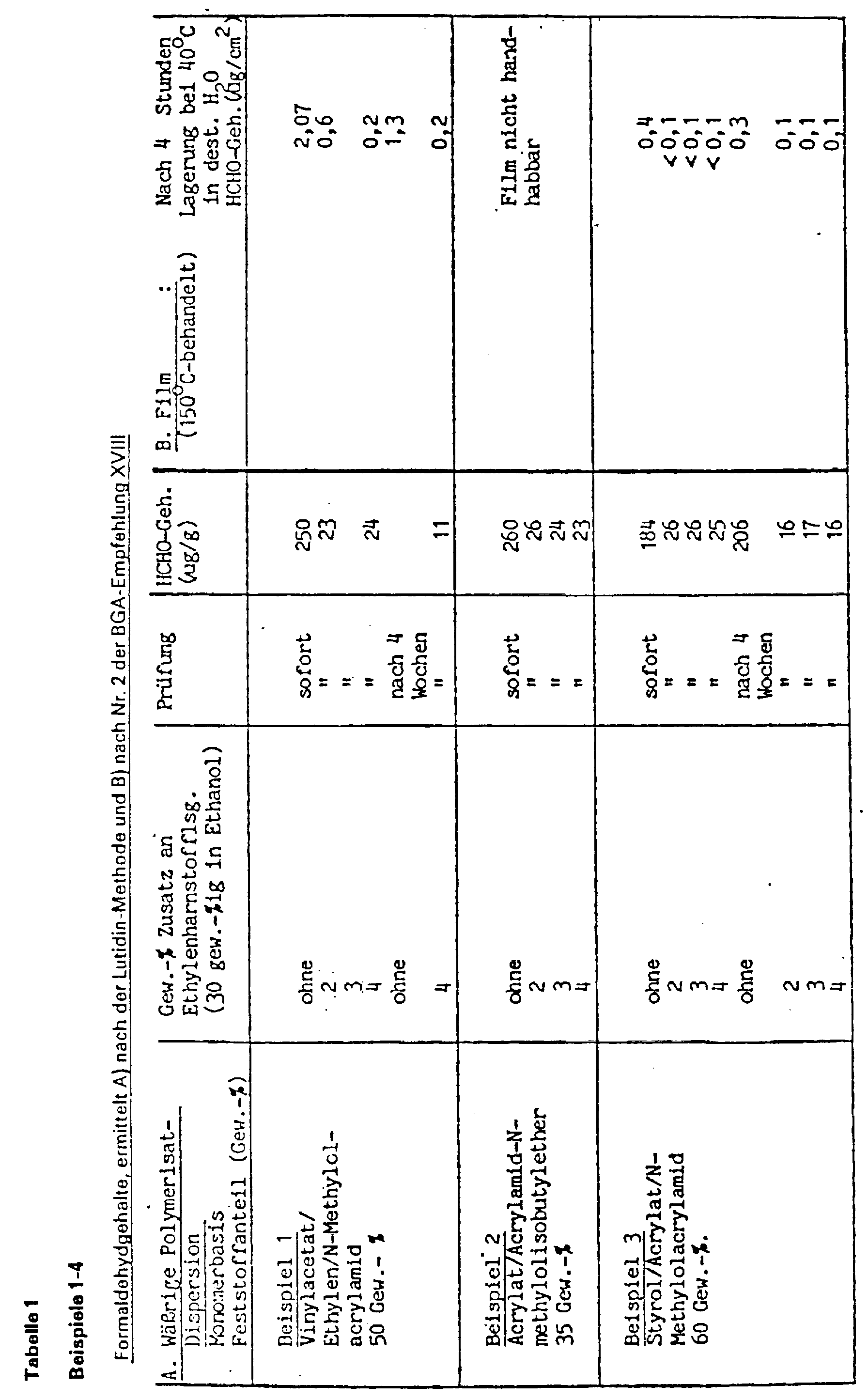
- Die Beurteilung der Filme wurde nach Lagerung der Proben in Anlehnung an Nr. 2 der BGA-Empfehlung XVIII für Melaminharzpressmassen in der 9. Mitteilung des BGA vom 1.8.78 über die "Gesundheitliche Beurteilung von Kunststoffen im Rahmen des Lebensmittelgesetzes" durchgeführt. Abweichend von dieser vorgegebenen Bestimmungsmethode wurden die Filme unter verschärften Bedingungen in destilliertem Wasser bei 40 C während 4 Stunden gelagert. Eine Zusammenfassung von Ergebnissen mit verschiedenen KunststoffDispersionssystemen nach der Lutidin-Methode und der Auswertung in Anlehnung an die BGA-Empfehlung XVIII ist in Tabelle 1 dargestellt.
- In der Tabelle 2 sind die Naßreißfestigkeiten eines mit einer vernetzbaren Polymerisatdispersion ausgerüsteten Spezialpapiers in Abhängigkeit von Zusätzen an Ethylenharnstoff aufgezeigt, wobei den Werten nach der Temperaturbehandlung bei 150°C besondere Bedeutung zukommt, da bei 100°C die Aktivierungsenergie zur vollständigen Vernetzung methylolgruppenhaltiger Polymerisate häufig noch nicht in dem erforderlichen Ausmaß zur Verfügung steht.
- Die erfindungsgemäßen, vernetzbaren wäßrigen Polymerisatdispersionen können zum physiologisch unbedenklichen Verkleben, Tränken, Verfestigen und Beschichten von Materialien verschiedenster Art, wie z.B. flächigen festen Körpern, Folien, Granulaten, Pulvern, Fasern, Fäden, Geweben, non wovens, Papier, verwendet werden. Ihr Einsatz erfolgt vorzugsweise zum physiologisch unbedenklichen Verfestigen von non wovens aus natürlichen, synthetischen oder mineralischen Fasern oder Fäden und deren Gemischen für den technischen Bereich sowie für die Sektoren Sanitär-, Haushalt- und Hygienevliesstoffe, ferner von Papier.


Claims (9)
- Verfahren zur Herstellung von formaldehydfreien wäßrigen Kunststoff-dispersionen auf Basis eines vernetzbaren Polymerisats aus ethylenisch ungesättigten Monomeren mit einem Gehalt an N-Methylolamid und/oder N-Methyloletheramidgruppen, dadurch gekennzeichnet, daß man in üblicher Weise hergestellte wäßrige, vernetzbare und N-Methylolamid- und/oder N-Methyloletheramidgruppen enthaltende Polymerisatdispersion mit bis 10 Gew.-%, bezogen auf die Dispersion, einer Verbindung der Formel I,
 worin n = 0 oder 1,X = Sauerstoff, -CH₂-, -CH(R)- oder -N(R)-, wobei R für (C₁-C₄)-Alkyl oder (C₁-C₄)- Alkylol steht,
undR₁, R₂ = H oder OH bedeutet.mischt, wobei sie übliche Säuren und/oder Säurespender enthalten und ihr Feststoffgehalt 15 bis 65 Gew.-%, bezogen auf die wäßrige Dispersion, beträgt, daß das vernetzbare Polymerisat übliche Grundmoleküleinheiten mit zur Vernetzung fähigen N-Methylolamid- und/oder N-Methyloletheramidgruppen enthält und daß das vernetzbare Polymerisat N-Methylolacrylamideinheiten und/oder N-(Isobutoxy-methyl)acrylamideinheiten enthält. - Verfahren nach Anspruch 1, dadurch gekennzeichnet, daß die Kunststoff-dispersionen organische Säuren und/oder organische Säurespender enthalten.
- Verfahren nach Anspruch 1 oder 2, dadurch gekennzeichnet, daß man die Polymerisatdispersion mit 0,15 bis 6 Gew.-%, bezogen auf die wäßrige Dispersion, einer Verbindung der Formel I vermischt.
- Verfahren nach Anspruch 1,2 oder 3, dadurch gekennzeichnet, daß in Formel I n = 0 und R¹, R = H bedeuten
- Verfahren nach Ansprüchen 1 bis 4, dadurch gekennzeichnet, daß das vernetzbare Polymerisat Grundmoleküleinheiten von ethylenisch ungesättigten Monomeren aus der Gruppe Vinylacetat, Vinylpropionat, Acrylsäureester, Maleinsäuremonoester, Maleinsäurediester, Styrol, Ethylen, Vinylester langkettiger linearer oder verzweigter Carbonsäuren, Vinylchlorid, Acrylamid, Acrylsäure, Acrylnitril, Methacrylsäure, Methacrylamid, deren mögliche Kombinationen zu Copolymerisaten oder Terpolymerisaten enthält.
- Verfahren nach Ansprüchen 1 bis 5, dadurch gekennzeichnet, daß man die Verbindung der Formel 1 als alkoholische Lösung zusetzt.
- Verwendung der formaldehyfreien wäßrigen Kunststoffdispersionen, hergestellt nach Ansprüchen 1 bis 6, zum Verkleben, Tränken, Verfestigen und Beschichten von Materialien verschiedenster Art.
- Verwendung der formaldehydfreien wäßrigen Kunststoffdispersion, hergestellt nach Ansprüchen 1 bis 6, zum Verfestigen von non wovens aus natürlichen, synthetischen oder mineralischen Fasern oder deren Gemischen für den technischen Bereich sowie für die Sektoren Sanitär-, Haushalt- und Hygienevliesstoffe, ferner zum Verfestigen von Papier, von Geweben aus natürlichen, synthetischen oder mineralischen Fasern oder deren Gemischen und zum Verkleben von Folien aus natürlichen oder synthetischen Materialien.
Priority Applications (1)
| Application Number | Priority Date | Filing Date | Title |
|---|---|---|---|
| AT84109152T ATE24928T1 (de) | 1983-08-06 | 1984-08-02 | Formaldehydfreie waessrige kunststoffdispersionen auf basis eines vernetzbaren polymerisats, verfahren zu ihrer herstellung und ihre verwendung. |
Applications Claiming Priority (2)
| Application Number | Priority Date | Filing Date | Title |
|---|---|---|---|
| DE3328456A DE3328456A1 (de) | 1983-08-06 | 1983-08-06 | Formaldehydfreie waessrige kunststoffdispersionen auf basis eines vernetzbaren polymerisats, verfahren zu ihrer herstellung und ihre verwendung |
| DE3328456 | 1983-08-06 |
Publications (3)
| Publication Number | Publication Date |
|---|---|
| EP0143175A1 EP0143175A1 (de) | 1985-06-05 |
| EP0143175B1 EP0143175B1 (de) | 1987-01-14 |
| EP0143175B2 true EP0143175B2 (de) | 1996-04-10 |
Family
ID=6205965
Family Applications (1)
| Application Number | Title | Priority Date | Filing Date |
|---|---|---|---|
| EP84109152A Expired - Lifetime EP0143175B2 (de) | 1983-08-06 | 1984-08-02 | Formaldehydfreie wässrige Kunststoffdispersionen auf Basis eines vernetzbaren Polymerisats, Verfahren zu ihrer Herstellung und ihre Verwendung |
Country Status (9)
| Country | Link |
|---|---|
| EP (1) | EP0143175B2 (de) |
| JP (1) | JPH0791434B2 (de) |
| AT (1) | ATE24928T1 (de) |
| AU (1) | AU568391B2 (de) |
| DE (2) | DE3328456A1 (de) |
| ES (1) | ES8600349A1 (de) |
| NO (1) | NO160662C (de) |
| PT (1) | PT79029B (de) |
| ZA (1) | ZA846017B (de) |
Cited By (3)
| Publication number | Priority date | Publication date | Assignee | Title |
|---|---|---|---|---|
| US7744791B2 (en) | 2004-04-29 | 2010-06-29 | The Procter & Gamble Company | Method for making polymeric structures |
| US7754119B2 (en) | 2004-04-29 | 2010-07-13 | The Procter & Gamble Company | Method for making polymeric structures |
| US7947766B2 (en) | 2003-06-06 | 2011-05-24 | The Procter & Gamble Company | Crosslinking systems for hydroxyl polymers |
Families Citing this family (21)
| Publication number | Priority date | Publication date | Assignee | Title |
|---|---|---|---|---|
| US4524093A (en) * | 1984-04-30 | 1985-06-18 | The B. F. Goodrich Company | Fabric coating composition with low formaldehyde evolution |
| DE3674079D1 (de) * | 1985-06-04 | 1990-10-18 | Sumitomo Chemical Co | Bindercopolymerzusammensetzung und damit behandelte papiere. |
| US4702957A (en) * | 1986-09-08 | 1987-10-27 | National Starch And Chemical Corporation | Binders for nonwovens based on EVA-maleate copolymers |
| EP0345566A1 (de) * | 1988-06-08 | 1989-12-13 | National Starch and Chemical Investment Holding Corporation | Wasserlösliche Formaldehydfreie wärmehärtbare Vernetzungsmittel |
| DE3902067A1 (de) * | 1989-01-25 | 1990-07-26 | Roehm Gmbh | Filmbildende, selbstvernetzende waessrige kunststoffdispersion |
| JPH03119163A (ja) * | 1989-06-05 | 1991-05-21 | Sequa Chemicals Inc | 不織繊維用バインダー |
| CA2034217A1 (en) * | 1990-01-16 | 1991-07-17 | Bernard North | Latex composition with reduced formaldehyde emissions |
| US5143954A (en) * | 1990-11-27 | 1992-09-01 | Rohm And Haas Company | Low-formaldehyde, self-crosslinking polymer latex composition |
| DE4040959C1 (de) * | 1990-12-20 | 1992-03-12 | Wacker-Chemie Gmbh, 8000 Muenchen, De | |
| GB9320649D0 (en) † | 1993-10-07 | 1993-11-24 | Unilever Plc | Improvements in or relating to emulsion polymers containing ethylene |
| DE19814873A1 (de) | 1998-04-02 | 1999-10-07 | Basf Ag | Verfahren zur Verminderung des C¶1¶-C¶2¶-Aldehyd-Gehalts aus Verbindungen mit CH¶2¶-CHR-0- oder -CH¶2¶-CH(OH)-Gruppen |
| DE10064085A1 (de) | 2000-12-21 | 2002-07-04 | Consortium Elektrochem Ind | Verfahren zur Entfernung von freien Aldehyden |
| DE10335673B4 (de) * | 2003-08-04 | 2007-01-18 | Celanese Emulsions Gmbh | Wässrige Dispersionsklebstoffe, Verfahren zu deren Herstellung und deren Verwendung |
| JP4666208B2 (ja) * | 2005-02-04 | 2011-04-06 | Dic株式会社 | ラジカル重合性樹脂組成物の製造方法 |
| DE102006022842A1 (de) | 2006-05-16 | 2007-11-22 | Wacker Chemie Ag | Über Methylolgruppen vernetzbare Siliconpolymere |
| DE102007016990A1 (de) | 2007-04-11 | 2008-10-16 | Wacker Chemie Ag | Methylolgruppen enthaltende Siloxane |
| DE102008054679A1 (de) | 2008-12-15 | 2010-06-17 | Wacker Chemie Ag | Vernetzung von auf einem Substrat vorliegender Organopolysiloxanverbindung mit gasförmigen Aldehydreagens |
| DE102008054671A1 (de) | 2008-12-15 | 2010-06-17 | Wacker Chemie Ag | Thermische Vernetzung von auf einem Substrat vorliegender Organopolysiloxanverbindung mit Aldehydreagens |
| DE102013213321A1 (de) | 2013-07-08 | 2015-01-08 | Wacker Chemie Ag | Symmetrisch poröse Membranen aus aldehydvernetztem thermoplastischen Siliconelastomer |
| DE102013213318A1 (de) | 2013-07-08 | 2015-01-08 | Wacker Chemie Ag | Asymmetrisch poröse Membranen aus aldehydvernetztem thermoplastischen Siliconelastomer |
| ES2750277T5 (es) | 2015-12-02 | 2022-11-03 | Organik Kimya Sanayi Ve Tic A S | Polímeros térmicamente curables libres de formaldehido |
Family Cites Families (3)
| Publication number | Priority date | Publication date | Assignee | Title |
|---|---|---|---|---|
| NL257973A (de) * | 1959-03-13 | 1900-01-01 | ||
| GB1136594A (en) * | 1964-12-10 | 1968-12-11 | Revertex Ltd | Improvements in or relating to aqueous dispersion coating compositions |
| FI62131B (fi) * | 1980-11-05 | 1982-07-30 | Tikkurilan Vaeritehtaat Oy | Ytbehandlingskomposition |
-
1983
- 1983-08-06 DE DE3328456A patent/DE3328456A1/de not_active Withdrawn
-
1984
- 1984-08-02 DE DE8484109152T patent/DE3462047D1/de not_active Expired
- 1984-08-02 AT AT84109152T patent/ATE24928T1/de not_active IP Right Cessation
- 1984-08-02 EP EP84109152A patent/EP0143175B2/de not_active Expired - Lifetime
- 1984-08-03 PT PT79029A patent/PT79029B/pt not_active IP Right Cessation
- 1984-08-03 AU AU31608/84A patent/AU568391B2/en not_active Ceased
- 1984-08-03 ES ES534889A patent/ES8600349A1/es not_active Expired
- 1984-08-03 ZA ZA846017A patent/ZA846017B/xx unknown
- 1984-08-03 NO NO843123A patent/NO160662C/no unknown
- 1984-08-04 JP JP59163489A patent/JPH0791434B2/ja not_active Expired - Lifetime
Cited By (12)
| Publication number | Priority date | Publication date | Assignee | Title |
|---|---|---|---|---|
| US7947766B2 (en) | 2003-06-06 | 2011-05-24 | The Procter & Gamble Company | Crosslinking systems for hydroxyl polymers |
| US7960453B2 (en) | 2003-06-06 | 2011-06-14 | The Procter & Gamble Company | Crosslinking systems for hydroxyl polymers |
| US8088843B2 (en) | 2003-06-06 | 2012-01-03 | The Procter & Gamble Company | Crosslinking systems for hydroxyl polymers |
| US8129449B2 (en) | 2003-06-06 | 2012-03-06 | The Procter & Gabmle Company | Crosslinking systems for hydroxyl polymers |
| US8357237B2 (en) | 2003-06-06 | 2013-01-22 | The Procter & Gamble Company | Crosslinking systems for hydroxyl polymers |
| US8617303B2 (en) | 2003-06-06 | 2013-12-31 | The Procter & Gamble Company | Crosslinking systems for hydroxyl polymers |
| US8815003B2 (en) | 2003-06-06 | 2014-08-26 | The Procter & Gamble Company | Crosslinking systems for hydroxyl polymers |
| US9340657B2 (en) | 2003-06-06 | 2016-05-17 | The Procter & Gamble Company | Crosslinking systems for hydroxyl polymers |
| US7744791B2 (en) | 2004-04-29 | 2010-06-29 | The Procter & Gamble Company | Method for making polymeric structures |
| US7754119B2 (en) | 2004-04-29 | 2010-07-13 | The Procter & Gamble Company | Method for making polymeric structures |
| US8623246B2 (en) | 2004-04-29 | 2014-01-07 | The Procter & Gamble Company | Process of making a fibrous structure |
| US9017586B2 (en) | 2004-04-29 | 2015-04-28 | The Procter & Gamble Company | Polymeric structures and method for making same |
Also Published As
| Publication number | Publication date |
|---|---|
| DE3328456A1 (de) | 1985-02-21 |
| ES534889A0 (es) | 1985-10-16 |
| ES8600349A1 (es) | 1985-10-16 |
| ZA846017B (en) | 1985-04-24 |
| NO160662C (no) | 1989-05-16 |
| NO843123L (no) | 1985-02-07 |
| AU3160884A (en) | 1985-02-07 |
| DE3462047D1 (en) | 1987-02-19 |
| JPS6053551A (ja) | 1985-03-27 |
| JPH0791434B2 (ja) | 1995-10-04 |
| PT79029B (pt) | 1986-09-08 |
| ATE24928T1 (de) | 1987-01-15 |
| NO160662B (no) | 1989-02-06 |
| PT79029A (pt) | 1984-09-01 |
| EP0143175A1 (de) | 1985-06-05 |
| EP0143175B1 (de) | 1987-01-14 |
| AU568391B2 (en) | 1987-12-24 |
Similar Documents
| Publication | Publication Date | Title |
|---|---|---|
| EP0143175B2 (de) | Formaldehydfreie wässrige Kunststoffdispersionen auf Basis eines vernetzbaren Polymerisats, Verfahren zu ihrer Herstellung und ihre Verwendung | |
| EP0084809B1 (de) | Acrylkunststoffdispersion | |
| DE3884156T2 (de) | Harzzusammensetzung. | |
| DE3852748T2 (de) | Verfahrensweise zur Oberflächenbehandlung von Kohlenstofffasern mit einem Schlichtemittel. | |
| DE2749386A1 (de) | Dispersionen hydrophiler acrylharze | |
| DE3147007C2 (de) | Selbstvernetzende wäßrige Kunststoff dispersion | |
| DE1141079B (de) | Verfahren zur Herstellung von Flaechengebilden aus waessrigen Emulsionen von Mischpolymerisaten | |
| EP0554667A1 (de) | Mischungen fluorhaltiger Copolymerisate | |
| DE1247013B (de) | Thermoplastische Massen zur Herstellung von Formkoerpern mit verbesserter Anfaerbbarkeit aus Polyolefinen | |
| DE69704671T2 (de) | Fluorierte copolymere für die öl - und wasser abweisende behandlung von substraten | |
| DE2744256A1 (de) | Verfahren zum beschichten von poroesen warenbahnen | |
| DE1162567B (de) | Verfahren zur Herstellung von Polymeren und Mischpolymeren von Ureidoalkylvinylaethern | |
| DE3689761T2 (de) | Vernetzbare Zusammensetzungen. | |
| DE2219361C3 (de) | Glasfaserverstärkte Polypropylenmassen | |
| DE1494678A1 (de) | Modifizierte Polypropylenfasern und Verfahren zu ihrer Herstellung | |
| DE1419385A1 (de) | Verfahren zum Flammfestmachen und zur Erhoehung des Widerstandes gegen Verschmutzen von Textilstoffen,wie Teppichen | |
| DE1118911B (de) | UEberzugsmittel und Lacke | |
| DE2626174A1 (de) | Vernetzbare acrylnitrilcopolymerisate | |
| DE1795262A1 (de) | Waschfeste oelabweisende Ausruestung von Textilien | |
| EP0527411B1 (de) | Wässriges Bindemittel für textile Flächengebilde | |
| DE1124465B (de) | Verfahren zur Kunstharzausruestung textiler Gebilde | |
| DE2526805C3 (de) | Phosphor enthaltende Flammschutzmittel, Verfahren zu deren Herstellung und deren Verwendung | |
| DE1793357A1 (de) | Fluorierte organische Verbindungen | |
| DE1669093C3 (de) | Anstrich- und Beschichtungsmittel auf Basis wäßriger Polyacrylat- oder Polymethacrylat-Dispersionen | |
| AT239527B (de) | Verfahren zur Herstellung von Formkörpern aus Polyäthylen oder Mischpolymerisaten des Äthylens |
Legal Events
| Date | Code | Title | Description |
|---|---|---|---|
| PUAI | Public reference made under article 153(3) epc to a published international application that has entered the european phase |
Free format text: ORIGINAL CODE: 0009012 |
|
| AK | Designated contracting states |
Designated state(s): AT BE CH DE FR GB IT LI NL SE |
|
| 17P | Request for examination filed |
Effective date: 19850704 |
|
| 17Q | First examination report despatched |
Effective date: 19860515 |
|
| GRAA | (expected) grant |
Free format text: ORIGINAL CODE: 0009210 |
|
| AK | Designated contracting states |
Kind code of ref document: B1 Designated state(s): AT BE CH DE FR GB IT LI NL SE |
|
| REF | Corresponds to: |
Ref document number: 24928 Country of ref document: AT Date of ref document: 19870115 Kind code of ref document: T |
|
| REF | Corresponds to: |
Ref document number: 3462047 Country of ref document: DE Date of ref document: 19870219 |
|
| ITF | It: translation for a ep patent filed | ||
| ET | Fr: translation filed | ||
| PGFP | Annual fee paid to national office [announced via postgrant information from national office to epo] |
Ref country code: NL Payment date: 19870831 Year of fee payment: 4 |
|
| PLBI | Opposition filed |
Free format text: ORIGINAL CODE: 0009260 |
|
| 26 | Opposition filed |
Opponent name: BASF AKTIENGESELLSCHAFT, LUDWIGSHAFEN Effective date: 19871008 Opponent name: ROEHM GMBH CHEMISCHE FABRIK Effective date: 19871009 |
|
| NLR1 | Nl: opposition has been filed with the epo |
Opponent name: BASF AKTIENGESELLSCHAFT Opponent name: ROEHM GMBH CHEMISCHE FABRIK |
|
| PG25 | Lapsed in a contracting state [announced via postgrant information from national office to epo] |
Ref country code: GB Effective date: 19890802 Ref country code: AT Effective date: 19890802 |
|
| PG25 | Lapsed in a contracting state [announced via postgrant information from national office to epo] |
Ref country code: SE Effective date: 19890803 |
|
| PG25 | Lapsed in a contracting state [announced via postgrant information from national office to epo] |
Ref country code: LI Effective date: 19890831 Ref country code: CH Effective date: 19890831 Ref country code: BE Effective date: 19890831 |
|
| BERE | Be: lapsed |
Owner name: HOECHST A.G. Effective date: 19890831 |
|
| PG25 | Lapsed in a contracting state [announced via postgrant information from national office to epo] |
Ref country code: NL Effective date: 19900301 |
|
| GBPC | Gb: european patent ceased through non-payment of renewal fee | ||
| NLV4 | Nl: lapsed or anulled due to non-payment of the annual fee | ||
| PG25 | Lapsed in a contracting state [announced via postgrant information from national office to epo] |
Ref country code: FR Effective date: 19900427 |
|
| REG | Reference to a national code |
Ref country code: CH Ref legal event code: PL |
|
| REG | Reference to a national code |
Ref country code: FR Ref legal event code: ST |
|
| EUG | Se: european patent has lapsed |
Ref document number: 84109152.3 Effective date: 19900418 |
|
| PUAH | Patent maintained in amended form |
Free format text: ORIGINAL CODE: 0009272 |
|
| STAA | Information on the status of an ep patent application or granted ep patent |
Free format text: STATUS: PATENT MAINTAINED AS AMENDED |
|
| 27A | Patent maintained in amended form |
Effective date: 19960410 |
|
| AK | Designated contracting states |
Kind code of ref document: B2 Designated state(s): AT BE CH DE FR GB IT LI NL SE |
|
| REG | Reference to a national code |
Ref country code: CH Ref legal event code: AEN Free format text: AUFRECHTERHALTUNG DES PATENTES IN GEAENDERTER FORM |
|
| EN | Fr: translation not filed | ||
| PGFP | Annual fee paid to national office [announced via postgrant information from national office to epo] |
Ref country code: DE Payment date: 19980912 Year of fee payment: 15 |
|
| PG25 | Lapsed in a contracting state [announced via postgrant information from national office to epo] |
Ref country code: DE Free format text: LAPSE BECAUSE OF NON-PAYMENT OF DUE FEES Effective date: 20000601 |
|
| APAH | Appeal reference modified |
Free format text: ORIGINAL CODE: EPIDOSCREFNO |