EP0145346A2 - Réacteur et initiateur pour un procédé de dépôt chimique en phase vapeur - Google Patents
Réacteur et initiateur pour un procédé de dépôt chimique en phase vapeur Download PDFInfo
- Publication number
- EP0145346A2 EP0145346A2 EP84307992A EP84307992A EP0145346A2 EP 0145346 A2 EP0145346 A2 EP 0145346A2 EP 84307992 A EP84307992 A EP 84307992A EP 84307992 A EP84307992 A EP 84307992A EP 0145346 A2 EP0145346 A2 EP 0145346A2
- Authority
- EP
- European Patent Office
- Prior art keywords
- susceptor
- reactor
- wafers
- reaction vessel
- faces
- Prior art date
- Legal status (The legal status is an assumption and is not a legal conclusion. Google has not performed a legal analysis and makes no representation as to the accuracy of the status listed.)
- Granted
Links
Images




Classifications
-
- C—CHEMISTRY; METALLURGY
- C23—COATING METALLIC MATERIAL; COATING MATERIAL WITH METALLIC MATERIAL; CHEMICAL SURFACE TREATMENT; DIFFUSION TREATMENT OF METALLIC MATERIAL; COATING BY VACUUM EVAPORATION, BY SPUTTERING, BY ION IMPLANTATION OR BY CHEMICAL VAPOUR DEPOSITION, IN GENERAL; INHIBITING CORROSION OF METALLIC MATERIAL OR INCRUSTATION IN GENERAL
- C23C—COATING METALLIC MATERIAL; COATING MATERIAL WITH METALLIC MATERIAL; SURFACE TREATMENT OF METALLIC MATERIAL BY DIFFUSION INTO THE SURFACE, BY CHEMICAL CONVERSION OR SUBSTITUTION; COATING BY VACUUM EVAPORATION, BY SPUTTERING, BY ION IMPLANTATION OR BY CHEMICAL VAPOUR DEPOSITION, IN GENERAL
- C23C16/00—Chemical coating by decomposition of gaseous compounds, without leaving reaction products of surface material in the coating, i.e. chemical vapour deposition [CVD] processes
- C23C16/44—Chemical coating by decomposition of gaseous compounds, without leaving reaction products of surface material in the coating, i.e. chemical vapour deposition [CVD] processes characterised by the method of coating
- C23C16/458—Chemical coating by decomposition of gaseous compounds, without leaving reaction products of surface material in the coating, i.e. chemical vapour deposition [CVD] processes characterised by the method of coating characterised by the method used for supporting substrates in the reaction chamber
Definitions
- the present invention relates to reactors and susceptors, and more particularly to reactors and susceptors useful in a chemical vapor deposition process occurring in a radiant absorption heater system.
- III-V materials such as gallium arsenide
- other epitaxial compositions used for semiconductors, etc.
- the chemical vapor deposition process is typically performed in any of a variety of reactors well recognized in the art, including horizontal reactors, vertical reactors, pancake reactors, and the like. Broadly, the reactors fall into two different classifications:
- the present invention is directed to a susceptor for use in such a radiant absorption heater system.
- the material must be capable of efficiently absorbing the specific form of radiant energy being introduced into the reaction vessel so as to minimize the energy input required to bring the system to, and maintain it at, its usual operating temperature (this typically being in the neighborhood of 700°C or higher for the production of epitaxial III-V materials).
- the material must also be chemically inert with respect to the materials it contacts, including the source gases being introduced into the reaction vessel, and must not be a source of contamination to either the source gases, the substrate or the material being produced.
- the susceptor In a horizontal type reactor, the susceptor has the configuration of a box or rectangular parallelopiped and the reaction gases are directed from one end, across the full length thereof, towards the other end.
- the wafers to be grown are disposed on only the large upwardly-facing surface of the susceptor, typically in recesses provided for this purpose.
- the other large surface i.e., the downwardly-facing one
- the "utilized area" for a horizontal reactor is relatively low.
- the power requirement (defined as the power to bring the susceptor to reaction temperature) is 50 kilowatts, and the utilized area (defined as the surface area occupied by wafers/total susceptor surface area) is about 23%.
- the susceptor in a horizontal reactor the susceptor is usually tilted slightly upwardly in the direction of the gas flow (i.e., downstream) so that the rear or downstream wafers are exposed to fresh input gas. This minimizes the problem of depletion which occurs when a fair sized series of successive upstream wafers deplete the input gases of the reactive components and expose the most downstream wafers only to the relatively exhausted input gases.
- the tilting of the susceptor can also assist in maintaining the desired temperature profile within the reactor vessel.
- An eight sided infrared heated vertical reactor may have almost double the wafer capacity (say about 30 such wafers), but an even lower utilized area of only about 17%. As much of the surface area of its susceptor is being heated for no functional purpose, the power requirement of this type of reactor is quite high, about 115 kilowatts. Thus, a 67% increase in the wafer capacity requires a 130% increase in the power requirement. In a radio frequency heated pancake-type reactor, a slightly enhanced capacity of 21 such wafers (relative to the horizontal reactor) provides slightly enhanced utilized area of 27%, but the reactor requires 100-115 kilowatts, at least twice as much power.
- a reactor which is characterized by both a large wafer capacity, and a low power requirement, in other words, a high utilized area. Accordingly, it is an object of the present invention to provide a reactor having a high utilized area so as to maximize its wafer capacity and minimize its power requirement.
- Another object is to provide a horizontal reactor employing a special susceptor which enables an approximate doubling of the utilized area so as to achieve an approximate doubling of the wafer capacity without an appreciable increase in the power requirement relative to a standard susceptor.
- a reactor for use in a chemical vapor deposition process comprising a reaction vessel having a gas inlet, a gas outlet and a substantially vertical gas flow path therebetween, a substantially solid susceptor configured as a truncated wedge, and heating means disposed about the reaction vessel for heating of the susceptor.
- the susceptor comprises a body having a top, a bottom, a pair of longitudinally-spaced ends, and a converging pair of opposed faces, each of the faces having means to receive a plurality of wafers and maintain the wafers exposed to the gas flow path.
- the susceptor is disposed within the reaction vessel with the opposed faces converging in a direction counter to that of the gas flow path.
- the susceptor ends are trapezoidal in configuration, with the susceptor top and bottom generally being parallel and the susceptor ends also being generally parallel.
- the susceptor is configured and dimensioned so that over 30%, and preferably 40%, of its surface area may be occupied by wafers.
- Each of the opposed faces preferably extends further horizontally than vertically (in other words, is longer than it is high).
- Each of the two susceptor faces preferably has an equal number of the receiving means. More particularly, each has means to receive a vertically-spaced plurality of horizontally extending rows of wafers, each face having three rows of the receiving means, and preferably three rows of six receiving means each.
- the heating means comprises a radiant absorption heating system which may be, for example, of the radio frequency or infrared type.
- the reaction vessel preferably has the gas inlet adjacent to the top thereof and the gas outlet adjacent to the bottom thereof.
- Means may further be provided for positioning the susceptor in the reaction vessel, the susceptor having a groove in each of its ends into which the positioning means are received.
- the substantially solid susceptor of the present invention configured as a truncated wedge for use in a vertical gas flow, has a power requirement of less than 1.1 times the given power requirement despite a doubled wafer capacity.
- the present invention is also directed to a susceptor for use with wafers in a chemical vapor deposition process in a radiant absorption heater system
- a susceptor for use with wafers in a chemical vapor deposition process in a radiant absorption heater system
- a substantially solid body configured as a truncated wedge.
- the body has a top, a bottom, a pair of ends, and an upwardly converging pair of opposed faces, each of the faces having means to receive a plurality of wafers.
- each of the faces has a length between the ends greater than the height between the top and bottom.
- the reactor A comprises a reaction vessel B, a susceptor C disposed within the reaction vessel B, heating means D disposed about.the reaction vessel B for heating of the susceptor C, and, optionally, means E for positioning the susceptor C in the reaction vessel B.
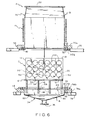
- the reactor A is shown with the reaction vessel B in its closed position in Figs. 2, 4, 8 and 9, and in its open position in Figs. 6 and 7.
- the susceptor C is configured as a truncated wedge and comprises a body having a top 10, a bottom 12, a pair of longitudinally spaced ends 14, and an upwardly converging pair of opposed faces 16.
- the susceptor top 10 and bottom 12 are generally parallel and rectangular in configuration while the susceptor ends 14 are generally parallel and trapezoidal in configuration.
- the opposed faces 16 are rectangular and, like the long edges of the susceptor ends 14, converge in a direction counter to that of the downward gas path to be described hereinafter -- in other words, they converge upwardly.
- Each susceptor end 14 defines a small peripheral groove 20 extending from the bottom 12 upwardly about halfway towards the top 10, the groove being adapted to be engaged by the means E for positioning the susceptor C within the reaction vessel B.
- Each of the susceptor faces 16 has means 22 configured and dimensioned to receive a plurality of polished substrates or wafers W (two such wafers W being represented in Fig. 1) and maintain the wafers W exposed to the aforementioned gas flow path.
- Each of the two faces 16 preferably has an equal number of receiving means 22, each face being illustrated as having eighteen receiving means 22 adapted to receive a vertically spaced plurality of horizontally extending rows of wafers W. More particularly, each of the faces 16 is provided with three rows of six receiving means each. The number of rows and the number of receiving-means on each row will, of course, be a function of the susceptor size, the wafer size and in general the particular application intended.
- each face extend further horizontally than vertically so that there will be relatively few rows, each containing a relatively large number of receiving means 22. While it is not required that each of the faces 16 have an equal number of receiving means 22, this is the desired goal from the standpoint of efficiency and economy.
- the wafer-receiving means 22 are preferably recesses in the faces 16. Each recess is preferably slightly oversized relative to the wafer diameter to facilitate insertion of the polished substrate or wafer and removal of the epitaxially grown wafer (actually a polished substrate with an epitaxially grown layer thereon) using tweezers, vacuum pencils or the like.
- the depth of the recesses is generally equal to or slightly less than that of the wafer so as to expose the outer surface of the wafer to the gas flow path. Alternate means recognized in the art for enabling a susceptor to receive and maintain wafers may be employed.
- the faces 16 may be substantially planar except for outwardly projecting nipples, arranged so that a plurality of nipples (generally a pair) receive and maintain each wafer in the desired position on the face.
- the nipples of course, must be made of a material compatible with that of the susceptor to avoid devitrification, peeling, contamination and the like.
- the susceptor C is substantially solid, the grooves 20 and recesses 22 in no way affecting this substantial solidity.
- the susceptor is preferably substantially homogeneous in composition and of uniform density, although variations in composition and density may be employed to alter the natural temperature profile of the susceptor, if desired.
- the susceptor ' C may be formed of any of the materials conventionally used for susceptors including high purity quartz, black-coated quartz, graphite, glassy carbon, silicone carbide, molybdenum, etc.
- the susceptors are formed of graphite coated with silicon carbide to effect a seal and prevent outgassing.
- the illustrated susceptor C preferably has overall dimensions of 21.0 inches by 12.0 inches with a thickness tapering from 1.288 inches at the bottom 12 to 0.50 inches at the top 10.
- Each groove 20 has a radius of 0.25 inches and a height of 6.0 inches.
- the receiving means or recesses 22 are spaced at least 1.00 inches from the bottom 12, 1.04 inches from the ends 14, and 1.70 inches from the top 10.
- the recesses 22 are approximately 3.05-3.06 inches in diameter to accommodate 3-inch diameter wafers.
- the susceptor C is disposed within the reaction vessel B, the latter comprising an upper section 30 having a gas inlet 32 adjacent the top thereof extending substantially the length of the susceptor top 10 and a lower section 34 having a gas outlet 36 adjacent the bottom thereof.
- the lower vessel section 34 is provided with four cross-members 38 which provides support for the positioning means E in a manner described hereinafter.
- the gas inlet 32 and gas outlet 36 are adapted to be connected to a gas supply (not shown) and a gas discharge or recirculation vent (not shown) respectively, so that a substantially vertical gas flow path is established between the upper inlet 32 and lower outlet 36.
- the bottom of the upper section 30 defines an outwardly extending peripheral rim or flange 40
- the top of the lower section 34 similarly defines an outwardly extending peripheral rim or flange 42.
- the lower flange 40 of the upper section 30 and the upper flange 42 of the lower section 34 may be of similar dimensions and aligned with one another vertically, the opposing faces of the flanges remain vertically spaced even in the closed position of the reaction vessel.
- the upper portion of the upper section 30 tapers slightly outwardly from the inlet 32 while the lower portion thereof defines an open-bottom chamber configured and dimensioned to enable the susceptor C to be totally received therewithin.
- the middle portion of the lower section 34 slopes inwardly so that the downward gas flow passing the cross-members 38 is concentrated and channeled into the outlet 36.
- the means E for positioning susceptor C within the reaction vessel B comprises a substantially planar rectangular support bar 50 having a pair of upstanding posts 52, one at either end thereof, and a plurality of depending spacer rods 54.
- the upstanding posts 52 are configured and dimensioned to be received within the grooves 20 of the susceptor ends 14 while the susceptor bottom 12 is resting on the top of the support bar 50. The engagement of the grooves 20 by the upstanding posts 52 stabilizes the susceptor C to prevent it from tipping over.
- the depending spacer rods 54 each have an upper section 56 and a lower section 58 of reduced diameter, the cross-members 38 of the lower reaction vessel section 34 having open-topped cylindrical apertures capable of accommodating the reduced diameter portions 58, but not the normal diameter portions 56. Accordingly, the support bar 50 is spaced by the length of the normal diameter portion 56 above the lower section 34, thereby permitting the gases which have traveled downwardly past the susceptor C and support bar 50 to sweep under the support bar 50 and into the passageways 60 (at least partially defined by the cross-members 38) leading to the gas outlet 36. (Obviously if the susceptor C or support bar 50 rested directly atop the cross-members 38, access of the gas to the passageways 60 would be blocked.)
- the reaction vessel B and the positioning means E are both preferably made of clear fused quartz.
- Conventional heating means D are disposed about the reaction vessel, particularly the upper section 30 thereof, for heating of the susceptor C disposed within the reaction vessel B.
- the heating system is of the radiant absorption variety wherein radiant energy in the form of radio frequency (RF), infrared (IR) or microwave energy is projected from outside into the reactor vessel, where it is selectively absorbed by the susceptor C.
- RF radio frequency
- IR infrared
- microwave energy is projected from outside into the reactor vessel, where it is selectively absorbed by the susceptor C.
- radio frequency energy is utilized to heat the susceptor, the susceptor composition having been selected at least partially for its ability to absorb within this frequency.
- the reaction vessel B is provided with two sealing means: an upper sealing means 70 and a lower sealing means 74.
- the upper sealing means 70 comprises an L-shaped top plate 70a which has been milled out to receive the upper and side surfaces of the flange 40 at the bottom of the upper reaction vessel section 30 and a planar bottom plate 70b which covers the lower surface of the flange 40 and extends partially therebeyond.
- the bottom plate 70b is secured to the top plate 70a, for example, by fastening means such as screws 71 (see Fig. 2) so that flange 40 is trapped therebetween.
- the lower sealing means 74 is comprised of an L-shaped bottom plate 74a and a planar top plate 74b.
- the bottom plate 74a has been milled out to receive the lower and side surfaces of the flange 42 at the top of the lower reaction vessel section 34 while the top plate 74b covers the upper surfaces of the flange 42 and extends therebeyond.
- the top plate 74b is secured to the bottom plate 74a by fastening means, for example, by screws 71 (see Fig. 2) so that flange 42 is trapped therebetween for movement therewith.
- a pair of laterally spaced gasket means such as O-rings 72, are disposed about the flange 42 to effect a gas-tight seal between the upper surface of the flange 42 and the lower surface of top plate 74b and between the lower surface of the flange 42 and the upper surface of bottom plate 74a.
- the planar top plate 74b of the lower sealing means 74 carries an additional gasket means, such as an O-ring 73, in a groove on its upper surface, gasket means 73 forming a seal between the bottom plate 70b of the upper sealing means 70 and the top plate 74b of the lower sealing means 74 (and thus between the flanges 40, 42) when the upper and lower reaction vessel sections 30, 34 are in the closed position. Even when the vessel B is in the closed position, the flanges 40, 42 are separated by the combined thicknesses of the bottom plate 70b and top plate 74b.
- the sealing means 70, 74 may be made of stainless steel or other material compatible with the quartz with which it comes into contact.
- the heating means D is wrapped in coils about the length of the upper reaction vessel section 30 (which is disposed about the susceptor C when the reaction vessel B is in the closed position)
- the upper section 30, heating means D, and upper sealing member 70 are fixed in position -- for example, by securing the top plate 70a to a fixed frame 76, such as the housing for the reactor A, with fasteners such as screws 75 (see Fig. 2).
- the heating means D, upper reaction vessel section 30, and upper sealing member 70 form a single stationary sub-assembly whose position is determined by fixed member 76.
- the lower reaction vessel section 34, positioning means E, susceptor C (including any wafers W carried thereby), and the lower sealing member 74 are secured to a movable carriage 78 to form a movable sub-assembly -- for example, by securing the bottom plate 74a to the movable carriage 78 with fasteners such as screws 75 (see Fig. 2).
- the movable sub-assembly is capable of being withdrawn from the fixed sub-assembly, by a downward movement in the direction of the arrows of Figs.
- the vertical motion of the movable carriage 78 which supports the lower sealing member 74 may be manual or mechanical depending upon the degree of automation desired for the operation.
- the fixed frame 76 and movable carriage 78 do not contact the quartz of the reaction vessel B and hence may be formed of ordinary steel plate.
- the fixed frame 76 may be secured to the upper sealing member 70 and the movable carriage 78 may be secured to the lower sealing member 74 by any of the fastening techniques conventional in the art.
- the two sections 30, 34 of the reaction vessel B are in closed position, as illustrated in Figs. 2, 4 and 8-9. Their respective flanges 40, 42 are separated by the intermediate sealing plates 70b, 74b which serve to preclude the escape of gases from the reaction vessel.
- Source gases appropriate for the particular CVD reaction contemplated are introduced along the full length of the gas inlet 32 in the upper reaction vessel section 30. The gas is passed downwardly, being split into two streams by the wedge-shaped susceptor C.
- the lower wafers extend further outwardly from the mid-plane of the susceptor C than the upper wafers, and because there are only three rows of wafers in all, the lower wafers are exposed to relatively fresh input gases, thereby minimizing or completely avoiding the common depletion problem.
- the unused portions of the two gas streams recombine below the crossbar 50 and eventually enter the passageways 60 of the lower reaction vessel section 34 on their way to the gas outlet 36.
- the gas flow path is indicated by the arrows of Figs. 8 and 9.
- the movable carriage 78 is transported in the direction of the arrows of Figs. 6-7, thereby displacing downwardly the entire movable sub-assembly (comprising the susceptor C, positioning means E, lower reaction vessel section 34 and the
- the movable carriage 78 is raised into the position indicated in Figs. 2, 4 and 8-9, thereby displacing upwardly the entire movable sub-assembly to the illustrated position and so "closing" the reactor.
- the "utilized area" of a susceptor is a measure of its efficiency.
- the illustrated susceptor C of the present invention can accommodate 36 wafers, each having a 7.62 centimeter (3.0 inch) diameter.
- the surface area of the susceptor, excluding the grooves 20 and recesses 22 (assuming faces 16 to be planar), is 3,604 centimeters square (558.8 inches square) so that the utilized area is 45%.
- the wafer capacity is only half (18 wafers) so that the utilized area is only 23%.
- a pancake type reactor with a susceptor of roughly similar dimensions may have a slightly greater wafer capacity (21 wafers) than the horizontal reactor, and a roughly comparable utilized area of 27%.
- a vertical type reactor utilizes a susceptor of high surface area (since the susceptor is generally a hollow polygon) and may accommodate only 30 wafers on a surface area 8225 cm 2 to give a very low utilized area of 17%.
- the wedge shaped susceptor of the present invention has twice the wafer capacity of a rectangular parallelopiped or box-shaped susceptor having dimensions equal to the average corresponding dimensions of the susceptor of the present invention. (This follows logically from the fact that both faces of the susceptor of the present invention may be utilized for bearing wafers, rather than just one face.) Because the overwhelmingly largest portion of the energy requirement of a reactor vessel is the energy required to bring the susceptor up to temperature, with only a minute fraction of the energy actually being utilized to bring the wafers themselves up to temperature, the power requirement of the illustrated susceptor C of the present invention (51 kilowatts) is, despite its doubling of the wafer capacity, less than 1.1 times the power requirement of the aforementioned box-shaped susceptor (50 KW) having dimensions equal to the average corresponding dimensions of the susceptor of the present invention.
- the conventional susceptor for use in a horizontal gas flow has a power requirement which is at least 90% that of the susceptor of the present invention, despite its having a wafer capacity which is only 50%.
- the power requirements of the previously referenced pancake and vertical reactors are substantially higher, about 115 KW for the vertical reactor and 100-115 KW for the pancake reactor.
- the 51 KW power requirement of the susceptor of the present invention is only 1.02 times the 50 KW power requirement of the aforementioned box-shaped susceptor, despite a doubling of the wafer capacity (in other words, the conventional box-shaped susceptor with half the wafer capacity has a power requirement which is 98% that of the susceptor of the present invention).
- Both the reactor of the present invention and the reactor of the conventional box-shaped susceptor have the same power ratio of 14.17 watts per cm 2 ("power ratio" being defined as the power requirement divided by the susceptor area).
- the problem of depletion is avoided or mitigated by two separate factors in the present invention.
Landscapes
- Chemical & Material Sciences (AREA)
- General Chemical & Material Sciences (AREA)
- Chemical Kinetics & Catalysis (AREA)
- Engineering & Computer Science (AREA)
- Materials Engineering (AREA)
- Mechanical Engineering (AREA)
- Metallurgy (AREA)
- Organic Chemistry (AREA)
- Chemical Vapour Deposition (AREA)
Applications Claiming Priority (2)
| Application Number | Priority Date | Filing Date | Title |
|---|---|---|---|
| US06/553,962 US4522149A (en) | 1983-11-21 | 1983-11-21 | Reactor and susceptor for chemical vapor deposition process |
| US553962 | 1983-11-21 |
Publications (3)
| Publication Number | Publication Date |
|---|---|
| EP0145346A2 true EP0145346A2 (fr) | 1985-06-19 |
| EP0145346A3 EP0145346A3 (en) | 1987-08-19 |
| EP0145346B1 EP0145346B1 (fr) | 1990-10-10 |
Family
ID=24211489
Family Applications (1)
| Application Number | Title | Priority Date | Filing Date |
|---|---|---|---|
| EP84307992A Expired EP0145346B1 (fr) | 1983-11-21 | 1984-11-19 | Réacteur et initiateur pour un procédé de dépôt chimique en phase vapeur |
Country Status (4)
| Country | Link |
|---|---|
| US (1) | US4522149A (fr) |
| EP (1) | EP0145346B1 (fr) |
| JP (2) | JPS60138910A (fr) |
| DE (1) | DE3483389D1 (fr) |
Cited By (2)
| Publication number | Priority date | Publication date | Assignee | Title |
|---|---|---|---|---|
| EP0221429A3 (fr) * | 1985-11-08 | 1987-08-26 | Focus Semiconductor Systems, Inc. | Réacteur pour dépôt chimique par vaporisation |
| EP0522986A1 (fr) * | 1991-07-12 | 1993-01-13 | PECHINEY RECHERCHE (Groupement d'Intérêt Economique régi par l'Ordonnance du 23 Septembre 1967) Immeuble Balzac | Dispositif et procédé de dépot de diamant par DCPV assisté par plasma microonde |
Families Citing this family (48)
| Publication number | Priority date | Publication date | Assignee | Title |
|---|---|---|---|---|
| US4694779A (en) * | 1984-10-19 | 1987-09-22 | Tetron, Inc. | Reactor apparatus for semiconductor wafer processing |
| US4596208A (en) * | 1984-11-05 | 1986-06-24 | Spire Corporation | CVD reaction chamber |
| US4673799A (en) * | 1985-03-01 | 1987-06-16 | Focus Semiconductor Systems, Inc. | Fluidized bed heater for semiconductor processing |
| US4794217A (en) * | 1985-04-01 | 1988-12-27 | Qing Hua University | Induction system for rapid heat treatment of semiconductor wafers |
| US4976996A (en) * | 1987-02-17 | 1990-12-11 | Lam Research Corporation | Chemical vapor deposition reactor and method of use thereof |
| US5234099A (en) * | 1987-02-20 | 1993-08-10 | Mcneil-Ppc, Inc. | Coated medicaments and apparatus and methods for making same |
| US5198034A (en) * | 1987-03-31 | 1993-03-30 | Epsilon Technology, Inc. | Rotatable substrate supporting mechanism with temperature sensing device for use in chemical vapor deposition equipment |
| US4978567A (en) * | 1988-03-31 | 1990-12-18 | Materials Technology Corporation, Subsidiary Of The Carbon/Graphite Group, Inc. | Wafer holding fixture for chemical reaction processes in rapid thermal processing equipment and method for making same |
| NZ233403A (en) * | 1989-04-28 | 1992-09-25 | Mcneil Ppc Inc | Simulated capsule-like medicament |
| SE465100B (sv) * | 1989-06-30 | 1991-07-22 | Inst Mikroelektronik Im | Foerfarande och anordning foer att i en kallvaeggsreaktor behandla en kiselskiva |
| US5119540A (en) * | 1990-07-24 | 1992-06-09 | Cree Research, Inc. | Apparatus for eliminating residual nitrogen contamination in epitaxial layers of silicon carbide and resulting product |
| US6086680A (en) * | 1995-08-22 | 2000-07-11 | Asm America, Inc. | Low-mass susceptor |
| FI972874A0 (fi) * | 1997-07-04 | 1997-07-04 | Mikrokemia Oy | Foerfarande och anordning foer framstaellning av tunnfilmer |
| WO1999023691A2 (fr) * | 1997-11-03 | 1999-05-14 | Asm America, Inc. | Systeme de support ameliore de faible poids pour plaquettes |
| US6159287A (en) * | 1999-05-07 | 2000-12-12 | Cbl Technologies, Inc. | Truncated susceptor for vapor-phase deposition |
| US6149365A (en) * | 1999-09-21 | 2000-11-21 | Applied Komatsu Technology, Inc. | Support frame for substrates |
| FI118474B (fi) * | 1999-12-28 | 2007-11-30 | Asm Int | Laite ohutkalvojen valmistamiseksi |
| US20050170314A1 (en) * | 2002-11-27 | 2005-08-04 | Richard Golden | Dental pliers design with offsetting jaw and pad elements for assisting in removing upper and lower teeth and method for removing teeth utilizing the dental plier design |
| US20040142558A1 (en) * | 2002-12-05 | 2004-07-22 | Granneman Ernst H. A. | Apparatus and method for atomic layer deposition on substrates |
| US7537662B2 (en) | 2003-04-29 | 2009-05-26 | Asm International N.V. | Method and apparatus for depositing thin films on a surface |
| US7601223B2 (en) * | 2003-04-29 | 2009-10-13 | Asm International N.V. | Showerhead assembly and ALD methods |
| US8083853B2 (en) * | 2004-05-12 | 2011-12-27 | Applied Materials, Inc. | Plasma uniformity control by gas diffuser hole design |
| US8328939B2 (en) * | 2004-05-12 | 2012-12-11 | Applied Materials, Inc. | Diffuser plate with slit valve compensation |
| US8074599B2 (en) * | 2004-05-12 | 2011-12-13 | Applied Materials, Inc. | Plasma uniformity control by gas diffuser curvature |
| US20060005771A1 (en) * | 2004-07-12 | 2006-01-12 | Applied Materials, Inc. | Apparatus and method of shaping profiles of large-area PECVD electrodes |
| US20060054090A1 (en) * | 2004-09-15 | 2006-03-16 | Applied Materials, Inc. | PECVD susceptor support construction |
| US7429410B2 (en) * | 2004-09-20 | 2008-09-30 | Applied Materials, Inc. | Diffuser gravity support |
| US20070028842A1 (en) * | 2005-08-02 | 2007-02-08 | Makoto Inagawa | Vacuum chamber bottom |
| US20070264427A1 (en) * | 2005-12-21 | 2007-11-15 | Asm Japan K.K. | Thin film formation by atomic layer growth and chemical vapor deposition |
| US20080317973A1 (en) * | 2007-06-22 | 2008-12-25 | White John M | Diffuser support |
| US8097082B2 (en) * | 2008-04-28 | 2012-01-17 | Applied Materials, Inc. | Nonplanar faceplate for a plasma processing chamber |
| US8801857B2 (en) * | 2008-10-31 | 2014-08-12 | Asm America, Inc. | Self-centering susceptor ring assembly |
| TW201122148A (en) * | 2009-12-24 | 2011-07-01 | Hon Hai Prec Ind Co Ltd | Chemical vapor deposition device |
| US9441295B2 (en) * | 2010-05-14 | 2016-09-13 | Solarcity Corporation | Multi-channel gas-delivery system |
| WO2014189622A1 (fr) * | 2013-05-23 | 2014-11-27 | Applied Materials, Inc. | Ensemble revêtement enduit pour chambre de traitement de semi-conducteur |
| US20160359080A1 (en) | 2015-06-07 | 2016-12-08 | Solarcity Corporation | System, method and apparatus for chemical vapor deposition |
| KR102629526B1 (ko) * | 2015-09-30 | 2024-01-25 | 도쿄엘렉트론가부시키가이샤 | 기판 처리 장치 및 기판 처리 방법 |
| US9748434B1 (en) | 2016-05-24 | 2017-08-29 | Tesla, Inc. | Systems, method and apparatus for curing conductive paste |
| US9954136B2 (en) | 2016-08-03 | 2018-04-24 | Tesla, Inc. | Cassette optimized for an inline annealing system |
| US10115856B2 (en) | 2016-10-31 | 2018-10-30 | Tesla, Inc. | System and method for curing conductive paste using induction heating |
| CN111446185A (zh) | 2019-01-17 | 2020-07-24 | Asm Ip 控股有限公司 | 通风基座 |
| USD914620S1 (en) | 2019-01-17 | 2021-03-30 | Asm Ip Holding B.V. | Vented susceptor |
| USD920936S1 (en) | 2019-01-17 | 2021-06-01 | Asm Ip Holding B.V. | Higher temperature vented susceptor |
| TWI845682B (zh) | 2019-05-22 | 2024-06-21 | 荷蘭商Asm Ip私人控股有限公司 | 工件基座主體 |
| US11764101B2 (en) | 2019-10-24 | 2023-09-19 | ASM IP Holding, B.V. | Susceptor for semiconductor substrate processing |
| TWI888578B (zh) | 2020-06-23 | 2025-07-01 | 荷蘭商Asm Ip私人控股有限公司 | 基座及反應腔室 |
| USD1031676S1 (en) | 2020-12-04 | 2024-06-18 | Asm Ip Holding B.V. | Combined susceptor, support, and lift system |
| US20240247374A1 (en) * | 2023-01-23 | 2024-07-25 | Applied Materials, Inc. | Precursor delivery system for semiconductor device formation |
Family Cites Families (8)
| Publication number | Priority date | Publication date | Assignee | Title |
|---|---|---|---|---|
| DE1544253C3 (de) * | 1964-09-14 | 1974-08-15 | Siemens Ag, 1000 Berlin Und 8000 Muenchen | Vorrichtung zum epitaktischen Abscheiden yon Halbleitermaterial |
| US3594242A (en) * | 1966-01-03 | 1971-07-20 | Monsanto Co | Method for production of epitaxial films |
| JPS4942857B1 (fr) * | 1970-03-20 | 1974-11-18 | ||
| JPS5346436B2 (fr) * | 1973-07-05 | 1978-12-13 | ||
| US4186684A (en) * | 1977-06-01 | 1980-02-05 | Ralph Gorman | Apparatus for vapor deposition of materials |
| JPS55110030A (en) * | 1979-02-19 | 1980-08-25 | Fujitsu Ltd | Method for vapor growth |
| JPS5670830A (en) * | 1979-11-10 | 1981-06-13 | Toshiba Corp | Vapor growth method |
| US4322592A (en) * | 1980-08-22 | 1982-03-30 | Rca Corporation | Susceptor for heating semiconductor substrates |
-
1983
- 1983-11-21 US US06/553,962 patent/US4522149A/en not_active Expired - Lifetime
-
1984
- 1984-11-19 DE DE8484307992T patent/DE3483389D1/de not_active Expired - Lifetime
- 1984-11-19 EP EP84307992A patent/EP0145346B1/fr not_active Expired
- 1984-11-21 JP JP59244695A patent/JPS60138910A/ja active Pending
-
1991
- 1991-06-18 JP JP1991045834U patent/JPH0710490Y2/ja not_active Expired - Lifetime
Cited By (4)
| Publication number | Priority date | Publication date | Assignee | Title |
|---|---|---|---|---|
| EP0221429A3 (fr) * | 1985-11-08 | 1987-08-26 | Focus Semiconductor Systems, Inc. | Réacteur pour dépôt chimique par vaporisation |
| EP0522986A1 (fr) * | 1991-07-12 | 1993-01-13 | PECHINEY RECHERCHE (Groupement d'Intérêt Economique régi par l'Ordonnance du 23 Septembre 1967) Immeuble Balzac | Dispositif et procédé de dépot de diamant par DCPV assisté par plasma microonde |
| FR2678956A1 (fr) * | 1991-07-12 | 1993-01-15 | Pechiney Recherche | Dispositif et procede de depot de diamant par dcpv assiste par plasma microonde. |
| US5360485A (en) * | 1991-07-12 | 1994-11-01 | Pechiney Recherche | Apparatus for diamond deposition by microwave plasma-assisted CVPD |
Also Published As
| Publication number | Publication date |
|---|---|
| US4522149A (en) | 1985-06-11 |
| JPS60138910A (ja) | 1985-07-23 |
| EP0145346A3 (en) | 1987-08-19 |
| DE3483389D1 (de) | 1990-11-15 |
| JPH0710490Y2 (ja) | 1995-03-08 |
| JPH0641129U (ja) | 1994-05-31 |
| EP0145346B1 (fr) | 1990-10-10 |
Similar Documents
| Publication | Publication Date | Title |
|---|---|---|
| EP0145346B1 (fr) | Réacteur et initiateur pour un procédé de dépôt chimique en phase vapeur | |
| US3796182A (en) | Susceptor structure for chemical vapor deposition reactor | |
| EP0104764B1 (fr) | Appareil et procédé pour le dépôt chimique à partir de la phase vapeur | |
| US4499354A (en) | Susceptor for radiant absorption heater system | |
| US9870937B2 (en) | High productivity deposition reactor comprising a gas flow chamber having a tapered gas flow space | |
| EP0198842B1 (fr) | Appareil reacteur pour le traitement de tranches semiconductrices | |
| JPS61194179A (ja) | 蒸着反応室を形成するためのハウジング | |
| KR20010031714A (ko) | 수명이 긴 고온 공정 챔버 | |
| JPH03500064A (ja) | 反応室ならびに化学蒸着法の改良 | |
| JPS6289871A (ja) | 軸対称性を有する化学蒸着用反応装置を構成する方法及び装置 | |
| JPH10218632A (ja) | 大面積ガラス基板の冷却および加熱方法とそのための装置 | |
| JPS6015918A (ja) | 外部隔離モジユ−ル | |
| US10961621B2 (en) | CVD reactor chamber with resistive heating and substrate holder | |
| US10718051B2 (en) | Methods for chemical vapor deposition (CVD) in a movable liner assembly | |
| US4547404A (en) | Chemical vapor deposition process | |
| US3491720A (en) | Epitaxial deposition reactor | |
| EP0381247A2 (fr) | Appareillage et procédé de déposition épitaxiale | |
| US7381926B2 (en) | Removable heater | |
| US10260147B2 (en) | Device for depositing nanotubes | |
| US4186684A (en) | Apparatus for vapor deposition of materials | |
| US20190376179A1 (en) | Vapor phase film deposition apparatus | |
| JPH0727870B2 (ja) | 減圧気相成長方法 | |
| EP2045373B1 (fr) | Reacteur epitaxial utilise dans la production de plaquettes a grande echelle | |
| JPH04356915A (ja) | ガスソースセル | |
| CN116536649B (zh) | 组合舟、单舟、处理设备、载片方法及处理方法 |
Legal Events
| Date | Code | Title | Description |
|---|---|---|---|
| PUAI | Public reference made under article 153(3) epc to a published international application that has entered the european phase |
Free format text: ORIGINAL CODE: 0009012 |
|
| AK | Designated contracting states |
Designated state(s): DE FR GB |
|
| PUAL | Search report despatched |
Free format text: ORIGINAL CODE: 0009013 |
|
| RHK1 | Main classification (correction) |
Ipc: C30B 25/14 |
|
| AK | Designated contracting states |
Kind code of ref document: A3 Designated state(s): DE FR GB |
|
| 17P | Request for examination filed |
Effective date: 19870909 |
|
| 17Q | First examination report despatched |
Effective date: 19890301 |
|
| GRAA | (expected) grant |
Free format text: ORIGINAL CODE: 0009210 |
|
| AK | Designated contracting states |
Kind code of ref document: B1 Designated state(s): DE FR GB |
|
| PG25 | Lapsed in a contracting state [announced via postgrant information from national office to epo] |
Ref country code: FR Effective date: 19901010 |
|
| REF | Corresponds to: |
Ref document number: 3483389 Country of ref document: DE Date of ref document: 19901115 |
|
| PGFP | Annual fee paid to national office [announced via postgrant information from national office to epo] |
Ref country code: FR Payment date: 19901126 Year of fee payment: 7 |
|
| EN | Fr: translation not filed | ||
| PLBE | No opposition filed within time limit |
Free format text: ORIGINAL CODE: 0009261 |
|
| STAA | Information on the status of an ep patent application or granted ep patent |
Free format text: STATUS: NO OPPOSITION FILED WITHIN TIME LIMIT |
|
| 26N | No opposition filed | ||
| PGFP | Annual fee paid to national office [announced via postgrant information from national office to epo] |
Ref country code: GB Payment date: 19911017 Year of fee payment: 8 |
|
| PGFP | Annual fee paid to national office [announced via postgrant information from national office to epo] |
Ref country code: DE Payment date: 19911128 Year of fee payment: 8 |
|
| PG25 | Lapsed in a contracting state [announced via postgrant information from national office to epo] |
Ref country code: GB Effective date: 19921119 |
|
| GBPC | Gb: european patent ceased through non-payment of renewal fee |
Effective date: 19921119 |
|
| PG25 | Lapsed in a contracting state [announced via postgrant information from national office to epo] |
Ref country code: DE Effective date: 19930803 |
|
| P01 | Opt-out of the competence of the unified patent court (upc) registered |
Effective date: 20230520 |