EP0145955A2 - Dispositif de mémoire morte et son procédé de fabrication - Google Patents
Dispositif de mémoire morte et son procédé de fabrication Download PDFInfo
- Publication number
- EP0145955A2 EP0145955A2 EP84113693A EP84113693A EP0145955A2 EP 0145955 A2 EP0145955 A2 EP 0145955A2 EP 84113693 A EP84113693 A EP 84113693A EP 84113693 A EP84113693 A EP 84113693A EP 0145955 A2 EP0145955 A2 EP 0145955A2
- Authority
- EP
- European Patent Office
- Prior art keywords
- mos transistor
- electrode terminal
- layer
- memory device
- semiconductor memory
- Prior art date
- Legal status (The legal status is an assumption and is not a legal conclusion. Google has not performed a legal analysis and makes no representation as to the accuracy of the status listed.)
- Granted
Links
Images



Classifications
-
- H—ELECTRICITY
- H10—SEMICONDUCTOR DEVICES; ELECTRIC SOLID-STATE DEVICES NOT OTHERWISE PROVIDED FOR
- H10B—ELECTRONIC MEMORY DEVICES
- H10B20/00—Read-only memory [ROM] devices
-
- H—ELECTRICITY
- H10—SEMICONDUCTOR DEVICES; ELECTRIC SOLID-STATE DEVICES NOT OTHERWISE PROVIDED FOR
- H10B—ELECTRONIC MEMORY DEVICES
- H10B20/00—Read-only memory [ROM] devices
- H10B20/27—ROM only
- H10B20/30—ROM only having the source region and the drain region on the same level, e.g. lateral transistors
- H10B20/38—Doping programmed, e.g. mask ROM
- H10B20/383—Channel doping programmed
-
- H—ELECTRICITY
- H10—SEMICONDUCTOR DEVICES; ELECTRIC SOLID-STATE DEVICES NOT OTHERWISE PROVIDED FOR
- H10W—GENERIC PACKAGES, INTERCONNECTIONS, CONNECTORS OR OTHER CONSTRUCTIONAL DETAILS OF DEVICES COVERED BY CLASS H10
- H10W20/00—Interconnections in chips, wafers or substrates
- H10W20/40—Interconnections external to wafers or substrates, e.g. back-end-of-line [BEOL] metallisations or vias connecting to gate electrodes
- H10W20/41—Interconnections external to wafers or substrates, e.g. back-end-of-line [BEOL] metallisations or vias connecting to gate electrodes characterised by their conductive parts
- H10W20/42—Vias, e.g. via plugs
-
- Y—GENERAL TAGGING OF NEW TECHNOLOGICAL DEVELOPMENTS; GENERAL TAGGING OF CROSS-SECTIONAL TECHNOLOGIES SPANNING OVER SEVERAL SECTIONS OF THE IPC; TECHNICAL SUBJECTS COVERED BY FORMER USPC CROSS-REFERENCE ART COLLECTIONS [XRACs] AND DIGESTS
- Y10—TECHNICAL SUBJECTS COVERED BY FORMER USPC
- Y10S—TECHNICAL SUBJECTS COVERED BY FORMER USPC CROSS-REFERENCE ART COLLECTIONS [XRACs] AND DIGESTS
- Y10S148/00—Metal treatment
- Y10S148/082—Ion implantation FETs/COMs
-
- Y—GENERAL TAGGING OF NEW TECHNOLOGICAL DEVELOPMENTS; GENERAL TAGGING OF CROSS-SECTIONAL TECHNOLOGIES SPANNING OVER SEVERAL SECTIONS OF THE IPC; TECHNICAL SUBJECTS COVERED BY FORMER USPC CROSS-REFERENCE ART COLLECTIONS [XRACs] AND DIGESTS
- Y10—TECHNICAL SUBJECTS COVERED BY FORMER USPC
- Y10S—TECHNICAL SUBJECTS COVERED BY FORMER USPC CROSS-REFERENCE ART COLLECTIONS [XRACs] AND DIGESTS
- Y10S148/00—Metal treatment
- Y10S148/109—Memory devices
Definitions
- This invention relates to an improvement in the memory elements of a read only memory and the manufacturing method of the same.
- Read only memory in which information is written in during the wafer manufacturing stage is generally known as mask programmable ROM.
- Some of the prior art methods of writting data into a mask programmable ROM are (1) the contact method, (2) the field oxide film method, (3) the threshold voltage method.
- the contact method logical 1 or logical 0 is written in depending on whether or not the output signal line (bit line) and the drain of the memory cell transistor are connected.
- the field oxide film method data is written in by whether a gate oxide film or a field oxide film is formed on the gate region of the memory cell transistor. Namely, when a gate oxide film is formed, the memory cell transistor is turned ON and OFF by the gate voltage and, when a field oxide film is formed, the transistor is always OFF. Data is written in by these changes in the state of the memory cell transistors.
- the threshold voltage method data is written in by varying the threshold voltage Vth of the memory cells by varying the density of the impurities in the gate region of the memory cell transistor.
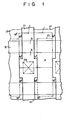
- Fig. 1 shows an expanded plan view of part of a memory using the threshold voltage method.
- Fig. 1 shows the positional relationship of the individual parts, and parts not required are omitted to facilitate the illustration.
- the memory cells are N channel type MOS transistors, and the description is of one of the memory cells of a pair of memory cells that share a common drain.
- the memory cell 1, shown by a one-dot broken line, is formed of a gate 3, drain 5, source 7, polycrystalline silicon gate electrode 9 and aluminum wire layer 11 (bit line) that crosses the gate electrode 9 at right angles.
- the Ai wire layer 11 is connected to the drain 5 by contact 13.
- Memory cell 1 is isolated from the contiguous memory cells by the P type isolation region 15.
- Source 27 is connected in common to the sources of the contiguous memory cells by N type regions 17, and is kept at ground level, for example.
- Fig. 3 shows a cross section along the arrowed line I-I of the memory cell shown in Fig. 2.
- unrelated parts have been omitted to facilitate illustration of the positional relationship.
- the memory cells are taken to be N channel MOS transistors of which one is described.
- the one-dot broken line shows memory cell 21, which is constructed of gate 25 formed in the P type semiconductor substrate 23, drain 27, source 29, insulation film 31, polycrystalline silicon gate electrode 33 (word line) formed over the gate 25 with insulation film 31 therebetween, and Al wire layer 37 (bit line), which is formed across gate electrode 33 at right angles and insulated therefrom by an insulation layer 35.
- Al wire layer 37 protrudes above drain 27 and this protrusion is connected to drain 27 by contact 39.
- This memory cell 21 is isolated from other elements by a P type isolation region 41.
- the source 29 is connected to the sources of memory cells contiguous to it by N type regions 43, and maintained at ground level, for example. For convenience of explanation, description of the passivation layer has been omitted.
- the Ai wire layer 37 contacts drain 27 and must be provided so as to avoid overlapping gate 25.
- a gap must be maintained such that Al wire 37 does not short other Al wires and the width of the Al wire 37 must be sufficient to prevent severing of the wires during manufacturing.
- contact 39 cannot be made too small because of manufacturing restrictions and because the contact resistance must be kept to a certain limit.
- the portion protruding over drain 27 of Al wire 37 must have sufficient size to cover contact 39. Accordingly, the size of the memory cell 21 in the direction of the gate electrode 33 is determined by the width of Ai wire 37 and the size of the gap, and the size of contact 39.
- the read only memory device of this invention is a MOS transistor formed with a conductive electrode terminal layer, which is electrically connected to the drain region of the MOS transistor but at least not overlapping the gate region of the MOS transistor, and a metal wire layer, which at least does not overlap the gate region of the MOS transistor, and which is connected to the electrode terminal layer and transmits output signals.
- the electrode terminal layer and the metal wire layer are not above the gate of the MOS transistor and, accordingly, it is possible to write data into the memory cell transistor by ion implanting the gate region after the metal wire layer has been formed. It is also possible to make the contact resistance between the MOS transistor drain and the electrode terminal layer smaller than was possible in the prior art. Accordingly, the contact area between the drain and the electrode terminal layer can be decreased, which in turn means that the area of the memory cell can be decreased. Also, the size of the memory cell is not limited by the gap between the protrusion of a metal wire layer and the neighbouring metal wire layer so the area of the memory cell can be made still smaller than the prior art.
- the contact resistance value between the drain and the electrode terminal layer can be made small so the total contact resistance can be made smaller than in the prior art, and deterioration in the characteristics of the memory cell transistor due to contact resistance can be decreased.
- the result, then, is a read only memory semiconductor memory device with good yield at high density, which in turn means a device with good characteristics and good economics.
- the memory cell transistors are taken to be N channel MOS transistors.
- this semiconductor memory device is comprised of a plurality of memory cells arranged in a matrix.
- the memory cells are arranged in pairs of contiguous cells in the vertical direction of the drawing (hereinafter referred to as the bit line direction).
- the drains of each pair of memory cells are formed as one and the memory cells are formed symmetrically in the drawing with the drain in the center.
- the source of each memory cell is connected to the source of the cell contiguous to it, and is maintained at ground level.
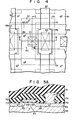
- the pair of memory cells 51, 53 shown by a one dot broken line only memory cell 51 will be described.
- N type source 57 and N type drain 59 are formed inside the P type semiconductor substrate 55.
- the source 57 is connected to the sources of the contiguous memory cells by an N type region 61.
- the drain 59 is formed as one with the drain 63 of the memory cell 53.
- the P type region between the source 57 and drain 59 is the gate region 65.
- a gate oxide film 67 is formed on this gate region 65, and a polycrystalline gate electrode 69 (word line) is formed on the gate oxide film 67.
- the field oxide film 71 shown by the broken line in Fig. 4 is formed in the element isolation region to isolate the elements.
- a silicon oxide film 73 is formed on the element region and another silicon oxide film 75 is formed over the whole wafer surface of the semiconductor.
- a square contact hole 77 is formed in the silicon oxide layers 73, 75 on the drain 59.
- a polycrystalline silicon electrode terminal layer 79 which does not overlap the gate region 65, is formed on the insulation layer filling contact hole 77.
- the electrode terminal layer 79 extends over drain 59 and has a contact portion which contacts drain 59.
- a silicon oxide film 81 is formed covering the electrode terminal layer 79 and the silicon oxide film 75.
- a square contact hole 83 is formed in a prescribed position of the silicon oxide film 81 on the electrode terminal layer 79. This contact hole 83 is filled, the electrode terminal layer 79 is contacted, and gate electrode 69 is crossed, while avoiding overlapping gate 65, by A£ wire layer 85.
- This Ai layer 85 is in electrical contact with drain 59 through electrical terminal layer 79 for the transmission of the output signals of the memory cell. Impurities are ion implanted in gate 65 as necessary to vary the threshold voltage of the MOS transistor for writting in data.
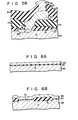
- Figs. 6A, 7A, 8A and 9A are cross sections along the line II-II of the device shown in Fig. 4 in one of the manufacturing stages.
- Figs. 6B, 7B, 8B and 9B are cross sections along the line III-III of the device in the same manufacturing stage as above.
- a field oxide film 71 approx. 600 nm thick is formed on the P type silicon substrate 55 by a selective oxide method, whereby the element region and the field region are isolated.
- An oxide film 91 approx. 50 nm thick is formed on the element region by thermal oxidation, for example.
- a polycrystalline silicon layer 93 is then formed over the whole surface of the wafer by a vapour-phase growth method.
- polycrystalline layer silicon 93 is patterned by PEP (photo engraving process) to form gate electrode 69 and gate oxide film 67.
- An N type impurity such as arsenic (As) is ion implanted, or dispersed, in the semiconductor substrate 55 using gate electrode 69 as a mask to form source 57 and drain 59.
- the silicon oxide film 73 is formed over the whole surface of the wafer by thermal oxidation, for example, after which a low-temperature oxide film 75 is formed by CVD (chemical vapour deposition), for example.
- CVD chemical vapour deposition
- contact hole 77 is formed on drain 59 by PEP and a polycrystalline silicon layer 300 nm thick, for example, is depositied over the whole surface of the wafer by CVD. PEP is then used to carry out the patterning to form the electrode terminal layer 79.
- the planar shape of electrode terminal layer 79 substantially follows the shape of Ai layer 85, and has a contact portion which extends only over the drain 59.
- This electrode terminal layer 79 may also be formed of polycrystalline silicon which includes phosphorous or arsenic.
- An electrode terminal layer 79, which does not include any impurities may be formed and phosphorous or arsenic may be dispersed or ion implanted after.
- a low temperature oxide film 81 is formed over the whole surface by CVD, for example, and a contact hole 83 is formed in a prescribed position on the electrode terminal layer 79 of this low temperature oxide film 81.
- an aluminum layer is vapour deposited over the whole wafer and patterned to form A1 wire layer 85.
- boron 8 is ion implanted in the specified gate region 65 through the oxide layers 81, 75, 73, 67, and gate electrode 69 to write in data.
- a protective layer (not shown) is formed and the semiconductor memory device of this embodiment is complete.
- the Al wire layer 85 is connected to the drain 59 by the electrode terminal layer 79 for the transmission of the output signals of the MOS transistor.
- the electrode terminal layer 79 and the A l wire layer 85 do not overlap the gate region 65 so it is possible to write in data by ion implantation after the formation of the Al wire layer 85 in the last stage of manufacturing of the semiconductor memory device. The result of this is that a read only memory device can be manufactured with a short turnaround time.
- the drain 59 and the electrode terminal layer 79 are in direct contact, the contact resistance is low and, accordingly, it is possible to decrease the size of the contact area of the electrode terminal compared to the prior art semiconductor memory device shown in Fig. 2.
- the size of the memory cell is not restricted by the gap between the contiguous Ai wire layers 85 and, accordingly, in the end the area of the memory cell can be reduced by 80% over the prior art memory cell shown in Fig. 2. Consequently, it is possible to increase the degree of integration of the semiconductor memory device.
- the contact area of the electrode terminal layer 79 and the Al layer 85 can, except for over the gate region 65, be made sufficiently large.
- the contact resistance value between the electrode terminal layer 79 and drain 59 can be decreased so the absolute value of the contact resistance can be reduced compared to the prior art device of Fig. 2. This means a reduction in the deterioration of the characteristics that are due to contact resistance. Accordingly, in this embodiment, a superior semiconductor memory device with high integration is possible.
- the gate electrode 69 of the memory cell 51 is formed of polycrystalline silicon.
- This invention is not, however, restricted to this, and a high melting point silicide film such as molybdenum silicide MOSi 2 or a high melting point metal such as Mo, or either one of these combined with a two layer film of polycrystalline silicon is also within the realm of possibility.
- the Ai wire layer 85 is not limited to the form shown in Fig. 4 and may, for example, be formed such as the Af wire layer 37 shown in Fig. 2 where it projects over the drain 59.
- planar shape of the contact between drain 59 and the electrode terminal layer 79 and the contact between the electrode terminal layer 79 and the Al wire layer 85 are limited to the square shape shown in Fig. 4, but may be of any shape providing it does not overlap gate region 65.
- the electrode terminal layer 79 and Ai wire layer 85 were described as not overlapping the gate region 65 at all. The reason for this is that if there is a region which is not ion implanted, when data is written in by ion implanting the gate region 65, a leakage current may form. However, if there is no problem of a leakage current, it is possible for the electrode terminal layer 79 and Al wire layer 85 to partially overlap gate region 65.
- an N channel MOS transistor was used in the description as the memory cell, but this invention is not limited to this; a P channel MOS transistor or a CMOS transistor may also be used.
Landscapes
- Semiconductor Memories (AREA)
Applications Claiming Priority (2)
| Application Number | Priority Date | Filing Date | Title |
|---|---|---|---|
| JP224921/83 | 1983-11-29 | ||
| JP58224921A JPS60116167A (ja) | 1983-11-29 | 1983-11-29 | 半導体記憶装置及びその製造方法 |
Publications (3)
| Publication Number | Publication Date |
|---|---|
| EP0145955A2 true EP0145955A2 (fr) | 1985-06-26 |
| EP0145955A3 EP0145955A3 (en) | 1985-07-31 |
| EP0145955B1 EP0145955B1 (fr) | 1989-02-01 |
Family
ID=16821250
Family Applications (1)
| Application Number | Title | Priority Date | Filing Date |
|---|---|---|---|
| EP84113693A Expired EP0145955B1 (fr) | 1983-11-29 | 1984-11-13 | Dispositif de mémoire morte et son procédé de fabrication |
Country Status (4)
| Country | Link |
|---|---|
| US (2) | US4649412A (fr) |
| EP (1) | EP0145955B1 (fr) |
| JP (1) | JPS60116167A (fr) |
| DE (1) | DE3476611D1 (fr) |
Families Citing this family (8)
| Publication number | Priority date | Publication date | Assignee | Title |
|---|---|---|---|---|
| JPS59201461A (ja) * | 1983-04-28 | 1984-11-15 | Toshiba Corp | 読み出し専用半導体記憶装置およびその製造方法 |
| KR900000065B1 (ko) * | 1985-08-13 | 1990-01-19 | 가부시끼가이샤 도오시바 | 독출전용 반도체기억장치와 그 제조방법 |
| US5612557A (en) * | 1986-10-27 | 1997-03-18 | Seiko Epson Corporation | Semiconductor device having an inter-layer insulating film disposed between two wiring layers |
| JPH06105773B2 (ja) * | 1987-12-22 | 1994-12-21 | 株式会社東芝 | 半導体装置 |
| JP3532325B2 (ja) * | 1995-07-21 | 2004-05-31 | 株式会社東芝 | 半導体記憶装置 |
| US5538914A (en) * | 1995-08-03 | 1996-07-23 | Taiwan Semiconductor Manufacturing Company | LDD method of coding mask ROM device and LDD coded mask ROM device produced thereby |
| US9029085B2 (en) | 2007-03-07 | 2015-05-12 | President And Fellows Of Harvard College | Assays and other reactions involving droplets |
| KR102492033B1 (ko) * | 2018-03-26 | 2023-01-26 | 에스케이하이닉스 주식회사 | 메모리 장치 및 이를 포함하는 메모리 시스템 |
Family Cites Families (25)
| Publication number | Priority date | Publication date | Assignee | Title |
|---|---|---|---|---|
| US3921282A (en) * | 1971-02-16 | 1975-11-25 | Texas Instruments Inc | Insulated gate field effect transistor circuits and their method of fabrication |
| US4059826A (en) * | 1975-12-29 | 1977-11-22 | Texas Instruments Incorporated | Semiconductor memory array with field effect transistors programmable by alteration of threshold voltage |
| JPS583380B2 (ja) * | 1977-03-04 | 1983-01-21 | 株式会社日立製作所 | 半導体装置とその製造方法 |
| US4240097A (en) * | 1977-05-31 | 1980-12-16 | Texas Instruments Incorporated | Field-effect transistor structure in multilevel polycrystalline silicon |
| JPS5819144B2 (ja) * | 1977-12-02 | 1983-04-16 | 株式会社東芝 | 読み出し専用記憶装置 |
| US4230504B1 (en) * | 1978-04-27 | 1997-03-04 | Texas Instruments Inc | Method of making implant programmable N-channel rom |
| US4290184A (en) * | 1978-03-20 | 1981-09-22 | Texas Instruments Incorporated | Method of making post-metal programmable MOS read only memory |
| US4268950A (en) * | 1978-06-05 | 1981-05-26 | Texas Instruments Incorporated | Post-metal ion implant programmable MOS read only memory |
| DE2927824A1 (de) * | 1978-07-12 | 1980-01-31 | Vlsi Technology Res Ass | Halbleitervorrichtungen und ihre herstellung |
| US4475964A (en) * | 1979-02-20 | 1984-10-09 | Tokyo Shibaura Denki Kabushiki Kaisha | Method of manufacturing a semiconductor device |
| US4381201A (en) * | 1980-03-11 | 1983-04-26 | Fujitsu Limited | Method for production of semiconductor devices |
| JPS56144572A (en) * | 1980-04-10 | 1981-11-10 | Seiko Epson Corp | Semiconductor device |
| JPS56147473A (en) * | 1980-04-18 | 1981-11-16 | Nec Corp | Read only semiconductor memory |
| US4398335A (en) * | 1980-12-09 | 1983-08-16 | Fairchild Camera & Instrument Corporation | Multilayer metal silicide interconnections for integrated circuits |
| JPS57126147A (en) * | 1981-01-28 | 1982-08-05 | Fujitsu Ltd | Manufacture of semiconductor device |
| JPS57130461A (en) * | 1981-02-06 | 1982-08-12 | Hitachi Ltd | Semiconductor memory storage |
| US4406349A (en) * | 1981-05-19 | 1983-09-27 | Andrew Vilchek | Escape apparatus |
| US4378628A (en) * | 1981-08-27 | 1983-04-05 | Bell Telephone Laboratories, Incorporated | Cobalt silicide metallization for semiconductor integrated circuits |
| JPS5873130A (ja) * | 1981-10-28 | 1983-05-02 | Toshiba Corp | 半導体単結晶の評価装置 |
| JPS5955054A (ja) * | 1982-09-24 | 1984-03-29 | Hitachi Ltd | 半導体装置の製造方法 |
| US4443930A (en) * | 1982-11-30 | 1984-04-24 | Ncr Corporation | Manufacturing method of silicide gates and interconnects for integrated circuits |
| US4617193A (en) * | 1983-06-16 | 1986-10-14 | Digital Equipment Corporation | Planar interconnect for integrated circuits |
| US4513494A (en) * | 1983-07-19 | 1985-04-30 | American Microsystems, Incorporated | Late mask process for programming read only memories |
| US4451326A (en) * | 1983-09-07 | 1984-05-29 | Advanced Micro Devices, Inc. | Method for interconnecting metallic layers |
| US4523372A (en) * | 1984-05-07 | 1985-06-18 | Motorola, Inc. | Process for fabricating semiconductor device |
-
1983
- 1983-11-29 JP JP58224921A patent/JPS60116167A/ja active Pending
-
1984
- 1984-11-13 DE DE8484113693T patent/DE3476611D1/de not_active Expired
- 1984-11-13 EP EP84113693A patent/EP0145955B1/fr not_active Expired
- 1984-11-27 US US06/674,999 patent/US4649412A/en not_active Expired - Lifetime
-
1988
- 1988-10-11 US US07/256,266 patent/US4892841A/en not_active Expired - Lifetime
Also Published As
| Publication number | Publication date |
|---|---|
| JPS60116167A (ja) | 1985-06-22 |
| US4649412A (en) | 1987-03-10 |
| EP0145955A3 (en) | 1985-07-31 |
| EP0145955B1 (fr) | 1989-02-01 |
| DE3476611D1 (en) | 1989-03-09 |
| US4892841A (en) | 1990-01-09 |
Similar Documents
| Publication | Publication Date | Title |
|---|---|---|
| US4701776A (en) | MOS floating gate memory cell and process for fabricating same | |
| US4822750A (en) | MOS floating gate memory cell containing tunneling diffusion region in contact with drain and extending under edges of field oxide | |
| EP0250078B1 (fr) | Elément d'interconnexion programmable à basse impédance | |
| US5200355A (en) | Method for manufacturing a mask read only memory device | |
| EP0135824B1 (fr) | Dispositif semi-conducteur à mémoire | |
| US5334861A (en) | Semiconductor memory cell | |
| EP0124115B1 (fr) | Dispositif ROM semi-conducteur et procédé de fabrication | |
| EP0043244B1 (fr) | Cellule à mémoire statique du type FET flip-flop à couche unique de silicium polycristallin | |
| US6300180B1 (en) | Method for forming an integrated circuit having improved polysilicon resistor structures | |
| US5343066A (en) | Semiconductor device and method of manufacturing same | |
| US5194929A (en) | Nonvolatile semiconductor memory and a memory of manufacturing the same | |
| EP0151476B1 (fr) | Mémoire à lecture seule et procédé pour sa fabrication | |
| EP0160003B1 (fr) | Cellule memoire mos a porte flottante et son procede de fabrication | |
| US5536962A (en) | Semiconductor device having a buried channel transistor | |
| US4892841A (en) | Method of manufacturing a read only semiconductor memory device | |
| EP0278587B1 (fr) | Cellule de mémoire | |
| EP0169595B1 (fr) | Dispositif semi-conducteur comprenant un transistor de stockage non-volatil | |
| US6065973A (en) | Memory cell having active regions without N+ implants | |
| JP2581411B2 (ja) | 半導体記憶回路装置及びその製造方法 | |
| US5893738A (en) | Method for forming double density MROM array structure | |
| US6548857B2 (en) | Low resistance contact structure for a select transistor of EEPROM memory cells in a NO-DPCC process | |
| JP3150747B2 (ja) | 半導体メモリ装置とその製造方法 | |
| US6150228A (en) | Method of manufacturing an SRAM with increased resistance length | |
| US7157336B2 (en) | Method of manufacturing semiconductor device | |
| US5067001A (en) | Structure and method for manufacturing a series read only memory with spacer film |
Legal Events
| Date | Code | Title | Description |
|---|---|---|---|
| PUAI | Public reference made under article 153(3) epc to a published international application that has entered the european phase |
Free format text: ORIGINAL CODE: 0009012 |
|
| PUAL | Search report despatched |
Free format text: ORIGINAL CODE: 0009013 |
|
| 17P | Request for examination filed |
Effective date: 19841210 |
|
| AK | Designated contracting states |
Designated state(s): DE FR GB |
|
| AK | Designated contracting states |
Designated state(s): DE FR GB |
|
| 17Q | First examination report despatched |
Effective date: 19870615 |
|
| GRAA | (expected) grant |
Free format text: ORIGINAL CODE: 0009210 |
|
| AK | Designated contracting states |
Kind code of ref document: B1 Designated state(s): DE FR GB |
|
| REF | Corresponds to: |
Ref document number: 3476611 Country of ref document: DE Date of ref document: 19890309 |
|
| ET | Fr: translation filed | ||
| PLBE | No opposition filed within time limit |
Free format text: ORIGINAL CODE: 0009261 |
|
| STAA | Information on the status of an ep patent application or granted ep patent |
Free format text: STATUS: NO OPPOSITION FILED WITHIN TIME LIMIT |
|
| 26N | No opposition filed | ||
| PGFP | Annual fee paid to national office [announced via postgrant information from national office to epo] |
Ref country code: GB Payment date: 19971104 Year of fee payment: 14 |
|
| PGFP | Annual fee paid to national office [announced via postgrant information from national office to epo] |
Ref country code: FR Payment date: 19971112 Year of fee payment: 14 |
|
| PGFP | Annual fee paid to national office [announced via postgrant information from national office to epo] |
Ref country code: DE Payment date: 19971121 Year of fee payment: 14 |
|
| PG25 | Lapsed in a contracting state [announced via postgrant information from national office to epo] |
Ref country code: GB Free format text: LAPSE BECAUSE OF NON-PAYMENT OF DUE FEES Effective date: 19981113 |
|
| GBPC | Gb: european patent ceased through non-payment of renewal fee |
Effective date: 19981113 |
|
| PG25 | Lapsed in a contracting state [announced via postgrant information from national office to epo] |
Ref country code: FR Free format text: LAPSE BECAUSE OF NON-PAYMENT OF DUE FEES Effective date: 19990730 |
|
| REG | Reference to a national code |
Ref country code: FR Ref legal event code: ST |
|
| PG25 | Lapsed in a contracting state [announced via postgrant information from national office to epo] |
Ref country code: DE Free format text: LAPSE BECAUSE OF NON-PAYMENT OF DUE FEES Effective date: 19990901 |