EP0146041A2 - Système de transfert de données avec une pluralité de mécanismes de mémoire à disques magnétiques - Google Patents
Système de transfert de données avec une pluralité de mécanismes de mémoire à disques magnétiques Download PDFInfo
- Publication number
- EP0146041A2 EP0146041A2 EP84114468A EP84114468A EP0146041A2 EP 0146041 A2 EP0146041 A2 EP 0146041A2 EP 84114468 A EP84114468 A EP 84114468A EP 84114468 A EP84114468 A EP 84114468A EP 0146041 A2 EP0146041 A2 EP 0146041A2
- Authority
- EP
- European Patent Office
- Prior art keywords
- data
- clock
- signal
- disk drives
- pulses
- Prior art date
- Legal status (The legal status is an assumption and is not a legal conclusion. Google has not performed a legal analysis and makes no representation as to the accuracy of the status listed.)
- Withdrawn
Links
Images

Classifications
-
- G—PHYSICS
- G11—INFORMATION STORAGE
- G11B—INFORMATION STORAGE BASED ON RELATIVE MOVEMENT BETWEEN RECORD CARRIER AND TRANSDUCER
- G11B20/00—Signal processing not specific to the method of recording or reproducing; Circuits therefor
- G11B20/10—Digital recording or reproducing
- G11B20/14—Digital recording or reproducing using self-clocking codes
-
- G—PHYSICS
- G06—COMPUTING OR CALCULATING; COUNTING
- G06F—ELECTRIC DIGITAL DATA PROCESSING
- G06F3/00—Input arrangements for transferring data to be processed into a form capable of being handled by the computer; Output arrangements for transferring data from processing unit to output unit, e.g. interface arrangements
- G06F3/06—Digital input from, or digital output to, record carriers, e.g. RAID, emulated record carriers or networked record carriers
- G06F3/0601—Interfaces specially adapted for storage systems
-
- G—PHYSICS
- G11—INFORMATION STORAGE
- G11B—INFORMATION STORAGE BASED ON RELATIVE MOVEMENT BETWEEN RECORD CARRIER AND TRANSDUCER
- G11B20/00—Signal processing not specific to the method of recording or reproducing; Circuits therefor
- G11B20/10—Digital recording or reproducing
- G11B20/14—Digital recording or reproducing using self-clocking codes
- G11B20/1403—Digital recording or reproducing using self-clocking codes characterised by the use of two levels
-
- G—PHYSICS
- G11—INFORMATION STORAGE
- G11B—INFORMATION STORAGE BASED ON RELATIVE MOVEMENT BETWEEN RECORD CARRIER AND TRANSDUCER
- G11B5/00—Recording by magnetisation or demagnetisation of a record carrier; Reproducing by magnetic means; Record carriers therefor
- G11B5/02—Recording, reproducing, or erasing methods; Read, write or erase circuits therefor
- G11B5/09—Digital recording
-
- G—PHYSICS
- G06—COMPUTING OR CALCULATING; COUNTING
- G06F—ELECTRIC DIGITAL DATA PROCESSING
- G06F3/00—Input arrangements for transferring data to be processed into a form capable of being handled by the computer; Output arrangements for transferring data from processing unit to output unit, e.g. interface arrangements
- G06F3/06—Digital input from, or digital output to, record carriers, e.g. RAID, emulated record carriers or networked record carriers
- G06F3/0601—Interfaces specially adapted for storage systems
- G06F3/0668—Interfaces specially adapted for storage systems adopting a particular infrastructure
- G06F3/0671—In-line storage system
- G06F3/0673—Single storage device
-
- G—PHYSICS
- G11—INFORMATION STORAGE
- G11B—INFORMATION STORAGE BASED ON RELATIVE MOVEMENT BETWEEN RECORD CARRIER AND TRANSDUCER
- G11B5/00—Recording by magnetisation or demagnetisation of a record carrier; Reproducing by magnetic means; Record carriers therefor
- G11B5/02—Recording, reproducing, or erasing methods; Read, write or erase circuits therefor
Definitions
- Our invention relates to apparatus for at least reproduction of data from magnetic disks such as those commonly referred to as floppy disks, and more specifically to a data transfer system of the type having a plurality of daisy chained magnetic disk drives or files for selective data transfer to and from magnetic disks replaceably mounted therein.
- Floppy disks have found widespread acceptance in information processing and allied industries as compact data storage media. Being thin and limply flexible, the disks are usually enclosed in more rigid, apertured envelopes to make up disk assemblies or cartridges that are self supporting.
- a variety of floppy disk drives (FDD) have been suggested and used for data transfer to and from such disk cartridges.
- FDD floppy disk drives
- the magnetic disks for use with the FDDs have data recorded thereon by the modified frequency modulation (MFM) or frequency modulation (FM) method. Either way, data are recorded together with clock pulses on the same tracks on the disks. On reading the disks, therefore, the recovered data must be separated from the clock pulses.
- the separation of the data from the clock pulses require the creation of data/clock separation signals known as a data window signal and a clock window signal. Either the data window or the clock window signal can be fabricated from the clock pulses contained in the readout signal along with the recovered data.
- the readout signal is therefore fed to a data/clock separation signal generator circuit in the form of a variable frequency oscillator (VFO) of the phase locked loop (PLL) circuit configuration.
- VFO variable frequency oscillator
- PLL phase locked loop
- the VFO responds to the clock pulses included in the readout signal for generating either of the data window signal and the clock window signal in synchornism with the clock pulses.
- the other window signal can be produced from the window signal generated by the VFO, simply by inverting the phase of the latter.
- the VFO has been provided either to each of the daisy chained FDDs or to the controller.
- the provision of the VFO to each FDD is objectionable because only a selected one of the daisy chained FDDs is used for data transfer at one time.
- the VFOs of the other FDDs are not in use then. That is to say, only one of the VFOs of the daisy chained FDDs are in use at any time.
- a substantial saving in the manufacturing costs of the FDDs will be possible if a single VFO can serve all the daisy chained FDDs.
- VFO VFO suffices if it is incorporated with the controller, as has been practiced heretofore. However, this alternative is not truly satisfactory as the VFO makes more complex and substantially more expensive the integrated circuitry of which the controller is made.
- our invention is directed to a data transfer system having a plurality of disk drives daisy chained to host equipment, for use with magnetic disks having data and a clock signal recorded on the same tracks thereon.
- Each disk drive has a transducer head for data transfer with one magnetic disk, a read circuit connected to the transducer head for providing a readout signal containing data pulses and clock pulses corresponding respectively to the data and clock signal that have been read from the magnetic disk by the transducer head, and a gate circuit for allowing the selective passage therethrough of the readout signal from the read circuit.
- the gate circuits of all the disk drives are connected to the host equipment via a common output line for the selective delivery thereto of the readout signal from only one of the disk drives at one time.
- our invention provides to only one of the disk drives a data/clock separation signal generator circuit responsive to the readout signals from the disk drives for generating a data/clock separation signal to be used by the host equipment for separating the readout signal from any of the disk drives into the data pulses and clock pulses.
- the data/clock separation signal generator circuit is connected between the outputs of the gate circuits of all the disk drives and the host equipment.
- this readout signal is supplied not only to the host equipment but also to the the data/clock separation signal generator circuit provided to only one of the disk drives.
- the data/clock separation signal generator circuit responds to the readout signal by generating a data/clock separation signal, which in practice may be either a data window signal or clock window signal, for delivery to the host equipment.
- the data/clock separation signal generator circuit can be a VFO.
- the single data/clock separation signal generator circuit can be connected to the controller more readily than when it is provided to each disk drive, and the controller needs but one input terminal for connection with the data/clock separation signl generator circuit.
- the representative FDD 10 is shown to have mounted therein a flexible magnetic disk 24 of the familiar cartridge form such as disclosed in the aforementioned U.S. Patents 3,678,481 and 4,089,029. Clamped in position in the FDD 10, the magnetic disk 24 is revolved by a disk drive motor 26 under the control of a motor control and drive circuit 28.
- a magnetic transducer head 30 is arrranged for data transfer with the magnetic disk 24.
- a head transport mechanism 32 is coupled to the transducer head 30 for its access to the tracks of the magnetic disk 24. Electrically, the transducer head 30 is coupled to a read circuit 34 and thence to one of the two inputs of a gate circuit herein shown as an open collector NAND circuit 36.
- the other input of this NAND circuit is connected via an inverter 38 to the controller 22 to receive therefrom a DRIVE SELECT signal intended for the selective use of the FDDs.
- the output of the NAND circuit 36 is connected to the controller 22 by way of an output line 40 common to all the FDDs 10, 12, 14 and 16.
- the FDD 10 is further provided with a write circuit, photoelectric sensors and sensor controls, and other circuitry. We have not illustrated these additional means as they bear no direct pertinence to our invention.
- the host equipment 18 comprising the CPU 20 and controller 22 is also familiar to the specialists.
- the controller 22 is generally referred to as the FDD controller, or FDC, comprising a CPU interface, a controller/formatter, and an FDD interface. It functions to deliver various control signals, as well as data to be written, to the FDDs 10, 12, 14 and 16, and to receive signals and recovered data from the FDDs. As far as our invention is concerned, the following connections between controller 22 and FDDs 10, 12, 14 and 16 are important.
- the controller 22 is connected as aforesaid to the inverters 38 of the FDDs 10, 12, 14 and 16 via respective output lines 42, 44, 46 and 48 for the delivery of the DRIVE SELECT signals.
- Each DRIVE SELECT signal is to go low when data is to be read out from the associated FDD.
- only one DRIVE SELECT signal is to go low at one time, so that data is not to be simultaneously read out from two or more of the FDDs 10, 12, 14 and 16.
- the inverters 38 invert the DRIVE SELECT signals, causing the NAND circuits 36 connected thereto to allow the passage of the recovered data (as well as clock pulses that have been read also from the magnetic disks 24) therethrough, on to the controller 22 by way of the common output line 40, when the DRIVE SELECT signals are low.
- the controller 22 is connected to the motor control and drive circuits 28 of the FDDs 10, 12, 14 and 16 by way of a common output line 50 for the delivery of a MOTOR ON signal common to all the FDDs.
- the MOTOR ON signal simultaneously sets the disk drive motors 26 of all the FDDs 10, 12, 14 and 16 into and out of rotation.
- Our invention particularly features the arrangement of a data/clock separation signal generator circuit 52 which functions to generate, in response to the readout signal from the NAND circuits 36 of the FDDs 10, 12, 14 and 16, a data/clock separation signal to be used by the controller 22 for resolving the readout signal into data pulses and clock pulses.
- the data/clock separation signal generator circuit 52 is provided to only the first 10 of the four daisy chained FDDs 10, 12, 14 and 16, although this circuit could be provided to any one of the other three FDDs 12, 14 and 16.
- the data/clock separation signal generator circuit 52 can take the form of a VFO, as we will describe in more detail subsequently, so that we will hereinafter refer to this circuit as the VFO.
- the VFO 52 has its input connected to the output of the NAND circuit 36 of the first FDD 10. As we have stated, the NAND circuits 36 of all the FDDs 10, 12, 14 and 16 are connected to the common output line 40 and, therefore, are in OR connection with respect to one another. Consequently, the VFO 52 has its input connected to the outputs of the NAND circuits 36 of all the FDDs 10, 12, 14 and 16. The output of the VFO 52 is connected to the controller 22 of the host equipment 18 by way of a line 54.
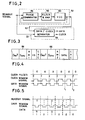
- the VFO 52 is of the phase locked loop configuration, comprising a phase comparator 56, filter and amplifier circuit 58, and voltage controlled oscillator (VCO) 60.
- the phase comparator 56 has a first input connected to the NAND circuits 36 of all the FDDs 10, 12, 14 and 16, and a second input connected to the output of the VCO 60. It is the function of the phase comparator 56 to detect the phase of the clock pulses included in the output from the magnetic disks 24.
- the output from the phase comparator 56 is directed via the filter and amplifier circuit 58 to the VCO 60.
- the VCO 60 puts out a clock window signal as the data/clock separation signal required for separating the outputs from the read circuits 34 into data pulses and clock pulses, as will be later explaiend in further detail.
- the output of the VCO 60, or of the VFO 52 is connected by way of a line 62 to a data/clock separator 64 included in the controller 22 of the host equipment 18, as shown also in FIG. 2.
- the data/clock separator 64 inputs not only the clock window signal from the VFO 52 but also the readout signals from the FDDs 10, 12, 14 and 16.
- a logic gate circuit, not shown, included in the data/clock separator 64 responds to these input signals to derive the clock pulses from the readout signals.
- Another logic gate circuit of the data/clock separator 64 inputs both the readout signals and a data window signal, the latter being a phase inversion of the clock window signal, to derive the data pulses from the readout signals.
- the VFO 52 may be fabricated by use of the IC chip HA16632 manufactured and distributed by Hitachi Ltd., of Tokyo, Japan.
- FIG. 3 is explanatory of the known format by which data to be read out and other information are written on the tracks of each magnetic disk 24.
- the tracks have synchronizing (sync) regions 66 where data are not written, or in a logical "0" state, but where there are written, instead, a series of low level clock pulses at spacings of two microseconds, for example, as illustrated in FIG. 4.
- the associated read circuit 34 puts out only the clock pulses, for delivery to the phase comparator 56, FIG. 2, of the VFO 52, as well as to the controller 22 of the host equipment 18, via the NAND circuit 36.
- the VFO 52 puts out, as the data/clock separation signal, the clock window signal in the form of a series of pulses synchronized with the clock pulses by virtue of the PLL performance of the VFO.
- FIG. 4 is a waveform diagram plotting, along with the clock pulses read out from each magnetic disk 24, the clock window signal produced by the VFO 52 from the clock pulses, and the data window signal produced by inverting the phase of the clock window signal. It will be seen from this diagram that the clock window signal goes low, as at moments tl and t2, in synchronism with the low level clock pulses, whereas the data window signal goes low during the high level spacings between the clock pulses.
- the disk drive motors 26 of all the FDDs 10, 12, 14 and 16 set the magnetic disks 24 into rotation upon delivery of the MOTOR ON signal from the controller 22 of the host equipment 18 to the motor control and drive circuits 28 of the FDDs by way of the line 50.
- the DRIVE SELECT signal delivered from the controller 22 to the first FDD 10 has subsequently gone low.
- the DRIVE SELECT signal will cause the NAND circuit 36 to pass the output from the read circuit 34.
- the transducer head 30 is moved into data transfer contact with the magnetic disk 24, in a radial position thereon determined by the head transport mechanism 32, to start reading the disk.
- the read circuit 34 shapes the output therefrom into a form suitable for subsequent processing.
- the readout signal from the read circuit 34 representing a datum "101000", for example, will be as plotted in FIG. 5, containing clock pulses along with the data pulses.
- the readout signal from the read circuit 34 will be delivered to the VFO 52, besides being fed directly to the controller 22 by way of the line 40.
- the VFO 52 will put out the clock window signal of FIG. 4, for delivery to the data/clock separator 64 of the controller 22 by way of the line 54.
- the data/clock separator 64 inverts the phase of the incoming clock window signal to provide the data window signal seen in both FIGS. 4 and 5.
- the gate circuit included in the data/clock separator 64 allows the passage of the readout signal of FIG. 5 only during the low states of the data window signal. Thus the desired data can be derived from the readout signal as in FIG. 5.
- the data/clock separator 64 operates in a like manner to derive the clock pulses from the readout signal by the clock window signal.
- the NAND circuit 36 of the second FDD will likewise deliver the readout signal from the second magnetic disk 24 to the controller 22 of the host equipment 18 by way of the common output line 40. Further, since the output lines of all the FDDs 10, 12, 14 and 16 are in OR connection, the readout signal from the second FDD 12 will also enter the VFO 52 provided to the first FDD 10. The VFO 52 will respond to the readout signal from the second FDD 12 by producing the clock window signal as the data/clock separation signal. Subsequently applied to the data/clock separator 64 of the controller 22, the clock window signal will be thereby used for separating the readout signal from the second FDD 12 into data pulses and clock pulses.
- the single VFO 52 provided to the first FDD 10 functions in a like manner to put out the data/clock separation signal in response to the readout signal from any of the FDDs 10, 12, 14 and 16. Accordingly, whenever a plurality of FDDs are daisy chained, only one of them may be provided with a VFO in accordance with the teachings of our invention, with the consequent advantages set forth previously.
Landscapes
- Engineering & Computer Science (AREA)
- Signal Processing (AREA)
- Theoretical Computer Science (AREA)
- Human Computer Interaction (AREA)
- Physics & Mathematics (AREA)
- General Engineering & Computer Science (AREA)
- General Physics & Mathematics (AREA)
- Signal Processing For Digital Recording And Reproducing (AREA)
Applications Claiming Priority (2)
| Application Number | Priority Date | Filing Date | Title |
|---|---|---|---|
| JP191331/83 | 1983-12-12 | ||
| JP1983191331U JPS6098159U (ja) | 1983-12-12 | 1983-12-12 | 磁気デイスク再生装置 |
Publications (2)
| Publication Number | Publication Date |
|---|---|
| EP0146041A2 true EP0146041A2 (fr) | 1985-06-26 |
| EP0146041A3 EP0146041A3 (fr) | 1986-07-09 |
Family
ID=16272775
Family Applications (1)
| Application Number | Title | Priority Date | Filing Date |
|---|---|---|---|
| EP84114468A Withdrawn EP0146041A3 (fr) | 1983-12-12 | 1984-11-29 | Système de transfert de données avec une pluralité de mécanismes de mémoire à disques magnétiques |
Country Status (3)
| Country | Link |
|---|---|
| EP (1) | EP0146041A3 (fr) |
| JP (1) | JPS6098159U (fr) |
| KR (1) | KR890007140Y1 (fr) |
Family Cites Families (4)
| Publication number | Priority date | Publication date | Assignee | Title |
|---|---|---|---|---|
| US4053944A (en) * | 1976-04-30 | 1977-10-11 | International Business Machines Corporation | Microprocessor controlled signal pattern detector |
| JPS56114054A (en) * | 1980-02-15 | 1981-09-08 | Hitachi Ltd | Transmission system of multiplexed signal |
| JPS5720052A (en) * | 1980-07-11 | 1982-02-02 | Toshiba Corp | Input data synchronizing circuit |
| GB2120819A (en) * | 1982-05-21 | 1983-12-07 | Pitney Bowes Inc | Disk drive size selector circuit |
-
1983
- 1983-12-12 JP JP1983191331U patent/JPS6098159U/ja active Granted
-
1984
- 1984-11-29 EP EP84114468A patent/EP0146041A3/fr not_active Withdrawn
- 1984-12-03 KR KR2019840012557U patent/KR890007140Y1/ko not_active Expired
Also Published As
| Publication number | Publication date |
|---|---|
| KR890007140Y1 (ko) | 1989-10-16 |
| KR850009688U (ko) | 1985-12-05 |
| JPH0416288Y2 (fr) | 1992-04-13 |
| EP0146041A3 (fr) | 1986-07-09 |
| JPS6098159U (ja) | 1985-07-04 |
Similar Documents
| Publication | Publication Date | Title |
|---|---|---|
| US4618897A (en) | System for synchronizing plural data storage devices to a common master | |
| US4375655A (en) | Universal digital data copying system | |
| US4425646A (en) | Input data synchronizing circuit | |
| GB2062905A (en) | Disc record reproducing apparatuses | |
| JPS59207068A (ja) | フロツピイデイスク装置 | |
| US4647828A (en) | Servo system | |
| JPS623498B2 (fr) | ||
| EP0425475B1 (fr) | Système de transmission et de détection de données | |
| US5475455A (en) | Information recording device | |
| JPH0416288Y2 (fr) | ||
| JP2740336B2 (ja) | 変調信号を書込み可能光ディスクに書き込み、再生する回路 | |
| US5978338A (en) | Apparatus for reproducing short length data stored on an optical disk | |
| EP0056128A2 (fr) | Circuit de synchronisation de phase | |
| US4953043A (en) | Magnetic recording or reproducing apparatus with erasing capability | |
| KR940006890B1 (ko) | 기록 매체 상에 정보를 자기적으로 기록하기 위한 방법 및 시스템 | |
| JP2988460B2 (ja) | 磁気ディスク装置 | |
| JPS59175054A (ja) | 磁気録画再生装置 | |
| JP3055447B2 (ja) | 磁気記録装置 | |
| JPH02132682A (ja) | ディスク装置のデータ復調回路 | |
| JP2680154B2 (ja) | 情報記録再生装置 | |
| JPH0242676A (ja) | 光ディスク装置 | |
| JPS5819768A (ja) | 回転形外部記憶装置 | |
| JPS62262270A (ja) | 情報記録再生装置 | |
| JPH0691618B2 (ja) | 画像デ−タ記録再生装置 | |
| JPS6231068A (ja) | デジタル信号再生装置の速度制御装置 |
Legal Events
| Date | Code | Title | Description |
|---|---|---|---|
| PUAI | Public reference made under article 153(3) epc to a published international application that has entered the european phase |
Free format text: ORIGINAL CODE: 0009012 |
|
| AK | Designated contracting states |
Designated state(s): DE GB NL |
|
| PUAL | Search report despatched |
Free format text: ORIGINAL CODE: 0009013 |
|
| AK | Designated contracting states |
Kind code of ref document: A3 Designated state(s): DE GB NL |
|
| STAA | Information on the status of an ep patent application or granted ep patent |
Free format text: STATUS: THE APPLICATION IS DEEMED TO BE WITHDRAWN |
|
| 18D | Application deemed to be withdrawn |
Effective date: 19870109 |
|
| RIN1 | Information on inventor provided before grant (corrected) |
Inventor name: SAKAI, YOSHIAKI Inventor name: SHOJI, MAKOTO |