EP0146450B1 - Dérivés de beta-[2-(Halogénobenzyl-)-phénoxy] -éthylamine, procédé de préparation et utilisation en thérapeutique. - Google Patents
Dérivés de beta-[2-(Halogénobenzyl-)-phénoxy] -éthylamine, procédé de préparation et utilisation en thérapeutique. Download PDFInfo
- Publication number
- EP0146450B1 EP0146450B1 EP84402387A EP84402387A EP0146450B1 EP 0146450 B1 EP0146450 B1 EP 0146450B1 EP 84402387 A EP84402387 A EP 84402387A EP 84402387 A EP84402387 A EP 84402387A EP 0146450 B1 EP0146450 B1 EP 0146450B1
- Authority
- EP
- European Patent Office
- Prior art keywords
- formula
- group
- addition salts
- phenoxy
- dichlorobenzyl
- Prior art date
- Legal status (The legal status is an assumption and is not a legal conclusion. Google has not performed a legal analysis and makes no representation as to the accuracy of the status listed.)
- Expired
Links
- 0 **(*)(*)CCOc1ccccc1Cc(cc1)ccc1Cl Chemical compound **(*)(*)CCOc1ccccc1Cc(cc1)ccc1Cl 0.000 description 4
Classifications
-
- A—HUMAN NECESSITIES
- A61—MEDICAL OR VETERINARY SCIENCE; HYGIENE
- A61K—PREPARATIONS FOR MEDICAL, DENTAL OR TOILETRY PURPOSES
- A61K31/00—Medicinal preparations containing organic active ingredients
- A61K31/13—Amines
-
- A—HUMAN NECESSITIES
- A61—MEDICAL OR VETERINARY SCIENCE; HYGIENE
- A61P—SPECIFIC THERAPEUTIC ACTIVITY OF CHEMICAL COMPOUNDS OR MEDICINAL PREPARATIONS
- A61P25/00—Drugs for disorders of the nervous system
- A61P25/18—Antipsychotics, i.e. neuroleptics; Drugs for mania or schizophrenia
-
- A—HUMAN NECESSITIES
- A61—MEDICAL OR VETERINARY SCIENCE; HYGIENE
- A61P—SPECIFIC THERAPEUTIC ACTIVITY OF CHEMICAL COMPOUNDS OR MEDICINAL PREPARATIONS
- A61P25/00—Drugs for disorders of the nervous system
- A61P25/24—Antidepressants
-
- A—HUMAN NECESSITIES
- A61—MEDICAL OR VETERINARY SCIENCE; HYGIENE
- A61P—SPECIFIC THERAPEUTIC ACTIVITY OF CHEMICAL COMPOUNDS OR MEDICINAL PREPARATIONS
- A61P25/00—Drugs for disorders of the nervous system
- A61P25/26—Psychostimulants, e.g. nicotine, cocaine
-
- A—HUMAN NECESSITIES
- A61—MEDICAL OR VETERINARY SCIENCE; HYGIENE
- A61P—SPECIFIC THERAPEUTIC ACTIVITY OF CHEMICAL COMPOUNDS OR MEDICINAL PREPARATIONS
- A61P31/00—Antiinfectives, i.e. antibiotics, antiseptics, chemotherapeutics
- A61P31/04—Antibacterial agents
Definitions
- the present invention relates as new industrial products to derivatives of P- [2- (halobenzyl) -phenoxy] -ethylamine. It also relates to the preparation process and the therapeutic use of these new products.
- antid- (2- (halobenzyl) -4-alkyl (C 1 -C 5 ) -phenoxy] -N, N-dialkyl has been proposed as antidepressant substances -propyl-, butyl- or pentylamines.
- new compounds of the dichloro- and trichlorobenzyl type are recommended which are structurally different from those of the above-mentioned prior art, on the one hand, and are particularly advantageous from the therapeutic point of view, in particular because of their affinity for water and their anti-infective and / or antidepressant properties, on the other hand.
- addition salts is meant here, on the one hand, the acid addition salts obtained by reaction of the free base of formula I with mineral or organic acids, and, on the other hand, the salts of 'ammonium.
- acids which can be used to salify the base of formula 1 mention may especially be made of hydrochloric, hydrobromic, acetic, formic, propionic, oxalic, fumaric, maleic, succinic, benzoic, cinnamic, mandelic, citric, malic, tartaric, aspartic acids, glutamic, methanesulfonic, p-toluenesulfonic.
- the invention therefore relates to the free bases of formula 1 eer their acid addition salts, on the one hand, and their ammonium salts of formula (where Ar, R, R 1 , R 2 , R 3 and X are defined as above), on the other hand.
- R 1 R 2 - CH 3 or CH 2 CH 3 and Y 1 is 4-CI, Y 2 is H and Y 3 is 2-Cl or 3-CI, and which are represented by the formula where R is a C 1 -C 8 alkyl group, R 'is CH 3 or C 2 H 5 ; their acid addition salts, and their quaternary ammonium salts with XR ' 3 (where R' 3 is CH 3 , CH 2 CH 3 or CH 2 C 6 H 5 , and, X is F, CI, Br or I).
- the preferred ammonium salts mentioned above can be represented by the formula (where X, R, R 'and R 3 are defined as above. X being advantageously CI, Br or I).
- the free bases of formula I, their acid addition salts and their ammonium salts are useful in therapy. They all have antiinfectious properties in the sense that they act according to the doses as bacteriostatic, bactericidal, fungistatic or fungicidal means; in general, the ammonium salts are more active as antiinfectious substances than the acid addition salts, the latter also being more active than the free bases.
- the free bases and their acid addition salts have other beneficial effects: they act on the central nervous system as antidepressant agents, and are active against enuresis.
- Certain compounds among the free bases and their acid addition salts such as for example the products of Examples 11 (B 795), 12 (B 805), 13 (B 809), 14 (B 785) and 15 ( B 751), also have beneficial spasmolytic properties.
- the most interesting compound, as a spasmolytic agent, is the product of Example 12 (B 805).
- a therapeutic composition which is characterized in that it contains, in association with a physiologically acceptable excipient, at least one compound of formula 1 or one of its addition salts, as active principle.
- the active principle which is chosen from the fiber bases of formula I, their non-toxic addition salts and, where appropriate, their mixtures, intervenes in an effective pharmaceutical amount.
- strains used are those of the catalogs of the Institut Pasteur "(abbreviated” CIP ") from the" International Center for the Distribution of Strains and Information on Microbial Types of Lausanne “(in abbreviation” La ”) and the" American Typ, Culture Collaction "(abbreviated as” ATCC ").
- the compounds according to the invention are not very toxic and are well tolerated by the body.
- Table VI below shows in particular that the ammonium salts of the compounds of formula 1 are less toxic than ammonium salts previously known as anti-infectious means.
Landscapes
- Health & Medical Sciences (AREA)
- General Health & Medical Sciences (AREA)
- Pharmacology & Pharmacy (AREA)
- Chemical & Material Sciences (AREA)
- Public Health (AREA)
- Veterinary Medicine (AREA)
- Medicinal Chemistry (AREA)
- Animal Behavior & Ethology (AREA)
- Life Sciences & Earth Sciences (AREA)
- Nuclear Medicine, Radiotherapy & Molecular Imaging (AREA)
- Organic Chemistry (AREA)
- Bioinformatics & Cheminformatics (AREA)
- Chemical Kinetics & Catalysis (AREA)
- Engineering & Computer Science (AREA)
- General Chemical & Material Sciences (AREA)
- Psychiatry (AREA)
- Biomedical Technology (AREA)
- Neurology (AREA)
- Neurosurgery (AREA)
- Epidemiology (AREA)
- Pain & Pain Management (AREA)
- Communicable Diseases (AREA)
- Oncology (AREA)
- Organic Low-Molecular-Weight Compounds And Preparation Thereof (AREA)
- Acyclic And Carbocyclic Compounds In Medicinal Compositions (AREA)
Description
- La présente invention concerne en tant que produits industriels nouveaux des dérivés de P-[2-(halogénobenzyl)-phénoxy]-éthylamine. Elle concerne également le procédé de préparation et l'utilisation en thérapeutique de ces nouveaux produits.
- On sait que l'on a déjà préconisé dans le passé d'utiliser des 2-(halogénobenzyl)-4-alkylphénols (où le groupe 4-alkyle est un radical hydrocarboné ramifié, notamment un radical isopropyle, s-butyle, t-butyle ou 1,1,3,3-tétra-méthylbutyle) en tant que substances bactériostatiques, voir à cet effet US-A-3 830 852, US-A-3 855 317 et US-A-3 984482, d'une part, et l'article de BUU-HOI et al., J. Org. Chem., 20, 1129-1134 (1955), d'autre part.
- On sait en particulier que le 2-(2,4-dichlorobenzyl)-4-(1,1,3,3-tétraméthylbutyl)-phénol (qui a pour N° de code B.11 et qui est décrit à l'exemple 1 de US-A-3 830 852 précité) a été commercialisé en France en tant que médicament anti-infectieux (Dénomination Commune Internationale: "CLOFOCTOL"; nom de marque de la spécialité: "OCTOFENE"). Or, il se trouve que ce produit, qui est particulièrement efficace dans le traitement des maladies infectieuses dues aux bactéries Gram+, et ses analogues du type 2-(halogénobenzyl) 4-alkylphénol ne sont pas naturellement hydrosolubles ni hydrodispersables. La faible affinité pour l'eau constitue un inconvénient qui limite, sur le plan galénique, l'utilisation de ces produits.
- On sait par ailleurs que des dérivés monohalogénés de P-[2-(halogénobenzyl)-phénoxy]-éthylamine ont déjà été décrits ou suggérés dans le passé. En particulier, l'article de BUU-HOI et al. précité décrit en tant que produits chimiques la 0-[2-(4-chlorobenzyl)-4-méthylphénoxy]-N,N-diméthyl-éthylamine et son chlorhydrate, et, le brevet BE-A-504 409 englobe dans sa formule générale des sels d'addition d'acide de β-[2-(monohalogénobenzyl)-4-alkyl(inférieur)-phénoxy]-N,N-dialkyl-éthylamine mais le seul produit monohalogénobenzyle qu'il décrit, la β-(2-(4-bromobenzyl)-phénoxy]-N,N-diméthyl-éthylamine, n'est pas alkylé en position 4 du groupe phénoxy.
- On sait enfin que dans FR-A-2 372 792 on a proposé en tant que substances antidépressives des ω-(2-(halogénobenzyl)-4-alkyl (en C1-C5)-phénoxy]-N,N-dialkyl-propyl-, butyl- ou pentylamines.
- Selon l'invention, on préconise de nouveaux composés du type dichloro- et trichlorobenzyle qui sont structurellement différents de ceux de l'art antérieur précité, d'une part, et particulièrement intéressants sur le plan thérapeutique en raison notamment de leur affinité pour l'eau et de leurs propriétés anti-infectieuses et/ou antidépressives, d'autre part.
- Les nouveaux composés selon l'invention, qui sont des dérivés de β-(2-(halogénobenzyl)-phénoxy]-éthylamine sont caractérisés en ce qu'ils sont choisis parmi l'ensemble constitué par
- (i) les N,N dialkyl-β-(2-(polychlorobenzyl)-4-alkylphenoxy]-éthylamines répondant à la formule générale
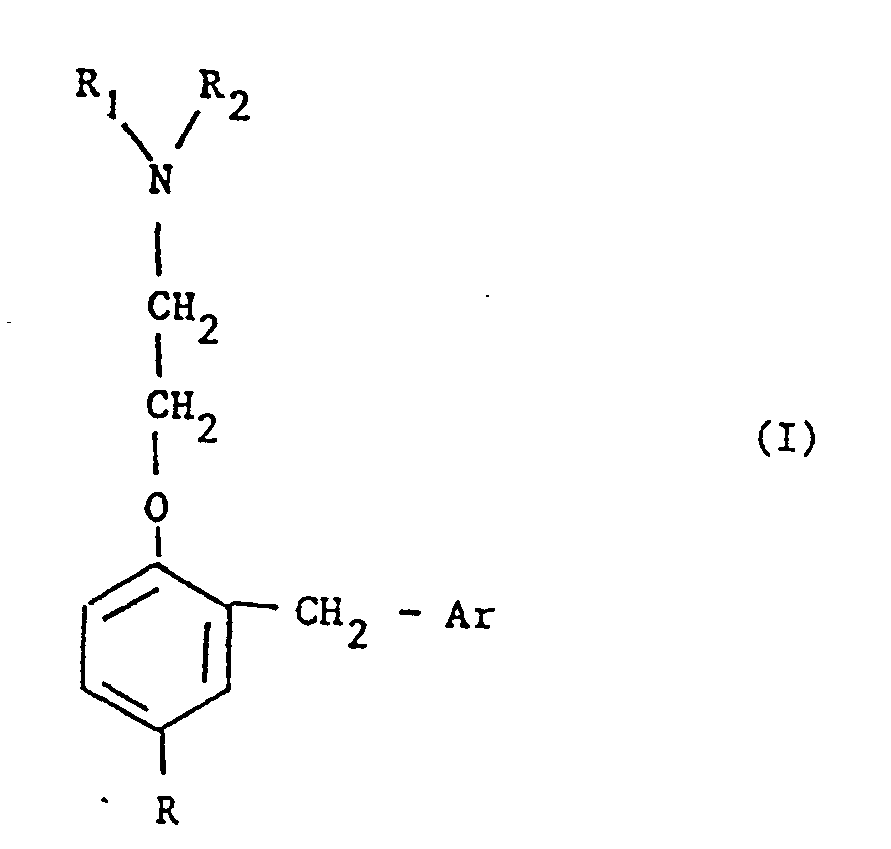
- R représente un groupe alkyle en C1-C8 à chaîne hydrocarbonée linéaire ou ramifiée,
- R1 et R2, identiques ou différents, représentent chacun un groupe alkyle en Cl-C4, et
- Ar représente un groupe polychlorophényle de formule

- (ii) leurs sels d'addition.
- Parmi les groupes alkyle R qui conviennent, on peut notamment mentionner les groupes CH3, CH2CH3; CH(CH3)2, C(CH3)3, CH(CH3)CH2CH3, (CH2)3CH3, CH2C(CH3)3, CH2CH(CH3)CH2CH3, C(CH3)2CH2C(CH3)3' C(CH3)2CH2CH3, (CH2)5CH3.
- Par sels d'addition, on entend ici, d'une part, les sels d'addition d'acide obtenus par réaction de la base libre de formule I avec des acides minéraux ou organiques, et, d'autre part, les sels d'ammonium. Parmi les acides utilisables pour salifier la base de formule 1, on peut notamment citer les acides chlorhydrique, bromhydrique, acétique, formique, propionique, oxalique, fumarique, maléique, succinique, benzoïque, cinnamique, mandélique, citrique, malique, tartrique, aspartique, glutamique, méthanesulfonique, p-toluènesulfonique. Parmi les composés permettant d'obtenir des sels d'ammonium, on peut citer les composés XR3 (où X est F, CI, Br ou 1, et, R3 est un groupe alkyle en C1-C10 ou un groupe benzyle).
- L'invention vise donc les bases libres de formule 1 eer leurs sels d'addition d'acide, d'une part, et leurs sels d'ammoniun de formule

- Les produits préférés selon l'invention sont ceux où R1 = R2 - CH3 ou CH2CH3 et Y1 est 4-CI, Y2 est H et Y3 est 2-Cl ou 3-CI, et qui sont représentes par la formule


- Les composés selon l'invention peuvent être préparés selon une méthode connue en soi par application de mécanismes réactionnels classiques. Le procédé que l'on préconise selon l'invention consiste à faire réagir un 2-(halogénobenzyl)-4-alkylphénol de formule

- Hal - CH2 - CH2 - NR1R2 (V)
- Cette réaction est avantageusement realisée dans un solvant inerte notamment le diméthylformamide, le tétrahydrofuranne pendant au moins 5 heures à une température inférieure ou égale à la température de reflux du milieu réactionnel à raison d'au moins 1,1 mole de V pour 1 mole de IV l'halogénure etant de préférence le chlorure (Hat = CI).
- Les bases libres de formule I, leurs sels d'addition d'acide et leurs sels d'ammonium sont utiles en thérapeutique. Ils présentent tous des propriétés antiinfectieuses en ce sens qu'ils agissent selon les doses en tant que moyens bactériostatiques, bactéricides, fongistatiques, ou, fongicides; d'une manière générale les sels d'ammonium sont plus actifs en tant que substances antiinfectieuses que les sels d'addition d'acides, ces derniers étant également plus actifs que les bases libres.
- Par ailleurs, les bases libres et leurs sels d'addition d'acide présentent d'autres effets bénéfiques: ils agissent sur le système nerveux central en tant qu'agents antidépresseurs, et sont actifs vis-à-vis de l'énurésie. Certains composés parmi les bases libres et leurs sels d'addition d'acide, tels que par exemple les produits des exemples 11 (B 795), 12 (B 805), 13 (B 809), 14 (B 785) et 15 (B 751), présentent en outre des propriétés spasmolytiques bénéfiques. Le composé le plus intéressant, en tant qu'agent spasmolytique, est le produit de l'exemple 12 (B 805).
- Selon l'invention on préconise une composition thérapeutique qui est caractérisée en ce qu'elle renferme en association avec un excipient physiologiquement acceptable, au moins un composé de formule 1 ou l'un de ses sels d'addition, en tant que principe actif.
- Bien entendu, dans une telle composition le principe actif, qui est choisi parmi les bases fibres de formule I, leurs sels d'addition non-toxiques et, le cas échéant, leurs mélanges, intervient en quantite pharmaceutiquemeut efficace.
- On a consigné de façon nullement limitative dans les tableaux I, Il ét III qui suivent un certain nombre de composés selon l'invention; les concéntrations minimales inhibitrices (CMI) de ces composés vis-à-vis d'une souche de bactérie Gram + (Staphylococcus aureus London) d'une souche de bactérie Gram- (Eschérichla coli) et d'une souche de champignon (Candida albicans) sont données dans le tableau IV ci-après. Dans le tableau V on a consigné les CMI de déux produits selon l'invention qui sont particulièrement intéressants [composé B673 (exemple 26) et composé B 674 (exemple 29)] vis-à-vis de plusieurs souches.
- Les souches utilisées sont celles des catalogues de l'institut Pasteur" (en abrégé "CIP") du "Centre International de Distribution de Souches et d'Information sur les Types Microbiens de Lausanne" (en abrége "La") et de l"American Typ, Culture Collaction" (en abrégé "ATCC").


- D'une manière générale les composés selon l'invention sont peu toxiques et bien tolérés par l'organisme. Le tableau VI ci-après montre en particulier que les sels d'ammonium des composés de formule 1 sont moins toxiques que des sels d'ammonium antérieurement connus en tant que moyens anti-infectieux.

- D'autres avantages et caractéristiques de l'invention seront mieux compris à la lecture qui va suivre d'exemples de préparation nullement limitatifs, mais donnés à titre d'illustration. Préparation 1
- Obtention de la β-(2-(2,4-dichlorobenzyl)-4-tertiobutylphénoxyl-N ,Ndiéthyl-éthylamine.

autre nomenclature: 2- (2-diéthylamino-éthoxy)-5-tertiobutyl-2',4'-dichlorodiphénylméthane. - On fait réagir dans un réacteur un mélange constitué par 1 mole (309,18 g) de 2-(2,4-dichlorobenzyl)-4-tertiobutyl-phénol, 2,4 mole de K2CO3, 2 litres de diméthylformamide et 1,2 moles de chlorhydrate de 2-chloro-N,N-diéthyl-éthylamine, sous agitation pendant 15 heures à 120°C.
- On verse le milieu réactionnel dans de l'eau saturée en NaCl extrait au moyen de CHCI3, lave la phase chloroformique avec de l'eau sèche et évapore le solvant sous vide. Par distillation sous vide du résidu d'évaporation on obtient le B 680 avec un rendement de 76,1 %.
- Eb0,5 mmHg 195-197°C. Préparation Il
-

- On fait réagir dans un réacteur 1 mole (408,25 g) de β-[2-(2,4-dichlorobenzyl)-4-tertiobutylphénoxyj-N,N- diéthyl-éthyl amine avec 1,25 mole de chlorure de benzyle pendant 17 heures à 90-100°C sous agitation. Après refroidissement jusqu'à la température ambiante (15-20°C) on lave le milieu réactionnel avec le diéthyléther pour obtenir un précipité qu'on lave à l'hexane puis à l'acétone à froid (15-20°C). Par recristallisation on obtient le B 674 avec un rendement de 85,8 %.
- Finst = 120-125° C. Préparation III
- Dans une solution de 1 mole (422,31 g) de β-(2-(2,4-dichlorobenzylj-4-(1,1-diméthylpropyl)-phénoxy)-N,N-diethyl-éthylamine (exemple 6; n° de code; B 748) dans 800 ml de diéthyléther anhydre on fait barboter un courant de HCI gaz. On évapore sous vide jusqu'à siccité reprend le résidu d'évaporation avec du diéthyléther anhydre. Il se forme un précipité qu'on lave avec du diéthyléther anhydre. On obtient le B 785 avec un rendement de 83,3
- Finst = 145-150° C. Préparation IV
- On fait réagir pendant 2 heures à 45°C sous agitation un mélange de 1 mole (422,31 g) de β-[2-(2,4-dichlorobenzyl)-4-(1,1-diméthylpropyl)-phénoxy]-N,N-diéthyl-éthylamine, de 1,25 mole de ICH3 et 1,2 1 d'acétone anhydre. Après refroidissement on verse le milieu réactionnel sur CH3CO2C2H5 froid (15°C). On obtient un précipité. Par recristallisation dans le mélange CH3CO2C2H5 - C2H5OH (98: 2) v/v on obtient le B 794 avec un rendement de 62,4 %.
- Finst = 138-140° C. Préparation V
- On fait réagir 1 mole (422,31 g) de β-[2-(2,4-dichloro-benzyl)-4-(1,1-diméthylpropyl)-phénoxy]-N,N-diéthyléthylamine avec 1,25 mole de 1-bromobutane pendant 15 heures à 100°C sous agitation. Après refroidissement on lave le milieu réactionnel avec de l'hexane puis avec du diéthyléther pour obtenir un précipité. Par lavage du précipité à 30°C avec CH3C02C2H, on obtient le B 798 avec un rendement de 20,4 %.
- Finst = 104-108° C.
(où Hal est CI ou Br et RI et R2 sont definis comme indique ci-dessus).
Claims (12)


Priority Applications (1)
| Application Number | Priority Date | Filing Date | Title |
|---|---|---|---|
| AT84402387T ATE24891T1 (de) | 1983-11-29 | 1984-11-23 | Derivate von beta-(2-(halogenobenzyl)-phenoxy>ethylaminen, verfahren zu ihrer herstellung und ihre therapeutische anwendung. |
Applications Claiming Priority (2)
| Application Number | Priority Date | Filing Date | Title |
|---|---|---|---|
| FR8319056A FR2555573A1 (fr) | 1983-11-29 | 1983-11-29 | Derives de b-(2-(halogenobenzyl)-phenoxy)-ethylamine, procede de preparation et utilisation en therapeutique |
| FR8319056 | 1983-11-29 |
Publications (3)
| Publication Number | Publication Date |
|---|---|
| EP0146450A2 EP0146450A2 (fr) | 1985-06-26 |
| EP0146450A3 EP0146450A3 (en) | 1985-07-24 |
| EP0146450B1 true EP0146450B1 (fr) | 1987-01-14 |
Family
ID=9294655
Family Applications (1)
| Application Number | Title | Priority Date | Filing Date |
|---|---|---|---|
| EP84402387A Expired EP0146450B1 (fr) | 1983-11-29 | 1984-11-23 | Dérivés de beta-[2-(Halogénobenzyl-)-phénoxy] -éthylamine, procédé de préparation et utilisation en thérapeutique. |
Country Status (14)
| Country | Link |
|---|---|
| US (1) | US4659741A (fr) |
| EP (1) | EP0146450B1 (fr) |
| JP (1) | JPS6127951A (fr) |
| AT (1) | ATE24891T1 (fr) |
| AU (1) | AU569927B2 (fr) |
| CA (1) | CA1222777A (fr) |
| DE (1) | DE3462030D1 (fr) |
| DK (1) | DK564384A (fr) |
| ES (1) | ES538548A0 (fr) |
| FR (1) | FR2555573A1 (fr) |
| GR (1) | GR81064B (fr) |
| NZ (1) | NZ210371A (fr) |
| PT (1) | PT79561B (fr) |
| ZA (1) | ZA849160B (fr) |
Families Citing this family (2)
| Publication number | Priority date | Publication date | Assignee | Title |
|---|---|---|---|---|
| DK368687A (da) * | 1986-11-21 | 1988-05-22 | Cheminova As | Aminoalkylerede hydroxyforbindelser og deres anvendelse som fungicider |
| CN115925585B (zh) * | 2022-04-22 | 2023-11-03 | 广州医科大学 | 氯福克酚衍生物、抗菌药物及制备方法与应用 |
Family Cites Families (9)
| Publication number | Priority date | Publication date | Assignee | Title |
|---|---|---|---|---|
| BE504409A (fr) * | ||||
| US2673879A (en) * | 1949-07-30 | 1954-03-30 | Lilly Co Eli | Substituted haloalkylamines |
| US2681933A (en) * | 1949-11-25 | 1954-06-22 | Bristol Lab Inc | Beta-chloroethylamines |
| CH438361A (de) * | 1962-01-18 | 1967-06-30 | Ciba Geigy | Verfahren zur Herstellung neuer Diphenylalkanverbindungen |
| US3488357A (en) * | 1967-04-07 | 1970-01-06 | Ciba Geigy Corp | 2-halophenyl-2-aminoalkoxy-phenylpropanes |
| US3855317A (en) * | 1967-08-31 | 1974-12-17 | Inst Rech Chim Biolog | 2-4-halobenzyl phenols and preparation thereof |
| US3984482A (en) * | 1967-08-31 | 1976-10-05 | Institut De Recherches Chimiques Et Biologiques Appliquees I.R.C.E.B.A. | 2-(Dihalobenzyl)-6-nitro-4-t-butylphenol and preparation thereof |
| US4024282A (en) * | 1975-11-25 | 1977-05-17 | Mitsubishi Chemical Industries Ltd. | Pharmaceutically active 2-(3-alkylaminopropoxy)diphenylmethanes |
| CA1086733A (fr) * | 1976-12-06 | 1980-09-30 | Ryoji Kikumoto | 1-(.omega.-AMINOALKOXY) BENZENES SUBSTITUES EN 2, A PROPRIETES PHARMACEUTIQUES |
-
1983
- 1983-11-29 FR FR8319056A patent/FR2555573A1/fr not_active Withdrawn
-
1984
- 1984-11-23 AT AT84402387T patent/ATE24891T1/de not_active IP Right Cessation
- 1984-11-23 DE DE8484402387T patent/DE3462030D1/de not_active Expired
- 1984-11-23 EP EP84402387A patent/EP0146450B1/fr not_active Expired
- 1984-11-23 ZA ZA849160A patent/ZA849160B/xx unknown
- 1984-11-26 CA CA000468623A patent/CA1222777A/fr not_active Expired
- 1984-11-27 PT PT79561A patent/PT79561B/fr not_active IP Right Cessation
- 1984-11-27 US US06/675,297 patent/US4659741A/en not_active Expired - Fee Related
- 1984-11-27 AU AU35905/84A patent/AU569927B2/en not_active Ceased
- 1984-11-27 GR GR81064A patent/GR81064B/el unknown
- 1984-11-28 DK DK564384A patent/DK564384A/da not_active Application Discontinuation
- 1984-11-28 NZ NZ210371A patent/NZ210371A/en unknown
- 1984-11-29 ES ES538548A patent/ES538548A0/es active Granted
- 1984-11-29 JP JP25389784A patent/JPS6127951A/ja active Granted
Also Published As
| Publication number | Publication date |
|---|---|
| EP0146450A3 (en) | 1985-07-24 |
| DE3462030D1 (en) | 1987-02-19 |
| JPS6127951A (ja) | 1986-02-07 |
| GR81064B (en) | 1985-03-27 |
| NZ210371A (en) | 1988-05-30 |
| AU3590584A (en) | 1985-06-06 |
| ZA849160B (en) | 1985-07-31 |
| JPS6323185B2 (fr) | 1988-05-16 |
| FR2555573A1 (fr) | 1985-05-31 |
| DK564384A (da) | 1985-05-30 |
| US4659741A (en) | 1987-04-21 |
| ATE24891T1 (de) | 1987-01-15 |
| ES8601096A1 (es) | 1985-11-01 |
| PT79561A (fr) | 1984-12-01 |
| EP0146450A2 (fr) | 1985-06-26 |
| PT79561B (fr) | 1986-09-15 |
| CA1222777A (fr) | 1987-06-09 |
| AU569927B2 (en) | 1988-02-25 |
| DK564384D0 (da) | 1984-11-28 |
| ES538548A0 (es) | 1985-11-01 |
Similar Documents
| Publication | Publication Date | Title |
|---|---|---|
| Yu et al. | Aliphatic propargylamines: potent, selective, irreversible monoamine oxidase B inhibitors | |
| AU606444B2 (en) | Phenoxy amine derivatives | |
| JP3129733B2 (ja) | 選択性mao−b抑制薬および神経保護薬としての脂肪族プロパルギルアミン | |
| FR2496102A1 (fr) | Benzopyranes 7-substitues, leur preparation et leur application en tant que medicaments | |
| EP0003445B1 (fr) | Dérivés d'aza-1 bicyclo(2,2,2)octane, leur procédé de préparation et produits intermédiaires, et médicaments les contenant | |
| EP0174242A2 (fr) | Dérivés de 1-(aminophényl)-2-amino-propanone, leur utilisation en thérapeutique et leur procédé de préparation | |
| EP0037780B1 (fr) | Alcoxy propanolamines utiles comme médicaments et procédé pour leur préparation | |
| EP0146450A2 (fr) | Dérivés de beta-[2-(Halogénobenzyl-)-phénoxy] -éthylamine, procédé de préparation et utilisation en thérapeutique. | |
| EP0143711B1 (fr) | Dérivés de N-(méthoxyphénacyl)-amine, utilisation notamment en thérapeutique et procédé de préparation | |
| EP0139590B1 (fr) | 4-Ethyl-2-hydroxy-3-méthyl-2-phénylmorpholine et ses sels d'addition | |
| EP0110747B1 (fr) | Dérivés de (2,4,6-triméthoxyphényl-(3-pipéridinopropyl)-cétone, utilisation en thérapeutique et procédé de préparation | |
| EP0097546B1 (fr) | Benzhydrylsulfinyléthylamines, procédé de préparation et utilisation en thérapeutique | |
| EP0135510B1 (fr) | Nouveaux medicaments appartenant a la famille des derives d'halo genobenzophenone-oxime | |
| EP0061406B1 (fr) | Dérivés d'acide benzamido-alkyl-hydroxamique, procédé de préparation et composition thérapeutique | |
| FR2505825A1 (fr) | Derives d'isoprenylamine et leur utilisation dans des compositions pharmaceutiques | |
| EP0110748B1 (fr) | Dérivés de phényl-(3-aminopropyl)-cétone, utilisation en thérapeutique et procédé de préparation | |
| EP0065908B1 (fr) | ((Alkyl- et alcényl-3 pipéridyl-4)-2 éthyl)-3 indoles et leur utilisation comme médicaments | |
| EP0002638B1 (fr) | Sels d'addition d'aralkylamines subsituées et composition thérapeutique les contenant | |
| FR2507180A1 (fr) | Nouvelles phenylalkylamines, leur preparation et leur application comme medicaments | |
| FR2597864A1 (fr) | Nouveaux derives de la n-((trimethoxy-2,4,6-benzoyl)-3 propyl) piperidine, leurs procedes de preparation et leur application en therapeutique | |
| EP0210904B1 (fr) | Phényl-(3-hexaméthylèneiminopropyl)-cétone, procédé de préparation et utilisation en thérapeutique | |
| EP0060954B1 (fr) | Dérivés de fluorophénacyl-amine, et leur application en thérapeutique | |
| FR2484407A1 (fr) | Derives de la nonaprenylamine, leurs sels acides d'addition et composition pharmaceutique les renfermant | |
| EP0063508B1 (fr) | Dérivés de 4-phénoxy-3-hydroxy-butyramidoxime, leur procédé de préparation et leur utilisation en thérapeutique | |
| WO1989004820A1 (fr) | Derives d'amino-4 trifluoromethyl-1 tetralines, leur preparation et leur application en therapeutique |
Legal Events
| Date | Code | Title | Description |
|---|---|---|---|
| PUAI | Public reference made under article 153(3) epc to a published international application that has entered the european phase |
Free format text: ORIGINAL CODE: 0009012 |
|
| PUAL | Search report despatched |
Free format text: ORIGINAL CODE: 0009013 |
|
| AK | Designated contracting states |
Designated state(s): AT BE CH DE FR GB IT LI LU NL SE |
|
| AK | Designated contracting states |
Designated state(s): AT BE CH DE FR GB IT LI LU NL SE |
|
| 17P | Request for examination filed |
Effective date: 19850712 |
|
| 17Q | First examination report despatched |
Effective date: 19860129 |
|
| GRAA | (expected) grant |
Free format text: ORIGINAL CODE: 0009210 |
|
| AK | Designated contracting states |
Kind code of ref document: B1 Designated state(s): AT BE CH DE FR GB IT LI LU NL SE |
|
| REF | Corresponds to: |
Ref document number: 24891 Country of ref document: AT Date of ref document: 19870115 Kind code of ref document: T |
|
| REF | Corresponds to: |
Ref document number: 3462030 Country of ref document: DE Date of ref document: 19870219 |
|
| ITF | It: translation for a ep patent filed | ||
| PLBE | No opposition filed within time limit |
Free format text: ORIGINAL CODE: 0009261 |
|
| STAA | Information on the status of an ep patent application or granted ep patent |
Free format text: STATUS: NO OPPOSITION FILED WITHIN TIME LIMIT |
|
| 26N | No opposition filed | ||
| ITTA | It: last paid annual fee | ||
| PGFP | Annual fee paid to national office [announced via postgrant information from national office to epo] |
Ref country code: AT Payment date: 19921019 Year of fee payment: 9 |
|
| PGFP | Annual fee paid to national office [announced via postgrant information from national office to epo] |
Ref country code: SE Payment date: 19921021 Year of fee payment: 9 |
|
| PGFP | Annual fee paid to national office [announced via postgrant information from national office to epo] |
Ref country code: BE Payment date: 19921027 Year of fee payment: 9 |
|
| PGFP | Annual fee paid to national office [announced via postgrant information from national office to epo] |
Ref country code: LU Payment date: 19921030 Year of fee payment: 9 |
|
| PGFP | Annual fee paid to national office [announced via postgrant information from national office to epo] |
Ref country code: FR Payment date: 19921106 Year of fee payment: 9 |
|
| PGFP | Annual fee paid to national office [announced via postgrant information from national office to epo] |
Ref country code: CH Payment date: 19921109 Year of fee payment: 9 |
|
| PGFP | Annual fee paid to national office [announced via postgrant information from national office to epo] |
Ref country code: GB Payment date: 19921116 Year of fee payment: 9 |
|
| PGFP | Annual fee paid to national office [announced via postgrant information from national office to epo] |
Ref country code: NL Payment date: 19921130 Year of fee payment: 9 |
|
| PGFP | Annual fee paid to national office [announced via postgrant information from national office to epo] |
Ref country code: DE Payment date: 19930129 Year of fee payment: 9 |
|
| EPTA | Lu: last paid annual fee | ||
| PG25 | Lapsed in a contracting state [announced via postgrant information from national office to epo] |
Ref country code: LU Free format text: LAPSE BECAUSE OF NON-PAYMENT OF DUE FEES Effective date: 19931123 Ref country code: GB Effective date: 19931123 Ref country code: AT Effective date: 19931123 |
|
| PG25 | Lapsed in a contracting state [announced via postgrant information from national office to epo] |
Ref country code: SE Effective date: 19931124 |
|
| PG25 | Lapsed in a contracting state [announced via postgrant information from national office to epo] |
Ref country code: LI Effective date: 19931130 Ref country code: CH Effective date: 19931130 Ref country code: BE Effective date: 19931130 |
|
| BERE | Be: lapsed |
Owner name: INSTITUT DE RECHERCHES CHIMIQUES ET BIOLOGIQUES AP Effective date: 19931130 |
|
| PG25 | Lapsed in a contracting state [announced via postgrant information from national office to epo] |
Ref country code: NL Effective date: 19940601 |
|
| NLV4 | Nl: lapsed or anulled due to non-payment of the annual fee | ||
| GBPC | Gb: european patent ceased through non-payment of renewal fee |
Effective date: 19931123 |
|
| PG25 | Lapsed in a contracting state [announced via postgrant information from national office to epo] |
Ref country code: FR Effective date: 19940729 |
|
| REG | Reference to a national code |
Ref country code: CH Ref legal event code: PL |
|
| PG25 | Lapsed in a contracting state [announced via postgrant information from national office to epo] |
Ref country code: DE Effective date: 19940802 |
|
| REG | Reference to a national code |
Ref country code: FR Ref legal event code: ST |
|
| EUG | Se: european patent has lapsed |
Ref document number: 84402387.9 Effective date: 19940610 |