EP0147024A2 - Construction d'une première - Google Patents
Construction d'une première Download PDFInfo
- Publication number
- EP0147024A2 EP0147024A2 EP84307343A EP84307343A EP0147024A2 EP 0147024 A2 EP0147024 A2 EP 0147024A2 EP 84307343 A EP84307343 A EP 84307343A EP 84307343 A EP84307343 A EP 84307343A EP 0147024 A2 EP0147024 A2 EP 0147024A2
- Authority
- EP
- European Patent Office
- Prior art keywords
- layer
- set forth
- shoe insert
- laminate
- tri
- Prior art date
- Legal status (The legal status is an assumption and is not a legal conclusion. Google has not performed a legal analysis and makes no representation as to the accuracy of the status listed.)
- Withdrawn
Links
- 238000010276 construction Methods 0.000 title description 7
- 239000006260 foam Substances 0.000 claims abstract description 33
- 239000004744 fabric Substances 0.000 claims abstract description 18
- 239000000463 material Substances 0.000 claims abstract description 8
- 239000012858 resilient material Substances 0.000 claims abstract description 3
- 238000000034 method Methods 0.000 claims description 13
- 238000000465 moulding Methods 0.000 claims description 13
- 239000000853 adhesive Substances 0.000 claims description 12
- 230000001070 adhesive effect Effects 0.000 claims description 12
- JOYRKODLDBILNP-UHFFFAOYSA-N Ethyl urethane Chemical compound CCOC(N)=O JOYRKODLDBILNP-UHFFFAOYSA-N 0.000 claims description 7
- 238000010438 heat treatment Methods 0.000 claims description 5
- 238000004519 manufacturing process Methods 0.000 claims description 5
- 238000007493 shaping process Methods 0.000 claims description 5
- 238000005304 joining Methods 0.000 claims description 4
- 229920000742 Cotton Polymers 0.000 claims description 3
- 239000004743 Polypropylene Substances 0.000 claims description 3
- 229920003020 cross-linked polyethylene Polymers 0.000 claims description 3
- 239000004703 cross-linked polyethylene Substances 0.000 claims description 3
- 238000003475 lamination Methods 0.000 claims description 3
- 229920000728 polyester Polymers 0.000 claims description 3
- -1 polypropylene Polymers 0.000 claims description 3
- 229920001155 polypropylene Polymers 0.000 claims description 3
- XLYOFNOQVPJJNP-UHFFFAOYSA-N water Substances O XLYOFNOQVPJJNP-UHFFFAOYSA-N 0.000 claims description 3
- 238000003780 insertion Methods 0.000 claims 1
- 230000037431 insertion Effects 0.000 claims 1
- 230000035939 shock Effects 0.000 abstract description 7
- 229920005830 Polyurethane Foam Polymers 0.000 description 3
- 239000011496 polyurethane foam Substances 0.000 description 3
- 239000011148 porous material Substances 0.000 description 3
- 229910001369 Brass Inorganic materials 0.000 description 2
- 238000010521 absorption reaction Methods 0.000 description 2
- 239000010951 brass Substances 0.000 description 2
- 210000004027 cell Anatomy 0.000 description 2
- 238000002844 melting Methods 0.000 description 2
- 230000008018 melting Effects 0.000 description 2
- 229920001247 Reticulated foam Polymers 0.000 description 1
- 229910000831 Steel Inorganic materials 0.000 description 1
- 230000004913 activation Effects 0.000 description 1
- XAGFODPZIPBFFR-UHFFFAOYSA-N aluminium Chemical compound [Al] XAGFODPZIPBFFR-UHFFFAOYSA-N 0.000 description 1
- 229910052782 aluminium Inorganic materials 0.000 description 1
- 230000015572 biosynthetic process Effects 0.000 description 1
- 210000000170 cell membrane Anatomy 0.000 description 1
- 238000001816 cooling Methods 0.000 description 1
- 229920001971 elastomer Polymers 0.000 description 1
- 238000012986 modification Methods 0.000 description 1
- 230000004048 modification Effects 0.000 description 1
- 229920002635 polyurethane Polymers 0.000 description 1
- 239000004814 polyurethane Substances 0.000 description 1
- 239000010959 steel Substances 0.000 description 1
Images

Classifications
-
- A—HUMAN NECESSITIES
- A43—FOOTWEAR
- A43B—CHARACTERISTIC FEATURES OF FOOTWEAR; PARTS OF FOOTWEAR
- A43B7/00—Footwear with health or hygienic arrangements
- A43B7/14—Footwear with health or hygienic arrangements with foot-supporting parts
- A43B7/1405—Footwear with health or hygienic arrangements with foot-supporting parts with pads or holes on one or more locations, or having an anatomical or curved form
- A43B7/1415—Footwear with health or hygienic arrangements with foot-supporting parts with pads or holes on one or more locations, or having an anatomical or curved form characterised by the location under the foot
- A43B7/142—Footwear with health or hygienic arrangements with foot-supporting parts with pads or holes on one or more locations, or having an anatomical or curved form characterised by the location under the foot situated under the medial arch, i.e. under the navicular or cuneiform bones
-
- A—HUMAN NECESSITIES
- A43—FOOTWEAR
- A43B—CHARACTERISTIC FEATURES OF FOOTWEAR; PARTS OF FOOTWEAR
- A43B13/00—Soles; Sole-and-heel integral units
- A43B13/02—Soles; Sole-and-heel integral units characterised by the material
- A43B13/12—Soles with several layers of different materials
-
- A—HUMAN NECESSITIES
- A43—FOOTWEAR
- A43B—CHARACTERISTIC FEATURES OF FOOTWEAR; PARTS OF FOOTWEAR
- A43B17/00—Insoles for insertion, e.g. footbeds or inlays, for attachment to the shoe after the upper has been joined
- A43B17/02—Insoles for insertion, e.g. footbeds or inlays, for attachment to the shoe after the upper has been joined wedge-like or resilient
-
- A—HUMAN NECESSITIES
- A43—FOOTWEAR
- A43B—CHARACTERISTIC FEATURES OF FOOTWEAR; PARTS OF FOOTWEAR
- A43B7/00—Footwear with health or hygienic arrangements
- A43B7/14—Footwear with health or hygienic arrangements with foot-supporting parts
- A43B7/1405—Footwear with health or hygienic arrangements with foot-supporting parts with pads or holes on one or more locations, or having an anatomical or curved form
- A43B7/1415—Footwear with health or hygienic arrangements with foot-supporting parts with pads or holes on one or more locations, or having an anatomical or curved form characterised by the location under the foot
- A43B7/144—Footwear with health or hygienic arrangements with foot-supporting parts with pads or holes on one or more locations, or having an anatomical or curved form characterised by the location under the foot situated under the heel, i.e. the calcaneus bone
-
- Y—GENERAL TAGGING OF NEW TECHNOLOGICAL DEVELOPMENTS; GENERAL TAGGING OF CROSS-SECTIONAL TECHNOLOGIES SPANNING OVER SEVERAL SECTIONS OF THE IPC; TECHNICAL SUBJECTS COVERED BY FORMER USPC CROSS-REFERENCE ART COLLECTIONS [XRACs] AND DIGESTS
- Y10—TECHNICAL SUBJECTS COVERED BY FORMER USPC
- Y10T—TECHNICAL SUBJECTS COVERED BY FORMER US CLASSIFICATION
- Y10T428/00—Stock material or miscellaneous articles
- Y10T428/249921—Web or sheet containing structurally defined element or component
- Y10T428/249953—Composite having voids in a component [e.g., porous, cellular, etc.]
- Y10T428/249981—Plural void-containing components
Definitions
- the present invention relates in general to a shoe insert and pertains, more particularly, to a shoe insert that is adapted to provide improved arch support, shock attenuation, and shock absorption. Also, the present invention is concerned with the associated method of manufacture of the shoe insert.
- Shoe inserts that are presently in use do not adequately withstand impact, particularly as might occur when the shoe or sneaker is used in a sporting event. For example, in connection with basketball or football playing, the player may well be subjected to severe shock impact in the foot area.
- Another object of the present invention is to provide an improved shoe insert construction that provides for substantial shock attenuation and shock absorption.
- Still another object of the present invention is to provide an improved shoe insert that is lightweight, relatively simple to manufacture, relatively inexpensive in construction, and which can withstand impacts that occur particularly in connection with sporting events.
- a further object of the present invention is to provide an improved shoe insert that maintains its functionality even over long periods of wear and further maintains its desired shape even after long hours of use.
- a shoe insert which is comprised of a base layer of a relatively resilient material, a foam layer disposed over the base layer, a fabric disposed over the foam layer and means for integrally forming the base layer, foam layer, and fabric into a sheet tri-laminate.
- a support layer is disposed at the heel area of the insert and is of a rigid material of a higher density than that of the tri-laminate. This rigid support layer is attached to and formed with the tri-laminate layer.
- the base layer and support layer are preferably both of a urethane foam.
- the fabric may be of cotton, polyester or polypropylene knit.
- the base layer is preferably of a cross-linked polyethylene.
- the method in accordance with the invention comprises the steps of providing a foam layer, providing a fabric layer, heating the foam layer, joining the foam and fabric layers, and prpviding a base layer.
- One of the base layer and foam layer are heated so as to join the base layer with the foam layer to form a tri-laminate.
- There is provided a pre-formed heel member and adhesive is applied between the heel member and the tri-laminate with the adhesive being heat and pressure reactivatable.
- the heel member and tri-laminate are molded under pressure causing shaping thereof and formation into an integral one-piece shoe insert.
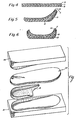
- FIGS. 1-6 illustrate the details of the shoe insert construction of the present invention.
- FIG. 7 is a schematic perspective view illustrating one of the steps in the sequence of the method of the invention.
- the insert comprises a base layer 12, a support layer 13, . a foam layer 11, and a fabric layer 14.
- the layers 11, 12, and 14 are relatively resilient and conform in shape to the desired shoe size.
- the support layer 13 is rigid and as noted in FIG. 1 is principally at the heel area of the shoe insert.
- the foam layer 11 as well as the support layer 13 is preferably constructed of a polyurethane foam material.
- the support layer 13 is of a denser foam thus making the support layer more rigid.
- the layer 11 preferably has a density of 5 lbs. per cubic ft. and it is preferred that this density be in the range of 4-6 lbs. per cubic ft..
- the layer 11 has a preferred thickness of 1/8" +or- 5% and is preferably in a range of thickness of 3/32"-5/32".
- the material used for layer 11 as well as layer 13 may be made by Crestfoam Company.
- The-layer 12 preferably also has a density in a range of 4-6 lbs. per cubic ft.
- the base layer 12 is preferably of cross-linked polyethylene.
- the thickness of the base layer 12 is preferably on the order of 5/16" +or- 10%.
- the thickness of the base layer 12 may actually extend through a range of 1/4" to 7/16" in thickness.
- the material of the base layer 12 may be made by Dynamet Nobel Company.
- the support layer 13 which is formed primarily at the heel area of.the insert, this is also made of a polyurethane foam. However, this is made by being compressed so that the final density is on the order of 22-23 lbs. per cubic ft.
- the fabric layer 14 may be constructed of, for example, cotton, polyester, or a polypropylene knit.
- FIG. 7 shows one of the steps in the method of construction of the shoe insert of this invention.
- the shoe insert is formed by first joining the foam layer 11 with the fabric layer 14.
- the layers 11 and 14 are laminatea together by a flame lamination technique which employs an open flame which is directed to the foam layer 11.
- the open flame generates sufficient heat on the surface to cause melting of the flat sheet layer 11.
- the fabric layer 14 is joined therewith and the two sandwiched together layers are preferably run between chilled rollers and sufficient pressure is applied between the rollers so that the layers 11 and 14 are joined together. At this point in the process, these layers are still maintained in a flat sheet form.
- the integrated layers 11 and 14 are then next joined also by flame lamination to the base layer 12. This step in the method of manufacture may also be carried out by the use of an open flame directed to either layer 11 or layer 12 to cause melting thereof.
- the previously integrated layers 11 and 14 are then joined to layer 12 and the laminated layers are then run betweeen chillea rollers. At this stage of the process, the layers are still in flat sheet form.
- the layers thus laminated to this point are then ready for molding. This requires a heating of the laminated layers to a molding temperature of approximately 250° F. for a period of about 225 seconds. This heats the previously laminated layers sufficiently to permit them to be inserted into the mold.
- FIG. 7 shows the mold in the schematic manner as comprised of mold pieces 20 and 21.
- the mold may be made of aluminum.
- FIG. 7 also shows the tri-laminate 22 which is comprised of layers 11, 12, and 14.
- the tri-laminate 22 is shown as still in flat sheet form in FIG. 7 and disposed adjacent the pre-formed support layer or cup 13. Reference is made hereinafter to the manner in which the compressed foam cup 13 is formed.
- the pre-formed heel layer or cup 13 is placed in the mold comprised of mold pieces 20 and.21 and an adhesive is applied to the inside of the layer 13.
- the tri-laminate 22 is appropriately positioned and the mold is closed.
- the adhesive is preferably a chlorinated rubber base adhesive which is heat and pressure reactivatable.
- One adhesive that is used is made by Jetco.
- the adhesive is activated at substantially the same time that the shaping of the tri-laminate 22 along with the heel layer 13 occurs. This shaping is accomplished of course, by means of the mold press..
- the molding occurs under a pressure, preferably of 85 lbs. psi.
- the mold is illustrated in FIG. 7 in a schematic fashion and is preferably a water cooled mold.
- the mold may be cooled by passage of water therethrough so as to maintain the temperature at approximately 40° F.
- the mold is maintained in its press-mold state for approximately 50-65 seconds.
- the material inserted into the mold which includes the tri-laminate 22 and the layer 13 essentially is inserted into the mold in a hot condition, recalling that at least the tri-laminate 22 is heated to proper molding temperatures, and is then brought to a colder temperature by virtue 6f the cooling of the mold.
- the adhesive is activated by virtue of contact with the preheated tri-laminate 22 along with the activation of the adhesive by means of the pressure applied during the molding operation.
- the molding step schematically illustrated in FIG. 7 causes the simultaneous shaping of the insert. It also causes the affixing of the cup or heel layer 13 to the previously formed tri-laminate 22.
- this member is constructed of a polyurethane foam that has been compressed to a density on the order of 22-23 lbs. per cubic ft. In its compressed state, the layer 13 may have a thickness of 1/16"-1/8".
- the polyurethane has a thickness of 1.5" and is constructed of a urethane product that has characteristics of being clickable and reticulated.
- the urethane is preferably clickable so that when it is cut with, for example,' a scissors, there will not be a pinching on the ends.
- the reticulated form of the urethane means that the cell membranes have been removed electrically of chemically.
- the reticulation is on the order of 80-90 pores/inch, although, a preferred range is 50-90 pores/inch of reticulated foam.
- a preferred range is 50-90 pores/inch of reticulated foam.
- the higher the cell or pore count the more cosmetically acceptable is the material because the cells are smaller and thus have a more pleasing aesthetic appearance.
- the 1.5" thick urethane is compressed by means of a steel or brass tool.
- the compressing tool preferably has a high heat conductivity and in this regard, brass is preferred.
- the tool is heated, preferably to a temperature of 450° F. and this causes the foam to be uniformly softened whereby it is caused to be compressed by the tool. Once compressed, it is set into this compressed state and it maintains the compressed state.
- the tool is similar in form to a mold and operates at say, 86 p si. for 90 seconds.
- the heat as mentioned previously, is preferably at 450° F. It is preferred that this temperature be maintained during the compressing phase and that the heat not be allowed to drop substantially from that temperature.
- cup layer 13 Once the cup layer 13 has been preformed, then it is employed in the mold illustrated in FIG. 7 with the adhesive being coated inside of the cavitated heel layer 13.
Landscapes
- Health & Medical Sciences (AREA)
- Epidemiology (AREA)
- General Health & Medical Sciences (AREA)
- Public Health (AREA)
- Chemical & Material Sciences (AREA)
- Engineering & Computer Science (AREA)
- Materials Engineering (AREA)
- Footwear And Its Accessory, Manufacturing Method And Apparatuses (AREA)
Applications Claiming Priority (2)
| Application Number | Priority Date | Filing Date | Title |
|---|---|---|---|
| US566186 | 1983-12-28 | ||
| US06/566,186 US4586273A (en) | 1983-12-28 | 1983-12-28 | Shoe insert construction |
Publications (2)
| Publication Number | Publication Date |
|---|---|
| EP0147024A2 true EP0147024A2 (fr) | 1985-07-03 |
| EP0147024A3 EP0147024A3 (fr) | 1986-08-27 |
Family
ID=24261859
Family Applications (1)
| Application Number | Title | Priority Date | Filing Date |
|---|---|---|---|
| EP84307343A Withdrawn EP0147024A3 (fr) | 1983-12-28 | 1984-10-25 | Construction d'une première |
Country Status (4)
| Country | Link |
|---|---|
| US (1) | US4586273A (fr) |
| EP (1) | EP0147024A3 (fr) |
| JP (1) | JPS60158803A (fr) |
| AU (1) | AU3515184A (fr) |
Cited By (7)
| Publication number | Priority date | Publication date | Assignee | Title |
|---|---|---|---|---|
| FR2754433A1 (fr) * | 1996-10-15 | 1998-04-17 | Pierre Chupin Sa | Chaussure et son procede de montage |
| WO1999004662A1 (fr) * | 1997-07-26 | 1999-02-04 | Lunge Lauf- Und Sportschuhe Gmbh | Garniture interieure de chaussure |
| WO2001054526A1 (fr) * | 2000-01-28 | 2001-08-02 | Schering-Plough Healthcare Products, Inc. | Semelles interieures pour grossesse/maternite |
| EP1116449A3 (fr) * | 1999-12-31 | 2002-04-03 | Schering-Plough Healthcare Products, Inc. | Semelle intérieure relaxante |
| EP2012612A4 (fr) * | 2006-04-20 | 2014-01-01 | Richard Engel | Chaussure de frappe |
| ES2523496R1 (es) * | 2013-05-22 | 2014-12-11 | Antonio Moron De Blas, Sl | Procedimiento de obtención de un artículo termoconformado |
| EP2859807A1 (fr) * | 2006-06-09 | 2015-04-15 | Kevan Orvitz | Appareil orthopédique |
Families Citing this family (54)
| Publication number | Priority date | Publication date | Assignee | Title |
|---|---|---|---|---|
| USD289103S (en) | 1983-08-01 | 1987-04-07 | Autry Industries | Shoe insole |
| JPS6058005U (ja) * | 1983-09-30 | 1985-04-23 | 株式会社アサヒコーポレーション | 靴の中敷 |
| US5184409A (en) * | 1984-08-24 | 1993-02-09 | Northwest Podiatric Laboratory, Inc. | Orthotic insert and method of making of the same |
| USD287302S (en) | 1986-02-24 | 1986-12-23 | Pensa, Inc. | Shoe insole |
| USD288383S (en) | 1986-04-17 | 1987-02-24 | Autry Industries, Inc. | Shoe insole |
| US4823483A (en) * | 1986-09-23 | 1989-04-25 | Bernard Chapnick | Shoe insert and laminating method |
| US5003708A (en) * | 1988-09-26 | 1991-04-02 | Dynamic Foam Products, Inc. | Custom insole for athletic shoes |
| KR930004897B1 (ko) * | 1989-01-17 | 1993-06-09 | 스미도모덴기고오교오 가부시기가이샤 | 광센서 |
| US4930232A (en) * | 1989-03-28 | 1990-06-05 | The United States Shoe Corporation | Multilayer shoe sole |
| US4973376A (en) * | 1989-07-28 | 1990-11-27 | Chiu Ou Y | Method for manufacturing air-pervious insole |
| EP0472963A3 (en) * | 1990-08-27 | 1992-07-08 | Sumitomo Electric Industries, Limited | Light emitting diode for photosensor and photosensor using such light emitting diode |
| US5282326A (en) * | 1991-07-09 | 1994-02-01 | Schering-Plough Healthcare Products, Inc. | Removeable innersole for footwear |
| USD336718S (en) | 1991-07-09 | 1993-06-22 | Schering-Plough Healthcare Products, Inc. | Innersole |
| USD354390S (en) | 1993-05-05 | 1995-01-17 | Scherling-Plough Healthcare Products, Inc. | Sports insole |
| USD354389S (en) | 1993-05-05 | 1995-01-17 | Schering-Plough Healthcare Products, Inc. | Sports insole with perforations |
| US5685092A (en) * | 1996-02-20 | 1997-11-11 | Prieskorn; David W. | Physiological motion enhancing shoe sole |
| US5669162A (en) * | 1996-03-07 | 1997-09-23 | Brown Group, Inc. | Cushion insert |
| US6854198B2 (en) | 1996-05-29 | 2005-02-15 | Jeffrey S. Brooks, Inc. | Footwear |
| US5787610A (en) * | 1996-05-29 | 1998-08-04 | Jeffrey S. Brooks, Inc. | Footwear |
| US5946825A (en) * | 1997-01-31 | 1999-09-07 | Nine West Group, Inc. | Footwear having slow recovery liner |
| US6070342A (en) * | 1998-11-16 | 2000-06-06 | Brown; Dennis N. | Contoured insole for footwear |
| US6871422B2 (en) * | 2000-10-17 | 2005-03-29 | Rhino Tuff, Inc. | Protective, orthotic insert for footwear |
| US20020178614A1 (en) * | 2001-05-21 | 2002-12-05 | Issler David C. | Variable width footwear |
| US6915598B2 (en) | 2002-08-06 | 2005-07-12 | Schering-Plough Healthcare Products Inc. | Insole with arch spring |
| US6962010B2 (en) | 2002-10-02 | 2005-11-08 | Footstar Corporation | Dress shoe with improved heel counter |
| US20060026865A1 (en) | 2004-08-06 | 2006-02-09 | Schering Plough Healthcare Products Inc. | Insole |
| US7284342B2 (en) * | 2004-08-06 | 2007-10-23 | Schering-Plough Healthcare Products, Inc. | Heel insert |
| US11786012B1 (en) | 2005-06-15 | 2023-10-17 | Houston Iii Telfair W | Insert for footwear |
| CA2659864C (fr) | 2006-08-03 | 2013-02-05 | Schering-Plough Healthcare Products, Inc. | Premiere semelle en gel |
| US8069587B2 (en) * | 2008-11-20 | 2011-12-06 | 3M Innovative Properties Company | Molded insulated shoe footbed and method of making an insulated footbed |
| US8621765B2 (en) * | 2008-12-09 | 2014-01-07 | Red Wing Shoe Company, Inc. | Molded insole for welted footwear |
| WO2010111623A1 (fr) * | 2009-03-26 | 2010-09-30 | Stratten Performance Group, Llc | Semelle intérieure de chaussure lestée et son procédé de fabrication |
| US8393092B2 (en) * | 2009-04-24 | 2013-03-12 | Nine West Development Corporation | Footbed system and footwear construction |
| US8166674B2 (en) * | 2009-08-03 | 2012-05-01 | Hbn Shoe, Llc | Footwear sole |
| CN103300539B (zh) * | 2012-03-16 | 2016-08-03 | 亚卡文投资有限公司 | 鞋垫 |
| US20140250727A1 (en) * | 2013-03-06 | 2014-09-11 | Josh VanDernoot | Combined midsole/insole |
| DE112014001368T5 (de) | 2013-03-15 | 2016-01-21 | Fisher & Paykel Healthcare Ltd. | Nasenkanülenanordnungen und relevante Teile |
| GB2514376B (en) * | 2013-05-21 | 2015-10-14 | Name Drop Sarl | An item of footwear |
| EP3007578B1 (fr) * | 2013-06-14 | 2020-11-04 | Superfeet Worldwide, Inc. | Semelles intérieures profilées pour articles chaussants |
| EP3763409B1 (fr) | 2013-08-09 | 2022-02-23 | Fisher & Paykel Healthcare Limited | Éléments asymétriques d'administration nasale et embouts pour interfaces nasales |
| US9750302B2 (en) * | 2013-08-13 | 2017-09-05 | Heel-It, Llc | Orthotic insert device |
| US20160286895A1 (en) * | 2013-12-19 | 2016-10-06 | Air & Grace Limited | Footwear |
| US10477915B2 (en) | 2016-03-01 | 2019-11-19 | Hbn Shoe, Llc | Device for high-heeled shoes and method of constructing a high-heeled shoe |
| US10390587B2 (en) | 2016-03-01 | 2019-08-27 | Hbn Shoe, Llc | Device for high-heeled shoes and method of constructing a high-heeled shoe |
| USD870269S1 (en) | 2016-09-14 | 2019-12-17 | Fisher & Paykel Healthcare Limited | Nasal cannula assembly |
| WO2018186914A1 (fr) | 2017-04-07 | 2018-10-11 | Bayer Healthcare Llc | Semelle intérieure pour soulager la douleur de la fasciite plantaire |
| US10702008B2 (en) | 2018-02-26 | 2020-07-07 | Hbn Shoe, Llc | Device and method of constructing shoes |
| US12396518B2 (en) | 2018-06-14 | 2025-08-26 | Scholl's Wellness Company Llc | Cushioning member |
| US11771174B2 (en) | 2018-06-14 | 2023-10-03 | Scholl's Wellness Company Llc | Insole |
| AU2020376694B2 (en) * | 2019-10-30 | 2024-02-29 | Winning One Co., Ltd. | Shoe insole |
| USD1001454S1 (en) * | 2021-03-15 | 2023-10-17 | David Epstein | Insole |
| US11540588B1 (en) | 2021-11-24 | 2023-01-03 | Hbn Shoe, Llc | Footwear insole |
| US11805850B1 (en) | 2023-07-19 | 2023-11-07 | Hbn Shoe, Llc | Cuboid pad |
| USD1082267S1 (en) | 2024-04-09 | 2025-07-08 | Hbn Shoe, Llc | Shoe insert |
Family Cites Families (12)
| Publication number | Priority date | Publication date | Assignee | Title |
|---|---|---|---|---|
| US2403442A (en) * | 1945-01-01 | 1946-07-09 | Calvin C Klaus | Shoe |
| FR1509112A (fr) * | 1966-11-22 | 1968-01-12 | Chaussures Cleal | Perfectionnement aux premières de chaussures |
| US4054706A (en) * | 1975-05-28 | 1977-10-18 | Continental Combining Corporation | Lining material for foot wear and a method for manufacturing same |
| DE7627371U1 (de) * | 1976-09-02 | 1976-12-30 | Fa. Carl Freudenberg, 6940 Weinheim | Schuheinlage |
| US4055699A (en) * | 1976-12-02 | 1977-10-25 | Scholl, Inc. | Cold insulating insole |
| US4185402A (en) * | 1977-11-02 | 1980-01-29 | Scholl, Inc. | Deodorizing insole |
| US4167824A (en) * | 1978-03-20 | 1979-09-18 | Wolpa Mark E | Inner soles for shoes |
| US4187621A (en) * | 1978-04-24 | 1980-02-12 | Cohen Leon H | Shoe innersole |
| US4338734A (en) * | 1980-02-22 | 1982-07-13 | Apex Foot Products Corp. | Universal orthotic |
| FR2505625A1 (fr) * | 1981-05-12 | 1982-11-19 | Astra Ab | Premiere de montage, son procede de fabrication et les moyens pour sa mise en oeuvre |
| US4413429A (en) * | 1981-06-22 | 1983-11-08 | Power-Soler, Inc. | Molded foot bed |
| US4461099A (en) * | 1983-02-28 | 1984-07-24 | Bailly Richard Louis | Molded odor-absorbing laminate |
-
1983
- 1983-12-28 US US06/566,186 patent/US4586273A/en not_active Expired - Fee Related
-
1984
- 1984-10-25 EP EP84307343A patent/EP0147024A3/fr not_active Withdrawn
- 1984-11-07 AU AU35151/84A patent/AU3515184A/en not_active Abandoned
- 1984-12-24 JP JP59272710A patent/JPS60158803A/ja active Pending
Cited By (7)
| Publication number | Priority date | Publication date | Assignee | Title |
|---|---|---|---|---|
| FR2754433A1 (fr) * | 1996-10-15 | 1998-04-17 | Pierre Chupin Sa | Chaussure et son procede de montage |
| WO1999004662A1 (fr) * | 1997-07-26 | 1999-02-04 | Lunge Lauf- Und Sportschuhe Gmbh | Garniture interieure de chaussure |
| EP1116449A3 (fr) * | 1999-12-31 | 2002-04-03 | Schering-Plough Healthcare Products, Inc. | Semelle intérieure relaxante |
| WO2001054526A1 (fr) * | 2000-01-28 | 2001-08-02 | Schering-Plough Healthcare Products, Inc. | Semelles interieures pour grossesse/maternite |
| EP2012612A4 (fr) * | 2006-04-20 | 2014-01-01 | Richard Engel | Chaussure de frappe |
| EP2859807A1 (fr) * | 2006-06-09 | 2015-04-15 | Kevan Orvitz | Appareil orthopédique |
| ES2523496R1 (es) * | 2013-05-22 | 2014-12-11 | Antonio Moron De Blas, Sl | Procedimiento de obtención de un artículo termoconformado |
Also Published As
| Publication number | Publication date |
|---|---|
| US4586273A (en) | 1986-05-06 |
| EP0147024A3 (fr) | 1986-08-27 |
| AU3515184A (en) | 1985-07-04 |
| JPS60158803A (ja) | 1985-08-20 |
Similar Documents
| Publication | Publication Date | Title |
|---|---|---|
| US4586273A (en) | Shoe insert construction | |
| US4782605A (en) | Shoe insert construction and method of making | |
| US4648923A (en) | Method of forming a shoe insert | |
| US4694589A (en) | Elastomeric shoe innersole | |
| US4823483A (en) | Shoe insert and laminating method | |
| US4627178A (en) | Molded shoe innersole | |
| US4674204A (en) | Shock absorbing innersole and method for preparing same | |
| US4910886A (en) | Shock-absorbing innersole | |
| US4581187A (en) | Method of manufacturing a molded composite elastomeric foam sheet innersole | |
| US4513518A (en) | Shoe inner sole | |
| US5396675A (en) | Method of manufacturing a midsole for a shoe and construction therefor | |
| US4538787A (en) | Rigid-foam plastic mold and method of preparation | |
| US4826552A (en) | Process for the production of multiple-layer moldings | |
| GB2088776A (en) | Understructure members for footwear | |
| JPS60222214A (ja) | 車両用内装板の製造方法 | |
| KR100215171B1 (ko) | 신발중창의 제조방법 | |
| JP3007798B2 (ja) | 靴胛被の製造方法および靴の製造方法 | |
| JPS6253811A (ja) | 積層体の製造方法 | |
| JPH0376121B2 (fr) | ||
| JPS6150775B2 (fr) | ||
| RU2793919C1 (ru) | Заготовка ортопедической стельки для обуви | |
| JPS599166B2 (ja) | 複合構成のシ−トクツシヨンの製造方法 | |
| JP2003061703A (ja) | 靴底及びその製造方法 | |
| JPS6054870B2 (ja) | 車輛用内装材の製造方法 | |
| JPS6179403A (ja) | 靴中敷の製法 |
Legal Events
| Date | Code | Title | Description |
|---|---|---|---|
| PUAI | Public reference made under article 153(3) epc to a published international application that has entered the european phase |
Free format text: ORIGINAL CODE: 0009012 |
|
| AK | Designated contracting states |
Designated state(s): AT BE CH DE FR GB IT LI LU NL SE |
|
| PUAL | Search report despatched |
Free format text: ORIGINAL CODE: 0009013 |
|
| AK | Designated contracting states |
Kind code of ref document: A3 Designated state(s): AT BE CH DE FR GB IT LI LU NL SE |
|
| 17P | Request for examination filed |
Effective date: 19870219 |
|
| 17Q | First examination report despatched |
Effective date: 19880328 |
|
| STAA | Information on the status of an ep patent application or granted ep patent |
Free format text: STATUS: THE APPLICATION IS DEEMED TO BE WITHDRAWN |
|
| 18D | Application deemed to be withdrawn |
Effective date: 19880503 |