EP0147399B1 - Photochemische reaktionen für handelssynthese - Google Patents
Photochemische reaktionen für handelssynthese Download PDFInfo
- Publication number
- EP0147399B1 EP0147399B1 EP83903807A EP83903807A EP0147399B1 EP 0147399 B1 EP0147399 B1 EP 0147399B1 EP 83903807 A EP83903807 A EP 83903807A EP 83903807 A EP83903807 A EP 83903807A EP 0147399 B1 EP0147399 B1 EP 0147399B1
- Authority
- EP
- European Patent Office
- Prior art keywords
- reactant
- water
- polymer
- carrier
- product
- Prior art date
- Legal status (The legal status is an assumption and is not a legal conclusion. Google has not performed a legal analysis and makes no representation as to the accuracy of the status listed.)
- Expired
Links
Images
Classifications
-
- C—CHEMISTRY; METALLURGY
- C07—ORGANIC CHEMISTRY
- C07C—ACYCLIC OR CARBOCYCLIC COMPOUNDS
- C07C409/00—Peroxy compounds
- C07C409/02—Peroxy compounds the —O—O— group being bound between a carbon atom, not further substituted by oxygen atoms, and hydrogen, i.e. hydroperoxides
- C07C409/04—Peroxy compounds the —O—O— group being bound between a carbon atom, not further substituted by oxygen atoms, and hydrogen, i.e. hydroperoxides the carbon atom being acyclic
-
- B—PERFORMING OPERATIONS; TRANSPORTING
- B01—PHYSICAL OR CHEMICAL PROCESSES OR APPARATUS IN GENERAL
- B01F—MIXING, e.g. DISSOLVING, EMULSIFYING OR DISPERSING
- B01F31/00—Mixers with shaking, oscillating, or vibrating mechanisms
- B01F31/44—Mixers with shaking, oscillating, or vibrating mechanisms with stirrers performing an oscillatory, vibratory or shaking movement
- B01F31/441—Mixers with shaking, oscillating, or vibrating mechanisms with stirrers performing an oscillatory, vibratory or shaking movement performing a rectilinear reciprocating movement
-
- B—PERFORMING OPERATIONS; TRANSPORTING
- B01—PHYSICAL OR CHEMICAL PROCESSES OR APPARATUS IN GENERAL
- B01F—MIXING, e.g. DISSOLVING, EMULSIFYING OR DISPERSING
- B01F33/00—Other mixers; Mixing plants; Combinations of mixers
- B01F33/50—Movable or transportable mixing devices or plants
- B01F33/501—Movable mixing devices, i.e. readily shifted or displaced from one place to another, e.g. portable during use
- B01F33/5011—Movable mixing devices, i.e. readily shifted or displaced from one place to another, e.g. portable during use portable during use, e.g. hand-held
- B01F33/50112—Movable mixing devices, i.e. readily shifted or displaced from one place to another, e.g. portable during use portable during use, e.g. hand-held of the syringe or cartridge type
-
- B—PERFORMING OPERATIONS; TRANSPORTING
- B01—PHYSICAL OR CHEMICAL PROCESSES OR APPARATUS IN GENERAL
- B01F—MIXING, e.g. DISSOLVING, EMULSIFYING OR DISPERSING
- B01F35/00—Accessories for mixers; Auxiliary operations or auxiliary devices; Parts or details of general application
- B01F35/71—Feed mechanisms
- B01F35/713—Feed mechanisms comprising breaking packages or parts thereof, e.g. piercing or opening sealing elements between compartments or cartridges
- B01F35/7137—Piercing, perforating or melting membranes or closures which seal the compartments
-
- B—PERFORMING OPERATIONS; TRANSPORTING
- B01—PHYSICAL OR CHEMICAL PROCESSES OR APPARATUS IN GENERAL
- B01F—MIXING, e.g. DISSOLVING, EMULSIFYING OR DISPERSING
- B01F35/00—Accessories for mixers; Auxiliary operations or auxiliary devices; Parts or details of general application
- B01F35/71—Feed mechanisms
- B01F35/716—Feed mechanisms characterised by the relative arrangement of the containers for feeding or mixing the components
- B01F35/7161—Feed mechanisms characterised by the relative arrangement of the containers for feeding or mixing the components the containers being connected coaxially before contacting the contents
-
- B—PERFORMING OPERATIONS; TRANSPORTING
- B01—PHYSICAL OR CHEMICAL PROCESSES OR APPARATUS IN GENERAL
- B01J—CHEMICAL OR PHYSICAL PROCESSES, e.g. CATALYSIS OR COLLOID CHEMISTRY; THEIR RELEVANT APPARATUS
- B01J19/00—Chemical, physical or physico-chemical processes in general; Their relevant apparatus
- B01J19/08—Processes employing the direct application of electric or wave energy, or particle radiation; Apparatus therefor
- B01J19/12—Processes employing the direct application of electric or wave energy, or particle radiation; Apparatus therefor employing electromagnetic waves
- B01J19/122—Incoherent waves
- B01J19/127—Sunlight; Visible light
-
- B—PERFORMING OPERATIONS; TRANSPORTING
- B65—CONVEYING; PACKING; STORING; HANDLING THIN OR FILAMENTARY MATERIAL
- B65D—CONTAINERS FOR STORAGE OR TRANSPORT OF ARTICLES OR MATERIALS, e.g. BAGS, BARRELS, BOTTLES, BOXES, CANS, CARTONS, CRATES, DRUMS, JARS, TANKS, HOPPERS, FORWARDING CONTAINERS; ACCESSORIES, CLOSURES, OR FITTINGS THEREFOR; PACKAGING ELEMENTS; PACKAGES
- B65D81/00—Containers, packaging elements, or packages, for contents presenting particular transport or storage problems, or adapted to be used for non-packaging purposes after removal of contents
- B65D81/32—Containers, packaging elements, or packages, for contents presenting particular transport or storage problems, or adapted to be used for non-packaging purposes after removal of contents for packaging two or more different materials which must be maintained separate prior to use in admixture
- B65D81/3216—Rigid containers disposed one within the other
- B65D81/3222—Rigid containers disposed one within the other with additional means facilitating admixture
-
- B—PERFORMING OPERATIONS; TRANSPORTING
- B65—CONVEYING; PACKING; STORING; HANDLING THIN OR FILAMENTARY MATERIAL
- B65D—CONTAINERS FOR STORAGE OR TRANSPORT OF ARTICLES OR MATERIALS, e.g. BAGS, BARRELS, BOTTLES, BOXES, CANS, CARTONS, CRATES, DRUMS, JARS, TANKS, HOPPERS, FORWARDING CONTAINERS; ACCESSORIES, CLOSURES, OR FITTINGS THEREFOR; PACKAGING ELEMENTS; PACKAGES
- B65D83/00—Containers or packages with special means for dispensing contents
- B65D83/76—Containers or packages with special means for dispensing contents for dispensing fluent contents by means of a piston
- B65D83/761—Containers or packages with special means for dispensing contents for dispensing fluent contents by means of a piston the piston being actuated by a screw-shaft
-
- C—CHEMISTRY; METALLURGY
- C07—ORGANIC CHEMISTRY
- C07C—ACYCLIC OR CARBOCYCLIC COMPOUNDS
- C07C401/00—Irradiation products of cholesterol or its derivatives; Vitamin D derivatives, 9,10-seco cyclopenta[a]phenanthrene or analogues obtained by chemical preparation without irradiation
-
- C—CHEMISTRY; METALLURGY
- C07—ORGANIC CHEMISTRY
- C07C—ACYCLIC OR CARBOCYCLIC COMPOUNDS
- C07C407/00—Preparation of peroxy compounds
-
- C—CHEMISTRY; METALLURGY
- C07—ORGANIC CHEMISTRY
- C07C—ACYCLIC OR CARBOCYCLIC COMPOUNDS
- C07C45/00—Preparation of compounds having >C = O groups bound only to carbon or hydrogen atoms; Preparation of chelates of such compounds
- C07C45/49—Preparation of compounds having >C = O groups bound only to carbon or hydrogen atoms; Preparation of chelates of such compounds by reaction with carbon monoxide
-
- C—CHEMISTRY; METALLURGY
- C07—ORGANIC CHEMISTRY
- C07C—ACYCLIC OR CARBOCYCLIC COMPOUNDS
- C07C45/00—Preparation of compounds having >C = O groups bound only to carbon or hydrogen atoms; Preparation of chelates of such compounds
- C07C45/61—Preparation of compounds having >C = O groups bound only to carbon or hydrogen atoms; Preparation of chelates of such compounds by reactions not involving the formation of >C = O groups
- C07C45/67—Preparation of compounds having >C = O groups bound only to carbon or hydrogen atoms; Preparation of chelates of such compounds by reactions not involving the formation of >C = O groups by isomerisation; by change of size of the carbon skeleton
- C07C45/673—Preparation of compounds having >C = O groups bound only to carbon or hydrogen atoms; Preparation of chelates of such compounds by reactions not involving the formation of >C = O groups by isomerisation; by change of size of the carbon skeleton by change of size of the carbon skeleton
-
- H—ELECTRICITY
- H02—GENERATION; CONVERSION OR DISTRIBUTION OF ELECTRIC POWER
- H02G—INSTALLATION OF ELECTRIC CABLES OR LINES, OR OF COMBINED OPTICAL AND ELECTRIC CABLES OR LINES
- H02G1/00—Methods or apparatus specially adapted for installing, maintaining, repairing or dismantling electric cables or lines
- H02G1/14—Methods or apparatus specially adapted for installing, maintaining, repairing or dismantling electric cables or lines for joining or terminating cables
-
- B—PERFORMING OPERATIONS; TRANSPORTING
- B01—PHYSICAL OR CHEMICAL PROCESSES OR APPARATUS IN GENERAL
- B01F—MIXING, e.g. DISSOLVING, EMULSIFYING OR DISPERSING
- B01F35/00—Accessories for mixers; Auxiliary operations or auxiliary devices; Parts or details of general application
- B01F35/30—Driving arrangements; Transmissions; Couplings; Brakes
- B01F35/32—Driving arrangements
- B01F35/32005—Type of drive
- B01F35/3202—Hand driven
-
- Y—GENERAL TAGGING OF NEW TECHNOLOGICAL DEVELOPMENTS; GENERAL TAGGING OF CROSS-SECTIONAL TECHNOLOGIES SPANNING OVER SEVERAL SECTIONS OF THE IPC; TECHNICAL SUBJECTS COVERED BY FORMER USPC CROSS-REFERENCE ART COLLECTIONS [XRACs] AND DIGESTS
- Y02—TECHNOLOGIES OR APPLICATIONS FOR MITIGATION OR ADAPTATION AGAINST CLIMATE CHANGE
- Y02P—CLIMATE CHANGE MITIGATION TECHNOLOGIES IN THE PRODUCTION OR PROCESSING OF GOODS
- Y02P20/00—Technologies relating to chemical industry
- Y02P20/50—Improvements relating to the production of bulk chemicals
- Y02P20/582—Recycling of unreacted starting or intermediate materials
-
- Y—GENERAL TAGGING OF NEW TECHNOLOGICAL DEVELOPMENTS; GENERAL TAGGING OF CROSS-SECTIONAL TECHNOLOGIES SPANNING OVER SEVERAL SECTIONS OF THE IPC; TECHNICAL SUBJECTS COVERED BY FORMER USPC CROSS-REFERENCE ART COLLECTIONS [XRACs] AND DIGESTS
- Y10—TECHNICAL SUBJECTS COVERED BY FORMER USPC
- Y10T—TECHNICAL SUBJECTS COVERED BY FORMER US CLASSIFICATION
- Y10T428/00—Stock material or miscellaneous articles
- Y10T428/29—Coated or structually defined flake, particle, cell, strand, strand portion, rod, filament, macroscopic fiber or mass thereof
- Y10T428/2982—Particulate matter [e.g., sphere, flake, etc.]
Definitions
- This invention relates to photochemical reactions and more particularly to a process for conducting photochemical processes, using solar radiation, to produce useful chemical products.
- a further difficulty with solar energy utilization arises from the fact that solar energy utilization arises from the fact that solar energy needs to be absorbed, and converted to a different energy form for utilization, the absorbing function and the converting function being best conducted at locations remote from one another for most efficient energy conversion.
- the solar energy absorption processes should make most efficient use of the limited periods of maximum incidence of solar energy, i.e. exposure to direct sunlight.
- the conversion process can equally well be conducted continuously, independently of the presence or absence of direct incident sunlight, so that best overall efficiencies are accomplished by separately locating the absorbing and converting function. In this way, one function does not hinder or interfere with the other.
- the present invention provides a means for utilizing solar energy by causing incident solar radiation to effect photochemical reaction of a chemical reactant to produce a chemical product therefrom, whilst supported on a buoyant, inert carrier floating on water.
- the carrier material is preferably in the form of discrete, small sized lumps or modules, e.g. beads, or buoyant foams which can distribute themselves fully and evenly over the surface of a body of water, for maximum solar incident exposure.
- the reactant materials are carried and supported by the carrier materials in such a manner that they are not chemically affected by the carrier but are exposed to solar radiation while supported thereby, and the products formed by the photochemical reactions thereof are readily recoverable from the carrier material.
- a process for producing chemical products by photochemical reaction of at least one photochemically reactive chemical reactant characterized in that it comprises:
- the body of water is a moving body of water such as a natural or artificial lake, river, stream, reservoir etc.
- the carrier supporting the reactant is then conveyed, by the natural or induced water flow in the body of water, to a downstream product recovery location from a reactant receiving location, with the solar energy absorption and photochemical conversion processes taking place during conveyance of the carrier therebetween.
- the chemical product so formed can be removed from the carrier following passage to the product recovery location, and then if desired the carrier can be recycled from the reactant receiving location.
- the carrier material is a mass of buoyant beads or discs each comprising a substantially water-insoluble, UV-stable polymer.
- the carrier may comprise hollow glass spheres coated with a suitable polymer, optionally covered with a protective film of low oxygen permeable polymer, or foam- cored plastic spheres provided with a suitable polymer coating.
- the water-insoluble, UV-stable polymer is treated, e.g. impregnated, with the reactant material so that it is swollen thereby, but does not chemically react with the reactant material.
- the product formed by photochemical reaction of the reactant whilst impreganted in the polymer is similarly chemically inert to the chosen polymer and extractable therefrom, but nevertheless remains supported e.g. impregnated in the polymer until positive steps are taken to extract the product from the carrier.
- the type of polymer is thus chosen in conjunction with the reactants to be used and the products to be formed, with a view to arranging suitable inertness, support and product extractability.
- the carrier can comprise a buoyant plastic or other foam material, capable of releasably holding and supporting the reactants and products and exposing them to solar radiation whilst floating on water.
- the present invention can be put into practice in several ways. For example, it can be used for the production of useful organic chemical compounds by photochemical conversion of other organic compound reactants. It can also be used for the collection and storage of solar energy, by causing a reactant to convert photochemically to an energy-enriched product from which energy can be obtained in one form or another e.g. by reversing the chemical reaction in the absence of the solar radiation, or by some other energy-releasing utilization of the product (fuel, hydrogen-source etc.).
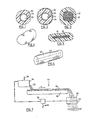
- Figure 1 shows a cross-sectional view of one embodiment of the invention.
- the bead comprises a glass sphere 22 with a hollow interior 24.
- the sphere 22 is surrounded by a layer of cross-linked, swellable polymer 20, namely cross-linked polymethylacrylate.
- the hollow sphere 22 acts as a buoyant particle surrounded by the swellable polymer layer 20 in which the photochemically reactive reagents are retained and photochemically react on exposure to U.V. radiation.
- Figure 2 illustrates a form of bead suitable for use where the photochemical reactions are inhibited by oxygen. It depicts a basically similar bead as shown in Figure 1 with glass sphere 22 and hollow interior 24 surrounded by swollen polymer layer 20 in which the photochemically reactive reagent is contained, but also includes an outer thin film 26.
- Thin film 26 consists of a low oxygen permeably elastomer film that allows reactions to occur in the swollen polymer in the absence of oxygen, whilst permitting sufficient solar radiation to pass therethrough to reach polymer layer 20.
- Figure 3 shows another form of bead for use in the invention which consists of a spherically shaped bead with inner cross-linked expanded foam core 32 surrounded by a cross-linked polymer layer 30.
- the foam core 32 which contains air pockets and acts as a buoyant particle, similar to the hollow sphere in Figure 1 described above, may be made of any polymer stable to solar U.V. radiation for example, poly styrene, polyacrylonitrile or polymethcrylonitrile and is most easily prepared by irradiation of prefoamed polymer beads.
- Cross-linking of the foam which is caused by irradiation, must be enough to prevent descruction of the foam when exposed to swelling solvents.
- a further useful form of bead depicted in Figure 4 and in Figure 5, is of different shape but is similar in construction to that of Figure 3. It has a flattened, disk-like shape, i.e. constituting a platelet.
- Figure 5 shows the cross-linked foam core 32 which is surrounded by a thin layer 30 of cross-linked polymer. Both the core 32 and polymer layer 30 may be made of the same materials as those described in Figure 3. The shape of this bead allows for a large area of exposure to solar radiation and thus efficient conversion of the reagents therein.
- Figure 6 depicts another form of bead for use in the invention.
- the embodiment is a rod shaped bead with an inner core 42 surrounded by a thin polymer layer 40.
- the core may be made of any foamed or unfoamed low density polymer, for example polyethylene, and the polymer layer 40 may be made of any of a variety of polymers as described herein. Solid, buoyant polymer rods are also useful.
- the dimensions of the beads as shown above, will depend on the thickness of the polymer layer which, in turn, depends on the extinction coefficient of reactive materials and their concentration in the polymer layer. Preferred layer thicknesses are in the range of 0.1 mm. to 2.00 mm., though greater layer thicknesses are also suitable.
- the beads may be easily handled using any man-made or natural reservoir of water on which the beads will float, and fluidized bed techniques. They may be pumped readily as slurries in water or other solvents.
- the size of the beads is variable though preferably the beads should be of small size, suitably in the range of 0.2 to 5 mm. diameter.
- the process of the invention contemplates the use of buoyant polymer beads, which float on the body of water.
- the density of the body of water can be increased, if desired, to promote the buoyancy of the beads, by dissolving salts in the water (sodium chloride, calcium chloride etc.).
- salts in the water sodium chloride, calcium chloride etc.
- Such salted solar ponds are known. This provides a means by which normally non-water-buoyant polymer beads can be used as the carrier for photochemical reactions.
- the beads After the beads have been exposed to solar U.V. radiation for suitable length of time to convert the reagents contained therein photochemically, they are removed from the water, for example by filtration. Depending on the nature of the energy enriched or energy releasing product in the bead, the useful products are removed from the bead, for example by distillation or solvent extraction, and the beads are then recharged with fresh reagents, ready for re-use.
- the exposure of the beads, and, consequently, of the reagents therein, may be controlled by controlling the rate of flow of surface water in the reservoir. Moreover, the beads will automatically spread themselves in a thin layer on the surface of the water, and, with sufficient wave action, uniform exposure of the beads occurs.
- FIG. 7 An embodiment of the process of the invention is illustrated schematically in Figure 7.
- This shows a body of water 50 flowing in the direction of arrow A.
- Polymer-bearing, buoyant beads 52 of one of the types previously described are fed to an impregnating vessel 54 disposed at an upstream location relative to the body of water for receiving chemical reactant.
- the reactant is fed to impregnating vessel 54 via inlet 56 and impregnates the beads therein.
- the impregnated beads are then poured onto the surface of the body of water 50, on which they float and spread out as a monolayer, thereby exposing the reactant impregnated therein to incident solar radiation as indicated.
- the beads 52 are transported by the moving body of water to a weir arrangement 58 over which the water and beads fall into a screened receiving vessel 60 where the beads, now impregnated with chemical reactant are separated from the water by screen 62 and fed to a product recovery vessel 64, where the chemical product is separated from the beads, e.g. by solvent extraction, and recovered via exit 66.
- the beads 52 are then recycled via line 68 for re-impregnation in vessel 54 with reactant and repeat of the cycle.
- the polymer for use as the carrier for the reactants and products can be chosen from a wide variety of different polymers, having regard to the function which is to perform.
- the polymer must be chosen with regard to its ability to retain the specific reactants and products in a stable but readily recoverable manner, and without chemically reacting or interfering with the reactants, products or course of reaction therein.
- Organic polymers and organic compounds generally show a reasonable degree of compatibility with one another, with the compounds having a solubility in the polymers, to various extents.
- the polymer must be stable as exposure to UV and other solar radiations. It must be substantially unaffected by water - where normally water soluble polymers are to be used, they are used in cross-linked form to import the necessary water resistance.
- Preferred polymers are capable of repeated cycles of impregnation with reactant, flotation and product removal, so that the beads used in the invention are re-usable many times over.
- Useful polymers can be chosen from among the following:
- Cross-linked polymers have the additional advantage what they swell to a high degree to provide for ready impregnation with reagents and removal of products.
- Preferred polymers for use in the invention have a glass transition temperature below that at which the impregnation and extraction takes place. If the polymer is in its glassy state, i.e. below its glass transition temperature, the diffusion of the chemical into the polymer is hindered, so that impregnation is slowed. Above this temperature, the mobility of the chemical reactants and products is enhanced, leading to shorter impregnation, recovery and reaction times, especially where a bimolecular reaction is to be accomplished.
- Specific preferred polymers are cross-linked ethylene-vinyl acetate copolymers and cross-linked ethylene-acrylic acid copolymers.
- the present invention can be utilized as a means of photosynthesis of organic chemicals.
- organic chemical compounds There are a number of useful organic chemical compounds whose only or whose most efficient synthesis involves a photochemically induced reaction.
- the present invention provides a simple and efficient means by which such reactions can be conducted using natural solar radiation and hence avoiding the conventional artificial lamp uses and exposures.
- photochemical synthesis is often the preferred method.
- a specific example of organic chemical synthesis which can be conducted by the process of the present invention is formaldehyde synthesis from carbon monoxide in the presence of water and metal complexes: Polymer beads are impregnated with carbon monoxide and an appropriate organic soluble metal complex, e.g. ferric carbonyl, floated on a body of water in exposure to direct sunlight, and formaldehyde and the metal complex catalyst subsequently recovered from the bead.
- the formaldehyde so formed is useful in a variety of purposes, including conversion to methanol for use as a fuel. This reaction to produce formaldehyde is similar to natural photosynthesis.
- An alternative manner in which the process of the invention may be conducted, in using a gaseous reagent such as carbon monoxide, or in adopting a chemical reaction or compound which is sensitive to oxygen, is to cover the floating beads on the water surface with a solar radiation permeable membrane, under which is provided an atmosphere of reactant or inert gas.
- the membrane may be supported by the atmosphere of gas beneath it, to exclude oxygen from the vicinity of the impregnated floating beads or provide for their contact with a reactant gas.
- squalene can be photochemically oxidised, in the presence of oxygen and sunlight, to form a hydroperoxide derivative thereof which is useful in a number of chemical reactions.
- ketones of hydrocarbons in which the ketonic group is located at a non-terminal carbon atom of the hydrocarbon chain will disproportionate on exposure to sunlight, to form smaller ketones and hydrocarbons by chain scission (Norrish reactions).
- 7-Dehydrochloresterol (obtainable by known processes from cholesterol, a natural product readily available from, e.g. cod liver oil) undergoes a photochemical ring opening process on UV irradiation to give previtamin D3, which on warming readily gives the thermodynamically more stable vitamin D 3 .
- the industrial process for producing vitamin A acetate produces a mixture of stereoisomers, only one of which, the all-trans isomer is useful.
- the 11-cis form in the mixture can be photochemically converted to the all-trans form by the process of the present invention.
- Sensitizers used to promote photochemical reaction in the process of the present invention are compounds capable of absorbing solar radiation and transferring it to the reactants, either radiatively or non-radiatively.
- the appropriate sensitizers may be chemically bound to the polymer layer or to the reactant, but removable from the product after the reaction is complete. They can if desired be left bonded to the polymer beads, if the beads are to be re-used in the same or similar reactions. They can be bound to the polymer in a similar way to that of UV stabilizers commonly used with polymers, or used in other ways analogously to known polymer stabilizer uses.
- the types of products which can be synthesized according to the invention, and the reactants which can be used, should have a relatively low vapour pressure in order to be retained in the polymer films for the required exposure times (anywhere from a few hours to, say, one month, depending upon the thickness of the layer and other factors).
- the reactants and/or products are normally unacceptably volatile, they can be introduced into the polymer bead as a complex, which can be made to give up the produce reagent on demand, chemically or thermally.
- the products and reactants should also be relatively stable to oxygen if they are to be exposed on open bodies of water. Use of beads of the type shown in Fig. 2 can be used in instances of high oxygen sensitivity.
- the present invention can be utilized as a solar energy collection and conversion means. As noted above, it can be used to conduct reversible chemical reactions which when reversed, yield useful energy. In addition, however, the present invention can be used to provide fuels for fuel cell utilization, and to generate and store hydrogen fuel.
- the quinone-hydroquinone redox reaction may be considered. Under solar radiation and in the presence of water, benzoquinone is reduced to hydroquinone:
- Hydrogen can be obtained by subjecting an aqueous solution of the reduced, hydroquinone compound to electric current, whereupon hydrogen is generated and the oxidised form benzoquinone is re-formed.
- the electrical power required to produce a standard amount of hydrogen from such a hydroquinone solution is approximately half that required to produce the standard amount of hydrogen by the normal process, electrolysis of water. Accordingly, the process of the present invention provides a means for obtaining hydrogen fuel using solar energy.
- the reduced product can either be fed to a fuel cell and oxidized therein to obtain electrical energy, or treated to release hydrogen, in an economically efficient manner.
- This process can also be viewed as a process for storing hydrogen, in a chemically combined form.
- Reaction (2) produces hydrogen fuel which is subsequently used in energy production.
- Reaction (3) produces electrical energy directly through fuel cell utilization. In either case compound A is regenerated, ready for recycling.
- reversible redox couples which can be photochemically reduced in the presence of water, and can hence be used in the process of the present invention, are adenosine triphosphate, adenosine diphosphate, and the aforementioned anthraquinone 9,10-dihydroxyanthracene.
- a still further aspect of the present invention concerns nitrogen fixation.
- the plastic bead or foam system used in the present invention can be used to retain photocatalysts suitable for the fixation of nitrogen from the atmosphere using natural sunlight as the source of energy, to form nitrogenous compounds useful as fertilizers.
- Such catalysts are normally transition metal catalysts.
- the nitrogenous compounds are formed in the polymer of the bead itself, and can be recovered therefrom.
- the beads may be made of a biodegradable polymer, so that the combined beads and nitrogenous product can be utilized as fertilizer.
- Crosslinked ethylene-vinylacetate copolymer beads were prepared by the following procedure. Ethylene-vinylacetate beads (500 g, ELVAX 150) containing approximately 33% vinylacetate were placed in a sealed vessel, evacuated and flushed with nitrogen. They were irradiated for three weeks with y-rays from a cobalt-60 source. The total dose required for crosslinking was about 15 megarad. After y-irradiation the beads were placed in a Soxhlet extractor and extracted with toluene until no further soluble materials could be recovered. The beads were then dried under vacuum at 40°C and stored for future use.
- Crosslinked ethylene-vinylacetate beads (10 g) were placed in a test tube along with 5 cc of a 2% solution of 2-undecanone in pentane.
- the test tube was stoppered and placed in a water bath at 35°C. After one hour all of the solvent had been absorbed by the beads.
- the beads were then dried in air and exposed to outdoor sunlight by floating them on a developing tray containing water. After two days of exposure to outdoor sunlight, 15% of the 12-undecanone had been converted to octene.
- Crosslinked ethylene-vinylacetate beads (20 g) were placed in a flask and gently agitated while 5 cc of a 2% solution of decanophenone was added. After agitating at room temperature for 30 min. all of the solution was absorbed by the beads. The beads were removed, dried and exposed for three days floating on the surface of water in a flat dish. After exposure, the beads were placed in a container with 20 cc of toluene. After standing for three hours, the excess toluene was decanted and additional 20 cc was added. This procedure was repeated until no further product could be removed from the beads. The toluene extracts were then analyzed by gas chromatography. The results indicated that substantially all of the starting material had been converted to photoproducts of which the major product was acetophenone.
- Crosslinked ethylene-vinylacetate beads (38 g) were immersed in 100 ml of squalene sensitized with 5 mg of rose bengal dye. After 48 hr the beads were removed and dried. Approximately 3.5 g of squalene had been taken up by the beads. The beads were floated over distilled water in a tray covered with a thin polyethylene film and were exposed to radiation from a sunlamp for six hours, after which they were removed from the surface of the water and extracted eight times with absolute methanol. The amount of hydroperoxide was determined by the changed in absorbance at 260 nm when treated with triphenylphosphine.
- 7-Dehydrochlolesterol (0.046 g) were dissolved in 4 ml of anhydrous ether.
- Crosslinked ethylene-vinylacetate beads (1 g) were added to the solution. After one hour all of the solution was absorbed by the beads. The beads were air dried. The concentration of 7-dehydrocholesterol remaining in the beads was approximately 5 wt-%.
- the beads were then floated on water in a tray and irradiated for a total of 48 hours in natural sunlight. The weather was cloudy during this period and very little direct sunlight reached the beads. After exposure, the beads were extracted with ether and analyzed by obtaining the UV spectra. Based on the UV analysis, approximately 60% of the 7-dehydrocholesterol had been converted to the previtamin D. Heating the ether solution of the previtamin at 60°C for two hours converted the previtamin to vitamin D.
- Low density polyethylene beads approximately 2 mm in diameter (Tenite 800E) were extracted with 95% ethanol in a Sohxlet extractor and dried. This polymer is non-crosslinked, and has limited crystalline regions. 50 g of the beads were placed in a flask with 20 ml 2-undecanone and heated to 60°C overnight. The amount of 2-undecanone absorbed was determined by extraction of a small sample (2 g) with ethanol followed by G.C. analysis. Samples of the beads were floated on water in a photographic tray and exposed for (1) 28 hrs, and (2) 60 hrs to natural sunlight. A further sample (sample 3) was exposed to a sunlamp for 16 hrs.
- the exposed beads were collected, rinsed with water to remove surface dust and dirt, then extracted 6-8 hrs with ethanol.
- the extracts were analysed by G.C.
- the conversion to octene and acetone was 18% by sample 1,40% for sample 2 and 35% for sample 3.
- the yield of acetone was lower than expected because of the loss of this volatile compound from the beads.
Landscapes
- Chemical & Material Sciences (AREA)
- Organic Chemistry (AREA)
- Chemical Kinetics & Catalysis (AREA)
- Engineering & Computer Science (AREA)
- Mechanical Engineering (AREA)
- Physics & Mathematics (AREA)
- Electromagnetism (AREA)
- Health & Medical Sciences (AREA)
- General Health & Medical Sciences (AREA)
- Toxicology (AREA)
- Organic Low-Molecular-Weight Compounds And Preparation Thereof (AREA)
- Physical Or Chemical Processes And Apparatus (AREA)
Claims (12)
Priority Applications (1)
| Application Number | Priority Date | Filing Date | Title |
|---|---|---|---|
| AT83903807T ATE43571T1 (de) | 1982-11-16 | 1983-11-15 | Photochemische reaktionen fuer handelssynthese. |
Applications Claiming Priority (2)
| Application Number | Priority Date | Filing Date | Title |
|---|---|---|---|
| US442181 | 1982-11-16 | ||
| US06/442,181 US4525255A (en) | 1982-11-16 | 1982-11-16 | Photochemical reactions for commercial synthesis |
Publications (2)
| Publication Number | Publication Date |
|---|---|
| EP0147399A1 EP0147399A1 (de) | 1985-07-10 |
| EP0147399B1 true EP0147399B1 (de) | 1989-05-31 |
Family
ID=23755836
Family Applications (1)
| Application Number | Title | Priority Date | Filing Date |
|---|---|---|---|
| EP83903807A Expired EP0147399B1 (de) | 1982-11-16 | 1983-11-15 | Photochemische reaktionen für handelssynthese |
Country Status (9)
| Country | Link |
|---|---|
| US (1) | US4525255A (de) |
| EP (1) | EP0147399B1 (de) |
| JP (1) | JPH0628724B2 (de) |
| AT (1) | ATE43571T1 (de) |
| AU (2) | AU2265283A (de) |
| DE (1) | DE3379948D1 (de) |
| IL (1) | IL70194A (de) |
| WO (1) | WO1984001944A1 (de) |
| ZA (1) | ZA838503B (de) |
Families Citing this family (5)
| Publication number | Priority date | Publication date | Assignee | Title |
|---|---|---|---|---|
| US20040055965A1 (en) * | 1997-06-13 | 2004-03-25 | Hubig Stephan M. | Recreational water treatment employing singlet oxygen |
| US20030194433A1 (en) * | 2002-03-12 | 2003-10-16 | Ecolab | Antimicrobial compositions, methods and articles employing singlet oxygen- generating agent |
| US20070020300A1 (en) * | 2002-03-12 | 2007-01-25 | Ecolab Inc. | Recreational water treatment employing singlet oxygen |
| US8110074B1 (en) * | 2005-10-03 | 2012-02-07 | Neckers Douglas C | Photochemical method for producing hydrocarbons |
| CN111668495B (zh) * | 2020-04-30 | 2025-08-26 | 浙江天能电池(江苏)有限公司 | 新型板栅网带 |
Family Cites Families (8)
| Publication number | Priority date | Publication date | Assignee | Title |
|---|---|---|---|---|
| US3994675A (en) * | 1973-10-08 | 1976-11-30 | Commonwealth Scientific And Industrial Research Organization | Chemical storage of radiant energy |
| US4315998A (en) * | 1974-06-12 | 1982-02-16 | Research Corporation | Polymer-bound photosensitizing catalysts |
| US4045315A (en) * | 1976-02-13 | 1977-08-30 | Nasa | Solar photolysis of water |
| GB1554192A (en) * | 1976-10-20 | 1979-10-17 | Battelle Development Corp | Process for solar energy collection and retrieval employing reversible photochemical isomerization |
| US4105517A (en) * | 1977-09-30 | 1978-08-08 | Nasa | Solar photolysis of water |
| JPS55105625A (en) * | 1979-02-09 | 1980-08-13 | Akira Fujishima | Reduction of carbonic acid gas |
| US4298439A (en) * | 1980-08-11 | 1981-11-03 | Research Foundation Of The City University Of New York | Producing long life disproportionation products from a photo redox agent useful as a reducing medium for water, and the like |
| US4327192A (en) * | 1980-10-06 | 1982-04-27 | The United States Of America As Represented By The United States Department Of Energy | Method of fabricating nested shells and resulting product |
-
1982
- 1982-11-16 US US06/442,181 patent/US4525255A/en not_active Expired - Lifetime
-
1983
- 1983-11-10 IL IL70194A patent/IL70194A/xx not_active IP Right Cessation
- 1983-11-15 ZA ZA838503A patent/ZA838503B/xx unknown
- 1983-11-15 AT AT83903807T patent/ATE43571T1/de not_active IP Right Cessation
- 1983-11-15 AU AU22652/83D patent/AU2265283A/en active Granted
- 1983-11-15 AU AU22652/83A patent/AU568829B1/en not_active Ceased
- 1983-11-15 EP EP83903807A patent/EP0147399B1/de not_active Expired
- 1983-11-15 JP JP59500026A patent/JPH0628724B2/ja not_active Expired - Lifetime
- 1983-11-15 DE DE8383903807T patent/DE3379948D1/de not_active Expired
- 1983-11-15 WO PCT/GB1983/000290 patent/WO1984001944A1/en not_active Ceased
Also Published As
| Publication number | Publication date |
|---|---|
| JPH0628724B2 (ja) | 1994-04-20 |
| ATE43571T1 (de) | 1989-06-15 |
| AU568829B1 (en) | 1988-01-14 |
| WO1984001944A1 (en) | 1984-05-24 |
| IL70194A (en) | 1987-01-30 |
| DE3379948D1 (en) | 1989-07-06 |
| AU2265283A (en) | 1984-06-04 |
| US4525255A (en) | 1985-06-25 |
| EP0147399A1 (de) | 1985-07-10 |
| ZA838503B (en) | 1984-08-29 |
| JPS60500007A (ja) | 1985-01-10 |
Similar Documents
| Publication | Publication Date | Title |
|---|---|---|
| Tunuli et al. | Aspects of artificial photosynthesis. Photosensitized electron transfer across bilayers, charge separation, and hydrogen production in anionic surfactant vesicles | |
| Willner | Photoinduced electron transfer across a water-oil boundary: A model for redox reaction separation | |
| EP1454036B1 (de) | Photolytische oxygenationseinheit mit kohlendioxidfixierung und -trennung | |
| US4609444A (en) | Photochemical reactions for commercial synthesis | |
| US4045315A (en) | Solar photolysis of water | |
| CA2496554A1 (en) | Photolytic oxygenator with carbon dioxide and/or hydrogen separation and fixation | |
| Greenbaum | Interfacial photoreactions at the photosynthetic membrane interface: an upper limit for the number of platinum atoms required to form a hydrogen-evolving platinum metal catalyst | |
| Alamdari et al. | Immobilization of ZnO: Ga nanocrystals in a polystyrene/cellulose matrix: A novel hybrid nanocomposite photocatalyst for future photo energy application | |
| CN106006929B (zh) | 一种光电催化膜耦合微生物燃料电池全天候处理污水的方法 | |
| US4525255A (en) | Photochemical reactions for commercial synthesis | |
| JP2526396B2 (ja) | 半導体光触媒を用いた水素及び酸素の製造方法 | |
| Matsuo et al. | A concerted two-step activation of photoinduced electron-transport across lipid membrane | |
| AU713011B2 (en) | Reactors for photocatalytic waste water purification with multiribbed plates as solar elements | |
| CN117886450B (zh) | 一种人工湿地-生物电芬顿耦合系统及其处理污水的方法 | |
| CA1248907A (en) | Photochemical reactions for commercial synthesis | |
| US4211621A (en) | Method and apparatus for producing hydrogen using solar energy | |
| Mistry et al. | Modeling and experimental investigation for development of Combined Electrolysis and Catalytic Exchange process for hydrogen isotope separation | |
| Guillet | Prospects for solar synthesis | |
| Wolfe | Biochemistry of methanogenesis | |
| Oelgemöller et al. | " Green Photochemistry" With Moderately Concentrated Sunlight | |
| JPH0295440A (ja) | 放射線触媒及びそれを用いた酸化還元方法と装置 | |
| Nishikubo et al. | Design of multifunctional polymeric photosensitizers containing pendant (nitroaryl) oxy groups and quaternary onium salts for photochemical valence isomerization of potassium 3-phenyl-2, 5-norbornadiene-2-carboxylate | |
| Karunakaran et al. | Semiconductor catalysis of solar photooxidation | |
| US20230390724A1 (en) | Photocatalyst suspension reactor for solar fuel formation | |
| US4869795A (en) | Method for gasification of aqueous acetone solution |
Legal Events
| Date | Code | Title | Description |
|---|---|---|---|
| PUAI | Public reference made under article 153(3) epc to a published international application that has entered the european phase |
Free format text: ORIGINAL CODE: 0009012 |
|
| 17P | Request for examination filed |
Effective date: 19841206 |
|
| AK | Designated contracting states |
Designated state(s): AT BE CH DE FR GB LI LU NL SE |
|
| 17Q | First examination report despatched |
Effective date: 19870611 |
|
| GRAA | (expected) grant |
Free format text: ORIGINAL CODE: 0009210 |
|
| AK | Designated contracting states |
Kind code of ref document: B1 Designated state(s): AT BE CH DE FR GB LI LU NL SE |
|
| PG25 | Lapsed in a contracting state [announced via postgrant information from national office to epo] |
Ref country code: LI Effective date: 19890531 Ref country code: CH Effective date: 19890531 Ref country code: AT Effective date: 19890531 |
|
| REF | Corresponds to: |
Ref document number: 43571 Country of ref document: AT Date of ref document: 19890615 Kind code of ref document: T |
|
| REF | Corresponds to: |
Ref document number: 3379948 Country of ref document: DE Date of ref document: 19890706 |
|
| ET | Fr: translation filed | ||
| REG | Reference to a national code |
Ref country code: CH Ref legal event code: PL |
|
| PGFP | Annual fee paid to national office [announced via postgrant information from national office to epo] |
Ref country code: SE Payment date: 19891109 Year of fee payment: 7 |
|
| PG25 | Lapsed in a contracting state [announced via postgrant information from national office to epo] |
Ref country code: LU Free format text: LAPSE BECAUSE OF NON-PAYMENT OF DUE FEES Effective date: 19891130 |
|
| PGFP | Annual fee paid to national office [announced via postgrant information from national office to epo] |
Ref country code: GB Payment date: 19891130 Year of fee payment: 7 |
|
| PGFP | Annual fee paid to national office [announced via postgrant information from national office to epo] |
Ref country code: BE Payment date: 19891201 Year of fee payment: 7 |
|
| PLBE | No opposition filed within time limit |
Free format text: ORIGINAL CODE: 0009261 |
|
| STAA | Information on the status of an ep patent application or granted ep patent |
Free format text: STATUS: NO OPPOSITION FILED WITHIN TIME LIMIT |
|
| 26N | No opposition filed | ||
| PG25 | Lapsed in a contracting state [announced via postgrant information from national office to epo] |
Ref country code: NL Effective date: 19900601 |
|
| NLV4 | Nl: lapsed or anulled due to non-payment of the annual fee | ||
| PGFP | Annual fee paid to national office [announced via postgrant information from national office to epo] |
Ref country code: FR Payment date: 19901114 Year of fee payment: 8 |
|
| PG25 | Lapsed in a contracting state [announced via postgrant information from national office to epo] |
Ref country code: GB Effective date: 19901115 |
|
| PG25 | Lapsed in a contracting state [announced via postgrant information from national office to epo] |
Ref country code: SE Effective date: 19901116 |
|
| PG25 | Lapsed in a contracting state [announced via postgrant information from national office to epo] |
Ref country code: BE Effective date: 19901130 |
|
| PGFP | Annual fee paid to national office [announced via postgrant information from national office to epo] |
Ref country code: DE Payment date: 19901228 Year of fee payment: 8 |
|
| BERE | Be: lapsed |
Owner name: GUILLET JAMES EDWIN Effective date: 19901130 |
|
| GBPC | Gb: european patent ceased through non-payment of renewal fee | ||
| PG25 | Lapsed in a contracting state [announced via postgrant information from national office to epo] |
Ref country code: FR Effective date: 19920731 |
|
| PG25 | Lapsed in a contracting state [announced via postgrant information from national office to epo] |
Ref country code: DE Effective date: 19920801 |
|
| REG | Reference to a national code |
Ref country code: FR Ref legal event code: ST |
|
| EUG | Se: european patent has lapsed |
Ref document number: 83903807.2 Effective date: 19910705 |