EP0148096B1 - Nouveaux arylamino-1 amino-3 propanols-2 diversement subtitués, leur méthode de préparation ainsi que leur application en thérapeutique - Google Patents
Nouveaux arylamino-1 amino-3 propanols-2 diversement subtitués, leur méthode de préparation ainsi que leur application en thérapeutique Download PDFInfo
- Publication number
- EP0148096B1 EP0148096B1 EP84450025A EP84450025A EP0148096B1 EP 0148096 B1 EP0148096 B1 EP 0148096B1 EP 84450025 A EP84450025 A EP 84450025A EP 84450025 A EP84450025 A EP 84450025A EP 0148096 B1 EP0148096 B1 EP 0148096B1
- Authority
- EP
- European Patent Office
- Prior art keywords
- group
- cor37
- isopropyl
- methyl group
- new
- Prior art date
- Legal status (The legal status is an assumption and is not a legal conclusion. Google has not performed a legal analysis and makes no representation as to the accuracy of the status listed.)
- Expired
Links
- 238000000034 method Methods 0.000 title claims 2
- 238000002360 preparation method Methods 0.000 title description 3
- 230000001225 therapeutic effect Effects 0.000 title description 2
- LFQSCWFLJHTTHZ-UHFFFAOYSA-N Ethanol Chemical compound CCO LFQSCWFLJHTTHZ-UHFFFAOYSA-N 0.000 claims description 16
- 239000002585 base Substances 0.000 claims description 13
- 239000002904 solvent Substances 0.000 claims description 13
- 125000002496 methyl group Chemical group [H]C([H])([H])* 0.000 claims description 11
- 125000001449 isopropyl group Chemical group [H]C([H])([H])C([H])(*)C([H])([H])[H] 0.000 claims description 8
- 239000003814 drug Substances 0.000 claims description 6
- BRLQWZUYTZBJKN-UHFFFAOYSA-N Epichlorohydrin Chemical compound ClCC1CO1 BRLQWZUYTZBJKN-UHFFFAOYSA-N 0.000 claims description 5
- KFZMGEQAYNKOFK-UHFFFAOYSA-N Isopropanol Chemical compound CC(C)O KFZMGEQAYNKOFK-UHFFFAOYSA-N 0.000 claims description 4
- 238000009835 boiling Methods 0.000 claims description 4
- 150000003839 salts Chemical class 0.000 claims description 4
- 206010002091 Anaesthesia Diseases 0.000 claims description 3
- 208000031226 Hyperlipidaemia Diseases 0.000 claims description 3
- 230000037005 anaesthesia Effects 0.000 claims description 3
- 239000012458 free base Substances 0.000 claims description 3
- 150000001412 amines Chemical class 0.000 claims description 2
- 150000004982 aromatic amines Chemical class 0.000 claims description 2
- 208000037265 diseases, disorders, signs and symptoms Diseases 0.000 claims description 2
- 125000002147 dimethylamino group Chemical group [H]C([H])([H])N(*)C([H])([H])[H] 0.000 claims 5
- 206010020751 Hypersensitivity Diseases 0.000 claims 1
- 208000026935 allergic disease Diseases 0.000 claims 1
- 230000007815 allergy Effects 0.000 claims 1
- 238000001949 anaesthesia Methods 0.000 claims 1
- 239000000470 constituent Substances 0.000 claims 1
- 230000007812 deficiency Effects 0.000 claims 1
- 230000000694 effects Effects 0.000 description 16
- VEXZGXHMUGYJMC-UHFFFAOYSA-N Hydrochloric acid Chemical compound Cl VEXZGXHMUGYJMC-UHFFFAOYSA-N 0.000 description 11
- VYPSYNLAJGMNEJ-UHFFFAOYSA-N Silicium dioxide Chemical compound O=[Si]=O VYPSYNLAJGMNEJ-UHFFFAOYSA-N 0.000 description 10
- 125000003118 aryl group Chemical group 0.000 description 7
- 241000700199 Cavia porcellus Species 0.000 description 6
- 238000010992 reflux Methods 0.000 description 6
- -1 2,4-dimethyl anilino Chemical group 0.000 description 5
- PNEYBMLMFCGWSK-UHFFFAOYSA-N aluminium oxide Inorganic materials [O-2].[O-2].[O-2].[Al+3].[Al+3] PNEYBMLMFCGWSK-UHFFFAOYSA-N 0.000 description 5
- 230000008020 evaporation Effects 0.000 description 5
- 238000001704 evaporation Methods 0.000 description 5
- 238000000338 in vitro Methods 0.000 description 5
- 238000000655 nuclear magnetic resonance spectrum Methods 0.000 description 5
- 239000000377 silicon dioxide Substances 0.000 description 5
- 239000000126 substance Substances 0.000 description 5
- XFSBVAOIAHNAPC-XTHSEXKGSA-N 16-Ethyl-1alpha,6alpha,19beta-trimethoxy-4-(methoxymethyl)-aconitane-3alpha,8,10alpha,11,18alpha-pentol, 8-acetate 10-benzoate Chemical compound O([C@H]1[C@]2(O)C[C@H]3[C@@]45C6[C@@H]([C@@]([C@H]31)(OC(C)=O)[C@@H](O)[C@@H]2OC)[C@H](OC)[C@@H]4[C@]([C@@H](C[C@@H]5OC)O)(COC)CN6CC)C(=O)C1=CC=CC=C1 XFSBVAOIAHNAPC-XTHSEXKGSA-N 0.000 description 4
- XFSBVAOIAHNAPC-UHFFFAOYSA-N Aconitin Natural products CCN1CC(C(CC2OC)O)(COC)C3C(OC)C(C(C45)(OC(C)=O)C(O)C6OC)C1C32C4CC6(O)C5OC(=O)C1=CC=CC=C1 XFSBVAOIAHNAPC-UHFFFAOYSA-N 0.000 description 4
- ROSDSFDQCJNGOL-UHFFFAOYSA-N Dimethylamine Chemical compound CNC ROSDSFDQCJNGOL-UHFFFAOYSA-N 0.000 description 4
- NTYJJOPFIAHURM-UHFFFAOYSA-N Histamine Chemical compound NCCC1=CN=CN1 NTYJJOPFIAHURM-UHFFFAOYSA-N 0.000 description 4
- 241000700159 Rattus Species 0.000 description 4
- GUGOEEXESWIERI-UHFFFAOYSA-N Terfenadine Chemical compound C1=CC(C(C)(C)C)=CC=C1C(O)CCCN1CCC(C(O)(C=2C=CC=CC=2)C=2C=CC=CC=2)CC1 GUGOEEXESWIERI-UHFFFAOYSA-N 0.000 description 4
- 229940039750 aconitine Drugs 0.000 description 4
- STDXGNLCJACLFY-UHFFFAOYSA-N aconitine Natural products CCN1CC2(COC)C(O)CC(O)C34C5CC6(O)C(OC)C(O)C(OC(=O)C)(C5C6OC(=O)c7ccccc7)C(C(OC)C23)C14 STDXGNLCJACLFY-UHFFFAOYSA-N 0.000 description 4
- 230000001387 anti-histamine Effects 0.000 description 4
- 239000000739 antihistaminic agent Substances 0.000 description 4
- 230000008018 melting Effects 0.000 description 4
- 238000002844 melting Methods 0.000 description 4
- LOUPRKONTZGTKE-LHHVKLHASA-N quinidine Chemical compound C([C@H]([C@H](C1)C=C)C2)C[N@@]1[C@H]2[C@@H](O)C1=CC=NC2=CC=C(OC)C=C21 LOUPRKONTZGTKE-LHHVKLHASA-N 0.000 description 4
- JWZZKOKVBUJMES-UHFFFAOYSA-N (+-)-Isoprenaline Chemical compound CC(C)NCC(O)C1=CC=C(O)C(O)=C1 JWZZKOKVBUJMES-UHFFFAOYSA-N 0.000 description 3
- 230000003288 anthiarrhythmic effect Effects 0.000 description 3
- 206010003119 arrhythmia Diseases 0.000 description 3
- 230000006793 arrhythmia Effects 0.000 description 3
- HVYWMOMLDIMFJA-DPAQBDIFSA-N cholesterol Chemical compound C1C=C2C[C@@H](O)CC[C@]2(C)[C@@H]2[C@@H]1[C@@H]1CC[C@H]([C@H](C)CCCC(C)C)[C@@]1(C)CC2 HVYWMOMLDIMFJA-DPAQBDIFSA-N 0.000 description 3
- 239000003589 local anesthetic agent Substances 0.000 description 3
- 210000004623 platelet-rich plasma Anatomy 0.000 description 3
- 239000000243 solution Substances 0.000 description 3
- YBRBMKDOPFTVDT-UHFFFAOYSA-N tert-butylamine Chemical compound CC(C)(C)N YBRBMKDOPFTVDT-UHFFFAOYSA-N 0.000 description 3
- OYPRJOBELJOOCE-UHFFFAOYSA-N Calcium Chemical compound [Ca] OYPRJOBELJOOCE-UHFFFAOYSA-N 0.000 description 2
- HEDRZPFGACZZDS-UHFFFAOYSA-N Chloroform Chemical compound ClC(Cl)Cl HEDRZPFGACZZDS-UHFFFAOYSA-N 0.000 description 2
- 241000699670 Mus sp. Species 0.000 description 2
- 241000283973 Oryctolagus cuniculus Species 0.000 description 2
- OIRDTQYFTABQOQ-KQYNXXCUSA-N adenosine Chemical compound C1=NC=2C(N)=NC=NC=2N1[C@@H]1O[C@H](CO)[C@@H](O)[C@H]1O OIRDTQYFTABQOQ-KQYNXXCUSA-N 0.000 description 2
- 230000003444 anaesthetic effect Effects 0.000 description 2
- 230000000903 blocking effect Effects 0.000 description 2
- 239000011575 calcium Substances 0.000 description 2
- 229910052791 calcium Inorganic materials 0.000 description 2
- LOUPRKONTZGTKE-UHFFFAOYSA-N cinchonine Natural products C1C(C(C2)C=C)CCN2C1C(O)C1=CC=NC2=CC=C(OC)C=C21 LOUPRKONTZGTKE-UHFFFAOYSA-N 0.000 description 2
- 230000001882 diuretic effect Effects 0.000 description 2
- 210000002837 heart atrium Anatomy 0.000 description 2
- 229960001340 histamine Drugs 0.000 description 2
- 150000003840 hydrochlorides Chemical class 0.000 description 2
- CGIGDMFJXJATDK-UHFFFAOYSA-N indomethacin Chemical compound CC1=C(CC(O)=O)C2=CC(OC)=CC=C2N1C(=O)C1=CC=C(Cl)C=C1 CGIGDMFJXJATDK-UHFFFAOYSA-N 0.000 description 2
- 238000001802 infusion Methods 0.000 description 2
- 230000005764 inhibitory process Effects 0.000 description 2
- 238000007912 intraperitoneal administration Methods 0.000 description 2
- 229940039009 isoproterenol Drugs 0.000 description 2
- RZXMPPFPUUCRFN-UHFFFAOYSA-N p-toluidine Chemical compound CC1=CC=C(N)C=C1 RZXMPPFPUUCRFN-UHFFFAOYSA-N 0.000 description 2
- 229920000136 polysorbate Polymers 0.000 description 2
- AQHHHDLHHXJYJD-UHFFFAOYSA-N propranolol Chemical compound C1=CC=C2C(OCC(O)CNC(C)C)=CC=CC2=C1 AQHHHDLHHXJYJD-UHFFFAOYSA-N 0.000 description 2
- 229960001404 quinidine Drugs 0.000 description 2
- 238000002560 therapeutic procedure Methods 0.000 description 2
- BHQCQFFYRZLCQQ-UHFFFAOYSA-N (3alpha,5alpha,7alpha,12alpha)-3,7,12-trihydroxy-cholan-24-oic acid Natural products OC1CC2CC(O)CCC2(C)C2C1C1CCC(C(CCC(O)=O)C)C1(C)C(O)C2 BHQCQFFYRZLCQQ-UHFFFAOYSA-N 0.000 description 1
- YKOLZVXSPGIIBJ-UHFFFAOYSA-N 2-Isopropylaniline Chemical compound CC(C)C1=CC=CC=C1N YKOLZVXSPGIIBJ-UHFFFAOYSA-N 0.000 description 1
- DDTKYVBFPULMGN-UHFFFAOYSA-N 2-methyl-6-propan-2-ylaniline Chemical compound CC(C)C1=CC=CC(C)=C1N DDTKYVBFPULMGN-UHFFFAOYSA-N 0.000 description 1
- BSYNRYMUTXBXSQ-UHFFFAOYSA-N Aspirin Chemical compound CC(=O)OC1=CC=CC=C1C(O)=O BSYNRYMUTXBXSQ-UHFFFAOYSA-N 0.000 description 1
- 241000283690 Bos taurus Species 0.000 description 1
- 239000002126 C01EB10 - Adenosine Substances 0.000 description 1
- 239000004380 Cholic acid Substances 0.000 description 1
- 102000008186 Collagen Human genes 0.000 description 1
- 108010035532 Collagen Proteins 0.000 description 1
- 206010052895 Coronary artery insufficiency Diseases 0.000 description 1
- 206010015856 Extrasystoles Diseases 0.000 description 1
- DGAQECJNVWCQMB-PUAWFVPOSA-M Ilexoside XXIX Chemical compound C[C@@H]1CC[C@@]2(CC[C@@]3(C(=CC[C@H]4[C@]3(CC[C@@H]5[C@@]4(CC[C@@H](C5(C)C)OS(=O)(=O)[O-])C)C)[C@@H]2[C@]1(C)O)C)C(=O)O[C@H]6[C@@H]([C@H]([C@@H]([C@H](O6)CO)O)O)O.[Na+] DGAQECJNVWCQMB-PUAWFVPOSA-M 0.000 description 1
- 241001465754 Metazoa Species 0.000 description 1
- 241000699666 Mus <mouse, genus> Species 0.000 description 1
- 208000000418 Premature Cardiac Complexes Diseases 0.000 description 1
- 208000003251 Pruritus Diseases 0.000 description 1
- 208000001871 Tachycardia Diseases 0.000 description 1
- 208000025865 Ulcer Diseases 0.000 description 1
- 229960001138 acetylsalicylic acid Drugs 0.000 description 1
- 229960005305 adenosine Drugs 0.000 description 1
- 230000002776 aggregation Effects 0.000 description 1
- 238000004220 aggregation Methods 0.000 description 1
- 230000000172 allergic effect Effects 0.000 description 1
- 230000002744 anti-aggregatory effect Effects 0.000 description 1
- 230000000702 anti-platelet effect Effects 0.000 description 1
- 239000003146 anticoagulant agent Substances 0.000 description 1
- 208000010668 atopic eczema Diseases 0.000 description 1
- 102000016966 beta-2 Adrenergic Receptors Human genes 0.000 description 1
- 108010014499 beta-2 Adrenergic Receptors Proteins 0.000 description 1
- 230000036772 blood pressure Effects 0.000 description 1
- 235000012000 cholesterol Nutrition 0.000 description 1
- BHQCQFFYRZLCQQ-OELDTZBJSA-N cholic acid Chemical compound C([C@H]1C[C@H]2O)[C@H](O)CC[C@]1(C)[C@@H]1[C@@H]2[C@@H]2CC[C@H]([C@@H](CCC(O)=O)C)[C@@]2(C)[C@@H](O)C1 BHQCQFFYRZLCQQ-OELDTZBJSA-N 0.000 description 1
- 229960002471 cholic acid Drugs 0.000 description 1
- 235000019416 cholic acid Nutrition 0.000 description 1
- 229920001436 collagen Polymers 0.000 description 1
- 230000008602 contraction Effects 0.000 description 1
- 210000004087 cornea Anatomy 0.000 description 1
- 230000034994 death Effects 0.000 description 1
- 231100000517 death Toxicity 0.000 description 1
- KXGVEGMKQFWNSR-UHFFFAOYSA-N deoxycholic acid Natural products C1CC2CC(O)CCC2(C)C2C1C1CCC(C(CCC(O)=O)C)C1(C)C(O)C2 KXGVEGMKQFWNSR-UHFFFAOYSA-N 0.000 description 1
- 230000037213 diet Effects 0.000 description 1
- 235000005911 diet Nutrition 0.000 description 1
- 208000035475 disorder Diseases 0.000 description 1
- 239000002934 diuretic Substances 0.000 description 1
- 239000008298 dragée Substances 0.000 description 1
- 230000002497 edematous effect Effects 0.000 description 1
- 230000029142 excretion Effects 0.000 description 1
- 201000005577 familial hyperlipidemia Diseases 0.000 description 1
- 230000000260 hypercholesteremic effect Effects 0.000 description 1
- 208000020346 hyperlipoproteinemia Diseases 0.000 description 1
- 210000003405 ileum Anatomy 0.000 description 1
- 238000001727 in vivo Methods 0.000 description 1
- 229960000905 indomethacin Drugs 0.000 description 1
- 230000008595 infiltration Effects 0.000 description 1
- 238000001764 infiltration Methods 0.000 description 1
- 238000002347 injection Methods 0.000 description 1
- 239000007924 injection Substances 0.000 description 1
- 230000000297 inotrophic effect Effects 0.000 description 1
- 238000001990 intravenous administration Methods 0.000 description 1
- 229960001317 isoprenaline Drugs 0.000 description 1
- 210000005246 left atrium Anatomy 0.000 description 1
- 238000002690 local anesthesia Methods 0.000 description 1
- 231100000053 low toxicity Toxicity 0.000 description 1
- 238000010172 mouse model Methods 0.000 description 1
- LPEZIAPDJJLVHP-UHFFFAOYSA-N n-chloro-4-methylaniline Chemical compound CC1=CC=C(NCl)C=C1 LPEZIAPDJJLVHP-UHFFFAOYSA-N 0.000 description 1
- 239000002674 ointment Substances 0.000 description 1
- 239000000546 pharmaceutical excipient Substances 0.000 description 1
- 230000000144 pharmacologic effect Effects 0.000 description 1
- MFDFERRIHVXMIY-UHFFFAOYSA-N procaine Chemical compound CCN(CC)CCOC(=O)C1=CC=C(N)C=C1 MFDFERRIHVXMIY-UHFFFAOYSA-N 0.000 description 1
- 229960004919 procaine Drugs 0.000 description 1
- 230000033764 rhythmic process Effects 0.000 description 1
- 210000005245 right atrium Anatomy 0.000 description 1
- 239000011734 sodium Substances 0.000 description 1
- 229910052708 sodium Inorganic materials 0.000 description 1
- 238000001228 spectrum Methods 0.000 description 1
- 208000010110 spontaneous platelet aggregation Diseases 0.000 description 1
- 239000000829 suppository Substances 0.000 description 1
- 239000006188 syrup Substances 0.000 description 1
- 235000020357 syrup Nutrition 0.000 description 1
- 239000003826 tablet Substances 0.000 description 1
- 230000006794 tachycardia Effects 0.000 description 1
- 231100000419 toxicity Toxicity 0.000 description 1
- 230000001988 toxicity Effects 0.000 description 1
- 230000002485 urinary effect Effects 0.000 description 1
- XLYOFNOQVPJJNP-UHFFFAOYSA-N water Substances O XLYOFNOQVPJJNP-UHFFFAOYSA-N 0.000 description 1
Classifications
-
- C—CHEMISTRY; METALLURGY
- C07—ORGANIC CHEMISTRY
- C07D—HETEROCYCLIC COMPOUNDS
- C07D303/00—Compounds containing three-membered rings having one oxygen atom as the only ring hetero atom
- C07D303/02—Compounds containing oxirane rings
- C07D303/36—Compounds containing oxirane rings with hydrocarbon radicals, substituted by nitrogen atoms
-
- A—HUMAN NECESSITIES
- A61—MEDICAL OR VETERINARY SCIENCE; HYGIENE
- A61P—SPECIFIC THERAPEUTIC ACTIVITY OF CHEMICAL COMPOUNDS OR MEDICINAL PREPARATIONS
- A61P1/00—Drugs for disorders of the alimentary tract or the digestive system
- A61P1/04—Drugs for disorders of the alimentary tract or the digestive system for ulcers, gastritis or reflux esophagitis, e.g. antacids, inhibitors of acid secretion, mucosal protectants
-
- A—HUMAN NECESSITIES
- A61—MEDICAL OR VETERINARY SCIENCE; HYGIENE
- A61P—SPECIFIC THERAPEUTIC ACTIVITY OF CHEMICAL COMPOUNDS OR MEDICINAL PREPARATIONS
- A61P23/00—Anaesthetics
- A61P23/02—Local anaesthetics
-
- A—HUMAN NECESSITIES
- A61—MEDICAL OR VETERINARY SCIENCE; HYGIENE
- A61P—SPECIFIC THERAPEUTIC ACTIVITY OF CHEMICAL COMPOUNDS OR MEDICINAL PREPARATIONS
- A61P25/00—Drugs for disorders of the nervous system
- A61P25/02—Drugs for disorders of the nervous system for peripheral neuropathies
-
- A—HUMAN NECESSITIES
- A61—MEDICAL OR VETERINARY SCIENCE; HYGIENE
- A61P—SPECIFIC THERAPEUTIC ACTIVITY OF CHEMICAL COMPOUNDS OR MEDICINAL PREPARATIONS
- A61P29/00—Non-central analgesic, antipyretic or antiinflammatory agents, e.g. antirheumatic agents; Non-steroidal antiinflammatory drugs [NSAID]
-
- A—HUMAN NECESSITIES
- A61—MEDICAL OR VETERINARY SCIENCE; HYGIENE
- A61P—SPECIFIC THERAPEUTIC ACTIVITY OF CHEMICAL COMPOUNDS OR MEDICINAL PREPARATIONS
- A61P3/00—Drugs for disorders of the metabolism
- A61P3/06—Antihyperlipidemics
-
- A—HUMAN NECESSITIES
- A61—MEDICAL OR VETERINARY SCIENCE; HYGIENE
- A61P—SPECIFIC THERAPEUTIC ACTIVITY OF CHEMICAL COMPOUNDS OR MEDICINAL PREPARATIONS
- A61P3/00—Drugs for disorders of the metabolism
- A61P3/12—Drugs for disorders of the metabolism for electrolyte homeostasis
- A61P3/14—Drugs for disorders of the metabolism for electrolyte homeostasis for calcium homeostasis
-
- A—HUMAN NECESSITIES
- A61—MEDICAL OR VETERINARY SCIENCE; HYGIENE
- A61P—SPECIFIC THERAPEUTIC ACTIVITY OF CHEMICAL COMPOUNDS OR MEDICINAL PREPARATIONS
- A61P37/00—Drugs for immunological or allergic disorders
- A61P37/08—Antiallergic agents
-
- A—HUMAN NECESSITIES
- A61—MEDICAL OR VETERINARY SCIENCE; HYGIENE
- A61P—SPECIFIC THERAPEUTIC ACTIVITY OF CHEMICAL COMPOUNDS OR MEDICINAL PREPARATIONS
- A61P7/00—Drugs for disorders of the blood or the extracellular fluid
- A61P7/02—Antithrombotic agents; Anticoagulants; Platelet aggregation inhibitors
-
- A—HUMAN NECESSITIES
- A61—MEDICAL OR VETERINARY SCIENCE; HYGIENE
- A61P—SPECIFIC THERAPEUTIC ACTIVITY OF CHEMICAL COMPOUNDS OR MEDICINAL PREPARATIONS
- A61P9/00—Drugs for disorders of the cardiovascular system
-
- A—HUMAN NECESSITIES
- A61—MEDICAL OR VETERINARY SCIENCE; HYGIENE
- A61P—SPECIFIC THERAPEUTIC ACTIVITY OF CHEMICAL COMPOUNDS OR MEDICINAL PREPARATIONS
- A61P9/00—Drugs for disorders of the cardiovascular system
- A61P9/08—Vasodilators for multiple indications
-
- A—HUMAN NECESSITIES
- A61—MEDICAL OR VETERINARY SCIENCE; HYGIENE
- A61P—SPECIFIC THERAPEUTIC ACTIVITY OF CHEMICAL COMPOUNDS OR MEDICINAL PREPARATIONS
- A61P9/00—Drugs for disorders of the cardiovascular system
- A61P9/10—Drugs for disorders of the cardiovascular system for treating ischaemic or atherosclerotic diseases, e.g. antianginal drugs, coronary vasodilators, drugs for myocardial infarction, retinopathy, cerebrovascula insufficiency, renal arteriosclerosis
Definitions
- the present invention relates to new arylamino-1 amino-3 propanols-2 variously substituted, their preparation method and their therapeutic application in particular in the treatment of arrhythmias.
- the products forming the subject of the present invention have the general formula with ⁇ representing an isopropyl group in position 2 or a methyl group in position 4 or an isopropyl group in position 2 and a methyl group in position 6, and with NR, R 2 representing a NHtertiobutyl group, a NHisopropyl group or an N group ( CH 3 ) 2 provided that NR 1 R 2 is different from N (CH 3 ) 2 if ⁇ represents a methyl group in position 4.
- These products may be in the form of the free base or of pharmaceutically compatible salts such as their hydrochlorides.
- SINHAJ.N., RASTOGI VK and PARMAR SS describe the specific beta 2 blocking activity of (2,4-dimethyl anilino) -1 isopropylamino-3 propanol-2 (Eur. J. Pharmacol., 1972,19, 285-287 ).
- the new arylamino-1 amino-3 propanols-2 which are the subject of the present invention have antiarrhythmic properties allowing their use in therapy in the treatment of arrhythmias. They also exhibit local anesthetic, anti-aggregation platelet, anticalcic, lipid-lowering, diuretic, antihistamine H1 and antihistamine H2 activities allowing their use in therapeutics in various indications.
- the products of the present invention are generally prepared from arylamine (with ⁇ as defined above), which by reaction with epichlorohydrin in a solvent such as ethanol at the boiling point of the solvent, leads to hydrochloride
- Hydrochloride prepared according to Example 1 is dissolved in absolute ethanol and kept in the autoclave at a temperature of 100 ° C for 24 hours in the presence of a large excess of dimethylamine. After evaporation of the solvents, the expected product is purified by column on alumina or silica and recrystallized. The base is obtained with a yield of 47% then transformed into dihydrochloride or COR37 49C.
- Hydrochloride prepared according to Example 2 is dissolved in absolute ethanol and kept in the autoclave at a temperature of 110 ° C for 24 hours in the presence of a large excess of dimethylamine. After evaporation of the solvents, the expected product is purified by column on alumina or silica and recrystallized. The base is obtained with a yield of 42% and then transformed into dihydrochloride or COR37 50C.
- Toxicity was determined in mice.
- COR37 05C causes 0% mortality at 500 mg / kg, 40% at 750 and 40% at 1000
- COR37 09C, COR37 49C and COR37 50C cause 0% mortality at 300 mg / kg.
- COR37 05C causes 0% mortality at 200 mg / kg
- COR37 06C causes 0% mortality at 100 mg / kg and 100% at 200
- COR37 09C causes 0% morality at 50 mg / kg and 100% at 100 mg / kg
- COR37 49C and 50C cause no mortality at 200 mg / kg.
- COR37 05C has an LD50 of 56.6 mg / kg (53.8-59.5).
- Antiarrhythmic activity has been determined on several experimental models.
- CO R37 05C and CO R37 06C exhibit antiarrhythmic activity after intraperitoneal administration at a dose of 25 mg / kg;
- COR37 50C is active on this same model at 100 mg / kg.
- Propanolol is active under the same conditions at a dose of 40 mg / kg and quinidine at a dose of 100 mg / kg.
- COR37 05C Administered orally 45 min before the infusion of aconitine at 100 mg / kg, COR37 05C causes 83% (E), 99% (T), 43% (F) and 107% (M) of activity and the COR37 06C 25% (E), 32% (T), 29% (F) and 105% (M) of activity.
- the percentage of animals showing no fibrilloflutters after administration of 100 mg / kg of COR37 05C and COR37 06C by the oral route is 70 and 60% respectively.
- the local anesthetic activity was determined in the test of the guinea-pig's cornea subjected to a tactile stimulus.
- COR37 06C used at a concentration of 0.5% is active for 30 min.
- the antiplatelet activity was determined in vitro.
- COR37 06C results in 100% inhibition at 1 microg / ml while l aspirin under the same conditions is active at 10 microg / ml and indomethacin at 0.5 microg / ml.
- the 09C COR37 causes 79% of activity, the results 50C COR37 80% activity and adenosine 64%.
- the products of the present invention do not exhibit beta-blocking activity. This was determined in vitro by research on an electrically stimulated guinea pig's atrium blocking the inotropic action of isoproterenol and in vivo by research into the inhibition of tachycardia induced by isoproterenol in mouse as well as by researching the activity with respect to the effects of isoprenaline on the blood pressure and the heart rate of the normal anesthetized rat.
- COR37 05C is only active with respect to beta2 adrenergic receptors;
- COR37 06C, COR37 09C, COR37 49C and COR37 50C do not have beta-blocking properties.
- the anticalcic activity was determined in vitro on the left atrium of the guinea pig electrically stimulated at 150 beats / min in a Tyrode solution poor in calcium (0.6 mM).
- COR37 49C and 50C used at a concentration of 100 microg / ml inhibit the increase in contractile force induced by the addition of 0.6 mM of calcium.
- Lipid-lowering activity was demonstrated in mice made hypercholesterolemic by a diet rich in cholesterol and cholic acid for 7 days.
- the oral administration of COR37 49C on the 6 th and 7 th day leads to a reduction in serum cholesterol of 22% at the dose of 400 mg / kg.
- Diuretic activity was determined in rats.
- the antiHistamine antiH2 activity has been demonstrated in vitro. At a concentration of 25 microg / ml COR37 49C inhibits by 50% the chromotropic effect induced by 5 microg / ml of histamine on the right atrium of the unstimulated guinea pig.
- the antiHistamine antiH1 activity has been demonstrated in vitro on guinea pig ileum.
- COR37 49C used at a concentration of 25 microg / ml 80% inhibits the contractions induced by histamine.
- the products which are the subject of the present invention can be used in human and veterinary therapy. Combined with the usual excipients, they can be used for example to treat heart rhythm disorders. They can also be used in local anesthesia for infiltration and conduction and in contact anesthesia, in the treatment of conditions of platelet hyperaggregability, in the treatment of coronary insufficiency, in the treatment of hyperlipemia , hyperlipoproteinemia and edematous states, in the treatment of ulcer disease and in the treatment of allergic or itchy conditions and transport ailments.
- the doses administered will vary depending on the indication and the subject from 1 to 100 mg / d in one to six doses for the oral route, from 1 to 100 mg / d in one or two doses for the rectal route, from 0.5 to 50 mg per injection for the parenteral routes .
Landscapes
- Health & Medical Sciences (AREA)
- Chemical & Material Sciences (AREA)
- Organic Chemistry (AREA)
- General Health & Medical Sciences (AREA)
- Animal Behavior & Ethology (AREA)
- Veterinary Medicine (AREA)
- Public Health (AREA)
- Chemical Kinetics & Catalysis (AREA)
- General Chemical & Material Sciences (AREA)
- Medicinal Chemistry (AREA)
- Nuclear Medicine, Radiotherapy & Molecular Imaging (AREA)
- Pharmacology & Pharmacy (AREA)
- Life Sciences & Earth Sciences (AREA)
- Engineering & Computer Science (AREA)
- Bioinformatics & Cheminformatics (AREA)
- Diabetes (AREA)
- Hematology (AREA)
- Cardiology (AREA)
- Heart & Thoracic Surgery (AREA)
- Rheumatology (AREA)
- Obesity (AREA)
- Anesthesiology (AREA)
- Neurosurgery (AREA)
- Immunology (AREA)
- Biomedical Technology (AREA)
- Neurology (AREA)
- Pulmonology (AREA)
- Endocrinology (AREA)
- Urology & Nephrology (AREA)
- Pain & Pain Management (AREA)
- Vascular Medicine (AREA)
- Acyclic And Carbocyclic Compounds In Medicinal Compositions (AREA)
- Pharmaceuticals Containing Other Organic And Inorganic Compounds (AREA)
- Organic Low-Molecular-Weight Compounds And Preparation Thereof (AREA)
Description
- La présente invention concerne de nouveaux arylamino-1 amino-3 propanols-2 diversement substitués, leur méthode de préparation ainsi que leur application en thérapeutique notamment dans le traitement des troubles du rythme.
- Les produits faisant l'objet de la présente invention ont pour formule générale

- On connaît déjà des arylamino-1 amino-3 propanols-2 diversement substitués. Ainsi FERRARI G., FERRINI R. et CASAGRANDE C. ont décrit (Boll. Chim. Farm., 1968,107,234-247) des arylamino-1 amino-3 propanols-2 et ont exposé leurs propriétés bêtabloquantes et anesthésiques locales. Les propriétés bêtabloquantes de ces dérivés sont soit très faibles soit très inférieures à celles de leurs homologues aryloxy-1 et n'ont donc pas été étudiées plus précisément par ces auteurs. SINHAJ.N., RASTOGI V.K. et PARMAR S.S. décrivent l'activité bêta2 bloquante spécifique du (diméthyl-2,4 anilino) -1 isopropylamino-3 propanol-2 (Eur. J. Pharmacol., 1972,19, 285-287).
- Nous avons maintenant découvert que les nouveaux arylamino-1 amino-3 propanols-2 qui font l'objet de la présente invention présentent des propriétés antiarythmiques permettant leur emploi en thérapeutique dans le traitement des troubles du rythme. Ils présentent également des activités anesthésiques locales, antiagrégantes plaquettai- res, anticalciques, hypolipidémiantes, diurétiques, antihistaminique H1 et antihistaminiques H2 permettant leur emploi en thérapeutique dans diverses indications.
- Les produits de la présente invention sont préparés de façon générale à partir de l'arylamine


- Ce chlorhydrate en présence de l'amine NHR1R2 dans un solvant tel que l'éthanol à une température égale ou supérieure à la température d'ébullition du solvant conduit au produit de formule (I)
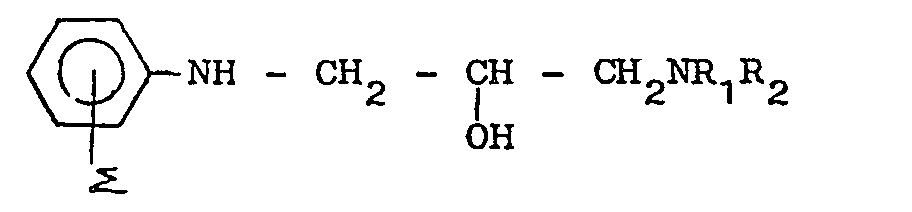
- Les exemples ci-dessous vont préciser la présente invention sans toutefois en limiter la portée.
- Dichlorhydrate de I'(isopropyl-2 anilino)-1 tertiobutylamino-3 propanol-2 ou COR37 05C. Dichlorhydrate du produit de formule (I) avec Σ = iPr-2, NR1R2 = NHtBu.
- On porte au reflux dans de l'éthanol absolu pendant 24 heures une mole d'isopropyl-2 aniline et 1,1 mole d'épichlorhydrine. On obtient ainsi le chlorhydrate de

- Celui-ci est mis en solution dans l'éthanol absolu et porté au reflux pendant 24 heures en présence d'un grand excès de tertiobutylamine. Après évaporation des solvants, le produit attendu est purifié par colonne sur alumine ou silice et recristallisé. La base est ainsi obtenue avec un rendement de 70% puis est transformée en dichlorhydrate ou COR37 05C.
- Point de fusion = 140°C.
- Point de fusion de la base correspondante = 82° C.
- Spectre de RMN de la base/TMS: 1 s (9 H) à 1,06 ppm, tBu; 1 d (6 H) à 1,25 ppm, J = 7 Hz, CMe2; 1 m (2 H) à 2,70 ppm, CH2 N(tBu); 1 m (3 H) à 3,2 ppm; Ar N CH2 + Ar
CH Me2: 1 m (1 H) à 3,8 ppm, CHO; 1 m (2 H) à 6,7 ppm, 2 protons aromatiques; 1 m (2 H) à 7,1 ppm, 2 protons aromatiques. - Dichlorhydrate de l'(isopropyl-2 méthyl-6 anilino)-1 tertiobutylamino-3 propanol-2 ou COR37 06C. Dichlorhydrate du produit de formule (I) avec Σ = iPr-2 Me-6, NR, R2 = NHtBu.
- On porte au reflux dans de l'éthanol absolu pendant 24 heures 1 mole d'isopropyl-2 méthyl-6 aniline et 1,1 mole d'épichlorhydrine. On obtient ainsi le chlorhydrate de
-
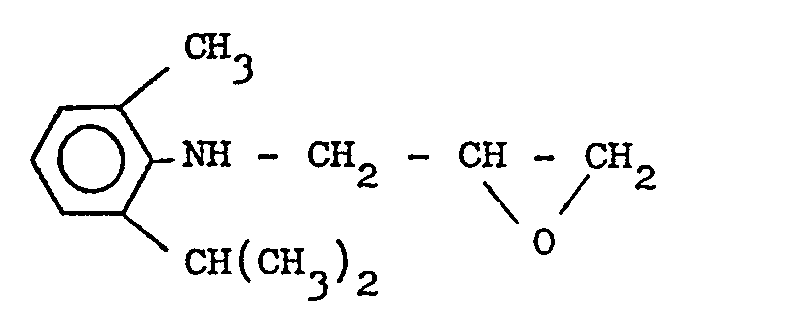
- Celui-ci est mis en solution dans l'éthanol absolu et porté au reflux pendant 24 heures en présence d'un grand excès de tertiobutylamine. Après évaporation des solvants le produit attendu est purifié par colonne sur alumine ou silice et recristallisé. La base est ainsi obtenue avec un rendement de 70% puis transformée en dichlorhydrate ou COR37 06C.
- Point de fusion = 158° C.
- Spectre de RMN de la base/TMS: 1 s (9 H) à 1,1 ppm, tBu; 1 d (6 H) à 1,25 ppm, J = 7 Hz, CMe2; 1 s (3 H) à 2,3 ppm Ar CH3; 1 m (2 H) à 2,7 ppm, CH2 NH tBu; 1 m (2 H) à 3,0 ppm, Ar NCH2;1 sp (1 H) à 3,2 ppm,Ar CHMe2;1 m(1 H) à 3,8 ppm, CHO. 1 m (3 H) à 6,9 ppm, 3 protons aromatiques.
- Dichlorhydrate du (méthyl-4 anilino)-1 tertiobutylamino-3 propanol-2 ou COR37 09C. Dichlorhydrate du produit de formule (1) avec Σ = Me-4, NR, R2 = NHtBu.
- On porte au reflux dans de l'éthanol absolu pendant 24 heures 1 mole de méthyl-4 aniline et 1,1 mole d'épichlorhydrine. On obtient ainsi le chlorhydrate de

- Celui-ci est mis en solution dans l'éthanol absolu et porté au reflux pendant 24 heures en présence d'un grand excès de tertiobutylamine. Après évaporation des solvants le produit attendu est purifié par colonne sur alumine ou silice et recristallisé. La base est obtenue avec un rendement de 60% puis transformée en dichlorhydrate ou COR37 09C.
- Point de fusion de la base correspondante = 82° C.
- Spectre de RMN de la base/TMS: 1 s (9 H) à 1,1 ppm, tBu; 1 s (3 H) à 2,2 ppm, Ar CH3; 1 m (2H) à 2,6 ppm, CH2 NHtBu;1 m (2H) à 3,1 ppm, Ar NCH2;1 1 m (1 H) à 3,7 ppm, CHO. Spectre AB (4 H) à 6,5 et 6,95 ppm, J = 8 Hz, 4 protons aromatiques.
- Dichlorhydrate de 1'(isopropyl-2 anilino)-1 diméthylamino-3 propanol-2 ou COR37 49C. Dichlorhydrate du produit de formule (I) avec Σ = iPr-2, NR,R2 = N(CH3)2.
- Le chlorhydrate de

- Spectre de RMN de la base/TMS: 1 d (6 H) à 1,15 ppm, J = 6 Hz, C(CH3)2; 1 s (6 H) à 1,95 ppm, N(CH3)2;1 1 m (5 H) de 2,5 à 3,3 ppm, CH(CH3)2 + 2 CH2N;1 m(1 H)à3,8ppm,CHO; 1 m (2 H) à 6,5 ppm, 2 protons aromatiques; 1 m (2 H) à 6,95 ppm, 2 protons aromatiques.
- Dichlorhydrate de l'(isopropyl-2 méthyl-6 anilino)-1 diméthylamino-3 propanol-2 ou COR37 50C. Dichlorhydrate du produit de formule (I) avec iPr-2 Me-6, NR1R2 = N(CH3)2.
- Le chlorhydrate de

- Spectre de RMN de la base/TMS: 1 d (6 H) à 1,25 ppm, J = 6 Hz, C(CH3)2; 1 s (9 H) à 2,25 ppm, Ar CH3 + N(CH3)2;1 1 m (5 H) de 2,5 à 3,5 ppm, CH(CH3)2 + 2NCH2; 1 m (1 H) à 3,85 ppm, CHO; 1 m (3 H) à 7,0 ppm, 3 protons aromatiques.
- Les propriétés toxicopharmacologiques des produits faisant l'objet de la présente invention sont exposées ci-après.
- La toxicité a été déterminée chez la souris. En solution dans le Tween et après administration par voie orale le COR37 05C entraîne 0% de mortalité à 500 mg/kg, 40% à 750 et 40% à 1000; le COR37 06C entraîne 0% de mortalité à 100 mg/kg, 10% à 200,10% à 250, 90% à 375,100% à 500 (DL50 = 294 mg/kg) (261-332); les COR37 09C, COR37 49C et COR37 50C entraînent 0% de mortalité à 300 mg/kg. En solution dans le Tween et après administration par voie intrapéritonéale le COR37 05C entraîne 0% de mortalité à 200 mg/kg, le COR37 06C entraîne 0% de mortalité à 100 mg/kg et 100% à 200, le COR37 09C entraîne 0% de moralité à 50 mg/kg et 100% à 100 mg/kg, les COR37 49C et 50C n'entraînent aucune mortalité à 200 mg/kg. Par voie intraveineuse le COR37 05C présente une DL50 de 56,6 mg/kg (53,8-59,5).
- L'activité antiarythmique a été déterminée sur plusieurs modèles expérimentaux. Dans le modèle de la souris soumise à une anesthésie chloroformi- que profonde le CO R37 05C et le CO R37 06C présentent après administration intrapéritonéale une activité antiarythmique dès la dose de 25 mg/kg; le COR37 50C est actif sur ce même modèle à 100 mg/kg. Le propanolol est actif dans les mêmes conditions à la dose de 40 mg/kg et la quinidine à la dose de 100 mg/kg.
- ln vitro dans le modèle de l'oreillette isolée de cobaye stimulée électriquement le COR37 05C et le COR37 06C sont actifs avec des Ci30 de respectivement 6,22 (4,37-8,86) 10-6 M/I et 7,26 - 10-s (4,68 10-6-1,12 · 10-5) M/I contre 10-5 M/I pour la procaïne, 4,10-6 M/I pour la quinidine et 4,5 10-s pour le propanolol.
- Ces produits ont été testés dans le modèle des arythmies induites par l'aconitine chez le rat. Les résultats sont exprimés par le pourcentage d'augmentation de la quantité d'aconitine provoquant l'apparition d'extrasystoles (E), de fibrilloflutters (F), detachycardies (T) et de morts (M). Administrés par voie intraveineuse 1 min avant la perfusion d'aconitine,le COR37 05C entraîne à 10 mg/kg 78% (E), 87% (T) et 83% (M) d'activité et le COR37 06C à 5 mg/kg entraîne 45% (E), 39% (T) et 79% (M) d'activité. Administrés par voie orale 45 min avant la perfusion d'aconitine à 100 mg/kg, le COR37 05C entraîne 83% (E), 99% (T) ,43% (F) et 107% (M) d'activité et le COR37 06C 25% (E), 32% (T), 29% (F) et 105% (M) d'activité. De plus le pourcentage d'animaux ne présentant pas de fibrilloflutters après administration de 100 mg/kg de COR37 05C et COR37 06C par voie orale est respectivement de 70 et 60%.
- L'activité anesthésique locale a été déterminée dans le test de la cornée de cobaye soumise à un stimulus tactile. Le COR37 06C employé à la concentration de 0,5% est actif pendant 30 min.
- L'activité antiagrégante plaquettaire a été déterminée in vitro. Quand l'agrégation est induite par 0,05 ml d'une préparation standardisée de collagène bovin dans un plasma riche en plaquettes (PRP) de lapin, le COR37 06C entraîne 100% d'in- hibition à 1 microg/ml alors que l'aspirine dans les mêmes conditions est active à 10 microg/ml et l'indométacine à 0,5 microg/ml. Dans le modèle de l'agrégation plaquettaire induite par 10-6 M d'ADP dans un PRP de lapin, 100 microg/ml, le COR37 09C entraîne 79% d'activité, le COR37 50C entraîne 80% d'activité et l'adénosine 64%.
- Les produits de la présente invention ne présentent pas d'activité bêtabloquante. Celle-ci a été déterminée in vitro par la recherche sur oreillette de cobaye stimulée électriquement d'un blocage de l'action inotrope de l'isoprotérénol et in vivo par la recherche de l'inhibition de la tachycardie induite par l'isoprotérénol chez la souris ainsi que par la recherche de l'activité vis-à-vis des effets de l'iso- prénaline sur la pression artérielle et la fréquence cardiaque du rat normal anesthésié. Le COR37 05C n'est actif que vis-à-vis des récepteurs bêta2 adrénergiques; les COR37 06C, COR37 09C, COR37 49C et COR37 50C ne présentent pas de propriétés bêtabloquantes.
- L'activité anticalcique a été déterminée in vitro sur oreillette gauche de cobaye stimulée électriquement à 150 battements/min dans une solution de Tyrode pauvre en calcium (0,6 mM). Les COR37 49C et 50C utilisés à la concentration de 100 microg/ml inhibent l'augmentation de la force contractile induite par l'addition de 0,6 mM de calcium.
- L'activité hypolipidémiante a été mise en évidence chez la souris rendue hypercholestérolémi- que par un régime riche en cholestérol et acide cholique pendant 7 jours. Ainsi l'administration par voie orale du COR37 49C le 6e et le 7e jour entraîne une diminution du cholestérol sérique de 22% à la dose de 400 mg/kg.
- L'activité diurétique a été déterminée chez le rat. Ainsi le COR37 49C administré au rat en surcharge hydrique à la dose orale de 20 mg/kg multiplie par 2,2 l'excrétion urinaire de sodium.
- L'activité antihistaminique antiH2 a été mise en évidence in vitro. A la concentration de 25 microg/ml le COR37 49C inhibe à 50% l'effet chro- notrope induit par 5 microg/ml d'histamine sur l'oreillette droite de cobaye non stimulée.
- L'activité antihistaminique antiH1 a été mise en évidence in vitro sur iléon de cobaye. Le COR37 49C employé à la concentration de 25 microg/ml inhibe à 80% les contractions induites par l'histamine.
- Compte tenu de leurs activités pharmacologiques jointes à une toxicité peu élevée, les produits faisant l'objet de la présente invention peuvent être employés en thérapeutique humaine et vétérinaire. Associés aux excipients habituels, ils pourront être utilisés par exemple pour traiter les troubles du rythme cardiaque. Ils pourront également être employés dans l'anesthésie locale d'infiltration et de conduction et dans l'anesthésie de contact, dans le traitement des états d'hyperagrégabilité plaquettaire, dans le traitement de l'insuffisance coronarienne, dans le traitement de l'hyperlipémie, l'hy- perlipoprotéinémie et des états oedémateux, dans le traitement de la maladie ulcéreuse et dans letrai- tement des affections allergiques ou prurigineuses et des maux de transport.
- Ils seront administrés par exemple par voie orale sous forme de dragées, comprimés, sirop, ampoules, par voie rectale sous forme de suppositoires, par voie intramusculaire ou intraveineuse, ou bien par voie topique sous forme de pommade ou gel. Les doses administrées varieront selon l'indication et le sujet de 1 à 100 mg/j en une à six prises pour la voie orale, de 1 à 100 mg/j en une ou deux prises par la voie rectale, de 0,5 à 50 mg par injection pour les voies parentérales.
Claims (11)


Applications Claiming Priority (2)
| Application Number | Priority Date | Filing Date | Title |
|---|---|---|---|
| FR8320747A FR2557102B1 (fr) | 1983-12-22 | 1983-12-22 | Nouveaux arylamino-1 amino-3 propanols-2 diversement substitues, leur methode de preparation ainsi que leur application en therapeutique |
| FR8320747 | 1983-12-22 |
Publications (2)
| Publication Number | Publication Date |
|---|---|
| EP0148096A1 EP0148096A1 (fr) | 1985-07-10 |
| EP0148096B1 true EP0148096B1 (fr) | 1987-08-05 |
Family
ID=9295545
Family Applications (1)
| Application Number | Title | Priority Date | Filing Date |
|---|---|---|---|
| EP84450025A Expired EP0148096B1 (fr) | 1983-12-22 | 1984-11-13 | Nouveaux arylamino-1 amino-3 propanols-2 diversement subtitués, leur méthode de préparation ainsi que leur application en thérapeutique |
Country Status (10)
| Country | Link |
|---|---|
| EP (1) | EP0148096B1 (fr) |
| JP (1) | JPS60139651A (fr) |
| CA (1) | CA1231972A (fr) |
| DE (1) | DE3465189D1 (fr) |
| ES (1) | ES8507465A1 (fr) |
| FR (1) | FR2557102B1 (fr) |
| MA (1) | MA20288A1 (fr) |
| OA (1) | OA07909A (fr) |
| PT (1) | PT79584B (fr) |
| ZA (1) | ZA8410027B (fr) |
-
1983
- 1983-12-22 FR FR8320747A patent/FR2557102B1/fr not_active Expired
-
1984
- 1984-11-13 EP EP84450025A patent/EP0148096B1/fr not_active Expired
- 1984-11-13 DE DE8484450025T patent/DE3465189D1/de not_active Expired
- 1984-11-19 JP JP59244316A patent/JPS60139651A/ja active Pending
- 1984-11-20 ES ES537796A patent/ES8507465A1/es not_active Expired
- 1984-11-30 PT PT79584A patent/PT79584B/fr not_active IP Right Cessation
- 1984-12-03 MA MA20512A patent/MA20288A1/fr unknown
- 1984-12-21 OA OA58486A patent/OA07909A/fr unknown
- 1984-12-21 ZA ZA8410027A patent/ZA8410027B/xx unknown
- 1984-12-21 CA CA000470939A patent/CA1231972A/fr not_active Expired
Also Published As
| Publication number | Publication date |
|---|---|
| PT79584B (fr) | 1986-09-11 |
| EP0148096A1 (fr) | 1985-07-10 |
| FR2557102B1 (fr) | 1987-08-14 |
| PT79584A (fr) | 1984-12-01 |
| JPS60139651A (ja) | 1985-07-24 |
| ZA8410027B (en) | 1985-08-28 |
| DE3465189D1 (en) | 1987-09-10 |
| ES537796A0 (es) | 1985-09-16 |
| ES8507465A1 (es) | 1985-09-16 |
| FR2557102A1 (fr) | 1985-06-28 |
| MA20288A1 (fr) | 1985-07-01 |
| CA1231972A (fr) | 1988-01-26 |
| OA07909A (fr) | 1986-11-20 |
Similar Documents
| Publication | Publication Date | Title |
|---|---|---|
| FR2479825A1 (fr) | Benzodioxanne 1,4 methoxy-2 propanolamines, leur preparation et leur application en tant que medicaments | |
| NO128869B (fr) | ||
| US3483221A (en) | 1 - (isopropylamino)-2-hydroxy-3-(alkenyloxyphenoxy) - propanes and the salts thereof | |
| EP0000299A1 (fr) | Nouveaux dérivés de benzoyl-2-chloro-4-glycinanilides substitués, leur procédé de préparation et leur application en tant que médicaments. | |
| HU181147B (en) | Process for preparing substituted heterocyclin phenoxamines | |
| EP0063084B1 (fr) | Dérivés de phénéthanolamine, leur préparation et leur application en thérapeutique | |
| US4638009A (en) | Derivatives of 3-pyrrolidinopropiophenone and a process for preparation thereof | |
| EP0148096A1 (fr) | Nouveaux arylamino-1 amino-3 propanols-2 diversement subtitués, leur méthode de préparation ainsi que leur application en thérapeutique | |
| EP0117171B1 (fr) | Dérivés aminés de la pyridazine substitués en position 6 par un hétérocycle ou un alicycle, procédé d'obtention et médicaments les contenant | |
| EP0077720A1 (fr) | Dérivés de biphényl alcoyl carboxylates, leur procédé de préparation et leur utilisation comme médicaments | |
| CH497433A (fr) | Procédé de préparation de nouveaux dérivés des benzimidazoles | |
| EP0008259A1 (fr) | Nouveaux dérivés de la pipéridylbenzimidazolinone, leurs procédés de préparation et les compositions pharmaceutiques les renfermant | |
| EP0173634B1 (fr) | Nouveaux dérivés d'(arylpipérazinyléthylaminoéthoxy)-4 phénol, leur méthode de préparation et leur application thérapeutique | |
| EP0172128B1 (fr) | Application thérapeutique d'aminométhylène-2 indanediones-1,3 substituées sur l'azote | |
| US3959359A (en) | Phenoxyalkylamines, process for their preparation and therapeutical composition containing same | |
| CA1057292A (fr) | 2-amino thiazoles | |
| EP0194164B1 (fr) | N-carboxyalcoyl-2 oxo-3 diaryl 5-6 triazines utiles en thérapeutique | |
| EP0036357B1 (fr) | Dérivés cétoniques de diaryl 5-6 triazines 1-2-4 antalgiques et antiagrégants utilisables dans le traitement de fond des migraines | |
| EP0020230A2 (fr) | Acides p-biphényl-4 méthyl-2 buten-3 oiques, procédé pour leur préparation, compositions pharmaceutiques les contenant et leur utilisation | |
| FR2564465A1 (fr) | Nouveaux diamino-1,3 propanols-2, leurs methodes de preparation et leurs applications therapeutiques | |
| DE1568734C3 (de) | N-Dialkyl-aminoalkyl-S-diphenylsulfoximine und ihre Salze sowie Verfahren zu ihrer Herstellung | |
| US3907999A (en) | Substituted dibenzocyclooctene compositions | |
| CH634075A5 (en) | Process for the preparation of hydrated imidazothiazole and thiazolopyrimidine derivatives having an anti-inflammatory activity | |
| US3935255A (en) | Phenylacetic acid derivatives | |
| EP0188169B1 (fr) | Bis-((hydroxy-4 isopropyl-2 méthyl-5 phénoxy)-2 amines, leur méthode de synthèse et les préparations pharmaceutiques les contenant |
Legal Events
| Date | Code | Title | Description |
|---|---|---|---|
| PUAI | Public reference made under article 153(3) epc to a published international application that has entered the european phase |
Free format text: ORIGINAL CODE: 0009012 |
|
| AK | Designated contracting states |
Designated state(s): BE CH DE GB IT LI LU NL |
|
| 17P | Request for examination filed |
Effective date: 19850606 |
|
| 17Q | First examination report despatched |
Effective date: 19860306 |
|
| D17Q | First examination report despatched (deleted) | ||
| ITF | It: translation for a ep patent filed | ||
| GRAA | (expected) grant |
Free format text: ORIGINAL CODE: 0009210 |
|
| AK | Designated contracting states |
Kind code of ref document: B1 Designated state(s): BE CH DE GB IT LI LU NL |
|
| REF | Corresponds to: |
Ref document number: 3465189 Country of ref document: DE Date of ref document: 19870910 |
|
| PLBE | No opposition filed within time limit |
Free format text: ORIGINAL CODE: 0009261 |
|
| STAA | Information on the status of an ep patent application or granted ep patent |
Free format text: STATUS: NO OPPOSITION FILED WITHIN TIME LIMIT |
|
| 26N | No opposition filed | ||
| ITTA | It: last paid annual fee | ||
| PGFP | Annual fee paid to national office [announced via postgrant information from national office to epo] |
Ref country code: CH Payment date: 19920929 Year of fee payment: 9 |
|
| PGFP | Annual fee paid to national office [announced via postgrant information from national office to epo] |
Ref country code: LU Payment date: 19921029 Year of fee payment: 9 |
|
| PGFP | Annual fee paid to national office [announced via postgrant information from national office to epo] |
Ref country code: GB Payment date: 19921105 Year of fee payment: 9 |
|
| PGFP | Annual fee paid to national office [announced via postgrant information from national office to epo] |
Ref country code: NL Payment date: 19921130 Year of fee payment: 9 |
|
| PGFP | Annual fee paid to national office [announced via postgrant information from national office to epo] |
Ref country code: BE Payment date: 19921231 Year of fee payment: 9 |
|
| PGFP | Annual fee paid to national office [announced via postgrant information from national office to epo] |
Ref country code: DE Payment date: 19930122 Year of fee payment: 9 |
|
| EPTA | Lu: last paid annual fee | ||
| PG25 | Lapsed in a contracting state [announced via postgrant information from national office to epo] |
Ref country code: LU Free format text: LAPSE BECAUSE OF NON-PAYMENT OF DUE FEES Effective date: 19931113 Ref country code: GB Effective date: 19931113 |
|
| PG25 | Lapsed in a contracting state [announced via postgrant information from national office to epo] |
Ref country code: LI Effective date: 19931130 Ref country code: CH Effective date: 19931130 Ref country code: BE Effective date: 19931130 |
|
| BERE | Be: lapsed |
Owner name: SOC. CORTIAL S.A. Effective date: 19931130 |
|
| PG25 | Lapsed in a contracting state [announced via postgrant information from national office to epo] |
Ref country code: NL Effective date: 19940601 |
|
| GBPC | Gb: european patent ceased through non-payment of renewal fee |
Effective date: 19931113 |
|
| NLV4 | Nl: lapsed or anulled due to non-payment of the annual fee | ||
| REG | Reference to a national code |
Ref country code: CH Ref legal event code: PL |
|
| PG25 | Lapsed in a contracting state [announced via postgrant information from national office to epo] |
Ref country code: DE Effective date: 19940802 |