EP0148500A2 - Hydrazin-thiocarbonsäure-O-carbamoylmethylester - Google Patents
Hydrazin-thiocarbonsäure-O-carbamoylmethylester Download PDFInfo
- Publication number
- EP0148500A2 EP0148500A2 EP84116312A EP84116312A EP0148500A2 EP 0148500 A2 EP0148500 A2 EP 0148500A2 EP 84116312 A EP84116312 A EP 84116312A EP 84116312 A EP84116312 A EP 84116312A EP 0148500 A2 EP0148500 A2 EP 0148500A2
- Authority
- EP
- European Patent Office
- Prior art keywords
- carbon atoms
- straight
- chain
- formula
- alkyl
- Prior art date
- Legal status (The legal status is an assumption and is not a legal conclusion. Google has not performed a legal analysis and makes no representation as to the accuracy of the status listed.)
- Granted
Links
- 150000002148 esters Chemical class 0.000 title claims description 10
- 125000000217 alkyl group Chemical group 0.000 claims abstract description 23
- 238000000034 method Methods 0.000 claims abstract description 19
- 125000001188 haloalkyl group Chemical group 0.000 claims abstract description 18
- 125000003545 alkoxy group Chemical group 0.000 claims abstract description 16
- 125000003342 alkenyl group Chemical group 0.000 claims abstract description 13
- 125000004183 alkoxy alkyl group Chemical group 0.000 claims abstract description 13
- COEWIOVAZWGZBG-UHFFFAOYSA-N aminocarbamothioic s-acid Chemical compound NNC(O)=S COEWIOVAZWGZBG-UHFFFAOYSA-N 0.000 claims abstract description 13
- 125000000392 cycloalkenyl group Chemical group 0.000 claims abstract description 13
- 125000003710 aryl alkyl group Chemical group 0.000 claims abstract description 12
- 125000003118 aryl group Chemical group 0.000 claims abstract description 12
- 229910052757 nitrogen Inorganic materials 0.000 claims abstract description 11
- 238000002360 preparation method Methods 0.000 claims abstract description 9
- 125000000304 alkynyl group Chemical group 0.000 claims abstract description 8
- 125000000753 cycloalkyl group Chemical group 0.000 claims abstract description 8
- 125000000623 heterocyclic group Chemical group 0.000 claims abstract description 8
- 239000001257 hydrogen Substances 0.000 claims abstract description 8
- 229910052739 hydrogen Inorganic materials 0.000 claims abstract description 8
- 125000004433 nitrogen atom Chemical group N* 0.000 claims abstract description 8
- 229920006395 saturated elastomer Polymers 0.000 claims abstract description 7
- 125000005842 heteroatom Chemical group 0.000 claims abstract description 6
- 125000003107 substituted aryl group Chemical group 0.000 claims abstract description 5
- 125000005346 substituted cycloalkyl group Chemical group 0.000 claims abstract description 5
- 125000004432 carbon atom Chemical group C* 0.000 claims description 38
- QGJOPFRUJISHPQ-UHFFFAOYSA-N Carbon disulfide Chemical compound S=C=S QGJOPFRUJISHPQ-UHFFFAOYSA-N 0.000 claims description 19
- 239000003085 diluting agent Substances 0.000 claims description 12
- -1 methoxy, methylthio Chemical group 0.000 claims description 11
- 125000001424 substituent group Chemical group 0.000 claims description 11
- NWZSZGALRFJKBT-KNIFDHDWSA-N (2s)-2,6-diaminohexanoic acid;(2s)-2-hydroxybutanedioic acid Chemical compound OC(=O)[C@@H](O)CC(O)=O.NCCCC[C@H](N)C(O)=O NWZSZGALRFJKBT-KNIFDHDWSA-N 0.000 claims description 10
- IKDUDTNKRLTJSI-UHFFFAOYSA-N hydrazine monohydrate Substances O.NN IKDUDTNKRLTJSI-UHFFFAOYSA-N 0.000 claims description 10
- TZGPACAKMCUCKX-UHFFFAOYSA-N 2-hydroxyacetamide Chemical class NC(=O)CO TZGPACAKMCUCKX-UHFFFAOYSA-N 0.000 claims description 9
- ZAMOUSCENKQFHK-UHFFFAOYSA-N Chlorine atom Chemical compound [Cl] ZAMOUSCENKQFHK-UHFFFAOYSA-N 0.000 claims description 9
- 125000001495 ethyl group Chemical group [H]C([H])([H])C([H])([H])* 0.000 claims description 9
- 125000002496 methyl group Chemical group [H]C([H])([H])* 0.000 claims description 9
- 239000002585 base Substances 0.000 claims description 8
- 239000002253 acid Substances 0.000 claims description 7
- IJGRMHOSHXDMSA-UHFFFAOYSA-N Atomic nitrogen Chemical compound N#N IJGRMHOSHXDMSA-UHFFFAOYSA-N 0.000 claims description 6
- 125000004122 cyclic group Chemical group 0.000 claims description 6
- 125000005843 halogen group Chemical group 0.000 claims description 6
- 125000001997 phenyl group Chemical group [H]C1=C([H])C([H])=C(*)C([H])=C1[H] 0.000 claims description 6
- 239000011230 binding agent Substances 0.000 claims description 5
- 239000000460 chlorine Substances 0.000 claims description 5
- 229910052801 chlorine Inorganic materials 0.000 claims description 5
- 229940106681 chloroacetic acid Drugs 0.000 claims description 5
- 125000000449 nitro group Chemical group [O-][N+](*)=O 0.000 claims description 4
- 238000005580 one pot reaction Methods 0.000 claims description 4
- 125000004414 alkyl thio group Chemical group 0.000 claims description 3
- 125000001797 benzyl group Chemical group [H]C1=C([H])C([H])=C(C([H])=C1[H])C([H])([H])* 0.000 claims description 3
- 125000004438 haloalkoxy group Chemical group 0.000 claims description 3
- 229910052736 halogen Inorganic materials 0.000 claims description 3
- 150000002367 halogens Chemical class 0.000 claims description 3
- ZZXYCAKBDUPTQS-UHFFFAOYSA-N o-(2-amino-2-oxoethyl) n-aminocarbamothioate Chemical compound NNC(=S)OCC(N)=O ZZXYCAKBDUPTQS-UHFFFAOYSA-N 0.000 claims description 3
- 239000001301 oxygen Substances 0.000 claims description 3
- 229910052760 oxygen Inorganic materials 0.000 claims description 3
- 125000000876 trifluoromethoxy group Chemical group FC(F)(F)O* 0.000 claims description 3
- 125000002023 trifluoromethyl group Chemical group FC(F)(F)* 0.000 claims description 3
- QVGXLLKOCUKJST-UHFFFAOYSA-N atomic oxygen Chemical compound [O] QVGXLLKOCUKJST-UHFFFAOYSA-N 0.000 claims description 2
- 125000004995 haloalkylthio group Chemical group 0.000 claims description 2
- RUDIYFIXQOWLHZ-UHFFFAOYSA-N trifluoromethyl thiohypofluorite Chemical compound FSC(F)(F)F RUDIYFIXQOWLHZ-UHFFFAOYSA-N 0.000 claims description 2
- 125000004435 hydrogen atom Chemical class [H]* 0.000 claims 3
- TUMFHRSSMDZROA-UHFFFAOYSA-N 2-(1,3,4-thiadiazol-2-yloxy)acetamide Chemical class NC(=O)COC1=NN=CS1 TUMFHRSSMDZROA-UHFFFAOYSA-N 0.000 abstract description 6
- 150000001875 compounds Chemical class 0.000 abstract description 6
- UFHFLCQGNIYNRP-UHFFFAOYSA-N Hydrogen Chemical compound [H][H] UFHFLCQGNIYNRP-UHFFFAOYSA-N 0.000 abstract description 5
- 125000006193 alkinyl group Chemical group 0.000 abstract description 5
- 150000002431 hydrogen Chemical class 0.000 abstract description 5
- 239000000543 intermediate Substances 0.000 abstract description 4
- KWYUFKZDYYNOTN-UHFFFAOYSA-M Potassium hydroxide Chemical compound [OH-].[K+] KWYUFKZDYYNOTN-UHFFFAOYSA-M 0.000 description 12
- XLYOFNOQVPJJNP-UHFFFAOYSA-N water Chemical compound O XLYOFNOQVPJJNP-UHFFFAOYSA-N 0.000 description 10
- YMWUJEATGCHHMB-UHFFFAOYSA-N Dichloromethane Chemical compound ClCCl YMWUJEATGCHHMB-UHFFFAOYSA-N 0.000 description 9
- 239000007858 starting material Substances 0.000 description 8
- PXGOKWXKJXAPGV-UHFFFAOYSA-N Fluorine Chemical compound FF PXGOKWXKJXAPGV-UHFFFAOYSA-N 0.000 description 7
- 230000002363 herbicidal effect Effects 0.000 description 7
- WKBOTKDWSSQWDR-UHFFFAOYSA-N Bromine atom Chemical compound [Br] WKBOTKDWSSQWDR-UHFFFAOYSA-N 0.000 description 6
- 239000000203 mixture Substances 0.000 description 6
- VEXZGXHMUGYJMC-UHFFFAOYSA-N Hydrochloric acid Chemical compound Cl VEXZGXHMUGYJMC-UHFFFAOYSA-N 0.000 description 5
- UIIMBOGNXHQVGW-UHFFFAOYSA-M Sodium bicarbonate Chemical compound [Na+].OC([O-])=O UIIMBOGNXHQVGW-UHFFFAOYSA-M 0.000 description 5
- 238000006243 chemical reaction Methods 0.000 description 4
- 238000002844 melting Methods 0.000 description 4
- 230000008018 melting Effects 0.000 description 4
- WEVYAHXRMPXWCK-UHFFFAOYSA-N Acetonitrile Chemical compound CC#N WEVYAHXRMPXWCK-UHFFFAOYSA-N 0.000 description 3
- LFQSCWFLJHTTHZ-UHFFFAOYSA-N Ethanol Chemical compound CCO LFQSCWFLJHTTHZ-UHFFFAOYSA-N 0.000 description 3
- OKKJLVBELUTLKV-UHFFFAOYSA-N Methanol Chemical compound OC OKKJLVBELUTLKV-UHFFFAOYSA-N 0.000 description 3
- HEMHJVSKTPXQMS-UHFFFAOYSA-M Sodium hydroxide Chemical compound [OH-].[Na+] HEMHJVSKTPXQMS-UHFFFAOYSA-M 0.000 description 3
- GDTBXPJZTBHREO-UHFFFAOYSA-N bromine Substances BrBr GDTBXPJZTBHREO-UHFFFAOYSA-N 0.000 description 3
- 229910052794 bromium Inorganic materials 0.000 description 3
- 239000007795 chemical reaction product Substances 0.000 description 3
- 229910052731 fluorine Inorganic materials 0.000 description 3
- 239000011737 fluorine Substances 0.000 description 3
- 238000004519 manufacturing process Methods 0.000 description 3
- 239000000047 product Substances 0.000 description 3
- 239000002904 solvent Substances 0.000 description 3
- ATACSYDDCNWCLV-UHFFFAOYSA-N 2-chloroacetic acid;sodium Chemical compound [Na].OC(=O)CCl ATACSYDDCNWCLV-UHFFFAOYSA-N 0.000 description 2
- PNEABRNAYDDYJK-UHFFFAOYSA-N 2-hydroxy-n-methyl-n-phenylacetamide Chemical compound OCC(=O)N(C)C1=CC=CC=C1 PNEABRNAYDDYJK-UHFFFAOYSA-N 0.000 description 2
- GFJMOZYIDADKLJ-UHFFFAOYSA-N 5-bromo-2-chloro-3-methoxypyridine Chemical compound COC1=CC(Br)=CN=C1Cl GFJMOZYIDADKLJ-UHFFFAOYSA-N 0.000 description 2
- HEDRZPFGACZZDS-UHFFFAOYSA-N Chloroform Chemical compound ClC(Cl)Cl HEDRZPFGACZZDS-UHFFFAOYSA-N 0.000 description 2
- JCXJVPUVTGWSNB-UHFFFAOYSA-N Nitrogen dioxide Chemical class O=[N]=O JCXJVPUVTGWSNB-UHFFFAOYSA-N 0.000 description 2
- PMZURENOXWZQFD-UHFFFAOYSA-L Sodium Sulfate Chemical compound [Na+].[Na+].[O-]S([O-])(=O)=O PMZURENOXWZQFD-UHFFFAOYSA-L 0.000 description 2
- 150000008044 alkali metal hydroxides Chemical class 0.000 description 2
- 230000015572 biosynthetic process Effects 0.000 description 2
- SKOLWUPSYHWYAM-UHFFFAOYSA-N carbonodithioic O,S-acid Chemical compound SC(S)=O SKOLWUPSYHWYAM-UHFFFAOYSA-N 0.000 description 2
- 238000001816 cooling Methods 0.000 description 2
- 239000013078 crystal Substances 0.000 description 2
- 150000007529 inorganic bases Chemical class 0.000 description 2
- 239000012074 organic phase Substances 0.000 description 2
- 239000000843 powder Substances 0.000 description 2
- 239000002243 precursor Substances 0.000 description 2
- 150000003254 radicals Chemical class 0.000 description 2
- 229910000030 sodium bicarbonate Inorganic materials 0.000 description 2
- 235000017557 sodium bicarbonate Nutrition 0.000 description 2
- 229910052938 sodium sulfate Inorganic materials 0.000 description 2
- 235000011152 sodium sulphate Nutrition 0.000 description 2
- 239000000126 substance Substances 0.000 description 2
- 238000003786 synthesis reaction Methods 0.000 description 2
- QAEDZJGFFMLHHQ-UHFFFAOYSA-N trifluoroacetic anhydride Chemical compound FC(F)(F)C(=O)OC(=O)C(F)(F)F QAEDZJGFFMLHHQ-UHFFFAOYSA-N 0.000 description 2
- BGPJLYIFDLICMR-UHFFFAOYSA-N 1,4,2,3-dioxadithiolan-5-one Chemical compound O=C1OSSO1 BGPJLYIFDLICMR-UHFFFAOYSA-N 0.000 description 1
- ZEGFTEOLGHYWAY-UHFFFAOYSA-N 2-hydroxy-1-piperidin-1-ylethanone Chemical compound OCC(=O)N1CCCCC1 ZEGFTEOLGHYWAY-UHFFFAOYSA-N 0.000 description 1
- BVKZGUZCCUSVTD-UHFFFAOYSA-M Bicarbonate Chemical class OC([O-])=O BVKZGUZCCUSVTD-UHFFFAOYSA-M 0.000 description 1
- MYMOFIZGZYHOMD-UHFFFAOYSA-N Dioxygen Chemical compound O=O MYMOFIZGZYHOMD-UHFFFAOYSA-N 0.000 description 1
- VABVARYXEKSYBT-UHFFFAOYSA-O NC(CO[S+]1C=NN=C1)=O Chemical class NC(CO[S+]1C=NN=C1)=O VABVARYXEKSYBT-UHFFFAOYSA-O 0.000 description 1
- 229910052783 alkali metal Inorganic materials 0.000 description 1
- 229910000288 alkali metal carbonate Inorganic materials 0.000 description 1
- 150000008041 alkali metal carbonates Chemical class 0.000 description 1
- 229910052784 alkaline earth metal Inorganic materials 0.000 description 1
- 150000001342 alkaline earth metals Chemical class 0.000 description 1
- QGJOPFRUJISHPQ-NJFSPNSNSA-N carbon disulfide-14c Chemical compound S=[14C]=S QGJOPFRUJISHPQ-NJFSPNSNSA-N 0.000 description 1
- 150000001244 carboxylic acid anhydrides Chemical class 0.000 description 1
- 238000001704 evaporation Methods 0.000 description 1
- 230000008020 evaporation Effects 0.000 description 1
- 238000001914 filtration Methods 0.000 description 1
- 239000005457 ice water Substances 0.000 description 1
- AZUWNNSKCBVWGK-UHFFFAOYSA-N n-methyl-n-phenyl-2-[[5-(trifluoromethyl)-1,3,4-thiadiazol-2-yl]oxy]acetamide Chemical compound C=1C=CC=CC=1N(C)C(=O)COC1=NN=C(C(F)(F)F)S1 AZUWNNSKCBVWGK-UHFFFAOYSA-N 0.000 description 1
- 150000007530 organic bases Chemical class 0.000 description 1
- 239000003960 organic solvent Substances 0.000 description 1
- 229910000028 potassium bicarbonate Inorganic materials 0.000 description 1
- 235000015497 potassium bicarbonate Nutrition 0.000 description 1
- 239000011736 potassium bicarbonate Substances 0.000 description 1
- TYJJADVDDVDEDZ-UHFFFAOYSA-M potassium hydrogencarbonate Chemical compound [K+].OC([O-])=O TYJJADVDDVDEDZ-UHFFFAOYSA-M 0.000 description 1
- 239000011814 protection agent Substances 0.000 description 1
- 239000000376 reactant Substances 0.000 description 1
- 239000011541 reaction mixture Substances 0.000 description 1
- FDRCDNZGSXJAFP-UHFFFAOYSA-M sodium chloroacetate Chemical compound [Na+].[O-]C(=O)CCl FDRCDNZGSXJAFP-UHFFFAOYSA-M 0.000 description 1
- 238000003756 stirring Methods 0.000 description 1
- 125000005017 substituted alkenyl group Chemical group 0.000 description 1
- 239000000725 suspension Substances 0.000 description 1
- 125000005034 trifluormethylthio group Chemical group FC(S*)(F)F 0.000 description 1
Classifications
-
- C—CHEMISTRY; METALLURGY
- C07—ORGANIC CHEMISTRY
- C07D—HETEROCYCLIC COMPOUNDS
- C07D285/00—Heterocyclic compounds containing rings having nitrogen and sulfur atoms as the only ring hetero atoms, not provided for by groups C07D275/00 - C07D283/00
- C07D285/01—Five-membered rings
- C07D285/02—Thiadiazoles; Hydrogenated thiadiazoles
- C07D285/04—Thiadiazoles; Hydrogenated thiadiazoles not condensed with other rings
- C07D285/12—1,3,4-Thiadiazoles; Hydrogenated 1,3,4-thiadiazoles
- C07D285/125—1,3,4-Thiadiazoles; Hydrogenated 1,3,4-thiadiazoles with oxygen, sulfur or nitrogen atoms, directly attached to ring carbon atoms, the nitrogen atoms not forming part of a nitro radical
- C07D285/13—Oxygen atoms
-
- C—CHEMISTRY; METALLURGY
- C07—ORGANIC CHEMISTRY
- C07D—HETEROCYCLIC COMPOUNDS
- C07D295/00—Heterocyclic compounds containing polymethylene-imine rings with at least five ring members, 3-azabicyclo [3.2.2] nonane, piperazine, morpholine or thiomorpholine rings, having only hydrogen atoms directly attached to the ring carbon atoms
- C07D295/16—Heterocyclic compounds containing polymethylene-imine rings with at least five ring members, 3-azabicyclo [3.2.2] nonane, piperazine, morpholine or thiomorpholine rings, having only hydrogen atoms directly attached to the ring carbon atoms acylated on ring nitrogen atoms
- C07D295/18—Heterocyclic compounds containing polymethylene-imine rings with at least five ring members, 3-azabicyclo [3.2.2] nonane, piperazine, morpholine or thiomorpholine rings, having only hydrogen atoms directly attached to the ring carbon atoms acylated on ring nitrogen atoms by radicals derived from carboxylic acids, or sulfur or nitrogen analogues thereof
- C07D295/182—Radicals derived from carboxylic acids
- C07D295/185—Radicals derived from carboxylic acids from aliphatic carboxylic acids
Definitions
- the invention relates to new hydrazine-thiocarboxylic acid 0-carbamoylmethyl esters, several processes for their preparation and their use as intermediates for the synthesis of 1,3,4-thiadiazol-2-yloxyacetamides which have herbicidal properties.
- herbicidal 1,3,4-thiadiazol-2-yloxyacetamides are obtained in substantially better yields and higher purity than when using those known from the prior art 2-Halogen-1,3,4-thiadiazoles as starting materials.
- Formula (I) provides a general definition of the hydrazine-thiocarboxylic acid O-carbamoyl methyl esters according to the invention.
- Formula (II) provides a general definition of the 0-carbamoylmethyl-S-carboxymethyldithiocarbonates required as starting materials for carrying out process (a) according to the invention.
- R and R 2 preferably represent those radicals which have already been stated as preferred for these substituents in the description of the substances of the formula (I) according to the invention.
- R and R 2 preferably represent those radicals which have already been mentioned as preferred for these substituents in the description of the substances of the formula (I) according to the invention.
- hydroxyacetamides of the formula (III) are known (cf. e.g. EP 18 497, EP 29 171, DE-OS 30 38 598 and DE-OS 31 48 839).
- Suitable diluents for carrying out process (a) according to the invention are organic solvents or aqueous systems.
- Water-miscible solvents such as, for example, methanol, ethanol or acetonitrile, or mixtures thereof with water, are preferably used.
- the use of pure water as a diluent is particularly preferred.
- Alkaline earth or alkali metal carbonates or bicarbonates such as sodium bicarbonate or potassium bicarbonate, are preferably used.
- reaction temperatures can be varied within a substantial range when carrying out process (a) according to the invention. In general, temperatures between -20 ° C and + 50 ° C, preferably between 0 ° C and + 30 ° C.
- any acid binder which is still present in excess is neutralized and the water-insoluble reaction product of the formula (I) is isolated by filtration.
- Suitable diluents for carrying out process (b) according to the invention are also water-miscible inert organic diluents or aqueous systems. Pure water is preferably used as the diluent.
- Strong inorganic bases are suitable as bases when carrying out process (b) according to the invention.
- Alkali metal hydroxides such as sodium hydroxide or potassium hydroxide, are preferably used.
- reaction temperatures can also be varied within a substantial range when carrying out process (b) according to the invention. In general, temperatures between -20 ° C and + 60 ° C, preferably between 0 ° C and + 40 ° C.
- the 1,3,4-thiadiazol-1-yloxyacetamides of the formula (IV) have herbicidal properties (cf. for example DE-OS 29 14 003, DE-OS 30 04 326, EP 18 497, DE-OS 29 46 526, EP 29 171 and DE-OS 32 18 482).
Landscapes
- Chemical & Material Sciences (AREA)
- Organic Chemistry (AREA)
- Organic Low-Molecular-Weight Compounds And Preparation Thereof (AREA)
- Heterocyclic Carbon Compounds Containing A Hetero Ring Having Nitrogen And Oxygen As The Only Ring Hetero Atoms (AREA)
- Pyrrole Compounds (AREA)
- Other In-Based Heterocyclic Compounds (AREA)
- Nitrogen- Or Sulfur-Containing Heterocyclic Ring Compounds With Rings Of Six Or More Members (AREA)
- Hydrogenated Pyridines (AREA)
- Agricultural Chemicals And Associated Chemicals (AREA)
Abstract

- R1 und R2 unabhängig voneinander für Wasserstoff, Alkyl, Alkenyl, Alkinyl, für jeweils gegebenenfalls substituiertes Cycloalkyl oder Cycloalkenyl, für Halogenalkyl, Alkoxyalkyl, Alkoxy, Aralkyl oder für gegebenenfalls substituiertes Aryl stehen oder R1 und R2 gemeinsam mit dem Stickstoffatom, an welches sie gebunden sind, für einen gegebenenfalls substituierten, gesättigten oder ungesättigten Heterocyclus stehen, der weitere Heteroatome enthalten kann, und Verfahren zu deren Herstellung. Die Verbindungen der Formel (I) können als Zwischenprodukte zur Herstellung von bekannten, herbizid wirksamen 1,3,4-Thiadiazol-2-yl-oxy-acetamiden verwendet werden.
Description
- Die Erfindung betrifft neue Hydrazin-thiocarbonsäure-0-carbamoylmethylester, mehrere Verfahren zu ihrer Herstellung sowie ihre Verwendung als Zwischenprodukte zur Synthese von 1,3,4-Thiadiazol-2-yloxyacetamiden, welche herbizide Eigenschaften besitzen.
- Es ist bereits bekannt, daß man herbizide Heteroaryloxyacetamide erhält, wenn man 2-Halogen-heteroarumaten mit Hydroxyacetamiden umsetzt (vgl. z.B. DE-OS 29 14 003 und DE-OS 30 04 326 [= EP 18 497], DE-OS 29 46 526 [= EP 29 171] und DE-OS 32 18 482).
- Besonders im Fall der 1,3,4-Thiadiazol-2-yloxyacetamide erhält man jedoch bei Verwendung von 2-Halogen-1,3,4-thiadiazolen als Ausgangsstoffe die gewünschten herbiziden Endprodukte nicht in zufriedenstellender Ausbeute und Reinheit.
- Es wurden neue Hydrazin-thiocarbonsäure-O-carbamoylmethylester der allgemeinen Formel (I),

- R1 und R 2 unabhängig voneinander für Wasserstoff, Alkyl, Alkenyl, Alkinyl, für jeweils gegebenenfalls substituiertes Cycloalkyl oder Cycloalkenyl, für Halogenalkyl, Alkoxyalkyl, Alkoxy, Aralkyl oder für gegebenenfalls substituiertes Aryl stehen oder
- R1 und R2 gemeinsam mit dem Stickstoffatom, an welches sie gebunden sind, für einen gegebenenfalls substituierten, gesättigten oder ungesättigten Heterocyclus stehen, der weitere Heteroatome enthalten kann,
- Weiterhin wurde gefunden, daß man die neuen Hydrazin-thiocarbonsäure-0-carbamoylmethylester der allgemeinen Formel (I),
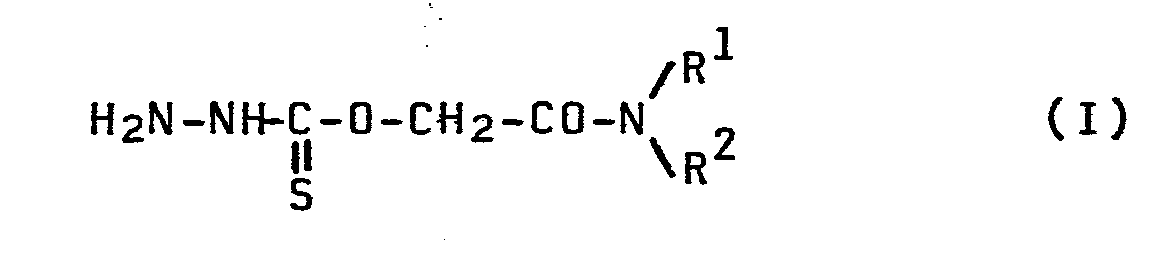
- R 1 und R 2 unabhängig voneinander für Wasserstoff, Alkyl, Alkenyl, Alkinyl, für jeweils gegebenenfalls substituiertes Cycloalkyl oder Cycloalkenyl, für Halogenalkyl, Alkoxyalkyl, Alkoxy, Aralkyl oder für gegebenenfalls substituiertes Aryl stehen oder
- R1 und R2 gemeinsam mit dem Stickstoffatom, an welches sie gebunden sind, für einen gegebenenfalls substituierten, gesättigten oder ungesättigten Heterocyclus stehen, der weitere Heteroatome enthalten kann,
- a) O-Carbamoylmethyl-S-carboxymethyl-dithiocarbonate der allgemeinen Formel (II),

- b) Hydroxyacetamide der allgemeinen Formel (III),

- Schließlich wurde gefunden, daß die neuen Hydrazin-thiocarbonsäure-O-carbamoylmethylester der Formel (I) interessante Zwischenprodukte zur Herstellung von Pflanzenschutzmitteln sind, welche herbizide Eigenschaften besitzen.
- Ueberraschenderweise erhält man bei Verwendung der neuen Hydrazin-thiocarbonsäure-O-carbamoylmethylester der Formel (I) als Ausgangsstoffe herbizide 1,3,4-Thiadiazol-2-yloxyacetamide in wesentlich besseren Ausbeuten und höherer Reinheit als bei Verwendung der aus dem Stand der Technik bekannten 2-Halogen-1,3,4-thiadiazole als Ausgangsstoffe.
- Die erfindungsgemäßen Hydrazin-thiocarbonsäure-O-carbamoylmethylester sind durch die Formel (I) allgemein definiert.
- Bevorzugt sind Verbindungen der Formel (I), bei welchen
- R1 und R2 unabhängig voneinander für Wasserstoff, geradkettiges oder verzweigtes Alkyl mit 1 bis 8 Kohlenstoffatomen, geradkettiges oder verzweigtes Alkenyl und Alkinyl mit jeweils 2 bis 8 Kohlenstoffatomen, für gegebenenfalls einfach oder mehrfach, gleich oder verschieden substituiertes Cycloalkyl oder Cycloalkenyl mit jeweils 3 bis 7 Kohlenstoffatomen, wobei als Substituenten insbesondere Alkylreste mit 1 bis 4 Kohlenstoffatomen infrage kommen, für geradkettiges oder verzweigtes Alkoxy und Alkoxyalkyl mit 1 bis 8 Kohlenstoffatomen, für Halogenalkyl mit 1 bis 8 Kohlenstoffatomen und 1 bis 5 Halogenatomen, insbesondere Fluor, Chlor und Brom, für Aralkyl mit 6 bis 10 Kohlenstoffatomen im Arylteil und 1 bis 2 Kohlenstoffatomen im Alkylteil, sowie für gegebenenfalls einfach oder mehrfach, gleich oder verschieden substituiertes Aryl mit 6 bis 10 Kohlenstoffatomen stehen, wobei als Substituenten infrage kommen : Halogen, geradkettiges oder verzweigtes Alkyl, Alkoxy oder Alkylthio mit jeweils 1 bis 4 Kohlenstoffatomen, Halogenalkyl, Halogenalkoxy und Halogenalkylthiomit jeweils 1 bis 2 Kohlenstoffatomen und 1 bis 5 Halogenatomen, insbesondere Fluor, Chlor oder Brom, sowie Nitro, oder
- R1 und R2 zusammen mit dem Stickstoffatom, an das sie gebunden sind, für einen gegebenenfalls einfach oder mehrfach, gleich oder verschieden substituierten gesättigten oder ungesättigten, 5- bis 7-gliedrigen Heterocyclus stehen, der bis zu 2 weitere Heteroatome, insbesondere Stickstoff und Sauerstoff enthalten kann, wobei als Substituenten infrage kommen : geradkettiges oder verzweigtes Alkyl mit 1 bis 6 Kohlenstoffatomen, auch in Form eines anellierten Ringsystems, Aryl mit 6 bis 10 Kohlenstoffatomen, auch in Form eines anellierten Ringsystems oder Dioxyalkylen mit 2 bis 3 Kohlenstoffatomen.
- Besonders bevorzugt sind Hydrazin-thiocarbonsäure-O-carbamoylmethylester der Formel (I), bei welchen
- R1 und R 2 unabhängig voneinander für Wasserstoff, für geradkettiges oder verzweigtes Alkyl mit 1 bis 6 Kohlenstoffatomen, für geradkettiges oder verzweigtes Alkenyl und Alkinyl mit jeweils 2 bis 6 Kohlenstoffatomen, gegebenenfalls ein- bis dreifach, gleich oder verschieden durch Methyl oder Ethyl substituiertes Cycloalkyl bzw. Cycloalkenyl mit 5 bis 7 Kohlenstoffatomen, für verzweigtes oder geradkettiges Alkoxy und Alkoxyalkyl mit 1 bis 6 Kohlenstoffatomen, für Halogenalkyl mit 1 bis 6 Kohlenstoffatomen und 1 bis 5 Halogenatomen, insbesondere Fluor, Brom und Chlor, für Benzyl sowie für gegebenenfalls ein- bis dreifach, gleich oder verschieden substituiertes Phenyl stehen, wobei als Substituenten besonders bevorzugt sind : Methyl, Ethyl, Methoxy, Methylthio, Trifluormethyl, Trifluormethoxy, Trifluormethylthio, Fluor, Chlor, Nitro, oder
- R und R2 zusammen mit dem Stickstoffatom, an das sie gebunden sind, für einen der gegebenenfalls einbis dreifach, gleich oder verschieden substituierten Heterocyclen


- Im einzelnen seien außer den bei den Herstellungsbeispielen genannten Verbindungen die folgenden Verbindungen der allgemeinen Formel (I) genannt :


- Verwendet man beispielsweise S-Carboxymethyl-0-(N-methyl-N-phenylcarbamoylmethyl)-dithiocarbonat und Hydrazinhydrat als Ausgangsstoffe, so läßt sich der Reaktionablauf des erfindungsgemäßen Verfahrens (a) durch das folgende Formelschema darstellen :

- Verwendet man beispielsweise Hydroxyessigsäurepiperidid, Schwefelkohlenstoff, Kaliumhydroxid, Chloressigsäure-Natriumsalz und Hydrazinhydrat als Ausgangsstoffe, so läßt sich der Reaktionsablauf des erfindungsgemäßen Verfahrens (b) durch das folgende Formelschema darstellen :

- Die als Ausgangsstoffe zur Durchführung des erfindungsgemäßen Verfahrens (a) benötigten 0-Carbamoylmethyl-S-carboxymethyl-dithiocarbonate sind durch die Formel (II) allgemein definiert. In dieser Formel (II) stehen R und R2 vorzugsweise für diejenigen Reste, die schon bei der Beschreibung der erfindungsgemäßen Stoffe der Formel (I) als bevorzugt für diese Substituenten angegeben wurden.
- Die O-Carbamoylmethyl-S- carboxymethyl-dithiocarbonate der Formel (II) sind noch nicht bekannt. Man erhält sie, wenn man Hydroxyacetamide der Formel (III),

- R1 und R2 die oben angegebene Bedeutung haben, nacheinander in einem 'Eintopfverfahren' zunächst mit Schwefelkohlenstoff in Gegenwart einer Base, wie beispielsweise einem Alkalimetallhydroxid, dann mit einem Chloressigsäure-Alkalisalz, wie beispielsweise Chloressigsäure-Natriumsalz,und zuletzt mit einer Säure, wie beispielsweise Salzsäure,gegebenenfalls in Gegenwart eines Verdünnungsmittels, wie beispielsweise Wasser, bei Temperaturen zwischen 0°C und +60°C umsetzt.
- Die neuen O-Carbamoyl-S-carboxymethyl-dithiocarbonate (II) und das vorstehend beschriebene Verfahren zu ihrer Herstellung sind ebenfalls Gegenstand dieser Erfindung.
- Die zur Durchführung des erfindungsgemäßen Verfahrens (b) und zur Synthese der Vorprodukte der Formel (II) als'Ausgangsstoffe benötigten Hydroxyacetamide sind durch die Formel (III) allgemein definiert. In dieser Formel (III) stehen R und R2 vorzugsweise für diejenigen Reste, die schon bei der Beschreibung der erfindungsgemäßen Stoffe der Formel (I) als bevorzugt für diese Substituenten genannt wurden.
- Die Hydroxyacetamide der Formel (III) sind bekannt (vgl. z.B. EP 18 497, EP 29 171, DE-OS 30 38 598 sowie DE-OS 31 48 839).
- Als Verdünnungsmittel zur Durchführung des erfindungsgemäßen Verfahrens (a) kommen organische Lösungsmittel oder wässrige Systeme infrage.
- Vorzugsweise verwendet man mit Wasser mischbare Lösungsmittel, wie beispielsweise Methanol, Ethanol oder Acetonitril oder deren Gemische mit Wasser. Besonders bevorzugt ist die Verwendung von reinem Wasser als Verdünnungsmittel.
- Als Säurebindemittel kommen bei der Durchführung des erfindungsgemäßen Verfahrens (a) prinzipiell alle üblicherweise verwendbaren anorganischen oder organischen Basen infrage. Vorzugsweise verwendet man Erdalkali- oder Alkalimetallcarbonate oder -hydrogencarbonate, wie beispielsweise Natriumhydrogencarbonat oder Kaliumhydrogencarbonat.
- Die Reaktionstemperaturen können bei der Durchführung des erfindungsgemäßen Verfahrens (a) in einem größeren Bereich variiert werden. Im allgemeinen arbeitet man bei Temperaturen zwischen -20°C und +50°C, vorzugsweise zwischen 0°C und +30°C.
- Zur Durchführung des erfindungsgemäßen Verfahrens (a) setzt man pro Mol O-Carbamoylmethyl-S-carboxymethyl-dithiocarbonat der Formel (II) im allgemeinen 1 bis 1,3 Mol, vorzugsweise äquimolare Mengen Hydrazinhydrat und im allgemeinen 1 bis 1,3, vorzugsweise 1 bis 1,1 Mol an Säurebindemittel ein.
- Zur Aufarbeitung neutralisiert man eventuell noch im Ueberschuß vorhandenes Säurebindemittel und isoliert das in Wasser unlösliche Reaktionsprodukt der Formel (I) durch Filtration.
- Als Verdünnungsmittel zur Durchführung des erfindungsgemäßen Verfahrens (b) kommen ebenfalls mit Wasser mischbare inerte organische Verdünnungsmittel oder wässrige Systeme infrage. Vorzugsweise verwendet man reines Wasser als Verdünnungsmittel.
- Als Basen kommen bei der Durchführung des erfindungsgemäßen Verfahrens (b) starke anorganische Basen infrage. Vorzugsweise verwendet man Alkalimetallhydroxide wie beispielsweise Natriumhydroxid oder Kaliumhydroxid.
- Die Reaktionstemperaturen können bei der Durchführung des erfindungsgemäßen Verfahrens (b) ebenfalls in einem größeren Bereich variiert werden. Im allgemeinen arbeitet man bei Temperaturen zwischen -20°C und +60°C, vorzugsweise zwischen 0°C und +40°C.
- Zur Durchführung des erfindungsgemäßen Verfahrens (b) setzt man pro Mol Hydroxyacetamid der Formel (III) im allgemeinen 1 bis 1,3 Mol Schwefelkohlenstoff, 1 bis 1,3 Mol Chloressigsäure-Alkalisalz, wie beispielsweise Chloressigsäure-Natriumsalz, 1 bis 1,3 Mol Hydrazinhydrat und 1 bis 1,3 Mol an Base ein , vorzugsweise verwendet man äquimolare Mengen von allen benötigten Reaktionspartnern. Die Aufarbeitung und Isolierung der Reaktionsprodukte der Formel (I) erfolgt in üblicher Art und Weise.
- Wie schon erwähnt, stellen die erfindungsgemäßen Hydrazin-thiocarbonsäure-0-carbamoylmethylester der Formel (I) interessante Zwischenprodukte dar.
- Sie lassen sich leicht in 1,3,4-Thiadiazol-2-yloxyacetamide der allgemeinen Formel (IV),
-

- R 1 und R2 die oben angegebenen Bedeutungen haben und
- R3 für Alkyl, Halogenalkyl, Aralkyl oder gegebenenfalls substituiertes Aryl steht,
- überführen, indem man die Verbindungen der Formel (I) mit allgemein bekannten Carbonsäureanhydriden der Formel (V),

- Die 1,3,4-Thiadiazol-1-yloxyacetamide der Formel (IV) besitzen herbizide Eigenschaften (vgl. z.B. DE-OS 29 14 003, DE-OS 30 04 326, EP 18 497, DE-OS 29 46 526, EP 29 171 und DE-OS 32 18 482).
- Herstellungsbeispiele :
-

- Zu einer Lösung von 9,3 g (0,11 Mol) Natriumhydrogencarbonat in 100 ml Wasser gibt man portionsweise 29,9 g (0,1 Mol) Dithiokohlensäure-S-carboxymethylester-0-(N-methyl-N-phenylcarbamoylmethylester). Nach 1 Stunde tropft man bei 5°C bis 10°C 5 g (0,1 Mol) Hydrazin-Hydrat zu, rührt 1 Stunde unter Kühlen nach und saugt dann das ausgefallene Produkt ab.
- Man erhält auf diese Weise 20 g (84 % der Theorie) Hydrazin-thiocarbonsäure-0-(N-methyl-N-phenylcarbamoylme- thylester) in Form eines beigen Pulvers mit dem Schmelzpunkt 104°C.
- Zu einer Lösung von 11,2 g (0,2 Mol) Kaliumhydroxid in 40 ml Wasser gibt man bei 10°C erst 33 g (0,2 Mol) Glykolsäure-N-methylanilid, dann 15,2 g (0,2 Mol) Schwefelkohlenstoff. Man rührt 10 Minuten bei 10°C bis 15°C nach und versetzt die dabei entstehende Suspension mit 23,2 g (0,2 Mol) Chloressigsäure-Natriumsalz. Die Temperatur des Reaktionsgemisches steigt auf ca. 38°C an. Nach 1 Stunde tropft man unter Kühlung bei 5°C bis 10°C 10 g (0,2 Mol) Hydrazinhydrat zu, versetzt das Gemisch mit 100 ml Eiswasser und extrahiert 3 mal mit je 50 ml Chloroform.
- Nach Abdampfen des Lösungsmittels erhält man 43,2 g (90 % der Theorie) Hydrazin-thiocarbonsäure-0-(N-methyl-N-phenylcarbamoylmethylester) in Form hellgrauer Kristalle mit dem Schmelzpunkt I13°C.
- In entsprechender Weise und gemäß den allgemeinen Herstellungsangaben erhält man die folgenden Verbindungen der allgemeinen Formel (I) :


-

- Zu einer Lösung von 5,6 g (0,1 Mol) Kaliumhydroxid in 20 ml Wasser gibt man bei 10°C erst 16,5 g (0,1 Mol) Glykolsäure-N-methylanilid und dann 7,6 g (0,1 Mol) Schwefelkohlenstoff. Man rührt das Gemisch 10 Minuten bei 10°C bis 15°C nach und gibt dann 11,6 g (0,1 Mol) Chloressigsäure-Natriumsalz zu. Die Temperatur steigt dabei bis auf ca. 32°C an. Nach 1,5 Stunden wird mit 40 ml Wasser verdünnt und mit konzentrierter Salzsäure auf pH 2 eingestellt. Das ausgefallene Produkt wird zweimal mit je 100 ml Methylenchlorid geschüttelt, die organische Phase wird über Natriumsulfat getrocknet und im Vakuum eingedampft.
- Man erhält 27,8 g (93 % der Theorie) Dithiokohlensäure-S-carboxymethylester-0-(N-methyl-N-phenylcarbamoyl- methylester) in Form gelber Kristalle mit dem Schmelzpunkt 109°C.
- In entsprechender Weise erhält man die folgenden Vorprodukte der allgemeinen Formel (II) :


- (Herstellung der Folgeprodukte)
-

- Eine Mischung aus 14,4 g (0,06 Mol) Hydrazin-thiocarbonsäure-0-(N-methyl-N-phenylcarbamoylmethylester) und 60 ml Methylenchlorid versetzt man bei 0°C bis 5°C mit 30,3 g (0,144 Mol) Trifluoressigsäureanhydrid und rührt 18 Stunden bei Raumtemperatur nach. Dann schüttelt man mit Wasser und gesättigter Natriumhydrogencarbonatlösung aus, trocknet die organische Phase über Natriumsulfat und destilliert das Lösungsmittel im Vakuum ab.
- Man erhält 18,1 g (95 % der Theorie) (5-Trifluormethyl-1,3,4-thiadiazol-2-yl)-oxyessigsäure-N-methylanilid in Form eines farblosen Pulvers mit dem Schmelzpunkt 58°C. In entsprechender Weise erhält man die folgenden herbiziden 1,3,4-Thiadiazol-2-yl-oxyacetamide der allgemeinen Formel (IV) :


gefunden.
erhält, wenn man
Claims (6)


Applications Claiming Priority (2)
| Application Number | Priority Date | Filing Date | Title |
|---|---|---|---|
| DE3400170 | 1984-01-04 | ||
| DE19843400170 DE3400170A1 (de) | 1984-01-04 | 1984-01-04 | Hydrazin-thiocarbonsaeure-0-carbamoylmethylester |
Publications (3)
| Publication Number | Publication Date |
|---|---|
| EP0148500A2 true EP0148500A2 (de) | 1985-07-17 |
| EP0148500A3 EP0148500A3 (en) | 1986-12-30 |
| EP0148500B1 EP0148500B1 (de) | 1988-05-11 |
Family
ID=6224348
Family Applications (1)
| Application Number | Title | Priority Date | Filing Date |
|---|---|---|---|
| EP84116312A Expired EP0148500B1 (de) | 1984-01-04 | 1984-12-27 | Hydrazin-thiocarbonsäure-O-carbamoylmethylester |
Country Status (6)
| Country | Link |
|---|---|
| US (1) | US4658025A (de) |
| EP (1) | EP0148500B1 (de) |
| JP (1) | JPH06738B2 (de) |
| DE (2) | DE3400170A1 (de) |
| HU (1) | HU196958B (de) |
| IL (1) | IL73981A (de) |
Families Citing this family (1)
| Publication number | Priority date | Publication date | Assignee | Title |
|---|---|---|---|---|
| EP3415507A1 (de) * | 2017-06-13 | 2018-12-19 | Solvay Sa | Verfahren zur herstellung von arylthiadiazolacetamidverbindungen |
Family Cites Families (10)
| Publication number | Priority date | Publication date | Assignee | Title |
|---|---|---|---|---|
| US3395234A (en) * | 1959-09-29 | 1968-07-30 | Gulf Oil Corp | Thiocarbazate methods and compositions for controlling plasnt rust |
| BE598028A (de) * | 1959-12-15 | |||
| US3261858A (en) * | 1962-07-25 | 1966-07-19 | Monsanto Co | Alkenyl and cycloalkenyl esters of dithiocarbazic acids |
| US3562284A (en) * | 1968-02-05 | 1971-02-09 | American Cyanamid Co | 2-(substituted) sulfonyl-5-trifluoromethyl-1,3,4-thiadiazoles |
| DE2914003A1 (de) * | 1979-04-06 | 1980-10-16 | Bayer Ag | Azolyloxy-carbonsaeureamide, verfahren zu ihrer herstellung und ihre verwendung als herbizide |
| DE2946524A1 (de) * | 1979-11-17 | 1981-06-11 | Bayer Ag, 5090 Leverkusen | Azolyloxy-carbonsaeure-n-oxy-amide, verfahren zu ihrer herstellung und ihre verwendung als herbizide |
| DE3109582A1 (de) * | 1981-03-13 | 1982-10-28 | Bayer Ag, 5090 Leverkusen | N-(2,2,2-trifluorethyl)-n-alkyl- azolyloxyessigsaeureamide, verfahren zu ihrer herstellung und ihre verwendung als herbizide sowie neue zwischenprodukte zu ihrer herstellung |
| JPS57183764A (en) * | 1981-04-06 | 1982-11-12 | Nippon Tokushu Noyaku Seizo Kk | Substituted acetanilide compound, its preparation, and herbicide |
| DE3400168A1 (de) * | 1984-01-04 | 1985-07-11 | Bayer Ag, 5090 Leverkusen | 5-halogenalkyl-1,3,4-thiadiazol-2-yloxyacetamide |
| DE3400169A1 (de) * | 1984-01-04 | 1985-07-11 | Bayer Ag, 5090 Leverkusen | N'-acylhydrazin-thiocarbonsaeure-0-carbamoyl methylester |
-
1984
- 1984-01-04 DE DE19843400170 patent/DE3400170A1/de not_active Withdrawn
- 1984-12-21 US US06/684,568 patent/US4658025A/en not_active Expired - Lifetime
- 1984-12-27 DE DE8484116312T patent/DE3471098D1/de not_active Expired
- 1984-12-27 EP EP84116312A patent/EP0148500B1/de not_active Expired
- 1984-12-27 JP JP59274221A patent/JPH06738B2/ja not_active Expired - Lifetime
-
1985
- 1985-01-02 IL IL73981A patent/IL73981A/xx not_active IP Right Cessation
- 1985-01-03 HU HU8522A patent/HU196958B/hu not_active IP Right Cessation
Also Published As
| Publication number | Publication date |
|---|---|
| US4658025A (en) | 1987-04-14 |
| HU196958B (en) | 1989-02-28 |
| DE3400170A1 (de) | 1985-07-11 |
| JPH06738B2 (ja) | 1994-01-05 |
| JPS60158165A (ja) | 1985-08-19 |
| IL73981A0 (en) | 1985-04-30 |
| IL73981A (en) | 1989-01-31 |
| DE3471098D1 (de) | 1988-06-16 |
| HUT36450A (en) | 1985-09-30 |
| EP0148500A3 (en) | 1986-12-30 |
| EP0148500B1 (de) | 1988-05-11 |
Similar Documents
| Publication | Publication Date | Title |
|---|---|---|
| EP0165537B1 (de) | Verfahren zur Herstellung von Heteroaryloxyacetamiden | |
| EP0255689B1 (de) | Verfahren zur Herstellung von 1-Hydroxy-2-pyridonen | |
| EP0471262B1 (de) | Verfahren zur Herstellung von substituierten 3-Aminoacrylestern | |
| EP0148500B1 (de) | Hydrazin-thiocarbonsäure-O-carbamoylmethylester | |
| EP0321833A2 (de) | Verfahren zur Herstellung von 4-Amino-1,2,4-triazol-5-onen | |
| EP0661277A1 (de) | Verfahren und neue Zwischenprodukte zur Herstellung von Triazolinonen | |
| EP0151312B1 (de) | N'-Acylhydrazin-N-thiocarbonsäure-O-carbamoylmethylester | |
| DD160416A5 (de) | Verfahren zur herstellung von 3-(n-aryl-n-acylamio)-gamma-butyrothiolactonen | |
| EP0077961A2 (de) | Substituierte 2-Nitro-5-(4-trifluormethyl-phenoxy)-toluole, Verfahren zu ihrer Herstellung sowie ihre Verwendung als Herbizide und Pflanzenwuchsregulatoren | |
| EP0276721A1 (de) | 2-Cyan-2-oximino-acetamide | |
| EP0114289B1 (de) | Verfahren zur Herstellung von 2-Alkylthiomethyl-4-hydroxypyrimidinen | |
| EP0581147B1 (de) | Chlorthiazolderivate | |
| EP0134934A1 (de) | 2-Ketosulfonamide und Verfahren zu deren Herstellung | |
| EP0012868A1 (de) | 1,2,3-Thiadiazol-5-yl-thioglycolsäure, deren Derivate sowie Verfahren zu deren Herstellung | |
| EP0195971B1 (de) | Verfahren zur Herstellung von substituierten Guanidinen | |
| DE3431923A1 (de) | Verfahren zur herstellung von sulvonyliso(thio)harnstoffen | |
| EP0150411A1 (de) | Verfahren zur Herstellung substituierter Chinazolin-2.4(1H.3H)-dione | |
| DD146184A5 (de) | Verfahren zur herstellung von 1,2,3-thiadiazol-5-yl-harnstoffen | |
| DE2366215C2 (de) | Glyoxylsäurehydrazid-2-acylhydrazone | |
| DE3139505A1 (de) | 1,2,3,-thiadiazol-5-yl-harnstoff-derivate, verfahren zur herstellung dieser verbindungen sowie diese enthaltende mittel mit wuchsregulatorischer und entblaetternder wirkung | |
| EP0257295A1 (de) | (Z)-2-Cyan-2-oximino-acetyl-chloride sowie ein Verfahren zu ihrer Herstellung | |
| EP0222210A2 (de) | Verfahren zur Herstellung von Phosphorsäurederivaten und Zwischenprodukten | |
| DE1193057B (de) | Verfahren zur Herstellung von disubstituierten 2-Hydroxy-s-triazinen | |
| EP0200065A1 (de) | Verfahren zur Herstellung von 2-Cyanamino-4,6-dialkoxy-1,3,5-triazinen | |
| DE19535242A1 (de) | Verfahren zur Herstellung von 1-Aryl-4-carbamoyl-tetrazolinonen |
Legal Events
| Date | Code | Title | Description |
|---|---|---|---|
| PUAI | Public reference made under article 153(3) epc to a published international application that has entered the european phase |
Free format text: ORIGINAL CODE: 0009012 |
|
| 17P | Request for examination filed |
Effective date: 19841227 |
|
| AK | Designated contracting states |
Designated state(s): BE CH DE FR GB IT LI NL |
|
| PUAL | Search report despatched |
Free format text: ORIGINAL CODE: 0009013 |
|
| AK | Designated contracting states |
Kind code of ref document: A3 Designated state(s): BE CH DE FR GB IT LI NL |
|
| 17Q | First examination report despatched |
Effective date: 19870729 |
|
| GRAA | (expected) grant |
Free format text: ORIGINAL CODE: 0009210 |
|
| AK | Designated contracting states |
Kind code of ref document: B1 Designated state(s): BE CH DE FR GB IT LI NL |
|
| ITF | It: translation for a ep patent filed | ||
| GBT | Gb: translation of ep patent filed (gb section 77(6)(a)/1977) | ||
| REF | Corresponds to: |
Ref document number: 3471098 Country of ref document: DE Date of ref document: 19880616 |
|
| ET | Fr: translation filed | ||
| PLBE | No opposition filed within time limit |
Free format text: ORIGINAL CODE: 0009261 |
|
| STAA | Information on the status of an ep patent application or granted ep patent |
Free format text: STATUS: NO OPPOSITION FILED WITHIN TIME LIMIT |
|
| 26N | No opposition filed | ||
| ITTA | It: last paid annual fee | ||
| PGFP | Annual fee paid to national office [announced via postgrant information from national office to epo] |
Ref country code: DE Payment date: 20011116 Year of fee payment: 18 |
|
| PGFP | Annual fee paid to national office [announced via postgrant information from national office to epo] |
Ref country code: FR Payment date: 20011130 Year of fee payment: 18 |
|
| PGFP | Annual fee paid to national office [announced via postgrant information from national office to epo] |
Ref country code: BE Payment date: 20011219 Year of fee payment: 18 |
|
| PGFP | Annual fee paid to national office [announced via postgrant information from national office to epo] |
Ref country code: GB Payment date: 20011227 Year of fee payment: 18 |
|
| PGFP | Annual fee paid to national office [announced via postgrant information from national office to epo] |
Ref country code: CH Payment date: 20011228 Year of fee payment: 18 |
|
| REG | Reference to a national code |
Ref country code: GB Ref legal event code: IF02 |
|
| PGFP | Annual fee paid to national office [announced via postgrant information from national office to epo] |
Ref country code: NL Payment date: 20021031 Year of fee payment: 19 |
|
| PG25 | Lapsed in a contracting state [announced via postgrant information from national office to epo] |
Ref country code: GB Free format text: LAPSE BECAUSE OF NON-PAYMENT OF DUE FEES Effective date: 20021227 |
|
| PG25 | Lapsed in a contracting state [announced via postgrant information from national office to epo] |
Ref country code: LI Free format text: LAPSE BECAUSE OF NON-PAYMENT OF DUE FEES Effective date: 20021231 Ref country code: CH Free format text: LAPSE BECAUSE OF NON-PAYMENT OF DUE FEES Effective date: 20021231 Ref country code: BE Free format text: LAPSE BECAUSE OF NON-PAYMENT OF DUE FEES Effective date: 20021231 |
|
| BERE | Be: lapsed |
Owner name: *BAYER A.G. Effective date: 20021231 |
|
| PG25 | Lapsed in a contracting state [announced via postgrant information from national office to epo] |
Ref country code: NL Free format text: LAPSE BECAUSE OF NON-PAYMENT OF DUE FEES Effective date: 20030701 Ref country code: DE Free format text: LAPSE BECAUSE OF NON-PAYMENT OF DUE FEES Effective date: 20030701 |
|
| REG | Reference to a national code |
Ref country code: CH Ref legal event code: PL |
|
| GBPC | Gb: european patent ceased through non-payment of renewal fee |
Effective date: 20021227 |
|
| NLV4 | Nl: lapsed or anulled due to non-payment of the annual fee |
Effective date: 20030701 |
|
| PG25 | Lapsed in a contracting state [announced via postgrant information from national office to epo] |
Ref country code: FR Free format text: LAPSE BECAUSE OF NON-PAYMENT OF DUE FEES Effective date: 20030901 |
|
| REG | Reference to a national code |
Ref country code: FR Ref legal event code: ST |