EP0148729A2 - Verfahren zur Herstellung von sterisch gehinderten Hydroxyphenyl-carbonsäureestern - Google Patents
Verfahren zur Herstellung von sterisch gehinderten Hydroxyphenyl-carbonsäureestern Download PDFInfo
- Publication number
- EP0148729A2 EP0148729A2 EP84810630A EP84810630A EP0148729A2 EP 0148729 A2 EP0148729 A2 EP 0148729A2 EP 84810630 A EP84810630 A EP 84810630A EP 84810630 A EP84810630 A EP 84810630A EP 0148729 A2 EP0148729 A2 EP 0148729A2
- Authority
- EP
- European Patent Office
- Prior art keywords
- formula
- transesterification
- butyl
- mbar
- preparation
- Prior art date
- Legal status (The legal status is an assumption and is not a legal conclusion. Google has not performed a legal analysis and makes no representation as to the accuracy of the status listed.)
- Granted
Links
Classifications
-
- C—CHEMISTRY; METALLURGY
- C07—ORGANIC CHEMISTRY
- C07C—ACYCLIC OR CARBOCYCLIC COMPOUNDS
- C07C69/00—Esters of carboxylic acids; Esters of carbonic or haloformic acids
- C07C69/66—Esters of carboxylic acids having esterified carboxylic groups bound to acyclic carbon atoms and having any of the groups OH, O—metal, —CHO, keto, ether, acyloxy, groups, groups, or in the acid moiety
- C07C69/73—Esters of carboxylic acids having esterified carboxylic groups bound to acyclic carbon atoms and having any of the groups OH, O—metal, —CHO, keto, ether, acyloxy, groups, groups, or in the acid moiety of unsaturated acids
- C07C69/732—Esters of carboxylic acids having esterified carboxylic groups bound to acyclic carbon atoms and having any of the groups OH, O—metal, —CHO, keto, ether, acyloxy, groups, groups, or in the acid moiety of unsaturated acids of unsaturated hydroxy carboxylic acids
-
- C—CHEMISTRY; METALLURGY
- C07—ORGANIC CHEMISTRY
- C07C—ACYCLIC OR CARBOCYCLIC COMPOUNDS
- C07C67/00—Preparation of carboxylic acid esters
- C07C67/03—Preparation of carboxylic acid esters by reacting an ester group with a hydroxy group
-
- C—CHEMISTRY; METALLURGY
- C07—ORGANIC CHEMISTRY
- C07C—ACYCLIC OR CARBOCYCLIC COMPOUNDS
- C07C69/00—Esters of carboxylic acids; Esters of carbonic or haloformic acids
- C07C69/76—Esters of carboxylic acids having a carboxyl group bound to a carbon atom of a six-membered aromatic ring
- C07C69/84—Esters of carboxylic acids having a carboxyl group bound to a carbon atom of a six-membered aromatic ring of monocyclic hydroxy carboxylic acids, the hydroxy groups and the carboxyl groups of which are bound to carbon atoms of a six-membered aromatic ring
- C07C69/88—Esters of carboxylic acids having a carboxyl group bound to a carbon atom of a six-membered aromatic ring of monocyclic hydroxy carboxylic acids, the hydroxy groups and the carboxyl groups of which are bound to carbon atoms of a six-membered aromatic ring with esterified carboxyl groups
Definitions
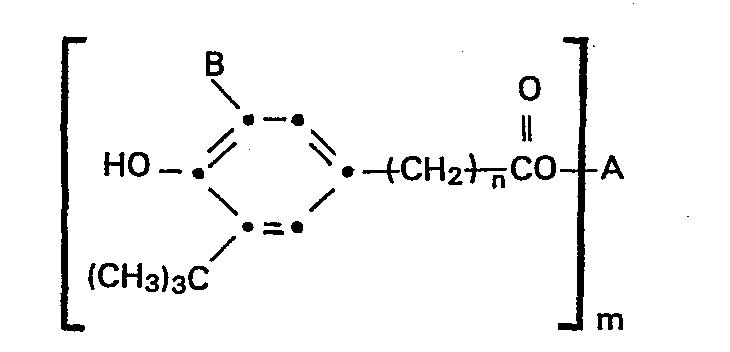
- the present invention relates to a process for the preparation of sterically hindered hydroxyphenylcarboxylic acid esters, in which a transesterification is carried out by treatment with a metal oxide or an organometallic compound and the melt obtained is distilled in a short-term distillation apparatus.
- Transesterification reactions for the preparation of sterically hindered hydroxyphenyl carboxylic acid esters are known.
- DE-AS 1 201 349 and DE-OS 1 543 644 describe transesterification reactions of this type in which alkali metal alcoholates are used as catalysts.
- Transesterification reactions of the same type are catalyzed with lithium amide according to DE - OS 2 150 327. All of these processes produce by-products (mostly oxidation products of 2,6-dialkylphenols) in more or less small amounts, which, even in very small amounts, cause a drastic reduction in the storage stability of the desired end product. The inevitable removal of these by-products is time, labor and energy consuming.
- A as a residue derived from an m-valent aliphatic alcohol, is an m-substituted or unsubstituted aliphatic residue having 2 to 18 carbon atoms.
- A is C 2 -C 18 alkyl, straight-chain or branched, such as, for example, ethyl, n-propyl, isopropyl, n-butyl, sec-butyl, tert-butyl, n-pentyl, n-hexyl, 2-ethylhexyl, n-octyl, 1,1,3,3-tetramethylbutyl, n-decyl, n-dodecyl, n-hexadecyl or n-octadecyl.
- N-Octadecyl is preferred.
- A can be, for example, C 2 -C 18 alkylene, preferably C 2 -C 6 alkylene, such as dimethylene, trimethylene, tetramethylene, hexamethylene, 2,2-dimethyl-trimethylene, octamethylene, nonamethylene, decamethylene, dodecamethylene or octadecamethylene.
- the alkylene group can be interrupted by -0-, -S- or -N (R) - as in 2-thiapropylene-1,3, 3-thiapentylene-1,5, 4-oxaheptamethylene, 3,6-dioxaoctamethylene-1, 8 or 3,6-diazaoctamethylene-1,8.
- A is interrupted C 2 -C 6 alkylene, it is preferably a group - (CH 2 ) 2 ⁇ S ⁇ (CH 2 ) 2 - or - (CH 2 ) 2 -O- (CH 2 ) 2 -O- (CH 2 ) 2 .
- A can be a trivalent aliphatic C 3 H 5 to C 7 H 13 hydrocarbon radical, such as -CH 2 -CH-CH 2 -, -CH 2 - C H 2 -C H- CH 2 -, -CH 2 -CH 2 -CH-CH 2 -CH 2 -, -CH 2 -CH 2 -CH-CH 2 -CH 2 - or -CH 2 -CH 2 -CH 2 -CH-CH 2 -CH 2 -CH 2 -CH 2 .
- A can be a tetravalent aliphatic C 4 H 6 to C 10 H 18 hydrocarbon radical, such as -CH 2 -CH-CH-CH 2 -, -CH 2 -CH 2 -CH-CH-CH 2 -, - CH 2 -CH 2 -CH-CH-CH 2 -CH 2 , -CH 2 -CH 2 -CH-CH 2 -CH-CH 2 -, -CH 2 -CH 2 -CH-CH 2 -CH 2 -CH 2 - or preferably pentaerythrityl.
- Suitable metal oxides as catalysts are e.g. Germanium and zirconium dioxide.
- the catalyst is preferably used in amounts between 0.1 and 0.3 mol% based on the ester of the formula II, at temperatures between 110 and 220 ° C, particularly preferably between 120 and 200 ° C and under a vacuum between 250 and 3 mbar used for 2 to 5 hours.
- Suitable short-term distillation apparatus are e.g. Film trudder, falling film evaporator and especially thin film evaporator.
- the distillation is advantageously carried out continuously, but batchwise operation is also possible.
- the melt obtained from the short-term distillation only needs to be granulated by conventional methods, e.g. on the cooling belt to get the finished product in a practically pure, free-flowing, dust-free form ready for its specific use.
- esters of formula II, the alcohols of formula III and the catalysts are known substances. If some of these substances are new, they can be produced by generally known methods.
- the compounds of formula I are valuable stabilizers for organic materials which are subject to decomposition, for example for synthetic organic polymers, animal and vegetable oils, hydrocarbons, lubricants and the like.
- the apparatus is relieved of nitrogen and the product melt is left out of the collecting vessel on a metal sheet for solidification.
- the solidified melt is then crushed. Under operating conditions, the melt is fed directly to the granulation. 1232 g (99.7% of theory) of pentaerythrityl tetrakis [3- (3,5-di-tert-butyl-4-hydroxyphenyl) propionate] with mp 58-62 ° C. are obtained.
- Example 3 The procedure of Example 2 is repeated with the only exception that instead of 1001 g, only 972 g (3.6 mol) of stearyl alcohol are used.
- Example 4 The procedure of Example 1 is repeated with the only exception that the transesterification is carried out at 190 instead of 180 ° C. The product of Example 1 is obtained with the same melting point and the same yield.
Landscapes
- Chemical & Material Sciences (AREA)
- Organic Chemistry (AREA)
- Organic Low-Molecular-Weight Compounds And Preparation Thereof (AREA)
- Low-Molecular Organic Synthesis Reactions Using Catalysts (AREA)
- Catalysts (AREA)
Abstract

Description
- Die vorliegende Erfindung betrifft ein Verfahren zur Herstellung von sterisch gehinderten Hydroxyphenylcarbonsäureestern, bei welchem eine Umesterung durch Behandlung mit einem Metalloxid oder einer metallorganischen Verbindung durchgeführt und die erhaltene Schmelze in einer Kurzzeit-Destillationsapparatur destilliert wird.
- Umesterungsreaktionen zur Herstellung von sterisch gehinderten Hydroxyphenylcarbonsäureestern sind bekannt. So beschreiben z.B. die DE-AS 1 201 349 und die DE-OS 1 543 644 Umesterungsreaktionen dieser Art, bei welchen Alkalialkoholate als Katalysatoren eingesetzt werden. Umesterungsreaktionen der gleichen Art werden nach der DE-OS 2 150 327 mit Lithiumamid katalysiert. Bei all diesen Verfahren entstehen in mehr oder weniger kleinen Mengen Nebenprodukte (meistens Oxydationsprodukte von 2,6-Dialkylphenolen), die selbst in sehr geringen Mengen eine drastische Herabsetzung der Lagerstabilität des gewünschten Endproduktes verursachen. Die unumgängliche Entfernung dieser Nebenprodukte ist zeit-, arbeits- und energieaufwendig.
- Es wurde nun gefunden, dass die Durchführung der Umesterung ohne Lösungsmittel in Gegenwart katalytischer Mengen eines Oxids oder einer metallorganischen Verbindung von Metallen der vierten Haupt-oder der vierten Nebengruppe des Periodensystems mit anschliessender Destillation der erhaltenen Schmelze in einer Kurzzeit-Destillationsapparatur bei bestimmten Bedingungen überraschenderweise zu einer praktisch quantitativen Ausbeute an reinem Endprodukt führt, das, da keine störenden Nebenprodukte enthaltend, nicht zusätzlich gereinigt werden muss. Ein weiterer Vorteil dieses Verfahrens ist die lösungsmittelfreie Arbeitsweise.
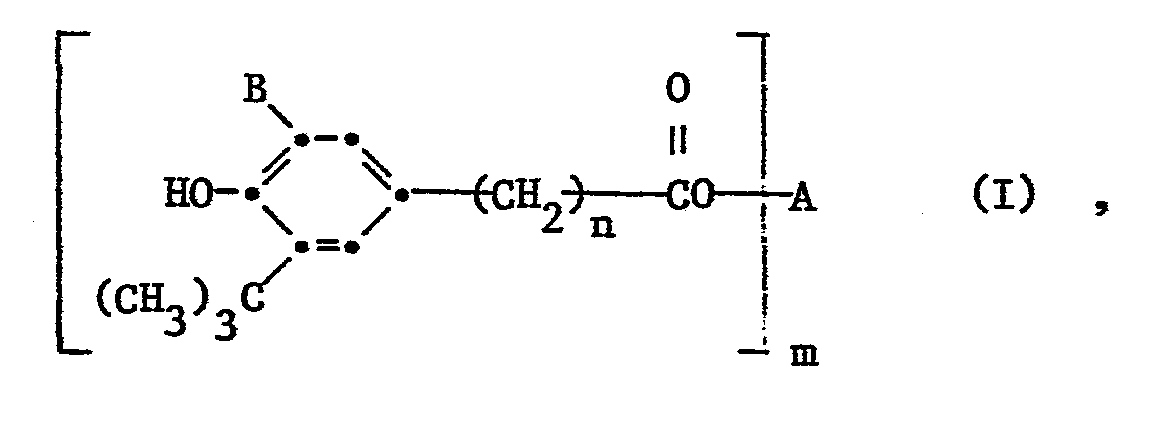
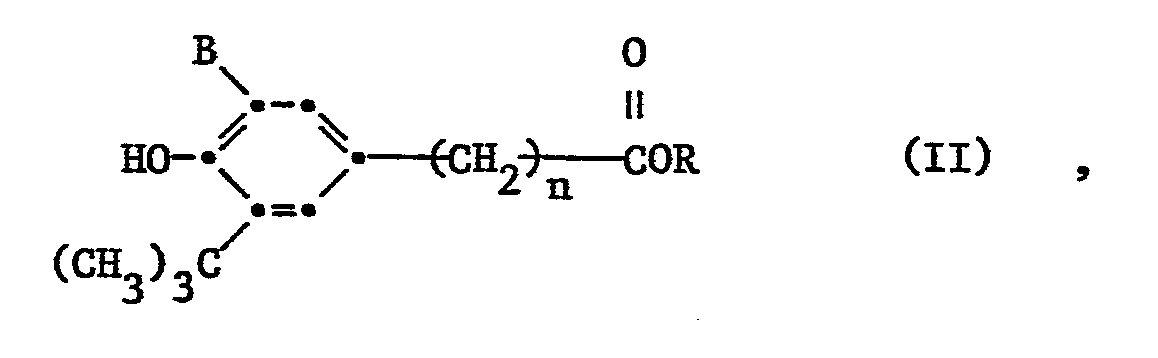
- Die vorliegende Erfindung betrifft demnach ein Verfahren zur Herstellung von Verbindungen der Formel I

- a) die Umesterung in Gegenwart eines Oxids oder einer metallorganischen Verbindung eines Metalls der vierten Haupt- oder der vierten Nebengruppe des Periodensystems als Katalysator in einer Menge zwischen 0,05 und 1,0 Mol% bezogen auf den Ester der Formel II durchgeführt und
- b) die erhaltene Schmelze in einer Kurzzeit-Destillationsapparatur bei einem Druck zwischen 0,5 und 6 mbar, bevorzugt zwischen 1 und 3 mbar und bei einer Temperatur zwischen 230 und 270°C, bevorzugt zwischen 240 und 260°C destilliert und die anfallende Schmelze granuliert wird.
- A ist als ein von einem m-wertigen aliphatischen Alkohol abgeleiteter Rest ein m-wertiger substituierter oder unsubstituierter aliphatischer Rest mit 2 bis 18 Kohlenstoffatomen.
- Ist m 1, so handelt es sich bei A um C2-C18 Alkyl, geradkettig oder verzweigt, wie z.B. Aethyl,n-Propyl, Isopropyl, n-Butyl, sec.-Butyl, tert.-Butyl, n-Pentyl, n-Hexyl, 2-Aethylhexyl,n-Octyl, 1,1,3,3-Tetramethylbutyl, n-Decyl, n-Dodecyl, n-Hexadecyl oder n-Octadecyl. Bevorzugt ist n-Octadecyl.
- Ist m 2, so kann A beispielsweise C2-C18-Alkylen, bevorzugt C2-C6-Alkylen sein, wie Dimethylen, Trimethylen, Tetramethylen, Hexamethylen, 2,2-Dimethyl-trimethylen, Octamethylen, Nonamethylen, Decamethylen, Dodecamethylen oder Octadecamethylen. Die Alkylengruppe kann unterbrochen sein durch -0-, -S- oder -N(R)- wie in 2-Thiapropylen-1,3, 3-Thiapentylen-1,5, 4-Oxaheptamethylen, 3,6-Dioxaoctamethylen-1,8 oder 3,6-Diazaoctamethylen-l,8. Ist A unterbrochenes C2-C6-Alkylen, so ist es bevorzugt eine Gruppe ―(CH2)2―S―(CH2)2― oder -(CH2)2-O-(CH2)2-O-(CH2)2.
- Ist m 3, so kann A ein trivalenter aliphatischer C3H5 bis C7 H 13 Kohlenwasserstoffrest sein, wie -CH2-CH-CH2-, -CH2-CH2-CH-CH2-, -CH2-CH2-CH-CH2-CH2-, -CH2-CH2-CH-CH2-CH2-CH2- oder -CH2-CH2-CH2-CH-CH2-CH2-CH2. Falls m 4 ist, kann A eintetravalenter aliphatischer C4H6 bis C10H18 Kohlenwasserstoffrest sein, wie -CH2-CH-CH-CH2-, -CH2-CH2-CH-CH-CH2-, -CH2-CH2-CH-CH-CH2-CH2 , -CH2-CH2-CH-CH 2-CH-CH2-CH2 -, -CH2-CH2-CH-CH2-CH2 -CH-CH2-CH2- oder bevorzugt Pentaerythrityl.
- Geeignete Metalloxide als Katalysatoren sind z.B. Germanium- und Zirkondioxid.
- Als metallorganische Verbindungen eines Metalls der vierten Haupt-oder der vierten Nebengruppe des Periodensystems kommen beispielsweise in Frage Verbindungen der Formel IV


- R 2 bedeutet als C4 -C12 -Alkyl z.B. n-Butyl, n-Pentyl, n-Hexyl, n-Octyl, n-Decyl, n-Dodecyl.
- R1 und R2 sind bevorzugt n-Butyl.
- Der Katalysator wird bevorzugt in Mengen zwischen 0,1 und 0,3 Mol % bezogen auf den Ester der Formel II, bei Temperaturen zwischen 110 und 220°C, besonders bevorzugt zwischen 120 und 200°C und bei einem Vakuum zwischen 250 und 3 mbar während 2 bis 5 Stunden eingesetzt.
- Bei Verbindungen der Formel I, worin m>l ist, ist es zweckmässig einen Ueberschuss von 10 - 30 Mol % an Ester der Formel II einzusetzen.
- Geeignete Kurzzeit-Destillationsapparaturen sind z.B. Filmtruder, Fallfilmverdampfer und insbesondere Dünnschichtverdampfer. Die Destillation wird vorteilhaft kontinuierlich durchgeführt, jedoch ist eine diskontinuierliche Arbeitsweise auch möglich.
- Die aus der Kurzzeit-Destillation erhaltene Schmelze braucht nur noch nach üblichen Methoden granuliert zu werden, z.B. auf dem Kühlband, um das fertige Endprodukt in praktisch reiner, freifliessender, staubfreier, für dessen spezifischen Einsatz bereiter Form zu erhalten.
- Das erfindungsgemässe Verfahren ist besonders geeignet für die Herstellung von Verbindungen der Formel I durch Umesterung eines Esters der Formel II mit einem Alkohol der Formel III, worin in den Formeln I, II und III
- n die Zahl 2 und m die Zahlen 1, 2 oder 4,
- A bei m = 1 C2-C18-Alkyl, bei m = 2 C2 C6-Alkylen, eine Gruppe -(CH2)2-S-(CH2)2 oder -(CH2)2-O-(CH2)2-O-(CH2)2- und bei m = 4 Pentaerythrityl und
- R Methyl bedeuten.
- Bevorzugtes erfindungsgemässes Verfahren ist die Herstellung von Pentaerythrityltetrakis[3-(3,5-di-tert.-butyl-4-hydroxyphenyl)-propionat] durch Umesterung von Methyl-3-(3,5-di-tert.-butyl-4-hydroxyphenyl)-propionat mit Pentaerythrit dadurch gekennzeichnet, dass
- a) die Umesterung in Gegenwart einer Verbindung der Formel V, worin R2 die oben angegebene Bedeutung hat, durchführt und
- b) die erhaltene Schmelze in einer Kurzzeit-Destillationsapparatur bei einem Druck zwischen 1 und 3 mbar und bei einer Temperatur zwischen 240 und 260°C destilliert und die anfallende Schmelze granuliert wird.
- Bei den Estern der Formel II, den Alkoholen der Formel III und den Katalysatoren handelt es sich um bekannte Substanzen. Sollten einzelne dieser Substanzen neu sein, so können sie nach allgemein bekannten Verfahren hergestellt werden.
- Die Verbindungen der Formel I sind wertvolle Stabilisatoren für organische Materialien, die der Zersetzung unterworfen sind, zum Beispiel für synthetische organische Polymere, tierische und pflanzliche Oele, Kohlenwasserstoffe, Schmiermittel und dergleichen.
- Die folgenden Beispiele erläutern die Erfindung, ohne sie einzuschränken.
-
- a) In einem Kolben, welcher mit einem auf 80°C beheizten Dephlegmator versehen ist, werden 1533 g (5,25 Mol) Methyl-3-(3,5-di-tert.-butyl-4-hydroxyphenyl)-propionat und 143 g (1,05 Mol) Pentaerythrit vorgelegt und auf 80°C erwärmt. Es werden dann 2,1 g (0,0084 Mol) Dibutylzinnoxid zugegeben und unter Stickstoff bei einem Vakuum von 250 mbar auf 180°C erhitzt. Das entstehende Methanol wird dabei in die Vorlage abdestilliert. Die Destillation wird bei 180°C und 250 mbar während weiteren 45 Minuten fortgesetzt und anschliessend das Vakuum innerhalb einer Stunde sukzessive auf ca. 4 mbar verbessert. Zum Schluss wird für weitere 30 Minuten bei 180°C und 3 bis 4 mbar gerührt. Die erhaltene leicht gelbliche Schmelze wird auf 80 - 100°C abgekühlt und bis zu ihrer Weiterverarbeitung unter Stickstoff aufbewahrt.
- b) Die unter a) erhaltene Schmelze wird in Portionen von ca. 300 ml durch einen Dünnschichtverdampfer bei einem Vakuum von 1 - 3 mbar und einer Temperatur im Verdampferteil von 260°C gelassen. Die Temperatur im Zulaufgefäss und im Auffanggefäss ist 150°C. Der Durchsatz ist von ca. 1000 g in der Stunde bei einer Rotordrehzahl von ca. 50 Upm. Dabei werden die Schmelze des Endprodukts im Auffanggefäss und das überschüssige Methyl-3-(3,5-di-tert.-butyl-4-hydroxyphenyl)-propionat mit Spuren von Methanol in der Destillationsvorlage aufgefangen.
- Jeweils nach Ende eines Durchlaufes wird die Apparatur mit Stickstoff entlastet und die Produkteschmelze aus dem Auffanggefäss auf ein Blech zur Erstarrung gelassen. Die erstarrte Schmelze wird anschliessend zerkleinert. Unter Betriebsbedingungen wird die Schmelze direkt zur Granulierung geführt. Man erhält 1232 g (99,7 % d.Th.) Pentaerythrityl-tetrakis-[3-(3,5-di-tert.-butyl-4-hydroxyphenyl)-propionat] mit Smp. 58 - 62°C.
-
- a) In einem Kolben werden 1051 g (3,6 Mol) Methyl-3-(3,5-di-tert.-butyl-4-hydroxyphenyl)-propionat und 1001 g (3,7 Mol) Stearylalkohol vorgelegt und auf 80°C erwärmt. Es werden dann 1,8 g (0,0072 Mol) Dibutylzinnoxid zugegeben und unter Stickstoff bei einem Vakuum von 250 mbar auf 140°C erhitzt. Das entstehende Methanol wird dabei in die Vorlage abdestilliert. Nun wird bei 140°C das Vakuum innerhalb einer Stunde sukzessive auf ca. 4 mbar verbessert. Zum Schluss wird für weitere 30 Minuten bei 140°C und 3-4 mbar gerührt. Die erhaltene leicht gelbliche Schmelze wird auf 80 - 100°C abgekühlt und bis zu ihrer Weiterverarbeitung unter Stickstoff aufbewahrt.
- b) Die unter a) erhaltene Schmelze wird genau wie unter Beispiel lb) beschrieben weiterverarbeitet.
- Man erhält 1905 g (99.8 % d. Th) Stearyl-3-(3,5-di-tert.-butyl-4-hydroxyphenyl)-propionat mit Smp. 50 - 51°C.
- Beispiel 3: Das Verfahren des Beispiels 2 wird wiederholt mit der einzigen Ausnahme, dass statt 1001 g nur 972 g (3,6 Mol) Stearylalkohol eingesetzt werden.
- Man erhält 1901 g (99,6% d.Th) Stearyl-3-(3,5-di-tert.-butyl-4-hydroxyphenyl)-propionat mit Smp. 50 - 51°C.
- Beispiel 4: Das Verfahren des Beispiels 1 wird wiederholt mit der einzigen Ausnahme, dass die Umesterung bei 190, statt bei 180°C durchgeführt wird. Man erhält das Produkt von Beispiel 1 mit gleichem Schmelzpunkt und gleicher Ausbeute.
Claims (7)


Applications Claiming Priority (2)
| Application Number | Priority Date | Filing Date | Title |
|---|---|---|---|
| CH6857/83 | 1983-12-22 | ||
| CH685783 | 1983-12-22 |
Publications (4)
| Publication Number | Publication Date |
|---|---|
| EP0148729A2 true EP0148729A2 (de) | 1985-07-17 |
| EP0148729A3 EP0148729A3 (en) | 1986-05-07 |
| EP0148729B1 EP0148729B1 (de) | 1989-03-01 |
| EP0148729B2 EP0148729B2 (de) | 1998-08-05 |
Family
ID=4316121
Family Applications (1)
| Application Number | Title | Priority Date | Filing Date |
|---|---|---|---|
| EP84810630A Expired - Lifetime EP0148729B2 (de) | 1983-12-22 | 1984-12-17 | Verfahren zur Herstellung von sterisch gehinderten Hydroxyphenyl-carbonsäureestern |
Country Status (6)
| Country | Link |
|---|---|
| US (1) | US4594444A (de) |
| EP (1) | EP0148729B2 (de) |
| JP (1) | JPH066553B2 (de) |
| BR (1) | BR8406666A (de) |
| CA (1) | CA1239146A (de) |
| DE (1) | DE3476875D1 (de) |
Cited By (10)
| Publication number | Priority date | Publication date | Assignee | Title |
|---|---|---|---|---|
| EP0154518A3 (en) * | 1984-02-29 | 1986-09-17 | Sumitomo Chemical Company, Limited | Phenolic compound, resin stabilizer containing it, and synthetic resins stabilized thereby |
| EP0210131A3 (en) * | 1985-07-19 | 1987-09-09 | Ciba-Geigy Ag | Solvent-free crystallization of pentaerythritol tetrakis-û-3-(3,5-di-tert. butyl-4-hydroxyphenyl)-propionate¨ and its lambda crystalline form |
| EP0200685A3 (en) * | 1985-05-02 | 1987-09-30 | Ciba-Geigy Ag | Process for the preparation of sterically hindered hydroxyphenylcarboxylic-acid esters |
| EP0255743A1 (de) * | 1986-07-25 | 1988-02-10 | ENICHEM SYNTHESIS S.p.A. | Tetrakis[3-(3,5-di-tert.Butyl-4-hydroxyphenyl)propionyloxymethyl]methan von amorpher Struktur, Verfahren zu seiner Herstellung und seine Verwendung als Stabilisator |
| EP0421928A3 (en) * | 1989-10-02 | 1992-04-22 | Ciba-Geigy Ag | Hydroxyphenylcarboxylic acid esters as stabilizers |
| EP0538189A3 (de) * | 1991-10-15 | 1993-04-28 | Ciba-Geigy Ag | Verfahren zur Herstellung von Hydroxyphenylcarbonsäureestern |
| EP0517832A4 (en) * | 1990-02-28 | 1994-05-18 | George H Greene | Antioxidant glyceride derivatives |
| EP0659814A1 (de) * | 1993-12-23 | 1995-06-28 | Bayer Ag | Verwendung von Antikernverfärbungsmitteln bei der Herstellung von Schaumstoffen auf Isocyanatbasis |
| EP0781834A3 (de) * | 1995-12-28 | 1997-08-20 | Nippon Oil Co Ltd | Schmierölzusammensetzung |
| EP0808818A1 (de) * | 1996-05-23 | 1997-11-26 | Ciba SC Holding AG | Verfahren zum Herstellen von substituierten Hydroxy-Hydrocinnamatestern |
Families Citing this family (29)
| Publication number | Priority date | Publication date | Assignee | Title |
|---|---|---|---|---|
| FI842618A7 (fi) * | 1984-06-28 | 1985-12-29 | Neste Oy | Foerfarande foer framstaellning av stearyl - -(3,5-dibutyl-4-hydroxifenyl)propionat och bis-( -(3,5-dibutyl-4- hydroxibenzyl)-metyl-karboxietyl)sulfid. |
| DE3639374A1 (de) * | 1986-11-18 | 1988-05-19 | Huels Chemische Werke Ag | Ester von 3-tert.-butyl- bzw. 3-tert.-butyl-5-alkyl-4-hydroxyphenyl-(alkan)-carbonsaeuren mit oxethylaten von bis-(4- bzw. 2-hydroxyphenyl)-alkanen, -oxiden, -sulfiden und -sulfonen von tris-(4-hydroxyphenyl)-alkanen und von 1,3,5-tris-(4-hydroxyphenyl-isopropyliden)-arylen, verfahren zu ihrer herstellung und ihre verwendung als stabilisatoren |
| JPH0710807B2 (ja) * | 1987-02-03 | 1995-02-08 | 吉富製薬株式会社 | テトラキス〔3−(3,5−ジ第3級ブチル−4−ヒドロキシフエニル)プロピオニルオキシメチル〕メタンの製造方法 |
| WO1988005773A1 (fr) * | 1987-02-03 | 1988-08-11 | Yoshitomi Pharmaceutical Industries, Ltd. | PROCEDE DE PREPARATION DE TETRAKIS (3-(3,5-DI-tert-BUTYL-4-HYDROXYPHENYL)PROPIONYLOXYMETHYL)METHANE |
| EP0278914B1 (de) * | 1987-02-13 | 1993-09-22 | Ciba-Geigy Ag | Verfahren zur Herstellung von tert.-Alkylestern der Bernsteinsäure |
| US5162405A (en) * | 1987-12-24 | 1992-11-10 | Elf Atochem North America, Inc. | Single-functional and mixtures of multi-functional oligomeric performance additive compositions and their uses |
| US5177246A (en) * | 1989-10-02 | 1993-01-05 | Ciba-Geigy Corporation | Hydroxphenylcarboxylic acid esters as stabilizers |
| JPH03284652A (ja) * | 1990-03-30 | 1991-12-16 | Kokusai Kagaku Gijutsu Consultant Kk | 着色の改良された粒状テトラキス[3―(3,5―ジ―ブチル―4―ヒドロキシフェニル)プロピオニルオキシメチル]メタン及びその製造方法 |
| WO1993008154A1 (en) * | 1991-10-18 | 1993-04-29 | Akzo Nobel N.V. | SYNTHESIS OF α,φ-BIS(p-HYDROXYBENZOYLOXY) ALKANE |
| TW289752B (de) * | 1994-03-11 | 1996-11-01 | Ciba Geigy Ag | |
| JP3401348B2 (ja) | 1994-12-07 | 2003-04-28 | 新日本石油株式会社 | 潤滑油組成物 |
| DE69905775T2 (de) | 1998-02-02 | 2003-10-16 | Ciba Speciality Chemicals Holding Inc., Basel | Verfahren zum Herstellen von substituierten Hydroxyhydrozimtsäureestern durch Entfernung von Zinnkatalysatoren |
| US6291703B1 (en) | 1998-02-09 | 2001-09-18 | Ciba Specialty Chemicals Corporation | Preparation of substituted hydroxyhydrocinnamate esters by continuous transesterification using reactive distillation |
| US6800228B1 (en) | 1998-09-22 | 2004-10-05 | Albemarle Corporation | Sterically hindered phenol antioxidant granules having balanced hardness |
| US6056898A (en) * | 1998-09-22 | 2000-05-02 | Albemarle Corporation | Low dust balanced hardness antioxidant pellets and process for the production of same |
| US6821456B2 (en) * | 1998-09-22 | 2004-11-23 | Albemarle Corporation | Granular polymer additives and their preparation |
| US6596198B1 (en) | 2000-04-28 | 2003-07-22 | Albemarle Corporation | Additive system for polymers in pellet form which provides proportioned stabilization and internal mold release characteristics |
| JP4925547B2 (ja) | 2000-06-23 | 2012-04-25 | チバ ホールディング インコーポレーテッド | ヒドロキシフェニルカルボン酸エステルの生成方法 |
| AU2003293598A1 (en) * | 2002-10-10 | 2004-05-04 | Ciba Specialty Chemicals Holding Inc. | Process for the preparation of phenolic carboxylic acid derivatives by enzymatic catalysis |
| GB0324964D0 (en) * | 2003-10-27 | 2003-11-26 | Great Lakes Chemical Europ | Preparation of hydroxyphenyl carboxylic acid esters |
| US7667066B2 (en) * | 2004-02-27 | 2010-02-23 | Albemarle Corporation | Preparation of sterically hindered hydroxyphenylcarboxylic acid esters |
| JP4327065B2 (ja) * | 2004-10-29 | 2009-09-09 | 花王株式会社 | サリチル酸エステルの製造方法 |
| WO2006054446A1 (ja) * | 2004-11-22 | 2006-05-26 | Adeka Corporation | ヒドロキシベンゾエート化合物の製造方法 |
| US20060183935A1 (en) * | 2005-02-15 | 2006-08-17 | The Lubrizol Corporation | Processing improvements for hindered, ester-substituted phenols |
| CN102060700B (zh) * | 2010-12-27 | 2012-09-26 | 营口市风光化工有限公司 | 一种从生产抗氧剂1010母液的醇解液中回收3,5-甲酯的方法 |
| CN102746154B (zh) * | 2012-07-03 | 2014-07-30 | 山东省临沂市三丰化工有限公司 | 一种固体抗氧剂的结晶方法 |
| CN106674002A (zh) * | 2016-12-28 | 2017-05-17 | 天津利安隆新材料股份有限公司 | 受阻酚类抗氧剂的制备方法 |
| EP4665707A1 (de) | 2023-02-17 | 2025-12-24 | Basf Se | Verfahren zur herstellung von hydroxyphenylcarbonsäureestern durch katalytische umesterung |
| CN116514654B (zh) * | 2023-04-11 | 2026-01-02 | 浙江石油化工有限公司 | 一种制备抗氧剂的方法 |
Family Cites Families (7)
| Publication number | Priority date | Publication date | Assignee | Title |
|---|---|---|---|---|
| BE624206A (de) * | 1961-10-30 | |||
| US3779945A (en) * | 1961-10-30 | 1973-12-18 | Geigy Ag J R | Mixtures of 3-(3,5-dialkyl-4-hydroxyphenyl)-propionic acid esters of alkanediols |
| CH471769A (de) * | 1965-08-02 | 1969-04-30 | Geigy Ag J R | Verfahren zur Herstellung von Hydroxyphenylfettsäureestern |
| US4093587A (en) * | 1974-07-23 | 1978-06-06 | Ciba-Geigy Corporation | Trisubstituted hydroxyphenylalkanoic acid ester and amide stabilized compositions |
| US4417071A (en) * | 1980-03-04 | 1983-11-22 | Ciba-Geigy Corporation | Phenols useful as stabilizers |
| US4536593A (en) * | 1982-07-13 | 1985-08-20 | Ciba-Geigy Corporation | Process for the preparation of sterically hindered hydroxphenylcarboxylic acid esters |
| JP3044667B2 (ja) * | 1990-06-19 | 2000-05-22 | アルプス電気株式会社 | 光学式読取り装置 |
-
1984
- 1984-12-12 US US06/680,681 patent/US4594444A/en not_active Expired - Lifetime
- 1984-12-17 EP EP84810630A patent/EP0148729B2/de not_active Expired - Lifetime
- 1984-12-17 DE DE8484810630T patent/DE3476875D1/de not_active Expired
- 1984-12-20 CA CA000470595A patent/CA1239146A/en not_active Expired
- 1984-12-21 BR BR8406666A patent/BR8406666A/pt not_active IP Right Cessation
- 1984-12-22 JP JP59271659A patent/JPH066553B2/ja not_active Expired - Fee Related
Cited By (11)
| Publication number | Priority date | Publication date | Assignee | Title |
|---|---|---|---|---|
| EP0154518A3 (en) * | 1984-02-29 | 1986-09-17 | Sumitomo Chemical Company, Limited | Phenolic compound, resin stabilizer containing it, and synthetic resins stabilized thereby |
| EP0200685A3 (en) * | 1985-05-02 | 1987-09-30 | Ciba-Geigy Ag | Process for the preparation of sterically hindered hydroxyphenylcarboxylic-acid esters |
| EP0210131A3 (en) * | 1985-07-19 | 1987-09-09 | Ciba-Geigy Ag | Solvent-free crystallization of pentaerythritol tetrakis-û-3-(3,5-di-tert. butyl-4-hydroxyphenyl)-propionate¨ and its lambda crystalline form |
| EP0255743A1 (de) * | 1986-07-25 | 1988-02-10 | ENICHEM SYNTHESIS S.p.A. | Tetrakis[3-(3,5-di-tert.Butyl-4-hydroxyphenyl)propionyloxymethyl]methan von amorpher Struktur, Verfahren zu seiner Herstellung und seine Verwendung als Stabilisator |
| EP0421928A3 (en) * | 1989-10-02 | 1992-04-22 | Ciba-Geigy Ag | Hydroxyphenylcarboxylic acid esters as stabilizers |
| EP0517832A4 (en) * | 1990-02-28 | 1994-05-18 | George H Greene | Antioxidant glyceride derivatives |
| EP0538189A3 (de) * | 1991-10-15 | 1993-04-28 | Ciba-Geigy Ag | Verfahren zur Herstellung von Hydroxyphenylcarbonsäureestern |
| EP0659814A1 (de) * | 1993-12-23 | 1995-06-28 | Bayer Ag | Verwendung von Antikernverfärbungsmitteln bei der Herstellung von Schaumstoffen auf Isocyanatbasis |
| EP0781834A3 (de) * | 1995-12-28 | 1997-08-20 | Nippon Oil Co Ltd | Schmierölzusammensetzung |
| US5912212A (en) * | 1995-12-28 | 1999-06-15 | Nippon Oil Co., Ltd. | Lubricating oil composition |
| EP0808818A1 (de) * | 1996-05-23 | 1997-11-26 | Ciba SC Holding AG | Verfahren zum Herstellen von substituierten Hydroxy-Hydrocinnamatestern |
Also Published As
| Publication number | Publication date |
|---|---|
| EP0148729B2 (de) | 1998-08-05 |
| EP0148729B1 (de) | 1989-03-01 |
| JPH066553B2 (ja) | 1994-01-26 |
| JPS60156644A (ja) | 1985-08-16 |
| BR8406666A (pt) | 1985-10-22 |
| EP0148729A3 (en) | 1986-05-07 |
| DE3476875D1 (en) | 1989-04-06 |
| US4594444A (en) | 1986-06-10 |
| CA1239146A (en) | 1988-07-12 |
Similar Documents
| Publication | Publication Date | Title |
|---|---|---|
| EP0148729B1 (de) | Verfahren zur Herstellung von sterisch gehinderten Hydroxyphenyl-carbonsäureestern | |
| EP0200685B1 (de) | Verfahren zur Herstellung von sterisch gehinderten Hydroxyphenylcarbonsäureestern | |
| EP0102920B1 (de) | Verfahren zur Herstellung von sterisch gehinderten Hydroxyphenylcarbonsäureestern | |
| EP0057360B1 (de) | Neue cyclische Kohlensäurederivate, ein Verfahren zu ihrer Herstellung und ihre Verwendung als Copolymerisationskomponenten bei der Herstellung von Polycarbonaten | |
| WO2003055837A1 (de) | Verfahren zur kontinuierlichen herstellung von alkyl(meth)acrylaten | |
| EP2162423A1 (de) | Verfahren zur herstellung von (meth)acrylaten | |
| DE19602035A1 (de) | Verfahren zur Herstellung von Alkoxypolyglycol(meth)acrylaten | |
| EP3390338A1 (de) | Verfahren zur herstellung von hydroxybenzophenonpolyglykolether-(meth)acrylat | |
| DE2438432B2 (de) | Stabile loesungen von p-isopropenylphenol und verfahren zu deren herstellung | |
| EP1292560B1 (de) | Verfahren zur herstellung von hydroxyphenylcarbonsäureestern | |
| EP0005452B1 (de) | Acyloxy-2-butene, ihre Herstellung und ihre Verwendung zur Herstellung von 4-Acetoxytiglinaldehyd | |
| EP0454742A1 (de) | Verfahren zur herstellung von guerbet-alkoholen | |
| CH621762A5 (de) | ||
| DE69306895T2 (de) | Verfahren zur Herstellung von Estern der substituierten Arylpropionsäure | |
| EP0297391B1 (de) | Verfahren zur Herstellung von monomeren Alkenylphenolen aus Dihydroxydiphenylalkanen | |
| EP0171584B1 (de) | Verfahren zur Herstellung von 2-Alkyl-4,5-dihydroximethylimidazolen | |
| DE1520093A1 (de) | Verfahren zur Herstellung von polymerisierten Kohlensaeureesterderivaten | |
| DE3313440C2 (de) | Verfahren zur Herstellung von Thio-bis-Phenolen | |
| DE2842238C2 (de) | Verfahren zur Herstellung von 1.1.4-Triacyloxy-3-methyl-2-butenen, 1.1.4-Triacetoxy-3-methyl-2-buten und dessen Verwendung | |
| DE1299624B (de) | Verfahren zur Herstellung von Adipinsaeure | |
| AT203474B (de) | Verfahren zur Herstellung von α,β-ungesättigten Aldehyden | |
| DE2504980B2 (de) | Verfahren zur herstellung von 2-acetoxypropionaldehyd | |
| EP0273378A1 (de) | Acetylketendialkylacetale und Verfahren zu ihrer Herstellung | |
| DE3011175C2 (de) | Verfahren zur Gewinnung von Dimethylterephthalat und Zwischenprodukten der DMT-Herstellung | |
| DE1793445B1 (de) | Verfahren zur Herstellung von Pseudo jononen |
Legal Events
| Date | Code | Title | Description |
|---|---|---|---|
| PUAI | Public reference made under article 153(3) epc to a published international application that has entered the european phase |
Free format text: ORIGINAL CODE: 0009012 |
|
| 17P | Request for examination filed |
Effective date: 19841219 |
|
| AK | Designated contracting states |
Designated state(s): DE FR GB IT NL |
|
| PUAL | Search report despatched |
Free format text: ORIGINAL CODE: 0009013 |
|
| AK | Designated contracting states |
Kind code of ref document: A3 Designated state(s): DE FR GB IT NL |
|
| 17Q | First examination report despatched |
Effective date: 19880519 |
|
| GRAA | (expected) grant |
Free format text: ORIGINAL CODE: 0009210 |
|
| AK | Designated contracting states |
Kind code of ref document: B1 Designated state(s): DE FR GB IT NL |
|
| REF | Corresponds to: |
Ref document number: 3476875 Country of ref document: DE Date of ref document: 19890406 |
|
| ITF | It: translation for a ep patent filed | ||
| GBT | Gb: translation of ep patent filed (gb section 77(6)(a)/1977) | ||
| PLBI | Opposition filed |
Free format text: ORIGINAL CODE: 0009260 |
|
| ET | Fr: translation filed | ||
| 26 | Opposition filed |
Opponent name: HUELS AKTIENGESELLSCHAFT Effective date: 19890522 |
|
| NLR1 | Nl: opposition has been filed with the epo |
Opponent name: H LS AKTIENGESELLSCHAFT |
|
| PLBI | Opposition filed |
Free format text: ORIGINAL CODE: 0009260 |
|
| 26 | Opposition filed |
Opponent name: RASCHIG AG Effective date: 19891130 Opponent name: HOECHST AKTIENGESELLSCHAFT ZENTRALE PATENTABTEILUN Effective date: 19891129 Opponent name: HUELS AKTIENGESELLSCHAFT Effective date: 19890522 |
|
| NLR1 | Nl: opposition has been filed with the epo |
Opponent name: RASCHIG AG Opponent name: HOECHST AKTIENGESELLSCHAFT |
|
| ITTA | It: last paid annual fee | ||
| PLAB | Opposition data, opponent's data or that of the opponent's representative modified |
Free format text: ORIGINAL CODE: 0009299OPPO |
|
| R26 | Opposition filed (corrected) |
Opponent name: HUELS AKTIENGESELLSCHAFT * 891129 HOECHST AKTIENGE Effective date: 19890522 |
|
| NLS | Nl: assignments of ep-patents |
Owner name: CIBA SC HOLDING AG |
|
| REG | Reference to a national code |
Ref country code: GB Ref legal event code: 732E |
|
| NLT1 | Nl: modifications of names registered in virtue of documents presented to the patent office pursuant to art. 16 a, paragraph 1 |
Owner name: CIBA SPECIALTY CHEMICALS HOLDING INC. |
|
| RAP2 | Party data changed (patent owner data changed or rights of a patent transferred) |
Owner name: CIBA SPECIALTY CHEMICALS HOLDING INC. |
|
| NLT2 | Nl: modifications (of names), taken from the european patent patent bulletin |
Owner name: CIBA SPECIALTY CHEMICALS HOLDING INC. |
|
| PLAW | Interlocutory decision in opposition |
Free format text: ORIGINAL CODE: EPIDOS IDOP |
|
| PLAW | Interlocutory decision in opposition |
Free format text: ORIGINAL CODE: EPIDOS IDOP |
|
| PLAW | Interlocutory decision in opposition |
Free format text: ORIGINAL CODE: EPIDOS IDOP |
|
| REG | Reference to a national code |
Ref country code: FR Ref legal event code: TP |
|
| PUAH | Patent maintained in amended form |
Free format text: ORIGINAL CODE: 0009272 |
|
| STAA | Information on the status of an ep patent application or granted ep patent |
Free format text: STATUS: PATENT MAINTAINED AS AMENDED |
|
| ITF | It: translation for a ep patent filed | ||
| 27A | Patent maintained in amended form |
Effective date: 19980805 |
|
| AK | Designated contracting states |
Kind code of ref document: B2 Designated state(s): DE FR GB IT NL |
|
| GBTA | Gb: translation of amended ep patent filed (gb section 77(6)(b)/1977) | ||
| NLR2 | Nl: decision of opposition | ||
| NLR3 | Nl: receipt of modified translations in the netherlands language after an opposition procedure | ||
| ET3 | Fr: translation filed ** decision concerning opposition | ||
| PGFP | Annual fee paid to national office [announced via postgrant information from national office to epo] |
Ref country code: GB Payment date: 19991115 Year of fee payment: 16 |
|
| PG25 | Lapsed in a contracting state [announced via postgrant information from national office to epo] |
Ref country code: GB Free format text: LAPSE BECAUSE OF NON-PAYMENT OF DUE FEES Effective date: 20001217 |
|
| GBPC | Gb: european patent ceased through non-payment of renewal fee |
Effective date: 20001217 |
|
| PGFP | Annual fee paid to national office [announced via postgrant information from national office to epo] |
Ref country code: FR Payment date: 20021106 Year of fee payment: 19 |
|
| PGFP | Annual fee paid to national office [announced via postgrant information from national office to epo] |
Ref country code: NL Payment date: 20021108 Year of fee payment: 19 |
|
| PGFP | Annual fee paid to national office [announced via postgrant information from national office to epo] |
Ref country code: DE Payment date: 20021118 Year of fee payment: 19 |
|
| PG25 | Lapsed in a contracting state [announced via postgrant information from national office to epo] |
Ref country code: NL Free format text: LAPSE BECAUSE OF NON-PAYMENT OF DUE FEES Effective date: 20040701 Ref country code: DE Free format text: LAPSE BECAUSE OF NON-PAYMENT OF DUE FEES Effective date: 20040701 |
|
| PG25 | Lapsed in a contracting state [announced via postgrant information from national office to epo] |
Ref country code: FR Free format text: LAPSE BECAUSE OF NON-PAYMENT OF DUE FEES Effective date: 20040831 |
|
| NLV4 | Nl: lapsed or anulled due to non-payment of the annual fee |
Effective date: 20040701 |
|
| REG | Reference to a national code |
Ref country code: FR Ref legal event code: ST |