EP0149938A2 - Procédé électrochimique pour enlever la gangue entourant des éléments métalliques dans des matériaux en vrac - Google Patents
Procédé électrochimique pour enlever la gangue entourant des éléments métalliques dans des matériaux en vrac Download PDFInfo
- Publication number
- EP0149938A2 EP0149938A2 EP84402618A EP84402618A EP0149938A2 EP 0149938 A2 EP0149938 A2 EP 0149938A2 EP 84402618 A EP84402618 A EP 84402618A EP 84402618 A EP84402618 A EP 84402618A EP 0149938 A2 EP0149938 A2 EP 0149938A2
- Authority
- EP
- European Patent Office
- Prior art keywords
- basket
- gangue
- metallic elements
- cell
- anode
- Prior art date
- Legal status (The legal status is an assumption and is not a legal conclusion. Google has not performed a legal analysis and makes no representation as to the accuracy of the status listed.)
- Granted
Links
Images
Classifications
-
- C—CHEMISTRY; METALLURGY
- C25—ELECTROLYTIC OR ELECTROPHORETIC PROCESSES; APPARATUS THEREFOR
- C25F—PROCESSES FOR THE ELECTROLYTIC REMOVAL OF MATERIALS FROM OBJECTS; APPARATUS THEREFOR
- C25F1/00—Electrolytic cleaning, degreasing, pickling or descaling
-
- C—CHEMISTRY; METALLURGY
- C25—ELECTROLYTIC OR ELECTROPHORETIC PROCESSES; APPARATUS THEREFOR
- C25F—PROCESSES FOR THE ELECTROLYTIC REMOVAL OF MATERIALS FROM OBJECTS; APPARATUS THEREFOR
- C25F7/00—Constructional parts, or assemblies thereof, of cells for electrolytic removal of material from objects; Servicing or operating
Definitions
- the present invention relates to an electrochemical process for removing the gangue surrounding metallic elements in bulk materials, notably originating from archaeological excavations and, more particularly, from marine archaeological excavations.
- the present invention aims to provide a method allowing the treatment of large quantities of bulk materials to separate the metallic elements, thus making possible the treatment of materials from marine archaeological excavations.
- the cathodic treatment can be improved by placing cathodic conductive elements within the basket, for example vertical grids in addition to the central metallic part. It is also possible to add, during filling with the bulk materials, metallic chains or flexible metallic mesh which are thus embedded in the bulk mass.
- the anode is advantageously of cylindrical symmetry and arranged around the basket.
- the conductors forming the cathode and the anode can be made of any low-destructible material having sufficient conductivity. Iron or steel can be used, for example.
- the basket is preferably made of a material which does not conduct electricity to allow the anions (chlorides, sulphides) to migrate from the interior of the basket to the external anode. It can be made in particular of plastic.
- the basic aqueous bath which is contained in the cell is advantageously a bath containing from 8 to 40 grams of OH / 1 ions. It is possible for this purpose to use solutions of hydroxides or water-soluble carbonates, for example KOH, NaOH, Na 2 C0 3 , LiOH.
- the treatment can generally be carried out at a temperature close to room temperature (from 15 to 50 ° C).
- the treatment time depends on the nature of the gangue and its size on the surface and in volume. Generally, the processing time can vary from a few tens of hours to a few hundred hours and is typically 100 to 600 hours.
- An additional dechlorination treatment can be carried out in a conventional manner if necessary.
- the method according to the present invention also finds application in the processing of ores containing native metals and, in particular, precious metals such as gold or silver.
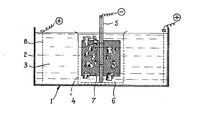
- the electrolysis cell 1 comprises a tank 2 of cylindrical shape. This tank contains an aqueous bath 3 consisting of an aqueous solution of potassium hydroxide at 5% by weight.
- a basket 4 of cylindrical plastic shape In the center of this tank is placed a basket 4 of cylindrical plastic shape, the side walls of which are pierced with holes.
- the assembly of the rod 5 and the grids 6 and 7 forms the cathode.
- a cylindrical grid 8 of stainless steel is arranged around the basket 4. This grid forms the anode.
- the basket can have a diameter of 40 cm and a height of 50 cm.
- a polarization is imposed between the anode and the cathode leading to a significant release of hydrogen by a current of 10A at approximately 3V of voltage.
- the polarization is maintained for 500 hours.
Landscapes
- Chemical & Material Sciences (AREA)
- Engineering & Computer Science (AREA)
- Chemical Kinetics & Catalysis (AREA)
- Electrochemistry (AREA)
- Materials Engineering (AREA)
- Metallurgy (AREA)
- Organic Chemistry (AREA)
- Electrolytic Production Of Metals (AREA)
- Electrolytic Production Of Non-Metals, Compounds, Apparatuses Therefor (AREA)
Abstract
- a) une cathode constituée d'une partie conductrice centrale (5) plongeant dans le panier et reliée à une grille métallique (6) disposée au fond du panier,
- b) une anode (8) extérieure au panier,
- c) un bain aqueux basique comme électrolyte, on maintient une polarisation cathodique conduisant à un dégagement d'hydrogène pendant un temps suffisant pour obtenir un détachement de la gangue, puis on retire le panier (4) de la cellule (1) et l'on sépare les éléments métalliques de la gangue.
Description
- La présente invention concerne un procédé électrochimique pour enlever la gangue entourant des éléments métalliques dans des matériaux en vrac, provenant notamment de fouilles archéologiques et, plus particulièrement, de fouilles d'archéologie marine.
- A de très rares exceptions près, les sites d'archéologie marine ne sont jamais complètement fouillés. Les plongeurs ne remontent que les pièces les plus caractéristiques, dégagées à la main ou par aspiration, tandis que restent au fond de grandes quantités d'objets pris dans des sédiments et de la gangue en conglomérat.
- En effet, la séparation des sédiments et des gangues par les moyens manuels classiques nécessite un temps considérable pour séparer des pièces intéressantes et, notamment, des pièces métalliques.
- La présente invention vise à fournir un procédé permettant le traitement de grandes quantités de matériaux en vrac pour en séparer les éléments métalliques, rendant ainsi possible le traitement des matériaux provenant de fouilles archéologiques marines.
- La présente invention a ainsi pour objet un procédé électrochimique pour enlever la gangue entourant des éléments métalliques dans des matériaux en vrac, caractérisé en ce que l'on introduit les matériaux en vrac dans un panier disposé dans une cellule d'électrolyse, cette cellule comprenant :
- . a) une cathode, constituée d'une partie conductrice centrale plongeant dans le panier et reliée à une grille métallique disposée au fond du panier,
- b) une anode extérieure au panier,
- c) un bain aqueux basique comme électrolyte, on maintient une polarisation cathodique conduisant à un dégagement d'hydrogène pendant un temps suffisant pour obtenir un détachement de la gangue, puis on retire le panier de la cellule et l'on sépare les éléments métalliques de la gangue.
- Dans le traitement cathodique selon la présente invention, on utilise à la fois la formation d'hydrogène naissant, la diffusion progressive de l'électrolyte jusqu'à l'interface métal-gangue, la protection du métal par le potentiel cathodique que l'on impose et le brassage de la masse en vrac sous l'action des bulles d'hydrogène qui se dégagent.
- On peut améliorer le traitement cathodique en disposant des éléments conducteurs cathodiques au sein du panier, par exemple des grilles verticales en plus de la partie métallique centrale. On peut également ajouter au cours du remplissage par les matériaux en vrac des chaînes métalliques ou des treillis métalliques souples qui sont ainsi noyés dans la masse en vrac.
- L'anode est avantageusement à symétrie cylindrique et disposée autour du panier.
- Les conducteurs formant la cathode et l'anode peuvent être constitués de n'importe quel matériau peu destructible ayant une conductivité suffisante. On peut utiliser par exemple du fer ou de l'acier.
- Le panier est de préférence en un matériau non conducteur de l'électricité pour permettre aux anions (chlorures, sulfures) de migrer de l'intérieur du panier vers l'anode extérieure. Il peut être constitué notamment en matière plastique.
- Le bain aqueux basique qui est contenu dans la cellule est avantageusement un bain contenant de 8 à 40 grammes d'ions OH /1._ On peut utiliser à cet effet des solutions d'hydroxydes ou de carbonates hydrosolubles, par exemple KOH, NaOH, Na2C03, LiOH.
- Le traitement peut généralement être effectué à une température voisine de la température ambiante (de 15 à 50°C).
- Le temps de traitement dépend de la nature de la gangue et de son importance en surface et en volume. Généralement, le temps de traitement peut varier de quelques dizaines d'heures à quelques centaines d'heures et est typiquement de 100 à 600 heures.
- Après ce traitement, on peut effectuer un rinçage dans la cellule d'électrolyse, puis retirer le panier et séparer aisément les éléments métalliques intéressants de la gangue qui les entoure.
- Les pièces archéologiques subissent au cours du traitement cathodique une déchloruration au moins partielle du métal. Un traitement de déchloruration complémentaire peut être effectué de manière classique si cela s'avère nécessaire.
- Il est à noter que le procédé selon la présente invention trouve en outre une application dans le traitement de minerais contenant des métaux natifs et, notamment, des métaux précieux tels que l'or ou l'argent.
- L'exemple suivant illustre la présente invention.
- On utilise une cellule d'électrolyse telle que représentée sur la figure unique.
- La cellule d'électrolyse 1 comprend une cuve 2 de forme cylindrique. Cette cuve contient un bain aqueux 3 constitué par une solution aqueuse d'hydroxyde de potassium à 5 % en poids.
- Au centre de cette cuve est disposé un panier 4 de forme cylindrique en matière plastique dont les parois latérales sont percées de trous.
- Au centre du panier 4 plonge une tige en fer 5 qui vient au contact d'une grille cylindrique 6 en fer disposée au fond du panier 4. Sur la tige 5 est en outre fixée une grille rectangulaire 7 en fer qui est disposée verticalement.
- L'ensemble de la tige 5 et des grilles 6 et 7 forme la cathode.
- Une grille cylindrique 8 en acier inoxydable est disposée autour du panier 4. Cette grille forme l'anode. A titre d'exemple, le panier peut avoir un diamètre de 40 cm et une hauteur de 50 cm.
- On verse dans ce panier 50 kg de matériaux en vrac provenant d'une fouille archéologique marine et comprenant des fragments ayant des dimensions allant de 1 à 40 cm.
- On impose entre l'anode et la cathode une polarisation conduisant à un dégagement important d'hydrogène par un courant de 10A sous 3V de tension environ.
- On maintient la polarisation pendant 500 heures.
- Puis, on effectue un rinçage dans la cuve d'électrolyse, on sort le panier et l'on dégage aisément les éléments de la gangue.
Claims (6)
Applications Claiming Priority (2)
| Application Number | Priority Date | Filing Date | Title |
|---|---|---|---|
| FR8400922A FR2558486B1 (fr) | 1984-01-20 | 1984-01-20 | Procede electrochimique pour enlever la gangue entourant des elements metalliques dans des materiaux en vrac |
| FR8400922 | 1984-01-20 |
Publications (3)
| Publication Number | Publication Date |
|---|---|
| EP0149938A2 true EP0149938A2 (fr) | 1985-07-31 |
| EP0149938A3 EP0149938A3 (en) | 1985-08-21 |
| EP0149938B1 EP0149938B1 (fr) | 1987-07-08 |
Family
ID=9300345
Family Applications (1)
| Application Number | Title | Priority Date | Filing Date |
|---|---|---|---|
| EP19840402618 Expired EP0149938B1 (fr) | 1984-01-20 | 1984-12-17 | Procédé électrochimique pour enlever la gangue entourant des éléments métalliques dans des matériaux en vrac |
Country Status (7)
| Country | Link |
|---|---|
| EP (1) | EP0149938B1 (fr) |
| EG (1) | EG16769A (fr) |
| ES (1) | ES8605304A1 (fr) |
| FR (1) | FR2558486B1 (fr) |
| GR (1) | GR850103B (fr) |
| TR (1) | TR22020A (fr) |
| YU (1) | YU7585A (fr) |
Cited By (3)
| Publication number | Priority date | Publication date | Assignee | Title |
|---|---|---|---|---|
| FR2626586A1 (fr) * | 1988-02-01 | 1989-08-04 | Electricite De France | Procede electrochimique pour le nettoyage de materiaux en feuille et dispositifs pour sa mise en oeuvre |
| EP0474365A1 (fr) * | 1990-08-31 | 1992-03-11 | United Kingdom Atomic Energy Authority | Nettoyage de filtres |
| WO2001040551A1 (fr) * | 1999-12-01 | 2001-06-07 | Qinetiq Limited | Procede d'elimination electrochimique in situ de structures metalliques |
Family Cites Families (2)
| Publication number | Priority date | Publication date | Assignee | Title |
|---|---|---|---|---|
| GB505273A (en) * | 1936-08-01 | 1939-05-01 | John Galbraith Quiros Worledge | Electro-chemical process for renovating table plate and other metal surfaces |
| US3497445A (en) * | 1967-07-28 | 1970-02-24 | Economics Lab | Apparatus for cleaning and detarnishing silverware |
-
1984
- 1984-01-20 FR FR8400922A patent/FR2558486B1/fr not_active Expired
- 1984-12-17 EP EP19840402618 patent/EP0149938B1/fr not_active Expired
- 1984-12-21 TR TR2202084A patent/TR22020A/xx unknown
-
1985
- 1985-01-15 GR GR850103A patent/GR850103B/el unknown
- 1985-01-16 ES ES539612A patent/ES8605304A1/es not_active Expired
- 1985-01-18 YU YU7585A patent/YU7585A/xx unknown
- 1985-01-19 EG EG2985A patent/EG16769A/xx active
Cited By (3)
| Publication number | Priority date | Publication date | Assignee | Title |
|---|---|---|---|---|
| FR2626586A1 (fr) * | 1988-02-01 | 1989-08-04 | Electricite De France | Procede electrochimique pour le nettoyage de materiaux en feuille et dispositifs pour sa mise en oeuvre |
| EP0474365A1 (fr) * | 1990-08-31 | 1992-03-11 | United Kingdom Atomic Energy Authority | Nettoyage de filtres |
| WO2001040551A1 (fr) * | 1999-12-01 | 2001-06-07 | Qinetiq Limited | Procede d'elimination electrochimique in situ de structures metalliques |
Also Published As
| Publication number | Publication date |
|---|---|
| TR22020A (tr) | 1986-01-13 |
| ES539612A0 (es) | 1986-04-01 |
| YU7585A (en) | 1988-04-30 |
| EP0149938B1 (fr) | 1987-07-08 |
| EG16769A (en) | 1993-04-30 |
| EP0149938A3 (en) | 1985-08-21 |
| FR2558486A1 (fr) | 1985-07-26 |
| ES8605304A1 (es) | 1986-04-01 |
| GR850103B (fr) | 1985-05-16 |
| FR2558486B1 (fr) | 1986-06-13 |
Similar Documents
| Publication | Publication Date | Title |
|---|---|---|
| US6319391B1 (en) | Removal of metal from graphite | |
| Mirza et al. | Corrosion of lead anodes in base metals electrowinning | |
| EP0149938B1 (fr) | Procédé électrochimique pour enlever la gangue entourant des éléments métalliques dans des matériaux en vrac | |
| Moats et al. | The role of electrolyte additives on passivation behaviour during copper electrorefining | |
| EP0620607B1 (fr) | Procédé de traitement de piles usagées par électrolyse | |
| Chen et al. | Mineralogical characterization of anode slimes—9. The reaction of Kidd creek anode slimes with various lixiviants | |
| EP3555345B1 (fr) | Procede electrolytique pour extraire de l'etain ou à la fois de l'etain et du plomb compris dans un melange électriquement conducteur | |
| RU2064344C1 (ru) | Магнитогравитационный сепаратор | |
| Van Meersbergen et al. | The electrochemical dissolution of gold in bromine medium | |
| Li et al. | Effect of additives on anode passivation in direct electrolysis process of copper—nickel based alloy scraps | |
| FR2513904A1 (fr) | Procede et installation pour recuperer des composants d'accumulateurs | |
| CA1250544A (fr) | Procede et dispositif pour la fabrication de lithium en continu | |
| EP0443929B1 (fr) | Procédé de destruction des piles électriques usagées et de récupération de différents constituants | |
| FR2502187A1 (fr) | Procede et dispositif pour l'electrotraitement de materiaux composites pulverulents | |
| EP0143051B1 (fr) | Procédé pour enlever la gangue de pièces métalliques | |
| Manilevich et al. | Improvement of the efficiency of electrochemical refining of cobalt | |
| SU1613591A1 (ru) | Система кучного выщелачивани полезных ископаемых | |
| EP4198153A1 (fr) | Procédé utile pour solubiliser sélectivement une couche à base de nickel d'un empilement multicouche | |
| FR2617508A1 (fr) | Structure anodique pour raffinage electrolytique | |
| WO2026087619A1 (fr) | Procédé de décrochage et/ou de récupération d'un métal | |
| US491686A (en) | Ore-amalgamator | |
| EP2188092B1 (fr) | Appareil et procede de nettoyage de pieces metalliques | |
| US640718A (en) | Process of extracting precious metals. | |
| US590524A (en) | Apparatus for extracting precious metals from black sand | |
| US1120175A (en) | Process for recovering precious metals. |
Legal Events
| Date | Code | Title | Description |
|---|---|---|---|
| PUAI | Public reference made under article 153(3) epc to a published international application that has entered the european phase |
Free format text: ORIGINAL CODE: 0009012 |
|
| PUAL | Search report despatched |
Free format text: ORIGINAL CODE: 0009013 |
|
| AK | Designated contracting states |
Designated state(s): BE GB IT NL |
|
| AK | Designated contracting states |
Designated state(s): BE GB IT NL |
|
| 17P | Request for examination filed |
Effective date: 19851207 |
|
| 17Q | First examination report despatched |
Effective date: 19860813 |
|
| GRAA | (expected) grant |
Free format text: ORIGINAL CODE: 0009210 |
|
| AK | Designated contracting states |
Kind code of ref document: B1 Designated state(s): BE GB IT NL |
|
| PG25 | Lapsed in a contracting state [announced via postgrant information from national office to epo] |
Ref country code: NL Effective date: 19870708 |
|
| ITF | It: translation for a ep patent filed | ||
| NLV1 | Nl: lapsed or annulled due to failure to fulfill the requirements of art. 29p and 29m of the patents act | ||
| PLBE | No opposition filed within time limit |
Free format text: ORIGINAL CODE: 0009261 |
|
| STAA | Information on the status of an ep patent application or granted ep patent |
Free format text: STATUS: NO OPPOSITION FILED WITHIN TIME LIMIT |
|
| 26N | No opposition filed | ||
| PGFP | Annual fee paid to national office [announced via postgrant information from national office to epo] |
Ref country code: GB Payment date: 19921211 Year of fee payment: 9 |
|
| ITTA | It: last paid annual fee | ||
| PGFP | Annual fee paid to national office [announced via postgrant information from national office to epo] |
Ref country code: BE Payment date: 19930115 Year of fee payment: 9 |
|
| PG25 | Lapsed in a contracting state [announced via postgrant information from national office to epo] |
Ref country code: GB Effective date: 19931217 |
|
| PG25 | Lapsed in a contracting state [announced via postgrant information from national office to epo] |
Ref country code: BE Effective date: 19931231 |
|
| BERE | Be: lapsed |
Owner name: ELECTRICITE DE FRANCE SERVICE NATIONAL Effective date: 19931231 |
|
| GBPC | Gb: european patent ceased through non-payment of renewal fee |
Effective date: 19931217 |