EP0150942B1 - Zellulares Polyurethan enthaltender wärmeisolierender Verbundwerkstoff - Google Patents
Zellulares Polyurethan enthaltender wärmeisolierender Verbundwerkstoff Download PDFInfo
- Publication number
- EP0150942B1 EP0150942B1 EP85300217A EP85300217A EP0150942B1 EP 0150942 B1 EP0150942 B1 EP 0150942B1 EP 85300217 A EP85300217 A EP 85300217A EP 85300217 A EP85300217 A EP 85300217A EP 0150942 B1 EP0150942 B1 EP 0150942B1
- Authority
- EP
- European Patent Office
- Prior art keywords
- sheet
- weight
- polymer
- adhesive
- styrene
- Prior art date
- Legal status (The legal status is an assumption and is not a legal conclusion. Google has not performed a legal analysis and makes no representation as to the accuracy of the status listed.)
- Expired
Links
- 0 *C(*(CCN(*)C1)CC1C1C=CCC*C1)=C Chemical compound *C(*(CCN(*)C1)CC1C1C=CCC*C1)=C 0.000 description 3
Images
Classifications
-
- B—PERFORMING OPERATIONS; TRANSPORTING
- B32—LAYERED PRODUCTS
- B32B—LAYERED PRODUCTS, i.e. PRODUCTS BUILT-UP OF STRATA OF FLAT OR NON-FLAT, e.g. CELLULAR OR HONEYCOMB, FORM
- B32B5/00—Layered products characterised by the non- homogeneity or physical structure, i.e. comprising a fibrous, filamentary, particulate or foam layer; Layered products characterised by having a layer differing constitutionally or physically in different parts
- B32B5/18—Layered products characterised by the non- homogeneity or physical structure, i.e. comprising a fibrous, filamentary, particulate or foam layer; Layered products characterised by having a layer differing constitutionally or physically in different parts characterised by features of a layer of foamed material
- B32B5/20—Layered products characterised by the non- homogeneity or physical structure, i.e. comprising a fibrous, filamentary, particulate or foam layer; Layered products characterised by having a layer differing constitutionally or physically in different parts characterised by features of a layer of foamed material foamed in situ
-
- B—PERFORMING OPERATIONS; TRANSPORTING
- B32—LAYERED PRODUCTS
- B32B—LAYERED PRODUCTS, i.e. PRODUCTS BUILT-UP OF STRATA OF FLAT OR NON-FLAT, e.g. CELLULAR OR HONEYCOMB, FORM
- B32B27/00—Layered products comprising a layer of synthetic resin
- B32B27/28—Layered products comprising a layer of synthetic resin comprising synthetic resins not wholly covered by any one of the sub-groups B32B27/30 - B32B27/42
-
- B—PERFORMING OPERATIONS; TRANSPORTING
- B32—LAYERED PRODUCTS
- B32B—LAYERED PRODUCTS, i.e. PRODUCTS BUILT-UP OF STRATA OF FLAT OR NON-FLAT, e.g. CELLULAR OR HONEYCOMB, FORM
- B32B27/00—Layered products comprising a layer of synthetic resin
- B32B27/06—Layered products comprising a layer of synthetic resin as the main or only constituent of a layer, which is next to another layer of the same or of a different material
- B32B27/065—Layered products comprising a layer of synthetic resin as the main or only constituent of a layer, which is next to another layer of the same or of a different material of foam
-
- B—PERFORMING OPERATIONS; TRANSPORTING
- B32—LAYERED PRODUCTS
- B32B—LAYERED PRODUCTS, i.e. PRODUCTS BUILT-UP OF STRATA OF FLAT OR NON-FLAT, e.g. CELLULAR OR HONEYCOMB, FORM
- B32B15/00—Layered products comprising a layer of metal
- B32B15/04—Layered products comprising a layer of metal comprising metal as the main or only constituent of a layer, which is next to another layer of the same or of a different material
- B32B15/046—Layered products comprising a layer of metal comprising metal as the main or only constituent of a layer, which is next to another layer of the same or of a different material of foam
-
- B—PERFORMING OPERATIONS; TRANSPORTING
- B32—LAYERED PRODUCTS
- B32B—LAYERED PRODUCTS, i.e. PRODUCTS BUILT-UP OF STRATA OF FLAT OR NON-FLAT, e.g. CELLULAR OR HONEYCOMB, FORM
- B32B5/00—Layered products characterised by the non- homogeneity or physical structure, i.e. comprising a fibrous, filamentary, particulate or foam layer; Layered products characterised by having a layer differing constitutionally or physically in different parts
- B32B5/18—Layered products characterised by the non- homogeneity or physical structure, i.e. comprising a fibrous, filamentary, particulate or foam layer; Layered products characterised by having a layer differing constitutionally or physically in different parts characterised by features of a layer of foamed material
-
- B—PERFORMING OPERATIONS; TRANSPORTING
- B32—LAYERED PRODUCTS
- B32B—LAYERED PRODUCTS, i.e. PRODUCTS BUILT-UP OF STRATA OF FLAT OR NON-FLAT, e.g. CELLULAR OR HONEYCOMB, FORM
- B32B7/00—Layered products characterised by the relation between layers; Layered products characterised by the relative orientation of features between layers, or by the relative values of a measurable parameter between layers, i.e. products comprising layers having different physical, chemical or physicochemical properties; Layered products characterised by the interconnection of layers
- B32B7/04—Interconnection of layers
- B32B7/12—Interconnection of layers using interposed adhesives or interposed materials with bonding properties
-
- C—CHEMISTRY; METALLURGY
- C09—DYES; PAINTS; POLISHES; NATURAL RESINS; ADHESIVES; COMPOSITIONS NOT OTHERWISE PROVIDED FOR; APPLICATIONS OF MATERIALS NOT OTHERWISE PROVIDED FOR
- C09J—ADHESIVES; NON-MECHANICAL ASPECTS OF ADHESIVE PROCESSES IN GENERAL; ADHESIVE PROCESSES NOT PROVIDED FOR ELSEWHERE; USE OF MATERIALS AS ADHESIVES
- C09J123/00—Adhesives based on homopolymers or copolymers of unsaturated aliphatic hydrocarbons having only one carbon-to-carbon double bond; Adhesives based on derivatives of such polymers
- C09J123/02—Adhesives based on homopolymers or copolymers of unsaturated aliphatic hydrocarbons having only one carbon-to-carbon double bond; Adhesives based on derivatives of such polymers not modified by chemical after-treatment
- C09J123/04—Homopolymers or copolymers of ethene
- C09J123/08—Copolymers of ethene
-
- F—MECHANICAL ENGINEERING; LIGHTING; HEATING; WEAPONS; BLASTING
- F23—COMBUSTION APPARATUS; COMBUSTION PROCESSES
- F23J—REMOVAL OR TREATMENT OF COMBUSTION PRODUCTS OR COMBUSTION RESIDUES; FLUES
- F23J15/00—Arrangements of devices for treating smoke or fumes
- F23J15/006—Layout of treatment plant
-
- B—PERFORMING OPERATIONS; TRANSPORTING
- B32—LAYERED PRODUCTS
- B32B—LAYERED PRODUCTS, i.e. PRODUCTS BUILT-UP OF STRATA OF FLAT OR NON-FLAT, e.g. CELLULAR OR HONEYCOMB, FORM
- B32B2266/00—Composition of foam
- B32B2266/02—Organic
- B32B2266/0214—Materials belonging to B32B27/00
- B32B2266/0278—Polyurethane
-
- B—PERFORMING OPERATIONS; TRANSPORTING
- B32—LAYERED PRODUCTS
- B32B—LAYERED PRODUCTS, i.e. PRODUCTS BUILT-UP OF STRATA OF FLAT OR NON-FLAT, e.g. CELLULAR OR HONEYCOMB, FORM
- B32B2307/00—Properties of the layers or laminate
- B32B2307/30—Properties of the layers or laminate having particular thermal properties
- B32B2307/304—Insulating
-
- B—PERFORMING OPERATIONS; TRANSPORTING
- B32—LAYERED PRODUCTS
- B32B—LAYERED PRODUCTS, i.e. PRODUCTS BUILT-UP OF STRATA OF FLAT OR NON-FLAT, e.g. CELLULAR OR HONEYCOMB, FORM
- B32B2509/00—Household appliances
- B32B2509/10—Refrigerators or refrigerating equipment
-
- Y—GENERAL TAGGING OF NEW TECHNOLOGICAL DEVELOPMENTS; GENERAL TAGGING OF CROSS-SECTIONAL TECHNOLOGIES SPANNING OVER SEVERAL SECTIONS OF THE IPC; TECHNICAL SUBJECTS COVERED BY FORMER USPC CROSS-REFERENCE ART COLLECTIONS [XRACs] AND DIGESTS
- Y10—TECHNICAL SUBJECTS COVERED BY FORMER USPC
- Y10T—TECHNICAL SUBJECTS COVERED BY FORMER US CLASSIFICATION
- Y10T428/00—Stock material or miscellaneous articles
- Y10T428/249921—Web or sheet containing structurally defined element or component
- Y10T428/249953—Composite having voids in a component [e.g., porous, cellular, etc.]
- Y10T428/249982—With component specified as adhesive or bonding agent
- Y10T428/249985—Composition of adhesive or bonding component specified
-
- Y—GENERAL TAGGING OF NEW TECHNOLOGICAL DEVELOPMENTS; GENERAL TAGGING OF CROSS-SECTIONAL TECHNOLOGIES SPANNING OVER SEVERAL SECTIONS OF THE IPC; TECHNICAL SUBJECTS COVERED BY FORMER USPC CROSS-REFERENCE ART COLLECTIONS [XRACs] AND DIGESTS
- Y10—TECHNICAL SUBJECTS COVERED BY FORMER USPC
- Y10T—TECHNICAL SUBJECTS COVERED BY FORMER US CLASSIFICATION
- Y10T428/00—Stock material or miscellaneous articles
- Y10T428/249921—Web or sheet containing structurally defined element or component
- Y10T428/249953—Composite having voids in a component [e.g., porous, cellular, etc.]
- Y10T428/249987—With nonvoid component of specified composition
- Y10T428/249991—Synthetic resin or natural rubbers
- Y10T428/249992—Linear or thermoplastic
-
- Y—GENERAL TAGGING OF NEW TECHNOLOGICAL DEVELOPMENTS; GENERAL TAGGING OF CROSS-SECTIONAL TECHNOLOGIES SPANNING OVER SEVERAL SECTIONS OF THE IPC; TECHNICAL SUBJECTS COVERED BY FORMER USPC CROSS-REFERENCE ART COLLECTIONS [XRACs] AND DIGESTS
- Y10—TECHNICAL SUBJECTS COVERED BY FORMER USPC
- Y10T—TECHNICAL SUBJECTS COVERED BY FORMER US CLASSIFICATION
- Y10T428/00—Stock material or miscellaneous articles
- Y10T428/31504—Composite [nonstructural laminate]
- Y10T428/31855—Of addition polymer from unsaturated monomers
- Y10T428/31909—Next to second addition polymer from unsaturated monomers
-
- Y—GENERAL TAGGING OF NEW TECHNOLOGICAL DEVELOPMENTS; GENERAL TAGGING OF CROSS-SECTIONAL TECHNOLOGIES SPANNING OVER SEVERAL SECTIONS OF THE IPC; TECHNICAL SUBJECTS COVERED BY FORMER USPC CROSS-REFERENCE ART COLLECTIONS [XRACs] AND DIGESTS
- Y10—TECHNICAL SUBJECTS COVERED BY FORMER USPC
- Y10T—TECHNICAL SUBJECTS COVERED BY FORMER US CLASSIFICATION
- Y10T428/00—Stock material or miscellaneous articles
- Y10T428/31504—Composite [nonstructural laminate]
- Y10T428/31855—Of addition polymer from unsaturated monomers
- Y10T428/31909—Next to second addition polymer from unsaturated monomers
- Y10T428/31913—Monoolefin polymer
-
- Y—GENERAL TAGGING OF NEW TECHNOLOGICAL DEVELOPMENTS; GENERAL TAGGING OF CROSS-SECTIONAL TECHNOLOGIES SPANNING OVER SEVERAL SECTIONS OF THE IPC; TECHNICAL SUBJECTS COVERED BY FORMER USPC CROSS-REFERENCE ART COLLECTIONS [XRACs] AND DIGESTS
- Y10—TECHNICAL SUBJECTS COVERED BY FORMER USPC
- Y10T—TECHNICAL SUBJECTS COVERED BY FORMER US CLASSIFICATION
- Y10T428/00—Stock material or miscellaneous articles
- Y10T428/31504—Composite [nonstructural laminate]
- Y10T428/31855—Of addition polymer from unsaturated monomers
- Y10T428/31909—Next to second addition polymer from unsaturated monomers
- Y10T428/31924—Including polyene monomers
-
- Y—GENERAL TAGGING OF NEW TECHNOLOGICAL DEVELOPMENTS; GENERAL TAGGING OF CROSS-SECTIONAL TECHNOLOGIES SPANNING OVER SEVERAL SECTIONS OF THE IPC; TECHNICAL SUBJECTS COVERED BY FORMER USPC CROSS-REFERENCE ART COLLECTIONS [XRACs] AND DIGESTS
- Y10—TECHNICAL SUBJECTS COVERED BY FORMER USPC
- Y10T—TECHNICAL SUBJECTS COVERED BY FORMER US CLASSIFICATION
- Y10T428/00—Stock material or miscellaneous articles
- Y10T428/31504—Composite [nonstructural laminate]
- Y10T428/31855—Of addition polymer from unsaturated monomers
- Y10T428/31909—Next to second addition polymer from unsaturated monomers
- Y10T428/31928—Ester, halide or nitrile of addition polymer
Definitions
- the present invention relates to a composite heat-insulating material which is used, for example, as a lining material for the main body or door of a refrigerator.
- the composite heat-insulating material of the present invention is a heat-insulating material having the structure wherein a cellular foamed urethane and a polyolefin or styrene-based polymer sheet are strongly adhered together.
- the main body or door of a refrigerator is provided with a lining material produced from a sheet of a styrene-based polymer such as an acrylonitrile/butadiene/styrene copolymer (ABS) by vacuum forming or pressure forming or a combination thereof (those forming methods are hereinafter referred to as "differential pressure forming").
- This lining material serves to prevent corrosion of a frame of stainless steel or of stove-enamelled steel and is shaped to include projections necessary for supporting shelves.
- Another possible method comprises coating an organic solvent-type adhesive on a polyolefin resin sheet, drying the adhesive and bonding the sheet to a urethane foam as heat-insulating material.
- an organic solvent-type adhesive on a polyolefin resin sheet, drying the adhesive and bonding the sheet to a urethane foam as heat-insulating material.
- use of the organic solvent is not preferred for environmental reasons, including the danger of fire and harm to the worker's health.
- US-3 467 569 discloses a composite material of (a) a sheet of a thermoplastic polymer, e.g. a copolymer of ethylene and an acidic comonomer, and (b) a synthetic cellular foamed material, e.g. a polymer of styrene, adhered together by an intermediate bonding layer of a thermoplastic material melting at a temperature below that of the foamed material, e.g. a copolymer of ethylene and an acidic comonomer having a carboxyl group such as acrylic acid.
- a thermoplastic polymer e.g. a copolymer of ethylene and an acidic comonomer having a carboxyl group such as acrylic acid.
- the sheet (a) is then adhered by a further adhesive polymer layer to a metal sheet and the composite laminate is useful for constructional purposes.
- the present invention provides a composite heat-insulating material comprising (a) a sheet of a polymer comprising at least 50 mol% of units of an olefin or styrene and (b) a layer of cellular foamed urethane, laminated together with an adhesive, said adhesive comprising:
- the polymer for the sheet material used in the present invention can comprise units of a polyolefin such as a high density polyethylene, a low density polyethylene, a polypropylene, a hydroxyethyl acrylate- grafted polypropylene, an ethyiene/propyiene copolymer, an ethylene/propylene/butene copolymer or a maleic anhydride-grafted polypropylene or a styrene such as a polystyrene, a styrene/butadiene/styrene block copolymer (SBS), an acrylonitrile/butadiene/styrene copolymer (ABS) or a high impact polystyrene (HIPS).
- a polyolefin such as a high density polyethylene, a low density polyethylene, a polypropylene, a hydroxyethyl acrylate- grafted polypropylene, an e
- Stabilizers, inorganic fillers, pigments, rubbers or other known additives may be added to the polymer.
- the resulting polymer composition is formed into a sheet by an extruder.
- the sheet may comprise two coextruded layers, (i) a surface layer having a good smooth (lustrous) quality and (ii) a base layer having good deep drawing properties (see some of the Sheet Production Examples). If necessary and required, a corona discharge treatment is applied onto at least one surface of the sheet, thereby providing a 0.3 to 4 mm thick sheet which can be formed to shape by applying differential pressure.
- the adhesive composition comprises a mixture of 20% to 80% by weight (solids base) of Component (A), 20 to 80% by weight of Component (B) and optionally up to 2% by weight of Component (C).
- This adhesive is used as an aqueous solution or aqueous dispersion, coated, e.g. by a roll, brush or spray, and then dried to remove the water.
- the adhesive is preferred for the adhesive to be composed of a mixture of 20 to 80% by weight of Component (A), 80 to 20% by weight of Component (B) and 0.01 to 2% by weight of Component (C).
- a carboxyl group-containing polyolefinic polymer used as the starting material for Component (A) can be prepared by copolymerizing unsaturated monocarboxylic acids such as acrylic acid and methacrylic acid or unsaturated polyhydric carboxylic anhydrides such as maleic anhydride, with olefins such as ethylene, or graft copolymerizing the above-described carboxylic acids onto polyolefins, or random copolymerizing unsaturated carboxylic acid esters such as alkyl (meth)acrylate with ethylene or graft copolymerizing the esters onto polyolefins followed by saponification.
- unsaturated monocarboxylic acids such as acrylic acid and methacrylic acid or unsaturated polyhydric carboxylic anhydrides such as maleic anhydride
- olefins such as ethylene
- graft copolymerizing the above-described carboxylic acids onto polyolefins or random copolymerizing uns
- carboxyl-group-containing polyolefin-based polymer examples include an ethylene/ acrylic acid random copolymer, an ethylene/methacrylic acid random copolymer, a maleic anhydride-grafted ethylene/vinyl acetate copolymer and an acrylic acid-grafted polyethylene.
- the carboxyl group-containing polyolefin can be solubilized or dispersed in water by a conventional method.
- an aqueous solution of alkali such as ammonia, alkanolamine or caustic soda is added to the carboxyl group-containing polyolefin to water-solubilize or self-emulsify the polyolefin, or the polyolefin is dispersed in water by using other emulsifying agents or protective colloids.
- alkali such as ammonia, alkanolamine or caustic soda
- Examples of the neutralized product are the commercially available products such as ZAIKTHENE A ZAIKTHENE A-TH or ZAIKTHENE AC (ammonia neutralized product, pH: 7-10), ZAIKTHENE L (alkanolamine neutralized product, pH: 8-10), ZAIKTHENE N (caustic soda neutralized product, pH: 8-11), produced by Shin-Nippon Seitetsu Kagaku Co., CHEMIPEARL S-100 produced by Mitsui Petroleum Chemical Industry Co., and COPOLENE L-4000 produced by Asahi Kogyo K.K.
- Component (A) are ammonia salt, alkanolamine salt or alkali metal salt of an ethylene/acrylic acid copolymer.
- the nitrogen-atom containing water-soluble polymer having the antistatic function is not particularly limited and may be a cationic, anionic, nonionic or amphoteric polymer.
- the water-soluble polymer is selected taking into consideration its ionic property so as to uniformly mix with Component (A).
- water-soluble polymer examples include a polyethyleneimine, a poly(ethyleneimine-urea), an ethyleneimine adduct of polyamine-polyamide and nitrogen-containing cationic or amphoteric polymers.
- the last-described nitrogen-containing water-soluble polymer can be obtained by homopolymerizing nitrogen-containing monomers or copolymerizing the monomers with other monomers copolymerizable therewith.
- the nitrogen-containing water-soluble polymer having the antistatic function can be prepared by homopolymerizing the above-described quaternary nitrogen-containing monomers (2), (4), (4)', (6), (6)', (8), (8)' and (9), or by copolymerizing these quaternary nitrogen-containing monomers with other vinyl monomers.
- tertiary nitrogen-containing monomers (1), (3), (5) and (7) are homopolymerized or copolymerized with other monomers and then quaternized with a cationizing agent such as alkyl halide, dimethylsulfuric acid and benzyl halide monochloroacetic acid ester, or amphoterized with an amphoterizing agent such as monochloroacetic acid or its salt, propanesultone and propiolactone.
- a cationizing agent such as alkyl halide, dimethylsulfuric acid and benzyl halide monochloroacetic acid ester
- an amphoterizing agent such as monochloroacetic acid or its salt, propanesultone and propiolactone.
- the polymer having the antistatic effect must be water-soluble. It is not desirable, however, that the polymer be excessively soluble in water.
- the tertiary or quaternary nitrogen-containing polymer is desirably a copolymer with a hydrophobic monomer. Examples of these hydrophobic monomers include styrene or its derivatives resulting from substitution in the nucleus or side chain thereof, acrylic or methacrylate acid esters, and vinyl halides.
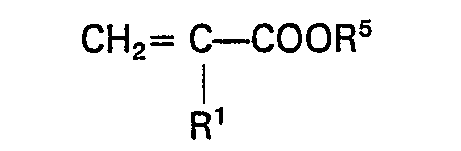
- acryl-based polymers prepared by copolymerizing the following components (a) to (c): (a) monomers (1) to (9) 20 to 40% by weight 60 to 80% by weight (wherein R 1 is H or a methyl group and R 5 is an alkyl group having from 1 to 18 carbon atoms) (c) hydrophobic vinyl monomer 0 to 20% by weight
- hydrophobic vinyl monomer examples include styrene, acrylonitrile, vinyl chloride, a-methyl styrene.
- the most suitable acryl-based polymer is a polymer comprising a monomer (a) wherein X° is Cl ⁇ in the above formula (6).
- water-soluble acryl-based polymers are commercially available under trade names ST-1000, ST-1100, ST-1300 and ST-3000 by M itsubishi Yuka Fine Co., Ltd.
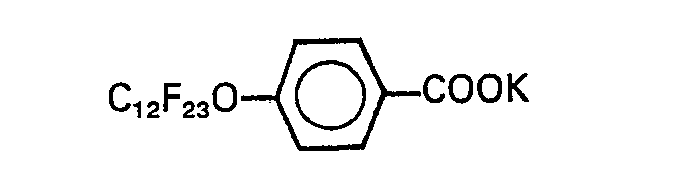
- the fluorine-based surface active agent as Component (C) may be cationic, anionic, nonionic or amphoteric. Examples of the agent are as follows.
- anionic or amphoteric agents are preferred as compared to cationic agents, and nonionic surface active agents are most preferred.
- the commercially available fluorine-based surface active agents are cationic agents FLUORAD 134 and FLUORAD 135; nonionic agents FLUORAD 170C, FLUORAD 430 and FLUORAD 431; and anionic agents FLUORAD 95, FLUORAD 98 and FLUORAD 129 (all marketed by Sumitomo 3M) and a cationic agent SURFLON 121 (perfluoroalkyltrimethyl ammonium salt); an amphoteric agent SURFLON 131 (perfluoroalkyl betaine); nonionic agents SURFLON 141 and SURFLON 145 (perfluoroalkylpolyether polyol); and anionic agents SURFLON 111 (perfluoroalkylcarboxylic acid) and SURFLON 112 (perfluoro- alkylphosphoric acid ester) (all marketed by Asahi Glass Co.).
- These agents are used by dissolving them in water, a mixed solution of water and an alcohol such as ethanol or isopropanol, or a mixed solution of water, butyl cellosolve and alcohol (ethanol).
- fluorine-based surface active agent (C) improves the adhesion between urethane foam and sheet.
- Component (C) if present, may be used in an amount of 0.01 to 2% by weight, preferably 0.1 to 0.5% by weight.
- the adhesive is used in the form of an aqueous solution or aqueous dispersion having the concentration of 0.1 to 10% by weight of solids in water, preferably 0.5 to 3% by weight, and may be applied in a coated weight of 0.01 to 10 grams of solids per square metre.
- the surface of the sheet opposite to the surface thereof on which the adhesive is applied is preferably coated with an antistatic agent.
- the antistatic agent may be the same as in the adhesive or may be another antistatic agent such as the water-soluble antistatic polymer of Component (B). Further, the antistatic agent may be a blend comprising the above-water soluble antistatic polymer and antistatic agents of anionic, cationic, amphoteric or nonionic surface active agents (e.g.
- sodium laurylaminopropionate sodium laurylaminopropionate, stearyl- trimethylammonium chloride, a 1-hydroxyethyl-2-undecyl-2-imidazoline/ethylene oxide adduct, a nonylphenyl/ethylene oxide adduct, sodium laurylsulfate and a fluorine-based surface active agent).
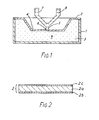
- a sheet (2a) of an olefinic or styrenic polymer is coated, as shown in Fig. 2, with at least an adhesive (2b), and if necessary also with an antistatic layer (2c) on its opposite surface which will be the visible face in the refrigerator lining.
- This sheet 2 is then shaped, preferably by differential pressure forming, to serve as a refrigerator lining, e.g. to have a recess 4 as shown in Fig. 1.
- the sheet is placed in a sheet metal (enamelled if not of stainless metal) refrigerator body or door 1, and an injection hole 6 is bored therein to receive the inlet 5 of injection apparatus 7, for the components 8 of an expandable urethane.
- the apparatus shown is for a "two-pack" urethane composition.
- the composition is injected into the cavity 3 between the metal frame 1 (serving here as a mould) and the polymer sheet 2, and is foamed to fill the cavity (as shown by stippling in Fig. 1) and to adhere to the underside of sheet 2.
- a crystalline propylene homopolymer (MFR: 2.0 g/10 min; boiling heptane extraction residue: 99% by weight) was used.
- a composition of 40% by weight of a crystalline propylene/ethylene block copolymer (ethylene content: 5% by weight; MFR: 0.5 g/10 min; boiling heptane extraction residue: 98% by weight), 40% by weight of polyethylene (density: 0.950 g/cm 3 ; MFR: 0.6 g/10 min) and 20% by weight of talc having a particle diameter of 1.5 pm was knead in an extruder and extruded in the form of a strand. The strand was cut to form pellets.
- the above pellets of the resin (ii) were fed to a two-layer multimanifold die (width: 700 mm) at 200 to 270°C by means of an extruder (diameter of a screw: 90 mm), and the resin (i) was fed to the same die as above at 230 to 270°C by means of an extruder (diameter of a screw: 40 mm).
- the temperature of the die was set at 230°C.
- a molten two-ply sheet extruded from the die was cooled and solidified successively on three rolls having a width of 700 mm and then subjected to a corona discharge treatment to produce a sheet for vacuum forming.
- the temperatures of the three rolls were as follows: 80°C for the nearest roll relative to the die; 95°C for the intermediate roll; and 100°C for the farthest roll.
- the rotation speed of the rolls was 1.5 m/min.
- the total thickness of the sheet was 1.6 mm; the thickness of the lustrous layer was 0.25 mm; and the thickness of the deep drawing layer was 1.35 mm.
- Polypropylene (trade name: Mitsubishi Norblen MA-8, produced by Mitsubishi Petrochemical Co., Ltd.) was extruded as a sheet at 230°C and then subjected to a corona discharge treatment to produce a 1.6 mm thick sheet.
- ABS resin (trade name: Toughlex 157, produced by Mitsubishi Montsant Kasei Co., Ltd.) was extruded as a sheet at 220°C to produce a 1.6 mm thick sheet.
- a 1.6 mm thick sheet was produced in the same manner as in Sheet production Example 2 except that polypropylene was replaced by a resin composition consisting of the above ingredients.
- a crystalline propylene homopolymer (MFR: 2.0 g/10 min; boiling heptane extraction residue: 99% by weight) was used.
- the above mixture (ii) was fed to a three-layer multimanifold die (width: 700 mm) at 230°C by means of an extruder (diameter of a screw: 90 mm), and the resin (i) was fed to the same die as above at 230°C by means of an extruder (diameter of a screw: 40 mm).
- the temperature of the die was set at 230°C.
- a molten three-ply sheet extruded from the die was cooled and solidified successively on three rolls having a width of 700 mm and then subjected to a corona discharge treatment to produce a sheet for vacuum forming.
- the temperatures of the three rolls were as follows: 80°C for the nearest roll relative to the die; 95°C for the intermediate roll; and 100°C for the farthest roll.
- the rotation speed of the rolls was 1.5 m/min.
- the total thickness of the sheet was 1.6 mm; the thickness of each surface layer was 0.2 mm; and the thickness of the deep drawing layer was 1.2 mm.
- a crystalline propylene hompolymer (MFR: 2.0 g/10 min; boiling heptane extraction residue: 99% by weight) was used.
- the above mixture (ii) was fed to a two-layer multimanifold die (width: 700 mm) at 230°C by means of an extruder (diameter of a screw: 90 mm), and the resin (i) was fed to the same die as above at 230°C by means of an extruder (diameter of a screw: 40 mm).
- the temperature of the die was set at 230°C.
- a molten two-ply sheet extruded from the die was cooled and solidified successively on three rolls having a width of 700 mm and then subjected to a corona discharge treatment to produce a sheet for vacuum forming.
- the temperature of the three rolls were as follows: 80°C for the nearest roll relative to the die; 95°C for the intermediate roll; and 100°C for the farthest roll.
- the rotation speed of the rolls was 1.5 m/min.
- the total thickness of the sheet was 1.6 mm; the thickness of each lustrous layer was 0.2 mm; and the thickness of the deep drawing layer was 1.2 mm.
- a reaction vessel having an internal volume of 200 I was charged with 5 kg of polypropylene (MFR: 0.8 g/10 min; density: 0.91 g/cm 3 ) and 90 I of xylene.
- the system was purged with nitrogen and the temperature was raised to 120°C while stirring to dissolve the polypropylene in xylene.
- a four-necked flask equipped with a stirrer, a reflux condenser, a thermometer and a dropping funnel was charged with 80 parts (0.5 mol) of N,N-dimethylaminoethyl methacrylate, 50 parts (0.5 mol) of methyl methacrylate and 200 parts of isopropyl alcohol. After displacement with nitrogen gas, 0.9 part of 2,2'-azobisisobutyronitrile was added as a polymerization initiator, and polymerization was conducted at 80°C for 4 hours.
- the thus-prepared acryl-based polymer (hereinafter referred to as "ST") had the following molecular chain:
- the vacuum pressure -600 mm Hg corresponds to 8 x 10 5 Pa
- the viscosity of 15,000 cps corresponds to 1.5 x 10 -1 Pa ⁇ s.
- ZAIKTHENE AC carboxyl group-containing polyolefin-based aqueous emulsion
- the surface resistivity of the sheet was 2.0 x 10 9 ⁇ .cm.
- the sheet was introduced in an oven maintained at about 220°C and was subjected to plug assist molding using an air pressure of 5.0 kg/cm 2 and a vacuum of -600 mm Hg by means of a vacuum/pressure molding machine.
- Laminates of urethane foam/resin sheet for heat-insulating materials were produced in the same manner as in Example 1 except that the coating material was changed as shown in Table 1.
- the rating scale was as follows:
- Laminates of urethane foam/sheet for heat-insulating materials were produced in the same manner as in Example 1 except that the sheets obtained in Sheet Production Examples 2 to 5 were used in place of the sheet obtained in Sheet Production Example 1.
- a cationic fluorine-based surface active agent "FLUORAD FC-430” (trade name, produced by Sumitomo 3M, viscosity (25°C): 15,000 cps, specific gravity
- a test piece was cut out of the sheet with the urethane foam bonded thereto and was measured for the adhesion between the sheet and the urethane foam.
- a sheet was produced in the same manner as above except that urethane bonding was not applied. Also, a test piece was cut out of the sheet and measured for the attachment of ash.
- Laminates of urethane foam/sheet for heat-insulating materials were produced in the same manner as in Example 14 except that the coating material was changed as shown in Table 3.
- Laminates of urethane foam/sheet for heat-insulating materials were produced in the same manner as in Example 14 except that the sheets obtained in Sheet Production Examples 2 to 5 were used in place of the sheet obtained in Sheet Production Example 1 and the coating material at the sheet surface side was changed to "ST-1100".
- FLUORAD FC-430 trade name, produced by Sumitomo 3M, viscosity (25°C): 15,000 cps, specific gravity: 1.1
- the flat portion and corner portion of the sheet to which the urethane foam was bonded were cut and the adhesion between the sheet and the urethane foam was measured by the cross cut test. As a result, the adhesion was 100% at the flat portion and 100% at the corner portion.
- FLUORAD FC-430 trade name, produced by Sumitomo 3M, viscosity (25°C): 15,000 cps, specific gravity: 1.1
- a sheet was produced in the same manner as above except that urethane bonding was not applied.
- a test piece was cut out of the sheet and measured for the attachment of ash.
- Laminates of urethane foam/sheet for heat-insulating materials were produced in the same manner as in Example 25 except that the coating materials were changed as shown in Table 5.
Landscapes
- Engineering & Computer Science (AREA)
- Mechanical Engineering (AREA)
- General Engineering & Computer Science (AREA)
- Chemical & Material Sciences (AREA)
- Organic Chemistry (AREA)
- Laminated Bodies (AREA)
- Manufacture Of Porous Articles, And Recovery And Treatment Of Waste Products (AREA)
Claims (11)





Applications Claiming Priority (4)
| Application Number | Priority Date | Filing Date | Title |
|---|---|---|---|
| JP3800/84 | 1984-01-12 | ||
| JP59003800A JPS60147330A (ja) | 1984-01-12 | 1984-01-12 | 複合断熱材 |
| JP59128216A JPS615935A (ja) | 1984-06-21 | 1984-06-21 | 複合断熱材 |
| JP128126/84 | 1984-06-21 |
Publications (3)
| Publication Number | Publication Date |
|---|---|
| EP0150942A2 EP0150942A2 (de) | 1985-08-07 |
| EP0150942A3 EP0150942A3 (en) | 1985-08-21 |
| EP0150942B1 true EP0150942B1 (de) | 1987-12-16 |
Family
ID=26337441
Family Applications (1)
| Application Number | Title | Priority Date | Filing Date |
|---|---|---|---|
| EP85300217A Expired EP0150942B1 (de) | 1984-01-12 | 1985-01-11 | Zellulares Polyurethan enthaltender wärmeisolierender Verbundwerkstoff |
Country Status (4)
| Country | Link |
|---|---|
| US (1) | US4567097A (de) |
| EP (1) | EP0150942B1 (de) |
| KR (1) | KR920000007B1 (de) |
| DE (1) | DE3561205D1 (de) |
Families Citing this family (7)
| Publication number | Priority date | Publication date | Assignee | Title |
|---|---|---|---|---|
| JPH0647260B2 (ja) * | 1985-07-30 | 1994-06-22 | 三菱油化株式会社 | 複合成形体 |
| JPH0655466B2 (ja) * | 1989-12-20 | 1994-07-27 | 住友化学工業株式会社 | 積層体およびその製造方法 |
| AU6491494A (en) * | 1993-04-07 | 1994-10-24 | Rexham Industries Corp. | Method of coating microporous membranes and resulting products |
| US5514299A (en) * | 1994-07-11 | 1996-05-07 | Bridgestone/Firestone, Inc. | Static dissipative container liner and method of making same |
| JPH1167403A (ja) * | 1997-08-08 | 1999-03-09 | Harness Sogo Gijutsu Kenkyusho:Kk | 吸音材および該吸音材を備えたケーブルリール |
| US7728163B2 (en) | 2007-08-06 | 2010-06-01 | E.I. Du Pont De Nemours And Company | Mixed fluoroalkyl-alkyl surfactants |
| TR201709825A2 (tr) * | 2017-07-04 | 2019-01-21 | Arcelik As | Plasti̇k i̇ç duvar i̇çeren buzdolabi |
Family Cites Families (8)
| Publication number | Priority date | Publication date | Assignee | Title |
|---|---|---|---|---|
| US3467569A (en) * | 1966-06-03 | 1969-09-16 | Dow Chemical Co | Resin foam-metal laminate composites |
| US3674896A (en) * | 1966-07-28 | 1972-07-04 | Union Carbide Corp | Bonding with ammonium polymer salts |
| CH441730A (de) * | 1966-08-09 | 1967-08-15 | Chemie Ind Investment Ag | Kunststoff-Verbundmaterial, Verfahren zu seiner Herstellung sowie Verwendung des Kunststoff-Verbundmaterials |
| US3640838A (en) * | 1970-06-24 | 1972-02-08 | Union Carbide Corp | Ionically interacting polymers |
| GB1437001A (en) * | 1972-08-21 | 1976-05-26 | Sidaplax | Laminates |
| US3911190A (en) * | 1974-12-23 | 1975-10-07 | Monsanto Co | Composite construction |
| US4416937A (en) * | 1980-12-12 | 1983-11-22 | The Dow Chemical Co. | Polymer blends and laminates and adhesive films prepared therefrom |
| US4500597A (en) * | 1983-07-26 | 1985-02-19 | Mitsubishi Petrochemical Co., Ltd. | Composite heat-insulating material and process for the production thereof |
-
1985
- 1985-01-10 US US06/690,253 patent/US4567097A/en not_active Expired - Lifetime
- 1985-01-11 EP EP85300217A patent/EP0150942B1/de not_active Expired
- 1985-01-11 DE DE8585300217T patent/DE3561205D1/de not_active Expired
- 1985-01-11 KR KR1019850000145A patent/KR920000007B1/ko not_active Expired
Also Published As
| Publication number | Publication date |
|---|---|
| US4567097A (en) | 1986-01-28 |
| DE3561205D1 (en) | 1988-01-28 |
| EP0150942A3 (en) | 1985-08-21 |
| KR850005329A (ko) | 1985-08-24 |
| EP0150942A2 (de) | 1985-08-07 |
| KR920000007B1 (ko) | 1992-01-06 |
Similar Documents
| Publication | Publication Date | Title |
|---|---|---|
| EP0183475B1 (de) | Wärmeisolierendes zusammengestelltes Material | |
| EP0214747B1 (de) | Polyurethanschaumstoffenthaltendes zusammengestelltes wärmeisolierendes Material | |
| US4500597A (en) | Composite heat-insulating material and process for the production thereof | |
| CN102971374A (zh) | 组合物、层叠结构及层叠结构的制造方法 | |
| EP0193126A1 (de) | Grundschichtzusammensetzung für Olefinharz | |
| EP0150942A2 (de) | Zellulares Polyurethan enthaltender wärmeisolierender Verbundwerkstoff | |
| JP2012144692A (ja) | 組成物 | |
| US9873788B2 (en) | Composition and surface protection film | |
| JPH0438581B2 (de) | ||
| JPH0414061B2 (de) | ||
| JPS63289046A (ja) | 熱可塑性樹脂組成物 | |
| JPS615936A (ja) | 複合断熱材 | |
| US20030149174A1 (en) | Precoated skin material for automobile interior part | |
| JP2009114317A (ja) | 水性塗工材 | |
| JPS61121935A (ja) | 複合断熱材 | |
| JPH0321335B2 (de) | ||
| JPH0414623B2 (de) | ||
| JPH0425133B2 (de) | ||
| JPH038248B2 (de) | ||
| JPH0432735B2 (de) | ||
| JPH0355507B2 (de) | ||
| JPH07233293A (ja) | エチレン‐酢酸ビニル系共重合体ケン化物溶液及びその用途 | |
| JP3457050B2 (ja) | エチレン‐酢酸ビニル系共重合体ケン化物溶液及びその用途 | |
| JPS60168639A (ja) | 発泡ポリウレタン積層体 | |
| EP2917270A2 (de) | Partikelschaumstoffe mit korrosionshemmendem hilfsstoff |
Legal Events
| Date | Code | Title | Description |
|---|---|---|---|
| PUAI | Public reference made under article 153(3) epc to a published international application that has entered the european phase |
Free format text: ORIGINAL CODE: 0009012 |
|
| PUAL | Search report despatched |
Free format text: ORIGINAL CODE: 0009013 |
|
| AK | Designated contracting states |
Kind code of ref document: A2 Designated state(s): DE FR GB IT SE |
|
| AK | Designated contracting states |
Kind code of ref document: A3 Designated state(s): DE FR GB IT SE |
|
| 17P | Request for examination filed |
Effective date: 19860128 |
|
| 17Q | First examination report despatched |
Effective date: 19860710 |
|
| GRAA | (expected) grant |
Free format text: ORIGINAL CODE: 0009210 |
|
| RAP1 | Party data changed (applicant data changed or rights of an application transferred) |
Owner name: MITSUBISHI PETROCHEMICAL CO., LTD. |
|
| AK | Designated contracting states |
Kind code of ref document: B1 Designated state(s): DE FR GB IT SE |
|
| ET | Fr: translation filed | ||
| REF | Corresponds to: |
Ref document number: 3561205 Country of ref document: DE Date of ref document: 19880128 |
|
| ITF | It: translation for a ep patent filed | ||
| PLBE | No opposition filed within time limit |
Free format text: ORIGINAL CODE: 0009261 |
|
| STAA | Information on the status of an ep patent application or granted ep patent |
Free format text: STATUS: NO OPPOSITION FILED WITHIN TIME LIMIT |
|
| 26N | No opposition filed | ||
| ITTA | It: last paid annual fee | ||
| EAL | Se: european patent in force in sweden |
Ref document number: 85300217.8 |
|
| PGFP | Annual fee paid to national office [announced via postgrant information from national office to epo] |
Ref country code: GB Payment date: 19980102 Year of fee payment: 14 |
|
| PGFP | Annual fee paid to national office [announced via postgrant information from national office to epo] |
Ref country code: FR Payment date: 19980109 Year of fee payment: 14 |
|
| PGFP | Annual fee paid to national office [announced via postgrant information from national office to epo] |
Ref country code: SE Payment date: 19980116 Year of fee payment: 14 Ref country code: DE Payment date: 19980116 Year of fee payment: 14 |
|
| PG25 | Lapsed in a contracting state [announced via postgrant information from national office to epo] |
Ref country code: GB Free format text: LAPSE BECAUSE OF NON-PAYMENT OF DUE FEES Effective date: 19990111 |
|
| PG25 | Lapsed in a contracting state [announced via postgrant information from national office to epo] |
Ref country code: SE Free format text: LAPSE BECAUSE OF NON-PAYMENT OF DUE FEES Effective date: 19990112 |
|
| GBPC | Gb: european patent ceased through non-payment of renewal fee |
Effective date: 19990111 |
|
| PG25 | Lapsed in a contracting state [announced via postgrant information from national office to epo] |
Ref country code: FR Free format text: LAPSE BECAUSE OF NON-PAYMENT OF DUE FEES Effective date: 19990930 |
|
| PG25 | Lapsed in a contracting state [announced via postgrant information from national office to epo] |
Ref country code: DE Free format text: LAPSE BECAUSE OF NON-PAYMENT OF DUE FEES Effective date: 19991103 |
|
| REG | Reference to a national code |
Ref country code: FR Ref legal event code: ST |