EP0151490A2 - Verfahren zur Herstellung von ultrafeinen Keramikpartikeln - Google Patents
Verfahren zur Herstellung von ultrafeinen Keramikpartikeln Download PDFInfo
- Publication number
- EP0151490A2 EP0151490A2 EP85101305A EP85101305A EP0151490A2 EP 0151490 A2 EP0151490 A2 EP 0151490A2 EP 85101305 A EP85101305 A EP 85101305A EP 85101305 A EP85101305 A EP 85101305A EP 0151490 A2 EP0151490 A2 EP 0151490A2
- Authority
- EP
- European Patent Office
- Prior art keywords
- process according
- metal powder
- ultra
- ceramic particles
- fine
- Prior art date
- Legal status (The legal status is an assumption and is not a legal conclusion. Google has not performed a legal analysis and makes no representation as to the accuracy of the status listed.)
- Granted
Links
Images


Classifications
-
- C—CHEMISTRY; METALLURGY
- C01—INORGANIC CHEMISTRY
- C01B—NON-METALLIC ELEMENTS; COMPOUNDS THEREOF; METALLOIDS OR COMPOUNDS THEREOF NOT COVERED BY SUBCLASS C01C
- C01B32/00—Carbon; Compounds thereof
- C01B32/90—Carbides
-
- B—PERFORMING OPERATIONS; TRANSPORTING
- B01—PHYSICAL OR CHEMICAL PROCESSES OR APPARATUS IN GENERAL
- B01J—CHEMICAL OR PHYSICAL PROCESSES, e.g. CATALYSIS OR COLLOID CHEMISTRY; THEIR RELEVANT APPARATUS
- B01J3/00—Processes of utilising sub-atmospheric or super-atmospheric pressure to effect chemical or physical change of matter; Apparatus therefor
- B01J3/06—Processes using ultra-high pressure, e.g. for the formation of diamonds; Apparatus therefor, e.g. moulds or dies
- B01J3/08—Application of shock waves for chemical reactions or for modifying the crystal structure of substances
-
- B—PERFORMING OPERATIONS; TRANSPORTING
- B82—NANOTECHNOLOGY
- B82Y—SPECIFIC USES OR APPLICATIONS OF NANOSTRUCTURES; MEASUREMENT OR ANALYSIS OF NANOSTRUCTURES; MANUFACTURE OR TREATMENT OF NANOSTRUCTURES
- B82Y30/00—Nanotechnology for materials or surface science, e.g. nanocomposites
-
- C—CHEMISTRY; METALLURGY
- C01—INORGANIC CHEMISTRY
- C01B—NON-METALLIC ELEMENTS; COMPOUNDS THEREOF; METALLOIDS OR COMPOUNDS THEREOF NOT COVERED BY SUBCLASS C01C
- C01B13/00—Oxygen; Ozone; Oxides or hydroxides in general
- C01B13/14—Methods for preparing oxides or hydroxides in general
- C01B13/32—Methods for preparing oxides or hydroxides in general by oxidation or hydrolysis of elements or compounds in the liquid or solid state or in non-aqueous solution, e.g. sol-gel process
- C01B13/322—Methods for preparing oxides or hydroxides in general by oxidation or hydrolysis of elements or compounds in the liquid or solid state or in non-aqueous solution, e.g. sol-gel process of elements or compounds in the solid state
-
- C—CHEMISTRY; METALLURGY
- C01—INORGANIC CHEMISTRY
- C01B—NON-METALLIC ELEMENTS; COMPOUNDS THEREOF; METALLOIDS OR COMPOUNDS THEREOF NOT COVERED BY SUBCLASS C01C
- C01B21/00—Nitrogen; Compounds thereof
- C01B21/06—Binary compounds of nitrogen with metals, with silicon, or with boron, or with carbon, i.e. nitrides; Compounds of nitrogen with more than one metal, silicon or boron
-
- C—CHEMISTRY; METALLURGY
- C01—INORGANIC CHEMISTRY
- C01B—NON-METALLIC ELEMENTS; COMPOUNDS THEREOF; METALLOIDS OR COMPOUNDS THEREOF NOT COVERED BY SUBCLASS C01C
- C01B21/00—Nitrogen; Compounds thereof
- C01B21/06—Binary compounds of nitrogen with metals, with silicon, or with boron, or with carbon, i.e. nitrides; Compounds of nitrogen with more than one metal, silicon or boron
- C01B21/076—Binary compounds of nitrogen with metals, with silicon, or with boron, or with carbon, i.e. nitrides; Compounds of nitrogen with more than one metal, silicon or boron with titanium or zirconium or hafnium
- C01B21/0761—Preparation by direct nitridation of titanium, zirconium or hafnium
-
- C—CHEMISTRY; METALLURGY
- C01—INORGANIC CHEMISTRY
- C01B—NON-METALLIC ELEMENTS; COMPOUNDS THEREOF; METALLOIDS OR COMPOUNDS THEREOF NOT COVERED BY SUBCLASS C01C
- C01B33/00—Silicon; Compounds thereof
- C01B33/113—Silicon oxides; Hydrates thereof
- C01B33/12—Silica; Hydrates thereof, e.g. lepidoic silicic acid
- C01B33/18—Preparation of finely divided silica neither in sol nor in gel form; After-treatment thereof
- C01B33/181—Preparation of finely divided silica neither in sol nor in gel form; After-treatment thereof by a dry process
-
- C—CHEMISTRY; METALLURGY
- C01—INORGANIC CHEMISTRY
- C01F—COMPOUNDS OF THE METALS BERYLLIUM, MAGNESIUM, ALUMINIUM, CALCIUM, STRONTIUM, BARIUM, RADIUM, THORIUM, OR OF THE RARE-EARTH METALS
- C01F5/00—Compounds of magnesium
- C01F5/02—Magnesia
- C01F5/04—Magnesia by oxidation of metallic magnesium
-
- C—CHEMISTRY; METALLURGY
- C01—INORGANIC CHEMISTRY
- C01F—COMPOUNDS OF THE METALS BERYLLIUM, MAGNESIUM, ALUMINIUM, CALCIUM, STRONTIUM, BARIUM, RADIUM, THORIUM, OR OF THE RARE-EARTH METALS
- C01F7/00—Compounds of aluminium
- C01F7/02—Aluminium oxide; Aluminium hydroxide; Aluminates
- C01F7/42—Preparation of aluminium oxide or hydroxide from metallic aluminium, e.g. by oxidation
- C01F7/422—Preparation of aluminium oxide or hydroxide from metallic aluminium, e.g. by oxidation by oxidation with a gaseous oxidator at a high temperature
-
- C—CHEMISTRY; METALLURGY
- C01—INORGANIC CHEMISTRY
- C01G—COMPOUNDS CONTAINING METALS NOT COVERED BY SUBCLASSES C01D OR C01F
- C01G23/00—Compounds of titanium
- C01G23/04—Oxides; Hydroxides
- C01G23/047—Titanium dioxide
-
- C—CHEMISTRY; METALLURGY
- C01—INORGANIC CHEMISTRY
- C01G—COMPOUNDS CONTAINING METALS NOT COVERED BY SUBCLASSES C01D OR C01F
- C01G25/00—Compounds of zirconium
- C01G25/02—Oxides
-
- C—CHEMISTRY; METALLURGY
- C01—INORGANIC CHEMISTRY
- C01G—COMPOUNDS CONTAINING METALS NOT COVERED BY SUBCLASSES C01D OR C01F
- C01G49/00—Compounds of iron
- C01G49/02—Oxides; Hydroxides
-
- C—CHEMISTRY; METALLURGY
- C01—INORGANIC CHEMISTRY
- C01B—NON-METALLIC ELEMENTS; COMPOUNDS THEREOF; METALLOIDS OR COMPOUNDS THEREOF NOT COVERED BY SUBCLASS C01C
- C01B21/00—Nitrogen; Compounds thereof
- C01B21/06—Binary compounds of nitrogen with metals, with silicon, or with boron, or with carbon, i.e. nitrides; Compounds of nitrogen with more than one metal, silicon or boron
- C01B21/0602—Binary compounds of nitrogen with metals, with silicon, or with boron, or with carbon, i.e. nitrides; Compounds of nitrogen with more than one metal, silicon or boron with two or more other elements chosen from metals, silicon or boron
-
- C—CHEMISTRY; METALLURGY
- C01—INORGANIC CHEMISTRY
- C01B—NON-METALLIC ELEMENTS; COMPOUNDS THEREOF; METALLOIDS OR COMPOUNDS THEREOF NOT COVERED BY SUBCLASS C01C
- C01B21/00—Nitrogen; Compounds thereof
- C01B21/06—Binary compounds of nitrogen with metals, with silicon, or with boron, or with carbon, i.e. nitrides; Compounds of nitrogen with more than one metal, silicon or boron
- C01B21/0612—Binary compounds of nitrogen with metals, with silicon, or with boron, or with carbon, i.e. nitrides; Compounds of nitrogen with more than one metal, silicon or boron with alkaline-earth metals, beryllium or magnesium
-
- C—CHEMISTRY; METALLURGY
- C01—INORGANIC CHEMISTRY
- C01B—NON-METALLIC ELEMENTS; COMPOUNDS THEREOF; METALLOIDS OR COMPOUNDS THEREOF NOT COVERED BY SUBCLASS C01C
- C01B21/00—Nitrogen; Compounds thereof
- C01B21/06—Binary compounds of nitrogen with metals, with silicon, or with boron, or with carbon, i.e. nitrides; Compounds of nitrogen with more than one metal, silicon or boron
- C01B21/0615—Binary compounds of nitrogen with metals, with silicon, or with boron, or with carbon, i.e. nitrides; Compounds of nitrogen with more than one metal, silicon or boron with transition metals other than titanium, zirconium or hafnium
- C01B21/0622—Binary compounds of nitrogen with metals, with silicon, or with boron, or with carbon, i.e. nitrides; Compounds of nitrogen with more than one metal, silicon or boron with transition metals other than titanium, zirconium or hafnium with iron, cobalt or nickel
-
- C—CHEMISTRY; METALLURGY
- C01—INORGANIC CHEMISTRY
- C01B—NON-METALLIC ELEMENTS; COMPOUNDS THEREOF; METALLOIDS OR COMPOUNDS THEREOF NOT COVERED BY SUBCLASS C01C
- C01B21/00—Nitrogen; Compounds thereof
- C01B21/06—Binary compounds of nitrogen with metals, with silicon, or with boron, or with carbon, i.e. nitrides; Compounds of nitrogen with more than one metal, silicon or boron
- C01B21/068—Binary compounds of nitrogen with metals, with silicon, or with boron, or with carbon, i.e. nitrides; Compounds of nitrogen with more than one metal, silicon or boron with silicon
-
- C—CHEMISTRY; METALLURGY
- C01—INORGANIC CHEMISTRY
- C01B—NON-METALLIC ELEMENTS; COMPOUNDS THEREOF; METALLOIDS OR COMPOUNDS THEREOF NOT COVERED BY SUBCLASS C01C
- C01B21/00—Nitrogen; Compounds thereof
- C01B21/06—Binary compounds of nitrogen with metals, with silicon, or with boron, or with carbon, i.e. nitrides; Compounds of nitrogen with more than one metal, silicon or boron
- C01B21/072—Binary compounds of nitrogen with metals, with silicon, or with boron, or with carbon, i.e. nitrides; Compounds of nitrogen with more than one metal, silicon or boron with aluminium
-
- C—CHEMISTRY; METALLURGY
- C01—INORGANIC CHEMISTRY
- C01B—NON-METALLIC ELEMENTS; COMPOUNDS THEREOF; METALLOIDS OR COMPOUNDS THEREOF NOT COVERED BY SUBCLASS C01C
- C01B21/00—Nitrogen; Compounds thereof
- C01B21/06—Binary compounds of nitrogen with metals, with silicon, or with boron, or with carbon, i.e. nitrides; Compounds of nitrogen with more than one metal, silicon or boron
- C01B21/076—Binary compounds of nitrogen with metals, with silicon, or with boron, or with carbon, i.e. nitrides; Compounds of nitrogen with more than one metal, silicon or boron with titanium or zirconium or hafnium
-
- C—CHEMISTRY; METALLURGY
- C01—INORGANIC CHEMISTRY
- C01P—INDEXING SCHEME RELATING TO STRUCTURAL AND PHYSICAL ASPECTS OF SOLID INORGANIC COMPOUNDS
- C01P2002/00—Crystal-structural characteristics
- C01P2002/02—Amorphous compounds
-
- C—CHEMISTRY; METALLURGY
- C01—INORGANIC CHEMISTRY
- C01P—INDEXING SCHEME RELATING TO STRUCTURAL AND PHYSICAL ASPECTS OF SOLID INORGANIC COMPOUNDS
- C01P2004/00—Particle morphology
- C01P2004/30—Particle morphology extending in three dimensions
- C01P2004/32—Spheres
-
- C—CHEMISTRY; METALLURGY
- C01—INORGANIC CHEMISTRY
- C01P—INDEXING SCHEME RELATING TO STRUCTURAL AND PHYSICAL ASPECTS OF SOLID INORGANIC COMPOUNDS
- C01P2004/00—Particle morphology
- C01P2004/60—Particles characterised by their size
- C01P2004/62—Submicrometer sized, i.e. from 0.1-1 micrometer
-
- C—CHEMISTRY; METALLURGY
- C01—INORGANIC CHEMISTRY
- C01P—INDEXING SCHEME RELATING TO STRUCTURAL AND PHYSICAL ASPECTS OF SOLID INORGANIC COMPOUNDS
- C01P2004/00—Particle morphology
- C01P2004/60—Particles characterised by their size
- C01P2004/64—Nanometer sized, i.e. from 1-100 nanometer
-
- C—CHEMISTRY; METALLURGY
- C01—INORGANIC CHEMISTRY
- C01P—INDEXING SCHEME RELATING TO STRUCTURAL AND PHYSICAL ASPECTS OF SOLID INORGANIC COMPOUNDS
- C01P2006/00—Physical properties of inorganic compounds
- C01P2006/10—Solid density
-
- C—CHEMISTRY; METALLURGY
- C01—INORGANIC CHEMISTRY
- C01P—INDEXING SCHEME RELATING TO STRUCTURAL AND PHYSICAL ASPECTS OF SOLID INORGANIC COMPOUNDS
- C01P2006/00—Physical properties of inorganic compounds
- C01P2006/80—Compositional purity
Definitions
- This invention concerns a process for producing ultra-fine ceramic particles utilizing powdered dust explosion.
- Ultra-fine ceramic particles with the particle size of less than 1000 A are of a great surface energy and, accordingly, have an advantage of easy sintering at low temperature and increased catalytic activity, and the mass production of such ultra-fine ceramic particles at a reduced cost has been demanded.
- the method of producing ultra-fine ceramic particles by using the chemical process includes a vapor phase chemical reaction process utilizing the reaction often employed in chemical vapor deposition process (CVD), for example, as shown in "Production of finely powdered material and technic for the surface improvement" in "Chemical Technology", p 525 - 529, published in October 1982.
- CVD chemical vapor deposition process
- As the heat source for the gas phase chemical reaction process arc, plasma, chemical flame or the like can be used.
- the chemical flame process includes examples of synthesizing ultra-fine oxide particles from volatiling metal halides by using H 2 ⁇ O 2 flame or C x H y ⁇ 0 2 flame.
- ultra high purity silica for use in the matrix of optical fibers is synthetisized by the reaction shown by the following equation:
- silicon tetrachloride (SiCl 4 ) , hydrogen (H 2 ) and oxygen (O 2 ) are reacted with each other to form ultra-fine particles of silicon dioxide (SiOz) and hydrogen chloride (HC1). Since silicon tetrachloride itself is expensive and the weight ratio of silicon in the silicon tetrachloride is low, the reaction does not suit to the mass production and also results in a problem that noxious by-products such as hydrogen chloride are resulted.
- the physical process includes, for example, vacuum vapor deposition process, in which moderate evaporizing phenomenon of substance heated to a high temperature under a reduced pressure is utilized.
- the process is carried out under a reduced pressure in order to facilitate the evaporization of the starting material.
- This process consumes a great amount of heat energy, as well as provides a problem in that, the production speed is slow and, accordingly, does not suit to the mass production.
- a process for producing ultra-fine ceramic particles which comprises the steps of forming powdered dust cloud composed of metal powder constituting a portion of aimed ultra-fine ceramic particles and a reaction gas containing an element constituting the other portion of the aimed ultra-fine ceramic particles, igniting the powdered dust to cause explosive burning and synthesizing the ultra-fine ceramic particles and collecting the ultra-fine ceramic particles.
- silicon, aluminum, titanium, magnesium, iron, zirconium and the like may be used as the metal for forming a portion of ultra-fine ceramic particles in this invention.
- the element constituting the other portion of the aimed ultra-fine ceramic particles for use in this invention includes oxygen, nitrogen, carbon and the like, and reaction gases containing these elements include gaseous oxygen, gaseous nitrogen, gaseous ammonium, hydrocarbons or the likes.
- reaction gases containing these elements include gaseous oxygen, gaseous nitrogen, gaseous ammonium, hydrocarbons or the likes.
- the metal powder reacting with the reaction gases is desirably as fine as possible, preferably, of less than 400 ⁇ m in particle size. Further, it is desired that the metal powder contains impurities as less as possible.
- the metal powder and the reaction gas are rendered into so-called powdered dust cloud upon reaction. It is necessary for the powdered dust cloud that it has a density of more than 20 g/m , usually, more than 500 g/m 3 and, more desirably, more than 1000 g/m although depending on the type of the metal powder and the reaction gas. No stable ignition can usually obtained unless the density is more than 500 g/m 3 .
- the heat source for the ignition it is possible to use such high density energy source as ohmic heating, arc discharge, plasma flame, laser, high frequency induction heating and electron beams. They are used as the seed fire.
- a chemical flame containing the gaseous element can be efficiently used both as the heat source and- the reaction gas especially for producing ultra-fine oxide particles as the ceramic particles.
- the process for producing ultra-fine oxide particles according to the method inwhich a chemical flame is used comprises forming a chemical flame containing oxygen, and feeding into the chemical flame metal powder for constituting a portion of aimed ultra-fine oxide particles in such an amount as capable of forming powdered dust cloud, thereby causing explosive burning and synthesizing the ultra-fine oxide particles.
- the reaction of this invention can be carried out under an atmospheric pressure. However, it can also be carried out in an elevated or reduced pressure.
- Figure 1 shows plots for various types of ceramics taking A H o on the abscissa and T on the ordinate.
- 0 represents ceramics formed by the explosion of powdered dust
- • represents ceramics not formed by the explosion of powdered dust, in which constitutional metals with particle size between 200 - 350 mesh at the concentration of 1000 g/m 3 were ignited using reaction gases such as oxygen and nitrogen for investigation.
- Ceramics situated above the dotted line are obtained by the explosion of powdered dust.
- typical ceramics that is, oxides such as aluminum oxide (Al 2 O 3 ) , silicon dioxide (SiO 2 ) , titanium oxide (TiO 2 ) and zirconium oxide (Zr02) and nitrides such as titanium nitride (TiN), and zirconium nitride (ZrN) can be synthesized.
- the following methods can be used.
- oxygen gas is at first filled in a vessel and then by a burner hydrogen gas is continuously burned in the vessel to form a chemical flame containing oxygen.
- hydrogen gas is continuously burned in the vessel to form a chemical flame containing oxygen.
- hydro-carbon (C x H y ) or the like can be burned continuously.
- These flames are usually formed by using a burner.
- the use of the chemical flame as the heat source is free from the defects of the method inwhich a spark discharge is used.
- the used of the chemical flame can eliminate the following defects in the use of plasma flame;
- a reaction gas is at first filled in a vessel and a metal powder is dispersed in the reaction gas to form a powdered dust cloud at a high concentration (more than 5 00 g/m 3 ). Then, an adequate ignition source such as arc discharge is actuated and the powdered dust cloud is ignited, whereby heat energy is applied to the surface of the metal powder, the surface temperature of the . metal powder is increased and the metal vapor prevails from the surface to the periphery of the metal powder. The metal vapor is mixed with the reaction gas to ignite and produce fire. The heat caused by the fire further promotes theimiation of the metal powder and the metal vapor resulted thereby is mixed with the reaction gas to cause ignition and propagation successively.
- an adequate ignition source such as arc discharge is actuated and the powdered dust cloud is ignited, whereby heat energy is applied to the surface of the metal powder, the surface temperature of the . metal powder is increased and the metal vapor prevails from the surface to the periphery of the metal powder.
- the metal powder itself also bursts to scatter and the promote the propagation of the fire. Then, when the resultant gas is cooled spontaneously after the burning, cloud of ultra-fine ceramic particles can be obtained.
- the ultra-fine ceramic particles thus obtained are collected by being charged in an ordinary electrical dust precipitator or the like.
- a gas containing oxygen as the reaction gas is at first filled in a vessel and a hydrogen gas is burned through a burner so that a chemical flame is formed in the reaction gas. Then, metal powder is supplied into the chemical flame to form powdered dust cloud at high density (more than 500 g/m 3 ). Then, heat energy is applied to the surface of the metal powder by the chemical flame, whereby the surface temperature of the metal powder is increased and the vapor of metal prevails from the surface to the periphery of the metal powder. The metal vapor reacts, with the oxygen gas to cause ignition and the result in fire.
- the heat caused by the fire further promotes the gasification of the metal powder, the metal vapor formed thereby and the reaction gas are mixed to cause chain- like ignition and propagation.
- the metal powder itself also bursts to scatter and promote the propagation of the fire.
- the resultant gas. is spontaneously cooled after the combustion, a cloud of ultra-fine oxide particles is formed.
- the ultra-fine oxide particles thus formed are collected by being charged with an ordinally electrical dust precipitator or the like.
- the first example shows a case for producing ultra-fine oxide particles as the ultra-fine ceramic particles.
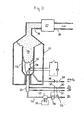
- Figure 2 is a schematic constitutional view showing the outline of the device for producing ultra-fine ceramic particles used in the first example according to this invention.
- reference numeral 1 denotes a tightly closed vessel forming an outer casing for the device for producing ultra-fine ceramic particles and a combustion device 2 and a hopper 4 for supplying metal powder 3 are disposed within the tightly closed vessel 1.
- the combustion device 2 and the hopper 4 are connected by means of a feedpipe 5 and the hopper 4 is further connected with an external reaction gas supply source (not illustrated) by means of a feedpipe 5.
- the combustion device 2 comprises a cylindrical portion 2a and a conical portion 2b made of quartz, in which a ball valve 6 made of alumina is inserted to the connection portion between the conical portion 2b and the feedpipe 5. Further, a pair of discharge electrodes 7 are opposed with a predetrermined gap at the cylindrical portion 2a of the combustion device 2, and the discharge electrodes 7 are connected to a high voltage transformer 8.
- a solenoid valve 9 is disposed at the midway of the feedpipe 5 for connecting the hopper 4 with the combustion device 2, and the solenoid valve 9 is controlled to open and close by a control device 10.
- an exhaust pipe 11 Above the combustion device 2 in the tightly closed vessel, is attached an exhaust pipe 11 and an electrical dust precipitator 12 is mounted at the midway of the exhaust pipe 11.
- Reference numeral 13 denotes a pressure gage.
- Fine oxide particles were produced by using such a ultra-fine ceramic particle producing device.
- the metal powder 3 as the starting material was at first charged in the hopper 4. Then, clean air is filled to the inside of the tightly closed vessel 1. Subequently, the bottom of the hopper 4 is opened and air as the reaction gas from a reaction gas supply source not illustrated is supplied under the pressure of 5 kg/m 2 . In this case, the solenoid valve 9 is closed by the control device 10. While on the other hand, 10 KV (AC) of voltage is applied from the high voltage transformer 8 with the electrode gap between the discharge electrodes 7 being set to 2 mm. As the result, sparks are always generated between the discharge electrodes 7. Under such a condition, the solenoid valve 9 was opened for 0.5 sec.
- the metal powder 3 was supplied carried on the pressurized air to the conical portion 2b of the combustion device 2, raised the ball valve 6 and formed powdered dust cloud comprising the metal powder 3 while being scattered upwardly to the inside of the combustion device 2.
- the powdered dust cloud was ignited by the sparks being generated between the discharge electrodes 7 to instantaeously from a combustion flame 14 and, thereafter, spontaneously cooled to form a cloud 15 of the ultra-fine oxide particles.
- the ultra-fine oxide particles were collected in the electrical dust precipitator 12 and the remaining gases were exhausted through the exhaust pipe 11.
- Such ultra-fine oxide particles were produced while varying the materials for the metal powder as Shown in the Table 1 below.
- the ultra-fine oxide particles obtained as the result were observed by a transmission type electron nicroscope (TEM) to examine the particle size, configuration and crystallinity. The results are also shown in Table 1.
- ultra-fine oxide particles of sphere or spheric polyhedron with particle size of between 5 - 100 nm can be obtained by the present example.
- Ultra-fine nitride particles were produced by using the same device as in the first example shown in Figure 2.
- the second example was different from the first example in that purified nitrogen gas (99.99 %) was introduced up to an atmospheric pressure after evacuating the inside of the tightly closed vessel to more than 10 Tor'r of vacuum degree, in that an ammonia gas is used as the reaction gas with a gas pressure of 3 kg/cm 2 and in that the metal powder as the starting material was heated by heating the feedpipe up to 600 C by ohmic heating, and ultra-fine nitride particles were produced substantially in the same manner as in the first example with respect to other procedures.
- purified nitrogen gas (99.99 %) was introduced up to an atmospheric pressure after evacuating the inside of the tightly closed vessel to more than 10 Tor'r of vacuum degree, in that an ammonia gas is used as the reaction gas with a gas pressure of 3 kg/cm 2 and in that the metal powder as the starting material was heated by heating the feedpipe up to 600 C by ohmic heating, and ultra-fine nitride particles were produced substantially in the same manner as in the first example with respect to other procedures.
- Such ultra-fine nitride particles were produced while varying the materials for the metal powder as shown in Table 2 listed below.
- the ultra-fine nitride particles obtained as the result were observed by a transmission type electron microscope (TEM) to examine the particle size, configuration and crystallinity. The results are also shown in Table 2.
- Figure 3 is a schematic structural view showing the outline of a device for producing ultra-fine oxide particles employed in the third example of this invention.
- reference numeral 21 denotes a tightly closed vessel forming the outer casing of a device for producing ultra-fine oxide particles
- a gas burner 22 is attached at the bottom of the tightly closed vessel 21.
- a combustion cylinder 23 made of quartz and the top end of an ignition device 24 is attached near the exit of the gas burner 22 in the combustion cylinder 23.
- the inside of the gas burner 22 is substantially structured as a double walled pipe, in which the inner space is communicated with one end of an introduction pipe 25.
- a hopper 26 for supplying metal powder is disposed at the midway of the introduction pipe 25 and a ball valve 27 is disposed to introduction pipe 25 between the hopper 26 and the gas burner 22.
- the ball valve 27 is controlled to open and close by a control device 28.
- the introduction pipe 25 is connected at the other end thereof to a hydrogen supply source as a carrier gas for the metal powder and the supply of the hydrogen is controlled by a valve 29.
- first gas pipe 30 and second gas pipe 31 With the other end of the first gas pipe 30 being connected with an oxygen supply source and the other end of the second gas pipe 31 being connected to a hydrogen supply source.
- the amount of the respective gases are controlled by means of valves 32 and 33 respectively.
- a third gas pipe 34 opens at one end thereof to the inside of the combustion cylinder 23 and communicates at the other end thereof with an argon and oxygen aupply source, in which the amount of the gas is controlled by a valve 35.
- an exhaust pipe 36 to an upper portion of the tightly closed vessel 21 situated above the combustion cylinder 23 is attached an exhaust pipe 36, and an electrical dust precipitator 37 is mounted at the midway of the exhaust pipe 36.
- Ultra-fine oxide particle were produced by using such a device for producing ultra-fine oxide particles.
- valve 35 was opened to introduce a gas mixture of argon and oxygen by way of the third gas pipe 34 to the inside of the tightly closed vessel 21 to replace the atmospheric air therein.
- the volume ratio between the argon gas and the oxygen was 4:1.
- valves 32 and 33 were opened to supply oxygen from the first gas pipe 30 at 20 1/min and hydrogen from the second gas pipe 31 at 10 1/min to the gas burner 22, and ignited by the ignition device 24 to form a combustion flame comprising flame comprising an oxygen - hydrogen flame.
- the bottom of the hopper 26 was opened and the metal powder was supplied to the gas burner 22 while being carried on the hydrogen at a pressure of 1 kg/cm by opening the valve 29 while opening and closing the ball valve 27 at 0.5 sec interval by the control device 28. Then, the metal powder scattered upwardly from the exit of the gas burner 22 to form a powdered dust cloud.
- the powdered dust cloud was ignited by the combustion flame 38 to obtain a great amount of ultra- fine oxide particles through the explosive burning.
- the cloud 39 of the ultra-fine oxide particles produced through the synthesis was passed to the electrical dust precipitator 37 to collect the ultra-fine oxide particles.
- Such ultra-fine oxide particles were produced while varying the materials for the metal powder as shown in Table 1 listed below.
- the ultra-fine oxide particles obtained as the result were observed under a transmission type electron microscope (TEM) to examine the particle size and configuration and crystallinity. The results are also shown in Table 3.
- the ultra-fine oxide particles with the particles size of between 5 - 100 nm can be obtained according to this example, in the shape of sphere or spheric polyhedron.
- the rate of synthesis was increased by more than 30 % as compared with that produced through the electric discharge ignition as described above.
Landscapes
- Chemical & Material Sciences (AREA)
- Organic Chemistry (AREA)
- Inorganic Chemistry (AREA)
- Engineering & Computer Science (AREA)
- Life Sciences & Earth Sciences (AREA)
- Geology (AREA)
- Nanotechnology (AREA)
- Crystallography & Structural Chemistry (AREA)
- Environmental & Geological Engineering (AREA)
- Composite Materials (AREA)
- Condensed Matter Physics & Semiconductors (AREA)
- General Physics & Mathematics (AREA)
- Materials Engineering (AREA)
- Physics & Mathematics (AREA)
- General Life Sciences & Earth Sciences (AREA)
- Chemical Kinetics & Catalysis (AREA)
- Oxygen, Ozone, And Oxides In General (AREA)
- Physical Or Chemical Processes And Apparatus (AREA)
- Inorganic Compounds Of Heavy Metals (AREA)
Applications Claiming Priority (4)
| Application Number | Priority Date | Filing Date | Title |
|---|---|---|---|
| JP22463/84 | 1984-02-09 | ||
| JP59022463A JPS60166025A (ja) | 1984-02-09 | 1984-02-09 | セラミツク超微粒子の製造方法 |
| JP59109108A JPS60255602A (ja) | 1984-05-29 | 1984-05-29 | 酸化物超微粒子の製造方法 |
| JP109108/84 | 1984-05-29 |
Publications (3)
| Publication Number | Publication Date |
|---|---|
| EP0151490A2 true EP0151490A2 (de) | 1985-08-14 |
| EP0151490A3 EP0151490A3 (en) | 1988-07-06 |
| EP0151490B1 EP0151490B1 (de) | 1991-01-16 |
Family
ID=26359690
Family Applications (1)
| Application Number | Title | Priority Date | Filing Date |
|---|---|---|---|
| EP85101305A Expired - Lifetime EP0151490B1 (de) | 1984-02-09 | 1985-02-07 | Verfahren zur Herstellung von ultrafeinen Keramikpartikeln |
Country Status (3)
| Country | Link |
|---|---|
| US (1) | US4705762A (de) |
| EP (1) | EP0151490B1 (de) |
| DE (1) | DE3581293D1 (de) |
Cited By (21)
| Publication number | Priority date | Publication date | Assignee | Title |
|---|---|---|---|---|
| GB2182650A (en) * | 1985-11-09 | 1987-05-20 | Tioxide Group Plc | Finely divided alumina and its manufacture |
| DE3741119A1 (de) * | 1987-12-04 | 1989-06-15 | Krupp Gmbh | Erzeugung von sekundaerpulverteilchen mit nanokristalliner struktur und mit versiegelten oberflaechen |
| EP0568861A1 (de) * | 1992-05-04 | 1993-11-10 | H.C. Starck GmbH & Co. KG | Feinteilige Nichtoxid-Keramikpulver |
| DE4214724A1 (de) * | 1992-05-04 | 1993-11-11 | Starck H C Gmbh Co Kg | Feinteiliges Oxid-Keramikpulver |
| WO1994016989A1 (en) * | 1993-01-21 | 1994-08-04 | Physical Sciences, Inc. | Process for producing nanoscale ceramic powders |
| US5356120A (en) * | 1992-05-04 | 1994-10-18 | H. C. Starck, Gmbh And Co. Kg. | Device for producing finely-divided metal and ceramic powder |
| WO1994026657A1 (en) * | 1993-05-10 | 1994-11-24 | Physical Sciences, Inc. | Apparatus for producing nanoscale ceramic powders |
| DE4337336C1 (de) * | 1993-11-02 | 1994-12-15 | Starck H C Gmbh Co Kg | Feinteilige Metall-, Legierungs- und Metallverbindungspulver |
| US5472477A (en) * | 1992-05-04 | 1995-12-05 | H.C. Starck Gmbh & Co. Kg | Process for the preparation of finely divided metal and ceramic powders |
| US6702994B1 (en) | 1999-03-29 | 2004-03-09 | Elkem Asa | Method and apparatus for production of amorphous silica from silicon and silicon containing materials |
| WO2008017444A1 (de) * | 2006-08-11 | 2008-02-14 | Cosma Engineering Europe Ag | Verfahren und vorrichtung zum explosionsumformen |
| US8047036B2 (en) | 2005-06-03 | 2011-11-01 | Magna International Inc. | Device and method for explosion forming |
| US8252210B2 (en) | 2006-08-11 | 2012-08-28 | Cosma Engineering Europe Ag | Method and device for explosion forming |
| US8250892B2 (en) | 2006-12-01 | 2012-08-28 | Cosma Engineering Europe Ag | Closure device for explosion forming |
| US8322175B2 (en) | 2006-12-20 | 2012-12-04 | Cosma Engineering Europe Ag | Workpiece and method for explosion forming |
| US8343415B2 (en) | 2007-01-15 | 2013-01-01 | Saint-Gobain Ceramics & Plastics, Inc. | Ceramic particulate material and processes for forming same |
| US8443641B2 (en) | 2007-02-14 | 2013-05-21 | Cosma Engineering Europe Ag | Explosion forming system |
| US8713982B2 (en) | 2008-01-31 | 2014-05-06 | Magna International Inc. | Device for explosive forming |
| US8875553B2 (en) | 2007-02-14 | 2014-11-04 | Cosma Engineering Europe Ag | Method and mould arrangement for explosion forming |
| US8939743B2 (en) | 2007-08-02 | 2015-01-27 | Cosma Engineering Europe Ag | Device for supplying a fluid for explosion forming |
| US9393606B2 (en) | 2007-05-22 | 2016-07-19 | Cosma Engineering Europe Ag | Ignition device for explosive forming |
Families Citing this family (70)
| Publication number | Priority date | Publication date | Assignee | Title |
|---|---|---|---|---|
| US5250478A (en) * | 1988-07-28 | 1993-10-05 | Kyocera Corporation | Aluminum nitride sintered body and process for preparation thereof |
| US5004488A (en) * | 1989-03-20 | 1991-04-02 | Pitman-Moore, Inc. | Process for producing high purity fused quartz powder |
| JP2899893B2 (ja) * | 1989-06-07 | 1999-06-02 | 京セラ株式会社 | 窒化アルミニウム質焼結体およびその製造方法 |
| US5128081A (en) * | 1989-12-05 | 1992-07-07 | Arch Development Corporation | Method of making nanocrystalline alpha alumina |
| JP2555786B2 (ja) * | 1991-01-22 | 1996-11-20 | 信越化学工業株式会社 | 電子・電気部品保護コート用シリコーンゴム組成物及び硬化物 |
| US5326589A (en) * | 1991-01-22 | 1994-07-05 | Shin-Etsu Chemical Co., Ltd | Method of protecting electronic or electric part |
| JPH0686557B2 (ja) * | 1991-05-27 | 1994-11-02 | 信越化学工業株式会社 | ポリプロピレンフィルム |
| US5316697A (en) * | 1993-03-24 | 1994-05-31 | Kerr-Mcgee Corporation | Conductive, particulate, fluorine-doped zinc oxide |
| DE4334639A1 (de) * | 1993-10-11 | 1995-04-13 | Inst Neue Mat Gemein Gmbh | Verfahren zur Herstellung von TiN-Sinterkörpern und -Schichten |
| US5455212A (en) * | 1994-03-15 | 1995-10-03 | The University Of British Columbia | In situ production of silicon carbide-containing ceramic composite powders |
| US5879794A (en) * | 1994-08-25 | 1999-03-09 | W. L. Gore & Associates, Inc. | Adhesive-filler film composite |
| US5731047A (en) * | 1996-11-08 | 1998-03-24 | W.L. Gore & Associates, Inc. | Multiple frequency processing to improve electrical resistivity of blind micro-vias |
| US5888631A (en) * | 1996-11-08 | 1999-03-30 | W. L. Gore & Associates, Inc. | Method for minimizing warp in the production of electronic assemblies |
| US5882459A (en) * | 1996-11-08 | 1999-03-16 | W. L. Gore & Associates, Inc. | Method for aligning and laminating substrates to stiffeners in electrical circuits |
| WO1998020534A1 (en) * | 1996-11-08 | 1998-05-14 | W.L. Gore & Associates, Inc. | Method for using fiducial schemes to increase nominal registration |
| US5847327A (en) * | 1996-11-08 | 1998-12-08 | W.L. Gore & Associates, Inc. | Dimensionally stable core for use in high density chip packages |
| US5841102A (en) * | 1996-11-08 | 1998-11-24 | W. L. Gore & Associates, Inc. | Multiple pulse space processing to enhance via entrance formation at 355 nm |
| US5966022A (en) * | 1996-11-08 | 1999-10-12 | W. L. Gore & Associates, Inc. | Wafer level burn-in system |
| US5909123A (en) * | 1996-11-08 | 1999-06-01 | W. L. Gore & Associates, Inc. | Method for performing reliability screening and burn-in of semi-conductor wafers |
| AU5084998A (en) * | 1996-11-08 | 1998-05-29 | W.L. Gore & Associates, Inc. | Method for using photoabsorptive coatings to enhance both blind and through micro-via entrance quality |
| US5868950A (en) * | 1996-11-08 | 1999-02-09 | W. L. Gore & Associates, Inc. | Method to correct astigmatism of fourth yag to enable formation of sub 25 micron micro-vias using masking techniques |
| AU5083998A (en) * | 1996-11-08 | 1998-05-29 | W.L. Gore & Associates, Inc. | Dimensionally stable solder mask material and method of application |
| US5863446A (en) * | 1996-11-08 | 1999-01-26 | W. L. Gore & Associates, Inc. | Electrical means for extracting layer to layer registration |
| US6103992A (en) * | 1996-11-08 | 2000-08-15 | W. L. Gore & Associates, Inc. | Multiple frequency processing to minimize manufacturing variability of high aspect ratio micro through-vias |
| JP4234205B2 (ja) * | 1996-11-08 | 2009-03-04 | ダブリュ.エル.ゴア アンド アソシエイツ,インコーポレイティド | 電子アセンブリおよび電子物品内でのヴァイアのインダクタンスを低減する方法 |
| US5886535A (en) * | 1996-11-08 | 1999-03-23 | W. L. Gore & Associates, Inc. | Wafer level burn-in base unit substrate and assembly |
| US6023041A (en) * | 1996-11-08 | 2000-02-08 | W.L. Gore & Associates, Inc. | Method for using photoabsorptive coatings and consumable copper to control exit via redeposit as well as diameter variance |
| US5900312A (en) | 1996-11-08 | 1999-05-04 | W. L. Gore & Associates, Inc. | Integrated circuit chip package assembly |
| US5779921A (en) * | 1996-11-08 | 1998-07-14 | W. L. Gore & Associates, Inc. | Method for selectively plating an organic substrate |
| AU4902897A (en) | 1996-11-08 | 1998-05-29 | W.L. Gore & Associates, Inc. | Method for improving reliability of thin circuit substrates by increasing the T of the substrate |
| US5838063A (en) * | 1996-11-08 | 1998-11-17 | W. L. Gore & Associates | Method of increasing package reliability using package lids with plane CTE gradients |
| US5868887A (en) * | 1996-11-08 | 1999-02-09 | W. L. Gore & Associates, Inc. | Method for minimizing warp and die stress in the production of an electronic assembly |
| US5965043A (en) * | 1996-11-08 | 1999-10-12 | W. L. Gore & Associates, Inc. | Method for using ultrasonic treatment in combination with UV-lasers to enable plating of high aspect ratio micro-vias |
| US5778523A (en) * | 1996-11-08 | 1998-07-14 | W. L. Gore & Associates, Inc. | Method for controlling warp of electronic assemblies by use of package stiffener |
| US5830565A (en) * | 1996-11-08 | 1998-11-03 | W. L. Gore & Associates, Inc. | High planarity and low thermal coefficient of expansion base for semi-conductor reliability screening |
| US5888630A (en) * | 1996-11-08 | 1999-03-30 | W. L. Gore & Associates, Inc. | Apparatus and method for unit area composition control to minimize warp in an integrated circuit chip package assembly |
| US5910255A (en) * | 1996-11-08 | 1999-06-08 | W. L. Gore & Associates, Inc. | Method of sequential laser processing to efficiently manufacture modules requiring large volumetric density material removal for micro-via formation |
| US5879786A (en) * | 1996-11-08 | 1999-03-09 | W. L. Gore & Associates, Inc. | Constraining ring for use in electronic packaging |
| US5879787A (en) * | 1996-11-08 | 1999-03-09 | W. L. Gore & Associates, Inc. | Method and apparatus for improving wireability in chip modules |
| US5966593A (en) * | 1996-11-08 | 1999-10-12 | W. L. Gore & Associates, Inc. | Method of forming a wafer level contact sheet having a permanent z-axis material |
| US5766979A (en) | 1996-11-08 | 1998-06-16 | W. L. Gore & Associates, Inc. | Wafer level contact sheet and method of assembly |
| US5853517A (en) * | 1996-11-08 | 1998-12-29 | W. L. Gore & Associates, Inc. | Method for coining solder balls on an electrical circuit package |
| US5896038A (en) * | 1996-11-08 | 1999-04-20 | W. L. Gore & Associates, Inc. | Method of wafer level burn-in |
| US5973290A (en) * | 1997-02-26 | 1999-10-26 | W. L. Gore & Associates, Inc. | Laser apparatus having improved via processing rate |
| US6387531B1 (en) | 1998-07-27 | 2002-05-14 | Nanogram Corporation | Metal (silicon) oxide/carbon composite particles |
| US6290735B1 (en) | 1997-10-31 | 2001-09-18 | Nanogram Corporation | Abrasive particles for surface polishing |
| US7384680B2 (en) * | 1997-07-21 | 2008-06-10 | Nanogram Corporation | Nanoparticle-based power coatings and corresponding structures |
| US6099798A (en) * | 1997-10-31 | 2000-08-08 | Nanogram Corp. | Ultraviolet light block and photocatalytic materials |
| US6726990B1 (en) | 1998-05-27 | 2004-04-27 | Nanogram Corporation | Silicon oxide particles |
| US20090255189A1 (en) * | 1998-08-19 | 2009-10-15 | Nanogram Corporation | Aluminum oxide particles |
| US6106798A (en) * | 1997-07-21 | 2000-08-22 | Nanogram Corporation | Vanadium oxide nanoparticles |
| CA2212471C (en) * | 1997-08-06 | 2003-04-01 | Tony Addona | A method of forming an oxide ceramic anode in a transferred plasma arc reactor |
| US5919329A (en) * | 1997-10-14 | 1999-07-06 | Gore Enterprise Holdings, Inc. | Method for assembling an integrated circuit chip package having at least one semiconductor device |
| US5938979A (en) * | 1997-10-31 | 1999-08-17 | Nanogram Corporation | Electromagnetic shielding |
| NL1012897C2 (nl) * | 1999-08-24 | 2001-02-27 | Tno | Werkwijze voor het maken van een tandheelkundig element. |
| US6746508B1 (en) * | 1999-10-22 | 2004-06-08 | Chrysalis Technologies Incorporated | Nanosized intermetallic powders |
| US6368406B1 (en) | 2000-09-13 | 2002-04-09 | Chrysalis Technologies Incorporated | Nanocrystalline intermetallic powders made by laser evaporation |
| US7416655B2 (en) | 2003-10-10 | 2008-08-26 | Instituto Mexicano Del Petroleo | Selective adsorbent material and its use |
| MXPA04004265A (es) * | 2004-05-04 | 2005-11-09 | Mexicano Inst Petrol | Material de oxido de titanio nanoestructurado y procedimiento para su obtencion. |
| US7645439B2 (en) * | 2003-10-10 | 2010-01-12 | Instituto Mexicano Del Petroleo | Nanostructured titanium oxide material and its synthesis procedure |
| WO2005060610A2 (en) * | 2003-12-11 | 2005-07-07 | The Trustees Of Columbia University In The City Ofnew York | Nano-sized particles, processes of making, compositions and uses thereof |
| US7282167B2 (en) * | 2003-12-15 | 2007-10-16 | Quantumsphere, Inc. | Method and apparatus for forming nano-particles |
| JP5024796B2 (ja) * | 2005-02-02 | 2012-09-12 | 独立行政法人物質・材料研究機構 | ナノサイズ粉体の製造方法 |
| DE102005045767B4 (de) * | 2005-09-23 | 2012-03-29 | Infineon Technologies Ag | Verfahren zur Herstellung eines Halbleiterbauteils mit Kunststoffgehäusemasse |
| CN104649282B (zh) * | 2006-06-09 | 2017-06-13 | 株式会社德山 | 干式二氧化硅微粒 |
| US7803295B2 (en) | 2006-11-02 | 2010-09-28 | Quantumsphere, Inc | Method and apparatus for forming nano-particles |
| US20090297626A1 (en) * | 2006-11-03 | 2009-12-03 | The Trustees Of Columbia University In The City Of New York | Methods for preparing metal oxides |
| KR102456021B1 (ko) * | 2017-09-20 | 2022-10-17 | 어플라이드 머티어리얼스, 인코포레이티드 | 증발에 의해 전기화학 셀의 컴포넌트를 형성하는 방법 |
| CN115806737B (zh) * | 2021-09-13 | 2024-05-14 | 中山台光电子材料有限公司 | 树脂组合物及其制品 |
| NL2038559B1 (en) * | 2024-09-02 | 2026-03-17 | Univ Eindhoven Tech | A reaction system |
Family Cites Families (10)
| Publication number | Priority date | Publication date | Assignee | Title |
|---|---|---|---|---|
| BE546121A (de) * | 1955-03-28 | 1900-01-01 | ||
| US2965474A (en) * | 1958-07-18 | 1960-12-20 | Union Carbide Corp | Reduction of metal oxides |
| US3183077A (en) * | 1962-01-30 | 1965-05-11 | Bendix Balzers Vacuum Inc | Process for vacuum degassing |
| GB1031651A (en) * | 1964-01-31 | 1966-06-02 | Welwyn Electric Ltd | Improvements in the manufacture of oxide mixes |
| US3726643A (en) * | 1970-04-09 | 1973-04-10 | I Khim Fiz Akademii Nauk | Method of producing refractory carbides,borides,silicides,sulfides,and nitrides of metals of groups iv,v,and vi of the periodic system |
| US3848068A (en) * | 1971-04-21 | 1974-11-12 | Corning Glass Works | Method for producing metal compounds |
| IT1055884B (it) * | 1976-02-17 | 1982-01-11 | Montedison Spa | Procedimento ad arco plasma di prodotti ceramici metallici e simili |
| US4221762A (en) * | 1978-01-30 | 1980-09-09 | Andrjushin Alexandr I | Apparatus for preparing carbides |
| US4468474A (en) * | 1983-05-16 | 1984-08-28 | Allied Corporation | Iron/silicon-based catalyst exhibiting high selectivity to C2 -C62 Fischer-Tropsch reactions |
| JPS60175537A (ja) * | 1984-02-22 | 1985-09-09 | Toyota Motor Corp | セラミツク超微粒子の製造方法 |
-
1985
- 1985-02-07 DE DE8585101305T patent/DE3581293D1/de not_active Expired - Lifetime
- 1985-02-07 EP EP85101305A patent/EP0151490B1/de not_active Expired - Lifetime
- 1985-02-08 US US06/699,909 patent/US4705762A/en not_active Expired - Lifetime
Cited By (30)
| Publication number | Priority date | Publication date | Assignee | Title |
|---|---|---|---|---|
| US4806333A (en) * | 1985-11-09 | 1989-02-21 | Tioxide Group Plc | Finely divided oxide and its manufacture |
| AU586044B2 (en) * | 1985-11-09 | 1989-06-29 | Tioxide Group Plc | Finely divided oxide and its manufacture |
| GB2182650B (en) * | 1985-11-09 | 1989-10-04 | Tioxide Group Plc | Finely divided alumina and its manufacture |
| GB2182650A (en) * | 1985-11-09 | 1987-05-20 | Tioxide Group Plc | Finely divided alumina and its manufacture |
| DE3741119A1 (de) * | 1987-12-04 | 1989-06-15 | Krupp Gmbh | Erzeugung von sekundaerpulverteilchen mit nanokristalliner struktur und mit versiegelten oberflaechen |
| US5389585A (en) * | 1992-05-04 | 1995-02-14 | H.C. Starck Gmbh And Co. | Fine non-oxide ceramic powders |
| EP0568861A1 (de) * | 1992-05-04 | 1993-11-10 | H.C. Starck GmbH & Co. KG | Feinteilige Nichtoxid-Keramikpulver |
| DE4214724A1 (de) * | 1992-05-04 | 1993-11-11 | Starck H C Gmbh Co Kg | Feinteiliges Oxid-Keramikpulver |
| US5356120A (en) * | 1992-05-04 | 1994-10-18 | H. C. Starck, Gmbh And Co. Kg. | Device for producing finely-divided metal and ceramic powder |
| US5472477A (en) * | 1992-05-04 | 1995-12-05 | H.C. Starck Gmbh & Co. Kg | Process for the preparation of finely divided metal and ceramic powders |
| DE4214724C2 (de) * | 1992-05-04 | 1995-05-18 | Starck H C Gmbh Co Kg | Feinteiliges Oxid-Keramikpulver |
| US5384306A (en) * | 1992-05-04 | 1995-01-24 | H. C. Starck Gmbh And Co. | Fine-particle oxide ceramic powders |
| WO1994016989A1 (en) * | 1993-01-21 | 1994-08-04 | Physical Sciences, Inc. | Process for producing nanoscale ceramic powders |
| WO1994026657A1 (en) * | 1993-05-10 | 1994-11-24 | Physical Sciences, Inc. | Apparatus for producing nanoscale ceramic powders |
| DE4337336C1 (de) * | 1993-11-02 | 1994-12-15 | Starck H C Gmbh Co Kg | Feinteilige Metall-, Legierungs- und Metallverbindungspulver |
| RU2136444C1 (ru) * | 1993-11-02 | 1999-09-10 | Х.К.Штарк ГмбХ унд Ко., КГ | Тонкодисперсный металлосодержащий порошок и способ его получения |
| EP0650791A1 (de) * | 1993-11-02 | 1995-05-03 | H.C. Starck GmbH & Co. KG | Feinteilige Metall-, Legierungs- und Metallverbindungspulver |
| US6702994B1 (en) | 1999-03-29 | 2004-03-09 | Elkem Asa | Method and apparatus for production of amorphous silica from silicon and silicon containing materials |
| US8047036B2 (en) | 2005-06-03 | 2011-11-01 | Magna International Inc. | Device and method for explosion forming |
| US8650921B2 (en) | 2006-08-11 | 2014-02-18 | Cosma Engineering Europe Ag | Method and device for explosion forming |
| US8252210B2 (en) | 2006-08-11 | 2012-08-28 | Cosma Engineering Europe Ag | Method and device for explosion forming |
| WO2008017444A1 (de) * | 2006-08-11 | 2008-02-14 | Cosma Engineering Europe Ag | Verfahren und vorrichtung zum explosionsumformen |
| US8250892B2 (en) | 2006-12-01 | 2012-08-28 | Cosma Engineering Europe Ag | Closure device for explosion forming |
| US8322175B2 (en) | 2006-12-20 | 2012-12-04 | Cosma Engineering Europe Ag | Workpiece and method for explosion forming |
| US8343415B2 (en) | 2007-01-15 | 2013-01-01 | Saint-Gobain Ceramics & Plastics, Inc. | Ceramic particulate material and processes for forming same |
| US8443641B2 (en) | 2007-02-14 | 2013-05-21 | Cosma Engineering Europe Ag | Explosion forming system |
| US8875553B2 (en) | 2007-02-14 | 2014-11-04 | Cosma Engineering Europe Ag | Method and mould arrangement for explosion forming |
| US9393606B2 (en) | 2007-05-22 | 2016-07-19 | Cosma Engineering Europe Ag | Ignition device for explosive forming |
| US8939743B2 (en) | 2007-08-02 | 2015-01-27 | Cosma Engineering Europe Ag | Device for supplying a fluid for explosion forming |
| US8713982B2 (en) | 2008-01-31 | 2014-05-06 | Magna International Inc. | Device for explosive forming |
Also Published As
| Publication number | Publication date |
|---|---|
| US4705762A (en) | 1987-11-10 |
| DE3581293D1 (de) | 1991-02-21 |
| EP0151490B1 (de) | 1991-01-16 |
| EP0151490A3 (en) | 1988-07-06 |
Similar Documents
| Publication | Publication Date | Title |
|---|---|---|
| EP0151490B1 (de) | Verfahren zur Herstellung von ultrafeinen Keramikpartikeln | |
| JPH0155201B2 (de) | ||
| CA2191198A1 (en) | Method and apparatus for producing high purity and unagglomerated submicron particles | |
| GB2168967A (en) | Process for producing metal oxide particles having a very small and uniform size | |
| JP3229353B2 (ja) | 金属酸化物粉末の製造方法 | |
| US4719095A (en) | Production of silicon ceramic powders | |
| US4917866A (en) | Production process of silicon carbide short fibers | |
| JP2868039B2 (ja) | 低級金属酸化物の製造方法 | |
| US3660025A (en) | Manufacture of pigmentary silica | |
| JPH05193928A (ja) | シリカガラス粉末の製造方法 | |
| JPS60166025A (ja) | セラミツク超微粒子の製造方法 | |
| JP3225073B2 (ja) | 金属酸化物粉末の製造方法 | |
| JPH05193908A (ja) | 金属酸化物粉末の製造方法 | |
| JPS61178408A (ja) | 窒化ケイ素粉末の製造方法 | |
| JP2003048704A (ja) | 金属酸化物粉末の製造方法 | |
| JPS60255603A (ja) | 窒化物超微粒子の製造方法 | |
| JP2679242B2 (ja) | 酸化物粉末の製造方法 | |
| JP2929815B2 (ja) | 炭化物粉末の製造方法 | |
| JPS61178413A (ja) | 炭化ケイ素粉末の製造方法 | |
| JP2679216B2 (ja) | 酸化物粉末の製造方法 | |
| JPH01167215A (ja) | 高度分散酸化アルミニウム粒子の製造方法および製造装置 | |
| JPH085652B2 (ja) | 炭化珪素粉末の製造方法 | |
| JPS61205604A (ja) | 酸化物超微粒子の製造方法及び装置 | |
| TW202319343A (zh) | 一氧化矽的製造方法 | |
| JPH02107505A (ja) | 水素と酸化物系セラミックス微粉末の製造方法 |
Legal Events
| Date | Code | Title | Description |
|---|---|---|---|
| PUAI | Public reference made under article 153(3) epc to a published international application that has entered the european phase |
Free format text: ORIGINAL CODE: 0009012 |
|
| AK | Designated contracting states |
Designated state(s): DE FR GB |
|
| PUAL | Search report despatched |
Free format text: ORIGINAL CODE: 0009013 |
|
| AK | Designated contracting states |
Kind code of ref document: A3 Designated state(s): DE FR GB |
|
| 17P | Request for examination filed |
Effective date: 19880922 |
|
| 17Q | First examination report despatched |
Effective date: 19900326 |
|
| GRAA | (expected) grant |
Free format text: ORIGINAL CODE: 0009210 |
|
| AK | Designated contracting states |
Kind code of ref document: B1 Designated state(s): DE FR GB |
|
| ET | Fr: translation filed | ||
| REF | Corresponds to: |
Ref document number: 3581293 Country of ref document: DE Date of ref document: 19910221 |
|
| PLBE | No opposition filed within time limit |
Free format text: ORIGINAL CODE: 0009261 |
|
| STAA | Information on the status of an ep patent application or granted ep patent |
Free format text: STATUS: NO OPPOSITION FILED WITHIN TIME LIMIT |
|
| 26N | No opposition filed | ||
| REG | Reference to a national code |
Ref country code: GB Ref legal event code: 746 Effective date: 19940523 |
|
| REG | Reference to a national code |
Ref country code: FR Ref legal event code: D6 |
|
| REG | Reference to a national code |
Ref country code: GB Ref legal event code: IF02 |
|
| PGFP | Annual fee paid to national office [announced via postgrant information from national office to epo] |
Ref country code: GB Payment date: 20040204 Year of fee payment: 20 |
|
| PGFP | Annual fee paid to national office [announced via postgrant information from national office to epo] |
Ref country code: FR Payment date: 20040210 Year of fee payment: 20 |
|
| PGFP | Annual fee paid to national office [announced via postgrant information from national office to epo] |
Ref country code: DE Payment date: 20040219 Year of fee payment: 20 |
|
| PG25 | Lapsed in a contracting state [announced via postgrant information from national office to epo] |
Ref country code: GB Free format text: LAPSE BECAUSE OF EXPIRATION OF PROTECTION Effective date: 20050206 |
|
| REG | Reference to a national code |
Ref country code: GB Ref legal event code: PE20 |