EP0154080B1 - Méthode pour réduire la migration de particules fines dans des structures poreuses - Google Patents
Méthode pour réduire la migration de particules fines dans des structures poreuses Download PDFInfo
- Publication number
- EP0154080B1 EP0154080B1 EP84307653A EP84307653A EP0154080B1 EP 0154080 B1 EP0154080 B1 EP 0154080B1 EP 84307653 A EP84307653 A EP 84307653A EP 84307653 A EP84307653 A EP 84307653A EP 0154080 B1 EP0154080 B1 EP 0154080B1
- Authority
- EP
- European Patent Office
- Prior art keywords
- copolymer
- weight
- percent
- fines
- sup
- Prior art date
- Legal status (The legal status is an assumption and is not a legal conclusion. Google has not performed a legal analysis and makes no representation as to the accuracy of the status listed.)
- Expired
Links
- 238000000034 method Methods 0.000 title claims abstract description 38
- 238000013508 migration Methods 0.000 title claims abstract description 8
- 230000005012 migration Effects 0.000 title claims abstract description 8
- 229920001577 copolymer Polymers 0.000 claims abstract description 55
- 230000015572 biosynthetic process Effects 0.000 claims abstract description 28
- 239000000178 monomer Substances 0.000 claims abstract description 22
- 125000002496 methyl group Chemical group [H]C([H])([H])* 0.000 claims abstract description 9
- 125000004432 carbon atom Chemical group C* 0.000 claims abstract description 6
- 125000001495 ethyl group Chemical group [H]C([H])([H])C([H])([H])* 0.000 claims abstract description 6
- 229910052739 hydrogen Inorganic materials 0.000 claims abstract description 6
- 239000001257 hydrogen Substances 0.000 claims abstract description 6
- 125000004435 hydrogen atom Chemical group [H]* 0.000 claims abstract description 5
- 229910052783 alkali metal Chemical group 0.000 claims abstract description 4
- 125000002947 alkylene group Chemical group 0.000 claims abstract description 4
- GAWIXWVDTYZWAW-UHFFFAOYSA-N C[CH]O Chemical group C[CH]O GAWIXWVDTYZWAW-UHFFFAOYSA-N 0.000 claims abstract description 3
- 150000001340 alkali metals Chemical group 0.000 claims abstract description 3
- 125000002887 hydroxy group Chemical group [H]O* 0.000 claims abstract description 3
- 125000004029 hydroxymethyl group Chemical group [H]OC([H])([H])* 0.000 claims abstract description 3
- 239000012530 fluid Substances 0.000 claims description 33
- VYPSYNLAJGMNEJ-UHFFFAOYSA-N Silicium dioxide Chemical compound O=[Si]=O VYPSYNLAJGMNEJ-UHFFFAOYSA-N 0.000 claims description 25
- 239000000203 mixture Substances 0.000 claims description 14
- -1 alkaline earth metal carbonates Chemical class 0.000 claims description 8
- 150000003839 salts Chemical class 0.000 claims description 7
- 239000000377 silicon dioxide Substances 0.000 claims description 7
- CERQOIWHTDAKMF-UHFFFAOYSA-N Methacrylic acid Chemical compound CC(=C)C(O)=O CERQOIWHTDAKMF-UHFFFAOYSA-N 0.000 claims description 6
- SMZOUWXMTYCWNB-UHFFFAOYSA-N 2-(2-methoxy-5-methylphenyl)ethanamine Chemical compound COC1=CC=C(C)C=C1CCN SMZOUWXMTYCWNB-UHFFFAOYSA-N 0.000 claims description 5
- NIXOWILDQLNWCW-UHFFFAOYSA-N 2-Propenoic acid Natural products OC(=O)C=C NIXOWILDQLNWCW-UHFFFAOYSA-N 0.000 claims description 5
- 229910052784 alkaline earth metal Inorganic materials 0.000 claims description 4
- JKNCOURZONDCGV-UHFFFAOYSA-N 2-(dimethylamino)ethyl 2-methylprop-2-enoate Chemical compound CN(C)CCOC(=O)C(C)=C JKNCOURZONDCGV-UHFFFAOYSA-N 0.000 claims description 3
- KQJLZBJOEUYHIM-UHFFFAOYSA-N diethylaminomethyl prop-2-enoate Chemical compound CCN(CC)COC(=O)C=C KQJLZBJOEUYHIM-UHFFFAOYSA-N 0.000 claims description 3
- 150000004820 halides Chemical group 0.000 claims description 3
- 229910001608 iron mineral Inorganic materials 0.000 claims description 3
- UUGXDEDGRPYWHG-UHFFFAOYSA-N (dimethylamino)methyl 2-methylprop-2-enoate Chemical compound CN(C)COC(=O)C(C)=C UUGXDEDGRPYWHG-UHFFFAOYSA-N 0.000 claims description 2
- SJIXRGNQPBQWMK-UHFFFAOYSA-N 2-(diethylamino)ethyl 2-methylprop-2-enoate Chemical compound CCN(CC)CCOC(=O)C(C)=C SJIXRGNQPBQWMK-UHFFFAOYSA-N 0.000 claims description 2
- WWJCRUKUIQRCGP-UHFFFAOYSA-N 3-(dimethylamino)propyl 2-methylprop-2-enoate Chemical compound CN(C)CCCOC(=O)C(C)=C WWJCRUKUIQRCGP-UHFFFAOYSA-N 0.000 claims description 2
- UFQHFMGRRVQFNA-UHFFFAOYSA-N 3-(dimethylamino)propyl prop-2-enoate Chemical compound CN(C)CCCOC(=O)C=C UFQHFMGRRVQFNA-UHFFFAOYSA-N 0.000 claims description 2
- KPGRTCPQLMJHFQ-UHFFFAOYSA-N diethylaminomethyl 2-methylprop-2-enoate Chemical compound CCN(CC)COC(=O)C(C)=C KPGRTCPQLMJHFQ-UHFFFAOYSA-N 0.000 claims description 2
- 125000005156 substituted alkylene group Chemical group 0.000 claims description 2
- XAEFZNCEHLXOMS-UHFFFAOYSA-M potassium benzoate Chemical compound [K+].[O-]C(=O)C1=CC=CC=C1 XAEFZNCEHLXOMS-UHFFFAOYSA-M 0.000 claims 2
- 159000000000 sodium salts Chemical class 0.000 claims 2
- QHVBLSNVXDSMEB-UHFFFAOYSA-N 2-(diethylamino)ethyl prop-2-enoate Chemical compound CCN(CC)CCOC(=O)C=C QHVBLSNVXDSMEB-UHFFFAOYSA-N 0.000 claims 1
- 229910001615 alkaline earth metal halide Inorganic materials 0.000 claims 1
- UFHFLCQGNIYNRP-UHFFFAOYSA-N Hydrogen Chemical compound [H][H] UFHFLCQGNIYNRP-UHFFFAOYSA-N 0.000 abstract 1
- 238000005755 formation reaction Methods 0.000 description 26
- 238000012360 testing method Methods 0.000 description 24
- 239000000126 substance Substances 0.000 description 15
- 125000000129 anionic group Chemical group 0.000 description 10
- 239000004576 sand Substances 0.000 description 10
- VEXZGXHMUGYJMC-UHFFFAOYSA-N Hydrochloric acid Chemical compound Cl VEXZGXHMUGYJMC-UHFFFAOYSA-N 0.000 description 8
- 230000035699 permeability Effects 0.000 description 7
- QTBSBXVTEAMEQO-UHFFFAOYSA-N Acetic acid Chemical compound CC(O)=O QTBSBXVTEAMEQO-UHFFFAOYSA-N 0.000 description 6
- KRKNYBCHXYNGOX-UHFFFAOYSA-N citric acid Chemical compound OC(=O)CC(O)(C(O)=O)CC(O)=O KRKNYBCHXYNGOX-UHFFFAOYSA-N 0.000 description 6
- 230000007423 decrease Effects 0.000 description 6
- 229930195733 hydrocarbon Natural products 0.000 description 6
- 150000002430 hydrocarbons Chemical class 0.000 description 6
- 238000002347 injection Methods 0.000 description 6
- 239000007924 injection Substances 0.000 description 6
- 238000004519 manufacturing process Methods 0.000 description 6
- 238000011084 recovery Methods 0.000 description 6
- 239000010419 fine particle Substances 0.000 description 5
- 239000013505 freshwater Substances 0.000 description 5
- 238000011282 treatment Methods 0.000 description 5
- XLYOFNOQVPJJNP-UHFFFAOYSA-N water Substances O XLYOFNOQVPJJNP-UHFFFAOYSA-N 0.000 description 5
- NLXLAEXVIDQMFP-UHFFFAOYSA-N Ammonia chloride Chemical compound [NH4+].[Cl-] NLXLAEXVIDQMFP-UHFFFAOYSA-N 0.000 description 4
- 239000004215 Carbon black (E152) Substances 0.000 description 4
- 239000002253 acid Substances 0.000 description 4
- 150000007513 acids Chemical class 0.000 description 4
- 125000002091 cationic group Chemical group 0.000 description 4
- 229920002851 polycationic polymer Polymers 0.000 description 4
- 239000011148 porous material Substances 0.000 description 4
- LFQSCWFLJHTTHZ-UHFFFAOYSA-N Ethanol Chemical compound CCO LFQSCWFLJHTTHZ-UHFFFAOYSA-N 0.000 description 3
- DGAQECJNVWCQMB-PUAWFVPOSA-M Ilexoside XXIX Chemical compound C[C@@H]1CC[C@@]2(CC[C@@]3(C(=CC[C@H]4[C@]3(CC[C@@H]5[C@@]4(CC[C@@H](C5(C)C)OS(=O)(=O)[O-])C)C)[C@@H]2[C@]1(C)O)C)C(=O)O[C@H]6[C@@H]([C@H]([C@@H]([C@H](O6)CO)O)O)O.[Na+] DGAQECJNVWCQMB-PUAWFVPOSA-M 0.000 description 3
- OKKJLVBELUTLKV-UHFFFAOYSA-N Methanol Chemical compound OC OKKJLVBELUTLKV-UHFFFAOYSA-N 0.000 description 3
- 239000007788 liquid Substances 0.000 description 3
- 230000007935 neutral effect Effects 0.000 description 3
- 229920000620 organic polymer Polymers 0.000 description 3
- 239000002245 particle Substances 0.000 description 3
- 229920000642 polymer Polymers 0.000 description 3
- 229910052708 sodium Inorganic materials 0.000 description 3
- 239000011734 sodium Substances 0.000 description 3
- 239000000243 solution Substances 0.000 description 3
- 230000000087 stabilizing effect Effects 0.000 description 3
- KRHYYFGTRYWZRS-UHFFFAOYSA-N Fluorane Chemical compound F KRHYYFGTRYWZRS-UHFFFAOYSA-N 0.000 description 2
- KFZMGEQAYNKOFK-UHFFFAOYSA-N Isopropanol Chemical compound CC(C)O KFZMGEQAYNKOFK-UHFFFAOYSA-N 0.000 description 2
- NBIIXXVUZAFLBC-UHFFFAOYSA-N Phosphoric acid Chemical compound OP(O)(O)=O NBIIXXVUZAFLBC-UHFFFAOYSA-N 0.000 description 2
- 150000001298 alcohols Chemical class 0.000 description 2
- 235000019270 ammonium chloride Nutrition 0.000 description 2
- 239000003945 anionic surfactant Substances 0.000 description 2
- 238000007596 consolidation process Methods 0.000 description 2
- 230000000694 effects Effects 0.000 description 2
- AEIXRCIKZIZYPM-UHFFFAOYSA-M hydroxy(oxo)iron Chemical compound [O][Fe]O AEIXRCIKZIZYPM-UHFFFAOYSA-M 0.000 description 2
- 239000004615 ingredient Substances 0.000 description 2
- BDAGIHXWWSANSR-UHFFFAOYSA-N methanoic acid Natural products OC=O BDAGIHXWWSANSR-UHFFFAOYSA-N 0.000 description 2
- 239000003921 oil Substances 0.000 description 2
- 238000012856 packing Methods 0.000 description 2
- 159000000001 potassium salts Chemical class 0.000 description 2
- 239000002244 precipitate Substances 0.000 description 2
- 230000008961 swelling Effects 0.000 description 2
- OSWFIVFLDKOXQC-UHFFFAOYSA-N 4-(3-methoxyphenyl)aniline Chemical compound COC1=CC=CC(C=2C=CC(N)=CC=2)=C1 OSWFIVFLDKOXQC-UHFFFAOYSA-N 0.000 description 1
- QGZKDVFQNNGYKY-UHFFFAOYSA-O Ammonium Chemical compound [NH4+] QGZKDVFQNNGYKY-UHFFFAOYSA-O 0.000 description 1
- CPELXLSAUQHCOX-UHFFFAOYSA-M Bromide Chemical compound [Br-] CPELXLSAUQHCOX-UHFFFAOYSA-M 0.000 description 1
- 229910021532 Calcite Inorganic materials 0.000 description 1
- OYPRJOBELJOOCE-UHFFFAOYSA-N Calcium Chemical compound [Ca] OYPRJOBELJOOCE-UHFFFAOYSA-N 0.000 description 1
- VEXZGXHMUGYJMC-UHFFFAOYSA-M Chloride anion Chemical compound [Cl-] VEXZGXHMUGYJMC-UHFFFAOYSA-M 0.000 description 1
- KRHYYFGTRYWZRS-UHFFFAOYSA-M Fluoride anion Chemical compound [F-] KRHYYFGTRYWZRS-UHFFFAOYSA-M 0.000 description 1
- FYYHWMGAXLPEAU-UHFFFAOYSA-N Magnesium Chemical compound [Mg] FYYHWMGAXLPEAU-UHFFFAOYSA-N 0.000 description 1
- ZLMJMSJWJFRBEC-UHFFFAOYSA-N Potassium Chemical compound [K] ZLMJMSJWJFRBEC-UHFFFAOYSA-N 0.000 description 1
- XUIMIQQOPSSXEZ-UHFFFAOYSA-N Silicon Chemical compound [Si] XUIMIQQOPSSXEZ-UHFFFAOYSA-N 0.000 description 1
- FAPWRFPIFSIZLT-UHFFFAOYSA-M Sodium chloride Chemical compound [Na+].[Cl-] FAPWRFPIFSIZLT-UHFFFAOYSA-M 0.000 description 1
- 239000004809 Teflon Substances 0.000 description 1
- 229920006362 Teflon® Polymers 0.000 description 1
- 230000002378 acidificating effect Effects 0.000 description 1
- 230000002411 adverse Effects 0.000 description 1
- 229910000147 aluminium phosphate Inorganic materials 0.000 description 1
- 150000003863 ammonium salts Chemical class 0.000 description 1
- 150000001450 anions Chemical class 0.000 description 1
- 239000011260 aqueous acid Substances 0.000 description 1
- 239000008365 aqueous carrier Substances 0.000 description 1
- 239000007864 aqueous solution Substances 0.000 description 1
- 239000002585 base Substances 0.000 description 1
- 238000009835 boiling Methods 0.000 description 1
- 239000012267 brine Substances 0.000 description 1
- 229910052791 calcium Inorganic materials 0.000 description 1
- 239000011575 calcium Substances 0.000 description 1
- 150000004649 carbonic acid derivatives Chemical class 0.000 description 1
- 239000003093 cationic surfactant Substances 0.000 description 1
- 239000003795 chemical substances by application Substances 0.000 description 1
- 239000002734 clay mineral Substances 0.000 description 1
- 238000013461 design Methods 0.000 description 1
- 239000006185 dispersion Substances 0.000 description 1
- 238000004090 dissolution Methods 0.000 description 1
- 229910000514 dolomite Inorganic materials 0.000 description 1
- 239000010459 dolomite Substances 0.000 description 1
- 235000013312 flour Nutrition 0.000 description 1
- 235000019253 formic acid Nutrition 0.000 description 1
- 239000007789 gas Substances 0.000 description 1
- 229910052595 hematite Inorganic materials 0.000 description 1
- 239000011019 hematite Substances 0.000 description 1
- XMBWDFGMSWQBCA-UHFFFAOYSA-N hydrogen iodide Chemical compound I XMBWDFGMSWQBCA-UHFFFAOYSA-N 0.000 description 1
- 150000004679 hydroxides Chemical class 0.000 description 1
- 229910052500 inorganic mineral Inorganic materials 0.000 description 1
- LIKBJVNGSGBSGK-UHFFFAOYSA-N iron(3+);oxygen(2-) Chemical compound [O-2].[O-2].[O-2].[Fe+3].[Fe+3] LIKBJVNGSGBSGK-UHFFFAOYSA-N 0.000 description 1
- SZVJSHCCFOBDDC-UHFFFAOYSA-N iron(II,III) oxide Inorganic materials O=[Fe]O[Fe]O[Fe]=O SZVJSHCCFOBDDC-UHFFFAOYSA-N 0.000 description 1
- 230000007774 longterm Effects 0.000 description 1
- 229910052749 magnesium Inorganic materials 0.000 description 1
- 239000011777 magnesium Substances 0.000 description 1
- 230000014759 maintenance of location Effects 0.000 description 1
- 239000011707 mineral Chemical class 0.000 description 1
- 239000002736 nonionic surfactant Substances 0.000 description 1
- 150000007524 organic acids Chemical class 0.000 description 1
- 235000005985 organic acids Nutrition 0.000 description 1
- 229910052700 potassium Inorganic materials 0.000 description 1
- 239000011591 potassium Substances 0.000 description 1
- 230000005588 protonation Effects 0.000 description 1
- 238000005086 pumping Methods 0.000 description 1
- 239000011435 rock Substances 0.000 description 1
- 229910021646 siderite Inorganic materials 0.000 description 1
- 229910052710 silicon Inorganic materials 0.000 description 1
- 239000010703 silicon Substances 0.000 description 1
- HPALAKNZSZLMCH-UHFFFAOYSA-M sodium;chloride;hydrate Chemical compound O.[Na+].[Cl-] HPALAKNZSZLMCH-UHFFFAOYSA-M 0.000 description 1
- 239000007787 solid Substances 0.000 description 1
- 239000007921 spray Substances 0.000 description 1
- 239000003381 stabilizer Substances 0.000 description 1
- 150000003467 sulfuric acid derivatives Chemical class 0.000 description 1
- BFKJFAAPBSQJPD-UHFFFAOYSA-N tetrafluoroethene Chemical compound FC(F)=C(F)F BFKJFAAPBSQJPD-UHFFFAOYSA-N 0.000 description 1
- 239000000080 wetting agent Substances 0.000 description 1
Classifications
-
- C—CHEMISTRY; METALLURGY
- C09—DYES; PAINTS; POLISHES; NATURAL RESINS; ADHESIVES; COMPOSITIONS NOT OTHERWISE PROVIDED FOR; APPLICATIONS OF MATERIALS NOT OTHERWISE PROVIDED FOR
- C09K—MATERIALS FOR MISCELLANEOUS APPLICATIONS, NOT PROVIDED FOR ELSEWHERE
- C09K8/00—Compositions for drilling of boreholes or wells; Compositions for treating boreholes or wells, e.g. for completion or for remedial operations
- C09K8/58—Compositions for enhanced recovery methods for obtaining hydrocarbons, i.e. for improving the mobility of the oil, e.g. displacing fluids
- C09K8/588—Compositions for enhanced recovery methods for obtaining hydrocarbons, i.e. for improving the mobility of the oil, e.g. displacing fluids characterised by the use of specific polymers
-
- C—CHEMISTRY; METALLURGY
- C09—DYES; PAINTS; POLISHES; NATURAL RESINS; ADHESIVES; COMPOSITIONS NOT OTHERWISE PROVIDED FOR; APPLICATIONS OF MATERIALS NOT OTHERWISE PROVIDED FOR
- C09K—MATERIALS FOR MISCELLANEOUS APPLICATIONS, NOT PROVIDED FOR ELSEWHERE
- C09K8/00—Compositions for drilling of boreholes or wells; Compositions for treating boreholes or wells, e.g. for completion or for remedial operations
- C09K8/56—Compositions for consolidating loose sand or the like around wells without excessively decreasing the permeability thereof
- C09K8/57—Compositions based on water or polar solvents
- C09K8/575—Compositions based on water or polar solvents containing organic compounds
- C09K8/5751—Macromolecular compounds
-
- C—CHEMISTRY; METALLURGY
- C09—DYES; PAINTS; POLISHES; NATURAL RESINS; ADHESIVES; COMPOSITIONS NOT OTHERWISE PROVIDED FOR; APPLICATIONS OF MATERIALS NOT OTHERWISE PROVIDED FOR
- C09K—MATERIALS FOR MISCELLANEOUS APPLICATIONS, NOT PROVIDED FOR ELSEWHERE
- C09K8/00—Compositions for drilling of boreholes or wells; Compositions for treating boreholes or wells, e.g. for completion or for remedial operations
- C09K8/60—Compositions for stimulating production by acting on the underground formation
- C09K8/62—Compositions for forming crevices or fractures
- C09K8/66—Compositions based on water or polar solvents
- C09K8/68—Compositions based on water or polar solvents containing organic compounds
-
- C—CHEMISTRY; METALLURGY
- C09—DYES; PAINTS; POLISHES; NATURAL RESINS; ADHESIVES; COMPOSITIONS NOT OTHERWISE PROVIDED FOR; APPLICATIONS OF MATERIALS NOT OTHERWISE PROVIDED FOR
- C09K—MATERIALS FOR MISCELLANEOUS APPLICATIONS, NOT PROVIDED FOR ELSEWHERE
- C09K8/00—Compositions for drilling of boreholes or wells; Compositions for treating boreholes or wells, e.g. for completion or for remedial operations
- C09K8/60—Compositions for stimulating production by acting on the underground formation
- C09K8/62—Compositions for forming crevices or fractures
- C09K8/72—Eroding chemicals, e.g. acids
- C09K8/74—Eroding chemicals, e.g. acids combined with additives added for specific purposes
-
- C—CHEMISTRY; METALLURGY
- C09—DYES; PAINTS; POLISHES; NATURAL RESINS; ADHESIVES; COMPOSITIONS NOT OTHERWISE PROVIDED FOR; APPLICATIONS OF MATERIALS NOT OTHERWISE PROVIDED FOR
- C09K—MATERIALS FOR MISCELLANEOUS APPLICATIONS, NOT PROVIDED FOR ELSEWHERE
- C09K8/00—Compositions for drilling of boreholes or wells; Compositions for treating boreholes or wells, e.g. for completion or for remedial operations
- C09K8/60—Compositions for stimulating production by acting on the underground formation
- C09K8/84—Compositions based on water or polar solvents
- C09K8/86—Compositions based on water or polar solvents containing organic compounds
- C09K8/88—Compositions based on water or polar solvents containing organic compounds macromolecular compounds
- C09K8/882—Compositions based on water or polar solvents containing organic compounds macromolecular compounds obtained by reactions only involving carbon-to-carbon unsaturated bonds
-
- Y—GENERAL TAGGING OF NEW TECHNOLOGICAL DEVELOPMENTS; GENERAL TAGGING OF CROSS-SECTIONAL TECHNOLOGIES SPANNING OVER SEVERAL SECTIONS OF THE IPC; TECHNICAL SUBJECTS COVERED BY FORMER USPC CROSS-REFERENCE ART COLLECTIONS [XRACs] AND DIGESTS
- Y10—TECHNICAL SUBJECTS COVERED BY FORMER USPC
- Y10S—TECHNICAL SUBJECTS COVERED BY FORMER USPC CROSS-REFERENCE ART COLLECTIONS [XRACs] AND DIGESTS
- Y10S106/00—Compositions: coating or plastic
- Y10S106/90—Soil stabilization
-
- Y—GENERAL TAGGING OF NEW TECHNOLOGICAL DEVELOPMENTS; GENERAL TAGGING OF CROSS-SECTIONAL TECHNOLOGIES SPANNING OVER SEVERAL SECTIONS OF THE IPC; TECHNICAL SUBJECTS COVERED BY FORMER USPC CROSS-REFERENCE ART COLLECTIONS [XRACs] AND DIGESTS
- Y10—TECHNICAL SUBJECTS COVERED BY FORMER USPC
- Y10S—TECHNICAL SUBJECTS COVERED BY FORMER USPC CROSS-REFERENCE ART COLLECTIONS [XRACs] AND DIGESTS
- Y10S507/00—Earth boring, well treating, and oil field chemistry
- Y10S507/935—Enhanced oil recovery
Definitions
- This invention relates to a method of preventing or reducing the migration of fines in a permeable structure such as a subterranean formation.
- the recovery of fluids such as oil and/or gas has been troublesome in areas wherein the subterranean formation is composed of one or more layers or zones which contain migrating fines such as silica, iron minerals, and alkaline earth metal carbonates. These fines tend to move or migrate to the well bore during the recovery of formation fluids from the particular layers or zones and frequently the migrating fines block the passageways leading to the well bore. Plugging or materially impairing the flow of the formation fluids towards the well bore results in a loss of these fluids to the producer or so decreases the rate of hydrocarbon recovery from the well as to cause the well to be shut down because it is economically unattractive to produce therefrom.
- migrating fines such as silica, iron minerals, and alkaline earth metal carbonates.
- An additional adverse factor resulting from the movement of the fines towards the well bore is that they are often carried along with the formation fluids to the well bore and pass through the pipes, pumps, etc., being used to recover the formation fluids to the surface with resulting damage to the moving parts thereof as the fines are very abrasive.
- Such a method involves introducing a fluid, such as water, steam, etc., into one or more injection wells which penetrate the formation and forcing the fluid toward one or more offset production wells. Migrating fine particles during such an operation can cause a decrease of the rate in which fluid can be injected into the formation and can decrease the permeability or porosity of the formation which results in a decrease in the rate of hydrocarbon production at the offset production wells.
- a fluid such as water, steam, etc.
- Migrating fine particles are frequently encountered during acidizing or fracturing operations and during sand consolidation operations. The presence of migrating fine particles during these operations can result in a decrease in the permeability of the formation which is being treated.
- Gravel packing is a widely practised method of preventing the production of sand from poorly consolidated formations.
- the migration of fine particles into the gravel pack can greatly reduce the permeability of the gravel pack. This can result in a decrease in the rate of production of hydrocarbons from the formation.
- Organic polycationic polymers have become widely used in preventing permeability damage due to swelling clays and/or migrating fines which are contained within the subterranean formation. These organic polycationic polymers, however, can form precipitates when they come into contact with anionic chemicals such as anionic surfactants and other anionic chemicals used in hydrocarbon recovery. In the past, this problem has been reduced by using chemicals with the organic polycationic polymers which are nonionic or cationic in character in a liquid media. The use of these chemicals, however, can result in higher costs and/or reduced hydrocarbon recovery from a subterranean formation.
- the present invention provides a method of stabilizing fines such as within a subterranean formation, using an organic copolymer which overcomes or at least mitigates the above-described problems.
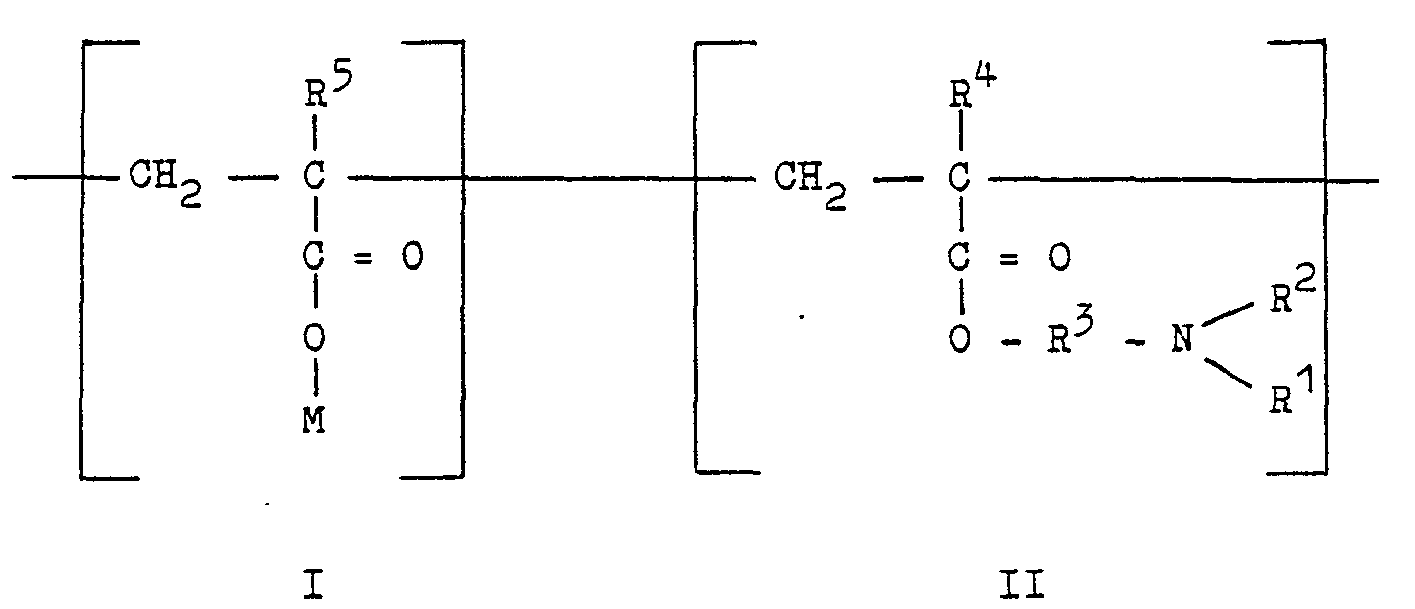
- a method of preventing or reducing the migration of fines in a permeable structure comprising:
- Monomer units I and II are linked together in a random sequence along the copolymer chain.
- the organic copolymers used in the method of the invention are very effective in treating fines such as silica, iron minerals such as hematite, magnetite, lepidocrocite, wuestite, akaganeite, and siderite, and alkaline earth metal carbonates such as calcite and dolomite.
- a treatment with the organic copolymers of the present invention is essentially permanent and the copolymers are very resistant to being removed by brines, oils, or acids. Formations exhibit high permeability retention after the fines of the formation have been treated with the organic copolymers.
- the copolymers are very effective over a wide range of temperatures and are particularly effective from 76°F to 560°F (24 to 293°C).
- the organic copolymers of the present invention which are noncationic in character in a liquid media having a pH of 7 or above, will not react with anionic chemicals which may be used with organic copolymers and are therefore compatible with anionic, nonionic, and cationic chemicals at acidic, basic, and neutral pH conditions.
- the organic copolymers will not precipitate or decompose when they are in the presence of the anionic, nonionic and/or cationic chemicals.
- the present invention involves the use of organic copolymers, which are noncationic in character in a liquid medium having a pH of 7 or above, to stabilize fines contained in the formation. These fines may or may not be present with clay minerals.
- the organic copolymers can be used to treat both natural and artificial structures which are permeable, including poorly consolidated and unconsolidated rocks.
- the method of the invention is particularly suited for stabilizing fine particles having a diameter of less than 10 microns.
- the invention is not limited to any particular theory of operation, it is believed that when the copolymer is in the presence of an anionic and/or nonionic chemical at a pH of 7 or above, the nonionic chemical and copolymer have a neutral electronic charge and the anionic chemical has a negative electronic charge. Therefore, the anionic chemical and nonionic chemical will not react with the copolymer because the copolymer has an electronic charge which is nonreactive with the electron charge of the anionic chemical and nonionic chemical. At a pH of less than 7, the nonionic and anionic chemicals have a neutral electronic charge and will not react with the copolymer which may have a positive electronic charge due to protonation.
- Examples of monomer unit I which are suitable in the method of the present invention include methacrylic acid, the sodium and potassium salts of methacrylic acid, acrylic acid, the sodium and potassium salts of acrylic acid and mixtures thereof.
- Examples of monomer unit II which are suitable in the method of the present invention include: dimethylaminoethyl methacrylate, diethylaminomethyl methacrylate, dimethylaminopropyl methacrylate, diethylaminoethyl methacrylate, dimethylaminomethyl methacrylate, diethylaminomethyl acrylate, diethylaminomethyl acrylate, dimethylaminopropyl acrylate and mixtures thereof.
- a particularly preferred copolymer which is suitable for use in the present invention comprises a copolymer having a molecular weight of about 1,000,000 and having recurring structural monomer salts linked in a random fashion and having the general formula: wherein monomer unit is present in the amount of about 30 percent by weight of the copolymer and monomer unit II is present in the amount of about 70 percent by weight of the coplymer.
- the organic copolymers of the present invention should have a molecular weight of from 1,000 to 3,000,000. Preferably the organic copolymers have a molecular weight of about 1,000,000.
- the molecular weight of the organic copolymers used in the method of the present invention will vary over a wide range depending upon the permeability of the formation to be treated and the copolymer utilized in the method of the invention.
- organic copolymers employed in the method of the present invention will vary according to, for example, the size and porosity of the particular formation and the type of fines present. Therefore, there are no upper or lower limits in this regard.
- any suitable method of application can be used to carry out the method of the invention.
- the organic polymers When a carrier fluid is used to carry out the method of the invention, the organic polymers will generally be present in the carrier fluid in a concentration within the range of from 0.01 to 5% by weight of the carrier fluid. Lower or higher concentrations can be used, but are not generally as practical. When a carrier fluid is used, the preferred concentration of the organic polymers is in the range of from 0.25 o 1.00% by weight of the carrier fluid.
- Carrier fluids which can be used to carry out the method of the present invention include polar and nonpolar fluids.
- suitable fluids are water, brine, and aqueous mixtures of low molecular weight alcohols.
- suitable low molecular weight alcohols include methanol, ethanol, and isopropanol.
- the carrier fluid can contain other ingredients which do not substantially interfere with the dispersion or dissolution or the polymer in the carrier fluid.
- the water can be gelled or thickened for certain applications.
- ingredients which can be included in the water include salts, mineral acids, low molecular weight organic acids, cationic, nonionic, or anionic surfactants, and wetting agents.
- the carrier fluid has a boiling point in the range of from 25°C to 200°C and a viscosity of less than 10 centipoise. Higher viscosity fluids may be used in certain applications but are not generally very practical due to the pressure and pumping requirements.
- a preferred aqueous carrier fluid is a saline solution containing 0.1 to 40 percent by weight of salt.
- the preferred salt concentration is about 2 to about 12% by eight of the solution.
- the salt can be an alkali metal salt, alkaline earth metal salt, an ammonium salt or mixtures thereof.
- Suitable anions include halides, such as chloride, bromide, iodide, and fluoride, sulfates, carbonates, hydroxides, or mixtures thereof.
- the halides of potassium, sodium, magnesium, calcium, and ammonium and mixtures thereof are preferred due to the economics and solubility.
- Aqueous acids having a concentration of 0.1 to 40% by weight of the solution can also be utilized in carrying out the method of the invention.
- suitable acids include hydrochloric acid, hydrofluoric acid, phosphoric acid, acetic acid, formic acid, citric acid, and mixtures thereof.
- the preferred acids include 3 to 15% by weight of hydrochloric acid and a mixture of 12 t 15% by weight of hydrochloric acid, about 1% by weight acetic acid and about 0.6% by weight citric acid.
- the method of the present invention can be used with a number of operations.
- the method of the present invention can be used in conjunction with sand consolidation procedures, gravel or sand packing procedures, secondary recovery operations, and acidizing or fracturing operations.
- the organic polymers can be used to prevent or reduce the migration of fines in the subterranean formation. This results in a greater increase of permeability in the formation.
- the test equipment used in the tests was a TEFLON sleeved test chamber having a diameter of about 2.32 cm. at the bottom of the chamber and a diameter of about 2.54 cm. at the top of the chamber.
- the chamber design insured that under modest applied pressure, fluids injected during the test would flow through the test sand rather than around the test sand.
- the test sand comprised 100 grams of a mixture of 85 percent by weight 70-170 U.S. Mesh sand and 15 percent by weight ground silica flour particles sieved through a 325 U.S. mesh screen. The median particle diameter of the silica particles was 22.4 micrometers.
- a 100 U.S. mesh screen was placed at the base of the chamber to hold the larger particles in place. 7.5 grams of 20-40 U.S. mesh sand was placed on the mixture at the top of the chamber to minimise the effects of turbulence during the initial fluid injection.
- the test chamber and a fluid reservoir were heated to about 145°F (63°C).
- the first fluid injected into the top of the chamber during the test comprised 234 cc. of an aqueous solution containing 2% by weight ammonium chloride and various concentrations of the copolymer. Included in these tests was a treatment in which no copolymer was added to the fluid.
- the injection pressure of the fluid was 5 psia (34.5 kPa).
- Fresh water was then injected into the top of the chamber at a pressure of 4 psig (27.6 kPag).
- the volume of the fresh water was 500 cc., which equaled about 30 pore volumes.
- the fresh water treatment was followed by an injection at 40 psig (276 kPag) of 400 cc. (24 pore volumes) of an aqeuous solution comprising 15 percent by weight hydrochloric acid followed by the injection of 40 psig (276 kPag) of 500 cc. (30 pore volumes) of fresh water.
Landscapes
- Chemical & Material Sciences (AREA)
- Life Sciences & Earth Sciences (AREA)
- General Life Sciences & Earth Sciences (AREA)
- Engineering & Computer Science (AREA)
- Materials Engineering (AREA)
- Organic Chemistry (AREA)
- Chemical Kinetics & Catalysis (AREA)
- General Chemical & Material Sciences (AREA)
- Oil, Petroleum & Natural Gas (AREA)
- Addition Polymer Or Copolymer, Post-Treatments, Or Chemical Modifications (AREA)
- Catalysts (AREA)
- Packages (AREA)
- Measuring Or Testing Involving Enzymes Or Micro-Organisms (AREA)
Claims (10)

Priority Applications (1)
| Application Number | Priority Date | Filing Date | Title |
|---|---|---|---|
| AT84307653T ATE38528T1 (de) | 1984-02-28 | 1984-11-06 | Verfahren zum reduzieren der wanderung von feinen teilchen in poroesen strukturen. |
Applications Claiming Priority (2)
| Application Number | Priority Date | Filing Date | Title |
|---|---|---|---|
| US06/584,379 US4558741A (en) | 1984-02-28 | 1984-02-28 | Methods of minimizing fines migration in subterranean formations |
| US584379 | 1984-02-28 |
Publications (3)
| Publication Number | Publication Date |
|---|---|
| EP0154080A2 EP0154080A2 (fr) | 1985-09-11 |
| EP0154080A3 EP0154080A3 (en) | 1986-07-23 |
| EP0154080B1 true EP0154080B1 (fr) | 1988-11-09 |
Family
ID=24337086
Family Applications (1)
| Application Number | Title | Priority Date | Filing Date |
|---|---|---|---|
| EP84307653A Expired EP0154080B1 (fr) | 1984-02-28 | 1984-11-06 | Méthode pour réduire la migration de particules fines dans des structures poreuses |
Country Status (7)
| Country | Link |
|---|---|
| US (1) | US4558741A (fr) |
| EP (1) | EP0154080B1 (fr) |
| AT (1) | ATE38528T1 (fr) |
| AU (1) | AU558642B2 (fr) |
| CA (1) | CA1228722A (fr) |
| DE (1) | DE3475082D1 (fr) |
| NO (1) | NO844554L (fr) |
Families Citing this family (9)
| Publication number | Priority date | Publication date | Assignee | Title |
|---|---|---|---|---|
| JPS61250085A (ja) * | 1985-04-30 | 1986-11-07 | Lion Corp | 土壌処理方法 |
| GB8610762D0 (en) * | 1986-05-02 | 1986-06-11 | Allied Colloids Ltd | Soil sealing compositions |
| US4913235A (en) * | 1987-06-03 | 1990-04-03 | Chevron Research Company | Enhanced oil recovery using CO2 flooding |
| US5072791A (en) * | 1990-10-03 | 1991-12-17 | Conoco Inc. | Method of stabilizing formation prior to gravel packing |
| US5249627A (en) * | 1992-03-13 | 1993-10-05 | Halliburton Company | Method for stimulating methane production from coal seams |
| CA2195959A1 (fr) * | 1994-08-19 | 1996-02-29 | Neil A. Randen | Adhesifs a base d'eau |
| US6855672B2 (en) * | 2001-11-07 | 2005-02-15 | Baker Hughes Incorporated | Copolymers useful for gelling acids |
| US8757261B2 (en) | 2011-05-12 | 2014-06-24 | Halliburton Energy Services, Inc. | Methods and compositions for clay control |
| US10160899B2 (en) | 2014-05-15 | 2018-12-25 | Halliburton Energy Services, Inc. | Method of treating water-swellable minerals in a subterranean formation with a stabilizing compound with a cationic group and hydrophobic portion |
Family Cites Families (37)
| Publication number | Priority date | Publication date | Assignee | Title |
|---|---|---|---|---|
| US2765290A (en) * | 1952-05-15 | 1956-10-02 | Zoesollte Company | Soil conditioning |
| US3057798A (en) * | 1960-09-12 | 1962-10-09 | Halliburton Co | Well treating fluid |
| GB1062742A (en) * | 1962-10-17 | 1967-03-22 | American Mach & Foundry | Electrodialysis method and device |
| US3434971A (en) * | 1965-08-25 | 1969-03-25 | Dow Chemical Co | Composition and method for acidizing wells |
| US3494865A (en) * | 1966-04-01 | 1970-02-10 | Nat Lead Co | Lignite products and compositions thereof |
| US3562226A (en) * | 1969-08-13 | 1971-02-09 | Calgon Corp | Friction reducing |
| US3827977A (en) * | 1969-11-25 | 1974-08-06 | Atlantic Richfield Co | Composition for inhibiting scale formation in oil well brines |
| US3704750A (en) * | 1969-11-25 | 1972-12-05 | Atlantic Richfield Co | Process for inhibiting scale formation in oil well brines |
| US3832302A (en) * | 1972-01-17 | 1974-08-27 | Halliburton Co | Methods for inhibiting scale formation |
| US3868328A (en) * | 1972-03-09 | 1975-02-25 | Calgon Corp | Friction reducing compounds for use in hydraulic fracturing fluids |
| US3794117A (en) * | 1972-09-05 | 1974-02-26 | Halliburton Co | Treatment of sandstone formations |
| US4062796A (en) * | 1973-12-10 | 1977-12-13 | Halliburton Company | Methods for inhibiting scale formation |
| US3927718A (en) * | 1973-12-26 | 1975-12-23 | Texaco Inc | Secondary recovery method |
| US3943060A (en) * | 1974-07-26 | 1976-03-09 | Calgon Corporation | Friction reducing |
| US4079011A (en) * | 1974-09-03 | 1978-03-14 | Texaco Inc. | Composition containing a polyvinylpyrrolidone and method for stimulating well production |
| US3962332A (en) * | 1974-12-11 | 1976-06-08 | Celanese Corporation | Bis-quaternary ammonium compounds and polymers |
| US3916995A (en) * | 1974-12-20 | 1975-11-04 | Texaco Inc | Secondary recovery method |
| US3916994A (en) * | 1974-12-20 | 1975-11-04 | Texaco Inc | Secondary recovery method |
| US3916996A (en) * | 1974-12-20 | 1975-11-04 | Texaco Inc | Secondary recovery method |
| US4055502A (en) * | 1975-12-24 | 1977-10-25 | Phillips Petroleum Company | Method and composition for acidizing subterranean formations |
| US4018285A (en) * | 1976-03-19 | 1977-04-19 | Exxon Production Research Company | Method for controlling fines migrations |
| US4366072A (en) * | 1976-08-13 | 1982-12-28 | Halliburton Company | Oil well treating method and composition |
| US4366071A (en) * | 1976-08-13 | 1982-12-28 | Halliburton Company | Oil well treating method and composition |
| US4374739A (en) * | 1976-08-13 | 1983-02-22 | Halliburton Company | Oil well treating method and composition |
| US4366073A (en) * | 1976-08-13 | 1982-12-28 | Halliburton Company | Oil well treating method and composition |
| US4366074A (en) * | 1976-08-13 | 1982-12-28 | Halliburton Company | Oil well treating method and composition |
| CA1103008A (fr) * | 1976-08-13 | 1981-06-16 | Homer C. Mclaughlin | Traitement des formations argileuses par des polymeres polycationiques, organiques |
| US4200154A (en) * | 1976-12-22 | 1980-04-29 | Texaco Inc. | Composition and method for stimulating well production |
| US4200151A (en) * | 1976-12-22 | 1980-04-29 | Texaco Inc. | Secondary recovery process |
| US4206058A (en) * | 1976-12-22 | 1980-06-03 | Texaco Inc. | Method for stimulating well production |
| US4193453A (en) * | 1977-06-20 | 1980-03-18 | Standard Oil Company (Indiana) | Method for consolidating sand or water control in subterranean formations |
| US4152274A (en) * | 1978-02-09 | 1979-05-01 | Nalco Chemical Company | Method for reducing friction loss in a well fracturing process |
| US4158521A (en) * | 1978-06-26 | 1979-06-19 | The Western Company Of North America | Method of stabilizing clay formations |
| US4393939A (en) * | 1981-04-20 | 1983-07-19 | Halliburton Services | Clay stabilization during oil and gas well cementing operations |
| US4460483A (en) * | 1981-10-09 | 1984-07-17 | Halliburton Company | Methods and hydrocarbon base treating fluids for stabilizing water sensitive clay containing formations |
| GB2110744B (en) * | 1981-12-02 | 1985-09-18 | Halliburton Co | Method and compositions for acidizing subterranean formations |
| US4447342A (en) * | 1982-04-19 | 1984-05-08 | Halliburton Co. | Method of clay stabilization in enhanced oil recovery |
-
1984
- 1984-02-28 US US06/584,379 patent/US4558741A/en not_active Expired - Lifetime
- 1984-10-18 CA CA000465761A patent/CA1228722A/fr not_active Expired
- 1984-10-25 AU AU34667/84A patent/AU558642B2/en not_active Ceased
- 1984-11-06 AT AT84307653T patent/ATE38528T1/de not_active IP Right Cessation
- 1984-11-06 EP EP84307653A patent/EP0154080B1/fr not_active Expired
- 1984-11-06 DE DE8484307653T patent/DE3475082D1/de not_active Expired
- 1984-11-15 NO NO844554A patent/NO844554L/no unknown
Also Published As
| Publication number | Publication date |
|---|---|
| EP0154080A2 (fr) | 1985-09-11 |
| AU558642B2 (en) | 1987-02-05 |
| DE3475082D1 (en) | 1988-12-15 |
| US4558741A (en) | 1985-12-17 |
| CA1228722A (fr) | 1987-11-03 |
| EP0154080A3 (en) | 1986-07-23 |
| ATE38528T1 (de) | 1988-11-15 |
| NO844554L (no) | 1985-08-29 |
| AU3466784A (en) | 1985-09-05 |
Similar Documents
| Publication | Publication Date | Title |
|---|---|---|
| EP0171163B1 (fr) | Méthodes pour réduire la migration de fines particules dans des formations souterraines | |
| US4563292A (en) | Methods for stabilizing fines contained in subterranean formations | |
| US4536305A (en) | Methods for stabilizing swelling clays or migrating fines in subterranean formations | |
| CA1178040A (fr) | Procedes et composes ameliores pour la recuperation des produits petroliers | |
| EP0680504B1 (fr) | Procede de traitement de schiste et d'argile dans le forage de formations d'hydrocarbures | |
| EP0197684B1 (fr) | Réduction de la perméabilité d'eau d'une formation souterraine | |
| US4532052A (en) | Polymeric well treating method | |
| US4374739A (en) | Oil well treating method and composition | |
| US3804173A (en) | Method for reducing polymer adsorption in secondary oil recovery operations | |
| US4366074A (en) | Oil well treating method and composition | |
| US2761843A (en) | Treatment of clays | |
| US4366071A (en) | Oil well treating method and composition | |
| US4462718A (en) | Oil well treating method and composition | |
| US4366073A (en) | Oil well treating method and composition | |
| US4738897A (en) | Polymer article and its use for controlled introduction of reagent into a fluid | |
| EP0266043B1 (fr) | Stabilisation de la perméabilité de formations souterraines contenant des substances particulaires | |
| US4366072A (en) | Oil well treating method and composition | |
| EP0251558A2 (fr) | Agent stabilisant l'argile | |
| US4497596A (en) | Method of minimizing fines migration in a subterranean formation | |
| US4143716A (en) | Tertiary oil recovery process utilizing a preflush | |
| US3208515A (en) | Method of recovering oil from underground reservoirs | |
| EP0154080B1 (fr) | Méthode pour réduire la migration de particules fines dans des structures poreuses | |
| CA1239921A (fr) | Composition et methode pour modifier la permeabilite d'un gisement | |
| US4982789A (en) | Method of using urea as a sacrificial agent for surfactants in enhanced oil recovery | |
| US4536304A (en) | Methods of minimizing fines migration in subterranean formations |
Legal Events
| Date | Code | Title | Description |
|---|---|---|---|
| PUAI | Public reference made under article 153(3) epc to a published international application that has entered the european phase |
Free format text: ORIGINAL CODE: 0009012 |
|
| AK | Designated contracting states |
Designated state(s): AT DE FR GB IT NL SE |
|
| PUAL | Search report despatched |
Free format text: ORIGINAL CODE: 0009013 |
|
| AK | Designated contracting states |
Kind code of ref document: A3 Designated state(s): AT DE FR GB IT NL SE |
|
| 17P | Request for examination filed |
Effective date: 19860826 |
|
| 17Q | First examination report despatched |
Effective date: 19871217 |
|
| GRAA | (expected) grant |
Free format text: ORIGINAL CODE: 0009210 |
|
| ITF | It: translation for a ep patent filed | ||
| AK | Designated contracting states |
Kind code of ref document: B1 Designated state(s): AT DE FR GB IT NL SE |
|
| REF | Corresponds to: |
Ref document number: 38528 Country of ref document: AT Date of ref document: 19881115 Kind code of ref document: T |
|
| REF | Corresponds to: |
Ref document number: 3475082 Country of ref document: DE Date of ref document: 19881215 |
|
| ET | Fr: translation filed | ||
| PLBE | No opposition filed within time limit |
Free format text: ORIGINAL CODE: 0009261 |
|
| STAA | Information on the status of an ep patent application or granted ep patent |
Free format text: STATUS: NO OPPOSITION FILED WITHIN TIME LIMIT |
|
| 26N | No opposition filed | ||
| PG25 | Lapsed in a contracting state [announced via postgrant information from national office to epo] |
Ref country code: GB Effective date: 19891106 Ref country code: AT Effective date: 19891106 |
|
| PG25 | Lapsed in a contracting state [announced via postgrant information from national office to epo] |
Ref country code: SE Effective date: 19891107 |
|
| PG25 | Lapsed in a contracting state [announced via postgrant information from national office to epo] |
Ref country code: NL Effective date: 19900601 |
|
| GBPC | Gb: european patent ceased through non-payment of renewal fee | ||
| NLV4 | Nl: lapsed or anulled due to non-payment of the annual fee | ||
| PG25 | Lapsed in a contracting state [announced via postgrant information from national office to epo] |
Ref country code: FR Effective date: 19900731 |
|
| PG25 | Lapsed in a contracting state [announced via postgrant information from national office to epo] |
Ref country code: DE Effective date: 19900801 |
|
| REG | Reference to a national code |
Ref country code: FR Ref legal event code: ST |
|
| EUG | Se: european patent has lapsed |
Ref document number: 84307653.0 Effective date: 19900705 |