EP0154855A2 - Zeolithe cristalline et agglomérat la contenant - Google Patents
Zeolithe cristalline et agglomérat la contenant Download PDFInfo
- Publication number
- EP0154855A2 EP0154855A2 EP85101899A EP85101899A EP0154855A2 EP 0154855 A2 EP0154855 A2 EP 0154855A2 EP 85101899 A EP85101899 A EP 85101899A EP 85101899 A EP85101899 A EP 85101899A EP 0154855 A2 EP0154855 A2 EP 0154855A2
- Authority
- EP
- European Patent Office
- Prior art keywords
- zeolite
- barium
- crystalline zeolite
- water
- molecular sieve
- Prior art date
- Legal status (The legal status is an assumption and is not a legal conclusion. Google has not performed a legal analysis and makes no representation as to the accuracy of the status listed.)
- Granted
Links
Images




Classifications
-
- B—PERFORMING OPERATIONS; TRANSPORTING
- B01—PHYSICAL OR CHEMICAL PROCESSES OR APPARATUS IN GENERAL
- B01J—CHEMICAL OR PHYSICAL PROCESSES, e.g. CATALYSIS OR COLLOID CHEMISTRY; THEIR RELEVANT APPARATUS
- B01J20/00—Solid sorbent compositions or filter aid compositions; Sorbents for chromatography; Processes for preparing, regenerating or reactivating thereof
- B01J20/02—Solid sorbent compositions or filter aid compositions; Sorbents for chromatography; Processes for preparing, regenerating or reactivating thereof comprising inorganic material
- B01J20/10—Solid sorbent compositions or filter aid compositions; Sorbents for chromatography; Processes for preparing, regenerating or reactivating thereof comprising inorganic material comprising silica or silicate
- B01J20/16—Alumino-silicates
- B01J20/18—Synthetic zeolitic molecular sieves
- B01J20/183—Physical conditioning without chemical treatment, e.g. drying, granulating, coating, irradiation
-
- C—CHEMISTRY; METALLURGY
- C01—INORGANIC CHEMISTRY
- C01B—NON-METALLIC ELEMENTS; COMPOUNDS THEREOF; METALLOIDS OR COMPOUNDS THEREOF NOT COVERED BY SUBCLASS C01C
- C01B13/00—Oxygen; Ozone; Oxides or hydroxides in general
- C01B13/02—Preparation of oxygen
- C01B13/0229—Purification or separation processes
- C01B13/0248—Physical processing only
- C01B13/0259—Physical processing only by adsorption on solids
- C01B13/0262—Physical processing only by adsorption on solids characterised by the adsorbent
- C01B13/027—Zeolites
-
- C—CHEMISTRY; METALLURGY
- C01—INORGANIC CHEMISTRY
- C01B—NON-METALLIC ELEMENTS; COMPOUNDS THEREOF; METALLOIDS OR COMPOUNDS THEREOF NOT COVERED BY SUBCLASS C01C
- C01B21/00—Nitrogen; Compounds thereof
- C01B21/04—Purification or separation of nitrogen
- C01B21/0405—Purification or separation processes
- C01B21/0433—Physical processing only
- C01B21/045—Physical processing only by adsorption in solids
- C01B21/0455—Physical processing only by adsorption in solids characterised by the adsorbent
- C01B21/0466—Zeolites
-
- C—CHEMISTRY; METALLURGY
- C01—INORGANIC CHEMISTRY
- C01B—NON-METALLIC ELEMENTS; COMPOUNDS THEREOF; METALLOIDS OR COMPOUNDS THEREOF NOT COVERED BY SUBCLASS C01C
- C01B32/00—Carbon; Compounds thereof
- C01B32/40—Carbon monoxide
-
- C—CHEMISTRY; METALLURGY
- C01—INORGANIC CHEMISTRY
- C01B—NON-METALLIC ELEMENTS; COMPOUNDS THEREOF; METALLOIDS OR COMPOUNDS THEREOF NOT COVERED BY SUBCLASS C01C
- C01B39/00—Compounds having molecular sieve and base-exchange properties, e.g. crystalline zeolites; Their preparation; After-treatment, e.g. ion-exchange or dealumination
- C01B39/02—Crystalline aluminosilicate zeolites; Isomorphous compounds thereof; Direct preparation thereof; Preparation thereof starting from a reaction mixture containing a crystalline zeolite of another type, or from preformed reactants; After-treatment thereof
- C01B39/026—After-treatment
-
- C—CHEMISTRY; METALLURGY
- C01—INORGANIC CHEMISTRY
- C01B—NON-METALLIC ELEMENTS; COMPOUNDS THEREOF; METALLOIDS OR COMPOUNDS THEREOF NOT COVERED BY SUBCLASS C01C
- C01B2210/00—Purification or separation of specific gases
- C01B2210/0043—Impurity removed
- C01B2210/0045—Oxygen
-
- C—CHEMISTRY; METALLURGY
- C01—INORGANIC CHEMISTRY
- C01B—NON-METALLIC ELEMENTS; COMPOUNDS THEREOF; METALLOIDS OR COMPOUNDS THEREOF NOT COVERED BY SUBCLASS C01C
- C01B2210/00—Purification or separation of specific gases
- C01B2210/0043—Impurity removed
- C01B2210/0046—Nitrogen
-
- C—CHEMISTRY; METALLURGY
- C01—INORGANIC CHEMISTRY
- C01B—NON-METALLIC ELEMENTS; COMPOUNDS THEREOF; METALLOIDS OR COMPOUNDS THEREOF NOT COVERED BY SUBCLASS C01C
- C01B2210/00—Purification or separation of specific gases
- C01B2210/0043—Impurity removed
- C01B2210/005—Carbon monoxide
-
- Y—GENERAL TAGGING OF NEW TECHNOLOGICAL DEVELOPMENTS; GENERAL TAGGING OF CROSS-SECTIONAL TECHNOLOGIES SPANNING OVER SEVERAL SECTIONS OF THE IPC; TECHNICAL SUBJECTS COVERED BY FORMER USPC CROSS-REFERENCE ART COLLECTIONS [XRACs] AND DIGESTS
- Y10—TECHNICAL SUBJECTS COVERED BY FORMER USPC
- Y10S—TECHNICAL SUBJECTS COVERED BY FORMER USPC CROSS-REFERENCE ART COLLECTIONS [XRACs] AND DIGESTS
- Y10S95/00—Gas separation: processes
- Y10S95/90—Solid sorbent
- Y10S95/902—Molecular sieve
Definitions
- the present invention relates to a crystalline zeolite, more specifically a barium-exchanged crystalline zeolite X (or a barium cation form type-X crystalline zeolite).
- the present invention also relates to an agglomerate comprising the above-mentioned crystalline zeolite and a binder material, which is suitable for use as an adsorbent for selective removal and/or separation of a specific component such as carbon monoxide, oxygen, carbon dioxide, and water vapor from a fluid stream containing the same.
- zeolites are industrially utilized for drying, purification, recovery, and/or separation of various fluids such as hydrocarbon streams and atmospheric air employing the adsorptive properties of the components in the fluids on the zeolites.
- the effectiveness of the treatments of a fluid stream such as drying, purification, recovery and/or separation depends upon the type of zeolite to be used as well as the components of a fluid to be treated.
- Na-A zeolite (or sodium cation form type-A crystalline zeolite) pellets comprising crystalline zeolite Na-A and a clay mineral as main constituents can adsorb molecules having size and shape to permit entrance through a micro-pore of 3.8 angstroms such as water vapor, hydrogen sulphide, carbon dioxide, ethane, ethyl alcohol and butadiene, while other molecules such as propane, cyclic hydrocarbons and compressor oil being excluded.
- the Na-A zeolite pellets therefore, have been advantageously utilized as an adsorbent for such as natural gas and solvent drying, carbon dioxde removal from natural gas streams.
- Na-X zeolite pellets comprising crystals of Na-X zeolite having rational formula of: and a clay mineral as main constituents can adsorb molecules smaller than an effective diameter of 10 angstroms such as iso-paraffins, iso-olefins and di-n-butylamine and exclude molecules having a large diameter of more than 10 angstroms such as tri-n-butylamine, and have been employed for the purposes of for example, simultaneous removal of moisture and carbon dioxide from fluid streams containing the same or the removal of sulphur compounds from hydrocarbon streams containing the same.
- the Ba-form zeolite X exhibits the desirable separation property for various sorbates such as nitrogen and oxygen.
- the desirable separation property of the conventional barium-form zeolite X is susceptible to be impaired during processing, i.e., the blending of the barium-form zeolite and the binder, the fashioning of the mixture into suitable forms and the firing of the formed material at elevated temperatures has prevented the prevalence thereof in the practical use.
- Na-X zeolite has been employed for the above-mentioned purpose, for example, as an industrial adsorbent for separation and/or removal, it is still not satisfactory for some uses as an adsorbent, for example, the separation of carbon monoxide and nitrogen and the separation of oxygen and nitrogen of atmospheric air.
- the object of the present invention is to eliminate the above-mentioned disadvantages of the conventional Na-X zeolite and to provide a barium-exchanged crystalline zeolite X.
- Another object of the present invention is to provide a zeolitic molecular sieve agglomerate for the use of effective separation and/or removal of specific components from fluid streams containing the same.
- a crystalline zeolite having, except for water of crystallization, the formula: wherein x is a number from 0.6 to 0.8.
- a zeolitic molecular sieve agglomerate comprising a bonded product of a crystalline zeolite having the above-mentioned formula (I) and a binder activated at elevated temperature for the use of separation and/or removal of a specific component from a fluid stream containing the same.
- the crystalline zeolites according to the present invention are those having, except for the water of crystallization, the general formula (I) and obtained by substituting barium cation for 60% to 80% of the sodium cation of the Na-X zeolite.
- the barium cation exchange ratio is less than 60%, the separation property of the sorbates in a fluid stream containing the same is not improved, when the agglomerates prepared by blending the zeolite and a clay binder and activated at elevated temperatures are compared with the conventional Na-X zeolite agglomerates prepared by the same procedure as the above-mentioned Ba-X zeolite agglomerates.
- the Ba-X having higher than 80% of cation exchange ratio causes a difficulty in crystalline stability thereof, when manufactured into agglomerates for the industrial use with maintaining the desired adsorptive and/or separation property.
- the Na-X zeolite used as a starting material in the preparation of the barium-exchanged crystalline zeolite X according to the present invention is known and commercially available, which can also be prepared by the methods disclosed in, for example, U.S. Patent No. 2,882, 244 and 2,979,381.
- the partial barium ion exchange of the Na-X zeolite can be carried out by, for example, a method disclosed in U.S. Patent No. 2,882,244.
- the Na-X zeolite is treated with a solution containing a certain amount of barium cation, such as an aqueous or alcoholic solution containing a certain amount of a barium compound to obtain the desired barium-exchanged crystalline zeolite X.
- a 0.1 to 1 mole/liter solution of barium chloride or barium nitrate can be typically employed in the preparation of the desired barium-exchanged crystalline zeolite X.
- the desired barium ion exchange ratio of 60% to 80% can be easily achieved by controlling the relative amounts of the barium compound and the Na-X zeolite used in the treatment process.
- the barium-exchanged crystalline zeolite having the above-mentioned general formula (I) thus prepared can be advantageously converted into a zeolitic molecular sieve agglomerate in any conventional manner, for example, by blending the binders, fashioning the mixture into suitable forms and activating at elevated temperatures. Thus, the clay is dried to give a bonded product and the water of hydration of the zeolite is lost.
- the binders usable in the present invention include any conventional binders, for example, bentonite clays such as bentonite, kaolin clays such as kaolin, plastic ball clays, and clays of attapulgite.
- the preferable weight ratio of the crystalline zeolite to the binder is 70:30 to 90:10.
- the barium-exchanged crystalline zeolite X and the binder and, optionally, some conventional additives, can be mixed together by using any conventional mechanical means such as a muller, kneader, or blender.
- the mixture is then formed in any conventional manner, for example, by using an extruder, pelletizer, or any other bead-forming means to pellets or other suitable forms.
- the resultant agglomerates are finally dried and calcined at elevated temperatures (e.g., 150°C to 300°C and 550°C to 700°C, respectively).
- the desired zeolitic molecular sieve agglomerate can be obtained.
- the water of crystallization i.e., 276 molecule of water pre unit cell
- the desired molecular sieve agglomerate suitable for use in the drying, adsorption, separation, or removal of a certain gas or other components can be produced.
- the molecular sieve agglomerate including the barium-exchanged type crystalline zeolite, in which 60% to 80% of the sodium ions is exchanged with barium ions can be manufactured by preparing a zeolitic molecular sieve agglomerate including Na-X zeolite and the above-mentioned binder, followed by partially exchanging the sodium ions of the resultant Na-X zeolite agglomerate with barium ions.
- the Na-X zeolitic molecular sieve agglomerate can be prepared in any conventional manner, e.g., by mixing the Na-X zeolite with the binder, followed by drying and calcining the formed mixture at elevated temperatures (e.g., 150°C to 300°C and 550°C to 700°C, respectively).
- the resultant Na-X zeolitic molecular sieve agglomerate can be treated with the above-mentioned solution containing barium ions.
- the resultant barium-exchanged molecular sieve agglomerate is then dried and activated at a temperature of, for example, 200°C to 550°C.
- the molecular sieve agglomerates including, as a main constituent, the barium-exchanged crystalline zeolite having the above-mentioned general formula (I) have excellent thermal stability and thermal deterioration resistance and can be effectively used in the separation and purification of gas mixtures.
- the present molecular sieve agglomerates can be advantageously used in the separation of carbon monoxide and nitrogen, in the separation of nitrogen and oxygen, or in the removal of water vapor and carbon dioxide from air containing the same.
- the crystal thus obtained was filtered and thoroughly washed with water until no chlorine ions were detected in the washed liquor. After air dried, the crystalline zeolite was heated at a temperature of 200°C for 2 hours and, then at a temperature of 450°C for 2 hours. Thus, the crystalline zeolite was activated.
- the zeolite crystal thus prepared had a barium content of 21.85% by weight determined by gravimetric analysis and a sodium content of 4.47% by weight determined by atomic-absorption spectroscopic analysis.
- the barium ion exchange ratio calculated from these analysis data was 62%.
- the X-ray diffraction pattern of the barium-exchanged crystalline zeolite obtained above was as shown in Fig. 1.
- the reason why the peak height of the X-ray diffraction pattern in Fig. 1 is lower than that of the molecular sieve 13X powder is that the X-ray absorption coefficient of barium is large.
- the water absorption capacity of the barium-exchanged crystalline zeolite obtained above was 27.3 g/ 100 g, as determined under the conditions of 17.5 mmHg and 25°C in a McBain Bakr apparatus. Although this water adsorption capacity was lower than that of the starting Na-X zeolite powder (i.e., 33.3 g/100 g), this was caused by the fact that the specific gravity of the crystalline zeolite was increased and that the internal void volume of the crystals per unit cell was changed due to the exchange of sodium ion with the barium ion. When the adsorption capacity was compared in terms of the adsorption amount per unit cell, there was no substantial difference between the water adsorption capacities.
- Barium-exchanged crystalline zeolite was prepared in the same manner as in Example 1, except that 60 g of BaCl 2 -2H 2 0 was used.
- the barium content and the sodium content of the resultant crystalline zeolite determined in the same manner as in Example 1 were 22.79% by weight and 4.04% by weight, respectively.
- the barium ion exchange ratio obtained from these data was 65%.
- the X-ray diffraction pattern of the crystalline zeolite obtained above was as shown in Fig. 2.
- the water absorption capacity of the crystalline zeolite was 26.9 g/100 g as determined in the same manner as in Example 1.
- Barium-exchanged crystalline zeolite was prepared in the same manner as in Example 1, except that 80 g of BaCl 2' 2H 2 0 was used.
- the barium content and the sodium content of the resultant crystalline determined in the same manner as in Example 1 were 25.92% by weight and 2.89% by weight, respectively.
- the barium ion exchange ratio obtained from these data was 75%.
- the X-ray diffraction pattern of the crystalline zeolite obtained above was as shown in Fig. 3.
- the water adsorption capacity of the crystalline zeolite was 26.6 g/100 g as determined in the same manner as in Example 1.
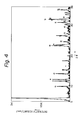
- Barium-exchange crystalline zeolite was prepared in the same manner as in Example 3, except that the mixture was heated at a temperature of 80°C for 1 hour after adding the barium solution, instead of being allowed to stand for one night.
- the barium content and the sodium content of the resultant crystalline zeolite determined in the same manner as in Example 1 were 25.62% by weight and 2.95% by weight, respectively.
- the barium ion exchange ratio obtained from these data was 74%.
- the X-ray diffraction pattern of the crystalline zeolite obtained above was as shown in Fig. 4.
- the water adsorption capacity of the crystalline zeolite was 26.5 g/100 g as determined in the same manner as Example 1.
- a 8 kg amount of barium-exchanged crystalline zeolite X having a barium ion exchange ratio of 66% prepared in the same manner as in Example 2 was saturated with moisture in ambient conditions.
- the crystalline zeolite thus obtained was mixed with 2 kg of attapulgite by adding 2.7 kg of water.
- the resultant mixture was extruded through a die and broken into pellets having a diameter of 1.6 mm.
- the pellets obtained above were heated at a temperature of 200°C for 2 hours and were, then, calcined at a temperature of 650°C for 2 hours for the activation.
- the pellets thus obtained were crushed to the particles having a size of 60 to 80 meshes in terms of Tyler mesh.
- the CO/N 2 separation capacity of the resultant agglomerate particles was determined by gas chromatography.
- the column diameter was 3 mm and the packed height was 0.5 m.
- the water adsorption capacity and the C0 2 adsorption capacity of the agglomerate particles determined in the same manner as in Example 1 were 23.6 g/100 g and 17.0 g/100 g, respectively.
- a 8 kg amount of barium-exchanged crystalline zeolite having a barium ion exchange ratio of 77% prepared in the same manner as in Example 3 was agglomerated in the same manner as in Example 5.
- the agglomerate particles having a size of 60 to 80 meshes were obtained.
- the CO/N 2 separation coefficient of the resultant agglomerate particles was 3.75.
- Barium-exchanged crystalline zeolite was prepared in the same manner as in Example 1, except that 25 g of BaCl2 ⁇ 2H20 was used.
- the barium content and the sodium content of the resultant crystalline zeolite determined in the same manner as in Example 1 were 14.7% by weight and 6.2% by weight, respectively.
- the barium ion exchange ratio obtained from these data was 44%.
- the agglomerates of the barium-exchanged Na-X zeolite were prepared in the same manner as in Example 5.
- the CO/N 2 separation coefficient of the resultant agglomerate particles was 3.53.
- Barium-exchanged crystalline zeolite was prepared in the same manner as in Example 1, except that 200 g of BaCl 2 • 2H 2 O was used.
- the barium content and the sodium content of the resultant crystalline zeolite determined in the same manner as in Example 1 were 27.9% by weight and 0.7% by weight, respectively.
- the barium ion exchange ratio obtained from these data was 93%.
- the water absorption capacity of the crystalline zeolite was 21.5 g/100 g as determined in the same manner as in Example 1.
- a 2 kg amount of Na-X zeolite in the form of pellets having a diameter of 1.6 mm was saturated with moisture in ambient conditions. Then, the hydrated pellets were dipped in a solution of 1 kg of Bacl 2 •2H 2 O dissolved in 10 liters of water and were allowed to stand, with occasionally stirring, at room temperature for one night.
- the pellets thus obtained was filtered and thoroughly washed with water until no chlorine ions were detected in the washed liquor. After air dried, the pellets were heated at a temperature of 200°C for 2 hours and, then at a temperature of 450°C for 2 hours. Thus, the pellets were activated.
- the barium content and the sodium content of the resultant pellets determined in the same manner as in Example 1 were 18.8% by weight and 3.6% by weight, respectively.
- the barium ion exchange ratio obtained from these data was 64%.
- the CO/N 2 separation coefficient of the resultant pellets was 3.86.
- a 1.8 kg amount of the barium-exchanged crystalline zeolite agglomerate particles prepared in Example 6 above was packed into a adsorption column having a nominal diameter of 50 mm and a length of 1100 mm.
- the C0 2 adsorption capacity at the C0 2 stoichiometric point was 2.84 g/100 g of zeolite and the mass transfer zone was 23.0% of the total amount of the packed zeolite particles. No breakthrough of the water vapor was observed during the test operation.
- Example 7 The adsorption test was carried out in the same manner as in Example 8, except that the agglomerate pellets obtained in Example 7 were used.
- the C0 2 adsorption capacity at the C0 2 stoichiometric point was 2.8 g/100 g of the zeolite and the mass transfer zone was 23.3% of the total amount of the packed zeolite pellets. No. breakthrough of the water vapor was observed during the test operation.
- Example 8 The adsorption test was carried out in the same manner as in Example 8, except that Na-X zeolite commercially available from UNION SHOWA K.K. were used.
- the C0 2 adsorption capacity at the C0 2 stoichiometric point was 2.5 g/100 g of the zeolite and the mass transfer zone was 28% of the total amount of the packed zeolite pellets. No breakthrough of the water vapor was observed during the test operation.
- the separation test of nitrogen and oxygen from air was carried out in the same manner as in Example 10, except that the zeolite particles X having a barium exchange ratio of 65% and air were used as the adsorbent and the gas mixture, respectively.
Landscapes
- Chemical & Material Sciences (AREA)
- Organic Chemistry (AREA)
- Inorganic Chemistry (AREA)
- General Life Sciences & Earth Sciences (AREA)
- Geology (AREA)
- Life Sciences & Earth Sciences (AREA)
- Analytical Chemistry (AREA)
- Chemical Kinetics & Catalysis (AREA)
- Engineering & Computer Science (AREA)
- Materials Engineering (AREA)
- Silicates, Zeolites, And Molecular Sieves (AREA)
- Solid-Sorbent Or Filter-Aiding Compositions (AREA)
- Carbon And Carbon Compounds (AREA)
- Separation Using Semi-Permeable Membranes (AREA)
- Separation Of Gases By Adsorption (AREA)
- Oxygen, Ozone, And Oxides In General (AREA)
Priority Applications (1)
| Application Number | Priority Date | Filing Date | Title |
|---|---|---|---|
| AT8585101899T ATE105538T1 (de) | 1984-02-28 | 1985-02-21 | Kristallines zeolith und dieses enthaltende agglomerat. |
Applications Claiming Priority (2)
| Application Number | Priority Date | Filing Date | Title |
|---|---|---|---|
| JP35266/84 | 1984-02-28 | ||
| JP59035266A JPS60179134A (ja) | 1984-02-28 | 1984-02-28 | 分子ふるい成形体 |
Publications (3)
| Publication Number | Publication Date |
|---|---|
| EP0154855A2 true EP0154855A2 (fr) | 1985-09-18 |
| EP0154855A3 EP0154855A3 (en) | 1986-11-05 |
| EP0154855B1 EP0154855B1 (fr) | 1994-05-11 |
Family
ID=12436995
Family Applications (1)
| Application Number | Title | Priority Date | Filing Date |
|---|---|---|---|
| EP85101899A Expired - Lifetime EP0154855B1 (fr) | 1984-02-28 | 1985-02-21 | Zeolithe cristalline et agglomérat la contenant |
Country Status (7)
| Country | Link |
|---|---|
| US (1) | US4765808A (fr) |
| EP (1) | EP0154855B1 (fr) |
| JP (1) | JPS60179134A (fr) |
| AT (1) | ATE105538T1 (fr) |
| CA (1) | CA1231931A (fr) |
| DE (1) | DE3587819T2 (fr) |
| ZA (1) | ZA851403B (fr) |
Cited By (4)
| Publication number | Priority date | Publication date | Assignee | Title |
|---|---|---|---|---|
| EP0358064A1 (fr) * | 1988-08-26 | 1990-03-14 | Ishikawajima-Harima Heavy Industries Co., Ltd. | Procédé de préparation de particules très fines très pures de métaux réactifs et récipient de préparation |
| FR2661170A1 (fr) * | 1990-04-20 | 1991-10-25 | Air Liquide | Procede d'elaboration d'azote ultra-pur. |
| US5238670A (en) * | 1990-04-20 | 1993-08-24 | L'air Liquide, Societe Anonyme Pour L'etude Et L'exploitation Des Procedes Georges Claude | Process for preparing ultra-pure nitrogen |
| FR2789914A1 (fr) * | 1999-02-22 | 2000-08-25 | Ceca Sa | Adsorbants zeolitiques agglomeres a faible taux de liant inerte, leur procede d'obtention et leurs utilisations |
Families Citing this family (12)
| Publication number | Priority date | Publication date | Assignee | Title |
|---|---|---|---|---|
| JPH01310712A (ja) * | 1988-06-09 | 1989-12-14 | Kinki Reinetsu Kk | 加熱炉用雰囲気ガスの製造装置 |
| US4957514A (en) * | 1989-02-07 | 1990-09-18 | Air Products And Chemicals, Inc. | Hydrogen purification |
| US5174979A (en) * | 1989-10-06 | 1992-12-29 | Uop | Mixed ion-exchanged zeolites and processes for the use thereof in gas separations |
| FR2795657B1 (fr) * | 1999-07-02 | 2001-09-14 | Air Liquide | Procede de purification d'air par adsorption sur zeolite echangee au baryum |
| AU2002246964A1 (en) | 2001-01-05 | 2002-09-04 | Questair Technologies, Inc. | Adsorbent coating compositions, laminates and adsorber elements comprising such compositions and methods for their manufacture and use |
| AU2003239922A1 (en) * | 2002-05-31 | 2003-12-19 | Praxair Technology, Inc. | Production of high purity and ultra-high purity gas |
| US6709485B1 (en) | 2002-12-04 | 2004-03-23 | Olin Corporation | Process of removing carbon dioxide from a chlor/alkali plant tail gas stream |
| US7404846B2 (en) * | 2005-04-26 | 2008-07-29 | Air Products And Chemicals, Inc. | Adsorbents for rapid cycle pressure swing adsorption processes |
| US20090223229A1 (en) * | 2006-12-19 | 2009-09-10 | Hua Wang | Method and System for Using Low BTU Fuel Gas in a Gas Turbine |
| JP5076192B2 (ja) * | 2007-01-12 | 2012-11-21 | 国立大学法人 岡山大学 | 未燃カーボンを用いてディーゼルエンジン排ガス中の窒素酸化物を浄化するための触媒と方法 |
| MX337737B (es) * | 2008-04-17 | 2015-10-13 | Univation Tech Llc | Sistemas y metodos para remover impurezas de un fluido de alimentacion. |
| JP5327783B2 (ja) * | 2008-07-24 | 2013-10-30 | 独立行政法人産業技術総合研究所 | 耐水性自立膜及びその製造方法 |
Family Cites Families (14)
| Publication number | Priority date | Publication date | Assignee | Title |
|---|---|---|---|---|
| US2882244A (en) * | 1953-12-24 | 1959-04-14 | Union Carbide Corp | Molecular sieve adsorbents |
| US3013989A (en) * | 1958-09-24 | 1961-12-19 | Union Carbide Corp | Metal-loaded molecular sieves |
| NL260186A (fr) * | 1960-01-06 | |||
| US3078639A (en) * | 1960-01-06 | 1963-02-26 | Union Carbide Corp | Carbon dioxide removal from vapor mixtures |
| US3140932A (en) * | 1960-12-02 | 1964-07-14 | Union Carbide Corp | Separation of an oxygen-nitrogen mixture |
| US3140933A (en) * | 1960-12-02 | 1964-07-14 | Union Carbide Corp | Separation of an oxygen-nitrogen mixture |
| US3280536A (en) * | 1963-07-30 | 1966-10-25 | Exxon Research Engineering Co | Method for providing an oxygen-enriched environment |
| US3969276A (en) * | 1973-05-02 | 1976-07-13 | Uop Inc. | Method of manufacturing a zeolitic adsorbent |
| US3885927A (en) * | 1974-02-05 | 1975-05-27 | Union Carbide Corp | Process for removing carbon dioxide from gas streams |
| JPS51106688A (fr) * | 1975-03-17 | 1976-09-21 | Toray Industries | |
| DE3143993A1 (de) * | 1981-11-05 | 1983-05-11 | Bayer Ag, 5090 Leverkusen | Molekularsieb-zeolith fuer die gewinnung von wasserstoff mit der druckwechsel-adsorptions-technik |
| US4394178A (en) * | 1981-12-10 | 1983-07-19 | Union Carbide Corporation | Bulk lactulose/lactose separation by selective adsorption on zeolitic molecular sieves |
| US4481018A (en) * | 1982-11-15 | 1984-11-06 | Air Products And Chemicals, Inc. | Polyvalent ion exchanged adsorbent for air separation |
| JPS6068052A (ja) * | 1983-09-22 | 1985-04-18 | Zenji Hagiwara | ゼオライト系組成物からなる酸素と窒素との分離剤 |
-
1984
- 1984-02-28 JP JP59035266A patent/JPS60179134A/ja active Granted
-
1985
- 1985-02-21 DE DE3587819T patent/DE3587819T2/de not_active Expired - Fee Related
- 1985-02-21 AT AT8585101899T patent/ATE105538T1/de not_active IP Right Cessation
- 1985-02-21 EP EP85101899A patent/EP0154855B1/fr not_active Expired - Lifetime
- 1985-02-25 ZA ZA851403A patent/ZA851403B/xx unknown
- 1985-02-26 CA CA000475186A patent/CA1231931A/fr not_active Expired
-
1987
- 1987-09-28 US US07/101,926 patent/US4765808A/en not_active Expired - Fee Related
Cited By (8)
| Publication number | Priority date | Publication date | Assignee | Title |
|---|---|---|---|---|
| EP0358064A1 (fr) * | 1988-08-26 | 1990-03-14 | Ishikawajima-Harima Heavy Industries Co., Ltd. | Procédé de préparation de particules très fines très pures de métaux réactifs et récipient de préparation |
| FR2661170A1 (fr) * | 1990-04-20 | 1991-10-25 | Air Liquide | Procede d'elaboration d'azote ultra-pur. |
| US5238670A (en) * | 1990-04-20 | 1993-08-24 | L'air Liquide, Societe Anonyme Pour L'etude Et L'exploitation Des Procedes Georges Claude | Process for preparing ultra-pure nitrogen |
| US5478534A (en) * | 1990-04-20 | 1995-12-26 | L'air Liquide, Societe Anonyme Pour L'etude Et L'exploitation Des Procedes Georges Claude | Apparatus for preparing ultra-pure nitrogen |
| FR2789914A1 (fr) * | 1999-02-22 | 2000-08-25 | Ceca Sa | Adsorbants zeolitiques agglomeres a faible taux de liant inerte, leur procede d'obtention et leurs utilisations |
| WO2000050166A1 (fr) * | 1999-02-22 | 2000-08-31 | Ceca S.A. | Adsorbants zeolitiques agglomeres leur procede d'obtention et leurs utilisations |
| US6884918B1 (en) | 1999-02-22 | 2005-04-26 | Ceca S.A. | Agglomerated zeolitic adsorbents, method for obtaining same uses thereof |
| US7452840B2 (en) | 1999-02-22 | 2008-11-18 | Institut Francais Du Petrole | Agglomerated zeolitic adsorbents, their process of preparation and their uses |
Also Published As
| Publication number | Publication date |
|---|---|
| US4765808A (en) | 1988-08-23 |
| JPS60179134A (ja) | 1985-09-13 |
| JPH0427900B2 (fr) | 1992-05-13 |
| EP0154855B1 (fr) | 1994-05-11 |
| CA1231931A (fr) | 1988-01-26 |
| ATE105538T1 (de) | 1994-05-15 |
| ZA851403B (en) | 1985-11-27 |
| DE3587819T2 (de) | 1994-08-18 |
| DE3587819D1 (de) | 1994-06-16 |
| EP0154855A3 (en) | 1986-11-05 |
Similar Documents
| Publication | Publication Date | Title |
|---|---|---|
| US4765808A (en) | Separation of carbon monoxide from nitrogen with Ba exchanged zeolite X | |
| US6530975B2 (en) | Molecular sieve adsorbent for gas purification and preparation thereof | |
| US5779767A (en) | Use of zeolites and alumina in adsorption processes | |
| KR930000531B1 (ko) | 극성이 더 작은 물질을 함유하는 질소 혼합물로부터 질소를 분리하는 방법 | |
| US4964889A (en) | Selective adsorption on magnesium-containing clinoptilolites | |
| US3773690A (en) | Zeolite adsorbents | |
| DE69010414T2 (de) | Chabazite für die Gastrennung. | |
| US8017825B2 (en) | Modified ETS-10 zeolites for olefin separation | |
| US9050581B2 (en) | Aggregate zeolitic absorbents, their method of preparation and their uses | |
| JP2011255376A (ja) | 二酸化炭素の吸着分離方法 | |
| CN86108824A (zh) | 采用菱沸石型吸附剂的干燥方法 | |
| KR20010034569A (ko) | 제올라이트 흡착제를 이용한 기류의 이산화탄소 제거 | |
| US5001098A (en) | 5A zeolite/kaolinite adsorbent for gas purification | |
| RU2380151C2 (ru) | Композиция цеолитового адсорбента, способ его получения и его использования для удаления h2o и/или co2, и/или h2s, содержащихся в газовых или жидких смесях | |
| US5292360A (en) | 5A zeolite/kaolinite adsorbent for gas purification | |
| US3078638A (en) | Carbon dioxide removal from vapor mixtures | |
| US5453113A (en) | Process for separation and recovery of methyl chloride from vent streams containing isobutane | |
| US3164453A (en) | Water removal from gas mixtures | |
| US3078636A (en) | Unsaturated hydrocarbon separation | |
| JP2002012418A (ja) | 較正された狭いメソ細孔分布を有する凝集した固体無機吸着剤を用いた気相中の分子の吸着分離方法 | |
| JP2572616B2 (ja) | 二酸化炭素の除去方法 | |
| JPH0421639A (ja) | Co↓2及び炭化水素混合物からco↓2を分離する方法と吸着剤 | |
| JP2001347123A (ja) | 二酸化炭素の吸着分離方法 | |
| CA2268489C (fr) | Adsorbant pour la separation de composes aromatiques halogenes et methode de separation employant cet adsorbant | |
| JPS61191516A (ja) | 結晶性ゼオライト |
Legal Events
| Date | Code | Title | Description |
|---|---|---|---|
| PUAI | Public reference made under article 153(3) epc to a published international application that has entered the european phase |
Free format text: ORIGINAL CODE: 0009012 |
|
| AK | Designated contracting states |
Designated state(s): AT DE FR GB |
|
| PUAL | Search report despatched |
Free format text: ORIGINAL CODE: 0009013 |
|
| PUAF | Information related to the publication of a search report (a3 document) modified or deleted |
Free format text: ORIGINAL CODE: 0009199SEPU |
|
| AK | Designated contracting states |
Kind code of ref document: A3 Designated state(s): AT DE FR GB |
|
| D17D | Deferred search report published (deleted) | ||
| PUAL | Search report despatched |
Free format text: ORIGINAL CODE: 0009013 |
|
| AK | Designated contracting states |
Kind code of ref document: A3 Designated state(s): AT DE FR GB |
|
| 17P | Request for examination filed |
Effective date: 19891220 |
|
| 17Q | First examination report despatched |
Effective date: 19910515 |
|
| GRAA | (expected) grant |
Free format text: ORIGINAL CODE: 0009210 |
|
| AK | Designated contracting states |
Kind code of ref document: B1 Designated state(s): AT DE FR GB |
|
| REF | Corresponds to: |
Ref document number: 105538 Country of ref document: AT Date of ref document: 19940515 Kind code of ref document: T |
|
| REF | Corresponds to: |
Ref document number: 3587819 Country of ref document: DE Date of ref document: 19940616 |
|
| ET | Fr: translation filed | ||
| PLBE | No opposition filed within time limit |
Free format text: ORIGINAL CODE: 0009261 |
|
| STAA | Information on the status of an ep patent application or granted ep patent |
Free format text: STATUS: NO OPPOSITION FILED WITHIN TIME LIMIT |
|
| 26N | No opposition filed | ||
| PGFP | Annual fee paid to national office [announced via postgrant information from national office to epo] |
Ref country code: GB Payment date: 19990112 Year of fee payment: 15 |
|
| PGFP | Annual fee paid to national office [announced via postgrant information from national office to epo] |
Ref country code: AT Payment date: 19990218 Year of fee payment: 15 |
|
| PGFP | Annual fee paid to national office [announced via postgrant information from national office to epo] |
Ref country code: FR Payment date: 19990224 Year of fee payment: 15 |
|
| PGFP | Annual fee paid to national office [announced via postgrant information from national office to epo] |
Ref country code: DE Payment date: 19990419 Year of fee payment: 15 |
|
| PG25 | Lapsed in a contracting state [announced via postgrant information from national office to epo] |
Ref country code: GB Free format text: LAPSE BECAUSE OF NON-PAYMENT OF DUE FEES Effective date: 20000221 Ref country code: AT Free format text: LAPSE BECAUSE OF NON-PAYMENT OF DUE FEES Effective date: 20000221 |
|
| GBPC | Gb: european patent ceased through non-payment of renewal fee |
Effective date: 20000221 |
|
| PG25 | Lapsed in a contracting state [announced via postgrant information from national office to epo] |
Ref country code: FR Free format text: LAPSE BECAUSE OF NON-PAYMENT OF DUE FEES Effective date: 20001031 |
|
| PG25 | Lapsed in a contracting state [announced via postgrant information from national office to epo] |
Ref country code: DE Free format text: LAPSE BECAUSE OF NON-PAYMENT OF DUE FEES Effective date: 20001201 |
|
| REG | Reference to a national code |
Ref country code: FR Ref legal event code: ST |