EP0156148A2 - Faserkunststoffmatrixzusammenstellungen mit hoher Schlagfestigkeit - Google Patents
Faserkunststoffmatrixzusammenstellungen mit hoher Schlagfestigkeit Download PDFInfo
- Publication number
- EP0156148A2 EP0156148A2 EP85101551A EP85101551A EP0156148A2 EP 0156148 A2 EP0156148 A2 EP 0156148A2 EP 85101551 A EP85101551 A EP 85101551A EP 85101551 A EP85101551 A EP 85101551A EP 0156148 A2 EP0156148 A2 EP 0156148A2
- Authority
- EP
- European Patent Office
- Prior art keywords
- interleaf
- resin
- layer
- matrix
- fiber
- Prior art date
- Legal status (The legal status is an assumption and is not a legal conclusion. Google has not performed a legal analysis and makes no representation as to the accuracy of the status listed.)
- Granted
Links
- CRWJUUQUBQLKDN-UHFFFAOYSA-N CCN(C(CCC1)CC1N(C(C=C1)=O)C1=O)C(N)=O Chemical compound CCN(C(CCC1)CC1N(C(C=C1)=O)C1=O)C(N)=O CRWJUUQUBQLKDN-UHFFFAOYSA-N 0.000 description 1
Images

Classifications
-
- C—CHEMISTRY; METALLURGY
- C08—ORGANIC MACROMOLECULAR COMPOUNDS; THEIR PREPARATION OR CHEMICAL WORKING-UP; COMPOSITIONS BASED THEREON
- C08J—WORKING-UP; GENERAL PROCESSES OF COMPOUNDING; AFTER-TREATMENT NOT COVERED BY SUBCLASSES C08B, C08C, C08F, C08G or C08H
- C08J5/00—Manufacture of articles or shaped materials containing macromolecular substances
- C08J5/24—Impregnating materials with prepolymers which can be polymerised in situ, e.g. manufacture of prepregs
- C08J5/241—Impregnating materials with prepolymers which can be polymerised in situ, e.g. manufacture of prepregs using inorganic fibres
- C08J5/243—Impregnating materials with prepolymers which can be polymerised in situ, e.g. manufacture of prepregs using inorganic fibres using carbon fibres
-
- B—PERFORMING OPERATIONS; TRANSPORTING
- B29—WORKING OF PLASTICS; WORKING OF SUBSTANCES IN A PLASTIC STATE IN GENERAL
- B29C—SHAPING OR JOINING OF PLASTICS; SHAPING OF MATERIAL IN A PLASTIC STATE, NOT OTHERWISE PROVIDED FOR; AFTER-TREATMENT OF THE SHAPED PRODUCTS, e.g. REPAIRING
- B29C70/00—Shaping composites, i.e. plastics material comprising reinforcements, fillers or preformed parts, e.g. inserts
- B29C70/04—Shaping composites, i.e. plastics material comprising reinforcements, fillers or preformed parts, e.g. inserts comprising reinforcements only, e.g. self-reinforcing plastics
- B29C70/06—Fibrous reinforcements only
- B29C70/08—Fibrous reinforcements only comprising combinations of different forms of fibrous reinforcements incorporated in matrix material, forming one or more layers, and with or without non-reinforced layers
-
- B—PERFORMING OPERATIONS; TRANSPORTING
- B32—LAYERED PRODUCTS
- B32B—LAYERED PRODUCTS, i.e. PRODUCTS BUILT-UP OF STRATA OF FLAT OR NON-FLAT, e.g. CELLULAR OR HONEYCOMB, FORM
- B32B27/00—Layered products comprising a layer of synthetic resin
- B32B27/12—Layered products comprising a layer of synthetic resin next to a fibrous or filamentary layer
-
- B—PERFORMING OPERATIONS; TRANSPORTING
- B29—WORKING OF PLASTICS; WORKING OF SUBSTANCES IN A PLASTIC STATE IN GENERAL
- B29C—SHAPING OR JOINING OF PLASTICS; SHAPING OF MATERIAL IN A PLASTIC STATE, NOT OTHERWISE PROVIDED FOR; AFTER-TREATMENT OF THE SHAPED PRODUCTS, e.g. REPAIRING
- B29C70/00—Shaping composites, i.e. plastics material comprising reinforcements, fillers or preformed parts, e.g. inserts
- B29C70/04—Shaping composites, i.e. plastics material comprising reinforcements, fillers or preformed parts, e.g. inserts comprising reinforcements only, e.g. self-reinforcing plastics
- B29C70/06—Fibrous reinforcements only
- B29C70/08—Fibrous reinforcements only comprising combinations of different forms of fibrous reinforcements incorporated in matrix material, forming one or more layers, and with or without non-reinforced layers
- B29C70/086—Fibrous reinforcements only comprising combinations of different forms of fibrous reinforcements incorporated in matrix material, forming one or more layers, and with or without non-reinforced layers and with one or more layers of pure plastics material, e.g. foam layers
-
- B—PERFORMING OPERATIONS; TRANSPORTING
- B32—LAYERED PRODUCTS
- B32B—LAYERED PRODUCTS, i.e. PRODUCTS BUILT-UP OF STRATA OF FLAT OR NON-FLAT, e.g. CELLULAR OR HONEYCOMB, FORM
- B32B27/00—Layered products comprising a layer of synthetic resin
- B32B27/06—Layered products comprising a layer of synthetic resin as the main or only constituent of a layer, which is next to another layer of the same or of a different material
- B32B27/08—Layered products comprising a layer of synthetic resin as the main or only constituent of a layer, which is next to another layer of the same or of a different material of synthetic resin
-
- B—PERFORMING OPERATIONS; TRANSPORTING
- B32—LAYERED PRODUCTS
- B32B—LAYERED PRODUCTS, i.e. PRODUCTS BUILT-UP OF STRATA OF FLAT OR NON-FLAT, e.g. CELLULAR OR HONEYCOMB, FORM
- B32B27/00—Layered products comprising a layer of synthetic resin
- B32B27/38—Layered products comprising a layer of synthetic resin comprising epoxy resins
-
- B—PERFORMING OPERATIONS; TRANSPORTING
- B32—LAYERED PRODUCTS
- B32B—LAYERED PRODUCTS, i.e. PRODUCTS BUILT-UP OF STRATA OF FLAT OR NON-FLAT, e.g. CELLULAR OR HONEYCOMB, FORM
- B32B38/00—Ancillary operations in connection with laminating processes
- B32B38/08—Impregnating
-
- B—PERFORMING OPERATIONS; TRANSPORTING
- B32—LAYERED PRODUCTS
- B32B—LAYERED PRODUCTS, i.e. PRODUCTS BUILT-UP OF STRATA OF FLAT OR NON-FLAT, e.g. CELLULAR OR HONEYCOMB, FORM
- B32B5/00—Layered products characterised by the non- homogeneity or physical structure, i.e. comprising a fibrous, filamentary, particulate or foam layer; Layered products characterised by having a layer differing constitutionally or physically in different parts
- B32B5/22—Layered products characterised by the non- homogeneity or physical structure, i.e. comprising a fibrous, filamentary, particulate or foam layer; Layered products characterised by having a layer differing constitutionally or physically in different parts characterised by the presence of two or more layers which are next to each other and are fibrous, filamentary, formed of particles or foamed
- B32B5/24—Layered products characterised by the non- homogeneity or physical structure, i.e. comprising a fibrous, filamentary, particulate or foam layer; Layered products characterised by having a layer differing constitutionally or physically in different parts characterised by the presence of two or more layers which are next to each other and are fibrous, filamentary, formed of particles or foamed one layer being a fibrous or filamentary layer
- B32B5/28—Layered products characterised by the non- homogeneity or physical structure, i.e. comprising a fibrous, filamentary, particulate or foam layer; Layered products characterised by having a layer differing constitutionally or physically in different parts characterised by the presence of two or more layers which are next to each other and are fibrous, filamentary, formed of particles or foamed one layer being a fibrous or filamentary layer impregnated with or embedded in a plastic substance
-
- C—CHEMISTRY; METALLURGY
- C08—ORGANIC MACROMOLECULAR COMPOUNDS; THEIR PREPARATION OR CHEMICAL WORKING-UP; COMPOSITIONS BASED THEREON
- C08J—WORKING-UP; GENERAL PROCESSES OF COMPOUNDING; AFTER-TREATMENT NOT COVERED BY SUBCLASSES C08B, C08C, C08F, C08G or C08H
- C08J5/00—Manufacture of articles or shaped materials containing macromolecular substances
- C08J5/24—Impregnating materials with prepolymers which can be polymerised in situ, e.g. manufacture of prepregs
- C08J5/249—Impregnating materials with prepolymers which can be polymerised in situ, e.g. manufacture of prepregs characterised by the additives used in the prepolymer mixture
-
- B—PERFORMING OPERATIONS; TRANSPORTING
- B29—WORKING OF PLASTICS; WORKING OF SUBSTANCES IN A PLASTIC STATE IN GENERAL
- B29K—INDEXING SCHEME ASSOCIATED WITH SUBCLASSES B29B, B29C OR B29D, RELATING TO MOULDING MATERIALS OR TO MATERIALS FOR MOULDS, REINFORCEMENTS, FILLERS OR PREFORMED PARTS, e.g. INSERTS
- B29K2101/00—Use of unspecified macromolecular compounds as moulding material
- B29K2101/10—Thermosetting resins
-
- B—PERFORMING OPERATIONS; TRANSPORTING
- B29—WORKING OF PLASTICS; WORKING OF SUBSTANCES IN A PLASTIC STATE IN GENERAL
- B29K—INDEXING SCHEME ASSOCIATED WITH SUBCLASSES B29B, B29C OR B29D, RELATING TO MOULDING MATERIALS OR TO MATERIALS FOR MOULDS, REINFORCEMENTS, FILLERS OR PREFORMED PARTS, e.g. INSERTS
- B29K2101/00—Use of unspecified macromolecular compounds as moulding material
- B29K2101/12—Thermoplastic materials
-
- B—PERFORMING OPERATIONS; TRANSPORTING
- B29—WORKING OF PLASTICS; WORKING OF SUBSTANCES IN A PLASTIC STATE IN GENERAL
- B29K—INDEXING SCHEME ASSOCIATED WITH SUBCLASSES B29B, B29C OR B29D, RELATING TO MOULDING MATERIALS OR TO MATERIALS FOR MOULDS, REINFORCEMENTS, FILLERS OR PREFORMED PARTS, e.g. INSERTS
- B29K2105/00—Condition, form or state of moulded material or of the material to be shaped
- B29K2105/06—Condition, form or state of moulded material or of the material to be shaped containing reinforcements, fillers or inserts
- B29K2105/08—Condition, form or state of moulded material or of the material to be shaped containing reinforcements, fillers or inserts of continuous length, e.g. cords, rovings, mats, fabrics, strands or yarns
- B29K2105/0809—Fabrics
-
- B—PERFORMING OPERATIONS; TRANSPORTING
- B29—WORKING OF PLASTICS; WORKING OF SUBSTANCES IN A PLASTIC STATE IN GENERAL
- B29K—INDEXING SCHEME ASSOCIATED WITH SUBCLASSES B29B, B29C OR B29D, RELATING TO MOULDING MATERIALS OR TO MATERIALS FOR MOULDS, REINFORCEMENTS, FILLERS OR PREFORMED PARTS, e.g. INSERTS
- B29K2105/00—Condition, form or state of moulded material or of the material to be shaped
- B29K2105/06—Condition, form or state of moulded material or of the material to be shaped containing reinforcements, fillers or inserts
- B29K2105/08—Condition, form or state of moulded material or of the material to be shaped containing reinforcements, fillers or inserts of continuous length, e.g. cords, rovings, mats, fabrics, strands or yarns
- B29K2105/0854—Condition, form or state of moulded material or of the material to be shaped containing reinforcements, fillers or inserts of continuous length, e.g. cords, rovings, mats, fabrics, strands or yarns in the form of a non-woven mat
-
- B—PERFORMING OPERATIONS; TRANSPORTING
- B29—WORKING OF PLASTICS; WORKING OF SUBSTANCES IN A PLASTIC STATE IN GENERAL
- B29K—INDEXING SCHEME ASSOCIATED WITH SUBCLASSES B29B, B29C OR B29D, RELATING TO MOULDING MATERIALS OR TO MATERIALS FOR MOULDS, REINFORCEMENTS, FILLERS OR PREFORMED PARTS, e.g. INSERTS
- B29K2105/00—Condition, form or state of moulded material or of the material to be shaped
- B29K2105/06—Condition, form or state of moulded material or of the material to be shaped containing reinforcements, fillers or inserts
- B29K2105/08—Condition, form or state of moulded material or of the material to be shaped containing reinforcements, fillers or inserts of continuous length, e.g. cords, rovings, mats, fabrics, strands or yarns
- B29K2105/10—Cords, strands or rovings, e.g. oriented cords, strands or rovings
- B29K2105/101—Oriented
-
- C—CHEMISTRY; METALLURGY
- C08—ORGANIC MACROMOLECULAR COMPOUNDS; THEIR PREPARATION OR CHEMICAL WORKING-UP; COMPOSITIONS BASED THEREON
- C08J—WORKING-UP; GENERAL PROCESSES OF COMPOUNDING; AFTER-TREATMENT NOT COVERED BY SUBCLASSES C08B, C08C, C08F, C08G or C08H
- C08J2363/00—Characterised by the use of epoxy resins; Derivatives of epoxy resins
Definitions
- This invention relates to fiber resin matrix materials and methods. More particularly, the invention relates to improved interleafed fiber resin matrix fabric sheeting having high impact strength.
- Bi-layer composites have been described therein which comprise (A) a fiber resin matrix layer of high-strength reinforcing filaments coated with a thermosetting epoxy resin and (B) a discrete interleaf layer of modified thermosetting epoxy resin, containing a rubbery, extensible polymer material.
- the composites are commonly formed into prepreg tapes, wherein the filaments are arranged in a flat, unidirectional array, and the tapes used to build, or "lay-up", a structural laminate, where the interleaf layers provide special advantages in terms of shear and impact strength.
- Fiber resin matrix composites are typically comprised of a dense layer of strong reinforcing filaments coated with a thermoset resin to form a curable sheet or tape. The composite can then be formed to desired shapes and cured. Numerous reinforced resin matrix composites have been described in the art, of which U.S.
- Patents 2,561,449 (Ruderman), 2,810,674 (Madden), 3,010,848 (Rochas et al), 3,649,435 (Varlas), 3,755,061 (Schurb), 3,914,494 (Park), 4,182,495 (Borgmeier et al), 4,309,473 (Minamisaway et al), 4,343,843 (Johnson et al) and 3,472,730 (Frigstad) and British Patent No. 1,182,377 are representative.
- thermoset films between the fiber-reinforced layers.
- U.S. 3,472,730 filament-reinforced resinous sheeting which comprises a thin layer of high-strength filaments coated with a heatcurable resin composition and a separate exterior film on at least one side of the filament-reinforced layer comprising a heat- curable resin composition modified with a resin that contains elastomeric material. It has been proposed to employ interleaf resins comprising a thermosetting epoxy resin modified with 8-70% by weight of a.
- rubbery vinyl addition polymer such that the shear modulus is greater than 50,000 psi and yield strength is greater than 3,000 psi at high temperatures provide fiber resin matrix composites having greatly improved resistance to impact damage over a wide range of temperatures. It has also been proposed to use lightweight woven cloths (scrims) in thermoset interleafed fabric resin matrix composites to improve the impact resistance of composites reinforced by high-strength woven fabrics.
- incorporating a thin, non-woven or woven fibrous mat or carrier into the elastomeric interleaf resin layer sufficiently supports the interleaf during cure to provide a fiber resin matrix prepreg fabric having significantly increased impact resistance, without significantly adding to the gross weight of the final composite.
- the non-woven or woven fibrous mat or carrier comprising, e.g., lightweight glass, polyester, graphite, carbon, boron, polyaramide, cellulosic, etc. fibers, does not reinforce the interleaf or add strength to the ultimate composite, rather it supports the interleaf resin during cure, providing a final interleaf layer that is continuous and integral.
- the preserved continuous interleaf layer in turn provides finished composites having greater impact strength and resistance to delamination after impact damage.
- interleafed prepreg fabric is produced by:
- prepreg fabrics comprising
- interleafed fiber resin matrix composites comprising:
- high temperatures and “upper use temperatures” refers to temperatures in and above a range of from about 180°F. to over 400°F.
- wet conditions refers to a test condition where the sample to be tested has been immersed in water at 160°F. for 14 days, or to any environmental exposure to moisture that produces a like condition.
- thermoplastic resin refers to a resin which is wholly thermoplastic as well as to thermoplastic/thermosetting resin blends wherein the thermosetting component is a minor constituent of the blend, present in an amount of no more than 40 % by weight; based on the weight of the blend.
- the term “mat” generally denotes a non-woven fibrous film
- carrier generally denotes woven such films.
- the collective term “fibrous mat or carrier” is intended to cover a wide range of lightweight non-woven and woven films capable of supporting (and not necessarily reinforcing) the interleaf resin layer during curing, as will be described in more detail below.
- FIGURE 5 is a schematic of the process of preparing a fiber resin matrix composite of the present invention.
- FIGURE 6 is a schematic of a process for providing a thermoplastic interleafing material on a fiber resin matrix in accordance with this invention.
- FIGURE 7 is an enlarged cross-sectional view of the thermoplastic interleafed fiber resin matrix tape of the subject invention.
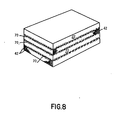
- FIGURE 8 is a portion of a stack of composites, illustrating (with exaggerated crosses) the desirable area of adhesive bonding between the discrete layers in cured composites according to the present invention.
- the present invention is directed to the provision of a laminate layer referred to as an interleaf for use in a composite structure of a fiber resin matrix and the interleaf.
- the fundamental discovery underlying the present invention is that a resin having particular mechanical properties;-when used to provide thin, discrete layers between reinforcing fabric layers of a fiber resin matrix fabric composite, results in a composite having unique toughness, shear resistance, and resistance to impact damage, and these properties are exhibited over a broad range of temperatures, e.g., from -67°F to 200°F.
- This performance is achieved by pairing a matrix resin having particular high-temperature properties and an interleaf resin having some elastomeric properties to form a composite structure of alternating fabric and interleaf layers.
- the invention further resides in the fact that resins have been developed that are well suited for use as particular interleaf materials to provide a fiber resin matrix and interleaf resin composite of superior toughness.
- the interleaf material contains a quantity of rubbery (elastomeric) material and that the interleaf resin and the resin of the fiber resin matrix be sufficiently compatible to form strong cross-links across the resin interface; yet, the interleaf material must be capable of being viscosity controlled to prevent intermixing, and a discrete interleaf layer must be achieved.
- the interleafed composites of the present invention besides exhibiting the high compression, tensile and flexural strengths characteristic of fiber resin matrices, also exhibit an unexpected ability to withstand impact damage, and over a wide range of temperatures (e.g., samples are tested at from -67°F to +200°F).
- the interleafed composites of the present invention show greater toughness, greater resistance to shear impact, greater tolerance of impact damage and greater resistance to crack propagation than conventional fiber resin matrix composites.
- the dynamic relationship between the fiber resin matrix component and the interleaf resin component of the present composites is complex, however in general the interleaf resin provides toughness, i.e., high impact strength, to the composite at all temperatures, while the matrix resin is highly resistant to the effects of wet conditions and changes in temperature.
- the interleaf resin layers are also designed to protect the fiber matrix layers by absorbing or otherwise "heading off" damaging forces before they reach levels harmful to the fiber resin matrix.
- the interleaf materials suitable for the purposes herein show great elongation above a certain shear stress level, and the components are paired so that the interleaf resin layer will flex and absorb the energy of the shear load as it approaches a level at which the fiber resin matrix will fail. If impact loads reach such levels that the structure cracks, the high strain capabilities of the interleaf layer help to maintain the integrity of the structure by increasing the energy required to drive cracks through the laminate. In this way crack propagation, even after damage, is curtailed; and by selecting the components to provide this sort of interprotective relationship, high-performance composites can be achieved.
- the reinforcing filaments useful in the present invention include, but are not limited to, filaments comprised of glass, carbon, graphite, silicon carbide, boron, polyaramide, polyester, polyamide, rayon, polybenzimidazole, polybenzothiazole, metal-coated such filaments, for example nickel-coated and/or silver-coated graphite fibers and filaments, or combinations of such filaments.
- filaments comprised of glass, carbon, graphite, silicon carbide, boron, polyaramide, polyester, polyamide, rayon, polybenzimidazole, polybenzothiazole, metal-coated such filaments, for example nickel-coated and/or silver-coated graphite fibers and filaments, or combinations of such filaments.
- carbon fibers, graphite filaments, polyaramid filaments or nickel-plated graphite filaments such as disclosed in published European Patent Office Application Serial No. 83101195.2. are preferred.
- reinforcing filaments are gathered in bundles, or tows, of approximately 1,000 to 12,000 filaments each and the tows are interwoven to form a flexible, strong fabric.
- reinforcing fabrics may appear to have a smooth surface, on a microscopic level the woven surface of the fabric is sufficiently irregular to disrupt the thin (e.g., about 0.0005 to 0.003 inch thick) interleaf layer under common curing conditions.
- the epoxy resin composition used to coat the reinforcing filaments is comprised primarily of epoxy compounds having more than one epoxide group per molecule available for reaction.
- epoxy - prepolymers include, but are not limited to, polyfunctional ethers of polyvalent phenols, for example pyrocatechol; resorcinol; hydroquinone; 4,4'-dihydroxydiphenyl methane; 4,4'-dihydroxy-3,3'-dimethyldiphenyl methane; 4,4'-dihydroxydiphenyl dimethyl methane; 4,4'-dihydroxydiphenyl methyl methane; 4,4'-dihydroxydiphenyl cyclohexane; 4,4'-dihydroxy3,3'-dimethyldiphenyl propane; 4,4'-dihydroxydiphenyl sulphone; or tris-(4-hydroxyphenyl) methane; polyglycidyl ethers of the chlorination and bromination products of
- suitable compounds include polyepoxy compounds based on aromatic amines and epichlorohydrin, for example N,N'-diglycidylaniline; N,N'-dimethyl-N,N'- diglycidyl-4,4'-diaminodiphenyl methane; N -diglycidyl-4-aminophenyl glycidyl ether; N,N,N',N'-tetraglycidyl-4,4'-diaminodiphenyl methane; and N,N,N',N'-tetraglycidyl-l,3-propylene bis-4-aminobenzoate, the latter two compounds being most preferred.
- N,N'-diglycidylaniline N,N'-dimethyl-N,N'- diglycidyl-4,4'-diaminodiphenyl methane
- Glycidyl esters and/or epoxycyclohexyl esters or aromatic, aliphatic and cycloaliphatic polycarboxylic acids for example phthalic acid diglycidyl ester and adipic ester diglycidyl and glycidyl esters of reaction products of 1 mol of an aromatic or cycloaliphatic dicarboxylic acid anhydride and h mol of a diol or 1/n mol of a polyol with n hydroxyl groups, or hexahydrophthalic acid diglycidyl esters, optionally substituted by methyl groups, are also suitable.
- phthalic acid diglycidyl ester and adipic ester diglycidyl and glycidyl esters of reaction products of 1 mol of an aromatic or cycloaliphatic dicarboxylic acid anhydride and h mol of a diol or 1/n mol of a polyol with n hydroxyl groups, or
- Glycidyl ethers of polyhydric alcohols for example of 1,4-butanediol; 1,4-butenediol; glycerol; 1,1,1-trimethylol propane; pentaerythritol and polyethylene glycols may also be used.
- the epoxy resin composition will also include a curing agent for the epoxy resin.
- a curing agent for the epoxy resin is well known to those skilled in the art, and preferred curing agents for the purposes herein will be diamines, including, but not limited to, diaminodiphenyl sulphone, diaminodiphenyl methane, phenylenediamine, etc.
- the amount of curing agent necessary for a particular application can be readily determined by persons skilled in the art and will vary according to the precise makeup of the resin composition, the curing conditions desired and other factors. However, by way of illustration, where a diamine curing agent is employed, from about 20 to 40 weight percent, most preferably about 27 to 31 weight percent, based on the total epoxy resin, has been found suitable.
- Fillers, dyes, pigments, plasticizers, curing catalysts and other such conventional additives and processing aids may be added to the epoxy resin compositions described herein before curing to influence the properties of the final resin composite.
- the modified heat-curable epoxy resin of the interleaf layer comprises 30% by weight or more epoxy resin composition and from about 8% to 70% by weight of a rubbery vinyl addition polymer.
- the suitable epoxy resins (and curing agents) are of the same type disclosed above, although the particular epoxy resin employed in the interleaf will typically be a different resin than that selected for use in the fiber resin matrix layer.
- the rubbery vinyl addition polymers contemplated herein include homopolymeric and copolymeric diene rubbers, derived from conjugated dienes of 4 to 8 carbons such as butadiene, isoprene, propylene, chloroprene, and the like. These include but are not limited to copolymers of such dienes with each other and with one or more of such monomers as styrene, acrylonitrile, methacrylonitrile, acrylic acid, methacrylic acid, methyl methacrylate, and the like. Butadieneacrylonitrile polymers and carboxylic-functional butadiene-acrylonitrile polymers are most preferred.
- the amount of rubbery modifier present can vary from 8 to 70 weight percent, and the specific amounts employed must be sufficient to impart elasticity and toughness to the interleaf resin. Preferably, about 8 to 24 weight percent of the modifier will be used; and where the preferred butadiene-acrylonitrile copolymers are employed, a level of about 10 to 15 weight percent is most preferred.
- Suitable supporting fibers for use in the non-woven or woven fibrous mat or carrier are selected for their ability to preserve the continuity of the interleaf layer during the curing process, and accordingly the fibers must survive the curing temperatures, e.g., 350°F, without disintegrating. Beyond this requirment, the primary factor influencing selection of the most appropriate fibrous mat or carrier is weight.
- the lightweight fibrous mat or carrier must add as little weight as possible to the final prepreg sheet, preferably less than 5%.
- Non-woven fibrous mats are generally preferred over woven carriers of the same material, since the mat or carrier will normally weigh much less than the woven carrier, however where a woven support will serve the purposes described herein without disadvantageously increasing the weight of the final prepreg, it is entirely acceptable.
- Mats of spun polyester fibers are most preferred.
- the physical properties of the interleaf resin composition are not affected by the presence of the lightweight fibrous mat or carrier.
- the physical strength of the mat or carrier is almost insignificant compared to that of the cured resin, and for that reason the fibrous mat' - or carrier is not thought of in the art as "reinforcing" the interleaf layer.
- the bi-layered prepreg fabric sheeting of the invention is prepared by methods well known in the art.
- the high-strength reinforcing fabric is dipped over tension rollers in an epoxy resin composition dispersed in solvent, then introduced through wiping rollers to control the resin content, e.g., to about 30% to 60% by weight, preferably 40% to 45%.
- the resin-coated fabric is passed through a drying tower to remove solvent, then introduced through a laminator, where it is mated with release paper coated with the modified interleaf resin.
- the fibrous mat or carrier is most easily introduced after the mating of the layers, by being wound into the interleaf layer before the interleaf resin dries.
- the bi-layer prepreg fabric is wound on a spool or otherwise conventionally stored for use in constructing high-strength composite structures.
- the viscosity of the interleaf resin must be sufficiently high to provide the interleaf with the necessary toughness and to maintain the interleaf resin as a discrete layer adjacent to the fabric resin matrix.
- crosslinking at the interface between the two resin layers is desireable (and most preferred). This condition-will occur when the resin of the interleaf is chemically compatible with the resin of the fiber resin matrix, so as to promote cross-linking, and loaded with the necessary amount of elastomeric (rubbery) material to define a discrete interleaf layer.
- a flow percent N below about 12 is required for optimal performance under this invention and preferably the N flow number will be between 5.5 and 7.7. Also, experimental data indicate that poor interleaf material is obtained when the N flow number is above about 14.6.
- an indication of the perfomance of laminated fiber resin matrix composites can be gained by subjecting cured samples of the resins to shear forces, and measuring the elongation (in inches) as a function of applied force (in lbs). The data from this test may be plotted, which typically generates a curve that ends at the point of applied force and elongation where the sample breaks. From this curve, the shear strain and shear stress of the resins can be calculated and the characteristic stress/strain curves plotted.
- the shear stress/strain curves at various temperatures for the matrix resin and the interleaf resin show high modulus and other properties (yield, strain to failure, ultimate stress), discussed in more detail below.
- the interleaf material of this invention can be used to form a variety of different parts.
- cover structures for airplane parts may be formed of fiber resin matrix-interleaf sheets stacked and cured to form 0.10-inch to 0.25-inch thin structural parts, for example wing and fuselage components.
- the fabric sheeting of this invention is suitable for primary structures having the highest performance requirements.
- the fiber resin matrix-interleaf fabric sheets range in thickness from 0.005 to 0.04 inch, the thickness varying according to resin content, type of fabric used, fiber count, etc.
- the fiber resin matrix-interleaf fabric sheets are also commonly laminated with the direction of the fabric weave oriented in different directions, e.g., 0° and 45° relative, depending on the stress requirements of the part.
- the relative thickness of the layers of the fiber resin matrix-interleaf resin sheet is also important.
- the discrete, mat- or carrier-supported interleaf layer will be in the range of about 0.0005 in. to 0.003 in. (or about 0.0004 to 0.03 pounds/square foot, most preferably 0.01 to 0.018 pounds/square foot), and the fabric resin matrix layer will be in -the range of about 0.005 in. to 0.014 in.
- the degree of elongation after reaching the yield point is important.
- the interleaf resin must have an overall elongation or strain to failure of at least 6%, preferably 9%, at -67°F, and a strain to failure at room temperature of at least about 15%, preferably 25% or greater. This property is less important at elevated temperatures, but preferred interleaf resins will have a strain to failure of over 20%, most preferably over 50% at 200°F.
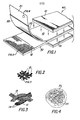
- the bi-layer prepreg fabric sheet 10 of the invention is comprised of two layers: A fiber resin matrix layer 30 and a thin interleaf layer 20.
- the fiber resin matrix 30 is comprised of a fabric 11 made of interwoven tows of bundled high-strength reinforcing filaments, and fabric 11 is coated and impregnated with a thermosetting epoxy resin composition 12.
- Adjacent said fiber resin matrix layer 30 is interleaf layer 20, comprising a modified epoxy resin composition 22 (containing a rubbery vinyl addition polymer) supported by fibrous mat or carrier 21 made of lightweight supporting fibers.
- FIGURE 2 illustrates the structure of fabric 11, wherein tows 13 are interwoven to form a high-strength fabric sheet.
- FIGURE 3 illustrates the construction of tows 13 from bundles of individual reinforcing filaments 14, numbering approximately 1,000 to 12,000 per tow 13.
- FIGURE 4 The general configuration of the non-woven or woven fibrous mat or carrier 21 that supports the modified resin composition 22 of interleaf layer 20 is detailed in FIGURE 4, wherein the non-woven, random arrangement of the lightweight supporting fibers 23 is shown.
- Bi-layered sheets 10 are typically stacked to form a prepreg laminate which is, in turn, shaped and cured to provide high performance fabric resin matrix composites, that is, fiber resin matrix composites wherein the reinforcing fiber matrix is in the configuration of a high-strength woven fabric.
- a resin having particular mechanical properties when used to provide thin, discrete layers between fiber-reinforced layers of a fiber resin matrix composite, results in a composite having unique toughness, shear resistance, and resistance to impact damage, and these properties are maintained at elevated temperatures, e.g., up to 270°F., and even higher.
- This performance is achieved by pairing a matrix resin having particular high-temperature properties and a thermoplastic interleaf resin having adhesive bonding properties, a relatively high glass transition temperature and a relatively high strain to failure to form a composite structure of alternating fiber resin matrix and interleaft resin layers.
- thermoplastic materials as particular interleaf materials, making possible fiber resin matrix and interleaf resin composites of superior toughness.
- the interleaf material comprises a thermoplastic material, that it contains at most a minor portion of thermosetting materials and that the interleaf resin and the resin of the fiber resin matrix are sufficiently compatible to form an adhesive bond at the resin interface.
- a thermoplastic material that it contains at most a minor portion of thermosetting materials and that the interleaf resin and the resin of the fiber resin matrix are sufficiently compatible to form an adhesive bond at the resin interface.
- the interleafed composites of the present invention exhibit high compression, tensile and flexural strengths as well as the ability to withstand impact damage.
- the interleafed composites of the present invention show greater toughness, greater resistance to shear impact, greater tolerance of impact damage and greater resistance to crack propagation than conventional fiber resin matrix composites.
- thinner thermoplastic films surprisingly are equivalent to thicker thermosetting films, with respect to their toughness.
- thermosetting interleafs With conventional thermosetting interleafs, it is not possible to employ interleaf thicknesses below about 0.001 inch without significant loss of toughness of the composite, however the thermoplastic interleaf in the present invention may be utilized at such low thicknesses, e.g., on the order of 0.0005 inch, without adverse effect on toughness properties.
- the basic fiber matrix material may be produced by delivering reinforcing filaments 42 through conventional eye-boards 44 and 46 to a pressure roller assembly 48.
- the curable thermosetting resin composition (matrix resin) is coated in a layer 50 from a conventional film coating applicator 52 onto a substrate such as release paper 54 and passed through the pressure roller assembly 48. Release paper 56 is also delivered to the pressure roller assembly 48.
- the pressure rollers 50 are set at a temperature and pressure for imbedding the fibers 42 in the resin layer 50 to form a fiber resin matrix 58.
- a temperature in the range of 190°F and pressures of one thousand pounds over a fifteen inch center are suitable for producing a fiber resin matrix 58.
- the fibers 42, the substrate 54 with resin layer 50 and the release paper 56 are delivered to the pressure rollers 48 and passed therethrough at the rate of 3-20 feet/minute.
- the feed of fiber 42 and resin layer 50 to the pressure rollers 48 is selected to produce a fiber resin matrix of about 30-40 weight percent (preferably 34 weight percent) resin and about 60-70 weight percent - (preferably about 66 weight percent) fiber.
- a fiber resin matrix of about 30-40 weight percent (preferably 34 weight percent) resin and about 60-70 weight percent - (preferably about 66 weight percent) fiber.
- 120 filaments of 6K carbon fibers are delivered within a twelve inch width to the pressure rollers 48 with a layer of resin .013 to .018 pounds per square foot.
- the resulting fiber resin matrix 58 is thus reinforced by a closely packed array of filaments.
- the release paper on one side of the fiber resin matrix 58 is removed and the fiber resin matrix is passed through another set of pressure rollers 60 for the application of the interleaf, material 62 to the fiber resin matrix 58.
- a layer of interleaf material 62 is typically extruded (by hot melt extrusion), or cast out of solvent, onto a carrier 68, cooled or dried, then laminated with the fiber resin matrix 58 through pressure rollers 60.
- the interleaf material 62 is deposited to provide an interleaf layer of about 0.0004 to 0.004 inches thickness.
- the exposed surface of the fiber resin matrix 58 is presented to the interleaf material 62 and the two are joined by the inherent adhesive nature of the matrix resin 58.
- the interleaf material is essentially thermoplastic and virtually without any adhesive characteristics.
- An interleafed fiber resin matrix composite 64 is thus produced and appears as shown in FIGURE 7.
- Thermosetting resin compositions potentially useful as the matrix resin in the present invention include epoxy, polyimide, bis maleimide and acetylene-terminated resins.
- Polyimides potentially useful as matrix resins in the practice of the present invention include the polyimides disclosed in U.S. Patent Nos. 3,528,950; 3,745,149; 4,233,258; and 4,166,170.
- Acetylene-terminated resins which may be utilized as the matrix resin include resins based on the following monomers: and wherein the - C ⁇ CH substituents each independently may be meta- or para - positioned.
- the thermoplastic resin of the interleaf comprises a high molecular weight engineering thermoplastic, much as a polyester, a polyamide, a polyaramid, a polyarylate, a polycarbonate, a poly(ester carbonate), a polybenzimidazole, a polyimide, a polyether imide, a polyamide imide, and the like.
- the thermoplastic will be a polyether ether ketone, abbreviated PEEK (ICI), a polyimide, e.g., KAPTON * (DuPont), or a polyether imide, e.g., ULTEM * (General Electric).
- the thermoplastic resin may contain a minor amount (up to 40% by weight) of a thermosetting resin, which may for example be of the same composition as the matrix resin, as may be necessary or desirable in a given application to achieve suitable solvent resistance or other material properties of the interleaf.
- a thermosetting resin which may for example be of the same composition as the matrix resin, as may be necessary or desirable in a given application to achieve suitable solvent resistance or other material properties of the interleaf.
- reinforcing materials in the interleaf such as mat scrim, whiskers, particulates, chopped fibers or other second phase reinforcement, and in general the reinforcing material may suitably be employed in various amounts, such as for example up to about 50% by weight based on the total weight of the interleaf.
- thermosetting resin compositions that is, the matrix resin (which coats the reinforcing filaments), and the interleaf resin must exhibit specific properties.
- the matrix resin when tested “neat”, or without reinforcement, must show a minimum stiffness when subjected to shear forces, especially at high temperatures and under wet conditions.
- the matrix resin must have a shear modulus of at least 90,000 psi under hot, dry conditions, e.g., when subjected to shear at 180 0 'F-270 0 F, or a shear modulus of at least 50,000 psi under hot, wet conditions, e.g., when subjected to shear at 180°F-270°F after soaking in water at 160°F for 14 days. It is also necessary that the matrix resin have a shear modulus above about 100,000 at room temperature and extremely low temperatures, i.e., -67°F, however, this is ordinarily the case where the modulus at 180°-200°F is as high as 50,000 psi.
- Preferred matrix resin compositions will show an initial shear modulus of 90,000 psi or above under hot, wet conditions, and will show an initial shear modulus of 130,000 psi or above at room temperature and low temperatures.
- the most preferred thermosetting resins for use as a matrix resin will also exhibit high strength, for example an ultimate stress over 3000 psi, most preferably 5000 psi or above.
- the interleaf resin must also exhibit a minimum initial shear modulus, and in addition the interleaf resin must show elongation above a minimum stress. This initial modulus is believed to transfer loads between the layers of the reinforcing fibers without large deformation of the structure.
- the interleaf material must have an initial shear modulus above 50,000 psi at high temperatures, preferably above 90,000 psi at 180°F-270°F.
- the initial shear modulus for the interleaf should be at least about 100,000 psi (preferably at least 130,000 psi), and at -67°F the shear modulus should be at least about 130,000 psi (preferably at least 150,000 psi); however, as with the matrix resin, such values at room temperature and low temperatures would be expected with high shear modulus at elevated temperatures.
- the interleaf resin will be slightly soluble in the uncured or partially cured thermosetting matrix resin at temperatures used to form the composites. This aids in providing adhesive bonding at each interface. The interleaf resin must, of course, also be able to survive the curing temperatures, usually about 350°F., that the composites are subjected to.
- the interleaf resin shows an initial rigidity (high modulus) when subjected to shear but at a certain level of shear stress, shows elongation (high ultimate strain).
- the point at which the resin begins to show high elongation in response to stress is the "yield strength" of the resin, and for the purposes herein, this must be at least about 3000 psi at high temperatures.
- Most preferred interleaf resins will have a room temperature yield strength of at least about 6000 psi and a high temperature yield strength of at least about 5000 psi.
- Resin C (interleaf resin)
- An interleaf resin composition was prepared according to the following formulation.
- pre-mix or "prereact”
- additional ingredients :
- Fiber resin matrix prepreg fabrics were prepared by coating the above formulations on high-strength reinforcing fabric woven from 3,000 filament count tows of CELION. high-strain graphite fiber (Celanese Plastics and Speciality Company), forming a fabric approximately 0.007 inch thick, having approximately 7 to 8 tows per inch. The fabric was coated to have a resin content of about 40%-45% by weight. In samples where an interleaf layer was included, the interleaf resin composition (Resin C) was applied in amounts between about 0.01 to 0.03 pounds per square foot (psf).
- Resin C the interleaf resin composition
- the mat was composed of Reemay 2105 lightweight spun polyester fiber, formed on a screen from a fibrous slurry.
- the mats weighed approximately .003 pounds per square foot (psf) and are similar to the gauzy supports used with film adhesives. Such mats added about 3-4% to the weight of the composites.
- a series of fiber resin matrix composite samples using graphite fabric were prepared from matrix resins A and B, interleaf resin C, and the Reemay 2105 mat.
- Prepreg fabric sheets were formed into 18-ply laminates, the orientation of the fabric weave being alternated according to the same quasi-isotropic pattern, and the 18-ply laminates were then autoclave cured two hours at 350°F and 100 psi pressure.
- the cured composites were cut into 4" x 6" panels and tested for compression strength after falling dart impact. The following results were observed:
- Resin A composite, a Resin B composite and an interleafed composite according to the present invention using the fiber resin matrix with Resin B and the mat-supported interleaf layer using Resin C was also performed.
- 12-ply composites were tested for compression strength (warp) at room temperature, 200°F and 200°F after immersion of the test panel in 160°F water for two weeks.
- 18-ply panels were subjected to compression strength after impact (1500 in.-lb./in. impact energy).
- Resin A and Resin B laminates were prepared from 40% resin content prepreg fabric; interleafed Resin B/Resin C laminates were prepared from 45% resin content prepreg. The following results were observed:
- reinforcing filaments such as carbon, silicon carbide, boron, aramide, polyester, polyamide, and rayon, or metal-coated, such as nickel- and/or silver-coated such filaments and fibers, alone or in any combination, can be used.
- metal-coated such as nickel- and/or silver-coated such filaments and fibers, alone or in any combination
- Alternative supporting filaments for the lightweight fibrous mat or carrier may also be used, including glass, graphite, polyaramide, etc.
- Matrix resin and interleaf resin formulations also can be varied in weight ratio widely, depending on the precise properties desired and the intended use.
- the preferred weight ratios are as follows:
- the interleaf resin, Parts A and B likewise can be mixed in broad ranges, but preferably, and most preferably the weights of ingredients used will fall in the following ranges:
- Part A to Part B can be used, but preferably, from 75 to 200 parts by weight of Part A will be present for each 100 parts by weight of Part B.
- a matrix resin according to the present invention was made according to the following formulation:
- a fiber resin matrix was formed by coating the above formulation on a layer of collimated graphite fibers.
- Composites were formed as shown in FIGURE 7, by applying to the aforementioned fiber resin matrix an interleaf film, approximately 0.0005 inches thick, of a polyether polyimide (ULTEM°), which was cast out of solvent.
- the thermoplastic interleaf resin formed a discrete layer adjacent to the fiber resin matrix having an adhesive bond at the interface between the two layers.
- Composites were stacked and autoclave cured at 350°F and 100 psi for 2 hours to produce a structural part.
- Stacks of eight plies, all arranged with collimated fibers, i.e., extending in the same direction (0°) were prepared for the Unidirectional Compresion Strength, or UNI-COMP, test.
- Stacks of sixteen plies with the fibers oriented equally at 0°, 90° and + 45° were prepared for the Quasi-isotropic Compression Strength, or QUASI-COMP, test.
- Stacks of thirty-six plies with the fibers oriented at relative angles of 0°, 90° and +45° were prepared for the Compression Strength After Impact, or COMP/IMPACT, test.
- the laminates exhibited the following properties:
- interleaf material can be used to form a variety of different parts.
- cover structures for airplane parts may be formed of fiber resin matrix-interleaf sheets stacked and cured to form 0.10-inch to 0.25-inch thin structural parts.
- Structural members such as wing panels will be much thicker.
- Fiber resin matrix-interleaf sheets according to this invention range in thickness from 0.0005 to 0.010 inch, thus, for example, a stack of twenty-five to fifty fiber resin matrix-interleaf sheets will form a 1 ⁇ 4-inch thick part.
- the fiber resin matrix-interleaf sheets are typically stacked with the direction of the fibers oriented in different directions, depending on the stress requirements of the part.
- the maximum number of fiber resin matrix-interleaf sheets may be oriented in the 0° direction, i.e., the direction in which the maximum tension or compression forces will be imposed, and the remainder of the fiber resin matrix-interleaf sheets are oriented at 90° and plus or minus 45° from the 0° orientation.
- the relative thickness of the layers of the fiber resin matrix-interleaf resin sheet is also important.
- the interleaf layer will be in the range of about .0004 in. to .002 in.
- the fiber resin matrix layer will be in the range of about .007 in. to .009 in.
- a fiber resin was prepared using the following matrix resin formulation:
- the laminates also exhibited a Critical Strain Energy Release Rate, G Ic , of 3.15 in-lbs/sq in; and Short Beam Shear Strength (unidirectional) of 13.1 ⁇ 0.4 KSI.
- G Ic Critical Strain Energy Release Rate
- Short Beam Shear Strength unidirectional
- a similar laminate showed a short beam shear strength (Quasi-isotropic) of 12.2 KSI.
- a fiber resin matrix was prepared using CYCOM® 1806 (American Cyanamid Company) as the matrix resin.
- Composites were prepared having a 0.001-inch interleaf layer of the same polyether polyimide-resin used in Example 2. Laminates were formed, cured and tested as in Example 2, and the following data were obtained: G Ic , 2.0 in-lbs/sq in; edged delamination strain, 0.77%; and Short Beam Shear Strength (Unidirectional) of 13.0+1.1 KSI. Microscopic examination showed good bonding of the interleaf to the matrix resin with no interfacial failure.
- a matrix resin having the following composition was prepared:
- Composites were prepared having a 0.001-inch interleaf layer of the same polyether polyimide used in Example 2. Laminates prepared from the composites exhibited a Compression Strength After Impact of 48.0+3 KSI.
- a fiber resin matrix was prepared using CYCOM * 1808 (American Cyanamid Company) as the matrix resin.
- Composites were prepared having a 0.002-inch interleaf layer of a polyether-ether ketone (PEEK) which had been degreased with methylene chloride to remove any surface soil or lubricant therefrom. Laminates exhibited a G Ic of 1.23 in-lbs/sq in. Microscopic examination showed good bonding of the interleaf to the matrix resin with no interfacial failure.
- PEEK polyether-ether ketone
- Laminates formed from the composites had a G Ic of 2.05 in-lbs/sq in. Microscopic examination showed good bonding of the interleaf to the matrix resin with no interfacial failure.
- Composites were prepared as in the previous examples having a bis(maleimide) matrix resin and a 0.001-inch interleaf layer of polyether polyimide (Example 2). Laminates formed from the composites had a G Ic of 1.38 in-lbs/sq in. Microscopic examination showed good bonding of the interleaf to the matrix resin with no interfacial failure.
- Laminates prepared from the composites showed a G Ic of 1.43 in-lbs/sq in; an edged delamination strain of .48%; and Compression Strength After Impact of 31.4 KSI.
- Fabric resin matrix composites formed by impregnating a woven graphite fiber fabric with the resin of Example 5 and applying a 0.001-inch interleaf layer of a polyether polyimide (ULTEM e ) were prepared. Laminates prepared from the composites showed a G Ic of 1.36 in-lbs/sq in. Similar composites having a light weight non-woven polyester scrim placed between the interleaf and fiber resin matrix layers (in order to improve the fracture toughness of the composite) were prepared and formed into laminates which exhibited a G Ic of 3.02 in-lbs/sq in.
- Resin A had the following composition:
- the composites were formed into laminates and subjected to UNI-COMP, QUASI-COMP and COMP/IMPACT tests, as described above, with the results shown in Table II below.
- the improvement in impact resistance achieved by Sample 12 over Sample 11, however, is realized at a sacrifice in elevated temperature compressive strength and compressive strength under high humidity conditions, especially with regard to uniaxial compressive strength (see, for example, at 200°F wet conditions, the compressive strength of Sample 12 is 90 KSI, while the corresponding value for Sample 11 is 125 KSI).
- Sample 13 illustrative of the present invention, shows an improvement in compressive stength after impact of 161%, with little change in compressive strength at either 200°F or 270°F, dry or wet, compared to the unmodified laminate of Sample 11.
- Samples 14 and 15 show the effect of using a thermoplastic interleaf in a high stiffness formulation designed to provide superior strength at a 270°F, wet condition.
- the utilization of the interleaf does not significantly change either uniaxial or quasi-isotropic compressive strength (within the experimental error of the test) relative to the unmodified laminate (Sample 14), yet improves the compression strength after impact from 32.3 to 49.3, an improvement of 153%.
- Samples 16-21 were prepared with the same matrix resin as Example 1 and in accordance with the procedure of Example 1 except for the interleaf, which was varied as follows:
- thermoplastic interleaf-containing composite (Sample 18) is markedly enhanced by combining the thermoplastic resin (ULTEM®) with 25% by weight of a thermosetting resin (including curative) as in Sample 19-21.
- ULTEM® thermoplastic resin
- thermosetting resin including curative
- filaments such as carbon, silicon carbide, boron, aramid, polyester, polyamide, and rayon
- metal-coated such as nickel- and/or silver-coated such filaments and fibers, alone or in any combination, can be used.
- Matrix resin formulations also can be varied in weight ratio widely, depending on the precise properties desired and the intended use.
- a preferred matrix resin according to this invention may have the following components, in the following proportions, by weight:
Landscapes
- Chemical & Material Sciences (AREA)
- Engineering & Computer Science (AREA)
- Materials Engineering (AREA)
- Polymers & Plastics (AREA)
- Organic Chemistry (AREA)
- Health & Medical Sciences (AREA)
- Chemical Kinetics & Catalysis (AREA)
- Medicinal Chemistry (AREA)
- Manufacturing & Machinery (AREA)
- Composite Materials (AREA)
- Inorganic Chemistry (AREA)
- Mechanical Engineering (AREA)
- Reinforced Plastic Materials (AREA)
- Laminated Bodies (AREA)
- Compositions Of Macromolecular Compounds (AREA)
- Inorganic Fibers (AREA)
- Treatments For Attaching Organic Compounds To Fibrous Goods (AREA)
Priority Applications (2)
| Application Number | Priority Date | Filing Date | Title |
|---|---|---|---|
| AT85101551T ATE58503T1 (de) | 1984-03-30 | 1985-02-13 | Faserkunststoffmatrixzusammenstellungen mit hoher schlagfestigkeit. |
| EP89105533A EP0327142B1 (de) | 1984-03-30 | 1985-02-13 | Kunststoff-Matrix-Komposite |
Applications Claiming Priority (4)
| Application Number | Priority Date | Filing Date | Title |
|---|---|---|---|
| US06/595,314 US4539253A (en) | 1984-03-30 | 1984-03-30 | High impact strength fiber resin matrix composites |
| US616540 | 1984-06-01 | ||
| US06616540 US4604319B1 (en) | 1984-06-01 | 1984-06-01 | Thermoplastic interleafed resin matrix composites with improved impact strength and toughness |
| US595314 | 2000-06-16 |
Related Child Applications (1)
| Application Number | Title | Priority Date | Filing Date |
|---|---|---|---|
| EP89105533.7 Division-Into | 1985-02-13 |
Publications (3)
| Publication Number | Publication Date |
|---|---|
| EP0156148A2 true EP0156148A2 (de) | 1985-10-02 |
| EP0156148A3 EP0156148A3 (en) | 1986-12-17 |
| EP0156148B1 EP0156148B1 (de) | 1990-11-22 |
Family
ID=27082229
Family Applications (1)
| Application Number | Title | Priority Date | Filing Date |
|---|---|---|---|
| EP85101551A Expired - Lifetime EP0156148B1 (de) | 1984-03-30 | 1985-02-13 | Faserkunststoffmatrixzusammenstellungen mit hoher Schlagfestigkeit |
Country Status (11)
| Country | Link |
|---|---|
| EP (1) | EP0156148B1 (de) |
| JP (1) | JPS60231738A (de) |
| KR (1) | KR940000624B1 (de) |
| AT (2) | ATE132806T1 (de) |
| AU (1) | AU581649B2 (de) |
| BR (1) | BR8501446A (de) |
| DE (2) | DE3580603D1 (de) |
| ES (1) | ES541551A0 (de) |
| HK (2) | HK28292A (de) |
| IL (1) | IL74432A (de) |
| SG (1) | SG19592G (de) |
Cited By (13)
| Publication number | Priority date | Publication date | Assignee | Title |
|---|---|---|---|---|
| WO1991000171A1 (en) * | 1989-07-04 | 1991-01-10 | 3-D Composites Limited | Zone stiffened composites, with two different resins |
| EP0366979A3 (de) * | 1988-11-01 | 1991-11-13 | Cytec Technology Corp. | Zwischenschicht in geschichteten faserverstärkten plastischen Verbundwerkstoffen |
| EP0337261A3 (de) * | 1988-04-14 | 1991-11-21 | BASF Aktiengesellschaft | Faserverbundwerkstoffe |
| EP0316922A3 (de) * | 1987-11-20 | 1992-01-08 | Asahi Glass Company Ltd. | Faserverstärktes Kunststoffmaterial und dieses als Basismaterial verwendender Schichtstoff |
| EP0445620A3 (en) * | 1990-03-08 | 1992-10-28 | Basf Aktiengesellschaft | Leaf springs from fibre/plastic composite |
| EP0612607A1 (de) * | 1993-01-28 | 1994-08-31 | FERRIERE BELLOLI & Co. | Zugkörper mit angeformtem Profil sowie Verfahren zur Herstellung derselben |
| EP0632087A4 (de) * | 1993-01-14 | 1995-09-13 | Toray Industries | Prepregs, verfahren zur herstellung und verbundwerkstoffbeschichtung. |
| EP1695889A3 (de) * | 2005-02-23 | 2007-10-10 | HÜBNER GmbH | Elastische Seitenwand zur Abdeckung eines Balges eines Übergangs zwischen zwei gelenkig miteinander verbundenen Fahrzeugen oder Fahrzeugteilen |
| WO2007135447A1 (en) | 2006-05-24 | 2007-11-29 | Auxetic Technologies Limited | A composite material |
| CN101220561B (zh) * | 2008-01-04 | 2010-09-08 | 中国航空工业第一集团公司北京航空材料研究院 | 一种液态成型复合材料用预制织物及其制备方法 |
| CN111909489A (zh) * | 2020-08-14 | 2020-11-10 | 南通大学 | 一种纤维树脂复合材料及其制备方法与应用 |
| US11208541B2 (en) | 2017-07-28 | 2021-12-28 | Toray Industries, Inc. | Prepreg and carbon fiber reinforced material |
| CN114393855A (zh) * | 2021-12-30 | 2022-04-26 | 山东大学 | 一种适用于预浸料成型纤维增强复合材料的共胶接连接方法及其应用 |
Families Citing this family (14)
| Publication number | Priority date | Publication date | Assignee | Title |
|---|---|---|---|---|
| JPS61159413A (ja) * | 1984-11-30 | 1986-07-19 | Polyplastics Co | 導電性樹脂複合体の製造方法 |
| JPH0530916Y2 (de) * | 1986-05-19 | 1993-08-09 | ||
| JPS63170427A (ja) * | 1987-01-07 | 1988-07-14 | Toray Ind Inc | 繊維強化プリプレグの製造方法 |
| JPS63170428A (ja) * | 1987-01-07 | 1988-07-14 | Toray Ind Inc | プリプレグの製造方法 |
| JPH01204735A (ja) * | 1988-02-09 | 1989-08-17 | Nec Corp | 繊維強化複合材料 |
| JPH02169634A (ja) * | 1988-12-22 | 1990-06-29 | Nec Corp | 繊維強化複合材料プリプレグシート |
| ES2050564B1 (es) * | 1991-07-02 | 1994-12-16 | Amoco Corp | Materiales compuestos reforzados con fibra y endurecidos con particulas resinosas porosas. |
| KR100553399B1 (ko) * | 1998-12-31 | 2006-06-07 | 에스케이케미칼주식회사 | 콤포지트 라미네이트 |
| KR100849289B1 (ko) * | 2000-08-22 | 2008-07-29 | 사이텍 테크놀러지 코포레이션 | 경화성 조성물내 가용화제로서 사용하기 위한 가요성 중합체 부재 |
| EP1914266B1 (de) | 2005-07-13 | 2011-11-09 | Mitsubishi Rayon Co. Ltd. | Prepreg |
| JP5117779B2 (ja) * | 2007-07-06 | 2013-01-16 | 株式会社Gsiクレオス | 複合材料 |
| ITMI20120245A1 (it) * | 2012-02-20 | 2013-08-21 | Automobili Lamborghini Spa | Processo per fabbricare tessuti in fibra di carbonio e tessuto fabbricato con questo processo |
| WO2018173953A1 (ja) | 2017-03-24 | 2018-09-27 | 東レ株式会社 | プリプレグおよび炭素繊維強化複合材料 |
| KR20210005852A (ko) | 2018-04-27 | 2021-01-15 | 도레이 카부시키가이샤 | 프리프레그 및 탄소섬유강화 복합재료 |
Family Cites Families (5)
| Publication number | Priority date | Publication date | Assignee | Title |
|---|---|---|---|---|
| GB1355331A (en) * | 1970-02-18 | 1974-06-05 | Formica Int | Process for preparing insulating substrates |
| JPS5796822A (en) * | 1980-12-08 | 1982-06-16 | Hitachi Chem Co Ltd | Manufacture of prepreg sheet |
| EP0133281A3 (de) * | 1983-08-01 | 1988-11-30 | American Cyanamid Company | Härtbare faserverstärkte Epoxyharzzubereitung |
| ATE41435T1 (de) * | 1984-01-27 | 1989-04-15 | Ici Plc | Faserverstaerktes produkt und verfahren zur herstellung. |
| EP0159482A3 (de) * | 1984-03-28 | 1987-02-25 | American Cyanamid Company | Harzverbundmaterial mit kontrolliertem Fluss und Klebrigkeit |
-
1985
- 1985-02-13 EP EP85101551A patent/EP0156148B1/de not_active Expired - Lifetime
- 1985-02-13 DE DE8585101551T patent/DE3580603D1/de not_active Expired - Lifetime
- 1985-02-13 AT AT89105533T patent/ATE132806T1/de not_active IP Right Cessation
- 1985-02-13 DE DE3588077T patent/DE3588077T2/de not_active Expired - Lifetime
- 1985-02-13 AT AT85101551T patent/ATE58503T1/de not_active IP Right Cessation
- 1985-02-24 IL IL74432A patent/IL74432A/xx not_active IP Right Cessation
- 1985-03-25 ES ES541551A patent/ES541551A0/es active Granted
- 1985-03-27 JP JP60061030A patent/JPS60231738A/ja active Granted
- 1985-03-29 AU AU40527/85A patent/AU581649B2/en not_active Expired
- 1985-03-29 KR KR1019850002102A patent/KR940000624B1/ko not_active Expired - Fee Related
- 1985-03-29 BR BR8501446A patent/BR8501446A/pt not_active IP Right Cessation
-
1992
- 1992-02-29 SG SG195/92A patent/SG19592G/en unknown
- 1992-04-16 HK HK282/92A patent/HK28292A/en not_active IP Right Cessation
-
1996
- 1996-04-18 HK HK68896A patent/HK68896A/en not_active IP Right Cessation
Cited By (17)
| Publication number | Priority date | Publication date | Assignee | Title |
|---|---|---|---|---|
| EP0316922A3 (de) * | 1987-11-20 | 1992-01-08 | Asahi Glass Company Ltd. | Faserverstärktes Kunststoffmaterial und dieses als Basismaterial verwendender Schichtstoff |
| EP0337261A3 (de) * | 1988-04-14 | 1991-11-21 | BASF Aktiengesellschaft | Faserverbundwerkstoffe |
| EP0366979A3 (de) * | 1988-11-01 | 1991-11-13 | Cytec Technology Corp. | Zwischenschicht in geschichteten faserverstärkten plastischen Verbundwerkstoffen |
| WO1991000171A1 (en) * | 1989-07-04 | 1991-01-10 | 3-D Composites Limited | Zone stiffened composites, with two different resins |
| US5344601A (en) * | 1989-07-04 | 1994-09-06 | John Newton | Molding method using two different resins and a membrane |
| EP0445620A3 (en) * | 1990-03-08 | 1992-10-28 | Basf Aktiengesellschaft | Leaf springs from fibre/plastic composite |
| EP0632087A4 (de) * | 1993-01-14 | 1995-09-13 | Toray Industries | Prepregs, verfahren zur herstellung und verbundwerkstoffbeschichtung. |
| EP0612607A1 (de) * | 1993-01-28 | 1994-08-31 | FERRIERE BELLOLI & Co. | Zugkörper mit angeformtem Profil sowie Verfahren zur Herstellung derselben |
| EP1695889A3 (de) * | 2005-02-23 | 2007-10-10 | HÜBNER GmbH | Elastische Seitenwand zur Abdeckung eines Balges eines Übergangs zwischen zwei gelenkig miteinander verbundenen Fahrzeugen oder Fahrzeugteilen |
| WO2007135447A1 (en) | 2006-05-24 | 2007-11-29 | Auxetic Technologies Limited | A composite material |
| EP2157121A1 (de) * | 2006-05-24 | 2010-02-24 | Auxetic Technologies Ltd. | Verbundwerkstoff |
| RU2430119C2 (ru) * | 2006-05-24 | 2011-09-27 | Оксетик Текнолоджиз Лимитед | Композитный материал |
| CN101220561B (zh) * | 2008-01-04 | 2010-09-08 | 中国航空工业第一集团公司北京航空材料研究院 | 一种液态成型复合材料用预制织物及其制备方法 |
| US11208541B2 (en) | 2017-07-28 | 2021-12-28 | Toray Industries, Inc. | Prepreg and carbon fiber reinforced material |
| CN111909489A (zh) * | 2020-08-14 | 2020-11-10 | 南通大学 | 一种纤维树脂复合材料及其制备方法与应用 |
| CN111909489B (zh) * | 2020-08-14 | 2023-12-29 | 南通大学 | 一种纤维树脂复合材料及其制备方法与应用 |
| CN114393855A (zh) * | 2021-12-30 | 2022-04-26 | 山东大学 | 一种适用于预浸料成型纤维增强复合材料的共胶接连接方法及其应用 |
Also Published As
| Publication number | Publication date |
|---|---|
| ES8602484A1 (es) | 1985-12-01 |
| HK68896A (en) | 1996-04-26 |
| DE3580603D1 (de) | 1991-01-03 |
| JPS60231738A (ja) | 1985-11-18 |
| SG19592G (en) | 1992-04-16 |
| AU581649B2 (en) | 1989-03-02 |
| EP0156148A3 (en) | 1986-12-17 |
| EP0156148B1 (de) | 1990-11-22 |
| IL74432A0 (en) | 1985-05-31 |
| DE3588077D1 (de) | 1996-02-22 |
| DE3588077T2 (de) | 1996-06-27 |
| IL74432A (en) | 1989-02-28 |
| AU4052785A (en) | 1985-10-03 |
| ATE132806T1 (de) | 1996-01-15 |
| ATE58503T1 (de) | 1990-12-15 |
| KR850006718A (ko) | 1985-10-16 |
| KR940000624B1 (ko) | 1994-01-26 |
| ES541551A0 (es) | 1985-12-01 |
| HK28292A (en) | 1992-04-24 |
| BR8501446A (pt) | 1985-11-26 |
| JPH0588261B2 (de) | 1993-12-21 |
Similar Documents
| Publication | Publication Date | Title |
|---|---|---|
| EP0156148A2 (de) | Faserkunststoffmatrixzusammenstellungen mit hoher Schlagfestigkeit | |
| US4539253A (en) | High impact strength fiber resin matrix composites | |
| US4604319A (en) | Thermoplastic interleafed resin matrix composites with improved impact strength and toughness | |
| US5057353A (en) | Advance composites with thermoplastic particles at the interface between layers | |
| US6117518A (en) | Particulate reinforcement for honeycomb core materials | |
| EP0274899B1 (de) | Zähe Verbundmaterialien | |
| JP2972240B2 (ja) | 積層複合材料及びその製造方法 | |
| US5087657A (en) | Fiber-reinforced composites toughened with resin particles | |
| US5972810A (en) | Self-adhesive prepreg, process for producing same, and use thereof | |
| EP0327142A2 (de) | Kunststoff-Matrix-Komposite | |
| US5141804A (en) | Interleaf layer in fiber reinforced resin laminate composites | |
| EP0723994A1 (de) | Epoxyharzzusammensetzung, prepeg und faserverstärktes verbundmaterial | |
| CA2566447A1 (en) | Self-adhesive prepreg | |
| EP0133280A2 (de) | Durch Wärme vernetzte laminatartige Harzmatrixkompositen mit Kompressionseigenschaften | |
| US6046257A (en) | Composition for prepreg comprising epoxy resin, polyamide block copolymer and curing agent | |
| JPH045056B2 (de) | ||
| EP0311370B1 (de) | Phenolmodifizierter Epoxydharzklebstoff | |
| EP1072634B1 (de) | Reaktionsharzblattmaterialien | |
| AU644701B2 (en) | Improved composite tooling | |
| JP4655329B2 (ja) | 一方向プリプレグおよび繊維強化複合材料 | |
| CA2053439C (en) | Epoxy resin blend for resin transfer molding and filament winding | |
| JP3539603B2 (ja) | プリプレグおよびコンポジット | |
| CA2048079A1 (en) | Fiber-reinforced composites toughened with resin particles |
Legal Events
| Date | Code | Title | Description |
|---|---|---|---|
| PUAI | Public reference made under article 153(3) epc to a published international application that has entered the european phase |
Free format text: ORIGINAL CODE: 0009012 |
|
| AK | Designated contracting states |
Designated state(s): AT BE CH DE FR GB IT LI NL SE |
|
| PUAL | Search report despatched |
Free format text: ORIGINAL CODE: 0009013 |
|
| AK | Designated contracting states |
Kind code of ref document: A3 Designated state(s): AT BE CH DE FR GB IT LI NL SE |
|
| 17P | Request for examination filed |
Effective date: 19870605 |
|
| 17Q | First examination report despatched |
Effective date: 19880519 |
|
| GRAA | (expected) grant |
Free format text: ORIGINAL CODE: 0009210 |
|
| AK | Designated contracting states |
Kind code of ref document: B1 Designated state(s): AT BE CH DE FR GB IT LI NL SE |
|
| REF | Corresponds to: |
Ref document number: 58503 Country of ref document: AT Date of ref document: 19901215 Kind code of ref document: T |
|
| XX | Miscellaneous (additional remarks) |
Free format text: TEILANMELDUNG 89105533.7 EINGEREICHT AM 13/02/85. |
|
| REF | Corresponds to: |
Ref document number: 3580603 Country of ref document: DE Date of ref document: 19910103 |
|
| ET | Fr: translation filed | ||
| ITF | It: translation for a ep patent filed | ||
| PLBE | No opposition filed within time limit |
Free format text: ORIGINAL CODE: 0009261 |
|
| STAA | Information on the status of an ep patent application or granted ep patent |
Free format text: STATUS: NO OPPOSITION FILED WITHIN TIME LIMIT |
|
| 26N | No opposition filed | ||
| ITTA | It: last paid annual fee | ||
| EAL | Se: european patent in force in sweden |
Ref document number: 85101551.1 |
|
| REG | Reference to a national code |
Ref country code: GB Ref legal event code: IF02 |
|
| PGFP | Annual fee paid to national office [announced via postgrant information from national office to epo] |
Ref country code: GB Payment date: 20040107 Year of fee payment: 20 |
|
| PGFP | Annual fee paid to national office [announced via postgrant information from national office to epo] |
Ref country code: AT Payment date: 20040108 Year of fee payment: 20 |
|
| PGFP | Annual fee paid to national office [announced via postgrant information from national office to epo] |
Ref country code: NL Payment date: 20040112 Year of fee payment: 20 |
|
| PGFP | Annual fee paid to national office [announced via postgrant information from national office to epo] |
Ref country code: FR Payment date: 20040202 Year of fee payment: 20 |
|
| PGFP | Annual fee paid to national office [announced via postgrant information from national office to epo] |
Ref country code: SE Payment date: 20040203 Year of fee payment: 20 |
|
| PGFP | Annual fee paid to national office [announced via postgrant information from national office to epo] |
Ref country code: DE Payment date: 20040227 Year of fee payment: 20 |
|
| PGFP | Annual fee paid to national office [announced via postgrant information from national office to epo] |
Ref country code: CH Payment date: 20040319 Year of fee payment: 20 |
|
| PGFP | Annual fee paid to national office [announced via postgrant information from national office to epo] |
Ref country code: BE Payment date: 20040518 Year of fee payment: 20 |
|
| PG25 | Lapsed in a contracting state [announced via postgrant information from national office to epo] |
Ref country code: LI Free format text: LAPSE BECAUSE OF EXPIRATION OF PROTECTION Effective date: 20050212 Ref country code: GB Free format text: LAPSE BECAUSE OF EXPIRATION OF PROTECTION Effective date: 20050212 Ref country code: CH Free format text: LAPSE BECAUSE OF EXPIRATION OF PROTECTION Effective date: 20050212 |
|
| PG25 | Lapsed in a contracting state [announced via postgrant information from national office to epo] |
Ref country code: NL Free format text: LAPSE BECAUSE OF EXPIRATION OF PROTECTION Effective date: 20050213 |
|
| BE20 | Be: patent expired |
Owner name: *AMERICAN CYANAMID CY Effective date: 20050213 |
|
| REG | Reference to a national code |
Ref country code: CH Ref legal event code: PL |
|
| REG | Reference to a national code |
Ref country code: GB Ref legal event code: PE20 |
|
| EUG | Se: european patent has lapsed | ||
| NLV7 | Nl: ceased due to reaching the maximum lifetime of a patent |
Effective date: 20050213 |
|
| BE20 | Be: patent expired |
Owner name: *AMERICAN CYANAMID CY Effective date: 20050213 |