EP0158110A2 - Triphendioxazinfarbstoffe - Google Patents
Triphendioxazinfarbstoffe Download PDFInfo
- Publication number
- EP0158110A2 EP0158110A2 EP85102448A EP85102448A EP0158110A2 EP 0158110 A2 EP0158110 A2 EP 0158110A2 EP 85102448 A EP85102448 A EP 85102448A EP 85102448 A EP85102448 A EP 85102448A EP 0158110 A2 EP0158110 A2 EP 0158110A2
- Authority
- EP
- European Patent Office
- Prior art keywords
- dyes
- formula
- alkyl
- fluoro
- pyrimidinyl
- Prior art date
- Legal status (The legal status is an assumption and is not a legal conclusion. Google has not performed a legal analysis and makes no representation as to the accuracy of the status listed.)
- Granted
Links
- 0 C*C(C(*)C(C)(C)*(C)=C)N Chemical compound C*C(C(*)C(C)(C)*(C)=C)N 0.000 description 14
- GWHJZXXIDMPWGX-UHFFFAOYSA-N Cc1ccc(C)c(C)c1 Chemical compound Cc1ccc(C)c(C)c1 GWHJZXXIDMPWGX-UHFFFAOYSA-N 0.000 description 1
Classifications
-
- C—CHEMISTRY; METALLURGY
- C09—DYES; PAINTS; POLISHES; NATURAL RESINS; ADHESIVES; COMPOSITIONS NOT OTHERWISE PROVIDED FOR; APPLICATIONS OF MATERIALS NOT OTHERWISE PROVIDED FOR
- C09B—ORGANIC DYES OR CLOSELY-RELATED COMPOUNDS FOR PRODUCING DYES, e.g. PIGMENTS; MORDANTS; LAKES
- C09B62/00—Reactive dyes, i.e. dyes which form covalent bonds with the substrates or which polymerise with themselves
- C09B62/002—Reactive dyes, i.e. dyes which form covalent bonds with the substrates or which polymerise with themselves with the linkage of the reactive group being alternatively specified
- C09B62/0025—Specific dyes not provided for in groups C09B62/004 - C09B62/018
-
- C—CHEMISTRY; METALLURGY
- C09—DYES; PAINTS; POLISHES; NATURAL RESINS; ADHESIVES; COMPOSITIONS NOT OTHERWISE PROVIDED FOR; APPLICATIONS OF MATERIALS NOT OTHERWISE PROVIDED FOR
- C09B—ORGANIC DYES OR CLOSELY-RELATED COMPOUNDS FOR PRODUCING DYES, e.g. PIGMENTS; MORDANTS; LAKES
- C09B62/00—Reactive dyes, i.e. dyes which form covalent bonds with the substrates or which polymerise with themselves
- C09B62/44—Reactive dyes, i.e. dyes which form covalent bonds with the substrates or which polymerise with themselves with the reactive group not directly attached to a heterocyclic ring
- C09B62/4401—Reactive dyes, i.e. dyes which form covalent bonds with the substrates or which polymerise with themselves with the reactive group not directly attached to a heterocyclic ring with two or more reactive groups at least one of them being directly attached to a heterocyclic system and at least one of them being directly attached to a non-heterocyclic system
Definitions
- alkyl radicals R 5 and R 6 water-solubilizing groups or hydrophilic groups such as: -SO 3 H, -OSO 3 H, -COOH, -OH, C 1 -C 4 alkoxy, optionally substituted by, for example C 1 -C 4 hydroxyalkyl or C 1 -C 4 alkoxy-C 1 -C 4 alkyl.
- bridge members Y 1 are alkylene radicals such as C 2 -C 6 alkylene, optionally interrupted by O, S or N, optionally substituted, for example ethylene, 1,2- and 1,3-propylene, 1,2-, 1,3 -, 1,4- and 2,3-butylene, 2-methyl-1,3-propylene, 2,2-dimethylpropylene, 2-methyl-2,4-pentylene, 1-phenylethylene, 2,5-hexylene, 1 , 5-pentylene, 1,6-hexylene, 1,3-cyclohexylene, 1,4-cyclohexylene, 4-methyl-1,3-cyclohexylene, 2-hydroxy 1,3-propylene, 2-sulfato-1,3-propylene, -CH 2 CH 2 -O-CH 2 CH 2 -CH 2 -CH 2 -S-CH 2 -CH 2 -, Alkylene residues such as
- Arylene radicals such as optionally substituted phenylene, in particular phenylene and phenylene substituted by alkyl, alkoxy, sulfo, carboxy or halogen, such as 1,2-, 1,3-, 1,4-phenylene, 3-methyl-1,2-phenylene, 4- Methyl-1,2-phenylene, 2-methyl-1,3-phenylene, 4-methyl-1,3-phenylene, 5-methyl-1,3-phenylene, 2-methyl-1,4-phenylene, 2, 4,6-trimethyl-1,3-phenylene, 2,3,5,6-tetramethyl-1,4-phenylene, 2,6-dimethyl-1,3-phenylene, 2-methyl-6-ethyl-1, 3-phenylene, 2-methyl-4,6-diethyl-1,3-phenylene, 2,6-diethyl-4-methyl-1,3-phenylene, 2-methoxy-1,3-phenylene, 4-methoxy 1,3-phenylene, 6-methoxy-1,3
- Suitable radicals R 1 and R 2 are, for example, Cl, Br, C 1 -C 4 alkyl, C 1 -C 4 alkoxy, aryloxy, in particular optionally substituted phenoxy, acylamino, carboxy and optionally further substituted carbonamide.
- Suitable radicals R 3 are, for example, C 1 -C 4 alkyl, C 1 -C 4 alkoxy, halogen, in particular Cl.
- Suitable radicals R 4 are the radicals R 6 .
- Preferred dyes are generally those in which the radicals A but not the radicals B contain a reactive group, furthermore those in which the radicals B contain a reactive group but not the radicals A.
- the residues are preferably in o-position to A.
- R 1 and R 2 are preferably Cl and R 3 are H.
- Suitable fiber-reactive radicals Z that is to say those which, under dyeing conditions, react with materials containing hydroxyl groups or amide groups to form a covalent bond
- the 5- or 6-membered heterocyclic rings which have at least one reactive substituent are therefore preferably those which contain one or more nitrogen atoms and 5- or preferably 6- may contain fused carbocyclic rings.
- reactive substituents on the heterocycle include: halogen (C1, Br or F), ammonium, including hydrazinium, sulfonium, sulfonyl, azido (N 3 ), rhodanido, thio, thiol ether, oxyether, sulfinic acid and sulfonic acid.
- halogen C1, Br or F
- ammonium including hydrazinium, sulfonium, sulfonyl, azido (N 3 ), rhodanido, thio, thiol ether, oxyether, sulfinic acid and sulfonic acid.
- mono- or dihalo-symmetrical triazinyl residues for example 2,4-dichlorotriazinyl-6-, 2-amino-4-chlorotriazinyl-6-, 2-alkylamino-4-chlorotriazinyl-6-, such as 2-methylamino-4-chlorotriazinyl-6, 2-ethylamino or 2-propylamino-4-chlorotriazinyl-6-, 2-B-oxethylamino-4-chlorotriazinyl-6-, 2-di-ß-oxethylamino-4- chlorotriazinyl-6 and the corresponding sulfuric acid half-esters, 2-diethylamino-4-chlorotriazinyl-6-, 2-morpholino- or 2-piperidino-4-chlorotriazinyl-6-, 2-cyclohexylamino-4-chlorotriazinyl-6-, 2-ary
- halotriazinyl radicals can also be linked to a second halotriazinyl radical.
- residues are the following:
- the reactive halogen atoms in the above-mentioned 2-halogen-4-substituted-triazinyl radicals can form quaternary salts against tertiary bases such as trimethylamine, triethylamine, dimethyl-B-hydroxyethylamine, triethanolamine, N, N-dimethylhydrazine, pyridine, ⁇ -, ⁇ -picoline, nicotinic acid or isonicotinic acid are exchanged.
- tertiary bases such as trimethylamine, triethylamine, dimethyl-B-hydroxyethylamine, triethanolamine, N, N-dimethylhydrazine, pyridine, ⁇ -, ⁇ -picoline, nicotinic acid or isonicotinic acid are exchanged.
- Mono-, di- or trihalopyrimidinyl residues such as 2,4-dichloropyrimidinyl-6, 2,4,5-trichloropyrimidinyl-6-, 2,4-dichloro-5-nitro- or -5-methyl- or -5 -carboxymethyl- or -5-carboxy- or -5-cyano- or -5-vinyl- or -5-sulfo-or -5-mono- -di or -trichloromethyl- or -5-carboalkoxy-pyrimidinyl- 6-, 2,6-dichloropyrimidine-4-carbonyl-, 2,4-dichloropyrimidine-5-carbonyl-, 2-chloro-4-methylpyrimidine-5-carbonyl-, 2-methyl-4-chloropyrimidine-5-carbonyl- , 2- Methylthio-4-fluoropyrimidine-5-carbonyl-, 6-methyl-2,4-dichloropyrimidine-5-carbonyl
- preferred fiber-reactive radicals are those which contain at least one reactive substituent bonded to a 5- or 6-membered heterocyclic ring.
- alkyl, alkylene, aryl and arylene radicals can be further substituted, in particular by -SO 3 H, -COOH, -OS0 3 H, -OH, -OC 1 -C 4 alkyl.
- dyes according to the invention particular preference is given to those having a fluorine or chloro-s-triazinyl radical which, as further substituents, has an amino group which is optionally substituted by alkyl or aryl radicals, in particular optionally substituted phenyl radicals, or those which contain a fluorine or chloropyrimidinyl radical.
- the condensation of the dioxazine compounds of the formulas (XIII), (XIV) and (XV) and the reactive components (XVI) is carried out either in an aqueous or aqueous-organic medium, depending on the reactive component used at temperatures of 0 - 80 ° C and pH values of 3-9 in the presence of alkaline condensing agents such as aqueous alkali hydrogen carbonate, alkali carbonate, alkali hydroxide, alkali hydrogen phosphate, dialkalihydrogen phosphate or trialkaliphosphate solution, or the condensation is carried out in aprotic organic solvents such as toluene, halobenzenes, nitrobenzene, dimethylformamide, N-methylpyrrolidone, tetramethylene sulfone, dimethyl sulfoxide, acetone, methyl ethyl ketone, optionally in the presence of aprotic organic bases such as trialkylamines, N, N-dialkylani
- the substituted carbonamide group in the dioxazines (XIII) to (XV) in the benzyne rings of the dioxazine system can occur either in the o- or in the p-positions to the ring oxygen atoms of the dioxazine system.
- the condensation of the benzoquinones of the formula (XVII) with the aminobenzene sulfonamides of the formula (XVIII) - (XX) is best carried out in an alkaline aqueous or aqueous-organic medium with the addition of a condensing agent at pH values of 3-11, preferably 4-8, and at temperatures of 20-90 o C, preferably 40-70 °, or in buffered solutions, the above alkaline Condensing agents included. You can also work in a purely organic environment with the addition of acid-binding agents.
- Alkaline condensing agents are, for example, sodium hydrogen carbonate, sodium carbonate, sodium or potassium acetate, sodium hydroxide solution, potassium hydroxide solution, sodium phosphates, sodium borate.
- the 2-alkylamino- or 5-amino-2- (substituted-amino) -benzenecarboxylic acid amides of the formulas (XVIII) - (XX) used can be obtained by stepwise condensation of 2-chloro-5-nitrobenzenecarboxylic acid chloride with ammonia or alkyl- or arylamines or substituted sulfonamides and subsequent catalytic reduction of the nitro group.
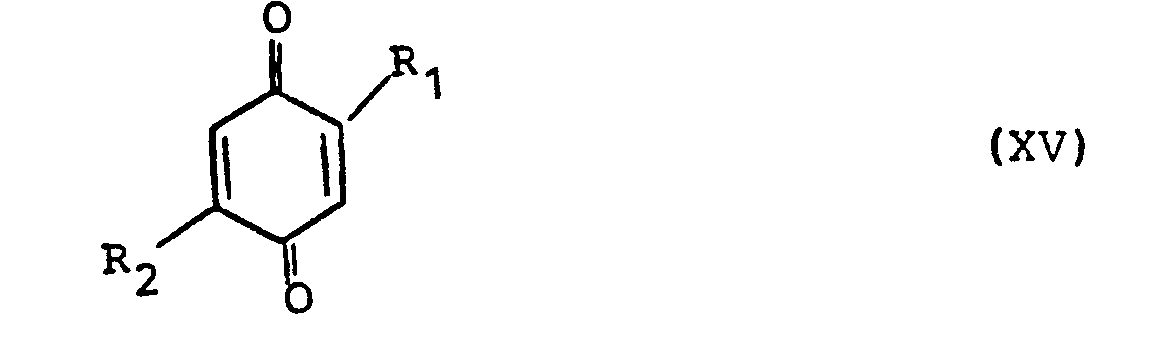
- a variant for the preparation of compounds of the formula (XXI) - (XXIII) consists in the addition of aminobenzene carboxamides of the formulas (XVIII) - (XX) to 1,4-benzoquinones of the formula wherein R 1 and R 2 have the meaning given above, and the oxidation of the primary adducts formed.
- the ring closure of the quinone condensation products (XXI) to (XXIII) can be carried out according to methods known per se, as described in German Offenlegungsschriften 2 122 262, 2 124 080, 2 302 382, 2 344 781, 2 503 611, 2 823 828 and in British Patent 2,019,872 are mentioned, in particular in concentrated sulfuric acid and especially in oleum with SO 3 contents of 1-50% at temperatures of 10-80 ° C., optionally with the addition of oxidizing agents such as potassium or ammonium peroxydisulfate or organic peroxides .
- oxidizing agents such as potassium or ammonium peroxydisulfate or organic peroxides .
- the new dyes in the shades of blue are valuable products that are characterized by high color strengths. They are suitable in dispersed or dissolved form for a wide variety of applications.
- water-soluble compounds find preferred interest for dyeing textile materials containing hydroxyl and amide groups, in particular materials made from native and regenerated cellulose and synthetic polyamide and polyurethane fibers, wool and silk.
- the temperature information in the examples is ° C.
- the formulas of the water-soluble dyes in the description and in the examples are those of the free acids. If the dyes are reactive, they are generally isolated and used in the form of their alkali metal salts, in particular the sodium or potassium salts.
- a dioxazine carbonamide component of the formula prepared by condensation of 2,3,5,6-tetrachloroquinone with 5-amino-2-8-hydroxyethylamino-benzoic acid-8-aminoethylamide and subsequent oxidative ring closure of the condensation product in oleum are in 250 ml of water by adding 2N sodium hydroxide solution at pH 12.0 solved.
- the resulting solution is kept at pH 8.8-9.0 for a few hours at 0-5 ° C. with in sodium hydroxide solution.
- the temperature is then allowed to rise to 20 ° C. overnight under constant pH control, the pH is adjusted to 7.5 and the reactive dye obtained is then salted out with 22% sodium chloride.
- the precipitate obtained is filtered off with suction, washed with sodium chloride solution and, after adding phosphates as a buffer, dried at 50 ° C. in a circulating air cabinet.
- a dioxazine carbonamide component of the formula prepared by condensation of 5-amino-2- ( ⁇ -amino-ethylamino) -benzoic acid (B-sulfoethylamide) with chloranil and subsequent oxidative ring closure in oleum,
- the solution of the color component is then introduced as quickly as possible into the suspension of the reactive component prepared above in such a way that a pH of 8.5-9.0 is established and this pH is maintained Drop in 1n sodium hydroxide solution. Stirring continues at 0-5 °. The color component, which initially failed, will soon be completely resolved as the implementation progresses.
- the temperature is allowed to rise to 20 ° C. overnight under constant pH control, the pH is adjusted to 7.5-8.0 and the reactive dye obtained is salted out with 15-20% sodium chloride.
- the precipitate obtained is suction filtered, the filter cake is washed with sodium chloride solution and, after the addition of phosphates as a buffer, it is dried in a vacuum cabinet at 50 ° C.
- An alternative work-up method is to evaporate the dye solution to dryness after adding phosphate buffers in a rotary evaporator. In any case, a blue powder is obtained, the coloring substance of which is the sodium salt of the dye of the following formula
- a dioxazine carbonamide component of the formula prepared by condensation of chloranil with 5-amino-2-ß-hydroxyethylamino-benzoic acid (3'-amino-2'-methyl-5'-sulfophenyl-amide) and oxidative ring closure of the condensation product in oleum are in 180 ml of water Adjust the pH to 6.0 with dilute sodium hydroxide solution. 3.7 ml of 2,4,6-trifluoro-5-chloropyrimidine are then added dropwise at 20 ° C. in 30 minutes and the pH is kept at 5.5-6.0 with 2N sodium carbonate solution.
- the dye obtained as the sodium salt corresponds in the form of the free acid to the formula and dyes cellulose fibers in clear blue tones in the dyeing and printing processes customary in industry.
- a dioxazine carbonamide component of the formula prepared by condensation of chloranil with 5-amino-2- (B-sulfoethylamino) -benzoic acid (4'-amino-3'-sulfophenylamide) and oxidative ring closure of the condensation product in oleum are dissolved in 300 ml of water at pH 5.5 .
- the solution is cooled to 0-5 ° C. and 3.7 ml of cyanuric fluoride are added dropwise over the course of 5 minutes.
- the pH in the reaction mixture was kept at 4.5-4.8 in the middle of 1N sodium carbonate solution.
- a neutralized solution of 8.0 g of 3-aminobenzenesulfonic acid in 80 ml of water is allowed to run in.
- the pH is now kept at 6.0-6.5 with sodium carbonate solution.
- the temperature is allowed to rise to 20 ° and, after the reaction has ended, the solution of the dye obtained is saturated at 20 ° with sodium or potassium chloride.
- the precipitated dye is suctioned off, washed with 25% sodium or potassium chloride solution and, after admixing phosphate buffer, dried in vacuo at 45 ° C.
- the dye obtained corresponds in the form of the free acid to the formula
- a product similar to the dye of Example 6 is obtained if, instead of the methylsulfonylcarbonamide component, 13.8 g of the following phenylsulfonylcarbonamide component is dissolved in 300 ml of water and this solution, according to the example, with the condensation product of 12.6 g of 2-aminobenzene 1,4-disulfonic acid and 5.0 ml of cyanuric fluoride are reacted and the rest of the procedure described in Example 1 is followed.
- the dye thus obtained corresponds to the formula
Landscapes
- Chemical & Material Sciences (AREA)
- Organic Chemistry (AREA)
- Coloring (AREA)
Abstract


Description
- Gegenstand der vorliegenden Erfindung sind Farbstoffe der Formel

- A = Substituent,
- B = H oder Substituent, mit der Maßgabe, daß mindestens einer dieser Substituenten eine faserreaktive Gruppe enthält,
- R1-R4 = H oder Substituent.
- Bevorzugt sind dabei Farbstoffe I, die mindestens zwei wasserlöslichmachende Gruppen, insbesondere Sulfo-, Sulfato- oder Carboxygruppen aufweisen.
- Geeignete Substituenten A sind beispielsweise solche der Formel

- W = direkte Bindung oder -Y1-(
wobei - n = 0 oder 1
- Y1 = Brückenglied
- Z = faserreaktive Gruppe
oder solche der Formel
- R5 = H, gegebenenfalls substituiertes C1-C6-Alkyl,
- R6 = H, gegebenenfalls substituiertes C1-C6-Alkyl, CS-C6-Cycloalkyl, gegebenenfalls substituiertes Phenyl-C1-C4-alkyl, gegebenenfalls substituiertes Aryl, vorzugsweise gegebenenfalls substituiertes Phenyl und Naphthyl, gegebenenfalls substituiertes C1-C4-Alkyl-, Phenyl-C1-C4-alkyl-, Phenyl- oder Naphthylsulfonyl,
- Als Substituenten für die Alkylreste R5 und R6 kommen insbesondere in Frage: wasserlöslichmachende Gruppen oder hydrophile Gruppen wie: -SO3H, -OSO3H, -COOH, -OH, C1-C4-Alkoxy, gegebenenfalls substituiert beispielsweise durch C1-C4-Hydroxyalkyl oder C1-C4-Alkoxy-C1-C4- alkyl.
- Als Substituienten für die Arylreste, insbesondere die Phenylreste kommen beispielsweise in Frage:
- -S03H, -COOH weiterhin C1-C4-Alkyl, Halogen, C1-C4-Alkoxy sowie funktionell abgewandelte Sulfo- und Carboxygruppen.
- Beispiele für Brückenglieder Y1 sind Alkylenreste wie C2-C6-Alkylen, gegebenenfalls durch O, S oder N unterbrochen, gegebenenfalls substituiert, beispielsweise Ethylen, 1,2- und 1,3-Propylen, 1,2-, 1,3-, 1,4- und 2,3-Butylen, 2-Methyl-1,3-Propylen, 2,2-Dimethylpropylen, 2-Methyl-2,4-pentylen, 1-Phenylethylen, 2,5-Hexylen, 1,5-Pentylen, 1,6-Hexylen, 1,3-Cyclohexylen, 1,4-Cyclohexylen, 4-Methyl-1,3-cyclohexylen, 2-Hydroxy 1,3-propylen, 2-Sulfato-1,3-propylen, -CH2CH2-O-CH2CH2 -CH2-CH2-S-CH2-CH2-,





- Arylenreste wie gegebenenfalls substituiertes Phenylen, insbesondere Phenylen und durch Alkyl, Alkoxy, Sulfo, Carboxy oder Halogen substituiertes Phenylen wie 1,2-, 1,3-, 1,4-Phenylen, 3-Methyl-1,2-phenylen, 4-Methyl-1,2-phenylen, 2-Methyl-1,3-phenylen, 4-Methyl-1,3-phenylen, 5-Methyl-1,3-phenylen, 2-Methyl-1,4-phenylen, 2,4,6-Trimethyl-1,3-phenylen, 2,3,5,6-Tetramethyl-1,4-phenylen, 2,6-Dimethyl-1,3-phenylen, 2-Methyl-6-ethyl-1,3-phenylen, 2-Methyl-4,6-diethyl-1,3-phenylen, 2,6-Diethyl-4-methyl-1,3-phenylen, 2-Methoxy-1,3-phenylen, 4-Methoxy-1,3-phenylen, 6-Methoxy-1,3-phenylen, 2-Methoxy-1,4-phenylen, 4-Chlor-1,3-phenylen, 2-Chlor-1,4-phenylen, 4-Chlor-1,3-phenylen, 2-Chlor-1,4-phenylen sowie insbesondere die durch 1-2 Sulfonsäuregruppen substituierten genannten Arylenreste wie zum Beispiel 4-Sulfo-1,2-phenylen, 4-Sulfo-1,3-phenylen, 3-Sulfo-1,4-phenylen, 2-Sulfo-1,4-phenylen, 4,6-Disulfo-1,3-phenylen, 2,5-Disulfo-1,4-phenylen, 2-Methyl-5-sulfo-1,3-phenylen, 2-Methyl-4-sulfo-1,3-phenylen, 2,4,6-Trimethyl-5-sulfo-1,3-phenylen, 2,6-Dimethyl-4- und -5-sulfo-1,3-phenylen, 2-Methyl-6-sulfo-1,3-phenylen, 4-Methyl-6-sulfo-1,3-phenylen, 6-Methyl-4-sulfo-1,3-phenylen, 3-Methyl-6-sulfo-1,4-phenylen, 6-Methoxy-4-sulfo-1,3-phenylen, 4-Methoxy-6-sulfo-1,3-phenylen.
- Geeignete Reste B sind beispielsweise solche der Formel


- Y2 = Brückenglied
- n = 0 oder 1.
- Geeignete Brückenglieder Y2 sind dabei die für Y1 genannten sowie für n = 1 solche der Formel

- Geeignete Reste R1 und R2 sind beispielsweise Cl, Br, C1-C4-Alkyl, C1-C4-Alkoxy, Aryloxy, insbesondere gegebenenfalls substituiertes Phenoxy, Acylamino, Carboxy, gegebenenfalls weitersubstituiertes Carbonamid.
- Geeignete Reste R3 sind beispielsweise C1-C4-Alkyl, C1-C4-Alkoxy, Halogen insbesondere Cl.
- Geeignete Reste R4 sind die Reste R6.
- Bevorzugte Farbstoffe sind ganz generell solche, bei denen die Reste A, nicht jedoch die Reste B eine Reaktivgruppe enthalten, weiterhin solche bei denen die Reste B eine Reaktivgruppe enthalten, nicht jedoch die Reste A.
- Vorzugsweise stehen die Reste

- Vorzugsweise stehen R1 und R2 für Cl und R3 für H.
- Geeignete faserreaktive Reste Z, also solche, die unter Färbebedingungen mit hydroxylgruppen- oder amidgruppenhaltigen Materialien unter Ausbildung einer kovalenten Bindung reagieren,
- sind beispielsweise solche, die mindestens einen abspaltbaren Substituenten an einen heterocyclischen oder an einen aliphatischen Rest gebunden enthalten, insbesondere solche, die mindestens einen reaktiven Substituenten an einen 5- oder 6-gliedrigen heterocyclischen Ring gebunden enthalten, wie an einen Monazin-, Diazin-, Triazin-, z.B. Pyridin-, Pyrimidin-, Pyridazin-, Pyrazin-, Thiazin-, Oxazin- oder asymmetrischen oder symmetrischen Triazinring, oder an ein derartiges Ringsystem, welches einen oder mehrere ankondensierte aromatische Ringe aufweist, wie ein Chinolin-, Phthalazin-, Chinazolin-, Chinoxalin-, Acridin-, Phenazin- und Phenanthridin-Ringsystemy die 5- oder 6-gliedrigen heterocyclischen Ringe, welche mindestens einen reaktiven Substituenten aufweisen, sind demnach bevorzugt solche, die ein oder mehrere Stickstoffatome enthalten und 5- oder bevorzugt 6-gliedrige carbocyclische Ringe ankondensiert enthalten können.
- Unter den reaktiven Substituenten am Heterocyclus sind beispielsweise zu erwähnen: Halogen (C1, Br oder F), Ammonium, einschließlich Hydrazinium, Sulfonium, Sulfonyl, Azido(N3), Rhodanido, Thio, Thiolether, Oxyether, Sulfinsäure und Sulfonsäure. Im einzelnen sind beispielsweise zu nennen: Mono- oder Dihalogen-symmetrische-triazinylreste, z.B. 2,4-Dichlortriazinyl-6-, 2-Amino-4-chlortriazinyl-6-, 2-Alkylamino-4-chlortriazinyl-6-, wie-2-Methylamino-4- chlortriazinyl-6-, 2-Ethylamino- oder 2-Propylamino-4- chlortriazinyl-6-, 2-B-Oxethylamino-4-chlortriazinyl-6-, 2-Di-ß-oxethylamino-4-chlortriazinyl-6- und die entsprechenden Schwefelsäurehalbester, 2-Diethylamino-4- chlortriazinyl-6-, 2-Morpholino- oder 2-Piperidino-4- chlortriazinyl-6-, 2-Cyclohexylamino-4-chlortriazinyl-6-, 2-Arylamino- und substituiertes Arylamino-4-chlor- triazinyl-6-, wie 2-Phenylamino-4-chlortriazinyl-6-, 2-(o-, m- oder p-Carboxy- oder -Sulfophenyl)-amino-4- chlortriazinyl-6-, 2-(2',4'-,2',5'- oder 3',4'-Disulfophenyl)-amino-4-chlor-triazinyl-6, 2-Alkoxy-4-chlortria- zinyl-6-, wie 2-Methoxy- oder -Ethoxy-4-chlortriazinyl-6-, 2-(Phenyl-sulfonylmethoxy)-4-chlortriazinyl-6-, 2-Aryloxy- und substituiertes Aryloxy-4-chlortriazinyl-6-, wie 2-Phenoxy-4-chlortriazinyl-6-, 2-(p-Sulfophenyl)-oxy-4-chlortriazinyl-6-, 2-(o-, m- oder p-Methyl- oder -Methoxj phenyl)-oxy-4-chlor-triazinyl-6-, 2-Alkylmercapto- oder 2-Arylmercapto- oder 2-(substituiertes Aryl)-mercapto-4- chlortriazinyl-6-, wie 2-ß-Hydroxyethylmercapto-4-chlor- triazinyl-6-, 2-Phenylmercapto-4-chlortriazinyl-6-, 3-(4'-Methylphenyl)-mercapto-4-chlortriazinyl-6-, 2-(2',4'-Dini- tro)-phenyl-mercapto-4-chlortriazinyl-6-, 2-Methyl-4-chlor- triazinyl-6-, 2-Phenyl-4-chlor-triazinyl-6, 2,4-Difluortriazinyl-6, Monofluortriazinylreste, die durch Amino-, Alkylamino-, Aralkylamino-, Arylaminogruppen substituiert sind, wobei Alkyl, insbesondere gegebenenfalls substituiertes Cl-C4-Alkyl, Aralkyl, insbesondere gegebenenfalls substituiertes Phenyl-C1-C4-Alkyl und Aryl, insbesondere gegebenenfalls durch Sulfo-, Alkyl-, insbesondere Cl-C4-Alkyl-, Alkoxy-, insbesondere Cl-C4-Alkoxy-, Carbonsäure-, Acylaminogruppen und Halogenatome wie Fluor, Chlor oder Brom substituiertes Phenyl oder Naphthyl bedeutet, beispielsweise 2-Amino-4-fluor-triazinyl-6, 2-Methylamino-4-fluor-triazinyl-6, 2-Ethylamino-4-fluor-triazinyl-6, 2-iso-Propylamino-4-fluor-triazinyl-6, 2-Dimethylamino-4-fluor-triazinyl-6, 2-Diethylamino-4-fluor-triazinyl-6, 2-ß-Methoxy-ethylamino-4-fluor-triazinyl-6, 2-ß-Hydroxyethylamino-4-fluor-triazinyl-6, 2-Di-(ß-hydroxyethylamino)-4-fluor-triazinyl-6, 2-ß-Sulfoethylamino-4-fluor- triazinyl-6, 2-ß-Sulfoethyl-methylamino-4-fluor-triazinyl-6, 2-Carboxymethylamino-4-fluor-triazinyl-6, 2-ß-Cyanethylamino-4-fluor-triazinyl-6, 2-Benzylamino-4-fluor-triazinyl-6, 2-B-Phenylethylamino-4-fluor-triazinyl-6, 2-Benzyl-methylamino-4-fluor-triazinyl-6, 2-(x-Sulfo-benzyl)-amino-4-fluor-triazinyl-6, 2-Cyclohexylamino-4-fluor-triazinyl-6, 2-(o-, m-, p-Methylphenyl)-amino-4-fluor-triazinyl-6, 2-(o-, m-, p-Sulfophenyl)-amino-4-fluor-triazinyl-6, 2-(2',5'-Disulfophenyl)-amino-4-fluor-triazinyl-6, 2-(o-, m-, p-Chlorphenyl)-amino-4-fluor-triazinyl-6, 2-(o-, m-, p-Methoxyphenyl)-4-fluor-triazinyl-6, 2-(2'-Methyl-4'-sulfophenyl)-amino-4-fluor-triazinyl-6, 2-(2'-Methyl-5'-sulfophenyl)-amino-4-fluor-triazinyl-6, 2-(2'-chlor-4'-sulfophenyl)-amino-4-fluor-triazinyl-6, 2-(2'-Chlor-5'-sulfophenyl)-amino-4-fluor-triazinyl-6, 2-(2'-Methoxy-4'-sulfophenyl)-amino-4-fluor-triazinyl-6, 2-(o-, m-, p-Carboxyphenyl)-amino-4-fluor-triazinyl-6, 2-(2',4'-Disulfophenyl)-amino-4-fluor-triazinyl-6, 2-(3',5'-Disulfophenyl)-amino-4-fluor-triazinyl-6, 2-(21-Carboxy-4-sulfophenyl)-amino-4-fluor-triazinyl-6, 2-(6'-Sulfonaphthyl-(2'))-amino-4-fluor-triazinyl-6, 2-(4',8'-Disulfonaphthyl-(2'))-amino-4-fluor-triazinyl-6, 2-(6',8'-Disulfonaphthyl-(2'))-amino-4-fluor-triazinyl-6, 2-(N-Methylphenyl)-amino-4-fluor-triazinyl-6, 2-(N-Ethylphenyl)-amino-4-fluor-triazinyl-6, 2- (N-ß-Hydroxyethylphenyl) -amino-4-fluor-triazinyl-6, 2-(N-iso-Propylphenyl)-amino-4-fluor-triazinyl-6, 2-Morpholino-4-fluor-triazinyl-6, 2-Piperidino-4-fluor-triazinyl-6, 2-(4',6',8'-Trisulfonaphthyl-(2'))-4-fluor-triazinyl-6, 2-(3',6',8'-Trisulfonaphthyl-(2'))-4-fluor-triazinyl-6, 2-(3',6'-Disulfonaphthyl-(1'))-4-fluor-triazinyl-6, 2-Chlor- oder 2-Fluor-4-(4'-ß-sulfatoethylsulfonyl-phen; amino)-6-triazinyl, 2-Chlor- oder 2-Fluor-4-(3'-ß-sulfa ethylsulfonyl-phenylamino)-6-triazinyl, 2-Chlor- und 2-Fluor-4-(ß-(ß'-sulfatoethylsulfonyl)-ethylamino)-6-tria zinyl, 2-Fluor-4-bis-(ß-(ß'-chlorethylsulfonyl)-ethyl)-amino-6-triazinyl.
- Die Halogentriazinylreste können auch mit einem zweiten Halogentriazinylrest verknüpft sein. Beispiele für derartige Reste sind die folgenden:


- Weiterhin können die reaktiven Halogenatome in den oben genannten 2-Halogen-4-substituierten-triazinyl-Resten unter Bildung quartärer Salze noch gegen tertiäre Basen wie Trimethylamin, Triethylamin, Dimethyl-B-hydroxyethylamin, Triethanolamin,N,N-Dimethylhydrazin, Pyridin, α-, γ-Picolin, Nicotinsäure oder Isonicotinsäure ausgetauscht werden.
- Mono-, Di- oder Trihalogenpyrimidinylreste, wie 2,4-Dichlor- pyrimidinyl-6-, 2,4,5-Trichlorpyrimidinyl-6-, 2,4-Dichlor-5-nitro- oder -5-methyl- oder -5-carboxymethyl- oder -5-carboxy- oder -5-cyano- oder -5-vinyl- oder -5-sulfo-oder -5-mono- -di- oder -trichlormethyl- oder -5-carbo- alkoxy-pyrimidinyl-6-, 2,6-Dichlorpyrimidin-4-carbonyl-, 2,4-Dichlorpyrimidin-5-carbonyl-, 2-Chlor-4-methylpyrimidin-5-carbonyl-, 2-Methyl-4-chlorpyrimidin-5-carbonyl-, 2-Methylthio-4-fluorpyrimidin-5-carbonyl-, 6-Methyl-2,4-dichlorpyrimidin-5-carbonyl-, 2,4,6-Trichlorpyrimidin-5-carbonyl-, 2,4-Dichlorpyrimidin-5-sulfonyl-, 2-Chlor- chinoxalin-3-carbonyl-, 2- oder 3-Monochlorchinoxalin-6-carbonyl-, 2- oder 3-Monochlorchinoxalin-6-sulfonyl-, 2,3-Dichlorchinoxalin-6-carbonyl-, 2,3-Dichlorchinoxalin-6-sulfonyl-, 1,4-Dichlorphthalazin-6-sulfonyl- oder -6-carbonyl-, 2,4-Dichlorchinazolin-7- oder -6-sulfonyl-oder -carbonyl-, 2- oder 3- oder 4-(4',5'-Dichlor- pyridazon-6'-yl-l')-phenylsulfonyl- oder -carbonyl-, ß-(4',S'-Dichlorpyridazon-6'-yl-l')-ethylcarbonyl-, N-Methyl-N-(2,4-dichlortriazinyl-6-)-carbamyl-, N-Methyl-N-(2-methylamino-4-chlortriazinyl-6)-carbamyl-, N-Methyl-N-2-dimethylamino-4-chlortriazinyl-6)-carbamyl-, N-Methyl-oder N-Ethyl-N-(2,4-dichlortriazinyl-6)-aminoacetyl-, N-Methyl-N-(2,3-dichlorchinoxalin-6-sulfonyl)-aminoacetyl-, N-Methyl-N-(2,3-dichlorchinoxalin-6-carbonyl)-aminoacetyl-, sowie die entsprechenden Brom- und Fluor-Derivate der oben erwähnten chlorsubstituierten heterocyclischen Reste, unter diesen beispielsweise 2-Fluor-4-pyrimidinyl-, 2,6-Difluor-4-pyrimidinyl-, 2,6-Difluor-5-chlor-4-pyrimidinyl, 2-Fluor-5,6-dichlor-4-pyrimidinyl-, 2,6-Difluor-5-methyl-4-pyrimidinyl-, 2-Fluor-5-methyl-6-chlor-4-pyrimidinyl-, 2-Fluor-5-nitro-6-chlor-4-pyrimidinyl-, 5-Brom-2-fluor-4-pyrimidinyl-, 2-Fluor-5-cyan-4-pyrimidinyl-, 2-Fluor-5-methyl-4-pyrimidinyl-, 2,5,6-Trifluor-4-pyrimidinyl-, 5-Chlor-6-chlormethyl-2-fluor-4-pyrimidinyl-, 2,6-Difluor-5-brom-4-pyrimidinyl-, 2-Fluor-5-brom-6-methyl-4-pyrimidinyl-, 2-Fluor-5-brom-6-chlormethyl-4-pyrimidinyl-, 2,6-Difluor-5-chlormethyl-4-pyrimidinyl-, 2,6-Difluor-5-nitro-4-pyrimidinyl-, 2-Fluor-6-methyl-4-pyrimidinyl-, 2-Fluor-5-chlor-6-methyl-4-pyrimidinyl-, 2-Fluor-5-chlor-4-pyrimidinyl-, 2-Fluor-6-chlor-4-pyrimidinyl-, 6-TrifluorMethyl-5-chlor-2-fluor-4-pyrimidinyl-, 6-Trifluormethyl-2-fluor-4-pyrimidinyl-, 2-Fluor-5-nitro-4-pyrimidinyl-, 2-Fluor-5-trifluormethyl-4-pyrimidinyl-, 2-Fluor-5-phenyl-oder -5-methylsulfonyl-4-pyrimidinyl-, 2-Fluor-5-carbon- amido-4-pyrimidinyl-, 2-Fluor-5-carbomethoxy-4-pyrimidinyl-, 2-Fluor-5-brom-6-trifluormethyl-4-pyrimidinyl-, 2-Fluor-6-carbonamido-4-pyrimidinyl-, 2-Fluor-6-carbomethoxy-4-pyrimidinyl-, 2-Fluor-6-phenyl-4-pyrimidinyl-, 2-Fluor-6-cyan-4-pyrimidinyl-, 2-Fluor-4-dichlormethyl-5-chlorpyri- midin-6-yl, 2-Fluor-5-chlor-pyrimidin-4-yl, 2-Methyl-4-fluor-5-methylsulfonylpyrimidinyl-6, 2,6-Difluor-5-methylsulfonyl-4-pyriaidinyl-, 2,6-Dichlor-5-methylsulfonyl-4-pyrimidinyl, 2-Fluor-5-sulfonamido-4-pyrimidinyl-, 2-Fluor-5-chlor-6- carbomethoxy-4-pyrimidinyl-, 2,6-Difluor-5-trifluormethyl-4-pyrimidinyl; sulfonylgruppenhaltige Triazinreste, wie 2,4-Bis-(phenylsulfonyl)-triazinyl-6-, 2-(3'-Carboxy- phenyl)- sulfonyl-4-chlortriazinyl-6-, 2-(3'-Sulfophenyl)-sulfonyl-4-chlortriazinyl-6-, 2,4-Bis-(3'-carboxyphenylsul- fonyl-)- triazinyl-6; sulfonylgruppenhaltige Pyrimidinringe, wie 2-Carboxymethylsulfonyl-pyrimidinyl-4-, 2-Methylsulfonyl-6-methyl-pyrimidinyl-4-, 2-Methylsulfonyl-6-ethyl- pyrimidinyl-4-, 2-Phenylsulfonyl-5-chlor-6-methyl-pyrimidinyl-4-, 2,6-Bis-methylsulfonyl-pyrimidinyl-4-, 2,6-Bis- methylsulfonyl-5-chlor-pyrimidinyl-4-, 2,4-Bis-methylsulfonyl-pyrimidin-5-sulfonyl-, 2-Methylsulfonyl-pyrimidinyl-4, 2-Phenylsulfonyl-pyrimidinyl-4-, 2-Trichlor- methylsulfonyl-6-methyl-pyrimidinyl-4-, 2-Methylsulfonyl-5-chlor-6-methyl-pyrimidinyl-4-, 2-Methylsulfonyl-5-brom-6-methyl-pyrimidinyl-4-, 2-Methylsulfonyl-5-chlor-6-ethyl-pyrimidinyl-4-, 2-Methylsulfonyl-5-chlor-6-chlormethyl-pyrimidinyl-4-, 2-Methylsulfonyl-4-chlor-6-methyl- pyrimidin-5-sulfonyl-, 2-Methylsulfonyl-5-nitro-6-methyl- pyrimidinyl-4-, 2,5,6-Tris-methylsulfonyl-pyrimidinyl-4-, 2-Methylsulfonyl-5,6-dimethyl-pyrimidinyl-4-, 2-Ethylsulfonyl-5-chlor-6-methyl-pyrimidinyl-4-, 2-Methylsulfonyl-6-chlor-pyrimidinyl-4-, 2,6-Bis-methylsulfonyl-5-chlor-pyrimidinyl-4-, 2-Methylsulfonyl-6-carboxy- pyrimidinyl-4-, 2-Methylsulfonyl-5-sulfo-pyrimidinyl-4-, 2-Methylsulfonyl-6-carbomethoxy-pyrimidinyl-4-, 2-Methylsulfonyl-5-carboxy-pyrimidinyl-4-, 2-Methylsulfonyl-5-cyan-6-methoxy-pyrimidinyl-4-, 2-Methylsulfonyl-5-chlor- pyrimidinyl-4-, 2-Sulfoethylsulfonyl-6-methyl-pyrimidinyl-4-, 2-Methylsulfonyl-5-brom-pyrimidinyl-4-, 2-Phenylsulfonyl-5-chlor-pyrimidinyl-4-, 2-Carboxymethylsul- fonyl-5-chlor-6-methyl-pyrimidinyl-4-, 2-Methylsulfonyl-6- chlorpyrimidin-4- und -5-carbonyl-, 2,6-Bis-(methylsulfonyl)-pyrimidin-4- oder -5-carbonyl-, 2-Ethylsulfonyl-6-chlorpyrimidin-5-carbonyl-, 2,4-Bis-(methylsulfonyl)-pyrimidin-5-sulfonyl-, 2-Methylsulfonyl-4-chlor-6-methyl- pyrimidin-5-sulfonyl- oder -carbonyl-; ammoniumgruppenhaltige Triazinringe, wie 2-Trimethylammonium-4-phenylamino-oder -4-(0-, m- oder p-sulfophenyl)-aminotriazinyl-6-, 2-(1,1-Dimethylhydrazinium)-4-phenylamino- oder -4-(o-, m- oder p-sulfophenyl)-aminotriazinyl-6-, 2-(2-Isopropyliden-1,1-dimethyl)-hydrazinium-4-phenylamino- oder -4-(o-, m- oder p-sulfophenyl)-aminotriazinyl-6-, 2-N-Aminopyrrolidinium- oder 2-N-Aminopiperidinium-4-phenylamino- oder -4-(o-, m- oder p-sulfophenyl)-aminotriazinyl-6-, ferner 4-Phenylamino- oder 4-(Sulfophenylamino)-triazinyl-6-Reste, die in 2-Stellung über eine Stickstoffbindung das 1,4-Bisazabicyclo-[2,2,2]-octan oder das 1,2-Bis-aza-bicyclo-[0,3,3]-octan quartär gebunden enthalten, 2-Pyridinium-4-phenylamino- oder -4-(o-, m- oder p-sulfophenyl)-aminotriazinyl-6- sowie entsprechende 2-Onium- triazinyl-6-Reste, die in 4-Stellung durch Alkylamino-, wie Methylamino-, Ethylamino- oder ß-Hydroxyethylamino-, oder Alkoxy-, wie Methoxy- oder Ethoxy-, oder Aroxy-, wie Phenoxy- oder Sulfophenoxy-Gruppen substituiert sind; 2-Chlorbenzthiazol-5- oder -6-carbonyl- oder -5- oder -6-sulfonyl-, 2-Arylsulfonyl- oder -Alkylsulfonylbenz- thiazol-5- oder -6-carbonyl- oder -5- oder -6-sulfonyl-, wie 2-Methylsulfonyl- oder 2-Ethylsulfonylbenzthiazol-5-oder -6-sulfonyl- oder -carbonyl-, 2-Phenylsulfonyl- benzthiazol-5- oder -6-sulfonyl- oder -carbonyl- und die entsprechenden im ankondensierten Benzolring Sulfogruppen enthaltenden 2-Sulfonylbenzthiazol-5- oder -6-carbonyl-oder -sulfonyl-Derivate, 2-Chlorbenzoxazol-5- oder -6-carbonyl- oder -sulfonyl-, 2-Chlorbenzimidazol-5- oder -6-carbonyl- oder -sulfonyl-, 2-Chlor-1-methylbenzimidazol-5- oder -6-carbonyl- oder -sulfonyl-, 2-Chlor-4-methyl- thiazol-(1,3)-5-carbonyl- oder -4- oder -5-sulfonyl-, N-Oxid des 4-Chlor- oder 4-Nitrochinolin-5-carbonyl.
- Desweiteren sind Reaktivgruppen der aliphatischen Reihe zu nennen, wie Acryloyl-, Mono-, Di- oder Trichloracryloyl-, wie -CO-CH=CH-C1, -CO-CCl=CH2, -CO-CCl=CH-CH3, ferner -CO-CCl=CH-COOH, -CO-CH=CC1-COOH, ß-Chlorpropionyl-, 3-Phenylsulfonylpropionyl-, 3-Methylsulfonylpropionyl-, ß-Sulfato-ethylaminosulfonyl-, Vinylsulfonyl-, B-Chlorethylsulfonyl-, ß-Sulfatoethylsulfonyl-, ß-Phosphatoethylsulfonyl, ß-Thiosulfatoethylsulfonyl, ß-Methylsulfonylethylsulfonyl-, ß-Phenylsulfonylethylsulfonyl-, 2-Fluor-2-chlor-3,3-difluorcyclobutan-l-carbonyl-, 2,2,3,3-Tetrafluorcyclobutan-carbonyl-l- oder sulfonyl-l-, ß-(2,2,3,3-Tetrafluorcyclobutyl-1)-acryloyl-,α- oder ß-Bromacryloyl-, α - oder ß-Alkyl- oder -Arylsulfonylacryloyl-Gruppen, wie α - oder ß-Methylsulfonylacryloyl, α, ß-Dichlor- und -Dibrompropionyl.
- Bevorzugte faserreaktive Reste sind jedoch solche, die mindestens einen reaktiven Substituenten an einem 5- oder 6-gliedrigen heterocyclischen Ring gebunden enthalten.
- Bevorzugte Farbstoffe der Formel (I) sind solche der Formel

- R12' R13 = H, C1-C4-Alkyl oder zusammen -CH2CH2-
- R11 = H, C1-C6-Alkyl,
- Y3 = gegebenenfalls substituiertes C2-C6-Alkylen, Cyclohexylen, gegebenenfalls substituiertes Phenylen,
- Z' = Heterocyclischer faserreaktiver Rest
sowie solche der Formel
- Y4 = C2-C6-Alkylen, Cyclohexylen.
- Die obengenannten Alkyl-, Alkylen-, Aryl- und Arylenreste können weitersubstituiert sein, insbesondere durch -SO3H, -COOH, -OS03H, -OH, -OC1-C4-Alkyl.
- Besonders bevorzugt sind unter den Farbstoffen der Formeln (V) und (VI) solche der Formel

- L = SO3H, OSO3H, OH, COOH
- M = C1-C6-Alkylen,
- Q = C2-C6-Alkylen,
- und solche der Formel

- R7 = H, -CH3, -CH2-CH2-SO3H, -CH2-CH2-OSO3H, -CH2-CH2OH, -CH2-COOH und

- R8 = H, CH3, Cl, OCH3


- R9 = C1-C4-Alkyl, Phenyl, Tolyl
- und schließlich solche der Formel
- Im Rahmen der erfindungsgemäßen Farbstoffe sind besonders bevorzugt solche mit einem Fluor- oder Chlor-s-triazinylrest, der als weitere Substituenten eine gegebenenfalls durch Alkyl- oder Arylreste insbesondere gegebenenfalls substituierte Phenylreste substituierte Aminogruppe aufweist oder solche die einen Fluor- oder Chlorpyrimidinylrest enthalten.
- Gegenstand der Erfindung sind auch reaktivgruppenfreie Farbstoffe der Formel
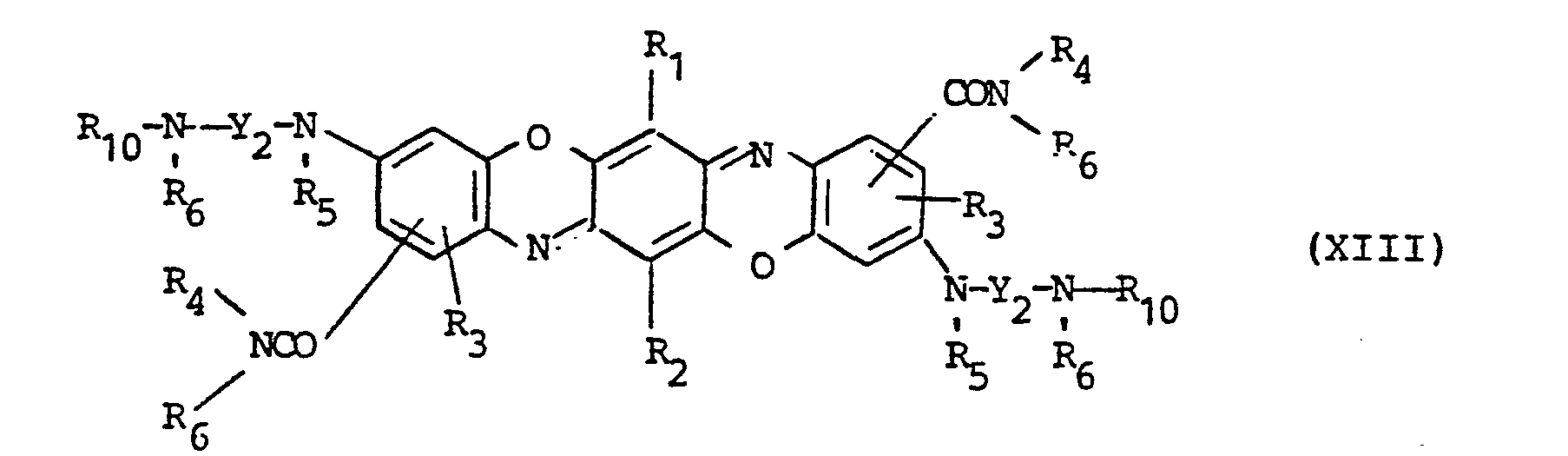

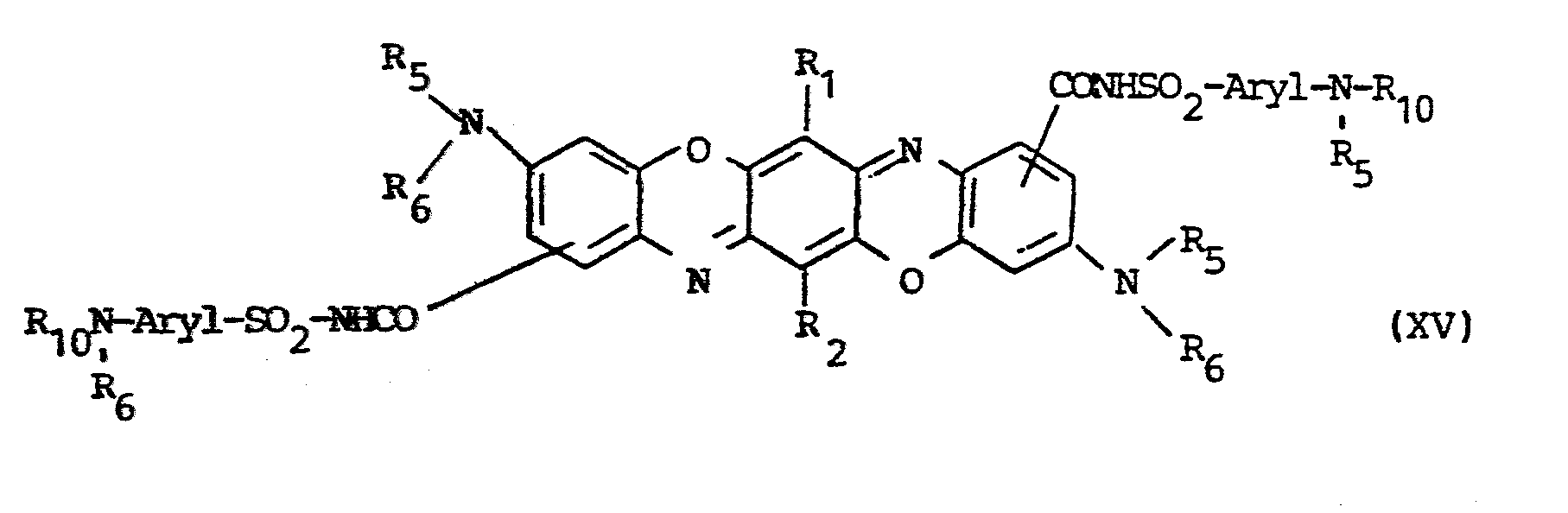
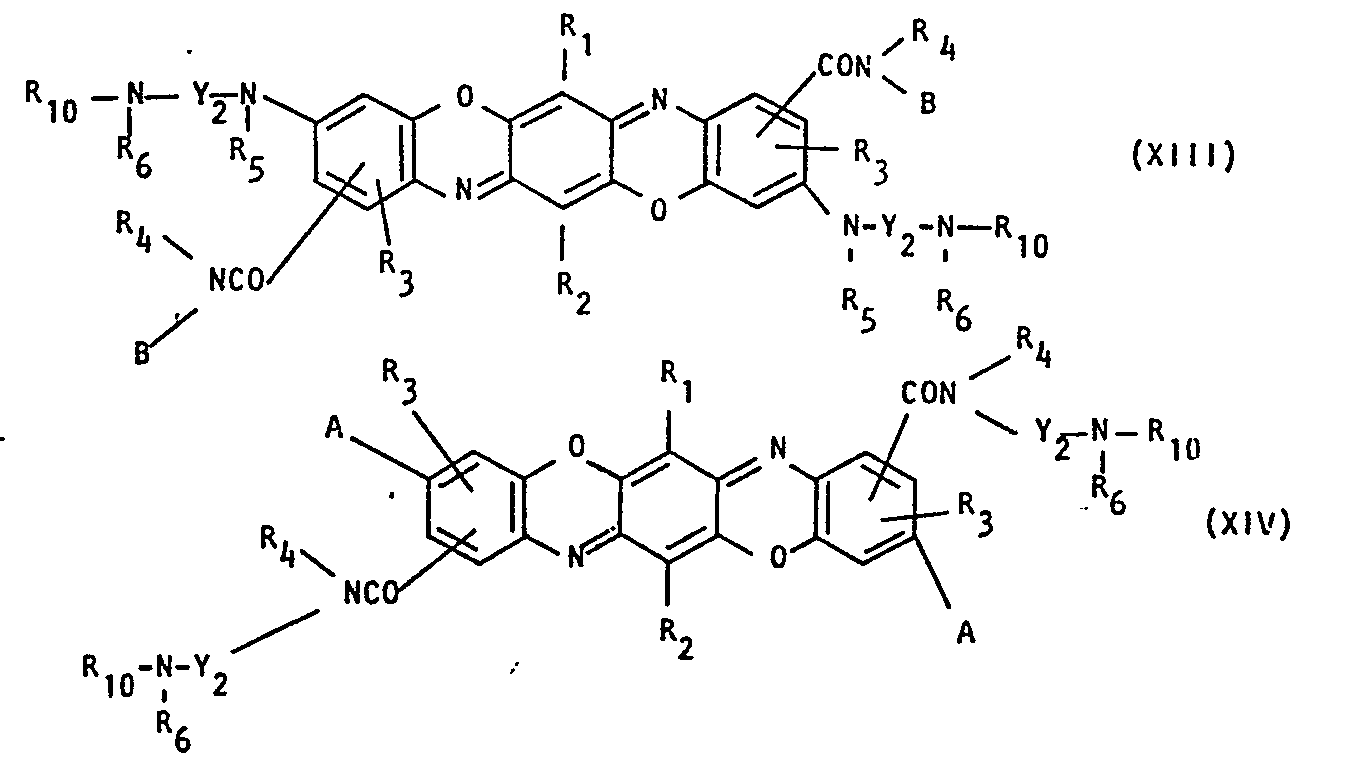
- Farbstoffe der Formel (I) werden beispielsweise in an sich bekannter Weise erhalten durch Umsetzung von Verbindungen der Formeln (XIII), (XIV) und (XV) mit R10 = H mit Reaktivkomponenten Z-Halogen (XVI), worin Z die oben angegebenen Bedeutung hat und Halogen F, Cl oder Br ist.
- Die Kondensation der Dioxazin-Verbindungen der Formeln (XIII), (XIV) und (XV) und der Reaktivkomponenten (XVI) wird entweder in wäßrigem oder wäßrig-organischen Medium in Abhängigkeit von der eingesetzten Reaktivkomponente bei Temperaturen von 0 - 80°C und pH-Werten von 3-9 in Gegenwart alkalischer Kondensationsmittel wie wäßriger Alkalihydrogencarbonat-, Alkalicarbonat-, Alkalihydroxid-, Alkalihydrogenphosphat-, Dialkalihydrogen-phosphat- oder Trialkaliphosphat-Lösung durchgeführt, oder aber die Kondensation wird in aprotischen organischen Lösungsmitteln wie Toluol, Halogenbenzolen, Nitrobenzol, Dimethylformamid, N-Methylpyrrolidon, Tetramethylensulfon, Dimethylsulfoxid, Aceton, Methylethylketon gegebenenfalls in Gegenwart aprotischer organischer Basen wie Trialkylaminen, N,N-Dialkylanilinen, Pyridin oder Alkylpyridinen bei Temperaturen von 0 - 80°C vollzogen.
- Die Herstellung von Verbindungen der Formeln (XIII), (XIV) und (XV) erfolgt nach an sich bekannten Methoden durch Kondensation von 1,4-Benzochinonen der Formel

- R1 und R2 die oben angegebene Bedeutung haben und
- T1 und T2 Wasserstoff, Cl, Br, OAlkyl oder OAryl bedeuten
mit 5-Amino-2-(substituierten-amino)-benzoesäureamiden der Formeln


- Je nach den beim Ringschluß angewandten Reaktionsbedingungen kann die substituierte Carbonamidgruppe bei den Dioxazinen (XIII) bis (XV) in den Benzringen des Dioxazinsystems entweder in den o- oder in den p-Stellungen zu den Ringsauerstoffatomen des Dioxazin-Systems auftreten.
- Die Kondensation der Benzochinone der Formel (XVII) mit den Aminobenzol-sulfonamiden der Formel (XVIII) - (XX) erfolgt am besten in wäßrigem oder wäßrig-organischem Medium unter Zugabe alkalischer Kondensationsmittel bei pH-Werten von 3-11, vorzugsweise 4-8, und Temperaturen von 20-90oC, vorzugsweise 40-70° oder in gepufferten Lösungen, die obige alkalische Kondensationsmittel enthalten. Man kann auch in rein organischem Milieu unter Zusatz säurebindender Mittel arbeiten.
- Alkalische Kondensationsmittel sind beispielsweise Natriumhydrogencarbonat, Natriumcarbonat, Natrium- oder Kaliumacetat, Natronlauge, Kalilauge, Natriumphosphate, Natriumborat.
- Im allgemeinen fallen die Kondensationsprodukte der For-meln (XXI) - (XXIII) als schwerlösliche, braune Produkte aus.
- Die eingesetzten 2-Alkylamino- bzw. 5-Amino-2-(substituierten-amino)-benzolcarbonsäureamide der Formeln (XVIII) - (XX) sind erhältlich durch stufenweise Kondensation von 2-Chlor-5-nitrobenzolcarbonsäurechlorid mit Ammoniak oder Alkyl- oder Arylaminen oder substituierten Sulfonamiden und anschließende katalytische Reduktion der Nitrogruppe.
- Eine Variante zur Herstellung von Verbindungen der Formel (XXI) - (XXIII) besteht in der Addition von Aminobenzolcarbonsäureamiden der Formeln (XVIII) - (XX) an 1,4-Benzochinone der Formel
- Der Ringschluß der Chinonkondensationsprodukte (XXI) bis (XXIII) kann nach an sich bekannten Methoden, wie sie in den Deutschen Offenlegungsschriften 2 122 262, 2 124 080, 2 302 382, 2 344 781, 2 503 611, 2 823 828 und in der Britischen Patentschrift 2 019 872 erwähnt sind, insbesondere in konzentrierter Schwefelsäure und vor allem in Oleum mit S03-Gehalten von 1-50 % bei Temperaturen von 10-80°C gegebenenfalls mit Zusatz von Oxydationsmitteln wie Kalium- oder Ammoniumperoxidisulfat oder organischen Peroxiden vorgenommen werden.
- Die neuen Farbstoffe im Nuancenbereich blau sind wertvolle Produkte, die sich durch hohe Farbstärken auszeichnen. Sie eignen sich in dispergierter oder gelöster Form für die verschiedensten Anwendungszwecke.
- In Form wasserlöslicher Verbindungen finden sie bevorzugtes Interesse für das Färben hydroxyl- und amidgruppenhaltiger Textilmaterialien, insbesondere von Materialien aus nativer und regenerierter Cellulose sowie synthetischen Polyamid- und Polyurethanfasern, Wolle und Seide.
- Handelt es sich um wasserlösliche Reaktivfarbstoffe, so werden die genannten Materialien nach den für Reaktivfarbstoffe allgemein bekannten und üblichen Verfahren gefärbt oder bedruckt. Man erhält dann licht- und naBechte blaue Färbungen und Drucke.
- Bei Temperaturangaben in den Beispielen handelt es sich um °C. Die Formeln der wasserlöslichen Farbstoffe in der Beschreibung und in den Beispielen sind die der freien Säuren. Handelt es sich um Reaktivfarbstoffe, dann werden diese in der Regel in Form ihrer Alkalisalze, insbesondere der Natrium- oder Kaliumsalze, isoliert und angewandt.
- 12,6 g 2-Aminobenzol-1,4-disulfonsäure werden in 50 ml Wasser durch Zutropfen von 10 %iger Sodalösung und Einstellen eines pH-Wertes von 5,5 gelöst. Man läßt nach Abkühlen der Lösung bei 0-5°C 5,0 ml Cyanurfluorid innerhalb von 5 Minuten zutropfen, hält den pH-Wert mittels 10 %iger Sodalösung auf 4,5-4,7 und rührt zur Beendigung der Kondensation noch 20 Minuten unter den angegebenen Bedingungen weiter.
- 13,3 g einer Dioxazincarbonamid-Komponente der Formel

- Die Lösung der Reaktivkomponente und des Farbkörpers werden nun in 50 ml vorgelegtes Wasser bei 0-5°C gleichzeitig so eingetropft, daß sich im Reaktionsgemisch ein pH-Wert von 9,0 einstellt und beide Lösungen in etwa 15 Minuten gleichzeitig eingetragen sind.
- Die entstehende Lösung wird zur Beendigung der Kondensation einige Stunden bei 0-5°C mit In Natronlauge weiter auf pH 8,8-9,0 gehalten. Man läßt dann die Temperatur unter ständiger pH-Kontrolle über Nacht auf 20°C ansteigen, stellt den pH-Wert auf 7,5 und salzt den erhaltenen Reaktivfarbstoff anschließend mit 22 % Natriumchlorid aus. Die erhaltene Fällung wird abgesaugt, mit Natriumchloridlösung gewaschen und nach Zusatz von Phosphaten als Puffer bei 50°C im Umluftschrank getrocknet. Der erhaltene Farbstoff entspricht in Form der freien Säure der Formel
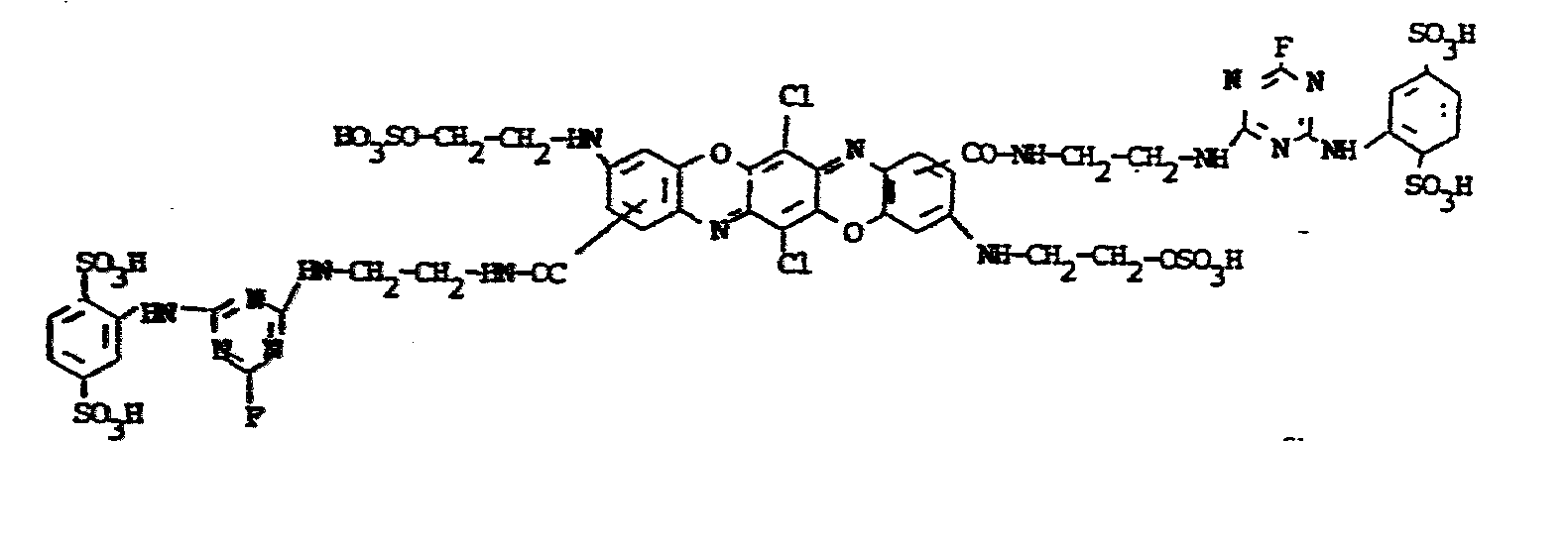
- Weitere ähnliche, Cellulosefasern blaufärbende Reaktivfarbstoffe erhält man, wenn man folgende nachstehend beschriebenen Dioxazincarbonamid-Komponenten mit den aufgefOhrten Reaktivkomponenten kondensiert.


- 7,5 g 2-Aminobenzolsulfonsäure werden in 90 ml Wasser bei pH 6-7 gelöst. Man stellt den pH-Wert auf 5,0, läßt bei 0-5°C 4,3 ml Cyanurfluorid in 5 Minuten zutropfen und hält den pH-Wert mit 5 %iger Sodalösung auf 4,5-4,7, wobei eine teilweise Ausfällung des Kondensationsproduktes auftritt. Zur Beendigung der Kondensation rührt man den Ansatz noch 15-20 Minuten unter den obigen Bedingungen nach.
- 11,2 g einer Dioxazincarbonamid-Komponente der Formel

- werden in 200 ml Wasser durch Zugabe von 2n Natronlauge bei pH 12 gelöst.
- Man trägt nun die Lösung der Farbkomponente bei 0-5°C in die Suspension der oben hergestellten Reaktivkomponente möglichst zügig so ein, daß sich ein pH-Wert von 8,5-9,0 einstellt und hält diesen pH-Wert weiterhin durch Zutropfen von 1nNatronlauge ein. Man rührt weiter bei 0-5°. Die zunächst teilweise ausgefallene Farbkomponente geht mit fortschreitender Umsetzung bald völlig in Lösung.
- Nach einigen Stunden läßt man die Temperatur unter ständiger pH-Kontrolle über Nacht auf 20°C ansteigen, stellt den pH-Wert auf 7,5-8,0 und salzt den erhaltenen Reaktivfarbstoff mit 15-20 % Natriumchlorid aus. Die erhaltene Fällung saugt man ab, wäscht den Filterkuchen mit Natriumchloridlösung und trocknet ihn nach Zusatz von Phosphaten als Puffer bei 50°C im Vakuumschrank. Eine alternative Aufarbeitungsmethode besteht darin, die Farbstofflösung nach Zusatz von Phosphatpuffern im Rotationsverdampfer zur Trockne einzudampfen. In jedem Falle wird ein blaues Pulver erhalten, dessen färbende Substanz das Natriumsalz des Farbstoffs folgender Formel ist
-

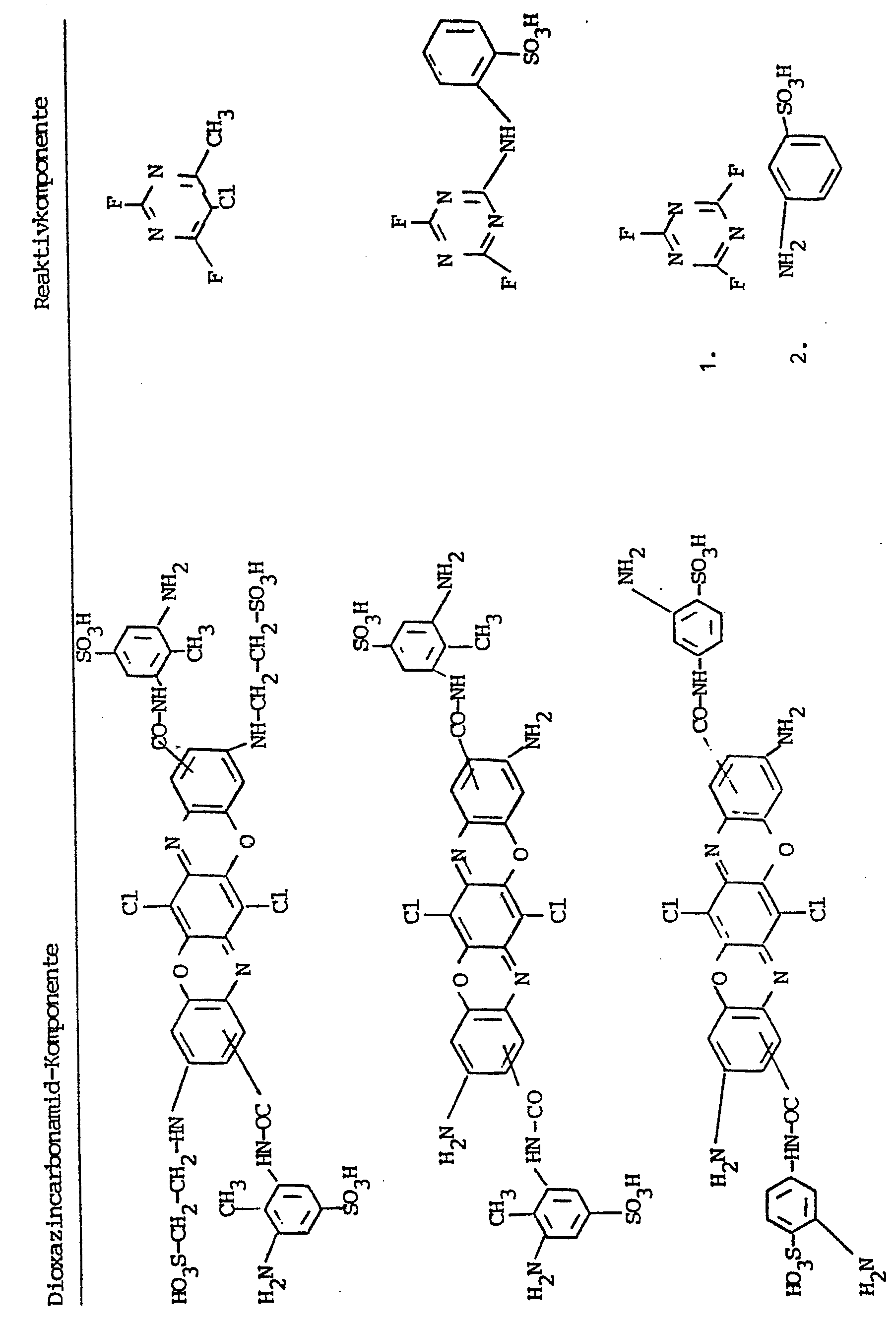
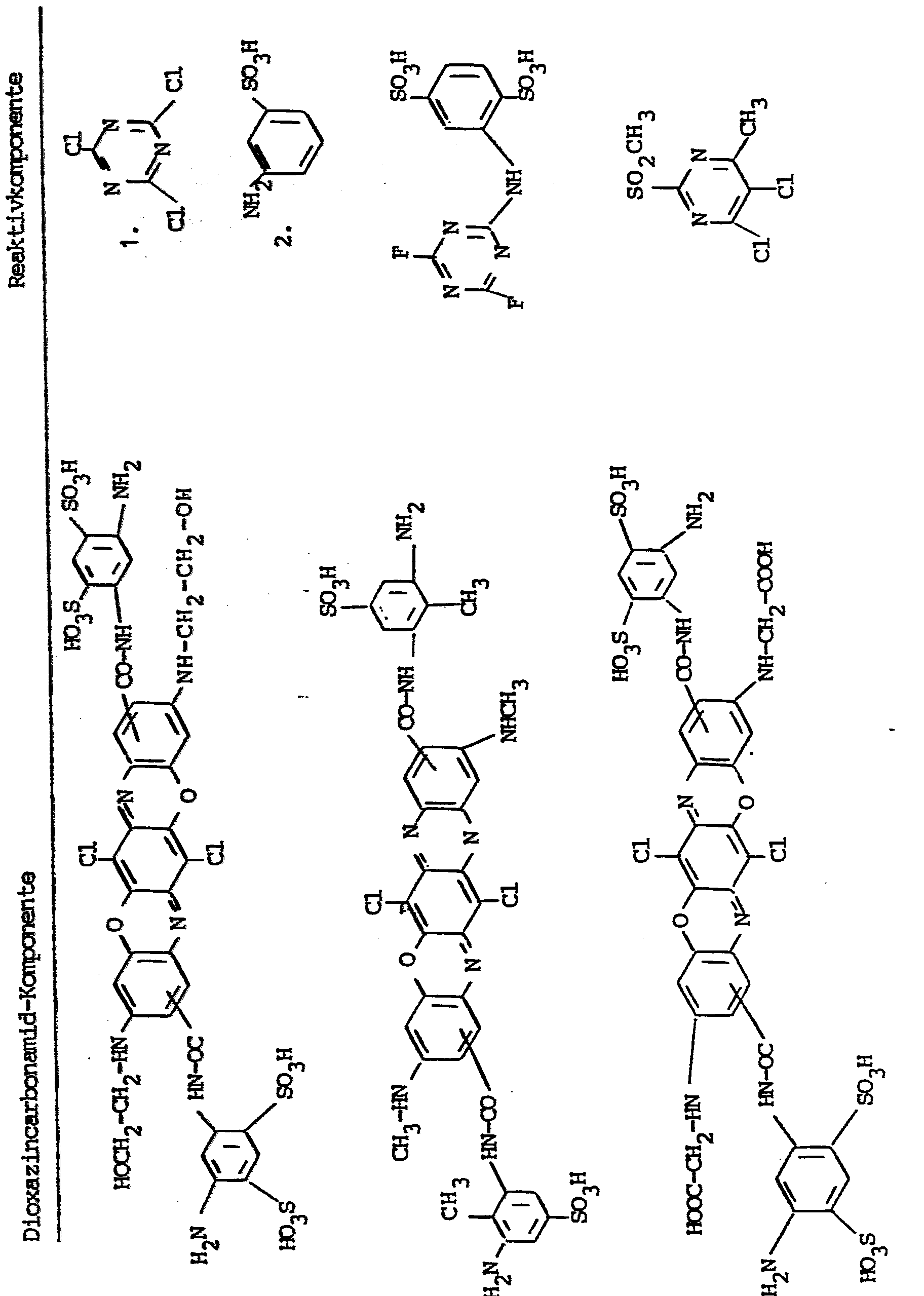
- Die nachfolgende Zusammenstellung zeigt Dioxazincarbonamid-Komponenten, aus denen sich mit den angegebenen Reaktivkomponenten weitere, Cellulosefasern kräftig blau färbende und druckende Reaktivfarbstoffe herstellen lassen, wobei die Zahl der einsetzbaren Reaktivkomponenten nicht auf die angegebenen Beispiele begrenzt ist.


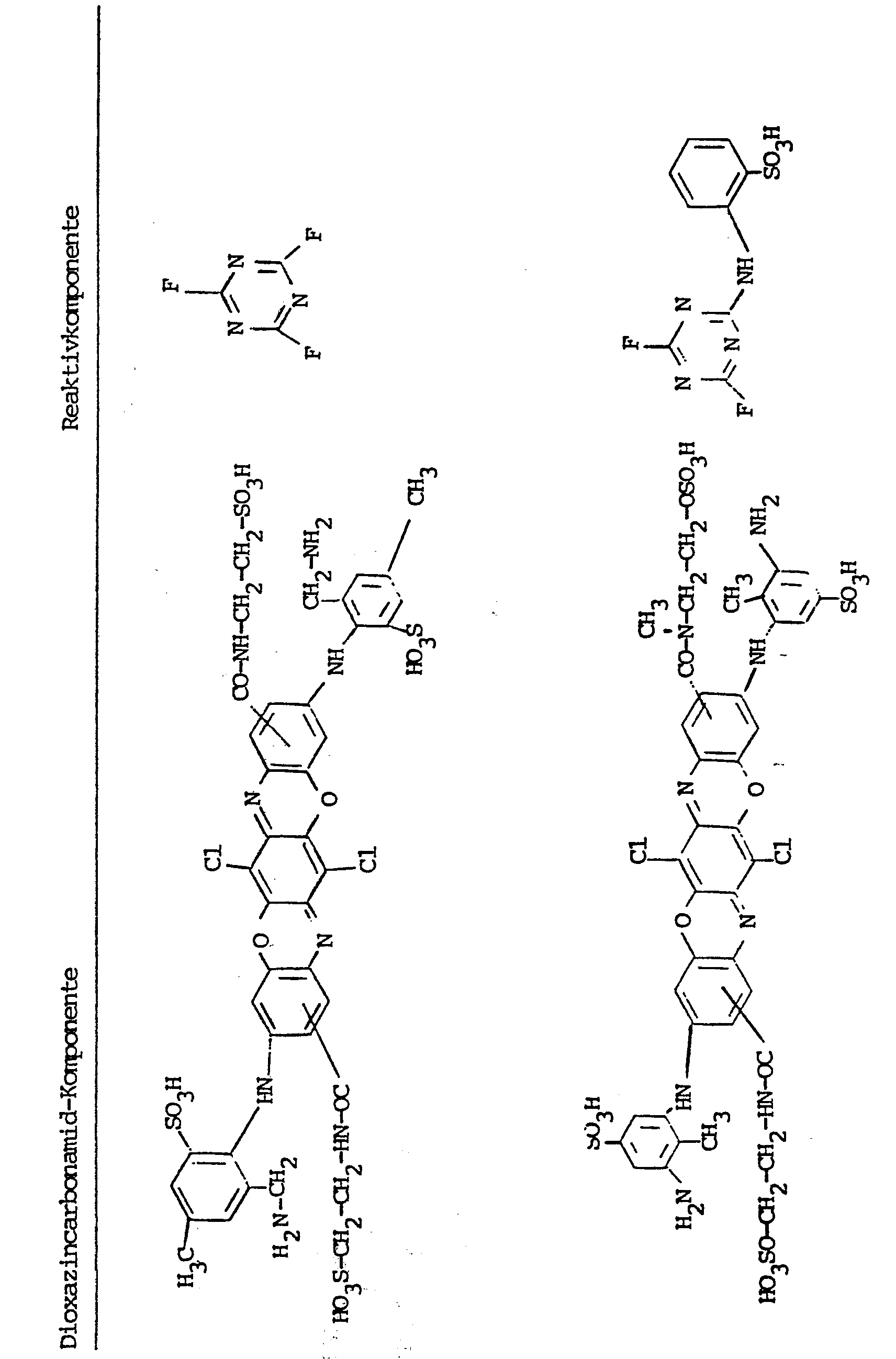

- 12,7 g einer Dioxazincarbonamidkomponente der Formel

- Der als Natriumsalz erhaltene Farbstoff entspricht in Form der freien Säure der Formel

- 16,7 g einer Dioxazincarbonamidkomponente der Formel

- Während und etwa 20 Minuten nach dem Zutropfen des Cyan fluorids hält man den pH-Wert im Reaktionsgemisch mitte 1n Sodalösung auf 4,5-4,8. Nach beendeter Kondensation läßt man anschie8end eine neutralisierte Lösung von 8,0 g 3-Aminobenzolsulfonsäure in 80 ml Wasser zulaufer Der pH-Wert wird jetzt mit Sodalösung auf 6,0-6,5 gehalten. Nach etwa 3 Stunden läßt man die Temperatur auf 20° ansteigen und sättigt nach beendeter Umsetzung die Lösung des erhaltenen Farbstoffes bei 20° mit Natrium-oder Kaliumchlorid. Der ausgefällte Farbstoff wird abge saugt, mit 25 %iger Natrium- oder Kaliumchloridlösung gewaschen und nach Zumischen von Phosphat-Puffer im Vakuum bei 45°C getrocknet. Der erhaltene Farbstoff entspricht in Form der freien Säure der Formel
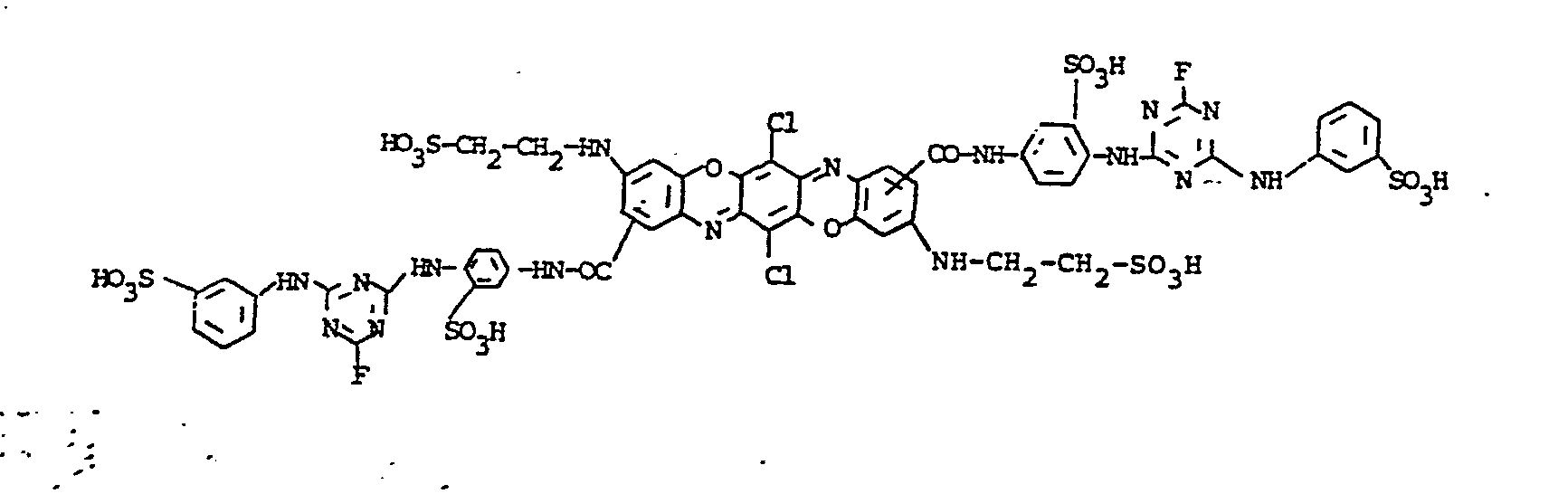
- Mit ihm lassen sich auf Cellulosefasern klare, blaue Färbungen und Drucke nach den bekannten Techniken anfertigen.
- Wenn man die in der folgenden Zusammenstellung angegebenen Dioxazincarbonamid-Komponenten mit den ausgewiesenen Reaktivkomponenten umsetzt, erhält man weitere blaue Reaktivfarbstoffe, mit denen Cellulosefasern in blauen Farbtönen naßecht gefärbt und bedruckt werden können.



- Setzt man anstelle der in Beispiel 2 beschriebenen Tauridverbindung 16,4 g eines Dioxazincarbonamids der Formel


- Weitere ähnliche Farbstoffe werden erhalten durch Umsetzung der in der folgenden Zusammenstellung wiedergege. benen Dioxazincarbonamid-Komponenten und Reaktivkomponenten.

- 11,7 g einer Dioxazincarbonamid-Komponente der Formel

- Man setzt diese Lösung in der im Beispiel 2 beschriebenen Weise mit Difluortriazinylaminobenzol-2-sulfonsäure um, die aus 8,5 g 2-Aminobenzol-sulfonsäure und 4,9 ml Cyanurfluorid hergestellt war. Nach Aufarbeitung der Lö sung wird ein Farbstoff der Formel

- Ein dem Farbstoff des Beispiels 6 ähnliches Produkt erhält man, wenn man anstelle der Methylsulfonylcarbonamid-Komponente 13,8 g folgender Phenylsulfonylcarbonamid-Komponente in 300 ml Wasser löst und diese Lösung nach den Angaben des Beispiels mit dem Kondensationsprodukt aus 12,6 g 2-Aminobenzol-1,4-disulfonsäure und 5,0 ml Cyanurfluorid umsetzt und in übrigen nach den Angaben des Beispiels 1 verfährt. Der so erhaltene Farbstoff entspricht der Formel
-

- Weitere derartige Farbstoffe erhält man durch Kondensation der nachstehend aufgeführten Sulfonylcarbonamide und Reaktivkomponenten.


- 9,9 g einer Dioxazincarbonamid-Komponente der Formel
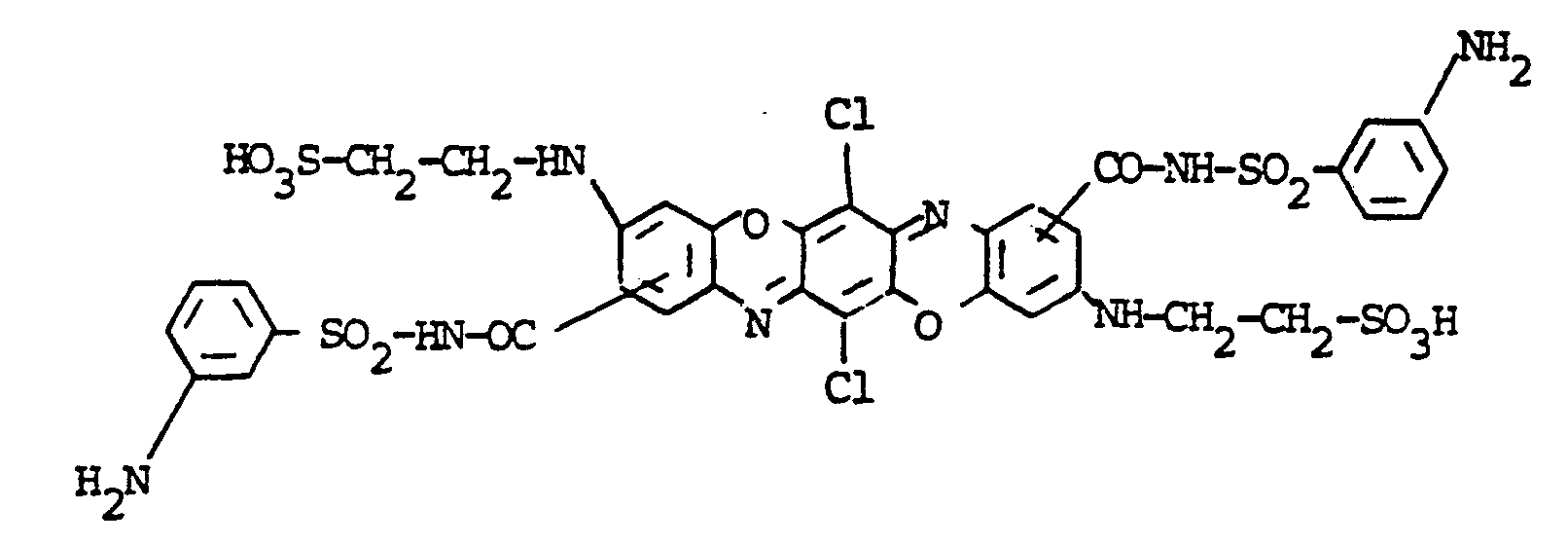

- Weitere ähnliche blaue Farbstoffe dieses Typ erhält durch Umsetzung der in nachfolgender Zusammenstellung beschriebenen Dioxazinkomponenten und Reaktivkomponenten.


wobei R5 und R6 zusammen auch einen gegebenenfalls durch 0 oder N unterbrochenen C4-C5-Alkylenrest bedeuten könnnen.

Claims (16)


wobei R5 und R6 zusammen auch einen gegebenenfalls durch 0 oder N unterbrochenen C4-C5-Alkylenrest bedeuten könnnen.


Y4 = C2-C6-Alkylen, Cyclohexylen und Z' die in A spruch 5 angegebene Bedeutung hat.


Z', Q und R8 die in Anspruch 7 bzw. 9 angegebene Bedeutung haben..


Z', M und L die in Anspruch 5 bzw. 7 angegebene Bedeutung haben.


R1-R6, R10 und Y2 die in den Ansprüchen 1, 3, 13 und 4 angegebene Bedeutung haben.
Applications Claiming Priority (2)
| Application Number | Priority Date | Filing Date | Title |
|---|---|---|---|
| DE19843409439 DE3409439A1 (de) | 1984-03-15 | 1984-03-15 | Triphendioxazinfarbstoffe |
| DE3409439 | 1984-03-15 |
Publications (3)
| Publication Number | Publication Date |
|---|---|
| EP0158110A2 true EP0158110A2 (de) | 1985-10-16 |
| EP0158110A3 EP0158110A3 (en) | 1986-03-12 |
| EP0158110B1 EP0158110B1 (de) | 1988-06-01 |
Family
ID=6230532
Family Applications (1)
| Application Number | Title | Priority Date | Filing Date |
|---|---|---|---|
| EP85102448A Expired EP0158110B1 (de) | 1984-03-15 | 1985-03-05 | Triphendioxazinfarbstoffe |
Country Status (4)
| Country | Link |
|---|---|
| US (1) | US4622396A (de) |
| EP (1) | EP0158110B1 (de) |
| JP (1) | JPS60212464A (de) |
| DE (2) | DE3409439A1 (de) |
Families Citing this family (4)
| Publication number | Priority date | Publication date | Assignee | Title |
|---|---|---|---|---|
| US5171852A (en) * | 1987-01-20 | 1992-12-15 | Imperial Chemical Industries Plc | Triphenodioxazine reactive dyes having sulphonate ester groups |
| DE3833864A1 (de) * | 1988-10-05 | 1990-04-12 | Hoechst Ag | Verfahren zum einphasigen bedrucken von cellulosefasern mit triphendioxazin-reaktivfarbstoffen |
| EP0365478B1 (de) * | 1988-10-18 | 1993-12-08 | Ciba-Geigy Ag | Reaktivfarbstoffe, deren Herstellung und Verwendung |
| CN103408965A (zh) * | 2013-08-08 | 2013-11-27 | 大连理工大学 | 一类含有酰亚胺和三苯二噁嗪结构的染料及其制备方法 |
Family Cites Families (7)
| Publication number | Priority date | Publication date | Assignee | Title |
|---|---|---|---|---|
| US2355497A (en) * | 1943-02-20 | 1944-08-08 | Du Pont | Dioxazine coloring matters and process for preparing the same |
| GB1450746A (en) * | 1974-01-31 | 1976-09-29 | Ici Ltd | Tripendioxazine dyestuffs |
| AU497288B2 (en) * | 1975-04-15 | 1978-12-07 | Imperial Chemical Industries Limited | Dyestuffs |
| US4336377A (en) * | 1979-02-02 | 1982-06-22 | Ciba-Geigy Corporation | Basic dioxazine compounds |
| JPS5733380A (en) * | 1980-08-07 | 1982-02-23 | Seiko Epson Corp | Wrist watch with alarm device |
| DE3045471A1 (de) * | 1980-12-02 | 1982-07-08 | Bayer Ag, 5090 Leverkusen | Dioxazin-reaktivfarbstoffe, verfahren zu ihrer herstellung und ihre verwendung zum faerben und bedrucken von hydroxyl- oder amidgruppenhaltigen fasermaterialien |
| DE3270683D1 (de) * | 1982-01-27 | 1986-05-22 | Ici Plc | Triphendioxazine dyestuffs |
-
1984
- 1984-03-15 DE DE19843409439 patent/DE3409439A1/de not_active Withdrawn
-
1985
- 1985-02-22 US US06/704,441 patent/US4622396A/en not_active Expired - Fee Related
- 1985-03-05 EP EP85102448A patent/EP0158110B1/de not_active Expired
- 1985-03-05 DE DE8585102448T patent/DE3563059D1/de not_active Expired
- 1985-03-13 JP JP60048448A patent/JPS60212464A/ja active Granted
Also Published As
| Publication number | Publication date |
|---|---|
| DE3563059D1 (de) | 1988-07-07 |
| EP0158110B1 (de) | 1988-06-01 |
| DE3409439A1 (de) | 1985-09-26 |
| JPS60212464A (ja) | 1985-10-24 |
| JPH0517942B2 (de) | 1993-03-10 |
| EP0158110A3 (en) | 1986-03-12 |
| US4622396A (en) | 1986-11-11 |
Similar Documents
| Publication | Publication Date | Title |
|---|---|---|
| EP0053743B1 (de) | Dioxazin-Reaktivfarbstoffe, Verfahren zu ihrer Herstellung und ihre Verwendung zum Färben und Bedrucken von hydroxyl- oder amidgruppenhaltigen Fasermaterialien | |
| EP0199036B1 (de) | Triphendioxazin-Farbstoffe | |
| EP0144580B1 (de) | Triphendioxazin-Farbstoffe | |
| EP0197418B1 (de) | Azoreaktivfarbstoffe | |
| EP0158857A2 (de) | Reaktive Dichlorotriphendioxazinfarbstoffe | |
| EP0134033B1 (de) | Benzthiazinophenoxazin-Farbstoffe | |
| EP0299328B1 (de) | Reaktivfarbstoffe | |
| EP0158882B1 (de) | Triphendioxazin-Farbstoffe | |
| EP0158110B1 (de) | Triphendioxazinfarbstoffe | |
| EP0204245B1 (de) | Reaktivfarbstoffe | |
| EP0271656B1 (de) | Aminoalkoxy-triphendioxazin-Reaktivfarbstoffe | |
| DE2455615A1 (de) | Reaktivfarbstoffe | |
| EP0153480A2 (de) | Reaktivfarbstoffe der Diarylaminoxanthen-Reihe, ihre Herstellung und Verwendung | |
| EP0272532A2 (de) | Farbstoffe | |
| EP0190603B1 (de) | Aminoalkylensulfon-triphendioxazin-Farbstoffe | |
| EP0349848A2 (de) | Triphendioxazin-Farbstoffe | |
| EP0414068B1 (de) | Reaktivfarbstoffe | |
| EP0205080B1 (de) | Triphendioxazin-disulfimid-Reaktivfarbstoffe | |
| EP0012411A1 (de) | Anthrachinon-Reaktivfarbstoffe sowie deren Verwendung zum Färben von OH- oder amidgruppenhaltigen Materialien | |
| EP0012342A1 (de) | Anthrachinon-Reaktivfarbstoffe und deren Verwendung beim Färben und Bedrucken von hydroxyl- oder amidgruppenhaltigen Materialien | |
| EP0338310B1 (de) | Reaktivfarbstoffe | |
| EP0097289B1 (de) | Azofarbstoffe | |
| DE3902053A1 (de) | Reaktivfarbstoffe | |
| DE2729497A1 (de) | Anthrachinon-reaktivfarbstoffe | |
| CH501099A (de) | Verfahren zum Färben oder Bedrucken hydroxylgruppenhaltiger oder stickstoffhaltiger Textilmaterialien mit Anthrachinon-Reaktivfarbstoffen |
Legal Events
| Date | Code | Title | Description |
|---|---|---|---|
| PUAI | Public reference made under article 153(3) epc to a published international application that has entered the european phase |
Free format text: ORIGINAL CODE: 0009012 |
|
| 17P | Request for examination filed |
Effective date: 19850305 |
|
| AK | Designated contracting states |
Designated state(s): CH DE FR GB LI |
|
| PUAL | Search report despatched |
Free format text: ORIGINAL CODE: 0009013 |
|
| AK | Designated contracting states |
Kind code of ref document: A3 Designated state(s): CH DE FR GB LI |
|
| 17Q | First examination report despatched |
Effective date: 19861024 |
|
| R17C | First examination report despatched (corrected) |
Effective date: 19870331 |
|
| GRAA | (expected) grant |
Free format text: ORIGINAL CODE: 0009210 |
|
| AK | Designated contracting states |
Kind code of ref document: B1 Designated state(s): CH DE FR GB LI |
|
| REF | Corresponds to: |
Ref document number: 3563059 Country of ref document: DE Date of ref document: 19880707 |
|
| GBT | Gb: translation of ep patent filed (gb section 77(6)(a)/1977) | ||
| ET | Fr: translation filed | ||
| PLBE | No opposition filed within time limit |
Free format text: ORIGINAL CODE: 0009261 |
|
| STAA | Information on the status of an ep patent application or granted ep patent |
Free format text: STATUS: NO OPPOSITION FILED WITHIN TIME LIMIT |
|
| 26N | No opposition filed | ||
| PGFP | Annual fee paid to national office [announced via postgrant information from national office to epo] |
Ref country code: DE Payment date: 19950214 Year of fee payment: 11 |
|
| PGFP | Annual fee paid to national office [announced via postgrant information from national office to epo] |
Ref country code: CH Payment date: 19950216 Year of fee payment: 11 |
|
| PGFP | Annual fee paid to national office [announced via postgrant information from national office to epo] |
Ref country code: GB Payment date: 19950223 Year of fee payment: 11 |
|
| PGFP | Annual fee paid to national office [announced via postgrant information from national office to epo] |
Ref country code: FR Payment date: 19950227 Year of fee payment: 11 |
|
| PG25 | Lapsed in a contracting state [announced via postgrant information from national office to epo] |
Ref country code: GB Effective date: 19960305 |
|
| PG25 | Lapsed in a contracting state [announced via postgrant information from national office to epo] |
Ref country code: LI Effective date: 19960331 Ref country code: CH Effective date: 19960331 |
|
| GBPC | Gb: european patent ceased through non-payment of renewal fee |
Effective date: 19960305 |
|
| REG | Reference to a national code |
Ref country code: CH Ref legal event code: PL |
|
| PG25 | Lapsed in a contracting state [announced via postgrant information from national office to epo] |
Ref country code: FR Effective date: 19961129 |
|
| PG25 | Lapsed in a contracting state [announced via postgrant information from national office to epo] |
Ref country code: DE Effective date: 19961203 |
|
| REG | Reference to a national code |
Ref country code: FR Ref legal event code: ST |