EP0158178A1 - Verfahren zur Herstellung einer Lochmaske - Google Patents
Verfahren zur Herstellung einer Lochmaske Download PDFInfo
- Publication number
- EP0158178A1 EP0158178A1 EP85103252A EP85103252A EP0158178A1 EP 0158178 A1 EP0158178 A1 EP 0158178A1 EP 85103252 A EP85103252 A EP 85103252A EP 85103252 A EP85103252 A EP 85103252A EP 0158178 A1 EP0158178 A1 EP 0158178A1
- Authority
- EP
- European Patent Office
- Prior art keywords
- etching
- shadow mask
- apertures
- etching solution
- viscosity
- Prior art date
- Legal status (The legal status is an assumption and is not a legal conclusion. Google has not performed a legal analysis and makes no representation as to the accuracy of the status listed.)
- Granted
Links
- 238000004519 manufacturing process Methods 0.000 title claims abstract description 7
- 238000005530 etching Methods 0.000 claims abstract description 87
- XEEYBQQBJWHFJM-UHFFFAOYSA-N Iron Chemical compound [Fe] XEEYBQQBJWHFJM-UHFFFAOYSA-N 0.000 claims abstract description 13
- 229910052751 metal Inorganic materials 0.000 claims abstract description 9
- 239000002184 metal Substances 0.000 claims abstract description 9
- PXHVJJICTQNCMI-UHFFFAOYSA-N Nickel Chemical compound [Ni] PXHVJJICTQNCMI-UHFFFAOYSA-N 0.000 claims abstract description 8
- 229910052742 iron Inorganic materials 0.000 claims abstract description 6
- 229910052759 nickel Inorganic materials 0.000 claims abstract description 4
- 238000000034 method Methods 0.000 claims description 12
- 229910021578 Iron(III) chloride Inorganic materials 0.000 claims description 8
- 229910045601 alloy Inorganic materials 0.000 claims description 8
- 239000000956 alloy Substances 0.000 claims description 8
- RBTARNINKXHZNM-UHFFFAOYSA-K iron trichloride Chemical compound Cl[Fe](Cl)Cl RBTARNINKXHZNM-UHFFFAOYSA-K 0.000 claims description 8
- 239000007921 spray Substances 0.000 claims description 5
- 229910003271 Ni-Fe Inorganic materials 0.000 claims description 2
- 239000000243 solution Substances 0.000 description 42
- 239000000463 material Substances 0.000 description 26
- 229910001374 Invar Inorganic materials 0.000 description 11
- 239000013078 crystal Substances 0.000 description 10
- 229910001030 Iron–nickel alloy Inorganic materials 0.000 description 5
- QAOWNCQODCNURD-UHFFFAOYSA-N Sulfuric acid Chemical compound OS(O)(=O)=O QAOWNCQODCNURD-UHFFFAOYSA-N 0.000 description 4
- 239000007864 aqueous solution Substances 0.000 description 4
- ORTQZVOHEJQUHG-UHFFFAOYSA-L copper(II) chloride Chemical compound Cl[Cu]Cl ORTQZVOHEJQUHG-UHFFFAOYSA-L 0.000 description 4
- XLYOFNOQVPJJNP-UHFFFAOYSA-N water Substances O XLYOFNOQVPJJNP-UHFFFAOYSA-N 0.000 description 4
- OAICVXFJPJFONN-UHFFFAOYSA-N Phosphorus Chemical compound [P] OAICVXFJPJFONN-UHFFFAOYSA-N 0.000 description 3
- 239000003513 alkali Substances 0.000 description 3
- 150000002500 ions Chemical class 0.000 description 3
- 230000005012 migration Effects 0.000 description 3
- 238000013508 migration Methods 0.000 description 3
- 239000000203 mixture Substances 0.000 description 3
- KZBUYRJDOAKODT-UHFFFAOYSA-N Chlorine Chemical compound ClCl KZBUYRJDOAKODT-UHFFFAOYSA-N 0.000 description 2
- 229910021592 Copper(II) chloride Inorganic materials 0.000 description 2
- 229910001209 Low-carbon steel Inorganic materials 0.000 description 2
- 239000002253 acid Substances 0.000 description 2
- KRVSOGSZCMJSLX-UHFFFAOYSA-L chromic acid Substances O[Cr](O)(=O)=O KRVSOGSZCMJSLX-UHFFFAOYSA-L 0.000 description 2
- 238000005097 cold rolling Methods 0.000 description 2
- 230000003247 decreasing effect Effects 0.000 description 2
- 238000001035 drying Methods 0.000 description 2
- 238000010894 electron beam technology Methods 0.000 description 2
- 229960002089 ferrous chloride Drugs 0.000 description 2
- AWJWCTOOIBYHON-UHFFFAOYSA-N furo[3,4-b]pyrazine-5,7-dione Chemical compound C1=CN=C2C(=O)OC(=O)C2=N1 AWJWCTOOIBYHON-UHFFFAOYSA-N 0.000 description 2
- 239000011521 glass Substances 0.000 description 2
- NMCUIPGRVMDVDB-UHFFFAOYSA-L iron dichloride Chemical compound Cl[Fe]Cl NMCUIPGRVMDVDB-UHFFFAOYSA-L 0.000 description 2
- 238000005406 washing Methods 0.000 description 2
- 229910000640 Fe alloy Inorganic materials 0.000 description 1
- 229910000655 Killed steel Inorganic materials 0.000 description 1
- 229910001327 Rimmed steel Inorganic materials 0.000 description 1
- 229910052782 aluminium Inorganic materials 0.000 description 1
- XAGFODPZIPBFFR-UHFFFAOYSA-N aluminium Chemical compound [Al] XAGFODPZIPBFFR-UHFFFAOYSA-N 0.000 description 1
- JOSWYUNQBRPBDN-UHFFFAOYSA-P ammonium dichromate Chemical compound [NH4+].[NH4+].[O-][Cr](=O)(=O)O[Cr]([O-])(=O)=O JOSWYUNQBRPBDN-UHFFFAOYSA-P 0.000 description 1
- 229940071162 caseinate Drugs 0.000 description 1
- 230000000593 degrading effect Effects 0.000 description 1
- 238000009792 diffusion process Methods 0.000 description 1
- 230000000694 effects Effects 0.000 description 1
- 230000005484 gravity Effects 0.000 description 1
- -1 iron ion Chemical class 0.000 description 1
- 230000001788 irregular Effects 0.000 description 1
- QSHDDOUJBYECFT-UHFFFAOYSA-N mercury Chemical compound [Hg] QSHDDOUJBYECFT-UHFFFAOYSA-N 0.000 description 1
- 229910052753 mercury Inorganic materials 0.000 description 1
- 239000008267 milk Substances 0.000 description 1
- 210000004080 milk Anatomy 0.000 description 1
- 235000013336 milk Nutrition 0.000 description 1
- 239000003921 oil Substances 0.000 description 1
- 239000002994 raw material Substances 0.000 description 1
- 239000010731 rolling oil Substances 0.000 description 1
- 238000005096 rolling process Methods 0.000 description 1
- 238000005507 spraying Methods 0.000 description 1
- 238000007669 thermal treatment Methods 0.000 description 1
Images
Classifications
-
- H—ELECTRICITY
- H01—ELECTRIC ELEMENTS
- H01J—ELECTRIC DISCHARGE TUBES OR DISCHARGE LAMPS
- H01J29/00—Details of cathode-ray tubes or of electron-beam tubes of the types covered by group H01J31/00
- H01J29/02—Electrodes; Screens; Mounting, supporting, spacing or insulating thereof
- H01J29/06—Screens for shielding; Masks interposed in the electron stream
- H01J29/07—Shadow masks for colour television tubes
-
- C—CHEMISTRY; METALLURGY
- C23—COATING METALLIC MATERIAL; COATING MATERIAL WITH METALLIC MATERIAL; CHEMICAL SURFACE TREATMENT; DIFFUSION TREATMENT OF METALLIC MATERIAL; COATING BY VACUUM EVAPORATION, BY SPUTTERING, BY ION IMPLANTATION OR BY CHEMICAL VAPOUR DEPOSITION, IN GENERAL; INHIBITING CORROSION OF METALLIC MATERIAL OR INCRUSTATION IN GENERAL
- C23F—NON-MECHANICAL REMOVAL OF METALLIC MATERIAL FROM SURFACE; INHIBITING CORROSION OF METALLIC MATERIAL OR INCRUSTATION IN GENERAL; MULTI-STEP PROCESSES FOR SURFACE TREATMENT OF METALLIC MATERIAL INVOLVING AT LEAST ONE PROCESS PROVIDED FOR IN CLASS C23 AND AT LEAST ONE PROCESS COVERED BY SUBCLASS C21D OR C22F OR CLASS C25
- C23F1/00—Etching metallic material by chemical means
- C23F1/02—Local etching
-
- C—CHEMISTRY; METALLURGY
- C23—COATING METALLIC MATERIAL; COATING MATERIAL WITH METALLIC MATERIAL; CHEMICAL SURFACE TREATMENT; DIFFUSION TREATMENT OF METALLIC MATERIAL; COATING BY VACUUM EVAPORATION, BY SPUTTERING, BY ION IMPLANTATION OR BY CHEMICAL VAPOUR DEPOSITION, IN GENERAL; INHIBITING CORROSION OF METALLIC MATERIAL OR INCRUSTATION IN GENERAL
- C23F—NON-MECHANICAL REMOVAL OF METALLIC MATERIAL FROM SURFACE; INHIBITING CORROSION OF METALLIC MATERIAL OR INCRUSTATION IN GENERAL; MULTI-STEP PROCESSES FOR SURFACE TREATMENT OF METALLIC MATERIAL INVOLVING AT LEAST ONE PROCESS PROVIDED FOR IN CLASS C23 AND AT LEAST ONE PROCESS COVERED BY SUBCLASS C21D OR C22F OR CLASS C25
- C23F1/00—Etching metallic material by chemical means
- C23F1/10—Etching compositions
- C23F1/14—Aqueous compositions
- C23F1/16—Acidic compositions
- C23F1/28—Acidic compositions for etching iron group metals
-
- H—ELECTRICITY
- H01—ELECTRIC ELEMENTS
- H01J—ELECTRIC DISCHARGE TUBES OR DISCHARGE LAMPS
- H01J9/00—Apparatus or processes specially adapted for the manufacture, installation, removal, maintenance of electric discharge tubes, discharge lamps, or parts thereof; Recovery of material from discharge tubes or lamps
- H01J9/02—Manufacture of electrodes or electrode systems
- H01J9/14—Manufacture of electrodes or electrode systems of non-emitting electrodes
- H01J9/142—Manufacture of electrodes or electrode systems of non-emitting electrodes of shadow-masks for colour television tubes
Definitions
- the present invention relates to a method of manufacturing a shadow mask for a color picture tube and, more particularly, to an etching method of a shadow mask material consisting of an iron-nickel alloy.
- a shadow mask for a color picture tube is generally made of high-purity low-carbon steel such as rimmed steel or aluminum killed steel.
- the material is determined with regard to material feed capacity, cost, workability, mechanical stregnth and the like.
- a high thermal expansion coefficient about 12 x 10 -6 /°C at a temperature of 0 to 100°C.
- thermal expansion causes a change in a required curvature of the shadow mask, thereby causing misalignment between the apertures of the shadow mask and the phosphor layers. Therefore, various means for eliminating thermal deformation of the shadow mask have been proposed.
- a shadow mask which uses an iron-nickel alloy having a low thermal expansion coefficient, e.g., a 36Ni-Fe invar alloy (about 2.0 x 10 -6 / o C at a temperature of 0 to 100°C) or a 42Ni-Fe alloy (about 5.0 x 10 -6 /°C at a temperature of 0 to 100°C) as a raw material has been proposed in Japanese Patent Publication No. 42-25446 and Japanese Patent Disclosure Nos. 50-58977 and 50-68650.
- an iron-nickel alloy having a low thermal expansion coefficient e.g., a 36Ni-Fe invar alloy (about 2.0 x 10 -6 / o C at a temperature of 0 to 100°C) or a 42Ni-Fe alloy (about 5.0 x 10 -6 /°C at a temperature of 0 to 100°C)
- an iron-nickel alloy such as invar contains rolled texture
- it has a higher etching rate in a direction parallel to a rolling direction than that in a direction perpendicular thereto (direction of thickness) in comparison to a low carbon steel used as a conventional shadow mask material and containing iron as a major component.
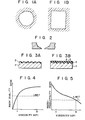
- an etching amount undesirably varies, and edges and side walls of apertures are roughened as shown in Figs. 1A and 1B and 2, thereby forming irregular apertures. Therefore, sizes of apertures slightly vary and mask uniformity is degraded.
- the material is subjected to a thermal treatment after cold rolling so as to adjust a size of a crystal grain.
- a shadow mask material to be etched undesirably comprises a polycrystalline structure having surfaces some of which can be easily etched and others which cannot. Therefore, when this shadow mask material is etched, apertures having nonuniform shapes and slightly different sizes are formed, thus obtaining a shadow mask having a low mask uniformity.
- the size of apertures of the shadow mask is large as in a conventional color picture tube, the disadvantageous effects caused by the nonuniformity of apertures are negligible, because the area of roughened edges and side walls is small with respect to the overall area of apertures.
- a method of manufacturing a shadow mask comprising the steps of: forming an etching-protective film having a pattern of a number of apertures on a surface of a thin metal plate containing iron and nickel as major components; and etching the thin metal plate using an etching solution of a viscosity of 1 to 5 centipoise (cP) so as to form a number of apertures in the thin metal plate.
- a viscosity 1 to 5 centipoise
- the viscosity of the etching solution is preferably 2 to 5 cP, more preferably, 2.5 to 4 cP.
- a ferric chloride aqueous solution, a copper (II) chloride aqueous solution, and mixed acid of chromic acid and sulfuric acid can be used as the etching solution.
- the concentration thereof is preferably 35 to 50% by weight, and the temperature thereof is preferably 40 to 70°C, more preferably, 50 to 60°C.
- the table below shows a composition of the invar.
- the shadow mask material made of the invar having the composition shown in the Table above was used and a shadow mask for a high resolution having a number of round apertures with a pitch of 0.3 mm and an aperture diameter of 140 pm was manufactured by the following procedure.
- the shadow mask material was degreased and washed using a high-temperature alkali solution.
- a photosensitive solution of alkali milk caseinate and ammonium dichromate was coated on two surfaces of the shadow mask material and was dried so as to form photosensitive films with a thickness of 5 um.
- a negative glass plate having large aperture negative image with a diameter of 210 ⁇ m was attached to one photosensitive film on t'he shadow mask material, and a negative glass plate having small apertures with a diameter of 75 um was attached to the other photosensitive film thereon.
- the resultant structure was exposed using a 5-kW superhigh pressure mercury lamp spaced by about 1 m for about 40 seconds, thereby forming latent images of apertures on the respective photosensitive films.
- the latent images were developped using warm pure water at a temperature of about 40°C.
- the resultant structure was subjected to drying and burning and etching-protective films having a pattern of a number of apertures were formed on two surfaces of the shadow mask material.
- the shadow mask material having the etching-protective films on two surfaces thereof was then etched.
- etching was performed by spraying a ferric chloride solution.
- An etching rate of this reaction is determined by diffusion of (Fe 3+ ) in an etching solution. More specifically, at an etching interface between the etching solution and the shadow mask material, Fe 3+ in the etching solution is reduced by the reaction of Fe + 2Fe 3+ ⁇ 3Fe 2+ , thus being turned into Fe 2+ which has no etching ability. Therefore, a total iron ion concentration in the etching solution near the etching interface becomes higher than that in the bulk etching solution.
- a viscosity of the etching solution near the etching interface is increased, thus forming a viscous layer thereon.
- the viscous layer is thick, since migration of Fe 3+ as an etching ion from the bulk etching solution to the etching interface is inhibited, the etching rate is low.
- the viscous layer is thin, the etching rate is high.
- an etching rate is high because a viscous layer near an etching interface is thin and migration of etching ions to the etching interface is increased.
- An invar alloy constituting the shadow mask material has various crystal planes. Among these crystal planes, a ⁇ 100 ⁇ plane is most easily etched, and a ⁇ 110 ⁇ plane is the next most easily etched.
- a viscous layer 2 formed on a shadow mask material 1 is thin as shown in Fig. 3A, a migration rate of Fe 3+ as etching ions cannot be lowered. Therefore, crystal planes which are active with respect to etching are etched prior to inactive ones until etching is completed. For this reason, etching cannot be uniformly performed. Conversely, as shown in Fig.
- the present inventors found that in order to perform etching suitable for a material having various crystal planes with different etching rates such as an invar, the thickness of the viscous layer must be controlled and the viscosity of the etching solution greatly influences the thickness of the viscous layer. Then, the present inventors examined the relationships between the viscosity of the etching solution and quality of the shadow mask, and between the viscosity of the etching solution and mass-producibility. The obtained results are respectively shown in Figs. 4 and 5.
- the viscosity of the etching solution is influenced by a solution temperature and a concentration thereof.
- the solution temperature is less than 40°C, mass-producibility is degraded, and when it exceeds 70°C, since a considerable amount of etching solution is evaporated, the composition of the solution becomes unstable and the etching resistivity of the photosensitive film is decreased, thus easily forming pin holes. Therefore, the temperature of the etching solution preferably falls within the range between 40 and 70°C, more preferably, between 50 and 60°C.
- concentration of the etching solution e.g., a ferric chloride solution is less than 35% by weight, fatigue of the etching solution becomes considerable and therefore etching ability cannot be constantly controlled.
- the concentration of the etching solution preferably falls within the range between 35 and 50% by weight.
- Ferric chloride contained in the etching solution is turned into ferrous chloride by etching of the shadow mask material, thus losing etching ability.
- ferrous chloride can be turned back into ferric chloride. Therefore, an etching process line with a mechanism for the introduction of a chlorine gas, addition of water, and temperature control is preferably used.
- the shadow mask material having two surfaces coated with the etching-protective films was subjected to etching so as to form apertures of a desired shape and size, and thereafter, the resultant structure was subjected to steps of washing with water, removal of etching-protective films using a high temperature alkali solution, washing with water, and drying, thus obtaining the shadow mask.
- the ferric chloriae aqueous solution is used as the etching solution.
- the present invention is not limited to this.
- copper (II) chloride, and a mixed acid of chromic acid and sulfuric acid can be used.
- 36Ni-invar is used as a material of the shadow mask.
- the present invention is not limited to this, and Ni-Fe alloy containing 30 to 45% of Ni is preferably used.
- 42Ni alloy, a super invar such as 32Ni-5Co alloy or the like which are generally termed invar type alloys can be used.
- the thickness of a viscous layer formed on an etching interface is controlled by maintaining the viscosity of an etching solution within a predetermined range.
- variation in an etching rate in a surface of a shadow mask material is controlled and uniform etching can be performed.
- apertures having a required shape and size can be formed, thereby obtaining a color picture tube having a high quality shadow mask and good white uniformity.
Landscapes
- Chemical & Material Sciences (AREA)
- Engineering & Computer Science (AREA)
- Chemical Kinetics & Catalysis (AREA)
- General Chemical & Material Sciences (AREA)
- Materials Engineering (AREA)
- Mechanical Engineering (AREA)
- Metallurgy (AREA)
- Organic Chemistry (AREA)
- Manufacturing & Machinery (AREA)
- ing And Chemical Polishing (AREA)
- Electrodes For Cathode-Ray Tubes (AREA)
Applications Claiming Priority (2)
| Application Number | Priority Date | Filing Date | Title |
|---|---|---|---|
| JP56353/84 | 1984-03-26 | ||
| JP59056353A JPS60200985A (ja) | 1984-03-26 | 1984-03-26 | シヤドウマスクの製造方法 |
Publications (2)
| Publication Number | Publication Date |
|---|---|
| EP0158178A1 true EP0158178A1 (de) | 1985-10-16 |
| EP0158178B1 EP0158178B1 (de) | 1989-05-31 |
Family
ID=13024865
Family Applications (1)
| Application Number | Title | Priority Date | Filing Date |
|---|---|---|---|
| EP85103252A Expired EP0158178B1 (de) | 1984-03-26 | 1985-03-20 | Verfahren zur Herstellung einer Lochmaske |
Country Status (6)
| Country | Link |
|---|---|
| US (1) | US4585518A (de) |
| EP (1) | EP0158178B1 (de) |
| JP (1) | JPS60200985A (de) |
| KR (1) | KR890002845B1 (de) |
| DE (1) | DE3570704D1 (de) |
| HK (1) | HK109490A (de) |
Cited By (3)
| Publication number | Priority date | Publication date | Assignee | Title |
|---|---|---|---|---|
| WO1989004883A1 (fr) * | 1987-11-27 | 1989-06-01 | Siemens Aktiengesellschaft | Procede de gravure de nickel |
| EP0463445A3 (en) * | 1990-06-18 | 1993-11-03 | Du Pont Deutschland | Process for making microstructures having a high aspect ratio by erosion lithography |
| CN108701776A (zh) * | 2016-02-16 | 2018-10-23 | Lg伊诺特有限公司 | 金属板、沉积用掩模及其制造方法 |
Families Citing this family (1)
| Publication number | Priority date | Publication date | Assignee | Title |
|---|---|---|---|---|
| US5863681A (en) * | 1996-09-19 | 1999-01-26 | Wickeder Westgalenstahl Gmbh | Composite shadow mask |
Citations (1)
| Publication number | Priority date | Publication date | Assignee | Title |
|---|---|---|---|---|
| US4420366A (en) * | 1982-03-29 | 1983-12-13 | Tokyo Shibaura Denki Kabushiki Kaisha | Method for manufacturing shadow mask |
Family Cites Families (2)
| Publication number | Priority date | Publication date | Assignee | Title |
|---|---|---|---|---|
| US4021279A (en) * | 1972-04-20 | 1977-05-03 | Stichting Reactor Centrum Nederland | Method of forming groove pattern |
| JPS58167771A (ja) * | 1982-03-29 | 1983-10-04 | Toshiba Corp | 腐蝕液の制御方法 |
-
1984
- 1984-03-26 JP JP59056353A patent/JPS60200985A/ja active Pending
-
1985
- 1985-03-04 KR KR1019850001347A patent/KR890002845B1/ko not_active Expired
- 1985-03-20 DE DE8585103252T patent/DE3570704D1/de not_active Expired
- 1985-03-20 EP EP85103252A patent/EP0158178B1/de not_active Expired
- 1985-03-21 US US06/714,551 patent/US4585518A/en not_active Expired - Lifetime
-
1990
- 1990-12-27 HK HK1094/90A patent/HK109490A/en not_active IP Right Cessation
Patent Citations (1)
| Publication number | Priority date | Publication date | Assignee | Title |
|---|---|---|---|---|
| US4420366A (en) * | 1982-03-29 | 1983-12-13 | Tokyo Shibaura Denki Kabushiki Kaisha | Method for manufacturing shadow mask |
Cited By (5)
| Publication number | Priority date | Publication date | Assignee | Title |
|---|---|---|---|---|
| WO1989004883A1 (fr) * | 1987-11-27 | 1989-06-01 | Siemens Aktiengesellschaft | Procede de gravure de nickel |
| EP0463445A3 (en) * | 1990-06-18 | 1993-11-03 | Du Pont Deutschland | Process for making microstructures having a high aspect ratio by erosion lithography |
| CN108701776A (zh) * | 2016-02-16 | 2018-10-23 | Lg伊诺特有限公司 | 金属板、沉积用掩模及其制造方法 |
| EP3419074A4 (de) * | 2016-02-16 | 2019-03-20 | LG Innotek Co., Ltd. | Metallplatte, maske zur abscheidung und herstellungsverfahren dafür |
| CN108701776B (zh) * | 2016-02-16 | 2020-09-22 | Lg伊诺特有限公司 | 金属板、沉积用掩模及其制造方法 |
Also Published As
| Publication number | Publication date |
|---|---|
| JPS60200985A (ja) | 1985-10-11 |
| DE3570704D1 (en) | 1989-07-06 |
| US4585518A (en) | 1986-04-29 |
| KR850006968A (ko) | 1985-10-25 |
| KR890002845B1 (ko) | 1989-08-04 |
| EP0158178B1 (de) | 1989-05-31 |
| HK109490A (en) | 1991-01-04 |
Similar Documents
| Publication | Publication Date | Title |
|---|---|---|
| EP0104453B1 (de) | Lochmaske für Farbfernsehröhre | |
| EP3419074B1 (de) | Metallplatte, maske zur abscheidung und herstellungsverfahren dafür | |
| US4357196A (en) | Apparatus for etching metallic sheet | |
| CN87102767A (zh) | 用光刻法处理薄金属片的方法 | |
| US6620554B1 (en) | Etching substrate material, etching process, and article obtained by etching | |
| EP0158178B1 (de) | Verfahren zur Herstellung einer Lochmaske | |
| US4420366A (en) | Method for manufacturing shadow mask | |
| US3909311A (en) | Shadow mask for use in color picture tube and method for fabricating same | |
| KR900009076B1 (ko) | 새도우 마스크 | |
| JPH0452585B2 (de) | ||
| GB2282913A (en) | Aperture grill and method of producing same | |
| EP0079738B1 (de) | Metallische Zusammensetzung für Farbbild-Kathodenstrahlröhre | |
| US6720720B2 (en) | Color selection electrode, method of producing color selection electrode and cathode ray tube. | |
| KR100680669B1 (ko) | 섀도우마스크 및 섀도우마스크용 기재 | |
| JPS6056053A (ja) | シャドウマスク用素材 | |
| JP3152446B2 (ja) | シャドウマスクの製造方法 | |
| JPS6139345A (ja) | シヤドウマスク | |
| JP2597971B2 (ja) | シヤドウマスク | |
| JPS6017837A (ja) | カラ−受像管用シヤドウマスク | |
| US3905079A (en) | Method of manufacturing color selective electrode for color picture tube of black matrix type or the like type | |
| Baudry et al. | Ability of Invar in Etching for High Performance Color Picture Tube Masks | |
| JPH0612979A (ja) | カラーブラウン管用シャドウマスクの製造方法 | |
| JPH0574340A (ja) | 陰極線管用シヤドウマスクの製法 | |
| JPS62229738A (ja) | シヤドウマスク | |
| JPH05255757A (ja) | エッチング性にすぐれるFe−Ni系合金シャドウマスク用薄板の製造方法 |
Legal Events
| Date | Code | Title | Description |
|---|---|---|---|
| PUAI | Public reference made under article 153(3) epc to a published international application that has entered the european phase |
Free format text: ORIGINAL CODE: 0009012 |
|
| 17P | Request for examination filed |
Effective date: 19850417 |
|
| AK | Designated contracting states |
Designated state(s): DE FR GB |
|
| 17Q | First examination report despatched |
Effective date: 19860909 |
|
| D17Q | First examination report despatched (deleted) | ||
| GRAA | (expected) grant |
Free format text: ORIGINAL CODE: 0009210 |
|
| AK | Designated contracting states |
Kind code of ref document: B1 Designated state(s): DE FR GB |
|
| REF | Corresponds to: |
Ref document number: 3570704 Country of ref document: DE Date of ref document: 19890706 |
|
| ET | Fr: translation filed | ||
| PLBE | No opposition filed within time limit |
Free format text: ORIGINAL CODE: 0009261 |
|
| STAA | Information on the status of an ep patent application or granted ep patent |
Free format text: STATUS: NO OPPOSITION FILED WITHIN TIME LIMIT |
|
| 26N | No opposition filed | ||
| REG | Reference to a national code |
Ref country code: GB Ref legal event code: 746 Effective date: 19981008 |
|
| REG | Reference to a national code |
Ref country code: FR Ref legal event code: D6 |
|
| REG | Reference to a national code |
Ref country code: GB Ref legal event code: IF02 |
|
| PGFP | Annual fee paid to national office [announced via postgrant information from national office to epo] |
Ref country code: FR Payment date: 20040309 Year of fee payment: 20 |
|
| PGFP | Annual fee paid to national office [announced via postgrant information from national office to epo] |
Ref country code: GB Payment date: 20040317 Year of fee payment: 20 |
|
| PGFP | Annual fee paid to national office [announced via postgrant information from national office to epo] |
Ref country code: DE Payment date: 20040401 Year of fee payment: 20 |
|
| PG25 | Lapsed in a contracting state [announced via postgrant information from national office to epo] |
Ref country code: GB Free format text: LAPSE BECAUSE OF EXPIRATION OF PROTECTION Effective date: 20050319 |
|
| REG | Reference to a national code |
Ref country code: GB Ref legal event code: PE20 |