EP0158340B1 - 1,5-Benzothiazepinderivate, Verfahren zu ihrer Herstellung und Arzneimittel - Google Patents
1,5-Benzothiazepinderivate, Verfahren zu ihrer Herstellung und Arzneimittel Download PDFInfo
- Publication number
- EP0158340B1 EP0158340B1 EP85104342A EP85104342A EP0158340B1 EP 0158340 B1 EP0158340 B1 EP 0158340B1 EP 85104342 A EP85104342 A EP 85104342A EP 85104342 A EP85104342 A EP 85104342A EP 0158340 B1 EP0158340 B1 EP 0158340B1
- Authority
- EP
- European Patent Office
- Prior art keywords
- compound
- methyl
- alkyl
- hydroxy
- cis
- Prior art date
- Legal status (The legal status is an assumption and is not a legal conclusion. Google has not performed a legal analysis and makes no representation as to the accuracy of the status listed.)
- Expired
Links
- 0 CN(C(*1)O)c(c*(*)cc2)c2SC(C2C3=CC(C*)=*C2C3)C1N=O Chemical compound CN(C(*1)O)c(c*(*)cc2)c2SC(C2C3=CC(C*)=*C2C3)C1N=O 0.000 description 2
Classifications
-
- C—CHEMISTRY; METALLURGY
- C07—ORGANIC CHEMISTRY
- C07D—HETEROCYCLIC COMPOUNDS
- C07D281/00—Heterocyclic compounds containing rings of more than six members having one nitrogen atom and one sulfur atom as the only ring hetero atoms
- C07D281/02—Seven-membered rings
- C07D281/04—Seven-membered rings having the hetero atoms in positions 1 and 4
- C07D281/08—Seven-membered rings having the hetero atoms in positions 1 and 4 condensed with carbocyclic rings or ring systems
- C07D281/10—Seven-membered rings having the hetero atoms in positions 1 and 4 condensed with carbocyclic rings or ring systems condensed with one six-membered ring
Definitions
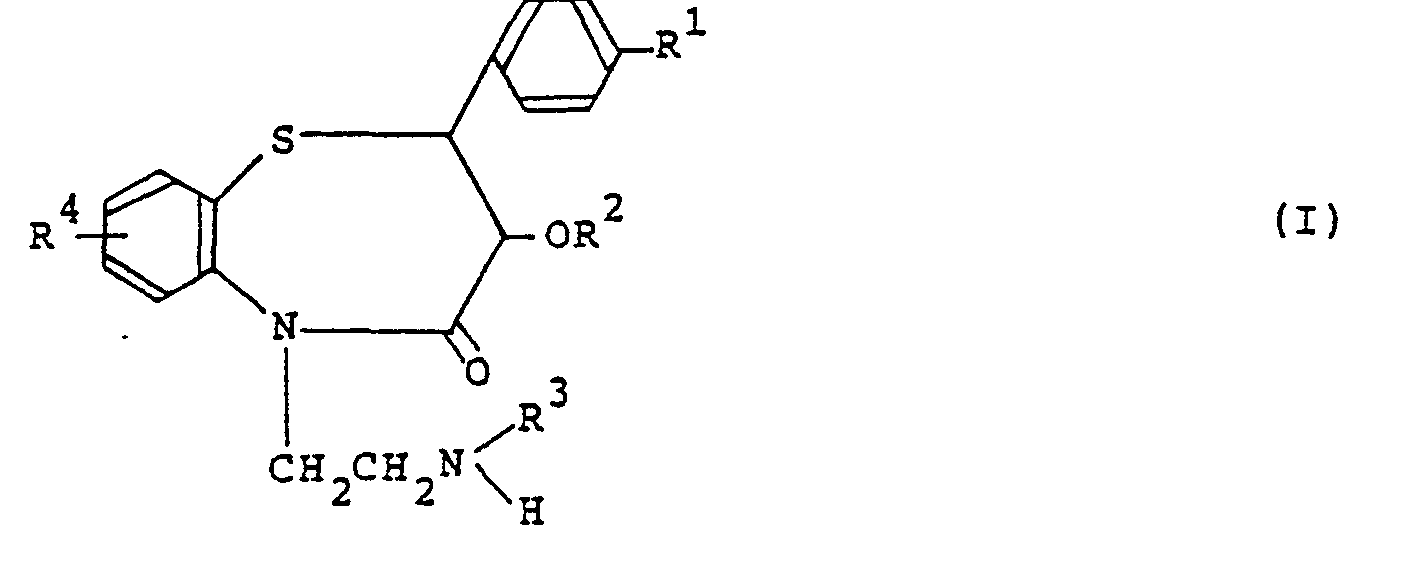
- This invention relates to a novel 1,5-benzothiazepine derivative and processes for preparing the same. More particularly, it relates to a compound of the formula: wherein
- U.S. Patent 3,562,257 discloses various benzothiazepine derivatives including 7-chloro-1,5-benzothiazepine derivatives such as 2-(4-methoxyphenyl)-3-hydroxy(or acetoxy)-5-[2-(dimethylamino)ethyl]-7-chloro-2,3-dihydro-1,5-benzothiazepin-4(5H)-one.
- Said U.S. Patent also discloses that these benzothiazepine derivatives have antidepressive, tranquilizing and/or coronary vasodilating activity.
- Chemical Abstracts, Vol. 96, No. 149164w discloses an anticoagulant formulation comprising a benzothiazepine, such as cis-2-(4-methoxyphenyl)-3-hydroxy-5-(2-(dimethylamino)-ethyl)-2,3-dihydro-1,5-benzothiazepin-4(5H)-one.
- a benzothiazepine such as cis-2-(4-methoxyphenyl)-3-hydroxy-5-(2-(dimethylamino)-ethyl)-2,3-dihydro-1,5-benzothiazepin-4(5H)-one.
- the compound (I) of the present invention or a pharmaceutically acceptable acid addition salt thereof has a potent platelet aggregation-inhibiting acitivity and is useful as an antithrombotic agent.
- IC 50 concentration of test compound which was required to induce 50% inhibition of collagen-induced platelet aggregation
- the IC 50 of (-)-cis-2-(4-methylphenyl)-3-hydroxy-5-[2-(N-methylamino)ethyl]-8-methyl-2,3-dihydro-1,5-benzothiazepin-4(5H)-one (hydrochloride) was 0.1 ⁇ g/ml (rat platelets) or 0.003-0.03 pg/ml (human platelets) whereas said value of acetylsalicyclic acid was about 45 ⁇ g
- Representative examples of the compound of the present invention include those of the formula (I) in which R 1 is alkyl or one to 4 carbon atoms such as methyl, ethyl, propyl or butyl, or alkoxy of one to 4 carbon atoms such as methoxy, ethoxy, propoxy or butoxy, and R 4 is alkyl of one to 4 carbon atoms such as methyl, ethyl, propyl or butyl, alkoxy of one to 4 carbon atoms such as methoxy, ethoxy, propoxy or butoxy;
- R 2 is hydrogen or alkanoyl of 2 to 5 carbon atoms such as acetyl, propionyl, butyryl, isobutyryl or valeryl;
- R 3 is alkyl of 1 to 4 carbon atoms such as methyl, ethyl, propyl or butyl; and R 4 is alkyl of 1 to 4 carbon atoms such as methyl, ethyl, propyl
- a preferred subgenus includes those of the formula (I) in which R 1 is C 1 - 4 alkyl and R 4 is C 1-4 alkyl.
- Another preferred subgenus includes those of the formula (I) in which R 1 is C 1-4 alkyl and R 4 is C 1 - 4 alkoxy.
- Other preferred subgenus includes those of the formula (I) in which R 1 is C 1 - 4 alkoxy and R 4 is C 1 - 4 alkyl.
- More preferred subgenus includes those of the formula (I) in which R 1 is methyl or methoxy; R 2 is hydrogen or acetyl; R 3 is methyl; and R 4 is methyl or methoxy.
- Most preferred subgenus includes those of the formula (I) in which R 1 is methyl, R 2 is hydrogen or acetyl, R 3 is methyl; and R 4 is methyl and is in the 8-position of benzothiazepine skeleton.
- the compound (I) of the present invention can exist in the form of two diastereoisomers (i.e., cis and trans isomers) or four optical isomers (i.e., (+)-cis, (-)-cis, (+)-trans and (-)-trans isomers) due to the two asymmetric carbon atoms involved therein, all of these isomers or a mixture thereof are included within the scope of the invention.
- the cis isomer, especially the (-)-cis-isomer, thereof is generally preferred for medicinal use.
- the compound (I) may be prepared by either one of the methods shown in the following reaction schemes:
- Q is hydrogen or a protecting group
- X 1 is halogen
- R 1 , R 2 , R 3 and R 4 are the same as defined above.
- R 5 is lower alkyl
- R 1 , R 3 , R 4 and Q are the same as defined above.
- R 1 , R 3 , R 4 , R I and Q are the same as defined above.
- protecting groups which have been usually employed to protect amino group may be used as the protecting group (Q).
- protecting groups include unsubstituted or substituted benzyloxycarbonyl such as benzyloxycarbonyl or p-methoxybenzyloxycarbonyl; unsubstituted or substituted lower alkoxycarbonyl such as tert.-butoxycarbonyl, trichloroethoxycarbonyl or iodoethoxycarbonyl) unsubstituted or substituted phenyl-lower alkyl such as benzyl, p-methoxybenzyl or 3,4-dimethoxybenzyl.
- the starting compounds (II), (V) and (VII) may be used either in a free form or in the form of a salt thereof.
- the salt of the compound (II) include alkalki metal salts such as sodium salt or potassium salt.
- examples of the salt of the compounds (V) and (VII) include inorganic acid addition salts such as hydrochloride, hydrobromide, perchlorate or hydroiodide, and organic acid addition salts such as oxalate, maleate, fumarate, succinate or methanesulfonate.
- the compound (I-a) may be prepared by condensing the compound (II) or a salt thereof with the compound (III) or a salt thereof to give the compound (IV) and, when Q is a protecting group, further removing said protecting group from the compound (IV).
- the condensation reaction of the compound (II) or a salt thereof with the compound (III) or a salt thereof may be carried out in a solvent.
- an alkali agent includes, for example, alkali metal hydroxide (e.g., potassium hydroxide, sodium hydroxide), alkali metal carbonate (e.g., potassium carbonate, sodium carbonate) and alkali metal hydride (e.g., sodium hydride).
- alkali metal hydroxide e.g., potassium hydroxide, sodium hydroxide
- alkali metal carbonate e.g., potassium carbonate, sodium carbonate
- alkali metal hydride e.g., sodium hydride
- the salt of the compound (III) include acid addition salts thereof such as hydochloride, hydrobromide and so forth. Acetone, ethyl acetate, dimethylsulfoxide, dimethylformamide and dioxane are suitable as the solvent. It is preferred to carry out the reaction at a temperature of
- Removal of the protecting group from the compound (IV) may be conducted in a conventional manner.
- the protecting group is a substituted or unsubstituted benzyloxycarbonyl group such as benzyloxycarbonyl or p-methoxybenzyloxycarbonyl
- it is preferably removed by treating the compound (IV) with an acid in a solvent.
- Hydrogen bromide, hydrogen chloride and trichloroacetic acid are preferably used as the acid.
- Acetic acid, benzene, ethyl acetate, methylene chloride, 1,2-dichloroethane, chloroform, toluene and chlorobenzene are suitable as the solvent.
- Tert.-butoxycarbonyl group may also be removed by treating the compound (IV) with an acid in a solvent.
- the acid include hydrobromic acid, hydrochloric acid, trifluoroacetic acid and formic acid. Acetic acid and water are suitable as the solvent.
- a,( 3 ,a-trichloroethoxycarbonyl group may be removed by treating with zinc-acetic acid at 20 to 60°C.
- iodoethoxycarbonyl group may be removed by treating with zinc-methanol at 20 to 60°C.
- the protecting group is a substituted or unsubstituted phenyl-lower alkyl group (e.g., benzyl, p-methoxybenzyl, 3,4-dimethoxybenzyl)
- it may be removed by replacing it with a group which can be removed with an acid (e.g., benzyloxycarbonyl), and then removing such replaced protecting group with an acid under the same conditions as above.
- benzene, toluene, xylene, dioxane and tetrahydrofuran are suitable as the solvent. It is preferred to carry out the reaction at a temperature of 50 to 130°C, especially at 80 to 100°C.
- the compound (I-b) may be prepared by condensing the compound (V) or a salt thereof with the compound (VI) or a reactive derivative thereof to give the compound (VII) and, when Q is a protecting group, further removing said protecting group from the compound (VII).
- the starting compound (V) corresponds to the above-obtained compound (IV) (wherein R 2 is hydrogen).
- the compound (V) in which Q is a protecting group may be prepared by introducing the protecting group into the compound (I-a) (wherein R 2 is hydrogen).
- the compound (V) in which Q is tert.-butoxycarbonyl may be prepared by reacting the compound (I-a) (wherein R 2 is hydrogen) with 2-tert.-butoxycarbonylthio-4,6-dimethylpyrimidine, tert.-butoxycarbonyl chloride, tert.-butoxycarbonyl azide or tert.-butoxycarbonyl hydrazide in a solvent (e.g., dioxane, tetrahydrofuran, benzene) at a temperature of 0 to 50°C, especially 10 to 25°C.
- a solvent e.g., dioxane, tetrahydrofuran, benzene
- Examples of the reactive derivative of the compound (VI) include lower alkanoic acid anhydride (e.g., acetic anhydride, propionic anhydride, butyric anhydride), lower alkanoyl halide (e.g., acetyl chloride, propionyl chloride, butyryl chloride, valeryl chloride,) and benzoyl halide (e.g., benzoyl chloride).
- the condensation of the compound (V) or a salt thereof with such reactive derivative of the compound (VI) may be carried out in a solvent in the presence or absence of an acid acceptor.
- the acid acceptor includes, for example, pyridine, triethylamine, N-methylpiperidine, N-methylmorpholine, N-methylpyrrolidine and N-ethyl-N,N-diisopropylamine.
- Pyridine, benzene, dioxane, tetrahydrofuran, toluene, methylene chloride and acetic acid are suitable as the solvent.
- acetic anhydride When excess amount of acetic anhydride is used as the reactive derivative of the compound (VI), it is not always necessary to use a solvent because said acetic anhydride serves as the solvent.
- reaction it is preferred to carry out the reaction at a temperature of 20 to 130°C if the lower alkanoic acid anhydride is used as the reactive derivative of the compound (VI); or at a temperature of 20 to 60°C if the lower alkanoyl halide or benzoyl halide is used as the reactive derivative.
- the condensation thereof with the compound (V) or a salt thereof may be carried out in the presence of a condensing agent in a solvent.
- the condensing agent includes, for example, dicyclohexylcarbodiimide, N,N'-carbonyldiimidazole, 1-methyl-2-halopyridium iodide (e.g., 1-methyl-2-bromopyridinium iodide), methoxyacetylene and (C 6 H 5 ) 3 P-CC1 4 - Methylene chloride, 1,2-dichloroethane, chloroform, benzene, toluene, tetrahydrofuran and dioxane are suitable as the solvent. It is preferred to carry out the reaction at a temperature of 0 to 80°C, especially at 10 to 40°C.
- Removal of the protecting group from the compound (VII) may be carried out in the same manner as employed in the method (A).
- the compound (I-c) may be prepared by deacylating the compound (VII) or a salt thereof to give the compound (V) and, when Q is a protecting group, further removing said protecting group from the compound (V).
- Deacylation of the compound (VII) or a salt thereof may be carried out by treating said compound with an alkali agent or an acid in a solvent.
- alkali agent include alkali metal hydroxide (e.g., sodium hydroxide, potassium hydroxide) and alkali metal carbonate (e.g., sodium carbonate, potassium carbonate).
- the acid includes, for example, hydrochloric acid and hydrobromic acid.
- Alkanol e.g., methanol, ethanol
- a mixture of said alkanol and water are suitable as the solvent.
- Removal of the protecting group from the compound (V) may be carried out in the same manner as employed in the method (A).
- the starting compound (II), (V) or (VII) of the invention involves four optical isomers due to the two asymmetric carbon atoms at the 2- and 3-positions of benzothiazepine skeleton.
- the compound (I) of the invention in an optically active form can be readily obtained by the use of an optically active isomer of the compound (II), (V) or (VII) as the starting compound.
- the starting compound (II) in which R 2 is hydrogen may be prepared, for example, according to the method described in Chem. Pharm. Bull., 18, 2028-2037 (1970) or the method shown in the following reaction scheme:
- R 6 is a lower alkyl and R 1 and R 4 are the same as defined above.
- Step (I) in the above-mentioned reaction scheme may be accomplished by heating a mixture of the compounds (VIII) and (IX) at 150 to 165°C either in a solvent (e.g., xylene, diphenyl ether, p-cymene) or without solvent. It is preferred to carry it out in an inert gas (e.g. argon, nitrogen).
- a solvent e.g., xylene, diphenyl ether, p-cymene
- an inert gas e.g. argon, nitrogen
- reaction product thus obtained is a mixture of the compound (II-a) and the compound (X) or a mixture of two stereoisomers (i.e., cis and trans isomers) of the compound (II-a)
- they may be separated from each other by their difference in solubility in a solvent (e.g., ethanol, ethyl acetate) or by column chromatography.
- a solvent e.g., ethanol, ethyl acetate
- the reaction of the compound (VIII) with the compound (IX), i.e., Step (II), is accomplished by heating a mixture of the compounds (VIII) and (IX) in a solvent (e.g., toluene, acetonitrile, benzene, dioxane, xylene) or without solvent. It is preferred to carry out the reaction at a temperature of 20 to 110°C.
- a solvent e.g., toluene, acetonitrile, benzene, dioxane, xylene
- the subsequent optional hydrolysis of the compound (X), i.e., Step (IV), is conducted by treating it with an alkali metal hydroxide (e.g., potassium carbonate, sodium hydroxide) or alkali metal carbonate (e.g., potassium carbonate, sodium carbonate) at 0 to 100°C in a solvent (e.g., alkanol such as methanol or ethanol, or a mixture of water and said alkanol).
- a solvent e.g., alkanol such as methanol or ethanol, or a mixture of water and said alkanol.
- the compound (XI) thus obtained may be resolved into each optical isomers by using a resolving agent such as optically active p-hydroxyphenylglycine esters.
- the intramolecular cyclization of the thus-obtained racemic or optically active compound (X) or (XI), i.e., Step (III) or (V), is carried out by heating at 110 to 160°C either in a solvent (e.g. xylene, toluene, diphenyl ether, p-cymene, acetic acid) or without solvent.
- a solvent e.g. xylene, toluene, diphenyl ether, p-cymene, acetic acid
- the intramolecular cyclization of the compound (X) may also be carried out at 0 to 50°C in the presence of methylsulfinylcarbanion (CH 3 SOCH 2 -) (prepared from dimethylsulfoxide and sodium hydride) in dimethylsulfoxide.
- the compound (II) in which R 2 is lower alkanoyl may be prepared by acylating the compound (II-a) with a compound of the formula: R S COOH (wherein R S is the same as defined above) or a reactive derivative thereof under the same conditions as employed in the first step of the method (B).
- the compound (I) of the invention can be used for pharmaceutical use either as the free base or a pharmaceutically acceptable acid addition salt thereof.
- Pharmaceutically acceptable acid addition salts of the compound (I) are, for example, inorganic acid addition salts such as hydrochloride, hydrobromide, hydroiodide, perchlorate, sulfate or phosphate, organic acid addition salts such as oxalate, maleate, fumarate, 2-(p-hydroxybenzoyl)benzoate, succinate or methanesulfonate, and so forth. These salts may be prepared, for example, by neutralizing the compound (I) with an acid.
- the compound (I) or a pharmaceutically acceptable acid addition salt thereof can be administered either orally or parenterally.
- the compound (I) or its salt may be used in the form of a pharmaceutical preparation containing the same compound in conjunction or admixture with a pharmaceutical excipient suitable for oral or parenteral administration.
- suitable excipients include, for example, starch, lactose, glucose, potassium phosphate, corn starch, arabic gum, stearic acid and other known medicinal excipients.
- the pharmaceutical preparations may be in solid form such as tablets, pills, capsules or suppositories; or in liquid form such as solutions, suspensions or emulsions. Further, when administered parenterally, the pharmaceutical preparation may be used in the form of injections.
- the compound (I) of the present invention has as potent platelet aggregation-inhibiting activity and is useful for the treatment, amelioration or prophylaxis of thrombotic diseases such as cerebral infarction (or cerebral thrombosis), transient cerebral ischemia, myocardial infarction (or coronary thrombosis), pulmonary infarction, peripheral vascular embolism, thromboangitis and/or other thromboembolism (e.g., the thromboembolism following heart valve replacement).
- thrombotic diseases such as cerebral infarction (or cerebral thrombosis), transient cerebral ischemia, myocardial infarction (or coronary thrombosis), pulmonary infarction, peripheral vascular embolism, thromboangitis and/or other thromboembolism (e.g., the thromboembolism following heart valve replacement).
- Therapeutic dose of the compound (I) or its salt depends on route of administration, the age, weight and conditions of patients, and particular diseases to be treated. In general, however, it may be used at a dose of 0.05 to 50 mg/kg/day, especially at a dose of 0.5 to 20 mg/kg/day in the case of oral administration or at a dose of 0.05 to 10 mg/kg/day in the case of parenteral administration (e.g., intravenous injection).
- threo means that the hydroxy and substituted- phenylthio groups substituted at the 2- and 3-positions of propionic acid have threo-type configuration (i.e., said two groups are placed on opposite of the central bond in the Fisher's projection formula).
- IC 50 i.e., the concentration of the test compound which was required to induce 50% inhibition of collagen-induced platelet aggregation.
- a test compound solution (Dose: 10 mg/kg) was orally administered to Sprague-Dawley rats fasted for about 20 hours. Three hours after administration, blood was collected from the abdominal aorta of the rats. Nine volumes of the blood were mixed with one volume of an aqueous 3.8% (w/v) trisodium citrate solution, and the mixture was centrifuged to give platelet-rich plasma ("PRP") as the supernatant solution. The bottom layer was further centrifuged to give platelet-poor plasma (“PPP”) as the supernatant solution. PRP was diluted with PPP so that the blood platelet counts were 0.8-1 x 10 6 /mm 3 . 25 ⁇ l of a collagen solution (Biochim. Biophys.
- one hydrochloride hemihydrate is obtained from ( ⁇ )-cis-2-(4-methylphenyl)-3-hydroxy-8-methyl-2,3-dihydro-1,5-benzothiazepin-4(5H)-one in the same manner as described in Example 21 ⁇ (1), (2) and (3).
Landscapes
- Chemical & Material Sciences (AREA)
- Organic Chemistry (AREA)
- Pharmaceuticals Containing Other Organic And Inorganic Compounds (AREA)
- Nitrogen- Or Sulfur-Containing Heterocyclic Ring Compounds With Rings Of Six Or More Members (AREA)
- Plural Heterocyclic Compounds (AREA)
- Steroid Compounds (AREA)
Claims (17)


Priority Applications (1)
| Application Number | Priority Date | Filing Date | Title |
|---|---|---|---|
| AT85104342T ATE40127T1 (de) | 1984-04-10 | 1985-04-10 | 1,5-benzothiazepinderivate, verfahren zu ihrer herstellung und arzneimittel. |
Applications Claiming Priority (4)
| Application Number | Priority Date | Filing Date | Title |
|---|---|---|---|
| GB8409259 | 1984-04-10 | ||
| GB8409259 | 1984-04-10 | ||
| GB848410949A GB8410949D0 (en) | 1984-04-28 | 1984-04-28 | 1 5-benzothiazepine derivatives |
| GB8410949 | 1984-04-28 |
Publications (3)
| Publication Number | Publication Date |
|---|---|
| EP0158340A2 EP0158340A2 (de) | 1985-10-16 |
| EP0158340A3 EP0158340A3 (en) | 1986-05-28 |
| EP0158340B1 true EP0158340B1 (de) | 1989-01-18 |
Family
ID=26287601
Family Applications (1)
| Application Number | Title | Priority Date | Filing Date |
|---|---|---|---|
| EP85104342A Expired EP0158340B1 (de) | 1984-04-10 | 1985-04-10 | 1,5-Benzothiazepinderivate, Verfahren zu ihrer Herstellung und Arzneimittel |
Country Status (7)
| Country | Link |
|---|---|
| US (1) | US4594342A (de) |
| EP (1) | EP0158340B1 (de) |
| KR (1) | KR900005680B1 (de) |
| AT (1) | ATE40127T1 (de) |
| CA (1) | CA1218992A (de) |
| DE (1) | DE3567651D1 (de) |
| ES (3) | ES8705410A1 (de) |
Families Citing this family (10)
| Publication number | Priority date | Publication date | Assignee | Title |
|---|---|---|---|---|
| FR2624117B1 (fr) * | 1987-12-08 | 1991-02-22 | Synthelabo | Derives de hydroxy-3 (methoxy-4 phenyl)-2 (methylamino-2 ethyl)-5 dihydro-2,3 5h-benzothiazepine-1,5 one-4, leur preparation et leur application en therapeutique |
| FR2630107B1 (fr) * | 1988-04-19 | 1990-06-08 | Synthelabo | Procede de preparation du (+) - (2s,3s) (amino-2 phenyl)thio)-3 hydroxy-2 (methoxy-4 phenyl)-3 propionate de methyle |
| US5002942A (en) * | 1988-07-25 | 1991-03-26 | Sankyo Company, Limited | 1,5-benzothiazepine derivatives, their preparation and their use in the treatment of cardiovascular disorders |
| IT1230057B (it) * | 1989-04-13 | 1991-09-27 | Zambon Spa | Processo di risoluzione di intermedi utili per la preparazione di 1,5-benzotiazepine |
| IT1240651B (it) * | 1990-05-17 | 1993-12-17 | Zambon Spa | Processo per la risoluzione di derivati glicidici |
| CA2049655C (en) * | 1990-09-17 | 1996-11-12 | Akio Odawara | Pharmaceutical composition for inhibiting platelet aggregation |
| US5378698A (en) * | 1991-10-21 | 1995-01-03 | Shionogi & Co., Ltd. | Benzothiazepine derivatives |
| US5637582A (en) * | 1992-10-23 | 1997-06-10 | Tanabe Seiyaku Co., Ltd. | Peripheral circulation improving agent |
| SG48753A1 (en) * | 1992-10-23 | 1998-05-18 | Tanabe Seiyaku Co | Peripheral circulation improving method |
| IT1302261B1 (it) | 1998-09-24 | 2000-09-05 | Zambon Spa | Processo per la risoluzione cinetica enzimatica di 3-fenilglicidatiper transesterificazione con amminoalcoli |
Family Cites Families (7)
| Publication number | Priority date | Publication date | Assignee | Title |
|---|---|---|---|---|
| US3075967A (en) * | 1961-06-12 | 1963-01-29 | Olin Mathieson | Benzothiazines |
| US3341519A (en) * | 1965-04-28 | 1967-09-12 | Squibb & Sons Inc | Novel benzoxazines, benzothiazines, benzoxazepins and benzothiazepins |
| GB1236467A (en) * | 1967-10-28 | 1971-06-23 | Tanabe Seiyaku Co | Benzothiazepine derivatives |
| US3562257A (en) * | 1967-10-28 | 1971-02-09 | Tanabe Seiyaku Co | Benzothiazepine derivatives |
| JPS56156218A (en) * | 1980-05-02 | 1981-12-02 | Tanabe Seiyaku Co Ltd | Inhibitor against blood platelet agglutination |
| JPS56156217A (en) * | 1980-05-02 | 1981-12-02 | Tanabe Seiyaku Co Ltd | Inhibitor against blood platelet agglutination |
| US5708066A (en) * | 1995-03-01 | 1998-01-13 | E. I. Du Pont De Nemours And Company | Reaction curable composition and solid surface material |
-
1985
- 1985-03-22 US US06/715,115 patent/US4594342A/en not_active Expired - Lifetime
- 1985-04-09 KR KR1019850002385A patent/KR900005680B1/ko not_active Expired
- 1985-04-09 CA CA000478614A patent/CA1218992A/en not_active Expired
- 1985-04-10 DE DE8585104342T patent/DE3567651D1/de not_active Expired
- 1985-04-10 ES ES542126A patent/ES8705410A1/es not_active Expired
- 1985-04-10 EP EP85104342A patent/EP0158340B1/de not_active Expired
- 1985-04-10 AT AT85104342T patent/ATE40127T1/de not_active IP Right Cessation
-
1986
- 1986-06-24 ES ES556551A patent/ES8707217A1/es not_active Expired
- 1986-06-24 ES ES556552A patent/ES8800920A1/es not_active Expired
Also Published As
| Publication number | Publication date |
|---|---|
| ES8800920A1 (es) | 1987-12-01 |
| KR900005680B1 (ko) | 1990-08-06 |
| ES556551A0 (es) | 1987-07-16 |
| ES8705410A1 (es) | 1987-05-01 |
| DE3567651D1 (en) | 1989-02-23 |
| US4594342A (en) | 1986-06-10 |
| CA1218992A (en) | 1987-03-10 |
| ATE40127T1 (de) | 1989-02-15 |
| EP0158340A2 (de) | 1985-10-16 |
| ES556552A0 (es) | 1987-12-01 |
| EP0158340A3 (en) | 1986-05-28 |
| ES8707217A1 (es) | 1987-07-16 |
| KR850007249A (ko) | 1985-12-02 |
| ES542126A0 (es) | 1987-05-01 |
Similar Documents
| Publication | Publication Date | Title |
|---|---|---|
| US4567175A (en) | 8-Chloro-1,5-benzothiazepine derivatives | |
| EP0154838B1 (de) | 1,5-Benzothiazepinderivate, Verfahren zu ihrer Herstellung und Arzneimittel | |
| EP0158339B1 (de) | 1,5-Benzothiazepinderivate, Verfahren zu ihrer Herstellung und Arzneimittel | |
| US4594342A (en) | 1,5-benzothiazepine derivative | |
| EP0182273B1 (de) | 1,5-Benzothiazepin-Derivate, Verfahren zu ihrer Herstellung, pharmazeutische Zusammensetzungen sowie ihre Verwendung | |
| JPH0427213B2 (de) | ||
| EP0234561A2 (de) | 2,3-Dihydro-2-phenyl-5-aminoalkyl-naphtho-[1,2-b]-1,4-thiazepin-4(5H)-on-derivate | |
| JPS6313994B2 (de) | ||
| US4521430A (en) | 1,5-Benzothiazepin-4-one, their pharmaceutical compositoins, and methods of use | |
| US5387581A (en) | Pharmaceutical composition of aspirin and a benzothiazepine for inhibiting platelet aggregation | |
| JPH0374661B2 (de) | ||
| EP0302379B1 (de) | Naphthothiazepin-Derivate und Verfahren zu ihrer Herstellung | |
| JPH0621071B2 (ja) | 血小板凝集抑制剤 | |
| GB2154578A (en) | Novel 1,5-benzothiazepine derivatives and processes for preparing the same | |
| GB2154577A (en) | 1,5-benzothiazepines | |
| JPH0376290B2 (de) | ||
| EP0239050A1 (de) | 2,3-Dihydro-2-phenyl-5-aminoalkyl-naphto¬1,8-bc -1,5-thiazocin-4(5H)-on-Derivate | |
| JPS6313966B2 (de) | ||
| JPH0374660B2 (de) | ||
| JPH05239042A (ja) | 1,5−ベンゾチアゼピン誘導体及びその合成中間体 |
Legal Events
| Date | Code | Title | Description |
|---|---|---|---|
| PUAI | Public reference made under article 153(3) epc to a published international application that has entered the european phase |
Free format text: ORIGINAL CODE: 0009012 |
|
| AK | Designated contracting states |
Designated state(s): AT BE CH DE FR GB IT LI LU NL SE |
|
| PUAL | Search report despatched |
Free format text: ORIGINAL CODE: 0009013 |
|
| AK | Designated contracting states |
Kind code of ref document: A3 Designated state(s): AT BE CH DE FR GB IT LI LU NL SE |
|
| 17P | Request for examination filed |
Effective date: 19860704 |
|
| 17Q | First examination report despatched |
Effective date: 19871111 |
|
| GRAA | (expected) grant |
Free format text: ORIGINAL CODE: 0009210 |
|
| AK | Designated contracting states |
Kind code of ref document: B1 Designated state(s): AT BE CH DE FR GB IT LI LU NL SE |
|
| REF | Corresponds to: |
Ref document number: 40127 Country of ref document: AT Date of ref document: 19890215 Kind code of ref document: T |
|
| ITF | It: translation for a ep patent filed | ||
| REF | Corresponds to: |
Ref document number: 3567651 Country of ref document: DE Date of ref document: 19890223 |
|
| ET | Fr: translation filed | ||
| PLBE | No opposition filed within time limit |
Free format text: ORIGINAL CODE: 0009261 |
|
| STAA | Information on the status of an ep patent application or granted ep patent |
Free format text: STATUS: NO OPPOSITION FILED WITHIN TIME LIMIT |
|
| 26N | No opposition filed | ||
| ITTA | It: last paid annual fee | ||
| EPTA | Lu: last paid annual fee | ||
| EAL | Se: european patent in force in sweden |
Ref document number: 85104342.2 |
|
| PGFP | Annual fee paid to national office [announced via postgrant information from national office to epo] |
Ref country code: SE Payment date: 19990406 Year of fee payment: 15 |
|
| PGFP | Annual fee paid to national office [announced via postgrant information from national office to epo] |
Ref country code: FR Payment date: 19990409 Year of fee payment: 15 |
|
| PGFP | Annual fee paid to national office [announced via postgrant information from national office to epo] |
Ref country code: CH Payment date: 19990413 Year of fee payment: 15 |
|
| PGFP | Annual fee paid to national office [announced via postgrant information from national office to epo] |
Ref country code: GB Payment date: 19990415 Year of fee payment: 15 Ref country code: AT Payment date: 19990415 Year of fee payment: 15 |
|
| PGFP | Annual fee paid to national office [announced via postgrant information from national office to epo] |
Ref country code: LU Payment date: 19990419 Year of fee payment: 15 Ref country code: DE Payment date: 19990419 Year of fee payment: 15 |
|
| PGFP | Annual fee paid to national office [announced via postgrant information from national office to epo] |
Ref country code: NL Payment date: 19990426 Year of fee payment: 15 |
|
| PGFP | Annual fee paid to national office [announced via postgrant information from national office to epo] |
Ref country code: BE Payment date: 19990614 Year of fee payment: 15 |
|
| PG25 | Lapsed in a contracting state [announced via postgrant information from national office to epo] |
Ref country code: LU Free format text: LAPSE BECAUSE OF NON-PAYMENT OF DUE FEES Effective date: 20000410 Ref country code: GB Free format text: LAPSE BECAUSE OF NON-PAYMENT OF DUE FEES Effective date: 20000410 Ref country code: AT Free format text: LAPSE BECAUSE OF NON-PAYMENT OF DUE FEES Effective date: 20000410 |
|
| PG25 | Lapsed in a contracting state [announced via postgrant information from national office to epo] |
Ref country code: SE Free format text: LAPSE BECAUSE OF NON-PAYMENT OF DUE FEES Effective date: 20000411 |
|
| PG25 | Lapsed in a contracting state [announced via postgrant information from national office to epo] |
Ref country code: LI Free format text: LAPSE BECAUSE OF NON-PAYMENT OF DUE FEES Effective date: 20000430 Ref country code: CH Free format text: LAPSE BECAUSE OF NON-PAYMENT OF DUE FEES Effective date: 20000430 Ref country code: BE Free format text: LAPSE BECAUSE OF NON-PAYMENT OF DUE FEES Effective date: 20000430 |
|
| BERE | Be: lapsed |
Owner name: TANABE SEIYAKU CO. LTD Effective date: 20000430 |
|
| PG25 | Lapsed in a contracting state [announced via postgrant information from national office to epo] |
Ref country code: NL Free format text: LAPSE BECAUSE OF NON-PAYMENT OF DUE FEES Effective date: 20001101 |
|
| GBPC | Gb: european patent ceased through non-payment of renewal fee |
Effective date: 20000410 |
|
| EUG | Se: european patent has lapsed |
Ref document number: 85104342.2 |
|
| REG | Reference to a national code |
Ref country code: CH Ref legal event code: PL |
|
| PG25 | Lapsed in a contracting state [announced via postgrant information from national office to epo] |
Ref country code: FR Free format text: LAPSE BECAUSE OF NON-PAYMENT OF DUE FEES Effective date: 20001229 |
|
| NLV4 | Nl: lapsed or anulled due to non-payment of the annual fee |
Effective date: 20001101 |
|
| PG25 | Lapsed in a contracting state [announced via postgrant information from national office to epo] |
Ref country code: DE Free format text: LAPSE BECAUSE OF NON-PAYMENT OF DUE FEES Effective date: 20010201 |
|
| REG | Reference to a national code |
Ref country code: FR Ref legal event code: ST |