EP0158545B1 - [Alpha-(Alkylaminomethyl)-Benzylthio]-essigsäure-Derivate, Verfahren zur Herstellung und Verwendung in Therapie - Google Patents
[Alpha-(Alkylaminomethyl)-Benzylthio]-essigsäure-Derivate, Verfahren zur Herstellung und Verwendung in Therapie Download PDFInfo
- Publication number
- EP0158545B1 EP0158545B1 EP85400431A EP85400431A EP0158545B1 EP 0158545 B1 EP0158545 B1 EP 0158545B1 EP 85400431 A EP85400431 A EP 85400431A EP 85400431 A EP85400431 A EP 85400431A EP 0158545 B1 EP0158545 B1 EP 0158545B1
- Authority
- EP
- European Patent Office
- Prior art keywords
- formula
- benzylthio
- crl
- alkyl
- alkylaminomethyl
- Prior art date
- Legal status (The legal status is an assumption and is not a legal conclusion. Google has not performed a legal analysis and makes no representation as to the accuracy of the status listed.)
- Expired
Links
Classifications
-
- A—HUMAN NECESSITIES
- A61—MEDICAL OR VETERINARY SCIENCE; HYGIENE
- A61K—PREPARATIONS FOR MEDICAL, DENTAL OR TOILETRY PURPOSES
- A61K31/00—Medicinal preparations containing organic active ingredients
- A61K31/21—Esters, e.g. nitroglycerine, selenocyanates
- A61K31/265—Esters, e.g. nitroglycerine, selenocyanates of carbonic, thiocarbonic, or thiocarboxylic acids, e.g. thioacetic acid, xanthogenic acid, trithiocarbonic acid
Definitions
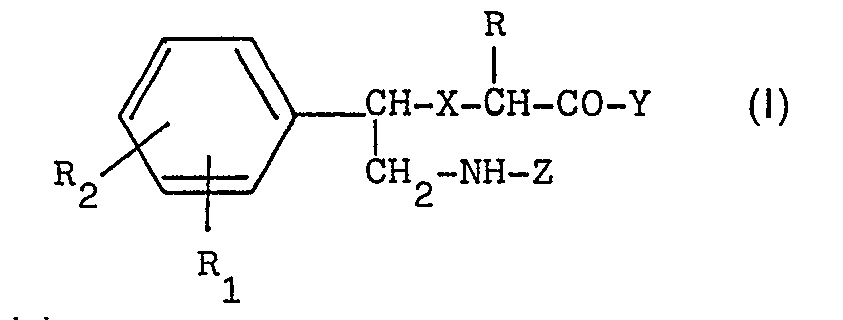
- the present invention relates, as industrial products, to new derivatives of [a- (alkylaminomethyl) -benzylthio] -acetic acid. It also relates to the preparation process and the therapeutic use of these new products.
- the [a- (alkylaminomethyl) -benzylthio] -acetic acid derivatives according to the invention namely the amides, esters and hydroxamic acids of formula 1 below, are useful in therapy in particular because of their properties on the central nervous system (CNS) and more particularly as antidepressant agents.
- addition salts is meant here the acid addition salts obtained by reaction of a free base of formula I with a mineral or organic acid, and ammonium salts.
- acids which can be used to salify the bases of formula l there may be mentioned in particular hydrochloric, hydrobromic, nitric, sulfuric, acetic, propionic, oxalic, fumaric, maleic, succinic, benzoic, cinnamic, mandelic, citric, malic, tartaric acids, p-toluenesulfonic and methanesulfonic.
- ammonium salts mention may in particular be made of CH 3 and CICH 3 .
- the acid addition salts are the preferred salts, and of these the most interesting are the hydrochlorides.
- C 1 -C 4 alkoxy groups involved in the definition of the radical Y which are suitable according to the invention, mention may in particular be made of methyloxy, ethyloxy, n-propyloxy, i-propyloxy, n-butyloxy, i-butyloxy groups. and t-butyloxy.
- C 1 -C 4 alkyl groups which are involved in the definition of the radical Z and which are suitable according to the invention, mention may in particular be made of the groups CH 3 , CH 2 CH 3 , CH 2 CH 2 CH 3 , CH ( CH 3 ) 2 , CH 2 CH 2 CH 2 CH 3 , CH 2 CH (CH3) 2 , CH (CH 3 ) CH 2 CH 3 and C (CH 3 ) 3 , the salkyl groups preferred from the therapeutic point of view being the isopropyl and tert-butyl groups.
- esters C 1 -C 4 alkoxy
- amides NH 2
- optical isomers resulting from separation previous racemates NHOH
- addition salts are also useful as intermediate synthetic compounds involved in the preparation of amides and hydroxamic acids.
- all the compounds according to the invention have the common property of acting on the CNS as antidepressant agents.
- the compounds of formula 1 according to the invention can be prepared according to a method known per se by application of conventional reaction mechanisms, in particular according to diagram A below [where Ar represents a group (R 1 R2) C 6 H 3 in which R 1 and R 2 are defined as indicated above, Hal is a halogen atom (in particular F, Clou Br), A is a C 1 -C 4 alkoxy group, and Z is defined as indicated above] .
- the reaction of stage a) is carried out by reacting 1 mole of Il with 1 mole of III in the presence of 2 gram atoms of alkali metal (in the form of alcoholate Na-A or KA) during minus 1 h at the reflux temperature of the reaction mixture, or for 6-12 h at 15-20 ° C.
- alkali metal in the form of alcoholate Na-A or KA
- the amidation reaction of stage b) is carried out by reacting 1 mole of ester V with 2 to 10 moles of NH 3 dissolved in an HA alcohol or water, for 5 to 50 h, at a temperature between 15 and 25 ° C.
- the reaction according to stage b) of the ester V with the hydroxylamine to obtain the hydroxamic acid VII is advantageously carried out by reacting, at a temperature between 15 and 25 ° C, for 5 to 20 h, 1 mole d 'ester V with 1 to 1, 2 mole of NH 2 OH.
- the oxidation reaction of stage c) is carried out by bringing a compound of formula V, VI or VII into contact with H 2 O 2 in the presence of acetic acid.
- 1 ml of hydrogen peroxide at 110-130 volumes is reacted with 0.01 mole of V, VI or VII at a temperature less than or equal to 50 ° C; preferably it will be operated at 40-45 ° C for 1 h and then at room temperature (15-20 ° C) for 5 to 15 h.
- the levorotatory and dextrorotatory optical isomers are separated from the corresponding racemic according to a method known per se, in particular by fractional crystallization.
- a therapeutic composition which is characterized in that it contains, in association with an acceptable physiological excipient, at least one compound chosen from the group consisting of racemates, levogyres and dextroyres of formula 1 above. , on the one hand, and their addition salts, on the other hand.
- the active principle intervenes in a pharmaceutically effective amount.
- the evaporation residue is taken up in 100 ml of diethyl ether, washed with water, extracted with 3N HCl, cold precipitated with concentrated NaOH, extracted with ether, dried and then evaporated with ether.
- the evaporation residue (which is in the form of an oil and consists essentially of ethyl [a- (tertiobuylaminomethyl) -benzylthio] -acetate) is taken up with 50 ml of CH 3 OH and poured into 100 ml of ammoniacal methanol (mixture containing 100 g / I of N H3); after 48 h of contact at 15-20 ° C., CH 3 OH is evaporated in vacuo, taken up in ether, filtered on charcoal and then precipitates the expected hydrochloride using hydrochloric ethanol.
- the evaporation residue is taken up in 30 ml of water, dropwise added 3N HCI to a pH of between 8 and 9, extracted with CH 2 Cl 2 , washed with 2 x 10 ml of water, dried and evaporates under vacuum.
- the evaporation residue is taken up with 100 ml of ethyl acetate and acidified with hydrochloric ethanol to precipitate the expected hydrochloride. After drying, washing with acetone and recrystallization from ethanol, CRL 41 214 is obtained with a yield of 72%.
- M inst 198-200 ° C (with decomposition).
- a sodium methoxide solution is prepared with 3.22 g (0.14 Atg) of sodium and 100 ml of methanol, 8.4 g (0.07 mol) of methyl thiolactate are added, then 17.4 g (0.07 mole) of 2-tertiobutylamino-1-phenyl-1-chloroethane hydrochloride.
- the resulting reaction medium is stirred for 5 h at a temperature between 0 and 5 ° C, then for 12 h at 20 ° C; the precipitate formed is filtered off, the alcohol is evaporated under vacuum, taken up with 100 ml of ether, the ethereal solution is washed with 3 times 50 ml of water, dried over MgSO 4 , the ether is evaporated under vacuum, poured evaporation residue in 100 ml of 20% ammonia and stirred the resulting mixture for 12 h. Extracted with ether, washed with water, extracted with 100 ml of 2N HCl, reprecipitates the free base using NaHCO 3 , extracted with ether, dried and evaporated in vacuo.
- the evaporation residue (13 g), which consists of 2- ⁇ [ ⁇ - (tertiobutylaminomethyl) -benzyl] -thio ⁇ - propionamide (product of Example 12), suspended in 40 ml of water , is acidified with 5.8 g (0.05 mole) of fumaric acid. Filter hot, cool, spin. By recrystallization from water, CRL 41 250 is obtained with a yield of 38%. M inst 156-157 ° C.
- CRL 41 190 (Ex. 1)
- CRL 41 214 (Ex. 3)
- the two test products dissolved in distilled water were administered, unless otherwise indicated, intraperitoneally in a volume of 20 ml / kg in male mice and in a volume of 5 ml / kg in male rats.
- the DL-0 (maximum non-lethal dose) of CRL 41 190 is greater than 128 mg / kg by the I.P. route in male mice, and the DL-30 is of the order of 256 mg / kg.
- mice 1. In mice:
- CRL 41 190 is administered to groups of 6 rats, 0.50 h before the subcutaneous injection of 0.5 mg / kg of apomorphine. It is observed that CRL 41190 leaves unchanged the stereotypes associated with apomorphine.
- Amphetamine (2 mg / kg) is injected intraperitoneally into batches of 6 rats, half an hour after administration of CRL 41 190.
- CRL 41 190 clearly increases the duration of amphetamine stereotypies.
- CRL 41 190 opposes the hypothermia induced by oxotremorine. This antagonism is clear at doses of 4 mg / kg, 16 mg / kg and especially 64 mg / kg.
- CRL 41 190 slightly reduces the intensity of the tremors due to oxotremorine.
- CRL 41 190 slightly reduces salivation between 1.5 h and 2 h after its administration. It is also noted that, at other doses, CRL 41 190 practically does not modify the signs of peripheral cholinergic stimulation due to oxotremorine.
- the test is carried out on batches of 10 mice 0.50 h after the administration of the product to be studied.
- CRL 41 190 does not increase the number of punished passages, that it does not cause motor incapacity ma niere and does not modify the convulsive effects, but that it aggravates, at the dose of 64 mg / kg, the lethal effects of electroshock.
- mice 0.5 h after receiving CRL 41 190, the mice (12 animals per dose, 24 control animals) are placed on an actimeter where their motility is recorded for 30 minutes.
- CRL 41 190 practically does not modify the spontaneous motor activity of the mouse.
- mice After having stayed for 3 weeks in each of the halves of a cage separated by an opaque partition, groups of 3 mice receive CRL41 190. Half an hour later, the two groups of the same cage are brought together by removal of the bulkhead and note the number of fights that occur in 10 minutes.
- CRL 41 190 moderately increases the number of fights.
- mice After 18 hours of stay in the actimeters, the mice (6 per dose, 12 controls) receive CRL 41190. They are immediately replaced in their respective enclosures and, half an hour later, their motility is recorded for 30 minutes.
- CRL 41 190 does not cause resumption of motor activity in mice accustomed to its enclosure.
- mice Half an hour after receiving CRL 41 190, the mice (10 per dose, 20 controls) are subjected to acute hypobaric anoxia [depression of 600 mmHg (ie approximately 8 ⁇ 10 4 pascals) in 90 seconds, then relaxation of 45 seconds], then they are placed in actimeters where their motility is recorded for 10 minutes.
- acute hypobaric anoxia depression of 600 mmHg (ie approximately 8 ⁇ 10 4 pascals) in 90 seconds, then relaxation of 45 seconds
- CRL 41 190 does not lead to an improvement in motor recovery in mice whose motility was depressed following a brief stay in an enclosure at reduced pressure.
- mortality 3/10 is observed immediately after acute hypoxia.
- mice receive CRL 41 190 half an hour before the intraperitoneal administration of 32 mg / kg of a standard curarizing agent, gallamine triiodoethylate.
- CRL 41 190 does not modify the time of onset of convulsions and of death following an asphyxial anoxia caused by a curarizing agent.
- CRL 41 190 decreases the duration of barbiturate sleep.
- mice are placed in a beaker filled with water to a height of 6 cm.
- the total duration of immobility between the 2 nd and 6 th minutes following the immersion is noted.
- CRL 41 190 clearly reduces the duration of the immobility of the mouse placed in forced immersion.
- CRL 41 190 acts essentially as an antidepressant substance from the CNS.
- the neuropsychopharmacological profile of CRL 41190 established from the results obtained in animals brings this product closer to stimulants of the ( ⁇ -adrenergic) type.
- CRL41 190 is distinguished by its action of stimulating antidepressants such as amineptine or even amphetamine.
- stimulating antidepressants such as amineptine or even amphetamine.
- the absence of antagonism of reserpinic ptosis and the rapidity of appearance of the effects of CRL 41 190 make it possible to differentiate CRL 41 190 from monoamine oxidase inhibitors.
- CRL 41 190 in solution in distilled water being administered by the gastric route in a volume of 20 ml / kg in male mice. It can be seen that CRL 41 190 by the gastric route, as by the intraperitoneal route, acts essentially as than antidepressant with, in large doses, a very moderate arousing and stimulating component.
- the DL-0 is greater than 256 mg / kg. At doses of 128 mg / kg and 256 mg / kg, sedation and dyspnea are observed.
- mice 1. In mice:
- CRL 41 214 antagonizes the hypothermia induced by apomorphine.
- CRL 41 214 clearly potentiates amphetamine stereotypies.
- CRL 41 214 antagonizes reserpinic hypothermia without modifying the ptosis.
- CRL 41 214 opposes hypothermia induced by oxotrominine.
- CRL 41 214 slightly reduces the intensity of tremors due to oxotremorine.
- CRL41 214 hardly changes the signs of peripheral cholinergic stimulation due to oxotremorine.
- CRL 41 214 does not cause a net increase in the number of punished passages, that it does not cause major motor incapacity, that it practically does not modify the convulsive effects, but that it worsens, at the dose of 128 mg / kg, the lethal effects of electroshock.
- CRL 41 214 clearly increases the spontaneous motor activity of the mouse.
- CRL 41 214 practically does not modify the number of fights.
- CRL41 214 causes a marked resumption of motor activity in mice accustomed to their enclosure.
- CRL 41 214 seems to cause a very moderate improvement in motor recovery in mice whose motility has been depressed following a brief stay in a reduced pressure enclosure.
- CRL 41 214 very moderately reduces the time from onset of convulsions and death following an asphyxial anoxia caused by a curarizing agent, gallamine triiodoethylate.
- CRL 41 214 markedly decreases the duration of barbiturate sleep.
- CRL 41 214 very moderately reduces the duration of immobility of the mouse placed in forced immersion.
- CRL 41 214 acts mainly on the CNS as an antidepressant substance with an exciting component in high doses.
- the antidepressant properties are manifested in much lower doses than the exciting effect.
- CRL 41 214 The neuropsychopharmacological profile of CRL 41 214 shows that this product differs from imipramine antidepressants by the absence of anticholinergic activity and the absence of net antagonism of immobility known as “despair” (the activity observed at high doses which may be related to the exciting effect), and that it differs from monoamine oxidase inhibitors by the absence of antagonism of the reserpinic ptosis and by the rapidity of appearance of its effects.
- CRL41 250 increases the femoral flow in the anesthetized dog at the dose of 19.1 mg / kg I.D. and that it causes a slight bradycardia at the dose of 1 mg / kg I.D .; there is no effect on blood pressure.
- the cumulative dose of 19.1 mg / kg LD. of CRL41 250 does not change the diastolic blood pressure or the heart rate: the diastolic blood pressure goes from 148 to 47 mmHg (or about 1.9 x 10 4 to 6.2 x 10 3 Pa) instead of 151 to 43 mmHg (i.e. from 2.0 x 10 4 to 5.7 x 10 3 Pa), and the heart rate goes from 175 to 265 beats / minute instead of 180 to 271 beats / minute.
- Noradrenaline hypertension (2 pg / kg IV) is slightly increased by CRL 41 250 (at the cumulative dose of 19.1 mg / kg lD), the systolic blood pressure increases from 191 to 330 mmHg (approximately 2.5 x 10 4 to 4.4 x 10 4 Pa) instead of 204 to 304 mmHg (i.e. approximately 2.7 x 10 4 to 4.0 x 10 4 Pa).
- CRL 41 252 has no effect on blood pressure or heart rate. It increases the femoral flow rates from the dose of 10 mg / kg I.D., this effect being confirmed by the I.M. injection of 10 mg / kg. We also note that CRL 41 252 increases rectal and skin temperatures.
- Noradrenaline hypertension (2 pg / kg IV) is increased by CRL41 252 (at the cumulative dose of 39.1 mg / kg ID), the arterial systolic pressure goes from 208 to 352 mmHg (about 2.7 7 x 10 4 to 4.7 x 10 4 Pa) instead of 204 to 328 mmHg (i.e. approximately 2.71 to 4.3 x 10 4 Pa).
- CRL 41 190 and CRL 41 214 in particular in the form of capsules or tablets each containing 25 mg or 50 mg of active principle at a rate of 1 2 times a day for two to three weeks.
- the antidepressant properties of CRL 41 190 and CRL 41 214 have also been observed to be very beneficial in the elderly.
- the use is recommended of a substance chosen from (i) the racemates of formula 1, (ii) their enantiomeric isomers and (iii) the corresponding non-toxic addition salts, for obtaining a CNS antidepressant drug intended for use in human therapy for depression.
Landscapes
- Health & Medical Sciences (AREA)
- Life Sciences & Earth Sciences (AREA)
- Chemical & Material Sciences (AREA)
- Medicinal Chemistry (AREA)
- Pharmacology & Pharmacy (AREA)
- Epidemiology (AREA)
- Emergency Medicine (AREA)
- Animal Behavior & Ethology (AREA)
- General Health & Medical Sciences (AREA)
- Public Health (AREA)
- Veterinary Medicine (AREA)
- Acyclic And Carbocyclic Compounds In Medicinal Compositions (AREA)
- Organic Low-Molecular-Weight Compounds And Preparation Thereof (AREA)
Claims (10)


Priority Applications (1)
| Application Number | Priority Date | Filing Date | Title |
|---|---|---|---|
| AT85400431T ATE26703T1 (de) | 1984-03-23 | 1985-03-06 | (alpha-(alkylaminomethyl)-benzylthio>-essigsaeur - derivate, verfahren zur herstellung und verwendung in therapie. |
Applications Claiming Priority (2)
| Application Number | Priority Date | Filing Date | Title |
|---|---|---|---|
| FR8404543 | 1984-03-23 | ||
| FR8404543A FR2561646B1 (fr) | 1984-03-23 | 1984-03-23 | Derives d'acide (a-(alkylaminomethyl)-benzyl)-thioacetique, procede de preparation et utilisation en therapeutique |
Publications (2)
| Publication Number | Publication Date |
|---|---|
| EP0158545A1 EP0158545A1 (de) | 1985-10-16 |
| EP0158545B1 true EP0158545B1 (de) | 1987-04-22 |
Family
ID=9302390
Family Applications (1)
| Application Number | Title | Priority Date | Filing Date |
|---|---|---|---|
| EP85400431A Expired EP0158545B1 (de) | 1984-03-23 | 1985-03-06 | [Alpha-(Alkylaminomethyl)-Benzylthio]-essigsäure-Derivate, Verfahren zur Herstellung und Verwendung in Therapie |
Country Status (4)
| Country | Link |
|---|---|
| EP (1) | EP0158545B1 (de) |
| AT (1) | ATE26703T1 (de) |
| DE (1) | DE3560141D1 (de) |
| FR (1) | FR2561646B1 (de) |
Families Citing this family (4)
| Publication number | Priority date | Publication date | Assignee | Title |
|---|---|---|---|---|
| FR2648814B1 (fr) * | 1989-06-26 | 1991-10-18 | Lafon Labor | L'alpha (tert-butyl-aminomethyl-3,4-dichlorobenzyl)thioacetamide, son procede de preparation et son application en therapeutique |
| FR2734264B1 (fr) * | 1995-05-19 | 1997-08-01 | Lafon Labor | Utilisation de derives d'alpha-aminomethyl-3,4-dichlorobenzyl-thioacetamide pour la fabrication d'un medicament inhibant la recapture de la dopamine et nouveaux composes pour cette utilisation |
| US6172057B1 (en) | 1997-02-27 | 2001-01-09 | American Cyanamid Company | N-Hydroxy-2-(alkyl, aryl, or heteroaryl sulfanyl, sulfinyl or sulfonyl)-3-substituted alkyl, aryl or heteroarylamides as matrix metalloproteinase inhibitors |
| GEP20022626B (en) * | 1997-02-27 | 2002-02-25 | American Cyanamid Company Us | N-Hydroxy-2-(Alkyl, Aryl, or Heteroaryl Sulfanyl, Sulfinil or Sulfonyl)-3-Substituted Alkyl, Aryl or Heteroarylamides as Matrix Metalloproteinase Inhibitors |
Family Cites Families (2)
| Publication number | Priority date | Publication date | Assignee | Title |
|---|---|---|---|---|
| GB1520812A (en) * | 1975-10-02 | 1978-08-09 | Lafon Labor | Benzhydrylsulphinyl derivatives |
| GB1584462A (en) * | 1977-03-31 | 1981-02-11 | Lafon Labor | N-diaryl-malonamide and diarylmethyl-sulphinyl-acetamide derivatives and pharmaceutical compositions containing them |
-
1984
- 1984-03-23 FR FR8404543A patent/FR2561646B1/fr not_active Expired
-
1985
- 1985-03-06 EP EP85400431A patent/EP0158545B1/de not_active Expired
- 1985-03-06 DE DE8585400431T patent/DE3560141D1/de not_active Expired
- 1985-03-06 AT AT85400431T patent/ATE26703T1/de not_active IP Right Cessation
Also Published As
| Publication number | Publication date |
|---|---|
| FR2561646B1 (fr) | 1987-10-09 |
| FR2561646A1 (fr) | 1985-09-27 |
| DE3560141D1 (en) | 1987-05-27 |
| ATE26703T1 (de) | 1987-05-15 |
| EP0158545A1 (de) | 1985-10-16 |
Similar Documents
| Publication | Publication Date | Title |
|---|---|---|
| EP0097071B1 (de) | Benzhydrylsulfinylacetamid-Derivate und deren Verwendung in der Therapeutik | |
| FR2500450A1 (fr) | Nouveaux derives aminomethyl-5 oxazolidiniques, leur procede de preparation et leur application en therapeutique | |
| EP0110781A1 (de) | Substituierte (Amino-2-ethyl)-6-Benzoxazolinone, ihre Herstellung und pharmazeutische Zusammenstellung die sie enthält | |
| EP0174242B1 (de) | 1-(Aminophenyl)-2-amino-propanon-Derivate, deren Verwendung in Therapie und Verfahren zu deren Herstellung | |
| CA1282781C (fr) | Derive tricyclique denomme acide [(chloro-3 methyl-6 dioxo- 5,5 dihydro-6,11 dibenzo (c,f) thiazepine(1,2)y l-11) amino)-5 pentanoique, et son procede depreparation | |
| EP0002978B1 (de) | Thiazolidindion-2,4 Derivate, deren Herstellung und Verwendung als Arzneimittel | |
| CH630606A5 (en) | Phenylamidine derivatives useful especially in therapeutics | |
| FR2534915A1 (fr) | Nouveaux derives de 2-(phenoxymethyl)-morpholine, utilisation en therapeutique et procede de preparation | |
| EP0158545A1 (de) | [Alpha-(Alkylaminomethyl)-Benzylthio]-essigsäure-Derivate, Verfahren zur Herstellung und Verwendung in Therapie | |
| EP0138714B1 (de) | 1-(Acetylaminophenyl)-2-Amino-Propanon-Derivate, deren therapeutische Verwendung und Verfahren zu deren Herstellung | |
| CH635570A5 (fr) | Derives d'amino-alcools. | |
| EP0080940B1 (de) | 2-Phenyl-Morpholin-Derivate und Arzneimittel | |
| EP0211746B1 (de) | Phenyl-Piperazin-Derivate, Verfahren zu deren Herstellung und Verwendung als Heilmittel | |
| EP0138716B1 (de) | 2-Tolyl-Morpholin-Derivate und Verwendung in der Therapeutik | |
| FR2486074A1 (fr) | Derives de fluorophenacyl-amine, leur procede de preparation et leur application en therapeutique | |
| EP0061406B1 (de) | Benzamido-alkyl-hydroxamsäurederivate, Verfahren zu ihrer Herstellung und pharmazeutische Mittel | |
| EP0174888B1 (de) | 1-(Aminophenyl)-2-amino-ethanon-Derivate, Verfahren zur Herstellung und therapeutische Verwendung | |
| EP0226511B1 (de) | 5-Phenyl-1,4,5,6-tetrahydropyrimidinderivate, Verfahren zur Herstellung und Verwendung in Arzneimitteln | |
| EP0060954B1 (de) | Fluorphenacyl-amin-Derivate und ihre therapeutische Verwendung | |
| FR2526793A1 (fr) | Nouveaux a-(n-pyrrolyl)-acides et leurs sels et esters, utiles comme medicaments et procede de la preparation de tels composes | |
| FR2553411A1 (fr) | Derives de 2-halogenophenyl-morpholine, procede de preparation et utilisation en therapeutique | |
| EP0110748B1 (de) | Phenyl-(3-aminopropyl)-keton-derivate, ihre therapeutische Verwendung und Verfahren zu ihrer Herstellung | |
| EP0174887B1 (de) | Derivate von 1-[N-(alpha-Amino-alpha-methylacetyl)-aminophenyl]-2-amino-propanon, Verfahren zur Herstellung und therapeutische Verwendung | |
| EP0662081B1 (de) | Ureidoacetamid-derivate,irhe herstellung und sie enthaltende medikamente | |
| EP0211745B1 (de) | Acetohydroxamsäurederivat, Herstellungsverfahren und therapeutische Verwendung |
Legal Events
| Date | Code | Title | Description |
|---|---|---|---|
| PUAI | Public reference made under article 153(3) epc to a published international application that has entered the european phase |
Free format text: ORIGINAL CODE: 0009012 |
|
| AK | Designated contracting states |
Designated state(s): AT BE CH DE FR GB IT LI LU NL SE |
|
| 17P | Request for examination filed |
Effective date: 19851016 |
|
| 17Q | First examination report despatched |
Effective date: 19860321 |
|
| GRAA | (expected) grant |
Free format text: ORIGINAL CODE: 0009210 |
|
| AK | Designated contracting states |
Kind code of ref document: B1 Designated state(s): AT BE CH DE FR GB IT LI LU NL SE |
|
| REF | Corresponds to: |
Ref document number: 26703 Country of ref document: AT Date of ref document: 19870515 Kind code of ref document: T |
|
| ITF | It: translation for a ep patent filed | ||
| REF | Corresponds to: |
Ref document number: 3560141 Country of ref document: DE Date of ref document: 19870527 |
|
| PLBE | No opposition filed within time limit |
Free format text: ORIGINAL CODE: 0009261 |
|
| STAA | Information on the status of an ep patent application or granted ep patent |
Free format text: STATUS: NO OPPOSITION FILED WITHIN TIME LIMIT |
|
| 26N | No opposition filed | ||
| ITTA | It: last paid annual fee | ||
| EPTA | Lu: last paid annual fee | ||
| EAL | Se: european patent in force in sweden |
Ref document number: 85400431.4 |
|
| REG | Reference to a national code |
Ref country code: GB Ref legal event code: IF02 |
|
| PGFP | Annual fee paid to national office [announced via postgrant information from national office to epo] |
Ref country code: NL Payment date: 20020218 Year of fee payment: 19 |
|
| PGFP | Annual fee paid to national office [announced via postgrant information from national office to epo] |
Ref country code: LU Payment date: 20030217 Year of fee payment: 19 |
|
| PGFP | Annual fee paid to national office [announced via postgrant information from national office to epo] |
Ref country code: CH Payment date: 20030218 Year of fee payment: 19 Ref country code: AT Payment date: 20030218 Year of fee payment: 19 |
|
| PGFP | Annual fee paid to national office [announced via postgrant information from national office to epo] |
Ref country code: SE Payment date: 20030219 Year of fee payment: 19 Ref country code: FR Payment date: 20030219 Year of fee payment: 19 |
|
| PGFP | Annual fee paid to national office [announced via postgrant information from national office to epo] |
Ref country code: GB Payment date: 20030228 Year of fee payment: 19 |
|
| PGFP | Annual fee paid to national office [announced via postgrant information from national office to epo] |
Ref country code: DE Payment date: 20030312 Year of fee payment: 19 |
|
| PGFP | Annual fee paid to national office [announced via postgrant information from national office to epo] |
Ref country code: BE Payment date: 20030328 Year of fee payment: 19 |
|
| PG25 | Lapsed in a contracting state [announced via postgrant information from national office to epo] |
Ref country code: LU Free format text: LAPSE BECAUSE OF NON-PAYMENT OF DUE FEES Effective date: 20040306 Ref country code: GB Free format text: LAPSE BECAUSE OF NON-PAYMENT OF DUE FEES Effective date: 20040306 Ref country code: AT Free format text: LAPSE BECAUSE OF NON-PAYMENT OF DUE FEES Effective date: 20040306 |
|
| PG25 | Lapsed in a contracting state [announced via postgrant information from national office to epo] |
Ref country code: SE Free format text: LAPSE BECAUSE OF NON-PAYMENT OF DUE FEES Effective date: 20040307 |
|
| PG25 | Lapsed in a contracting state [announced via postgrant information from national office to epo] |
Ref country code: LI Free format text: LAPSE BECAUSE OF NON-PAYMENT OF DUE FEES Effective date: 20040331 Ref country code: CH Free format text: LAPSE BECAUSE OF NON-PAYMENT OF DUE FEES Effective date: 20040331 Ref country code: BE Free format text: LAPSE BECAUSE OF NON-PAYMENT OF DUE FEES Effective date: 20040331 |
|
| BERE | Be: lapsed |
Owner name: LABORATOIRE L. *LAFON Effective date: 20040331 |
|
| PG25 | Lapsed in a contracting state [announced via postgrant information from national office to epo] |
Ref country code: NL Free format text: LAPSE BECAUSE OF NON-PAYMENT OF DUE FEES Effective date: 20041001 Ref country code: DE Free format text: LAPSE BECAUSE OF NON-PAYMENT OF DUE FEES Effective date: 20041001 |
|
| GBPC | Gb: european patent ceased through non-payment of renewal fee | ||
| EUG | Se: european patent has lapsed | ||
| REG | Reference to a national code |
Ref country code: CH Ref legal event code: PL |
|
| PG25 | Lapsed in a contracting state [announced via postgrant information from national office to epo] |
Ref country code: FR Free format text: LAPSE BECAUSE OF NON-PAYMENT OF DUE FEES Effective date: 20041130 |
|
| NLV4 | Nl: lapsed or anulled due to non-payment of the annual fee |
Effective date: 20041001 |
|
| REG | Reference to a national code |
Ref country code: FR Ref legal event code: ST |