EP0158721A2 - Verfahren zum Herstellen eines beflockten Textilflächengebildes und flexibles Textilflächengebilde - Google Patents
Verfahren zum Herstellen eines beflockten Textilflächengebildes und flexibles Textilflächengebilde Download PDFInfo
- Publication number
- EP0158721A2 EP0158721A2 EP84114801A EP84114801A EP0158721A2 EP 0158721 A2 EP0158721 A2 EP 0158721A2 EP 84114801 A EP84114801 A EP 84114801A EP 84114801 A EP84114801 A EP 84114801A EP 0158721 A2 EP0158721 A2 EP 0158721A2
- Authority
- EP
- European Patent Office
- Prior art keywords
- flock
- textile fabric
- adhesive
- flocked
- fabric
- Prior art date
- Legal status (The legal status is an assumption and is not a legal conclusion. Google has not performed a legal analysis and makes no representation as to the accuracy of the status listed.)
- Granted
Links
- 239000004753 textile Substances 0.000 title claims abstract description 35
- 239000004744 fabric Substances 0.000 title claims abstract description 33
- 238000000034 method Methods 0.000 title claims description 10
- 239000000853 adhesive Substances 0.000 claims abstract description 24
- 230000001070 adhesive effect Effects 0.000 claims abstract description 24
- 244000144992 flock Species 0.000 claims abstract description 19
- 239000006260 foam Substances 0.000 claims abstract description 15
- 238000003490 calendering Methods 0.000 claims abstract description 11
- 239000000835 fiber Substances 0.000 claims description 21
- 239000012790 adhesive layer Substances 0.000 claims description 10
- 239000006185 dispersion Substances 0.000 claims description 8
- 239000010410 layer Substances 0.000 claims description 8
- 238000001035 drying Methods 0.000 claims description 4
- 239000000463 material Substances 0.000 description 9
- 238000011282 treatment Methods 0.000 description 7
- 238000004049 embossing Methods 0.000 description 4
- 238000004519 manufacturing process Methods 0.000 description 4
- 239000004033 plastic Substances 0.000 description 4
- 229920003023 plastic Polymers 0.000 description 4
- 238000010276 construction Methods 0.000 description 3
- 239000003086 colorant Substances 0.000 description 2
- 230000003670 easy-to-clean Effects 0.000 description 2
- 238000010438 heat treatment Methods 0.000 description 2
- 201000003445 large cell neuroendocrine carcinoma Diseases 0.000 description 2
- 230000035699 permeability Effects 0.000 description 2
- 229920002635 polyurethane Polymers 0.000 description 2
- 239000004814 polyurethane Substances 0.000 description 2
- 239000000758 substrate Substances 0.000 description 2
- NIXOWILDQLNWCW-UHFFFAOYSA-M Acrylate Chemical compound [O-]C(=O)C=C NIXOWILDQLNWCW-UHFFFAOYSA-M 0.000 description 1
- 239000004952 Polyamide Substances 0.000 description 1
- 238000010521 absorption reaction Methods 0.000 description 1
- 239000002313 adhesive film Substances 0.000 description 1
- 230000005540 biological transmission Effects 0.000 description 1
- 238000004140 cleaning Methods 0.000 description 1
- 239000002131 composite material Substances 0.000 description 1
- 238000009833 condensation Methods 0.000 description 1
- 230000005494 condensation Effects 0.000 description 1
- 229920001577 copolymer Polymers 0.000 description 1
- 238000005520 cutting process Methods 0.000 description 1
- 230000000694 effects Effects 0.000 description 1
- 229920001971 elastomer Polymers 0.000 description 1
- 238000005562 fading Methods 0.000 description 1
- 239000003292 glue Substances 0.000 description 1
- 239000002649 leather substitute Substances 0.000 description 1
- 239000002184 metal Substances 0.000 description 1
- 239000003960 organic solvent Substances 0.000 description 1
- 230000000149 penetrating effect Effects 0.000 description 1
- 229920002647 polyamide Polymers 0.000 description 1
- 229920000642 polymer Polymers 0.000 description 1
- 229920003009 polyurethane dispersion Polymers 0.000 description 1
- 239000002994 raw material Substances 0.000 description 1
- 230000003014 reinforcing effect Effects 0.000 description 1
- 239000011347 resin Substances 0.000 description 1
- 229920005989 resin Polymers 0.000 description 1
- 239000005060 rubber Substances 0.000 description 1
- 239000002904 solvent Substances 0.000 description 1
- 239000007858 starting material Substances 0.000 description 1
- XLYOFNOQVPJJNP-UHFFFAOYSA-N water Substances O XLYOFNOQVPJJNP-UHFFFAOYSA-N 0.000 description 1
- 238000004804 winding Methods 0.000 description 1
Images
Classifications
-
- D—TEXTILES; PAPER
- D04—BRAIDING; LACE-MAKING; KNITTING; TRIMMINGS; NON-WOVEN FABRICS
- D04H—MAKING TEXTILE FABRICS, e.g. FROM FIBRES OR FILAMENTARY MATERIAL; FABRICS MADE BY SUCH PROCESSES OR APPARATUS, e.g. FELTS, NON-WOVEN FABRICS; COTTON-WOOL; WADDING ; NON-WOVEN FABRICS FROM STAPLE FIBRES, FILAMENTS OR YARNS, BONDED WITH AT LEAST ONE WEB-LIKE MATERIAL DURING THEIR CONSOLIDATION
- D04H11/00—Non-woven pile fabrics
- D04H11/08—Non-woven pile fabrics formed by creation of a pile on at least one surface of a non-woven fabric without addition of pile-forming material, e.g. by needling, by differential shrinking
-
- D—TEXTILES; PAPER
- D04—BRAIDING; LACE-MAKING; KNITTING; TRIMMINGS; NON-WOVEN FABRICS
- D04H—MAKING TEXTILE FABRICS, e.g. FROM FIBRES OR FILAMENTARY MATERIAL; FABRICS MADE BY SUCH PROCESSES OR APPARATUS, e.g. FELTS, NON-WOVEN FABRICS; COTTON-WOOL; WADDING ; NON-WOVEN FABRICS FROM STAPLE FIBRES, FILAMENTS OR YARNS, BONDED WITH AT LEAST ONE WEB-LIKE MATERIAL DURING THEIR CONSOLIDATION
- D04H11/00—Non-woven pile fabrics
-
- B—PERFORMING OPERATIONS; TRANSPORTING
- B05—SPRAYING OR ATOMISING IN GENERAL; APPLYING FLUENT MATERIALS TO SURFACES, IN GENERAL
- B05D—PROCESSES FOR APPLYING FLUENT MATERIALS TO SURFACES, IN GENERAL
- B05D1/00—Processes for applying liquids or other fluent materials
- B05D1/16—Flocking otherwise than by spraying
Definitions
- the invention relates to a method for producing a flocked, porous textile fabric which consists of an adhesive layer and a short fiber layer (flock).
- the textile fabric is produced by an adhesive layer being non-adherently absorbed by a carrier surface and being electrostatically flocked. This fabric is dried and then fixed. In the cleaned state, it is separated from the carrier surface and is available as a self-supporting textile product for further use.
- Producing fabrics from adhesive and short fibers on a carrier surface is known from DE PS 10 81 857.
- a uniform, continuous adhesive film made of low-viscosity plastic, resin, rubber or copolymer in the form of a volatile organic solvent solution is applied to a support surface, flocked and dried after flocking, so that the solvent evaporates.
- the textile fabric obtained is light and porous and has a velvety surface. In additional treatment stages with the help of glue and pile layer, it can also get a pile-like surface.
- Textile fabrics which are provided with short fibers are, according to the handbook "The Textile Raw Materials", E. Wagner, 6th edition 1981, page 159, as imitation suede, velvet, plush and fur, as velor paper, synthetic leather, among others Made from pile products.
- a substrate in the form of woven, knitted or paper serves as an adhesive and flock-bearing product component.
- the aim of the invention is to produce a substrate-free, flocked textile fabric which has improved properties with regard to its usability and furthermore should have a refined, flannel-like appearance with regard to its textile surface.
- the object of the invention is to produce the textile fabric from commercially available adhesives and short fibers and to achieve the desired properties simply and inexpensively by means of the starting materials mentioned and by finishing in a further treatment stage.
- this is achieved in that a fabric obtained from an aqueous polymeric air foam dispersion and short fibers (flock) is additionally calendered after flocking.
- An aqueous dispersion adhesive in the form of an air foam which is continuously applied to a carrier surface in a thin layer is flocked with short fibers in the flocking stage and is moved as a dried, not yet hardened textile fabric connected to a dense flock layer of essentially upright fibers through the nip of a calender and thereby on a certain, selectable thickness compressed.
- a uniform surface deformation of the flock is achieved.
- the calendered fabric is then fixed and condensed, then cleaned of excess flock and separated from the support surface.
- the textile fabric product obtained in this way is light, air-permeable and bi-elastic. It has a surface that is equivalent to a fine flannel. This refined look is achieved by calendering.
- the textile surface product can be used advantageously in many areas, e.g. as lining material in bags and suitcases, as a replacement for textile wallpaper in rooms and as interior lining in vehicles.
- lining material e.g. as lining material in bags and suitcases
- the textile surface product can be used advantageously in many areas, e.g. as lining material in bags and suitcases, as a replacement for textile wallpaper in rooms and as interior lining in vehicles.
- As a less decorative material it can be used in vehicles and machine housings, e.g. Typewriters or other office machines or vacuum cleaners can be used as sound-breaking material. When used in rooms, it can be heat-insulating and sound-absorbing.
- Dispersion adhesives are known from the Kunststoff Handbuch Polyurethane Band 7, G. Oertel, 2nd edition 1983; see. Page 591, for example adhesives made from aqueous polyurethane dispersions. See also chapter 11.7.4 clothing industry, in particular composites with woven and knitted fabrics, etc. for all-over flocking, and Chapter 11.7.5 Vehicle construction, especially vehicle parts, e.g. Glove box for decorative flocking.
- the dispersion adhesive is bonded to the flock layer such that the short fibers penetrating the adhesive hold and reinforce the adhesive layer and are supported thereby by the substantially upright short fibers present in full density.
- This in its adhesive layer area still plastic, not condensed, not finally cross-linked, large-cell foam component and the short fibers of the flock area are pressed together in the calender roll nip and essentially the flock surface receives its very uniform surface deformation that extends over the entire area. It subsequently gives it a flannel-like, uniformly uneven appearance.
- This fabric treated by calendering, results in a very light web after drying and fixing, which is highly permeable to air and has limited bi-elasticity and which has a flock surface in the manner described above.
- the textile fabric can preferably be given a decorative pattern in accordance with predetermined, selectable embossing aids. For example, receive a rustic fabric design.
- the treatment in calendering and embossing stages results in a textile fabric that has a character that is similar to that of flat weave and flannel.
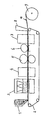
- the drawing shows schematically the structure of the means for producing a flocked textile web with a flannel appearance.
- aqueous polymeric foam adhesive dispersion with a foam weight of 100 to 500 g / 1 made of polyurethane or acrylate is run through a doctor blade a carrier surface 2 in the form of a non-adhesive and heat-resistant endless belt in a thickness of the air foam of optionally 100 to 1000 microns.
- a flocking level 3 i.e. an electrostatically constructed field, electrostatically prepared short fibers of known type, e.g. Polyamide in a fineness of either 1.7 to 3.3 dtex and optionally about 0.6 to 1.0 mm cutting length, flocked into the adhesive layer, so that the ends of the short fibers are at least partially surrounded by the adhesive material.
- the adhesive layer is relatively large-celled and the layer thickness is very small.
- the adhesive foam connects to the short fibers, which are flocked in full density, whereby both hold each other and the fibers reinforce the adhesive mass to a certain extent.
- the doctoring and flocking take place at room temperature.
- the flocked web which leaves the flocking stage, is soft, plastic and viscoelastic and has not yet hardened. It is then dried in a first drying zone 4 either by heat or heat treatment, depending on the type of foam adhesive chosen, the water being removed from the adhesive foam.
- This web is then passed through the nip of a calender 5 and is subject to a surface pressure by which the short fibers are subjected to pressure and / or kinking.
- the surface shows a uniform, flannel-like or matted flannel-like appearance. It is present uniformly on the entire surface and can be seen as a new finishing treatment that can only be achieved with cloth fabrics by a high level of equipment.
- further surface finishing can be carried out in an intermediate stage 6.
- embossing or partial embossing may be provided. This depends on the requirements of the later use of the textile surface structure. Areas of application are e.g. the automotive industry and the wall covering or bagging material processing industry.
- the dried, finished textile web is subjected to a drying and fixing process, with heat treatments which may be different for the top and bottom.
- the sheet goods receive the desired structural stability and the required quality.
- the textile fabric is cleaned of excess material residues, for example by a suction device 8. Then it is separated from the carrier surface 2 and wound up.
- the total process time takes about 5 to 6 minutes.
- the wound web is relatively soft and elastic, has a full grip and has a weight of about 120 to 150 g / m 2 .
- the winding is 9 and the flocked substrate-free textile sheet is designated 10.
- the textile fabric obtained by the process of the invention consists of a) the adhesive foam of the aforementioned aqueous dispersion, mechanically air-foamed and has good inherent stability and at the same time good air permeability due to the large-cell structure and b) the flock layer made of commercially available flock construction.
- This substrate-less web material is self-supporting, the short fibers being anchored better in the adhesive, in particular by calendering, and the fibers reinforcing the adhesive.
- the density of the flock entry favors this combination.
- the condensed adhesive foam thickness can be between 0.1 and 1 mm depending on the intended area of application.
- the product can be used in vehicle construction.
- the product is placed on the support structure, e.g. Sheet metal or plastic, glued on before deformation, then deformed and punched together with it. This has several advantages.
- Bags and suitcases can also be lined with this textile product in all desired designs cheaply, easy to clean and wear-resistant.
- the textile fabric is also suitable with advantages for interior design as an inexpensive covering material for rooms in conference halls, concert halls, theaters, etc. It is sound-refracting and slightly sound-reflecting. It can easily replace the expensive textile covering.
- the colors and pattern designs can be achieved as desired.
- the aforementioned flannel-like surface appearance can also be easily produced in an embossed form.
Landscapes
- Textile Engineering (AREA)
- Engineering & Computer Science (AREA)
- Laminated Bodies (AREA)
- Treatment Of Fiber Materials (AREA)
- Application Of Or Painting With Fluid Materials (AREA)
- Synthetic Leather, Interior Materials Or Flexible Sheet Materials (AREA)
- Chemical Or Physical Treatment Of Fibers (AREA)
- Diaphragms For Electromechanical Transducers (AREA)
- Arrangements For Transmission Of Measured Signals (AREA)
- Medicines Containing Plant Substances (AREA)
- Treatments For Attaching Organic Compounds To Fibrous Goods (AREA)
- Separation Of Suspended Particles By Flocculating Agents (AREA)
- Paper (AREA)
- Treating Waste Gases (AREA)
Abstract
Description
- Verfahren zum Herstellen eines beflockten Textilflächengebildes und flexibles Textilflächengebilde
- Die Erfindung betrifft ein Verfahren zum Herstellen eines beflockten, porösen Textilflächengebildes, das aus einer Klebstoffschicht und einer Kurzfaserschicht (Flock) besteht. Hergestellt wird das Textilflächengebilde, indem eine Klebstoffschicht von einer Trägerfläche nicht haftend aufgenommen und elektrostatisch beflockt wird. Dieses Flächengebilde wird getrocknet und anschließend fixiert. Im gereinigten Zustand wird es von der Trägerfläche getrennt und liegt als sich selbsttragendes Textilprodukt zur Weiterverwendung vor.
- Flächengebilde aus Klebstoff und Kurzfasern auf einer Trägerfläche herzustellen, ist nach DE PS 10 81 857 bekannt. Dabei wird ein gleichförmiger, kontinuierlicher Klebstoffilm aus geringviskosem Kunststoff, Harz, Kautschuk oder Mischpolymerisat in Form einer flüchtigen organischen Lösungsmittellösung auf eine Trägerfläche aufgebracht, beflockt und nach dem Beflocken getrocknet, so daß das Lösungsmittel verdampft. Das erhaltene textile Flächengebilde ist leicht und porös und zeigt eine samtartige Oberfläche. In zusätzlichen Behandlungsstufen mit Hilfe von Kleber und Florlage kann es auch eine florartige Oberfläche erhalten.
- Textile Flächengebilde, bestehend aus Substrat, Kleber und Kurzfasern, mit samtartiger Oberfläche herzustellen, ist nach DE-PS 832 112 bekannt. Die Fasern werden dabei an bestimmten Stellen in ihrer Neigung durch Kippen infolge Luftstrahlbehandlung geändert. Dadurch werden hellere und dunklere Effekte in der samtartigen Oberfläche erzielt.
- Textile Flächengebilde, die mit Kurzfasern (Flock) versehen sind, werden nach Handbuch "Die textilen Rohstoffe", E. Wagner, 6. Auflage 1981, Seite 159, als Wildleder-, Samt-, Plüsch- und Fellimitationen, als Velourpapiere, Kunstleder, u.a. Florprodukte hergestellt. Dabei dient ein Substrat in Form von Gewebe, Gewirke oder Papier als Kleber und Flock tragendes Produktbestandteil.
- Ziel der Erfindung ist es, ein substratloses, eine Flockschicht aufweisendes Textilflächengebilde herzustellen, das hinsichtlich seiner Gebrauchstüchtigkeit verbesserte Eigenschaften aufweisen und des weiteren bezüglich seiner textilen Oberfläche ein veredeltes, flanellartigen Charakter aufweisendes Aussehen erhalten soll. Der Erfindung liegt die Aufgabe zugrunde, das Textilflächengebilde aus handelsüblichen Klebstoffen und Kurzfasern herzustellen und dabei die gewünschten Eigenschaften durch die genannten Ausgangsstoffe und durch eine Veredelung in einer weiteren Behandlungsstufe einfach und kostengünstig zu erzielen.
- Erfindungsgemäß wird dies dadurch erreicht, das ein aus einer wäßrigen polymeren Luftschaumdispersion und Kurzfasern (Flock) erhaltenes Flächengebilde nach dem Beflocken zusätzlich kalandriert wird. Ein in einer Dünnschicht auf eine Trägerfläche kontinuierlich aufgegebener wäßriger Dispersionskleber in Luftschaumform wird in der Beflockungsstufe mit Kurzfasern beflockt und wird als angetrocknetes, mit einer dichten Flockschicht aus im wesentlichen aufrechtstehenden Fasern verbundenes, noch nicht ausgehärtetes textiles Flächengebilde durch den Walzenspalt eines Kalanders bewegt und dabei auf eine bestimmte, wählbare Dicke zusammengepreßt. Im wesentlichen wird dabei eine gleichmäßige Oberflächenverformung des Flocks erzielt.
- Das kalandrierte Flächengebilde wird anschließend fixiert und auskondensiert, dann vom Flocküberschuß gereinigt und von der Trägerfläche getrennt. Das so erhaltene textile Flächenprodukt ist leicht, luftdurchlässig und bi-elastisch. Es weist eine Oberfläche auf, die einem feinen Flanell gleichkommt. Dieses veredelte Aussehen wird durch das Kalandrieren erzielt.
- Es ist außerdem weich im Griff und sieht optisch voller aus, als es tatsächlich ist. Es ist außerdem reinigungsbeständig. Aufgrund dieser Eigenschaften ist das textile Flächenprodukt in vielen Bereichen vorteilhaft anzuwenden, so z.B. als Auskleidungsmaterial in Taschen und Koffer, als Textiltapetenersatz in Räumen und als Innenverkleidung in Fahrzeugen. Als weniger dekorativ ausgestattetes Material kann es in Fahrzeugen und Maschinengehäusen, wie z.B. Schreib- oder anderen BUromaschinen oder Staubsauger als schallbrechendes Material verwendet werden. Bei der Verwendung in Räumen kann es wärmeisolierend und schallschluckend sein.
- Dispersionsklebstoffe sind nach Kunststoff Handbuch Polyurethane Band 7, G. Oertel, 2. Auflage 1983, bekannt; vgl. Seite 591, beispielsweise Klebstoffe aus wäßrigen Polyurethandispersionen. Vgl. auch Kapitel 11.7.4 Bekleidungsindustrie, insbesondere Verbunde mit Geweben und Gewirken, u.a.O. für ganzflächige Beflockung, und Kapitel 11.7.5 Fahrzeugbau, insbesondere Fahrzeugteile, z.B. Handschuhkasten, bezüglich dekorativer Beflockung.
- Nach dem Herstellungsverfahren der vorliegenden Erfindung wird der Dispersionsklebstoff derart mit der Flockschicht verbunden, daß die in den Kleber eindringenden Kurzfasern die Klebschicht halten und verstärken und daß sie dabei von den in voller Dichte vorhandenen, im wesentlichen aufrechtstehenden Kurzfasern selbst unterstützt werden. Dieser, in seinem Kleberschichtbereich noch plastische, nicht auskondensierte, nicht abschließend vernetzte, großzellige Schaumstoffbestandteil und die Kurzfasern des Flockbereichs werden im Kalanderwalzenspalt zusammengepreßt und hierbei erhält im wesentlichen die Flockoberfläche ihre über die gesamte Fläche reichende sehr gleichmäßige Oberflächenverformung. Sie verleiht ihr hernach ein flanellartiges, gleichmäßig ungleichmäßiges Aussehen.
- Dieses durch Kalandrieren behandelte Flächengebilde ergibt nach dem Trocknen und Fixieren eine sehr leichte Warenbahn, die hoch luftdurchlässig und begrenzt bi-elastisch ist und die eine Flockoberfläche in der vorbeschriebenen Art aufweist.
- Nach einer weiteren Ausgestaltung kann das textile Flächengebilde nach dem Kalandrieren in einer Prägestufe bevorzugt ein dekoratives Muster nach vorgegebenen, wählbar einzusetzenden Prägehilfsmitteln erhalten. Es kann z.B. ein rustikales Gewebedessin erhalten. Die Behandlung in Kalandrier- und Prägestufen ergibt ein textiles Flächengebilde, das einen kombiniert aus Flachgewebe und Flanell ähnlichen Charakter aufweist.
- Das Verfahren und daraus erhaltene textile Flächenprodukt nach Erfindung wird anhand von Beispielen näher erläutert.
- Die Zeichnung zeigt schematisch den Aufbau der Mittel zum Herstellen einer beflockten Textilbahn mit Flanellaussehen.
- Eine wäßrige polymere Schaumkleberdispersion mit einem Schaumgewicht von 100 bis 500 g/1 aus Polyurethan oder Acrylat wird durch eine Rakel lauf eine Trägerfläche 2 in Form eines nicht haftenden und hitzebeständigen Endlosbandes in einer Dicke des Luftschaums von wahlweise 100 bis 1000 um aufgegeben. In einer Beflockungsstufe 3, d.i. ein elektrostatisch aufgebautes Feld, werden elektrostatisch präparierte Kurzfasern bekannter Art, z.B. Polyamid in einer Feinheit von wahlweise 1,7 bis 3,3 dtex und wahlweise etwa 0,6 bis 1,0 mm Schnittlänge, in die Kleberschicht eingeflockt, so daß die Kurzfasern mit ihren Enden von dem Klebermaterial zumindest teilweise umgeben sind. Die Kleberschicht ist verhältnismäßig großzellig und die Schichtdicke ist sehr gering. Der klebende Schaumstoff verbindet sich mit den in voller Dichte eingeflockten Kurzfasern, wobei sich beide gegenseitig halten und die Fasern gewissermaßen die Klebermasse verstärken. Das Aufrakeln und Beflocken erfolgen bei Raumtemperatur. Die beflockte Bahn, die die Beflockungsstufe verläßt, ist weich, plastisch und viscoelastisch und noch nicht ausgehärtet. Sie wird dann in einer ersten Trockenzone 4 je nach Art des gewählten Schaumklebers entweder durch Hitze- oder Wärmebehandlung getrocknet, wobei dem Kleberschaum das Wasser entzogen wird.
- Diese Bahn wird dann durch den Walzenspalt eines Kalanders 5 geführt, unterliegt hierbei einer Flächenpressung, durch die die Kurzfasern auf Druck und/oder Knickung beansprucht werden. Im Ergebnis zeigt sich die Oberfläche mit einem gleichmäßigen, flanellartigen oder verfilzt flanellartigen Aussehen. Es ist einheitlich an der gesamten Oberfläche vorhanden und als neue Veredelungsbehandlung anzusehen, die bei Tuchgeweben vergleichsweise nur durch hohen Ausrüstungsaufwand erzielt werden kann. Bevor der Schaumkleber auskondensiert, können weitere Oberflächenveredelungen in einer Zwischenstufe 6 vorgenommen werden. Es kann z.B. ein Prägen oder Teilprägen vorgesehen werden. Dies richtet sich nach den Erfordernissen der späteren Verwendung des textilen Oberflächengebildes. Einsatzgebiete sind z.B. die Fahrzeugindustrie sowie die Wandbespann- oder Täschnermaterial verarbeitende Branche.
- In einer weiteren Behandlungsstufe 7 wird die angetrocknete, veredelte textile Warenbahn einem Trocken- und Fixierprozeß mit gegebenenfalls für Ober- und Unterseite unterschiedl_ichen Wärmebehandlungen unterworfen. Hierbei erhält die Bahnenware die gewünschte Strukturstabilität und die erforderliche Qualität. Im Anschluß an diese letzte Behandlungsstufe wird das Textilflächengebilde von überschüssigen Materialresten gereinigt, z.B. durch eine Absaugevorrichtung 8. Dann wird es von der Trägerfläche 2 getrennt und aufgewickelt. Die Gesamtprozeßzeit dauert etwa 5 bis 6 Minuten. Die gewickelte Warenbahn ist verhältnismäßig weich und elastisch, weist einen fülligen Griff auf und hat ein Gewicht von etwa 120 bis 150 g/m2. Der Wickel ist mit 9 und die beflockte substratlose Textilflächenbahn ist mit 10 bezeichnet.
- Das nach dem Verfahren der Erfindung erhaltene textile Flächengebilde besteht a) aus dem Kleberschaum der vorgenannten wäßrigen Dispersion, mechanisch luftgeschäumt und weist eine gute Eigenstabilität und zugleich gute Luftdurchlässigkeit aufgrund der großzelligen Struktur auf und b) aus der Flockschicht aus handelsüblicher Flockkonstruktion.
- Diese substratlose Bahnenware ist selbsttragend, wobei sich die Kurzfasern im Kleber inbesondere durch das Kalandrieren verbessert verankern und wobei die Fasern den Kleber verstärken. Die Dichte des Flockeintrags begünstigt diesen Verbund. Die auskondensierte Kleberschaumdicke kann zwischen 0,1 und 1 mm je nach dem vorgesehenem Einsatzgebiet betragen.
- Es werden eine hohe Atmungsaktivität und Luftdurchlässigkeit erreicht. Der hohe Lufteinschluß gibt der leichten Bahnenware eine dem Gewicht entsprechende Feuchtigkeitsaufnahme. Das optisch volle Bild der Ware läßt scheinbar auf eine schwerere Ware schließen, als sie tatsächlich ist. Die erzielte Bi-Elastizität macht das Produkt bis zu 25% tiefziehfähig.
- Es kann Verwendung finden im Fahrzeugbau. Bei der Produktion des sogenannten Autohimmels wird das Produkt auf die Trägerkonstruktion, z.B. Blech oder Kunststoff, vor der Verformung aufgeklebt, dann zusammen mit diesem verformt und gestanzt. Dies ergibt mehrere Vorteile.
- Es bildet sich kein Kondenswasser am Autohimmel. Er ist schallisolierend und temperaturisolierend. Er ist modisch in den gewünschten Farben zu bekleiden, nicht verfärbend, nicht verbleichend und reinigungsfreundlich. Bei der Verwendung des textilen Flächengebildes können ebenso Autotüren, Fächer und Ablagen innen mit dieser Ware preisgünstig in modischen Dessins ausgerüstet werden. Die Vorteile gleichen denen des Autohimmels. Als Schallschluckelement können Gehäuse von Schreibmaschinen und anderen Büromaschinen mit dieser textilen Ware ausgestattet werden. Die Schallübertragung wird dabei wesentlich reduziert.
- Des weiteren können Taschen und Koffer mit dieser textilen Ware in allen gewünschten Dessins günstig, reinigungsfreundlich und abriebfest ausgekleidet werden.
- Das textile Flächengebilde eignet sich ferner mit Vorteilen für die Raumgestaltung als kostengünstiges Bespannmaterial für Räume in Konferenzsälen, Konzertsälen, Theater usw.. Es ist schallbrechend und gering schallreflektierend. Es kann die teuere Textilbespannung ohne weiteres ersetzen. Die Farben und Mustergestaltungen sind je nach Wunsch zu erzielen. Zugleich kann das erwähnte flanellartige Oberflächenaussehen auch in geprägter Form einfach hergestellt werden.
Claims (4)
Priority Applications (1)
| Application Number | Priority Date | Filing Date | Title |
|---|---|---|---|
| AT84114801T ATE55428T1 (de) | 1984-04-17 | 1984-12-05 | Verfahren zum herstellen eines beflockten textilflaechengebildes und flexibles textilflaechengebilde. |
Applications Claiming Priority (2)
| Application Number | Priority Date | Filing Date | Title |
|---|---|---|---|
| DE3414505A DE3414505C2 (de) | 1984-04-17 | 1984-04-17 | Verfahren zum Herstellen eines beflockten Textilflächengebildes und flexibles Textilflächengebilde |
| DE3414505 | 1984-04-17 |
Publications (3)
| Publication Number | Publication Date |
|---|---|
| EP0158721A2 true EP0158721A2 (de) | 1985-10-23 |
| EP0158721A3 EP0158721A3 (en) | 1987-12-02 |
| EP0158721B1 EP0158721B1 (de) | 1990-08-08 |
Family
ID=6233827
Family Applications (1)
| Application Number | Title | Priority Date | Filing Date |
|---|---|---|---|
| EP84114801A Expired - Lifetime EP0158721B1 (de) | 1984-04-17 | 1984-12-05 | Verfahren zum Herstellen eines beflockten Textilflächengebildes und flexibles Textilflächengebilde |
Country Status (12)
| Country | Link |
|---|---|
| US (1) | US4668323A (de) |
| EP (1) | EP0158721B1 (de) |
| JP (1) | JPS60244534A (de) |
| KR (1) | KR880000387B1 (de) |
| AT (1) | ATE55428T1 (de) |
| BR (1) | BR8500406A (de) |
| DE (2) | DE3414505C2 (de) |
| DK (1) | DK162450C (de) |
| ES (1) | ES8605696A1 (de) |
| FI (1) | FI73900C (de) |
| NO (1) | NO157509C (de) |
| ZA (1) | ZA85764B (de) |
Cited By (4)
| Publication number | Priority date | Publication date | Assignee | Title |
|---|---|---|---|---|
| EP0420256A3 (en) * | 1989-09-29 | 1992-02-12 | Kimberly-Clark Corporation | Increased pile density composite elastic material |
| FR2770157A1 (fr) * | 1997-10-23 | 1999-04-30 | Thierry Agard | Procede et dispositif de flocage |
| US8153254B2 (en) | 2002-05-24 | 2012-04-10 | Max-Planck-Gesellschaft zur Foerdurung der Wissenschafter E.V. | Methods for modifying the surfaces of a solid and microstructured surfaces with increased adherence produced with said methods |
| EP2548461A1 (de) * | 2008-09-19 | 2013-01-23 | Nike International Ltd. | Sport-bh |
Families Citing this family (51)
| Publication number | Priority date | Publication date | Assignee | Title |
|---|---|---|---|---|
| DE8805586U1 (de) * | 1988-04-28 | 1988-07-14 | Marco Pelzveredlungs-GmbH, 8510 Fürth | Fell, insbes. Naturfell |
| US4961896A (en) * | 1988-11-04 | 1990-10-09 | Cadillac Products, Inc. | Method of making simulated fabric |
| CA2024768C (en) * | 1989-09-06 | 2002-11-12 | David I. Walsh | Method and apparatus for impressing a pattern in flocked material |
| KR100312886B1 (ko) * | 1993-11-02 | 2001-12-28 | 휴스톤 로버트 엘 | 아스팔트실글용공기압입자배합기 |
| US5756180A (en) * | 1994-01-12 | 1998-05-26 | Squires; William J. | Flocked fabric suitable as outerwear |
| US5624522A (en) * | 1995-06-07 | 1997-04-29 | Owens-Corning Fiberglas Technology Inc. | Method for applying granules to strip asphaltic roofing material to form variegated shingles |
| US5747105A (en) * | 1996-04-30 | 1998-05-05 | Owens Corning Fiberglas Technology Inc. | Traversing nozzle for applying granules to an asphalt coated sheet |
| JP3659758B2 (ja) * | 1996-12-26 | 2005-06-15 | 株式会社トクヤマ | 複合フィルムの製造方法 |
| US5858156A (en) * | 1998-02-17 | 1999-01-12 | High Voltage Graphics, Inc. | Diminishing bleed plush transfer |
| US6214141B1 (en) * | 1998-11-02 | 2001-04-10 | John Chinung Kim | Decorative flocking techniques |
| DE19942996B4 (de) * | 1999-09-09 | 2006-03-16 | Ntt New Textile Technologies Gmbh | Verfahren zur Herstellung eines Unterbekleidungsstückes und damit hergestelltes Unterbekleidungsstück |
| US7344769B1 (en) * | 2000-07-24 | 2008-03-18 | High Voltage Graphics, Inc. | Flocked transfer and article of manufacture including the flocked transfer |
| US20080006968A1 (en) * | 2000-07-24 | 2008-01-10 | High Voltage Graphics, Inc. | Heat moldable flock transfer with heat resistant, reusable release sheet and methods of making same |
| US6929771B1 (en) | 2000-07-31 | 2005-08-16 | High Voltage Graphics, Inc. | Method of decorating a molded article |
| US8354050B2 (en) * | 2000-07-24 | 2013-01-15 | High Voltage Graphics, Inc. | Co-molded direct flock and flock transfer and methods of making same |
| US7364782B2 (en) | 2000-07-24 | 2008-04-29 | High Voltage Graphics, Inc. | Flocked transfer and article of manufacture including the application of the transfer by thermoplastic polymer film |
| US7338697B2 (en) | 2000-07-24 | 2008-03-04 | High Voltage Graphics, Inc. | Co-molded direct flock and flock transfer and methods of making same |
| US20070289688A1 (en) * | 2000-07-24 | 2007-12-20 | High Voltage Graphics, Inc. | Processes for precutting laminated flocked articles |
| FR2814093A1 (fr) * | 2000-09-20 | 2002-03-22 | Cera | Complexe de revetement pour element de siege en mousse |
| WO2003015076A1 (en) * | 2001-08-06 | 2003-02-20 | Index Corporation | Device and method for judging dog's feeling from cry vocal character analysis |
| US6977023B2 (en) | 2001-10-05 | 2005-12-20 | High Voltage Graphics, Inc. | Screen printed resin film applique or transfer made from liquid plastic dispersion |
| US7897236B2 (en) * | 2002-06-10 | 2011-03-01 | Playtex Products, Inc. | Electrostatic flocking and articles made therefrom |
| JP2005532202A (ja) * | 2002-07-03 | 2005-10-27 | ハイ ボルテイジ グラフィックス インコーポレイテッド | フロック加工品およびその製造方法 |
| US7410682B2 (en) * | 2002-07-03 | 2008-08-12 | High Voltage Graphics, Inc. | Flocked stretchable design or transfer |
| CN1678454A (zh) * | 2002-07-03 | 2005-10-05 | 高压制图公司 | 用于植绒制品的印花和模塑的方法 |
| CA2541821A1 (en) * | 2003-10-08 | 2005-04-21 | High Voltage Graphics, Inc. | Processes for precutting laminated flocked articles |
| US7465485B2 (en) * | 2003-12-23 | 2008-12-16 | High Voltage Graphics, Inc. | Process for dimensionalizing flocked articles or wear, wash and abrasion resistant flocked articles |
| US7393576B2 (en) * | 2004-01-16 | 2008-07-01 | High Voltage Graphics, Inc. | Process for printing and molding a flocked article |
| DE102005002378C5 (de) * | 2005-01-18 | 2012-11-08 | Metzeler Automotive Profile Systems Gmbh | Verfahren zum Herstellen einer Dichtung, insbesondere für ein Kraftfahrzeug |
| US8007889B2 (en) * | 2005-04-28 | 2011-08-30 | High Voltage Graphics, Inc. | Flocked multi-colored adhesive article with bright lustered flock and methods for making the same |
| RU2294990C1 (ru) * | 2005-06-27 | 2007-03-10 | Общество с ограниченной ответственностью "Олмар Флок" | Способ получения многоцветных ворсовых рисунков |
| JP2009502485A (ja) * | 2005-07-28 | 2009-01-29 | ハイ ボルテイジ グラフィックス インコーポレイテッド | 多孔質フィルムを有するフロック加工された物品 |
| US7749589B2 (en) * | 2005-09-20 | 2010-07-06 | High Voltage Graphics, Inc. | Flocked elastomeric articles |
| US20070110949A1 (en) * | 2005-11-17 | 2007-05-17 | High Voltage Graphics, Inc. | Flocked adhesive article |
| US20070148397A1 (en) * | 2005-12-07 | 2007-06-28 | High Voltage Graphics, Inc. | Flocked multi-colored adhesive article with bright lustered flock |
| US20080003399A1 (en) * | 2005-12-07 | 2008-01-03 | High Voltage Graphics, Inc. | Wet-on-wet method for forming flocked adhesive article |
| WO2008030203A1 (en) * | 2006-09-05 | 2008-03-13 | Flokser Tekstil Sanayi Ve Ticaret A.S. | Cold-embossing process for pattern transfer over flocked wet fabric and the fabric manufactured according to this process |
| US20080095973A1 (en) * | 2006-10-17 | 2008-04-24 | High Voltage Graphics, Inc. | Laser textured flocked substrate |
| US8206800B2 (en) * | 2006-11-02 | 2012-06-26 | Louis Brown Abrams | Flocked adhesive article having multi-component adhesive film |
| WO2008061163A2 (en) * | 2006-11-14 | 2008-05-22 | High Voltage Graphics, Inc. | Rigid mouse pad |
| US20080145585A1 (en) * | 2006-12-15 | 2008-06-19 | High Voltage Graphics, Inc. | Flocked slurried thermosetting adhesive article |
| WO2008101115A1 (en) | 2007-02-14 | 2008-08-21 | High Voltage Graphics, Inc. | Sublimation dye printed textile |
| EP2110165A1 (de) | 2008-04-17 | 2009-10-21 | Tödi Sport AG | Verfahren zum Herstellen eines Steigfells, Einrichtung zum Durchführen des Verfahrens sowie ein Steigfell hergestellt nach diesem Verfahren |
| US20090307928A1 (en) * | 2008-06-16 | 2009-12-17 | Ingo Pietsch Gmbh & Co.Kg | Shoe and sole insert therefor |
| US9012005B2 (en) | 2009-02-16 | 2015-04-21 | High Voltage Graphics, Inc. | Flocked stretchable design or transfer including thermoplastic film and method for making the same |
| US9175436B2 (en) * | 2010-03-12 | 2015-11-03 | High Voltage Graphics, Inc. | Flocked articles having a resistance to splitting and methods for making the same |
| DE102011012517A1 (de) * | 2011-02-25 | 2012-08-30 | Renolit Ag | Verfahren zum Schutz von Oberflächen vor Bewuchs |
| CN104271233B (zh) | 2012-05-02 | 2018-06-08 | 安塞尔保健产品有限责任公司 | 高度吸收性泡沫内衬 |
| US9193214B2 (en) | 2012-10-12 | 2015-11-24 | High Voltage Graphics, Inc. | Flexible heat sealable decorative articles and method for making the same |
| WO2014120931A1 (en) * | 2013-01-31 | 2014-08-07 | Johnson Controls Technology Company | Sheet material attachment system and method |
| WO2017082252A1 (ja) * | 2015-11-09 | 2017-05-18 | 中央発條株式会社 | 植毛粉体塗装物 |
Family Cites Families (12)
| Publication number | Priority date | Publication date | Assignee | Title |
|---|---|---|---|---|
| DE159790C (de) * | 1904-01-19 | |||
| US2853413A (en) * | 1954-09-13 | 1958-09-23 | Chicago Mill & Lumber Co | Wood particle veneer board and method of making same |
| US3219507A (en) * | 1961-02-20 | 1965-11-23 | Magee Carpet Co | Method of applying plastic sheet to pile fabric backing |
| GB1206974A (en) * | 1967-03-16 | 1970-09-30 | Dunlop Co Ltd | Method of applying a pattern to sheet material |
| FR1550972A (de) * | 1967-03-17 | 1968-12-27 | ||
| FR2034108A1 (de) * | 1969-02-05 | 1970-12-11 | Rhone Progil | |
| ZA72328B (en) * | 1971-01-22 | 1972-09-27 | Dunlop Ltd | Pile coated sheet material |
| BE790868R (nl) * | 1971-11-12 | 1973-05-03 | Serpo Nv | Werkwijze en inrichting voor het vervaardigen van een bekledingmet |
| GB1500165A (en) * | 1974-05-10 | 1978-02-08 | Energy Sciences Inc | Process for curing of adhesives for flocking and texturing on heat-sensitive substrates by electron-beam radiation |
| DE2423284C2 (de) * | 1974-05-14 | 1982-04-01 | Basf Ag, 6700 Ludwigshafen | Verfahren zum Beflocken von flächigen textilen Substraten |
| DD128826A3 (de) * | 1974-09-25 | 1977-12-14 | Manfred Pfeifer | Verfahren zum strukturieren |
| DE2932866C3 (de) * | 1979-08-14 | 1982-05-19 | Metzeler Kautschuk GmbH, 8000 München | Verfahren zur Herstellung eines haftenden Polyurethan- bzw. Poyharnstoff-Elastomerfilms |
-
1984
- 1984-04-17 DE DE3414505A patent/DE3414505C2/de not_active Expired
- 1984-12-05 DE DE8484114801T patent/DE3482956D1/de not_active Expired - Lifetime
- 1984-12-05 EP EP84114801A patent/EP0158721B1/de not_active Expired - Lifetime
- 1984-12-05 AT AT84114801T patent/ATE55428T1/de not_active IP Right Cessation
-
1985
- 1985-01-25 DK DK035185A patent/DK162450C/da not_active IP Right Cessation
- 1985-01-30 ES ES539979A patent/ES8605696A1/es not_active Expired
- 1985-01-30 BR BR8500406A patent/BR8500406A/pt unknown
- 1985-01-30 KR KR1019850000564A patent/KR880000387B1/ko not_active Expired
- 1985-01-31 NO NO850378A patent/NO157509C/no unknown
- 1985-01-31 JP JP60015641A patent/JPS60244534A/ja active Granted
- 1985-01-31 ZA ZA85764A patent/ZA85764B/xx unknown
- 1985-02-07 FI FI850506A patent/FI73900C/fi not_active IP Right Cessation
- 1985-02-15 US US06/702,029 patent/US4668323A/en not_active Expired - Fee Related
Cited By (5)
| Publication number | Priority date | Publication date | Assignee | Title |
|---|---|---|---|---|
| EP0420256A3 (en) * | 1989-09-29 | 1992-02-12 | Kimberly-Clark Corporation | Increased pile density composite elastic material |
| FR2770157A1 (fr) * | 1997-10-23 | 1999-04-30 | Thierry Agard | Procede et dispositif de flocage |
| US8153254B2 (en) | 2002-05-24 | 2012-04-10 | Max-Planck-Gesellschaft zur Foerdurung der Wissenschafter E.V. | Methods for modifying the surfaces of a solid and microstructured surfaces with increased adherence produced with said methods |
| US8480452B2 (en) | 2005-04-22 | 2013-07-09 | Nike, Inc. | Athletic bra |
| EP2548461A1 (de) * | 2008-09-19 | 2013-01-23 | Nike International Ltd. | Sport-bh |
Also Published As
| Publication number | Publication date |
|---|---|
| US4668323A (en) | 1987-05-26 |
| DK162450C (da) | 1992-03-23 |
| KR850007832A (ko) | 1985-12-09 |
| DE3414505C2 (de) | 1987-01-22 |
| DE3482956D1 (de) | 1990-09-13 |
| ES539979A0 (es) | 1986-04-01 |
| ATE55428T1 (de) | 1990-08-15 |
| DE3414505A1 (de) | 1985-10-24 |
| FI73900B (fi) | 1987-08-31 |
| EP0158721B1 (de) | 1990-08-08 |
| DK162450B (da) | 1991-10-28 |
| JPS60244534A (ja) | 1985-12-04 |
| DK35185A (da) | 1985-10-18 |
| KR880000387B1 (ko) | 1988-03-20 |
| ES8605696A1 (es) | 1986-04-01 |
| FI850506L (fi) | 1985-10-18 |
| NO157509B (no) | 1987-12-21 |
| EP0158721A3 (en) | 1987-12-02 |
| FI73900C (fi) | 1987-12-10 |
| ZA85764B (en) | 1985-09-25 |
| JPH047897B2 (de) | 1992-02-13 |
| DK35185D0 (da) | 1985-01-25 |
| BR8500406A (pt) | 1985-12-03 |
| NO850378L (no) | 1985-10-18 |
| FI850506A0 (fi) | 1985-02-07 |
| NO157509C (no) | 1988-03-30 |
Similar Documents
| Publication | Publication Date | Title |
|---|---|---|
| EP0158721B1 (de) | Verfahren zum Herstellen eines beflockten Textilflächengebildes und flexibles Textilflächengebilde | |
| DE1068660B (de) | ||
| DE1964215A1 (de) | Textilkleber | |
| DE1469543A1 (de) | Verfahren zur Herstellung eines beschichteten Gewebes mit geringem Gewicht | |
| DE69720462T2 (de) | Verfahren zur herstellung eines verbundwerkstoffs und nach diesem verfahren hergestelltes material | |
| DE2244520A1 (de) | Lederaustauschstoff und verfahren zu dessen herstellung | |
| EP2653607A1 (de) | Kunstleder und Verfahren zum Herstellen desselben | |
| DE2558350C2 (de) | Verfahren zur Herstellung von lederähnlichem Folienmaterial | |
| DE1619275A1 (de) | Kunstleder | |
| DE2053892A1 (de) | ||
| DE3414504C2 (de) | ||
| DE3136790A1 (de) | Harzimpraegnierte faserbahn, verfahren zu deren herstellung und deren verwendung | |
| DE2108883C3 (de) | Schichtstoff | |
| AT412882B (de) | Kunstleder | |
| DE3313681A1 (de) | Textilverbundstoff, verfahren zu seiner herstellung und dessen verwendung | |
| EP0781646B1 (de) | Verfahren zur Herstellung eines Schichtaufbaus sowie damit herstellbares Produkt | |
| DE3143064C2 (de) | Wildlederartiger Textilverbundstoff und Verfahren zu seiner Herstellung | |
| DE69535124T2 (de) | Verbundwerkstoff bestehend aus Kunstleder mit Mikrofasern und einem Kunststofffilm, das Herstellungsverfahren dazu und seine Verwendung zum Auskleiden von geformten Kunststoffartikeln | |
| DE10319416B3 (de) | Textiles Flächengebilde und Verfahren zu dessen Herstellung | |
| DE60303331T2 (de) | Verfahren zur Herstellung eines Verbundelements für Polsterungen und dadurch erhaltenes Verbundelement | |
| DE1938712A1 (de) | Verfahren zur Herstellung von lederartigem Material und lederartiges Material | |
| DE1101345B (de) | Kunstleder von weicher, wildlederartiger Beschaffenheit und Verfahren zu seiner Herstellung | |
| DE8412062U1 (de) | Flexible Flockflächengebilde | |
| DE2716923A1 (de) | Verfahren zum herstellen von kunstvelourleder und danach hergestelltes kunstvelourleder | |
| DE112012004447T5 (de) | Verbundwerkstoff |
Legal Events
| Date | Code | Title | Description |
|---|---|---|---|
| PUAI | Public reference made under article 153(3) epc to a published international application that has entered the european phase |
Free format text: ORIGINAL CODE: 0009012 |
|
| 17P | Request for examination filed |
Effective date: 19841222 |
|
| AK | Designated contracting states |
Designated state(s): AT BE CH DE FR GB IT LI LU NL SE |
|
| ITCL | It: translation for ep claims filed |
Representative=s name: ING. C. GREGORJ S.P.A. |
|
| TCNL | Nl: translation of patent claims filed | ||
| EL | Fr: translation of claims filed | ||
| PUAL | Search report despatched |
Free format text: ORIGINAL CODE: 0009013 |
|
| AK | Designated contracting states |
Kind code of ref document: A3 Designated state(s): AT BE CH DE FR GB IT LI LU NL SE |
|
| 17Q | First examination report despatched |
Effective date: 19890213 |
|
| GRAA | (expected) grant |
Free format text: ORIGINAL CODE: 0009210 |
|
| AK | Designated contracting states |
Kind code of ref document: B1 Designated state(s): AT BE CH DE FR GB IT LI LU NL SE |
|
| REF | Corresponds to: |
Ref document number: 55428 Country of ref document: AT Date of ref document: 19900815 Kind code of ref document: T |
|
| ITF | It: translation for a ep patent filed | ||
| REF | Corresponds to: |
Ref document number: 3482956 Country of ref document: DE Date of ref document: 19900913 |
|
| ET | Fr: translation filed | ||
| GBT | Gb: translation of ep patent filed (gb section 77(6)(a)/1977) | ||
| ITTA | It: last paid annual fee | ||
| PLBE | No opposition filed within time limit |
Free format text: ORIGINAL CODE: 0009261 |
|
| STAA | Information on the status of an ep patent application or granted ep patent |
Free format text: STATUS: NO OPPOSITION FILED WITHIN TIME LIMIT |
|
| 26N | No opposition filed | ||
| PGFP | Annual fee paid to national office [announced via postgrant information from national office to epo] |
Ref country code: DE Payment date: 19921216 Year of fee payment: 9 |
|
| EPTA | Lu: last paid annual fee | ||
| PG25 | Lapsed in a contracting state [announced via postgrant information from national office to epo] |
Ref country code: DE Effective date: 19940901 |
|
| EAL | Se: european patent in force in sweden |
Ref document number: 84114801.8 |
|
| PGFP | Annual fee paid to national office [announced via postgrant information from national office to epo] |
Ref country code: SE Payment date: 19951018 Year of fee payment: 12 |
|
| PGFP | Annual fee paid to national office [announced via postgrant information from national office to epo] |
Ref country code: BE Payment date: 19951027 Year of fee payment: 12 |
|
| PGFP | Annual fee paid to national office [announced via postgrant information from national office to epo] |
Ref country code: GB Payment date: 19951107 Year of fee payment: 12 |
|
| PGFP | Annual fee paid to national office [announced via postgrant information from national office to epo] |
Ref country code: AT Payment date: 19951113 Year of fee payment: 12 |
|
| PGFP | Annual fee paid to national office [announced via postgrant information from national office to epo] |
Ref country code: LU Payment date: 19951201 Year of fee payment: 12 |
|
| PGFP | Annual fee paid to national office [announced via postgrant information from national office to epo] |
Ref country code: CH Payment date: 19951211 Year of fee payment: 12 |
|
| PGFP | Annual fee paid to national office [announced via postgrant information from national office to epo] |
Ref country code: FR Payment date: 19951226 Year of fee payment: 12 |
|
| PGFP | Annual fee paid to national office [announced via postgrant information from national office to epo] |
Ref country code: NL Payment date: 19951230 Year of fee payment: 12 |
|
| PG25 | Lapsed in a contracting state [announced via postgrant information from national office to epo] |
Ref country code: LU Free format text: LAPSE BECAUSE OF NON-PAYMENT OF DUE FEES Effective date: 19961205 Ref country code: GB Effective date: 19961205 Ref country code: AT Effective date: 19961205 |
|
| PG25 | Lapsed in a contracting state [announced via postgrant information from national office to epo] |
Ref country code: SE Effective date: 19961206 |
|
| PG25 | Lapsed in a contracting state [announced via postgrant information from national office to epo] |
Ref country code: LI Effective date: 19961231 Ref country code: CH Effective date: 19961231 Ref country code: BE Effective date: 19961231 |
|
| BERE | Be: lapsed |
Owner name: CHEMISCHE FABRIK STOCKHAUSEN G.M.B.H. Effective date: 19961231 Owner name: S.A. UNIROYAL ENGLEBERT TEXTILCORD Effective date: 19961231 |
|
| PG25 | Lapsed in a contracting state [announced via postgrant information from national office to epo] |
Ref country code: NL Effective date: 19970701 |
|
| GBPC | Gb: european patent ceased through non-payment of renewal fee |
Effective date: 19961205 |
|
| REG | Reference to a national code |
Ref country code: CH Ref legal event code: PL |
|
| PG25 | Lapsed in a contracting state [announced via postgrant information from national office to epo] |
Ref country code: FR Effective date: 19970829 |
|
| NLV4 | Nl: lapsed or anulled due to non-payment of the annual fee |
Effective date: 19970701 |
|
| EUG | Se: european patent has lapsed |
Ref document number: 84114801.8 |
|
| REG | Reference to a national code |
Ref country code: FR Ref legal event code: ST |