EP0160779B1 - Procédé et installation pour la production de titane à partir de tétrachlorure de titane - Google Patents
Procédé et installation pour la production de titane à partir de tétrachlorure de titane Download PDFInfo
- Publication number
- EP0160779B1 EP0160779B1 EP85100932A EP85100932A EP0160779B1 EP 0160779 B1 EP0160779 B1 EP 0160779B1 EP 85100932 A EP85100932 A EP 85100932A EP 85100932 A EP85100932 A EP 85100932A EP 0160779 B1 EP0160779 B1 EP 0160779B1
- Authority
- EP
- European Patent Office
- Prior art keywords
- vessel
- magnesium
- lid
- interspace
- titanium metal
- Prior art date
- Legal status (The legal status is an assumption and is not a legal conclusion. Google has not performed a legal analysis and makes no representation as to the accuracy of the status listed.)
- Expired
Links
- RTAQQCXQSZGOHL-UHFFFAOYSA-N Titanium Chemical compound [Ti] RTAQQCXQSZGOHL-UHFFFAOYSA-N 0.000 title claims description 26
- 239000010936 titanium Substances 0.000 title claims description 26
- 239000002184 metal Substances 0.000 title claims description 25
- 229910052719 titanium Inorganic materials 0.000 title claims description 25
- 229910052751 metal Inorganic materials 0.000 title claims description 24
- 238000000034 method Methods 0.000 title claims description 23
- XJDNKRIXUMDJCW-UHFFFAOYSA-J titanium tetrachloride Chemical compound Cl[Ti](Cl)(Cl)Cl XJDNKRIXUMDJCW-UHFFFAOYSA-J 0.000 title claims description 18
- 230000006872 improvement Effects 0.000 title description 5
- FYYHWMGAXLPEAU-UHFFFAOYSA-N Magnesium Chemical compound [Mg] FYYHWMGAXLPEAU-UHFFFAOYSA-N 0.000 claims description 43
- 239000011777 magnesium Substances 0.000 claims description 39
- 229910052749 magnesium Inorganic materials 0.000 claims description 38
- 238000006243 chemical reaction Methods 0.000 claims description 27
- TWRXJAOTZQYOKJ-UHFFFAOYSA-L Magnesium chloride Chemical compound [Mg+2].[Cl-].[Cl-] TWRXJAOTZQYOKJ-UHFFFAOYSA-L 0.000 claims description 20
- 239000006227 byproduct Substances 0.000 claims description 11
- 239000007788 liquid Substances 0.000 claims description 10
- 238000004519 manufacturing process Methods 0.000 claims description 10
- 229910001629 magnesium chloride Inorganic materials 0.000 claims description 9
- 239000000047 product Substances 0.000 claims description 9
- 238000001816 cooling Methods 0.000 claims description 8
- 230000008878 coupling Effects 0.000 claims description 8
- 238000010168 coupling process Methods 0.000 claims description 8
- 238000005859 coupling reaction Methods 0.000 claims description 8
- XKRFYHLGVUSROY-UHFFFAOYSA-N Argon Chemical compound [Ar] XKRFYHLGVUSROY-UHFFFAOYSA-N 0.000 claims description 6
- 210000000078 claw Anatomy 0.000 claims description 5
- 239000011261 inert gas Substances 0.000 claims description 5
- 230000009467 reduction Effects 0.000 claims description 5
- KPZGRMZPZLOPBS-UHFFFAOYSA-N 1,3-dichloro-2,2-bis(chloromethyl)propane Chemical compound ClCC(CCl)(CCl)CCl KPZGRMZPZLOPBS-UHFFFAOYSA-N 0.000 claims description 4
- 238000007599 discharging Methods 0.000 claims description 4
- 229910052786 argon Inorganic materials 0.000 claims description 3
- 239000007787 solid Substances 0.000 claims description 3
- 230000001105 regulatory effect Effects 0.000 claims description 2
- 239000012265 solid product Substances 0.000 claims description 2
- 239000002245 particle Substances 0.000 claims 1
- 239000000463 material Substances 0.000 description 9
- 235000011147 magnesium chloride Nutrition 0.000 description 8
- 230000008569 process Effects 0.000 description 7
- VEXZGXHMUGYJMC-UHFFFAOYSA-M Chloride anion Chemical compound [Cl-] VEXZGXHMUGYJMC-UHFFFAOYSA-M 0.000 description 6
- XEEYBQQBJWHFJM-UHFFFAOYSA-N Iron Chemical compound [Fe] XEEYBQQBJWHFJM-UHFFFAOYSA-N 0.000 description 6
- PXHVJJICTQNCMI-UHFFFAOYSA-N Nickel Chemical compound [Ni] PXHVJJICTQNCMI-UHFFFAOYSA-N 0.000 description 6
- 238000010276 construction Methods 0.000 description 6
- 229910000831 Steel Inorganic materials 0.000 description 4
- 239000003570 air Substances 0.000 description 4
- 229910001220 stainless steel Inorganic materials 0.000 description 4
- 239000010959 steel Substances 0.000 description 4
- 238000011109 contamination Methods 0.000 description 3
- 238000005336 cracking Methods 0.000 description 3
- 238000010438 heat treatment Methods 0.000 description 3
- 229910052742 iron Inorganic materials 0.000 description 3
- 229910052759 nickel Inorganic materials 0.000 description 3
- 239000010935 stainless steel Substances 0.000 description 3
- 229910000975 Carbon steel Inorganic materials 0.000 description 2
- 238000005275 alloying Methods 0.000 description 2
- 230000000903 blocking effect Effects 0.000 description 2
- 238000009529 body temperature measurement Methods 0.000 description 2
- 239000010962 carbon steel Substances 0.000 description 2
- 239000003638 chemical reducing agent Substances 0.000 description 2
- 238000004891 communication Methods 0.000 description 2
- 238000007796 conventional method Methods 0.000 description 2
- 230000003247 decreasing effect Effects 0.000 description 2
- 238000013461 design Methods 0.000 description 2
- 230000002349 favourable effect Effects 0.000 description 2
- 238000012856 packing Methods 0.000 description 2
- 239000000126 substance Substances 0.000 description 2
- 229910010066 TiC14 Inorganic materials 0.000 description 1
- 238000009825 accumulation Methods 0.000 description 1
- 229910045601 alloy Inorganic materials 0.000 description 1
- 239000000956 alloy Substances 0.000 description 1
- 239000012080 ambient air Substances 0.000 description 1
- 230000008859 change Effects 0.000 description 1
- 239000007795 chemical reaction product Substances 0.000 description 1
- 238000005260 corrosion Methods 0.000 description 1
- 230000007797 corrosion Effects 0.000 description 1
- 238000001514 detection method Methods 0.000 description 1
- 230000006866 deterioration Effects 0.000 description 1
- 230000000694 effects Effects 0.000 description 1
- 239000007789 gas Substances 0.000 description 1
- 239000004615 ingredient Substances 0.000 description 1
- 238000002347 injection Methods 0.000 description 1
- 239000007924 injection Substances 0.000 description 1
- 239000007791 liquid phase Substances 0.000 description 1
- 230000013011 mating Effects 0.000 description 1
- 229910001510 metal chloride Inorganic materials 0.000 description 1
- 238000012986 modification Methods 0.000 description 1
- 230000004048 modification Effects 0.000 description 1
- 230000003647 oxidation Effects 0.000 description 1
- 238000007254 oxidation reaction Methods 0.000 description 1
- 230000035515 penetration Effects 0.000 description 1
- 239000000376 reactant Substances 0.000 description 1
- 230000000630 rising effect Effects 0.000 description 1
- 239000007790 solid phase Substances 0.000 description 1
- 238000007711 solidification Methods 0.000 description 1
- 230000008023 solidification Effects 0.000 description 1
- 238000012546 transfer Methods 0.000 description 1
- XLYOFNOQVPJJNP-UHFFFAOYSA-N water Substances O XLYOFNOQVPJJNP-UHFFFAOYSA-N 0.000 description 1
- 238000003466 welding Methods 0.000 description 1
Images
Classifications
-
- C—CHEMISTRY; METALLURGY
- C22—METALLURGY; FERROUS OR NON-FERROUS ALLOYS; TREATMENT OF ALLOYS OR NON-FERROUS METALS
- C22B—PRODUCTION AND REFINING OF METALS; PRETREATMENT OF RAW MATERIALS
- C22B34/00—Obtaining refractory metals
- C22B34/10—Obtaining titanium, zirconium or hafnium
- C22B34/12—Obtaining titanium or titanium compounds from ores or scrap by metallurgical processing; preparation of titanium compounds from other titanium compounds see C01G23/00 - C01G23/08
- C22B34/1263—Obtaining titanium or titanium compounds from ores or scrap by metallurgical processing; preparation of titanium compounds from other titanium compounds see C01G23/00 - C01G23/08 obtaining metallic titanium from titanium compounds, e.g. by reduction
- C22B34/1268—Obtaining titanium or titanium compounds from ores or scrap by metallurgical processing; preparation of titanium compounds from other titanium compounds see C01G23/00 - C01G23/08 obtaining metallic titanium from titanium compounds, e.g. by reduction using alkali or alkaline-earth metals or amalgams
- C22B34/1272—Obtaining titanium or titanium compounds from ores or scrap by metallurgical processing; preparation of titanium compounds from other titanium compounds see C01G23/00 - C01G23/08 obtaining metallic titanium from titanium compounds, e.g. by reduction using alkali or alkaline-earth metals or amalgams reduction of titanium halides, e.g. Kroll process
-
- B—PERFORMING OPERATIONS; TRANSPORTING
- B01—PHYSICAL OR CHEMICAL PROCESSES OR APPARATUS IN GENERAL
- B01J—CHEMICAL OR PHYSICAL PROCESSES, e.g. CATALYSIS OR COLLOID CHEMISTRY; THEIR RELEVANT APPARATUS
- B01J19/00—Chemical, physical or physico-chemical processes in general; Their relevant apparatus
- B01J19/0006—Controlling or regulating processes
- B01J19/0013—Controlling the temperature of the process
-
- B—PERFORMING OPERATIONS; TRANSPORTING
- B01—PHYSICAL OR CHEMICAL PROCESSES OR APPARATUS IN GENERAL
- B01J—CHEMICAL OR PHYSICAL PROCESSES, e.g. CATALYSIS OR COLLOID CHEMISTRY; THEIR RELEVANT APPARATUS
- B01J19/00—Chemical, physical or physico-chemical processes in general; Their relevant apparatus
- B01J19/14—Production of inert gas mixtures; Use of inert gases in general
-
- B—PERFORMING OPERATIONS; TRANSPORTING
- B01—PHYSICAL OR CHEMICAL PROCESSES OR APPARATUS IN GENERAL
- B01J—CHEMICAL OR PHYSICAL PROCESSES, e.g. CATALYSIS OR COLLOID CHEMISTRY; THEIR RELEVANT APPARATUS
- B01J2219/00—Chemical, physical or physico-chemical processes in general; Their relevant apparatus
- B01J2219/00049—Controlling or regulating processes
- B01J2219/00051—Controlling the temperature
- B01J2219/00054—Controlling or regulating the heat exchange system
- B01J2219/00056—Controlling or regulating the heat exchange system involving measured parameters
- B01J2219/00058—Temperature measurement
-
- B—PERFORMING OPERATIONS; TRANSPORTING
- B01—PHYSICAL OR CHEMICAL PROCESSES OR APPARATUS IN GENERAL
- B01J—CHEMICAL OR PHYSICAL PROCESSES, e.g. CATALYSIS OR COLLOID CHEMISTRY; THEIR RELEVANT APPARATUS
- B01J2219/00—Chemical, physical or physico-chemical processes in general; Their relevant apparatus
- B01J2219/00049—Controlling or regulating processes
- B01J2219/00051—Controlling the temperature
- B01J2219/00074—Controlling the temperature by indirect heating or cooling employing heat exchange fluids
- B01J2219/00087—Controlling the temperature by indirect heating or cooling employing heat exchange fluids with heat exchange elements outside the reactor
- B01J2219/00094—Jackets
-
- B—PERFORMING OPERATIONS; TRANSPORTING
- B01—PHYSICAL OR CHEMICAL PROCESSES OR APPARATUS IN GENERAL
- B01J—CHEMICAL OR PHYSICAL PROCESSES, e.g. CATALYSIS OR COLLOID CHEMISTRY; THEIR RELEVANT APPARATUS
- B01J2219/00—Chemical, physical or physico-chemical processes in general; Their relevant apparatus
- B01J2219/00049—Controlling or regulating processes
- B01J2219/00051—Controlling the temperature
- B01J2219/00132—Controlling the temperature using electric heating or cooling elements
-
- B—PERFORMING OPERATIONS; TRANSPORTING
- B01—PHYSICAL OR CHEMICAL PROCESSES OR APPARATUS IN GENERAL
- B01J—CHEMICAL OR PHYSICAL PROCESSES, e.g. CATALYSIS OR COLLOID CHEMISTRY; THEIR RELEVANT APPARATUS
- B01J2219/00—Chemical, physical or physico-chemical processes in general; Their relevant apparatus
- B01J2219/00049—Controlling or regulating processes
- B01J2219/00051—Controlling the temperature
- B01J2219/0015—Controlling the temperature by thermal insulation means
- B01J2219/00155—Controlling the temperature by thermal insulation means using insulating materials or refractories
Definitions
- the present invention relates to improvements in a method and an apparatus for producing titanium metal by Kroll Process, in which titanium tetrachloride is reduced with fused magnesium.
- Titanium metal is industrially produced generally by reduction of titanium tetrachloride with fused magnesium: TiC1 4 + 2 Mg - Ti + 2 MgC1 2 in which such tetrachloride is fed to the magnesium held in a crucible which is heatable with an openly surrounding furnace.
- the crucible is subjected inside to a temperature of above 800°C as well as a positive pressure which is provided for blocking penetration of ambient air and is further raised to 1 kg/ cm 2 (98 KPa) (by gauge) in many cases where magnesium chloride byproduct is tapped off as liquid during or at the end of reduction run.
- Such vessel to be used for this purpose must exhibit a mechanical strength enough to support the weight of both the contents and the vessel itself under a combined condition of such elevated temperatures and differential pressure.
- some heat resistant steel is available quite a thick wall must be necessarily provided to impart proper physical strength, unfavorably in addition to the material being rather expensive.
- the vessel weights as much as six tons with a wall thickness of 32 mm.
- Nickel alloyed steel is preferred because of improved heat resistance but is not applicable without a troublesome handling such as provision of a special lining thereon, since ingredient nickel is consumed as alloyed with magnesium during the process, otherwise.
- the material also is vulnerable to cracking due to inherent intergranular corrosion and thus involves a dangerous possibility to flow liquid contents out of the vessel.
- the metallic reducing agent is in some cases replenished after the chloride byproduct is removed when the metal has been consumed up, especially in cases where the vessels are of a design to provide rather a small space within.
- reaction is controlled as said above, usually on temperature measurement of a reaction zone (one in a vicinity of the magnesium surface as fused) by means of thermometers placed at different height levels on an outer face of the outer vessel, since an excessively elevated temperature of a region adjacent to the vessel wall causes contamination of the metallic product deposited thereon by alloying with wall material to result in a poor product purity achieved, and since the reaction is of an exothermic nature, the region is essentially controlled so that a temperature may be maintained in this circumferential region securely below an alloying point between the two materials, by moderately feeding titanium tetrachloride or by cooling the zone from outside the vessels.
- US-A-2 787 539 describes a method for producing titanium metal by reducing titanium tetrachloride with fused magnesium within an heatable elongated vertical vessel comprising a grid plate for supporting the initially loaded magnesium and the obtained solid titanium metal, wherein the magnesium is loaded up to a level substantially above the grid plate and the withdrawal of magnesium chloride byproduct is commenced when 15-50% of the titanium tetrachloride being charged has been consumed.
- An objective of the present invention is to provide an improved apparatus for production of titanium metal by chloride reduction with magnesium, which is substantially free of above said drawbacks.
- Another objective of the invention is to provide an improved method for production of titanium metal characterized by the use of the apparatus according to the invention.
- the fused magnesium dichloride is discharged in part from the vessel or vessels continuously or intermittently through a duct which extends into the vessel at a bottom portion thereof.
- magnesium surface level is maintained within such a range of the initial level that an effective room is secured over the magnesium surface for further reaction to take place while a substantial vertical distance is maintained from the bottom grid plate. Such distance varies dependently on vessel capacity.
- the vessel is cooled from outside in some ways.
- a cylindrical jacket which is attached to the outside face of the first cylindrical vessel (hereinafter also referred as "outer vessel") and through which cold air is circulated, is inexpensive to construct and easy to access while working effectively.
- an airtightly sealed closed space (referred as "interspace" in this specification) is provided between the vessel and furnace usually sealed at a flange portion with a heat resistant packing.
- Such an inert gas as argon is filled in the interspace.
- the vessel may consist of carbon steel of some grades, which has been heretofore considered ineffective to this application due to inherent insufficient mechanical strength at elevated temperature, in the place of conventionally employed rather expensive stainless steels.
- a possibility is provided by the invention to readily construct a vessel for the process of a substantially increased capacity.
- the second cylindrical vessel (hereinafter also referred as “inner cylindrical vessel”) is detached from the lid for discharging reaction products and for charging fresh magnesium metal.
- Connection between the lid and the vessel can be realised in various ways.
- the vessel is in a hanging arrangement from the lid through a rather thin tubular body (bottle neck) which is cut to disassemble and welded to unite; or an inner vessel of generally straight cylindrical construction is fixed to the lid by means of several bolts running through the lid into a rather thick walled top edge of the vessel, said bolts being preferably forcibly cooled at the head.
- An additional mechanical coupling may be provided for a facilitated positioning and secured tightness.
- the mating faces of the lid and vessel may have a circular tenon and a groove to fitly accommodate it, each on either side.
- the lid has a rather short cylindrical skirt with which the vessel is put in a close telescopic connection, with either placed on outside.
- bolting and the secondary coupling means can be replaced by a so-called bayonet connection, by which several pins or claws attached to the lid are put in respective L-shape small slots and then revolved relatively to the vessel slightly to a stop, thus providing a secured fixation.
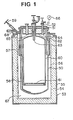
- Figure 1 illustrates an elevational view, in section, of an apparatus constructed according to the invention and suitably applicable to the method of the invention
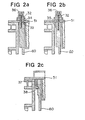
- Figure 2 schematically shows at (a) to (c) a detailed view of a few variations for connection between the inner vessel and the top lid.
- a substantially cylindrical inner vessel 60 which has a grid plate 61 detachably attached at the open bottom for receiving a downcoming solid product of titanium metal while allowing to pass such liquids as magnesium metal and magnesium chloride.
- the neck member is cut for separating and to be connected by welding for rejoining the inner vessel with the lid.
- the cooling jacket 57 and the grid plate 61 are arranged at a substantial vertical space therebetween.
- the inner vessel 60 in this example is joined with the lid 51 by means of several threaded bolts 32 run into a top portion having a rather thickened wall of the vessel as better seen in Figure 2 at (a) and (b), simultaneously with an auxiliary mechanical coupling, such as a circular tenon 33 to be mated with a circular groove 34 to fitly accommodate the former.
- an auxiliary mechanical coupling such as a circular tenon 33 to be mated with a circular groove 34 to fitly accommodate the former.
- a telescopic connection may also be employed which consists of a rather short cylindrical skirt or ring 35 attached to the lid as hanging therefrom and having such dimensions as to be fitly and closely connected with the vessel.
- the bolts preferably have a top end covered with respective cap nuts 36 which are advantageously water cooled.
- a so-called bayonet connection is also effective (given schematically in Figure 2 at (c), particularly), by which several hooked claws 37 attached to the lid, in a circular arrangement, are put into L-shaped slots 38 so formed as to mate with each claw at a top end of the vessel 60, and then the members 25, 60 are pushed close until they are in a close contact and slightly revolved relative to each other to a stop, thus providing a secured connection between the lid and the vessel. It is obvious here that a small modification may be effectively made, within the scope of the invention, to the above listed joints between the inner vessel and the lid.
- the lid 51 has a can 62, packed with a suitable heat insulative substance and, preferably, provided therein with a heating element (not shown) for preventing solidification of magnesium metal on a can surface which results in purity trouble on the metallic product.
- a tube 63 and tubes 64 and 65 with a pressure indicator 66, each arranged to extend through the lid 51 and into and outside the inner vessel 60, are used to feed titanium tetrachloride and to supply inert gas or to degas for evacuating the vessels 50, 60, respectively.
- a closed interspace 67 is formed between the outer vessel 50 and the furnace 53, airtightly sealed with a heat resistant packing ring provided between a flange portion 68 and the furnace 53, the space being pressure regulatable by means of a tube with a pressure indicator.
- a duct (not shown) also may be provided for supplying magnesium metal in fused state to the inner vessel 60 for an extended operation period.
- FIG. 1 An apparatus substantially illustrated in Figure 1 was used, which comprised a SUS 410 grade (byJIS Designation) inner vessel which measured 1.6 m in I.D. and 19 mm in wall thickness, and a SUS 316 grade stainless steel outer vessel which measured 4.5 m in general length, 1.7 m in I.D. and 32 mm in wall thickness and had a cylindrical jacket over a range of about 2 to 3 m from the bottom end of the inner vessel.
- a furnace was cylindrical and measured 2.5 m in O.D. and 5 m in length with an iron shell tightly covering thereover. Heating element was divisively regulatable at an upper section adjacent to the cooling jacket.
- the inner vessel as disassembled was charged with about 7.8 tons of magnesium as ingots, which is calculated to give a bath surface level of approximately 2.3 meters and 3 meters from the bottom of the inner and outer vessels, respectively.
- the vessel With the vessels assembled as set in the furnace, and with the interspace, between the outer vessel and the furnace, filled with argon gas, the vessel were heated to approximately 800°C to melt the magnesium contained therein, onto which titanium tetrachloride was introduced at a rate of 400 kg/h through a tube atop the vessels.
- On estimated magnesium level from a total amount of supplied chloride and from differential pressure between inside and outside the outer vessel liquid was tapped off from the vessels through a duct intermittently every three hours starting after initial six hours of chloride introduction.
Landscapes
- Chemical & Material Sciences (AREA)
- Organic Chemistry (AREA)
- Life Sciences & Earth Sciences (AREA)
- Environmental & Geological Engineering (AREA)
- General Life Sciences & Earth Sciences (AREA)
- Geology (AREA)
- Engineering & Computer Science (AREA)
- Chemical Kinetics & Catalysis (AREA)
- Mechanical Engineering (AREA)
- Metallurgy (AREA)
- Materials Engineering (AREA)
- Manufacturing & Machinery (AREA)
- Manufacture And Refinement Of Metals (AREA)
- Crystals, And After-Treatments Of Crystals (AREA)
- Inorganic Compounds Of Heavy Metals (AREA)
- Prostheses (AREA)
Claims (15)
Applications Claiming Priority (6)
| Application Number | Priority Date | Filing Date | Title |
|---|---|---|---|
| JP56050896A JPS605653B2 (ja) | 1981-04-04 | 1981-04-04 | 金属塩化物の還元方法 |
| JP50896/81 | 1981-04-04 | ||
| JP56074606A JPS5942060B2 (ja) | 1981-05-18 | 1981-05-18 | 金属Tiの製造方法 |
| JP74606/81 | 1981-05-18 | ||
| JP7746181A JPS57192234A (en) | 1981-05-22 | 1981-05-22 | Metallic titanium-making apparatus |
| JP77461/81 | 1981-05-22 |
Related Parent Applications (1)
| Application Number | Title | Priority Date | Filing Date |
|---|---|---|---|
| EP82850058.7 Division | 1982-03-22 |
Publications (2)
| Publication Number | Publication Date |
|---|---|
| EP0160779A1 EP0160779A1 (fr) | 1985-11-13 |
| EP0160779B1 true EP0160779B1 (fr) | 1988-10-19 |
Family
ID=27294121
Family Applications (2)
| Application Number | Title | Priority Date | Filing Date |
|---|---|---|---|
| EP85100932A Expired EP0160779B1 (fr) | 1981-04-04 | 1982-03-22 | Procédé et installation pour la production de titane à partir de tétrachlorure de titane |
| EP82850058A Expired EP0063552B1 (fr) | 1981-04-04 | 1982-03-22 | Procédé et installation pour la production de titane à partir de tétrachlorure de titane |
Family Applications After (1)
| Application Number | Title | Priority Date | Filing Date |
|---|---|---|---|
| EP82850058A Expired EP0063552B1 (fr) | 1981-04-04 | 1982-03-22 | Procédé et installation pour la production de titane à partir de tétrachlorure de titane |
Country Status (6)
| Country | Link |
|---|---|
| US (1) | US4441925A (fr) |
| EP (2) | EP0160779B1 (fr) |
| AU (3) | AU556835B2 (fr) |
| CA (1) | CA1179144A (fr) |
| DE (1) | DE3267510D1 (fr) |
| NO (1) | NO162121C (fr) |
Cited By (1)
| Publication number | Priority date | Publication date | Assignee | Title |
|---|---|---|---|---|
| DE102018128004A1 (de) * | 2018-11-08 | 2020-05-14 | Bayerische Motoren Werke Aktiengesellschaft | Achsträger eines Fahrzeugs mit einem Schubfeld |
Families Citing this family (37)
| Publication number | Priority date | Publication date | Assignee | Title |
|---|---|---|---|---|
| JPS57175701A (en) * | 1981-04-20 | 1982-10-28 | Hiroshi Ishizuka | Chlorination furnace and its operation |
| JPS58174530A (ja) * | 1982-04-06 | 1983-10-13 | Hiroshi Ishizuka | 金属塩化物から金属を得るための装置及び方法 |
| US4556420A (en) * | 1982-04-30 | 1985-12-03 | Westinghouse Electric Corp. | Process for combination metal reduction and distillation |
| CA1202183A (fr) * | 1982-05-31 | 1986-03-25 | Hiroshi Ishizuka | Dispositif et methode de production d'un metal refractaire affine a partir de son chlorure |
| FR2604184B1 (fr) * | 1986-09-19 | 1988-11-10 | Cezus Co Europ Zirconium | Procede et dispositif de fabrication de zirconium metal par reduction de tetrachlorure de zirconium |
| US4749409A (en) * | 1987-08-31 | 1988-06-07 | Hiroshi Ishizuka | Method of purifying refractory metal |
| JPH0747787B2 (ja) * | 1989-05-24 | 1995-05-24 | 株式会社エヌ・ケイ・アール | チタン粉末またはチタン複合粉末の製造方法 |
| US5460642A (en) * | 1994-03-21 | 1995-10-24 | Teledyne Industries, Inc. | Aerosol reduction process for metal halides |
| RU2119966C1 (ru) * | 1997-07-08 | 1998-10-10 | Анатолий Агафонович Путин | Реторта для получения губчатого титана белокопытова-путиных |
| RU2153017C1 (ru) * | 1999-09-15 | 2000-07-20 | Открытое акционерное общество "АВИСМА титано-магниевый комбинат" | Способ управления процессом вакуумной сепарации губчатого титана |
| US6523573B2 (en) * | 2000-07-13 | 2003-02-25 | Caldera Engineering, Lc | Flash tube device |
| JP3512738B2 (ja) * | 2000-12-19 | 2004-03-31 | Necマイクロシステム株式会社 | 丸め検出回路及び該丸め検出回路がシフト回路に接続されてなる複合回路 |
| RU2202638C2 (ru) * | 2001-06-20 | 2003-04-20 | Открытое акционерное общество "АВИСМА титано-магниевый комбинат" | Способ получения губчатого титана |
| RU2215052C1 (ru) * | 2002-03-21 | 2003-10-27 | Открытое акционерное общество "АВИСМА титано-магниевый комбинат" | Устройство для получения губчатого титана |
| RU2240371C1 (ru) * | 2003-07-08 | 2004-11-20 | Открытое акционерное общество "АВИСМА титано-магниевый комбинат" | Устройство для получения губчатого титана |
| RU2265071C1 (ru) * | 2004-05-06 | 2005-11-27 | Открытое акционерное общество "АВИСМА титано-магниевый комбинат" | Устройство для магниетермического получения губчатого титана |
| US8118939B2 (en) * | 2005-03-17 | 2012-02-21 | Noah Precision, Llc | Temperature control unit for bubblers |
| RU2311468C2 (ru) * | 2006-01-25 | 2007-11-27 | Открытое Акционерное Общество "Российский научно-исследовательский и проектный институт титана и магния" (ОАО "РИТМ") | Аппарат вакуумной сепарации губчатого титана |
| RU2310001C1 (ru) * | 2006-03-07 | 2007-11-10 | Открытое Акционерное Общество "Российский научно-исследовательский и проектный институт титана и магния" (ОАО "РИТМ") | Устройство для магниетермического получения губчатого титана |
| RU2313592C1 (ru) * | 2006-04-26 | 2007-12-27 | Открытое Акционерное Общество "Корпорация Всмпо-Ависма" | Способ получения губчатого титана и устройство для его осуществления |
| RU2390573C2 (ru) * | 2006-05-19 | 2010-05-27 | Открытое Акционерное Общество "Российский научно-исследовательский и проектный институт титана и магния" (ОАО "РИТМ") | Устройство магниетермического получения губчатого титана |
| RU2358028C1 (ru) * | 2007-12-24 | 2009-06-10 | Открытое Акционерное Общество "Российский научно-исследовательский и проектный институт титана и магния" (ОАО "РИТМ") | Устройство для магниетермического получения губчатого титана |
| CN101831562B (zh) * | 2009-03-12 | 2012-04-04 | 四川恒为制钛科技有限公司 | 海绵钛生产用双氯化镁管反应器及海绵钛的生产方法 |
| CN101948961B (zh) * | 2010-10-08 | 2011-11-30 | 洛阳双瑞万基钛业有限公司 | 一种用于制取海绵钛的反应器排氯化镁管制作方法 |
| EP2532717B1 (fr) | 2011-06-08 | 2015-07-01 | Rohm and Haas Company | Composé de réparation de paroi basé sur la microsphère |
| CN102537347B (zh) * | 2012-01-18 | 2013-01-02 | 深圳市新星轻合金材料股份有限公司 | 一种密封圈及其制备方法 |
| CN102560152B (zh) * | 2012-01-18 | 2014-03-26 | 深圳市新星轻合金材料股份有限公司 | 一种用于海绵钛生产的反应设备 |
| CN102534262A (zh) * | 2012-01-18 | 2012-07-04 | 深圳市新星轻合金材料股份有限公司 | 一种用于生产海绵钛的蒸馏设备 |
| DE102012015045A1 (de) | 2012-07-31 | 2014-02-06 | Dockweiler Ag | Vorrichtung zum Temperieren eines Gefäßes in einer Kammer |
| RU2586187C1 (ru) * | 2014-12-25 | 2016-06-10 | Публичное Акционерное Общество "Корпорация Всмпо-Ависма" | Способ получения губчатого титана |
| RU2596555C2 (ru) * | 2015-01-12 | 2016-09-10 | Публичное Акционерное Общество "Корпорация Всмпо-Ависма" | Система для контроля процесса вакуумной сепарации губчатого титана в аппаратах сепарации, разогреваемых в электропечах |
| RU2599071C1 (ru) * | 2015-06-22 | 2016-10-10 | Публичное Акционерное Общество "Корпорация Всмпо-Ависма" | Способ получения губчатого титана |
| CN106916970B (zh) * | 2017-01-19 | 2019-02-19 | 贵州大学 | 散热型镁热法制备海绵钛的散热分析系统及散热分析方法 |
| RU2743208C1 (ru) * | 2020-04-28 | 2021-02-16 | Публичное Акционерное Общество "Корпорация Всмпо-Ависма" | Способ контроля подачи тетрахлорида титана в аппарат восстановления при магниетермическом восстановлении титана |
| CN112520773B (zh) * | 2020-11-19 | 2023-08-01 | 衡阳鸿宇化工有限责任公司 | 一种气密性好的三氯化铝反应炉及其使用方法 |
| CN113035748B (zh) * | 2021-02-27 | 2022-03-11 | 楚赟精工科技(上海)有限公司 | 真空腔室及其压力控制方法以及半导体处理设备 |
| WO2024072486A2 (fr) * | 2022-04-29 | 2024-04-04 | Stoke Space Technologies, Inc. | Coque incurvée à paroi mince formée à partir d'une préforme multi-conique, et ses procédés de fabrication |
Family Cites Families (23)
| Publication number | Priority date | Publication date | Assignee | Title |
|---|---|---|---|---|
| US2205854A (en) * | 1937-07-10 | 1940-06-25 | Kroll Wilhelm | Method for manufacturing titanium and alloys thereof |
| US2586134A (en) * | 1948-12-24 | 1952-02-19 | Du Pont | Production of metals |
| US2607674A (en) * | 1949-05-25 | 1952-08-19 | Du Pont | Production of metals |
| US2763480A (en) * | 1950-07-28 | 1956-09-18 | Nat Lead Co | Apparatus for producing refractory metals |
| US2782118A (en) * | 1952-02-19 | 1957-02-19 | Monsanto Chemicals | Production of refractory metals |
| US2847297A (en) * | 1952-08-23 | 1958-08-12 | Nat Res Corp | Method of producing titanium crystals |
| US2787539A (en) * | 1952-10-30 | 1957-04-02 | Du Pont | Production of refractory metals |
| US2882143A (en) * | 1953-04-16 | 1959-04-14 | Nat Lead Co | Continuous process for the production of titanium metal |
| US3158671A (en) * | 1954-08-12 | 1964-11-24 | Montedison Spa | Apparatus for producing titanium sponge |
| DE1084923B (de) * | 1954-10-15 | 1960-07-07 | Hiroshi Ishizuka | Vorrichtung zur Herstellung von Titanschwamm |
| US2865738A (en) * | 1955-08-17 | 1958-12-23 | Nat Distillers Chem Corp | Process of preparation of titanium |
| US2816828A (en) * | 1956-06-20 | 1957-12-17 | Nat Res Corp | Method of producing refractory metals |
| US2942969A (en) * | 1956-07-19 | 1960-06-28 | Nat Lead Co | Method for producing zirconium metal |
| CH353341A (de) * | 1957-04-29 | 1961-04-15 | Ciba Geigy | Autoklav |
| DE1796728U (de) * | 1957-10-15 | 1959-10-01 | Werner Dr Herdieckerhoff | Ofen zum haerten, schmelzen od. dgl. |
| CA934168A (en) * | 1970-01-08 | 1973-09-25 | Ishizuka Hiroshi | Method for reducing chlorides and device therefor |
| US3684264A (en) * | 1971-01-06 | 1972-08-15 | Vasily Ivanovich Petrov | Apparatus for reduction of titanium halides and subsequent vacuum separation of reduction products |
| US3692294A (en) * | 1971-02-16 | 1972-09-19 | Nippon Mining Co | Apparatus for production of zirconium metal |
| US3966460A (en) * | 1974-09-06 | 1976-06-29 | Amax Specialty Metal Corporation | Reduction of metal halides |
| JPS585252B2 (ja) * | 1975-02-13 | 1983-01-29 | ニホンコウギヨウ カブシキガイシヤ | ジルコニウムスポンジルイノ セイゾウホウホウ オヨビ ソノソウチ |
| DE2755299A1 (de) * | 1976-12-20 | 1978-06-22 | Asea Ab | Zylinderfoermiger langgestreckter ofen zur behandlung von material unter hoher temperatur und hohem druck |
| US4242136A (en) * | 1979-04-10 | 1980-12-30 | Hiroshi Ishizuka | Process for producing metallic zirconium |
| US4285724A (en) * | 1979-11-15 | 1981-08-25 | Aluminum Company Of America | Continuous production of finely divided zirconium powder |
-
1982
- 1982-03-19 US US06/360,054 patent/US4441925A/en not_active Expired - Fee Related
- 1982-03-19 CA CA000398835A patent/CA1179144A/fr not_active Expired
- 1982-03-22 AU AU81766/82A patent/AU556835B2/en not_active Ceased
- 1982-03-22 DE DE8282850058T patent/DE3267510D1/de not_active Expired
- 1982-03-22 EP EP85100932A patent/EP0160779B1/fr not_active Expired
- 1982-03-22 EP EP82850058A patent/EP0063552B1/fr not_active Expired
- 1982-04-02 NO NO821128A patent/NO162121C/no unknown
-
1986
- 1986-09-24 AU AU63127/86A patent/AU579490B2/en not_active Ceased
- 1986-09-24 AU AU63126/86A patent/AU578376B2/en not_active Ceased
Cited By (1)
| Publication number | Priority date | Publication date | Assignee | Title |
|---|---|---|---|---|
| DE102018128004A1 (de) * | 2018-11-08 | 2020-05-14 | Bayerische Motoren Werke Aktiengesellschaft | Achsträger eines Fahrzeugs mit einem Schubfeld |
Also Published As
| Publication number | Publication date |
|---|---|
| AU6312786A (en) | 1987-01-08 |
| DE3267510D1 (en) | 1986-01-02 |
| EP0063552A1 (fr) | 1982-10-27 |
| US4441925A (en) | 1984-04-10 |
| CA1179144A (fr) | 1984-12-11 |
| AU556835B2 (en) | 1986-11-20 |
| AU8176682A (en) | 1982-10-14 |
| NO821128L (no) | 1982-10-05 |
| AU579490B2 (en) | 1988-11-24 |
| AU578376B2 (en) | 1988-10-20 |
| NO162121B (no) | 1989-07-31 |
| NO162121C (no) | 1989-11-08 |
| EP0063552B1 (fr) | 1985-11-21 |
| AU6312686A (en) | 1987-01-08 |
| EP0160779A1 (fr) | 1985-11-13 |
Similar Documents
| Publication | Publication Date | Title |
|---|---|---|
| EP0063552B1 (fr) | Procédé et installation pour la production de titane à partir de tétrachlorure de titane | |
| EP0097135B1 (fr) | Installation et procédé pour la production de métaux réfractaires à partir de leurs chlorures | |
| US4902341A (en) | Method for producing titanium alloy | |
| JPH059497B2 (fr) | ||
| US4527778A (en) | Apparatus for production of refractory metal from a chloride thereof | |
| CA1328561C (fr) | Methode pour la preparation de titane metallique et appareillage a cette fin | |
| US3158671A (en) | Apparatus for producing titanium sponge | |
| JPS6112838A (ja) | スポンジチタン製造装置 | |
| CA1186901A (fr) | Methode de production du titane metallique a partir du tetrachlorure de titane | |
| JPS58217647A (ja) | 還元蒸留炉 | |
| JPS5942060B2 (ja) | 金属Tiの製造方法 | |
| US1839756A (en) | Method of electrolysis of fused bath and apparatus therefor | |
| JPH0255491B2 (fr) | ||
| JPS5934218B2 (ja) | 金属チタニウム製造装置 | |
| JP3567209B2 (ja) | スポンジチタン還元炉の冷却方法 | |
| JPH059498B2 (fr) | ||
| JPH0255490B2 (fr) | ||
| US3269830A (en) | Production of niobium from niobium pentachloride | |
| JP2021091941A (ja) | コンテナ、コンテナの使用方法、スポンジチタンの製造方法、及び溶融マグネシウムの製造方法 | |
| US4744545A (en) | Apparatus for degassing molten metal | |
| JPS6137338B2 (fr) | ||
| EP0592231A1 (fr) | Appareil pour la production d'uranium | |
| JPS605653B2 (ja) | 金属塩化物の還元方法 | |
| JPS6112836A (ja) | スポンジチタンの製造法 | |
| JP4441278B2 (ja) | 金属チタンの製造装置 |
Legal Events
| Date | Code | Title | Description |
|---|---|---|---|
| PUAI | Public reference made under article 153(3) epc to a published international application that has entered the european phase |
Free format text: ORIGINAL CODE: 0009012 |
|
| AC | Divisional application: reference to earlier application |
Ref document number: 63552 Country of ref document: EP |
|
| AK | Designated contracting states |
Designated state(s): DE FR GB SE |
|
| 17P | Request for examination filed |
Effective date: 19860228 |
|
| 17Q | First examination report despatched |
Effective date: 19870410 |
|
| GRAA | (expected) grant |
Free format text: ORIGINAL CODE: 0009210 |
|
| AC | Divisional application: reference to earlier application |
Ref document number: 63552 Country of ref document: EP |
|
| AK | Designated contracting states |
Kind code of ref document: B1 Designated state(s): DE FR GB SE |
|
| REF | Corresponds to: |
Ref document number: 3279125 Country of ref document: DE Date of ref document: 19881124 |
|
| EN | Fr: translation not filed | ||
| PLBE | No opposition filed within time limit |
Free format text: ORIGINAL CODE: 0009261 |
|
| STAA | Information on the status of an ep patent application or granted ep patent |
Free format text: STATUS: NO OPPOSITION FILED WITHIN TIME LIMIT |
|
| 26N | No opposition filed | ||
| PG25 | Lapsed in a contracting state [announced via postgrant information from national office to epo] |
Ref country code: FR Free format text: LAPSE BECAUSE OF NON-PAYMENT OF DUE FEES Effective date: 19891130 |
|
| REG | Reference to a national code |
Ref country code: FR Ref legal event code: ST |
|
| PGFP | Annual fee paid to national office [announced via postgrant information from national office to epo] |
Ref country code: FR Payment date: 19910326 Year of fee payment: 10 |
|
| PGFP | Annual fee paid to national office [announced via postgrant information from national office to epo] |
Ref country code: DE Payment date: 19920530 Year of fee payment: 11 |
|
| PG25 | Lapsed in a contracting state [announced via postgrant information from national office to epo] |
Ref country code: DE Effective date: 19931201 |
|
| PGFP | Annual fee paid to national office [announced via postgrant information from national office to epo] |
Ref country code: GB Payment date: 19940214 Year of fee payment: 13 |
|
| PGFP | Annual fee paid to national office [announced via postgrant information from national office to epo] |
Ref country code: SE Payment date: 19940224 Year of fee payment: 13 |
|
| EAL | Se: european patent in force in sweden |
Ref document number: 85100932.4 |
|
| PG25 | Lapsed in a contracting state [announced via postgrant information from national office to epo] |
Ref country code: GB Effective date: 19950322 |
|
| PG25 | Lapsed in a contracting state [announced via postgrant information from national office to epo] |
Ref country code: SE Effective date: 19950323 |
|
| GBPC | Gb: european patent ceased through non-payment of renewal fee |
Effective date: 19950322 |
|
| EUG | Se: european patent has lapsed |
Ref document number: 85100932.4 |