EP0160915A2 - Schmelzbare, elektrisch leitfähige TCNQ-Komplexe - Google Patents
Schmelzbare, elektrisch leitfähige TCNQ-Komplexe Download PDFInfo
- Publication number
- EP0160915A2 EP0160915A2 EP85105197A EP85105197A EP0160915A2 EP 0160915 A2 EP0160915 A2 EP 0160915A2 EP 85105197 A EP85105197 A EP 85105197A EP 85105197 A EP85105197 A EP 85105197A EP 0160915 A2 EP0160915 A2 EP 0160915A2
- Authority
- EP
- European Patent Office
- Prior art keywords
- tcnq
- atoms
- optionally substituted
- radical
- complexes
- Prior art date
- Legal status (The legal status is an assumption and is not a legal conclusion. Google has not performed a legal analysis and makes no representation as to the accuracy of the status listed.)
- Withdrawn
Links
- PUAGWDROEJOYQL-UHFFFAOYSA-N N#CC(C(C=C1)C=CC1C#N)C#N Chemical compound N#CC(C(C=C1)C=CC1C#N)C#N PUAGWDROEJOYQL-UHFFFAOYSA-N 0.000 description 1
Classifications
-
- C—CHEMISTRY; METALLURGY
- C07—ORGANIC CHEMISTRY
- C07C—ACYCLIC OR CARBOCYCLIC COMPOUNDS
- C07C255/00—Carboxylic acid nitriles
-
- C—CHEMISTRY; METALLURGY
- C07—ORGANIC CHEMISTRY
- C07F—ACYCLIC, CARBOCYCLIC OR HETEROCYCLIC COMPOUNDS CONTAINING ELEMENTS OTHER THAN CARBON, HYDROGEN, HALOGEN, OXYGEN, NITROGEN, SULFUR, SELENIUM OR TELLURIUM
- C07F9/00—Compounds containing elements of Groups 5 or 15 of the Periodic Table
- C07F9/02—Phosphorus compounds
- C07F9/28—Phosphorus compounds with one or more P—C bonds
- C07F9/54—Quaternary phosphonium compounds
- C07F9/5442—Aromatic phosphonium compounds (P-C aromatic linkage)
-
- H—ELECTRICITY
- H01—ELECTRIC ELEMENTS
- H01B—CABLES; CONDUCTORS; INSULATORS; SELECTION OF MATERIALS FOR THEIR CONDUCTIVE, INSULATING OR DIELECTRIC PROPERTIES
- H01B1/00—Conductors or conductive bodies characterised by the conductive materials; Selection of materials as conductors
- H01B1/06—Conductors or conductive bodies characterised by the conductive materials; Selection of materials as conductors mainly consisting of other non-metallic substances
- H01B1/12—Conductors or conductive bodies characterised by the conductive materials; Selection of materials as conductors mainly consisting of other non-metallic substances organic substances
- H01B1/121—Charge-transfer complexes
-
- H—ELECTRICITY
- H05—ELECTRIC TECHNIQUES NOT OTHERWISE PROVIDED FOR
- H05K—PRINTED CIRCUITS; CASINGS OR CONSTRUCTIONAL DETAILS OF ELECTRIC APPARATUS; MANUFACTURE OF ASSEMBLAGES OF ELECTRICAL COMPONENTS
- H05K1/00—Printed circuits
- H05K1/02—Details
- H05K1/09—Use of materials for the conductive, e.g. metallic pattern
-
- H—ELECTRICITY
- H05—ELECTRIC TECHNIQUES NOT OTHERWISE PROVIDED FOR
- H05K—PRINTED CIRCUITS; CASINGS OR CONSTRUCTIONAL DETAILS OF ELECTRIC APPARATUS; MANUFACTURE OF ASSEMBLAGES OF ELECTRICAL COMPONENTS
- H05K2201/00—Indexing scheme relating to printed circuits covered by H05K1/00
- H05K2201/03—Conductive materials
- H05K2201/032—Materials
- H05K2201/0329—Intrinsically conductive polymer [ICP]; Semiconductive polymer
Definitions
- TCNQ a TCNQ molecule is reduced by iodide to the TCNQ radical anion with the release of iodine.
- Another method consists in the reaction of nitrogen-containing heteroaromatics or tertiary amines with "H 2 TCNQ" (cf. Reactor II) and TCNQ, for example in accordance with
- R 1 , R 2 , R 3 are given by formula: The following are examples of R 4 :
- the complexes according to the invention can advantageously be prepared by reacting solutions of organic phosphonium iodides with a solution of TCNQ in organic solvents at temperatures below 150 ° C., preferably from 50-150 ° C.
- Suitable phosphonium iodides correspond to the formula wherein R to R 4 have the meaning already mentioned.
- Suitable phosphonium iodides are triphenylmethylphosphonium iodide, triphenylethylphosphonium iodide, triphenylbutylphosphonium iodide, triphenyloctylphosphonium iodide.
- Suitable organic solvents are e.g. Halogenated hydrocarbons, e.g. Methylene chloride, chloroform, carbon tetrachloride, 1,2-dichloroethane, 1,1,2-trichloroethane; Acetonitrile; Alcohols, e.g. Methanol, ethanol, isopropanol; aliphatic ketones, e.g. Acetone, methyl ethyl ketone; acyclic and cyclic ethers, e.g. Diethyl ether, tetrahydrofuran. Solvents with a low boiling point (below 100 ° C.) are preferred in order to avoid thermal damage to the complex formed.
- Halogenated hydrocarbons e.g. Methylene chloride, chloroform, carbon tetrachloride, 1,2-dichloroethane, 1,1,2-trichloroethane
- Acetonitrile Alcohols, e.g. Methanol, ethanol, isoprop
- the reactants are preferably used in a ratio of 1 mol of TCNQ to 0.5 to 1.5 mol of phosphonium iodide.
- the compounds of formula 1 can be used to produce electrically conductive coatings on substrates by melting.
- TCNQ complexes which contain at least one compound of the formula I can also advantageously be processed from the melt to form conductive coatings.
- These coatings can optionally also contain stabilizing, adhesion-improving or coloring additives.
- Suitable substrates include: glass, metals, metal oxides, organic polymers.
- the substrates can be coated in such a way that the substrates are heated to temperatures above the melting point of the TCNQ complexes of the formula I and then the TCNQ complexes are sprinkled on.
- the melting of the TCNQ complexes can also under protective gases such as Hydrogen, nitrogen, argon or helium or in a vacuum.
- the procedure is such that the TCNQ complexes of the formula I are applied to the substrates to be coated at room temperature and then melted in a preheated oven.
- the coatings produced in this way are used in the electronics industry.
- the melting or decomposition points were determined by means of differential scanning calorimetry. The temperatures of the maxima of the endothermic melting or exothermic decomposition phase are given.
- the complexes were heated in glass vessels for the specified time to the specified temperature and then cooled to room temperature.
- the conductivity of the pure complexes ⁇ ° before and after heating was determined by means of two-electrode measurement.
- a glass plate was heated to 320 ° C in an oven.
- An approximately 0.5 mm thick layer of the complex according to Example 1 was then sprinkled on.
- the complex melts and forms a hard, coherent, electrically conductive coating after cooling.
- Example 6 The procedure was as in Example 6, using the complexes according to Examples 2-5 and changing the temperatures: In all cases, electrically conductive coatings were obtained.
Landscapes
- Chemical & Material Sciences (AREA)
- Organic Chemistry (AREA)
- Biochemistry (AREA)
- Health & Medical Sciences (AREA)
- General Health & Medical Sciences (AREA)
- Molecular Biology (AREA)
- Life Sciences & Earth Sciences (AREA)
- Physics & Mathematics (AREA)
- Spectroscopy & Molecular Physics (AREA)
- Engineering & Computer Science (AREA)
- Microelectronics & Electronic Packaging (AREA)
- Organic Low-Molecular-Weight Compounds And Preparation Thereof (AREA)
- Conductive Materials (AREA)
Abstract
Description
- Komplexsalze aus dem 7.7.8.8-Tetracyano-p-chinodimethananion (TCNQ);


- Hierbei wird ein TCNQ-Molekül durch Jodid zum TCNQ Radikal-Anion unter Freisetzung von Jod reduziert. Ein anderes Verfahren besteht in der Umsetzung von stickstoffhaltigen Heteroaromaten oder tertiären Aminen mit "H2TCNQ" (vgl. Reaktionsnehmer II) und TCNQ, z.B. gemäß
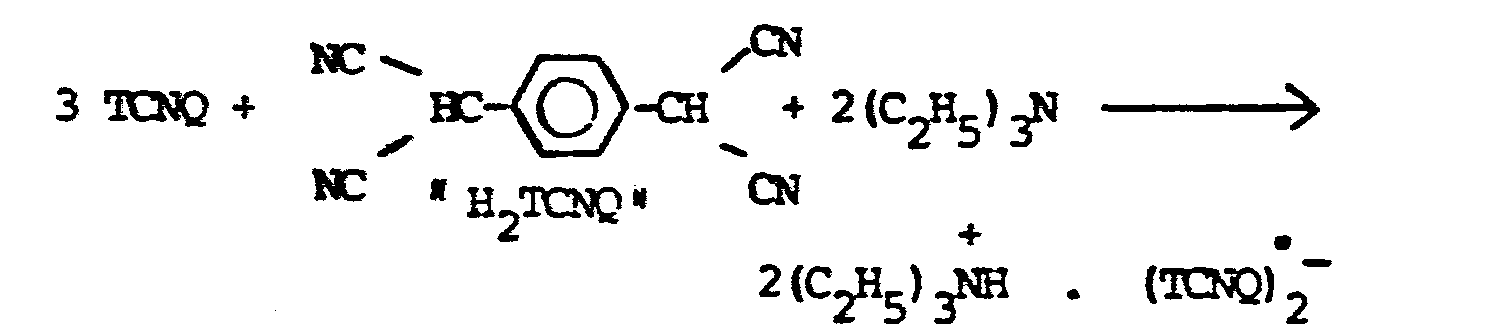
- Die Verarbeitung dieser Komplexe bei Temperaturen oberhalb ihres Schmelzpunktes bereitet Schwierigkeiten, da die bisher bekannten Verbindungen sich bereits am Schmelzpunkt oder wenig oberhalb des Schmelzpunktes zersetzen (s. Tab. 1).
- Es wurde gefunden, daß Komplexe aus TCNQ und organischen Phosphoniumionen längere Zeit im geschmolzenen Zustand gehalten werden können, ohne daß ihre elektrische Leitfähigkeit nach dem Erkalten wesentlich vermindert ist.
- Gegenstand der Erfindung sind daher TCNQ-Komplexe der allgemeinen Formel I

- n 2, 1 oder 0 (bevorzugt 1 oder 0) bedeutet,
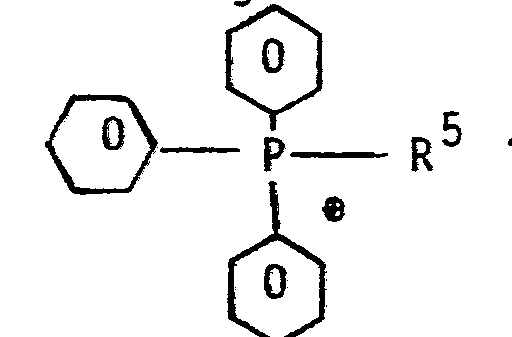
- R 1, R2, R 3, gleich oder verschieden,für einen gegebenenfalls substituierten geradkettigen oder verzweigten Alkylrest mit 1 bis 30 C-Atomen, einen gegebenenfalls substituierten Cycloalkylrest mit 5 bis 12 C-Atomen, einen gegebenenfalls substituierten Arylrest mit 6 bis 14 C-Atomen oder einen heterocyclischen Rest mit 4 bis 12 C-Atomen stehen und
- R4 einen gegebenenfalls substituierten geradkettigen oder verzweigten Alkylrest mit 3 bis 30 C-Atomen, einen gegebenenfalls substituierten Cycloalkylrest mit 5 bis 12 C-Atomen, einen gegebenenfalls substituierten Arylrest mit 6 bis 14 C-Atomen oder einen heterocyclischen Rest mit 4 bis 12 C-Atomen bedeutet.
- Bevorzugt sind Verbindungen der Formel I, in denen R1=R2=R3=Aryl, insbesondere Phenyl, und R4= C3 bis C24-Alkyl ist.
- Als Beispiele für R1, R2, R3 seien formelmäßig angegeben:


- Besonders bevorzugt sind Verbindungen der Formel I, in denen R1 = R2 = R3 = Phenyl und R4 = C3 bis C12-Alkyl ist, da diese Verbindungen niedrige Schmelzpunkte bei hohen Zersetzungstemperaturen aufweisen.
- Besonders bevorzugt sind somit TCNQ-Komplexsalze der Formel
- Die erfindungsgemäßen Komplexe können vorteilhaft durch Umsetzung von Lösungen organischer Phosphoniumjodide mit einer Lösung von TCNQ in organischen Lösungsmitteln bei Temperaturen unterhalb 150°C, bevorzugt von 50 - 150°C, hergestellt werden.
- Geeignete Phosphoniumjodide entsprechen der Formel

- Beispiele für geeignete Phosphoniumjodide sind Triphenylmethylphosphoniumjodid, Triphenylethylphosphoniumjodid, Triphenylbutylphosphoniumjodid, Triphenyloctylphosphoniumjodid.
- Geeignete organische Lösungsmittel sind z.B. Halogenkohlenwasserstoffe, z.B. Methylenchlorid, Chloroform, Tetrachlorkohlenstoff, 1,2-Dichlorethan, 1,1,2-Trichlorethan; Acetonitril; Alkohole, z.B. Methanol, Ethanol, Isopropanol; aliphatische Ketone, z.B. Aceton, Methylethylketon; acyclische und cyclische Ether, z.B. Diethylether, Tetrahydrofuran. Bevorzugt sind hierbei Lösungsmittel mit niedrigem Siedepunkt (unter 100°C), um eine thermische Schädigung des gebildeten Komplexes zu vermeiden.
- Die Reaktionspartner werden bevorzugt im Verhältnis 1 Mol TCNQ zu 0,5 bis 1,5 Mol Phosphoniumjodid eingesetzt.
- Aufgrund ihres günstigen Schmelz- und Zersetzungsverhaltens können die Verbindungen der Formel 1 zur Herstellung elektrisch leitender Überzüge auf Substraten durch Aufschmelzen verwendet werden.
- In vorteilhafter Weise können auch Gemische verschiedener TCNQ-Komplexe, die mindestens eine Verbindung der Formel I enthalten, aus der Schmelze zu leitenden Überzügen verarbeitet werden. Diese Überzüge können gegebenenfalls auch stabilisierende, die Haftung verbessernde bzw. farbgebende Zusätze enthalten.
- Als geeignete Substrate seien genannt: Glas, Metalle, Metalloxide, organische Polymere.
- Das Beschichten der Substrate kann in der Weise erfolgen, daß die Substrate auf Temperaturen oberhalb des Schmelzpunktes der TCNQ-Komplexe der Formel I aufgeheizt werden und anschließend die TCNQ Komplexe aufgestreut werden.
- Das Aufschmelzen der TCNQ-Komplexe kann auch unter Schutzgasen wie z.B. Wasserstoff, Stickstoff, Argon oder Helium bzw. im Vakuum durchgeführt werden.
- Bei einem anderen Verfahren geht man so vor, daß die TCNQ-Komplexe der Formel I bei Raumtemperatur auf die zu beschichtenden Substrate aufgebracht und anschließend in einem vorgeheizten Ofen aufgeschmolzen werden.
- Beide Verfahren führen zu elektrisch leitfähigen, gut haftenden Überzügen.
- Die so hergestellten Überzüge finden Verwendung in der Elektronikindustrie.
- 20,4 g TCNQ in 1.000 ml Acetonitril werden bei Rückfluß mit einer 70°C heißen Lösung aus 35 g Triphenylmethylphosphoniumjodid in 400 ml Acetonitril versetzt und 1 Stunde bei 50°C gerührt. Anschließend wird abgekühlt und der über Nacht auskristallisierte Niederschlag abgesaugt und getrocknet. Ausb.: 31,8 g93 % d.Th. Komplex der Zusammensetzung:

-

- Wie in Beispiel 1 beschrieben, werden 4,1 g TCNQ in 120 ml Acetonitril und 7,0 g Triphenylethylphosphoniumjodid in 100 ml Acetonitril zur Reaktion gebracht und aufgearbeitet. Ausb.: 6,1 g = 87 % d.Th. Komplex der Zusammensetzung:

- Wie in Beispiel 1 beschrieben, werden 4,1 g TCNQ in 300 ml Acetonitril und 6,5 g 2-Propyl-triphenylphosphoniumjodid zur Reaktion gebracht und aufgearbeitet. Ausbeute: 6,4 g90 % d.Th. Komplex der Zusammensetzung:


- Wie in Beispiel 1 beschrieben, werden 4,1 g TCNQ in 300 ml Acetonitril und 6,7 g n-Butyl-triphenylphosphoniumjodid in 100 ml Acetonitril zur Reaktion gebracht und aufgearbeitet. Ausbeute: 5,9 g81 % d.Th. Komplex der Zusammensetzung:


- Wie in Beispiel 1 beschrieben, werden 4,1 g TCNQ in 300 ml Acetonitril und 10,0 g n-Octyl-triphenylphosphoniumjodid in 100 ml Acetonitril zur Reaktion gebracht und aufgearbeitet. Ausbeute: 6,1 g 2 78 % d.Th. Komplex der Zusammensetzung:

- Schmelz- und Zersetzungspunkte der Verbindungen gemäß Beispiel 1 bis 5 siehe Tabelle 1.

- Die Schmelz- bzw. Zersetzungspunkte wurden mittels Differential-Scanning-Calorimetrie ermittelt. Angegeben sind die Temperaturen der Maxima der endothermen Schmelz- bzw. exothermen Zersetzungsphase.
- Die thermische Stabilität der erfindungsgemäßen Komplexe ist aus Tabelle 2 ersichtlich.
- Die Komplexe wurden in Glasgefäßen für die angegebene Zeit auf die angegebene Temperatur erhitzt und anschliessend auf Raumtemperatur abgekühlt. Die Leitfähigkeit der reinen Komplexe δ° vor bzw. nach dem Erhitzen wurde mittels Zweielektrodenmessung bestimmt.

- Eine Glasplatte wurde in einem Ofen auf 320°C aufgeheizt. Anschließend wurde eine ca. 0.5 mm dicke Schicht des Komplexes nach Beispiel 1 aufgestreut. Der Komplex schmilzt hierbei und bildet nach dem Abkühlen einen harten, zusammenhängenden, elektrisch leitfähigen Überzug.
- Es wurde wie in Beispiel 6 vorgegangen unter Verwendung der Komplexe nach Beispiel 2 - 5 und unter Veränderung der Temperaturen:

- Auf Glasplatten wurden ca. 0,5 mm dicke Schichten der Komplexe 1 - 5 aufgestreut und anschließend im Warmluftofen bei der angegebenen Temperatur aufgeschmolzen (Dauer 4 bis 6 Minuten)

- In allen Fällen wurden elektrisch leitfähige Überzüge erhalten.
Claims (3)


Applications Claiming Priority (2)
| Application Number | Priority Date | Filing Date | Title |
|---|---|---|---|
| DE3417466 | 1984-05-11 | ||
| DE19843417466 DE3417466A1 (de) | 1984-05-11 | 1984-05-11 | Schmelzbare, elektrisch leitfaehige tcnq-komplexe |
Publications (2)
| Publication Number | Publication Date |
|---|---|
| EP0160915A2 true EP0160915A2 (de) | 1985-11-13 |
| EP0160915A3 EP0160915A3 (de) | 1986-03-26 |
Family
ID=6235552
Family Applications (1)
| Application Number | Title | Priority Date | Filing Date |
|---|---|---|---|
| EP85105197A Withdrawn EP0160915A3 (de) | 1984-05-11 | 1985-04-29 | Schmelzbare, elektrisch leitfähige TCNQ-Komplexe |
Country Status (3)
| Country | Link |
|---|---|
| EP (1) | EP0160915A3 (de) |
| JP (1) | JPS60239493A (de) |
| DE (1) | DE3417466A1 (de) |
Cited By (2)
| Publication number | Priority date | Publication date | Assignee | Title |
|---|---|---|---|---|
| EP0261380A1 (de) * | 1986-08-26 | 1988-03-30 | Bayer Ag | Schmelzbare, elektrisch leitfähige TCNQ-Komplexe, Verfahren zu ihrer Herstellung und ihre Verwendung |
| EP0355644A3 (de) * | 1988-08-25 | 1990-07-11 | Bayer Ag | Verfahren zur Erzeugung elektrisch leitender Schichten auf Substraten und in dem Verfahren zu verwendende Druckpasten |
Family Cites Families (1)
| Publication number | Priority date | Publication date | Assignee | Title |
|---|---|---|---|---|
| DE3335589A1 (de) * | 1983-09-30 | 1985-04-18 | Bayer Ag, 5090 Leverkusen | Verfahren zur herstellung von tcnq-komplexen |
-
1984
- 1984-05-11 DE DE19843417466 patent/DE3417466A1/de not_active Withdrawn
-
1985
- 1985-04-29 EP EP85105197A patent/EP0160915A3/de not_active Withdrawn
- 1985-05-08 JP JP9618085A patent/JPS60239493A/ja active Pending
Cited By (2)
| Publication number | Priority date | Publication date | Assignee | Title |
|---|---|---|---|---|
| EP0261380A1 (de) * | 1986-08-26 | 1988-03-30 | Bayer Ag | Schmelzbare, elektrisch leitfähige TCNQ-Komplexe, Verfahren zu ihrer Herstellung und ihre Verwendung |
| EP0355644A3 (de) * | 1988-08-25 | 1990-07-11 | Bayer Ag | Verfahren zur Erzeugung elektrisch leitender Schichten auf Substraten und in dem Verfahren zu verwendende Druckpasten |
Also Published As
| Publication number | Publication date |
|---|---|
| DE3417466A1 (de) | 1985-11-14 |
| JPS60239493A (ja) | 1985-11-28 |
| EP0160915A3 (de) | 1986-03-26 |
Similar Documents
| Publication | Publication Date | Title |
|---|---|---|
| DE69131636T2 (de) | (6,7-substituierte-8-Alkoxy-1-cyclopropyl-1,4-dihydro-4-oxo-3-chinolinkarbonsäure-03,04)-bis(acyloxy-0)-Borate und ihre Salze sowie Methoden zu ihrer Herstellung | |
| DE2065236C3 (de) | Phosphonsäuresalze, ihre Herstellung und Verwendung | |
| DE2344332B2 (de) | Verfahren zur Herstellung von Vinylphosphinsa'uren | |
| EP0194543B1 (de) | Schmelzbare, elektrisch leitfähige TCNQ-Komplexe | |
| EP0073379B1 (de) | Neue Komplexsalze mit hoher elektrischer Leitfähigkeit | |
| EP0160915A2 (de) | Schmelzbare, elektrisch leitfähige TCNQ-Komplexe | |
| EP0261380B1 (de) | Schmelzbare, elektrisch leitfähige TCNQ-Komplexe, Verfahren zu ihrer Herstellung und ihre Verwendung | |
| DE2739584A1 (de) | Derivate von schwefel- und/oder selenhaltigen heterofulvalenen und verfahren zu ihrer herstellung | |
| EP0138093A2 (de) | Verfahren zur Herstellung von TCNQ-Komplexen | |
| DE2212604A1 (de) | Verfahren zur Herstellung von 2-Halogenaethylphosphonsaeuren | |
| DE3504732C2 (de) | ||
| EP0183977B1 (de) | Schmelzbare, elektrisch leitfähige Mischungen | |
| EP0116169A2 (de) | Verfahren zur Herstellung wasserfreier, fluorhaltiger 1,3-Diketonato-Metall-Komplexe | |
| DE2226774B2 (de) | Verfahren zur Herstellung von Distannanen der Formel R3 Sn-Sn R3 | |
| DE2517292B2 (de) | Verfahren zur herstellung von reinem galliumoxid | |
| DE2002629A1 (de) | Verfahren zur Herstellung von Thiono- oder Dithiophosphonsaeureestern | |
| DE2720911C3 (de) | Verfahren zur Herstellung von n-Hexyl-Carboran | |
| DE2407015B2 (de) | Dihalogen-bis(2-pyridylthio)-Zinn (IV)-Verbindungen und Verfahren zu deren Herstellung | |
| DE69220952T2 (de) | VERFAHREN ZUR HERSTELLUNG VON Mo4S4L6 | |
| EP0297037A1 (de) | Poly(arylensulfide) | |
| DE102005017269A1 (de) | Ionische Flüssigkeit | |
| DE3802170C2 (de) | ||
| EP0015503A1 (de) | Verfahren zur Herstellung von Diazinon | |
| DE3607668A1 (de) | Schmelzbare, elektrisch leitfaehige mischungen | |
| DE3203538A1 (de) | 4-pyrazolylphosphite und verfahren zu ihrer herstellung |
Legal Events
| Date | Code | Title | Description |
|---|---|---|---|
| PUAI | Public reference made under article 153(3) epc to a published international application that has entered the european phase |
Free format text: ORIGINAL CODE: 0009012 |
|
| 17P | Request for examination filed |
Effective date: 19850429 |
|
| AK | Designated contracting states |
Designated state(s): CH DE FR GB IT LI NL |
|
| PUAL | Search report despatched |
Free format text: ORIGINAL CODE: 0009013 |
|
| AK | Designated contracting states |
Kind code of ref document: A3 Designated state(s): CH DE FR GB IT LI NL |
|
| STAA | Information on the status of an ep patent application or granted ep patent |
Free format text: STATUS: THE APPLICATION HAS BEEN WITHDRAWN |
|
| 18W | Application withdrawn |
Withdrawal date: 19870123 |
|
| RIN1 | Information on inventor provided before grant (corrected) |
Inventor name: JONAS, FRIEDRICH, DR. Inventor name: HOCKER, JUERGEN, DR. |