EP0183977B1 - Schmelzbare, elektrisch leitfähige Mischungen - Google Patents
Schmelzbare, elektrisch leitfähige Mischungen Download PDFInfo
- Publication number
- EP0183977B1 EP0183977B1 EP85113674A EP85113674A EP0183977B1 EP 0183977 B1 EP0183977 B1 EP 0183977B1 EP 85113674 A EP85113674 A EP 85113674A EP 85113674 A EP85113674 A EP 85113674A EP 0183977 B1 EP0183977 B1 EP 0183977B1
- Authority
- EP
- European Patent Office
- Prior art keywords
- optionally substituted
- araliphatic
- tcnq
- fusible
- aromatic
- Prior art date
- Legal status (The legal status is an assumption and is not a legal conclusion. Google has not performed a legal analysis and makes no representation as to the accuracy of the status listed.)
- Expired
Links
- 239000000203 mixture Substances 0.000 title claims description 22
- NLZUEZXRPGMBCV-UHFFFAOYSA-N Butylhydroxytoluene Chemical compound CC1=CC(C(C)(C)C)=C(O)C(C(C)(C)C)=C1 NLZUEZXRPGMBCV-UHFFFAOYSA-N 0.000 claims description 28
- -1 cyclic aliphatic ketones Chemical class 0.000 claims description 15
- 125000003118 aryl group Chemical group 0.000 claims description 12
- 150000002148 esters Chemical class 0.000 claims description 10
- 150000002894 organic compounds Chemical class 0.000 claims description 10
- 150000001768 cations Chemical class 0.000 claims description 8
- 150000002576 ketones Chemical class 0.000 claims description 7
- 239000007787 solid Substances 0.000 claims description 7
- 150000002825 nitriles Chemical class 0.000 claims description 5
- 150000003457 sulfones Chemical class 0.000 claims description 5
- 150000003568 thioethers Chemical class 0.000 claims description 5
- 150000001298 alcohols Chemical class 0.000 claims description 3
- 150000007933 aliphatic carboxylic acids Chemical class 0.000 claims description 3
- 125000000753 cycloalkyl group Chemical group 0.000 claims description 3
- 150000002170 ethers Chemical class 0.000 claims description 3
- 150000002391 heterocyclic compounds Chemical class 0.000 claims description 3
- 229930195733 hydrocarbon Natural products 0.000 claims description 3
- 150000002430 hydrocarbons Chemical class 0.000 claims description 3
- 125000001931 aliphatic group Chemical group 0.000 claims description 2
- 125000004432 carbon atom Chemical group C* 0.000 claims description 2
- 150000002892 organic cations Chemical class 0.000 claims description 2
- 150000003254 radicals Chemical class 0.000 claims description 2
- 238000002844 melting Methods 0.000 description 12
- 230000008018 melting Effects 0.000 description 12
- UFWIBTONFRDIAS-UHFFFAOYSA-N Naphthalene Chemical compound C1=CC=CC2=CC=CC=C21 UFWIBTONFRDIAS-UHFFFAOYSA-N 0.000 description 7
- 239000000155 melt Substances 0.000 description 7
- 239000000758 substrate Substances 0.000 description 6
- 238000000576 coating method Methods 0.000 description 5
- 150000001875 compounds Chemical class 0.000 description 5
- RTZKZFJDLAIYFH-UHFFFAOYSA-N Diethyl ether Chemical compound CCOCC RTZKZFJDLAIYFH-UHFFFAOYSA-N 0.000 description 4
- ZUOUZKKEUPVFJK-UHFFFAOYSA-N diphenyl Chemical compound C1=CC=CC=C1C1=CC=CC=C1 ZUOUZKKEUPVFJK-UHFFFAOYSA-N 0.000 description 4
- USIUVYZYUHIAEV-UHFFFAOYSA-N diphenyl ether Chemical compound C=1C=CC=CC=1OC1=CC=CC=C1 USIUVYZYUHIAEV-UHFFFAOYSA-N 0.000 description 4
- JBKVHLHDHHXQEQ-UHFFFAOYSA-N epsilon-caprolactam Chemical compound O=C1CCCCCN1 JBKVHLHDHHXQEQ-UHFFFAOYSA-N 0.000 description 4
- 238000000034 method Methods 0.000 description 4
- GLDOVTGHNKAZLK-UHFFFAOYSA-N octadecan-1-ol Chemical compound CCCCCCCCCCCCCCCCCCO GLDOVTGHNKAZLK-UHFFFAOYSA-N 0.000 description 4
- RZJRJXONCZWCBN-UHFFFAOYSA-N octadecane Chemical compound CCCCCCCCCCCCCCCCCC RZJRJXONCZWCBN-UHFFFAOYSA-N 0.000 description 4
- SXVPOSFURRDKBO-UHFFFAOYSA-N Cyclododecanone Chemical compound O=C1CCCCCCCCCCC1 SXVPOSFURRDKBO-UHFFFAOYSA-N 0.000 description 3
- ZMANZCXQSJIPKH-UHFFFAOYSA-N Triethylamine Chemical compound CCN(CC)CC ZMANZCXQSJIPKH-UHFFFAOYSA-N 0.000 description 3
- MWPLVEDNUUSJAV-UHFFFAOYSA-N anthracene Chemical compound C1=CC=CC2=CC3=CC=CC=C3C=C21 MWPLVEDNUUSJAV-UHFFFAOYSA-N 0.000 description 3
- 238000006243 chemical reaction Methods 0.000 description 3
- KZTYYGOKRVBIMI-UHFFFAOYSA-N diphenyl sulfone Chemical compound C=1C=CC=CC=1S(=O)(=O)C1=CC=CC=C1 KZTYYGOKRVBIMI-UHFFFAOYSA-N 0.000 description 3
- 239000011521 glass Substances 0.000 description 3
- 150000003839 salts Chemical class 0.000 description 3
- YFKBXYGUSOXJGS-UHFFFAOYSA-N 1,3-Diphenyl-2-propanone Chemical compound C=1C=CC=CC=1CC(=O)CC1=CC=CC=C1 YFKBXYGUSOXJGS-UHFFFAOYSA-N 0.000 description 2
- YJTKZCDBKVTVBY-UHFFFAOYSA-N 1,3-Diphenylbenzene Chemical group C1=CC=CC=C1C1=CC=CC(C=2C=CC=CC=2)=C1 YJTKZCDBKVTVBY-UHFFFAOYSA-N 0.000 description 2
- VUQPJRPDRDVQMN-UHFFFAOYSA-N 1-chlorooctadecane Chemical compound CCCCCCCCCCCCCCCCCCCl VUQPJRPDRDVQMN-UHFFFAOYSA-N 0.000 description 2
- JLTPSDHKZGWXTD-UHFFFAOYSA-N 2-[6-(dicyanomethylidene)naphthalen-2-ylidene]propanedinitrile Chemical compound N#CC(C#N)=C1C=CC2=CC(=C(C#N)C#N)C=CC2=C1 JLTPSDHKZGWXTD-UHFFFAOYSA-N 0.000 description 2
- GJNGXPDXRVXSEH-UHFFFAOYSA-N 4-chlorobenzonitrile Chemical compound ClC1=CC=C(C#N)C=C1 GJNGXPDXRVXSEH-UHFFFAOYSA-N 0.000 description 2
- 102100025683 Alkaline phosphatase, tissue-nonspecific isozyme Human genes 0.000 description 2
- 101710161969 Alkaline phosphatase, tissue-nonspecific isozyme Proteins 0.000 description 2
- IJGRMHOSHXDMSA-UHFFFAOYSA-N Atomic nitrogen Chemical compound N#N IJGRMHOSHXDMSA-UHFFFAOYSA-N 0.000 description 2
- FLIACVVOZYBSBS-UHFFFAOYSA-N Methyl palmitate Chemical compound CCCCCCCCCCCCCCCC(=O)OC FLIACVVOZYBSBS-UHFFFAOYSA-N 0.000 description 2
- HPEUJPJOZXNMSJ-UHFFFAOYSA-N Methyl stearate Chemical compound CCCCCCCCCCCCCCCCCC(=O)OC HPEUJPJOZXNMSJ-UHFFFAOYSA-N 0.000 description 2
- JUJWROOIHBZHMG-UHFFFAOYSA-N Pyridine Chemical compound C1=CC=NC=C1 JUJWROOIHBZHMG-UHFFFAOYSA-N 0.000 description 2
- SMWDFEZZVXVKRB-UHFFFAOYSA-N Quinoline Chemical compound N1=CC=CC2=CC=CC=C21 SMWDFEZZVXVKRB-UHFFFAOYSA-N 0.000 description 2
- RWCCWEUUXYIKHB-UHFFFAOYSA-N benzophenone Chemical compound C=1C=CC=CC=1C(=O)C1=CC=CC=C1 RWCCWEUUXYIKHB-UHFFFAOYSA-N 0.000 description 2
- IOJUPLGTWVMSFF-UHFFFAOYSA-N benzothiazole Chemical compound C1=CC=C2SC=NC2=C1 IOJUPLGTWVMSFF-UHFFFAOYSA-N 0.000 description 2
- LUFPJJNWMYZRQE-UHFFFAOYSA-N benzylsulfanylmethylbenzene Chemical compound C=1C=CC=CC=1CSCC1=CC=CC=C1 LUFPJJNWMYZRQE-UHFFFAOYSA-N 0.000 description 2
- 235000010290 biphenyl Nutrition 0.000 description 2
- 239000004305 biphenyl Substances 0.000 description 2
- 238000001816 cooling Methods 0.000 description 2
- IIRFCWANHMSDCG-UHFFFAOYSA-N cyclooctanone Chemical compound O=C1CCCCCCC1 IIRFCWANHMSDCG-UHFFFAOYSA-N 0.000 description 2
- 238000000354 decomposition reaction Methods 0.000 description 2
- WOZVHXUHUFLZGK-UHFFFAOYSA-N dimethyl terephthalate Chemical compound COC(=O)C1=CC=C(C(=O)OC)C=C1 WOZVHXUHUFLZGK-UHFFFAOYSA-N 0.000 description 2
- NIHNNTQXNPWCJQ-UHFFFAOYSA-N fluorene Chemical compound C1=CC=C2CC3=CC=CC=C3C2=C1 NIHNNTQXNPWCJQ-UHFFFAOYSA-N 0.000 description 2
- AWJUIBRHMBBTKR-UHFFFAOYSA-N isoquinoline Chemical compound C1=NC=CC2=CC=CC=C21 AWJUIBRHMBBTKR-UHFFFAOYSA-N 0.000 description 2
- 229910052751 metal Inorganic materials 0.000 description 2
- 239000002184 metal Substances 0.000 description 2
- 238000002156 mixing Methods 0.000 description 2
- 239000004570 mortar (masonry) Substances 0.000 description 2
- XKJCHHZQLQNZHY-UHFFFAOYSA-N phthalimide Chemical compound C1=CC=C2C(=O)NC(=O)C2=C1 XKJCHHZQLQNZHY-UHFFFAOYSA-N 0.000 description 2
- RIOQSEWOXXDEQQ-UHFFFAOYSA-N triphenylphosphine Chemical compound C1=CC=CC=C1P(C=1C=CC=CC=1)C1=CC=CC=C1 RIOQSEWOXXDEQQ-UHFFFAOYSA-N 0.000 description 2
- FGYADSCZTQOAFK-UHFFFAOYSA-N 1-methylbenzimidazole Chemical compound C1=CC=C2N(C)C=NC2=C1 FGYADSCZTQOAFK-UHFFFAOYSA-N 0.000 description 1
- TVPNGVPSNXPYLT-UHFFFAOYSA-N 1-phenylimidazolidine Chemical compound C1NCCN1C1=CC=CC=C1 TVPNGVPSNXPYLT-UHFFFAOYSA-N 0.000 description 1
- MWVTWFVJZLCBMC-UHFFFAOYSA-N 4,4'-bipyridine Chemical compound C1=NC=CC(C=2C=CN=CC=2)=C1 MWVTWFVJZLCBMC-UHFFFAOYSA-N 0.000 description 1
- MQULHHGPCRMEGA-UHFFFAOYSA-N 4,5-dimethyl-4,5-dihydro-1,3-thiazole Chemical compound CC1SC=NC1C MQULHHGPCRMEGA-UHFFFAOYSA-N 0.000 description 1
- ZCYVEMRRCGMTRW-UHFFFAOYSA-N 7553-56-2 Chemical compound [I] ZCYVEMRRCGMTRW-UHFFFAOYSA-N 0.000 description 1
- ROFVEXUMMXZLPA-UHFFFAOYSA-N Bipyridyl Chemical compound N1=CC=CC=C1C1=CC=CC=N1 ROFVEXUMMXZLPA-UHFFFAOYSA-N 0.000 description 1
- VYGWKANSKNMCFV-VVTCLWCFSA-N C/C(/Cc1ccc(C/C(/C#N)=C/C#N)cc1)=C\C#N Chemical compound C/C(/Cc1ccc(C/C(/C#N)=C/C#N)cc1)=C\C#N VYGWKANSKNMCFV-VVTCLWCFSA-N 0.000 description 1
- KMTRUDSVKNLOMY-UHFFFAOYSA-N Ethylene carbonate Chemical compound O=C1OCCO1 KMTRUDSVKNLOMY-UHFFFAOYSA-N 0.000 description 1
- OAICVXFJPJFONN-UHFFFAOYSA-N Phosphorus Chemical compound [P] OAICVXFJPJFONN-UHFFFAOYSA-N 0.000 description 1
- NINIDFKCEFEMDL-UHFFFAOYSA-N Sulfur Chemical compound [S] NINIDFKCEFEMDL-UHFFFAOYSA-N 0.000 description 1
- DGEZNRSVGBDHLK-UHFFFAOYSA-N [1,10]phenanthroline Chemical compound C1=CN=C2C3=NC=CC=C3C=CC2=C1 DGEZNRSVGBDHLK-UHFFFAOYSA-N 0.000 description 1
- 229910052782 aluminium Inorganic materials 0.000 description 1
- XAGFODPZIPBFFR-UHFFFAOYSA-N aluminium Chemical compound [Al] XAGFODPZIPBFFR-UHFFFAOYSA-N 0.000 description 1
- QVGXLLKOCUKJST-UHFFFAOYSA-N atomic oxygen Chemical compound [O] QVGXLLKOCUKJST-UHFFFAOYSA-N 0.000 description 1
- 239000011230 binding agent Substances 0.000 description 1
- 150000001767 cationic compounds Chemical class 0.000 description 1
- 239000004020 conductor Substances 0.000 description 1
- 239000000470 constituent Substances 0.000 description 1
- 238000004870 electrical engineering Methods 0.000 description 1
- CAMHHLOGFDZBBG-UHFFFAOYSA-N epoxidized methyl oleate Natural products CCCCCCCCC1OC1CCCCCCCC(=O)OC CAMHHLOGFDZBBG-UHFFFAOYSA-N 0.000 description 1
- 230000002349 favourable effect Effects 0.000 description 1
- RMBPEFMHABBEKP-UHFFFAOYSA-N fluorene Chemical compound C1=CC=C2C3=C[CH]C=CC3=CC2=C1 RMBPEFMHABBEKP-UHFFFAOYSA-N 0.000 description 1
- 238000000227 grinding Methods 0.000 description 1
- 238000010438 heat treatment Methods 0.000 description 1
- XMBWDFGMSWQBCA-UHFFFAOYSA-N hydrogen iodide Chemical compound I XMBWDFGMSWQBCA-UHFFFAOYSA-N 0.000 description 1
- 229910052740 iodine Inorganic materials 0.000 description 1
- 239000011630 iodine Substances 0.000 description 1
- 239000007788 liquid Substances 0.000 description 1
- 238000005259 measurement Methods 0.000 description 1
- 229910044991 metal oxide Inorganic materials 0.000 description 1
- 150000004706 metal oxides Chemical class 0.000 description 1
- 150000002739 metals Chemical class 0.000 description 1
- LXNFVVDCCWUUKC-UHFFFAOYSA-N methyl 4-chlorobenzoate Chemical compound COC(=O)C1=CC=C(Cl)C=C1 LXNFVVDCCWUUKC-UHFFFAOYSA-N 0.000 description 1
- CIXSDMKDSYXUMJ-UHFFFAOYSA-N n,n-diethylcyclohexanamine Chemical compound CCN(CC)C1CCCCC1 CIXSDMKDSYXUMJ-UHFFFAOYSA-N 0.000 description 1
- 230000007935 neutral effect Effects 0.000 description 1
- 229910052757 nitrogen Inorganic materials 0.000 description 1
- 229940038384 octadecane Drugs 0.000 description 1
- 229920000620 organic polymer Polymers 0.000 description 1
- 229910052760 oxygen Inorganic materials 0.000 description 1
- 239000001301 oxygen Substances 0.000 description 1
- 229910052698 phosphorus Inorganic materials 0.000 description 1
- 239000011574 phosphorus Substances 0.000 description 1
- 239000000049 pigment Substances 0.000 description 1
- 238000002360 preparation method Methods 0.000 description 1
- UMJSCPRVCHMLSP-UHFFFAOYSA-N pyridine Natural products COC1=CC=CN=C1 UMJSCPRVCHMLSP-UHFFFAOYSA-N 0.000 description 1
- 125000001453 quaternary ammonium group Chemical group 0.000 description 1
- 239000003381 stabilizer Substances 0.000 description 1
- 238000003756 stirring Methods 0.000 description 1
- 125000000446 sulfanediyl group Chemical group *S* 0.000 description 1
- RWSOTUBLDIXVET-UHFFFAOYSA-O sulfonium Chemical compound [SH3+] RWSOTUBLDIXVET-UHFFFAOYSA-O 0.000 description 1
- 229910052717 sulfur Inorganic materials 0.000 description 1
- 239000011593 sulfur Substances 0.000 description 1
- 150000003512 tertiary amines Chemical class 0.000 description 1
- PCCVSPMFGIFTHU-UHFFFAOYSA-N tetracyanoquinodimethane Chemical compound N#CC(C#N)=C1C=CC(=C(C#N)C#N)C=C1 PCCVSPMFGIFTHU-UHFFFAOYSA-N 0.000 description 1
- 230000008646 thermal stress Effects 0.000 description 1
- NRZWQKGABZFFKE-UHFFFAOYSA-N trimethylsulfonium Chemical compound C[S+](C)C NRZWQKGABZFFKE-UHFFFAOYSA-N 0.000 description 1
Classifications
-
- H—ELECTRICITY
- H01—ELECTRIC ELEMENTS
- H01B—CABLES; CONDUCTORS; INSULATORS; SELECTION OF MATERIALS FOR THEIR CONDUCTIVE, INSULATING OR DIELECTRIC PROPERTIES
- H01B1/00—Conductors or conductive bodies characterised by the conductive materials; Selection of materials as conductors
- H01B1/06—Conductors or conductive bodies characterised by the conductive materials; Selection of materials as conductors mainly consisting of other non-metallic substances
- H01B1/12—Conductors or conductive bodies characterised by the conductive materials; Selection of materials as conductors mainly consisting of other non-metallic substances organic substances
- H01B1/121—Charge-transfer complexes
Definitions
- a TCNQ molecule is reduced by iodide to the TCNQ anion with the release of iodine.
- Another method consists in the reaction of nitrogen-containing heteroaromatics or tertiary amines with P-phenylene-1,4-dimalodinitrile of the formula H 2 TCNQ (11) and TCNQ, e.g. B.
- TCNQ 1,11,12,12-tetracyano-2,6-naphthoquinone dimethane
- Electron number is formed.
- Melting points of suitable organic compounds are generally above 30 ° C., preferably above 60 ° C., but below the melting point of the TCNQ complex. A typical range is 60 to 180 ° C.
- the organic compounds can be used individually or as mixtures.
- the mixtures according to the invention with TCNQ complexes contain 0.5 to 99% by weight, preferably 10 to 90% by weight, of TCNQ complex of the formula III and 1 to 99.5% by weight, preferably 10 to 90% by weight. % of one or more of the organic compounds described.
- TCNQ complexes suitable for the preparation of the mixtures according to the invention are known per se. Their composition can be determined by Formula III are described in which D is an electron donor or a cation and n is a number from 1 to 5, preferably 2.
- CT complexes correspond to the formula wherein D + is a cation and in 1, 2, 3 or 4, in particular 1.
- CT batch transfer
- CT complexes whose donor part is easily accessible and which is derived from an organic compound containing nitrogen and / or oxygen and / or sulfur and / or phosphorus and is present as a cation.
- these are the cations of the following compounds or the corresponding quaternary ammonium, sulfonium or phosphonium ions:
- the mixtures according to the invention can be mixed by mixing the individual components in the solid state by known methods, for. B. by grinding, mortars.
- the TCNQ complex can also be introduced into a melt of the organic compounds.
- the conductivity of the mixtures can be varied within wide limits by changing the ratio of TCNQ complex to organic compound.
- the mixtures can generally be kept in the melt for at least 5 minutes without losing their electrical properties. Repeated melting of the mixtures is also possible.
- the melting points of the mixtures according to the invention depend on the mixing ratio and on the melting points of the individual components. However, they are always well below the melting points of the pure TCNQ complexes, which means that the thermal stress on the TCNQ complexes is lower and processing is easier.
- the mixtures according to the invention can also contain further constituents, such as polymeric binders, stabilizers, pigments.
- the mixtures according to the invention can be used to produce electrically conductive coatings on substrates by melting.
- Suitable substrates include: glass, metals, metal oxides, organic polymers. Such substrates can be coated by applying melts of the mixtures according to the invention to preheated substrates. The mixtures according to the invention can also be applied to the substrates to be coated at room temperature and then melted in a preheated oven. Both processes lead to electrically conductive, well-adhering coatings.
- the coatings produced in this way can be used in electrical engineering and electronics.
- the conductivity of the mixtures was determined by means of two-electrode measurement at a pressure of 1960 bar (2000 kp / cm 2 ).
- X g TCNQ complex of formula A and Y g of compound * are intimately mixed by mortar and then melted for z-minutes in a glass sample tube by heating in a metal bath of temperature T. Low-viscosity melts were obtained in all cases. The conductivities of the re-solidified melts were determined.
Landscapes
- Physics & Mathematics (AREA)
- Spectroscopy & Molecular Physics (AREA)
- Organic Low-Molecular-Weight Compounds And Preparation Thereof (AREA)
- Compositions Of Macromolecular Compounds (AREA)
- Paints Or Removers (AREA)
Description
- Komplexsalze aus dem 7,7,8,8-Tetracyano-p-chinodime-thananion (TCNQ)- der Formel

- Diese Komplexe können durch Umsetzung von TCNQ mit organischen Kationjodiden hergestellt werden [J. Am. Chem. Soc. 4, 3374-3387 (1962)], z. B.

- Hierbei wird ein TCNQ-Molekül durch Jodid zum TCNQ-Anion unter Freisetzung von Jod reduziert.
- Ein anderes Verfahren besteht in der Umsetzung von stickstoffhaltigen Heteroaromaten oder tertiären Aminen mit P-Phenylen-1.4-dimalodinitril der Formel H2TCNQ (11) und TCNQ, z. B.

- Reaktionsschema 11
- Die Verarbeitung dieser Komplexe bei Temperaturen oberhalb ihres Schmelzpunktes bereitet Schwierigkeiten, da bei den bisher bekannten Verbindungen Schmelz- und Zersetzungstemperatur sehr nahe beieinander liegen. Aus der DE-OS-3 214 355 ist bekannt, daß bestimmte TCNQ-Komplexe kurze Zeit, maximal 1 bis 2 Minuten, auf Temperaturen oberhalb ihres Schmelzpunktes erhitzt werden können, ohne ihre elektrische Leitfähigkeit zu verlieren. Erschwerend ist, daß die zur Verarbeitung erforderlichen Temperaturen zu hoch sind.
- Aus der FR-A-2 211 464 sind spezielle feste organische Leiter bekannt, nämlich TCNQ- und TNAP-Komplexsalze (TNAP=11,11,12,12-Tetracyano-2,6-naphthoquinonedimethan), deren Kation von bekannten Thioverbindungen mit ungerader Elektronenzahl gebildet wird. Diese Komplexsalze werden in reiner Form oder in Form von Gemischen als elektrisch leitende Verbindungen angewendet.
- Es wurde gefunden, daß Mischungen aus TCNQ-Komplexen und schmelzbaren, niedermolekularen, bei Raumtemperatur festen organischen Verbindungen bei niedrigeren Temperaturen als die reinen TCNQ-Komplexe zu festen, elektrisch leitfähigen Überzügen auf Substraten verarbeitet werden können, ohne daß die elektrische Leitfähigkeit verloren geht.
- Die Erfindung betrifft daher schmelzbare Mischungen mit hoher elektrischer Leitfähigkeit, bestehend aus 0,5 bis 99 Gew.-% eines TCNQ-Komplexes der Formel

- D für einen Elektronendonator oder ein Kation und
- n für eine Zahl von 1 bis 5 steht,
- Als Vertreter der im Anspruch genannten bei Raumtemperatur festen, schmelzbaren organischen Verbindungen seien genannt:
- gegebenenfalls substituierte lineare oder cyclische Kohlenwasserstoffe wie Octadecan, 1-Chloroctadecan, Ester aliphatischer Carbonsäuren, wie Palmitinsäuremethylester, Stearinsäuremethylester, Ethylencarbonat; lineare oder cyclische aliphatische Ketone und Alkohole, wie Cyclododecanon, Cyclooctanon; Octadecanol; gegebenenfalls substituierte, aromatische oder araliphatische Kohlenwasserstoffe, wie Naphthalin, Anthracen, Biphenyl, Fluoren, Terphenyl;
- gegebenenfalls substituierte aromatische oder araliphatische Ketone wie Diphenylketon, Dibenzylketon;
- gegebenenfalls substituierte aromatische oder araliphatische Ether wie Diphenylether;
- gegebenenfalls substituierte aromatische oder araliphatische Thioether und Sulfone wie Dibenzylsulfid, Diphenylsulfon;
- Ester aromatischer Carbonsäuren, wie 4-Chlorbenzoesäuremethylester, Terephthalsäuredimethylester; Nitrile aromatischer Carbonsäuren wie 4-Chlorbenzonitril; heterocyclische Verbindungen, wie Caprolactam, Phthalimid.
- Schmelzpunkte geeigneter organischer Verbindungen liegen im allgemeinen oberhalb 30°C, bevorzugt oberhalb 60° C, aber unterhalb des Schmelzpunktes des TCNQ-Komplexes. Ein typischer Bereich ist eher 60 bis etwa 180° C.
- Die organischen Verbindungen können einzeln oder als Gemische verwendet werden. Die erfindungsgemäßen Mischungen mit TCNQ-Komplexen enthalten 0,5 bis 99 Gew.-%, bevorzugt 10 bis 90 Gew.- % TCNQ-Komplex der Formel III und 1 bis 99,5 Gew.-%, bevorzugt 10 bis 90 Gew.-% einer oder mehrerer der beschriebenen organischen Verbindungen.
- Die für die Herstellung der erfindungsgemäßen Mischungen geeigneten TCNQ-Komplexe sind an sich bekannt. Ihre Zusammensetzung kann durch die Formel III

- Besonders geeignete CT-Komplexe entsprechen der Formel

- Diese Komplexe werden auch als Chargetransfer- (abgekürzt CT-) Komplexe oder Radikalionensalze bezeichnet. Ein Überblick findet sich in J. Am. Chem. Soc. 84, 3374-3387 (1962).
- Bevorzugt werden im Rahmen der Erfindung solche CT-Komplexe, deren Donatorteil leicht zugänglich ist und sich von einer organischen, Stickstoff und/oder Sauerstoff und/oder Schwefel und/oder Phosphor enthaltenden, Verbindung ableitet und als Kation vorliegt. Beispiele hierfür sind die Kationen der folgenden Verbindungen bzw. die entsprechenden quarternären Ammonium-, Sulfonium- oder Phosphoniumionen:
- Triethylamin, Diethylcyclohexylamin, Chinolin, Benzo-2,3-chinolin, o-Phenanthrolin, Benzthiazol, N-Methylbenzimidazol, Pyridin, 2,2'-Dipyridin, 4,4'-Dipyridin, 4,5-Dimethylthiazolin, 1-Phenylimidazolidin, Bis-[1,3-diphenyl-imidazolidinyliden-(2)], Bis-[3-methyl-benzthiazolinyliden-(2)], Isochinolin, Triphenylphosphin, Trimethylsulfoniumion.
- Besonders bevorzugt sind TCNQ-Komplexe der Formel 111, in denen D für ein Kation der Formel IV, V oder VI
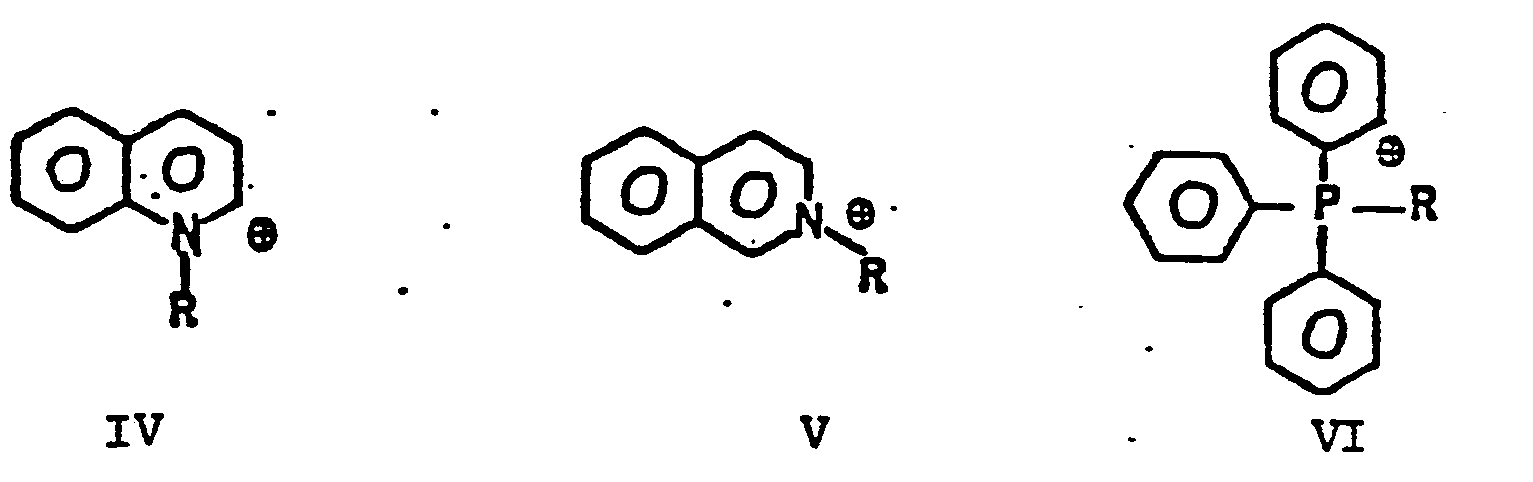
- R einen gegebenenfalls substituierten aliphatischen, cycloaliphatischen oder araliphatischen Rest mit 1 bis 30 C-Atomen bedeutet und
- n 1 oder 2 ist.
- Die erfindungsgemäßen Mischungen können durch Vermischen der Einzelbestandteile im festen Zustand nach bekannten Verfahren z. B. durch Mahlen, Mörsern hergestellt werden. Man kann aber auch den TCNQ-Komplex in eine Schmelze der organischen Verbindungen eintragen.
- Die Leitfähigkeit der Mischungen kann durch Verändern des Verhältnisses von TCNQ-Komplex zu organischer Verbindung in weiten Bereichen variiert werden. Die Mischungen können im allgemeinen mindestens 5 Minuten in der Schmelze gehalten werden, ohne daß ihre elektrischen Eigenschaften verloren gehen. Auch ein mehrmaliges Aufschmelzen der Mischungen ist möglich.
- Die Schmelzpunkte der erfindungsgemäßen Mischungen hängen vom Mischungsverhältnis sowie von den Schmelzpunkten der Einzelbestandteile ab. Sie liegen aber immer deutlich unter den Schmelzpunkten der reinen TCNQ-Komplexe, wodurch eine geringere thermische Belastung der TCNQ-Komplexe und leichtere Verarbeitung erreicht werden.
- Die erfindungsgemäßen Mischungen können darüber hinaus noch weitere Bestandteile enthalten, wie polymere Binder, Stabilisatoren, Pigmente.
- Aufgrund ihres günstigen Schmelz- und Zersetzungsverhaltens können die erfindungsgemäßen Mischungen zur Herstellung elektrisch leitender Überzüge auf Substraten durch Aufschmelzen verwendet werden.
- Als geeignete Substrate seien genannt: Glas, Metalle, Metalloxide, organische Polymere. Solche Substrate können beschichtet werden, indem Schmelzen der erfindungsgemäßen Mischungen auf vorgeheizte Substrate aufgebracht werden. Man kann auch die erfindungsgemäßen Mischungen bei Raumtemperatur auf die zu beschichtenden Substrate aufbringen und anschließend in einem vorgeheizten Ofen aufschmelzen. Beide Verfahren führen zu elektrisch leitfähigen gut haftenden Überzügen.
- Die so hergestellten Überzüge können in der Elektrotechnik und in der Elektronik verwendet werden.
- Eingesetzte TCNQ-Komplexe:


- Die Leitfähigkeiten der Mischungen wurden mittels Zweielektrodenmessung bei einem Druck von 1960 bar (2000 kp/cm2) bestimmt.
- X g TCNQ-Komplex der Formel A und Y g der Verbindung * (siehe Tabelle 1) werden durch Mörsern innig vermischt und anschließend für z-Minuten in einem Glasprobenröhrchen durch Erhitzen in einem Metallbad der Temperatur T geschmolzen. In allen Fällen wurden dünnflüssige Schmelzen erhalten. Die Leitfähigkeiten der wieder erstarrten Schmelzen wurden bestimmt.

- Es wird wie im Beispiel 1 vorgegangen unter Verwendung der TCNQ-Komplexe B-E.

- Aus den Beispielen 1 und 2 wird deutlich, daß die erfindungsgemäßen Mischungen gegenüber den reinen TCNQ-Komplexen niedrigere Schmelzpunkte bei stark erhöhter Stabilität bei hohen Temperaturen und gute elektrische Leitfähigkeit aufweisen.
- Mischungen aus je 2 g der TCNQ-Komplexe der Formeln A-E und je 2 g Naphthalin wurden bei 200°C aufgeschmolzen. Die erhaltenen Schmelzen wurden in flüssigem Zustand auf vorgeheizte (180°C) Glasplatten bzw. Aluminiumplatten aufgetragen. Schichtdicke ca. 0,5 mm. Nach dem Abkühlen wurden in allen Fällen harte, glänzende Überzüge mit guter elektrischer Leitfähigkeit erhalten.
- In eine Schmelze von 2 g Naphthalin bei 160°C werden unter Rühren 2 g TCNQ-Komplex der Formel B eingetragen. Es wird eine dünnflüssige Schmelze erhalten, die nach dem Abkühlen eine elektrische Leitfähigkeit von 8=2.10-2 S/cm aufweist.
und 1 bis 99 Gew.-% einer oder mehrerer der folgenden bei Raumtemperatur festen, schmelzbaren, organischen Verbindungen: gegebenenfalls substituierte lineare oder cyclische Kohlenwasserstoffe, Ester aliphatischer Carbonsäuren, lineare oder cyclische aliphatische Ketone und Alkohole, gegebenenfalls substituierte aromatische oder araliphatische Kohlenwasserstoffe, gegebenenfalls substituierte aromatische oder araliphatische Ketone, gegebenenfalls substituierte aromatische oder araliphatische Ether, gegebenenfalls substituierte aromatische oder araliphatische Thioether und Sulfone, Ester aromatischer Carbonsäuren, Nitrile aromatischer Carbonsäuren und heterocyclische Verbindungen.
Claims (2)

und 1 bis 99,5 Gew.-% einer oder mehrerer der folgenden bei Raumtemperatur festen, schmelzbaren, organischen Verbindungen: gegebenenfalls substituierte lineare oder cyclische Kohlenwasserstoffe, Ester aliphatischer Carbonsäuren, lineare oder cyclische aliphatische Ketone und Alkohole, gegebenenfalls substituierte aromatische oder araliphatische Kohlenwasserstoffe, gegebenenfalls substituierte aromatische oder araliphatische Ketone, gegebenenfalls substituierte aromatische oder araliphatische Ether, gegebenenfalls substituierte aromatische oder araliphatische Thioether und Sulfone, Ester aromatischer Carbonsäuren, Nitrile aromatischer Carbonsäuren und heterocyclische Verbindungen.

Applications Claiming Priority (2)
| Application Number | Priority Date | Filing Date | Title |
|---|---|---|---|
| DE19843440914 DE3440914A1 (de) | 1984-11-09 | 1984-11-09 | Schmelzbare, elektrisch leitfaehige mischungen |
| DE3440914 | 1984-11-09 |
Publications (2)
| Publication Number | Publication Date |
|---|---|
| EP0183977A1 EP0183977A1 (de) | 1986-06-11 |
| EP0183977B1 true EP0183977B1 (de) | 1988-03-16 |
Family
ID=6249861
Family Applications (1)
| Application Number | Title | Priority Date | Filing Date |
|---|---|---|---|
| EP85113674A Expired EP0183977B1 (de) | 1984-11-09 | 1985-10-28 | Schmelzbare, elektrisch leitfähige Mischungen |
Country Status (4)
| Country | Link |
|---|---|
| US (1) | US4663078A (de) |
| EP (1) | EP0183977B1 (de) |
| JP (1) | JPS61118904A (de) |
| DE (2) | DE3440914A1 (de) |
Families Citing this family (4)
| Publication number | Priority date | Publication date | Assignee | Title |
|---|---|---|---|---|
| FR2564231B1 (fr) * | 1984-05-10 | 1986-09-05 | Commissariat Energie Atomique | Films conducteurs de l'electricite comprenant au moins une couche monomoleculaire d'un complexe organique a transfert de charge et leur procede de fabrication |
| DE3607668A1 (de) * | 1986-03-08 | 1987-09-10 | Bayer Ag | Schmelzbare, elektrisch leitfaehige mischungen |
| DE3828758A1 (de) * | 1988-08-25 | 1990-03-01 | Bayer Ag | Verfahren zur erzeugung elektrisch leitender schichten auf substraten und in dem verfahren zu verwendende druckpasten |
| US5091285A (en) * | 1989-04-28 | 1992-02-25 | Fujitsu Limited | Method of forming pattern by using an electroconductive composition |
Family Cites Families (8)
| Publication number | Priority date | Publication date | Assignee | Title |
|---|---|---|---|---|
| ES316614A1 (es) * | 1964-08-24 | 1966-07-01 | Gen Electric | Un procedimiento para preparar una composicion electronicamente conductora. |
| US4026905A (en) * | 1972-12-26 | 1977-05-31 | Monsanto Company | Electrically conducting organic salts |
| US4293452A (en) * | 1980-01-31 | 1981-10-06 | The United States Of America As Represented By The Secretary Of The Navy | Electrically conductive polymeric compositions |
| US4359411A (en) * | 1980-10-03 | 1982-11-16 | The United States Of America As Represented By The Secretary Of The Navy | Flexible semiconductive polymers |
| DE3133738A1 (de) * | 1981-08-26 | 1983-03-10 | Bayer Ag, 5090 Leverkusen | Neue komplexsalze mit hoher elektrischer leitfaehigkeit |
| US4529538A (en) * | 1983-08-09 | 1985-07-16 | The United States Of America As Represented By The Secretary Of The Navy | Electrically conductive polymer compositions |
| DE3335513A1 (de) * | 1983-09-30 | 1985-04-18 | Bayer Ag, 5090 Leverkusen | Gegen hcn-abspaltung stabilisierte, tcnq-komplexe enthaltende organische polymere |
| DE3335589A1 (de) * | 1983-09-30 | 1985-04-18 | Bayer Ag, 5090 Leverkusen | Verfahren zur herstellung von tcnq-komplexen |
-
1984
- 1984-11-09 DE DE19843440914 patent/DE3440914A1/de not_active Withdrawn
-
1985
- 1985-10-28 DE DE8585113674T patent/DE3561911D1/de not_active Expired
- 1985-10-28 EP EP85113674A patent/EP0183977B1/de not_active Expired
- 1985-10-31 US US06/793,226 patent/US4663078A/en not_active Expired - Fee Related
- 1985-11-06 JP JP60247295A patent/JPS61118904A/ja active Pending
Also Published As
| Publication number | Publication date |
|---|---|
| JPS61118904A (ja) | 1986-06-06 |
| US4663078A (en) | 1987-05-05 |
| DE3440914A1 (de) | 1986-05-15 |
| DE3561911D1 (en) | 1988-04-21 |
| EP0183977A1 (de) | 1986-06-11 |
Similar Documents
| Publication | Publication Date | Title |
|---|---|---|
| DE69534293T2 (de) | Flüssige, hydrophobe Salze, ihre Herstellung und ihre Verwendung in der Elektrochemie | |
| DE10229218A1 (de) | Alkylendioxythiophen-Dimere und Trimere | |
| DE2530068C2 (de) | Verfahren zur Herstellung von mit Lithium eingelagerten Metallchalkogeniden und nach diesem Verfahren hergestellte Produkte | |
| DE69217759T2 (de) | Fluorierte Thiophene, von diesen Thiophenen abgeleitete Polymere, leitfähige Polymere, die diese Polymere enthalten, Verfahren zu ihrer Herstellung, ihre Anwendung sowie Vorrichtungen die diese leitfähigen Polymere enthalten | |
| DE112005003198B4 (de) | Ionische Flüssigkeit | |
| EP0183977B1 (de) | Schmelzbare, elektrisch leitfähige Mischungen | |
| DE3441011C2 (de) | Elektroleitfähiges organisches Polymer, enthaltend einen Elektronenakzeptor als Dotiermittel und Verfahren zu dessen Herstellung | |
| DE19932317A1 (de) | Verfahren zur Herstellung von Lithiumkomplexsalzen zur Anwendung in elektrochemischen Zellen | |
| DE19941566A1 (de) | Stabile (CF3)2N-Salze und Verfahren zu deren Herstellung | |
| DE2739584A1 (de) | Derivate von schwefel- und/oder selenhaltigen heterofulvalenen und verfahren zu ihrer herstellung | |
| DE2364445A1 (de) | Elektrisch leitende organische salze | |
| EP0073379B1 (de) | Neue Komplexsalze mit hoher elektrischer Leitfähigkeit | |
| DE68923678T2 (de) | Organisch supraleitende Materialien und Verfahren zu deren Herstellung. | |
| DE3607668A1 (de) | Schmelzbare, elektrisch leitfaehige mischungen | |
| US4249013A (en) | Conjugatively linked tetrathiafulvalenes and method for preparation thereof | |
| EP0138093A2 (de) | Verfahren zur Herstellung von TCNQ-Komplexen | |
| EP0073327A1 (de) | Verfahren zur Abscheidung von Metallen auf elektrisch leitfähigen, polymeren Trägern und Verwendung der erhaltenen Materialien | |
| EP0194543B1 (de) | Schmelzbare, elektrisch leitfähige TCNQ-Komplexe | |
| EP0261380A1 (de) | Schmelzbare, elektrisch leitfähige TCNQ-Komplexe, Verfahren zu ihrer Herstellung und ihre Verwendung | |
| DE3511703A1 (de) | Lithiumionenleiter | |
| EP0160915A2 (de) | Schmelzbare, elektrisch leitfähige TCNQ-Komplexe | |
| EP0071862A1 (de) | Polystyrol mit hoher elektrischer Leitfähigkeit | |
| EP0176921A2 (de) | Verfahren zur Herstellung von elektrisch leitfähigen Systemen | |
| EP0100509B1 (de) | Verfahren zur Herstellung elektrisch leitfähiger Polyarylen-Verbindungen mit elektronenanziehenden Seitengruppen und deren Verwendung in der Elektrotechnik und antistatischen Ausrüstung von Kunststoffen | |
| DE102005017269A1 (de) | Ionische Flüssigkeit |
Legal Events
| Date | Code | Title | Description |
|---|---|---|---|
| PUAI | Public reference made under article 153(3) epc to a published international application that has entered the european phase |
Free format text: ORIGINAL CODE: 0009012 |
|
| 17P | Request for examination filed |
Effective date: 19851028 |
|
| AK | Designated contracting states |
Kind code of ref document: A1 Designated state(s): CH DE FR GB IT LI NL |
|
| 17Q | First examination report despatched |
Effective date: 19870213 |
|
| GRAA | (expected) grant |
Free format text: ORIGINAL CODE: 0009210 |
|
| AK | Designated contracting states |
Kind code of ref document: B1 Designated state(s): CH DE FR GB IT LI NL |
|
| ITF | It: translation for a ep patent filed | ||
| REF | Corresponds to: |
Ref document number: 3561911 Country of ref document: DE Date of ref document: 19880421 |
|
| ET | Fr: translation filed | ||
| GBT | Gb: translation of ep patent filed (gb section 77(6)(a)/1977) | ||
| PLBE | No opposition filed within time limit |
Free format text: ORIGINAL CODE: 0009261 |
|
| STAA | Information on the status of an ep patent application or granted ep patent |
Free format text: STATUS: NO OPPOSITION FILED WITHIN TIME LIMIT |
|
| 26N | No opposition filed | ||
| PGFP | Annual fee paid to national office [announced via postgrant information from national office to epo] |
Ref country code: DE Payment date: 19890914 Year of fee payment: 5 |
|
| PGFP | Annual fee paid to national office [announced via postgrant information from national office to epo] |
Ref country code: FR Payment date: 19890929 Year of fee payment: 5 |
|
| PGFP | Annual fee paid to national office [announced via postgrant information from national office to epo] |
Ref country code: CH Payment date: 19891017 Year of fee payment: 5 |
|
| ITTA | It: last paid annual fee | ||
| PGFP | Annual fee paid to national office [announced via postgrant information from national office to epo] |
Ref country code: NL Payment date: 19891031 Year of fee payment: 5 Ref country code: GB Payment date: 19891031 Year of fee payment: 5 |
|
| PG25 | Lapsed in a contracting state [announced via postgrant information from national office to epo] |
Ref country code: GB Effective date: 19901028 |
|
| PG25 | Lapsed in a contracting state [announced via postgrant information from national office to epo] |
Ref country code: LI Effective date: 19901031 Ref country code: CH Effective date: 19901031 |
|
| PG25 | Lapsed in a contracting state [announced via postgrant information from national office to epo] |
Ref country code: NL Effective date: 19910501 |
|
| NLV4 | Nl: lapsed or anulled due to non-payment of the annual fee | ||
| GBPC | Gb: european patent ceased through non-payment of renewal fee | ||
| PG25 | Lapsed in a contracting state [announced via postgrant information from national office to epo] |
Ref country code: FR Effective date: 19910628 |
|
| REG | Reference to a national code |
Ref country code: CH Ref legal event code: PL |
|
| PG25 | Lapsed in a contracting state [announced via postgrant information from national office to epo] |
Ref country code: DE Effective date: 19910702 |
|
| REG | Reference to a national code |
Ref country code: FR Ref legal event code: ST |