EP0261380B1 - Schmelzbare, elektrisch leitfähige TCNQ-Komplexe, Verfahren zu ihrer Herstellung und ihre Verwendung - Google Patents
Schmelzbare, elektrisch leitfähige TCNQ-Komplexe, Verfahren zu ihrer Herstellung und ihre Verwendung Download PDFInfo
- Publication number
- EP0261380B1 EP0261380B1 EP87111793A EP87111793A EP0261380B1 EP 0261380 B1 EP0261380 B1 EP 0261380B1 EP 87111793 A EP87111793 A EP 87111793A EP 87111793 A EP87111793 A EP 87111793A EP 0261380 B1 EP0261380 B1 EP 0261380B1
- Authority
- EP
- European Patent Office
- Prior art keywords
- tcnq
- complexes
- electrically conductive
- formula
- substrates
- Prior art date
- Legal status (The legal status is an assumption and is not a legal conclusion. Google has not performed a legal analysis and makes no representation as to the accuracy of the status listed.)
- Expired - Lifetime
Links
- 238000000034 method Methods 0.000 title description 8
- NLZUEZXRPGMBCV-UHFFFAOYSA-N Butylhydroxytoluene Chemical class CC1=CC(C(C)(C)C)=C(O)C(C(C)(C)C)=C1 NLZUEZXRPGMBCV-UHFFFAOYSA-N 0.000 claims description 25
- 239000000758 substrate Substances 0.000 claims description 13
- 239000000155 melt Substances 0.000 claims description 5
- 239000012799 electrically-conductive coating Substances 0.000 claims description 3
- 238000003618 dip coating Methods 0.000 claims description 2
- 125000005843 halogen group Chemical group 0.000 claims description 2
- WEVYAHXRMPXWCK-UHFFFAOYSA-N Acetonitrile Chemical compound CC#N WEVYAHXRMPXWCK-UHFFFAOYSA-N 0.000 description 21
- 238000002844 melting Methods 0.000 description 10
- 230000008018 melting Effects 0.000 description 10
- OKKJLVBELUTLKV-UHFFFAOYSA-N Methanol Chemical compound OC OKKJLVBELUTLKV-UHFFFAOYSA-N 0.000 description 9
- 150000003839 salts Chemical class 0.000 description 7
- -1 ammonium ions Chemical class 0.000 description 6
- 238000000576 coating method Methods 0.000 description 6
- 238000010992 reflux Methods 0.000 description 4
- ZWEHNKRNPOVVGH-UHFFFAOYSA-N 2-Butanone Chemical compound CCC(C)=O ZWEHNKRNPOVVGH-UHFFFAOYSA-N 0.000 description 3
- YMWUJEATGCHHMB-UHFFFAOYSA-N Dichloromethane Chemical compound ClCCl YMWUJEATGCHHMB-UHFFFAOYSA-N 0.000 description 3
- RTZKZFJDLAIYFH-UHFFFAOYSA-N Diethyl ether Chemical compound CCOCC RTZKZFJDLAIYFH-UHFFFAOYSA-N 0.000 description 3
- LFQSCWFLJHTTHZ-UHFFFAOYSA-N Ethanol Chemical compound CCO LFQSCWFLJHTTHZ-UHFFFAOYSA-N 0.000 description 3
- 238000001816 cooling Methods 0.000 description 3
- 239000002244 precipitate Substances 0.000 description 3
- UBOXGVDOUJQMTN-UHFFFAOYSA-N 1,1,2-trichloroethane Chemical compound ClCC(Cl)Cl UBOXGVDOUJQMTN-UHFFFAOYSA-N 0.000 description 2
- JVPRDSZBDKZPQC-UHFFFAOYSA-M 1-phenylpyridin-1-ium;iodide Chemical class [I-].C1=CC=CC=C1[N+]1=CC=CC=C1 JVPRDSZBDKZPQC-UHFFFAOYSA-M 0.000 description 2
- CSCPPACGZOOCGX-UHFFFAOYSA-N Acetone Chemical compound CC(C)=O CSCPPACGZOOCGX-UHFFFAOYSA-N 0.000 description 2
- XKRFYHLGVUSROY-UHFFFAOYSA-N Argon Chemical compound [Ar] XKRFYHLGVUSROY-UHFFFAOYSA-N 0.000 description 2
- IJGRMHOSHXDMSA-UHFFFAOYSA-N Atomic nitrogen Chemical compound N#N IJGRMHOSHXDMSA-UHFFFAOYSA-N 0.000 description 2
- HEDRZPFGACZZDS-UHFFFAOYSA-N Chloroform Chemical compound ClC(Cl)Cl HEDRZPFGACZZDS-UHFFFAOYSA-N 0.000 description 2
- KFZMGEQAYNKOFK-UHFFFAOYSA-N Isopropanol Chemical compound CC(C)O KFZMGEQAYNKOFK-UHFFFAOYSA-N 0.000 description 2
- WYURNTSHIVDZCO-UHFFFAOYSA-N Tetrahydrofuran Chemical compound C1CCOC1 WYURNTSHIVDZCO-UHFFFAOYSA-N 0.000 description 2
- 150000001298 alcohols Chemical class 0.000 description 2
- 150000001768 cations Chemical class 0.000 description 2
- 230000002349 favourable effect Effects 0.000 description 2
- SMWDFEZZVXVKRB-UHFFFAOYSA-O hydron;quinoline Chemical compound [NH+]1=CC=CC2=CC=CC=C21 SMWDFEZZVXVKRB-UHFFFAOYSA-O 0.000 description 2
- AWJUIBRHMBBTKR-UHFFFAOYSA-O isoquinolin-2-ium Chemical compound C1=[NH+]C=CC2=CC=CC=C21 AWJUIBRHMBBTKR-UHFFFAOYSA-O 0.000 description 2
- 239000000203 mixture Substances 0.000 description 2
- VZGDMQKNWNREIO-UHFFFAOYSA-N tetrachloromethane Chemical compound ClC(Cl)(Cl)Cl VZGDMQKNWNREIO-UHFFFAOYSA-N 0.000 description 2
- 125000000229 (C1-C4)alkoxy group Chemical group 0.000 description 1
- WSLDOOZREJYCGB-UHFFFAOYSA-N 1,2-Dichloroethane Chemical compound ClCCCl WSLDOOZREJYCGB-UHFFFAOYSA-N 0.000 description 1
- FHIWTZOWCILSIC-UHFFFAOYSA-N 1-phenylpyridin-1-ium Chemical compound C1=CC=CC=C1[N+]1=CC=CC=C1 FHIWTZOWCILSIC-UHFFFAOYSA-N 0.000 description 1
- QGZKDVFQNNGYKY-UHFFFAOYSA-O Ammonium Chemical compound [NH4+] QGZKDVFQNNGYKY-UHFFFAOYSA-O 0.000 description 1
- PQBAWAQIRZIWIV-UHFFFAOYSA-N N-methylpyridinium Chemical compound C[N+]1=CC=CC=C1 PQBAWAQIRZIWIV-UHFFFAOYSA-N 0.000 description 1
- JUJWROOIHBZHMG-UHFFFAOYSA-N Pyridine Chemical class C1=CC=NC=C1 JUJWROOIHBZHMG-UHFFFAOYSA-N 0.000 description 1
- CIUQDSCDWFSTQR-UHFFFAOYSA-N [C]1=CC=CC=C1 Chemical group [C]1=CC=CC=C1 CIUQDSCDWFSTQR-UHFFFAOYSA-N 0.000 description 1
- 125000002015 acyclic group Chemical group 0.000 description 1
- 239000003513 alkali Substances 0.000 description 1
- 229910001413 alkali metal ion Inorganic materials 0.000 description 1
- 229910001420 alkaline earth metal ion Inorganic materials 0.000 description 1
- 150000001450 anions Chemical group 0.000 description 1
- 229910052786 argon Inorganic materials 0.000 description 1
- VUEDNLCYHKSELL-UHFFFAOYSA-N arsonium Chemical compound [AsH4+] VUEDNLCYHKSELL-UHFFFAOYSA-N 0.000 description 1
- 238000009835 boiling Methods 0.000 description 1
- 239000011248 coating agent Substances 0.000 description 1
- 238000004040 coloring Methods 0.000 description 1
- 150000001875 compounds Chemical class 0.000 description 1
- 150000004292 cyclic ethers Chemical class 0.000 description 1
- 230000007423 decrease Effects 0.000 description 1
- 239000007789 gas Substances 0.000 description 1
- 239000011521 glass Substances 0.000 description 1
- 150000008282 halocarbons Chemical class 0.000 description 1
- 238000010438 heat treatment Methods 0.000 description 1
- 239000001307 helium Substances 0.000 description 1
- 229910052734 helium Inorganic materials 0.000 description 1
- SWQJXJOGLNCZEY-UHFFFAOYSA-N helium atom Chemical compound [He] SWQJXJOGLNCZEY-UHFFFAOYSA-N 0.000 description 1
- 239000001257 hydrogen Substances 0.000 description 1
- 229910052739 hydrogen Inorganic materials 0.000 description 1
- 125000004435 hydrogen atom Chemical class [H]* 0.000 description 1
- XMBWDFGMSWQBCA-UHFFFAOYSA-N hydrogen iodide Chemical compound I XMBWDFGMSWQBCA-UHFFFAOYSA-N 0.000 description 1
- 238000010348 incorporation Methods 0.000 description 1
- 150000002576 ketones Chemical class 0.000 description 1
- 238000004519 manufacturing process Methods 0.000 description 1
- 238000005259 measurement Methods 0.000 description 1
- 229910052751 metal Inorganic materials 0.000 description 1
- 239000002184 metal Substances 0.000 description 1
- 229910021645 metal ion Inorganic materials 0.000 description 1
- 229910044991 metal oxide Inorganic materials 0.000 description 1
- 150000004706 metal oxides Chemical class 0.000 description 1
- 150000002739 metals Chemical class 0.000 description 1
- 230000007935 neutral effect Effects 0.000 description 1
- 229910052757 nitrogen Inorganic materials 0.000 description 1
- 229920000620 organic polymer Polymers 0.000 description 1
- 239000003960 organic solvent Substances 0.000 description 1
- TWNQGVIAIRXVLR-UHFFFAOYSA-N oxo(oxoalumanyloxy)alumane Chemical compound O=[Al]O[Al]=O TWNQGVIAIRXVLR-UHFFFAOYSA-N 0.000 description 1
- XYFCBTPGUUZFHI-UHFFFAOYSA-O phosphonium Chemical compound [PH4+] XYFCBTPGUUZFHI-UHFFFAOYSA-O 0.000 description 1
- 239000004033 plastic Substances 0.000 description 1
- 229920003023 plastic Polymers 0.000 description 1
- 229920000515 polycarbonate Polymers 0.000 description 1
- 239000004417 polycarbonate Substances 0.000 description 1
- 230000001681 protective effect Effects 0.000 description 1
- 150000003222 pyridines Chemical class 0.000 description 1
- JUJWROOIHBZHMG-UHFFFAOYSA-O pyridinium Chemical compound C1=CC=[NH+]C=C1 JUJWROOIHBZHMG-UHFFFAOYSA-O 0.000 description 1
- 150000003856 quaternary ammonium compounds Chemical class 0.000 description 1
- 239000000376 reactant Substances 0.000 description 1
- 239000007787 solid Substances 0.000 description 1
- 239000002904 solvent Substances 0.000 description 1
- 230000000087 stabilizing effect Effects 0.000 description 1
- 238000003756 stirring Methods 0.000 description 1
- 239000000725 suspension Substances 0.000 description 1
- 150000003512 tertiary amines Chemical class 0.000 description 1
- PCCVSPMFGIFTHU-UHFFFAOYSA-N tetracyanoquinodimethane Chemical compound N#CC(C#N)=C1C=CC(=C(C#N)C#N)C=C1 PCCVSPMFGIFTHU-UHFFFAOYSA-N 0.000 description 1
- YLQBMQCUIZJEEH-UHFFFAOYSA-N tetrahydrofuran Natural products C=1C=COC=1 YLQBMQCUIZJEEH-UHFFFAOYSA-N 0.000 description 1
- 125000005270 trialkylamine group Chemical group 0.000 description 1
- XLYOFNOQVPJJNP-UHFFFAOYSA-N water Substances O XLYOFNOQVPJJNP-UHFFFAOYSA-N 0.000 description 1
Classifications
-
- H—ELECTRICITY
- H01—ELECTRIC ELEMENTS
- H01G—CAPACITORS; CAPACITORS, RECTIFIERS, DETECTORS, SWITCHING DEVICES, LIGHT-SENSITIVE OR TEMPERATURE-SENSITIVE DEVICES OF THE ELECTROLYTIC TYPE
- H01G9/00—Electrolytic capacitors, rectifiers, detectors, switching devices, light-sensitive or temperature-sensitive devices; Processes of their manufacture
- H01G9/004—Details
- H01G9/022—Electrolytes; Absorbents
- H01G9/025—Solid electrolytes
- H01G9/028—Organic semiconducting electrolytes, e.g. TCNQ
-
- C—CHEMISTRY; METALLURGY
- C07—ORGANIC CHEMISTRY
- C07C—ACYCLIC OR CARBOCYCLIC COMPOUNDS
- C07C255/00—Carboxylic acid nitriles
-
- C—CHEMISTRY; METALLURGY
- C07—ORGANIC CHEMISTRY
- C07D—HETEROCYCLIC COMPOUNDS
- C07D213/00—Heterocyclic compounds containing six-membered rings, not condensed with other rings, with one nitrogen atom as the only ring hetero atom and three or more double bonds between ring members or between ring members and non-ring members
- C07D213/02—Heterocyclic compounds containing six-membered rings, not condensed with other rings, with one nitrogen atom as the only ring hetero atom and three or more double bonds between ring members or between ring members and non-ring members having three double bonds between ring members or between ring members and non-ring members
- C07D213/04—Heterocyclic compounds containing six-membered rings, not condensed with other rings, with one nitrogen atom as the only ring hetero atom and three or more double bonds between ring members or between ring members and non-ring members having three double bonds between ring members or between ring members and non-ring members having no bond between the ring nitrogen atom and a non-ring member or having only hydrogen or carbon atoms directly attached to the ring nitrogen atom
- C07D213/06—Heterocyclic compounds containing six-membered rings, not condensed with other rings, with one nitrogen atom as the only ring hetero atom and three or more double bonds between ring members or between ring members and non-ring members having three double bonds between ring members or between ring members and non-ring members having no bond between the ring nitrogen atom and a non-ring member or having only hydrogen or carbon atoms directly attached to the ring nitrogen atom containing only hydrogen and carbon atoms in addition to the ring nitrogen atom
- C07D213/16—Heterocyclic compounds containing six-membered rings, not condensed with other rings, with one nitrogen atom as the only ring hetero atom and three or more double bonds between ring members or between ring members and non-ring members having three double bonds between ring members or between ring members and non-ring members having no bond between the ring nitrogen atom and a non-ring member or having only hydrogen or carbon atoms directly attached to the ring nitrogen atom containing only hydrogen and carbon atoms in addition to the ring nitrogen atom containing only one pyridine ring
- C07D213/18—Salts thereof
-
- H—ELECTRICITY
- H01—ELECTRIC ELEMENTS
- H01B—CABLES; CONDUCTORS; INSULATORS; SELECTION OF MATERIALS FOR THEIR CONDUCTIVE, INSULATING OR DIELECTRIC PROPERTIES
- H01B1/00—Conductors or conductive bodies characterised by the conductive materials; Selection of materials as conductors
- H01B1/06—Conductors or conductive bodies characterised by the conductive materials; Selection of materials as conductors mainly consisting of other non-metallic substances
- H01B1/12—Conductors or conductive bodies characterised by the conductive materials; Selection of materials as conductors mainly consisting of other non-metallic substances organic substances
- H01B1/121—Charge-transfer complexes
Definitions
- the invention relates to new meltable, electrically conductive complex salts of 7,7,8,8-tetracyanopquinodimethane (TCNQ).
- the procedure is such that the TCNQ complexes of the formula (II) are applied to the substrates to be coated at room temperature and then melted in a preheated oven.
Landscapes
- Chemical & Material Sciences (AREA)
- Organic Chemistry (AREA)
- Chemical Kinetics & Catalysis (AREA)
- Electrochemistry (AREA)
- Engineering & Computer Science (AREA)
- Power Engineering (AREA)
- Microelectronics & Electronic Packaging (AREA)
- Physics & Mathematics (AREA)
- Spectroscopy & Molecular Physics (AREA)
- Pyridine Compounds (AREA)
- Paints Or Removers (AREA)
- Elimination Of Static Electricity (AREA)
Description
- Die Erfindung betrifft neue schmelzbare, elektrisch leitfähige Komplexsalze des 7,7,8,8-Tetracyanop-chinodimethans (TCNQ).
- Komplexsalze des TCNQ und ihre Verwendung als elektrisch leitfähige Verbindungen sind bekannt (siehe z.B. J. Am. Chem. Soc. Vol. 84 (1962), Seiten 3374-3387; die US-PS 3 941 792 und 4 580 855, die deutsche Offenlegungsschrift 3 417 466 und die EP-A 161 987). Diese Komplexsalze entsprechen der allgemeinen Formel

- Kn+ein Kation und
- n eine ganze, der Wertigkeit von K entsprechende Zahl ist, und
- m die Anzahl der Mole an neutralem TCNQ angibt, die in einem Mol des Komplexsalzes enthalten ist; für m gilt:
- 0≤ m ≤ 2 n vorzugsweise 0≤ m sn.
- Als Kationen Kn9 wurden bislang Alkali- und Erdalkalimetallionen, ferner Arsonium-, Phosphonium-und Ammoniumionen vorgeschlagen. Als Ammoniumionen wurden vor allem solche verwendet, die sich von tertiären Aminen, wie Trialkylaminen, Dialkylanilinen und Pyridinen, und quartären Ammoniumverbindungen, wie Chinolinium-, lsochinolinium- und Pyridinium-Verbindungen oder aber deren N-Alkyl-Derivaten ableiten.
- Von den bislang bekannten TCNQ-Komplexen sind die Salze der Formel (1), in denen Kn⊕ für ein Ammoniumion, z.B. ein (N-Alkyl-)pyridinium-, (N-Alkyl-)chinolinium-, (N-Alkyl-)isochinoliniumion oder ein Phosphoniumion steht, schmelzbar. Diese schmelzbaren Komplexe haben aber den Nachteil, daß ihre elektrische Leitfähigkeit beim Schmelzen um mehrere Zehnerpotenzen abnimmt (N-Alkylpyridinium-TCNQ-Komplexe wie der N-Methyl-pyridinium TCNQ-Komplex und die in der EP-A 161 987 beschriebenen amphiphilen N-C12-C30-Alkyl-pyridinium-jodid-Komplexsalze) oder daß sie in der Schmelze zwar kurze Zeit stabil sind, aber dafür eine für viele Anwendungsgebiete nicht ausreichende elektrische Leitfähigkeit aufweisen (Isochinolinium- und N-C12-C30-Alkyl-pyridinium-TCNQ-Komplexsalze).
- Überraschenderweise wurde nun gefunden, daß TCNQ-Komplexe der Formel (I), in der Kn⊕ für ein N-Phenyl pyridinium-lon steht, nicht nur ein günstiges Schmelzverhalten und eine hohe thermische Stabilität, sondern gleichzeitig auch eine hervorragende elektrische Leitfähigkeit aufweisen.
- Die Erfindung betrifft daher TCNQ-Komplexe der Formel

- m Null oder eine ganze oder gebrochene Zahl von 0 bis 2, vorzugsweise von 0 bis 1, ist und
- R für einen gegebenenfalls durch Cl-C4-Alkyl-, C1―C4-Alkoxy-, C1―C5-Acyl-Reste und/oder Halogenatome substituierten Phenylrest steht.
- Die erfindungsgemäßen TCNQ-Komplexe der Formel (II) können nach an sich bekannten Verfahren, z.B, den in J. Am. Chem. Soc. 84, (1962), Seiten 3374 ff, insbesondere auf Seite 3380 beschriebenen Verfahren hergestellt werden. Eines dieser Verfahren verläuft nach folgender Reaktionsgleichung
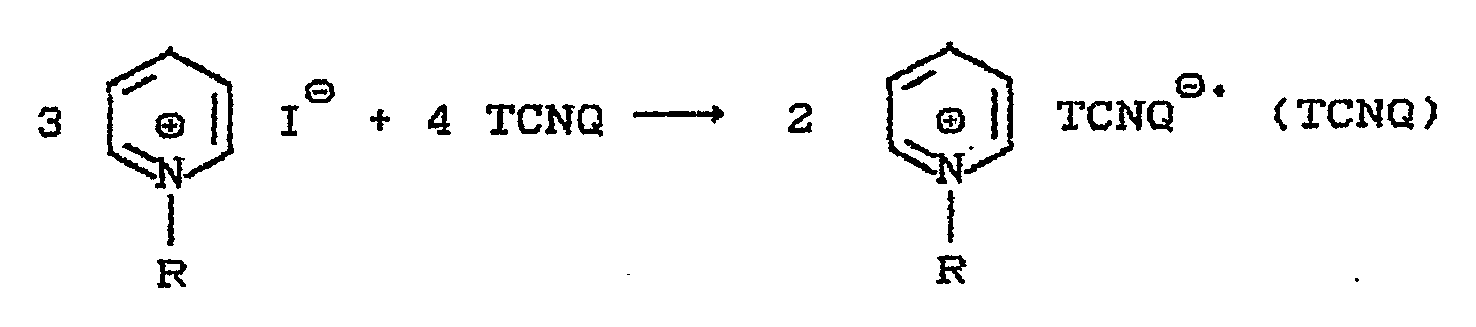
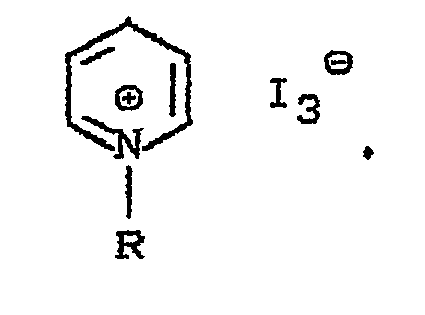
- Die Umsetzung der N-Phenyl-pyridiniumiodide mit TCNQ wird vorzugsweise in organischen Lösungsmitteln bei Temperaturen unterhalb von 150°C vorzugsweise bei Temperaturen von 20 bis 100°C vorgenommen.
- Geeignete Lösungsmittel für diese Umsetzung sind z.B. Halogenkohlenwasserstoffe, z.B. Methylenchlorid, Chloroform, Tetrachlormethan, 1,2-Dichlorethan, 1,1,2-Trichlorethan; Acetonitril; Alkohole, z.B. Methanol, Ethanol, Isopropanol; alphatische Ketone, z.B. Aceton, Methylethylketon; acyclische oder cyclische Ether, z.B. Diethylether, Tetrahydrofuran. Die Reaktionspartner, TCNQ und N-Aryl-pyridiniumiode, werden in einem Molverhältnis von 1:0,5-1,5 eingesetzt.
- Ein anderes Verfahren verläuft nach folgender Reaktionsgleichung (X = Anion, vorzugsweise Halogenidion; M = Metallion, vorzugsweise Li⊕):


- In Stufe 1 wird die Umsetzung vorzugsweise in wäßrigen Alkoholen, in Stufe 2 vorzugsweise in Acetonitril vorgenommen.
- Wegen ihres günstigen Schmelzverhaltens und ihrer hohen thermischen Stabilität eignen sich die erfindungsgemäßen N-Phenyl-pyridinium-TCNQ-Komplexe der Formel (11) besonders zur Herstellung elektrisch leitender Überzüge auf Substraten durch Aufschmelzen.
- Die Erfindung betrifft daher auch die Verwendung der erfindungsgemäßen N-Phenyl-pyridinium-TCNQ-Komplexe zur Herstellung elektrisch leitfähiger Überzüge durch Aufschmelzen auf Substraten oder aber durch Tauchbeschichtung von Substraten.
- Die erfindungsgemäßen TCNQ-Komplexe lassen sich auch aus der Schmelze zu leitenden Überzügen verarbeiten. Diese Überzüge können gegebenenfalls auch stabilisierende, die Haftung verbessernde oder farbgebende, oder den Schmelzpunkt erniedrigende Zusätze enthalten.
- Als für die Beschichtung geeignete Substrate seien beispielsweise genannt; Glas, Metalle, Metalloxide, wie Aluminiumoxid, ferner organische Polymere.
- Das Beschichten der Substrate kann in der Weise erfolgen, daß man die Substrate auf eine Temperatur oberhalb des Schmelzpunktes der N-Phenyl-pyridinium-TCNQ-Komplexe erhitzt und anschließend die festen TCNQ-Komplexe auf diese heißen Substratoberflächen aufstreut. Dieses Aufschmelzen der TCNQ-Komplexe auf die erhitzten Substratoberflächen kann gegebenenfalls in einer Schutzgasatmosphäre, z.B. unter Wasserstoff, Stickstoff, Argon oder Helium oder aber auch im Vakuum vorgenommen werden.
- Bei einem anderen Verfahren geht man so vor, daß man die TCNQ-Komplexe der Formel (II) bei Raumtemperatur auf die zu beschichtenden Substrate aufbringt und anschließend in einem vorgeheizten Ofen aufschmilzt.
- Ein drittes Verfahren zur Aufbringung besteht darin, die Substrate durch Tauchen in eine Schmelze der TCNQ-Komplexe der Formel (II) zu beschichten.
- Alle diese Verfahren führen zu elektrisch leitfähigen Uberzugen auf den Substraten. Die so hergestellten, mit einem elektrisch leitfähigen Überzug versehenen Substrate finden Verwendung in der Elektronikindustrie.
- Die erfindungsgemäßen N-Phenyl-pyridinium-TCNQ-Komplexe eignen sich auch für eine Einarbeitung in Kunststoffe, z.B. in Polycarbonat, um diese antistatisch auszurüsten.
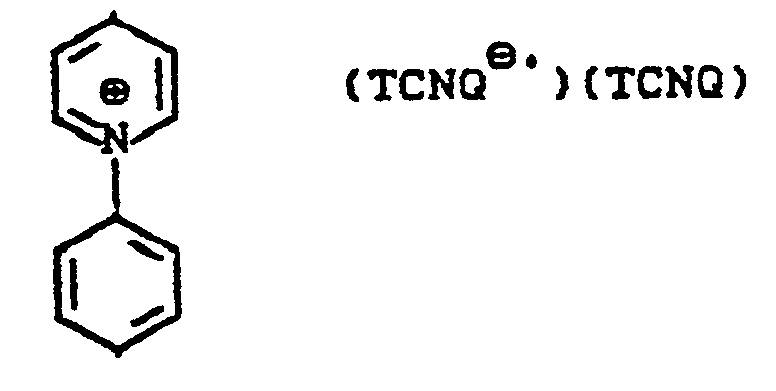
- Eine Suspension von 8,2 g (0,04 Mol) TCNQ in 200 ml Acetonitril wird bei Rückflußtemperatur unter Rühren mit einer Lösung von 8,5 g (0,03 Mol) N-Phenylpyridiniumiodid in 50 ml Acetonitril versetzt. Die Mischung wird anschließend noch 10 Minuten bei Rückflußtemperatur gerührt.
- Beim Abkühlen scheidet sich aus der Lösung ein kristalliner Niederschlag ab. Dieser wird nach 12- stündigem Stehen abgesaugt, mit wenig Acetonitril gewaschen und getrocknet.
- Ausbeute: 7,9 g (70 % der Theorie) des N-Phenyl-pyridinium-TCNQ-Komplexes der Formel
-
- Bestimmung des Schmelzverhaltens und der thermischen Stabilität verschiedener TCNQ-Komplexe und des vorstehend beschriebenen N-Phenyl-pyridinium-TCNQ-Komplexes:
- Jeweils 0,5 g TCNQ-Komplex werden 1 Minute bei der in der nachstehenden Tabelle angegebenen Temperatur T geschmolzen. Es werden die Leitfähigkeiten der verschiedenen TCNQ-Komplexe vor dem Schmelzen (σ o) und der wiedererstarrten Schmelzen (6 o) bestimmt (Vierelektrodenmessung unter Druck 250 Kp/cm2).
- In der nachstehenden Tabelle sind die verschiedenen untersuchten TCNQ-Komplexe, die zum Schmelzen erforderlichen Temperaturen und die erhaltenen α o und σ s-Werte zusammengestellt.

- Die siedende Lösung von 1,42 g (6,7 mmol) Li ⊕(TCNQ e) in 20 ml wäßrigem Methanol (CH30H:H20 = 10:1) wird mit der Lösung von 2,0 g (6,8 mmol) N-p-Tolylpyridiniumiodid in 13 ml wäßrigem Methanol (CH30H:H20 = 10:1) versetzt. Die Mischung wird 10 Minuten auf Rückflußtemperatur erhitzt.
- Nach dem Abkühlen wird der Niederschlag abgesaugt, mit wenig kaltem Wasser gewaschen und getrocknet.
- Ausbeute: 2,14 g (85 % der Theorie) des N-p-Tolylpyridinium-TCNQ-Komplexes der Formel

- Die 2,14 g (5,7 mmol) N-p-Tolylpyridinium-TCNQ-Salz werden mit 1,16 g (5,7 mmol) TCNQ in 100 ml Acetonitril 10 Minuten auf Rückflußtemperatur erhitzt. Nach dem Abkühlen wird der kristalline Niederschlag abgesaugt, mit wenig kaltem Acetonitril gewaschen und getrocknet.
- Ausbeute: 2,89 g (87 % der Theorie) des N-p-Tolyl-pyridinium-TCNQ-Komplexes der Formel
-

Claims (3)

Applications Claiming Priority (2)
| Application Number | Priority Date | Filing Date | Title |
|---|---|---|---|
| DE3628905 | 1986-08-26 | ||
| DE19863628905 DE3628905A1 (de) | 1986-08-26 | 1986-08-26 | Schmelzbare, elektrisch leitfaehige tcnq-komplexe, verfahren zu ihrer herstellung und ihre verwendung |
Publications (2)
| Publication Number | Publication Date |
|---|---|
| EP0261380A1 EP0261380A1 (de) | 1988-03-30 |
| EP0261380B1 true EP0261380B1 (de) | 1990-10-03 |
Family
ID=6308161
Family Applications (1)
| Application Number | Title | Priority Date | Filing Date |
|---|---|---|---|
| EP87111793A Expired - Lifetime EP0261380B1 (de) | 1986-08-26 | 1987-08-14 | Schmelzbare, elektrisch leitfähige TCNQ-Komplexe, Verfahren zu ihrer Herstellung und ihre Verwendung |
Country Status (4)
| Country | Link |
|---|---|
| US (1) | US4849520A (de) |
| EP (1) | EP0261380B1 (de) |
| JP (1) | JPS6357571A (de) |
| DE (2) | DE3628905A1 (de) |
Families Citing this family (4)
| Publication number | Priority date | Publication date | Assignee | Title |
|---|---|---|---|---|
| DE3828758A1 (de) * | 1988-08-25 | 1990-03-01 | Bayer Ag | Verfahren zur erzeugung elektrisch leitender schichten auf substraten und in dem verfahren zu verwendende druckpasten |
| US5091285A (en) * | 1989-04-28 | 1992-02-25 | Fujitsu Limited | Method of forming pattern by using an electroconductive composition |
| DE3922852A1 (de) * | 1989-07-12 | 1991-01-24 | Roederstein Kondensatoren | Feststoffelektrolyte und diese enthaltende kondensatoren |
| GB2431517B (en) * | 2005-10-19 | 2008-08-27 | Kidde Ip Holdings Ltd | Temperature switch |
Family Cites Families (6)
| Publication number | Priority date | Publication date | Assignee | Title |
|---|---|---|---|---|
| US3115506A (en) * | 1960-03-28 | 1963-12-24 | Du Pont | Derivatives of 1, 4-bismethylene cyclohexane and 1, 4-bismethylene cyclohexadiene and processes of preparation |
| JPS5551283B2 (de) * | 1972-06-08 | 1980-12-23 | ||
| JPS547198A (en) * | 1977-06-17 | 1979-01-19 | Matsushita Electric Ind Co Ltd | Organic semiconductor |
| US4580855A (en) * | 1981-04-17 | 1986-04-08 | Sanyo Electric Co., Ltd. | Solid electrolyte capacitor |
| FR2564092B1 (fr) * | 1984-05-10 | 1988-06-10 | Commissariat Energie Atomique | Complexes organiques amphiphiles a transfert de charge, conducteurs de l'electricite ou precurseurs de conducteurs de l'electricite |
| DE3417466A1 (de) * | 1984-05-11 | 1985-11-14 | Bayer Ag, 5090 Leverkusen | Schmelzbare, elektrisch leitfaehige tcnq-komplexe |
-
1986
- 1986-08-26 DE DE19863628905 patent/DE3628905A1/de not_active Withdrawn
-
1987
- 1987-08-11 US US07/084,659 patent/US4849520A/en not_active Expired - Fee Related
- 1987-08-14 EP EP87111793A patent/EP0261380B1/de not_active Expired - Lifetime
- 1987-08-14 DE DE8787111793T patent/DE3765378D1/de not_active Expired - Lifetime
- 1987-08-21 JP JP62206604A patent/JPS6357571A/ja active Pending
Non-Patent Citations (1)
| Title |
|---|
| Chemistry Letters, pp 709-712, 1986 * |
Also Published As
| Publication number | Publication date |
|---|---|
| JPS6357571A (ja) | 1988-03-12 |
| US4849520A (en) | 1989-07-18 |
| EP0261380A1 (de) | 1988-03-30 |
| DE3765378D1 (de) | 1990-11-08 |
| DE3628905A1 (de) | 1988-03-03 |
Similar Documents
| Publication | Publication Date | Title |
|---|---|---|
| DE2065236C3 (de) | Phosphonsäuresalze, ihre Herstellung und Verwendung | |
| EP0261380B1 (de) | Schmelzbare, elektrisch leitfähige TCNQ-Komplexe, Verfahren zu ihrer Herstellung und ihre Verwendung | |
| EP0073379B1 (de) | Neue Komplexsalze mit hoher elektrischer Leitfähigkeit | |
| DE1158066B (de) | Verfahren zur Herstellung von p-Styryldiphenylphosphin | |
| EP0194543B1 (de) | Schmelzbare, elektrisch leitfähige TCNQ-Komplexe | |
| DE2226774C3 (de) | Verfahren zur Herstellung von Distannanen der Formel R↓3↓Sn-Sn R↓3↓ | |
| EP0160915A2 (de) | Schmelzbare, elektrisch leitfähige TCNQ-Komplexe | |
| EP0183977B1 (de) | Schmelzbare, elektrisch leitfähige Mischungen | |
| DE3883394T2 (de) | Verfahren zur herstellung von dialkyltellur und dialkylselen. | |
| EP1874784B1 (de) | Ionische flüssigkeit | |
| DE3873920T2 (de) | Oligopyridinliganden, verfahren zu ihrer herstellung und ihre verwendung als komplexbildnermittel. | |
| DE3531004C2 (de) | ||
| DE937647C (de) | Verfahren zur Herstellung von p-Xylylendichlorid bzw. -dibromid | |
| EP0297037A1 (de) | Poly(arylensulfide) | |
| DE2720911C3 (de) | Verfahren zur Herstellung von n-Hexyl-Carboran | |
| EP0110305B1 (de) | Verfahren zur Herstellung aromatischer Phosphor-Chlor-Verbindungen | |
| DE3228866C2 (de) | ||
| DE69008151T2 (de) | Herstellung von dikationethern. | |
| EP0236842A2 (de) | Schmelzbare, elektrisch leitfähige Mischungen | |
| DE69220952T2 (de) | VERFAHREN ZUR HERSTELLUNG VON Mo4S4L6 | |
| DE4038536A1 (de) | Herstellung von sulfoxoniumsalzen | |
| DE3875885T2 (de) | Methode zur herstellung von polycyclischen 1,3-thiazolidinen. | |
| DE2407015B2 (de) | Dihalogen-bis(2-pyridylthio)-Zinn (IV)-Verbindungen und Verfahren zu deren Herstellung | |
| DE3802170C2 (de) | ||
| DE68906589T2 (de) | Elektrochemische Synthese von 2-Aryl-Hydrochinonen. |
Legal Events
| Date | Code | Title | Description |
|---|---|---|---|
| PUAI | Public reference made under article 153(3) epc to a published international application that has entered the european phase |
Free format text: ORIGINAL CODE: 0009012 |
|
| 17P | Request for examination filed |
Effective date: 19870814 |
|
| AK | Designated contracting states |
Kind code of ref document: A1 Designated state(s): BE CH DE FR GB IT LI NL |
|
| 17Q | First examination report despatched |
Effective date: 19890915 |
|
| GRAA | (expected) grant |
Free format text: ORIGINAL CODE: 0009210 |
|
| AK | Designated contracting states |
Kind code of ref document: B1 Designated state(s): BE CH DE FR GB IT LI NL |
|
| ITF | It: translation for a ep patent filed | ||
| REF | Corresponds to: |
Ref document number: 3765378 Country of ref document: DE Date of ref document: 19901108 |
|
| GBT | Gb: translation of ep patent filed (gb section 77(6)(a)/1977) | ||
| ET | Fr: translation filed | ||
| PGFP | Annual fee paid to national office [announced via postgrant information from national office to epo] |
Ref country code: DE Payment date: 19910724 Year of fee payment: 5 |
|
| PGFP | Annual fee paid to national office [announced via postgrant information from national office to epo] |
Ref country code: FR Payment date: 19910730 Year of fee payment: 5 |
|
| PLBE | No opposition filed within time limit |
Free format text: ORIGINAL CODE: 0009261 |
|
| STAA | Information on the status of an ep patent application or granted ep patent |
Free format text: STATUS: NO OPPOSITION FILED WITHIN TIME LIMIT |
|
| PGFP | Annual fee paid to national office [announced via postgrant information from national office to epo] |
Ref country code: GB Payment date: 19910805 Year of fee payment: 5 |
|
| PGFP | Annual fee paid to national office [announced via postgrant information from national office to epo] |
Ref country code: CH Payment date: 19910821 Year of fee payment: 5 |
|
| PGFP | Annual fee paid to national office [announced via postgrant information from national office to epo] |
Ref country code: BE Payment date: 19910828 Year of fee payment: 5 |
|
| ITTA | It: last paid annual fee | ||
| PGFP | Annual fee paid to national office [announced via postgrant information from national office to epo] |
Ref country code: NL Payment date: 19910831 Year of fee payment: 5 |
|
| K2C2 | Correction of patent specification (partial reprint) published |
Effective date: 19901003 |
|
| 26N | No opposition filed | ||
| PG25 | Lapsed in a contracting state [announced via postgrant information from national office to epo] |
Ref country code: GB Effective date: 19920814 |
|
| PG25 | Lapsed in a contracting state [announced via postgrant information from national office to epo] |
Ref country code: LI Effective date: 19920831 Ref country code: CH Effective date: 19920831 Ref country code: BE Effective date: 19920831 |
|
| BERE | Be: lapsed |
Owner name: BAYER A.G. Effective date: 19920831 |
|
| PG25 | Lapsed in a contracting state [announced via postgrant information from national office to epo] |
Ref country code: NL Effective date: 19930301 |
|
| GBPC | Gb: european patent ceased through non-payment of renewal fee |
Effective date: 19920814 |
|
| NLV4 | Nl: lapsed or anulled due to non-payment of the annual fee | ||
| PG25 | Lapsed in a contracting state [announced via postgrant information from national office to epo] |
Ref country code: FR Effective date: 19930430 |
|
| REG | Reference to a national code |
Ref country code: CH Ref legal event code: PL |
|
| PG25 | Lapsed in a contracting state [announced via postgrant information from national office to epo] |
Ref country code: DE Effective date: 19930501 |
|
| REG | Reference to a national code |
Ref country code: FR Ref legal event code: ST |
|
| PG25 | Lapsed in a contracting state [announced via postgrant information from national office to epo] |
Ref country code: IT Free format text: LAPSE BECAUSE OF NON-PAYMENT OF DUE FEES;WARNING: LAPSES OF ITALIAN PATENTS WITH EFFECTIVE DATE BEFORE 2007 MAY HAVE OCCURRED AT ANY TIME BEFORE 2007. THE CORRECT EFFECTIVE DATE MAY BE DIFFERENT FROM THE ONE RECORDED. Effective date: 20050814 |