EP0162461A2 - Übertragungssystem für digitale Signale - Google Patents
Übertragungssystem für digitale Signale Download PDFInfo
- Publication number
- EP0162461A2 EP0162461A2 EP85106302A EP85106302A EP0162461A2 EP 0162461 A2 EP0162461 A2 EP 0162461A2 EP 85106302 A EP85106302 A EP 85106302A EP 85106302 A EP85106302 A EP 85106302A EP 0162461 A2 EP0162461 A2 EP 0162461A2
- Authority
- EP
- European Patent Office
- Prior art keywords
- digital signal
- signal
- digital
- signals
- terminal
- Prior art date
- Legal status (The legal status is an assumption and is not a legal conclusion. Google has not performed a legal analysis and makes no representation as to the accuracy of the status listed.)
- Granted
Links
Images



Classifications
-
- H—ELECTRICITY
- H04—ELECTRIC COMMUNICATION TECHNIQUE
- H04L—TRANSMISSION OF DIGITAL INFORMATION, e.g. TELEGRAPHIC COMMUNICATION
- H04L25/00—Baseband systems
- H04L25/38—Synchronous or start-stop systems, e.g. for Baudot code
- H04L25/40—Transmitting circuits; Receiving circuits
- H04L25/49—Transmitting circuits; Receiving circuits using code conversion at the transmitter; using predistortion; using insertion of idle bits for obtaining a desired frequency spectrum; using three or more amplitude levels ; Baseband coding techniques specific to data transmission systems
-
- H—ELECTRICITY
- H04—ELECTRIC COMMUNICATION TECHNIQUE
- H04H—BROADCAST COMMUNICATION
- H04H20/00—Arrangements for broadcast or for distribution combined with broadcast
- H04H20/65—Arrangements characterised by transmission systems for broadcast
- H04H20/76—Wired systems
- H04H20/77—Wired systems using carrier waves
- H04H20/78—CATV [Community Antenna Television] systems
- H04H20/79—CATV [Community Antenna Television] systems using downlink of the CATV systems, e.g. audio broadcast via CATV network
-
- H—ELECTRICITY
- H04—ELECTRIC COMMUNICATION TECHNIQUE
- H04H—BROADCAST COMMUNICATION
- H04H60/00—Arrangements for broadcast applications with a direct linking to broadcast information or broadcast space-time; Broadcast-related systems
- H04H60/09—Arrangements for device control with a direct linkage to broadcast information or to broadcast space-time; Arrangements for control of broadcast-related services
- H04H60/14—Arrangements for conditional access to broadcast information or to broadcast-related services
-
- H—ELECTRICITY
- H04—ELECTRIC COMMUNICATION TECHNIQUE
- H04H—BROADCAST COMMUNICATION
- H04H60/00—Arrangements for broadcast applications with a direct linking to broadcast information or broadcast space-time; Broadcast-related systems
- H04H60/09—Arrangements for device control with a direct linkage to broadcast information or to broadcast space-time; Arrangements for control of broadcast-related services
- H04H60/13—Arrangements for device control affected by the broadcast information
Definitions
- This invention relates generally to a digital signal transmitting system for use with, for example, a wire or cable television system having many television receivers as terminals and, in particular, is directed to a digital signal transmitting system in which descramble control data is transmitted to each television receiver by using a service bit signal.
- a digital signal transmitting system has been proposed for transmitting a digital signal reproduced from a so-called compact disc or the like by using a CATV (cable television) transmission line.
- CATV digital television
- Such a system is disclosed, for example, in U.S. Patent Application Serial No. 668,794 ("Digital Signal Transmitting and/or Receiving System") filed November 6, 1984, and which is assigned to the same assignee as the present application.
- the above-mentioned digital signal transmitting system includes a signal generator for producing time division-multiplexed digital audio signals and service bit signals, a modulator for modulating a carrier in accordance with the time division-multiplexed signals and a transmitter to transmit the modulated carrier through a CATV transmission line.
- the service bit signals are decoded so as to control the channel change-over or selection of a television receiver to a vacant channel when an emergency broadcast signal is transmitted.
- a mating control circuit is also provided to mute an audio signal from a D/A (digital-to-analog) converter.
- scrambled data is transmitted to the receiver, but it has not yet been proposed to transmit a descramble key code to,each terminal together with an address number of that terminal.
- Another object of this invention is to provide a digital signal transmitting system in which a control signal for identifying a terminal number, a group number, a tier level and the like is transmitted on the service bit of a first or odd-numbered frame, while a scramble key code is transmitted on the service bit of a second or even-numbered frame.
- a further object of this invention is to provide a digital signal transmitting system, as aforesaid, in which a control signal for determining a group number, a channel number or kinds of data is transmitted on the service bit of a second or even-numbered frame to thereby control a terminal at high speed.
- a digital signal transmitting system comprising: a digital signal generator for producing digital information signals, for example, representing music or digital data; a control signal generator for producing a frame synchronizing signal and service bit signals; time division-multiplexing means for producing a composite digital signal including the frame synchronizing signal, service bit signals and digital information signals, said service bit signals being arranged so that different first and second control signals are transmitted in each different frame of the composite digital signal; and means modulating said composite digital signal on a carrier for transmission thereby through a transmission line.
- a digital signal transmitting and receiving system including a central unit and a plurality of terminal units in communication with said control unit through a transmission line, said central unit comprising: a digital signal generator for producing digital information signals representing music or digital datai a control signal generator for producing a frame synchronizing signal and service bit signals; time division-multiplexing means for producing a composite digital signal including said frame synchronizing signal, service bit signals and digital information signals, said service bit signals being arranged so that at least different first and second control signals are transmitted in alternating, for example, odd-numbered and even-numbered frames of the composite digital signal; and means modulating said composite digital signal on a carrier for transmission thereby through a transmission line; and each said terminal unit comprising: a demodulator supplied with the transmitted modulated signal to demodulate said composite digital signals therefrom; means separating said first and second control signals from the demodulated digital signal for control of operation of the respective terminal unit; and de-multiplexing means supplied with said demodulated composite digital signal to provide there
- each word is formed of 168 bits and comprises a word synchronizing signal "Word Sync", for example, of 8 bits, a service bit signal portion “SB” formed of 4 bits SB 1 to SB 4 , a data portion "DATA" of 128 bits (providing 4 channels of data with each channel being formed of 32 bits), and an error check code "ECC” of 28 bits (with the error check code for each of the 4 channels being formed of 7 bits).
- Word Sync word synchronizing signal
- SB service bit signal portion
- DATA data portion
- ECC error check code
- the data DATA and error check code ECC of each channel are respectively re-arranged at every bit, that is, the data and error check codes for the several channels are subjected to so-called interleaving processing.
- Fig. 2 shows that, in a data format of a frame of a digital signal used in accordance with this invention, each frame is formed of 256 words, with each word having the data format shown in Figs. 1A and 1B.
- the first word is formed of a frame sync signal "Frame Sync”, service bits SB, data DATA and an error check code ECC
- the second word is formed of a word sync signal "Word Sync (1)", service bits SB, data and an error check code ECC.
- a third word is formed of a word sync signal "word Sync (2)", service bits SB, data and an error check code ECC.
- the last or 256th word is formed of a word sync signal "Word Sync (255)", service bits SB, data DATA and an error check code ECC.
- the service bits portion of 4 bits assigned to each word aggregates 1024 bits per frame.
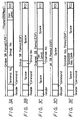
- Figs. 3A to 3E Five kinds of frame formats in which the service bits SB are used to transmit control data are shown in Figs. 3A to 3E. More particularly, a unique service format (USF) is shown in Fig. 3A, a group service format (GSF) is shown in Fig. 3B, a channel service format (CSF) is shown in Fig. 3C, an all service format (ASF) is shown in Fig. 3D, and a scrambling key code format (SKF) is sown in Fig. 3E.
- USF unique service format
- GSF group service format
- CSF channel service format
- ASF all service format
- SBF scrambling key code format
- the legend "Header” refers to a portion of the format which identifies the kind of the respective format; and, in each of Figs. 3A,3B,3D and 3E, the legend “Command” refers to the portion of the format by which a television receiver is commanded to operate.
- the legend "Group No.” refers to the number of a group of receivers having a common characteristic, such as, the area in which the television receivers are situated, or the occupations of the subscribers, or the like.
- the legend "Terminal No.” refers to the address number assigned to a particular television receiver.
- the legend "Tier Level” refers to the condition of the contract for the respective subscriber or television receiver. For example, if the "Tier Level" of the contract is below a predetermined level, the television receiver covered by such contract will be able to receive a broadcast or transmitted signal which is being transmitted on a data channel, such as, a music broadcasting channel, identified in the portion of the format indicated by the legend "Channel No.” on Fig. 3C.
- the legend "Scramble Key Code” identifies a portion of the respective format in which will appear scramble key data, for example, data representing an initial value of an M-sequence code used for descrambling data, as hereinafter described.
- the legend ECC designates an error check code.
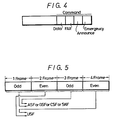
- the "Command” indicated on Figs. 3A, 3B,3D and 3E may be any one of the commands shown on Fig. 4, that is, a command "Emergency”, to start emergency 0162461 broadcasting a command "Announce”, to announce broadcasting, a command "FAX” to start facsimile reception , or a command "DATA" to start the loading of data .
- the formats ASF (Fig. 3D), GSF (Fig. 3B), CSF (Fig. 3C) and SKF (Fig. 3E) are delivered alternately, while, during the second or even-numbered frame, the format USF (Fig. 3A) is delivered alone.
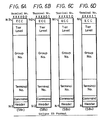
- the manner in which the unique service format (USF) of Fig. 3A is assigned to each television receiver in a memory is illustrated in Figs. 6A to 6D.
- the unique service format of Fig. 6A is assigned to that receiver in the memory for transmission on a service bit SB 1 .
- the unique service format shown in Fig. 6B is assigned to the respective receiver in the memory for transmission on a service bit SB 2 ; when the "Terminal No.” is “10”, the unique service format shown in Fig. 6C is assigned to the memory for transmission on service bit SB 3 ; and, when the "Terminal No.” is “11”, the unique service format shown in Fig. 6D is assigned to the memory for transmission on service bit SB 4 .
- the four unique service formats (USF) illustrated on Figs. 6A to 6D, respectively are different in their contents with the exception of the headers thereof which merely identify the formats as being of the USF type.
- the reference letter N indicates an address in the memory
- the reference letter L indicates the length of the respective unique service format.
- control data for controlling a receiver are added to the service bits will be described separately for the transmitter and the receiver.
- memories 17a,17b,17c corresponding to the all service format (ASF), the channel service format (CSF), and the scrambling key format (SKF), respectively, a group information memory 18 corresponding to the group service format (GSF), and a unique information memory 19 corresponding to the unique service format (USF).
- ASF all service format
- CSF channel service format
- SSF scrambling key format
- GSF group information memory 18
- USB unique information memory 19
- the memory map for the individual information is as shown in Fig. 3A.
- the service bit SB 1 has added thereto the unique service format (USF) shown in Fig. 6A
- the service bit SB 2 has added thereto the unique service format (USF) shown in Fig. 6B
- the service bit SB 3 has added thereto the unique service format ( U SF) shown in Fig. 6C
- the service bit SB. has added thereto the unique service format (USF) shown in Fig. 6D.
- the unique service format is added to the service bit and the data is addressed at high speed, the unique service format is transmitted in an even frame period as shown in Fig. 5.
- the cycle of the unique service format in Fig. 3A can become long depending on the number of television receivers.
- group service format contains vacant spaces, as in Fig. 3B so that the cycle of the group service format is very much shorter than that of the unique service format, and transmission at high speed becomes possible.
- Such service bit corresponding to the address number of the receiver is input thereto within one frame period in synchronism with the frame sync signal.
- the sampling of data and the error checking of data can easily be carried out by utilizing the serial port of a microcomputer or microprocessor constituting a controller at the receiver side.
- the data portion is produced and its data format is as shown in the respective one of Figs. 3A to 3E.
- the data sampled in a frame period will be in accordance with one of the formats shown in Figs. 3A to 3E.
- the unique service format (USF) and the other service formats (GSF,CSF,ASF and SKF) are alternately transmitted and these formats are discriminated from one another by the header that is inserted in the start portion of each format.
- a receiver having an address number coincident with that specified by the (Terminal No.) of the format (USF) memorizes the group number specified by the (Group No.) and the level specified by the (Tier Level) and executes the processing specified by the (Command).
- the tier level of the data channel (music broadcasting and so on) to be transmitted by the system embodying this invention is specified in all the receivers. Service for the user is commenced only when the tier level of the channel selected by the user coincides with the tier level specified by the unique service format (USF) and which has been stored therein.
- CSF channel service format
- USF unique service format
- the processing corresponding to the specified command is carried out regardless of the Terminal No.
- the data is descrambled by the specified scramble key code. It is to be noted that the above-described scramble key format (SKF) may be transmitted as a part of the all service format (ASF).
- analog information or data for example, constituting a stereo music signal
- Analog information or data comprised of broadcast communications and announcements is supplied to input terminals 3 and 4.
- Facsimile information or data is supplied to an input terminal 5
- digital information or data such as, that constituting game software and the like, is supplied to an input terminal 6.
- the analog data from input terminals 1 to 4 are supplied to, and converted digital signals by, analog-to-digital converters (hereinafter simply A/D converters) 7 to 10, respectively.
- A/D converters analog-to-digital converters
- the respective digital signals are applied to a multiplexer 12, while the facsimile signal from input terminal 5 is also supplied through a facsimile interface circuit 11 to multiplexer 12.
- the digital data from input terminal 6 is supplied as is to multiplexer 12.
- the input signals are distributed into respective individual channels and subjected to signal processings, such as, the addition of error check codes, bit-interleaving and so on and then delivered therefrom.
- the output signal from multiplexer 12 is supplied to one input terminal of a multiplier 13 and therein multiplied with an M-sequence code signal supplied to another input terminal of multiplier 13 from an M-sequence code oscillator 14.
- M-sequence code oscillator 14 the output signal from multiplexer 12 is scrambled. If n is taken as the stage number of shift register in the M-sequence code oscillator 14, the latter has 2 n- 1 bits as the length of its maximum sequence. As shown more particularly in Fig.
- M-sequence code oscillator 14 comprises a shift register 14a which is formed of a D-type flip-flop, for example, of three stages, and a logic circuit which feeds back a logic value representative of the state of each stage to input terminal SI of the shift register 14a.
- Such logic circuit is shown to include an exclusive-OR (hereinafter referred to as EOR) circuit 14b.
- EOR exclusive-OR
- the M-sequence code oscillator 14 produces an M-sequence code of seven cycles, each cycle being represented as "1110100".
- the frequency of the clock signal supplied to the clock terminal CK for use in shifting register 14a is set properly and the initial phase of the M-sequence code is determined by a frame synchronizing pulse that is supplied from a terminal LP to the load terminal L of shift register 14a.
- a predetermined preset signal for example, "111" is set at preset terminal A,B and C of shift register 14a.
- the frame synchronizing pulse and a PN (pseudo noise) code of the M-sequence code oscillator 14 are in phase coincidence with each other.
- the output pulse of seven cycles, such as, "1110100" produced from the M-sequence code oscillator 14 is multiplied with the output of multiplexer 12 so that the multiplier 13 produces data scrambled by the M-sequence code.
- the data and error check code thus scrambled is supplied to a sync/SB (service bit) generator 15 in which the synchronizing signal and the service bits are added to the scrambled data and error check code.
- a controller 16 which may be a microcomputer or microprocessor, outputs from memories 17a,17b,17c,18 and 19 are respectively fed to the sync/SB generator 15 and there selectively added to the service bits.
- the initial value (scramble key data of the M-sequence code oscillator 14 is set by controller 16 in synchronism with the frame synchronizing signal. This initial value is changed constantly from time to time in order to increase security.
- the filter 20 is used as an equalizer for matching the frequency characteristics of the whole transmitting- receiving system, thereby to remove inter symbol interference.
- A/M-modulator 21 the carrier from an oscillator 22 is modulated by the output signal from filter 20. Accordingly, modulator 21 produces, at its output, an intermediate frequency signal and this signal is supplied through a vestigial side-band filter 23 to a mixing circuit 24. In mixing circuit 24, the intermediate frequency signal is mixed with the local oscillation frequency signal from a local oscillating circuit 25 and is thereby frequency-converted.
- the local oscillation frequency of local oscillating circuit 25 is set higher than a transmitting frequency of a desired channel by the value of the intermediate frequency. Accordingly, the transmission channel is determined by selected the local oscillation frequency.
- the output signal from mixing circuit 24 is delivered through a band-pass filter 26 to an output terminal 27 and the signal developed at the output terminal 27 is transmitted to a so-called head end (not shown) of the cable or CATV system.
- the signal from the head end is transmitted through a CATV transmission line (not shown) to the receiving side.
- the signal transmitted through the CATV transmission line is supplied through an input terminal 31 at the receiving side to a front end 32 in which it is amplified and then converted to an intermediate frequency signal of a predetermined frequency.
- This intermediate frequency signal is supplied to an AM detector, for example, a PLL (phase-locked loop) detector 33, which then demodulates a base band signal.
- the detector may be of the type of Am detector that is normally used in a standard television system, it is preferable to use the mentioned PLL detector 33 in order to avoid any waveform distortion.
- a part of the output signal from PLL detector 33 is supplied to an AGC (automatic gain control) circuit 34 which applies an automatic gain control signal to front end 32.
- AGC automatic gain control
- the output from the PLL detector 33 is supplied to a data recovery circuit 35 in which, on the basis of a clock signal reproduced from the output of the PLL detector 33 by a clock recovery circuit 36, the level of the input signal to circuit 35 is discriminated by the center level of an eye pattern to thereby produce digital data.
- the data thus produced or recovered in circuit 35 is supplied it asucceeding sync/SB separator 37 in which the synchronizing signal and the service bits are separated from the data and supplied to a controller 38.
- the controller 38 which is desirably a microprocessor or microcomputer is adapted to carry out various control operations in synchronism with the synchronizing signal and the control data added to the service bit is stored through the controller 38 in a memory 39.
- the data output from the sync/SB separator 37 is supplied to one input terminal of a multiplier 40 and multiplied in the latter by an M-sequence code signal supplied to the other input terminal of multiplier 40 from an M-sequence code oscillator 41 which may be similar to M-sequence code oscillator 14 of Fig. 7B.
- M-sequence code oscillator 41 which may be similar to M-sequence code oscillator 14 of Fig. 7B.
- the data from multiplier 40 is supplied to a de-multiplexer 42 in which it is subjected to signal processing, such as, rearrangement of data (bit-deinterleaving), error correction and so on.
- the digital signals from de-multiplexer 42 are supplied through switches 43 and 44 to digital-to-analog (D/A) converters 45 and 46, respectively, in which they are converted from digital-to-analog signals and then delivered to output terminals 47 and 48, respectively.
- D/A digital-to-analog
- a facsimile signal is obtained from de-multiplexer 42, such facsimile signal is delivered through a facsimile interface circuit 49 to an output terminal 50.
- digital data such as game software and so on, is directly delivered from de-multiplexer 42 to an output terminal 51.
- the digital signal transmitting system is simple in circuit arrangement and descrambling is possible only when the receiving side is synchronized with the transmitting side so that digital signal transmission of very high security becomes possible.
- the scrambling can be effected at high speed. Furthermore, since the descramble key data (scramble key format) is serially transmitted by utilizing the service bit, such data can be descrambled with ease and at high speed in the receiving side.
- the scramble key data is always transmitted with a cycle shorter than that of the individual data, such as unique service format and so on, the changed scramble key data can be reset immediately.
Landscapes
- Engineering & Computer Science (AREA)
- Signal Processing (AREA)
- Multimedia (AREA)
- Physics & Mathematics (AREA)
- Spectroscopy & Molecular Physics (AREA)
- Computer Networks & Wireless Communication (AREA)
- Time-Division Multiplex Systems (AREA)
- Two-Way Televisions, Distribution Of Moving Picture Or The Like (AREA)
Applications Claiming Priority (2)
| Application Number | Priority Date | Filing Date | Title |
|---|---|---|---|
| JP59105188A JPS60248042A (ja) | 1984-05-24 | 1984-05-24 | デイジタル伝送システム |
| JP105188/84 | 1984-05-24 |
Publications (3)
| Publication Number | Publication Date |
|---|---|
| EP0162461A2 true EP0162461A2 (de) | 1985-11-27 |
| EP0162461A3 EP0162461A3 (en) | 1987-12-23 |
| EP0162461B1 EP0162461B1 (de) | 1992-07-22 |
Family
ID=14400696
Family Applications (1)
| Application Number | Title | Priority Date | Filing Date |
|---|---|---|---|
| EP85106302A Expired - Lifetime EP0162461B1 (de) | 1984-05-24 | 1985-05-22 | Übertragungssystem für digitale Signale |
Country Status (6)
| Country | Link |
|---|---|
| EP (1) | EP0162461B1 (de) |
| JP (1) | JPS60248042A (de) |
| KR (1) | KR930009869B1 (de) |
| AU (1) | AU583268B2 (de) |
| CA (1) | CA1244154A (de) |
| DE (1) | DE3586370T2 (de) |
Cited By (5)
| Publication number | Priority date | Publication date | Assignee | Title |
|---|---|---|---|---|
| EP0242121A3 (en) * | 1986-04-10 | 1989-07-26 | Sony Corporation | Synchronising systems for digital apparatus |
| EP0389689A1 (de) * | 1989-03-28 | 1990-10-03 | POLYGRAM MANUFACTURING & DISTRIBUTION CENTRES GMBH | Verfahren zur Übertragung eines Übertragungssignals und eine Übertragungsvorrichtung und eine Empfangseinrichtung zur Anwendung in dem Verfahren |
| EP0779738A3 (de) * | 1995-12-15 | 1997-12-03 | Hitachi, Ltd. | Kommunikationsgerät und verfahren |
| FR2759223A1 (fr) * | 1997-01-31 | 1998-08-07 | Canon Kk | Procede et dispositif de diffusion de symboles d'information et procede et dispositif de reception de symboles d'information |
| US5850058A (en) * | 1995-11-17 | 1998-12-15 | Hitachi, Ltd. | Information processor |
Families Citing this family (1)
| Publication number | Priority date | Publication date | Assignee | Title |
|---|---|---|---|---|
| JPH0685517B2 (ja) * | 1985-06-28 | 1994-10-26 | ソニー株式会社 | 情報サ−ビスシステム |
Family Cites Families (6)
| Publication number | Priority date | Publication date | Assignee | Title |
|---|---|---|---|---|
| DE3126880A1 (de) * | 1981-07-08 | 1983-01-27 | Licentia Gmbh | Digitales signaluebertragungssystem, insbesondere fuer satelliten-rundfunk |
| DE3146466A1 (de) * | 1981-11-24 | 1983-09-01 | AEG-Telefunken Nachrichtentechnik GmbH, 7150 Backnang | "verfahren zur buendelung von tonrundfunk-signalen" |
| JPS59174080A (ja) * | 1983-03-24 | 1984-10-02 | Sony Corp | テレビジヨン信号受信装置 |
| MX155858A (es) * | 1983-06-10 | 1988-05-11 | Gen Instrument Corp | Mejoras a convertidor programable-direccionable usado en un sistema de distribucion de television por cable de dos vias |
| JPS60103748A (ja) * | 1983-11-09 | 1985-06-08 | Sony Corp | デイジタル信号伝送方式 |
| JPH0654973B2 (ja) * | 1983-11-09 | 1994-07-20 | ソニー株式会社 | Catvラインを使用したデジタル信号の伝送装置 |
-
1984
- 1984-05-24 JP JP59105188A patent/JPS60248042A/ja active Pending
-
1985
- 1985-05-21 AU AU42721/85A patent/AU583268B2/en not_active Ceased
- 1985-05-22 CA CA000482059A patent/CA1244154A/en not_active Expired
- 1985-05-22 DE DE8585106302T patent/DE3586370T2/de not_active Expired - Fee Related
- 1985-05-22 EP EP85106302A patent/EP0162461B1/de not_active Expired - Lifetime
- 1985-05-24 KR KR1019850003589A patent/KR930009869B1/ko not_active Expired - Fee Related
Cited By (6)
| Publication number | Priority date | Publication date | Assignee | Title |
|---|---|---|---|---|
| EP0242121A3 (en) * | 1986-04-10 | 1989-07-26 | Sony Corporation | Synchronising systems for digital apparatus |
| EP0389689A1 (de) * | 1989-03-28 | 1990-10-03 | POLYGRAM MANUFACTURING & DISTRIBUTION CENTRES GMBH | Verfahren zur Übertragung eines Übertragungssignals und eine Übertragungsvorrichtung und eine Empfangseinrichtung zur Anwendung in dem Verfahren |
| US5850058A (en) * | 1995-11-17 | 1998-12-15 | Hitachi, Ltd. | Information processor |
| EP0779738A3 (de) * | 1995-12-15 | 1997-12-03 | Hitachi, Ltd. | Kommunikationsgerät und verfahren |
| US6069956A (en) * | 1995-12-15 | 2000-05-30 | Hitachi, Ltd | Method and apparatus for encrypting multiplexed data streams using key information continued in streams |
| FR2759223A1 (fr) * | 1997-01-31 | 1998-08-07 | Canon Kk | Procede et dispositif de diffusion de symboles d'information et procede et dispositif de reception de symboles d'information |
Also Published As
| Publication number | Publication date |
|---|---|
| JPS60248042A (ja) | 1985-12-07 |
| DE3586370D1 (de) | 1992-08-27 |
| DE3586370T2 (de) | 1993-03-11 |
| AU583268B2 (en) | 1989-04-27 |
| EP0162461A3 (en) | 1987-12-23 |
| AU4272185A (en) | 1985-11-28 |
| KR930009869B1 (ko) | 1993-10-12 |
| CA1244154A (en) | 1988-11-01 |
| EP0162461B1 (de) | 1992-07-22 |
| KR850008766A (ko) | 1985-12-21 |
Similar Documents
| Publication | Publication Date | Title |
|---|---|---|
| EP0144801B1 (de) | Digitales Datenübertragungssystem | |
| EP0144770B1 (de) | CATV Signal-Übertragungssystem und zugehöriges Empfangssystem | |
| CA1215165A (en) | Digital signal transmitting and/or receiving system | |
| AU595037B2 (en) | A digital signal transmitting system | |
| US4710921A (en) | Digital signal transmitting system | |
| CA2003763C (en) | Apparatus and method for providing digital audio in the fm broadcast band | |
| US4689661A (en) | Method of simultaneously transmitting a plurality of television signals on a single radio link and apparatus adapted to carry out said method | |
| CA1284220C (en) | Synchronizing system for digital apparatus | |
| JPH0219656B2 (de) | ||
| US4665427A (en) | Method and apparatus for converting C-MAC television signals for transmission over a limited bandwidth medium | |
| US4706109A (en) | Television transmission system | |
| EP0162461A2 (de) | Übertragungssystem für digitale Signale | |
| JPS61281633A (ja) | 音楽放送システム | |
| WO1992022987A1 (en) | System for broadband descrambling of sync suppressed television signals | |
| JPS61281634A (ja) | 音楽放送システム | |
| US4829377A (en) | Horizontal synchronization, clock synchronization, D. C. restoration and gain control scheme for an analog TV system | |
| JPH0614277A (ja) | テレビジョン受信装置 | |
| GB2145610A (en) | Television transmission systems | |
| JPH0531332B2 (de) | ||
| GB2137843A (en) | Television Transmission Systems | |
| CN1008042B (zh) | 数字信号发送系统 | |
| JPS60248046A (ja) | デイジタル伝送システムにおける受像機のアドレス方式 | |
| CA1258521A (en) | Digital signal transmitting system | |
| JPH0531333B2 (de) | ||
| JPS5916439A (ja) | Catvラインを用いたデイジタル信号伝送方式 |
Legal Events
| Date | Code | Title | Description |
|---|---|---|---|
| PUAI | Public reference made under article 153(3) epc to a published international application that has entered the european phase |
Free format text: ORIGINAL CODE: 0009012 |
|
| AK | Designated contracting states |
Designated state(s): DE FR GB NL |
|
| PUAL | Search report despatched |
Free format text: ORIGINAL CODE: 0009013 |
|
| AK | Designated contracting states |
Kind code of ref document: A3 Designated state(s): DE FR GB NL |
|
| 17P | Request for examination filed |
Effective date: 19880623 |
|
| 17Q | First examination report despatched |
Effective date: 19900809 |
|
| GRAA | (expected) grant |
Free format text: ORIGINAL CODE: 0009210 |
|
| AK | Designated contracting states |
Kind code of ref document: B1 Designated state(s): DE FR GB NL |
|
| REF | Corresponds to: |
Ref document number: 3586370 Country of ref document: DE Date of ref document: 19920827 |
|
| ET | Fr: translation filed | ||
| PLBE | No opposition filed within time limit |
Free format text: ORIGINAL CODE: 0009261 |
|
| STAA | Information on the status of an ep patent application or granted ep patent |
Free format text: STATUS: NO OPPOSITION FILED WITHIN TIME LIMIT |
|
| 26N | No opposition filed | ||
| PGFP | Annual fee paid to national office [announced via postgrant information from national office to epo] |
Ref country code: DE Payment date: 19950523 Year of fee payment: 11 |
|
| PGFP | Annual fee paid to national office [announced via postgrant information from national office to epo] |
Ref country code: NL Payment date: 19950531 Year of fee payment: 11 |
|
| PG25 | Lapsed in a contracting state [announced via postgrant information from national office to epo] |
Ref country code: NL Effective date: 19961201 |
|
| PG25 | Lapsed in a contracting state [announced via postgrant information from national office to epo] |
Ref country code: DE Effective date: 19970201 |
|
| NLV4 | Nl: lapsed or anulled due to non-payment of the annual fee |
Effective date: 19961201 |
|
| REG | Reference to a national code |
Ref country code: GB Ref legal event code: IF02 |
|
| PGFP | Annual fee paid to national office [announced via postgrant information from national office to epo] |
Ref country code: FR Payment date: 20040510 Year of fee payment: 20 |
|
| PGFP | Annual fee paid to national office [announced via postgrant information from national office to epo] |
Ref country code: GB Payment date: 20040519 Year of fee payment: 20 |
|
| PG25 | Lapsed in a contracting state [announced via postgrant information from national office to epo] |
Ref country code: GB Free format text: LAPSE BECAUSE OF EXPIRATION OF PROTECTION Effective date: 20050521 |
|
| REG | Reference to a national code |
Ref country code: GB Ref legal event code: PE20 |