EP0163499A2 - Einspritz- oder "Transfer"-Giessen - Google Patents
Einspritz- oder "Transfer"-Giessen Download PDFInfo
- Publication number
- EP0163499A2 EP0163499A2 EP85303672A EP85303672A EP0163499A2 EP 0163499 A2 EP0163499 A2 EP 0163499A2 EP 85303672 A EP85303672 A EP 85303672A EP 85303672 A EP85303672 A EP 85303672A EP 0163499 A2 EP0163499 A2 EP 0163499A2
- Authority
- EP
- European Patent Office
- Prior art keywords
- mould
- moulding
- chamber
- polymerisation
- injection
- Prior art date
- Legal status (The legal status is an assumption and is not a legal conclusion. Google has not performed a legal analysis and makes no representation as to the accuracy of the status listed.)
- Withdrawn
Links
- 239000007924 injection Substances 0.000 title claims abstract description 22
- 238000001746 injection moulding Methods 0.000 title claims description 9
- 238000001721 transfer moulding Methods 0.000 title description 2
- 238000000465 moulding Methods 0.000 claims abstract description 36
- 238000000034 method Methods 0.000 claims abstract description 31
- 238000002347 injection Methods 0.000 claims abstract description 20
- 230000000694 effects Effects 0.000 claims abstract description 8
- 239000000203 mixture Substances 0.000 claims abstract 2
- 239000000463 material Substances 0.000 claims description 32
- 238000004519 manufacturing process Methods 0.000 claims description 7
- VVQNEPGJFQJSBK-UHFFFAOYSA-N Methyl methacrylate Chemical compound COC(=O)C(C)=C VVQNEPGJFQJSBK-UHFFFAOYSA-N 0.000 claims description 6
- 229920001577 copolymer Polymers 0.000 claims description 5
- 239000012530 fluid Substances 0.000 claims description 5
- 239000011324 bead Substances 0.000 claims description 4
- NIXOWILDQLNWCW-UHFFFAOYSA-N Acrylic acid Chemical class OC(=O)C=C NIXOWILDQLNWCW-UHFFFAOYSA-N 0.000 claims description 3
- 230000003028 elevating effect Effects 0.000 claims description 2
- 238000010438 heat treatment Methods 0.000 claims description 2
- 238000003825 pressing Methods 0.000 claims description 2
- 238000009877 rendering Methods 0.000 claims description 2
- 230000000717 retained effect Effects 0.000 claims description 2
- CERQOIWHTDAKMF-UHFFFAOYSA-N Methacrylic acid Chemical compound CC(=C)C(O)=O CERQOIWHTDAKMF-UHFFFAOYSA-N 0.000 claims 2
- SMZOUWXMTYCWNB-UHFFFAOYSA-N 2-(2-methoxy-5-methylphenyl)ethanamine Chemical compound COC1=CC=C(C)C=C1CCN SMZOUWXMTYCWNB-UHFFFAOYSA-N 0.000 claims 1
- 150000002148 esters Chemical class 0.000 claims 1
- 230000000063 preceeding effect Effects 0.000 claims 1
- 239000004575 stone Substances 0.000 abstract description 9
- 229920000642 polymer Polymers 0.000 abstract description 5
- 239000000178 monomer Substances 0.000 abstract description 4
- XLYOFNOQVPJJNP-UHFFFAOYSA-N water Substances O XLYOFNOQVPJJNP-UHFFFAOYSA-N 0.000 description 9
- 238000009835 boiling Methods 0.000 description 5
- 238000006243 chemical reaction Methods 0.000 description 4
- 229910052602 gypsum Inorganic materials 0.000 description 4
- 239000010440 gypsum Substances 0.000 description 4
- LYCAIKOWRPUZTN-UHFFFAOYSA-N Ethylene glycol Chemical compound OCCO LYCAIKOWRPUZTN-UHFFFAOYSA-N 0.000 description 3
- 239000003795 chemical substances by application Substances 0.000 description 3
- 210000003739 neck Anatomy 0.000 description 3
- 239000011347 resin Substances 0.000 description 3
- 229920005989 resin Polymers 0.000 description 3
- 239000004925 Acrylic resin Substances 0.000 description 2
- 229920000178 Acrylic resin Polymers 0.000 description 2
- 239000011248 coating agent Substances 0.000 description 2
- 238000000576 coating method Methods 0.000 description 2
- 239000003599 detergent Substances 0.000 description 2
- 238000011038 discontinuous diafiltration by volume reduction Methods 0.000 description 2
- 230000000750 progressive effect Effects 0.000 description 2
- FHVDTGUDJYJELY-UHFFFAOYSA-N 6-{[2-carboxy-4,5-dihydroxy-6-(phosphanyloxy)oxan-3-yl]oxy}-4,5-dihydroxy-3-phosphanyloxane-2-carboxylic acid Chemical compound O1C(C(O)=O)C(P)C(O)C(O)C1OC1C(C(O)=O)OC(OP)C(O)C1O FHVDTGUDJYJELY-UHFFFAOYSA-N 0.000 description 1
- 229940072056 alginate Drugs 0.000 description 1
- 229920000615 alginic acid Polymers 0.000 description 1
- 235000010443 alginic acid Nutrition 0.000 description 1
- 230000006835 compression Effects 0.000 description 1
- 238000007906 compression Methods 0.000 description 1
- 238000000748 compression moulding Methods 0.000 description 1
- 238000010276 construction Methods 0.000 description 1
- 230000001276 controlling effect Effects 0.000 description 1
- 229920006158 high molecular weight polymer Polymers 0.000 description 1
- 239000007788 liquid Substances 0.000 description 1
- 230000007774 longterm Effects 0.000 description 1
- 230000013011 mating Effects 0.000 description 1
- 239000002184 metal Substances 0.000 description 1
- 238000005498 polishing Methods 0.000 description 1
- 230000001105 regulatory effect Effects 0.000 description 1
- 238000000820 replica moulding Methods 0.000 description 1
- 239000000344 soap Substances 0.000 description 1
- 229920002994 synthetic fiber Polymers 0.000 description 1
Images

Classifications
-
- A—HUMAN NECESSITIES
- A61—MEDICAL OR VETERINARY SCIENCE; HYGIENE
- A61C—DENTISTRY; APPARATUS OR METHODS FOR ORAL OR DENTAL HYGIENE
- A61C13/00—Dental prostheses; Making same
- A61C13/12—Tools for fastening artificial teeth; Holders, clamps, or stands for artificial teeth
- A61C13/14—Vulcanising devices for artificial teeth
-
- A—HUMAN NECESSITIES
- A61—MEDICAL OR VETERINARY SCIENCE; HYGIENE
- A61C—DENTISTRY; APPARATUS OR METHODS FOR ORAL OR DENTAL HYGIENE
- A61C13/00—Dental prostheses; Making same
- A61C13/01—Palates or other bases or supports for the artificial teeth; Making same
- A61C13/04—Palates or other bases or supports for the artificial teeth; Making same made by casting
-
- A—HUMAN NECESSITIES
- A61—MEDICAL OR VETERINARY SCIENCE; HYGIENE
- A61C—DENTISTRY; APPARATUS OR METHODS FOR ORAL OR DENTAL HYGIENE
- A61C13/00—Dental prostheses; Making same
- A61C13/20—Methods or devices for soldering, casting, moulding or melting
- A61C13/206—Injection moulding
Definitions
- This invention relates to the injection or trahsfer moulding of polymerisable resins and relates more especially but not exclusively to accurate and reliable moulding of bases for dentures.
- German Patent Specification No. 2312934 describes another method where the enclosure for a denture mould creates a temperature gradient when it is partially immersed in boiling water.
- the apparatus is such that polymerisation commences at points furthest from an injection channel and as this progresses the shrinkage of the resin is intended to be conpensated by a flow of more material which enters the mould under pressure from a store.
- the temperature of 100°C is maintained for 35 minutes.
- the moulds are highly stressed by the apparatus and the operating conditions of this method which in practice can frequently lead to distortion or even fracture of the moulds and surface quality and impact strength of resultant mouldings leaves much to be desired.
- a method of making mouldings by the injection of polymerisable moulding material into a mould comprising the steps of preparing a said mould to have a mould space of a desired shape and dimensions, rendering the inner surfaces of the mould space releasable from the moulding to be made, connecting the mould space to a container of said material, applying pressure to the said material to inject the material into the mould space and elevating the temperature thereof to effect polymerisation characterised by the step of raising the temperature of said mould being a temperature rise to a value (typically 66°C) only sufficiently high to cause controlled polymerisation without appreciable exothermal effects until a desired material density has been achieved and only then finishing the polymerisation process (typically by raising the temperature of said mould to an appreciably higher temperature).
- a value typically 66°C
- the invention further provides injection moulding apparatus characterised by a chamber formed between two closure members for forming and containing a mould said chamber having means for injecting moulding material in fluid form under pressure into a mould space of a mould contained in said chamber.
- said chamber is formed between two mutually facing detachable closure plates spaced apart by a body extending around the sides of the mould between the closure plates and a part of said body being outwardly moveable relative to the remainder to permit the mould to be replaceably released from the internal surface of the chamber.
- a mouth impression is first reproduced in a dental stone model material and artificial teeth are set in wax to form a replica denture. After trial fitment of this wax denture in the mouth of the patient, it is then sealed with wax to the stone model cast whose base is set in a gypsum investment with the teeth protruding from half of a denture flask. When the investment has hardened, the surfaces are coated with a separating medium. The remaining half of the denture flask is filled with more gypsum investment and assembled with the first part containing the wax replica denture for moulding.
- the complete denture flask is next immersed in boiling water for a short period, the two halves separated and the wax eliminated with boiling water and detergent. All surfaces, apart from the teeth, are coated with a mould sealer prior to moulding the acrylic resin in the flask by compression.
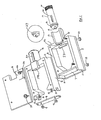
- the mould is made in a flask in the form of a mould container such as is shown dismantled in Figs 1 and 2.
- the mould container comprises body parts 1 and 2 having side parts 3 and 4 with closely mating surfaces such that when placed together they form a box which can be closed on each side by closely fitting metal plates 5 and 6.
- One end of body part 1 is closed by the vertical plate 7 set at right angles to and screwed pe rmanen t l yto the rigid plate 5.
- the corresponding end of body part 2 is closeable by an end plate 8 that may be fitted and attached by nuts 9 and screw studs 10 following the final filling of the mould container with mould investment material through the opening between container ends 12.
- the body parts 1 and 2 and side parts 3 and 4 are formed of a polymer which is slightly flexible and permits the ends 11 of body side parts 3 and the ends 12 of body side parts 4 to be slightly sprung apart manually, after removal of the closure plates, for release and easy removal of the mould.
- Each of body parts 1 and 2 has a neck 13 and 14, the interior of which is shaped with an annular recess 15 to receive an annular flange 16 of a cylinder housing 17 which contains an injection cylinder 18 with an injection nozzle 19 to extend into the interior of the mould container when assembled.
- Parts 1 and 2 also have respective inward projections 27 and 28 which act to retard temperature rise in the region of the injection nozzle.
- the cylinder housing 17 is provided with a window 20 having graduations against which the progressive movement of a piston 25 can be observed and measured in the injection cylinder 18 which is transparent.
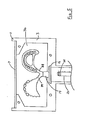
- Fig. 3 shows one view of a complete assembly wherein it is to be seen that the cylinder housing 17 is assembled into the body necks 13 and 14 and a screw-on fluid pressure operable actuator 31 is attached to the threaded end 21 of the cylinder housing 17.
- This actuator 31 drives the piston 25 within the injection cylinder 18 when contained in the cylinder housing 17.
- pressure is applied initially from a compressed air line through a quick release connector and valve 32. After a desired pressure has been established by a pressure gauge 33 the connector and valve 32 can be released from the air line and the apparatus removed with retained pressure for polymerisation.
- the finally adjusted wax replica denture sealed to a stone model cast (ADA Spec. Type IV) is invested in a low expansion gypsum mould material which is levelled off to the upper surface of body extensions 3, whilst the wax denture and teeth are left projecting from the surface.
- a stone model cast (ADA Spec. Type IV)
- Fig. 4 where the wax replica moulding is also shown connected to the injection nozzle 19 by a wax connecting sprue 26 but the sprue may be formed later if desired.
- the exposed surfaces of the gypsum investment are treated with soap as a release agent prior to coating all wax surfaces and the artificial teeth with a 4mm. layer of dental stone (ADA Spec.
- Type IV which is allowed to harden for 15 minutes.
- the mould container is then assembled as indicated in Fig. 1 with a dummy nozzle (shown inset at 29) to occupy the aperture at 19a. It is then filled with investment whilst supported upright with the body necks 13 and 14 downward before the plate 8 is placed in position on studs 10.
- the nuts 9 are left loosely threaded in position to allow for some setting expansion.
- the completed mould may be released from the container after setting by removing the plates 5 and 7, 6 and 8, gently prising apart ends 11 of body extensions 3 and ends 12 of body extensions 4 and lifting body parts 1 and 2 a2ay from the contained mould. This releases the cylinder housing 17 and injection cylinder 18 from the retaining groove 15.
- the mould container may then be used to prepare further such moulds if required.
- Each mould so prepared now has the wax removed by immersing in warm water (52°C) for 30 minutes before separating into two halves.
- the softened wax is taken out of the mould and any residue eliminated by thoroughly cleansing with boiling water and detergent.
- a connecting sprue 26 has not been previously formed in a wax, a channel can be cut with a 6mm. carbide drill in order that moulding material will flow from the injection cylinder 18 into the moulding cavity.
- the two mould halves or mould stones are held together and the moulding volume measured by filling the davity with water through the sprue channel from a graduated syringe. All surfaces of the mould stones are then thoroughly dried prior to coating the moulding surfaces with three layers of an alginate sealer as a moulding release agent.
- the mould stones are returned to the body parts 1 and 2 and the mould container re-assembled according to Fig.1 including the cylinder housing 17.
- a measured quantity of a rubber grafted co-polymer of methylmethacrylate in the form of beads is mixed with a methylmethacrylate monomer, in a ratio of 3:1 by volume and transferred to the injection cylinder 18.
- the methylmethacrylate monomer has a suitable proportion of ethylene glycol dimetheylacrylate as across linking agent.
- the excess air is expelled by condensing the material with a piston 25 and sufficient time is allowed for the beads to become at least partially dissolved in monomer.
- the injection cylinder is then placed with the cylinder housing 17 and the fluid pressure operable actuator 31 is screwed in position on thread 21.
- the air pressure within the actuator 31 is gradually raised to sufficient pressure to inject the moulding cavity with the material from the injection cylinder.
- the pressure is then approximately doubled to about 90 p.s.i. and the apparatus is allowed to stand for a period of five minutes to ensure complete filling of the mould.
- the apparatus is next disconnected from the air line whilst the quick-release connection and valve 32 ensures that the pressure is maintained and the container body is immersed in water to the mark 24 on plate 6 at a temperature, typically 66 0 , being a temperature at which a controlled slow polymerisation is supported without any substantial rapid exother mic reaction.
- a temperature typically 66 0
- a progressive volume reduction is observed through the window 20 over a period, typically two hours, depending upon the moulding volume.
- the water temperature is raised to near boiling for a further period of one hour during which further curing takes place.
- the whole assembly is then cooled slowly to room temperature.
- the mould is then removed from the container and the investment carefully broken apart to release the denture which has an exceptionally fine surface requiring very little polishing.
- two denture base models may be embedded in the same mould in one mould container.
- Two passages 38, 39 may be provided from the single injection nozzle 19 as shown for the purpose of simultaneous production by injection moulding and polymerisation of two denture bases. The procedure is substantially as described in the foregoing for a single denture base.
- the body of the actuator 31 may be fabricated from a transparent polymer through which movement of the actuator piston within may be observed against a measuring scale as described in the foregoing in the use of the apparatus.
- the plates such as 6 and 7 of Fig. 1 may be provided with contained electrical heating elements and a suitable thermo-electrically operable temperature control device.
- a convenient and relatively inexpensive injection moulding apparatus may be provided which not only enables a quantity of moulds successively to be produced in the same apparatus, removed for dewaxing and subsequent replacement in the mould container for moulding but it is found that stressing of the mould and the resultant moulding can be appreciably reduced.
- the first part of the polymerisation process is best effected at a temperature of approximately 66°C. It will be appreciated however that with alternative materials a different preferred temperature at which a rapid exothermic reaction does not occur may be selected.
- the impact strength, resilience and long-term dimensional stability of a denture base produced by a method in accordance with the invention is further enhanced by the novel use of a specifically chosen rubber grafted copolymer of methylmethacrylate in bead form as a denture base material. Resulting denture bases are better tolerated by the patients than hitherto.
- the moulding apparatus having a body 1, 2 formed of a polymer, the expansion characteristics of which are themselves chosen to be close to those of the synthetic materials to be contained thereby undesirable stresses which may otherwise be produced in said contained materials are substantially preventable and this enhances the quality of resulting mouldings.
Landscapes
- Health & Medical Sciences (AREA)
- Oral & Maxillofacial Surgery (AREA)
- Dentistry (AREA)
- Epidemiology (AREA)
- Life Sciences & Earth Sciences (AREA)
- Animal Behavior & Ethology (AREA)
- General Health & Medical Sciences (AREA)
- Public Health (AREA)
- Veterinary Medicine (AREA)
- Dental Prosthetics (AREA)
- Processing And Handling Of Plastics And Other Materials For Molding In General (AREA)
Applications Claiming Priority (4)
| Application Number | Priority Date | Filing Date | Title |
|---|---|---|---|
| GB848413393A GB8413393D0 (en) | 1984-05-25 | 1984-05-25 | Injection/transfer moulding |
| GB8413393 | 1984-05-25 | ||
| GB848413394A GB8413394D0 (en) | 1984-05-25 | 1984-05-25 | Injection/transfer moulding apparatus |
| GB8413394 | 1984-05-25 |
Publications (2)
| Publication Number | Publication Date |
|---|---|
| EP0163499A2 true EP0163499A2 (de) | 1985-12-04 |
| EP0163499A3 EP0163499A3 (de) | 1986-11-05 |
Family
ID=26287780
Family Applications (1)
| Application Number | Title | Priority Date | Filing Date |
|---|---|---|---|
| EP85303672A Withdrawn EP0163499A3 (de) | 1984-05-25 | 1985-05-24 | Einspritz- oder "Transfer"-Giessen |
Country Status (6)
| Country | Link |
|---|---|
| EP (1) | EP0163499A3 (de) |
| AU (1) | AU4264385A (de) |
| DK (1) | DK233285A (de) |
| ES (1) | ES8607805A1 (de) |
| GB (1) | GB2159457B (de) |
| NO (1) | NO852087L (de) |
Cited By (2)
| Publication number | Priority date | Publication date | Assignee | Title |
|---|---|---|---|---|
| WO2006108647A1 (de) * | 2005-04-12 | 2006-10-19 | Vekoerrer Franz | Verfahren zur herstellung von dentalformteilen |
| CN118992307A (zh) * | 2024-09-13 | 2024-11-22 | 云南省烟草公司文山州公司 | 一种烟草顺-冷杉醇自动包埋模具 |
Families Citing this family (3)
| Publication number | Priority date | Publication date | Assignee | Title |
|---|---|---|---|---|
| PT85126A (en) * | 1986-06-20 | 1987-07-01 | Courtaulds Plc | Preparation de polymer dispersions |
| JPH0771564B2 (ja) * | 1988-11-02 | 1995-08-02 | 博 木村 | レジン義歯床の製造方法 |
| GB0027654D0 (en) | 2000-11-13 | 2000-12-27 | Knott Nigel J | Manufacture of moulded dentures |
Family Cites Families (5)
| Publication number | Priority date | Publication date | Assignee | Title |
|---|---|---|---|---|
| US2976570A (en) * | 1958-08-15 | 1961-03-28 | Ettenberg Morris | Molding apparatus for and method of forming a prosthesis and the like |
| DE2312934C3 (de) * | 1973-03-15 | 1980-01-24 | Et. Dentaire Ivoclar, Schaan (Liechtenstein) | Verfahren und Vorrichtung zur Herstellung von Dentalprothesen aus Kunststoff |
| US4161065A (en) * | 1977-10-07 | 1979-07-17 | John Gigante | Method for making readily reshapable dentures |
| FR2495052A1 (fr) * | 1980-11-28 | 1982-06-04 | Leis Gerard | Dispositif pour l'injection en discontinu d'une matiere plastique dans un moule, et procede pour l'application de ce dispositif a la realisation d'une prothese dentaire |
| DE3214486A1 (de) * | 1982-04-20 | 1983-10-27 | Kulzer & Co Gmbh, 6380 Bad Homburg | Verfahren und vorrichtung zur herstellung von zahnprothesen aus polymerisierbarem, injizierbarem und wenigstens zeitweise giessfaehigem kunststoff |
-
1985
- 1985-02-18 GB GB08504046A patent/GB2159457B/en not_active Expired
- 1985-05-20 AU AU42643/85A patent/AU4264385A/en not_active Abandoned
- 1985-05-24 EP EP85303672A patent/EP0163499A3/de not_active Withdrawn
- 1985-05-24 ES ES543486A patent/ES8607805A1/es not_active Expired
- 1985-05-24 NO NO852087A patent/NO852087L/no unknown
- 1985-05-24 DK DK233285A patent/DK233285A/da not_active Application Discontinuation
Cited By (2)
| Publication number | Priority date | Publication date | Assignee | Title |
|---|---|---|---|---|
| WO2006108647A1 (de) * | 2005-04-12 | 2006-10-19 | Vekoerrer Franz | Verfahren zur herstellung von dentalformteilen |
| CN118992307A (zh) * | 2024-09-13 | 2024-11-22 | 云南省烟草公司文山州公司 | 一种烟草顺-冷杉醇自动包埋模具 |
Also Published As
| Publication number | Publication date |
|---|---|
| DK233285A (da) | 1985-11-26 |
| EP0163499A3 (de) | 1986-11-05 |
| GB8504046D0 (en) | 1985-03-20 |
| GB2159457A (en) | 1985-12-04 |
| AU4264385A (en) | 1985-11-28 |
| ES8607805A1 (es) | 1986-06-01 |
| DK233285D0 (da) | 1985-05-24 |
| NO852087L (no) | 1985-11-26 |
| ES543486A0 (es) | 1986-06-01 |
| GB2159457B (en) | 1988-06-22 |
Similar Documents
| Publication | Publication Date | Title |
|---|---|---|
| US9492252B2 (en) | Molding artificial teeth in denture base disc | |
| CA2108497C (en) | Process for the duplication or construction of a copy of a denture and the product thereby obtained | |
| US9662189B2 (en) | Stress-reduced denture base disc | |
| US2491147A (en) | Method of making denture base parts and applying artificial teeth thereto | |
| EP0163499A2 (de) | Einspritz- oder "Transfer"-Giessen | |
| US2528219A (en) | Method of making thermoplastic articles | |
| US3251909A (en) | Method of molding dentures | |
| US2491097A (en) | Method of making synthetic resin articles such as teeth | |
| JPH11146887A (ja) | 義歯の製造方法 | |
| JPS6379651A (ja) | 義歯の製造方法 | |
| US20040197736A1 (en) | Manufacture of moulded dentures | |
| JP3293250B2 (ja) | 歯科用フラスコ | |
| JPS6176331A (ja) | 射出成型方法および装置 | |
| US3298067A (en) | Mold for forming dentures | |
| KR0135520B1 (ko) | 의치상(義齒床)용 가소재료 보충장치 | |
| JPH0236858A (ja) | 義歯床用可塑材料の補充装置 | |
| JP4163936B2 (ja) | 人工歯及びその製造方法 | |
| US5510411A (en) | Flask for microwave processing of dental protheses | |
| JP7801837B2 (ja) | 義歯床の製造方法 | |
| Winkler | Construction of denture bases from pour resins | |
| US3607996A (en) | Method of processing dentures | |
| JP3810496B2 (ja) | 有床義歯の作製方法 | |
| SU1050698A1 (ru) | Способ изготовлени съемных зубных протезов из пластмасс | |
| Agrawal | Comparison of Two Cooling Procedures on Linear Dimensional Change of Heat Cured Acrylic Maxillary Complete Denture Base | |
| JPH058268A (ja) | 精密注型品の製造方法および製造装置 |
Legal Events
| Date | Code | Title | Description |
|---|---|---|---|
| PUAI | Public reference made under article 153(3) epc to a published international application that has entered the european phase |
Free format text: ORIGINAL CODE: 0009012 |
|
| AK | Designated contracting states |
Designated state(s): AT BE CH DE FR IT LI NL SE |
|
| PUAL | Search report despatched |
Free format text: ORIGINAL CODE: 0009013 |
|
| AK | Designated contracting states |
Kind code of ref document: A3 Designated state(s): AT BE CH DE FR IT LI NL SE |
|
| 17P | Request for examination filed |
Effective date: 19870501 |
|
| 17Q | First examination report despatched |
Effective date: 19890123 |
|
| STAA | Information on the status of an ep patent application or granted ep patent |
Free format text: STATUS: THE APPLICATION IS DEEMED TO BE WITHDRAWN |
|
| 18D | Application deemed to be withdrawn |
Effective date: 19890603 |