EP0164744A2 - Dispositif pour la fixation détachable des bâches d'un véhicule utilitaire - Google Patents
Dispositif pour la fixation détachable des bâches d'un véhicule utilitaire Download PDFInfo
- Publication number
- EP0164744A2 EP0164744A2 EP85107256A EP85107256A EP0164744A2 EP 0164744 A2 EP0164744 A2 EP 0164744A2 EP 85107256 A EP85107256 A EP 85107256A EP 85107256 A EP85107256 A EP 85107256A EP 0164744 A2 EP0164744 A2 EP 0164744A2
- Authority
- EP
- European Patent Office
- Prior art keywords
- tarpaulin
- strips
- lever
- edge
- locking
- Prior art date
- Legal status (The legal status is an assumption and is not a legal conclusion. Google has not performed a legal analysis and makes no representation as to the accuracy of the status listed.)
- Granted
Links
Images



Classifications
-
- B—PERFORMING OPERATIONS; TRANSPORTING
- B60—VEHICLES IN GENERAL
- B60J—WINDOWS, WINDSCREENS, NON-FIXED ROOFS, DOORS, OR SIMILAR DEVICES FOR VEHICLES; REMOVABLE EXTERNAL PROTECTIVE COVERINGS SPECIALLY ADAPTED FOR VEHICLES
- B60J5/00—Doors
- B60J5/04—Doors arranged at the vehicle sides
- B60J5/0497—Doors arranged at the vehicle sides for load transporting vehicles or public transport, e.g. lorries, trucks, buses
-
- B—PERFORMING OPERATIONS; TRANSPORTING
- B60—VEHICLES IN GENERAL
- B60J—WINDOWS, WINDSCREENS, NON-FIXED ROOFS, DOORS, OR SIMILAR DEVICES FOR VEHICLES; REMOVABLE EXTERNAL PROTECTIVE COVERINGS SPECIALLY ADAPTED FOR VEHICLES
- B60J7/00—Non-fixed roofs; Roofs with movable panels, e.g. rotary sunroofs
- B60J7/08—Non-fixed roofs; Roofs with movable panels, e.g. rotary sunroofs of non-sliding type, i.e. movable or removable roofs or panels, e.g. let-down tops or roofs capable of being easily detached or of assuming a collapsed or inoperative position
- B60J7/10—Non-fixed roofs; Roofs with movable panels, e.g. rotary sunroofs of non-sliding type, i.e. movable or removable roofs or panels, e.g. let-down tops or roofs capable of being easily detached or of assuming a collapsed or inoperative position readily detachable, e.g. tarpaulins with frames, or fastenings for tarpaulins
- B60J7/102—Readily detachable tarpaulins, e.g. for utility vehicles; Frames therefor
- B60J7/104—Fastening means for tarpaulins
Definitions
- the invention relates to a device for the detachable connection of the lower region of a tarpaulin covering the loading space of a truck, trailer or semi-trailer to the walls surrounding the loading space.
- Conventional motor vehicles their trailers or semitrailers are equipped in their areas overlapped with tarpaulins with brackets provided at relatively short distances, projecting normally from the walls and possibly pivoting, and the lower tarpaulin edge has openings bordered by metal eyelets at equal intervals.
- the eyelets are guided over the brackets and locked in a form-fitting manner. This can be achieved by turning or folding the bracket; usually, however, a cord, for example made of plastic, is pulled through the brackets and covers the tarpaulin and the recessed eyelets.
- additional measures have been taken to enable the temple or cord to be sealed by the customs authorities once it has been closed.
- brackets match that of the eyelets, in order to enable the closure at all, but also to make the closure as tension-free as possible and flutter Avoid tarpaulin while driving and avoid overloading individual eyelets, especially since the eyelets are highly stressed anyway. and tend to tear out of the tarpaulin.
- the brackets protruding from the wall of the bracket have also proven to be unfavorable, which, even when rounded to a great extent, cannot rule out tendencies to injure persons or damage.
- the invention is based on the object to provide devices for holding the tarpaulin in motor vehicles or trucks and their trailers, which are easy to operate, avoid protruding parts over the vehicle side and by uniformly holding the tarpaulin local overloads and thus Avoid damage.
- edge strips of the tarpaulin are reinforced and walls, for example brackets, which delimit the loading space are provided with retaining strips at their free ends which have projections directed against the wall and to which actuating devices are assigned, the projections of which for inserting edge strips Lift the tarpaulin off the walls and, overlapping the edge of the tarpaulin, guide it against the wall and / or fix it in the clamped position. It is no longer necessary to provide separate, eyelet-reinforced slits in preferred positions of the tarpaulin, it is sufficient to provide the edge seams which are provided in any case for stabilizing the tarpaulin with a strand or strip which reinforces the hem.
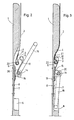
- Fig. 1 the view of an area of a bracket 1 of a truck is shown, the loading space of which is moved by a tarpaulin 2 shown broken off, the lower edge strip 3 of which is fixed by means of a holding device.
- a ramp 4 is incorporated into the bracket t, which forms the upper end of a recess 5, which is extended downwards in some areas by attached pockets 6.
- the lower region of a holding strip is inside the recess 5 by means of rivets 8. 7 connected to the bottom of the recess 5, while the upper, free end 9 of the retaining strip 7 has a bend 10 directed towards the bracket, which is formed as an approximately circular bead according to FIGS. 2 and 3.
- Trestles are fastened via recesses 23 in the retaining strip 7, a base plate 11 being covered by a shell plate 12 of the same base area, as shown in FIG the shell plate is bent out at both ends in its central regions and the base and the shell plate are connected to the base of the recess 5 by rivets 13.
- a round steel 14 is supported in the bearing blocks 20 formed by the base plate and the shell plate, which is cranked into eccentric rods 15 outside the bearing blocks and is firmly connected between the block 20 with a lever 16, for example by welding, the free end 17 of which is bent at right angles. So that the lever and with it the round steel 14 is guided in the link slot 18 formed between the blocks 20.
- the retaining strip 7 is designed according to FIG. 2 with its basic profile such that when the lower profile end connected to the bottom of the recess -5, the upper free profile end 9 equipped with the bend 10 projects freely from the bracket 1.
- the bracket 1 largely corresponds to that of FIG. 1; its upper front end is slightly rounded to prevent local loads and local wear on the tarpaulin 2.
- the blocks 20 are shown as blocks which are produced in one piece, for example by injection molding or die casting.
- Fig. 2 also illustrates that after pivoting the lever 16 into the position shown in the FIG.
- a so-called lead tape 22 is inserted into the hem 21 of the tarpaulin 2 formed by the edge strip 3, as is known, for example, from curtains and is formed by lead balls which are introduced into a knitted tube.
- lead tape 22 other means reinforcing the seam 21 can also be used, for example plastic strands, plastic cords, ropes, but also metal, wire, wire rope pieces or other means. Lead tapes have proven themselves in the present case both because of their suppleness and because of their weight, by means of which they facilitate insertion.
- the tarpaulin is now attached by simply moving the lever 16 from its position shown in FIG. 2 to the position shown in FIG. 3.
- the lever pivots around the round steel 14 serving as a bearing journal.
- the cranked eccentric rods here describe an arc about the axis of the round steel 14 and are pivoted as an eccentric against the retaining bar 7, which they then guide against the bottom of the recess 5 with elastic deflection thereof. Since the eccentric rods 15 exceed the dead center, the position of the lever 16 is automatically fixed. .Furthermore, the upper free end 9 of the retaining strip is pivoted against the lower end of the ramp 4 or the bottom of the recess 5, and its bead-shaped bend 10 overlaps the reinforced seam 21 of the tarpaulin 2.
- the tarpaulin is along the entire length Length of the hem set in the desired sense, so that local overloads are safely avoided.
- the device for fastening tarpaulins can also be varied further.
- perforated forks T9 or corresponding angles can be arranged in the region of the levers 16 or their free ends, which allow a usual sealing. If necessary, the levers themselves can also be provided with holes for pulling through a sealing tape.
- perforated fork or corresponding simple legs can be formed by attaching the base plates 11 or shell plates 12.
- an actuator are formed by brackets protruding normally from brackets, which pass through recesses in the retaining strip and are equipped with holes or openings so that pins or wedges can be inserted in such a way that the free end 9 of the retaining strip 7 is guided through them against the bracket.
- Such pins, wedges or the like could be captively connected to the tabs by chains, a nose of the back of the wedge could act as a lock, and holes provided in the pins or wedges could be used for sealing.
- wedges or pins could also be connected to one another by rods.
- actuating device shafts can be connected to several levers, for example in order to be able to actuate them from different locations. In general, however, it is sufficient to provide a lever for actuating the shaft.
- the number and spacing of the levers can be determined by customs regulations.
- the tarpaulin is fixed practically continuously, so that the usual distances required by the regulations for the customs closure, for example, distances of 15 or 25 cm, are fallen short of, since the tarpaulin is fastened without gaps within a bracket.
- eccentrics mounted on the shafts can also be connected to the shafts at predetermined intervals, and in the simplest case it is sufficient to short, cantilevered pins in such predetermined intervals to connect with the shafts so that they are guided against the free end of the retaining bar when turning the lever for fixing and press it with its bend against the edge of the tarpaulin, expediently to reach self-locking the blind spot is exceeded.
- Such cross pins could have a turned shaft which is inserted through a bore in the shaft and the end of which is connected to the shaft by rivets, possibly also by welding.
- the tarpaulin fastening according to the invention is not limited to brackets; however, it is advisable to run the retaining strip over these in the case of bracket segments.
- the bending out of the upper free end of the retaining strips can, as already mentioned, also be effected by further actuating devices.
- the fixing can be carried out under pretension and the actuating device can lift off the free end for loosening the tarpaulin or for inserting it.
- the actuation and / or locking can also be effected by mandrels, hooks or the like.
- a pivotable holding bar can be provided, which can optionally also be prestressed by springs.
- FIG. 4 shows a broken bracket 25, which is covered in some areas by a tarpaulin 26.
- the lower edge strip 27 of the tarpaulin is through one reinforced plastic strand inserted in the folded hem; in the end region, the bracket returns to a recess 29 via a rounded ramp 28.
- hinges 30 are connected to the bracket 25, which pivotally support a retaining strip 31, expediently via a machined or inserted axis, which is expediently created as an extruded profile, so that in the closed state shown in FIG. 5 gives a smooth outer surface.
- the profile of the retaining strip 31 is closed by a continuous projection 32, and in the central region, rear-facing ribs 33, 34 are connected, which on the one hand stiffen the retaining strip 31 and, on the other hand, guide a U-shaped locking bar 35 in mutually facing grooves.
- the locking bar 35 is equipped with openings 36 which, in the unlocked state, stand above hook-like bars 37 which are firmly connected to the bracket 25.
- Locking levers 40 are mounted on the bolts, to which in turn links 41 are articulated, the free ends of which are pivotally connected to blocks 42, which in turn are fixedly connected to the locking bar 35. 7 and 8, the free ends of the locking lever 40 are cranked inwards and have a locking slot 43 which, when the locking lever in question is pressed, is guided by a locking spring 44 and through it is held.
- the free end of the detent spring is provided with an opening 45 to receive wires, threads or the like for the purpose of a customs seal.
- the closing lever 40 is pivoted from the position shown in FIG. 7 into that of FIG. 8.
- the handlebar 41 it forms a toggle lever mechanism which, when the locking lever 40 is pivoted in, moves the locking bar 35 to the left in its guide formed by the grooves of the ribs 33, 34 or downwards in FIG. 7.
- edge regions of the opening 36 slide under the latch 37, which now fix the latch bar 35 and thus the retaining bar 31 in their swiveled-up position, shown in FIG. 5.
- the locking lever 40 is finally pressed on, its locking slot 43 is engaged by the locking spring 44 so that the locking lever is already held in this position shown in FIG. 8 by this locking spring.
- the toggle lever mechanism formed by the closing lever 40 and the handlebar 41 is designed such that when the closing lever 40 is finally pressed, this toggle lever mechanism exceeds its dead center tet and thus also locks itself.
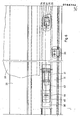
- FIG. 6 shows the closed, continuous profile of the holding strip 31 with its smooth surface facing outward, which offers dirt few points of attack.
- a hinge 30 and a bolt 37 which crosses an opening 36 of the bolt rod 35 can be recognized by knockouts.
- a locking lever 40 can be seen in the window 38, which is additionally held in its basic position by the detent spring 44, in which, as shown in FIGS. 5 and 8, it does not protrude or practically does not protrude beyond the outer contour.
- the cranked free end of the locking lever can be easily reached for the purpose of loosening.
- the locking carried out by means of the locking bar 35 and the locking bar 37 not only holds the retaining bar 31 in its working position, the expediently inclined holding surface of the locking bar 37 also brings about an additional adjustment of the retaining bar 31 and thus an additional, exerted on the edge strip 27 of the tarpaulin Contact pressure and thus a further stiffening of the tarpaulin.
- the actual locking mechanism is largely protected against contamination and corrosion within the profile of the retaining strip 31.
- the invention is not restricted to the described or varied exemplary embodiments. It is for example also possible, in manner known per se with loops equipped P la- NEN provide and to dispense with a circumferential retaining strip.
- the fastening device for the equipped with eyelets Plane has a case-mounted in brackets in this, one having at least Lever equipped shaft, which is equipped with one-sided cantilevered cross pins in the spacing of the eyelets. In this case it is possible, by pivoting the shaft by means of the lever, to have the cross pins engage in the eyelets so that the cross pins now hold the tarpaulin over their eyelet edges.
- Such an intervention is secured by the cross pins running in separate grooves in the bracket, the side wall or the like so that they pass through the eyelets sufficiently.
- a further securing can be achieved by the cross pins being bent like a hook in such a way that they engage with the hook end and the hook end prevents the eyelets from slipping in the working position. It is possible to bring the cross pins into engagement with the eyelets from below when the tarpaulin is tightened and to limit the swivel path of the shaft by means of stops which act on the lever, for example. This reliably prevents automatic release under tension. But it is also possible to let the hooks engage in the eyelets from above; in this case the shaft must be secured after the tensioning movement has been carried out.
- a number of variants are possible even when reinforcing a tarpaulin edge.
- Strands, wires or cables made of plastic or metal can be inserted into the hem, and metal or plastic balls or pins can be inserted which are expediently held in a predetermined position by covering a hose, a knitted stocking or the like.
- fastening devices for tarpaulins can be created that are easy and safe to operate and, if necessary, sealable, and in which local overloading is essentially avoided by continuous mounting and any foreign, unnoticed access is prevented.
Landscapes
- Engineering & Computer Science (AREA)
- Mechanical Engineering (AREA)
- Package Frames And Binding Bands (AREA)
- Clamps And Clips (AREA)
- Load-Engaging Elements For Cranes (AREA)
- Heterocyclic Carbon Compounds Containing A Hetero Ring Having Oxygen Or Sulfur (AREA)
Priority Applications (1)
| Application Number | Priority Date | Filing Date | Title |
|---|---|---|---|
| AT85107256T ATE53965T1 (de) | 1984-06-15 | 1985-06-12 | Vorrichtung zur loesbaren befestigung der plane eines lastfahrzeuges. |
Applications Claiming Priority (4)
| Application Number | Priority Date | Filing Date | Title |
|---|---|---|---|
| DE8418122U | 1984-06-15 | ||
| DE19848418122U DE8418122U1 (de) | 1984-06-15 | 1984-06-15 | Mit einer loesbaren plane versehenes kraftfahrzeug, ein kraftfahrzeuganhaenger oder sattelauflieger |
| DE3503149 | 1985-01-31 | ||
| DE3503149A DE3503149C2 (de) | 1984-06-15 | 1985-01-31 | Vorrichtung zur lösbaren Befestigung der Plane eines Lastfahrzeuges |
Publications (3)
| Publication Number | Publication Date |
|---|---|
| EP0164744A2 true EP0164744A2 (fr) | 1985-12-18 |
| EP0164744A3 EP0164744A3 (en) | 1988-01-27 |
| EP0164744B1 EP0164744B1 (fr) | 1990-06-20 |
Family
ID=25829004
Family Applications (1)
| Application Number | Title | Priority Date | Filing Date |
|---|---|---|---|
| EP19850107256 Expired - Lifetime EP0164744B1 (fr) | 1984-06-15 | 1985-06-12 | Dispositif pour la fixation détachable des bâches d'un véhicule utilitaire |
Country Status (3)
| Country | Link |
|---|---|
| EP (1) | EP0164744B1 (fr) |
| DK (1) | DK167484B1 (fr) |
| ES (1) | ES8609057A1 (fr) |
Cited By (4)
| Publication number | Priority date | Publication date | Assignee | Title |
|---|---|---|---|---|
| EP0742131A1 (fr) * | 1995-05-11 | 1996-11-13 | GRAAFF Gesellschaft mit beschränkter Haftung | Dispositif pour étancher l'assemblage de couverture d'un véhicule de transport |
| US5607200A (en) * | 1995-04-21 | 1997-03-04 | Wabash National Corporation | Curtain securing mechanism |
| EP1043183A3 (fr) * | 1999-04-09 | 2001-10-17 | Franz Miederhoff oHG | Tensionneur pour bâche latérale |
| CN109415013A (zh) * | 2016-07-22 | 2019-03-01 | 标致雪铁龙汽车股份有限公司 | 具有发光装置的机动车辆的保险杠 |
Family Cites Families (2)
| Publication number | Priority date | Publication date | Assignee | Title |
|---|---|---|---|---|
| US2911254A (en) * | 1958-03-26 | 1959-11-03 | Sperry Rand Corp | Vehicle load cover retaining means |
| BE881751A (fr) * | 1980-02-15 | 1980-05-30 | Simme Sture Bertil Ragnar | Dispositif de fixation amovible d'un element souple sur un element rigide |
-
1985
- 1985-06-12 EP EP19850107256 patent/EP0164744B1/fr not_active Expired - Lifetime
- 1985-06-14 ES ES544187A patent/ES8609057A1/es not_active Expired
- 1985-06-14 DK DK269585A patent/DK167484B1/da not_active IP Right Cessation
Cited By (5)
| Publication number | Priority date | Publication date | Assignee | Title |
|---|---|---|---|---|
| US5607200A (en) * | 1995-04-21 | 1997-03-04 | Wabash National Corporation | Curtain securing mechanism |
| EP0742131A1 (fr) * | 1995-05-11 | 1996-11-13 | GRAAFF Gesellschaft mit beschränkter Haftung | Dispositif pour étancher l'assemblage de couverture d'un véhicule de transport |
| EP1043183A3 (fr) * | 1999-04-09 | 2001-10-17 | Franz Miederhoff oHG | Tensionneur pour bâche latérale |
| CN109415013A (zh) * | 2016-07-22 | 2019-03-01 | 标致雪铁龙汽车股份有限公司 | 具有发光装置的机动车辆的保险杠 |
| CN109415013B (zh) * | 2016-07-22 | 2022-02-15 | 标致雪铁龙汽车股份有限公司 | 具有发光装置的车辆的保险杠及设置有该保险杠的车辆 |
Also Published As
| Publication number | Publication date |
|---|---|
| EP0164744B1 (fr) | 1990-06-20 |
| ES544187A0 (es) | 1986-07-16 |
| EP0164744A3 (en) | 1988-01-27 |
| DK167484B1 (da) | 1993-11-08 |
| DK269585D0 (da) | 1985-06-14 |
| DK269585A (da) | 1985-12-16 |
| ES8609057A1 (es) | 1986-07-16 |
Similar Documents
| Publication | Publication Date | Title |
|---|---|---|
| DE69500037T2 (de) | Vorrichtung zum Tragen von Gegenständen, insbesondere Fahrrädern, auf der Hinterseite eines Kraftfahrzeuges | |
| DE3040164C2 (fr) | ||
| DE69022231T2 (de) | Drehbare leiter. | |
| DE10328042A1 (de) | Gleitschiene für einen Fahrzeugsitz und Verfahren zu ihrer Herstellung | |
| EP0569039A2 (fr) | Véhicule | |
| DE3105795A1 (de) | Schneekette | |
| DE69017836T2 (de) | Verbesserungen an und in Bezug auf Stützen für Anhänger. | |
| DE102015108782B4 (de) | Fahrzeugaufbau, insbesondere für Nutzfahrzeuge, Nutzfahrzeug mit einem solchen Fahrzeugaufbau und Herstellungsverfahren | |
| DE3012010A1 (de) | Fahrzeugaufbau und dafuer bestimmte pfostenanordnung | |
| DE2103820A1 (de) | Rolladen | |
| DE2757662A1 (de) | Ladeflaeche oder bruecke fuer transportmittel | |
| EP0131706A2 (fr) | Bâche de rideau tendable | |
| EP0164744B1 (fr) | Dispositif pour la fixation détachable des bâches d'un véhicule utilitaire | |
| DE2718249C2 (de) | Gleitschutzvorrichtung für Fahrzeugreifen | |
| DE4237410C2 (de) | Pritschenaufbau für LKW-Wechselbehälter und Festaufbauten | |
| EP0858930B1 (fr) | Bâche à dispositif de serrage pour camions | |
| DE10226067A1 (de) | Lastfahrzeug-Aufbau | |
| DE3503149C2 (de) | Vorrichtung zur lösbaren Befestigung der Plane eines Lastfahrzeuges | |
| EP3106329B1 (fr) | Carrosserie de vehicule, en particulier pour vehicules utilitaires, vehicule utilitaire comprenant une telle carrosserie et procede de fabrication | |
| EP1375313A2 (fr) | Véhicule automobile | |
| EP0010065A1 (fr) | Dispositif de fermeture pour ridelles rabattables de camions ou de leurs remorques | |
| DE102005016113B4 (de) | Karosserie für ein Kraftfahrzeug | |
| DE1945636A1 (de) | Ladegutbehaelter mit senkrecht verstellbaren Ladedecks | |
| EP2431205B1 (fr) | Dispositif de fixation pour un montage de superstructure d'un véhicule utilitaire, montage de véhicule utilitaire et véhicule utilitaire doté d'un tel dispositif de fixation | |
| DE2658919A1 (de) | Ladeflaeche oder bruecke fuer fahrzeuge |
Legal Events
| Date | Code | Title | Description |
|---|---|---|---|
| PUAI | Public reference made under article 153(3) epc to a published international application that has entered the european phase |
Free format text: ORIGINAL CODE: 0009012 |
|
| 17P | Request for examination filed |
Effective date: 19850703 |
|
| AK | Designated contracting states |
Designated state(s): AT BE CH DE FR GB IT LI LU NL SE |
|
| PUAL | Search report despatched |
Free format text: ORIGINAL CODE: 0009013 |
|
| AK | Designated contracting states |
Kind code of ref document: A3 Designated state(s): AT BE CH DE FR GB IT LI LU NL SE |
|
| 17Q | First examination report despatched |
Effective date: 19881212 |
|
| GRAA | (expected) grant |
Free format text: ORIGINAL CODE: 0009210 |
|
| AK | Designated contracting states |
Kind code of ref document: B1 Designated state(s): AT BE CH DE FR GB IT LI LU NL SE |
|
| PG25 | Lapsed in a contracting state [announced via postgrant information from national office to epo] |
Ref country code: SE Effective date: 19900620 Ref country code: NL Effective date: 19900620 Ref country code: GB Effective date: 19900620 Ref country code: FR Effective date: 19900620 Ref country code: BE Effective date: 19900620 |
|
| REF | Corresponds to: |
Ref document number: 53965 Country of ref document: AT Date of ref document: 19900715 Kind code of ref document: T |
|
| REF | Corresponds to: |
Ref document number: 3578324 Country of ref document: DE Date of ref document: 19900726 |
|
| ITF | It: translation for a ep patent filed | ||
| EN | Fr: translation not filed | ||
| NLV1 | Nl: lapsed or annulled due to failure to fulfill the requirements of art. 29p and 29m of the patents act | ||
| GBV | Gb: ep patent (uk) treated as always having been void in accordance with gb section 77(7)/1977 [no translation filed] | ||
| PLBE | No opposition filed within time limit |
Free format text: ORIGINAL CODE: 0009261 |
|
| STAA | Information on the status of an ep patent application or granted ep patent |
Free format text: STATUS: NO OPPOSITION FILED WITHIN TIME LIMIT |
|
| 26N | No opposition filed | ||
| REG | Reference to a national code |
Ref country code: GB Ref legal event code: 777A |
|
| NLXE | Nl: other communications concerning ep-patents (part 3 heading xe) |
Free format text: A REQUEST FOR RESTORATION TO THE PRIOR STATE HAS BEEN FILED ON 910704 |
|
| PGFP | Annual fee paid to national office [announced via postgrant information from national office to epo] |
Ref country code: FR Payment date: 19910909 Year of fee payment: 7 |
|
| REG | Reference to a national code |
Ref country code: CH Ref legal event code: PUE Owner name: FUDICKAR METALL GMBH |
|
| PGFP | Annual fee paid to national office [announced via postgrant information from national office to epo] |
Ref country code: SE Payment date: 19920520 Year of fee payment: 8 |
|
| ITPR | It: changes in ownership of a european patent |
Owner name: CESSIONE;FUDICKAR METALL GMBH |
|
| NLXE | Nl: other communications concerning ep-patents (part 3 heading xe) |
Free format text: THE REQUEST FOR THE RESTORATION TO THE PRIOR STATE HAS PROVIDED OF 910704,HAS BEEN REJECTED ON 920324 |
|
| REG | Reference to a national code |
Ref country code: FR Ref legal event code: DE |
|
| ITTA | It: last paid annual fee | ||
| PGFP | Annual fee paid to national office [announced via postgrant information from national office to epo] |
Ref country code: DE Payment date: 19940514 Year of fee payment: 10 |
|
| PGFP | Annual fee paid to national office [announced via postgrant information from national office to epo] |
Ref country code: CH Payment date: 19940516 Year of fee payment: 10 |
|
| PGFP | Annual fee paid to national office [announced via postgrant information from national office to epo] |
Ref country code: AT Payment date: 19940517 Year of fee payment: 10 |
|
| PGFP | Annual fee paid to national office [announced via postgrant information from national office to epo] |
Ref country code: LU Payment date: 19940531 Year of fee payment: 10 |
|
| EPTA | Lu: last paid annual fee | ||
| PG25 | Lapsed in a contracting state [announced via postgrant information from national office to epo] |
Ref country code: LU Free format text: LAPSE BECAUSE OF NON-PAYMENT OF DUE FEES Effective date: 19950612 Ref country code: AT Effective date: 19950612 |
|
| PG25 | Lapsed in a contracting state [announced via postgrant information from national office to epo] |
Ref country code: LI Effective date: 19950630 Ref country code: CH Effective date: 19950630 |
|
| REG | Reference to a national code |
Ref country code: CH Ref legal event code: PL |
|
| PG25 | Lapsed in a contracting state [announced via postgrant information from national office to epo] |
Ref country code: DE Effective date: 19960301 |