EP0165416A2 - Verfahren und Apparat für die Kontrolle einer Polymerisationsreaktion - Google Patents
Verfahren und Apparat für die Kontrolle einer Polymerisationsreaktion Download PDFInfo
- Publication number
- EP0165416A2 EP0165416A2 EP85105220A EP85105220A EP0165416A2 EP 0165416 A2 EP0165416 A2 EP 0165416A2 EP 85105220 A EP85105220 A EP 85105220A EP 85105220 A EP85105220 A EP 85105220A EP 0165416 A2 EP0165416 A2 EP 0165416A2
- Authority
- EP
- European Patent Office
- Prior art keywords
- temperature
- polymerization
- reactor
- rate
- target
- Prior art date
- Legal status (The legal status is an assumption and is not a legal conclusion. Google has not performed a legal analysis and makes no representation as to the accuracy of the status listed.)
- Granted
Links
Images


Classifications
-
- C—CHEMISTRY; METALLURGY
- C08—ORGANIC MACROMOLECULAR COMPOUNDS; THEIR PREPARATION OR CHEMICAL WORKING-UP; COMPOSITIONS BASED THEREON
- C08F—MACROMOLECULAR COMPOUNDS OBTAINED BY REACTIONS ONLY INVOLVING CARBON-TO-CARBON UNSATURATED BONDS
- C08F2/00—Processes of polymerisation
-
- B—PERFORMING OPERATIONS; TRANSPORTING
- B01—PHYSICAL OR CHEMICAL PROCESSES OR APPARATUS IN GENERAL
- B01J—CHEMICAL OR PHYSICAL PROCESSES, e.g. CATALYSIS OR COLLOID CHEMISTRY; THEIR RELEVANT APPARATUS
- B01J19/00—Chemical, physical or physico-chemical processes in general; Their relevant apparatus
- B01J19/0006—Controlling or regulating processes
-
- B—PERFORMING OPERATIONS; TRANSPORTING
- B01—PHYSICAL OR CHEMICAL PROCESSES OR APPARATUS IN GENERAL
- B01J—CHEMICAL OR PHYSICAL PROCESSES, e.g. CATALYSIS OR COLLOID CHEMISTRY; THEIR RELEVANT APPARATUS
- B01J2219/00—Chemical, physical or physico-chemical processes in general; Their relevant apparatus
- B01J2219/00049—Controlling or regulating processes
- B01J2219/00051—Controlling the temperature
- B01J2219/00054—Controlling or regulating the heat exchange system
- B01J2219/00056—Controlling or regulating the heat exchange system involving measured parameters
- B01J2219/00058—Temperature measurement
- B01J2219/00063—Temperature measurement of the reactants
-
- B—PERFORMING OPERATIONS; TRANSPORTING
- B01—PHYSICAL OR CHEMICAL PROCESSES OR APPARATUS IN GENERAL
- B01J—CHEMICAL OR PHYSICAL PROCESSES, e.g. CATALYSIS OR COLLOID CHEMISTRY; THEIR RELEVANT APPARATUS
- B01J2219/00—Chemical, physical or physico-chemical processes in general; Their relevant apparatus
- B01J2219/00049—Controlling or regulating processes
- B01J2219/00051—Controlling the temperature
- B01J2219/00074—Controlling the temperature by indirect heating or cooling employing heat exchange fluids
- B01J2219/00087—Controlling the temperature by indirect heating or cooling employing heat exchange fluids with heat exchange elements outside the reactor
- B01J2219/00094—Jackets
-
- B—PERFORMING OPERATIONS; TRANSPORTING
- B01—PHYSICAL OR CHEMICAL PROCESSES OR APPARATUS IN GENERAL
- B01J—CHEMICAL OR PHYSICAL PROCESSES, e.g. CATALYSIS OR COLLOID CHEMISTRY; THEIR RELEVANT APPARATUS
- B01J2219/00—Chemical, physical or physico-chemical processes in general; Their relevant apparatus
- B01J2219/00049—Controlling or regulating processes
- B01J2219/00191—Control algorithm
- B01J2219/00193—Sensing a parameter
- B01J2219/00195—Sensing a parameter of the reaction system
- B01J2219/002—Sensing a parameter of the reaction system inside the reactor
-
- B—PERFORMING OPERATIONS; TRANSPORTING
- B01—PHYSICAL OR CHEMICAL PROCESSES OR APPARATUS IN GENERAL
- B01J—CHEMICAL OR PHYSICAL PROCESSES, e.g. CATALYSIS OR COLLOID CHEMISTRY; THEIR RELEVANT APPARATUS
- B01J2219/00—Chemical, physical or physico-chemical processes in general; Their relevant apparatus
- B01J2219/00049—Controlling or regulating processes
- B01J2219/00191—Control algorithm
- B01J2219/00211—Control algorithm comparing a sensed parameter with a pre-set value
-
- B—PERFORMING OPERATIONS; TRANSPORTING
- B01—PHYSICAL OR CHEMICAL PROCESSES OR APPARATUS IN GENERAL
- B01J—CHEMICAL OR PHYSICAL PROCESSES, e.g. CATALYSIS OR COLLOID CHEMISTRY; THEIR RELEVANT APPARATUS
- B01J2219/00—Chemical, physical or physico-chemical processes in general; Their relevant apparatus
- B01J2219/00049—Controlling or regulating processes
- B01J2219/00191—Control algorithm
- B01J2219/00211—Control algorithm comparing a sensed parameter with a pre-set value
- B01J2219/00213—Fixed parameter value
-
- B—PERFORMING OPERATIONS; TRANSPORTING
- B01—PHYSICAL OR CHEMICAL PROCESSES OR APPARATUS IN GENERAL
- B01J—CHEMICAL OR PHYSICAL PROCESSES, e.g. CATALYSIS OR COLLOID CHEMISTRY; THEIR RELEVANT APPARATUS
- B01J2219/00—Chemical, physical or physico-chemical processes in general; Their relevant apparatus
- B01J2219/00049—Controlling or regulating processes
- B01J2219/00191—Control algorithm
- B01J2219/00222—Control algorithm taking actions
- B01J2219/00227—Control algorithm taking actions modifying the operating conditions
- B01J2219/00229—Control algorithm taking actions modifying the operating conditions of the reaction system
- B01J2219/00231—Control algorithm taking actions modifying the operating conditions of the reaction system at the reactor inlet
-
- B—PERFORMING OPERATIONS; TRANSPORTING
- B01—PHYSICAL OR CHEMICAL PROCESSES OR APPARATUS IN GENERAL
- B01J—CHEMICAL OR PHYSICAL PROCESSES, e.g. CATALYSIS OR COLLOID CHEMISTRY; THEIR RELEVANT APPARATUS
- B01J2219/00—Chemical, physical or physico-chemical processes in general; Their relevant apparatus
- B01J2219/00049—Controlling or regulating processes
- B01J2219/00191—Control algorithm
- B01J2219/00222—Control algorithm taking actions
- B01J2219/00227—Control algorithm taking actions modifying the operating conditions
- B01J2219/00238—Control algorithm taking actions modifying the operating conditions of the heat exchange system
Definitions
- the present invention relates in general to a method and an apparatus for controlling a polymerization reaction, and particularly to those in which an optimum polymerization reaction is attained by temperature control.
- the particle sizes are determined primarily dependent on the fluctuations in the quantity of an emulsifying agent and the temperature of polymerization. Even when the quantity of the emulsifying agent is fixed, therefore, the particle sizes of the produced polymers are varied by the fluctuation of the temperature during the process of polymerization, which results in the deterioration of the quality of the rubber.
- An object of the present invention is to provide a method for controlling a polymerization reaction to prepare polymers of uniform particle size, and an apparatus for controlling the polymerization reaction which facilitates and ensures the control of particle sizes.
- the method and apparatus for controlling the polymerization reaction features various sensors for determining status of the polymerization reaction, computerized analysis of status and fine temperature control so as to achieve uniform particle size.
- the present invention provides a method for controlling a polymerization reaction comprising the steps of:
- the present invention provides an apparatus for controlling the polymerization reaction comprising:
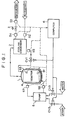
- FIGURE 1 shows the construction of one embodiment of the apparatus for controlling the polymerization reaction according to the present invention.
- a cooling condenser 2 used as a cooling means is connected to a reactor 1.
- monomer(s) e.g. butadiene
- CVl control valve
- the gases of the vaporized monomers are condensed again by the cooling condenser 2, and the above-described process is repeated.
- a refrigerant is supplied to the cooling condenser 2,'and the flow rate thereof is controlled by a control valve 3.
- Reactor 1 is provided with a jacket 4 which provides cooling and heating. Hot water in jacket 4 is forced to circulate by a pump 5, and the temperature of the hot water is controlled by a control valve CV2 supplying steam to a tank in the pump 5 and by a control valve CV3 supplying water thereto.
- Reactor 1 and the cooling system therefor thus.constructed are provided with a temperature sensor S1 (e.g. a platinum temperature-measuring resistor, a thermocouple or the like) which detects a temperature T R inside the reactor 1, a temperature sensor S2 which detects the inlet temperature T Bi of the refrigerant supplied to cooling condenser 2, a temperature sensor S3 which detects the outlet temperature T Bo of the refrigerant, a flow sensor S4 (e.g.
- an ultrasonic flowmeter, an orifice-type flowmeter or the like which detects the flow rate F B of the refrigerant
- a pressure sensor S5 which detects a pressure P R inside the reactor 1
- a temperature sensor S6 which detects the inlet temperature T ji of the hot water supplied to the jacket 4
- a temperature sensor S7 which detects the outlet temperature T jo of the hot water
- a level sensor S8 e.g. a differential pressure type level gauge or the like
- Detection signals output from these sensors Sl to S8 are input to a computer 6, which controls the control valves CV1 to CV3 based on the detection signals so that the polymerization reaction in the reactor 1 can occur in the optimum manner.
- the control on the temperature inside the reactor 1 is performed in this way.
- FIGURE 2 is a block diagram showing the details of the control system of the invention.
- the respective output terminals of the sensors Sl to S8 described above are connected to the input terminals of a multiplexer 61 in computer 6, and the output terminal of the multiplexer 61 is connected to a controller 63 via an A/D converter 62.
- Controller 63 is connected to an arithmetic unit 64 and a memory 65.
- a target polymerization rate Y and the degradation rate K of a polymerization initiator depending on the temperature, and other data such as a prescribed count value t l , a prescribed pressure P and a prescribed number a, are stored beforehand.
- controller 63 is connected to the input terminal of a driver 66, and the output terminals of the driver 66 are connected to the control valves CV1 to CV3, respectively.
- the controller 63 also delivers control signals to the multiplexer 61, the A/D converter 62 and the driver 66, etc. so as to control the input and output operations thereof.
- the controller 63 is provided with a counter (not shown in the figure) for controlling the operations.
- FIGURES 3(a) and (b) are flow charts of the present embodiment
- FIGURE 4 is a graph showing the change with time of an output of each of the sensors Sl to S8.
- N is provided to distinguish between a period running from a polymerization start time point I (FIGURE 4) to a starting time point of cooling III (FIGURE 4) and a period thereafter.
- C is provided for checking periodically a polymerization rate on and after the starting time point of cooling III.
- the computer 6 controls the control valves CV2 and CV3 to supply hot water to -the jacket 4 and raise the temperature T R inside the reactor 1.
- the computer 6 controls the control valves CV2 and CV3 to supply hot water to -the jacket 4 and raise the temperature T R inside the reactor 1.
- T R detected by the temperature sensor Sl reaches a prescribed temperature
- a catalyst is charged in the reactor 1 and thereby the polymerization is started (ST2).
- detection data from each of the sensors Sl to S8 are input sequentially by the operation of the multiplexer 61, converted into a digital signal by the A/D converter 62 and stored in memory 65 (ST3).
- the heat release value Qp of the polymerization, the conversion x and the polymerization rate y are calculated on the basis of the sensor-detected data (T R , T B i, T Bo , F B , P R , Tji, T jo and H D ) which are input (ST4).
- the heat release value Qp of the polymerization is calculated in the following way.
- the total value of heat taken away from the jacket 4 Q 2 where A J is the heat transfer area of the jacket 4, U J the heat transfer coefficient thereof, and T J an average temperature of the hot water in the jacket calculated from T Ji and T Jo .
- the data (Qp, x, y) obtained by the above calculations are stored in the memory 65, together with a count value t representing the time point when said data are obtained and a target polymerization rate Y at that time, accompanying the detection data described above.
- the controller 63 controls the control valves CV2 and CV3 through the driver 66 so as to lower rapidly the temperature of the hot water in the jacket 4 (ST7). Simultaneously, the control valve CV1 is opened under the condition that the cooling power of the cooling condenser 2 is fully increased to drop the accumulated BD into the reactor 1 and to start the cooling by the latent heat of vaporization (ST8). This time point corresponds to the cooling start time point III in FIGURE 4.
- the prescribed value t 1 corresponds to the time point of the termination of a period IV in FIGURE 4, and.during this period IV, a normal cooling operation is conducted by the cooling condenser 2.
- a correction heat value ⁇ Q is calculated from the temperature difference (T R - T) between the temperature T R at the present time point in the reactor 1 which is detected by the temperature sensor Sl and the target set temperature T which is the initial value TO (ST14).
- the rate of change with time of the temperature inside the reactor 1 is set in accordance with the temperature difference (T R - T) beforehand, and said temperature is made to return to the target set temperature T in the optimum state.
- this rate of change with time is set, the state inside the reactor 1 during a period between the time points I and III can be controlled by the temperature.
- a correction value ⁇ F D of the flow rate of BD is calculated by the following equation.
- the value of the flow resistance R D ' is output from the controller 63 to the driver 66, and based on said value, the driver 66 varies the opening degree of the control valve CV1 (ST16).
- sensor-detected data obtained at the following time point are input again (ST3), and the operations at the steps ST4, ST5 and ST10 to ST16 are repeated as described above for performing the temperature control.
- C becomes equal to a at the time point of the a-th repetition (ST12), and determination is made as NO at ST12.
- the polymerization rate Y to serve as a target is read out of the memory 65 (ST17), and it is determined whether or not the difference between the calculated polymerization rate y at the present time point (ST4) and the target polymerization rate Y is smaller than a prescribed value ⁇ (ST18).
- ⁇ YES in ST18
- C is set to 0 (ST19) and the above-described normal cooling operations (ST13 to ST16) are performed.
- the target set value T is readjusted by using this difference and the degradation rate K of the initiator depending on the temperature which is stored beforehand in the memory 65 (ST20).
- a correction coefficient a of the degradation rate of the initiator which is required for obtaining a prescribed polymerization rate, is calculated by the following equation.
- Y is the target polymerization rate
- y the present polymerization rate
- k a constant set before hand.
- a new target set temperature T is calculated by the following equation.
- E is an activation energy set by an initiator system
- R a gas constant
- T R the present polymerization temperature
- the controller 63 adjusts the control valves CV2 and CV3 via the driver 66 to raise the temperature of the hot water in the jacket 4 so that the temperature T R inside the reactor 1 is fixed (ST22).
- the temperature T R in the period IV in FIGURE 4 is particularly important.
- FIGURE 5 is a graph showing the relationship between the initial temperature T R in the period IV and the particle sizes of the rubber prepared by the emulsion polymerization
- FIGURE 6 is a graph showing the relationship between said initial temperature T R and a final conversion.
- particle size is small and the final conversion falls when the temperature TR is high. Therefore, it is necessary to set a target temperature in consideration of the relation with the final conversion and to maintain said temperature with high accuracy, particularly when rubber in small particle sizes is to be prepared.
- the temperature T R inside the reactor 1 was successfully controlled to be within about ⁇ 0.1°C in the period IV and within about ⁇ 1.0 O C even in the periods V and VI, as shown in FIGURE 4, and as the result, the rubber which had uniform and desired particle sizes was successfully prepared.
- the starting time point of cooling is decided on the basis of the pressure inside the reactor 1 detected during a period between the time points I and III.
- the starting time point of cooling can be set also on the basis of the temperature T RI the conversion x, or the polymerization rate y.
- temperature control can be performed on the basis of the difference between the polymerization rate y and the target polymerization rate Y, which is obtained by comparing the former with the latter continuously.
- the temperature inside the reactor is stabilized and the particle sizes of polymers are made uniform, since fine temperature control is performed continuously on the basis of the temperature inside the reactor and a target temperature.
- a desired final conversion can be estimated, and an improvement in yield and the shortening of the polymerization cycle can be attained, since the temperature inside the reactor is stable.
- the conversion at the present time point can be presumed and the accuracy in a reaction control can be improved, since the conversion and the polymerization rate are calculated from a heat release value of polymerization.
- the present control system can be applied easily to the existing reactors as well without providing any additional new detecting means in the reactor or preparing any reservoir of a reaction liquid for presuming the conversion and the polymerization rate.
- a reactor with the inner wall of glass lining provided with incidental facilities as set forth in Fig. 1 and having the apparatus for controlling as set forth in Figs. 2 and 3 were 190 parts by weight of deionized water, 2 parts by weight of potassium oleate, 1 part by weight of dextrose, 25 parts by weight of styrene, one part by weight of divinylbenzene and 0.2 parts by weight of diisopropylbenzene peroxide added.
- the reactor was purged with nitrogen gas while stirring the contents and placed under reduced pressure. Thereafter, 75. parts by weight of l,3-butadiene (hereinafter referred to as BD) containing 30 ppm of a polymerization inhibitor were added. Then, the computer controlling according to the present invention was commenced.
- BD l,3-butadiene
- warmed water of about 85°C was circulated to the jacket of the reactor and when the contents of the reactor were elevated to temperature of 43°C, a mixture of 10 parts by weight of deionized water, 0.5 parts by weight of sodium pyrophosphate and 0.01 part by weight of ferrous sulfate was charged to the reactor to commence polymerization (at ST2 of Fig. 3(a) and I of Fig. 4). Thereafter, polymerization was followed in accordance with the flow chart of Fig. 3(a). Detection data was input at ST3 and ST4, and the heat release value Qp of the polymerization, the conversion x and the polymerization rate y were calculated every 5 seconds.
- the pressure at beginning of cooling at ST6 was set to 4.9 kg/cm 2 G and the period (a) for changing of the target value of polymerization temperature at ST12 was set to five minutes.
- the polymerization rate during 1.5 hours after the beginning of cooling was exactly controlled in such a manner that the target polymerization rate Y is 30%/h and the allowable difference 6 between the target value and the calculated value is 5%/h and thereafter 100%/h.
- the polymerization rate immediately before the beginning of cooling was 35%/h which was larger than the target value and therefore, the target temperature immediately after the beginning of cooling was lowered to 58°C from 60°C. Thereafter, since the polymerization rate was maintained within the allowable error, the target temperature was not changed. The polymerization was completed for 8 hours. Conversion was 98.5%. Average particle size of rubber was 0.075 pm.
- Example 2 The same polymerization as in Example 1 was effected using BD containing 70 ppm of a polymerization inhibitor.
- the polymerization temperature was targeted for 63°C and the target temperature was, thereafter, changed once.
- the polymerization was completed for 8 hours. Conversion was 98%. Average particle size of rubber was 0.077um.
- Example 2 The same polymerization as in Example 1 was effected by hand operation at temperatures of about 59°C. Average particle size of rubber was 0.088pm which was somewhat larger than those obtained in Examples 1 and 2.
- Example 2 The same polymerization as in Example 1 was effected by hand operation and the polymerization temperature was 67°C during one hour of from 0.5 hours after the beginning of cooling to 1.5 hours. Thereafter, the polymerization temperature was returned to 63°C and the polymerization was continued. However, the conversion barely reached 94% after the lapse of 8 hours. Therefore, 0.5 parts by weight of dextrose and 0.05 parts by weight of diisoproplybenzene hydroperoxide were added to the reactor and further polymerization was effected for two hour to complete the reaction. Conversion was 97.8%.
Landscapes
- Chemical & Material Sciences (AREA)
- Chemical Kinetics & Catalysis (AREA)
- Organic Chemistry (AREA)
- Health & Medical Sciences (AREA)
- Medicinal Chemistry (AREA)
- Polymers & Plastics (AREA)
- Polymerisation Methods In General (AREA)
- Other Resins Obtained By Reactions Not Involving Carbon-To-Carbon Unsaturated Bonds (AREA)
Applications Claiming Priority (2)
| Application Number | Priority Date | Filing Date | Title |
|---|---|---|---|
| JP59103663A JPS60248702A (ja) | 1984-05-24 | 1984-05-24 | 重合反応制御方法および装置 |
| JP103663/84 | 1984-05-24 |
Publications (3)
| Publication Number | Publication Date |
|---|---|
| EP0165416A2 true EP0165416A2 (de) | 1985-12-27 |
| EP0165416A3 EP0165416A3 (en) | 1987-01-28 |
| EP0165416B1 EP0165416B1 (de) | 1989-07-26 |
Family
ID=14360021
Family Applications (1)
| Application Number | Title | Priority Date | Filing Date |
|---|---|---|---|
| EP85105220A Expired EP0165416B1 (de) | 1984-05-24 | 1985-04-29 | Verfahren und Apparat für die Kontrolle einer Polymerisationsreaktion |
Country Status (5)
| Country | Link |
|---|---|
| US (1) | US4742472A (de) |
| EP (1) | EP0165416B1 (de) |
| JP (1) | JPS60248702A (de) |
| CA (1) | CA1255441A (de) |
| DE (1) | DE3571812D1 (de) |
Cited By (8)
| Publication number | Priority date | Publication date | Assignee | Title |
|---|---|---|---|---|
| FR2593507A1 (fr) * | 1985-12-27 | 1987-07-31 | Mitsui Toatsu Chemicals | Procede de regulation de la temperature de polymerisation |
| EP0295519A1 (de) * | 1987-06-15 | 1988-12-21 | Maria Luisa Piani | Vorrichtung zur Blockierung der Copolymerisationsreaktion in Anlagen zur kontinuierlich-zyklischen Produktion von SBR-Elastomeren oder dgl. |
| FR2632718A1 (fr) * | 1988-06-08 | 1989-12-15 | Chinoin Gyogyszer Es Vegyeszet | Dispositif pour la mise en oeuvre de procedes thermiques |
| EP0486262A1 (de) * | 1990-11-13 | 1992-05-20 | Vinamul Ltd. | Chemisches Verfahren |
| EP1491558A1 (de) * | 2003-06-27 | 2004-12-29 | National Starch and Chemical Investment Holding Corporation | Datenraten-Copolymerisation |
| EP1705193A2 (de) | 2005-03-24 | 2006-09-27 | Rohm and Haas Company | Polymerisationsverfahren |
| US7728081B2 (en) | 2004-10-04 | 2010-06-01 | Sumitomo Chemical Company, Limited | Apparatus for continuous polymerization and method for continuous polymerizing using the same |
| EP4230289A1 (de) * | 2022-02-16 | 2023-08-23 | CHT Turkey Kimya Sanayi ve Ticaret A.S. | Emulsionspolymerisations-managementsystem (epm) durch proportionales heizen/kühlen und durchflussregelung für gleichbleibende produktqualitäten |
Families Citing this family (21)
| Publication number | Priority date | Publication date | Assignee | Title |
|---|---|---|---|---|
| US4888704A (en) * | 1987-12-18 | 1989-12-19 | Amoco Corporation | Advanced control strategies for melt flow rate and reactor concentration in the polypropylene slurry process |
| US5239484A (en) * | 1988-03-31 | 1993-08-24 | Takeda Chemical Industries, Ltd. | Automatic synthesis apparatus |
| US5736938A (en) * | 1996-05-06 | 1998-04-07 | Ruthroff; Clyde L. | Apparatus, employing capacitor coupling for measuremet of torque on a rotating shaft |
| DE19905712A1 (de) * | 1999-02-11 | 2000-08-17 | Basf Ag | Verfahren zur kontinuierlichen Überwachung und Steuerung des Monomerenumsatzes bei der Emulsionspolymerisation |
| GB9927148D0 (en) * | 1999-11-17 | 2000-01-12 | Cambridge Discovery Chemistry | Examining chemical reactions |
| US6991763B2 (en) * | 2000-04-26 | 2006-01-31 | Rohm And Haas Company | Polymer process |
| JP4666438B2 (ja) * | 2001-04-19 | 2011-04-06 | 日東電工株式会社 | ポリマー合成方法 |
| US7003971B2 (en) * | 2004-04-12 | 2006-02-28 | York International Corporation | Electronic component cooling system for an air-cooled chiller |
| JP2006002032A (ja) * | 2004-06-17 | 2006-01-05 | Nitto Denko Corp | ポリマー製造方法およびその装置 |
| US7428159B2 (en) * | 2005-03-31 | 2008-09-23 | Silicon Laboratories Inc. | Digital PWM controller |
| US7142140B2 (en) * | 2004-07-27 | 2006-11-28 | Silicon Laboratories Inc. | Auto scanning ADC for DPWM |
| US7426123B2 (en) * | 2004-07-27 | 2008-09-16 | Silicon Laboratories Inc. | Finite state machine digital pulse width modulator for a digitally controlled power supply |
| KR100586362B1 (ko) * | 2004-11-25 | 2006-06-08 | 삼성전자주식회사 | 순차적 자외광 중합을 이용한 플라스틱 광섬유용 모재의제조장치 및 방법 |
| KR100783295B1 (ko) * | 2006-04-10 | 2007-12-10 | 주식회사 엘지화학 | 중합 반응계에서 개시제 조절에 의한 최적화 방법 |
| SG138525A1 (en) * | 2006-06-13 | 2008-01-28 | Sumitomo Chemical Co | Method for measuring concentration of propylene polymer slurry, and process for producing propylene polymer |
| EP2477734A1 (de) * | 2009-09-17 | 2012-07-25 | Basf Se | Zwei-freiheitsgrade-regelung mit expliziter umschaltung zur regelung verfahrenstechnischer prozesse |
| CN103513572B (zh) * | 2013-10-25 | 2016-01-20 | 中国船舶重工集团公司第七�三研究所 | 幂函数与对数嵌套的pid变目标算法 |
| US10746400B2 (en) * | 2016-06-28 | 2020-08-18 | General Electric Company | Integrated flare combustion control |
| JP6564950B1 (ja) * | 2018-03-27 | 2019-08-21 | 三井化学株式会社 | 光学材料の製造方法 |
| US11572324B1 (en) | 2021-09-09 | 2023-02-07 | Chevron Phillips Chemical Company, Lp | Methods for operating ethylene oligomerization reactor systems with an integrated ultrasonic flow meter |
| CN115055134B (zh) * | 2022-06-29 | 2024-09-20 | 浙江中控技术股份有限公司 | 一种橡胶聚合釜温度控制系统及其控制方法 |
Family Cites Families (11)
| Publication number | Priority date | Publication date | Assignee | Title |
|---|---|---|---|---|
| CA648358A (en) * | 1962-09-11 | J. Taylor Anthony | Nuclear power plant coolant temperature control | |
| US3991258A (en) * | 1970-03-10 | 1976-11-09 | Imperial Chemical Industries Limited | Control of exothermic and endothermic chemical reactions |
| US3926738A (en) * | 1972-05-10 | 1975-12-16 | Wilson John D | Method and apparatus for control of biochemical processes |
| US3931503A (en) * | 1973-11-13 | 1976-01-06 | Westinghouse Electric Corporation | System for operating a boiling water reactor steam turbine power plant utilizing dual analog throttle pressure controllers |
| DE2504659C3 (de) * | 1975-02-05 | 1988-02-11 | Hüls AG, 4370 Marl | Verfahren zum geregelten Abführen der Reaktionswärme bei Polymerisationsreaktionen in Dispersion bzw. Lösung |
| DD150617A1 (de) * | 1980-05-08 | 1981-09-09 | Reiner Thiele | Verfahren zur kontinuierlichen herstellung von polymeren |
| EP0071988B1 (de) * | 1981-08-05 | 1988-05-11 | Sumitomo Rubber Industries Limited | Vorrichtung zum automatischen Messen und Steuern eines chemischen Reaktionsgrades |
| US4491924A (en) * | 1982-04-22 | 1985-01-01 | The Babcock & Wilcox Company | Olefin oxidation reactor temperature control |
| US4488239A (en) * | 1982-04-22 | 1984-12-11 | The Babcock & Wilcox Company | Temperature control system for olefin oxidation reactor |
| JPS59108002A (ja) * | 1982-12-13 | 1984-06-22 | Sumitomo Chem Co Ltd | ビニル化合物重合体の製造方法 |
| IN160886B (de) * | 1983-04-25 | 1987-08-15 | Babcock & Wilcox Co |
-
1984
- 1984-05-24 JP JP59103663A patent/JPS60248702A/ja active Granted
-
1985
- 1985-04-22 US US06/725,813 patent/US4742472A/en not_active Expired - Fee Related
- 1985-04-29 EP EP85105220A patent/EP0165416B1/de not_active Expired
- 1985-04-29 DE DE8585105220T patent/DE3571812D1/de not_active Expired
- 1985-05-07 CA CA000480964A patent/CA1255441A/en not_active Expired
Cited By (8)
| Publication number | Priority date | Publication date | Assignee | Title |
|---|---|---|---|---|
| FR2593507A1 (fr) * | 1985-12-27 | 1987-07-31 | Mitsui Toatsu Chemicals | Procede de regulation de la temperature de polymerisation |
| EP0295519A1 (de) * | 1987-06-15 | 1988-12-21 | Maria Luisa Piani | Vorrichtung zur Blockierung der Copolymerisationsreaktion in Anlagen zur kontinuierlich-zyklischen Produktion von SBR-Elastomeren oder dgl. |
| FR2632718A1 (fr) * | 1988-06-08 | 1989-12-15 | Chinoin Gyogyszer Es Vegyeszet | Dispositif pour la mise en oeuvre de procedes thermiques |
| EP0486262A1 (de) * | 1990-11-13 | 1992-05-20 | Vinamul Ltd. | Chemisches Verfahren |
| EP1491558A1 (de) * | 2003-06-27 | 2004-12-29 | National Starch and Chemical Investment Holding Corporation | Datenraten-Copolymerisation |
| US7728081B2 (en) | 2004-10-04 | 2010-06-01 | Sumitomo Chemical Company, Limited | Apparatus for continuous polymerization and method for continuous polymerizing using the same |
| EP1705193A2 (de) | 2005-03-24 | 2006-09-27 | Rohm and Haas Company | Polymerisationsverfahren |
| EP4230289A1 (de) * | 2022-02-16 | 2023-08-23 | CHT Turkey Kimya Sanayi ve Ticaret A.S. | Emulsionspolymerisations-managementsystem (epm) durch proportionales heizen/kühlen und durchflussregelung für gleichbleibende produktqualitäten |
Also Published As
| Publication number | Publication date |
|---|---|
| DE3571812D1 (en) | 1989-08-31 |
| CA1255441A (en) | 1989-06-06 |
| JPH0542441B2 (de) | 1993-06-28 |
| EP0165416B1 (de) | 1989-07-26 |
| EP0165416A3 (en) | 1987-01-28 |
| JPS60248702A (ja) | 1985-12-09 |
| US4742472A (en) | 1988-05-03 |
Similar Documents
| Publication | Publication Date | Title |
|---|---|---|
| EP0165416B1 (de) | Verfahren und Apparat für die Kontrolle einer Polymerisationsreaktion | |
| US2989517A (en) | Polymerization method | |
| Ellis et al. | On‐line molecular weight distribution estimation and control in batch polymerization | |
| JP2002511963A (ja) | 重合プロセス制御装置 | |
| CA1187267A (en) | Olefin oxidation reactor temperature control | |
| US20050246067A1 (en) | Method for monitoring and ensuring the safety of exothermic reactions | |
| JPH05148307A (ja) | エチレン/酢酸ビニルコポリマーの製造 | |
| De Buruaga et al. | On-line calorimetric control of emulsion polymerization reactors | |
| US4846584A (en) | Automated calorimeter and methods of operating the same | |
| US3676653A (en) | Measurement of heat generated in exothermic reaction | |
| US3645697A (en) | Controlling apparatus of a reactor | |
| Meeks | An analog computer study of polymerization rates in vinyl chloride suspensions | |
| EP0486262A1 (de) | Chemisches Verfahren | |
| EP0028824A1 (de) | Verfahren zur Kontrolle der Temperaturdifferenz entlang einer Reaktionszone zur Herstellung von Methyl-tert-butyl-Äther | |
| Merrett et al. | Aspects of polymerization at high pressures | |
| US4628034A (en) | Control of a polymerization reaction | |
| KR100651091B1 (ko) | 유화 중합시 단량체 전환률의 연속 모니터링 및 조절 방법 | |
| JPH10296075A (ja) | バッチ式反応器の温度制御装置、制御方法及び制御プログラムを記録した記録媒体 | |
| EP0111341A2 (de) | Verfahren zur Herstellung eines vinylischen Polymers | |
| CA1290496C (en) | Method for controlling an impact copolymer reactor | |
| US20050136547A1 (en) | Polymer reaction and quality optimizer | |
| US4533517A (en) | Control of a polymerization reaction | |
| Singh | Vent sizing for gas-generating runaway reactions | |
| RU2046809C1 (ru) | Способ управления процессом полимеризации простых полиэфиров | |
| RU2846863C2 (ru) | Способ автоматического контроля степени превращения изопрена в полимер |
Legal Events
| Date | Code | Title | Description |
|---|---|---|---|
| PUAI | Public reference made under article 153(3) epc to a published international application that has entered the european phase |
Free format text: ORIGINAL CODE: 0009012 |
|
| AK | Designated contracting states |
Designated state(s): BE DE FR GB IT NL |
|
| PUAL | Search report despatched |
Free format text: ORIGINAL CODE: 0009013 |
|
| AK | Designated contracting states |
Kind code of ref document: A3 Designated state(s): BE DE FR GB IT NL |
|
| 17P | Request for examination filed |
Effective date: 19870515 |
|
| 17Q | First examination report despatched |
Effective date: 19880712 |
|
| GRAA | (expected) grant |
Free format text: ORIGINAL CODE: 0009210 |
|
| ITF | It: translation for a ep patent filed | ||
| AK | Designated contracting states |
Kind code of ref document: B1 Designated state(s): BE DE FR GB IT NL |
|
| REF | Corresponds to: |
Ref document number: 3571812 Country of ref document: DE Date of ref document: 19890831 |
|
| ET | Fr: translation filed | ||
| PLBI | Opposition filed |
Free format text: ORIGINAL CODE: 0009260 |
|
| 26 | Opposition filed |
Opponent name: BASF AKTIENGESELLSCHAFT, LUDWIGSHAFEN Effective date: 19900423 |
|
| NLR1 | Nl: opposition has been filed with the epo |
Opponent name: BASF AG |
|
| ITTA | It: last paid annual fee | ||
| PLBN | Opposition rejected |
Free format text: ORIGINAL CODE: 0009273 |
|
| STAA | Information on the status of an ep patent application or granted ep patent |
Free format text: STATUS: OPPOSITION REJECTED |
|
| 27O | Opposition rejected |
Effective date: 19911215 |
|
| NLR2 | Nl: decision of opposition | ||
| PGFP | Annual fee paid to national office [announced via postgrant information from national office to epo] |
Ref country code: FR Payment date: 19940411 Year of fee payment: 10 |
|
| PGFP | Annual fee paid to national office [announced via postgrant information from national office to epo] |
Ref country code: GB Payment date: 19940419 Year of fee payment: 10 |
|
| PGFP | Annual fee paid to national office [announced via postgrant information from national office to epo] |
Ref country code: DE Payment date: 19940426 Year of fee payment: 10 |
|
| PGFP | Annual fee paid to national office [announced via postgrant information from national office to epo] |
Ref country code: NL Payment date: 19940430 Year of fee payment: 10 |
|
| PGFP | Annual fee paid to national office [announced via postgrant information from national office to epo] |
Ref country code: BE Payment date: 19940607 Year of fee payment: 10 |
|
| PG25 | Lapsed in a contracting state [announced via postgrant information from national office to epo] |
Ref country code: GB Effective date: 19950429 |
|
| PG25 | Lapsed in a contracting state [announced via postgrant information from national office to epo] |
Ref country code: BE Effective date: 19950430 |
|
| BERE | Be: lapsed |
Owner name: MITSUBISHI RAYON CO. LTD Effective date: 19950430 |
|
| PG25 | Lapsed in a contracting state [announced via postgrant information from national office to epo] |
Ref country code: NL Effective date: 19951101 |
|
| PG25 | Lapsed in a contracting state [announced via postgrant information from national office to epo] |
Ref country code: FR Effective date: 19951229 |
|
| NLV4 | Nl: lapsed or anulled due to non-payment of the annual fee |
Effective date: 19951101 |
|
| GBPC | Gb: european patent ceased through non-payment of renewal fee |
Effective date: 19950429 |
|
| PG25 | Lapsed in a contracting state [announced via postgrant information from national office to epo] |
Ref country code: DE Effective date: 19960103 |
|
| REG | Reference to a national code |
Ref country code: FR Ref legal event code: ST |