EP0165620B1 - Résines imides thermodurcissables modifiées - Google Patents
Résines imides thermodurcissables modifiées Download PDFInfo
- Publication number
- EP0165620B1 EP0165620B1 EP19850108123 EP85108123A EP0165620B1 EP 0165620 B1 EP0165620 B1 EP 0165620B1 EP 19850108123 EP19850108123 EP 19850108123 EP 85108123 A EP85108123 A EP 85108123A EP 0165620 B1 EP0165620 B1 EP 0165620B1
- Authority
- EP
- European Patent Office
- Prior art keywords
- resin
- forming mixture
- mixture
- group
- curable bisimide
- Prior art date
- Legal status (The legal status is an assumption and is not a legal conclusion. Google has not performed a legal analysis and makes no representation as to the accuracy of the status listed.)
- Expired
Links
Classifications
-
- C—CHEMISTRY; METALLURGY
- C08—ORGANIC MACROMOLECULAR COMPOUNDS; THEIR PREPARATION OR CHEMICAL WORKING-UP; COMPOSITIONS BASED THEREON
- C08G—MACROMOLECULAR COMPOUNDS OBTAINED OTHERWISE THAN BY REACTIONS ONLY INVOLVING UNSATURATED CARBON-TO-CARBON BONDS
- C08G73/00—Macromolecular compounds obtained by reactions forming a linkage containing nitrogen with or without oxygen or carbon in the main chain of the macromolecule, not provided for in groups C08G12/00 - C08G71/00
- C08G73/06—Polycondensates having nitrogen-containing heterocyclic rings in the main chain of the macromolecule
- C08G73/10—Polyimides; Polyester-imides; Polyamide-imides; Polyamide acids or similar polyimide precursors
- C08G73/12—Unsaturated polyimide precursors
-
- C—CHEMISTRY; METALLURGY
- C08—ORGANIC MACROMOLECULAR COMPOUNDS; THEIR PREPARATION OR CHEMICAL WORKING-UP; COMPOSITIONS BASED THEREON
- C08G—MACROMOLECULAR COMPOUNDS OBTAINED OTHERWISE THAN BY REACTIONS ONLY INVOLVING UNSATURATED CARBON-TO-CARBON BONDS
- C08G18/00—Polymeric products of isocyanates or isothiocyanates
- C08G18/04—Polymeric products of isocyanates or isothiocyanates with vinyl compounds
-
- Y—GENERAL TAGGING OF NEW TECHNOLOGICAL DEVELOPMENTS; GENERAL TAGGING OF CROSS-SECTIONAL TECHNOLOGIES SPANNING OVER SEVERAL SECTIONS OF THE IPC; TECHNICAL SUBJECTS COVERED BY FORMER USPC CROSS-REFERENCE ART COLLECTIONS [XRACs] AND DIGESTS
- Y10—TECHNICAL SUBJECTS COVERED BY FORMER USPC
- Y10T—TECHNICAL SUBJECTS COVERED BY FORMER US CLASSIFICATION
- Y10T428/00—Stock material or miscellaneous articles
- Y10T428/31504—Composite [nonstructural laminate]
-
- Y—GENERAL TAGGING OF NEW TECHNOLOGICAL DEVELOPMENTS; GENERAL TAGGING OF CROSS-SECTIONAL TECHNOLOGIES SPANNING OVER SEVERAL SECTIONS OF THE IPC; TECHNICAL SUBJECTS COVERED BY FORMER USPC CROSS-REFERENCE ART COLLECTIONS [XRACs] AND DIGESTS
- Y10—TECHNICAL SUBJECTS COVERED BY FORMER USPC
- Y10T—TECHNICAL SUBJECTS COVERED BY FORMER US CLASSIFICATION
- Y10T428/00—Stock material or miscellaneous articles
- Y10T428/31504—Composite [nonstructural laminate]
- Y10T428/31551—Of polyamidoester [polyurethane, polyisocyanate, polycarbamate, etc.]
Definitions
- imide resins are obtained by reacting bisimides with dihydrazides (Published British Patent Application 2011920A) or amino acid hydrazides (Published British Patent Application 2009767A) or azomethines (British Patent Specification 1443067).
- Bisimide resins which contain polyisocyanates and polyimides are described in British Patent Specification 1564491. In most of the Examples in this specification the isocyanate component is in excess and in no case does the molar ratio of bisimide:polyisocyanate exceed 1.15.
- BI-type resins are highly crosslinked when finally cured and exhibit low tensile strength, flexural strength and a low elongation at break.
- these BI-type resins are used as matrix resins in crossplied graphite laminates the above mentioned combination of mechanical properties give rise to a phenomenon called "microcracks" which have a deleterious effect on the mechanical properties of the composites.
- Another object of this invention is to provide BI-type curable bisimide resin-forming mixtures which can be processed either from the melt or from the solution together with fibres like glass, graphite or aramides to form composites showing significantly reduced microcracking.
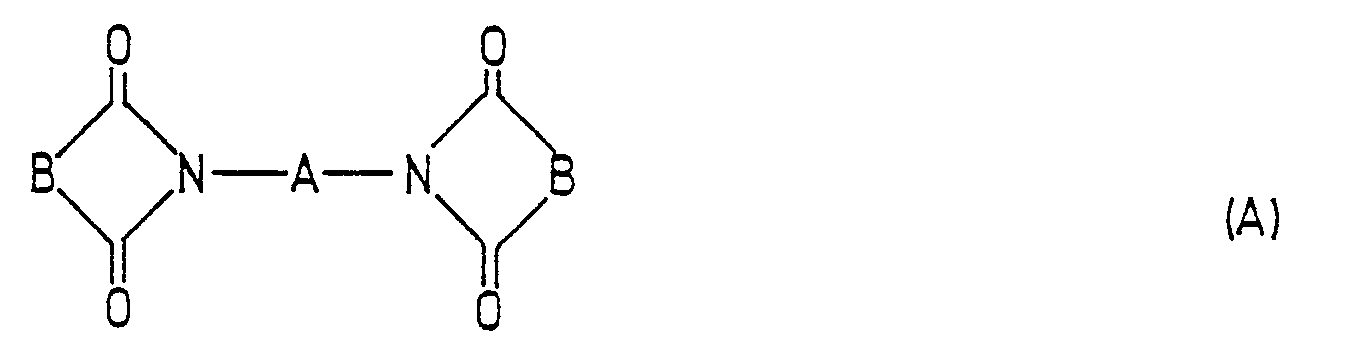
- the present invention relates to new curable bisimide resin-forming mixtures which comprise a mixture of (a) at least one bisimide of formula I in which B is a bivalent organic radical containing a carbon-carbon double bond and A is a bivalent organic radical having at least two carbon atoms and (b) a diisocyanate of the general formula II in which D stands for a divalent organic residue.
- the molar ratio a:b lies in the range 5.25 to 100.
- the mixture does not contain polyamines, polyhydrazides, amino acid hydrazides, azomethines, mixtures thereof or unsaturated polyesters obtained by the polycondensation of polycarboxylic acids with polyglycols.
- the copolymerization of bisimides with diisocyanates can be effected by simply heating a mixture of the two to between 80 and 400°C, long enough to finalize the reaction.
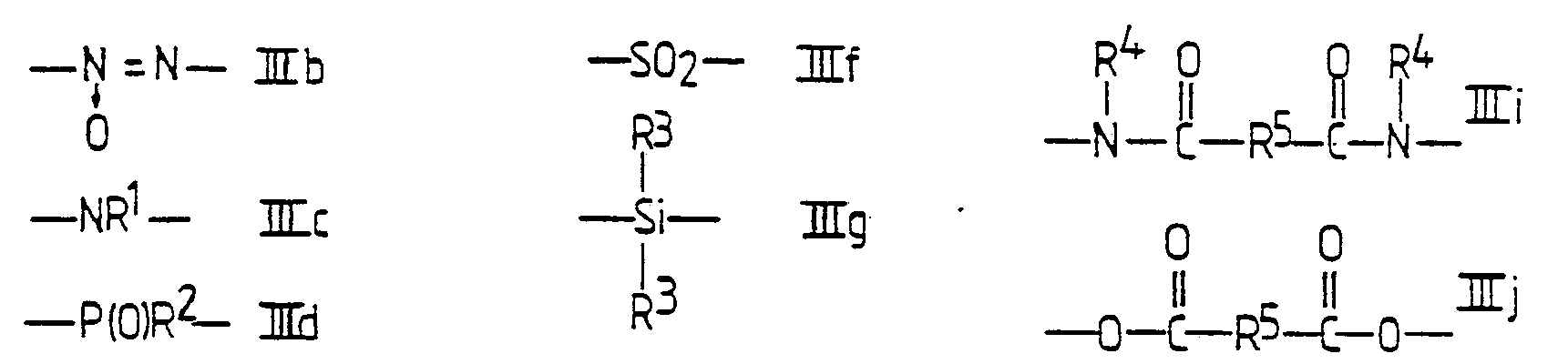
- the radical designated A in general formula I may be (a) an alkylene group with up to 12 carbon atoms, (b) a cycloalkylene group with 5 to 6 carbon atoms, (c) a heterocyclic group with 4 to 5 carbon atoms and at least one nitrogen, oxygen or sulphur atom in the ring, (d) a mono or dicarbocyclic group or (e) at least two mono or dicarbocyclic aromatic or cycloalkylene groups which are connected to one another by a direct carbon-carbon bond or by a divalent group chosen from oxygen, sulphur, alkylene with one to three carbon atoms, or a group of formula Illa to lllj the radicals R i , R 2 , R 3 , R 4 , being alkyl groups with one to five carbon atoms, R 5 being an alkylene group or an arylene group.
- the radical B in the general formula I represents a divalent organic radical containing a carbon-carbon double bond.
- the radical B may have a structure as shown in formula IV, V, VI or VII Bismaleimides of formula I in which the radical B is of formula IV may be used for producing the new imide resins.
- suitable bismaleimides are 1,2-bismaleimidoethane, 1,6-bismaleimidohexane, 1,12- bismaleimidododecane, 1,6-bismaleimido-(2,2,4-trimethyl)hexane, 1,3-bismaleimidobenzene, 1,4-bismaleimidobenzene, 4,4'-bismaleimidodiphenylmethane, 4,4'-bismaleimidodiphenylether, 4,4'-bismale- imidodiphenylsulphide, 4,4'-bismaleimidodiphenylsulphone, 4,4'-bismaleimidodicyclohexylmethane, 2,4- bismaleimidotoluene, 2,6-bismaleimidotoluene, N,N'-m-xylylenebismaleimide, N,N-p-xylylenebismale- imide.
- Examples of other suitable bisimides are N,N-m-phenylene-biscitraconomide and N,N-4,4'-diphenylmethane-citraconimide, in which the radical B is of formula VI and N,N-4,4'-diphenylmethane-bis- itaconomide in which the radical B is of formula VII.
- organic diisocyanates II may be employed to react with the bisimides of the general formula I including aromatic, aliphatic and cycloaliphatic diisocyanates, referred to here as group 1 polyisocyanates.
- Representative compounds include toluene-2,6-diisocyanate, toluene-2,4-diisocyanate, m-phenylenediisocyanate, 4-chloro-1,3-phenylenediisocyanate, 4,4'-biphenylenediisocyanate, 1,5-naphthylenediisocyanate, 4,4-bisisocyanatodiphenyl methane, 2,4'-bisisocyanatodiphenylmethane, 4,4'bis-isocyanatodiphenyl ether, 4,4'-bisisocyanatodiphenyl-sulphone, 3,3-diisocyanatodiphenylsulphone, 4,4'-bis-isocyan
- Very advantageous diisocyanates to be co-reacted with bismaleimides of formula I are those obtained by the reaction of a diisocyanate of the aforementioned group 1 diisocyanates with polyalkylene ether glycols, providing isocyanate-terminated macropolyisocyanates of the formula IX, referred to here as group 2 diisocyanates, in which R represents a divalent organic aliphatic or aromatic residue and F represents a group of formula X, XI or XII F representing polyalkylene ether backbone, ⁇ being a number providing a molecular weight for the structure IX of between 200 and 10,000.
- the group 2 diisocyanates of formula IX are well known substances and their preparations described in detail in Kunststoffhandbuch, Band VII, p. 84-85, Carl Hanser Verlag, Munchen 1966; they may be used in quantities up to 80% by weight of the total resin mixture.
- the residue F in the general formula IX can also be a polyester backbone, and the preparation of diisocyanates of formula IX with a polyester backbone is described in Kunststoffhandbuch, Band VII, p. 60-72, Carl Hanser Verlay, Munchen 1966.
- the preparation of the new curable bisimide resin-forming mixtures can be carried out in an inert organic solvent of diluent, for example in dimethyl formamide, dimethylacetamide, N-methyl pyrrolidone and tetramethyl urea, or ketone type solvents such as acetone, methyl-ethyl ketone, methyl isobutyl ketone and cyclohexanone or chlorinated solvents such as methylene chloride, ethyl chloride, 1,2-dichloroethane and ether-type solvents such as dioxane, tetrahydrofuran ethyl glycol and ester type solvents such as ethyl acetate or mixed glycol ether-esters such as ethyl glycol acetate, methyl glycol acetate, diethylene glycol diethyl ether, diethylene glycol monoethyl ether acetate and mixtures thereof in such a manner that prepolymer
- the preparation of the new curable bisimide resin-forming mixtures can be performed by using conventional techniques for mixing and grinding of powders or powders and liquids to intimately blend the bisimides with the diisocyanates. Prepolymers are obtained by heating the homogeneous mixture at a temperature between 80 and 200°C, for sufficient time to produce a still formable and soluble product.
- the production of the new curable bisimide resin-forming mixtures according to this invention can also be carried out in inert diluents in which either only one of the starting materials is completely soluble or all the starting components are completely soluble.
- inert diluents in which either only one of the starting materials is completely soluble or all the starting components are completely soluble. The latter procedure is preferred when the application of the resin-forming mixtures requires a solution as is the case for the production of prepregs.
- Effective curing catalysts are organic peroxides such as ditertiary butyl peroxide, diamyl peroxide, t-butyl perbenzoate in the concentration of 0.05 to 0.5% in relation to the total weight of the curable bisimide resin-forming mixtures.
- Other catalysts that may be used are tertiary amines like N,N'-dimethylaniline, N,N'-dimethyl-benzylamine, N-methylmorpholine, tri-n-butylamine, tri-methylamine and azabicyclooctane and others.
- the catalysts can be admixed with the components of the curable bisimide resin-forming mixtures or they temperatures may be added during the production of the prepolymers either by a powder blending process or by the solvent blending process described above.
- the resin-forming mixtures of the present invention can be blended with so-called reactive diluents, preferably those that are liquid at room temperature.
- the reactive diluents that may be employed carry one or more polymerizable double bonds of the general formula XIII of the vinyl-, allyl- or acryl- type.
- These reactive diluents can be of the ether, ester, hydrocarbon or heterocyclic type.
- Typical ethers that may be employed are vinylallylether, diallylether, methallylether and vinylphenylether.
- esters are vinyl-, allyl-, methylallyl-, 1-chlorallyl-, crotyl-, isopropenyl esters derived from saturated or unsaturated aliphatic or aromatic mono- or polycarboxylic acids such as formic, acetic, propionic, butyric, oxalic, malonic, adipic, sebacic, acrylic, methacrylic, phenylacrylic, crotonic, maleic, fumaric, itaconic, citraconic, tetrahydrophthalic, benzoic, phenylacetic, o-phthalic, isophthalic or terephthalic acid and naphthalic-dicarboxylic acid or mixtures thereof.
- saturated or unsaturated aliphatic or aromatic mono- or polycarboxylic acids such as formic, acetic, propionic, butyric, oxalic, malonic, adipic, sebacic, acrylic, methacrylic, phenyl
- hydrocarbon type reactive diluents to be used are styrene, methylstyrene, vinylhexane, vinylcyclohexane, divinylbenzene, divinyl cyclohexane, diallylbenzene, vinyltoluene and 1-vinyl-4-ethyl-benzene or mixtures thereof.
- heterocyclic type reactive diluents are vinylpyridine and vinylpyrrolidine.
- the diisocyanate component is added.
- the diisocyanate is preferably dissolved in the reactive diluent and then blended with the bismaleimide compounds.
- the quantity of reactive diluent that may be employed can be up to 80% by weight of the total final resin mixture.
- Very advantageous reactive diluents are styrene and divinylbenzene which are used in quantities up to 30% of the total bisimide-diisocyanate mixture. Care has to be taken with these diluents because they crosslink at very low temperatures, at around 100-110°C, therefore mixtures containing these diluents have to be prepared at temperatures well below 100°C.
- the new curable bisimide resin-forming mixtures of the present invention can be thermally converted to crosslinked polyimide-isocyanate copolymers by heating them to temperatures of between 80 and 400°C, for a time sufficient to complete cure.
- the new curable bisimide resin-forming mixtures are advantageously used to produce laminated materials.
- the prepolymers produced from the curable bisimide resin-forming mixtures are dissolved in suitable solvents to provide a 50-60% by weight solution, which is used to impregnate glass fibres in the form of fabrics or rovings or carbon fibres or boron fibres or organic synthetic fibres in the form of fabrics, filaments or rovings are impregnated with this solution and then stripped of the solvent by drying after which they are moulded into laminate form by the application of pressure and temperature, the crosslinked polyimide-isocyanate copolymer being the binder.
- the curable bisimide resin-forming mixtures according to the invention can also be processed by the known methods of the powder moulding industry in relation to curable compositions, to produce mouldings, curing out taking place with simultaneous shaping under pressure.
- additives such as fillers, colourants, softeners and flameproofing agents.
- Ideal fillers are for example glass fibres, carbon fibres, organic high modulus fibres such as aramides, quartz flour, kaolin, silica and metals in the form of fine powders.
Landscapes
- Chemical & Material Sciences (AREA)
- Health & Medical Sciences (AREA)
- Chemical Kinetics & Catalysis (AREA)
- Medicinal Chemistry (AREA)
- Polymers & Plastics (AREA)
- Organic Chemistry (AREA)
- Macromolecular Compounds Obtained By Forming Nitrogen-Containing Linkages In General (AREA)
- Polyurethanes Or Polyureas (AREA)
- Polymers With Sulfur, Phosphorus Or Metals In The Main Chain (AREA)
- Reinforced Plastic Materials (AREA)
Claims (14)

dans lequel le rapport molaire a:b se trouve dans l'intervalle de 5,25 à 100, mais qui ne contient ni polyhydrazides de polyamines, ni hydrazides d'amino-acides, ni azométhines, ni mélanges de ceux-ci ni polyesters non saturés obtenus par la polycondensation d'acides polycarboxyliques avec des polyglycols.



Applications Claiming Priority (2)
| Application Number | Priority Date | Filing Date | Title |
|---|---|---|---|
| GB8221116 | 1982-07-21 | ||
| GB8221116 | 1982-07-21 |
Related Parent Applications (1)
| Application Number | Title | Priority Date | Filing Date |
|---|---|---|---|
| EP83304149.4 Division | 1983-07-18 |
Publications (2)
| Publication Number | Publication Date |
|---|---|
| EP0165620A1 EP0165620A1 (fr) | 1985-12-27 |
| EP0165620B1 true EP0165620B1 (fr) | 1988-08-03 |
Family
ID=10531814
Family Applications (2)
| Application Number | Title | Priority Date | Filing Date |
|---|---|---|---|
| EP19850108123 Expired EP0165620B1 (fr) | 1982-07-21 | 1983-07-18 | Résines imides thermodurcissables modifiées |
| EP19830304149 Expired EP0102722B1 (fr) | 1982-07-21 | 1983-07-18 | Résines imidiques thermodurcissables modifiées |
Family Applications After (1)
| Application Number | Title | Priority Date | Filing Date |
|---|---|---|---|
| EP19830304149 Expired EP0102722B1 (fr) | 1982-07-21 | 1983-07-18 | Résines imidiques thermodurcissables modifiées |
Country Status (7)
| Country | Link |
|---|---|
| US (2) | US4520145A (fr) |
| EP (2) | EP0165620B1 (fr) |
| JP (1) | JPS5920323A (fr) |
| DE (1) | DE3366595D1 (fr) |
| GB (1) | GB2125806B (fr) |
| IL (1) | IL69221A (fr) |
| WO (1) | WO1984000552A1 (fr) |
Families Citing this family (6)
| Publication number | Priority date | Publication date | Assignee | Title |
|---|---|---|---|---|
| US4520145A (en) * | 1982-07-21 | 1985-05-28 | The Boots Company Plc | Modified thermosetting imide resins with improved fracture toughness |
| DE3481915D1 (de) * | 1983-11-04 | 1990-05-17 | Technochemie Gmbh | Haertbare bisimidharzmischungen. |
| NL8801788A (nl) * | 1988-07-13 | 1990-02-01 | Wavin Bv | Buis uit vinylchloride kunststof en uit dergelijke buis vervaardigde drukleiding. |
| US4942093A (en) * | 1988-09-09 | 1990-07-17 | Bridgestone/Firestone, Inc. | Adhesive system for bonding uncured rubber to cured polyurethane |
| DE60315145T2 (de) * | 2002-03-13 | 2008-04-30 | Beijing Jiankai Technology Co., Ltd. | Hydrophiles polymerderivat mit y-verzweigung und herstellungsverfahren dafür; obige verbindung enthaltender medizinischer verbundwerkstoff |
| EP3717245B1 (fr) | 2017-11-28 | 2023-09-20 | Questek Innovations LLC | Méthode d'utilisation d'une poudre d'alliage atomisée dans la fabrication additive |
Citations (1)
| Publication number | Priority date | Publication date | Assignee | Title |
|---|---|---|---|---|
| EP0102722A1 (fr) * | 1982-07-21 | 1984-03-14 | The Boots Company PLC | Résines imidiques thermodurcissables modifiées |
Family Cites Families (10)
| Publication number | Priority date | Publication date | Assignee | Title |
|---|---|---|---|---|
| SE316011B (fr) * | 1964-11-13 | 1969-10-13 | Rhodiaceta | |
| CH569758A5 (fr) * | 1972-07-24 | 1975-11-28 | Ciba Geigy Ag | |
| US3779996A (en) * | 1972-09-11 | 1973-12-18 | Gen Electric | Polyamideimides from unsaturated anhydrides |
| FR2279793A2 (fr) * | 1974-07-22 | 1976-02-20 | Rhone Poulenc Ind | Resines thermostables |
| FR2288767A1 (fr) * | 1974-10-21 | 1976-05-21 | Rhone Poulenc Ind | Compositions thermodurcissables a base de bis-imide polyurethanne |
| FR2376167A1 (fr) * | 1976-12-31 | 1978-07-28 | Rhone Poulenc Ind | Polymeres a groupements imides |
| DE2754631C2 (de) * | 1977-12-08 | 1986-05-07 | Technochemie Gmbh, Verfahrenstechnik, 6901 Dossenheim | Heißhärtbare Imidharze |
| DE2754632C2 (de) * | 1977-12-08 | 1984-04-19 | Technochemie Gmbh, Verfahrenstechnik, 6901 Dossenheim | Heißhärtbare Imidharze |
| FR2473528A1 (fr) * | 1980-01-09 | 1981-07-17 | Rhone Poulenc Ind | Procede pour eviter la cristallisation des n,n' diphenylene bis imides dans les compositions thermodurcissables en contenant |
| JPS5728128A (en) * | 1980-07-24 | 1982-02-15 | Mitsubishi Gas Chem Co Inc | Heat-resistant composition |
-
1982
- 1982-10-29 US US06/437,794 patent/US4520145A/en not_active Expired - Lifetime
-
1983
- 1983-05-19 JP JP58088322A patent/JPS5920323A/ja active Pending
- 1983-07-14 IL IL6922183A patent/IL69221A/xx unknown
- 1983-07-18 EP EP19850108123 patent/EP0165620B1/fr not_active Expired
- 1983-07-18 GB GB8319388A patent/GB2125806B/en not_active Expired
- 1983-07-18 EP EP19830304149 patent/EP0102722B1/fr not_active Expired
- 1983-07-18 WO PCT/GB1983/000176 patent/WO1984000552A1/fr not_active Ceased
- 1983-07-18 DE DE8383304149T patent/DE3366595D1/de not_active Expired
-
1985
- 1985-02-28 US US06/706,613 patent/US4587281A/en not_active Expired - Fee Related
Patent Citations (1)
| Publication number | Priority date | Publication date | Assignee | Title |
|---|---|---|---|---|
| EP0102722A1 (fr) * | 1982-07-21 | 1984-03-14 | The Boots Company PLC | Résines imidiques thermodurcissables modifiées |
Also Published As
| Publication number | Publication date |
|---|---|
| IL69221A (en) | 1987-03-31 |
| EP0102722A1 (fr) | 1984-03-14 |
| US4587281A (en) | 1986-05-06 |
| DE3366595D1 (en) | 1986-11-06 |
| EP0102722B1 (fr) | 1986-10-01 |
| JPS5920323A (ja) | 1984-02-02 |
| WO1984000552A1 (fr) | 1984-02-16 |
| EP0165620A1 (fr) | 1985-12-27 |
| GB2125806B (en) | 1986-04-16 |
| GB2125806A (en) | 1984-03-14 |
| GB8319388D0 (en) | 1983-08-17 |
| US4520145A (en) | 1985-05-28 |
Similar Documents
| Publication | Publication Date | Title |
|---|---|---|
| US4510272A (en) | Bis-maleimide-epoxy compositions and prepregs | |
| US4871821A (en) | Curable resin from bis-maleimide and alkenyl phenyl hydroxy ether | |
| US3658764A (en) | Cross-linked resins | |
| USRE29316E (en) | Cross-linked resins | |
| US4043986A (en) | Polymers possessing imide groups | |
| EP0212808B1 (fr) | Résines durcissables | |
| US4931496A (en) | Damage tolerant fiber-reinforced composites based on cyanate ester/urea thermosetting composition | |
| US4849490A (en) | Novel bis(maleimide)/polysiloxanes | |
| EP0485405B1 (fr) | Copolymeres a base de biscitraconimides comportant des substances non saturees a l'olefine | |
| US4342861A (en) | Polyisocyanato/imido compositions and imide group containing polymers prepared from polyisocyanate, polyimide and copolymerizable comonomer | |
| US4520145A (en) | Modified thermosetting imide resins with improved fracture toughness | |
| US5122589A (en) | Imido/siloxane bismaleimide/aromatic diamine prepolymers | |
| US4085164A (en) | Thermosetting compositions based on a bis-imide and a polyurethane | |
| US4275185A (en) | Polyimides of bismaleimides and activated methylene compounds | |
| US4132747A (en) | Heat-resistant molding resin composition | |
| GB2159165A (en) | Curable bisimide resin-forming mixtures | |
| US4806419A (en) | Bisimide/polyhydantoin curable resins | |
| US3998787A (en) | Heat-stable polyimide resins from bis-imide and aldehyde-azine | |
| US3972960A (en) | Heat-stable polyimide resin modified by unsaturated polyester | |
| EP0384711A1 (fr) | Produit moulé pour éléments coulissants | |
| US4593083A (en) | Curable composition comprising bismaleimide and maleimide-amide | |
| US4039628A (en) | Heat-stable polyimide resins | |
| US5198516A (en) | Thermally stable bisimido/p-allylaniline copolymers | |
| JPS6172023A (ja) | 熱硬化性樹脂組成物 | |
| JPH029051B2 (fr) |
Legal Events
| Date | Code | Title | Description |
|---|---|---|---|
| PUAI | Public reference made under article 153(3) epc to a published international application that has entered the european phase |
Free format text: ORIGINAL CODE: 0009012 |
|
| 17P | Request for examination filed |
Effective date: 19850701 |
|
| AC | Divisional application: reference to earlier application |
Ref document number: 102722 Country of ref document: EP |
|
| AK | Designated contracting states |
Designated state(s): BE DE FR IT NL SE |
|
| 17Q | First examination report despatched |
Effective date: 19870102 |
|
| GRAA | (expected) grant |
Free format text: ORIGINAL CODE: 0009210 |
|
| AC | Divisional application: reference to earlier application |
Ref document number: 102722 Country of ref document: EP |
|
| AK | Designated contracting states |
Kind code of ref document: B1 Designated state(s): BE DE FR IT NL SE |
|
| REF | Corresponds to: |
Ref document number: 3377581 Country of ref document: DE Date of ref document: 19880908 |
|
| ITF | It: translation for a ep patent filed | ||
| ET | Fr: translation filed | ||
| PLBE | No opposition filed within time limit |
Free format text: ORIGINAL CODE: 0009261 |
|
| STAA | Information on the status of an ep patent application or granted ep patent |
Free format text: STATUS: NO OPPOSITION FILED WITHIN TIME LIMIT |
|
| 26N | No opposition filed | ||
| ITTA | It: last paid annual fee | ||
| NLS | Nl: assignments of ep-patents |
Owner name: TECHNOCHEMIE GMBH VERFAHRENSTECHNIK TE DOSSENHEIM, |
|
| ITPR | It: changes in ownership of a european patent |
Owner name: CESSIONE;TECNOCHEMIE GMBH VERFAHRENSTECHNIK |
|
| REG | Reference to a national code |
Ref country code: FR Ref legal event code: TP |
|
| EAL | Se: european patent in force in sweden |
Ref document number: 85108123.2 |
|
| PGFP | Annual fee paid to national office [announced via postgrant information from national office to epo] |
Ref country code: FR Payment date: 19960528 Year of fee payment: 14 |
|
| PGFP | Annual fee paid to national office [announced via postgrant information from national office to epo] |
Ref country code: SE Payment date: 19960610 Year of fee payment: 14 |
|
| PGFP | Annual fee paid to national office [announced via postgrant information from national office to epo] |
Ref country code: BE Payment date: 19960708 Year of fee payment: 14 |
|
| PGFP | Annual fee paid to national office [announced via postgrant information from national office to epo] |
Ref country code: NL Payment date: 19960729 Year of fee payment: 14 |
|
| PGFP | Annual fee paid to national office [announced via postgrant information from national office to epo] |
Ref country code: DE Payment date: 19960807 Year of fee payment: 14 |
|
| PG25 | Lapsed in a contracting state [announced via postgrant information from national office to epo] |
Ref country code: SE Effective date: 19970719 |
|
| PG25 | Lapsed in a contracting state [announced via postgrant information from national office to epo] |
Ref country code: BE Free format text: LAPSE BECAUSE OF NON-PAYMENT OF DUE FEES Effective date: 19970731 |
|
| BERE | Be: lapsed |
Owner name: TECHNOCHEMIE G.M.B.H. VERFAHRENSTECHNIK Effective date: 19970731 |
|
| PG25 | Lapsed in a contracting state [announced via postgrant information from national office to epo] |
Ref country code: NL Free format text: LAPSE BECAUSE OF NON-PAYMENT OF DUE FEES Effective date: 19980201 |
|
| PG25 | Lapsed in a contracting state [announced via postgrant information from national office to epo] |
Ref country code: FR Free format text: LAPSE BECAUSE OF NON-PAYMENT OF DUE FEES Effective date: 19980331 |
|
| NLV4 | Nl: lapsed or anulled due to non-payment of the annual fee |
Effective date: 19980201 |
|
| PG25 | Lapsed in a contracting state [announced via postgrant information from national office to epo] |
Ref country code: DE Free format text: LAPSE BECAUSE OF NON-PAYMENT OF DUE FEES Effective date: 19980401 |
|
| EUG | Se: european patent has lapsed |
Ref document number: 85108123.2 |
|
| REG | Reference to a national code |
Ref country code: FR Ref legal event code: ST |