EP0166096B1 - Combustibles pour moteurs - Google Patents
Combustibles pour moteurs Download PDFInfo
- Publication number
- EP0166096B1 EP0166096B1 EP19850104214 EP85104214A EP0166096B1 EP 0166096 B1 EP0166096 B1 EP 0166096B1 EP 19850104214 EP19850104214 EP 19850104214 EP 85104214 A EP85104214 A EP 85104214A EP 0166096 B1 EP0166096 B1 EP 0166096B1
- Authority
- EP
- European Patent Office
- Prior art keywords
- hydrocarbons
- fuel
- weight
- methanol
- mixture
- Prior art date
- Legal status (The legal status is an assumption and is not a legal conclusion. Google has not performed a legal analysis and makes no representation as to the accuracy of the status listed.)
- Expired - Lifetime
Links
Images




Classifications
-
- C—CHEMISTRY; METALLURGY
- C10—PETROLEUM, GAS OR COKE INDUSTRIES; TECHNICAL GASES CONTAINING CARBON MONOXIDE; FUELS; LUBRICANTS; PEAT
- C10L—FUELS NOT OTHERWISE PROVIDED FOR; NATURAL GAS; SYNTHETIC NATURAL GAS OBTAINED BY PROCESSES NOT COVERED BY SUBCLASSES C10G OR C10K; LIQUIFIED PETROLEUM GAS; USE OF ADDITIVES TO FUELS OR FIRES; FIRE-LIGHTERS
- C10L1/00—Liquid carbonaceous fuels
- C10L1/02—Liquid carbonaceous fuels essentially based on components consisting of carbon, hydrogen, and oxygen only
Definitions
- the invention relates to fuels based on methanol and / or ethanol which contain additives to mixtures of C 5 / C 6 -, C 5 ⁇ C 7 hydrocarbons and gasoline and mixtures of C 4 hydrocarbons.
- the hydrocarbons used can also be partially unsaturated or consist of unsaturated hydrocarbons (column 5, lines 28-34).
- the additional components specified are n-pentane, isopentane and a C4 cut which contains up to 20% butenes.
- a mixture of saturated C S hydrocarbons can also be used for the special case of fuel for aircraft engines in US Pat. No. 2,365,009, mixtures of ethanol with aliphatic C 3 -C, hydrocarbons are also described, the aliphatic hydrocarbons can be both saturated and unsaturated, and preferably isopentane (claim 8 and Table 1) is added as the hydrocarbon.
- a process for producing a gaseous fuel mixture is described in GB-A-669,037 with 5-10% by volume of C 3 -C S hydrocarbons, C 2 ⁇ C 5 alcohols and 5-30% by volume of water.
- FR-B-2,251,614 describes a method for producing and transporting an energy carrier. This consists of methanol and Cg-C 6 hydrocarbons dissolved therein, the proportion of C 3 hydrocarbons being 12.96% by weight. After transport, these can be wholly or partly expelled from the methanol.
- the experts are aware of important fuel-specific disadvantages of the lower alcohols, e.g. the poor cold start behavior, the poor driving behavior at low outside temperatures, the inevitable miscibility with hydrocarbons, especially at low temperatures, and the wide explosion range.
- the cold start problems are to be found in the low ignitability of the alcohols methanol and ethanol.
- a measure of the ignitability is the vapor pressure of a fuel, which is measured according to the so-called Reid test at 38.0 ° C.
- gasoline in the Reid test has a vapor pressure of 700 mbar, methanol, on the other hand, of 350 mbar.
- methanol methanol
- the vapor pressures of methanol and ethanol are so low that a gaseous, ignitable mixture is hardly possible.
- the explosion limits of pure methanol in air are 6.75 to 36.7 vol.%, So that there is an explosive fuel-air mixture in the vehicle tanks between + 10 ° C and + 35 ° C. Additions of 6 ⁇ 9% by weight isopentane reduce the upper explosion limits to -7 ° C in summer and -20 ° C in winter. so that the security problems are largely eliminated.
- Isopentane is also characterized by excellent solubility in both methanol and ethanol, especially at low temperatures.
- the most favorable setting data for the vapor pressure of pure methanol turned out to be the upper vapor pressure values of the fuel standard DIN 51 600 with 700 mbar for summer and 900 mbar for winter fuel (Reid test).
- isopentane (2-methylbutane) was therefore regarded as the optimal admixing component to date.
- the vapor pressure is too high when pure methanol is used, despite lowering the isopentane content to 5 to 6% by weight, with undesirable outgassing of the isopentane occurring as a result, while in winter operation, despite an isopentane content up to 9% by weight at low Temperatures a vapor pressure drop occurs, which means that the cold start properties leave something to be desired in winter cold weather below -10 ° C.
- a methanol fuel that contains saturated C 4 hydrocarbons and a mixture of saturated C S - Contains hydrocarbons with a proportion of> 12.3% by weight> C 5 hydrocarbons is disclosed in EP-A-0 118 805. (Release date: Jan 2, 1986).
- the object of the present invention was to find fuels based on methanol and ethanol which provide better cold start behavior, better driving behavior, in particular at relatively high and relatively low outside temperatures, as is required in practical motor vehicle operation, with perfect solubility even in winter operation and less Ensure degassing in summer operation and, at the same time, ensure safe operation without an explosive mixture occurring in the fuel tank.
- C 5 ⁇ C 7 hydrocarbons or gasoline such as those found in the refinery and primary chemicals production area, e.g. ethylene and gasoline / toluene (BT) plants, are eminently suitable, despite the different composition of individual hydrocarbons, the proportion of C 6 + C 7 hydrocarbons in the C 5 ⁇ C 7 mixture is> 12.3% by weight.
- Examples of straight run, crack and catalytic crack cuts for the refinery sector may be mentioned, furthermore, for example, reformer cuts or Merox cuts.
- the cuts claimed according to the invention are, however, not restricted to the cuts mentioned, since, as is known to the person skilled in the art, the fuel components according to the invention can also be obtained from other plants due to the different structure of the refining. It goes without saying that the hydrocarbons contained in the fuels according to the invention can also be obtained, including the C 4 hydrocarbons, in the form of a single technical cut.
- the total amount of C 4 -hydrocarbons on the one hand and C-C 7 -hydrocarbons or gasoline on the other hand can be 0.1 to 25% by weight.
- the ratio of C 4 hydrocarbons on the one hand to C 5 ⁇ C 7 hydrocarbons and petrol on the other hand can be 1: 500 to 3: 1.
- a ratio of C 4 -hydrocarbons on the one hand and Cg-C 7 -hydrocarbons or gasoline on the other hand is preferred from 1: 1 to 1:20.
- Suitable fractions of C 4 , C s , C 6 and C 7 mixtures are given as examples in the following analyzes, although the hydrocarbons contained in the fuels according to the invention cannot consist of such individual fractions but also of jointly cut fractions:
- the methanol quality previously used for methanol-based fuels is methanol processed by distillation, so-called pure methanol (absolutely pure or refined methanol). It is known to the person skilled in the art that high demands are made with regard to the purity of this methanol quality, a correspondingly high level of operational effort being required, particularly in the distillation area. Since certain technical problems arise, especially with methanol fuel, e.g.
- raw methanol contains up to approx. 5% by weight of water numerous impurities, e.g. Formaldehyde, methyl formate, formic acid, dimethyl sulfide, formaldehyde dimethyl acetal, iron pentacarbonyl and other carboxylic acids and their esters.
- impurities e.g. Formaldehyde, methyl formate, formic acid, dimethyl sulfide, formaldehyde dimethyl acetal, iron pentacarbonyl and other carboxylic acids and their esters.
- a tubular methanol can also be used which is not distilled but is topped off with removal of volatile impurities.
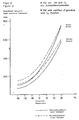
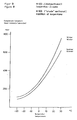
- Fig. 1 the vapor pressure of a fuel made of pure or raw methanol and C 4 - / C 5 ⁇ C 7 hydrocarbons is plotted in mbar against the temperature range -30 to + 30 ° C for winter and summer.
- Table 2 shows the compositions in% by weight, which are to be regarded as examples.
- the fuels according to the invention include, in particular, compositions in which the total hydrocarbon quantity for summer and winter operation is as large as possible, since this means that no or only slight changes in the engine setting for winter and summer operation are required. This also applies to C 4 / C 5 ⁇ C 7 - as well as for CJ gasoline components or mixtures of hydrocarbons.
- the preferred total amounts of hydrocarbons contained in the fuels according to the invention are 2-18 for C 4 -C 7 and 2-25% by weight for C 4 / gasoline.
- Reid vapor pressures are 700 mbar for this summer fuel and 900 mbar for the winter fuel.
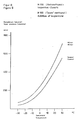
- vapor pressures of the fuels according to the invention can vary within a certain range.
- FIG. 6 This general behavior is shown in FIG. 6.
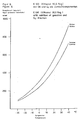
- a single curve is shown in FIG. 7 for a mixture of 95.6% by weight of ethanol and C 5 / C 6 hydrocarbon additives. If the total amount of, for example, C 5 / C 6 hydrocarbons is kept constant, but if the ratio of C s to C s hydrocarbons varies, the result is a set of curves.
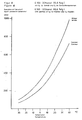
- Fig. 2 is the vapor pressure of a fuel made of pure or raw methanol with the addition of petrol in mbar against the temperature range -30 ° C- + 30 ° C for winter and summer.
- Table 3 shows the composition, in each case in% by weight:
- Reid vapor pressures are 700 mbar for this summer fuel and 900 mbar for the winter fuel.
- Figures 1 and 2 give surprising results for the person skilled in the art. (The common basis is the Reid steam pressure of 700 mbar for summer and 900 mbar for winter operation).
- the vapor pressures of the fuels according to the invention shown in the curves in FIGS. 1 and 2 are summarized in Table 4 for -30 ° C. and + 30 ° C. They show that, for the person skilled in the art, the fuels according to the invention unpredictably ensure excellent vapor pressure behavior.
- Table 7 summarizes the compositions of ethanol-based fuels according to the invention.
- the ratio of C 5 -C 6 in this example is 1: 1. If the (preferred) concentration of C 5 / C 6 or C S -C 7 or OK has been determined in accordance with the concentration curve 6 or 7, then sufficient C 4 is added to obtain the desired pure steam pressure.
- Reid vapor pressures of 700 mbar (summer) and 900 mbar (winter) are preferred as a comparison basis for the fuels according to the invention, but that other summer or winter vapor pressures can also be selected as the basis according to the invention, or that the vapor pressures of the fuels used in practical driving operation are variable in certain areas.
- the fuels according to the invention can be additized, as is customary in the case of alcohol-based fuels.
- Suitable corrosion inhibitors include e.g. those based on triazole, imidazole or benzoate.
- Tricresyl phosphate e.g. Tricresyl phosphate, but also others, can be used.
- emulsifiers such as glycols or their mono- and diether and others can be used.
Landscapes
- Chemical & Material Sciences (AREA)
- Oil, Petroleum & Natural Gas (AREA)
- Engineering & Computer Science (AREA)
- Chemical Kinetics & Catalysis (AREA)
- General Chemical & Material Sciences (AREA)
- Organic Chemistry (AREA)
- Liquid Carbonaceous Fuels (AREA)
Claims (10)
Priority Applications (3)
| Application Number | Priority Date | Filing Date | Title |
|---|---|---|---|
| AT85104214T ATE58911T1 (de) | 1984-06-16 | 1985-04-06 | Motor-kraftstoffe. |
| IN902/DEL/85A IN169742B (fr) | 1984-06-16 | 1985-10-29 | |
| IN550/DEL/88A IN169750B (fr) | 1984-06-16 | 1988-06-29 |
Applications Claiming Priority (2)
| Application Number | Priority Date | Filing Date | Title |
|---|---|---|---|
| EP84106899 | 1984-06-16 | ||
| EP84106899A EP0166006A1 (fr) | 1984-06-16 | 1984-06-16 | Combustible pour moteurs |
Publications (2)
| Publication Number | Publication Date |
|---|---|
| EP0166096A1 EP0166096A1 (fr) | 1986-01-02 |
| EP0166096B1 true EP0166096B1 (fr) | 1990-12-05 |
Family
ID=8191995
Family Applications (2)
| Application Number | Title | Priority Date | Filing Date |
|---|---|---|---|
| EP84106899A Withdrawn EP0166006A1 (fr) | 1984-06-16 | 1984-06-16 | Combustible pour moteurs |
| EP19850104214 Expired - Lifetime EP0166096B1 (fr) | 1984-06-16 | 1985-04-06 | Combustibles pour moteurs |
Family Applications Before (1)
| Application Number | Title | Priority Date | Filing Date |
|---|---|---|---|
| EP84106899A Withdrawn EP0166006A1 (fr) | 1984-06-16 | 1984-06-16 | Combustible pour moteurs |
Country Status (2)
| Country | Link |
|---|---|
| EP (2) | EP0166006A1 (fr) |
| DE (1) | DE3580791D1 (fr) |
Families Citing this family (7)
| Publication number | Priority date | Publication date | Assignee | Title |
|---|---|---|---|---|
| DE3711985A1 (de) * | 1987-04-09 | 1988-10-20 | Union Rheinische Braunkohlen | Verwendung von polyolethern zur verhinderung oder verminderung von ablagerungen in gemischaufbereitungssystemen |
| US6324827B1 (en) * | 1997-07-01 | 2001-12-04 | Bp Corporation North America Inc. | Method of generating power in a dry low NOx combustion system |
| GB2333048B (en) * | 1998-01-13 | 2002-03-20 | Hugh F Collins | A rejuvenating and/or cleaning agent |
| US6843813B1 (en) | 2000-06-07 | 2005-01-18 | Hugh Frederick Collins | Rejuvenation and/or cleaning of catalysts |
| GB2433265A (en) * | 2005-12-16 | 2007-06-20 | Derek Lowe | Low toxicity fuel |
| CN113088348A (zh) * | 2021-04-09 | 2021-07-09 | 重庆邑丰新能源有限公司 | 一种工业用改性甲醇燃料及其制备方法 |
| US12606757B2 (en) | 2023-10-02 | 2026-04-21 | Turn 3 Holdings LLC | Alcohol based unleaded automotive racing fuel |
Family Cites Families (3)
| Publication number | Priority date | Publication date | Assignee | Title |
|---|---|---|---|---|
| JPS5629920B2 (fr) * | 1973-11-20 | 1981-07-11 | ||
| JPS5416510A (en) * | 1977-07-07 | 1979-02-07 | Suzuki Motor Co | Blended fuel for internal combustion engines |
| US4333739A (en) * | 1979-10-23 | 1982-06-08 | Neves Alan M | Blended ethanol fuel |
-
1984
- 1984-06-16 EP EP84106899A patent/EP0166006A1/fr not_active Withdrawn
-
1985
- 1985-04-06 DE DE8585104214T patent/DE3580791D1/de not_active Expired - Lifetime
- 1985-04-06 EP EP19850104214 patent/EP0166096B1/fr not_active Expired - Lifetime
Also Published As
| Publication number | Publication date |
|---|---|
| EP0166006A1 (fr) | 1986-01-02 |
| EP0166096A1 (fr) | 1986-01-02 |
| DE3580791D1 (de) | 1991-01-17 |
Similar Documents
| Publication | Publication Date | Title |
|---|---|---|
| DE60111018T2 (de) | Verfahren zur verringerung des dampfdruckes von ethanolhaltigen motortreibstoffen für funkengezündete verbrennungsmotoren | |
| EP0289785B1 (fr) | Procédé pour empêcher ou diminuer les dépôts dans les systèmes de préparation de mélanges pour moteurs | |
| DE3308433C1 (de) | Motor-Kraftstoff | |
| DE69003075T2 (de) | Stabilisierungszusammensetzungen. | |
| EP0166096A1 (fr) | Combustibles pour moteurs | |
| EP0121089B1 (fr) | Combustible pour moteurs | |
| DE4333418C1 (de) | Treibstoffgemisch | |
| DE60104098T2 (de) | Brennstoffzusammensetzung | |
| DE3307091C2 (fr) | ||
| DE3422506C2 (de) | Motor-Kraftstoffe auf Basis niederer Alkohole | |
| EP2594623A1 (fr) | Hydropéroxyde de tertiobutyle (TBHP) comme additif diesel | |
| EP0171440B1 (fr) | Combustible pour moteurs | |
| DD228294A5 (de) | Motor-kraftstoffe | |
| DE69201768T2 (de) | Bleifreies Hochleistungsbenzin. | |
| DE2444528B2 (de) | Treibstoff fuer otto-motoren | |
| DE69033497T2 (de) | Neuer kohlenwasserstoff-brennstoff, methode zur herstellung und verwendung | |
| DE929156C (de) | Treibstoff fuer Verbrennungsmotore | |
| DE2419439A1 (de) | Bleiarmer umweltfreundlicher vergaserkraftstoff hoher klopffestigkeit | |
| AT376446B (de) | Treibstoff-mischung und verfahren zu ihrer herstellung | |
| EP0050289B1 (fr) | Compositions de carburant | |
| EP3399008B1 (fr) | Essence potentiellement neutre en co2 et écologique bassée sur la chimie c1 | |
| DE1041727B (de) | Motortreibstoff | |
| AT208485B (de) | Kraftstoff | |
| JPS6121194A (ja) | 低級アルコ−ルを基礎とした自動車用燃料 | |
| DE3040062A1 (de) | Neuer fluessigkraftstoff |
Legal Events
| Date | Code | Title | Description |
|---|---|---|---|
| PUAI | Public reference made under article 153(3) epc to a published international application that has entered the european phase |
Free format text: ORIGINAL CODE: 0009012 |
|
| 17P | Request for examination filed |
Effective date: 19850406 |
|
| AK | Designated contracting states |
Designated state(s): AT BE CH DE FR GB IT LI LU NL SE |
|
| ITCL | It: translation for ep claims filed |
Representative=s name: SOCIETA' ITALIANA BREVETTI S.P.A. |
|
| TCNL | Nl: translation of patent claims filed | ||
| EL | Fr: translation of claims filed | ||
| 17Q | First examination report despatched |
Effective date: 19860725 |
|
| ITF | It: translation for a ep patent filed | ||
| RAP1 | Party data changed (applicant data changed or rights of an application transferred) |
Owner name: DEA MINERALOEL AKTIENGESELLSCHAFT |
|
| GRAA | (expected) grant |
Free format text: ORIGINAL CODE: 0009210 |
|
| AK | Designated contracting states |
Kind code of ref document: B1 Designated state(s): AT BE CH DE FR GB IT LI LU NL SE |
|
| REF | Corresponds to: |
Ref document number: 58911 Country of ref document: AT Date of ref document: 19901215 Kind code of ref document: T |
|
| GBT | Gb: translation of ep patent filed (gb section 77(6)(a)/1977) | ||
| REF | Corresponds to: |
Ref document number: 3580791 Country of ref document: DE Date of ref document: 19910117 |
|
| ET | Fr: translation filed | ||
| PG25 | Lapsed in a contracting state [announced via postgrant information from national office to epo] |
Ref country code: LU Free format text: LAPSE BECAUSE OF NON-PAYMENT OF DUE FEES Effective date: 19910430 |
|
| NLR4 | Nl: receipt of corrected translation in the netherlands language at the initiative of the proprietor of the patent | ||
| PLBI | Opposition filed |
Free format text: ORIGINAL CODE: 0009260 |
|
| K2C2 | Correction of patent specification (partial reprint) published |
Effective date: 19901205 |
|
| 26 | Opposition filed |
Opponent name: VEBA OEL AG Effective date: 19910904 |
|
| NLR1 | Nl: opposition has been filed with the epo |
Opponent name: VEBA OEL AG |
|
| ITTA | It: last paid annual fee | ||
| PLBM | Termination of opposition procedure: date of legal effect published |
Free format text: ORIGINAL CODE: 0009276 |
|
| STAA | Information on the status of an ep patent application or granted ep patent |
Free format text: STATUS: OPPOSITION PROCEDURE CLOSED |
|
| 27C | Opposition proceedings terminated |
Effective date: 19940705 |
|
| EAL | Se: european patent in force in sweden |
Ref document number: 85104214.3 |
|
| PGFP | Annual fee paid to national office [announced via postgrant information from national office to epo] |
Ref country code: SE Payment date: 19960327 Year of fee payment: 12 |
|
| PGFP | Annual fee paid to national office [announced via postgrant information from national office to epo] |
Ref country code: GB Payment date: 19960329 Year of fee payment: 12 |
|
| PGFP | Annual fee paid to national office [announced via postgrant information from national office to epo] |
Ref country code: BE Payment date: 19960424 Year of fee payment: 12 |
|
| PGFP | Annual fee paid to national office [announced via postgrant information from national office to epo] |
Ref country code: FR Payment date: 19960425 Year of fee payment: 12 |
|
| PGFP | Annual fee paid to national office [announced via postgrant information from national office to epo] |
Ref country code: AT Payment date: 19960429 Year of fee payment: 12 |
|
| PGFP | Annual fee paid to national office [announced via postgrant information from national office to epo] |
Ref country code: NL Payment date: 19960430 Year of fee payment: 12 |
|
| PGFP | Annual fee paid to national office [announced via postgrant information from national office to epo] |
Ref country code: DE Payment date: 19960625 Year of fee payment: 12 |
|
| PGFP | Annual fee paid to national office [announced via postgrant information from national office to epo] |
Ref country code: CH Payment date: 19960701 Year of fee payment: 12 |
|
| PG25 | Lapsed in a contracting state [announced via postgrant information from national office to epo] |
Ref country code: GB Effective date: 19970406 Ref country code: AT Effective date: 19970406 |
|
| PG25 | Lapsed in a contracting state [announced via postgrant information from national office to epo] |
Ref country code: SE Effective date: 19970407 |
|
| PG25 | Lapsed in a contracting state [announced via postgrant information from national office to epo] |
Ref country code: LI Free format text: LAPSE BECAUSE OF NON-PAYMENT OF DUE FEES Effective date: 19970430 Ref country code: CH Free format text: LAPSE BECAUSE OF NON-PAYMENT OF DUE FEES Effective date: 19970430 Ref country code: BE Effective date: 19970430 |
|
| BERE | Be: lapsed |
Owner name: DEA MINERALOL A.G. Effective date: 19970430 |
|
| PG25 | Lapsed in a contracting state [announced via postgrant information from national office to epo] |
Ref country code: NL Effective date: 19971101 |
|
| GBPC | Gb: european patent ceased through non-payment of renewal fee |
Effective date: 19970406 |
|
| REG | Reference to a national code |
Ref country code: CH Ref legal event code: PL |
|
| PG25 | Lapsed in a contracting state [announced via postgrant information from national office to epo] |
Ref country code: FR Free format text: LAPSE BECAUSE OF NON-PAYMENT OF DUE FEES Effective date: 19971231 |
|
| PG25 | Lapsed in a contracting state [announced via postgrant information from national office to epo] |
Ref country code: DE Free format text: LAPSE BECAUSE OF NON-PAYMENT OF DUE FEES Effective date: 19980101 |
|
| NLV4 | Nl: lapsed or anulled due to non-payment of the annual fee |
Effective date: 19971101 |
|
| EUG | Se: european patent has lapsed |
Ref document number: 85104214.3 |
|
| REG | Reference to a national code |
Ref country code: FR Ref legal event code: ST |