EP0167323A2 - Stabile photovoltaische Anordnungen und Verfahren zu ihrer Herstellung - Google Patents
Stabile photovoltaische Anordnungen und Verfahren zu ihrer Herstellung Download PDFInfo
- Publication number
- EP0167323A2 EP0167323A2 EP85304351A EP85304351A EP0167323A2 EP 0167323 A2 EP0167323 A2 EP 0167323A2 EP 85304351 A EP85304351 A EP 85304351A EP 85304351 A EP85304351 A EP 85304351A EP 0167323 A2 EP0167323 A2 EP 0167323A2
- Authority
- EP
- European Patent Office
- Prior art keywords
- band gap
- gap energy
- layer
- intrinsic layer
- intrinsic
- Prior art date
- Legal status (The legal status is an assumption and is not a legal conclusion. Google has not performed a legal analysis and makes no representation as to the accuracy of the status listed.)
- Withdrawn
Links
- 238000000034 method Methods 0.000 title claims description 17
- 239000004065 semiconductor Substances 0.000 claims abstract description 46
- 239000000463 material Substances 0.000 claims abstract description 40
- 230000008021 deposition Effects 0.000 claims abstract description 13
- 239000000203 mixture Substances 0.000 claims abstract description 13
- 238000000151 deposition Methods 0.000 claims description 17
- 239000002800 charge carrier Substances 0.000 claims description 15
- IJGRMHOSHXDMSA-UHFFFAOYSA-N Atomic nitrogen Chemical compound N#N IJGRMHOSHXDMSA-UHFFFAOYSA-N 0.000 claims description 6
- 230000004044 response Effects 0.000 claims description 5
- OKTJSMMVPCPJKN-UHFFFAOYSA-N Carbon Chemical compound [C] OKTJSMMVPCPJKN-UHFFFAOYSA-N 0.000 claims description 3
- PXGOKWXKJXAPGV-UHFFFAOYSA-N Fluorine Chemical compound FF PXGOKWXKJXAPGV-UHFFFAOYSA-N 0.000 claims description 3
- ATJFFYVFTNAWJD-UHFFFAOYSA-N Tin Chemical compound [Sn] ATJFFYVFTNAWJD-UHFFFAOYSA-N 0.000 claims description 3
- QVGXLLKOCUKJST-UHFFFAOYSA-N atomic oxygen Chemical compound [O] QVGXLLKOCUKJST-UHFFFAOYSA-N 0.000 claims description 3
- 229910052799 carbon Inorganic materials 0.000 claims description 3
- 239000011737 fluorine Substances 0.000 claims description 3
- 229910052731 fluorine Inorganic materials 0.000 claims description 3
- 229910052732 germanium Inorganic materials 0.000 claims description 3
- GNPVGFCGXDBREM-UHFFFAOYSA-N germanium atom Chemical compound [Ge] GNPVGFCGXDBREM-UHFFFAOYSA-N 0.000 claims description 3
- 229910052757 nitrogen Inorganic materials 0.000 claims description 3
- 239000001301 oxygen Substances 0.000 claims description 3
- 229910052760 oxygen Inorganic materials 0.000 claims description 3
- 230000007774 longterm Effects 0.000 abstract 1
- 238000005286 illumination Methods 0.000 description 22
- 238000010521 absorption reaction Methods 0.000 description 17
- 238000005215 recombination Methods 0.000 description 16
- 230000006798 recombination Effects 0.000 description 16
- 229910021417 amorphous silicon Inorganic materials 0.000 description 15
- 239000000956 alloy Substances 0.000 description 14
- 230000015556 catabolic process Effects 0.000 description 12
- 238000006731 degradation reaction Methods 0.000 description 12
- 230000007547 defect Effects 0.000 description 9
- BLRPTPMANUNPDV-UHFFFAOYSA-N Silane Chemical compound [SiH4] BLRPTPMANUNPDV-UHFFFAOYSA-N 0.000 description 8
- 230000008569 process Effects 0.000 description 8
- 229910000077 silane Inorganic materials 0.000 description 8
- 238000000354 decomposition reaction Methods 0.000 description 7
- 230000007423 decrease Effects 0.000 description 7
- 239000007789 gas Substances 0.000 description 7
- 239000000758 substrate Substances 0.000 description 6
- 229910052739 hydrogen Inorganic materials 0.000 description 5
- QGZKDVFQNNGYKY-UHFFFAOYSA-N Ammonia Chemical compound N QGZKDVFQNNGYKY-UHFFFAOYSA-N 0.000 description 4
- XYFCBTPGUUZFHI-UHFFFAOYSA-N Phosphine Chemical compound P XYFCBTPGUUZFHI-UHFFFAOYSA-N 0.000 description 4
- 239000001257 hydrogen Substances 0.000 description 4
- 229910000927 Ge alloy Inorganic materials 0.000 description 3
- UFHFLCQGNIYNRP-UHFFFAOYSA-N Hydrogen Chemical compound [H][H] UFHFLCQGNIYNRP-UHFFFAOYSA-N 0.000 description 3
- 229910001199 N alloy Inorganic materials 0.000 description 3
- 230000015572 biosynthetic process Effects 0.000 description 3
- 230000002035 prolonged effect Effects 0.000 description 3
- 239000010935 stainless steel Substances 0.000 description 3
- 229910001220 stainless steel Inorganic materials 0.000 description 3
- PXHVJJICTQNCMI-UHFFFAOYSA-N Nickel Chemical compound [Ni] PXHVJJICTQNCMI-UHFFFAOYSA-N 0.000 description 2
- 229910000676 Si alloy Inorganic materials 0.000 description 2
- XUIMIQQOPSSXEZ-UHFFFAOYSA-N Silicon Chemical compound [Si] XUIMIQQOPSSXEZ-UHFFFAOYSA-N 0.000 description 2
- 229910021529 ammonia Inorganic materials 0.000 description 2
- 238000005094 computer simulation Methods 0.000 description 2
- 238000005137 deposition process Methods 0.000 description 2
- 230000008020 evaporation Effects 0.000 description 2
- 238000001704 evaporation Methods 0.000 description 2
- 230000004907 flux Effects 0.000 description 2
- AMGQUBHHOARCQH-UHFFFAOYSA-N indium;oxotin Chemical compound [In].[Sn]=O AMGQUBHHOARCQH-UHFFFAOYSA-N 0.000 description 2
- 229910000073 phosphorus hydride Inorganic materials 0.000 description 2
- 230000005855 radiation Effects 0.000 description 2
- 239000010703 silicon Substances 0.000 description 2
- 239000007787 solid Substances 0.000 description 2
- 101100234002 Drosophila melanogaster Shal gene Proteins 0.000 description 1
- 229910000878 H alloy Inorganic materials 0.000 description 1
- 235000015076 Shorea robusta Nutrition 0.000 description 1
- 244000166071 Shorea robusta Species 0.000 description 1
- 229910045601 alloy Inorganic materials 0.000 description 1
- 229910052782 aluminium Inorganic materials 0.000 description 1
- XAGFODPZIPBFFR-UHFFFAOYSA-N aluminium Chemical compound [Al] XAGFODPZIPBFFR-UHFFFAOYSA-N 0.000 description 1
- 238000000137 annealing Methods 0.000 description 1
- 230000004888 barrier function Effects 0.000 description 1
- 230000008901 benefit Effects 0.000 description 1
- 239000000969 carrier Substances 0.000 description 1
- 230000008859 change Effects 0.000 description 1
- 238000006243 chemical reaction Methods 0.000 description 1
- 238000005229 chemical vapour deposition Methods 0.000 description 1
- 239000002178 crystalline material Substances 0.000 description 1
- 230000003247 decreasing effect Effects 0.000 description 1
- 230000000593 degrading effect Effects 0.000 description 1
- 238000009826 distribution Methods 0.000 description 1
- 239000011521 glass Substances 0.000 description 1
- 150000002431 hydrogen Chemical class 0.000 description 1
- 239000011810 insulating material Substances 0.000 description 1
- 230000031700 light absorption Effects 0.000 description 1
- 238000004519 manufacturing process Methods 0.000 description 1
- 239000007769 metal material Substances 0.000 description 1
- 229910052759 nickel Inorganic materials 0.000 description 1
- 230000035515 penetration Effects 0.000 description 1
- 239000002243 precursor Substances 0.000 description 1
- 238000004544 sputter deposition Methods 0.000 description 1
- 229920001059 synthetic polymer Polymers 0.000 description 1
- 239000010409 thin film Substances 0.000 description 1
- 238000000427 thin-film deposition Methods 0.000 description 1
Images
Classifications
-
- H—ELECTRICITY
- H10—SEMICONDUCTOR DEVICES; ELECTRIC SOLID-STATE DEVICES NOT OTHERWISE PROVIDED FOR
- H10F—INORGANIC SEMICONDUCTOR DEVICES SENSITIVE TO INFRARED RADIATION, LIGHT, ELECTROMAGNETIC RADIATION OF SHORTER WAVELENGTH OR CORPUSCULAR RADIATION
- H10F10/00—Individual photovoltaic cells, e.g. solar cells
- H10F10/10—Individual photovoltaic cells, e.g. solar cells having potential barriers
- H10F10/13—Photovoltaic cells having absorbing layers comprising graded bandgaps
-
- H—ELECTRICITY
- H10—SEMICONDUCTOR DEVICES; ELECTRIC SOLID-STATE DEVICES NOT OTHERWISE PROVIDED FOR
- H10F—INORGANIC SEMICONDUCTOR DEVICES SENSITIVE TO INFRARED RADIATION, LIGHT, ELECTROMAGNETIC RADIATION OF SHORTER WAVELENGTH OR CORPUSCULAR RADIATION
- H10F77/00—Constructional details of devices covered by this subclass
- H10F77/40—Optical elements or arrangements
- H10F77/42—Optical elements or arrangements directly associated or integrated with photovoltaic cells, e.g. light-reflecting means or light-concentrating means
- H10F77/488—Reflecting light-concentrating means, e.g. parabolic mirrors or concentrators using total internal reflection
-
- Y—GENERAL TAGGING OF NEW TECHNOLOGICAL DEVELOPMENTS; GENERAL TAGGING OF CROSS-SECTIONAL TECHNOLOGIES SPANNING OVER SEVERAL SECTIONS OF THE IPC; TECHNICAL SUBJECTS COVERED BY FORMER USPC CROSS-REFERENCE ART COLLECTIONS [XRACs] AND DIGESTS
- Y02—TECHNOLOGIES OR APPLICATIONS FOR MITIGATION OR ADAPTATION AGAINST CLIMATE CHANGE
- Y02E—REDUCTION OF GREENHOUSE GAS [GHG] EMISSIONS, RELATED TO ENERGY GENERATION, TRANSMISSION OR DISTRIBUTION
- Y02E10/00—Energy generation through renewable energy sources
- Y02E10/50—Photovoltaic [PV] energy
- Y02E10/52—PV systems with concentrators
Definitions
- Thin film amorphous semiconductor materials offer several distinct advantage over crystalline materials.
- Amorphous semiconductors can be easily and economically fabricated into large-area photoresponsive devices by newly developed mass production processes.
- photoresponsive amorphous silicon-based semiconductor materials have historically degraded in performance over time as a result of prolonged exposure to light. This process, termed “photo-induced degradation", or “Staebler-Wronski degradation,” is not fully understood.
- Photo-induced degradation is believed to result from the formation of defect states in the band gap of the material by broken semiconductor-semiconductor bonds.
- the photo-induced defects may be removed by annealing at a temperature of approximately 150°C for several hours.
- Photovoltaic cells that comprise a layer of intrinsic amorphous semiconductor material having a layer of p-type semiconductor material disposed on one side and a layer of n-type semiconductor material disposed on the opposite side are referred to as p-i-n cells.
- p-i-n cells Photovoltaic cells that comprise a layer of intrinsic amorphous semiconductor material having a layer of p-type semiconductor material disposed on one side and a layer of n-type semiconductor material disposed on the opposite side are referred to as p-i-n cells.
- Blue illumination is defined as having wavelengths from approximately 350 to 550 nanometers
- red illumination is defined as having wavelengths from approximately 550 to 750 nanometers. It is known that blue light is absorbed in amorphous silicon alloy materials much more readily than red light.
- blue light is almost totally absorbed in the first hundred nanometers of the photo-active or intrinsic region of a p-i-n cell, but red light is absorbed throughout a greater volume of the intrinsic region.
- Blue illumination therefore produces a high density of charge carriers within a shal'ow volume of the intrinsic region.
- the high density of carriers encourages recombination and decreases photocell efficiency, much like a high concentration of defect states in a degraded photovoltaic cell decreases efficiency.
- the problem of photo-induced degradation of amorphous semiconductor photovoltaic cells is attacked by changing the depth in the intrinsic region at which charge carriers are produced by blue illumination.
- the invention provides that blue light is absorbed throughout the intrinsic region, much as red light is, to discourage recombination either from a high density of light-generated charge carriers or from defects produced by prolonged illumination.
- the solid the photovoltaic cell
- the desired result is achieved by grading the band gap of the intrinsic layer of the photovoltaic cell. That is, the band gap energy of the layer varies spatially in the direction of light penetration.
- a relatively wide band gap energy region for instance 1.9eV
- a narrower band gap energy region for instance 1.7eV
- the band gap energy grading includes smooth variations, abrupt, stepped variations and any combination of smooth and abrupt variations.
- the grading of the band gap energy of the intrinsic layer of a p-i-n type photovoltaic devices results in absorption of blue light throughout a substantial portion of the bulk of the intrinsic region and an increase of the effective lifetime of photo-generated charge carriers.
- the improved photovoltaic cells exhibit increased tolerance to defect states, that is to photo-induced degradation. It is not necessary to grade the entire layer of intrinsic material.
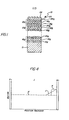
- FIG. 1 shows a p-i-n type photovoltaic device 10, such as a solar cell, made up of individual p-i-n type cells 12a, 12b, and 12c.
- a substrate 11 adjacent cell 12a forms one electrode of cell 10.
- Substrate 11 may be a metallic material such as stainless steel or aluminum, a thin electroformed member, such as nickel, or an insulating material, such as a glass or synthetic polymer, bearing an electrically conductive electrode layer. Certain applications may require a thin oxide layer and/or a series of base contacts and/or a reflecting layer be disposed on substrate 11 prior to the deposition of the semiconductor material.
- the term "substrate" includes any elements added by preliminary processing.
- Each of cells, 12a, 12b, and 12c is fabricated with an amorphous semiconductor body containing at least a silicon or germanium alloy.
- Each of the semiconductor bodies includes an n-type conductivity semiconductor layer 20a, 20b, and 20c; a graded band gap intrinsic semiconductor layer 18a, 18b and 18c; and a p-type conductivity semiconductor layer 16a, 16b and 16c.
- cell 12b is an intermediate cell and, as indicated in Figure 1, additional intermediate cells may be stacked on the illustrated cells without departing from the spirit or scope of the present invention.
- a transparent conductive oxide (TCO) layer 22 formed in the preferred embodiment of indium tin oxide, is deposited on cell 12c and forms a second electrode.
- a metallic electrode grid 24 is preferably applied to layer 22 for efficient current collection.
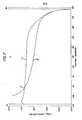
- Figure 2 is a graphical representation of hole (or electron) lifetime in the intrinsic semiconductor layer of a p-i-n photovoltaic device at various positions in that intrinsic layer.
- Curve A represents holes generated by red illumination and curve B represents holes generated by blue illumination.
- Figure 2 was derived from a computer simulation of a p-i-n photovoltaic device illuminated through the n-type layer with a flux of 10 16 photons per cm 2 . Plotted along the abscissa is the position, in microns, within the intrinsic semiconductor layer of the photovoltaic cell. The ordinate shows the logarithm of hole lifetime as measured in seconds.
- the intrinsic layer of amorphous silicon alloy material was determined to possess an absorption coefficient of 2 ⁇ 10 3 cm -1 with respect to red light.
- Curve B similarly depicts the lifetime of holes generated by the absorption of blue radiation in the intrinsic layer of amorphous silicon alloy material. The absorption coefficient for blue light was determined to be of 2 ⁇ 10 5 cm -1 .
- the coefficient of absorption of blue light in the amorphous silicon alloy material is two orders of magnitude greater than that of the red light. For this reason, most of the absorption of blue light will occur proximate (i.e. within 100 nanometers of) the light-incident surface of the intrinsic region. The absorption of red light will occur more uniformly throughout the bulk of the intrinsic layer. As a result of this differential light absorption in the intrinsic material, there is a differential distribution of holes generated by the absorption of the photons of light.
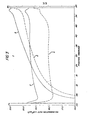
- Figure 3 is a graph of the recombination rate for holes (or electrons) at various positions in a p-i-n type photovoltaic device, for both a degraded and an undegraded semiconductor material, under both red and blue light.
- Light-induced degradation was computer simulated by increasing both the minimum density of states and the charge carrier capture cross section of the recombination centers by an order of magnitude.
- Curves-D and E respectively, represent the hole recombination rate of an undegraded photovoltaic device under red and blue illumination.
- Curves F and G respectively, represent the hole recombination rate of a degraded device under red and blue illumination.
- the undegraded device under red illumination of approximately 10 16 photons per square centimeter per second produced a soort circuit current of approximately 0.9 mA, while the degraded photovoltaic device produced a short circuit current of 0.68 mA.
- Figure 4 is a graphic representation of a p-i-n type photovoltaic device illustrating several variations in the band gap energy of the intrinsic region according to the invention.
- the band gap energy is constant throughout the intrinsic region, as indicated by dashed line H.
- the band gap energy of the intrinsic layer is graded in a uniform or stepped fashion.
- Curve J shows a smoothly varying, graded band gap intrinsic semiconductor material.
- the band gap energy of the layer of intrinsic semiconductor material represented by curve J varies linearly from a highest initial value at the n-type layer-intrinsic layer interface to a lowest value represented by the line H, at a point approximately 1/3 of the way into the bulk thickness of that intrinsic layer.
- the band gap energy may vary smoothly, in the manner illustrated by curve J, but in a non-linear manner, e.g., the variation in band gap energy with increasing thickness of the intrinsic semiconductor material may be exponential.
- the band gap of the intrinsic layer is graded in an abrupt or step manner, as illustrated by curve K.
- Curve K shows two levels of band gap energy (i.e. one step), but the band gap energy may be varied through the use of as great a number of steps as deemed convenient.
- Curves J and K depict the band gap energy as graded through only a portion of the bulk thickness of the intrinsic semiconductor layer. The entire thickness of the intrinsic layer need not be band gap graded in order to spread the absorption of blue light. It has been found that if the initial one to two hundred nanometers of the intrinsic layer is band gap graded, the desired absorption will be promoted to secure improved stability.
- Photovoltaic devices according to the invention may be manufactured by any of several known thin film deposition processes, including sputtering, evaporation, chemical vapor deposition, or glow discharge deposition.
- the improved, more stable photovoltaic device of the instant invention may be fabricated by incorporating increasing amounts of one or more band gap widening elements into the amorphous semiconductor alloy material of the intrinsic layer of a p-i-n photovoltaic device as that intrinsic layer is being deposited.
- band gap narrowing elements such as germanium, tin, lead, and mixtures thereof, may be employed to narrow the band gap of amorphous semiconductor materials such as silicon and germanium alloys.
- An embodiment of the instant invention a p-i-n type photovoltaic device, was prepared by a glow discharge deposition technique.
- a p-doped semiconductor layer less than 20 nanometers thick was deposited upon a stainless steel substrate by the glow discharge decomposition of a gas mixture comprising silane, hydrogen and diborane gas, through the application of radio frequency energy of approximately 13.56 megahertz at a gas pressure of approximately 66.7 pascal.
- the deposition chamber was purged and a process gas mixture for depositing a layer of intrinsic amorphous silicon alloy material was admitted.
- the precursor intrinsic process gas mixture comprised silane and hydrogen, and the pressure within the deposition chamber was maintained at approximately 66.7 pascal.
- the decomposition of the process gas mixture and the deposition of the intrinsic semiconductor alloy layer was initiated by the application of radio frequency energy and allowed to proceed until approximately 400 nanometers of intrinsic amorphous silicon alloy material was deposited.
- ammonia equal to 30% of the amount of silane present, was admitted into the deposition chamber and the deposition process proceeded until approximately an additional 100 nanometers of intrinsic amorphous silicon:nitrogen alloy material was deposited.
- a graded band gap structure comprising approximately 400 nanometers of an intrinsic amorphous silicon alloy material and 100 nanometers of amorphous silicon:nitrogen alloy material was deposited.
- a layer of less than approximately 20 nanometers thickness of n-doped amorphous silicon alloy material was deposited on the intrinsic semiconductor layer by the glow discharge decomposition of a process gas mixture comprising silane, hydrogen and phosphine.
- a transparent electrode formed of indium tin oxide was deposited on the layer of n-doped semiconductor alloy material in a reactive evaporation process.
- a pair of p-i-n type photovoltaic devices specifically including t nd gap graded intrinsic layers were fabricated by glow discharge deposition.
- the devices comprised an aggregate of layers formed on stainless steel substrates.
- Each aggregate of layers included an approximately 10 nanometer thick layer of p-type semiconductor material fabricated by the glow discharge decomposition of a mixture of silane and diborane; and an approximately 10 nanometer thick layer of n-type semiconductor mate-ial fabricated by the glow discharge decomposition of silane and phosphine.
- Disposed between the p-type and n-type layers is the graded band gap layer of intrinsic semiconductor material according to the invention.
- the graded band gap layer comprises a first approximately 400 nanometer thick portion formed of an amorphous silicon:hydrogen alloy having a band gap of approximately 1.7 electron volts, disposed immediately on the p-layer; and a second approximately 100 nanometer thick portion formed of an amorphous silicon:hydrogen:nitrogen alloy having a band gap of approximately 1.9 electron volts disposed on the 1.7 electron volt portion.
- Deposition of both of the band gap graded intrinsic layer portions was accomplished by a glow discharge process.
- the 1.7 electron volt portion of the intrinsic layer was deposited by the decomposition of silane, and the 1.9 electron volt portion was deposited by the decomposition of a mixture of 30 percent ammonia and 70 percent silane.
- a similar p-i-n photovoltaic device having a 500 nanometer thick, ungraded intrinsic layer of semiconductor material with a constant 1.7 electron volt band gap was prepared in an identical glow discharge deposition process.
- This particular device configuration with a relatively thick single p-i-n photovoltaic cell is known to show a high degree of photo-induced degradation.
- Initial operational parameters were measured, and the devices were then subjected to prolonged exposure to AM-1 (i.e. one sun directly overhead reduced by atmospheric losses) illumination.
- AM-1 i.e. one sun directly overhead reduced by atmospheric losses
- Short circuit current under blue illumination was measured after 6 and 72 hours of AM-1 illumination. After 6 hours of illumination, the blue light short circuit current of the test devices were 96.0 percent and 97.1 percent of the initial values, while for the control device it was 72 percent of its original value. After 72 hours, the test devices still exhibited 91.3 percent and 90.3 percent of their initial blue light short circuit currents, while the control device fell to 54 percent of its initial value.
- the invention is equally applicable to n-i-p devices illuminated on the p-doped semiconductor layer side.
- the electrons represent the minority charge carriers and therefore determine cell efficiency.
- the previous discussion relative to holes will be applicable to electrons in n-i-p devices.
- the principles of the invention may be similarly applied to other photo-responsive devices, such as p-n devices, or Schottky barrier devices, in which a photo-responsive region is formed in a semiconductor material at an interface with a metallic layer.
Landscapes
- Photovoltaic Devices (AREA)
Applications Claiming Priority (2)
| Application Number | Priority Date | Filing Date | Title |
|---|---|---|---|
| US06/623,860 US4547621A (en) | 1984-06-25 | 1984-06-25 | Stable photovoltaic devices and method of producing same |
| US623860 | 1984-06-25 |
Publications (2)
| Publication Number | Publication Date |
|---|---|
| EP0167323A2 true EP0167323A2 (de) | 1986-01-08 |
| EP0167323A3 EP0167323A3 (de) | 1986-07-16 |
Family
ID=24499680
Family Applications (1)
| Application Number | Title | Priority Date | Filing Date |
|---|---|---|---|
| EP85304351A Withdrawn EP0167323A3 (de) | 1984-06-25 | 1985-06-18 | Stabile photovoltaische Anordnungen und Verfahren zu ihrer Herstellung |
Country Status (9)
| Country | Link |
|---|---|
| US (1) | US4547621A (de) |
| EP (1) | EP0167323A3 (de) |
| JP (1) | JPH0671090B2 (de) |
| AU (1) | AU4399585A (de) |
| BR (1) | BR8503017A (de) |
| CA (1) | CA1262766A (de) |
| ES (1) | ES8609820A1 (de) |
| MX (1) | MX157839A (de) |
| ZA (1) | ZA854621B (de) |
Families Citing this family (17)
| Publication number | Priority date | Publication date | Assignee | Title |
|---|---|---|---|---|
| US4692558A (en) * | 1983-05-11 | 1987-09-08 | Chronar Corporation | Counteraction of semiconductor impurity effects |
| US4772933A (en) * | 1986-02-03 | 1988-09-20 | General Electric Company | Method for compensating operationally-induced defects and semiconductor device made thereby |
| JPS62234379A (ja) * | 1986-04-04 | 1987-10-14 | Kanegafuchi Chem Ind Co Ltd | 半導体装置 |
| JP2717583B2 (ja) * | 1988-11-04 | 1998-02-18 | キヤノン株式会社 | 積層型光起電力素子 |
| US5204272A (en) * | 1991-12-13 | 1993-04-20 | United Solar Systems Corporation | Semiconductor device and microwave process for its manufacture |
| JP4733519B2 (ja) * | 2002-10-25 | 2011-07-27 | エリコン ソーラー アーゲー,トゥルーバッハ | 半導体装置の製造方法及びこの方法で得られた半導体装置 |
| US20100029036A1 (en) * | 2006-06-12 | 2010-02-04 | Robinson Matthew R | Thin-film devices formed from solid group iiia particles |
| JP5526461B2 (ja) * | 2007-03-19 | 2014-06-18 | 三洋電機株式会社 | 光起電力装置 |
| KR101359401B1 (ko) * | 2007-06-21 | 2014-02-10 | 주성엔지니어링(주) | 고효율 박막 태양전지와 그 제조방법 및 제조장치 |
| US8440498B2 (en) | 2009-10-28 | 2013-05-14 | Nanosolar, Inc. | Thin-film devices formed from solid particles |
| US9634165B2 (en) * | 2009-11-02 | 2017-04-25 | International Business Machines Corporation | Regeneration method for restoring photovoltaic cell efficiency |
| US20110240121A1 (en) * | 2010-04-02 | 2011-10-06 | Iowa State University Research Foundation, Inc. | Nanocrystalline Superlattice Solar Cell |
| KR20130042785A (ko) * | 2011-10-19 | 2013-04-29 | 한국전자통신연구원 | 태양전지 |
| US9040340B2 (en) * | 2011-11-14 | 2015-05-26 | International Business Machines Corporation | Temperature grading for band gap engineering of photovoltaic devices |
| WO2014093816A2 (en) * | 2012-12-13 | 2014-06-19 | Daniel Scott Marshall | Magnetically polarized photonic device |
| US9722120B2 (en) * | 2015-09-14 | 2017-08-01 | International Business Machines Corporation | Bandgap grading of CZTS solar cell |
| US10361331B2 (en) | 2017-01-18 | 2019-07-23 | International Business Machines Corporation | Photovoltaic structures having multiple absorber layers separated by a diffusion barrier |
Family Cites Families (11)
| Publication number | Priority date | Publication date | Assignee | Title |
|---|---|---|---|---|
| US4206002A (en) * | 1976-10-19 | 1980-06-03 | University Of Pittsburgh | Graded band gap multi-junction solar energy cell |
| US4342044A (en) * | 1978-03-08 | 1982-07-27 | Energy Conversion Devices, Inc. | Method for optimizing photoresponsive amorphous alloys and devices |
| JPS5688377A (en) * | 1979-12-19 | 1981-07-17 | Mitsubishi Electric Corp | Solar battery and manufacture thereof |
| US4377723A (en) * | 1980-05-02 | 1983-03-22 | The University Of Delaware | High efficiency thin-film multiple-gap photovoltaic device |
| IE52207B1 (en) * | 1980-09-09 | 1987-08-05 | Energy Conversion Devices Inc | Method of grading the band gaps of amorphous alloys and devices |
| JPS5898988A (ja) * | 1981-12-08 | 1983-06-13 | Matsushita Electric Ind Co Ltd | 太陽光電池 |
| US4379943A (en) * | 1981-12-14 | 1983-04-12 | Energy Conversion Devices, Inc. | Current enhanced photovoltaic device |
| JPS58220478A (ja) * | 1982-06-17 | 1983-12-22 | Matsushita Electric Ind Co Ltd | アモルフアス光電変換素子 |
| JPS5997514A (ja) * | 1982-11-22 | 1984-06-05 | Agency Of Ind Science & Technol | 太陽電池の製造法 |
| US4471155A (en) * | 1983-04-15 | 1984-09-11 | Energy Conversion Devices, Inc. | Narrow band gap photovoltaic devices with enhanced open circuit voltage |
| JPH0658970B2 (ja) * | 1983-08-31 | 1994-08-03 | 工業技術院長 | 半導体装置 |
-
1984
- 1984-06-25 US US06/623,860 patent/US4547621A/en not_active Expired - Lifetime
-
1985
- 1985-06-18 EP EP85304351A patent/EP0167323A3/de not_active Withdrawn
- 1985-06-19 ZA ZA854621A patent/ZA854621B/xx unknown
- 1985-06-19 CA CA000484433A patent/CA1262766A/en not_active Expired
- 1985-06-24 ES ES544481A patent/ES8609820A1/es not_active Expired
- 1985-06-24 JP JP60137633A patent/JPH0671090B2/ja not_active Expired - Lifetime
- 1985-06-24 AU AU43995/85A patent/AU4399585A/en not_active Abandoned
- 1985-06-24 BR BR8503017A patent/BR8503017A/pt unknown
- 1985-07-24 MX MX205759A patent/MX157839A/es unknown
Also Published As
| Publication number | Publication date |
|---|---|
| EP0167323A3 (de) | 1986-07-16 |
| ES544481A0 (es) | 1986-07-16 |
| ES8609820A1 (es) | 1986-07-16 |
| US4547621A (en) | 1985-10-15 |
| BR8503017A (pt) | 1986-03-11 |
| CA1262766A (en) | 1989-11-07 |
| MX157839A (es) | 1988-12-15 |
| AU4399585A (en) | 1986-01-02 |
| JPS6113673A (ja) | 1986-01-21 |
| JPH0671090B2 (ja) | 1994-09-07 |
| ZA854621B (en) | 1986-02-26 |
Similar Documents
| Publication | Publication Date | Title |
|---|---|---|
| US4476346A (en) | Photovoltaic device | |
| US5403404A (en) | Multijunction photovoltaic device and method of manufacture | |
| Carlson | Recent developments in amorphous silicon solar cells | |
| US4775425A (en) | P and n-type microcrystalline semiconductor alloy material including band gap widening elements, devices utilizing same | |
| EP0304145B1 (de) | Dünnschichtsolarzelle mit räumlich modulierter intrinsischer Schicht | |
| JP2006080557A (ja) | 高水素希釈低温プラズマ蒸着によって製造されるアモルファスシリコン系素子の向上せしめられた安定化特性 | |
| US4609771A (en) | Tandem junction solar cell devices incorporating improved microcrystalline p-doped semiconductor alloy material | |
| US4398054A (en) | Compensated amorphous silicon solar cell incorporating an insulating layer | |
| CA1262766A (en) | Stable photovoltaic devices and method of producing same | |
| US4600801A (en) | Fluorinated, p-doped microcrystalline silicon semiconductor alloy material | |
| US5419783A (en) | Photovoltaic device and manufacturing method therefor | |
| US4555586A (en) | Photovoltiac device having long term energy conversion stability and method of producing same | |
| US5104455A (en) | Amorphous semiconductor solar cell | |
| US12635283B2 (en) | Solar cell and method for forming the same | |
| JP3519543B2 (ja) | 半導体薄膜形成用前駆体及び半導体薄膜の製造方法 | |
| US20110277823A1 (en) | System and Method for High Yield Deposition of Conductive Materials onto Solar Cells | |
| Carlson | Solar cells | |
| KR20130061346A (ko) | 태양전지 및 그 제조방법 | |
| JPS6225275B2 (de) | ||
| TWI483405B (zh) | 光伏打電池及製造光伏打電池之方法 | |
| Von Roedern et al. | An Assessment of a-SiGe: H Alloys with a Band GaP of 1.5 Ev as to their Suitability for Solar Cell Applications | |
| Platz | Amorphous silicon for optimized multi-junction solar cells: material study and cell design | |
| Chopra et al. | Amorphous silicon solar cells |
Legal Events
| Date | Code | Title | Description |
|---|---|---|---|
| PUAI | Public reference made under article 153(3) epc to a published international application that has entered the european phase |
Free format text: ORIGINAL CODE: 0009012 |
|
| AK | Designated contracting states |
Designated state(s): CH DE FR GB IT LI NL |
|
| PUAL | Search report despatched |
Free format text: ORIGINAL CODE: 0009013 |
|
| AK | Designated contracting states |
Kind code of ref document: A3 Designated state(s): CH DE FR GB IT LI NL |
|
| STAA | Information on the status of an ep patent application or granted ep patent |
Free format text: STATUS: THE APPLICATION IS DEEMED TO BE WITHDRAWN |
|
| 18D | Application deemed to be withdrawn |
Effective date: 19870119 |
|
| RIN1 | Information on inventor provided before grant (corrected) |
Inventor name: HACK, MICHAEL Inventor name: GUHA, SUBHENDU |