EP0168501A1 - Procede d'usinage de surfaces - Google Patents
Procede d'usinage de surfaces Download PDFInfo
- Publication number
- EP0168501A1 EP0168501A1 EP19850900733 EP85900733A EP0168501A1 EP 0168501 A1 EP0168501 A1 EP 0168501A1 EP 19850900733 EP19850900733 EP 19850900733 EP 85900733 A EP85900733 A EP 85900733A EP 0168501 A1 EP0168501 A1 EP 0168501A1
- Authority
- EP
- European Patent Office
- Prior art keywords
- area
- centroid
- partitioning
- cutting
- curve
- Prior art date
- Legal status (The legal status is an assumption and is not a legal conclusion. Google has not performed a legal analysis and makes no representation as to the accuracy of the status listed.)
- Granted
Links
Images




Classifications
-
- G—PHYSICS
- G05—CONTROLLING; REGULATING
- G05B—CONTROL OR REGULATING SYSTEMS IN GENERAL; FUNCTIONAL ELEMENTS OF SUCH SYSTEMS; MONITORING OR TESTING ARRANGEMENTS FOR SUCH SYSTEMS OR ELEMENTS
- G05B19/00—Program-control systems
- G05B19/02—Program-control systems electric
- G05B19/18—Numerical control [NC], i.e. automatically operating machines, in particular machine tools, e.g. in a manufacturing environment, so as to execute positioning, movement or co-ordinated operations by means of program data in numerical form
- G05B19/41—Numerical control [NC], i.e. automatically operating machines, in particular machine tools, e.g. in a manufacturing environment, so as to execute positioning, movement or co-ordinated operations by means of program data in numerical form characterised by interpolation, e.g. the computation of intermediate points between programmed end points to define the path to be followed and the rate of travel along that path
-
- G—PHYSICS
- G05—CONTROLLING; REGULATING
- G05B—CONTROL OR REGULATING SYSTEMS IN GENERAL; FUNCTIONAL ELEMENTS OF SUCH SYSTEMS; MONITORING OR TESTING ARRANGEMENTS FOR SUCH SYSTEMS OR ELEMENTS
- G05B2219/00—Program-control systems
- G05B2219/30—Nc systems
- G05B2219/49—Nc machine tool, till multiple
- G05B2219/49381—Raster, line servo, area machining, cutting, facing
-
- G—PHYSICS
- G05—CONTROLLING; REGULATING
- G05B—CONTROL OR REGULATING SYSTEMS IN GENERAL; FUNCTIONAL ELEMENTS OF SUCH SYSTEMS; MONITORING OR TESTING ARRANGEMENTS FOR SUCH SYSTEMS OR ELEMENTS
- G05B2219/00—Program-control systems
- G05B2219/30—Nc systems
- G05B2219/49—Nc machine tool, till multiple
- G05B2219/49392—Multipasses, segmentation of cut, paraxial cutting
Definitions
- This invention relates to an area cutting method in a numerically controlled machine tool and, more particularly, to an area cutting method for cutting the interior of an area bounded by the curve of an external shape.
- Forms of numerically controlled machining include cutting in which the interior of an area bounded by the curve of an external shape, for example the curve of an external shape comprising straight lines and circular arcs, is hollowed out down to a predetermined depth, and die milling in which the interior of an area is die milled. In such machining, as shown in Fig.
- an area cutting method is conventionally carried out by performing cutting along an (i-l)th cutting path PTi-1 in one direction (the direction of the solid line arrow), raising the tool a predetermined amount at the completion of cutting, then positioning the tool directly above a cutting starting point Ps on the next, or i-th, cutting path PTi, thereafter lowering the tool to the cutting starting point P s, moving the tool along the i-th cutting path PTi in the direction of the solid line arrow, and subsequently repeating the above unidirectional cutting.
- FIG. l(B) Another area cutting method shown in Fig. l(B) includes, following completion of cutting along the cutting path PTi-1 of the (i-l)th cutting path, moving the tool from a cutting end point Pe to the cutting starting point Ps on the next, or i-th, cutting path, and thereafter performing cutting along the i-th cutting path PTi.
- cutting is performed back and forth in the direction of the arrows.
- Still another area cutting method shown in Fig. l(C) includes obtaining offset paths OFCl, OFC2,... OFCn offset by predetermined amounts with respect to a curve OLC of an external shape, and moving the tool successively along the offset paths.
- the tool must be positioned at the cutting starting point Ps on the i-th cutting path PTi after the completion of cutting along the (i-l)th cutting path PTi-1.
- This method is disadvantageous in that it results in a long tool travelling distance.
- the cutting processes referred to here indicate up cutting and down cutting processes.
- Figs. 2(A), (B) show examples of the down cutting process
- Figs. 2(C), (D) depict exampes of the up cutting process. If the workpiece material has been decided, then a cutting method capable of cutting the workpiece efficiently is selected from the up cutting and down cutting processes. However, with the second method, the up cutting process [e.g., Fig. 2(A)] and the down cutting process [e.g., Fig. 2(C)] are always mixed, so that cutting cannot be performed efficiently.
- portions are left uncut at, e.g., the central portion of the area, depending upon the contour of the external shape curve.
- This method is disadvantageous in that dealing with these uncut portions is a complicated task.
- an object of the present invention is to provide an area cutting method whereby the interior of an area can be cut continuously and efficiently without requiring control for raising a tool, positioning the tool at the next cutting starting point and then lowering the tool.
- Another object of the present invention is to provide an area cutting method wherein portions are not left uncut.
- An area cutting method for cutting the interior of an area bounded by a closed curve has a step of calculating a centroid of an area bounded by a closed curve, a step of determining whether each line segment connecting the centroid with each vertex of the area intersects the closed curve, a step of partitioning each line segment into a predetermined number of partitions if the line segment does not intersect the closed curve, a step of performing area cutting by moving a tool along plural closed paths each of which is obtained by connecting corresponding ones of the partitioning points of respective line segments, and a step, which is executed if at least one line segment intersects the closed curve, of partitioning the area into a plurality of regions, calculating the centroid of each partitioned region, partitioning each line segment connecting the centroid with each vertex of the partitioned region corresponding to the centroid into a predetermined number of partitions, finding plural closed curves, for each and every partitioned region, obtained by connecting corresponding ones of the partitioning points of the line segments, and performing area cutting by successively
- Fig. 1 is a view for describing the conventional area cutting method
- Fig. 2 is a view for describing up cutting and down cutting processes
- Fig. 3 is a view for describing the general features of the present invention
- Fig. 4 is a block diagram of an embodiment of the present invention
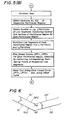
- Fig. 5 is a flowchart of processing indicative of the area cutting method of the present invention
- Fig. 6 is a view for describing a method of calculating an offset curve
- Fig. 7 is a view for describing a method of linear approximation of a circular arc portion
- Fig. 8 is a view for describing a method of calculating a centroid
- Fig. 9 is a view for describing the area cutting method of the present invention for a case where the area has a complicated shape.
- Fig. 4 is a block diagram of an embodiment of the present invention
- Fig. 5 is a flowchart of processing. The area cutting method of the present invention will now be described with reference to Figs. 3 through 5.
- Area cutting data necessary for area cutting are recorded at appropriate locations on an NC tape or memory (assumed to be an NC tape hereafter) 101.
- area cutting instructions in addition to ordinary numerical control data, area cutting instructions, coordinate values (x j ,y j ) of the vertices Ql, Q2, Q3,... Qn of the area, the radius r. of each circular arc, finishing margin t, cut-in pitch P, cutting velocity fc, and data for identifying the end of the area cutting data, are recorded on the NC tape 101.
- the processor 103 finds incremental values Xi, Yi, Zi along the respective axes.
- the processor delivers ⁇ X, ⁇ Y, ⁇ Z to the pulse distributor 106 every ⁇ T sec.
- ⁇ T is stored beforehand in a parameter memory 109.
- the pulse distributor 106 On the basis of the input data, the pulse distributor 106 performs a simultaneous three-axis pulse distribution calculation to generate distributed pulses Xp, Yp, Zp. These are delivered to servo circuits 110X, 110Y, 110Z for the respective axes to transport the tool along the cutting path.
- the processor 103 in accordance with the following formulae, updates the present position X a , Y a Z a every ⁇ T sec, X a , Y a , Z a having been stored in a RAM 111:
- the processor 103 updates remaining traveling distances X r , Y r , Z (the initial values of which are the incremental values X i , Y i , Z i , respectively) every ⁇ T sec, X r , Y r , Z r having been stored in the RAM 111:
- the processor 103 treats this as indicating that the movable element has arrived at a target position and causes the NC data reader 104 to read the next item of NC data.
- the processor 103 causes the NC data reader 104 to read the area cutting data and store the data in the RAM 111 until the code indicating the end of the area cutting data is read out.
- the tool radius ra is obtained by reading a radius value corresponding to a commanded tool number from an offset memory 112, which stores the correspondence between tool numbers and tool radii.
- the offset curve OFC is found through the following processing. Specifically, as shown in Fig. 6, let two straight lines specifying the curve OLC of the external shape be Sl and S2. Straight lines Sl', S2' offset from the straight lines Sl, S2, respectively, by the distance D are found.
- intersection P2 of the straight lines Sl', S2' is then found.
- the intersection P2 is one point specifying the offset curve OFC. Accordingly, if points of intersection are found in a similar manner and stored in the RAM 111, the offset curve OFC will be obtained.
- Fig. 7 is a view for describing the linear approximation processing.
- the maximum distance d between the circular arc Al and the straight line (chord) LN is given by where the radius of the arc is r and the central angle of the chord LN is 8. Accordingly, the central angle 9 for which d ⁇ P holds, namely the central angle 0 that satisfies the relation is found, the central angle ⁇ of the circular arc Al is partitioned at the angle 8 and the coordinate values of each partitioning point R i are stored in the RAM 111. This ends the processing for linear approximation.
- the processor 103 calculates the centroid W of an area (a polygon) bounded by an offset curve OFC' (see Fig. 3) obtained by the linear approximation.
- the coordinate values of the centroid of the area (polygon) are calculated through the following processing. Specifically, as shown in Fig. 8, a polygon PG is broken down into a plurality of triangles TR1 through TR3 and the centroids Wll through W13 and areas SQ1 through SQ3 of the respective triangles are calculated. Next, a point W21 that divides a line segment W12Wll connecting the centroids Wll, W12 into the ratio SQl:SQ2 (area ratio) is found.
- the point W21 is the centroid of a quadrilateral P1P2P3P4. After the point W21 is calculated, a point W is found that divides a line segment W13W21 into the area ratio (SQ1+SQ2):SQ3. The point W is the centroid of the polygon PG.
- the processor 103 checks whether line segments Ll - L10 connecting the centroid W with each of the vertices Pl - P10 of the area intersect the linearly approximated offset curve OFC'.
- intersect refers to a state in which, as shown in Fig. 9(A), the line segment L6 connecting the centroid W with the vertex P6 of the polygon P1P2...P7 crosses the offset curve OFC'.
- the processor obtains, and stores in the RAM 111, the coordinate values of partitioning points that partition, into a predetermined number of partitions n, each of the line segments Ll - L10.
- the number n of partitions the length l of the longest of all the abovementioned line segments Ll - L10 is found, after which n is so decided as to satisfy the relation
- the processor moves the tool to the point P a2 along the first closed path CPT1 in a cutting feed mode and thereafter successively moves the tool along the first closed path in the manner P a2 ⁇ P a3 ⁇ P a4 ... ⁇ PalO to perform cutting.
- the tool is shifted to the point P bl (Pal ⁇ Pbl) in the cutting feed mode and cutting is subsequently performed along the second closed path CPT2, third closed path, ... n-th closed path CPTn.
- the tool is moved along the offset curve OFC or OFC' in accordance with the data specifying the offset curve OFC or OFC' stored in the RAM 111. This ends the area cutting processing. Thereafter, the next item of NC data is read from the NC tape and the foregoing processing is repeated.
- the present invention is not limited to this sequence, for movement along the offset curve OFC (OFC') can be exercised first. Further, it is possible to adopt an arrangement wherein an NC tape is prepared by the above-described method using area cutting data and the NC tape is loaded into an NC unit to cut the area.
- the foregoing processing partitions the area into a plurality of regions. (In the example of Fig. 9, the area is partitioned into two regions ARl, AR2.)
- area cutting can be performed while moving a tool in a continuous manner. This eliminates wasted tool motion, raises the efficiency of cutter pass and shortens machining time.
- the distance between i-th and (i+l)th closed paths is changed in dependence upon the shape to be cut, with the result that portions are not left uncut at the central and other parts of the area.
- area cutting is performed in a simple manner merely by finding a centroid, partitioning straight lines connecting the centroid with the vertices of the area into a predetermined number of segments, and successively moving the tool along the closed paths connecting corresponding ones of the partitioning points.
- tool paths can be generated automatically merely by entering area cutting data.
- the present invention is well-suited for application to area cutting performed by machine tools, or to the creation of NC data for area cutting.
Landscapes
- Engineering & Computer Science (AREA)
- Computing Systems (AREA)
- Theoretical Computer Science (AREA)
- Human Computer Interaction (AREA)
- Manufacturing & Machinery (AREA)
- Physics & Mathematics (AREA)
- General Physics & Mathematics (AREA)
- Automation & Control Theory (AREA)
- Numerical Control (AREA)
Abstract
Applications Claiming Priority (2)
| Application Number | Priority Date | Filing Date | Title |
|---|---|---|---|
| JP59002520A JPS60155342A (ja) | 1984-01-10 | 1984-01-10 | 領域加工方法 |
| JP2520/84 | 1984-01-10 |
Publications (3)
| Publication Number | Publication Date |
|---|---|
| EP0168501A1 true EP0168501A1 (fr) | 1986-01-22 |
| EP0168501A4 EP0168501A4 (fr) | 1988-06-13 |
| EP0168501B1 EP0168501B1 (fr) | 1992-06-03 |
Family
ID=11531646
Family Applications (1)
| Application Number | Title | Priority Date | Filing Date |
|---|---|---|---|
| EP85900733A Expired EP0168501B1 (fr) | 1984-01-10 | 1985-01-10 | Procede d'usinage de surfaces |
Country Status (5)
| Country | Link |
|---|---|
| US (1) | US4706201A (fr) |
| EP (1) | EP0168501B1 (fr) |
| JP (1) | JPS60155342A (fr) |
| DE (1) | DE3586148T2 (fr) |
| WO (1) | WO1985003023A1 (fr) |
Cited By (3)
| Publication number | Priority date | Publication date | Assignee | Title |
|---|---|---|---|---|
| EP0411144A4 (en) * | 1989-02-14 | 1992-08-12 | Fanuc Ltd. | Profiling method |
| EP0229851B1 (fr) * | 1985-07-17 | 1993-09-15 | Fanuc Ltd. | Procede d'usinage de region |
| US5313400A (en) * | 1989-02-14 | 1994-05-17 | Fanuc Ltd. | Tracing method |
Families Citing this family (12)
| Publication number | Priority date | Publication date | Assignee | Title |
|---|---|---|---|---|
| JPS6219908A (ja) * | 1985-07-17 | 1987-01-28 | Fanuc Ltd | 領域加工方法 |
| JPS6219909A (ja) * | 1985-07-17 | 1987-01-28 | Fanuc Ltd | 領域加工方法 |
| JPS6234754A (ja) * | 1985-07-20 | 1987-02-14 | Fanuc Ltd | 面加工方法 |
| JPH0710480B2 (ja) * | 1985-07-20 | 1995-02-08 | ファナック株式会社 | 面加工方法 |
| US4747734A (en) * | 1985-11-22 | 1988-05-31 | Mitsubishi Jukogyo Kabushiki Kaisha | Profiling apparatus |
| DE3820566C2 (de) * | 1987-06-19 | 1994-01-27 | Mitsubishi Electric Corp | Verfahren zum Ermitteln einer Bewegungsbahn eines Bearbeitungswerkzeugs einer von einer numerischen Steuervorrichtung gesteuerten Werkzeugmaschine |
| JPH0734166B2 (ja) * | 1987-06-26 | 1995-04-12 | 三菱電機株式会社 | 数値制御装置のオフセット形状作成方法 |
| JPH01130204A (ja) * | 1987-11-16 | 1989-05-23 | Fanuc Ltd | エラー表示方式 |
| US4951217A (en) * | 1988-08-05 | 1990-08-21 | Pmx, Inc. | System and process for generating a tool path offset |
| JP3293693B2 (ja) * | 1993-07-30 | 2002-06-17 | 株式会社小松製作所 | 板金切断作図装置 |
| ES2122048T3 (es) * | 1994-01-20 | 1998-12-16 | Kubo Akio | Aparato para encontrar coordenadas del centro de gravedad en las figuras. |
| RU2422251C2 (ru) * | 2008-10-20 | 2011-06-27 | Государственное образовательное учреждение высшего профессионального образования Московский Государственный Технологический Университет "СТАНКИН" | Способ фрезерования поверхностей сложного контура |
Family Cites Families (5)
| Publication number | Priority date | Publication date | Assignee | Title |
|---|---|---|---|---|
| JPS5218869B2 (fr) * | 1972-07-25 | 1977-05-24 | ||
| JPS5274185A (en) * | 1975-12-16 | 1977-06-21 | Toshiba Mach Co Ltd | Program-driven contour processing machines |
| JPS57194855A (en) * | 1981-05-27 | 1982-11-30 | Fanuc Ltd | Numerical control system |
| JPS59161253A (ja) * | 1983-03-03 | 1984-09-12 | Fanuc Ltd | 工作機械の加工方法 |
| JPS6090653A (ja) * | 1983-10-22 | 1985-05-21 | Fanuc Ltd | 領域加工方法 |
-
1984
- 1984-01-10 JP JP59002520A patent/JPS60155342A/ja active Granted
-
1985
- 1985-01-10 DE DE8585900733T patent/DE3586148T2/de not_active Expired - Lifetime
- 1985-01-10 EP EP85900733A patent/EP0168501B1/fr not_active Expired
- 1985-01-10 WO PCT/JP1985/000008 patent/WO1985003023A1/fr not_active Ceased
- 1985-01-10 US US06/776,205 patent/US4706201A/en not_active Expired - Fee Related
Cited By (3)
| Publication number | Priority date | Publication date | Assignee | Title |
|---|---|---|---|---|
| EP0229851B1 (fr) * | 1985-07-17 | 1993-09-15 | Fanuc Ltd. | Procede d'usinage de region |
| EP0411144A4 (en) * | 1989-02-14 | 1992-08-12 | Fanuc Ltd. | Profiling method |
| US5313400A (en) * | 1989-02-14 | 1994-05-17 | Fanuc Ltd. | Tracing method |
Also Published As
| Publication number | Publication date |
|---|---|
| DE3586148D1 (de) | 1992-07-09 |
| DE3586148T2 (de) | 1992-12-03 |
| JPS60155342A (ja) | 1985-08-15 |
| EP0168501B1 (fr) | 1992-06-03 |
| JPH0152141B2 (fr) | 1989-11-07 |
| WO1985003023A1 (fr) | 1985-07-18 |
| EP0168501A4 (fr) | 1988-06-13 |
| US4706201A (en) | 1987-11-10 |
Similar Documents
| Publication | Publication Date | Title |
|---|---|---|
| EP0160097B1 (fr) | Procece d'usinage de surfaces | |
| EP0168501A1 (fr) | Procede d'usinage de surfaces | |
| US4703415A (en) | Method of approach in area cutting | |
| US4739489A (en) | Area cutting method | |
| JP2800861B2 (ja) | 三次元加工方法 | |
| EP0144426B1 (fr) | Procede de controle d'interference d'outil | |
| EP0166000B1 (fr) | Procede d'usinage de surfaces | |
| US4905158A (en) | Normal vector computation method | |
| US4870597A (en) | Complex curved surface creation method | |
| EP0229190B1 (fr) | Procede d'usinage de regions | |
| EP0215955B1 (fr) | Procede de production de plans courbes composites | |
| US4855927A (en) | Complex curved surface creation method | |
| EP0161321B1 (fr) | Procede d'usinage pour machine-outil | |
| EP0229851B1 (fr) | Procede d'usinage de region | |
| JPH0720920A (ja) | 工具軌跡データ作成方法 | |
| EP0235293A1 (fr) | Procede de production de surfaces courbes composites | |
| EP0229852A1 (fr) | Procede d'usinage de region | |
| US4893251A (en) | Method of generating cutting path of complex curved surface | |
| EP0160705B1 (fr) | Procede d'usinage pour machines-outils | |
| US4764877A (en) | Surface cutting method | |
| US4764878A (en) | Surface cutting method | |
| EP0261249B1 (fr) | Procede permettant de preparer des donnees de commande numerique d'une surface courbe composite | |
| EP0328662B1 (fr) | Procede de preparation de donnees de commande numerique pour la taille de rainures |
Legal Events
| Date | Code | Title | Description |
|---|---|---|---|
| PUAI | Public reference made under article 153(3) epc to a published international application that has entered the european phase |
Free format text: ORIGINAL CODE: 0009012 |
|
| 17P | Request for examination filed |
Effective date: 19850926 |
|
| AK | Designated contracting states |
Kind code of ref document: A1 Designated state(s): DE FR GB Designated state(s): DE FR GB |
|
| A4 | Supplementary search report drawn up and despatched |
Effective date: 19880613 |
|
| 17Q | First examination report despatched |
Effective date: 19910522 |
|
| GRAA | (expected) grant |
Free format text: ORIGINAL CODE: 0009210 |
|
| AK | Designated contracting states |
Kind code of ref document: B1 Designated state(s): DE FR GB |
|
| PG25 | Lapsed in a contracting state [announced via postgrant information from national office to epo] |
Ref country code: FR Effective date: 19920603 |
|
| RIN1 | Information on inventor provided before grant (corrected) |
Inventor name: ONISHI, YASUSHI Inventor name: TAKEGAHARA, TAKASHI Inventor name: SEKI, MASAKI Inventor name: KISHI, HAJIMU |
|
| REF | Corresponds to: |
Ref document number: 3586148 Country of ref document: DE Date of ref document: 19920709 |
|
| EN | Fr: translation not filed | ||
| PG25 | Lapsed in a contracting state [announced via postgrant information from national office to epo] |
Ref country code: GB Effective date: 19930110 |
|
| PLBE | No opposition filed within time limit |
Free format text: ORIGINAL CODE: 0009261 |
|
| STAA | Information on the status of an ep patent application or granted ep patent |
Free format text: STATUS: NO OPPOSITION FILED WITHIN TIME LIMIT |
|
| 26N | No opposition filed | ||
| GBPC | Gb: european patent ceased through non-payment of renewal fee |
Effective date: 19930110 |
|
| PGFP | Annual fee paid to national office [announced via postgrant information from national office to epo] |
Ref country code: DE Payment date: 19960115 Year of fee payment: 12 |
|
| PG25 | Lapsed in a contracting state [announced via postgrant information from national office to epo] |
Ref country code: DE Effective date: 19971001 |