EP0168962A1 - Milieu d'enregistrement magnétique - Google Patents
Milieu d'enregistrement magnétique Download PDFInfo
- Publication number
- EP0168962A1 EP0168962A1 EP85304218A EP85304218A EP0168962A1 EP 0168962 A1 EP0168962 A1 EP 0168962A1 EP 85304218 A EP85304218 A EP 85304218A EP 85304218 A EP85304218 A EP 85304218A EP 0168962 A1 EP0168962 A1 EP 0168962A1
- Authority
- EP
- European Patent Office
- Prior art keywords
- magnetic recording
- recording medium
- magnetic
- resin
- layer
- Prior art date
- Legal status (The legal status is an assumption and is not a legal conclusion. Google has not performed a legal analysis and makes no representation as to the accuracy of the status listed.)
- Granted
Links
- 230000005291 magnetic effect Effects 0.000 title claims abstract description 174
- 239000010410 layer Substances 0.000 claims abstract description 143
- 229920002803 thermoplastic polyurethane Polymers 0.000 claims abstract description 74
- 239000011247 coating layer Substances 0.000 claims abstract description 14
- 239000012948 isocyanate Substances 0.000 claims description 59
- 229920005989 resin Polymers 0.000 claims description 55
- 239000011347 resin Substances 0.000 claims description 55
- -1 aromatic isocyanate Chemical class 0.000 claims description 46
- 239000011230 binding agent Substances 0.000 claims description 30
- 229920001577 copolymer Polymers 0.000 claims description 29
- 239000002245 particle Substances 0.000 claims description 28
- 150000002513 isocyanates Chemical class 0.000 claims description 24
- 125000000753 cycloalkyl group Chemical group 0.000 claims description 17
- 239000013034 phenoxy resin Substances 0.000 claims description 16
- 229920006287 phenoxy resin Polymers 0.000 claims description 16
- JOYRKODLDBILNP-UHFFFAOYSA-N Ethyl urethane Chemical compound CCOC(N)=O JOYRKODLDBILNP-UHFFFAOYSA-N 0.000 claims description 7
- XEEYBQQBJWHFJM-UHFFFAOYSA-N Iron Chemical compound [Fe] XEEYBQQBJWHFJM-UHFFFAOYSA-N 0.000 claims description 7
- 239000003082 abrasive agent Substances 0.000 claims description 7
- UQSXHKLRYXJYBZ-UHFFFAOYSA-N Iron oxide Chemical compound [Fe]=O UQSXHKLRYXJYBZ-UHFFFAOYSA-N 0.000 claims description 6
- 125000004432 carbon atom Chemical group C* 0.000 claims description 5
- 239000006249 magnetic particle Substances 0.000 claims description 5
- 229910052742 iron Inorganic materials 0.000 claims description 3
- 125000001183 hydrocarbyl group Chemical group 0.000 claims 4
- 150000003377 silicon compounds Chemical class 0.000 claims 2
- 239000006247 magnetic powder Substances 0.000 description 39
- 239000003973 paint Substances 0.000 description 32
- 230000000052 comparative effect Effects 0.000 description 25
- 239000000203 mixture Substances 0.000 description 19
- 239000003795 chemical substances by application Substances 0.000 description 18
- 239000000843 powder Substances 0.000 description 17
- BZHJMEDXRYGGRV-UHFFFAOYSA-N Vinyl chloride Chemical compound ClC=C BZHJMEDXRYGGRV-UHFFFAOYSA-N 0.000 description 16
- 238000000034 method Methods 0.000 description 16
- 239000006229 carbon black Substances 0.000 description 14
- 150000001875 compounds Chemical class 0.000 description 14
- 238000005299 abrasion Methods 0.000 description 13
- 239000011248 coating agent Substances 0.000 description 13
- 238000000576 coating method Methods 0.000 description 13
- CWYNVVGOOAEACU-UHFFFAOYSA-N Fe2+ Chemical compound [Fe+2] CWYNVVGOOAEACU-UHFFFAOYSA-N 0.000 description 11
- 239000002270 dispersing agent Substances 0.000 description 11
- 238000005259 measurement Methods 0.000 description 11
- 229920001296 polysiloxane Polymers 0.000 description 11
- 239000001913 cellulose Substances 0.000 description 10
- 229920002678 cellulose Polymers 0.000 description 10
- 229920005862 polyol Polymers 0.000 description 9
- 150000003077 polyols Chemical class 0.000 description 9
- 238000003490 calendering Methods 0.000 description 8
- WYURNTSHIVDZCO-UHFFFAOYSA-N Tetrahydrofuran Chemical compound C1CCOC1 WYURNTSHIVDZCO-UHFFFAOYSA-N 0.000 description 7
- 238000006243 chemical reaction Methods 0.000 description 7
- 150000002009 diols Chemical class 0.000 description 7
- 238000001914 filtration Methods 0.000 description 7
- 230000006872 improvement Effects 0.000 description 7
- 239000002904 solvent Substances 0.000 description 7
- 150000005846 sugar alcohols Polymers 0.000 description 7
- UPMLOUAZCHDJJD-UHFFFAOYSA-N 4,4'-Diphenylmethane Diisocyanate Chemical compound C1=CC(N=C=O)=CC=C1CC1=CC=C(N=C=O)C=C1 UPMLOUAZCHDJJD-UHFFFAOYSA-N 0.000 description 6
- IJGRMHOSHXDMSA-UHFFFAOYSA-N Atomic nitrogen Chemical compound N#N IJGRMHOSHXDMSA-UHFFFAOYSA-N 0.000 description 6
- 230000000694 effects Effects 0.000 description 6
- 238000009472 formulation Methods 0.000 description 6
- 150000002430 hydrocarbons Chemical group 0.000 description 6
- 229920002635 polyurethane Polymers 0.000 description 6
- 239000007858 starting material Substances 0.000 description 6
- 230000003746 surface roughness Effects 0.000 description 6
- OKTJSMMVPCPJKN-UHFFFAOYSA-N Carbon Chemical compound [C] OKTJSMMVPCPJKN-UHFFFAOYSA-N 0.000 description 5
- WNLRTRBMVRJNCN-UHFFFAOYSA-N adipic acid Chemical compound OC(=O)CCCCC(O)=O WNLRTRBMVRJNCN-UHFFFAOYSA-N 0.000 description 5
- 230000015572 biosynthetic process Effects 0.000 description 5
- HGAZMNJKRQFZKS-UHFFFAOYSA-N chloroethene;ethenyl acetate Chemical compound ClC=C.CC(=O)OC=C HGAZMNJKRQFZKS-UHFFFAOYSA-N 0.000 description 5
- 150000002483 hydrogen compounds Chemical class 0.000 description 5
- JEIPFZHSYJVQDO-UHFFFAOYSA-N iron(III) oxide Inorganic materials O=[Fe]O[Fe]=O JEIPFZHSYJVQDO-UHFFFAOYSA-N 0.000 description 5
- 229910052757 nitrogen Inorganic materials 0.000 description 5
- 238000006116 polymerization reaction Methods 0.000 description 5
- 239000004814 polyurethane Substances 0.000 description 5
- 229920002554 vinyl polymer Polymers 0.000 description 5
- LYCAIKOWRPUZTN-UHFFFAOYSA-N Ethylene glycol Chemical compound OCCO LYCAIKOWRPUZTN-UHFFFAOYSA-N 0.000 description 4
- VTLYFUHAOXGGBS-UHFFFAOYSA-N Fe3+ Chemical compound [Fe+3] VTLYFUHAOXGGBS-UHFFFAOYSA-N 0.000 description 4
- OFOBLEOULBTSOW-UHFFFAOYSA-N Malonic acid Chemical compound OC(=O)CC(O)=O OFOBLEOULBTSOW-UHFFFAOYSA-N 0.000 description 4
- 239000002253 acid Substances 0.000 description 4
- 229910045601 alloy Inorganic materials 0.000 description 4
- 239000000956 alloy Substances 0.000 description 4
- 238000011109 contamination Methods 0.000 description 4
- 239000003431 cross linking reagent Substances 0.000 description 4
- 150000004292 cyclic ethers Chemical class 0.000 description 4
- 125000005442 diisocyanate group Chemical group 0.000 description 4
- 239000006185 dispersion Substances 0.000 description 4
- 230000005294 ferromagnetic effect Effects 0.000 description 4
- 239000000314 lubricant Substances 0.000 description 4
- 239000000463 material Substances 0.000 description 4
- 239000005056 polyisocyanate Substances 0.000 description 4
- 229920001228 polyisocyanate Polymers 0.000 description 4
- 238000002360 preparation method Methods 0.000 description 4
- 238000002834 transmittance Methods 0.000 description 4
- 238000004804 winding Methods 0.000 description 4
- VZXPHDGHQXLXJC-UHFFFAOYSA-N 1,6-diisocyanato-5,6-dimethylheptane Chemical compound O=C=NC(C)(C)C(C)CCCCN=C=O VZXPHDGHQXLXJC-UHFFFAOYSA-N 0.000 description 3
- ZWEHNKRNPOVVGH-UHFFFAOYSA-N 2-Butanone Chemical compound CCC(C)=O ZWEHNKRNPOVVGH-UHFFFAOYSA-N 0.000 description 3
- CSCPPACGZOOCGX-UHFFFAOYSA-N Acetone Chemical compound CC(C)=O CSCPPACGZOOCGX-UHFFFAOYSA-N 0.000 description 3
- UHOVQNZJYSORNB-UHFFFAOYSA-N Benzene Chemical compound C1=CC=CC=C1 UHOVQNZJYSORNB-UHFFFAOYSA-N 0.000 description 3
- YMWUJEATGCHHMB-UHFFFAOYSA-N Dichloromethane Chemical compound ClCCl YMWUJEATGCHHMB-UHFFFAOYSA-N 0.000 description 3
- XEKOWRVHYACXOJ-UHFFFAOYSA-N Ethyl acetate Chemical compound CCOC(C)=O XEKOWRVHYACXOJ-UHFFFAOYSA-N 0.000 description 3
- 239000005057 Hexamethylene diisocyanate Substances 0.000 description 3
- OKKJLVBELUTLKV-UHFFFAOYSA-N Methanol Chemical compound OC OKKJLVBELUTLKV-UHFFFAOYSA-N 0.000 description 3
- 239000004721 Polyphenylene oxide Substances 0.000 description 3
- DNIAPMSPPWPWGF-UHFFFAOYSA-N Propylene glycol Chemical compound CC(O)CO DNIAPMSPPWPWGF-UHFFFAOYSA-N 0.000 description 3
- YXFVVABEGXRONW-UHFFFAOYSA-N Toluene Chemical compound CC1=CC=CC=C1 YXFVVABEGXRONW-UHFFFAOYSA-N 0.000 description 3
- PNEYBMLMFCGWSK-UHFFFAOYSA-N aluminium oxide Inorganic materials [O-2].[O-2].[O-2].[Al+3].[Al+3] PNEYBMLMFCGWSK-UHFFFAOYSA-N 0.000 description 3
- 125000000113 cyclohexyl group Chemical group [H]C1([H])C([H])([H])C([H])([H])C([H])(*)C([H])([H])C1([H])[H] 0.000 description 3
- MTHSVFCYNBDYFN-UHFFFAOYSA-N diethylene glycol Chemical compound OCCOCCO MTHSVFCYNBDYFN-UHFFFAOYSA-N 0.000 description 3
- JXCHMDATRWUOAP-UHFFFAOYSA-N diisocyanatomethylbenzene Chemical compound O=C=NC(N=C=O)C1=CC=CC=C1 JXCHMDATRWUOAP-UHFFFAOYSA-N 0.000 description 3
- 238000001035 drying Methods 0.000 description 3
- RRAMGCGOFNQTLD-UHFFFAOYSA-N hexamethylene diisocyanate Chemical compound O=C=NCCCCCCN=C=O RRAMGCGOFNQTLD-UHFFFAOYSA-N 0.000 description 3
- 238000010348 incorporation Methods 0.000 description 3
- SZVJSHCCFOBDDC-UHFFFAOYSA-N iron(II,III) oxide Inorganic materials O=[Fe]O[Fe]O[Fe]=O SZVJSHCCFOBDDC-UHFFFAOYSA-N 0.000 description 3
- 230000001050 lubricating effect Effects 0.000 description 3
- 229920000570 polyether Polymers 0.000 description 3
- 229920000642 polymer Polymers 0.000 description 3
- HBMJWWWQQXIZIP-UHFFFAOYSA-N silicon carbide Chemical compound [Si+]#[C-] HBMJWWWQQXIZIP-UHFFFAOYSA-N 0.000 description 3
- 229910010271 silicon carbide Inorganic materials 0.000 description 3
- 229920002545 silicone oil Polymers 0.000 description 3
- 239000000126 substance Substances 0.000 description 3
- YLQBMQCUIZJEEH-UHFFFAOYSA-N tetrahydrofuran Natural products C=1C=COC=1 YLQBMQCUIZJEEH-UHFFFAOYSA-N 0.000 description 3
- 125000000391 vinyl group Chemical group [H]C([*])=C([H])[H] 0.000 description 3
- FKTHNVSLHLHISI-UHFFFAOYSA-N 1,2-bis(isocyanatomethyl)benzene Chemical compound O=C=NCC1=CC=CC=C1CN=C=O FKTHNVSLHLHISI-UHFFFAOYSA-N 0.000 description 2
- RTTZISZSHSCFRH-UHFFFAOYSA-N 1,3-bis(isocyanatomethyl)benzene Chemical compound O=C=NCC1=CC=CC(CN=C=O)=C1 RTTZISZSHSCFRH-UHFFFAOYSA-N 0.000 description 2
- RYHBNJHYFVUHQT-UHFFFAOYSA-N 1,4-Dioxane Chemical compound C1COCCO1 RYHBNJHYFVUHQT-UHFFFAOYSA-N 0.000 description 2
- KUBDPQJOLOUJRM-UHFFFAOYSA-N 2-(chloromethyl)oxirane;4-[2-(4-hydroxyphenyl)propan-2-yl]phenol Chemical compound ClCC1CO1.C=1C=C(O)C=CC=1C(C)(C)C1=CC=C(O)C=C1 KUBDPQJOLOUJRM-UHFFFAOYSA-N 0.000 description 2
- VTYYLEPIZMXCLO-UHFFFAOYSA-L Calcium carbonate Chemical compound [Ca+2].[O-]C([O-])=O VTYYLEPIZMXCLO-UHFFFAOYSA-L 0.000 description 2
- HEDRZPFGACZZDS-UHFFFAOYSA-N Chloroform Chemical compound ClC(Cl)Cl HEDRZPFGACZZDS-UHFFFAOYSA-N 0.000 description 2
- XTHFKEDIFFGKHM-UHFFFAOYSA-N Dimethoxyethane Chemical compound COCCOC XTHFKEDIFFGKHM-UHFFFAOYSA-N 0.000 description 2
- LFQSCWFLJHTTHZ-UHFFFAOYSA-N Ethanol Chemical compound CCO LFQSCWFLJHTTHZ-UHFFFAOYSA-N 0.000 description 2
- PEDCQBHIVMGVHV-UHFFFAOYSA-N Glycerine Chemical compound OCC(O)CO PEDCQBHIVMGVHV-UHFFFAOYSA-N 0.000 description 2
- 239000005058 Isophorone diisocyanate Substances 0.000 description 2
- 229920000877 Melamine resin Polymers 0.000 description 2
- LRHPLDYGYMQRHN-UHFFFAOYSA-N N-Butanol Chemical compound CCCCO LRHPLDYGYMQRHN-UHFFFAOYSA-N 0.000 description 2
- 239000000020 Nitrocellulose Substances 0.000 description 2
- GWEVSGVZZGPLCZ-UHFFFAOYSA-N Titan oxide Chemical compound O=[Ti]=O GWEVSGVZZGPLCZ-UHFFFAOYSA-N 0.000 description 2
- WGLPBDUCMAPZCE-UHFFFAOYSA-N Trioxochromium Chemical compound O=[Cr](=O)=O WGLPBDUCMAPZCE-UHFFFAOYSA-N 0.000 description 2
- XLOMVQKBTHCTTD-UHFFFAOYSA-N Zinc monoxide Chemical compound [Zn]=O XLOMVQKBTHCTTD-UHFFFAOYSA-N 0.000 description 2
- 239000001361 adipic acid Substances 0.000 description 2
- 235000011037 adipic acid Nutrition 0.000 description 2
- 150000001298 alcohols Chemical class 0.000 description 2
- IISBACLAFKSPIT-UHFFFAOYSA-N bisphenol A Chemical compound C=1C=C(O)C=CC=1C(C)(C)C1=CC=C(O)C=C1 IISBACLAFKSPIT-UHFFFAOYSA-N 0.000 description 2
- CDQSJQSWAWPGKG-UHFFFAOYSA-N butane-1,1-diol Chemical compound CCCC(O)O CDQSJQSWAWPGKG-UHFFFAOYSA-N 0.000 description 2
- OSGAYBCDTDRGGQ-UHFFFAOYSA-L calcium sulfate Chemical compound [Ca+2].[O-]S([O-])(=O)=O OSGAYBCDTDRGGQ-UHFFFAOYSA-L 0.000 description 2
- 229920003086 cellulose ether Polymers 0.000 description 2
- 230000008859 change Effects 0.000 description 2
- 229910000423 chromium oxide Inorganic materials 0.000 description 2
- 125000004122 cyclic group Chemical group 0.000 description 2
- JHIVVAPYMSGYDF-UHFFFAOYSA-N cyclohexanone Chemical compound O=C1CCCCC1 JHIVVAPYMSGYDF-UHFFFAOYSA-N 0.000 description 2
- 229910003460 diamond Inorganic materials 0.000 description 2
- 239000010432 diamond Substances 0.000 description 2
- 235000014113 dietary fatty acids Nutrition 0.000 description 2
- KIQKWYUGPPFMBV-UHFFFAOYSA-N diisocyanatomethane Chemical compound O=C=NCN=C=O KIQKWYUGPPFMBV-UHFFFAOYSA-N 0.000 description 2
- QXYJCZRRLLQGCR-UHFFFAOYSA-N dioxomolybdenum Chemical compound O=[Mo]=O QXYJCZRRLLQGCR-UHFFFAOYSA-N 0.000 description 2
- 238000010894 electron beam technology Methods 0.000 description 2
- LZCLXQDLBQLTDK-UHFFFAOYSA-N ethyl 2-hydroxypropanoate Chemical compound CCOC(=O)C(C)O LZCLXQDLBQLTDK-UHFFFAOYSA-N 0.000 description 2
- 239000000194 fatty acid Substances 0.000 description 2
- 229930195729 fatty acid Natural products 0.000 description 2
- 230000004907 flux Effects 0.000 description 2
- 150000002334 glycols Chemical class 0.000 description 2
- 239000010439 graphite Substances 0.000 description 2
- 229910002804 graphite Inorganic materials 0.000 description 2
- NIMLQBUJDJZYEJ-UHFFFAOYSA-N isophorone diisocyanate Chemical compound CC1(C)CC(N=C=O)CC(C)(CN=C=O)C1 NIMLQBUJDJZYEJ-UHFFFAOYSA-N 0.000 description 2
- 239000007788 liquid Substances 0.000 description 2
- FPYJFEHAWHCUMM-UHFFFAOYSA-N maleic anhydride Chemical compound O=C1OC(=O)C=C1 FPYJFEHAWHCUMM-UHFFFAOYSA-N 0.000 description 2
- 229910052751 metal Inorganic materials 0.000 description 2
- 239000002184 metal Substances 0.000 description 2
- 229910052759 nickel Inorganic materials 0.000 description 2
- 229920001220 nitrocellulos Polymers 0.000 description 2
- XNGIFLGASWRNHJ-UHFFFAOYSA-N phthalic acid Chemical compound OC(=O)C1=CC=CC=C1C(O)=O XNGIFLGASWRNHJ-UHFFFAOYSA-N 0.000 description 2
- 230000000704 physical effect Effects 0.000 description 2
- 229920000728 polyester Polymers 0.000 description 2
- 229920005906 polyester polyol Polymers 0.000 description 2
- 229920000139 polyethylene terephthalate Polymers 0.000 description 2
- 239000005020 polyethylene terephthalate Substances 0.000 description 2
- 230000009467 reduction Effects 0.000 description 2
- 150000003839 salts Chemical class 0.000 description 2
- 229910052594 sapphire Inorganic materials 0.000 description 2
- VZGDMQKNWNREIO-UHFFFAOYSA-N tetrachloromethane Chemical compound ClC(Cl)(Cl)Cl VZGDMQKNWNREIO-UHFFFAOYSA-N 0.000 description 2
- 229920005992 thermoplastic resin Polymers 0.000 description 2
- 229920001187 thermosetting polymer Polymers 0.000 description 2
- 125000003396 thiol group Chemical group [H]S* 0.000 description 2
- OGIDPMRJRNCKJF-UHFFFAOYSA-N titanium oxide Inorganic materials [Ti]=O OGIDPMRJRNCKJF-UHFFFAOYSA-N 0.000 description 2
- BHHYHSUAOQUXJK-UHFFFAOYSA-L zinc fluoride Chemical compound F[Zn]F BHHYHSUAOQUXJK-UHFFFAOYSA-L 0.000 description 2
- PUPZLCDOIYMWBV-UHFFFAOYSA-N (+/-)-1,3-Butanediol Chemical compound CC(O)CCO PUPZLCDOIYMWBV-UHFFFAOYSA-N 0.000 description 1
- WSLDOOZREJYCGB-UHFFFAOYSA-N 1,2-Dichloroethane Chemical compound ClCCCl WSLDOOZREJYCGB-UHFFFAOYSA-N 0.000 description 1
- OCJBOOLMMGQPQU-UHFFFAOYSA-N 1,4-dichlorobenzene Chemical compound ClC1=CC=C(Cl)C=C1 OCJBOOLMMGQPQU-UHFFFAOYSA-N 0.000 description 1
- ICLCCFKUSALICQ-UHFFFAOYSA-N 1-isocyanato-4-(4-isocyanato-3-methylphenyl)-2-methylbenzene Chemical compound C1=C(N=C=O)C(C)=CC(C=2C=C(C)C(N=C=O)=CC=2)=C1 ICLCCFKUSALICQ-UHFFFAOYSA-N 0.000 description 1
- IIZPXYDJLKNOIY-JXPKJXOSSA-N 1-palmitoyl-2-arachidonoyl-sn-glycero-3-phosphocholine Chemical compound CCCCCCCCCCCCCCCC(=O)OC[C@H](COP([O-])(=O)OCC[N+](C)(C)C)OC(=O)CCC\C=C/C\C=C/C\C=C/C\C=C/CCCCC IIZPXYDJLKNOIY-JXPKJXOSSA-N 0.000 description 1
- HXDLWJWIAHWIKI-UHFFFAOYSA-N 2-hydroxyethyl acetate Chemical compound CC(=O)OCCO HXDLWJWIAHWIKI-UHFFFAOYSA-N 0.000 description 1
- ZHSKUOZOLHMKEA-UHFFFAOYSA-N 4-[5-[bis(2-chloroethyl)amino]-1-methylbenzimidazol-2-yl]butanoic acid;hydron;chloride Chemical compound Cl.ClCCN(CCCl)C1=CC=C2N(C)C(CCCC(O)=O)=NC2=C1 ZHSKUOZOLHMKEA-UHFFFAOYSA-N 0.000 description 1
- MEALYKUPKPCGDF-UHFFFAOYSA-N 5-isocyanato-6-methylidenecyclohexa-1,3-diene Chemical compound C=C1C=CC=CC1N=C=O MEALYKUPKPCGDF-UHFFFAOYSA-N 0.000 description 1
- GZVHEAJQGPRDLQ-UHFFFAOYSA-N 6-phenyl-1,3,5-triazine-2,4-diamine Chemical compound NC1=NC(N)=NC(C=2C=CC=CC=2)=N1 GZVHEAJQGPRDLQ-UHFFFAOYSA-N 0.000 description 1
- 239000005995 Aluminium silicate Substances 0.000 description 1
- 238000004438 BET method Methods 0.000 description 1
- 229910052582 BN Inorganic materials 0.000 description 1
- PZNSFCLAULLKQX-UHFFFAOYSA-N Boron nitride Chemical compound N#B PZNSFCLAULLKQX-UHFFFAOYSA-N 0.000 description 1
- DKPFZGUDAPQIHT-UHFFFAOYSA-N Butyl acetate Natural products CCCCOC(C)=O DKPFZGUDAPQIHT-UHFFFAOYSA-N 0.000 description 1
- 239000005997 Calcium carbide Substances 0.000 description 1
- 229910020630 Co Ni Inorganic materials 0.000 description 1
- 229910002440 Co–Ni Inorganic materials 0.000 description 1
- LCGLNKUTAGEVQW-UHFFFAOYSA-N Dimethyl ether Chemical group COC LCGLNKUTAGEVQW-UHFFFAOYSA-N 0.000 description 1
- BRLQWZUYTZBJKN-UHFFFAOYSA-N Epichlorohydrin Chemical compound ClCC1CO1 BRLQWZUYTZBJKN-UHFFFAOYSA-N 0.000 description 1
- IMROMDMJAWUWLK-UHFFFAOYSA-N Ethenol Chemical compound OC=C IMROMDMJAWUWLK-UHFFFAOYSA-N 0.000 description 1
- 239000001856 Ethyl cellulose Substances 0.000 description 1
- ZZSNKZQZMQGXPY-UHFFFAOYSA-N Ethyl cellulose Chemical compound CCOCC1OC(OC)C(OCC)C(OCC)C1OC1C(O)C(O)C(OC)C(CO)O1 ZZSNKZQZMQGXPY-UHFFFAOYSA-N 0.000 description 1
- IAYPIBMASNFSPL-UHFFFAOYSA-N Ethylene oxide Chemical compound C1CO1 IAYPIBMASNFSPL-UHFFFAOYSA-N 0.000 description 1
- KDXKERNSBIXSRK-UHFFFAOYSA-N Lysine Natural products NCCCCC(N)C(O)=O KDXKERNSBIXSRK-UHFFFAOYSA-N 0.000 description 1
- 239000004472 Lysine Substances 0.000 description 1
- NTIZESTWPVYFNL-UHFFFAOYSA-N Methyl isobutyl ketone Chemical compound CC(C)CC(C)=O NTIZESTWPVYFNL-UHFFFAOYSA-N 0.000 description 1
- UIHCLUNTQKBZGK-UHFFFAOYSA-N Methyl isobutyl ketone Natural products CCC(C)C(C)=O UIHCLUNTQKBZGK-UHFFFAOYSA-N 0.000 description 1
- 229910017709 Ni Co Inorganic materials 0.000 description 1
- 229910003267 Ni-Co Inorganic materials 0.000 description 1
- 229910018104 Ni-P Inorganic materials 0.000 description 1
- 229910003262 Ni‐Co Inorganic materials 0.000 description 1
- 229910018487 Ni—Cr Inorganic materials 0.000 description 1
- 229910018536 Ni—P Inorganic materials 0.000 description 1
- 229910018605 Ni—Zn Inorganic materials 0.000 description 1
- CTQNGGLPUBDAKN-UHFFFAOYSA-N O-Xylene Chemical compound CC1=CC=CC=C1C CTQNGGLPUBDAKN-UHFFFAOYSA-N 0.000 description 1
- 229910019142 PO4 Inorganic materials 0.000 description 1
- 239000004743 Polypropylene Substances 0.000 description 1
- XBDQKXXYIPTUBI-UHFFFAOYSA-M Propionate Chemical compound CCC([O-])=O XBDQKXXYIPTUBI-UHFFFAOYSA-M 0.000 description 1
- GOOHAUXETOMSMM-UHFFFAOYSA-N Propylene oxide Chemical compound CC1CO1 GOOHAUXETOMSMM-UHFFFAOYSA-N 0.000 description 1
- 235000021355 Stearic acid Nutrition 0.000 description 1
- QAOWNCQODCNURD-UHFFFAOYSA-L Sulfate Chemical compound [O-]S([O-])(=O)=O QAOWNCQODCNURD-UHFFFAOYSA-L 0.000 description 1
- ZJCCRDAZUWHFQH-UHFFFAOYSA-N Trimethylolpropane Chemical compound CCC(CO)(CO)CO ZJCCRDAZUWHFQH-UHFFFAOYSA-N 0.000 description 1
- 229920001807 Urea-formaldehyde Polymers 0.000 description 1
- 229920006311 Urethane elastomer Polymers 0.000 description 1
- XTXRWKRVRITETP-UHFFFAOYSA-N Vinyl acetate Chemical compound CC(=O)OC=C XTXRWKRVRITETP-UHFFFAOYSA-N 0.000 description 1
- 229920002433 Vinyl chloride-vinyl acetate copolymer Polymers 0.000 description 1
- 229910001297 Zn alloy Inorganic materials 0.000 description 1
- SMEGJBVQLJJKKX-HOTMZDKISA-N [(2R,3S,4S,5R,6R)-5-acetyloxy-3,4,6-trihydroxyoxan-2-yl]methyl acetate Chemical compound CC(=O)OC[C@@H]1[C@H]([C@@H]([C@H]([C@@H](O1)O)OC(=O)C)O)O SMEGJBVQLJJKKX-HOTMZDKISA-N 0.000 description 1
- FJWGYAHXMCUOOM-QHOUIDNNSA-N [(2s,3r,4s,5r,6r)-2-[(2r,3r,4s,5r,6s)-4,5-dinitrooxy-2-(nitrooxymethyl)-6-[(2r,3r,4s,5r,6s)-4,5,6-trinitrooxy-2-(nitrooxymethyl)oxan-3-yl]oxyoxan-3-yl]oxy-3,5-dinitrooxy-6-(nitrooxymethyl)oxan-4-yl] nitrate Chemical compound O([C@@H]1O[C@@H]([C@H]([C@H](O[N+]([O-])=O)[C@H]1O[N+]([O-])=O)O[C@H]1[C@@H]([C@@H](O[N+]([O-])=O)[C@H](O[N+]([O-])=O)[C@@H](CO[N+]([O-])=O)O1)O[N+]([O-])=O)CO[N+](=O)[O-])[C@@H]1[C@@H](CO[N+]([O-])=O)O[C@@H](O[N+]([O-])=O)[C@H](O[N+]([O-])=O)[C@H]1O[N+]([O-])=O FJWGYAHXMCUOOM-QHOUIDNNSA-N 0.000 description 1
- YIMQCDZDWXUDCA-UHFFFAOYSA-N [4-(hydroxymethyl)cyclohexyl]methanol Chemical compound OCC1CCC(CO)CC1 YIMQCDZDWXUDCA-UHFFFAOYSA-N 0.000 description 1
- 238000010521 absorption reaction Methods 0.000 description 1
- KXKVLQRXCPHEJC-UHFFFAOYSA-N acetic acid trimethyl ester Natural products COC(C)=O KXKVLQRXCPHEJC-UHFFFAOYSA-N 0.000 description 1
- 229940081735 acetylcellulose Drugs 0.000 description 1
- 150000007513 acids Chemical class 0.000 description 1
- 230000009471 action Effects 0.000 description 1
- 238000005054 agglomeration Methods 0.000 description 1
- 230000002776 aggregation Effects 0.000 description 1
- 229920000180 alkyd Polymers 0.000 description 1
- 125000000217 alkyl group Chemical group 0.000 description 1
- DTOSIQBPPRVQHS-PDBXOOCHSA-N alpha-linolenic acid Chemical compound CC\C=C/C\C=C/C\C=C/CCCCCCCC(O)=O DTOSIQBPPRVQHS-PDBXOOCHSA-N 0.000 description 1
- 235000020661 alpha-linolenic acid Nutrition 0.000 description 1
- 229910052782 aluminium Inorganic materials 0.000 description 1
- 235000012211 aluminium silicate Nutrition 0.000 description 1
- 239000002216 antistatic agent Substances 0.000 description 1
- 150000004945 aromatic hydrocarbons Chemical class 0.000 description 1
- 230000008901 benefit Effects 0.000 description 1
- 230000008033 biological extinction Effects 0.000 description 1
- 125000004063 butyryl group Chemical group O=C([*])C([H])([H])C([H])([H])C([H])([H])[H] 0.000 description 1
- 229910000019 calcium carbonate Inorganic materials 0.000 description 1
- 229910052799 carbon Inorganic materials 0.000 description 1
- 229920002301 cellulose acetate Polymers 0.000 description 1
- 239000000919 ceramic Substances 0.000 description 1
- 229910052801 chlorine Inorganic materials 0.000 description 1
- 125000001309 chloro group Chemical group Cl* 0.000 description 1
- 229920006026 co-polymeric resin Polymers 0.000 description 1
- 238000009833 condensation Methods 0.000 description 1
- 230000005494 condensation Effects 0.000 description 1
- 238000007796 conventional method Methods 0.000 description 1
- 125000001511 cyclopentyl group Chemical group [H]C1([H])C([H])([H])C([H])([H])C([H])(*)C1([H])[H] 0.000 description 1
- 230000006735 deficit Effects 0.000 description 1
- 230000006866 deterioration Effects 0.000 description 1
- 229940117389 dichlorobenzene Drugs 0.000 description 1
- KORSJDCBLAPZEQ-UHFFFAOYSA-N dicyclohexylmethane-4,4'-diisocyanate Chemical compound C1CC(N=C=O)CCC1CC1CCC(N=C=O)CC1 KORSJDCBLAPZEQ-UHFFFAOYSA-N 0.000 description 1
- XXJWXESWEXIICW-UHFFFAOYSA-N diethylene glycol monoethyl ether Chemical compound CCOCCOCCO XXJWXESWEXIICW-UHFFFAOYSA-N 0.000 description 1
- 229940075557 diethylene glycol monoethyl ether Drugs 0.000 description 1
- 238000009826 distribution Methods 0.000 description 1
- 229910052571 earthenware Inorganic materials 0.000 description 1
- 229910001651 emery Inorganic materials 0.000 description 1
- 239000003822 epoxy resin Substances 0.000 description 1
- 150000002148 esters Chemical class 0.000 description 1
- 150000002170 ethers Chemical class 0.000 description 1
- 229940116333 ethyl lactate Drugs 0.000 description 1
- 235000010944 ethyl methyl cellulose Nutrition 0.000 description 1
- 230000001747 exhibiting effect Effects 0.000 description 1
- 150000004665 fatty acids Chemical class 0.000 description 1
- 239000000945 filler Substances 0.000 description 1
- 238000011049 filling Methods 0.000 description 1
- 230000009975 flexible effect Effects 0.000 description 1
- 230000006870 function Effects 0.000 description 1
- 239000002223 garnet Substances 0.000 description 1
- 239000011521 glass Substances 0.000 description 1
- 230000009477 glass transition Effects 0.000 description 1
- 235000011187 glycerol Nutrition 0.000 description 1
- 150000008282 halocarbons Chemical class 0.000 description 1
- 229910052736 halogen Inorganic materials 0.000 description 1
- 125000005843 halogen group Chemical group 0.000 description 1
- LNEPOXFFQSENCJ-UHFFFAOYSA-N haloperidol Chemical compound C1CC(O)(C=2C=CC(Cl)=CC=2)CCN1CCCC(=O)C1=CC=C(F)C=C1 LNEPOXFFQSENCJ-UHFFFAOYSA-N 0.000 description 1
- 238000010438 heat treatment Methods 0.000 description 1
- FUZZWVXGSFPDMH-UHFFFAOYSA-M hexanoate Chemical compound CCCCCC([O-])=O FUZZWVXGSFPDMH-UHFFFAOYSA-M 0.000 description 1
- 125000002887 hydroxy group Chemical group [H]O* 0.000 description 1
- 239000012535 impurity Substances 0.000 description 1
- 230000003993 interaction Effects 0.000 description 1
- IQPQWNKOIGAROB-UHFFFAOYSA-N isocyanate group Chemical group [N-]=C=O IQPQWNKOIGAROB-UHFFFAOYSA-N 0.000 description 1
- NLYAJNPCOHFWQQ-UHFFFAOYSA-N kaolin Chemical compound O.O.O=[Al]O[Si](=O)O[Si](=O)O[Al]=O NLYAJNPCOHFWQQ-UHFFFAOYSA-N 0.000 description 1
- 150000002576 ketones Chemical class 0.000 description 1
- 150000003951 lactams Chemical class 0.000 description 1
- 150000002596 lactones Chemical class 0.000 description 1
- 239000000787 lecithin Substances 0.000 description 1
- 235000010445 lecithin Nutrition 0.000 description 1
- 229940067606 lecithin Drugs 0.000 description 1
- 229960004488 linolenic acid Drugs 0.000 description 1
- KQQKGWQCNNTQJW-UHFFFAOYSA-N linolenic acid Natural products CC=CCCC=CCC=CCCCCCCCC(O)=O KQQKGWQCNNTQJW-UHFFFAOYSA-N 0.000 description 1
- VZCYOOQTPOCHFL-UPHRSURJSA-N maleic acid Chemical compound OC(=O)\C=C/C(O)=O VZCYOOQTPOCHFL-UPHRSURJSA-N 0.000 description 1
- 239000011976 maleic acid Substances 0.000 description 1
- 238000000691 measurement method Methods 0.000 description 1
- JDSHMPZPIAZGSV-UHFFFAOYSA-N melamine Chemical compound NC1=NC(N)=NC(N)=N1 JDSHMPZPIAZGSV-UHFFFAOYSA-N 0.000 description 1
- 150000002739 metals Chemical class 0.000 description 1
- 229920000609 methyl cellulose Polymers 0.000 description 1
- 125000002496 methyl group Chemical group [H]C([H])([H])* 0.000 description 1
- 239000001923 methylcellulose Substances 0.000 description 1
- 235000010981 methylcellulose Nutrition 0.000 description 1
- 229920003087 methylethyl cellulose Polymers 0.000 description 1
- CWQXQMHSOZUFJS-UHFFFAOYSA-N molybdenum disulfide Chemical compound S=[Mo]=S CWQXQMHSOZUFJS-UHFFFAOYSA-N 0.000 description 1
- 229910052982 molybdenum disulfide Inorganic materials 0.000 description 1
- QIQXTHQIDYTFRH-UHFFFAOYSA-N octadecanoic acid Chemical compound CCCCCCCCCCCCCCCCCC(O)=O QIQXTHQIDYTFRH-UHFFFAOYSA-N 0.000 description 1
- OQCDKBAXFALNLD-UHFFFAOYSA-N octadecanoic acid Natural products CCCCCCCC(C)CCCCCCCCC(O)=O OQCDKBAXFALNLD-UHFFFAOYSA-N 0.000 description 1
- 239000003921 oil Substances 0.000 description 1
- 150000007524 organic acids Chemical class 0.000 description 1
- TWNQGVIAIRXVLR-UHFFFAOYSA-N oxo(oxoalumanyloxy)alumane Chemical compound O=[Al]O[Al]=O TWNQGVIAIRXVLR-UHFFFAOYSA-N 0.000 description 1
- WXZMFSXDPGVJKK-UHFFFAOYSA-N pentaerythritol Chemical compound OCC(CO)(CO)CO WXZMFSXDPGVJKK-UHFFFAOYSA-N 0.000 description 1
- 239000005011 phenolic resin Substances 0.000 description 1
- 125000000951 phenoxy group Chemical group [H]C1=C([H])C([H])=C(O*)C([H])=C1[H] 0.000 description 1
- 239000010452 phosphate Substances 0.000 description 1
- NBIIXXVUZAFLBC-UHFFFAOYSA-K phosphate Chemical compound [O-]P([O-])([O-])=O NBIIXXVUZAFLBC-UHFFFAOYSA-K 0.000 description 1
- IEQIEDJGQAUEQZ-UHFFFAOYSA-N phthalocyanine Chemical compound N1C(N=C2C3=CC=CC=C3C(N=C3C4=CC=CC=C4C(=N4)N3)=N2)=C(C=CC=C2)C2=C1N=C1C2=CC=CC=C2C4=N1 IEQIEDJGQAUEQZ-UHFFFAOYSA-N 0.000 description 1
- 239000000049 pigment Substances 0.000 description 1
- 229920003023 plastic Polymers 0.000 description 1
- 239000004033 plastic Substances 0.000 description 1
- 229920000233 poly(alkylene oxides) Polymers 0.000 description 1
- 229920002037 poly(vinyl butyral) polymer Polymers 0.000 description 1
- 229920000768 polyamine Polymers 0.000 description 1
- 229920000515 polycarbonate Polymers 0.000 description 1
- 239000004417 polycarbonate Substances 0.000 description 1
- 229920000647 polyepoxide Polymers 0.000 description 1
- 229920001155 polypropylene Polymers 0.000 description 1
- 229910052573 porcelain Inorganic materials 0.000 description 1
- 239000011148 porous material Substances 0.000 description 1
- 230000002265 prevention Effects 0.000 description 1
- BDERNNFJNOPAEC-UHFFFAOYSA-N propan-1-ol Chemical compound CCCO BDERNNFJNOPAEC-UHFFFAOYSA-N 0.000 description 1
- 125000001501 propionyl group Chemical group O=C([*])C([H])([H])C([H])([H])[H] 0.000 description 1
- 230000000717 retained effect Effects 0.000 description 1
- 238000007788 roughening Methods 0.000 description 1
- 229920002050 silicone resin Polymers 0.000 description 1
- 238000001179 sorption measurement Methods 0.000 description 1
- 230000006641 stabilisation Effects 0.000 description 1
- 238000011105 stabilization Methods 0.000 description 1
- 239000008117 stearic acid Substances 0.000 description 1
- 238000003756 stirring Methods 0.000 description 1
- 238000003786 synthesis reaction Methods 0.000 description 1
- 238000010189 synthetic method Methods 0.000 description 1
- 239000000454 talc Substances 0.000 description 1
- 229910052623 talc Inorganic materials 0.000 description 1
- CLZWAWBPWVRRGI-UHFFFAOYSA-N tert-butyl 2-[2-[2-[2-[bis[2-[(2-methylpropan-2-yl)oxy]-2-oxoethyl]amino]-5-bromophenoxy]ethoxy]-4-methyl-n-[2-[(2-methylpropan-2-yl)oxy]-2-oxoethyl]anilino]acetate Chemical compound CC1=CC=C(N(CC(=O)OC(C)(C)C)CC(=O)OC(C)(C)C)C(OCCOC=2C(=CC=C(Br)C=2)N(CC(=O)OC(C)(C)C)CC(=O)OC(C)(C)C)=C1 CLZWAWBPWVRRGI-UHFFFAOYSA-N 0.000 description 1
- 238000012360 testing method Methods 0.000 description 1
- 238000005979 thermal decomposition reaction Methods 0.000 description 1
- VZCYOOQTPOCHFL-UHFFFAOYSA-N trans-butenedioic acid Natural products OC(=O)C=CC(O)=O VZCYOOQTPOCHFL-UHFFFAOYSA-N 0.000 description 1
- PJANXHGTPQOBST-VAWYXSNFSA-N trans-stilbene Chemical group C=1C=CC=CC=1/C=C/C1=CC=CC=C1 PJANXHGTPQOBST-VAWYXSNFSA-N 0.000 description 1
- 238000012546 transfer Methods 0.000 description 1
- QXJQHYBHAIHNGG-UHFFFAOYSA-N trimethylolethane Chemical compound OCC(C)(CO)CO QXJQHYBHAIHNGG-UHFFFAOYSA-N 0.000 description 1
- ITRNXVSDJBHYNJ-UHFFFAOYSA-N tungsten disulfide Chemical compound S=[W]=S ITRNXVSDJBHYNJ-UHFFFAOYSA-N 0.000 description 1
- 230000004304 visual acuity Effects 0.000 description 1
- 239000008096 xylene Substances 0.000 description 1
- 229910052725 zinc Inorganic materials 0.000 description 1
- 239000011701 zinc Substances 0.000 description 1
- 239000011787 zinc oxide Substances 0.000 description 1
- 229910003145 α-Fe2O3 Inorganic materials 0.000 description 1
- 229910006297 γ-Fe2O3 Inorganic materials 0.000 description 1
Images

Classifications
-
- G—PHYSICS
- G11—INFORMATION STORAGE
- G11B—INFORMATION STORAGE BASED ON RELATIVE MOVEMENT BETWEEN RECORD CARRIER AND TRANSDUCER
- G11B5/00—Recording by magnetisation or demagnetisation of a record carrier; Reproducing by magnetic means; Record carriers therefor
- G11B5/62—Record carriers characterised by the selection of the material
- G11B5/72—Protective coatings, e.g. anti-static or antifriction
-
- G—PHYSICS
- G11—INFORMATION STORAGE
- G11B—INFORMATION STORAGE BASED ON RELATIVE MOVEMENT BETWEEN RECORD CARRIER AND TRANSDUCER
- G11B5/00—Recording by magnetisation or demagnetisation of a record carrier; Reproducing by magnetic means; Record carriers therefor
- G11B5/62—Record carriers characterised by the selection of the material
- G11B5/73—Base layers, i.e. all non-magnetic layers lying under a lowermost magnetic recording layer, e.g. including any non-magnetic layer in between a first magnetic recording layer and either an underlying substrate or a soft magnetic underlayer
- G11B5/735—Base layers, i.e. all non-magnetic layers lying under a lowermost magnetic recording layer, e.g. including any non-magnetic layer in between a first magnetic recording layer and either an underlying substrate or a soft magnetic underlayer characterised by the back layer
-
- Y—GENERAL TAGGING OF NEW TECHNOLOGICAL DEVELOPMENTS; GENERAL TAGGING OF CROSS-SECTIONAL TECHNOLOGIES SPANNING OVER SEVERAL SECTIONS OF THE IPC; TECHNICAL SUBJECTS COVERED BY FORMER USPC CROSS-REFERENCE ART COLLECTIONS [XRACs] AND DIGESTS
- Y10—TECHNICAL SUBJECTS COVERED BY FORMER USPC
- Y10S—TECHNICAL SUBJECTS COVERED BY FORMER USPC CROSS-REFERENCE ART COLLECTIONS [XRACs] AND DIGESTS
- Y10S428/00—Stock material or miscellaneous articles
- Y10S428/90—Magnetic feature
-
- Y—GENERAL TAGGING OF NEW TECHNOLOGICAL DEVELOPMENTS; GENERAL TAGGING OF CROSS-SECTIONAL TECHNOLOGIES SPANNING OVER SEVERAL SECTIONS OF THE IPC; TECHNICAL SUBJECTS COVERED BY FORMER USPC CROSS-REFERENCE ART COLLECTIONS [XRACs] AND DIGESTS
- Y10—TECHNICAL SUBJECTS COVERED BY FORMER USPC
- Y10T—TECHNICAL SUBJECTS COVERED BY FORMER US CLASSIFICATION
- Y10T428/00—Stock material or miscellaneous articles
- Y10T428/25—Web or sheet containing structurally defined element or component and including a second component containing structurally defined particles
- Y10T428/256—Heavy metal or aluminum or compound thereof
-
- Y—GENERAL TAGGING OF NEW TECHNOLOGICAL DEVELOPMENTS; GENERAL TAGGING OF CROSS-SECTIONAL TECHNOLOGIES SPANNING OVER SEVERAL SECTIONS OF THE IPC; TECHNICAL SUBJECTS COVERED BY FORMER USPC CROSS-REFERENCE ART COLLECTIONS [XRACs] AND DIGESTS
- Y10—TECHNICAL SUBJECTS COVERED BY FORMER USPC
- Y10T—TECHNICAL SUBJECTS COVERED BY FORMER US CLASSIFICATION
- Y10T428/00—Stock material or miscellaneous articles
- Y10T428/25—Web or sheet containing structurally defined element or component and including a second component containing structurally defined particles
- Y10T428/256—Heavy metal or aluminum or compound thereof
- Y10T428/257—Iron oxide or aluminum oxide
-
- Y—GENERAL TAGGING OF NEW TECHNOLOGICAL DEVELOPMENTS; GENERAL TAGGING OF CROSS-SECTIONAL TECHNOLOGIES SPANNING OVER SEVERAL SECTIONS OF THE IPC; TECHNICAL SUBJECTS COVERED BY FORMER USPC CROSS-REFERENCE ART COLLECTIONS [XRACs] AND DIGESTS
- Y10—TECHNICAL SUBJECTS COVERED BY FORMER USPC
- Y10T—TECHNICAL SUBJECTS COVERED BY FORMER US CLASSIFICATION
- Y10T428/00—Stock material or miscellaneous articles
- Y10T428/31504—Composite [nonstructural laminate]
- Y10T428/31551—Of polyamidoester [polyurethane, polyisocyanate, polycarbamate, etc.]
- Y10T428/31609—Particulate metal or metal compound-containing
Definitions
- This invention relates to a magnetic recording medium such as magnetic tape, magnetic sheet, magnetic disc, etc.
- a magnetic recording medium is prepared by applying a magnetic paint containing magnetic powder, a binder resin, etc. on a support and drying the coating.
- the magnetic layer comes into vigorous sliding contact with a magnetic head to give rise readily to abrasion or powder drop-off, whereby lowering in reproduction output, output fluctuation, drop-out, increase of noise are liable to be caused.
- OC layer an overcoat layer
- BC layer a back-coating layer
- a urethane resin as the binder resin, as disclosed in Japanese Patent Publications Nos. 2613/1965, 15004/1963 and 29769/1982.
- Urethane resins known in the art are synthesized from a polymeric diol, a diisocyanate, a chain elongating agent and (optionally) a cross-linking agent.
- the polymeric diol there may be included polyester diols obtained from adipic acid, butane diol, etc., polyether diols, polycarbonate diols and the like; and the diisocyanate available may be, for example, diphenylmethane diisocyanate, etc.
- the chain elongating agent may comprise ethylene glycol, butane diol and the like, and the cross-linking agent may be, for example, a polyol, a polyamine, etc.
- urethane resins in general may be excellent in flexibility, but they are lacking in hardness. Therefore, in sliding contact against a guide pin or a magnetic head, the magnetic recording medium is poor in mechanical strength and also involves problems in aspects of running performance or powder drop-off.
- the magnetic powder ferromagnetic powder is generally employed, which has a large magnetic moment, and interactions will readily occur between the particles to cause particle agglomeration, whereby it is impossible to disperse particles uniformly in the binder resin.
- the magnetic recording medium becomes markedly inferior not only in the magnetic characteristics such as rectangular ratio, etc. but also inferior in properties such as surface characteristic, running performance, abrasion resistance, etc., whereby powder drop-off, drop-out will occur to bring about lowering in reproduction output and still characteristic.
- y-Fe 2 0 3 is generally employed as the magnetic powder for such a magnetic layer.
- the ⁇ -Fe 2 O 3 powder ordinarily consists of co-existing trivalent iron (Fe 3+ ) and divalent ion (Fe 2+ ), mostly of Fe 3+ with a proportion of F e 2+ being 2 to 3 atomic %.
- the magnetic characteristics are considered to be better as the Fe 3+ is greater in amount, and therefore Fe 2+ is made as small as possible.
- the shielding force is increased by addition of carbon black in the magnetic layer to suppress light transmittance to 0.05 % or less.
- carbon black for the purpose of increasing the shielding force, the magnetic layer will become weaker in strength to be poor in durability.
- Japanese Patent Publication No. 44967/1982 proposes to use a magnetic paint containing a polyvinyl butyral resin and a polyfunctional isocyanate compound as the binder components of the magnetic powder.
- a binder resin for the magnetic layer a composition comprising a vinyl chloride-vinyl acetate-vinyl alcohol copolymer with a molecular weight distribution of 1.80 to 2.40 and a urethane polymer as the main components, to which a low molecular weight polyisocyanate is added.
- a magnetic recording medium is required to satisfy the following requirements in recording and reproduction:
- silicone oil is excellent in lubricity, it is poor in compatibility with a binder resin and therefore involved the drawbacks such as formation of pinholes through ununiformization of the magnetic layer or blooming onto the surface of the magnetic layer, although it could sufficiently reduce the frictional resistance of the magnetic layer.
- abrasive material such as alumina, etc.
- the urethane resin as the binder resin is soft as mentioned above, the durability of the magnetic layer becomes worsened unless particle sizes of the abrasive particles are made to be relatively larger.
- good abrasive force can be exhibited if the abrasive particles are made to have particle sizes of 0.5 ⁇ m or larger, but contrariwise there is involved the drwback that the magnetic head in contact with the magnetic layer will readily be damaged.
- the curing agent for curing the magnetic layer an isocyanate has been known, but it has hitherto been recognized that the amount of this curing agent cannot be increased so much. That is, if the amount of curing agent is too much, the magnetic layer will be embrittled to form readily cracks, etc. This is particularly marked when a conventional binder resin is employed in the magnetic layer, and for this reason the amount of the curing agent is described as 10 % by weight or less of the total amount of the binder resin and the curing agent (see Japanese Patent Publications N os. 15046/1981 and 41484/1979).
- a dialkylsulfosuccinic acid salt is known to act effectively as a dispersing agent to improve filling degree and orientatability of the magnetic powder and impart excellent magnetic characteristics or electromagnetic converting characteristics thereto.
- a dispersing agent When such a dispersing agent is employed, the binding force between the magnetic powder and the binder resin may be lowered, or blooming of the dispersing agent may readily occur on the magnetic layer surface, whereby various phenomena such as powder drop-off, output fluctuation or tape squeaking may be caused to make durability inferior.
- a polyalkylene oxide alkylphosphate can also act effectively as the dispersing agent similarly as the above dispersing agent, but also involves the same drawbacks.
- the solvent for the magnetic paint to be used for formation of a magnetic layer will influence the dispersibility of the magnetic powder, and hence the recording and repioduction characteristics, and yet itself required to be stable and have a long pot life.
- solvents have hitherto not necessarily been studied thoroughly.
- An object of the present invention is to provide a magnetic recording medium having adequate flexibility as well as sufficient mechanical strength and durability, which is excellent in running performance and little in powder drop-off.
- Another object of the present invention is to provide a magnetic recording medium having good reproduction output characteristic and electromagnetic converting characteristic, which is free from damage of a sliding partner member such as a magnetic head while retaining abrasion resistance of the magnetic layer.
- the magnetic recording medium of the present invention comprises a support, a magnetic recording layer and optionally a back-coating layer, at least one of said magnetic recording layer and back-coating layer containing a urethane resin having a yield point.
- a urethane resin having a yield point is employed as the binder resin component of the magnetic layer or back-coating layer.
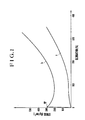
- This urethane resin is a urethane resin having a yield point YP as illustrated by the curve b, as contrasted to the curve a of the urethane resin of the prior art, as shown in Fig. 1.
- the elongation is very small with application of a stress, and therefore adequate hardness is imparted to the urethane resin, and, after reaching the yield point, the resin exhibits the property to be elongated without breaking by application of stress. Accordingly, the mechanical strength of the magnetic recording medium can be improved with reduction in damage such as abrasion, etc.
- a magnetic tape for VTR is free from edge flex, whereby control tracks at the edges and in the vicinity thereof can be maintained to exhibit excellently their functions.
- the above-mentioned yield point YP is important for the performance of the urethane resin of the present invention, and the yield point should desirably exist at the stress range of from 50 to 600 kg/cm 2 , preferably from 100 to 560 kg/cm 2 (about 290 kg/cm 2 in the example shown in Fig. 1). If the yield point exists at the stress range lower than 50 kg/cm 2 , the resin tends to be soft, while the resin tends to become rigid and brittle at the stress range higher than 600 kg/ cm 2 .
- the urethane resin to be used in the present invention should preferably have cyclilc hydrocarbon residues in the molecule in order to exhibit excellent performance as mentioned above.
- Such cyclic hydrocarbon residues may preferably saturatd cyclic hyrocarbon residues, including divalent or monovalent cyclopentyl group, cyclohexyl group, etc., or derivatives thereof (e.g. derivatives substituted with alkyls such as methyl or derivatives substituted with halogens such as chlorine atom).
- These saturated cyclic hydrocarbon residues are desirable with respect to imparting adequate hardness to the urethane resin as well as availability of the starting material.
- the cyclic hydrocarbon residue may be bonded preferably at the site in the main chain of the urethane resin molecule, but it may also be bonded to the side chain. Also, by varying the content of the cyclic hydrocarbon residues in the urethane resin, a urethane resin having a desired glass transition point (Tg) can be obtained, and Tg may be - 30 °C to 100 °C, preferably 0 °C to 90 °C. If Tg is lower than - 30 °C, the resin is too soft and can give no satisfactory film strength, while with a Tg over 100 °C, the film tends to be brittle.
- Tg glass transition point
- the urethane resin to be used in the present invention can be synthesied by the reaction between a polyol and a polyisocyanate.
- the following methods (1) to (4) may be employed:
- the synthetic method for obtaining the above urethane resin there may be employed the method in which a polyester polyol obtained from 1,4-dihydroxy- methylcyclohexane: - and adipic acid (HOOC-(CH2)4-COOH) is urethanized with methylene-bis-phenylisocyanate:
- the chain elongating agent may be 1,4-dihydroxymethylcyclohexanone as mentioned above or other diols (e.g. butane-l,4-diol).
- polyhydric alcohol which may have previously cyclic hydrocarbon residues
- those having cyclohexyl groups in the molecular chains of ethylene glycol structure as described above may be available.
- glycols such as propylene glycol, butylene glycol, diethylene glycol and the like
- polyhydric alcohols such as trimethylolpropane, hexanonetriol, glycerine, trimethylolethane, pentaerythritol and the like or glycols thereof; or those having cyclic hydrocarbon residues during preparation thereof.
- available dibasic acids may include phthalic acid, dimerized linolenic acid, maleic acid, or those having cyclic hydrocarbon residues in these molecules.
- lactone type polyester polyols synthesized from lactams such as s-caprolactam, a-methyl-1-caprolactam, s-methyl-s-caprolactam, y-butyrolactam and the like or polyether polyols synthesized from ethylene oxide, propylene oxide, butylene oxide and the like.
- polyols may be allowed to react with isocyanate compounds such as toluylene diisocyanate, hexamethylene diisocyanate, methylene diisocyanate, metaxylylene diisocyanate and the like, whereby urethanized polyester polyurethanes, polyether polyurethanes may be synthesized.
- urethane resins according to the present invention can be usually produced primarily by the reaction between polyisocyanates and polyols, and they can be either in the form of urethane resins or urethane prepolymers containing free isocyanate groups and/or hydroxyl groups, or in the form of those containing none of these reactive terminal groups (e.g. the form of urethane elastomers).
- the chain elongating agent available may also be the polyhydric alcohol as exemplified above (either having cyclic hydrocarbon residues in the molecules or not).
- a phenoxy resin and/or a vinyl chloride type copolymer can also be incorporated together with the above urethane resin to improve dispersibility of the magnetic powder and increase its mechanical strength when applied for a magnetic layer.
- the layer will become too rigid, which can be prevented by incorporation of a polyurethane to improve adhesion with a support or a subbing layer.
- the amounts of the above vinyl chloride type copolymer and/or phenoxy resin can be made smaller than those known in the prior art. Accordingly, embrittlement of the magnetic layer, crack generation, etc. caused by greater amount of a vinyl chloride type copolymer and/or a phenoxy resin can be avoided.
- Examples of the above polymer are PKHC, PKHH and PKHT produced by Union Carbide Co.
- an available vinyl type copolymer as mentioned above may be represented by the formula:
- the molar ratio derived from t and m in may be 95 to 50 mole % for the former unit and 5 to 50 mole % for the latter unit.
- X represents monomeric residues copolymerizable with vinyl chloride, representing at least one selected from the group consisting of vinyl acetate, vinyl alcohol, maleic anhydride, etc.
- the polymerization degree represented as (Z + m) may preferably be 100 to 600. With a polymerization degree less than 100, the magnetic layer, etc. tend to be tacky, while a polymerization degree over 600 will result in poor dispersibility.
- the above vinyl chloride type copolymer may be partially hydrolyzed.
- vinyl chloride type copolymer there may be preferably employed copolymers containing vinyl chloride-vinyl acetate (hereinafter referred to as "vinyl chloride-vinyl acetate type copolymer").
- vinyl chloride-vinyl acetate type copolymer may include vinyl chloride-vinyl acetate-vinyl alcohol copolymers and vinyl chloride-vinyl acetate-maleic anhydride copolymers.
- vinyl chloride-vinyl acetate type copolymers partially hydrolyzed copolymers are preferred.
- Typical examples of the above vinyl chloride-vinyl acetate type copolymers are "VAGH”, "VYHH” and “VMCH” produced by Union Carbide Co., "Ethlec A”, “Ethlec A-5”, “Ethlec C” and “Ethlec M” produced by Sekisui Kagaku K.K., "Denkavinyl 1000G” and “Denkavinyl 1000W” produced by Denki Kagaku Kogyo K.K. and others.
- cellulose type resins may also be employed as the binder resin, which may include cellulose ethers, cellulose inorganic acid esters, cellulose organic acid estPrs, etc.
- cellulose ether methyl cellulose, ethyl cellulose and the like may be employed.
- cellulose inorganic acid ester nitrocellulose, sulfate cellulose, phosphate cellulose and the like may be available.
- available cellulose organic acid esters may be acetyl cellulose, propionyl cellulose, butyryl cellulose and the like.
- nitrocellulose is preferred.
- the ratio of the above urethane resin to other resins has been confirmed to be desirably 30/70 to 80/20 in terms of weight ratio, more preferably 35/65 to 75/25. If the urethane resin is greater in amount outside of this range, its dispersibility will be worsened, while an excessive amount of other resins will result in bad surface characteristic. Particularly, at a level over 60 % by weight, the overall physical properties of coating will become unfavorable.
- the binder resin in the layer constituting the magnetic recording medium of the present invention in addition to those as mentioned above, it is also possible to use a thermoplastic resin, a thermosetting resin, a reactive resin, or an electron beam curable resin.
- thermoplastic resin there may be employed those having a softening temperature not higher than 150 °C, an average molecular weight of 10,000 to 200,000 and a polymerization degree of about 200 to 2,000, as exemplified by acrylate-acrylonitrile copolymers, acrylate-vinylidene chloride copolymers, acrylate-styrene copolymers, etc.
- thermosetting resin or the reactive resin there may be employed those having a molecular weight of not more tran 200,000 under the state of a coating liquid, but being increased infinitely in molecular weight through condensation, addition, etc. after coating and drying.
- these resins it is preferred to use one which will not be softened or melted until thermal decomposition of the resin. More specifically, there may be included phenol resins, epoxy resins, urea resins, melamine resins and alkyd resins.
- electron beam curable resins there may be included, for example, unsaturated prepolymers such as maleic anhydride type, urethane-acrylic type and polyester-acrylic type resins.
- the magnetic recording medium according to the present invention may comprise a urethane resin having a yield point and a mercapto-modified organic silicone compound represented by the following formula contained in a certain layer on a support: wherein R 1 , R 2 , R 3 , R 4 , R 5 , R 6 and R 7 represent hydrocarbon residues which are identical or different, X represents a hydrocarbon residue having 1 to 30 carbon atoms, m is 0 ⁇ m ⁇ 1000, n is 1 ⁇ n ⁇ 300 and m + n is m + n ⁇ 1000.
- the organic silicone compound since having hydrocarbon residues in the main chain excellent in affinity for the binder resin, is well compatible with the binder resin to be free from exudation on the layer surface or generation of pinholes.
- the hydrocarbon residues having mercapto groups have lubricity to exhibit also lubricating effect also through the hydrocarbon residues having mercapto groups along with the main chain comprising organic silicone compounds excellent in lubricity, and therefore lubricity and abrasion resistance can further be improved.
- the paint employing the above mercapto-modified organic silicone compound can also be improved in durability and abrasion resistance of the layer without impairment of dispersibility of magnetic powder, etc.
- the mercapto-modified organic silicone compound may preferably be incorporated in the magnetic layer in an amount of 0.0005 to 0.1 part by weight (further preferably 0.001 to 0.05 part by weight) per 100 parts by weight of the magnetic powder. If the amount is too small, little effect can be obtained, while an excessive amount will tend to cause blooming.
- a urethane resin having no yield point may be contained in a certain layer on the support.
- the urethane resin having no yield point has a flexible property which can continuously be elongated by a stress, as illustrated by the curve a in Fig. 1, which contributes to imparting adequate flexibility and binding force to the layer.
- both of the urethane resins as mentioned above should preferably be contained in the layer at a formulation ratio adequate to exhibit excellently the effect of their combined use. More specifically, the formulation ratio of the urethane resin having a yield point to the urethane resin having no yield point may preferably be 9 : 1 to 1 : 9 in terms of weight ratio. If the former resin is less than this range, the hardness of the layer will become insufficient due to the softeness of the urethane resin of the prior art, while an excessive amount of the former urethane resin will pose a problem in compatibility between the two different kinds of urethane resins.
- the urethane resin having no yield point can be synthesized by use of starting materials having no cyclic hydrocarbon residue as described above according to the methods (1) to (4) for preparation of the urethane resin having a yield point.
- the magnetic recording medium according to the present invention may also be one containing a urethane resin having a yield point together with a curing agent of an aromatic isocyanate and/or an aliphatic isocyanate in a layer on the support.
- an aromatic isocyanate and an aliphatic isocyanate are not only well compatible with each other, but also have the property to react with a paint containing binder components, thereby hardening adequately the paint.
- the reaction of the aromatic isocyanate in the above paint is rapid, while that of the aliphatic isocyanate is slow, and therefore addition of both isocyanates at a suitable formulation ratio to the above paint will result in formation of a layer having an adequate hardness and good surface characteristic without tackiness. For example, running stability of said medium as well as performance of recording and reproduction will be improved. Also, if only an aromatic isocyanate is added, hardening by itself is too rapid to effect uniform hardening, and yet the solvent used in synthesis thereof is also mixed into the paint, whereby the solvent to be added into the paint is restricted in kind due to the presence of such a solvent.
- the amount of the aromatic isocyanate can be relatively reduced to alleviate the above problem, and hardening can be effected sufficiently and uniformly by the aliphatic isocyanate.
- the urethane resin having a yield point as described above, having cyclic hydrocarbon residues in molecules, is more regid than conventional urethane resins, and for this reason tends to be weak in molecular movements and slow in hardening.
- the urethane resin can be hardened sufficiently and at an adequate speed.
- the aromatic isocyanate to be used in the present invention may include, for example, toluylene diisocyanate (TDI), 4,4'-diphenylmethane diisocyanate (MDI), xylylene diisocyanate (XDI), metaxylylene diisocyanate (MXDI) and adducts of these isocyanates with active hydrogen compounds, having suitably a molecular weight of 100 to 3,000.
- TDI toluylene diisocyanate
- MDI 4,4'-diphenylmethane diisocyanate
- XDI xylylene diisocyanate
- MXDI metaxylylene diisocyanate
- adducts of these isocyanates with active hydrogen compounds having suitably a molecular weight of 100 to 3,000.
- Sumidule T80 Sumidule 44S, Sumidule PF and Sumidule L, Desmodule T65, Desmodule 15, Desmodule R, Desmodule RF, Desmodule IL and Desmodule SL, produced by Sumitomo-Bayer Urethane K.K.; Takenate 300 S and Takenate 500, produced by Takeda Chemical Industries K.K.; "NDI” and “TODI”, produced by Mitsui Nisso Urethane K.K.; Desmodule T100, Millionate MR, Millionate MT, Coronate L, produced by Nippon Polyurethane K.K.; and PAPI-135, TDI65, TDI80, TDI100, Isonate 125M and Isonate 143 L, produced by Kasei Upjon K.K.
- aliphatic isocyanates may include hexamethylene diisocyanate (HMDI), lysine isocyanate, trimethylhexamethylene diisocyanate (TMDI) and adducts of these isocyanates with active hydrogen compounds.
- HMDI hexamethylene diisocyanate
- TMDI trimethylhexamethylene diisocyanate
- aliphatic isocyanates and adducts of these isocyanates with active hydrogen compounds preferred are those having molecular weights within the range of from 100 to 3,000.
- non-cyclic isocyanates and adducts of these compounds with active hydrogen compounds are preferred.
- Sumidule N Desmodule Z4273, produced by Sumitomo Bayer Urethane K.K.; Duranate 50 M, Duranate 24A-100 and Duranate 24A-90CX, produced by Asahi Kasei K.K.; Coronate HL produced by Nippon Polyurethane K.K.; and TMDI produced by Huls K.K.
- aliphatic isocyanates may be exemplified by methylcyclohexane-2,4-diisocyanate:
- the amount of isocyanates (both aromatic isocyanate and aliphatic isocyanate are called comprehensively as isocyanates) added may be 1 to 100 % by weight based on the binder resin. At a level lower than 1 % by weight, the magnetic layer can insufficiently be hardened, while a level over 100 % by weight will give a magnetic layer which may be hardened but is "tacky". For obtaining further preferably magnetic layer, the amount of the isocyanates added may preferably be 5 to 40 % by weight based on the binder resin.
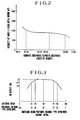
- the ratio of the aromatic isocyanate in the isocyanates should desirably be 20 to 80 %. That is, as shown in Fig. 2, if the aromatic isocyanate is less than 20 %, the hardening reaction may sometimes be too slow, while the hardening reaction may sometimes be too rapid at a level over 80 %. In either case, the surface condition of the magnetic layer may be unfavorable (namely, "tacky" or accompanied with coarsened surface), whereby, for example, RF output, etc. of the magnetic recording medium may sometimes be lowered.
- the above curing agent When the above curing agent is to be used in combination with a vinyl chloride type copolymer or a phenoxy resin, its amount may preferably be 15 % by weight or more, more preferably 20 to 40 %, based on the total amount of the binder resin and the curing agent.
- the amount of the isocyanates By making the amount of the isocyanates as the curing agent 15 % by weight or more, the layer can be cured sufficiently, and the curing agent not participating in the reaction has the effect of plasticizing action on the binder resin, thus contributing to improvement of surface characteristic by the calendering treatment.
- embrittlement of the layer by increase of the amount of the curing agent may be considered to be related also to the rigid resin which is the binder resin component other than the urethane resin.
- a rigid resin such as vinyl chloride type copolymer (e.g. vinyl chloride-vinyl acetate copolymer) or a phenoxy resin will become very hard as the amount of the curing agent is increased to promote embrittlement of the layer.
- vinyl chloride type copolymer e.g. vinyl chloride-vinyl acetate copolymer
- a phenoxy resin will become very hard as the amount of the curing agent is increased to promote embrittlement of the layer.
- the above urethane resin having a yield point contributes to improvement of the strength
- the amounts of a vinyl chloride type copolymer and/or a phenoxy resin can be reduced to lower levels than those known in the art.
- the formulation ratio of the above urethane resin having a yield point to a vinyl chloride type copolymer and/or a phenoxy resin may preferably be 30 : 70 to 80 : 20, more preferably 35 : 65 to 75 to 25, in terms of weight ratio.
- the urethane resin is less than this range, the magnetic layer will be embrittled, while an excessive amount of the urethane resin will result in shortage of the strength of the magnetic resin.
- RF output of the medium in Fig. 3, relative output based on that of Example 9 as hereinafter described as 0 dB) will readily be lowered.
- carbon black may further be added in the layer containing above urethane resin.
- the carbon black should desirably have electroconductivity, but it is also possible to add one having light-shielding property.
- electroconductive carbon black there may be employed, for example, Conductex 975 (specific surface area 250 m 2 /g, particle size 24 mu), Conductex 900 (specific surface area 125 m 2 /g, particle size 27 mu), produced by Columbia Carbon Co.; Cabot Vulcan XC-72 (specific surface area 254 m 2 /g, particle size 30 mu), Laven 1040, 420, produced by Cabot Co.; and 44, produced by Mitsubishi Kasei K.K.
- the carbon for light-shielding there may be employed, for example, Laven 2000 (specific surface area 190 m 2 /g, particle size 18 mu), 2100, 1170, 1000; #100, #75, #40, #35, #30, etc. produced by Mitsubishi Kasei K.K.
- the carbon black should preferably have particle sizes of 20 to 30 mu, more preferably 21 to 29 m ⁇ , and should desirably have an oil absorption amount of 90 ml (DBP)/100 g or more for taking readily a structure constitution and exhibiting higher electroconductivity.
- DBP oil absorption amount
- the layer containing the urethane resin having cyclic hydrocarbon residues as described above may be, for example, a BC layer 3 provided on the surface opposite to the magnetic layer 2 of the support 1, as shown in Fig. 4.
- the non-magnetic powder contained in the BC layer 3 there may be included those comprising carbon black, silicon carbide, titanium oxide, aluminum oxide, chromium oxide, calcium carbide, zinc oxide, ⁇ -Fe 2 O 3 , talc, kaolin, calcium sulfate, boron nitride, zinc fluoride, molybdenum dioxide, calcium carbonate, etc., preferably carbon black (especially electroconductive carbon black) and/or titanium oxide.
- the surface of the BC layer can be adequately roughened (matted) to improve the surface characteristic, and, in the case of carbon black, electroconductivity can be imparted to the BC layer to obtain charging prevention effect.
- carbon black is used in combination with other non-magnetic powder, both effects of improved surface characteristic (stabilization of running performance) and improvement of electroconductivity can advantageously be obtained.
- the surface roughness of the BC layer should preferably such that the average roughness or height (Ra) of the center line of the surface unevenness may be 0.005 to 0.1 ⁇ m and the maximum roughness (Rmax) may be 0.05 to 0.40 ⁇ m.
- Ra should desirably be not greater than 0.030 ⁇ m (Ra ⁇ 0.030 ⁇ m) in order to obtain good chroma-S/N. If the value of Ra or Rmax is too small, running performance and winding appearance when winding up a tape become insufficient, while too large values will result in transfer from BC layer to magnetic layer (during tape winding) to cause further roughening of the surface.
- a lubricant may be added to the BC layer 3, and such lubricants may include silicone oil, graphite, molybdenum disulfide, tungsten disulfide, fatty acid esters comprising mono-basic fatty acids having 12 to 20 carbon atoms (e.g. stearic acid) and monohydric alcohols having 13 to 26 carbon atoms.
- organic powder such as benzoguanamine type resins, melamine type resins, phthalocyanine type pigment, etc. may also be added.
- the filler (including the non-magnetic powder) in the BC layer 3 may have an average particle size of 0.5 ⁇ m or less, preferably 0.2 ⁇ m or less, in order to obtain the surface roughness as mentioned above.
- the film thickness of the BC layer 3 after coating and drying should desirably be 0.1 to 3.0 ⁇ m, preferably 1 ⁇ m or less.
- the amount of the non-magnetic powder in the BC layer added may be generally 10 to 600 mg/m 2 , preferably 20 to 500 m g/ m 2 .
- the magnetic powder, particularly ferromagnetic powder, to be used ir the magnetic layer 2 as shown in Fig. 2 may include various ferromagnetic powders, for example, iron oxide magnetic powder such as ⁇ -Fe 2 0 3 . Co-containing-Y-Fe203, Fe 3 0 4 , Co-containing-Fe 3 0 4 , and the like; metal magnetic powders consisting mainly of Fe, Ni and Co such as of Fe, Ni, Co, Fe-Ni-Co alloys, Fe-Mn-Zn alloys, Fe-Ni-Zn alloyw, Fe-Co-Ni-Cr alloys, Fe-Co-Ni-P alloys, Co-Ni alloys and the like.
- iron oxide magnetic powder such as ⁇ -Fe 2 0 3 .
- metal magnetic powders consisting mainly of Fe, Ni and Co such as of Fe, Ni, Co
- the shielding force with magnetic powder namely light-shielding property
- the shielding force of the magnetic layer can be made sufficient, its durability can also be improved.
- the respective characteristics of the audio output fluctuation and RF output can be markedly improved, as shown in Fig.
- the magnetic powder, particularly ferromagnetic powder, to be used in the magnetic layer 2 may include iron oxide magnetic powders such as of ⁇ -Fe 2 0 3 . Co-containing- ⁇ -Fe203 and the like.
- Fe 2+ is contained in an amount of 4 to 6 atomic % based on the present invention, and this can be accomplished by controlling the ratio of the amounts of starting materials in the conventional method for preparation of magnetic powder.
- the magnetic powder in the above magnetic layer should preferably have a surface area of 30 m 2 /g or higher in terms of BET value.
- the surface area of the magnetic powder in the magnetic layer 30 m 2 /g or higher, the reproduction output and S/N ratio can be markedly improved. If the specific surface area of the magnetic powder is made greater than necessary, dispersion badness may be rather caused and therefore the upper limit should desirably be 100 m 2 /g.
- the "specific surface area” refers to the surface area per unit weight, which is a physical amount entirely different from the average particle size. For example, of the particles with the same average particle size, there exist those having greater specific surface area and those having smaller surface area.
- the specific surface area for example, magnetic powder is degassed by heat treatment at around 250 °C for 30 to 60 minutes to remove impurities adsorbed on said powder, followed by introduction into a measuring device, wherein the initial pressure of nitrogen is set at 0.5 kg/m 2 and adsorption measurement is conducted by using nitrogen at a temperature of liquid nitrogen (- 195 °C) [the measurement method generally called as the BET method; see in detail J. Am. ⁇ hem. Soc., 60, 309 (1938)].
- the formulation ratio of the above urethane resin having a yield point to a vinyl chloride type copolymer and/or a phenoxy resin should desirably 30 : 70 to 80 : 20, further preferably 35 : 65 to 75 : 25, in terms of weight ratio.
- an average surface roughness (Ra-mag) of the magnetic recording layer which is used the above urethane resin having a yield point as a binder resin may be 0.020 ⁇ m or less.
- the Ra-mag should preferably be 0.020 ⁇ m or less, more preferably 0.016 ⁇ m or less, and most preferable 0.014 ⁇ m whereby preferable for a Hi-fi, a high grade, a high resolving power and a master tape which are required to have high quality.
- the lower limit of the Ra-mag may desirably be 0.005 ⁇ m since running characteristics will be apt to become unstable, e.g. image fluctuation may be caused when it is too little.
- 0.5 to 6 % by weight of a dispersant should desirably be used when the magnetic recording layer is formed. If the amount of the dispersant is too small which is out of the range as mentioned above, it is difficult to make the surface roughness of the magnetic recording layer in the predetermined small range of Ra-mag S 0.020 ⁇ m becasue of bad dispersion, while the dispersant is too much, bleed out of the dispersant from the magnetic recording layer will likely be caused.
- the urethane resin to be used in the present invention has smaller tackiness as compared with the conventional urethane resin, running thereof becomes stable when it is used, for example, for a video tape, and jitter value thereof could be controlled in a small value than the conventional one. Therefore, running characteristics thereof is stable even when the Ra-mag of the magnetic recording layer is 0.014 ⁇ m or less, and thus there is another advantage that high output could be retained.
- the magnetic recording medium as shown in Fig. 4 may be one having a subbing layer (not shown) between the magnetic layer 2 and the support 1, or no such subbing layer may be provided (hereinafter the same).
- the binder resin in the magnetic layer 2 may be any one known in the art.
- the lubricants as described above, as well as known dispersants (e.g. powdery lecithin), abrasives (e.g. molten alumina), antistatic agents (e.g. graphite), etc.
- Abrasives to be employed may preferably have an average particle size of 0.4 ⁇ m or less, more preferably from 0.1 to 0.4 um. By making the average particle size of abrasive particles 0.4 ⁇ m or less, the magnetic head, etc., which the sliding partner material of the magnetic layer, will not be damaged because of small particle sizes.
- the abrasive particles can be made to have such a small average particle size, because there is involved no problem by use of abrasive particles with smaller average particle size, since the urethane resin is hard enough to be enhanced in strength and abrasion resistance of the magnetic layer as described above.
- the abrasive material available here may include various materials as hereinafter described, but particularly preferably ⁇ -Al 2 O 3 .
- the a-A1 2 0 3 has a high crystallinity due to its crystalline structure, and therefore can exhibit sufficient abrasive force even when it is made to have smaller particle sizes.
- abrasive material there may be employed ⁇ -Al 2 O 3 (corrundum), artificial corrundum, molten alumina, silicon carbide, chromium oxide, diamond, artificial diamond, garnet, emery (main components: corrundum and magnetite), etc.
- corrundum corrundum
- artificial corrundum molten alumina
- silicon carbide silicon carbide
- chromium oxide diamond
- diamond artificial diamond
- garnet emery (main components: corrundum and magnetite), etc.
- emery main components: corrundum and magnetite
- plastics such as polyethyleneterephthalate, polypropylene, etc., metals such as Al, Zn, etc., glasses, ceramics such as BN, silicon carbide, porcelain, earthenware, etc.
- Such cross-linking agents may include, in addition to the polyfunctional polyisocyanates as already described, triphenylmethanetriisocya- nate, tris-(p-isocyanatephenyl)thiophosphite, poly- methylenephenylisocyanate and the like, but preferably methylene diisocyanate type and toluylene diisocyante type compounds.
- a desired layer such as magnetic layer by coating by incorporating a cyclic ether (particularly tetrahydrofuran or dioxane) in the paint containing the above urethane resin. That is, a cyclic ether such as tetrahydrofuran can dissolve well a urethane resin, whereby the viscosity of the paint can be adequately suppressed to enable sufficiently and easily dispersion of particles such as magnetic powder. In contrast, with the use of a solvent other than cyclic ether, the paint viscosity becomes so high that no good dispersion can be effected.
- the content of the cyclic ehter should desirably be 20 to 150 parts by weight (per 100 parts by weight of the magnetic powder). If the amount is either too small or too much, the physical properties of the coating tend to be deteriorated.
- the magnetic recording medium according to the present invention should desirably have a coercive force (Hc) of at least 500 Oe, whereby retentivity of the recorded information (accordingly residual flux density) becomes sufficient to give very good reproduction characteristic.
- Hc coercive force
- extinction characteristic will contrariwise become worsened, and hence the upper limit of He should desirably be made 1600 Oe.
- selection may be made particularly of the kind of the magnetic powder for the magnetic layer.
- the magnetic powder there may be included Co-cont&ining-y-Fe 2 o 3' Fe type metallic magnetic powder.
- the strength and performance required can be obtained with the use of a conventional urethane resin, but no sufficient strength and performance can be obtained for a magnetic recording medium with a He of 500 Oe or higher, unless a hard urethane resin such as a urethane resin having cyclic hydrocarbon residues as described above is used.
- a hard urethane resin such as a urethane resin having cyclic hydrocarbon residues as described above is used.
- the device for which the magnetic recording medium is employed namely because the device (e.g. video deck, etc.) for which the medium with 500 Oe or more is employed is harder in running system, particularly more severe in influence of the running system on the medium.
- the present invention can satisfactorily respond to such a demand.
- cyclic ethers such as tetrahydrofuran, dioxane, etc., and in addition to these, ketones such as acetone, methyl ethyl ketone, methyl isobutyl ketone, cyclohexanone and the like; alcohols such as methanol, ethanol, propanol, butanol and the like; esters such as methyl acetate, ethyl acetate, butyl acetate, ethyl lactate, ethylene glycol monoacetate and the like; ethers such as ethylene glycol dimethyl ether, diethylene glycol monoethyl ether and the like; aromatic hydrocarbons such as benzene, toluene, xylene and the like; halogenated hydrocarbons such as methylene chloride, ethylene chloride, carbon tetrachloride, chloroform, dichlorobenzene and the like; and so on.
- ketones such as acetone,
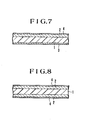
- Fig. 7 shows another example of magnetic recording medium, in which an OC layer 4 is provided on the magnetic layer 2 of the medium as shown in Fig. 4.
- the OC layer 4 is provided for the purpose of protecting the magnetic layer 2 against damages, etc. and for this purpose it is required to have sufficient lubricity.
- the binder resin for the OC layer.4 the urethane resin used for the above BC layer 3 (desirably in combination with a phenoxy resin and/or a vinyl chloride type copolymer) is employed.
- the surface roughness of the OC layer 4 should desirably be made in relationship with the color-S/N such that Ra ⁇ 0.01 ⁇ m and Rmax ⁇ 0.13 ⁇ m. In this case, it is desirable that the surface roughness of the support 1 used should be smooth with Ra ⁇ 0.01 and Rmax ⁇ 0.13 um.
- the above urethane resin may also be contained in both of the OC layer 4 and the BC layer.
- Fig. 8 shows a magnetic recording medium constituted as a magnetic disc, in which the same magnetic layer 2 and the OC layer 4 are provided, respectively, on both surfaces of the support 1, and the binder resin comprising the above urethane resin as the main component is incorporated in the OC layer 4.
- a magnetic paint having the following composition was prepared.
- composition was thoroughly mixed under stirring in a ball mill, further admixed with 10 parts of a polyfunctional isocyanate (Coronate L produced by Nippon Polyurethane Co.) and filtered through a filter with a mean pore size of 1 um.
- a polyfunctional isocyanate Coronate L produced by Nippon Polyurethane Co.
- the resultant magnetic paint was applied to a dried thickness of 5 ⁇ m on the surface of a polyethyleneterephthalate base with a thickness of 12 ⁇ m.
- This paint was applied to a dried thickness of 0.5 ⁇ m on the base surface on the side opposite to the above magnetic layer to form a BC layer.
- the magnetic layer was subjected to the surface working treatment by super calender rolls to obtain a broad magnetic film having a magnetic layer with a desired thickness.
- This film was cut to have a breadth of 12.7 mm for preparation of a magnetic tape for video recording.
- Example 2 Fe type metallic magnetic powder was employed as the magnetic powder and VAGH was replaced with a phenoxy resin (PKHH produced by U.C.C.), following otherwise the same procedure as in Example 1, to form a magnetic layer.
- PKHH phenoxy resin
- Example 2 a paint for over coating comprising the paint composition for back-coating of Example 1 was applied to a thickness of 0.1 ⁇ m or less to form an over-coating layer (this is called Example 2).
- a urethane resin having no cyclohexyl group in the molecule MAU 2010 (produced by Dainichi Seika Co.) was used to prepare a paint for back-coating, which was aspplied on the support surface similarly as in Example 1 to form a BC layer.
- each tape was run under the conditions of 20 ° C and 65 % RH for 50 times and thereafter subjected to the following measurements.
- Chroma-S/N Chroma-S/N:
- the tape performance can be markedly improved by incorporating the urethane resin of the present invention in the BC layer.
- jitter values are measured similarly as in Examples 1 and 2.
- RF output of Comparative example 5 is measured relative to Example 5 as being 0 dB, and RF output of Comparative example 6 relative to Example 6 as being 0 dB.
- Chroma-S/N, Lumi-S/N and RF output of Comparative example 11 are measured relative to Example 11 as being 0 dB
- Chroma-S/N, Lumi-S/N and RF output of Comparative example 12 are measured relative to Example 12 as being 0 dB.
- RF output and audio output fluctuation after 100 passes of Comparative example 13 are measured relative to Example 13 as being 0 dB
- RF output and audio output fluctuation after 100 passes of Comparative example 14 are measured relative to Example 14 as being 0 dB
- RF output and audio output fluctuation after 100 passes of Example 15 are measured relative to Example 13 as being 0 dB.
- Head wear is measured according to the following method: Head wear: Value representing the reduction in head thickness after reproduction for 100 hours (value relative to Example 16 as the standard).
Landscapes
- Paints Or Removers (AREA)
- Magnetic Record Carriers (AREA)
Applications Claiming Priority (3)
| Application Number | Priority Date | Filing Date | Title |
|---|---|---|---|
| JP12101384 | 1984-06-13 | ||
| JP121013/84 | 1984-06-13 | ||
| JP59121013A JPS61915A (ja) | 1984-06-13 | 1984-06-13 | 磁気記録媒体 |
Publications (3)
| Publication Number | Publication Date |
|---|---|
| EP0168962A1 true EP0168962A1 (fr) | 1986-01-22 |
| EP0168962B1 EP0168962B1 (fr) | 1989-12-27 |
| EP0168962B2 EP0168962B2 (fr) | 2000-07-05 |
Family
ID=14800642
Family Applications (1)
| Application Number | Title | Priority Date | Filing Date |
|---|---|---|---|
| EP85304218A Expired - Lifetime EP0168962B2 (fr) | 1984-06-13 | 1985-06-13 | Milieu d'enregistrement magnétique |
Country Status (4)
| Country | Link |
|---|---|
| US (1) | US4652496A (fr) |
| EP (1) | EP0168962B2 (fr) |
| JP (1) | JPS61915A (fr) |
| DE (1) | DE3575034D1 (fr) |
Cited By (1)
| Publication number | Priority date | Publication date | Assignee | Title |
|---|---|---|---|---|
| EP0959461A1 (fr) * | 1998-05-21 | 1999-11-24 | Sony Corporation | Support d'enregistrement magnétique et sa méthode de fabrication |
Families Citing this family (7)
| Publication number | Priority date | Publication date | Assignee | Title |
|---|---|---|---|---|
| US4970121A (en) * | 1987-08-06 | 1990-11-13 | Fuji Photo Film Co., Ltd. | Magnetic recording medium |
| JP2824974B2 (ja) * | 1989-11-10 | 1998-11-18 | ティーディーケイ株式会社 | 磁気テープカートリッジ |
| US6327754B1 (en) | 1999-05-10 | 2001-12-11 | Pactiv Corporation | Fastener with slider thereon for use in manufacturing recloseable bags |
| US6292986B1 (en) | 1999-05-10 | 2001-09-25 | Alexander R. Provan | Assembly and accumulation of sliders for profiled zippers |
| US6071011A (en) * | 1999-08-12 | 2000-06-06 | Tenneco Packaging, Inc. | Fill-through-the-top package |
| US7124466B2 (en) * | 2002-02-05 | 2006-10-24 | Seagate Technology Llc | Particle capture system |
| JP5388825B2 (ja) * | 2009-12-07 | 2014-01-15 | 三菱電機株式会社 | 繊維強化プラスチック成形体の製造装置、及び繊維強化プラスチック成形体の製造方法 |
Citations (15)
| Publication number | Priority date | Publication date | Assignee | Title |
|---|---|---|---|---|
| DE2228643A1 (de) * | 1972-06-13 | 1974-01-10 | Basf Ag | Kartenfoermige magnetogrammtraeger |
| JPS5441484A (en) | 1977-09-07 | 1979-04-02 | Nippon Telegr & Teleph Corp <Ntt> | Manufacturing process of communication cable |
| JPS5737731A (en) | 1980-08-20 | 1982-03-02 | Hitachi Maxell Ltd | Magnetic recording medium |
| JPS5737733A (en) | 1980-08-20 | 1982-03-02 | Hitachi Maxell Ltd | Magnetic recording medium |
| JPS5737732A (en) | 1980-08-20 | 1982-03-02 | Hitachi Maxell Ltd | Magnetic recording medium |
| JPS5737734A (en) | 1980-08-20 | 1982-03-02 | Hitachi Maxell Ltd | Magnetic recording medium |
| JPS5744967A (en) | 1980-08-31 | 1982-03-13 | Toshiba Battery Co Ltd | Manufacture of dry cell |
| JPS5756128A (en) | 1980-09-18 | 1982-04-03 | Nippon Kentetsu Co Ltd | Manufacture of header for heat exchanger |
| DE3121215A1 (de) * | 1980-05-28 | 1982-05-19 | Shin-Etsu Chemical Co., Ltd., Tokyo | Magnetisches aufzeichnungsmedium |
| JPS5729769B2 (fr) | 1974-02-15 | 1982-06-24 | ||
| JPS57152535A (en) | 1981-03-18 | 1982-09-20 | Hitachi Maxell Ltd | Magnetic recording medium |
| JPS57152537A (en) | 1981-03-18 | 1982-09-20 | Hitachi Maxell Ltd | Magnetic recording medium |
| DE3243676A1 (de) * | 1981-11-26 | 1983-06-01 | Sony Corp., Tokyo | Magnetisches aufzeichnungsmedium |
| DE3308597A1 (de) * | 1982-03-19 | 1983-09-22 | Fuji Photo Film Co., Ltd., Minami Ashigara, Kanagawa | Magnetisches aufzeichnungsmaterial |
| DE3327278A1 (de) * | 1982-07-29 | 1984-02-02 | Victor Company Of Japan, Ltd., Yokohama, Kanagawa | Magnetisches aufzeichnungsmaterial mit einer magnetschicht auf einer seite eines traegers und einer nichtmagnetischen tio-schicht auf der anderen seite |
Family Cites Families (16)
| Publication number | Priority date | Publication date | Assignee | Title |
|---|---|---|---|---|
| DE2442762C2 (de) * | 1974-09-06 | 1983-02-24 | Basf Ag, 6700 Ludwigshafen | Schichtmagnetogrammträger mit Polyurethanelastomer-Bindemitteln in der Magnetschicht |
| JPS55122234A (en) * | 1979-03-08 | 1980-09-19 | Fuji Photo Film Co Ltd | Magnetic recording medium |
| JPS5698719A (en) * | 1980-01-10 | 1981-08-08 | Fuji Photo Film Co Ltd | Magnetic recording medium |
| US4284750A (en) * | 1980-06-20 | 1981-08-18 | Morton-Norwich Products, Inc. | Polyurethane resins |
| JPS5750327A (en) * | 1980-08-18 | 1982-03-24 | Fuji Photo Film Co Ltd | Magnetic recording medium |
| JPS5863759A (ja) * | 1981-10-13 | 1983-04-15 | Kuraray Co Ltd | コ−テイング剤に適しているポリウレタン組成物 |
| JPS5822436A (ja) * | 1981-07-31 | 1983-02-09 | Sony Corp | 座標入力装置 |
| US4546044A (en) * | 1982-04-22 | 1985-10-08 | Konishiroku Photo Industry Co., Ltd. | Magnetic recording medium |
| JPS58222436A (ja) * | 1982-06-10 | 1983-12-24 | Konishiroku Photo Ind Co Ltd | 磁気記録媒体 |
| JPS595422A (ja) * | 1982-06-30 | 1984-01-12 | Konishiroku Photo Ind Co Ltd | 磁気記録媒体 |
| JPS5922227A (ja) * | 1982-07-29 | 1984-02-04 | Victor Co Of Japan Ltd | 磁気記録媒体 |
| DE3333930C2 (de) * | 1982-09-21 | 1985-08-14 | Victor Company Of Japan, Ltd., Yokohama, Kanagawa | Magnetaufzeichnungsmaterial |
| JPS5954314A (ja) * | 1982-09-22 | 1984-03-29 | Hitachi Ltd | 選局装置 |
| US4525424A (en) * | 1983-12-30 | 1985-06-25 | International Business Machines Corporation | Flexible magnetic recording media having a polyester-polyurethane binder and chromium dioxide pigment |
| JPS60150230A (ja) * | 1984-01-17 | 1985-08-07 | Fuji Photo Film Co Ltd | 磁気記録体 |
| US4568611A (en) * | 1985-04-03 | 1986-02-04 | Morton Thiokol, Inc. | Polyester-polyurethane composition and use thereof |
-
1984
- 1984-06-13 JP JP59121013A patent/JPS61915A/ja active Granted
-
1985
- 1985-06-07 US US06/742,615 patent/US4652496A/en not_active Expired - Lifetime
- 1985-06-13 EP EP85304218A patent/EP0168962B2/fr not_active Expired - Lifetime
- 1985-06-13 DE DE8585304218T patent/DE3575034D1/de not_active Expired - Lifetime
Patent Citations (15)
| Publication number | Priority date | Publication date | Assignee | Title |
|---|---|---|---|---|
| DE2228643A1 (de) * | 1972-06-13 | 1974-01-10 | Basf Ag | Kartenfoermige magnetogrammtraeger |
| JPS5729769B2 (fr) | 1974-02-15 | 1982-06-24 | ||
| JPS5441484A (en) | 1977-09-07 | 1979-04-02 | Nippon Telegr & Teleph Corp <Ntt> | Manufacturing process of communication cable |
| DE3121215A1 (de) * | 1980-05-28 | 1982-05-19 | Shin-Etsu Chemical Co., Ltd., Tokyo | Magnetisches aufzeichnungsmedium |
| JPS5737733A (en) | 1980-08-20 | 1982-03-02 | Hitachi Maxell Ltd | Magnetic recording medium |
| JPS5737734A (en) | 1980-08-20 | 1982-03-02 | Hitachi Maxell Ltd | Magnetic recording medium |
| JPS5737732A (en) | 1980-08-20 | 1982-03-02 | Hitachi Maxell Ltd | Magnetic recording medium |
| JPS5737731A (en) | 1980-08-20 | 1982-03-02 | Hitachi Maxell Ltd | Magnetic recording medium |
| JPS5744967A (en) | 1980-08-31 | 1982-03-13 | Toshiba Battery Co Ltd | Manufacture of dry cell |
| JPS5756128A (en) | 1980-09-18 | 1982-04-03 | Nippon Kentetsu Co Ltd | Manufacture of header for heat exchanger |
| JPS57152535A (en) | 1981-03-18 | 1982-09-20 | Hitachi Maxell Ltd | Magnetic recording medium |
| JPS57152537A (en) | 1981-03-18 | 1982-09-20 | Hitachi Maxell Ltd | Magnetic recording medium |
| DE3243676A1 (de) * | 1981-11-26 | 1983-06-01 | Sony Corp., Tokyo | Magnetisches aufzeichnungsmedium |
| DE3308597A1 (de) * | 1982-03-19 | 1983-09-22 | Fuji Photo Film Co., Ltd., Minami Ashigara, Kanagawa | Magnetisches aufzeichnungsmaterial |
| DE3327278A1 (de) * | 1982-07-29 | 1984-02-02 | Victor Company Of Japan, Ltd., Yokohama, Kanagawa | Magnetisches aufzeichnungsmaterial mit einer magnetschicht auf einer seite eines traegers und einer nichtmagnetischen tio-schicht auf der anderen seite |
Non-Patent Citations (5)
| Title |
|---|
| J. M. DALLAVALLE; CLYDEORR JR. ET AL.: "Handbook of Chemistry", 30 April 1966, CHEMICAL SOCIETY OF JAPAN |
| J.M. DALLAVALLE; CLYDEORR JR., MEASUREMENT OF POWDER |
| MARUZEN K.K.: "Handbook of Chemistry", 30 April 1966, CHEMICAL SOCIETY OF JAPAN |
| MARUZEN K.K: "Handbook of Chemistry", 30 April 1966 |
| YUASA DENCHI K.K. ET AL.: "Measurement of powder", article "General description about specific surface area and its measuring method is given in detail" |
Cited By (2)
| Publication number | Priority date | Publication date | Assignee | Title |
|---|---|---|---|---|
| EP0959461A1 (fr) * | 1998-05-21 | 1999-11-24 | Sony Corporation | Support d'enregistrement magnétique et sa méthode de fabrication |
| US6165581A (en) * | 1998-05-21 | 2000-12-26 | Sony Corporation | Magnetic recording medium apparatus |
Also Published As
| Publication number | Publication date |
|---|---|
| JPS61915A (ja) | 1986-01-06 |
| EP0168962B1 (fr) | 1989-12-27 |
| EP0168962B2 (fr) | 2000-07-05 |
| JPH0576694B2 (fr) | 1993-10-25 |
| US4652496A (en) | 1987-03-24 |
| DE3575034D1 (de) | 1990-02-01 |
Similar Documents
| Publication | Publication Date | Title |
|---|---|---|
| US6835438B2 (en) | Magnetic recording tape | |
| US4789583A (en) | Magnetic recording medium | |
| EP0168962B1 (fr) | Milieu d'enregistrement magnétique | |
| US6074724A (en) | Magnetic recording medium | |
| EP0735524B1 (fr) | Système d'enregistrement magnétique | |
| EP0107984A1 (fr) | Milieu d'enregistrement magnétique | |
| US4741954A (en) | Magnetic recording medium | |
| US7060340B2 (en) | Magnetic recording medium | |
| EP0244868B1 (fr) | Disque d'enregistrement magnétique | |
| GB2154155A (en) | Magnetic recording medium | |
| US5093172A (en) | Magnetic recording medium comprising a vinyl chloride copolymer containing a polar group and a polyurethane containing a polar group and specified aromatic or alicyclic units | |
| US6821603B2 (en) | Magnetic recording tape | |
| JPH059847B2 (fr) | ||
| US5830556A (en) | Magnetic recording medium | |
| JPH0576689B2 (fr) | ||
| US4687706A (en) | Magnetic recording medium | |
| JPH0535483B2 (fr) | ||
| JPH079692B2 (ja) | 磁気記録媒体 | |
| JP2510904B2 (ja) | 磁気記録媒体 | |
| JPH0576690B2 (fr) | ||
| EP0415708B1 (fr) | Milieu d'enregistrement magnétique | |
| JP3638379B2 (ja) | 磁気記録媒体 | |
| JPH0576693B2 (fr) | ||
| JPH0531211B2 (fr) | ||
| JPH0619823B2 (ja) | 磁気記録媒体 |
Legal Events
| Date | Code | Title | Description |
|---|---|---|---|
| PUAI | Public reference made under article 153(3) epc to a published international application that has entered the european phase |
Free format text: ORIGINAL CODE: 0009012 |
|
| AK | Designated contracting states |
Designated state(s): DE FR GB |
|
| 17P | Request for examination filed |
Effective date: 19860609 |
|
| 17Q | First examination report despatched |
Effective date: 19870102 |
|
| GRAA | (expected) grant |
Free format text: ORIGINAL CODE: 0009210 |
|
| AK | Designated contracting states |
Kind code of ref document: B1 Designated state(s): DE FR GB |
|
| REF | Corresponds to: |
Ref document number: 3575034 Country of ref document: DE Date of ref document: 19900201 |
|
| ET | Fr: translation filed | ||
| PLBI | Opposition filed |
Free format text: ORIGINAL CODE: 0009260 |
|
| RAP4 | Party data changed (patent owner data changed or rights of a patent transferred) |
Owner name: KONICA CORPORATION |
|
| PLBI | Opposition filed |
Free format text: ORIGINAL CODE: 0009260 |
|
| PLBI | Opposition filed |
Free format text: ORIGINAL CODE: 0009260 |
|
| 26 | Opposition filed |
Opponent name: N.V. PHILIPS' GLOEILAMPENFABRIEKEN Effective date: 19900907 |
|
| 26 | Opposition filed |
Opponent name: AGFA-GEVAERT AG, LEVERKUSEN Effective date: 19900926 Opponent name: N.V. PHILIPS' GLOEILAMPENFABRIEKEN Effective date: 19900907 |
|
| 26 | Opposition filed |
Opponent name: FUJI PHOTO FILM CO., LTD. Effective date: 19900927 Opponent name: AGFA-GEVAERT AG, LEVERKUSEN Effective date: 19900926 Opponent name: N.V. PHILIPS' GLOEILAMPENFABRIEKEN Effective date: 19900907 |
|
| PLAB | Opposition data, opponent's data or that of the opponent's representative modified |
Free format text: ORIGINAL CODE: 0009299OPPO |
|
| R26 | Opposition filed (corrected) |
Opponent name: N.V. PHILIPS' GLOEILAMPENFABRIEKEN * 900926 AGFA-G Effective date: 19900907 |
|
| APAC | Appeal dossier modified |
Free format text: ORIGINAL CODE: EPIDOS NOAPO |
|
| APAC | Appeal dossier modified |
Free format text: ORIGINAL CODE: EPIDOS NOAPO |
|
| PLAW | Interlocutory decision in opposition |
Free format text: ORIGINAL CODE: EPIDOS IDOP |
|
| APAC | Appeal dossier modified |
Free format text: ORIGINAL CODE: EPIDOS NOAPO |
|
| APAE | Appeal reference modified |
Free format text: ORIGINAL CODE: EPIDOS REFNO |
|
| PLBQ | Unpublished change to opponent data |
Free format text: ORIGINAL CODE: EPIDOS OPPO |
|
| PLAB | Opposition data, opponent's data or that of the opponent's representative modified |
Free format text: ORIGINAL CODE: 0009299OPPO |
|
| R26 | Opposition filed (corrected) |
Opponent name: PHILIPS ELECTRONICS N.V. * 900926 AGFA-GEVAERT AG Effective date: 19900907 |
|
| APAC | Appeal dossier modified |
Free format text: ORIGINAL CODE: EPIDOS NOAPO |
|
| APAC | Appeal dossier modified |
Free format text: ORIGINAL CODE: EPIDOS NOAPO |
|
| PLAW | Interlocutory decision in opposition |
Free format text: ORIGINAL CODE: EPIDOS IDOP |
|
| PUAH | Patent maintained in amended form |
Free format text: ORIGINAL CODE: 0009272 |
|
| STAA | Information on the status of an ep patent application or granted ep patent |
Free format text: STATUS: PATENT MAINTAINED AS AMENDED |
|
| 27A | Patent maintained in amended form |
Effective date: 20000705 |
|
| AK | Designated contracting states |
Kind code of ref document: B2 Designated state(s): DE FR GB |
|
| ET3 | Fr: translation filed ** decision concerning opposition | ||
| REG | Reference to a national code |
Ref country code: GB Ref legal event code: IF02 |
|
| PGFP | Annual fee paid to national office [announced via postgrant information from national office to epo] |
Ref country code: FR Payment date: 20040608 Year of fee payment: 20 |
|
| PGFP | Annual fee paid to national office [announced via postgrant information from national office to epo] |
Ref country code: GB Payment date: 20040609 Year of fee payment: 20 |
|
| PGFP | Annual fee paid to national office [announced via postgrant information from national office to epo] |
Ref country code: DE Payment date: 20040624 Year of fee payment: 20 |
|
| PG25 | Lapsed in a contracting state [announced via postgrant information from national office to epo] |
Ref country code: GB Free format text: LAPSE BECAUSE OF EXPIRATION OF PROTECTION Effective date: 20050612 |
|
| REG | Reference to a national code |
Ref country code: GB Ref legal event code: PE20 |
|
| APAH | Appeal reference modified |
Free format text: ORIGINAL CODE: EPIDOSCREFNO |